CVR COLLEGE OF ENGINEERING
Department of Emerging Technologies
B.Tech CSE(DS) IV Year I Semester
Technical Seminar, 19 August 2024
 PRC Members
 Dr M Varaprasad Rao
 Dr M Surya Bhupal Rao
 Dr Y Sowmya Reddy
 Mr D Ratnam
Credit Card Fraud Detection Using State-of-the-
Art Machine Learning and Deep Learning
Algorithms
NAME: BADUGU SRINATH
ROLL NO: 21B81A66C1
Under the guidance of
Ms K. Anuradha
Abstract
Credit Card Fraud:
• Increasing fraud with growing credit card use.
• Major financial losses for cardholders and companies.
Research Goals:
• Improve fraud detection.
• Address challenges: data access, class imbalance, fraud evolution, false alarms.
Current Methods:
• Machine learning algorithms: Decision Tree, Random Forest, SVM, Logistic Regression, XGBoost.
• Limitations: lower accuracy.
Deep Learning:
• Recent algorithms show better accuracy.
Approach:
• Compare machine learning and deep learning.
• Use European card dataset.
• Test CNN models with varying layers and epochs.
Results:
• Accuracy: 99.9%, F1-Score: 85.71%, Precision: 93%
Conclusion:
• Deep learning outperforms traditional methods.
• Effective for real-world fraud detection.
Introduction
Problem Domain Knowledge:
 Increasing digital transactions heighten risk of credit card fraud.
 Fraudsters develop sophisticated techniques to exploit transaction systems.
Knowledge of Relevant Contemporary Issues:
 Traditional fraud detection methods struggle with large volumes and evolving fraud tactics.
 Need for advanced ML and DL algorithms to improve detection accuracy.
Problem Definition:
 Develop a robust system to accurately identify fraudulent transactions.
 Balance between detecting fraud and minimizing false positives.
Task Identification:
 Analyze dataset features and distribution.
 Select and evaluate suitable ML and DL algorithms.
 Train models on historical transaction data.
 Evaluate model performance with accuracy, precision, recall, and F1-score.
 Implement and deploy the model for real-time fraud detection.
Existing
work/method
Existing Work:
 - Real-time deep learning models enhance fraud detection
accuracy.
 - AI techniques tackle imbalanced data logs in fraud
detection.
 - PCA improves dimensionality reduction for fraud detection
models.
Disadvantages:
 - High false positives and negatives in fraud detection.
 - Struggles with imbalanced datasets.
 - Inefficient handling of real-time data.
Overcoming Issues:
 - Utilize deep learning models for better fraud detection
precision.
 - Implement advanced AI methods to handle data
imbalance.
 - Apply PCA for optimal feature selection and faster
processing.
Objectives,
Goals,
Outcomes
Objectives:
 - Detect fraud with high accuracy and low false positives.
 - Improve real-time processing for fraud detection.
 - Mitigate the impact of imbalanced datasets.
Goals:
 - Achieve efficient, scalable fraud detection systems.
 - Develop a model that adapts to evolving fraud patterns.
 - Ensure high accuracy and reliability in real-time detection.
Outcomes:
 - Enhanced detection accuracy.
 - Reduced fraud cases with early detection.
 - Increased efficiency in handling large datasets.
Literature Review or Related works
[1] Y. Abakarim et al. (2018) proposed a real-time deep learning model for credit card fraud detection, focusing on efficiency
and accuracy.
[2] H. Abdi and L. J. Williams (2010) discussed Principal Component Analysis (PCA) for dimensionality reduction, crucial for
enhancing fraud detection models.
[3] V. Arora et al. (2020) explored AI techniques for user authorization from imbalanced credit card data logs, highlighting the
challenges in fraud detection.
4] A. O. Balogun et al. (2019) analyzed feature selection methods in software defect prediction, offering insights relevant to
fraud detection.
[5] B. Bandaranayake (2014) examined fraud and corruption control in education systems, providing a comparative
perspective on fraud management.
[6] J. Błaszczyński et al. (2021) compared dominance-based rough set approach and machine learning methods for auto loan
fraud detection.
[7] B. Branco et al. (2020) introduced Interleaved Sequence RNNs for fraud detection, improving sequence modeling in
anomaly detection.
[8] F. Cartella et al. (2021) investigated adversarial attacks on tabular data for fraud detection, addressing challenges in
imbalanced datasets.
[9] S. S. Lad and A. C. Adamuthe (2021) enhanced malware classification using an improved convolutional neural network
model.
[10] V. N. Dornadula and S. Geetha (2019) applied machine learning algorithms to credit card fraud detection, focusing on
algorithmic effectiveness.
Proposed method
Evaluation: Aim to minimize false negatives using
confusion matrices.
Deep Learning Accuracy: More CNN layers improve
performance; deeper models work better.
CNN Model: 14-layer CNN with 119,457 parameters
achieves 96.34% accuracy.
Data & Epochs: More training epochs and balanced
data boost accuracy to 94.60% (training) and 95.80%
(validation).
Model Performance: Deeper CNN models (up to 20
layers) perform best, with a 20-layer CNN reaching
99.72% accuracy.
Architecture diagram
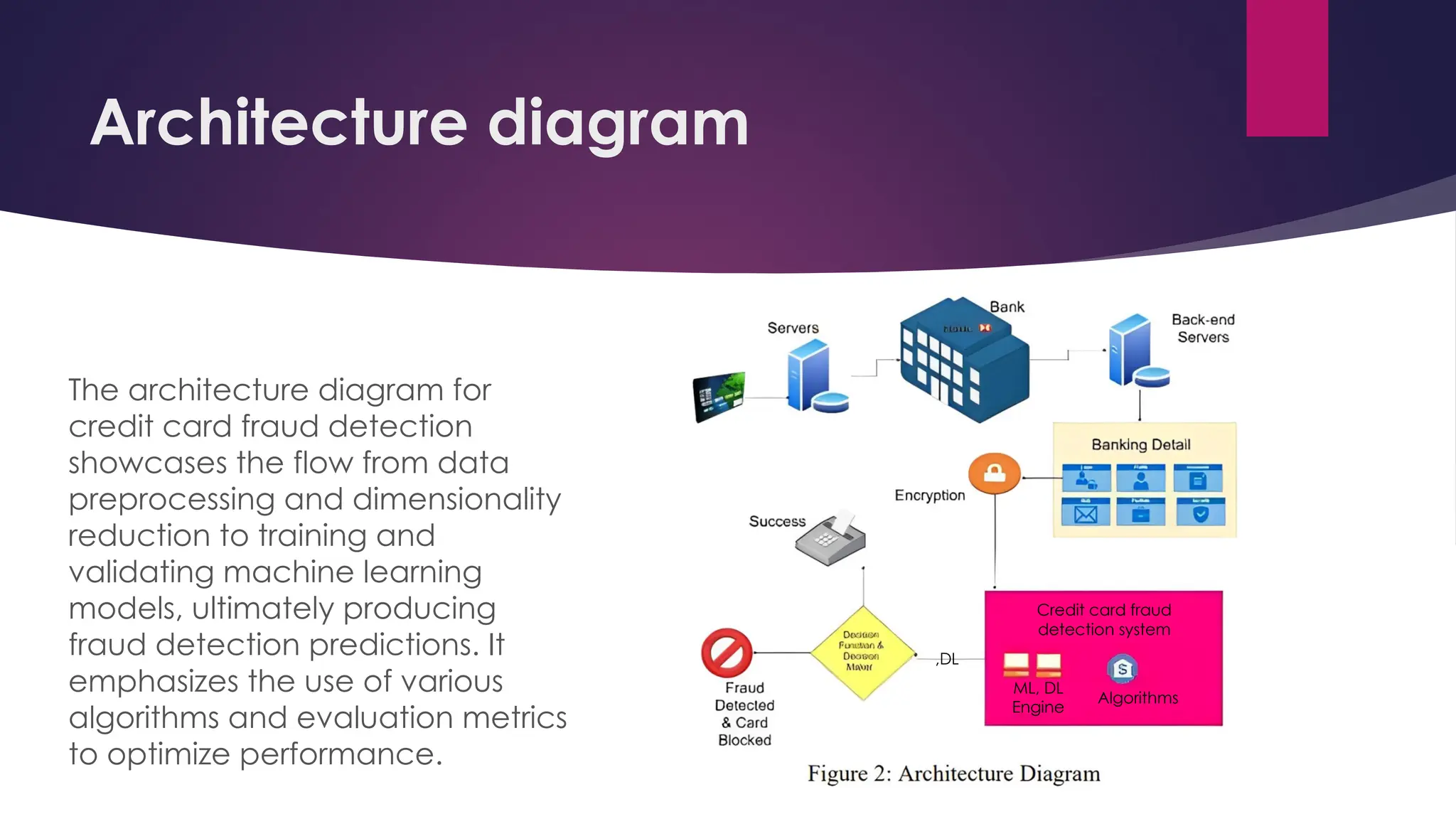
The architecture diagram for
credit card fraud detection
showcases the flow from data
preprocessing and dimensionality
reduction to training and
validating machine learning
models, ultimately producing
fraud detection predictions. It
emphasizes the use of various
algorithms and evaluation metrics
to optimize performance.
,DL
Algorithms
Credit card fraud
detection system
ML, DL
Engine
Results and
Discussion
References
 [1] Y. Abakarim, M. Lahby, and A. Attioui, ‘‘An efficient real-time model for credit card fraud detection based on
deep learning,’’ in *Proc. 12th Int. Conf. Intell. Systems: Theories Appl.*, Oct. 2018, pp. 1–7, doi:
10.1145/3289402.3289530.
 [2] H. Abdi and L. J. Williams, ‘‘Principal component analysis,’’ *Wiley Interdiscipl. Rev., Comput. Statist.*, vol. 2, no.
4, pp. 433–459, Jul. 2010, doi: 10.1002/wics.101.
 [3] V. Arora, R. S. Leekha, K. Lee, and A. Kataria, ‘‘Facilitating user authorization from imbalanced data logs of
credit cards using artificial intelligence,’’ *Mobile Inf. Syst.*, vol. 2020, pp. 1–13, Oct. 2020, doi:
10.1155/2020/8885269.
 [4] A. O. Balogun, S. Basri, S. J. Abdulkadir, and A. S. Hashim, ‘‘Performance analysis of feature selection methods in
software defect prediction: A search method approach,’’ *Appl. Sci.*, vol. 9, no. 13, p. 2764, Jul. 2019, doi:
10.3390/app9132764.
 [5] B. Bandaranayake, ‘‘Fraud and corruption control at education system level: A case study of the Victorian
department of education and early childhood development in Australia,’’ *J. Cases Educ. Leadership*, vol. 17, no.
4, pp. 34–53, Dec. 2014, doi: 10.1177/1555458914549669.
 [6] J. Błaszczyński, A. T. de Almeida Filho, A. Matuszyk, M. Szelg, and R. Słowiński, ‘‘Auto loan fraud detection using
dominance-based rough set approach versus machine learning methods,’’ *Expert Syst. Appl.*, vol. 163, Jan. 2021,
Art. no. 113740, doi: 10.1016/j.eswa.2020.113740.
 [7] B. Branco, P. Abreu, A. S. Gomes, M. S. C. Almeida, J. T. Ascensão, and P. Bizarro, ‘‘Interleaved sequence RNNs
for fraud detection,’’ in *Proc. 26th ACM SIGKDD Int. Conf. Knowl. Discovery Data Mining*, 2020, pp. 3101–3109, doi:
10.1145/3394486.3403361.
 9] S. S. Lad, I. Dept. of CSERajarambapu Institute of TechnologyRajaramnagarSangliMaharashtra, and A. C. Adamuthe,
‘‘Malware classification with improved convolutional neural network model,’’ *Int. J. Comput. Netw. Inf. Secur.*, vol. 12, no.
6, pp. 30–43, Dec. 2021, doi: 10.5815/ijcnis.2020.06.03.
 [10] V. N. Dornadula and S. Geetha, ‘‘Credit card fraud detection using machine learning algorithms,’’ *Proc. Comput. Sci.*,
vol. 165, pp. 631–641, Jan. 2019, doi: 10.1016/j.procs.2020.01.057.
 [11] I. Benchaji, S. Douzi, and B. E. Ouahidi, ‘‘Credit card fraud detection model based on LSTM recurrent neural networks,’’
*J. Adv. Inf. Technol.*, vol. 12, no. 2, pp. 113–118, 2021, doi: 10.12720/jait.12.2.113-118.
 [12] Y. Fang, Y. Zhang, and C. Huang, ‘‘Credit card fraud detection based on machine learning,’’ *Comput., Mater.
Continua*, vol. 61, no. 1, pp. 185–195, 2019, doi: 10.32604/cmc.2019.06144.
 [13] J. Forough and S. Momtazi, ‘‘Ensemble of deep sequential models for credit card fraud detection,’’ *Appl. Soft
Comput.*, vol. 99, Feb. 2021, Art. no. 106883, doi: 10.1016/j.asoc.2020.106883.
 [14] K. He, X. Zhang, S. Ren, and J. Sun, ‘‘Deep residual learning for image recognition,’’ 2015, arXiv:1512.03385.
 [15] X. Hu, H. Chen, and R. Zhang, ‘‘Short paper: Credit card fraud detection using LightGBM with asymmetric error control,’’
in *Proc. 2nd Int. Conf. Artif. Intell. for Industries (AII)*, Sep. 2019, pp. 91–94, doi: 10.1109/AI4I46381.2019.00030.
 [16] J. Kim, H.-J. Kim, and H. Kim, ‘‘Fraud detection for job placement using hierarchical clusters-based deep neural
networks,’’ *Int. J. Speech Technol.*, vol. 49, no. 8, pp. 2842–2861, Aug. 2019, doi: 10.1007/s10489-019-01419-2.
 [17] M.-J. Kim and T.-S. Kim, ‘‘A neural classifier with fraud density map for effective credit card fraud detection,’’ in
*Intelligent Data Engineering and Automated Learning*, vol. 2412, H. Yin, N. Allinson, R. Freeman, J. Keane, and S. Hubbard,
Eds. Berlin, Germany: Springer, 2002, pp. 378–383, doi: 10.1007/3-540-45675-9_56.
Thank you

credit_card_fraud_detection_technical_seminar_ppt (1).pptx

  • 1.
    CVR COLLEGE OFENGINEERING Department of Emerging Technologies B.Tech CSE(DS) IV Year I Semester Technical Seminar, 19 August 2024  PRC Members  Dr M Varaprasad Rao  Dr M Surya Bhupal Rao  Dr Y Sowmya Reddy  Mr D Ratnam
  • 2.
    Credit Card FraudDetection Using State-of-the- Art Machine Learning and Deep Learning Algorithms NAME: BADUGU SRINATH ROLL NO: 21B81A66C1 Under the guidance of Ms K. Anuradha
  • 3.
    Abstract Credit Card Fraud: •Increasing fraud with growing credit card use. • Major financial losses for cardholders and companies. Research Goals: • Improve fraud detection. • Address challenges: data access, class imbalance, fraud evolution, false alarms. Current Methods: • Machine learning algorithms: Decision Tree, Random Forest, SVM, Logistic Regression, XGBoost. • Limitations: lower accuracy. Deep Learning: • Recent algorithms show better accuracy. Approach: • Compare machine learning and deep learning. • Use European card dataset. • Test CNN models with varying layers and epochs. Results: • Accuracy: 99.9%, F1-Score: 85.71%, Precision: 93% Conclusion: • Deep learning outperforms traditional methods. • Effective for real-world fraud detection.
  • 4.
    Introduction Problem Domain Knowledge: Increasing digital transactions heighten risk of credit card fraud.  Fraudsters develop sophisticated techniques to exploit transaction systems. Knowledge of Relevant Contemporary Issues:  Traditional fraud detection methods struggle with large volumes and evolving fraud tactics.  Need for advanced ML and DL algorithms to improve detection accuracy. Problem Definition:  Develop a robust system to accurately identify fraudulent transactions.  Balance between detecting fraud and minimizing false positives. Task Identification:  Analyze dataset features and distribution.  Select and evaluate suitable ML and DL algorithms.  Train models on historical transaction data.  Evaluate model performance with accuracy, precision, recall, and F1-score.  Implement and deploy the model for real-time fraud detection.
  • 5.
    Existing work/method Existing Work:  -Real-time deep learning models enhance fraud detection accuracy.  - AI techniques tackle imbalanced data logs in fraud detection.  - PCA improves dimensionality reduction for fraud detection models. Disadvantages:  - High false positives and negatives in fraud detection.  - Struggles with imbalanced datasets.  - Inefficient handling of real-time data. Overcoming Issues:  - Utilize deep learning models for better fraud detection precision.  - Implement advanced AI methods to handle data imbalance.  - Apply PCA for optimal feature selection and faster processing.
  • 6.
    Objectives, Goals, Outcomes Objectives:  - Detectfraud with high accuracy and low false positives.  - Improve real-time processing for fraud detection.  - Mitigate the impact of imbalanced datasets. Goals:  - Achieve efficient, scalable fraud detection systems.  - Develop a model that adapts to evolving fraud patterns.  - Ensure high accuracy and reliability in real-time detection. Outcomes:  - Enhanced detection accuracy.  - Reduced fraud cases with early detection.  - Increased efficiency in handling large datasets.
  • 7.
    Literature Review orRelated works [1] Y. Abakarim et al. (2018) proposed a real-time deep learning model for credit card fraud detection, focusing on efficiency and accuracy. [2] H. Abdi and L. J. Williams (2010) discussed Principal Component Analysis (PCA) for dimensionality reduction, crucial for enhancing fraud detection models. [3] V. Arora et al. (2020) explored AI techniques for user authorization from imbalanced credit card data logs, highlighting the challenges in fraud detection. 4] A. O. Balogun et al. (2019) analyzed feature selection methods in software defect prediction, offering insights relevant to fraud detection. [5] B. Bandaranayake (2014) examined fraud and corruption control in education systems, providing a comparative perspective on fraud management. [6] J. Błaszczyński et al. (2021) compared dominance-based rough set approach and machine learning methods for auto loan fraud detection. [7] B. Branco et al. (2020) introduced Interleaved Sequence RNNs for fraud detection, improving sequence modeling in anomaly detection. [8] F. Cartella et al. (2021) investigated adversarial attacks on tabular data for fraud detection, addressing challenges in imbalanced datasets. [9] S. S. Lad and A. C. Adamuthe (2021) enhanced malware classification using an improved convolutional neural network model. [10] V. N. Dornadula and S. Geetha (2019) applied machine learning algorithms to credit card fraud detection, focusing on algorithmic effectiveness.
  • 8.
    Proposed method Evaluation: Aimto minimize false negatives using confusion matrices. Deep Learning Accuracy: More CNN layers improve performance; deeper models work better. CNN Model: 14-layer CNN with 119,457 parameters achieves 96.34% accuracy. Data & Epochs: More training epochs and balanced data boost accuracy to 94.60% (training) and 95.80% (validation). Model Performance: Deeper CNN models (up to 20 layers) perform best, with a 20-layer CNN reaching 99.72% accuracy.
  • 9.
    Architecture diagram The architecturediagram for credit card fraud detection showcases the flow from data preprocessing and dimensionality reduction to training and validating machine learning models, ultimately producing fraud detection predictions. It emphasizes the use of various algorithms and evaluation metrics to optimize performance. ,DL Algorithms Credit card fraud detection system ML, DL Engine
  • 11.
  • 13.
    References  [1] Y.Abakarim, M. Lahby, and A. Attioui, ‘‘An efficient real-time model for credit card fraud detection based on deep learning,’’ in *Proc. 12th Int. Conf. Intell. Systems: Theories Appl.*, Oct. 2018, pp. 1–7, doi: 10.1145/3289402.3289530.  [2] H. Abdi and L. J. Williams, ‘‘Principal component analysis,’’ *Wiley Interdiscipl. Rev., Comput. Statist.*, vol. 2, no. 4, pp. 433–459, Jul. 2010, doi: 10.1002/wics.101.  [3] V. Arora, R. S. Leekha, K. Lee, and A. Kataria, ‘‘Facilitating user authorization from imbalanced data logs of credit cards using artificial intelligence,’’ *Mobile Inf. Syst.*, vol. 2020, pp. 1–13, Oct. 2020, doi: 10.1155/2020/8885269.  [4] A. O. Balogun, S. Basri, S. J. Abdulkadir, and A. S. Hashim, ‘‘Performance analysis of feature selection methods in software defect prediction: A search method approach,’’ *Appl. Sci.*, vol. 9, no. 13, p. 2764, Jul. 2019, doi: 10.3390/app9132764.  [5] B. Bandaranayake, ‘‘Fraud and corruption control at education system level: A case study of the Victorian department of education and early childhood development in Australia,’’ *J. Cases Educ. Leadership*, vol. 17, no. 4, pp. 34–53, Dec. 2014, doi: 10.1177/1555458914549669.  [6] J. Błaszczyński, A. T. de Almeida Filho, A. Matuszyk, M. Szelg, and R. Słowiński, ‘‘Auto loan fraud detection using dominance-based rough set approach versus machine learning methods,’’ *Expert Syst. Appl.*, vol. 163, Jan. 2021, Art. no. 113740, doi: 10.1016/j.eswa.2020.113740.  [7] B. Branco, P. Abreu, A. S. Gomes, M. S. C. Almeida, J. T. Ascensão, and P. Bizarro, ‘‘Interleaved sequence RNNs for fraud detection,’’ in *Proc. 26th ACM SIGKDD Int. Conf. Knowl. Discovery Data Mining*, 2020, pp. 3101–3109, doi: 10.1145/3394486.3403361.
  • 14.
     9] S.S. Lad, I. Dept. of CSERajarambapu Institute of TechnologyRajaramnagarSangliMaharashtra, and A. C. Adamuthe, ‘‘Malware classification with improved convolutional neural network model,’’ *Int. J. Comput. Netw. Inf. Secur.*, vol. 12, no. 6, pp. 30–43, Dec. 2021, doi: 10.5815/ijcnis.2020.06.03.  [10] V. N. Dornadula and S. Geetha, ‘‘Credit card fraud detection using machine learning algorithms,’’ *Proc. Comput. Sci.*, vol. 165, pp. 631–641, Jan. 2019, doi: 10.1016/j.procs.2020.01.057.  [11] I. Benchaji, S. Douzi, and B. E. Ouahidi, ‘‘Credit card fraud detection model based on LSTM recurrent neural networks,’’ *J. Adv. Inf. Technol.*, vol. 12, no. 2, pp. 113–118, 2021, doi: 10.12720/jait.12.2.113-118.  [12] Y. Fang, Y. Zhang, and C. Huang, ‘‘Credit card fraud detection based on machine learning,’’ *Comput., Mater. Continua*, vol. 61, no. 1, pp. 185–195, 2019, doi: 10.32604/cmc.2019.06144.  [13] J. Forough and S. Momtazi, ‘‘Ensemble of deep sequential models for credit card fraud detection,’’ *Appl. Soft Comput.*, vol. 99, Feb. 2021, Art. no. 106883, doi: 10.1016/j.asoc.2020.106883.  [14] K. He, X. Zhang, S. Ren, and J. Sun, ‘‘Deep residual learning for image recognition,’’ 2015, arXiv:1512.03385.  [15] X. Hu, H. Chen, and R. Zhang, ‘‘Short paper: Credit card fraud detection using LightGBM with asymmetric error control,’’ in *Proc. 2nd Int. Conf. Artif. Intell. for Industries (AII)*, Sep. 2019, pp. 91–94, doi: 10.1109/AI4I46381.2019.00030.  [16] J. Kim, H.-J. Kim, and H. Kim, ‘‘Fraud detection for job placement using hierarchical clusters-based deep neural networks,’’ *Int. J. Speech Technol.*, vol. 49, no. 8, pp. 2842–2861, Aug. 2019, doi: 10.1007/s10489-019-01419-2.  [17] M.-J. Kim and T.-S. Kim, ‘‘A neural classifier with fraud density map for effective credit card fraud detection,’’ in *Intelligent Data Engineering and Automated Learning*, vol. 2412, H. Yin, N. Allinson, R. Freeman, J. Keane, and S. Hubbard, Eds. Berlin, Germany: Springer, 2002, pp. 378–383, doi: 10.1007/3-540-45675-9_56.
  • 15.