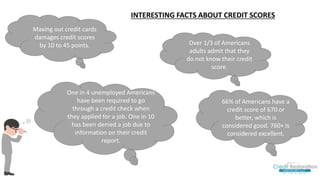
Maxing out credit cards
damages credit scores
by 10 to 45 points. Over 1/3 of Americans
adults admit that they
do not know their credit
score.
One in 4 unemployed Americans
have been required to go
through a credit check when
they applied for a job. One in 10
has been denied a job due to
information on their credit
report.
66% of Americans have a
credit score of 670 or
better, which is
considered good. 760+ is
considered excellent.
INTERESTING FACTS ABOUT CREDIT SCORES
VICTOR VONICO JOHNSON
Real Estate Investor/Published
Author/Entrepreneur/Speaker
• Author of ‘Proven Pathways To Wealth
& Happiness’
• Senior Managing Partner, 555 Equity,
LLC
• General Partner, Credit Restoration
Mentors, LLC
• 20 Years Experience in Debt Collections
Industry/ 2 Years Regulatory Compliance
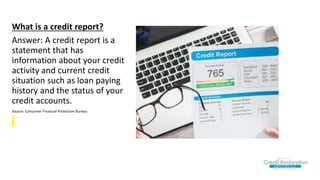
What is a credit report?
Answer: A credit report is a
statement that has
information about your credit
activity and current credit
situation such as loan paying
history and the status of your
credit accounts.
Source: Consumer Financial Protection Bureau
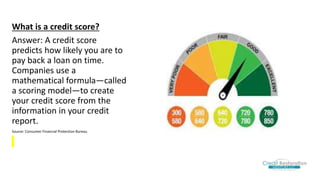
What is a credit score?
Answer: A credit score
predicts how likely you are to
pay back a loan on time.
Companies use a
mathematical formula—called
a scoring model—to create
your credit score from the
information in your credit
report.
Source: Consumer Financial Protection Bureau
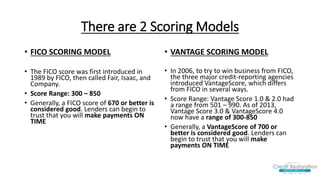
There are 2 Scoring Models
• FICO SCORING MODEL
• The FICO score was first introduced in
1989 by FICO, then called Fair, Isaac, and
Company.
• Score Range: 300 – 850
• Generally, a FICO score of 670 or better is
considered good. Lenders can begin to
trust that you will make payments ON
TIME
• VANTAGE SCORING MODEL
• In 2006, to try to win business from FICO,
the three major credit-reporting agencies
introduced VantageScore, which differs
from FICO in several ways.
• Score Range: Vantage Score 1.0 & 2.0 had
a range from 501 – 990. As of 2013,
Vantage Score 3.0 & VantageScore 4.0
now have a range of 300-850
• Generally, a VantageScore of 700 or
better is considered good. Lenders can
begin to trust that you will make
payments ON TIME
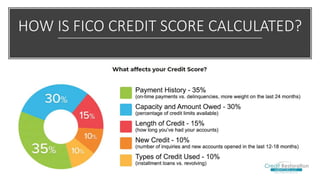
HOW IS FICO CREDIT SCORE CALCULATED?
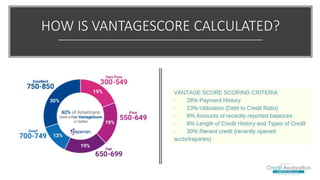
HOW IS VANTAGESCORE CALCULATED?
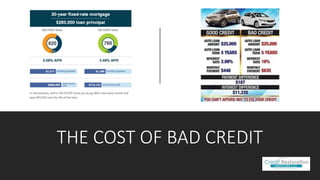
THE COST OF BAD CREDIT
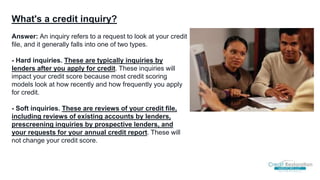
What's a credit inquiry?
Answer: An inquiry refers to a request to look at your credit
file, and it generally falls into one of two types.
- Hard inquiries. These are typically inquiries by
lenders after you apply for credit. These inquiries will
impact your credit score because most credit scoring
models look at how recently and how frequently you apply
for credit.
- Soft inquiries. These are reviews of your credit file,
including reviews of existing accounts by lenders,
prescreening inquiries by prospective lenders, and
your requests for your annual credit report. These will
not change your credit score.
1) Identity Errors
•Errors made to your identity information (wrong name, phone number, address)
•Incorrect accounts resulting from identity theft
2) Incorrect Reporting of Account Status
•Closed accounts reported as open
•You are reported as the owner of the account, when you are actually just an authorized user
•Incorrect date of last payment, date opened, or date of first delinquency
3) Data Management Errors
•Reinsertion of incorrect information after it was corrected
•Accounts that appear multiple times with different creditors listed (especially in the case of delinquent accounts or
accounts in collections)
4) Balance Errors
•Accounts with an incorrect current balance
•Accounts with an incorrect credit limit
COMMON ERRORS FOUND ON A CREDIT REPORT
Fair Credit Reporting Act
The federal Fair Credit Reporting Act (FCRA) promotes
the accuracy, fairness, and privacy of information in
the files of consumer reporting agencies. There are
many types of consumer reporting agencies, including
credit bureaus and specialty agencies (such as agencies
that sell information about check writing histories,
medical records, and rental history records).
For more information, including information about additional rights, go to
www.consumerfinance.gov/learnmore or write to: Consumer Financial Protection Bureau,
1700 G Street N.W., Washington, DC 20552
7 Things you Can Do to
Improve Your Credit Score
• Start paying ALL BILLS ON TIME (Automate them when
possible)
• Do Not Charge More Than 30% of your Credit Limit
• Keep Credit Card Balances BELOW 9% of the Available
Credit Limit
• Do Not Apply for New Credit while working to Improve
your Score (activity within the past 18 months hurts,
within 6 months is the most impactful)
• Open a Secured Credit Card Account
• Keep old PAID OFF accounts Open to build your ‘Credit
Age’
• Become an Authorized User (this helps FICO but not
VANTAGESCORE)
BONUS TIPS TO BUILD CREDIT
Experian Boost
• Add Utility Bills to Credit Report
• Can boost scores between 5
points – 40 points
• Must provide access to bank
account where payments come
from
Add Rent Payments to Credit
• Takes about 90 days to see
impact
• Can boost scores between 10 –
60 points within 90 days
• Landlord/Property Manager
verifies rent payment monthly
It Comes Down
to Having The
Right Mindset!
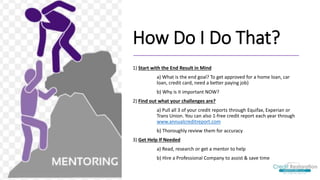
How Do I Do That?
1) Start with the End Result in Mind
a) What is the end goal? To get approved for a home loan, car
loan, credit card, need a better paying job)
b) Why is it important NOW?
2) Find out what your challenges are?
a) Pull all 3 of your credit reports through Equifax, Experian or
Trans Union. You can also 1-free credit report each year through
www.annualcreditreport.com
b) Thoroughly review them for accuracy
3) Get Help If Needed
a) Read, research or get a mentor to help
b) Hire a Professional Company to assist & save time
My Challenge to you!
ONE SOLUTION YOU MAY CONSIDER…
• FREE credit consultation
• FREE in-depth credit analysis
• FREE credit recommendations
• Plans starting as low as $150.00
• We do not charge an hourly fee
• We charge less than you would pay for a few hours
with an attorney
• We do not stick you with any hidden fees​
• We will be there for you every step of the way
www.creditrestorationmentors.com
Email: creditrestorationmentors@gmail.com
Phone: 855-YES-CREDIT
www.victorvjohnson.com
The #1 Key To Financial Success
BELIEVE IT IS
POSSIBLE
Disclaimer: The information posted to this presentation
was accurate at the time it was initially published. We do
not guarantee the accuracy or completeness of the
information provided. The information contained in the
presentation is provided for educational purposes only
and does not constitute legal or financial advice. You
should consult your own attorney or financial adviser
regarding your particular situation.
Credit Repair Education for Libraries  6.15.19

Credit Repair Education for Libraries 6.15.19

  • 1.
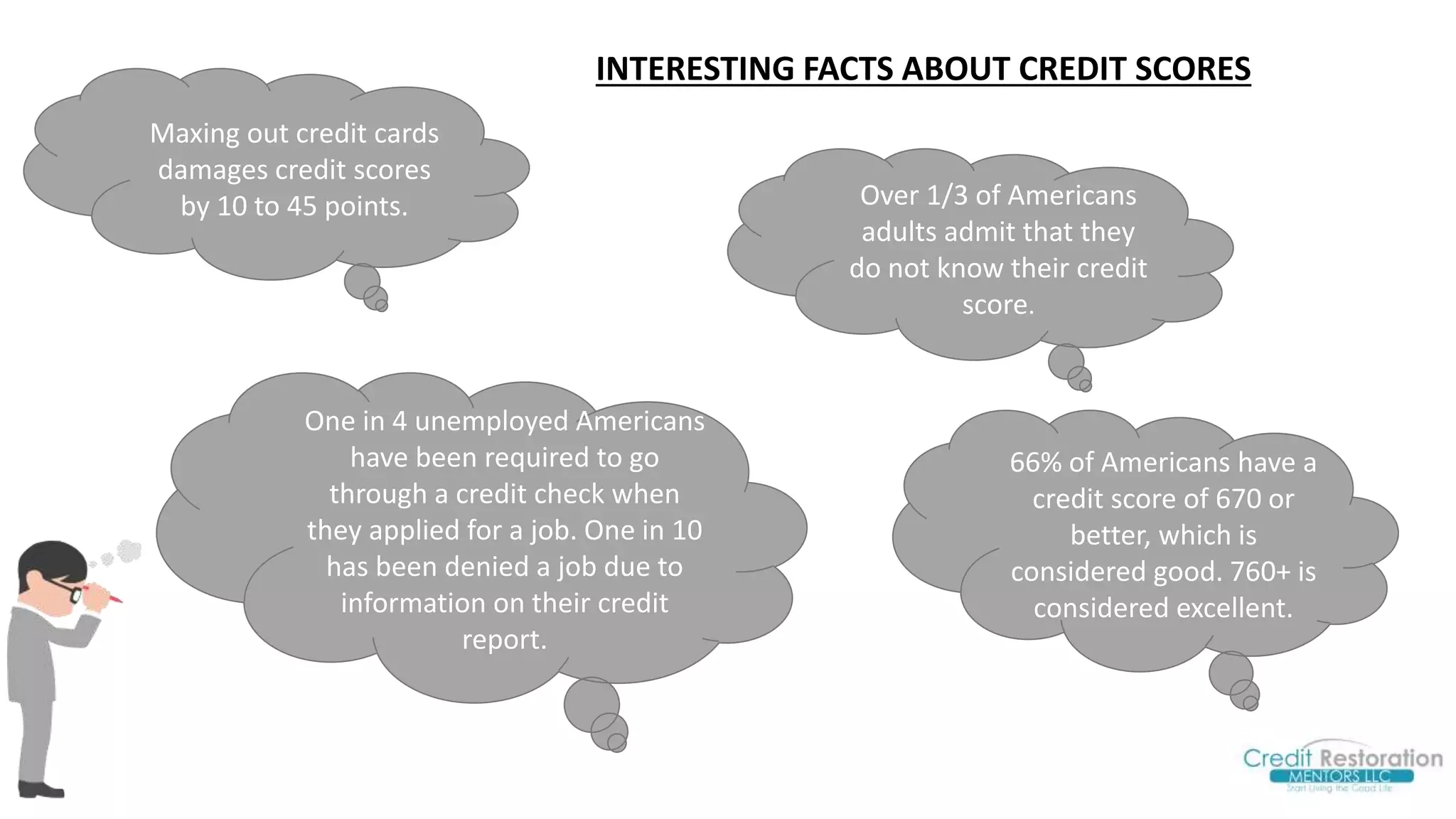
    Maxing out creditcards damages credit scores by 10 to 45 points. Over 1/3 of Americans adults admit that they do not know their credit score. One in 4 unemployed Americans have been required to go through a credit check when they applied for a job. One in 10 has been denied a job due to information on their credit report. 66% of Americans have a credit score of 670 or better, which is considered good. 760+ is considered excellent. INTERESTING FACTS ABOUT CREDIT SCORES
  • 2.
    VICTOR VONICO JOHNSON RealEstate Investor/Published Author/Entrepreneur/Speaker • Author of ‘Proven Pathways To Wealth & Happiness’ • Senior Managing Partner, 555 Equity, LLC • General Partner, Credit Restoration Mentors, LLC • 20 Years Experience in Debt Collections Industry/ 2 Years Regulatory Compliance
  • 3.
    What is acredit report? Answer: A credit report is a statement that has information about your credit activity and current credit situation such as loan paying history and the status of your credit accounts. Source: Consumer Financial Protection Bureau
  • 5.
    What is acredit score? Answer: A credit score predicts how likely you are to pay back a loan on time. Companies use a mathematical formula—called a scoring model—to create your credit score from the information in your credit report. Source: Consumer Financial Protection Bureau
  • 6.
    There are 2Scoring Models • FICO SCORING MODEL • The FICO score was first introduced in 1989 by FICO, then called Fair, Isaac, and Company. • Score Range: 300 – 850 • Generally, a FICO score of 670 or better is considered good. Lenders can begin to trust that you will make payments ON TIME • VANTAGE SCORING MODEL • In 2006, to try to win business from FICO, the three major credit-reporting agencies introduced VantageScore, which differs from FICO in several ways. • Score Range: Vantage Score 1.0 & 2.0 had a range from 501 – 990. As of 2013, Vantage Score 3.0 & VantageScore 4.0 now have a range of 300-850 • Generally, a VantageScore of 700 or better is considered good. Lenders can begin to trust that you will make payments ON TIME
  • 7.
    HOW IS FICOCREDIT SCORE CALCULATED?
  • 9.
  • 10.
    THE COST OFBAD CREDIT
  • 11.
    What's a creditinquiry? Answer: An inquiry refers to a request to look at your credit file, and it generally falls into one of two types. - Hard inquiries. These are typically inquiries by lenders after you apply for credit. These inquiries will impact your credit score because most credit scoring models look at how recently and how frequently you apply for credit. - Soft inquiries. These are reviews of your credit file, including reviews of existing accounts by lenders, prescreening inquiries by prospective lenders, and your requests for your annual credit report. These will not change your credit score.
  • 12.
    1) Identity Errors •Errorsmade to your identity information (wrong name, phone number, address) •Incorrect accounts resulting from identity theft 2) Incorrect Reporting of Account Status •Closed accounts reported as open •You are reported as the owner of the account, when you are actually just an authorized user •Incorrect date of last payment, date opened, or date of first delinquency 3) Data Management Errors •Reinsertion of incorrect information after it was corrected •Accounts that appear multiple times with different creditors listed (especially in the case of delinquent accounts or accounts in collections) 4) Balance Errors •Accounts with an incorrect current balance •Accounts with an incorrect credit limit COMMON ERRORS FOUND ON A CREDIT REPORT
  • 13.
    Fair Credit ReportingAct The federal Fair Credit Reporting Act (FCRA) promotes the accuracy, fairness, and privacy of information in the files of consumer reporting agencies. There are many types of consumer reporting agencies, including credit bureaus and specialty agencies (such as agencies that sell information about check writing histories, medical records, and rental history records). For more information, including information about additional rights, go to www.consumerfinance.gov/learnmore or write to: Consumer Financial Protection Bureau, 1700 G Street N.W., Washington, DC 20552
  • 14.
    7 Things youCan Do to Improve Your Credit Score • Start paying ALL BILLS ON TIME (Automate them when possible) • Do Not Charge More Than 30% of your Credit Limit • Keep Credit Card Balances BELOW 9% of the Available Credit Limit • Do Not Apply for New Credit while working to Improve your Score (activity within the past 18 months hurts, within 6 months is the most impactful) • Open a Secured Credit Card Account • Keep old PAID OFF accounts Open to build your ‘Credit Age’ • Become an Authorized User (this helps FICO but not VANTAGESCORE)
  • 15.
    BONUS TIPS TOBUILD CREDIT Experian Boost • Add Utility Bills to Credit Report • Can boost scores between 5 points – 40 points • Must provide access to bank account where payments come from Add Rent Payments to Credit • Takes about 90 days to see impact • Can boost scores between 10 – 60 points within 90 days • Landlord/Property Manager verifies rent payment monthly
  • 16.
    It Comes Down toHaving The Right Mindset!
  • 17.
    How Do IDo That? 1) Start with the End Result in Mind a) What is the end goal? To get approved for a home loan, car loan, credit card, need a better paying job) b) Why is it important NOW? 2) Find out what your challenges are? a) Pull all 3 of your credit reports through Equifax, Experian or Trans Union. You can also 1-free credit report each year through www.annualcreditreport.com b) Thoroughly review them for accuracy 3) Get Help If Needed a) Read, research or get a mentor to help b) Hire a Professional Company to assist & save time
  • 18.
  • 19.
    ONE SOLUTION YOUMAY CONSIDER… • FREE credit consultation • FREE in-depth credit analysis • FREE credit recommendations • Plans starting as low as $150.00 • We do not charge an hourly fee • We charge less than you would pay for a few hours with an attorney • We do not stick you with any hidden fees​ • We will be there for you every step of the way www.creditrestorationmentors.com Email: creditrestorationmentors@gmail.com Phone: 855-YES-CREDIT www.victorvjohnson.com
  • 20.
    The #1 KeyTo Financial Success BELIEVE IT IS POSSIBLE
  • 21.
    Disclaimer: The informationposted to this presentation was accurate at the time it was initially published. We do not guarantee the accuracy or completeness of the information provided. The information contained in the presentation is provided for educational purposes only and does not constitute legal or financial advice. You should consult your own attorney or financial adviser regarding your particular situation.

Editor's Notes

  • #2 Wow them with 4 quick credit score statistics!
  • #3 My name is Victor Vonico Johnson, I am a published author
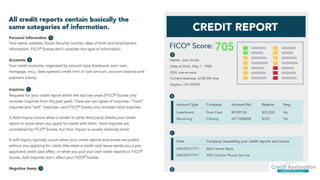
  • #4 Walk through Sample CBR here