Driving
 Creative
Innovation
         by Steve Massi
Overview


•Today’s brand environment is more challenging than ever
•Brands are looking for ways to drive business impact faster and
 more efficiently
•The needs to access, integrate and activate new capabilities and
 platforms are growing rapidly
•The advent of social media has accelerated this demand
•This presentation will lay out the foundations of creative
 innovation, what it is, why it is important, key elements and
 must do’s for success
What is Creative Innovation
         & Why?
What is it – some examples

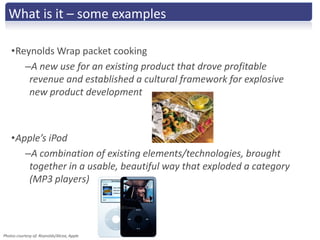
    •Reynolds Wrap packet cooking
       –A new use for an existing product that drove profitable
        revenue and established a cultural framework for explosive
        new product development


    •Apple’s iPod
       –A combination of existing elements/technologies, brought
        together in a usable, beautiful way that exploded a category
        (MP3 players)


Photos courtesy of: Reynolds/Alcoa, Apple
What is it – some examples

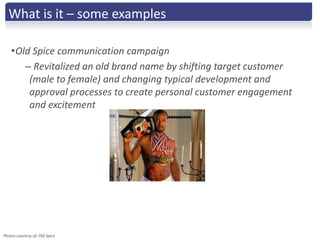
    •Old Spice communication campaign
       – Revitalized an old brand name by shifting target customer
        (male to female) and changing typical development and
        approval processes to create personal customer engagement
        and excitement


Photos courtesy of: Old Spice
What is innovation?


•What is Innovation?
  – Change that creates a new dimension of
    performance. Peter Drucker (Hesselbein, 2002)
What is innovation?

    •Innovation is not invention
      – Invention can be an idea, a great idea
      – Most inventions or ideas fail because they do not drive
         profitability of ROI
      – Most companies focus on ideas or inventions
      – Innovation drives economic value*
    •In economics the change (innovation) must increase value,
     customer value, or producer value**
    •The term innovation may refer to both radical and incremental
     changes to products, processes or services. The often unspoken
     goal of innovation is to solve a problem**

*Knowledge@Wharton-Sirkin
**Wikipedia
Why creative innovation?


•Any aspect of our business requires direct or indirect
 sensitivity to creativity
•Knowledge, insight, skills and motivation should
 embrace the driving concept of creativity
•All areas must strive not just to ideate or invent, but to
 innovate
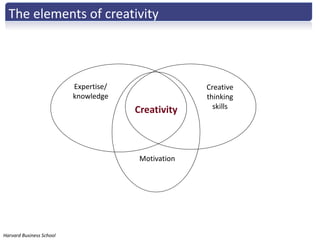
The elements of creativity


                          Expertise/                 Creative
                          knowledge                  thinking
                                                       skills
                                       Creativity


                                        Motivation


Harvard Business School
Key Elements of Creative
       Innovation
It starts with knowledge and insight


    •Creativity and innovation start with knowledge and insight*
      – More than topline knowledge, which can drive idea generation
      – Must be deep customer insight that reveals true need


*Knowledge@Wharton- Huston
The role of tacit knowledge


     •Tacit knowledge has been found to be a crucial input to the
      innovation process. A society’s ability to innovate depends on its
      level of tacit knowledge of how to innovate.*
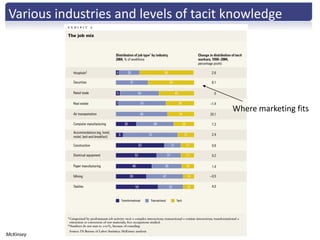
     •Most service industries driven by “tacit interactions, activities
      and tacit knowledge”
       – By definition, tacit knowledge is knowledge that people carry
          in their minds and is, therefore, difficult to access. Often,
          people are not aware of the knowledge they possess or how
          it can be valuable to others. Tacit knowledge is considered
          more valuable because it provides context for people,
          places, ideas, and experiences. Effective transfer of tacit
          knowledge generally requires extensive personal contact and
          trust.*


*Wikipedia
Various industries and levels of tacit knowledge


                                        Where marketing fits


McKinsey
Improving tacit interactions

     •Companies boost productivity by improving the efficiency of
      transformational activities (such as the extraction of raw
      materials) or of transactions (for instance, the work of the clerks
      in the accounts-payable function)…
     •But the productivity of marketing managers and lawyers can’t be
      raised by standardizing their work or replacing them with
      machines*
     •Companies can analyze work done in processes and root out
      wasteful activities so employees do more in less time. But
      companies don’t improve tacit interactions by forcing
      salespeople (or other tacit workers) to follow a uniform
      procedure.*

*McKinsey
Improving tacit interactions


   •Managing for effectiveness in tacit interactions is about
    fostering change, learning, collaboration, shared values
    and innovation*
   •Consistent, high-quality tacit interactions have a
    dramatic impact on innovation and economic value


*McKinsey
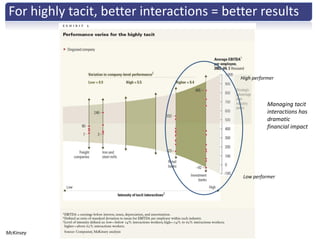
For highly tacit, better interactions = better results


                                            High performer


                                                       Managing tacit
                                                       interactions has
                                                       dramatic
                                                       financial impact


                                             Low performer


McKinsey
Improving tacit interactions


   •Top performers have figured out that by managing
    tacit interactions more effectively, they can create
    competitive advantages that rivals in their sectors find
    hard to match…*


*McKinsey
Managing tacit interactions for creative innovation


 •To enable and encourage an environment where tacit
  interactions and knowledge sharing can flourish and
  grow
   – What needs to be done?
   – What incentives are needed?
What Needs To Be Done
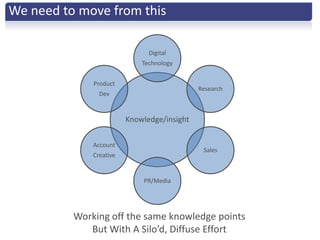
We need to move from this

                               Digital
                             Technology


              Product
                                             Research
                Dev


                         Knowledge/insight

              Account
                                              Sales
              Creative


                             PR/Media


          Working off the same knowledge points
             But With A Silo’d, Diffuse Effort
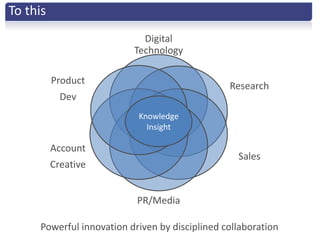
To this
                            Digital
                          Technology

          Product
                                                Research
            Dev
                           Knowledge
                             Insight

          Account
                                                  Sales
          Creative


                           PR/Media

     Powerful innovation driven by disciplined collaboration
Collaboration – A Key Behavior for
            Innovation
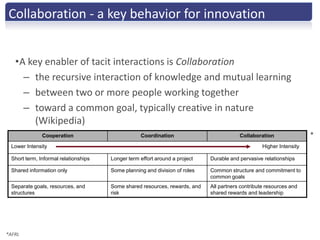
Collaboration - a key behavior for innovation


   •A key enabler of tacit interactions is Collaboration
     – the recursive interaction of knowledge and mutual learning
     – between two or more people working together
     – toward a common goal, typically creative in nature
        (Wikipedia)
              Cooperation                         Coordination                          Collaboration                *
 Lower Intensity                                                                                  Higher Intensity

 Short term, Informal relationships   Longer term effort around a project   Durable and pervasive relationships

 Shared information only              Some planning and division of roles   Common structure and commitment to
                                                                            common goals
 Separate goals, resources, and       Some shared resources, rewards, and   All partners contribute resources and
 structures                           risk                                  shared rewards and leadership


*AFRL
Collaboration - a key behavior for innovation

   •There are four working types of collaborations*:
      –Progressive collaboration
             • Communities of practice, knowledge-sharing sites, inter-
               organizational networks
         –Self-Organizing collaboration
             • Facebook, Twitter, LinkedIn, Yahoo groups
         –Remedial collaboration
             • Innovation or problem-solving teams, task forces, informal
               workarounds
         –Oppositional collaboration
             • Electronic caucuses, rumor mills, external associations


*Accenture
Collaboration - a key behavior for innovation

   •And each brings different value*:
      –Progressive collaboration
             • Produces value indirectly, largely by adding depth to the
               understanding of a process or an activity that directly creates value
         –Self-Organizing collaboration
             • Helps people discover the common interests that often serve as the
               precursor to value creating activity
         –Remedial collaboration
             • Helps achieve value when a system is incapable of monitoring and
               correcting itself
         –Oppositional collaboration
             • Usually destroys value or dissipates it


*Accenture
Collaboration - a key behavior for innovation


 •Enabling and encouraging a Collaborative Work environment has
  many benefits:
   – Creates tacit interactions
   – Improves tacit knowledge transfer
   – Broadens capabilities and expertise
   – Helps overcome locked-in ways of approaching problems
   – Encourages team participation
   – Improves morale and a sense of belonging
   – Utilizes human capital more effectively
   – Creates an innovative work environment and culture
Creating The Right Environment
Formalizing collaboration


 •Creating an insight driven, collaborative culture
   – Successful collaboration is based on three key principals –
     inclusion, motivators/incentives, alignment
      • You can’t collaborate if you don’t include
      • Create incentives supporting the right motivators
      • Alignment in/of decision making is crucial
Include the right people


     •Diversify by responsibility and personality at different points in
      the process
        –Encourages flexibility and imagination, discourages
         Groupthink
        –Include to make better decisions, provide better quality
         implementation, speed implementation of decision making
     •Experiment with the numbers
        –In research of Broadway musicals, seven is an optimal
         number for musical creation*
        –Different situations will require different resources


* Brian Uzzi, Northwestern University’s Kellogg School of Management (Edward Boches , 10 rules for modern collaboration )
Create incentives to encourage collaboration


     •Most organizations use the “carrot and stick” reward system
      only to find it ineffective*
     •Knowledge workers are driven by higher order motivational
      needs*:
        –Purpose
                  • Driven by a common cause or greater unifying purpose
            –Mastery
                  • Desire for continual learning and improvement
            –Self-sufficiency/autonomy
                  • Ability to perform at a high level and take responsibility for one’s
                    actions


*Daniel Pink: Drive, The surprising truth about what motivates us
Establish effective decision making


 •Increased collaboration requires disciplined decision making
 •Must establish criteria:
    –What is the decision to be made
       • Frame and split into sub-decisions if necessary
    –Who will play what roles
       • RASCI, RAPID, etc.
    –How will decisions be made
       • Voting, Directive, Consultative, Alignment
    –When must the decision be made
       • Consider execution and resource implementation as well
Summary
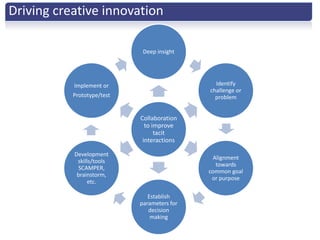
Driving creative innovation

                             Deep insight


           Implement or                        Identify
                                             challenge or
           Prototype/test                      problem


                            Collaboration
                              to improve
                                  tacit
                             interactions

           Development
                                              Alignment
            skills/tools
                                               towards
            SCAMPER,
                                             common goal
            brainstorm,
                                              or purpose
                etc.

                               Establish
                            parameters for
                               decision
                                making
Implications for brands


 •Team members must know the business reasons for
  collaboration - improve the frequency and quality of tacit
  interactions to drive innovation and economic value for clients
  and company
 •Consider investments that foster insight gathering, collaboration
  and tacit interactions
   – Information gathering and sharing tools/platforms,
      including social platforms
   – Employee training for improved collaboration and
      engagement
   – Behavior and outcome based benchmarks and measures for
      success
Thanks


 Please feel free to share or contact me

 • Steve Massi
 • stevemassi@verizon.net
 • linkedin.com/in/stevemassi
 • twitter.com/stevemassi
 • stevemassi.posterous.com

Driving Creative Innovation

  • 1.
  • 2.
    Overview •Today’s brand environmentis more challenging than ever •Brands are looking for ways to drive business impact faster and more efficiently •The needs to access, integrate and activate new capabilities and platforms are growing rapidly •The advent of social media has accelerated this demand •This presentation will lay out the foundations of creative innovation, what it is, why it is important, key elements and must do’s for success
  • 3.
    What is CreativeInnovation & Why?
  • 4.
    What is it– some examples •Reynolds Wrap packet cooking –A new use for an existing product that drove profitable revenue and established a cultural framework for explosive new product development •Apple’s iPod –A combination of existing elements/technologies, brought together in a usable, beautiful way that exploded a category (MP3 players) Photos courtesy of: Reynolds/Alcoa, Apple
  • 5.
    What is it– some examples •Old Spice communication campaign – Revitalized an old brand name by shifting target customer (male to female) and changing typical development and approval processes to create personal customer engagement and excitement Photos courtesy of: Old Spice
  • 6.
    What is innovation? •Whatis Innovation? – Change that creates a new dimension of performance. Peter Drucker (Hesselbein, 2002)
  • 7.
    What is innovation? •Innovation is not invention – Invention can be an idea, a great idea – Most inventions or ideas fail because they do not drive profitability of ROI – Most companies focus on ideas or inventions – Innovation drives economic value* •In economics the change (innovation) must increase value, customer value, or producer value** •The term innovation may refer to both radical and incremental changes to products, processes or services. The often unspoken goal of innovation is to solve a problem** *Knowledge@Wharton-Sirkin **Wikipedia
  • 8.
    Why creative innovation? •Anyaspect of our business requires direct or indirect sensitivity to creativity •Knowledge, insight, skills and motivation should embrace the driving concept of creativity •All areas must strive not just to ideate or invent, but to innovate
  • 9.
    The elements ofcreativity Expertise/ Creative knowledge thinking skills Creativity Motivation Harvard Business School
  • 10.
    Key Elements ofCreative Innovation
  • 11.
    It starts withknowledge and insight •Creativity and innovation start with knowledge and insight* – More than topline knowledge, which can drive idea generation – Must be deep customer insight that reveals true need *Knowledge@Wharton- Huston
  • 12.
    The role oftacit knowledge •Tacit knowledge has been found to be a crucial input to the innovation process. A society’s ability to innovate depends on its level of tacit knowledge of how to innovate.* •Most service industries driven by “tacit interactions, activities and tacit knowledge” – By definition, tacit knowledge is knowledge that people carry in their minds and is, therefore, difficult to access. Often, people are not aware of the knowledge they possess or how it can be valuable to others. Tacit knowledge is considered more valuable because it provides context for people, places, ideas, and experiences. Effective transfer of tacit knowledge generally requires extensive personal contact and trust.* *Wikipedia
  • 13.
    Various industries andlevels of tacit knowledge Where marketing fits McKinsey
  • 14.
    Improving tacit interactions •Companies boost productivity by improving the efficiency of transformational activities (such as the extraction of raw materials) or of transactions (for instance, the work of the clerks in the accounts-payable function)… •But the productivity of marketing managers and lawyers can’t be raised by standardizing their work or replacing them with machines* •Companies can analyze work done in processes and root out wasteful activities so employees do more in less time. But companies don’t improve tacit interactions by forcing salespeople (or other tacit workers) to follow a uniform procedure.* *McKinsey
  • 15.
    Improving tacit interactions •Managing for effectiveness in tacit interactions is about fostering change, learning, collaboration, shared values and innovation* •Consistent, high-quality tacit interactions have a dramatic impact on innovation and economic value *McKinsey
  • 16.
    For highly tacit,better interactions = better results High performer Managing tacit interactions has dramatic financial impact Low performer McKinsey
  • 17.
    Improving tacit interactions •Top performers have figured out that by managing tacit interactions more effectively, they can create competitive advantages that rivals in their sectors find hard to match…* *McKinsey
  • 18.
    Managing tacit interactionsfor creative innovation •To enable and encourage an environment where tacit interactions and knowledge sharing can flourish and grow – What needs to be done? – What incentives are needed?
  • 19.
  • 20.
    We need tomove from this Digital Technology Product Research Dev Knowledge/insight Account Sales Creative PR/Media Working off the same knowledge points But With A Silo’d, Diffuse Effort
  • 21.
    To this Digital Technology Product Research Dev Knowledge Insight Account Sales Creative PR/Media Powerful innovation driven by disciplined collaboration
  • 22.
    Collaboration – AKey Behavior for Innovation
  • 23.
    Collaboration - akey behavior for innovation •A key enabler of tacit interactions is Collaboration – the recursive interaction of knowledge and mutual learning – between two or more people working together – toward a common goal, typically creative in nature (Wikipedia) Cooperation Coordination Collaboration * Lower Intensity Higher Intensity Short term, Informal relationships Longer term effort around a project Durable and pervasive relationships Shared information only Some planning and division of roles Common structure and commitment to common goals Separate goals, resources, and Some shared resources, rewards, and All partners contribute resources and structures risk shared rewards and leadership *AFRL
  • 24.
    Collaboration - akey behavior for innovation •There are four working types of collaborations*: –Progressive collaboration • Communities of practice, knowledge-sharing sites, inter- organizational networks –Self-Organizing collaboration • Facebook, Twitter, LinkedIn, Yahoo groups –Remedial collaboration • Innovation or problem-solving teams, task forces, informal workarounds –Oppositional collaboration • Electronic caucuses, rumor mills, external associations *Accenture
  • 25.
    Collaboration - akey behavior for innovation •And each brings different value*: –Progressive collaboration • Produces value indirectly, largely by adding depth to the understanding of a process or an activity that directly creates value –Self-Organizing collaboration • Helps people discover the common interests that often serve as the precursor to value creating activity –Remedial collaboration • Helps achieve value when a system is incapable of monitoring and correcting itself –Oppositional collaboration • Usually destroys value or dissipates it *Accenture
  • 26.
    Collaboration - akey behavior for innovation •Enabling and encouraging a Collaborative Work environment has many benefits: – Creates tacit interactions – Improves tacit knowledge transfer – Broadens capabilities and expertise – Helps overcome locked-in ways of approaching problems – Encourages team participation – Improves morale and a sense of belonging – Utilizes human capital more effectively – Creates an innovative work environment and culture
  • 27.
    Creating The RightEnvironment
  • 28.
    Formalizing collaboration •Creatingan insight driven, collaborative culture – Successful collaboration is based on three key principals – inclusion, motivators/incentives, alignment • You can’t collaborate if you don’t include • Create incentives supporting the right motivators • Alignment in/of decision making is crucial
  • 29.
    Include the rightpeople •Diversify by responsibility and personality at different points in the process –Encourages flexibility and imagination, discourages Groupthink –Include to make better decisions, provide better quality implementation, speed implementation of decision making •Experiment with the numbers –In research of Broadway musicals, seven is an optimal number for musical creation* –Different situations will require different resources * Brian Uzzi, Northwestern University’s Kellogg School of Management (Edward Boches , 10 rules for modern collaboration )
  • 30.
    Create incentives toencourage collaboration •Most organizations use the “carrot and stick” reward system only to find it ineffective* •Knowledge workers are driven by higher order motivational needs*: –Purpose • Driven by a common cause or greater unifying purpose –Mastery • Desire for continual learning and improvement –Self-sufficiency/autonomy • Ability to perform at a high level and take responsibility for one’s actions *Daniel Pink: Drive, The surprising truth about what motivates us
  • 31.
    Establish effective decisionmaking •Increased collaboration requires disciplined decision making •Must establish criteria: –What is the decision to be made • Frame and split into sub-decisions if necessary –Who will play what roles • RASCI, RAPID, etc. –How will decisions be made • Voting, Directive, Consultative, Alignment –When must the decision be made • Consider execution and resource implementation as well
  • 32.
  • 33.
    Driving creative innovation Deep insight Implement or Identify challenge or Prototype/test problem Collaboration to improve tacit interactions Development Alignment skills/tools towards SCAMPER, common goal brainstorm, or purpose etc. Establish parameters for decision making
  • 34.
    Implications for brands •Team members must know the business reasons for collaboration - improve the frequency and quality of tacit interactions to drive innovation and economic value for clients and company •Consider investments that foster insight gathering, collaboration and tacit interactions – Information gathering and sharing tools/platforms, including social platforms – Employee training for improved collaboration and engagement – Behavior and outcome based benchmarks and measures for success
  • 35.
    Thanks Please feelfree to share or contact me • Steve Massi • stevemassi@verizon.net • linkedin.com/in/stevemassi • twitter.com/stevemassi • stevemassi.posterous.com