Moving to framework of outcomes
for young people
January 2012


Bethia McNeil, The Young Foundation
for the Catalyst Consortium, the Department for Education’s strategic
partner for young people


Slide 1   The Young Foundation 2012
What’s the problem?
                                            Not all youth sector
                                            providers are:
                                            • Considering their impact as
                                              part of their core business; or
                                            • Presenting outcomes in a
                                              consistent way.


                                       The sector lacks a common language and
                                         good process for sharing knowledge

                                                                           Not all investors are:
          Not all commissioners are:                                       • Accounting for social impact
          • Specifying social outcomes                                       in a way that is appropriate
            in tenders; or                                                   for the youth sector when
          • Accounting for social impact                                     making investment
            in a ‘smart’ way when buying                                     decisions; or
            goods and services.                                            • Asking investees to report on
                                                                             their social impact.


Slide 2    The Young Foundation 2012
What’s our ambition for the framework?
    1.      Accepted by key champions amongst commissioners, providers and
            social investors

    2.      Bold, yet flexible

    3.      Straight forward to use whilst also reasonably robust

    4.      Based on a coherent ‘theory of change’

    5.      Enabling benchmarking of ‘value added’, taking forward knowledge
            on ‘what works’

    6.      Use of a common language to promote consistent measurement of
            the difference services make for young people


Slide 3   The Young Foundation 2012
The framework of outcomes aims to underpin answers
to five key questions for young people’s services
              1. What are we trying to achieve?
              To build consensus on what we aim to achieve with and for young
              people

              2.What difference do services make?
              To measure the change in outcomes from services for young
              people

              3.Why should someone commission, fund or invest in a service?
              To articulate the value of a youth service or programme

              4. With limited resource, who and what is our focus?
              To target and tailor support for different young people

              5. How can we make the biggest difference for young people?
              To inform practice and the sector’s development

 Slide 4   The Young Foundation 2011
How might the outcomes framework be used, and by whom?
  Audience                              Why might they use the                What attributes do they need the
                                        framework?                            framework to have?
  Commissioners (e.g. Local             •   To target resources effectively   •   Allows comparability across providers
  Authorities)                              to local needs                    •   Clear to understand
                                        •   To intelligently commission a     •   Reliable/evidence based/robust
                                            range of services which
                                            ‘speak’ to one another
                                        •   To share best practice
  Providers (e.g. youth                 •   To demonstrate the                •   Flexible and adaptable to their context
  services)                                 difference made for young         •   Easy to use
                                            people                            •   Affordable
                                        •   To articulate value               •   Low resource intensity
                                        •   To improve services for           •   Recognised by central/local government,
                                            young people                          commissioners and investors
                                        •   To grow the evidence base
                                        •   To build consensus
                                        •   To benchmark the difference
                                            they make to young people
  Investors (e.g. central               •   To help decide between            •   Allow comparability across providers
  government, philanthropists)              competing priorities              •   Low resource intensity
                                        •   To inform investment              •   Clear to understand
                                            decisions                         •   Reliable/evidenced based/robust
                                        •   To understand the potential       •   Sit alongside existing impact
                                            of the sector                         measurement tools

  Slide 5   The Young Foundation 2012
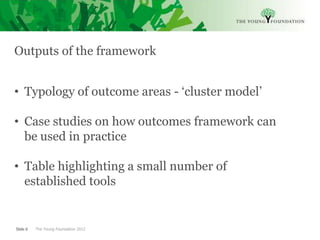
Outputs of the framework


• Typology of outcome areas - ‘cluster model’

• Case studies on how outcomes framework can
  be used in practice

• Table highlighting a small number of
  established tools


Slide 6   The Young Foundation 2012
How have we developed an answer?

• Focus groups (young people, commissioners, funders
  etc)

• Advisory group

• Consultation across the sector

• Literature review


Slide 7   The Young Foundation 2012
Outcomes: what matters?


Slide 8   The Young Foundation 2012
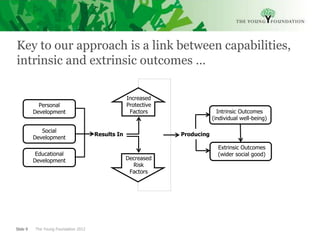
Key to our approach is a link between capabilities,
intrinsic and extrinsic outcomes …

                                                   Increased
            Personal                               Protective
          Development                               Factors                   Intrinsic Outcomes
                                                                            (individual well-being)

             Social
                                      Results In                Producing
          Development
                                                                              Extrinsic Outcomes
           Educational                                                        (wider social good)
          Development                              Decreased
                                                     Risk
                                                    Factors


Slide 9   The Young Foundation 2012
… that can be summarised as a relationship between long-term
outcomes, interim indicators, social & emotional capabilities


 Slide 10   The Young Foundation 2012
… which is supported by a strong evidence base …


Slide 11   The Young Foundation 2012
At the heart of the Outcomes Framework are seven
  clusters of capabilities


Slide 12   The Young Foundation 2012
Consistency across frameworks
New Philanthropy Capital
       Self-esteem
       Resilience
       Emotional wellbeing
       Peer relationships
                                                            Fairbridge
       Family relationships
       Satisfaction with school environment
                                         Communicating, Managing feelings, Establishing
       Satisfaction with local community interpersonal relationships, Understanding social
                                            values, Understanding and identifying with
                                          others, Negotiating, Problem solving, Planning,
                                                             Reviewing


 Dartington SRU - key developmental outcomes
                                                                 AQR Mental Toughness
 1.        Educational skills and attainment
                                                                 1. Control
 2.        Emotional wellbeing
 3.        Physical health                                       2. Challenge
 4.        Positive behavior                                     3. Commitment
 5.        Positive relationships                                4. Confidence


Slide 13    The Young Foundation 2011
Using the Outcomes
Framework


Slide 14   The Young Foundation 2012
Stages in using the Framework


Slide 15   The Young Foundation 2012
Case study: provider working with victims
            of bullying


Slide 16   The Young Foundation 2012
Case study: provider working with victims
           of bullying
                                              Young people in the local area have been victims of bullying. They have suffered from physical and verbal abuse and their school
           Step 1: What’s the need?
                                                                      attendance has worsened. 15 young people have been referred to the scheme.


                                                                                                                           Step 4: Service design

    Step 2: Planned outputs & outcomes             Step 3: Which clusters?                                   Activities                                Inputs

                                                                                                                                           Local Authority funded
                                                      Managing Feelings                                       Activity A                   therapist who can provide a
             Provide refuge/safe-place                                                                                                     two hour session once a
                                                                                                                                           week
                                                  Resilience & Determination
      Provide supported activities to build
          social ands emotional skills                                                                                                     Use of church hall two
                                                                                                                                           evenings a week (4pm till
                                                    Confidence & Agency                                       Activity B                   9.30pm)
           Work with schools to stop the
                     bullying
                                                       Communication                                                                       1 full time dedicated member
                                                                                                                                           of staff


                                                                                                              Activity C                   3 volunteers who can each
                                                                                                                                           devote an evening a week (6
                                                                                                                                           till 9 pm)


                                                                                                       Training sessions with
                                                                                                              teachers

Slide 17      The Young Foundation 2012
Case study: provider working with victims
           of bullying


Slide 18   The Young Foundation 2012
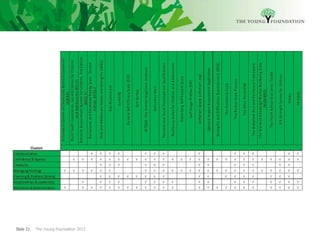
Matrix of tools


Slide 19   The Young Foundation 2012
Approach to assessing tools

           • We have collated information on commonly-used
             and referenced measurement tools and
             techniques

           • Information includes an overview of which
             clusters are covered; the cost of using the tool;
             and the robustness of the underlying evidence
             base


Slide 20   The Young Foundation 2012
Slide 21   The Young Foundation 2012
Next steps
    • Pilot phase
                  For example, applied in LGA/NYA case study work with
                   councils on investment analysis
    • Generating knowledge
                  Continuing to gather information on tools and their use
                  Working with groups of practitioners and analysts to share
                   data and experiences
    • Encouragement from commissioners and funders


Slide 22   The Young Foundation 2012
Contact

    Bethia McNeil
    bethia.mcneil@youngfoundation.org


Slide 23   The Young Foundation 2012

Youth Sector Outcomes Framework

  • 1.
    Moving to frameworkof outcomes for young people January 2012 Bethia McNeil, The Young Foundation for the Catalyst Consortium, the Department for Education’s strategic partner for young people Slide 1 The Young Foundation 2012
  • 2.
    What’s the problem? Not all youth sector providers are: • Considering their impact as part of their core business; or • Presenting outcomes in a consistent way. The sector lacks a common language and good process for sharing knowledge Not all investors are: Not all commissioners are: • Accounting for social impact • Specifying social outcomes in a way that is appropriate in tenders; or for the youth sector when • Accounting for social impact making investment in a ‘smart’ way when buying decisions; or goods and services. • Asking investees to report on their social impact. Slide 2 The Young Foundation 2012
  • 3.
    What’s our ambitionfor the framework? 1. Accepted by key champions amongst commissioners, providers and social investors 2. Bold, yet flexible 3. Straight forward to use whilst also reasonably robust 4. Based on a coherent ‘theory of change’ 5. Enabling benchmarking of ‘value added’, taking forward knowledge on ‘what works’ 6. Use of a common language to promote consistent measurement of the difference services make for young people Slide 3 The Young Foundation 2012
  • 4.
    The framework ofoutcomes aims to underpin answers to five key questions for young people’s services 1. What are we trying to achieve? To build consensus on what we aim to achieve with and for young people 2.What difference do services make? To measure the change in outcomes from services for young people 3.Why should someone commission, fund or invest in a service? To articulate the value of a youth service or programme 4. With limited resource, who and what is our focus? To target and tailor support for different young people 5. How can we make the biggest difference for young people? To inform practice and the sector’s development Slide 4 The Young Foundation 2011
  • 5.
    How might theoutcomes framework be used, and by whom? Audience Why might they use the What attributes do they need the framework? framework to have? Commissioners (e.g. Local • To target resources effectively • Allows comparability across providers Authorities) to local needs • Clear to understand • To intelligently commission a • Reliable/evidence based/robust range of services which ‘speak’ to one another • To share best practice Providers (e.g. youth • To demonstrate the • Flexible and adaptable to their context services) difference made for young • Easy to use people • Affordable • To articulate value • Low resource intensity • To improve services for • Recognised by central/local government, young people commissioners and investors • To grow the evidence base • To build consensus • To benchmark the difference they make to young people Investors (e.g. central • To help decide between • Allow comparability across providers government, philanthropists) competing priorities • Low resource intensity • To inform investment • Clear to understand decisions • Reliable/evidenced based/robust • To understand the potential • Sit alongside existing impact of the sector measurement tools Slide 5 The Young Foundation 2012
  • 6.
    Outputs of theframework • Typology of outcome areas - ‘cluster model’ • Case studies on how outcomes framework can be used in practice • Table highlighting a small number of established tools Slide 6 The Young Foundation 2012
  • 7.
    How have wedeveloped an answer? • Focus groups (young people, commissioners, funders etc) • Advisory group • Consultation across the sector • Literature review Slide 7 The Young Foundation 2012
  • 8.
    Outcomes: what matters? Slide8 The Young Foundation 2012
  • 9.
    Key to ourapproach is a link between capabilities, intrinsic and extrinsic outcomes … Increased Personal Protective Development Factors Intrinsic Outcomes (individual well-being) Social Results In Producing Development Extrinsic Outcomes Educational (wider social good) Development Decreased Risk Factors Slide 9 The Young Foundation 2012
  • 10.
    … that canbe summarised as a relationship between long-term outcomes, interim indicators, social & emotional capabilities Slide 10 The Young Foundation 2012
  • 11.
    … which issupported by a strong evidence base … Slide 11 The Young Foundation 2012
  • 12.
    At the heartof the Outcomes Framework are seven clusters of capabilities Slide 12 The Young Foundation 2012
  • 13.
    Consistency across frameworks NewPhilanthropy Capital Self-esteem Resilience Emotional wellbeing Peer relationships Fairbridge Family relationships Satisfaction with school environment Communicating, Managing feelings, Establishing Satisfaction with local community interpersonal relationships, Understanding social values, Understanding and identifying with others, Negotiating, Problem solving, Planning, Reviewing Dartington SRU - key developmental outcomes AQR Mental Toughness 1. Educational skills and attainment 1. Control 2. Emotional wellbeing 3. Physical health 2. Challenge 4. Positive behavior 3. Commitment 5. Positive relationships 4. Confidence Slide 13 The Young Foundation 2011
  • 14.
    Using the Outcomes Framework Slide14 The Young Foundation 2012
  • 15.
    Stages in usingthe Framework Slide 15 The Young Foundation 2012
  • 16.
    Case study: providerworking with victims of bullying Slide 16 The Young Foundation 2012
  • 17.
    Case study: providerworking with victims of bullying Young people in the local area have been victims of bullying. They have suffered from physical and verbal abuse and their school Step 1: What’s the need? attendance has worsened. 15 young people have been referred to the scheme. Step 4: Service design Step 2: Planned outputs & outcomes Step 3: Which clusters? Activities Inputs Local Authority funded Managing Feelings Activity A therapist who can provide a Provide refuge/safe-place two hour session once a week Resilience & Determination Provide supported activities to build social ands emotional skills Use of church hall two evenings a week (4pm till Confidence & Agency Activity B 9.30pm) Work with schools to stop the bullying Communication 1 full time dedicated member of staff Activity C 3 volunteers who can each devote an evening a week (6 till 9 pm) Training sessions with teachers Slide 17 The Young Foundation 2012
  • 18.
    Case study: providerworking with victims of bullying Slide 18 The Young Foundation 2012
  • 19.
    Matrix of tools Slide19 The Young Foundation 2012
  • 20.
    Approach to assessingtools • We have collated information on commonly-used and referenced measurement tools and techniques • Information includes an overview of which clusters are covered; the cost of using the tool; and the robustness of the underlying evidence base Slide 20 The Young Foundation 2012
  • 21.
    Slide 21 The Young Foundation 2012
  • 22.
    Next steps • Pilot phase  For example, applied in LGA/NYA case study work with councils on investment analysis • Generating knowledge  Continuing to gather information on tools and their use  Working with groups of practitioners and analysts to share data and experiences • Encouragement from commissioners and funders Slide 22 The Young Foundation 2012
  • 23.
    Contact Bethia McNeil bethia.mcneil@youngfoundation.org Slide 23 The Young Foundation 2012

Editor's Notes

  • #13 Young people had an impact on this process …Inter-related, no hierarchy involvedMuch of it is around common language
  • #23 One key issue is generating a rating system for tools in a way that is not open to gaming