Stores:
1. Sisley
2. Dress Code
3. House
4. LTB
5. Art Gallery
6. Puma
7. Adidas
 
 
Before you enter the store:
 
Does the store draw you in? If so, how?
1. Didn't draw in as there were no items to attract customer’s. So unless you are
    looking for this exact brand then there is nothing to attract you from outside.
2. Yes, the store has large logos of the brands that they are selling printed at the
    entrance walls. Recognizing several brands that I like drew my attention.
3. Bright color clothes displayed at the windows of the shop drew my attention as well
    as elements of the design that are seen through the windows, e.g. bright yellow brick
    wall.
4. Didn’t draw in. Simply displaying few clothes of the brand at the sop’s window is
    clearly not enough.
5. No. Plain entrance, there isn’t even a translation for the store’s name in case if
    tourists will be passing by - very poor entrance execution.
6. Glowing bright colors (orange and white) attract customers, especially this works
    well in the evening.
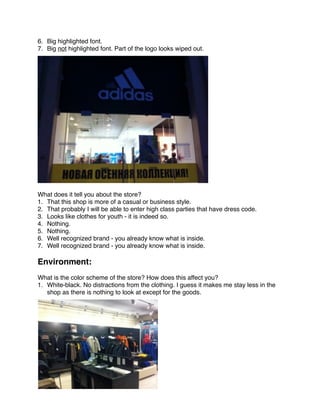
7. Police-like looking stripe saying “New Collection” draw the attention - it is always
    nice to see new stuff from well established brands like adidas. From the other side
    Adidas needs little effort to attract customers as it is well established brand.
 
Is the door open or closed?
1. Open
2. Open
3. Open
4. Open
5. Closed
6. Closed
7. Closed
 
How does this make you feel?
1. It is easy to access but there in no magic about entering the store.
2. The same as #1
3. The same as #1
4. The same as #1
5. I like when doors into the store are closed. It feels like you get to discover the store
   yourself not like following some marking plan.
6. The same as #5
7. The same as #5
 
How big is the sign lettering and in what font?
1. Not big single color highlighted font


2. Big highlighted font.
3. Big highlighted red font.


4. Big not highlighted - boring.


5. Small not highlighted font, only in Belorussian language.
6. Big highlighted font.
7. Big not highlighted font. Part of the logo looks wiped out.


What does it tell you about the store?
1. That this shop is more of a casual or business style.
2. That probably I will be able to enter high class parties that have dress code.
3. Looks like clothes for youth - it is indeed so.
4. Nothing.
5. Nothing.
6. Well recognized brand - you already know what is inside.
7. Well recognized brand - you already know what is inside.
 
Environment:
 
What is the color scheme of the store? How does this affect you?
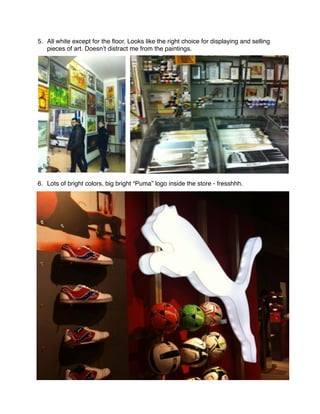
1. White-black. No distractions from the clothing. I guess it makes me stay less in the
   shop as there is nothing to look at except for the goods.
2. White, black, grey - pretty much the same as #1.


3. Multi-colored walls more colors and design features used than in previous 2 stores.
   Makes you stay longer in the shop to look at the design solutions as well. On the
   negative side such approach distracts you from shopping.


4. Has a bit more colors than #1 and #2 but basically feels the same.
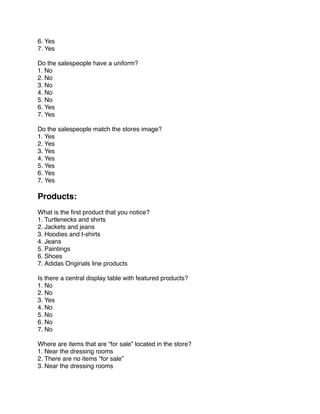
5. All white except for the floor. Looks like the right choice for displaying and selling
   pieces of art. Doesn’t distract me from the paintings.


6. Lots of bright colors, big bright “Puma” logo inside the store - fresshhh.
7. White with different sections painted in different colors. Makes it easier to find what
   you are looking for.


What type of floor does the store have? How does this effect the environment?
1. Ceramic tiles - looks stylish white. Fits the overall store environment.
2. The same as #1
3. Ceramic tiles black and wood, wood is fake and I don't like it.
4. The same as #1
5. Milk-and-coffee colored tiles. Fits the environment, nothing special.
6. Large dark grey ceramic tiles, fits nicely with black walls.
7. White ceramic tiles. Nothing special.
 
How high is the ceiling? How does this feel?
1. Ceiling is high enough not to pay attention to it. Not much to tell about.
2. The same here.
3. Ceiling is high and stylish with lights similar to photo studio - creative.
4. The same as #1.
5. Very high to hang as many drawings as possible. Feels good - it is nice to have
   bigger vertical space.
6. Lower hanging black-colored ceiling. Not that much space but still comfortable.


7. High ceiling, nothing special as the store is quite big itself.
 
How brightly lit is the store? How does this affect you?
1. It is bright sometimes a little too bright. Getting tired from bright light hitting the eyes.
2. Bright
3. Bright
4. Bright
5. Bright
6. Not very bright. Lights are spotted more on the goods rather than annoying you by
   hitting your face with the beam of light.
7. Not very bright.
 
How loud is the environment?
1. Not loud
2. Not loud
3. Not loud
4. Loud
5. Very quiet, only thing you can hear is your footsteps and the footsteps of other
   visitors.
6. Not loud
7. Quiet
 
What is causing the noise?
1. Music
2. Music
3. Music
4. Music
5. Only store visitors
6. Music
7. Store visitors and personnel
 
Is there music playing? If so, does it fit the environment?
1. Yes, Yes.
2. Yes. Yes.
3. Yes, Yes.
4. Music better music and louder I can recognize few songs this makes me stay longer.
5. Not playing.
6. Yes, Yes.
7. Not playing, which is strange as Adidas is associated with street culture.
 
Is the store warm or cold?
1. Warm
2. Warm
3. Warm
4. Warm
5. Warm
6. Warm
7. Warm
 
Is the store crowed with merchandise or is it sparse?
1. Sparse
2. Sparse
3. Crowed
4. Crowed
5. Sparse
6. Sparse
7. Sparse
 
Does the store have a distinctive smell?
1. No
2. No
3. No
4. No
5. No
6. No
7. No
 
Where is the cash register located?
1. Facing the exit at the wall you can see it right after you enter the store.
2. Same as #1.
3. To the left of the entrance.
4. To the left of the entrance.
5. At the left wing of the store. Store has left, center, and right wings.
6. At the last room of the store. You have to go through all three areas of the store to
   reach the register and then go back through whole store to exit.
7. To the left of the entrance.
 
How visible is the store security?
1. Not visible at all
2. Not visible at all
3. Not visible at all
4. Not visible at all
5. Not visible at all
6. Not visible at all
7. Not visible at all
 
How long do you want to stay in this store?
1. 5 minutes
2. 10 minutes
3. 10 minutes
4. 5 minutes
5. 20 minutes
6. 15 minutes
7. 7 minutes
 
Does the environment influence the perceived value of the merchandise?
1. Yes
2. Yes
3. Yes
4. Yes
5. No
6. Yes
7. Yes

Personnel:
 
How long does it take before a sales person initiates contact?
1. No contact after 15 minutes
2. No contact
3. No contact
4. No contact
5. No contact
6. No contact
7. No contact
 
Does the salesperson have a script to follow with each customer?
1. Looks like no
2. No
3. No
4. No
5. No
6. No
7. No
Does the salesperson treat different customers differently?
1. No
2. No
3. No
4. No
5. No
6. No
7. No
 
What is the ratio of salespeople to customers?
1. 1:3
2. 1:5
3. 1:7
4. 1:3
5. 1:4
6. 1:4
7. 1:3
 
What age and gender are the employees?
1. Approx. 30 yr. old - females
2. Approx. 30 yr. old - females
3. Approx. 25 yr. old - females
4. Approx. 30 yr. old - females
5. Approx. 40 yr. old - females
6. Approx. 25 yr. old - females
7. Approx. 25 yr. old - females & males
 
Are the salespeople using the store products?
1. Hard to say
2. Hard to say
3. Yes
4. Hard to say
5. No
6. Yes
7. Yes

Do the salespeople have a uniform?
1. No
2. No
3. No
4. No
5. No
6. Yes
7. Yes
 
Do the salespeople match the stores image?
1. Yes
2. Yes
3. Yes
4. Yes
5. Yes
6. Yes
7. Yes
 
Products:
 
What is the first product that you notice?
1. Turtlenecks and shirts
2. Jackets and jeans
3. Hoodies and t-shirts
4. Jeans
5. Paintings
6. Shoes
7. Adidas Originals line products
 
Is there a central display table with featured products?
1. No
2. No
3. Yes
4. No
5. No
6. No
7. No
 
Where are items that are “for sale” located in the store?
1. Near the dressing rooms
2. There are no items “for sale”
3. Near the dressing rooms
4. There are no items “for sale”
5. There are no items “for sale”
6. There are no items “for sale”
7. There are no items “for sale”
 
How are the products arranged? By function?  By price? By color?
1. By function and by gender
2. By function and by gender
3. By function, by gender, and by “for sale” items
4. By function
5. By function
6. By collection
7. By collection
 
Are there free samples or demonstrations?
1. No
2. No
3. No
4. No
5. No
6. No
7. No

What products are at eye level?
1. More expensive ones.
2. Basically every product is lifted to the eye level except for accessories that reside on
   the lower shelves.
3. More expensive ones.
4. More expensive ones.
5. Same as the ones that are not at the eye level.
6. Different products, cannot provide certain category.
7. Different products, cannot provide certain category.
 
What items in the store are in the least accessible locations?
1. Accessories
2. Accessories and watches
3. “For sale” items.
4. Accessories
5. Paint and instruments for painting.
6. Accessories
7. Accessories
 
Where are the most and least expensive products located?
1. Most - at the walls, least - at the cash register.
2. Most - at the closes right and left stands form the entrance. Least - at the cash
   register.
3. Most - at the walls, least - at the cash register.
4. Most - at the walls, least - at the cash register.
5. Hard to tell - products location is not depending on the price.
6. Least - by the cash register. Other locations seem not to be depending on the price.
7. Least - by the cash register. Other locations seem not to be depending on the price.
 
Are the prices of the products easy to find?
1. Yes
2. Yes
3. Yes
4. Yes
5. Yes
6. Yes
7. Yes
 
Are there impulse items near the cash register?
1. Yes
 
 
Customers:
 
Are most customers alone or with someone else? What is the relationship?
 1. With someone
What is the average age and gender of the customers?
 1. 25-40
When a customer enters the store, do they tend to walk in the same path or direction? -  
1. No
 
How long do customers stay in the store, on average?
1. 5-7 minutes
 
Do customer touch the products? Is this encouraged?
1. Yes, No
2. Yes, No
3. Yes, Yes
4. Yes, No
5. No, No
6. Yes, Yes
7. Yes, Yes
 
Do most customers appear to be on a mission or are they browsing?
1. Browsing
2. Browsing
3. Browsing
4. Browsing
5. Browsing
6. Browsing
7. Browsing
 
What percent of customers purchase products in the store?
1. 30%
2. 10%
3. 20%
4. 0%
5. 0%
6. 20%
7. 0%
(During my stay indoors)


Other Observations:
1. Mist of the stores are built using similar principals. This is a bit sad - It feels like in one
   hundred years everyone will look the same. Globalization plays hard on smaller
   cultures and they vanish making all shops lookalike and use the same marketing
   ideas to attract customers. I would definitely add something that s not seen in the
   stores in other countries.
2. Observation shows that lots of people are just browsing the products. Which means
   that they don’t really have enough money to buy what they need or want and they are
   searching for a compromise between quality and price.
3. Improvement could be made by better learning your customers - what they like and
   what the are used to. It is necessary to understand the habits of your customers. For
   example one shop made me stay there longer just because I heard one of the songs I
   liked and it was playing louder than in the other stores.

Creative assignment2

  • 1.
    Stores: 1. Sisley 2. DressCode 3. House 4. LTB 5. Art Gallery 6. Puma 7. Adidas     Before you enter the store:   Does the store draw you in? If so, how? 1. Didn't draw in as there were no items to attract customer’s. So unless you are looking for this exact brand then there is nothing to attract you from outside. 2. Yes, the store has large logos of the brands that they are selling printed at the entrance walls. Recognizing several brands that I like drew my attention. 3. Bright color clothes displayed at the windows of the shop drew my attention as well as elements of the design that are seen through the windows, e.g. bright yellow brick wall. 4. Didn’t draw in. Simply displaying few clothes of the brand at the sop’s window is clearly not enough. 5. No. Plain entrance, there isn’t even a translation for the store’s name in case if tourists will be passing by - very poor entrance execution. 6. Glowing bright colors (orange and white) attract customers, especially this works well in the evening. 7. Police-like looking stripe saying “New Collection” draw the attention - it is always nice to see new stuff from well established brands like adidas. From the other side Adidas needs little effort to attract customers as it is well established brand.   Is the door open or closed? 1. Open 2. Open 3. Open 4. Open 5. Closed 6. Closed 7. Closed   How does this make you feel? 1. It is easy to access but there in no magic about entering the store. 2. The same as #1 3. The same as #1 4. The same as #1
  • 2.
    5. I likewhen doors into the store are closed. It feels like you get to discover the store yourself not like following some marking plan. 6. The same as #5 7. The same as #5   How big is the sign lettering and in what font? 1. Not big single color highlighted font 2. Big highlighted font.
  • 3.
    3. Big highlightedred font. 4. Big not highlighted - boring. 5. Small not highlighted font, only in Belorussian language.
  • 4.
    6. Big highlightedfont. 7. Big not highlighted font. Part of the logo looks wiped out.   What does it tell you about the store? 1. That this shop is more of a casual or business style. 2. That probably I will be able to enter high class parties that have dress code. 3. Looks like clothes for youth - it is indeed so. 4. Nothing. 5. Nothing. 6. Well recognized brand - you already know what is inside. 7. Well recognized brand - you already know what is inside.   Environment:   What is the color scheme of the store? How does this affect you? 1. White-black. No distractions from the clothing. I guess it makes me stay less in the shop as there is nothing to look at except for the goods.
  • 5.
    2. White, black,grey - pretty much the same as #1. 3. Multi-colored walls more colors and design features used than in previous 2 stores. Makes you stay longer in the shop to look at the design solutions as well. On the negative side such approach distracts you from shopping. 4. Has a bit more colors than #1 and #2 but basically feels the same.
  • 6.
    5. All whiteexcept for the floor. Looks like the right choice for displaying and selling pieces of art. Doesn’t distract me from the paintings. 6. Lots of bright colors, big bright “Puma” logo inside the store - fresshhh.
  • 7.
    7. White withdifferent sections painted in different colors. Makes it easier to find what you are looking for.   What type of floor does the store have? How does this effect the environment? 1. Ceramic tiles - looks stylish white. Fits the overall store environment. 2. The same as #1 3. Ceramic tiles black and wood, wood is fake and I don't like it. 4. The same as #1 5. Milk-and-coffee colored tiles. Fits the environment, nothing special. 6. Large dark grey ceramic tiles, fits nicely with black walls. 7. White ceramic tiles. Nothing special.   How high is the ceiling? How does this feel? 1. Ceiling is high enough not to pay attention to it. Not much to tell about. 2. The same here. 3. Ceiling is high and stylish with lights similar to photo studio - creative.
  • 8.
    4. The sameas #1. 5. Very high to hang as many drawings as possible. Feels good - it is nice to have bigger vertical space. 6. Lower hanging black-colored ceiling. Not that much space but still comfortable. 7. High ceiling, nothing special as the store is quite big itself.   How brightly lit is the store? How does this affect you? 1. It is bright sometimes a little too bright. Getting tired from bright light hitting the eyes. 2. Bright 3. Bright 4. Bright 5. Bright 6. Not very bright. Lights are spotted more on the goods rather than annoying you by hitting your face with the beam of light. 7. Not very bright.   How loud is the environment? 1. Not loud 2. Not loud 3. Not loud 4. Loud 5. Very quiet, only thing you can hear is your footsteps and the footsteps of other visitors.
  • 9.
    6. Not loud 7.Quiet   What is causing the noise? 1. Music 2. Music 3. Music 4. Music 5. Only store visitors 6. Music 7. Store visitors and personnel   Is there music playing? If so, does it fit the environment? 1. Yes, Yes. 2. Yes. Yes. 3. Yes, Yes. 4. Music better music and louder I can recognize few songs this makes me stay longer. 5. Not playing. 6. Yes, Yes. 7. Not playing, which is strange as Adidas is associated with street culture.   Is the store warm or cold? 1. Warm 2. Warm 3. Warm 4. Warm 5. Warm 6. Warm 7. Warm   Is the store crowed with merchandise or is it sparse? 1. Sparse 2. Sparse 3. Crowed 4. Crowed 5. Sparse 6. Sparse 7. Sparse   Does the store have a distinctive smell? 1. No 2. No 3. No 4. No 5. No 6. No
  • 10.
    7. No   Where isthe cash register located? 1. Facing the exit at the wall you can see it right after you enter the store. 2. Same as #1. 3. To the left of the entrance. 4. To the left of the entrance. 5. At the left wing of the store. Store has left, center, and right wings. 6. At the last room of the store. You have to go through all three areas of the store to reach the register and then go back through whole store to exit. 7. To the left of the entrance.   How visible is the store security? 1. Not visible at all 2. Not visible at all 3. Not visible at all 4. Not visible at all 5. Not visible at all 6. Not visible at all 7. Not visible at all   How long do you want to stay in this store? 1. 5 minutes 2. 10 minutes 3. 10 minutes 4. 5 minutes 5. 20 minutes 6. 15 minutes 7. 7 minutes   Does the environment influence the perceived value of the merchandise? 1. Yes 2. Yes 3. Yes 4. Yes 5. No 6. Yes 7. Yes Personnel:   How long does it take before a sales person initiates contact? 1. No contact after 15 minutes 2. No contact 3. No contact
  • 11.
    4. No contact 5.No contact 6. No contact 7. No contact   Does the salesperson have a script to follow with each customer? 1. Looks like no 2. No 3. No 4. No 5. No 6. No 7. No Does the salesperson treat different customers differently? 1. No 2. No 3. No 4. No 5. No 6. No 7. No   What is the ratio of salespeople to customers? 1. 1:3 2. 1:5 3. 1:7 4. 1:3 5. 1:4 6. 1:4 7. 1:3   What age and gender are the employees? 1. Approx. 30 yr. old - females 2. Approx. 30 yr. old - females 3. Approx. 25 yr. old - females 4. Approx. 30 yr. old - females 5. Approx. 40 yr. old - females 6. Approx. 25 yr. old - females 7. Approx. 25 yr. old - females & males   Are the salespeople using the store products? 1. Hard to say 2. Hard to say 3. Yes 4. Hard to say 5. No
  • 12.
    6. Yes 7. Yes Dothe salespeople have a uniform? 1. No 2. No 3. No 4. No 5. No 6. Yes 7. Yes   Do the salespeople match the stores image? 1. Yes 2. Yes 3. Yes 4. Yes 5. Yes 6. Yes 7. Yes   Products:   What is the first product that you notice? 1. Turtlenecks and shirts 2. Jackets and jeans 3. Hoodies and t-shirts 4. Jeans 5. Paintings 6. Shoes 7. Adidas Originals line products   Is there a central display table with featured products? 1. No 2. No 3. Yes 4. No 5. No 6. No 7. No   Where are items that are “for sale” located in the store? 1. Near the dressing rooms 2. There are no items “for sale” 3. Near the dressing rooms
  • 13.
    4. There areno items “for sale” 5. There are no items “for sale” 6. There are no items “for sale” 7. There are no items “for sale”   How are the products arranged? By function?  By price? By color? 1. By function and by gender 2. By function and by gender 3. By function, by gender, and by “for sale” items 4. By function 5. By function 6. By collection 7. By collection   Are there free samples or demonstrations? 1. No 2. No 3. No 4. No 5. No 6. No 7. No What products are at eye level? 1. More expensive ones. 2. Basically every product is lifted to the eye level except for accessories that reside on the lower shelves. 3. More expensive ones. 4. More expensive ones. 5. Same as the ones that are not at the eye level. 6. Different products, cannot provide certain category. 7. Different products, cannot provide certain category.   What items in the store are in the least accessible locations? 1. Accessories 2. Accessories and watches 3. “For sale” items. 4. Accessories 5. Paint and instruments for painting. 6. Accessories 7. Accessories   Where are the most and least expensive products located? 1. Most - at the walls, least - at the cash register. 2. Most - at the closes right and left stands form the entrance. Least - at the cash register.
  • 14.
    3. Most -at the walls, least - at the cash register. 4. Most - at the walls, least - at the cash register. 5. Hard to tell - products location is not depending on the price. 6. Least - by the cash register. Other locations seem not to be depending on the price. 7. Least - by the cash register. Other locations seem not to be depending on the price.   Are the prices of the products easy to find? 1. Yes 2. Yes 3. Yes 4. Yes 5. Yes 6. Yes 7. Yes   Are there impulse items near the cash register? 1. Yes     Customers:   Are most customers alone or with someone else? What is the relationship?  1. With someone What is the average age and gender of the customers?  1. 25-40 When a customer enters the store, do they tend to walk in the same path or direction? -   1. No   How long do customers stay in the store, on average? 1. 5-7 minutes   Do customer touch the products? Is this encouraged? 1. Yes, No 2. Yes, No 3. Yes, Yes 4. Yes, No 5. No, No 6. Yes, Yes 7. Yes, Yes   Do most customers appear to be on a mission or are they browsing? 1. Browsing 2. Browsing 3. Browsing 4. Browsing
  • 15.
    5. Browsing 6. Browsing 7.Browsing   What percent of customers purchase products in the store? 1. 30% 2. 10% 3. 20% 4. 0% 5. 0% 6. 20% 7. 0% (During my stay indoors) Other Observations: 1. Mist of the stores are built using similar principals. This is a bit sad - It feels like in one hundred years everyone will look the same. Globalization plays hard on smaller cultures and they vanish making all shops lookalike and use the same marketing ideas to attract customers. I would definitely add something that s not seen in the stores in other countries. 2. Observation shows that lots of people are just browsing the products. Which means that they don’t really have enough money to buy what they need or want and they are searching for a compromise between quality and price. 3. Improvement could be made by better learning your customers - what they like and what the are used to. It is necessary to understand the habits of your customers. For example one shop made me stay there longer just because I heard one of the songs I liked and it was playing louder than in the other stores.