The document describes views in a database, including how to create, modify, retrieve data from, and remove views. It also discusses rules for performing data manipulation operations on views and examples of inline views and top-N analysis queries.
Objectives Aftercompleting this lesson, you should be able to do the following: " Describe a view " Create, alter the definition of, and drop a view " Retrieve data through a view " Insert, update, and delete data through a view " Create and use an inline view " Perform ³Top-N´ analysis http://ecomputernotes.com
3.
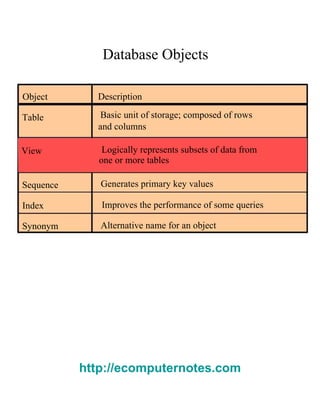
Database Objects Object Description Basic unit of storage; composed of rows Table and columns View Logically represents subsets of data from one or more tables Sequence Generates primary key values Index Improves the performance of some queries Synonym Alternative name for an object http://ecomputernotes.com
4.
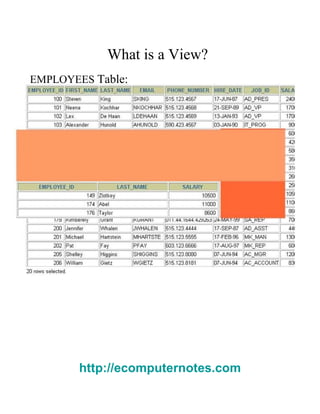
What is aView? EMPLOYEES Table: http://ecomputernotes.com
5.
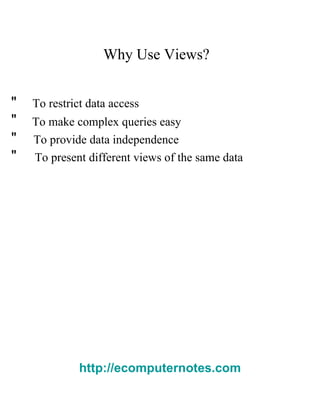
Why Use Views? " To restrict data access " To make complex queries easy " To provide data independence " To present different views of the same data http://ecomputernotes.com
6.
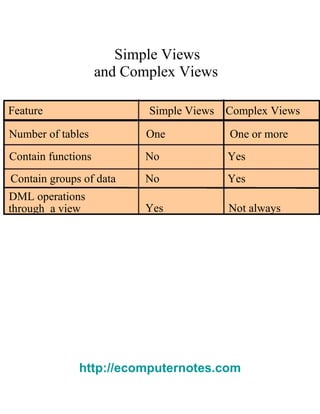
Simple Views and Complex Views Feature Simple Views Complex Views Number of tables One One or more Contain functions No Yes Contain groups of data No Yes DML operations through a view Yes Not always http://ecomputernotes.com
7.
Creating a View "Y ou embed a subquery within the C REATE VIEW s tatement. CREATE [OR REPLACE] [FORCE|NOFORCE] VIEW view [( alias [, alias ]...) ] AS subquery [WITH CHECK OPTION [CONSTRAINT constraint ]] [WITH READ ONLY [CONSTRAINT constraint ]]; "T he subquery can contain complex S ELECT syntax. http://ecomputernotes.com
8.
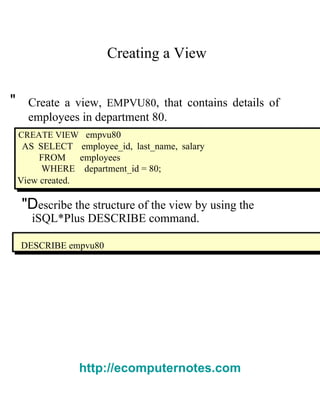
Creating a View " Create a view, EMPVU80 , that contains details of employees in department 80. CREATE VIEW empvu80 AS SELECT employee_id, last_name, salary FROM employees WHERE department_id = 80; View created. "D escribe the structure of the view by using the i SQL*Plus DESCRIBE command. DESCRIBE empvu80 http://ecomputernotes.com
9.
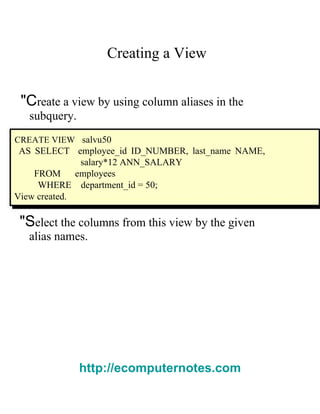
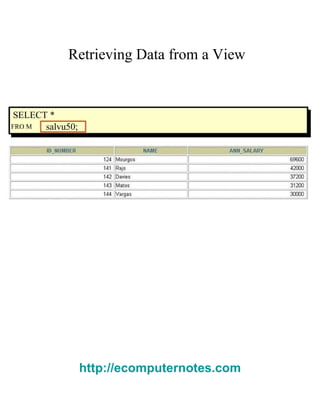
Creating a View "C reate a view by using column aliases in the subquery. CREATE VIEW salvu50 AS SELECT employee_id ID_NUMBER, last_name NAME, salary*12 ANN_SALARY FROM employees WHERE department_id = 50; View created. "S elect the columns from this view by the given alias names. http://ecomputernotes.com
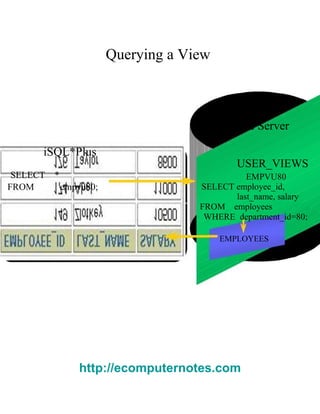
Querying a View Oracle Server i SQL*Plus USER_VIEWS SELECT * EMPVU80 FROM empvu80; SELECT employee_id, last_name, salary FROM employees WHERE department_id=80; EMPLOYEES http://ecomputernotes.com
12.
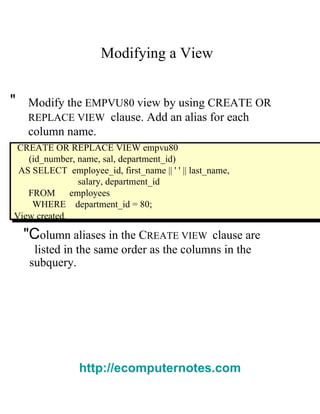
Modifying a View " Modify the EMPVU80 view by using CREATE OR REPLACE VIEW clause. Add an alias for each column name. CREATE OR REPLACE VIEW empvu80 (id_number, name, sal, department_id) AS SELECT employee_id, first_name || ' ' || last_name, salary, department_id FROM employees WHERE department_id = 80; View created. "C olumn aliases in the C REATE VIEW clause are listed in the same order as the columns in the subquery. http://ecomputernotes.com
13.
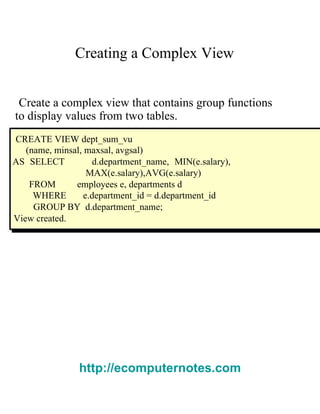
Creating a ComplexView Create a complex view that contains group functions to display values from two tables. CREATE VIEW dept_sum_vu (name, minsal, maxsal, avgsal) AS SELECT d.department_name, MIN(e.salary), MAX(e.salary),AVG(e.salary) FROM employees e, departments d WHERE e.department_id = d.department_id GROUP BY d.department_name; View created. http://ecomputernotes.com
14.
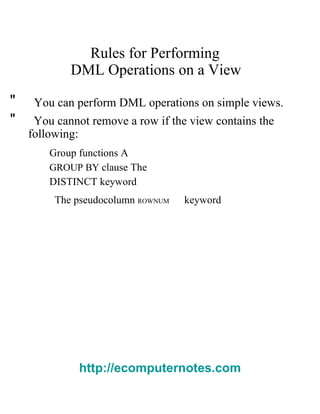
Rules for Performing DML Operations on a View " You can perform DML operations on simple views. " You cannot remove a row if the view contains the following: Group functions A GROUP BY clause The DISTINCT keyword The pseudocolumn ROWNUM keyword http://ecomputernotes.com
15.
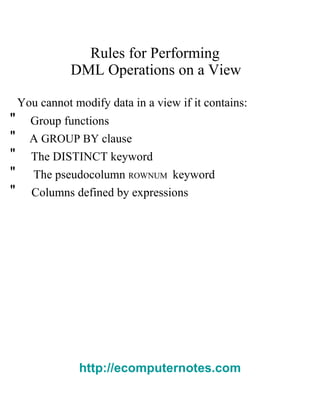
Rules for Performing DML Operations on a View You cannot modify data in a view if it contains: " Group functions " A GROUP BY clause " The DISTINCT keyword " The pseudocolumn ROWNUM keyword " Columns defined by expressions http://ecomputernotes.com
16.
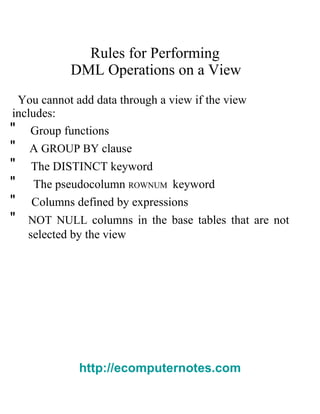
Rules for Performing DML Operations on a View You cannot add data through a view if the view includes: " Group functions " A GROUP BY clause " The DISTINCT keyword " The pseudocolumn ROWNUM keyword " Columns defined by expressions " NOT NULL columns in the base tables that are not selected by the view http://ecomputernotes.com
17.
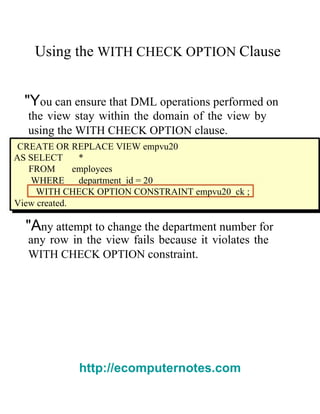
Using the WITH CHECK OPTION Clause "Y ou can ensure that DML operations performed on the view stay within the domain of the view by using the WITH CHECK OPTION clause. CREATE OR REPLACE VIEW empvu20 AS SELECT * FROM employees WHERE department_id = 20 WITH CHECK OPTION CONSTRAINT empvu20_ck ; View created. "A ny attempt to change the department number for any row in the view fails because it violates the WITH CHECK OPTION constraint. http://ecomputernotes.com
18.
Denying DML Operations "Y ou can ensure that no DML operations occur by adding the WITH READ ONLY option to your view definition. "A ny attempt to perform a DML on any row in the view results in an Oracle server error. http://ecomputernotes.com
19.
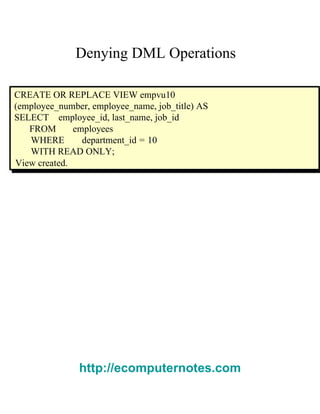
Denying DML Operations CREATE OR REPLACE VIEW empvu10 (employee_number, employee_name, job_title) AS SELECT employee_id, last_name, job_id FROM employees WHERE department_id = 10 WITH READ ONLY; View created. http://ecomputernotes.com
20.
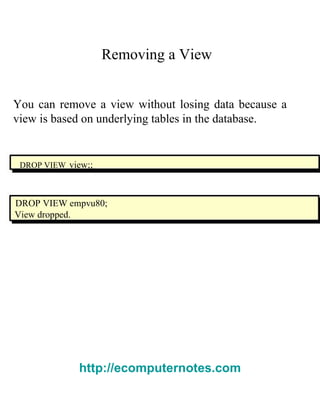
Removing a View You can remove a view without losing data because a view is based on underlying tables in the database. DROP VIEW view ;; DROP VIEW empvu80; View dropped. http://ecomputernotes.com
21.
Inline Views " An inline view is a subquery with an alias (or correlation name) that you can use within a SQL statement. " A named subquery in the FROM clause of the main query is an example of an inline view. " An inline view is not a schema object. http://ecomputernotes.com
22.
Top-N Analysis "T op-N queries ask for the n l argest or smallest values of a column. For example: What are the ten best selling products? " What are the ten worst selling products? Both largest values and smallest values sets are considered Top-N queries. http://ecomputernotes.com
23.
Performing Top-N Analysis The high-level structure of a Top-N analysis query is: SELECT [ column_list ], ROWNUM FROM (SELECT [ column_list ] FROM table ORDER BY Top-N_column) WHERE ROWNUM <= N; http://ecomputernotes.com
24.
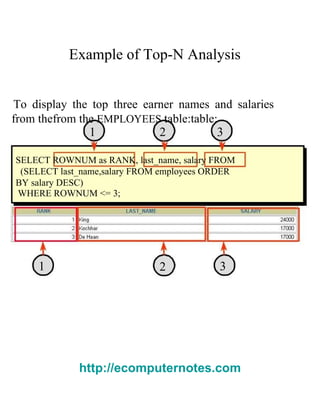
Example of Top-NAnalysis To display the top three earner names and salaries from thefrom the EMPLOYEES table:table: 1 2 3 SELECT ROWNUM as RANK, last_name, salary FROM (SELECT last_name,salary FROM employees ORDER BY salary DESC) WHERE ROWNUM <= 3; 1 2 3 http://ecomputernotes.com
![Creating a View "Y ou embed a subquery within the C REATE VIEW s tatement. CREATE [OR REPLACE] [FORCE|NOFORCE] VIEW view [( alias [, alias ]...) ] AS subquery [WITH CHECK OPTION [CONSTRAINT constraint ]] [WITH READ ONLY [CONSTRAINT constraint ]]; "T he subquery can contain complex S ELECT syntax. http://ecomputernotes.com](https://image.slidesharecdn.com/creatingviews-111224104723-phpapp02/85/e-computer-notes-Creating-views-7-320.jpg)
![Performing Top-N Analysis The high-level structure of a Top-N analysis query is: SELECT [ column_list ], ROWNUM FROM (SELECT [ column_list ] FROM table ORDER BY Top-N_column) WHERE ROWNUM <= N; http://ecomputernotes.com](https://image.slidesharecdn.com/creatingviews-111224104723-phpapp02/85/e-computer-notes-Creating-views-23-320.jpg)


![Les12[1]Creating Views](https://cdn.slidesharecdn.com/ss_thumbnails/les121-220214152453-thumbnail.jpg?width=640&height=640&fit=bounds)


