High Availability and PostgreSQL
Fujitsu Coffee Morning — July 28th, 2006
                 Gavin Sherry
              gavin@alcove.com.au


                                    High Availability and PostgreSQL – p.
What is high availability?
A system to reduce application down time
Usually consists of
  Master server(s)
  Slave server(s)
  Software to detect the failure of a master
  Software to promote a slave to master status
  Software or hardware to ensure data consistency
  between the master(s) and slave(s)
Sometimes technologies provide HA incidentally (more
later)


                                            High Availability and PostgreSQL – p.
What high availability is not
... a mechanism to increase performance
       Usually HA comes at the price of performance
... a way to simplify your network
... cheap
... easy to implement


                                                High Availability and PostgreSQL – p.
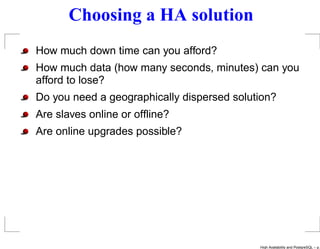
Choosing a HA solution
How much down time can you afford?
How much data (how many seconds, minutes) can you
afford to lose?
Do you need a geographically dispersed solution?
Are slaves online or offline?
Are online upgrades possible?


                                            High Availability and PostgreSQL – p.
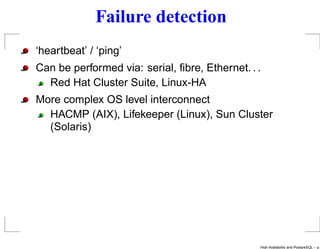
Failure detection
‘heartbeat’ / ‘ping’
Can be performed via: serial, fibre, Ethernet. . .
  Red Hat Cluster Suite, Linux-HA
More complex OS level interconnect
  HACMP (AIX), Lifekeeper (Linux), Sun Cluster
  (Solaris)


                                                High Availability and PostgreSQL – p.
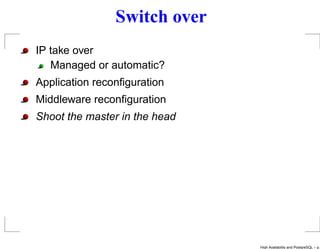
Switch over
IP take over
   Managed or automatic?
Application reconfiguration
Middleware reconfiguration
Shoot the master in the head


                               High Availability and PostgreSQL – p.
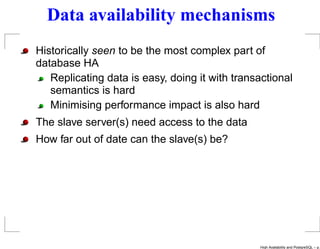
Data availability mechanisms
Historically seen to be the most complex part of
database HA
   Replicating data is easy, doing it with transactional
   semantics is hard
   Minimising performance impact is also hard
The slave server(s) need access to the data
How far out of date can the slave(s) be?


                                                High Availability and PostgreSQL – p.
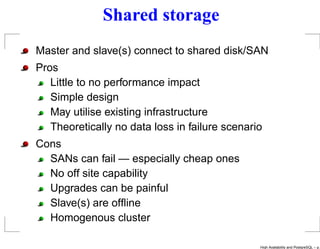
Shared storage
Master and slave(s) connect to shared disk/SAN
Pros
   Little to no performance impact
   Simple design
   May utilise existing infrastructure
   Theoretically no data loss in failure scenario
Cons
  SANs can fail — especially cheap ones
  No off site capability
  Upgrades can be painful
  Slave(s) are offline
  Homogenous cluster

                                                High Availability and PostgreSQL – p.
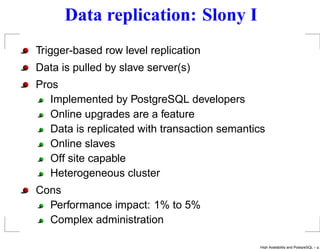
Data replication: Slony I
Trigger-based row level replication
Data is pulled by slave server(s)
Pros
   Implemented by PostgreSQL developers
   Online upgrades are a feature
   Data is replicated with transaction semantics
   Online slaves
   Off site capable
   Heterogeneous cluster
Cons
  Performance impact: 1% to 5%
  Complex administration

                                              High Availability and PostgreSQL – p.
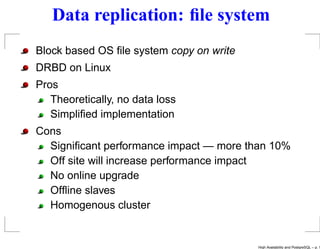
Data replication: file system
Block based OS file system copy on write
DRBD on Linux
Pros
   Theoretically, no data loss
   Simplified implementation
Cons
  Significant performance impact — more than 10%
  Off site will increase performance impact
  No online upgrade
  Offline slaves
  Homogenous cluster


                                          High Availability and PostgreSQL – p. 1
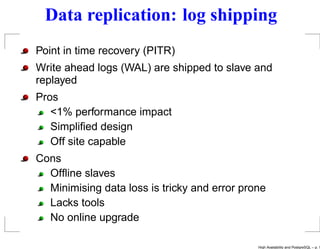
Data replication: log shipping
Point in time recovery (PITR)
Write ahead logs (WAL) are shipped to slave and
replayed
Pros
   <1% performance impact
   Simplified design
   Off site capable
Cons
  Offline slaves
  Minimising data loss is tricky and error prone
  Lacks tools
  No online upgrade

                                              High Availability and PostgreSQL – p. 1
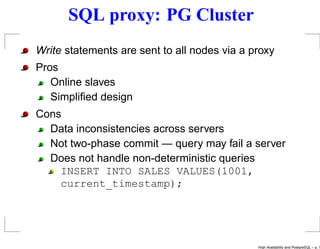
SQL proxy: PG Cluster
Write statements are sent to all nodes via a proxy
Pros
   Online slaves
   Simplified design
Cons
  Data inconsistencies across servers
  Not two-phase commit — query may fail a server
  Does not handle non-deterministic queries
    INSERT INTO SALES VALUES(1001,
    current_timestamp);


                                              High Availability and PostgreSQL – p. 1
SQL proxy: PgPool
Much like PG Cluster
Other cons
   One slave


                             High Availability and PostgreSQL – p. 1
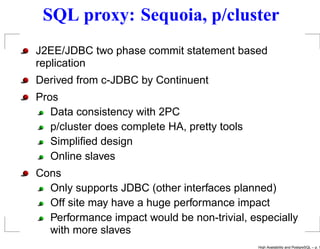
SQL proxy: Sequoia, p/cluster
J2EE/JDBC two phase commit statement based
replication
Derived from c-JDBC by Continuent
Pros
   Data consistency with 2PC
   p/cluster does complete HA, pretty tools
   Simplified design
   Online slaves
Cons
  Only supports JDBC (other interfaces planned)
  Off site may have a huge performance impact
  Performance impact would be non-trivial, especially
  with more slaves
                                              High Availability and PostgreSQL – p. 1
Testing
Test your HA solution(s)
... but thoroughness is hard


                               High Availability and PostgreSQL – p. 1
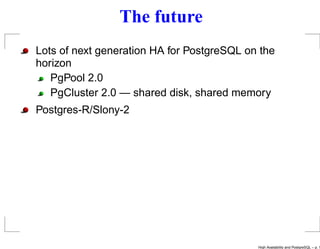
The future
Lots of next generation HA for PostgreSQL on the
horizon
   PgPool 2.0
   PgCluster 2.0 — shared disk, shared memory
Postgres-R/Slony-2


                                            High Availability and PostgreSQL – p. 1
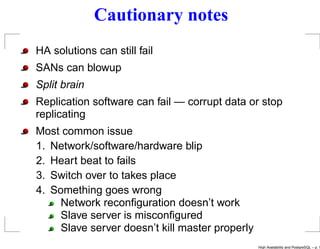
Cautionary notes
HA solutions can still fail
SANs can blowup
Split brain
Replication software can fail — corrupt data or stop
replicating
Most common issue
1. Network/software/hardware blip
2. Heart beat to fails
3. Switch over to takes place
4. Something goes wrong
     Network reconfiguration doesn’t work
     Slave server is misconfigured
     Slave server doesn’t kill master properly
                                                 High Availability and PostgreSQL – p. 1
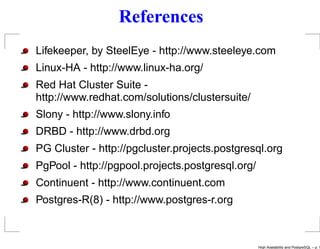
References
Lifekeeper, by SteelEye - http://www.steeleye.com
Linux-HA - http://www.linux-ha.org/
Red Hat Cluster Suite -
http://www.redhat.com/solutions/clustersuite/
Slony - http://www.slony.info
DRBD - http://www.drbd.org
PG Cluster - http://pgcluster.projects.postgresql.org
PgPool - http://pgpool.projects.postgresql.org/
Continuent - http://www.continuent.com
Postgres-R(8) - http://www.postgres-r.org


                                                  High Availability and PostgreSQL – p. 1

Creating customized openSUSE versions with SUSE Studio

  • 1.
    High Availability andPostgreSQL Fujitsu Coffee Morning — July 28th, 2006 Gavin Sherry gavin@alcove.com.au High Availability and PostgreSQL – p.
  • 2.
    What is highavailability? A system to reduce application down time Usually consists of Master server(s) Slave server(s) Software to detect the failure of a master Software to promote a slave to master status Software or hardware to ensure data consistency between the master(s) and slave(s) Sometimes technologies provide HA incidentally (more later) High Availability and PostgreSQL – p.
  • 3.
    What high availabilityis not ... a mechanism to increase performance Usually HA comes at the price of performance ... a way to simplify your network ... cheap ... easy to implement High Availability and PostgreSQL – p.
  • 4.
    Choosing a HAsolution How much down time can you afford? How much data (how many seconds, minutes) can you afford to lose? Do you need a geographically dispersed solution? Are slaves online or offline? Are online upgrades possible? High Availability and PostgreSQL – p.
  • 5.
    Failure detection ‘heartbeat’ /‘ping’ Can be performed via: serial, fibre, Ethernet. . . Red Hat Cluster Suite, Linux-HA More complex OS level interconnect HACMP (AIX), Lifekeeper (Linux), Sun Cluster (Solaris) High Availability and PostgreSQL – p.
  • 6.
    Switch over IP takeover Managed or automatic? Application reconfiguration Middleware reconfiguration Shoot the master in the head High Availability and PostgreSQL – p.
  • 7.
    Data availability mechanisms Historicallyseen to be the most complex part of database HA Replicating data is easy, doing it with transactional semantics is hard Minimising performance impact is also hard The slave server(s) need access to the data How far out of date can the slave(s) be? High Availability and PostgreSQL – p.
  • 8.
    Shared storage Master andslave(s) connect to shared disk/SAN Pros Little to no performance impact Simple design May utilise existing infrastructure Theoretically no data loss in failure scenario Cons SANs can fail — especially cheap ones No off site capability Upgrades can be painful Slave(s) are offline Homogenous cluster High Availability and PostgreSQL – p.
  • 9.
    Data replication: SlonyI Trigger-based row level replication Data is pulled by slave server(s) Pros Implemented by PostgreSQL developers Online upgrades are a feature Data is replicated with transaction semantics Online slaves Off site capable Heterogeneous cluster Cons Performance impact: 1% to 5% Complex administration High Availability and PostgreSQL – p.
  • 10.
    Data replication: filesystem Block based OS file system copy on write DRBD on Linux Pros Theoretically, no data loss Simplified implementation Cons Significant performance impact — more than 10% Off site will increase performance impact No online upgrade Offline slaves Homogenous cluster High Availability and PostgreSQL – p. 1
  • 11.
    Data replication: logshipping Point in time recovery (PITR) Write ahead logs (WAL) are shipped to slave and replayed Pros <1% performance impact Simplified design Off site capable Cons Offline slaves Minimising data loss is tricky and error prone Lacks tools No online upgrade High Availability and PostgreSQL – p. 1
  • 12.
    SQL proxy: PGCluster Write statements are sent to all nodes via a proxy Pros Online slaves Simplified design Cons Data inconsistencies across servers Not two-phase commit — query may fail a server Does not handle non-deterministic queries INSERT INTO SALES VALUES(1001, current_timestamp); High Availability and PostgreSQL – p. 1
  • 13.
    SQL proxy: PgPool Muchlike PG Cluster Other cons One slave High Availability and PostgreSQL – p. 1
  • 14.
    SQL proxy: Sequoia,p/cluster J2EE/JDBC two phase commit statement based replication Derived from c-JDBC by Continuent Pros Data consistency with 2PC p/cluster does complete HA, pretty tools Simplified design Online slaves Cons Only supports JDBC (other interfaces planned) Off site may have a huge performance impact Performance impact would be non-trivial, especially with more slaves High Availability and PostgreSQL – p. 1
  • 15.
    Testing Test your HAsolution(s) ... but thoroughness is hard High Availability and PostgreSQL – p. 1
  • 16.
    The future Lots ofnext generation HA for PostgreSQL on the horizon PgPool 2.0 PgCluster 2.0 — shared disk, shared memory Postgres-R/Slony-2 High Availability and PostgreSQL – p. 1
  • 17.
    Cautionary notes HA solutionscan still fail SANs can blowup Split brain Replication software can fail — corrupt data or stop replicating Most common issue 1. Network/software/hardware blip 2. Heart beat to fails 3. Switch over to takes place 4. Something goes wrong Network reconfiguration doesn’t work Slave server is misconfigured Slave server doesn’t kill master properly High Availability and PostgreSQL – p. 1
  • 18.
    References Lifekeeper, by SteelEye- http://www.steeleye.com Linux-HA - http://www.linux-ha.org/ Red Hat Cluster Suite - http://www.redhat.com/solutions/clustersuite/ Slony - http://www.slony.info DRBD - http://www.drbd.org PG Cluster - http://pgcluster.projects.postgresql.org PgPool - http://pgpool.projects.postgresql.org/ Continuent - http://www.continuent.com Postgres-R(8) - http://www.postgres-r.org High Availability and PostgreSQL – p. 1