






Cracking The Code: How To Think About QR26 October 2010
What we’ll cover:Origins & Early AdoptionEvolution of Proprietary CodesConsiderations & RecommendationsWhat’s Next?
Origins & Early Adoption
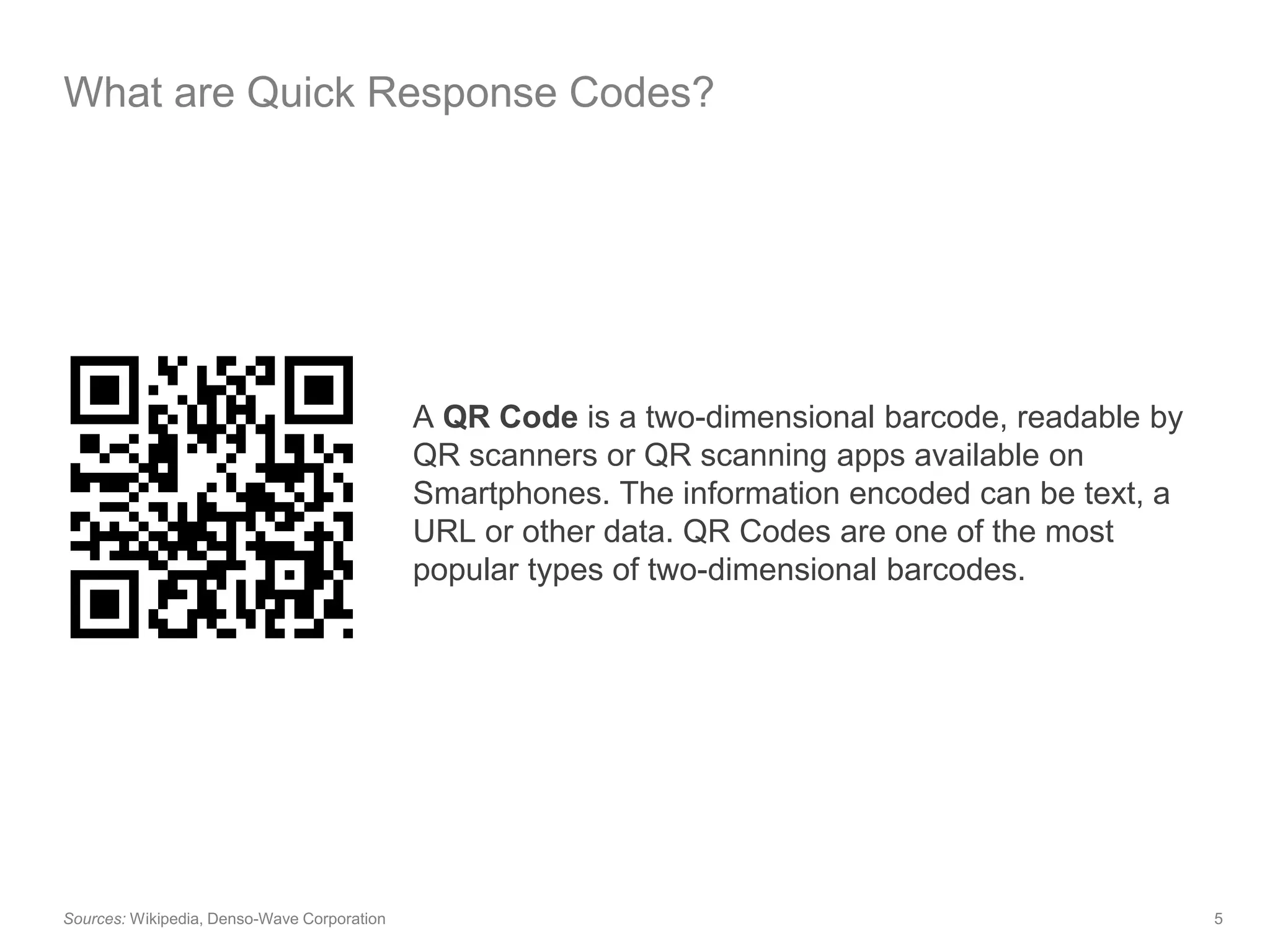
What are Quick Response Codes?A QR Code is a two-dimensional barcode, readable by QR scanners or QR scanning apps available on Smartphones. The information encoded can be text, a URL or other data. QR Codes are one of the most popular types of two-dimensional barcodes.Sources: Wikipedia, Denso-Wave Corporation
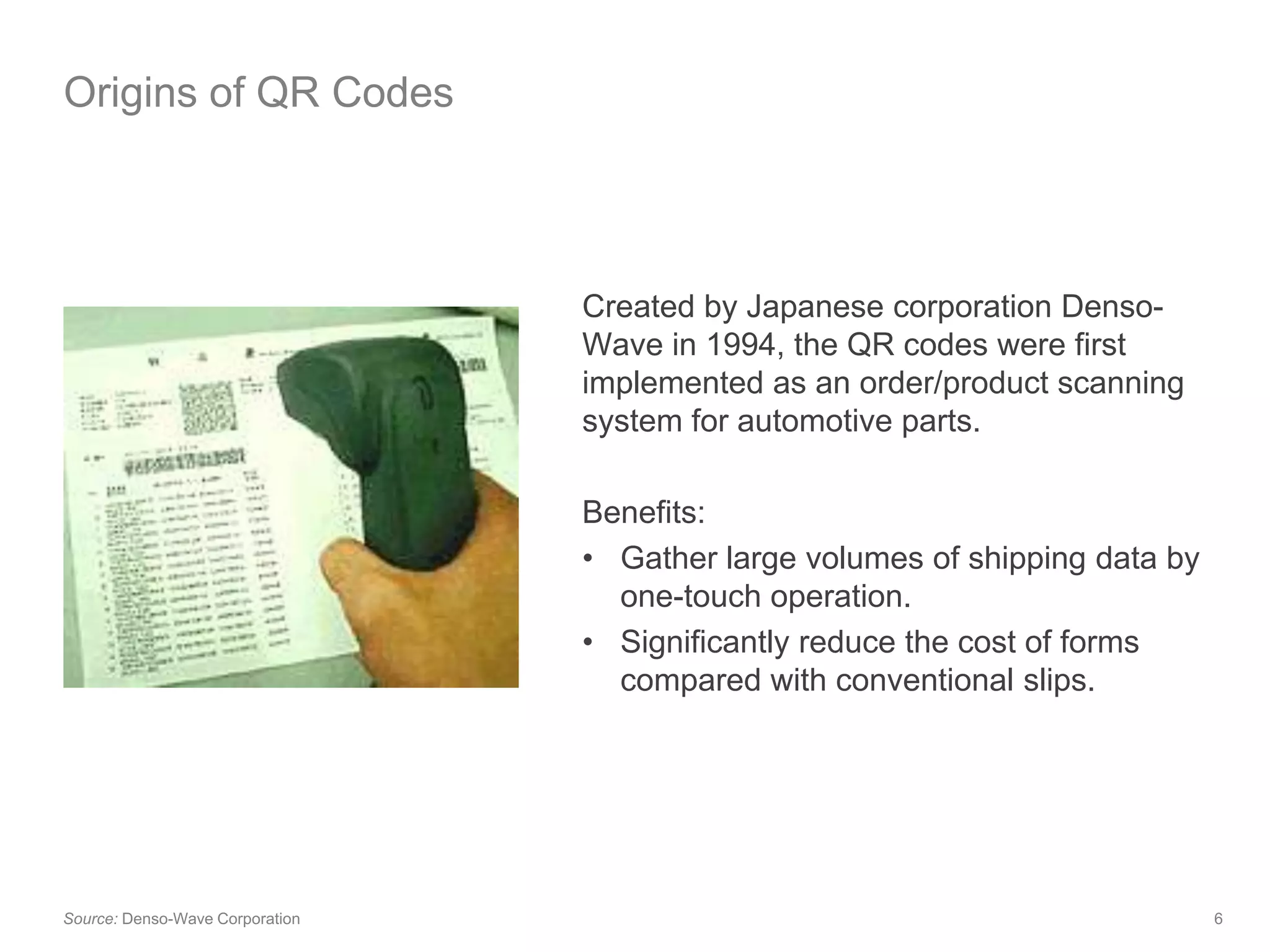
Origins of QR CodesCreated by Japanese corporation Denso-Wave in 1994, the QR codes were first implemented as an order/product scanning system for automotive parts.Benefits:Gather large volumes of shipping data by one-touch operation.
Significantly reduce the cost of forms compared with conventional slips.Source: Denso-Wave Corporation
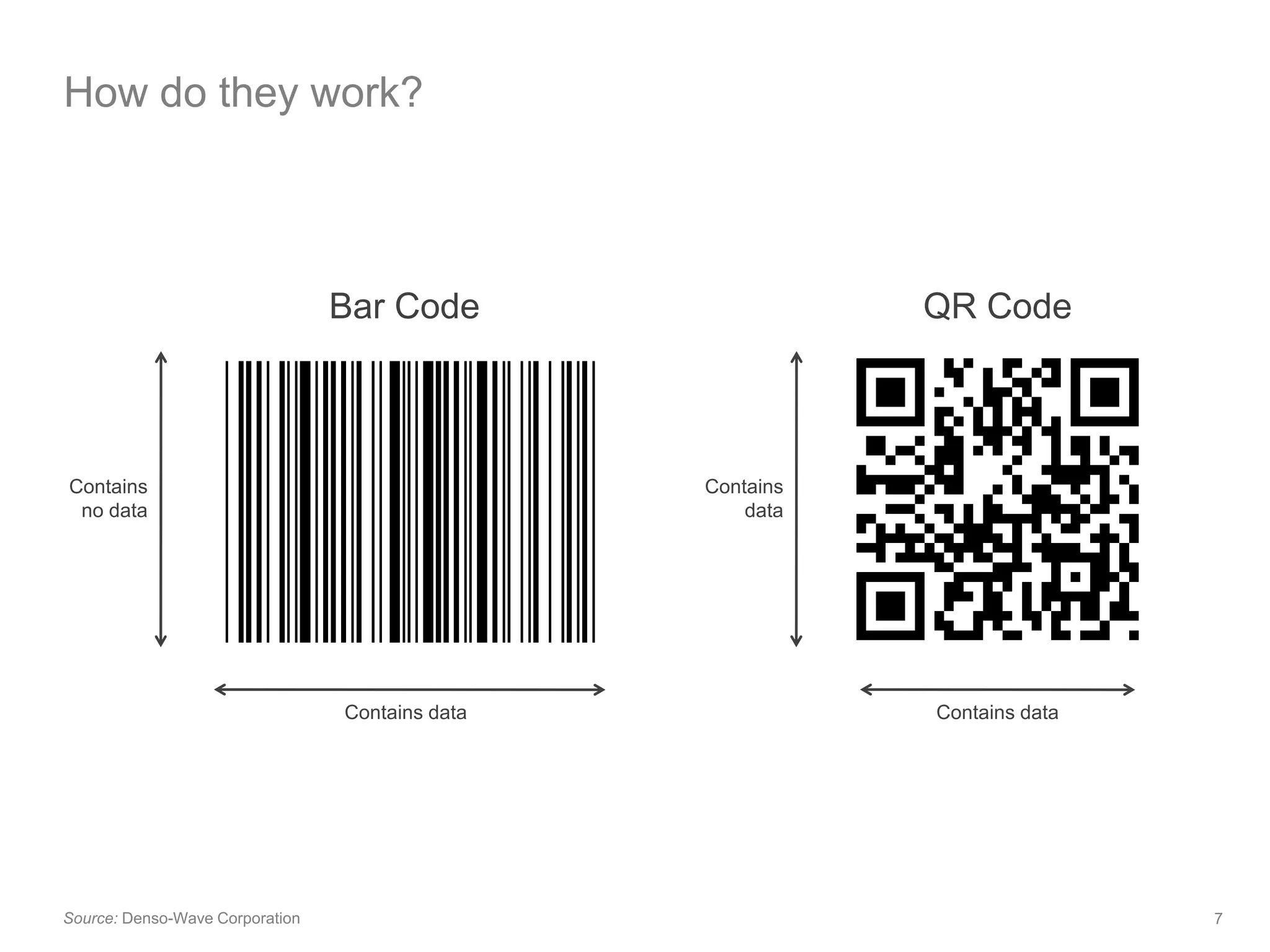
How do they work?QR CodeBar CodeContains dataContains no dataContains dataContains dataSource: Denso-Wave Corporation
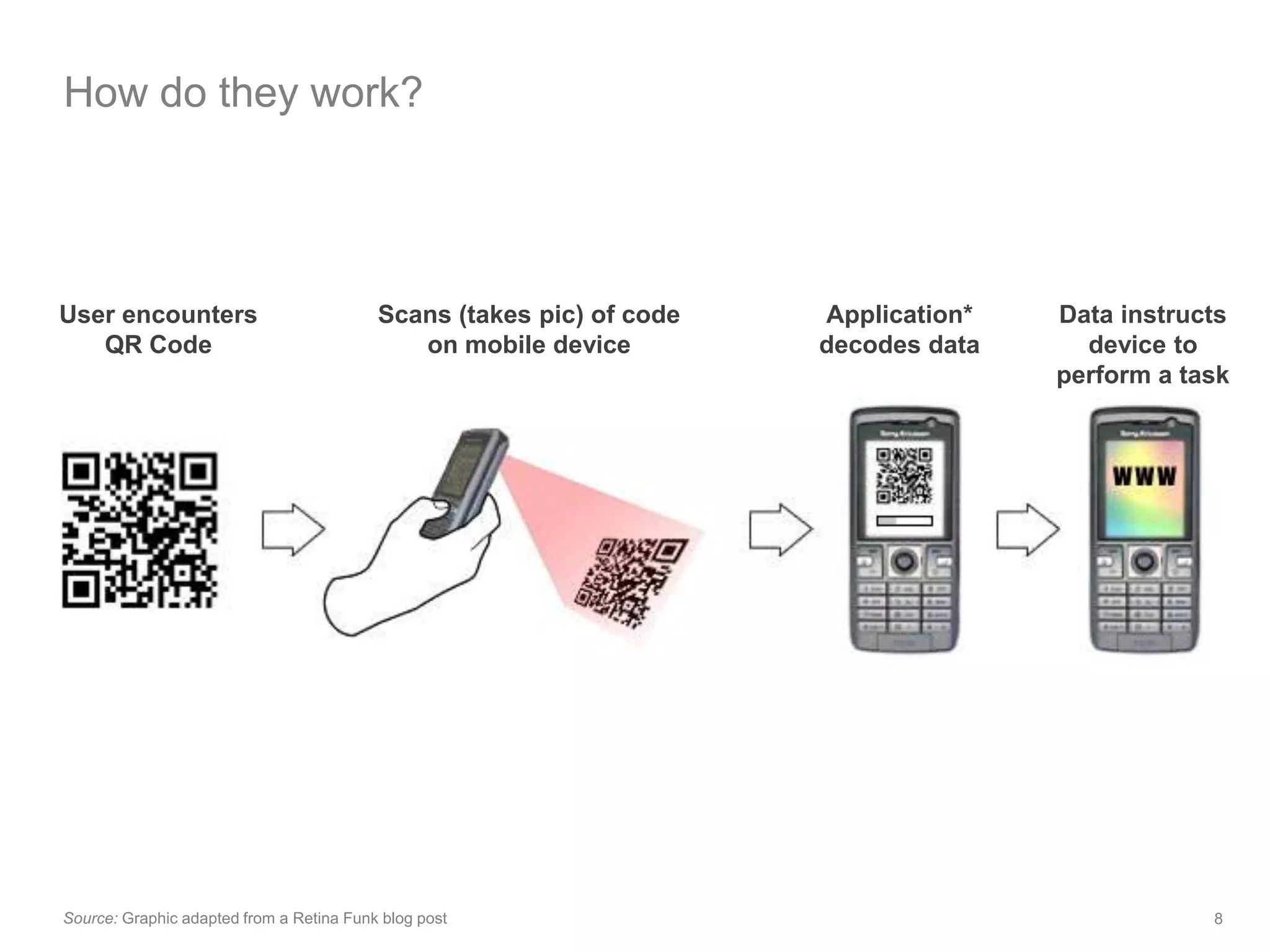
How do they work?Application* decodes dataData instructs device to perform a taskScans (takes pic) of code on mobile deviceUser encounters QR CodeSource: Graphic adapted from a Retina Funk blog post
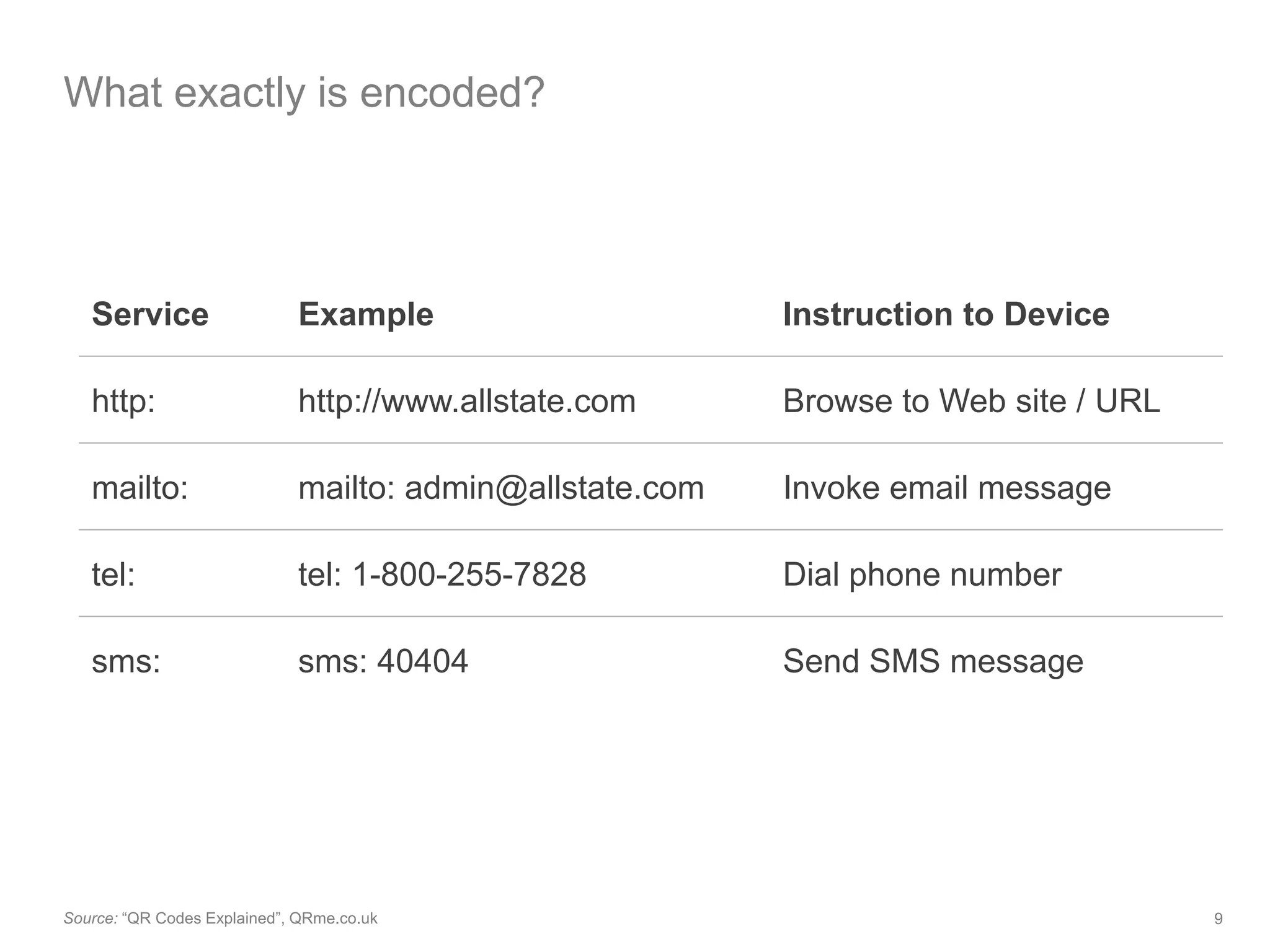
What exactly is encoded?Source: “QR Codes Explained”, QRme.co.uk
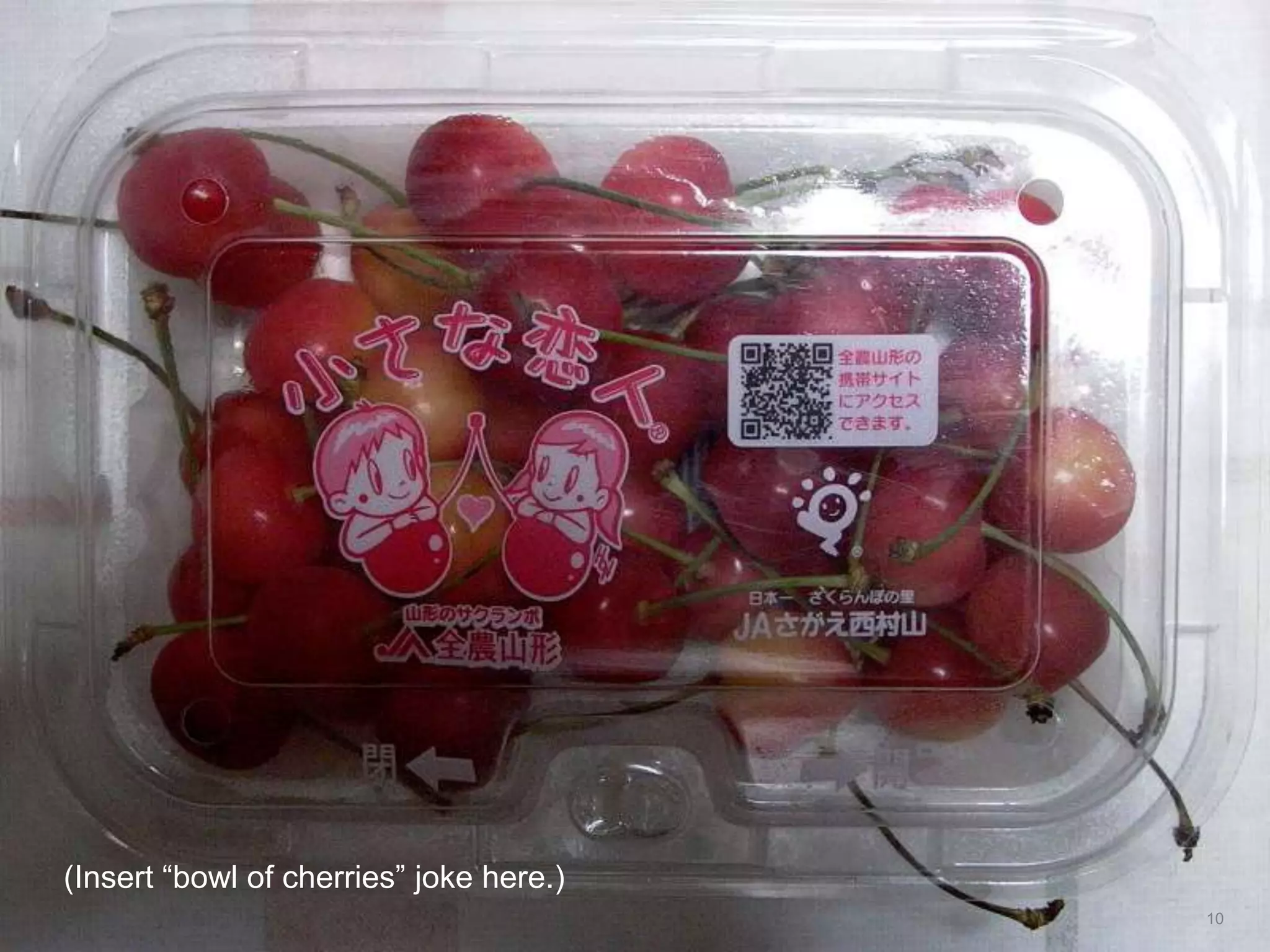
Early Adoption of QR Codes(Insert “bowl of cherries” joke here.)10
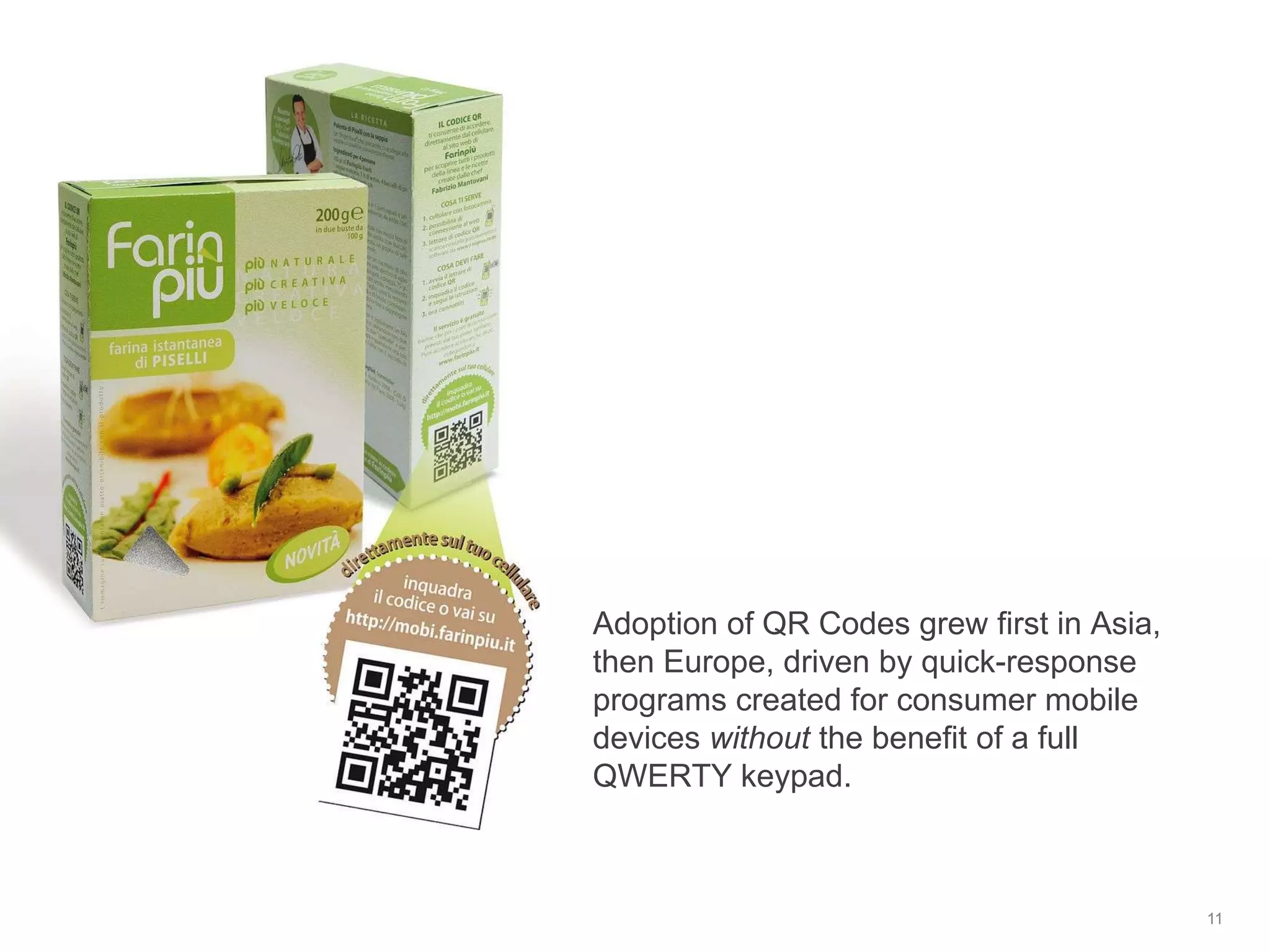
Adoption of QR Codes grew first in Asia, then Europe, driven by quick-response programs created for consumer mobile devices without the benefit of a full QWERTY keypad.11
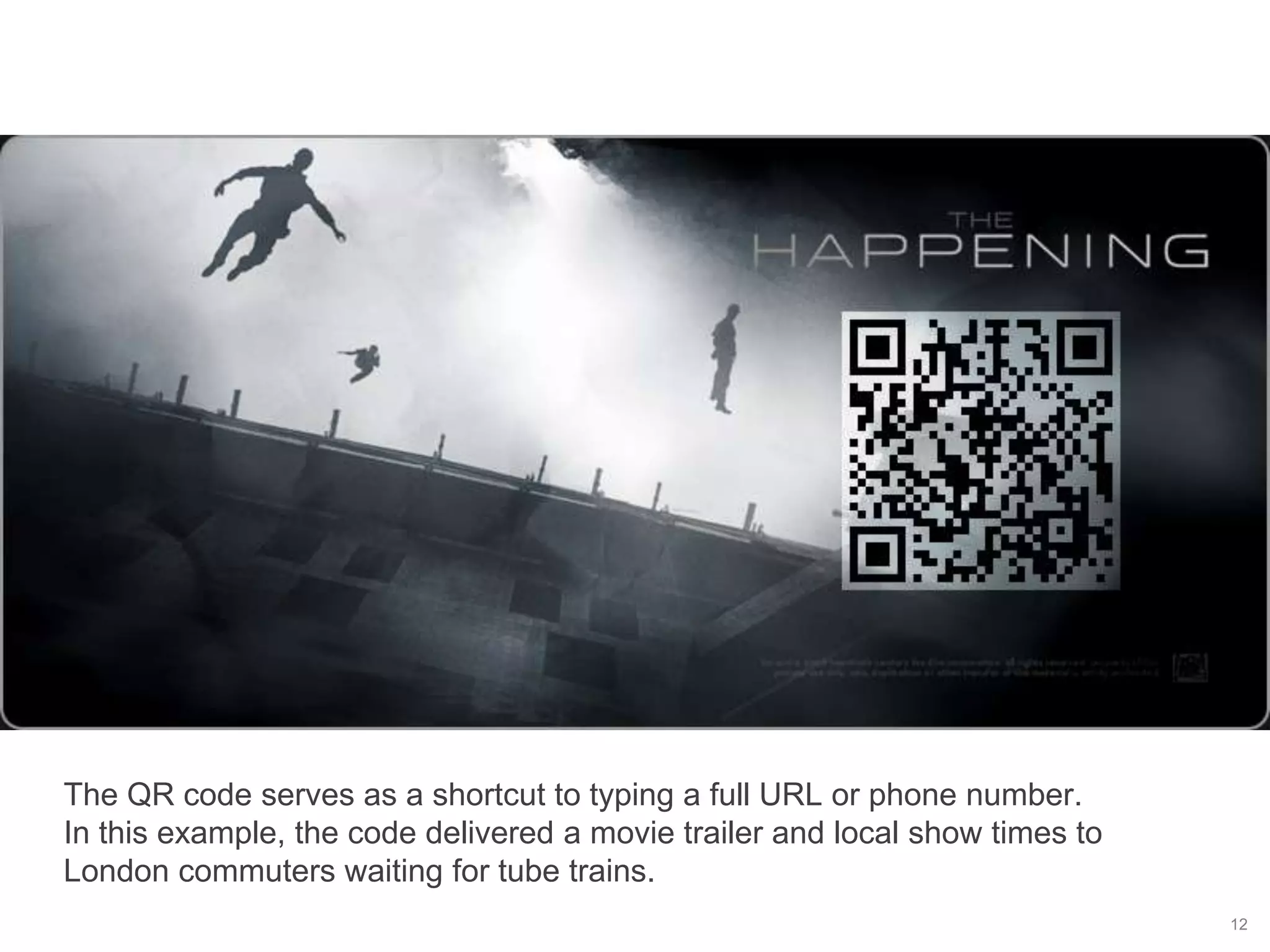
The QR code serves as a shortcut to typing a full URL or phone number. In this example, the code delivered a movie trailer and local show times to London commuters waiting for tube trains.12
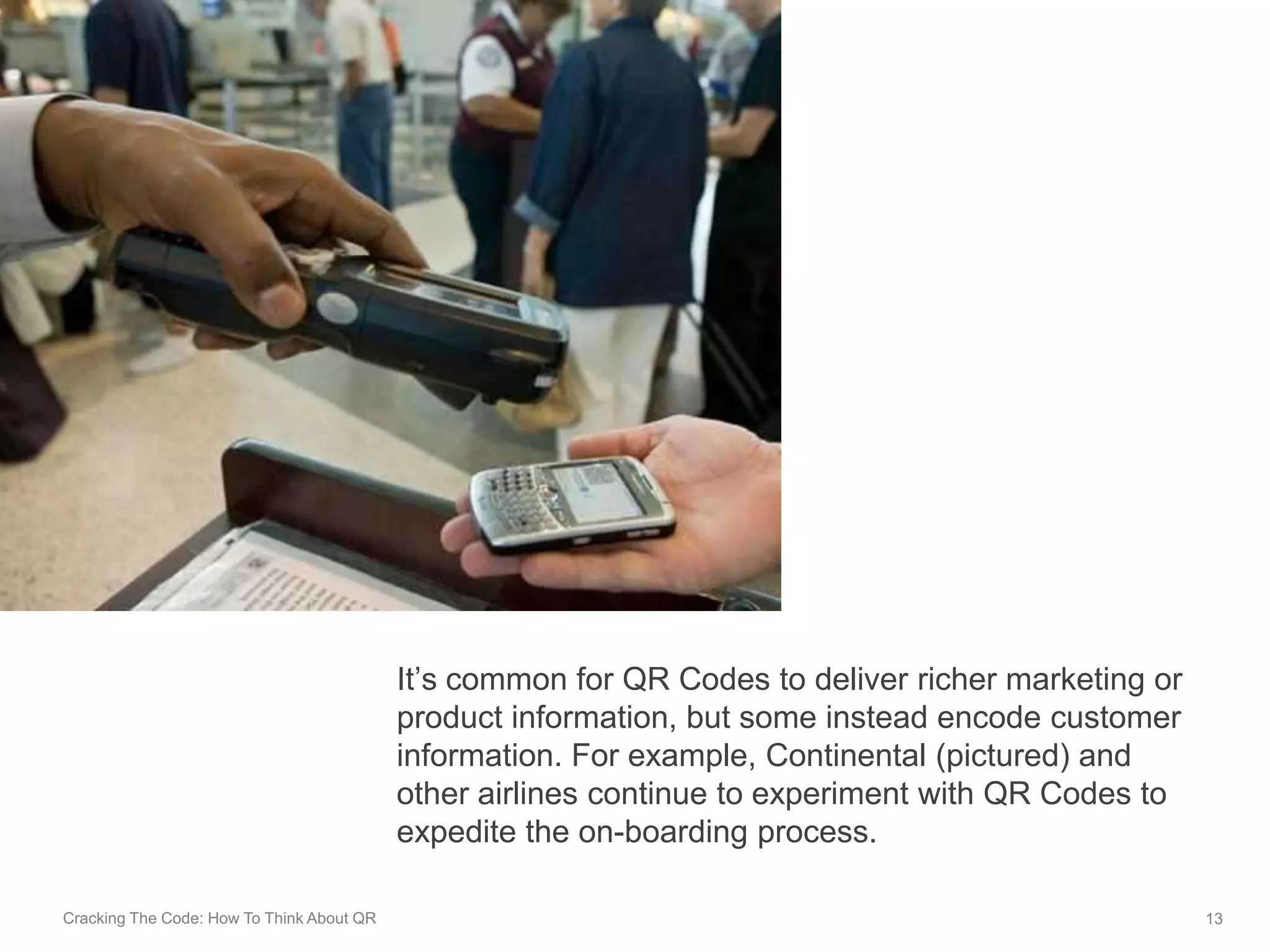
It’s common for QR Codes to deliver richer marketing or product information, but some instead encode customer information. For example, Continental (pictured) and other airlines continue to experiment with QR Codes to expedite the on-boarding process.
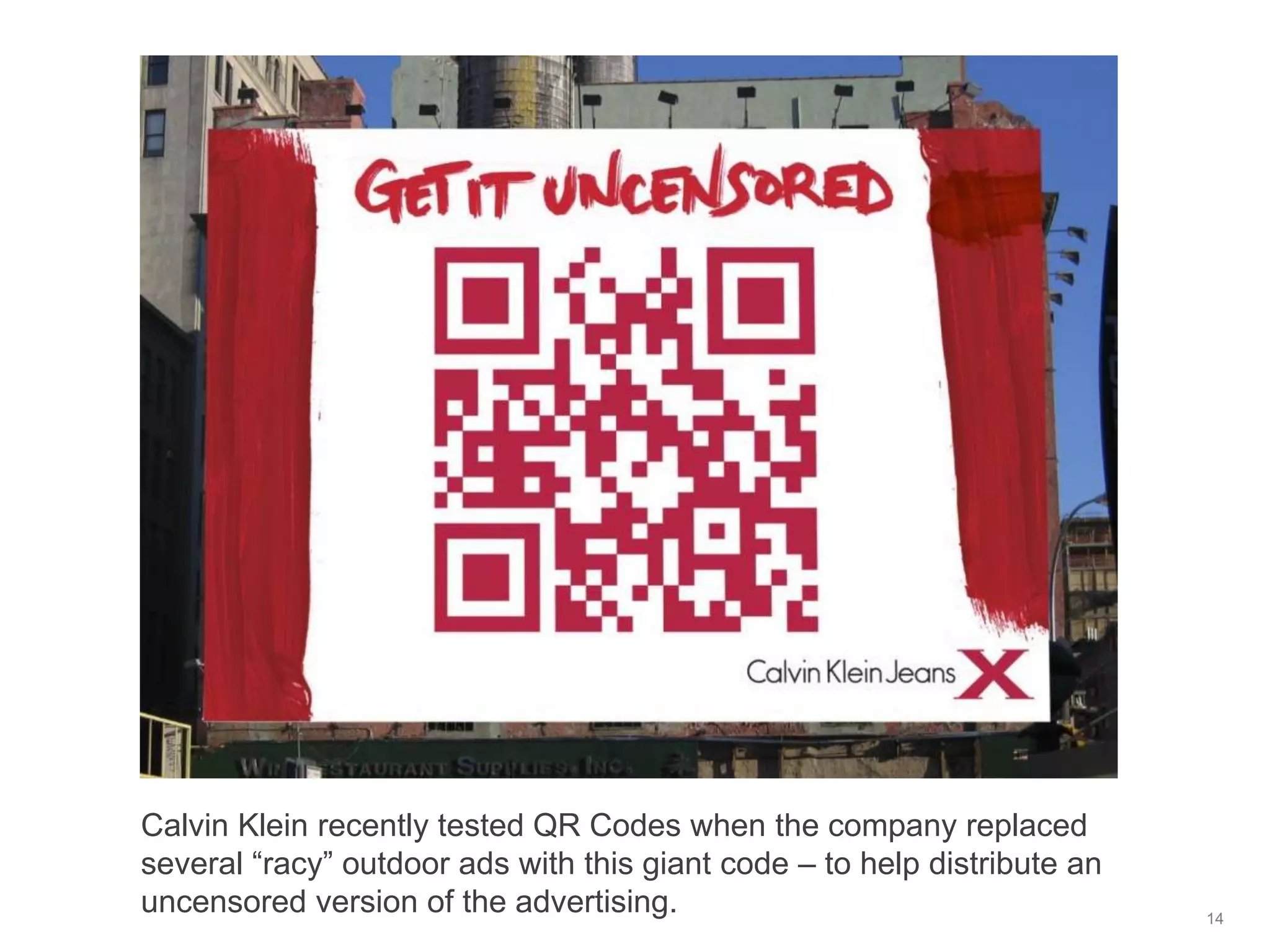
Calvin Klein recently tested QR Codes when the company replaced several “racy” outdoor ads with this giant code – to help distribute an uncensored version of the advertising.14
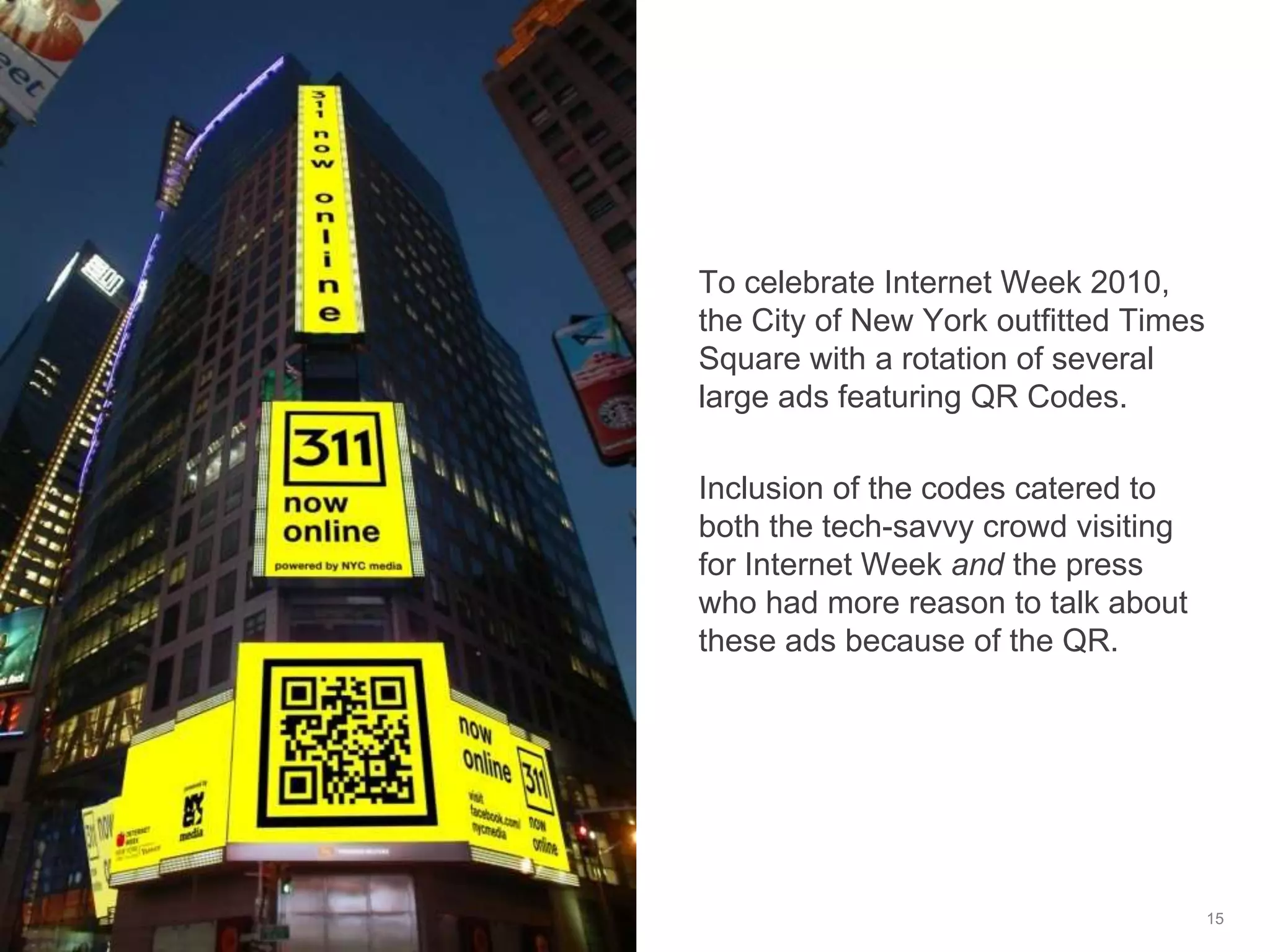
Adoption of QR CodesTo celebrate Internet Week 2010, the City of New York outfitted Times Square with a rotation of several large ads featuring QR Codes.Inclusion of the codes catered to both the tech-savvy crowd visiting for Internet Week and the press who had more reason to talk about these ads because of the QR.15
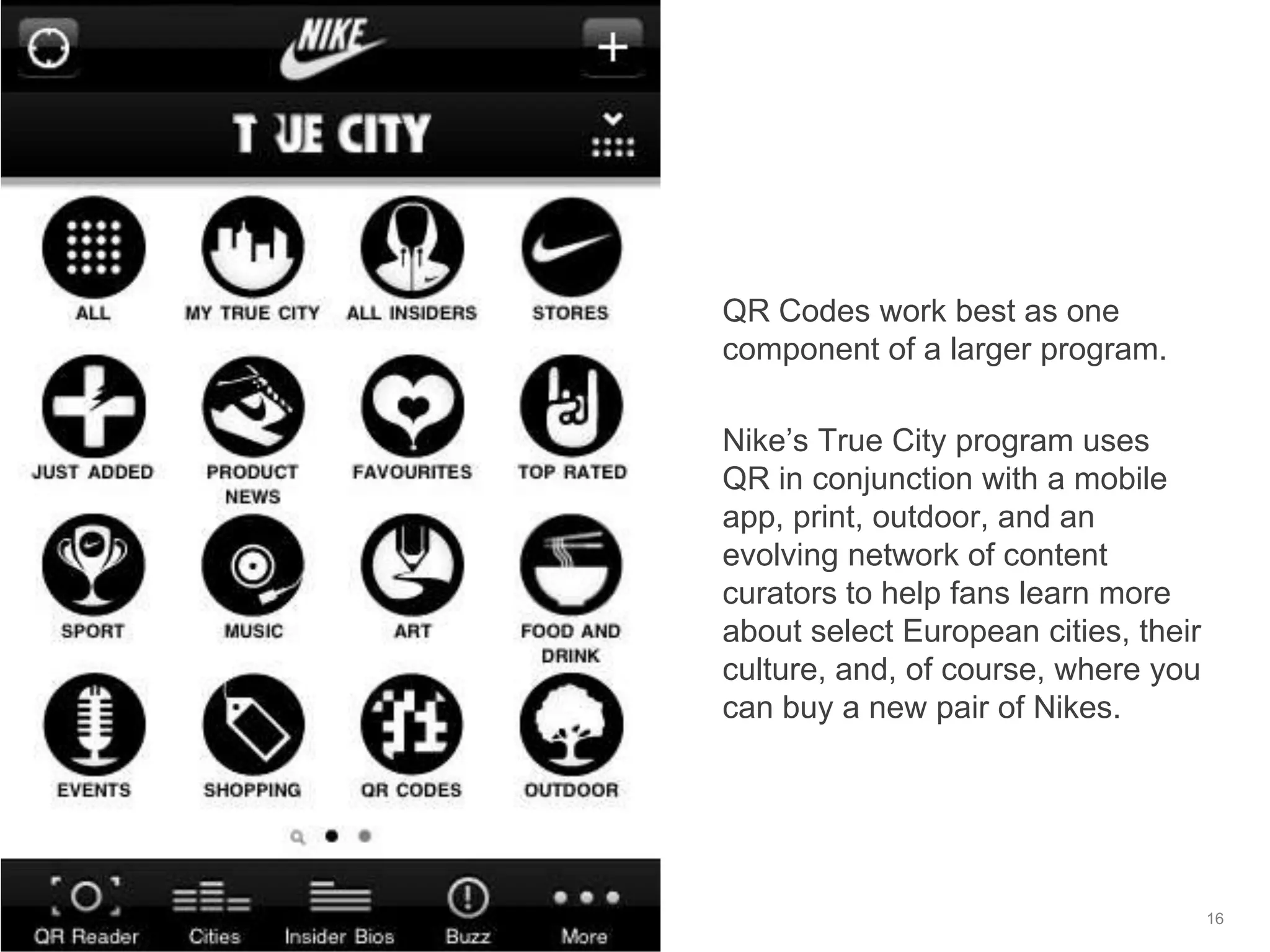
QR Codes work best as one component of a larger program.Nike’s True City program uses QR in conjunction with a mobile app, print, outdoor, and an evolving network of content curators to help fans learn more about select European cities, their culture, and, of course, where you can buy a new pair of Nikes.16
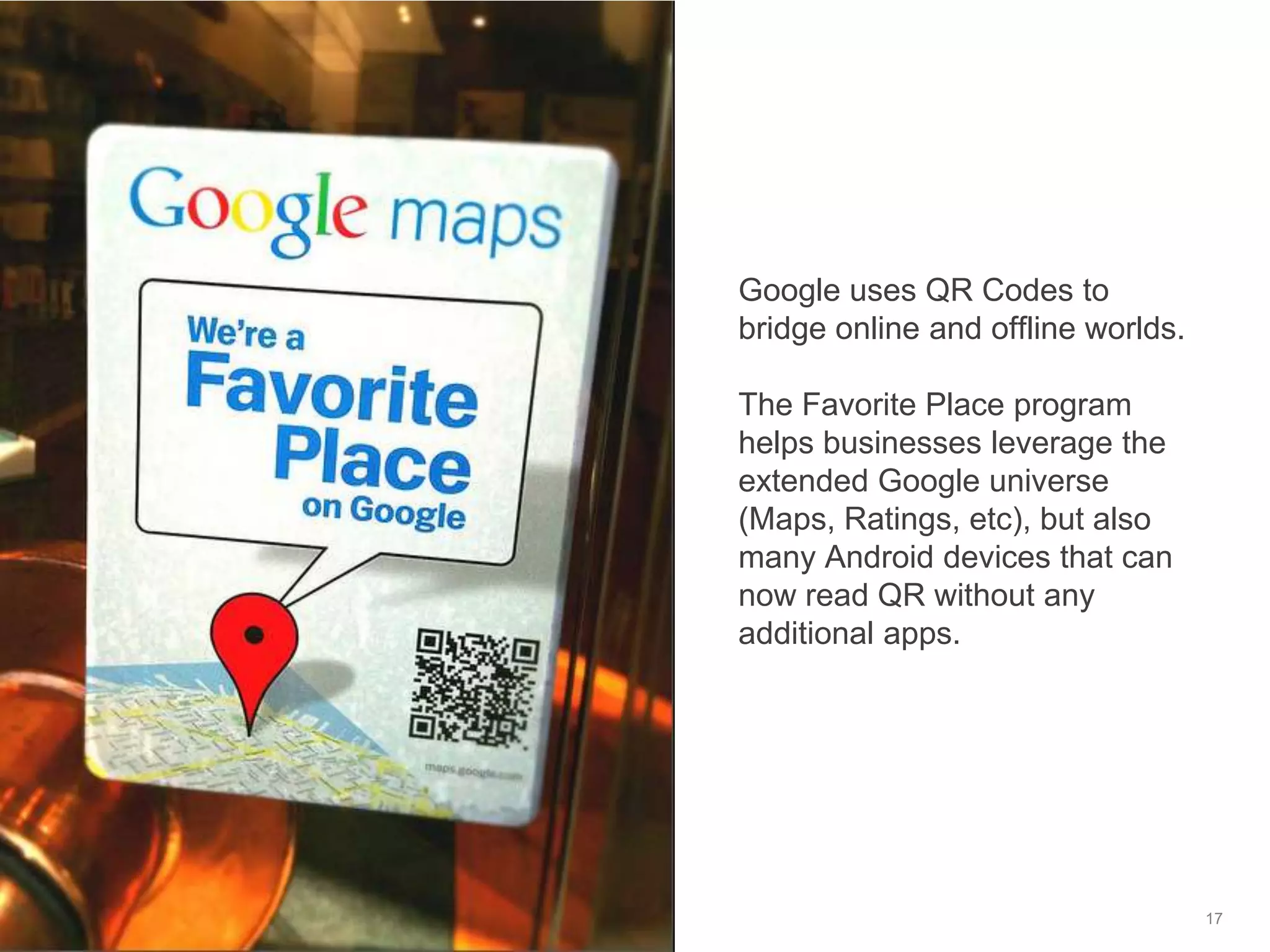
Google uses QR Codes to bridge online and offline worlds.The Favorite Place program helps businesses leverage the extended Google universe (Maps, Ratings, etc), but also many Android devices that can now read QR without any additional apps.
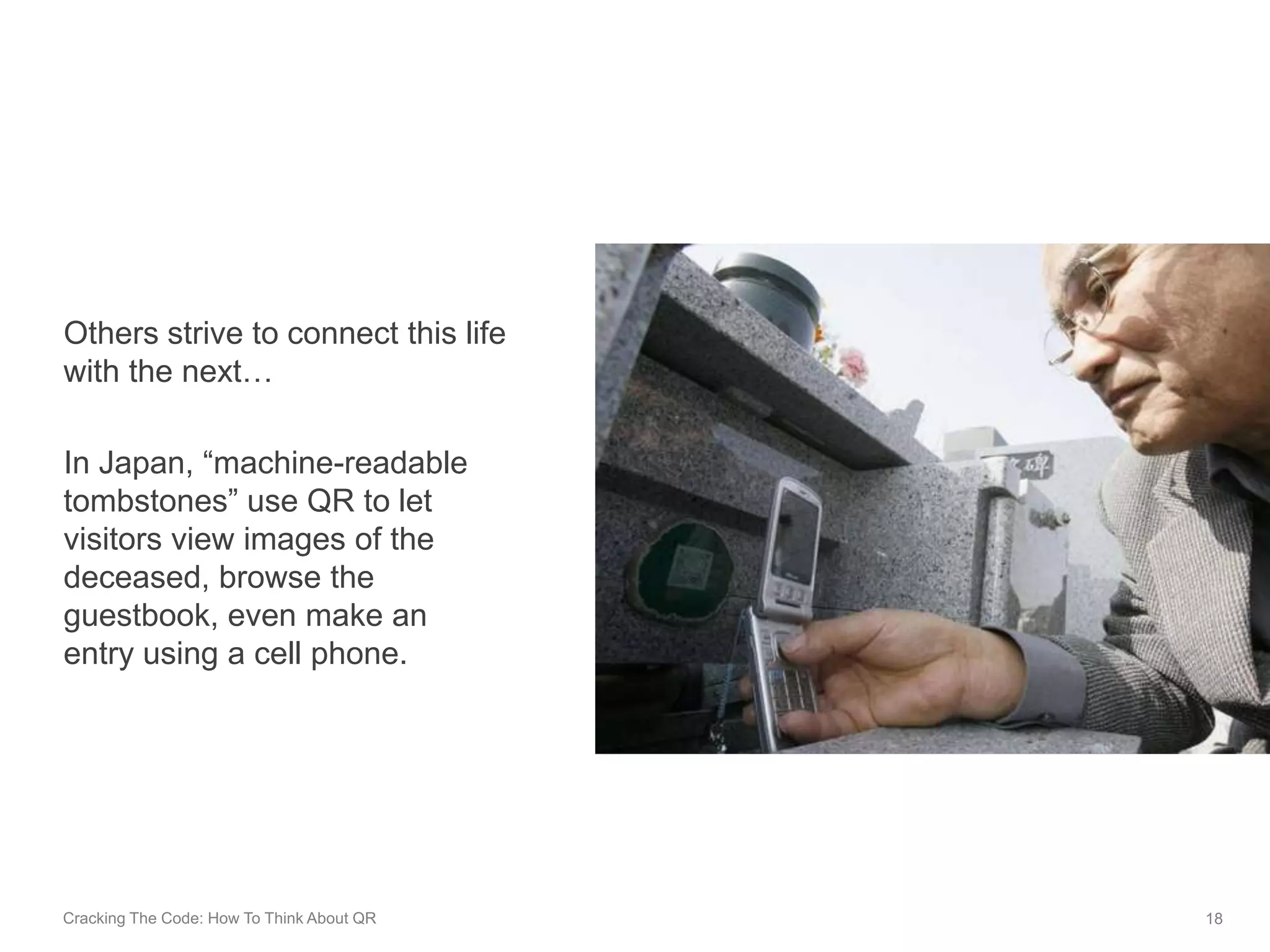
Others strive to connect this life with the next…In Japan, “machine-readable tombstones” use QR to let visitors view images of the deceased, browse the guestbook, even make an entry using a cell phone.
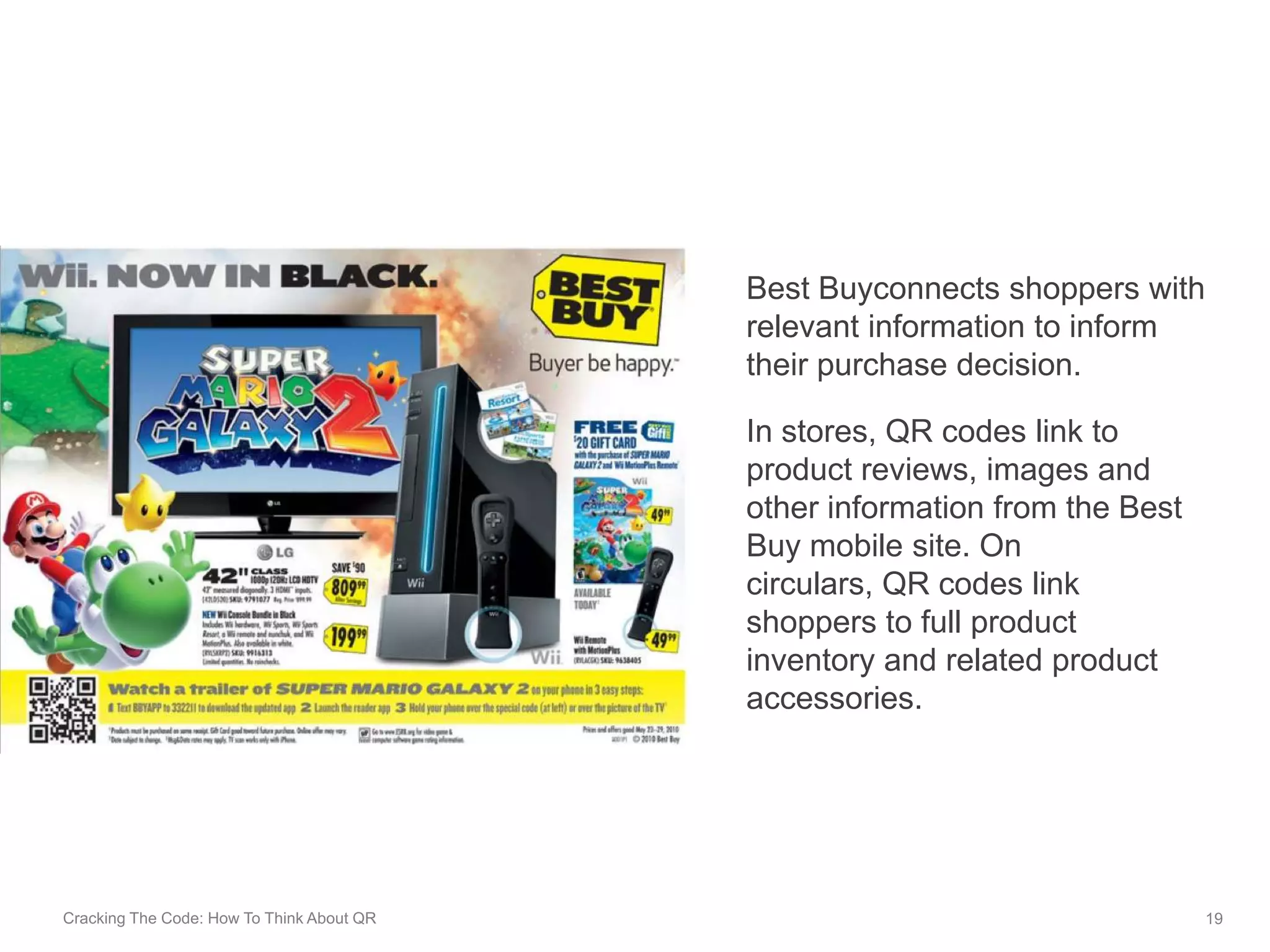
Best Buyconnects shoppers with relevant information to inform their purchase decision. In stores, QR codes link to product reviews, images and other information from the Best Buy mobile site. On circulars, QR codes link shoppers to full product inventory and related product accessories.
Evolution of Proprietary Codes
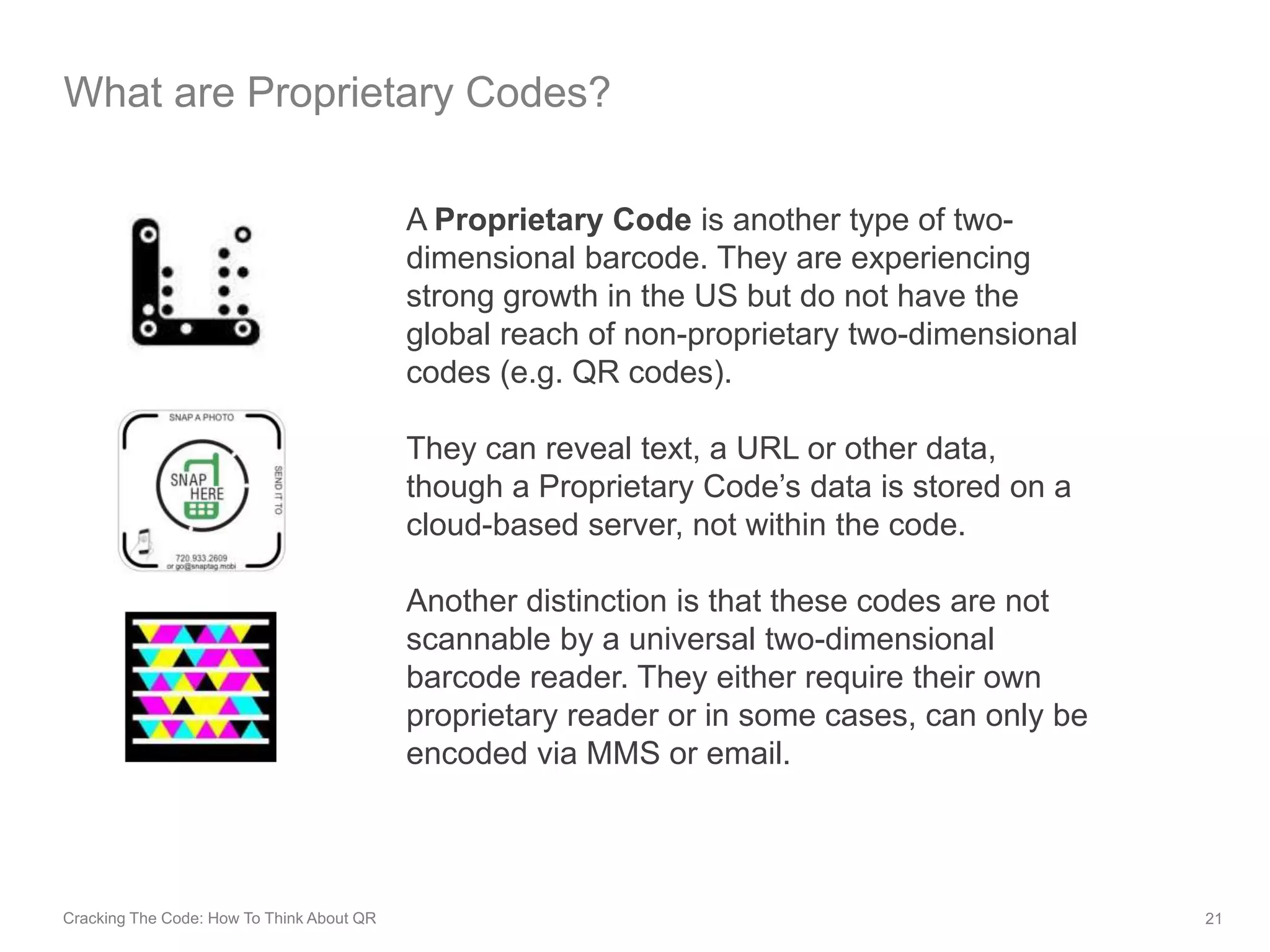
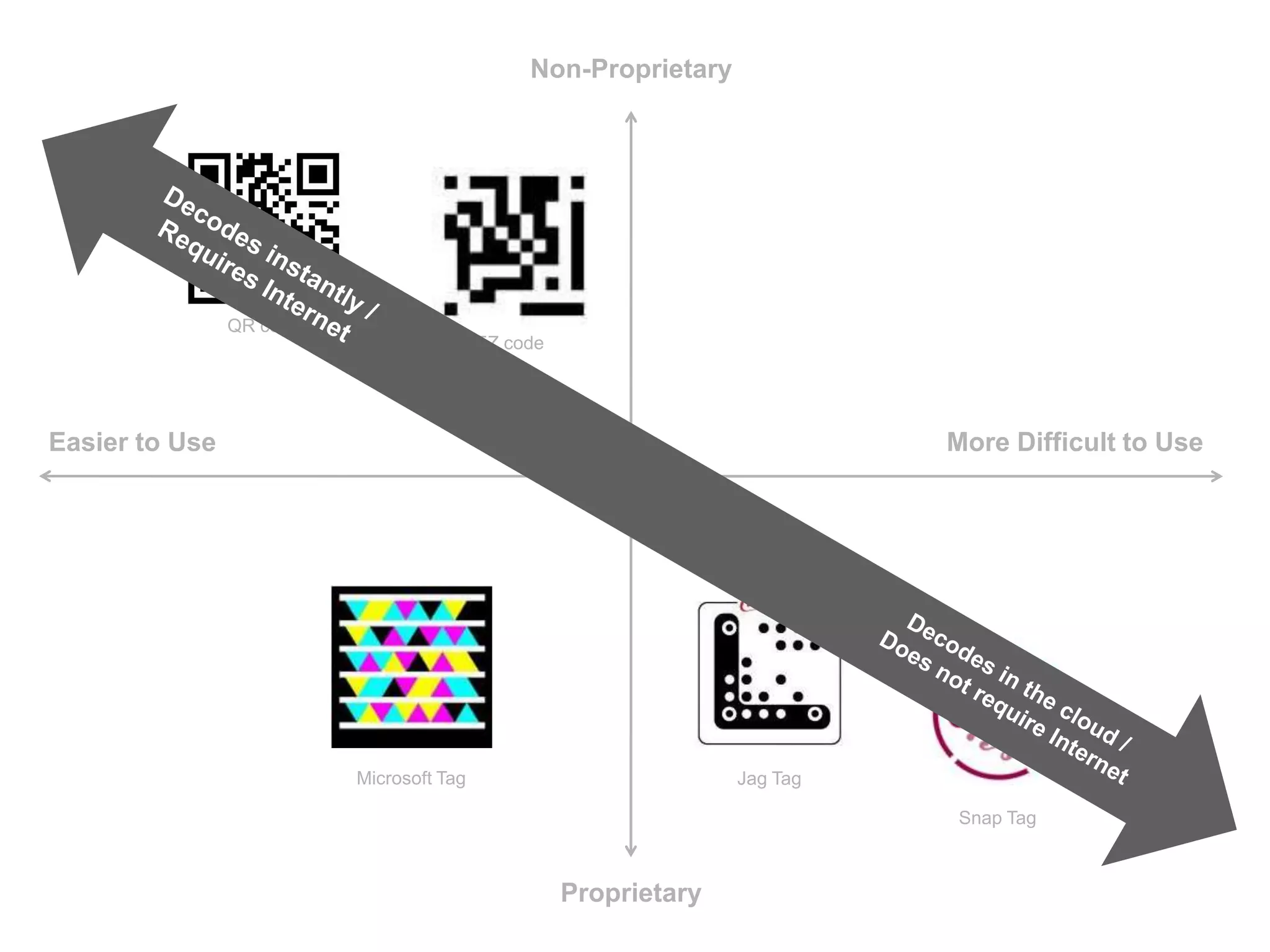
What are Proprietary Codes?A Proprietary Code is another type of two-dimensional barcode. They are experiencing strong growth in the US but do not have the global reach of non-proprietary two-dimensional codes (e.g. QR codes).They can reveal text, a URL or other data, though a Proprietary Code’s data is stored on a cloud-based server, not within the code.Another distinction is that these codes are not scannable by a universal two-dimensional barcode reader. They either require their own proprietary reader or in some cases, can only be encoded via MMS or email.
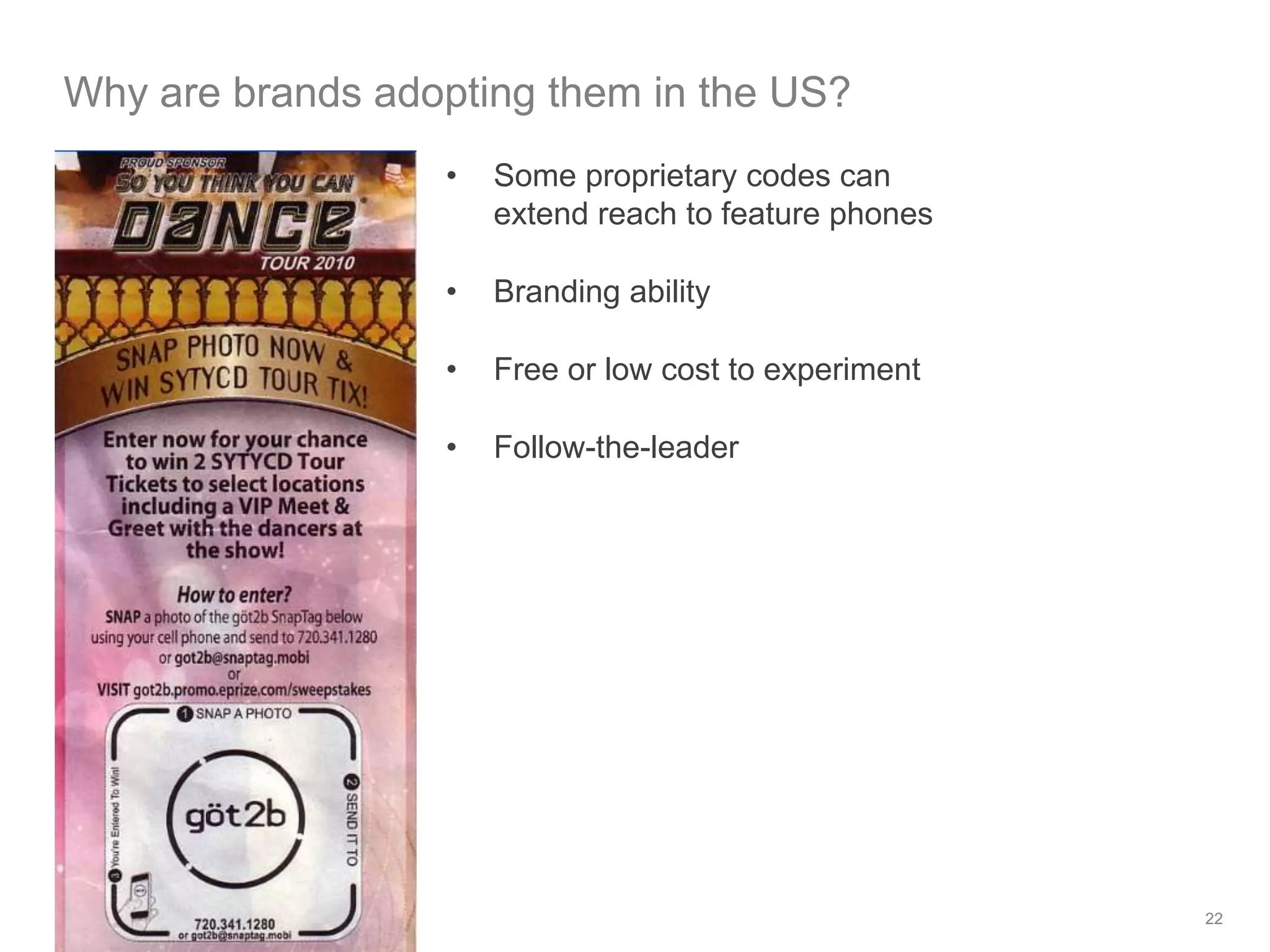
Why are brands adopting them in the US?Some proprietary codes can extend reach to feature phones
Branding ability
Free or low cost to experiment
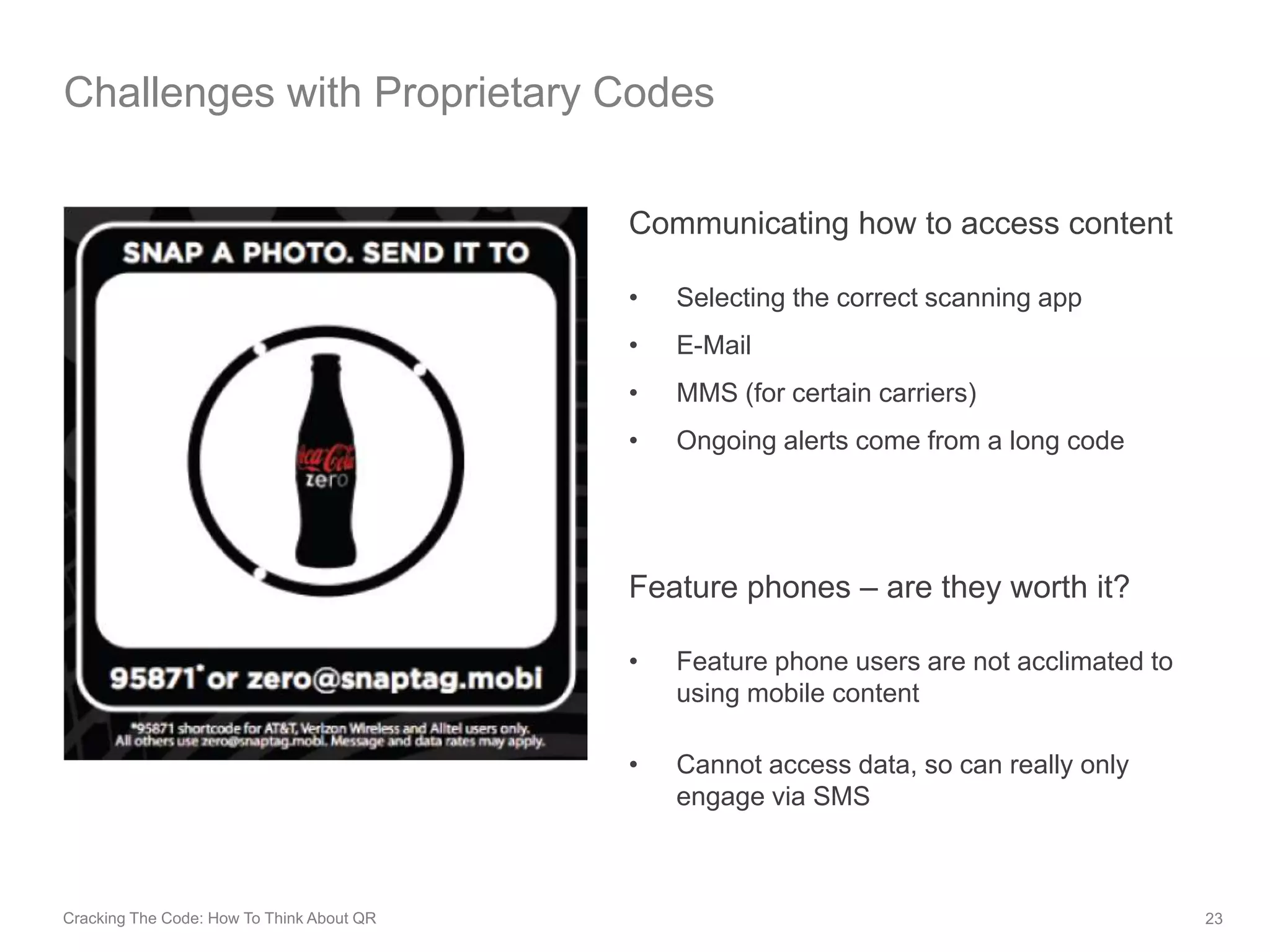
Follow-the-leaderChallenges with Proprietary CodesCommunicating how to access contentSelecting the correct scanning app
E-Mail
MMS (for certain carriers)
Ongoing alerts come from a long codeFeature phones – are they worth it?Feature phone users are not acclimated to using mobile content
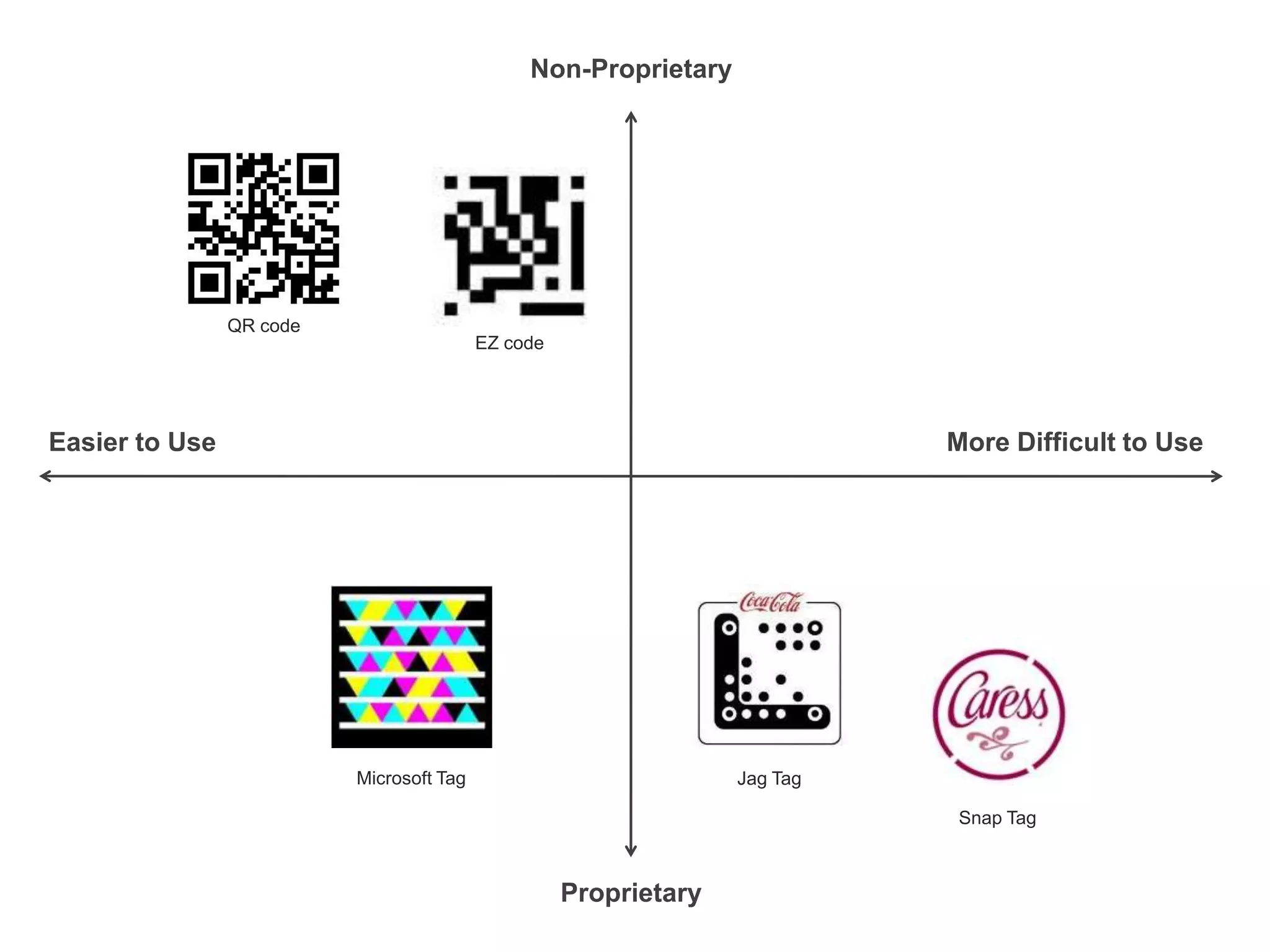
Cannot access data, so can really only engage via SMSNon-ProprietaryQR codeEZ codeEasier to UseMore Difficult to UseMicrosoft TagJag TagSnap TagProprietary
Non-ProprietaryDecodes instantly /  Requires InternetQR codeEZ codeEasier to UseMore Difficult to UseDecodes in the cloud / Does not require InternetMicrosoft TagJag TagSnap TagProprietary
Considerations & Recommendations
We don’t really need QR & 2D codes.
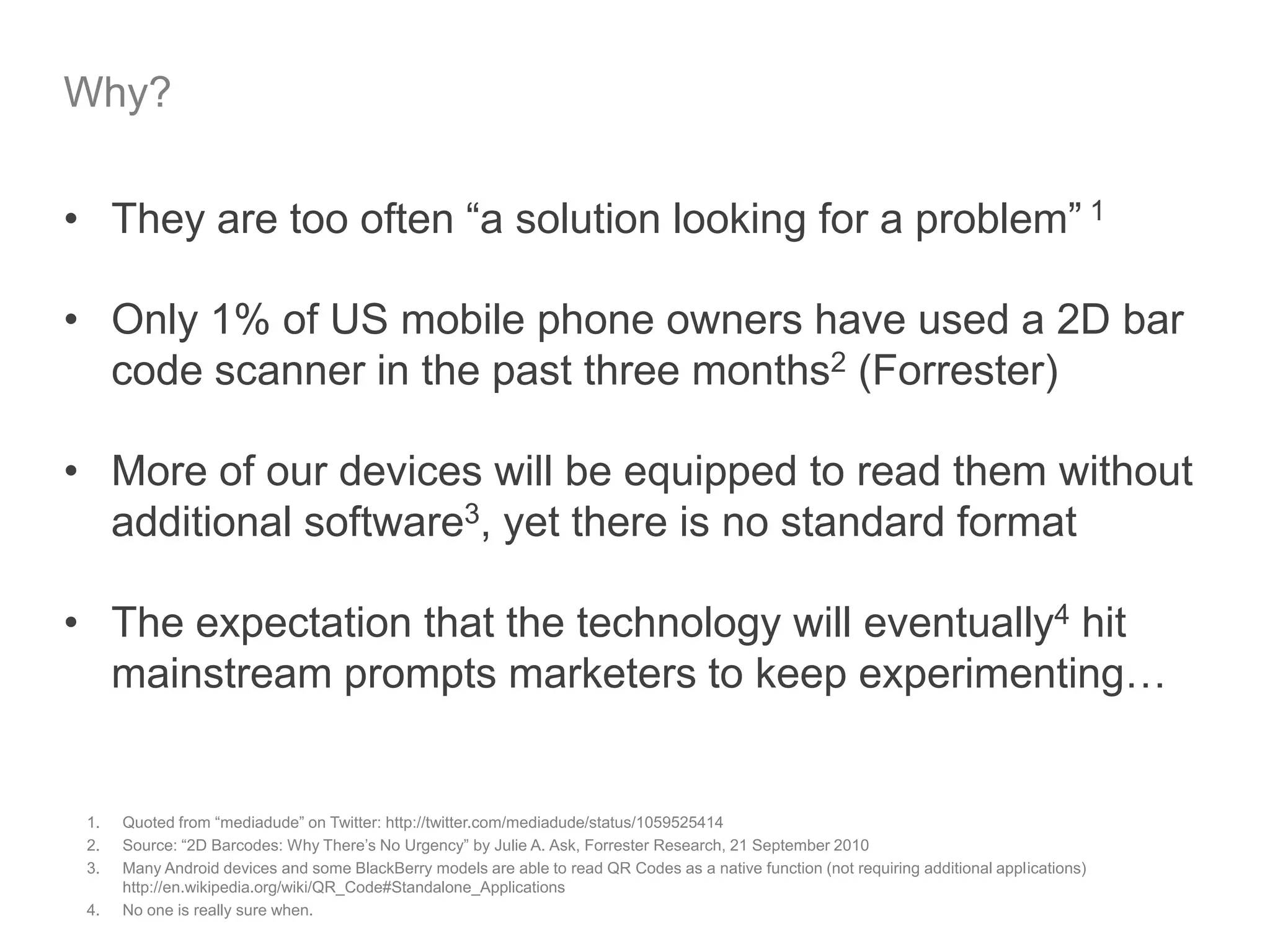
They are too often “a solution looking for a problem” 1

Cracking the Code: How to Think about QR Codes

  • 1.
    Cracking The Code:How To Think About QR26 October 2010
  • 2.
    What we’ll cover:Origins& Early AdoptionEvolution of Proprietary CodesConsiderations & RecommendationsWhat’s Next?
  • 4.
  • 5.
    What are QuickResponse Codes?A QR Code is a two-dimensional barcode, readable by QR scanners or QR scanning apps available on Smartphones. The information encoded can be text, a URL or other data. QR Codes are one of the most popular types of two-dimensional barcodes.Sources: Wikipedia, Denso-Wave Corporation
  • 6.
    Origins of QRCodesCreated by Japanese corporation Denso-Wave in 1994, the QR codes were first implemented as an order/product scanning system for automotive parts.Benefits:Gather large volumes of shipping data by one-touch operation.
  • 7.
    Significantly reduce thecost of forms compared with conventional slips.Source: Denso-Wave Corporation
  • 8.
    How do theywork?QR CodeBar CodeContains dataContains no dataContains dataContains dataSource: Denso-Wave Corporation
  • 9.
    How do theywork?Application* decodes dataData instructs device to perform a taskScans (takes pic) of code on mobile deviceUser encounters QR CodeSource: Graphic adapted from a Retina Funk blog post
  • 10.
    What exactly isencoded?Source: “QR Codes Explained”, QRme.co.uk
  • 11.
    Early Adoption ofQR Codes(Insert “bowl of cherries” joke here.)10
  • 12.
    Adoption of QRCodes grew first in Asia, then Europe, driven by quick-response programs created for consumer mobile devices without the benefit of a full QWERTY keypad.11
  • 13.
    The QR codeserves as a shortcut to typing a full URL or phone number. In this example, the code delivered a movie trailer and local show times to London commuters waiting for tube trains.12
  • 14.
    It’s common forQR Codes to deliver richer marketing or product information, but some instead encode customer information. For example, Continental (pictured) and other airlines continue to experiment with QR Codes to expedite the on-boarding process.
  • 15.
    Calvin Klein recentlytested QR Codes when the company replaced several “racy” outdoor ads with this giant code – to help distribute an uncensored version of the advertising.14
  • 16.
    Adoption of QRCodesTo celebrate Internet Week 2010, the City of New York outfitted Times Square with a rotation of several large ads featuring QR Codes.Inclusion of the codes catered to both the tech-savvy crowd visiting for Internet Week and the press who had more reason to talk about these ads because of the QR.15
  • 17.
    QR Codes workbest as one component of a larger program.Nike’s True City program uses QR in conjunction with a mobile app, print, outdoor, and an evolving network of content curators to help fans learn more about select European cities, their culture, and, of course, where you can buy a new pair of Nikes.16
  • 18.
    Google uses QRCodes to bridge online and offline worlds.The Favorite Place program helps businesses leverage the extended Google universe (Maps, Ratings, etc), but also many Android devices that can now read QR without any additional apps.
  • 19.
    Others strive toconnect this life with the next…In Japan, “machine-readable tombstones” use QR to let visitors view images of the deceased, browse the guestbook, even make an entry using a cell phone.
  • 20.
    Best Buyconnects shopperswith relevant information to inform their purchase decision. In stores, QR codes link to product reviews, images and other information from the Best Buy mobile site. On circulars, QR codes link shoppers to full product inventory and related product accessories.
  • 21.
  • 22.
    What are ProprietaryCodes?A Proprietary Code is another type of two-dimensional barcode. They are experiencing strong growth in the US but do not have the global reach of non-proprietary two-dimensional codes (e.g. QR codes).They can reveal text, a URL or other data, though a Proprietary Code’s data is stored on a cloud-based server, not within the code.Another distinction is that these codes are not scannable by a universal two-dimensional barcode reader. They either require their own proprietary reader or in some cases, can only be encoded via MMS or email.
  • 23.
    Why are brandsadopting them in the US?Some proprietary codes can extend reach to feature phones
  • 24.
  • 25.
    Free or lowcost to experiment
  • 26.
    Follow-the-leaderChallenges with ProprietaryCodesCommunicating how to access contentSelecting the correct scanning app
  • 27.
  • 28.
  • 29.
    Ongoing alerts comefrom a long codeFeature phones – are they worth it?Feature phone users are not acclimated to using mobile content
  • 30.
    Cannot access data,so can really only engage via SMSNon-ProprietaryQR codeEZ codeEasier to UseMore Difficult to UseMicrosoft TagJag TagSnap TagProprietary
  • 31.
    Non-ProprietaryDecodes instantly / Requires InternetQR codeEZ codeEasier to UseMore Difficult to UseDecodes in the cloud / Does not require InternetMicrosoft TagJag TagSnap TagProprietary
  • 32.
  • 33.
    We don’t reallyneed QR & 2D codes.
  • 34.
    They are toooften “a solution looking for a problem” 1
  • 35.
    Only 1% ofUS mobile phone owners have used a 2D bar code scanner in the past three months2 (Forrester)
  • 36.
    More of ourdevices will be equipped to read them without additional software3, yet there is no standard format
  • 37.
    The expectation thatthe technology will eventually4 hit mainstream prompts marketers to keep experimenting…Why?Quoted from “mediadude” on Twitter: http://twitter.com/mediadude/status/1059525414Source: “2D Barcodes: Why There’s No Urgency” by Julie A. Ask, Forrester Research, 21 September 2010Many Android devices and some BlackBerry models are able to read QR Codes as a native function (not requiring additional applications) http://en.wikipedia.org/wiki/QR_Code#Standalone_ApplicationsNo one is really sure when.
  • 38.
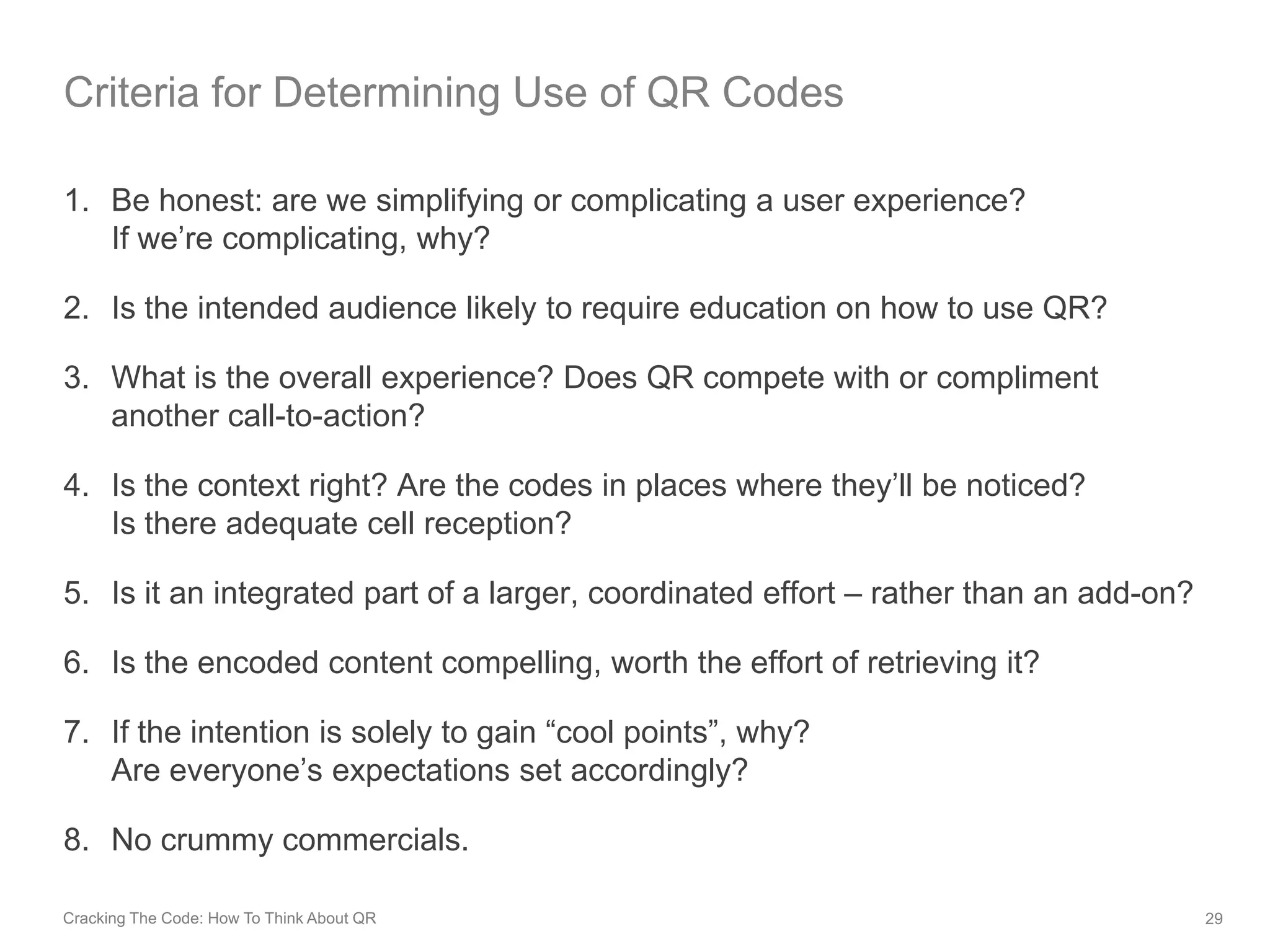
    Criteria for DeterminingUse of QR CodesBe honest: are we simplifying or complicating a user experience? If we’re complicating, why?Is the intended audience likely to require education on how to use QR?What is the overall experience? Does QR compete with or compliment another call-to-action?Is the context right? Are the codes in places where they’ll be noticed? Is there adequate cell reception?Is it an integrated part of a larger, coordinated effort – rather than an add-on?Is the encoded content compelling, worth the effort of retrieving it?If the intention is solely to gain “cool points”, why? Are everyone’s expectations set accordingly?No crummy commercials.
  • 39.
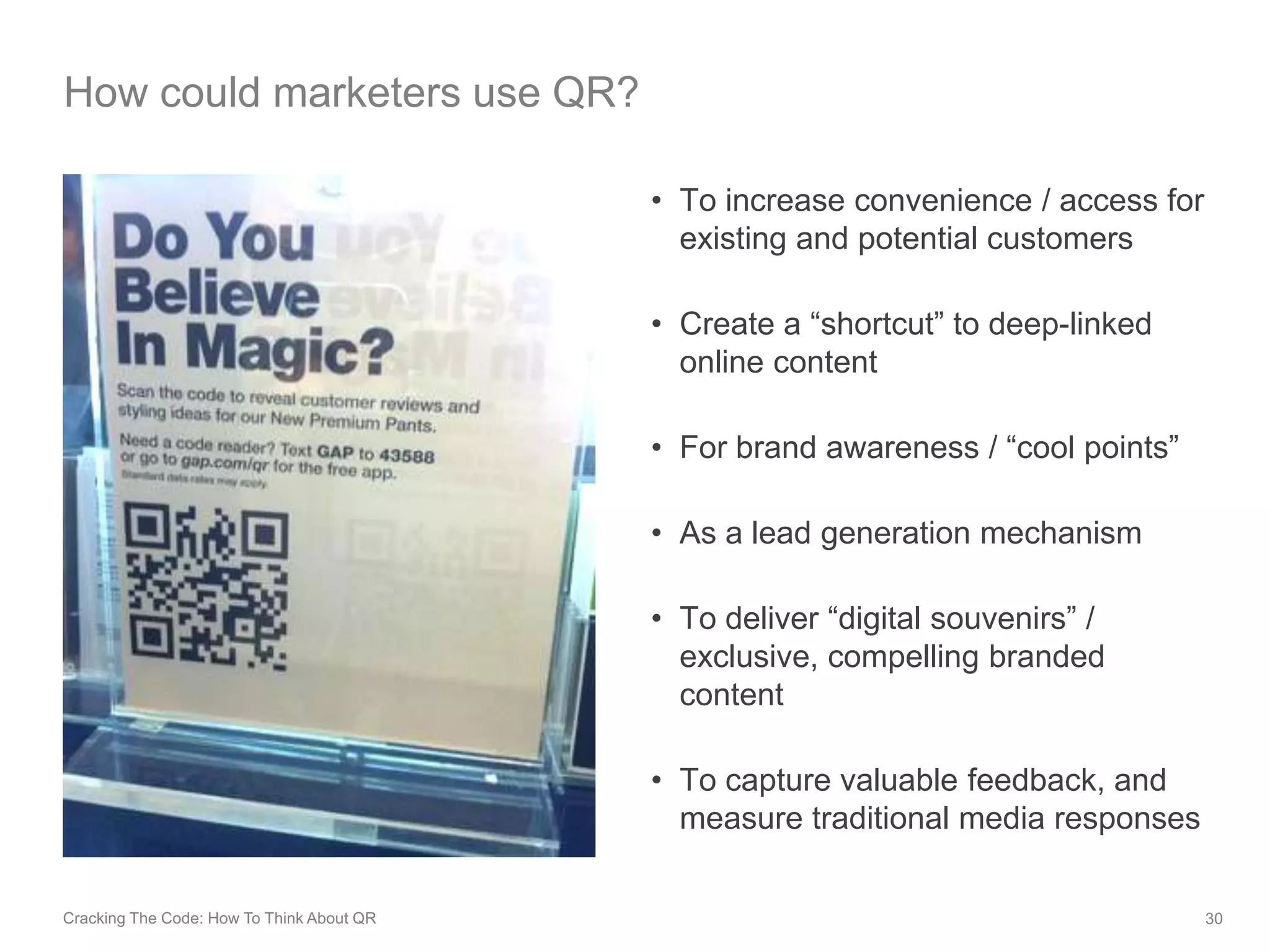
    How could marketersuse QR?To increase convenience / access for existing and potential customers
  • 40.
    Create a “shortcut”to deep-linked online content
  • 41.
    For brand awareness/ “cool points”
  • 42.
    As a leadgeneration mechanism
  • 43.
    To deliver “digitalsouvenirs” / exclusive, compelling branded content
  • 44.
    To capture valuablefeedback, and measure traditional media responsesWhat’s Next?
  • 45.
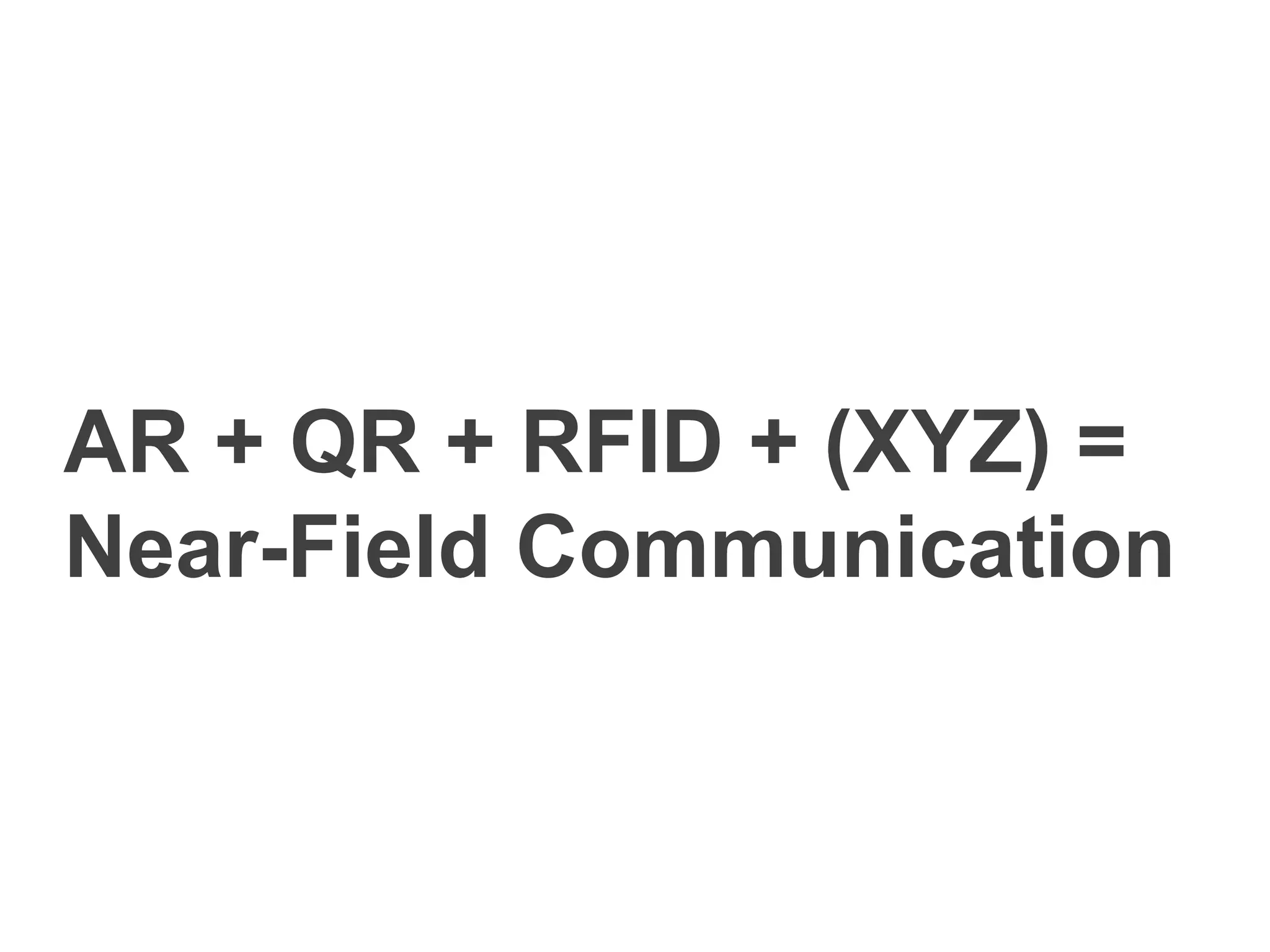
    AR + QR+ RFID + (XYZ) = Near-Field Communication
  • 46.
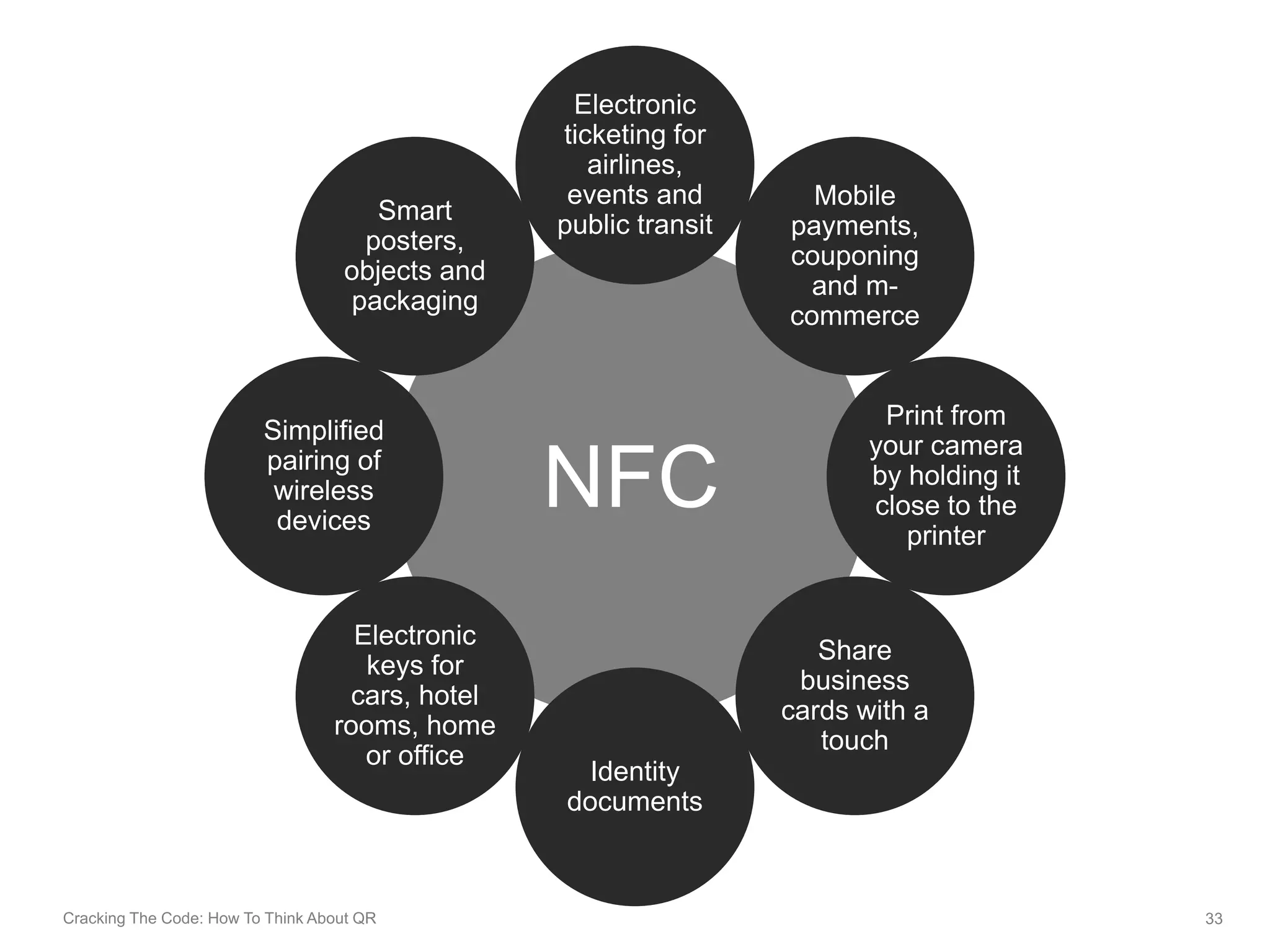
    Electronic ticketing forairlines, events and public transitMobile payments, couponing and m-commerceSmart posters, objects and packagingNFCPrint from your camera by holding it close to the printerSimplified pairing of wireless devicesShare business cards with a touchElectronic keys for cars, hotel rooms, home or officeIdentity documents
  • 47.