Data Structures - I
“No Bonus” marks for this course anymore
C
P
C
S
2
0
4
Dr. Jonathan (Yahya) Cazalas Dr. Muhammad Umair Ramzan
1
and say, O my Lord, Give me more knowledge.
(Quran 20 : 114)
Data Structures - I
“No Bonus” marks for this course anymore
C
P
C
S
2
0
4
Dr. Jonathan (Yahya) Cazalas Dr. Muhammad Umair Ramzan
Algorithm Analysis
2
Introduction
Data Structures - I
“No Bonus” marks for this course anymore
C
P
C
S
2
0
4
Dr. Jonathan (Yahya) Cazalas Dr. Muhammad Umair Ramzan
Algorithm Analysis - Introduction
• Efficiency
oMax # of 1’s
• O(n)
oLinear Search
• O(n)
oBinary Search
• O(log2 n)
oSorted List Matching Problems
• O(n)
3
Data Structures - I
“No Bonus” marks for this course anymore
C
P
C
S
2
0
4
Dr. Jonathan (Yahya) Cazalas Dr. Muhammad Umair Ramzan
Algorithm Analysis - Introduction
• We will use Order Notation to approximate
two things about algorithms:
o How much time they take
o How much memory (space) they use
• Note:
oIt is nearly impossible to figure out the exact
amount of time an algorithm will take
oEach algorithm gets translated into smaller and
smaller machine instructions
oEach of these instructions take various amounts of
time to execute on different computers
4
Data Structures - I
“No Bonus” marks for this course anymore
C
P
C
S
2
0
4
Dr. Jonathan (Yahya) Cazalas Dr. Muhammad Umair Ramzan
Algorithm Analysis - Introduction
• We want to judge algorithms independent of
their implementation
• Specifically
owe want to know how the performance of an
algorithm responds to changes in problem size
• And, rather than figure out an algorithm’s
exact running time
oWe only want an approximation
oBig-O approximation
5
Data Structures - I
“No Bonus” marks for this course anymore
C
P
C
S
2
0
4
Dr. Jonathan (Yahya) Cazalas Dr. Muhammad Umair Ramzan
Algorithm Analysis - Introduction
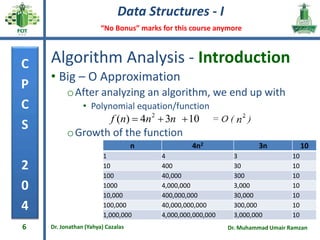
• Big – O Approximation
oAfter analyzing an algorithm, we end up with
• Polynomial equation/function
oGrowth of the function
6
10
3
4
)
( 2


 n
n
n
f
n 4n2 3n 10
1 4 3 10
10 400 30 10
100 40,000 300 10
1000 4,000,000 3,000 10
10,000 400,000,000 30,000 10
100,000 40,000,000,000 300,000 10
1,000,000 4,000,000,000,000 3,000,000 10
Data Structures - I
“No Bonus” marks for this course anymore
C
P
C
S
2
0
4
Dr. Jonathan (Yahya) Cazalas Dr. Muhammad Umair Ramzan
Algorithm Analysis - Introduction
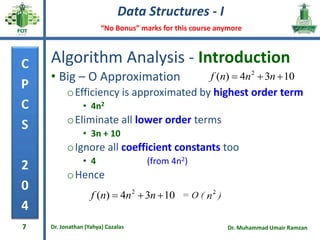
• Big – O Approximation
oEfficiency is approximated by highest order term
• 4n2
oEliminate all lower order terms
• 3n + 10
oIgnore all coefficient constants too
• 4 (from 4n2)
oHence
7
10
3
4
)
( 2


 n
n
n
f
10
3
4
)
( 2


 n
n
n
f
Data Structures - I
“No Bonus” marks for this course anymore
C
P
C
S
2
0
4
Dr. Jonathan (Yahya) Cazalas Dr. Muhammad Umair Ramzan
Algorithm Analysis - Introduction
• Big – O Approximation
of(n) = 4n2 +3n +10
• O(n2)
of(n) = 76,756,234n2 + 427,913n + 7
• O(n2)
of(n) = 74n8 - 62n5 - 71562n3 + 3n2 – 5
• O(n8)
of(n) = 42n4*(12n6 - 73n2 + 11)
• O(n10)
of(n) = 75n*logn – 415
• O(n*logn)
8
Data Structures - I
“No Bonus” marks for this course anymore
C
P
C
S
2
0
4
Dr. Jonathan (Yahya) Cazalas Dr. Muhammad Umair Ramzan
Big–Oh - Introduction
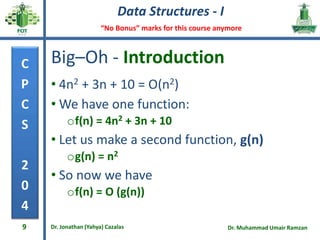
• 4n2 + 3n + 10 = O(n2)
• We have one function:
of(n) = 4n2 + 3n + 10
• Let us make a second function, g(n)
og(n) = n2
• So now we have
of(n) = O (g(n))
9
Data Structures - I
“No Bonus” marks for this course anymore
C
P
C
S
2
0
4
Dr. Jonathan (Yahya) Cazalas Dr. Muhammad Umair Ramzan
Big–Oh – Introduction (formal definition)
10
 
   

    
o
o
n
n
n
cg
n
f
n
c
n
f
n
g





all
for
0
such that
and
constants
positive
exist
there
:
• c * g(n) is an upper
bound on the value
of f(n)
• Such that
• f(n) <= c * g(n)
Data Structures - I
“No Bonus” marks for this course anymore
C
P
C
S
2
0
4
Dr. Jonathan (Yahya) Cazalas Dr. Muhammad Umair Ramzan
Common Order – Introduction
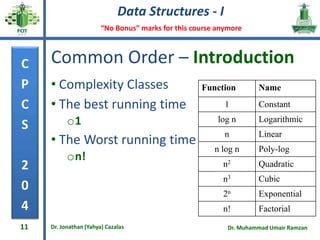
• Complexity Classes
• The best running time
o1
• The Worst running time
on!
11
Function Name
1 Constant
log n Logarithmic
n Linear
n log n Poly-log
n2 Quadratic
n3 Cubic
2n Exponential
n! Factorial
Data Structures - I
“No Bonus” marks for this course anymore
C
P
C
S
2
0
4
Dr. Jonathan (Yahya) Cazalas Dr. Muhammad Umair Ramzan
Complexity Classes – O(1)
• It is a notation for “constant work”
• An example would be finding the smallest
element in a sorted array
oThere’s nothing to search for here
oThe smallest element is always at the
beginning of a sorted array
oSo this would take O(1) time
12
Data Structures - I
“No Bonus” marks for this course anymore
C
P
C
S
2
0
4
Dr. Jonathan (Yahya) Cazalas Dr. Muhammad Umair Ramzan
Complexity Classes – O(n)
• It means that the work changes in a way that
is proportional to n
• Example:
oIf the input size doubles, the running time also
doubles
• It is a notation for “work grows at a linear
rate”
• You usually can’t really do a lot better than this
for most problems we deal with
13
Data Structures - I
“No Bonus” marks for this course anymore
C
P
C
S
2
0
4
Dr. Jonathan (Yahya) Cazalas Dr. Muhammad Umair Ramzan
Complexity Classes – O(nk)
• O(n2) or “Order n2 ”: Quadratic time
oIf input size doubles, running time increases by
a factor of 4
• O(n3) or “Order n3 ”: Cubic time
oIf input size doubles, running time increases by
a factor of 8
• O(nk): Other polynomial time
oShould really try to avoid high order
polynomial running times
14
Data Structures - I
“No Bonus” marks for this course anymore
C
P
C
S
2
0
4
Dr. Jonathan (Yahya) Cazalas Dr. Muhammad Umair Ramzan
Complexity Classes – O(Exponential)
• O(2n) or “Order 2n ”: Exponential time
omore theoretical rather than practical interest
because they cannot reasonably run on typical
computers for even for moderate values of n.
oInput sizes bigger than 40 or 50 become
unmanageable
• Even on faster computers
• O(n!): even worse than exponential!
oInput sizes bigger than 10 will take a long time
15
Data Structures - I
“No Bonus” marks for this course anymore
C
P
C
S
2
0
4
Dr. Jonathan (Yahya) Cazalas Dr. Muhammad Umair Ramzan
Complexity Classes – O(Logarithmic)
• O(n logn):
oOnly slightly worse than O(n) time
• And O(n logn) will be much less than O(n2)
• This is the running time for the better sorting
algorithms we will go over (later)
• O(log n) or “Order log n”: Logarithmic time
oIf input size doubles, running time increases ONLY
by a constant amount
oany algorithm that halves the data remaining to
be processed on each iteration of a loop will be an
O(log n) algorithm.
16
Data Structures - I
“No Bonus” marks for this course anymore
C
P
C
S
2
0
4
Dr. Jonathan (Yahya) Cazalas Dr. Muhammad Umair Ramzan
Algorithm Analysis
17
Some Example
Data Structures - I
“No Bonus” marks for this course anymore
C
P
C
S
2
0
4
Dr. Jonathan (Yahya) Cazalas Dr. Muhammad Umair Ramzan
Algorithm Analysis - Example - 01
• The number of operations
executed by these loops is
the sum of the individual
loop operations.
• The first loop has n/2
operations
• The second loop has n2
operations
• Not nested, So we simply
ADD their operations
• The total number of
operations would be
o T(n) = n/2 + n2
18
for (k = 1; k <= n/2; k++) {
sum = sum + 5;
}
for (j = 1; j <= n*n; j++) {
delta = delta + 1;
}
In Big-O terms, we can
express the number of
operations as O(n2)
Data Structures - I
“No Bonus” marks for this course anymore
C
P
C
S
2
0
4
Dr. Jonathan (Yahya) Cazalas Dr. Muhammad Umair Ramzan
Algorithm Analysis - Example - 02
• The outer loop runs n
times
• for each of those n
times, the inner loop
also runs n times
• So we have n
operations per
iteration of OUTER
loop
• Finally, we have the
number of operations
oT(n) = n*n
19
In Big-O terms, we can express
the number of operations as
O(n2)
int func1(int n) {
int i, j, x = 0;
for (i = 1; i <= n; i++) {
for (j = 1; j <= n; j++) {
x++;
}
}
return x;
}
Data Structures - I
“No Bonus” marks for this course anymore
C
P
C
S
2
0
4
Dr. Jonathan (Yahya) Cazalas Dr. Muhammad Umair Ramzan
Algorithm Analysis - Example - 03
• The loops are NOT
nested
• First loop runs n
times
• Second loop runs n
times
• Total runtime is on
the order of
oT(n) = n+n = 2n
20
In Big-O terms, we can express
the number of operations as
O(n)
int func3(int n) {
int i, x = 0;
for (i = 1; i <= n; i++)
x++;
for (i = 1; i<=n; i++)
x++;
return x;
}
Data Structures - I
“No Bonus” marks for this course anymore
C
P
C
S
2
0
4
Dr. Jonathan (Yahya) Cazalas Dr. Muhammad Umair Ramzan
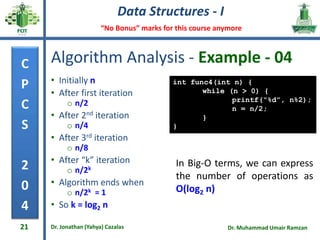
Algorithm Analysis - Example - 04
• Initially n
• After first iteration
o n/2
• After 2nd iteration
o n/4
• After 3rd iteration
o n/8
• After “k” iteration
o n/2k
• Algorithm ends when
o n/2k = 1
• So k = log2 n
21
In Big-O terms, we can express
the number of operations as
O(log2 n)
int func4(int n) {
while (n > 0) {
printf(“%d”, n%2);
n = n/2;
}
}
Data Structures - I
“No Bonus” marks for this course anymore
C
P
C
S
2
0
4
Dr. Jonathan (Yahya) Cazalas Dr. Muhammad Umair Ramzan
Algorithm Analysis - Example - 05
• Outer loop can never run more than n times
• Inner loop can never run more than n times
• The MOST number of times these two statements can run
(combined) is 2n times
• we approximate the running time as O(n)
22
int func5(int[][] array, int n) {
int i = 0, j = 0;
while (i < n) {
while (j < n && array[i][j] == 1)
j++;
i++;
}
return j;
}
Data Structures - I
“No Bonus” marks for this course anymore
C
P
C
S
2
0
4
Dr. Jonathan (Yahya) Cazalas Dr. Muhammad Umair Ramzan
Algorithm Analysis - Example - 06
• Outer loop will run n times
• Each outer iteration, Inner loop will run n times
• The MOST number of times these two statements can run n*n
times
• we approximate the running time as O(n2)
23
int func6(int[][] array, int n) {
int i = 0, j;
while (i < n) {
j = 0;
while (j < n && array[i][j] == 1)
j++;
i++;
}
return j;
}
Data Structures - I
“No Bonus” marks for this course anymore
C
P
C
S
2
0
4
Dr. Jonathan (Yahya) Cazalas Dr. Muhammad Umair Ramzan
Algorithm Analysis - Example - 07
• the runtime here is NOT in terms of n
• The outer loop runs sizeA times
• For each iteration of outer loop, the inner loop runs sizeB times
• So this algorithm runs sizeA*sizeB times
• We approximate the running time as O(sizeA*sizeB)
24
int func7(int A[], int sizeA, int B[], int sizeB) {
int i, j;
for (i = 0; i < sizeA; i++)
for (j = 0; j < sizeB; j++)
if (A[i] == B[j])
return 1;
return 0;
}
Data Structures - I
“No Bonus” marks for this course anymore
C
P
C
S
2
0
4
Dr. Jonathan (Yahya) Cazalas Dr. Muhammad Umair Ramzan
Algorithm Analysis - Example - 08
• the runtime here is NOT in terms of n
• The outer loop runs sizeA times
• For each iteration of outer loop, the inner loop runs lg(sizeB) times
• So this algorithm runs sizeA*lg (sizeB) times
• We approximate the running time as O(sizeA*lg(sizeB))
25
int func8(int A[], int sizeA, int B[], int sizeB) {
int i, j;
for (i = 0; i < sizeA; i++) {
if (binSearch(B, sizeB, A[i]))
return 1;
}
return 0;
}
Data Structures - I
“No Bonus” marks for this course anymore
C
P
C
S
2
0
4
Dr. Jonathan (Yahya) Cazalas Dr. Muhammad Umair Ramzan
Algorithm Analysis
26
Practical Problems
Data Structures - I
“No Bonus” marks for this course anymore
C
P
C
S
2
0
4
Dr. Jonathan (Yahya) Cazalas Dr. Muhammad Umair Ramzan
Big–Oh – Introduction (formal definition)
27
 
   

    
o
o
n
n
n
cg
n
f
n
c
n
f
n
g





all
for
0
such that
and
constants
positive
exist
there
:
• c * g(n) is an upper
bound on the value
of f(n)
• Such that
• f(n) <= c * g(n)
Data Structures - I
“No Bonus” marks for this course anymore
C
P
C
S
2
0
4
Dr. Jonathan (Yahya) Cazalas Dr. Muhammad Umair Ramzan
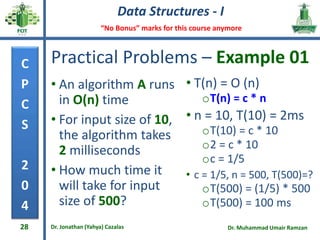
Practical Problems – Example 01
• An algorithm A runs
in O(n) time
• For input size of 10,
the algorithm takes
2 milliseconds
• How much time it
will take for input
size of 500?
28
• T(n) = O (n)
oT(n) = c * n
• n = 10, T(10) = 2ms
oT(10) = c * 10
o2 = c * 10
oc = 1/5
• c = 1/5, n = 500, T(500)=?
oT(500) = (1/5) * 500
oT(500) = 100 ms
Data Structures - I
“No Bonus” marks for this course anymore
C
P
C
S
2
0
4
Dr. Jonathan (Yahya) Cazalas Dr. Muhammad Umair Ramzan
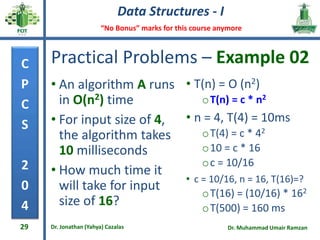
Practical Problems – Example 02
• An algorithm A runs
in O(n2) time
• For input size of 4,
the algorithm takes
10 milliseconds
• How much time it
will take for input
size of 16?
29
• T(n) = O (n2)
oT(n) = c * n2
• n = 4, T(4) = 10ms
oT(4) = c * 42
o10 = c * 16
oc = 10/16
• c = 10/16, n = 16, T(16)=?
oT(16) = (10/16) * 162
oT(500) = 160 ms
Data Structures - I
“No Bonus” marks for this course anymore
C
P
C
S
2
0
4
Dr. Jonathan (Yahya) Cazalas Dr. Muhammad Umair Ramzan
Practical Problems – Example 03
• An algorithm A runs
in O(log2n) time
• For input size of 16,
the algorithm takes
28 milliseconds
• How much time it
will take for input
size of 64?
30
• T(n) = O (log2n)
oT(n) = c * log2n
• n = 16, T(16) = 28ms
oT(16) = c * log216
o28 = c * 4
oc = 7
• c = 7, n = 64, T(64)=?
oT(64) = 7* log264
oT(64) = 7 * 6
oT(64) = 42 ms
Data Structures - I
“No Bonus” marks for this course anymore
C
P
C
S
2
0
4
Dr. Jonathan (Yahya) Cazalas Dr. Muhammad Umair Ramzan
31
Allah (Alone) is Sufficient for us,
and He is the Best Disposer of
affairs (for us).(Quran 3 : 173)

CPCS204-06 or last-AlgorithmAnalysis.pptx

  • 1.
    Data Structures -I “No Bonus” marks for this course anymore C P C S 2 0 4 Dr. Jonathan (Yahya) Cazalas Dr. Muhammad Umair Ramzan 1 and say, O my Lord, Give me more knowledge. (Quran 20 : 114)
  • 2.
    Data Structures -I “No Bonus” marks for this course anymore C P C S 2 0 4 Dr. Jonathan (Yahya) Cazalas Dr. Muhammad Umair Ramzan Algorithm Analysis 2 Introduction
  • 3.
    Data Structures -I “No Bonus” marks for this course anymore C P C S 2 0 4 Dr. Jonathan (Yahya) Cazalas Dr. Muhammad Umair Ramzan Algorithm Analysis - Introduction • Efficiency oMax # of 1’s • O(n) oLinear Search • O(n) oBinary Search • O(log2 n) oSorted List Matching Problems • O(n) 3
  • 4.
    Data Structures -I “No Bonus” marks for this course anymore C P C S 2 0 4 Dr. Jonathan (Yahya) Cazalas Dr. Muhammad Umair Ramzan Algorithm Analysis - Introduction • We will use Order Notation to approximate two things about algorithms: o How much time they take o How much memory (space) they use • Note: oIt is nearly impossible to figure out the exact amount of time an algorithm will take oEach algorithm gets translated into smaller and smaller machine instructions oEach of these instructions take various amounts of time to execute on different computers 4
  • 5.
    Data Structures -I “No Bonus” marks for this course anymore C P C S 2 0 4 Dr. Jonathan (Yahya) Cazalas Dr. Muhammad Umair Ramzan Algorithm Analysis - Introduction • We want to judge algorithms independent of their implementation • Specifically owe want to know how the performance of an algorithm responds to changes in problem size • And, rather than figure out an algorithm’s exact running time oWe only want an approximation oBig-O approximation 5
  • 6.
    Data Structures -I “No Bonus” marks for this course anymore C P C S 2 0 4 Dr. Jonathan (Yahya) Cazalas Dr. Muhammad Umair Ramzan Algorithm Analysis - Introduction • Big – O Approximation oAfter analyzing an algorithm, we end up with • Polynomial equation/function oGrowth of the function 6 10 3 4 ) ( 2    n n n f n 4n2 3n 10 1 4 3 10 10 400 30 10 100 40,000 300 10 1000 4,000,000 3,000 10 10,000 400,000,000 30,000 10 100,000 40,000,000,000 300,000 10 1,000,000 4,000,000,000,000 3,000,000 10
  • 7.
    Data Structures -I “No Bonus” marks for this course anymore C P C S 2 0 4 Dr. Jonathan (Yahya) Cazalas Dr. Muhammad Umair Ramzan Algorithm Analysis - Introduction • Big – O Approximation oEfficiency is approximated by highest order term • 4n2 oEliminate all lower order terms • 3n + 10 oIgnore all coefficient constants too • 4 (from 4n2) oHence 7 10 3 4 ) ( 2    n n n f 10 3 4 ) ( 2    n n n f
  • 8.
    Data Structures -I “No Bonus” marks for this course anymore C P C S 2 0 4 Dr. Jonathan (Yahya) Cazalas Dr. Muhammad Umair Ramzan Algorithm Analysis - Introduction • Big – O Approximation of(n) = 4n2 +3n +10 • O(n2) of(n) = 76,756,234n2 + 427,913n + 7 • O(n2) of(n) = 74n8 - 62n5 - 71562n3 + 3n2 – 5 • O(n8) of(n) = 42n4*(12n6 - 73n2 + 11) • O(n10) of(n) = 75n*logn – 415 • O(n*logn) 8
  • 9.
    Data Structures -I “No Bonus” marks for this course anymore C P C S 2 0 4 Dr. Jonathan (Yahya) Cazalas Dr. Muhammad Umair Ramzan Big–Oh - Introduction • 4n2 + 3n + 10 = O(n2) • We have one function: of(n) = 4n2 + 3n + 10 • Let us make a second function, g(n) og(n) = n2 • So now we have of(n) = O (g(n)) 9
  • 10.
    Data Structures -I “No Bonus” marks for this course anymore C P C S 2 0 4 Dr. Jonathan (Yahya) Cazalas Dr. Muhammad Umair Ramzan Big–Oh – Introduction (formal definition) 10             o o n n n cg n f n c n f n g      all for 0 such that and constants positive exist there : • c * g(n) is an upper bound on the value of f(n) • Such that • f(n) <= c * g(n)
  • 11.
    Data Structures -I “No Bonus” marks for this course anymore C P C S 2 0 4 Dr. Jonathan (Yahya) Cazalas Dr. Muhammad Umair Ramzan Common Order – Introduction • Complexity Classes • The best running time o1 • The Worst running time on! 11 Function Name 1 Constant log n Logarithmic n Linear n log n Poly-log n2 Quadratic n3 Cubic 2n Exponential n! Factorial
  • 12.
    Data Structures -I “No Bonus” marks for this course anymore C P C S 2 0 4 Dr. Jonathan (Yahya) Cazalas Dr. Muhammad Umair Ramzan Complexity Classes – O(1) • It is a notation for “constant work” • An example would be finding the smallest element in a sorted array oThere’s nothing to search for here oThe smallest element is always at the beginning of a sorted array oSo this would take O(1) time 12
  • 13.
    Data Structures -I “No Bonus” marks for this course anymore C P C S 2 0 4 Dr. Jonathan (Yahya) Cazalas Dr. Muhammad Umair Ramzan Complexity Classes – O(n) • It means that the work changes in a way that is proportional to n • Example: oIf the input size doubles, the running time also doubles • It is a notation for “work grows at a linear rate” • You usually can’t really do a lot better than this for most problems we deal with 13
  • 14.
    Data Structures -I “No Bonus” marks for this course anymore C P C S 2 0 4 Dr. Jonathan (Yahya) Cazalas Dr. Muhammad Umair Ramzan Complexity Classes – O(nk) • O(n2) or “Order n2 ”: Quadratic time oIf input size doubles, running time increases by a factor of 4 • O(n3) or “Order n3 ”: Cubic time oIf input size doubles, running time increases by a factor of 8 • O(nk): Other polynomial time oShould really try to avoid high order polynomial running times 14
  • 15.
    Data Structures -I “No Bonus” marks for this course anymore C P C S 2 0 4 Dr. Jonathan (Yahya) Cazalas Dr. Muhammad Umair Ramzan Complexity Classes – O(Exponential) • O(2n) or “Order 2n ”: Exponential time omore theoretical rather than practical interest because they cannot reasonably run on typical computers for even for moderate values of n. oInput sizes bigger than 40 or 50 become unmanageable • Even on faster computers • O(n!): even worse than exponential! oInput sizes bigger than 10 will take a long time 15
  • 16.
    Data Structures -I “No Bonus” marks for this course anymore C P C S 2 0 4 Dr. Jonathan (Yahya) Cazalas Dr. Muhammad Umair Ramzan Complexity Classes – O(Logarithmic) • O(n logn): oOnly slightly worse than O(n) time • And O(n logn) will be much less than O(n2) • This is the running time for the better sorting algorithms we will go over (later) • O(log n) or “Order log n”: Logarithmic time oIf input size doubles, running time increases ONLY by a constant amount oany algorithm that halves the data remaining to be processed on each iteration of a loop will be an O(log n) algorithm. 16
  • 17.
    Data Structures -I “No Bonus” marks for this course anymore C P C S 2 0 4 Dr. Jonathan (Yahya) Cazalas Dr. Muhammad Umair Ramzan Algorithm Analysis 17 Some Example
  • 18.
    Data Structures -I “No Bonus” marks for this course anymore C P C S 2 0 4 Dr. Jonathan (Yahya) Cazalas Dr. Muhammad Umair Ramzan Algorithm Analysis - Example - 01 • The number of operations executed by these loops is the sum of the individual loop operations. • The first loop has n/2 operations • The second loop has n2 operations • Not nested, So we simply ADD their operations • The total number of operations would be o T(n) = n/2 + n2 18 for (k = 1; k <= n/2; k++) { sum = sum + 5; } for (j = 1; j <= n*n; j++) { delta = delta + 1; } In Big-O terms, we can express the number of operations as O(n2)
  • 19.
    Data Structures -I “No Bonus” marks for this course anymore C P C S 2 0 4 Dr. Jonathan (Yahya) Cazalas Dr. Muhammad Umair Ramzan Algorithm Analysis - Example - 02 • The outer loop runs n times • for each of those n times, the inner loop also runs n times • So we have n operations per iteration of OUTER loop • Finally, we have the number of operations oT(n) = n*n 19 In Big-O terms, we can express the number of operations as O(n2) int func1(int n) { int i, j, x = 0; for (i = 1; i <= n; i++) { for (j = 1; j <= n; j++) { x++; } } return x; }
  • 20.
    Data Structures -I “No Bonus” marks for this course anymore C P C S 2 0 4 Dr. Jonathan (Yahya) Cazalas Dr. Muhammad Umair Ramzan Algorithm Analysis - Example - 03 • The loops are NOT nested • First loop runs n times • Second loop runs n times • Total runtime is on the order of oT(n) = n+n = 2n 20 In Big-O terms, we can express the number of operations as O(n) int func3(int n) { int i, x = 0; for (i = 1; i <= n; i++) x++; for (i = 1; i<=n; i++) x++; return x; }
  • 21.
    Data Structures -I “No Bonus” marks for this course anymore C P C S 2 0 4 Dr. Jonathan (Yahya) Cazalas Dr. Muhammad Umair Ramzan Algorithm Analysis - Example - 04 • Initially n • After first iteration o n/2 • After 2nd iteration o n/4 • After 3rd iteration o n/8 • After “k” iteration o n/2k • Algorithm ends when o n/2k = 1 • So k = log2 n 21 In Big-O terms, we can express the number of operations as O(log2 n) int func4(int n) { while (n > 0) { printf(“%d”, n%2); n = n/2; } }
  • 22.
    Data Structures -I “No Bonus” marks for this course anymore C P C S 2 0 4 Dr. Jonathan (Yahya) Cazalas Dr. Muhammad Umair Ramzan Algorithm Analysis - Example - 05 • Outer loop can never run more than n times • Inner loop can never run more than n times • The MOST number of times these two statements can run (combined) is 2n times • we approximate the running time as O(n) 22 int func5(int[][] array, int n) { int i = 0, j = 0; while (i < n) { while (j < n && array[i][j] == 1) j++; i++; } return j; }
  • 23.
    Data Structures -I “No Bonus” marks for this course anymore C P C S 2 0 4 Dr. Jonathan (Yahya) Cazalas Dr. Muhammad Umair Ramzan Algorithm Analysis - Example - 06 • Outer loop will run n times • Each outer iteration, Inner loop will run n times • The MOST number of times these two statements can run n*n times • we approximate the running time as O(n2) 23 int func6(int[][] array, int n) { int i = 0, j; while (i < n) { j = 0; while (j < n && array[i][j] == 1) j++; i++; } return j; }
  • 24.
    Data Structures -I “No Bonus” marks for this course anymore C P C S 2 0 4 Dr. Jonathan (Yahya) Cazalas Dr. Muhammad Umair Ramzan Algorithm Analysis - Example - 07 • the runtime here is NOT in terms of n • The outer loop runs sizeA times • For each iteration of outer loop, the inner loop runs sizeB times • So this algorithm runs sizeA*sizeB times • We approximate the running time as O(sizeA*sizeB) 24 int func7(int A[], int sizeA, int B[], int sizeB) { int i, j; for (i = 0; i < sizeA; i++) for (j = 0; j < sizeB; j++) if (A[i] == B[j]) return 1; return 0; }
  • 25.
    Data Structures -I “No Bonus” marks for this course anymore C P C S 2 0 4 Dr. Jonathan (Yahya) Cazalas Dr. Muhammad Umair Ramzan Algorithm Analysis - Example - 08 • the runtime here is NOT in terms of n • The outer loop runs sizeA times • For each iteration of outer loop, the inner loop runs lg(sizeB) times • So this algorithm runs sizeA*lg (sizeB) times • We approximate the running time as O(sizeA*lg(sizeB)) 25 int func8(int A[], int sizeA, int B[], int sizeB) { int i, j; for (i = 0; i < sizeA; i++) { if (binSearch(B, sizeB, A[i])) return 1; } return 0; }
  • 26.
    Data Structures -I “No Bonus” marks for this course anymore C P C S 2 0 4 Dr. Jonathan (Yahya) Cazalas Dr. Muhammad Umair Ramzan Algorithm Analysis 26 Practical Problems
  • 27.
    Data Structures -I “No Bonus” marks for this course anymore C P C S 2 0 4 Dr. Jonathan (Yahya) Cazalas Dr. Muhammad Umair Ramzan Big–Oh – Introduction (formal definition) 27             o o n n n cg n f n c n f n g      all for 0 such that and constants positive exist there : • c * g(n) is an upper bound on the value of f(n) • Such that • f(n) <= c * g(n)
  • 28.
    Data Structures -I “No Bonus” marks for this course anymore C P C S 2 0 4 Dr. Jonathan (Yahya) Cazalas Dr. Muhammad Umair Ramzan Practical Problems – Example 01 • An algorithm A runs in O(n) time • For input size of 10, the algorithm takes 2 milliseconds • How much time it will take for input size of 500? 28 • T(n) = O (n) oT(n) = c * n • n = 10, T(10) = 2ms oT(10) = c * 10 o2 = c * 10 oc = 1/5 • c = 1/5, n = 500, T(500)=? oT(500) = (1/5) * 500 oT(500) = 100 ms
  • 29.
    Data Structures -I “No Bonus” marks for this course anymore C P C S 2 0 4 Dr. Jonathan (Yahya) Cazalas Dr. Muhammad Umair Ramzan Practical Problems – Example 02 • An algorithm A runs in O(n2) time • For input size of 4, the algorithm takes 10 milliseconds • How much time it will take for input size of 16? 29 • T(n) = O (n2) oT(n) = c * n2 • n = 4, T(4) = 10ms oT(4) = c * 42 o10 = c * 16 oc = 10/16 • c = 10/16, n = 16, T(16)=? oT(16) = (10/16) * 162 oT(500) = 160 ms
  • 30.
    Data Structures -I “No Bonus” marks for this course anymore C P C S 2 0 4 Dr. Jonathan (Yahya) Cazalas Dr. Muhammad Umair Ramzan Practical Problems – Example 03 • An algorithm A runs in O(log2n) time • For input size of 16, the algorithm takes 28 milliseconds • How much time it will take for input size of 64? 30 • T(n) = O (log2n) oT(n) = c * log2n • n = 16, T(16) = 28ms oT(16) = c * log216 o28 = c * 4 oc = 7 • c = 7, n = 64, T(64)=? oT(64) = 7* log264 oT(64) = 7 * 6 oT(64) = 42 ms
  • 31.
    Data Structures -I “No Bonus” marks for this course anymore C P C S 2 0 4 Dr. Jonathan (Yahya) Cazalas Dr. Muhammad Umair Ramzan 31 Allah (Alone) is Sufficient for us, and He is the Best Disposer of affairs (for us).(Quran 3 : 173)