Introduction:
Basic Concepts and Notations
Complexity analysis: time space tradeoff
Algorithmic notations, Big O notation
Introduction to omega, theta and little o
notation
Basic Concepts and Notations
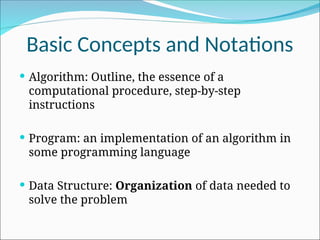
 Algorithm: Outline, the essence of a
computational procedure, step-by-step
instructions
 Program: an implementation of an algorithm in
some programming language
 Data Structure: Organization of data needed to
solve the problem
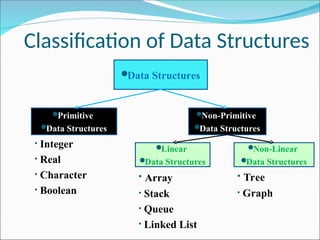
Classification of Data Structures
Data Structures
Primitive
Data Structures
Non-Primitive
Data Structures
Linear
Data Structures
Non-Linear
Data Structures
• Integer
• Real
• Character
• Boolean
• Array
• Stack
• Queue
• Linked List
• Tree
• Graph
Data Structure Operations
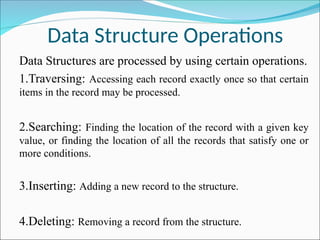
Data Structures are processed by using certain operations.
1.Traversing: Accessing each record exactly once so that certain
items in the record may be processed.
2.Searching: Finding the location of the record with a given key
value, or finding the location of all the records that satisfy one or
more conditions.
3.Inserting: Adding a new record to the structure.
4.Deleting: Removing a record from the structure.
Special Data Structure-
Operations
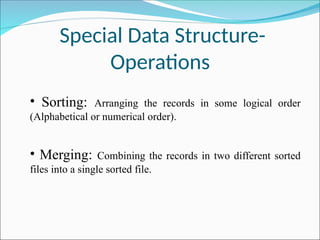
• Sorting: Arranging the records in some logical order
(Alphabetical or numerical order).
• Merging: Combining the records in two different sorted
files into a single sorted file.
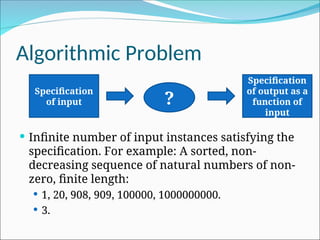
Algorithmic Problem
 Infinite number of input instances satisfying the
specification. For example: A sorted, non-
decreasing sequence of natural numbers of non-
zero, finite length:
 1, 20, 908, 909, 100000, 1000000000.
 3.
Specification
of input ?
Specification
of output as a
function of
input
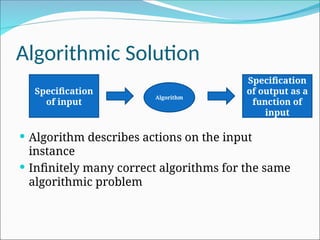
Algorithmic Solution
 Algorithm describes actions on the input
instance
 Infinitely many correct algorithms for the same
algorithmic problem
Specification
of input
Algorithm
Specification
of output as a
function of
input
What is a Good Algorithm?
 Efficient:
 Running time
 Space used
 Efficiency as a function of input size:
 The number of bits in an input number
 Number of data elements(numbers, points)
Complexity analysis
 Why we should analyze algorithms?
 Predict the resources that the algorithm requires
 Computational time (CPU consumption)
 Memory space (RAM consumption)
 Communication bandwidth consumption
 The running time of an algorithm is:
 The total number of primitive operations executed
(machine independent steps)
 It is a determination of order of magnitude of statement.
 Also known as algorithm complexity
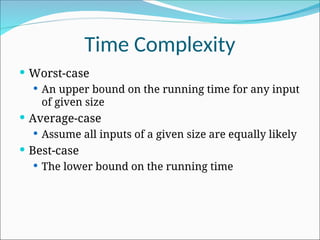
Time Complexity
 Worst-case
 An upper bound on the running time for any input
of given size
 Average-case
 Assume all inputs of a given size are equally likely
 Best-case
 The lower bound on the running time
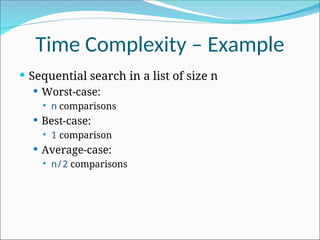
Time Complexity – Example
 Sequential search in a list of size n
 Worst-case:
 n comparisons
 Best-case:
 1 comparison
 Average-case:
 n/2 comparisons
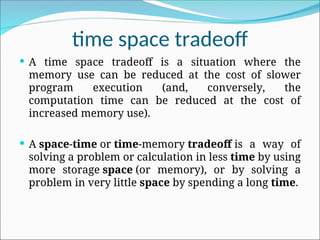
time space tradeoff
 A time space tradeoff is a situation where the
memory use can be reduced at the cost of slower
program execution (and, conversely, the
computation time can be reduced at the cost of
increased memory use).
 A space-time or time-memory tradeoff is a way of
solving a problem or calculation in less time by using
more storage space (or memory), or by solving a
problem in very little space by spending a long time.
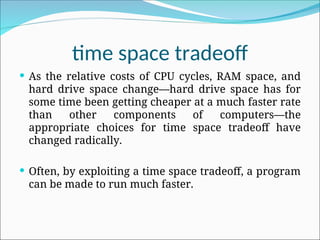
time space tradeoff
 As the relative costs of CPU cycles, RAM space, and
hard drive space change—hard drive space has for
some time been getting cheaper at a much faster rate
than other components of computers—the
appropriate choices for time space tradeoff have
changed radically.
 Often, by exploiting a time space tradeoff, a program
can be made to run much faster.
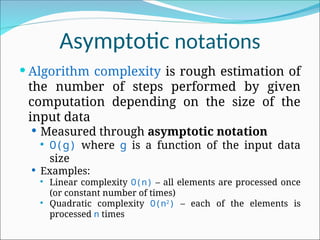
Asymptotic notations
 Algorithm complexity is rough estimation of
the number of steps performed by given
computation depending on the size of the
input data
 Measured through asymptotic notation
 O(g) where g is a function of the input data
size
 Examples:
 Linear complexity O(n) – all elements are processed once
(or constant number of times)
 Quadratic complexity O(n2
) – each of the elements is
processed n times
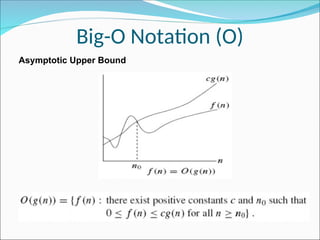
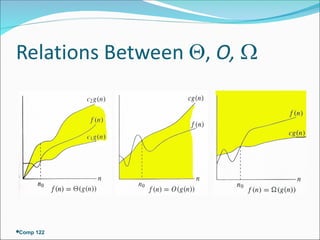
Big-O Notation (O)
Asymptotic Upper Bound
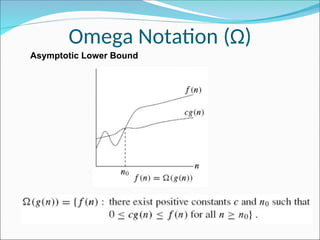
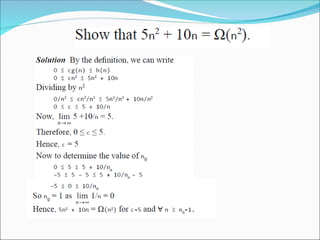
Omega Notation (Ω)
Asymptotic Lower Bound
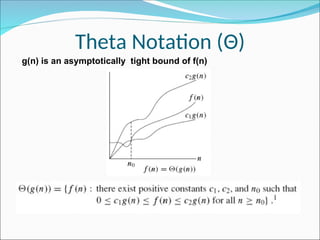
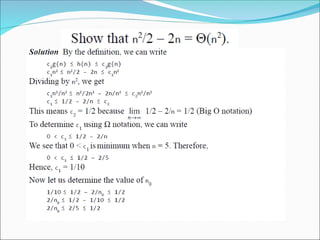
Theta Notation (Θ)
g(n) is an asymptotically tight bound of f(n)
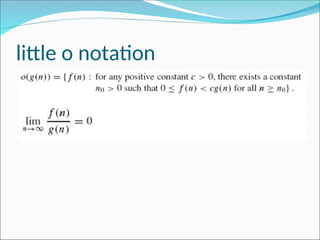
little o notation
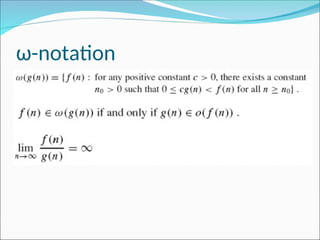
ω-notation
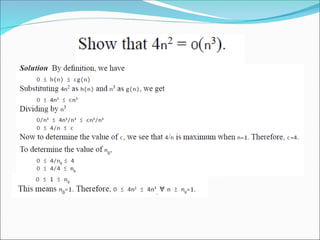
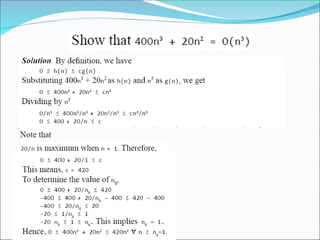
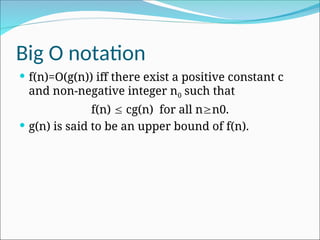
Big O notation
 f(n)=O(g(n)) iff there exist a positive constant c
and non-negative integer n0 such that
f(n)  cg(n) for all nn0.
 g(n) is said to be an upper bound of f(n).
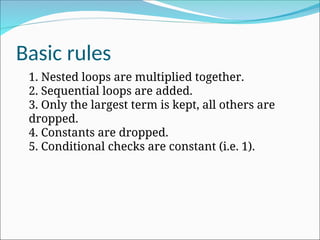
Basic rules
1. Nested loops are multiplied together.
2. Sequential loops are added.
3. Only the largest term is kept, all others are
dropped.
4. Constants are dropped.
5. Conditional checks are constant (i.e. 1).
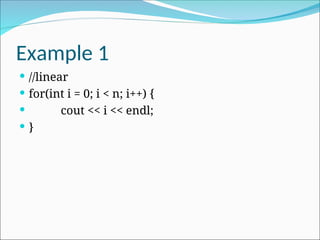
Example 1
 //linear
 for(int i = 0; i < n; i++) {
 cout << i << endl;
 }
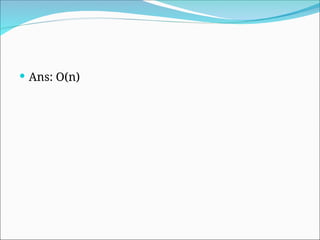
 Ans: O(n)
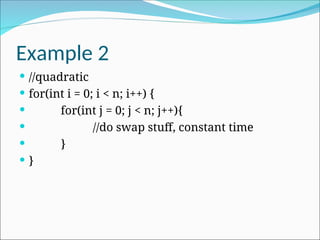
Example 2
 //quadratic
 for(int i = 0; i < n; i++) {
 for(int j = 0; j < n; j++){
 //do swap stuff, constant time
 }
 }
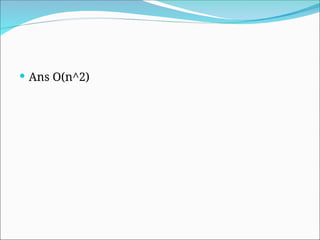
 Ans O(n^2)
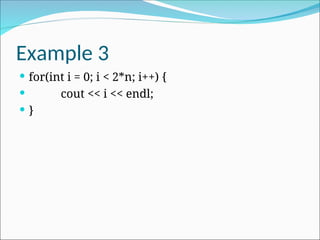
Example 3
 for(int i = 0; i < 2*n; i++) {
 cout << i << endl;
 }
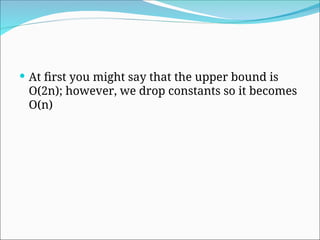
 At first you might say that the upper bound is
O(2n); however, we drop constants so it becomes
O(n)
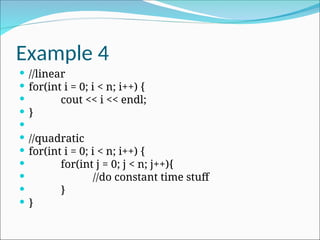
Example 4
 //linear
 for(int i = 0; i < n; i++) {
 cout << i << endl;
 }

 //quadratic
 for(int i = 0; i < n; i++) {
 for(int j = 0; j < n; j++){
 //do constant time stuff
 }
 }
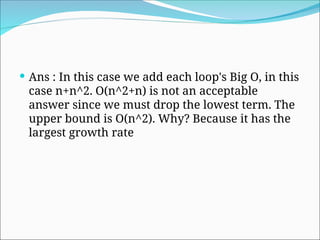
 Ans : In this case we add each loop's Big O, in this
case n+n^2. O(n^2+n) is not an acceptable
answer since we must drop the lowest term. The
upper bound is O(n^2). Why? Because it has the
largest growth rate
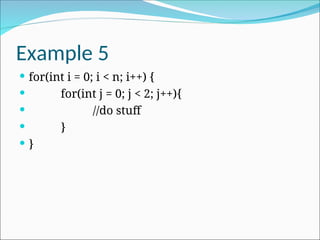
Example 5
 for(int i = 0; i < n; i++) {
 for(int j = 0; j < 2; j++){
 //do stuff
 }
 }
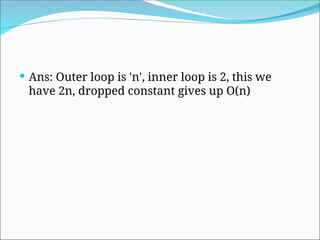
 Ans: Outer loop is 'n', inner loop is 2, this we
have 2n, dropped constant gives up O(n)
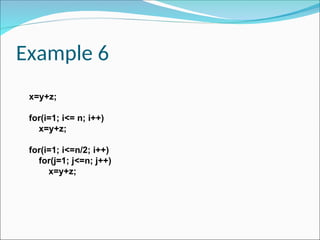
Example 6
x=y+z;
for(i=1; i<= n; i++)
x=y+z;
for(i=1; i<=n/2; i++)
for(j=1; j<=n; j++)
x=y+z;
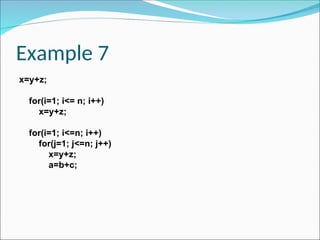
Example 7
x=y+z;
for(i=1; i<= n; i++)
x=y+z;
for(i=1; i<=n; i++)
for(j=1; j<=n; j++)
x=y+z;
a=b+c;
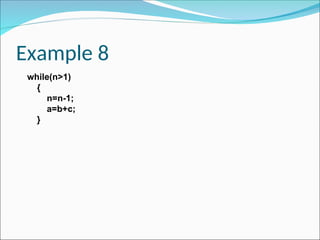
Example 8
while(n>1)
{
n=n-1;
a=b+c;
}
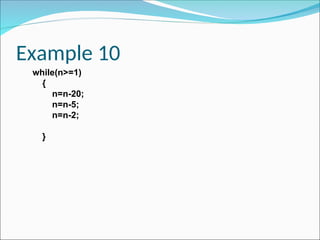
Example 10
while(n>=1)
{
n=n-20;
n=n-5;
n=n-2;
}
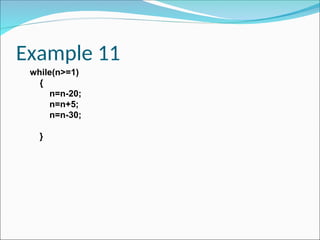
Example 11
while(n>=1)
{
n=n-20;
n=n+5;
n=n-30;
}
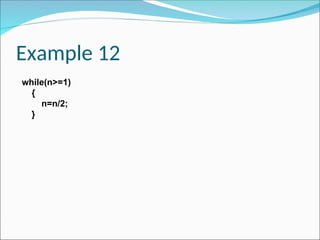
Example 12
while(n>=1)
{
n=n/2;
}
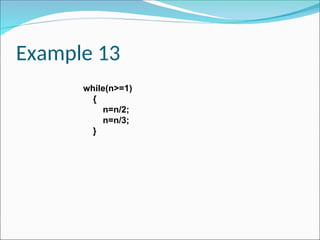
Example 13
while(n>=1)
{
n=n/2;
n=n/3;
}
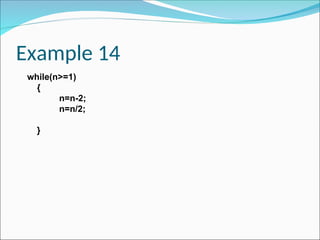
Example 14
while(n>=1)
{
n=n-2;
n=n/2;
}
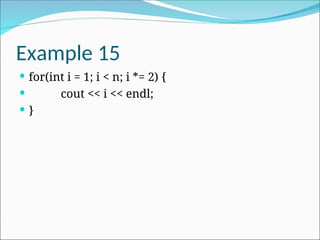
Example 15
 for(int i = 1; i < n; i *= 2) {
 cout << i << endl;
 }
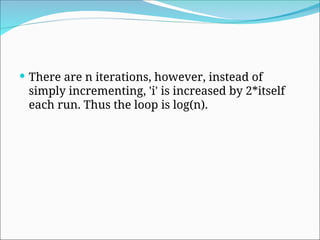
 There are n iterations, however, instead of
simply incrementing, 'i' is increased by 2*itself
each run. Thus the loop is log(n).
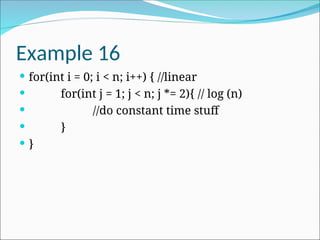
Example 16
 for(int i = 0; i < n; i++) { //linear
 for(int j = 1; j < n; j *= 2){ // log (n)
 //do constant time stuff
 }
 }
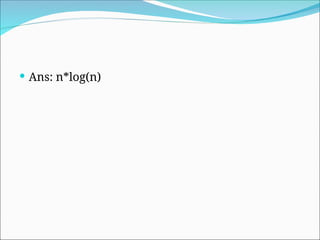
 Ans: n*log(n)
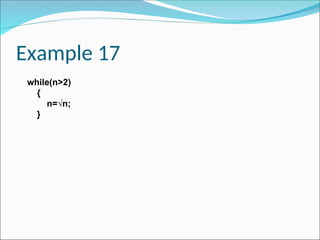
Example 17
while(n>2)
{
n=√n;
}
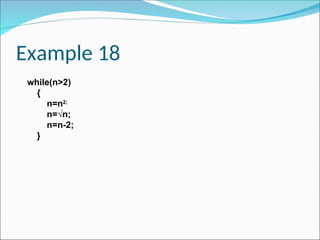
Example 18
while(n>2)
{
n=n2;
n=√n;
n=n-2;
}
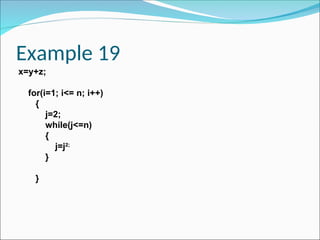
Example 19
x=y+z;
for(i=1; i<= n; i++)
{
j=2;
while(j<=n)
{
j=j2;
}
}
Comp 122
Thank You

Basics of data structure types of data structures

  • 1.
    Introduction: Basic Concepts andNotations Complexity analysis: time space tradeoff Algorithmic notations, Big O notation Introduction to omega, theta and little o notation
  • 2.
    Basic Concepts andNotations  Algorithm: Outline, the essence of a computational procedure, step-by-step instructions  Program: an implementation of an algorithm in some programming language  Data Structure: Organization of data needed to solve the problem
  • 3.
    Classification of DataStructures Data Structures Primitive Data Structures Non-Primitive Data Structures Linear Data Structures Non-Linear Data Structures • Integer • Real • Character • Boolean • Array • Stack • Queue • Linked List • Tree • Graph
  • 4.
    Data Structure Operations DataStructures are processed by using certain operations. 1.Traversing: Accessing each record exactly once so that certain items in the record may be processed. 2.Searching: Finding the location of the record with a given key value, or finding the location of all the records that satisfy one or more conditions. 3.Inserting: Adding a new record to the structure. 4.Deleting: Removing a record from the structure.
  • 5.
    Special Data Structure- Operations •Sorting: Arranging the records in some logical order (Alphabetical or numerical order). • Merging: Combining the records in two different sorted files into a single sorted file.
  • 6.
    Algorithmic Problem  Infinitenumber of input instances satisfying the specification. For example: A sorted, non- decreasing sequence of natural numbers of non- zero, finite length:  1, 20, 908, 909, 100000, 1000000000.  3. Specification of input ? Specification of output as a function of input
  • 7.
    Algorithmic Solution  Algorithmdescribes actions on the input instance  Infinitely many correct algorithms for the same algorithmic problem Specification of input Algorithm Specification of output as a function of input
  • 8.
    What is aGood Algorithm?  Efficient:  Running time  Space used  Efficiency as a function of input size:  The number of bits in an input number  Number of data elements(numbers, points)
  • 9.
    Complexity analysis  Whywe should analyze algorithms?  Predict the resources that the algorithm requires  Computational time (CPU consumption)  Memory space (RAM consumption)  Communication bandwidth consumption  The running time of an algorithm is:  The total number of primitive operations executed (machine independent steps)  It is a determination of order of magnitude of statement.  Also known as algorithm complexity
  • 10.
    Time Complexity  Worst-case An upper bound on the running time for any input of given size  Average-case  Assume all inputs of a given size are equally likely  Best-case  The lower bound on the running time
  • 11.
    Time Complexity –Example  Sequential search in a list of size n  Worst-case:  n comparisons  Best-case:  1 comparison  Average-case:  n/2 comparisons
  • 12.
    time space tradeoff A time space tradeoff is a situation where the memory use can be reduced at the cost of slower program execution (and, conversely, the computation time can be reduced at the cost of increased memory use).  A space-time or time-memory tradeoff is a way of solving a problem or calculation in less time by using more storage space (or memory), or by solving a problem in very little space by spending a long time.
  • 13.
    time space tradeoff As the relative costs of CPU cycles, RAM space, and hard drive space change—hard drive space has for some time been getting cheaper at a much faster rate than other components of computers—the appropriate choices for time space tradeoff have changed radically.  Often, by exploiting a time space tradeoff, a program can be made to run much faster.
  • 14.
    Asymptotic notations  Algorithmcomplexity is rough estimation of the number of steps performed by given computation depending on the size of the input data  Measured through asymptotic notation  O(g) where g is a function of the input data size  Examples:  Linear complexity O(n) – all elements are processed once (or constant number of times)  Quadratic complexity O(n2 ) – each of the elements is processed n times
  • 15.
  • 18.
  • 20.
    Theta Notation (Θ) g(n)is an asymptotically tight bound of f(n)
  • 23.
  • 24.
  • 25.
    Big O notation f(n)=O(g(n)) iff there exist a positive constant c and non-negative integer n0 such that f(n)  cg(n) for all nn0.  g(n) is said to be an upper bound of f(n).
  • 26.
    Basic rules 1. Nestedloops are multiplied together. 2. Sequential loops are added. 3. Only the largest term is kept, all others are dropped. 4. Constants are dropped. 5. Conditional checks are constant (i.e. 1).
  • 27.
    Example 1  //linear for(int i = 0; i < n; i++) {  cout << i << endl;  }
  • 28.
  • 29.
    Example 2  //quadratic for(int i = 0; i < n; i++) {  for(int j = 0; j < n; j++){  //do swap stuff, constant time  }  }
  • 30.
  • 31.
    Example 3  for(inti = 0; i < 2*n; i++) {  cout << i << endl;  }
  • 32.
     At firstyou might say that the upper bound is O(2n); however, we drop constants so it becomes O(n)
  • 33.
    Example 4  //linear for(int i = 0; i < n; i++) {  cout << i << endl;  }   //quadratic  for(int i = 0; i < n; i++) {  for(int j = 0; j < n; j++){  //do constant time stuff  }  }
  • 34.
     Ans :In this case we add each loop's Big O, in this case n+n^2. O(n^2+n) is not an acceptable answer since we must drop the lowest term. The upper bound is O(n^2). Why? Because it has the largest growth rate
  • 35.
    Example 5  for(inti = 0; i < n; i++) {  for(int j = 0; j < 2; j++){  //do stuff  }  }
  • 36.
     Ans: Outerloop is 'n', inner loop is 2, this we have 2n, dropped constant gives up O(n)
  • 37.
    Example 6 x=y+z; for(i=1; i<=n; i++) x=y+z; for(i=1; i<=n/2; i++) for(j=1; j<=n; j++) x=y+z;
  • 38.
    Example 7 x=y+z; for(i=1; i<=n; i++) x=y+z; for(i=1; i<=n; i++) for(j=1; j<=n; j++) x=y+z; a=b+c;
  • 39.
  • 40.
  • 41.
  • 42.
  • 43.
  • 44.
  • 45.
    Example 15  for(inti = 1; i < n; i *= 2) {  cout << i << endl;  }
  • 46.
     There aren iterations, however, instead of simply incrementing, 'i' is increased by 2*itself each run. Thus the loop is log(n).
  • 47.
    Example 16  for(inti = 0; i < n; i++) { //linear  for(int j = 1; j < n; j *= 2){ // log (n)  //do constant time stuff  }  }
  • 48.
  • 49.
  • 50.
  • 51.
    Example 19 x=y+z; for(i=1; i<=n; i++) { j=2; while(j<=n) { j=j2; } }
  • 52.
  • 53.

Editor's Notes

  • #3 PRIMITIVE DATATYPE       The primitive data types are the basic data types that are available in most of the programming languages. The primitive data types are used to represent single values.  NON PRIMITIVE DATATYPES               The data types that are derived from primary data types are known as non-Primitive data types. These datatypes are used to store group of values.  
  • #4 목차 자바의 생성배경 자바를 사용하는 이유 과거, 현재, 미래의 자바 자바의 발전과정 버전별 JDK에 대한 설명 자바와 C++의 차이점 자바의 성능 자바 관련 산업(?)의 경향
  • #5 목차 자바의 생성배경 자바를 사용하는 이유 과거, 현재, 미래의 자바 자바의 발전과정 버전별 JDK에 대한 설명 자바와 C++의 차이점 자바의 성능 자바 관련 산업(?)의 경향
  • #8 Refer the notes.
  • #9 Refer the Notes
  • #15 Where, C>0 & n0>=1 Also Known as Worst Case Complexity
  • #18 Where, C>0 & n0>=1 Also Known as Best Case Complexity
  • #20 C1>0, C2>0, N0>=1 Also Known as Average Time Complexity
  • #37 O(n2
  • #38 O(n2
  • #39 O(n)
  • #40 n/27 O(n)
  • #41 n/45 O(n)
  • #42 log2n
  • #43 O(log6n)
  • #44 O(log2n)
  • #49 O(log logn)
  • #50 O(n)
  • #51 O(n.log(log2n))