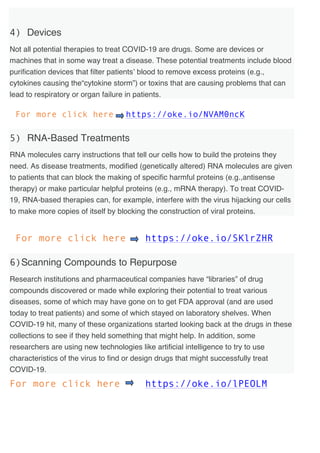
This document discusses potential treatments for COVID-19, including antibodies from recovered patients or made in labs to neutralize the virus, antivirals that block viral replication, cell-based therapies to help the immune system respond properly, devices to remove excess proteins or toxins, RNA-based treatments that interfere with viral protein production, and repurposing existing drug compounds that may be effective.
![COVID-19 TREATMENT
1)Antibodies
Antibodies are one of your body’s natural defense systems against foreign attackers.
When your body detects foreign intruders (like bacteria or viruses), your immune
system makes antibodies that recognizes them. These specific antibodies attach to
the foreign intruders and target them for destruction. To treat or prevent disease,
scientists can either use antibodies from the blood of people who have recovered
from the infection (i.e., “convalescent plasma”) or use antibodies made in a lab that
will attach to and stop (“neutralize”) the foreign intruders.
Antibodies created to attach to different molecules in the body (i.e., not foreign
intruders) can also be used to treat disease, for example, by turning down your
immune response to stop it from overreacting and causing damage to the body (a
phenomenon known as “cytokine storm”).
For more click here https://oke.io/nNQW
2) Antivirals
Viruses travel light—they usually only carry a few things they need, including the
code to make more of themselves (the “nucleic acid,” either DNA or RNA) and a
protective shell around them. They can’t make more of themselves (“replicate”) on
their own. They need to get into animal cells, where they hijack the replication
system that those cells use. Antiviral treatments stop viruses from making more of
themselves by blocking one or more steps in the process.
For more click here https://oke.io/2fqm8c
3) Cell-Based Therapies
Cell-based therapies work by transferring into patients live cells to treat a specific
disease. To make cell-based therapies, researchers take cells either from the patient
(called “autologous” therapies) or from a donor (called “allogeneic”therapies) and
either transfer the cells unchanged or change the cells in specific ways to treat a
specific disease (e.g., CAR-T therapies). Different cell types from different sources
can be used (e.g., stem cells from fat tissue or bone marrow, cells from placenta, T-
cells, natural killer [NK] cells). To treat COVID-19 disease, potential cell-based
therapies work, in general, by helping the patient’s immune system work better (and
not overreact) by releasing signals to other cells in the body to coordinate a proper
reaction to the infection and help healing.
For more click here https://oke.io/o9BYzpPP](https://image.slidesharecdn.com/covid19treatment-210914212158/85/Covid19-treatment-1-320.jpg)
![COVID-19 TREATMENT
1)Antibodies
Antibodies are one of your body’s natural defense systems against foreign attackers.
When your body detects foreign intruders (like bacteria or viruses), your immune
system makes antibodies that recognizes them. These specific antibodies attach to
the foreign intruders and target them for destruction. To treat or prevent disease,
scientists can either use antibodies from the blood of people who have recovered
from the infection (i.e., “convalescent plasma”) or use antibodies made in a lab that
will attach to and stop (“neutralize”) the foreign intruders.
Antibodies created to attach to different molecules in the body (i.e., not foreign
intruders) can also be used to treat disease, for example, by turning down your
immune response to stop it from overreacting and causing damage to the body (a
phenomenon known as “cytokine storm”).
For more click here https://oke.io/nNQW
2) Antivirals
Viruses travel light—they usually only carry a few things they need, including the
code to make more of themselves (the “nucleic acid,” either DNA or RNA) and a
protective shell around them. They can’t make more of themselves (“replicate”) on
their own. They need to get into animal cells, where they hijack the replication
system that those cells use. Antiviral treatments stop viruses from making more of
themselves by blocking one or more steps in the process.
For more click here https://oke.io/2fqm8c
3) Cell-Based Therapies
Cell-based therapies work by transferring into patients live cells to treat a specific
disease. To make cell-based therapies, researchers take cells either from the patient
(called “autologous” therapies) or from a donor (called “allogeneic”therapies) and
either transfer the cells unchanged or change the cells in specific ways to treat a
specific disease (e.g., CAR-T therapies). Different cell types from different sources
can be used (e.g., stem cells from fat tissue or bone marrow, cells from placenta, T-
cells, natural killer [NK] cells). To treat COVID-19 disease, potential cell-based
therapies work, in general, by helping the patient’s immune system work better (and
not overreact) by releasing signals to other cells in the body to coordinate a proper
reaction to the infection and help healing.
For more click here https://oke.io/o9BYzpPP](https://image.slidesharecdn.com/covid19treatment-210914212158/75/Covid19-treatment-1-2048.jpg)