International Research Journal of Engineering and Technology (IRJET) e-ISSN: 2395-0056
Volume: 09 Issue: 04 | Apr 2022 www.irjet.net p-ISSN: 2395-0072
© 2021, IRJET | Impact Factor value: 7.529 | ISO 9001:2008 Certified Journal | Page 2745
Covid Norms Checker with IOT Based Health Monitoring
Sameer Choudhary1, Vaibhav Chaudhari2, Darshan Darji3, Siddharth Gurukhel4, Mohan Kumar5
1234B.E. Student, Electronics and Tele-Communication Engineering, Atharva College of Engineering, Mumbai, India
5Professor, Electronics and Tele-Communication Engineering, Atharva College of Engineering, Mumbai, India
---------------------------------------------------------------------***---------------------------------------------------------------------
Abstract – In this project we would be making use of a
face recognition algorithm for detecting whether a person is
spitting and then taking necessary action. The project also
includes specific work using OpenCV to detect crowds. A
pulse oximeter is also included in the system, which captures
users' oxygen levels and heart rate data, which is then
transferred to Telegram Cloud, along with their image
captured using the ESP32 Cam Board. Spitting Person Face
Recognition which will charge the person with a fine. Crowd
detection system for maintaining places with social
distancing norms. Pulse Oximeter System for measuring
pulse rate and oxygen level of the user.
Key Words: Face Detection, OpenCV, Haar Features,
Cam Board, Dlib Model
1. INTRODUCTION
Face detection is a type of computer vision that assists in
the detection of human faces in digital images. Face
detection has become more important as technology has
advanced, particularly in industries such as photography,
security, and marketing. In the field of permeating
systems, people counting systems can get an exact count of
people indoors or outdoors and have a wide range of uses.
People counting devices are commonly used for
promotional evaluation, calculating demand ratios in retail
environments, and in crowd management surveillance. In
this project we would be making use of a face recognition
algorithm for detecting whether a person is spitting and
then taking necessary action.
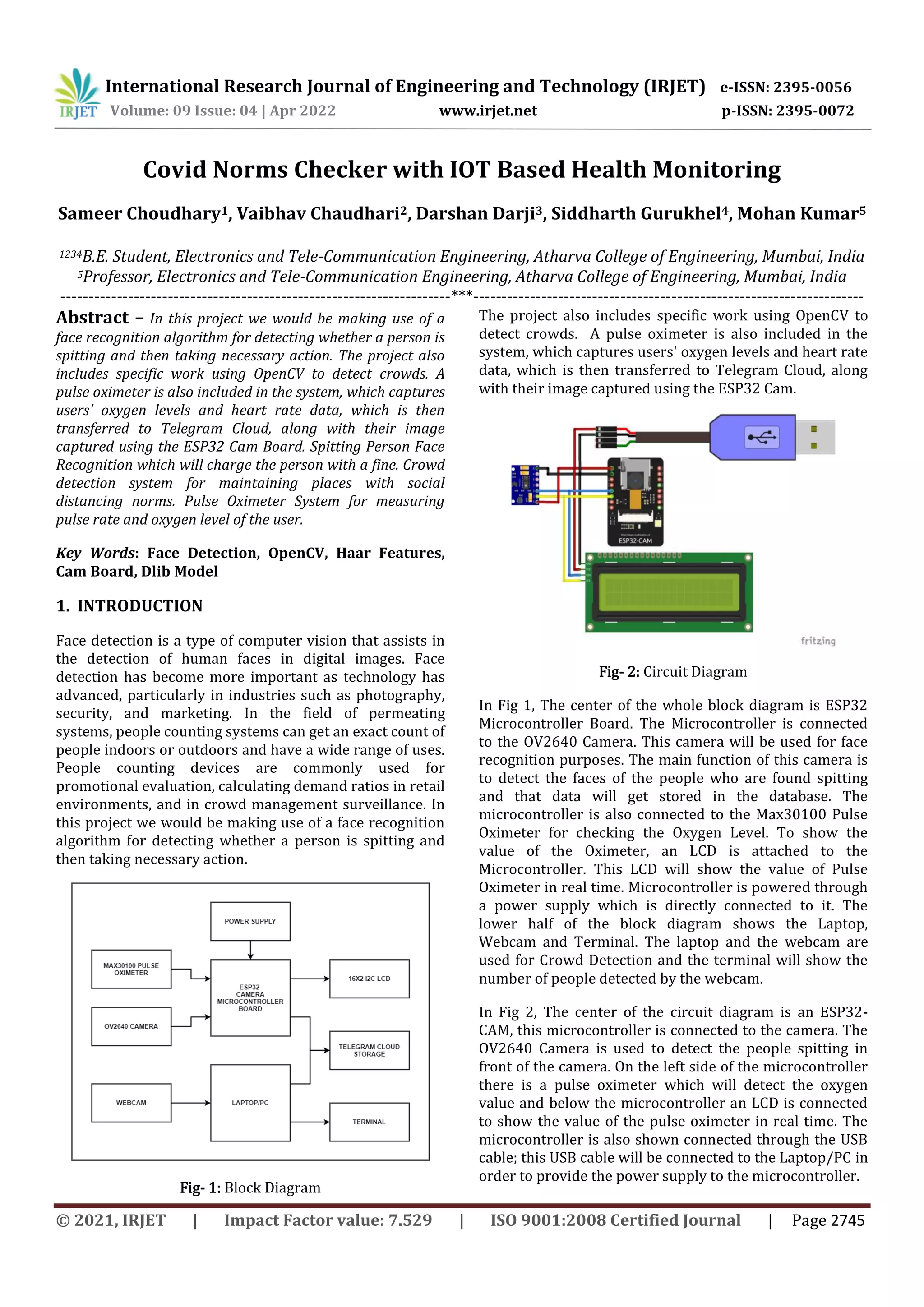
Fig- 1: Block Diagram
The project also includes specific work using OpenCV to
detect crowds. A pulse oximeter is also included in the
system, which captures users' oxygen levels and heart rate
data, which is then transferred to Telegram Cloud, along
with their image captured using the ESP32 Cam.
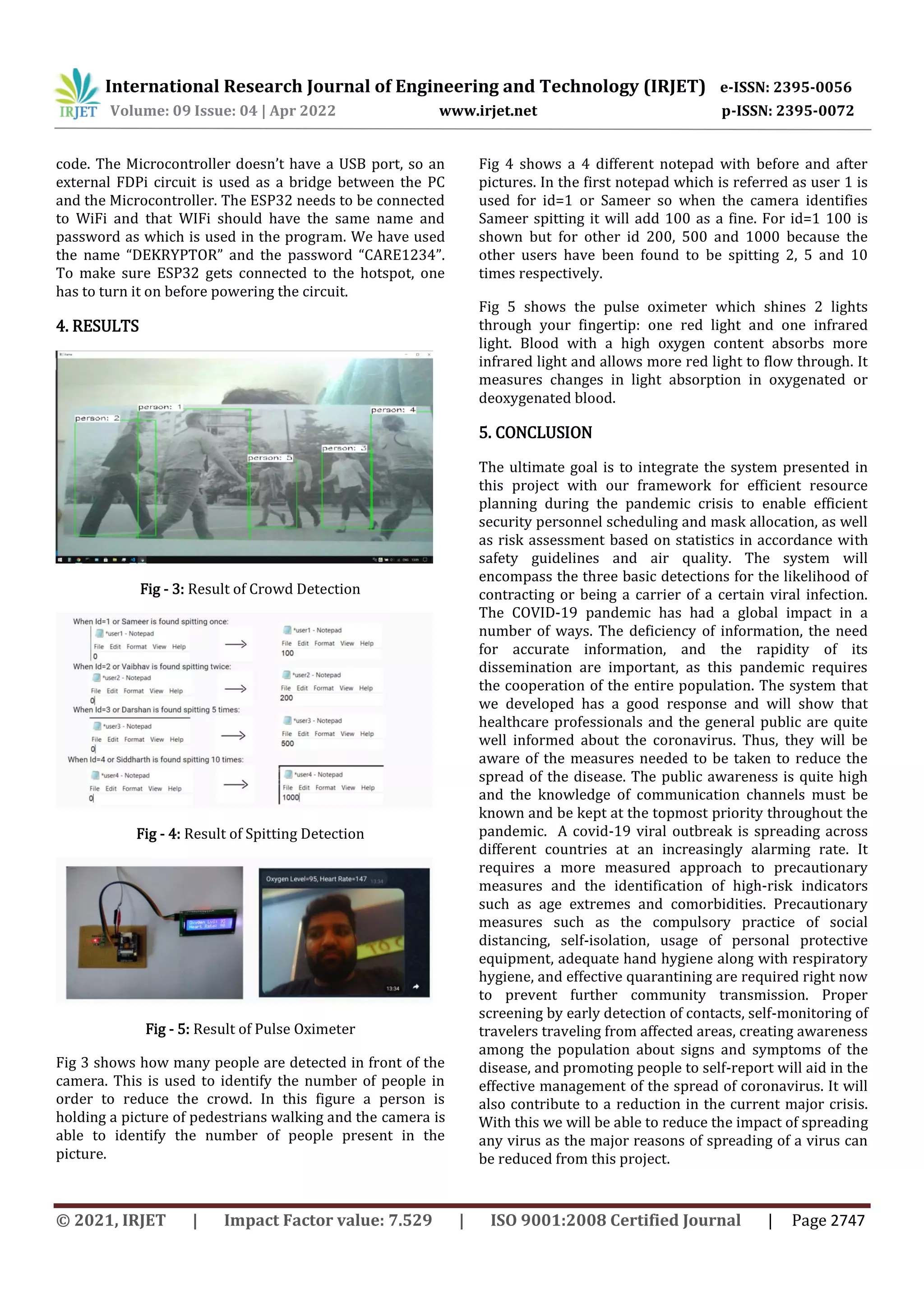
Fig- 2: Circuit Diagram
In Fig 1, The center of the whole block diagram is ESP32
Microcontroller Board. The Microcontroller is connected
to the OV2640 Camera. This camera will be used for face
recognition purposes. The main function of this camera is
to detect the faces of the people who are found spitting
and that data will get stored in the database. The
microcontroller is also connected to the Max30100 Pulse
Oximeter for checking the Oxygen Level. To show the
value of the Oximeter, an LCD is attached to the
Microcontroller. This LCD will show the value of Pulse
Oximeter in real time. Microcontroller is powered through
a power supply which is directly connected to it. The
lower half of the block diagram shows the Laptop,
Webcam and Terminal. The laptop and the webcam are
used for Crowd Detection and the terminal will show the
number of people detected by the webcam.
In Fig 2, The center of the circuit diagram is an ESP32-
CAM, this microcontroller is connected to the camera. The
OV2640 Camera is used to detect the people spitting in
front of the camera. On the left side of the microcontroller
there is a pulse oximeter which will detect the oxygen
value and below the microcontroller an LCD is connected
to show the value of the pulse oximeter in real time. The
microcontroller is also shown connected through the USB
cable; this USB cable will be connected to the Laptop/PC in
order to provide the power supply to the microcontroller.
International Research Journal of Engineering and Technology (IRJET) e-ISSN: 2395-0056
Volume: 09 Issue: 04 | Apr 2022 www.irjet.net p-ISSN: 2395-0072
© 2021, IRJET | Impact Factor value: 7.529 | ISO 9001:2008 Certified Journal | Page 2746
1.1. SPITTING PERSON FACE RECOGNITION
The working of the system starts with creating a database
of identified faces. An automated image capture is used to
capture 100 images of each user whose face data needs to
be registered in the system. These 100 images are stored
with a unique id for each user. After images of each user
are captured the training of these images is done. Once the
training is done the system can now recognize faces of
users in the database. For the above steps OpenCV is used.
Dlib model is used to find out whether a person is spitting
or not based on the Mouth Aspect Ratio of the user. The
complete system works as follows: If a person is spitting it
is verified by the dlib model. The dlib model calls the
recognizer OpenCV model to recognize the face of the
spitting person. If a person is found to be spitting the
person is charged with a fine along with an alert.
The system will be developed using MobileNettSSD Model
and Haar Features for determination of number of persons
in the frame. The system when activated would capture
live frames and determine the number of persons in the
frame. If the number of persons remains less than the
threshold then the system will run in the main loop. Once
the number of persons exceeds the threshold a message of
alert will be printed on the terminal.
The system has a pulse oximeter installed with a ESP32
Microcontroller board which collects users’ oxygen level
and heart rate data This data is then sent to Telegram
Cloud with their image captured using ESP32 Cam Board.
2. LITERATURE REVIEW
Kohonen [1] demonstrated face identification using a
simple neural net for normalized facial photos in one of
the most well-known early studies on face recognition
systems. A different algorithm for face detection was
implemented in [2] which is based on skin color detection
by compensating for lighting conditions followed by an
elliptical skin model for detection. A face score is
computed for each verified eye-mouth triangle based on
the orientation of the face, ellipse vote, and eyes/mouth
maps, followed by the Hough transform to extract the best
fitting ellipse. The [3] describes the feasibility of using a
facial recognition system in a real-time environment. They
use Neural Networks to classify faces and perform
recognition tasks with great accuracy. Deep learning-
based feature extractors are used to improve the results
even more. A CNN-based feature extractor combined with
an SVM-based classifier yields very high accuracy, as
shown in [4, 5]. Researchers primarily developed object
detection using a cascade of simple features for face
detection [6], [7]. In their paper, they go through the
importance of Haar characteristics taken from an integral
image in object detection. Some researchers describe a
framework for object detection that can be learned [8]. An
object class is derived from a set of wavelet basis functions
and used as an input to support vector machines. Many
studies have been conducted employing part-based
human detectors to detect persons in a scene [9–11].
Because of circumstances such as inter-object occlusion,
illumination, and so on, parts may not be clearly seen.
Other study has been done using foreground segmentation
to detect the presence of humans [12-14]. To extract
human motion blobs from the frame, the backdrop is
eliminated from the frame and different types of filtering,
such as Gaussian filtering, is applied. In most cases, this
procedure is carried out on a grayscale image. The motion
blobs are then analyzed to see how they compare to those
of humans. Illumination variation in different regions give
rise to split motion blobs and hence it becomes difficult to
formulate a shape for human detection. Some researchers
have performed density-based head detection [15].
3. IMPLEMENTATION
The project is divided into 3 parts which are crowd
detection, spitting detection and pulse oximeter. For
crowd detection, we first installed Python and Visual
Studio Code. Visual Studio Code is a compiler that is used
to run different codes in the same environment. We used
SSD in Crowd Detection which stands for Single Shot
Detection, there were other methods available which were
YOLO, and CNN but we opted for SSD because the accuracy
and speed of SSD were better comparatively. We have
taken databases from the web which will help us to
identify the object in front of us. The id number given to
the human detection is 15, and if this id number is
detected the output will count the number of people. We
have also provided a threshold value, if the number of
people captured in the camera is more than the threshold
value the output will say “It is Crowded”.
The next part is spitting detection, in this, we have
downloaded a compiler called Anaconda into our system
and Python was used as the coding language. In this, we
first take 100 photos of one person and store them in the
database giving a unique ID. All the faces of the people are
stored in a folder named facedata. For each user ID, a
notepad folder is created with an initial value of 0. While
running the code the system will check whether the
person captured has a similar ID to the faces stored in the
facedata folder. If the ID is detector the code will read and
write the notepad associated with that ID number. The
notepad value will change from 0 to the amount at which
the camera has spotted that ID spitting. This will be true
for all the other IDs.
The last part is the pulse oximeter, we are using telegram
cloud storage. We have used an ESP32 Cam
Microcontroller and by coding, we have used Arduino IDE
1.2. CROWD DETECTION
1.3. PULSE OXIMETER SYSTEM
International Research Journal of Engineering and Technology (IRJET) e-ISSN: 2395-0056
Volume: 09 Issue: 04 | Apr 2022 www.irjet.net p-ISSN: 2395-0072
© 2021, IRJET | Impact Factor value: 7.529 | ISO 9001:2008 Certified Journal | Page 2747
code. The Microcontroller doesn’t have a USB port, so an
external FDPi circuit is used as a bridge between the PC
and the Microcontroller. The ESP32 needs to be connected
to WiFi and that WIFi should have the same name and
password as which is used in the program. We have used
the name “DEKRYPTOR” and the password “CARE1234”.
To make sure ESP32 gets connected to the hotspot, one
has to turn it on before powering the circuit.
4. RESULTS
Fig - 3: Result of Crowd Detection
Fig - 4: Result of Spitting Detection
Fig - 5: Result of Pulse Oximeter
Fig 3 shows how many people are detected in front of the
camera. This is used to identify the number of people in
order to reduce the crowd. In this figure a person is
holding a picture of pedestrians walking and the camera is
able to identify the number of people present in the
picture.
Fig 4 shows a 4 different notepad with before and after
pictures. In the first notepad which is referred as user 1 is
used for id=1 or Sameer so when the camera identifies
Sameer spitting it will add 100 as a fine. For id=1 100 is
shown but for other id 200, 500 and 1000 because the
other users have been found to be spitting 2, 5 and 10
times respectively.
Fig 5 shows the pulse oximeter which shines 2 lights
through your fingertip: one red light and one infrared
light. Blood with a high oxygen content absorbs more
infrared light and allows more red light to flow through. It
measures changes in light absorption in oxygenated or
deoxygenated blood.
5. CONCLUSION
The ultimate goal is to integrate the system presented in
this project with our framework for efficient resource
planning during the pandemic crisis to enable efficient
security personnel scheduling and mask allocation, as well
as risk assessment based on statistics in accordance with
safety guidelines and air quality. The system will
encompass the three basic detections for the likelihood of
contracting or being a carrier of a certain viral infection.
The COVID-19 pandemic has had a global impact in a
number of ways. The deficiency of information, the need
for accurate information, and the rapidity of its
dissemination are important, as this pandemic requires
the cooperation of the entire population. The system that
we developed has a good response and will show that
healthcare professionals and the general public are quite
well informed about the coronavirus. Thus, they will be
aware of the measures needed to be taken to reduce the
spread of the disease. The public awareness is quite high
and the knowledge of communication channels must be
known and be kept at the topmost priority throughout the
pandemic. A covid-19 viral outbreak is spreading across
different countries at an increasingly alarming rate. It
requires a more measured approach to precautionary
measures and the identification of high-risk indicators
such as age extremes and comorbidities. Precautionary
measures such as the compulsory practice of social
distancing, self-isolation, usage of personal protective
equipment, adequate hand hygiene along with respiratory
hygiene, and effective quarantining are required right now
to prevent further community transmission. Proper
screening by early detection of contacts, self-monitoring of
travelers traveling from affected areas, creating awareness
among the population about signs and symptoms of the
disease, and promoting people to self-report will aid in the
effective management of the spread of coronavirus. It will
also contribute to a reduction in the current major crisis.
With this we will be able to reduce the impact of spreading
any virus as the major reasons of spreading of a virus can
be reduced from this project.
International Research Journal of Engineering and Technology (IRJET) e-ISSN: 2395-0056
Volume: 09 Issue: 04 | Apr 2022 www.irjet.net p-ISSN: 2395-0072
© 2021, IRJET | Impact Factor value: 7.529 | ISO 9001:2008 Certified Journal | Page 2748
ACKNOWLEDGEMENT
We would like to express our heartfelt gratitude to our
guide, Professor Mohan Kumar, for his motivation and
guidance throughout the process. We would also like to
thank the faculty of the Electronics and
Telecommunication Department for their valuable
assistance with our project.
REFERENCES
[1] T. Kohonen, Self-organization and Associative
Memory, SpringerVerlag, Berlin, 1989.
[2] Hsu, R.-L., Abdel-Mottaleb, M., and Jain, A. K. Face
Detection In Color Images.Ieee Trans. Pattern Analysis
and Machine Intelligence 24, 5, 696–706, 2002
[3] S. Stoimenov et al., “Face recognition in android using
neural networks”, 13th Symposium on Neural
Networks and Applications (NEUREL) SAVA Center,
November 22-24, 2016
[4] S. Guo, S. Chen, Y. Li, "Face recognition based on
convolutional neural network and support vector
machine", IEEE International Conference on
Information and Automation, 2017.
[5] Matsugu M., Mori K., Suzuki T., “Face Recognition
Using SVM Combined with CNN for Face Detection”.
Neural Information Processing. ICONIP 2004. Lecture
Notes in Computer Science, vol 3316. Springer, Berlin,
Heidelberg.
[6] Paul Viola and Michael Jones, “Rapid object detection
using a boosted cascade of simple features,”
Mitsubishi electric research labs, Cambridge, IEEE,
2001.
[7] Souhail Guennouni, Ali Ahaitouf, and Anass Mansouri,
“Multiple object detection using OpenCV on an
embedded platform,” IEEE International colloquium in
information science and technology, IEEE, 2014.
[8] P. Papageorgiou, Micheal Oren, and Tornaso Poggio,
“A general framework for object detection,” Center for
Biological and Computational Learning Artificial
Intelligence Laboratory, Cambridge.
[9] Ashfin Dehghan, Haroon Idrees, Amir Roshan Zamir,
and Mubrarak Shah, “Automatic detection and
tracking of Pedestrians in videos with various crowd
densities,” Computer vision lab, University of Central
Florida, Springer International Publishing
Switzerland, Orlando, USA, 2014.
[10] Fuentes O., Ramirez G. A., “Multi-Pose face detection
with asymmetric Haar features,” in Proceedings of the
15th IEEE workshop on applications of computer
vision, Copper Mountain, 2008, pp. 1–6.
[11] J. Yang, A. Wailbel, “A real-time face tracker,” in
Proceedings of the third IEEE workshop on
applications of computer vision, WACV96, 1996.
[12] A. Jaysri Thangam, Padmini Thupalli Siva, and B.
Yogameena, “Crowd count in low resolution
surveillance video using head detector and color
based segmentation for disaster management,” IEEE,
2015.
[13] Min Li, Zhaoxiang Zhang, Kaiqi Huang, and Tieniu Tan,
“Estimating the number of people in crowded scenes
by mid based foreground segmentation and head-
shoulder detection,” Institute of Automation, Chinese
Academy of Sciences.
[14] K. Kraus, M. Uiberacker, R. Reda, and O. Martikainen
“Hot-spot blob merging for real-time image
segmentation,” World academy of science, engineering
and technology, international journal of electrical,
computer, energetic, electronic and communication
engineering, vol. 2, no. 10, 2008.
[15] Mikel Rodriguez, Ivan Laptev, Josef Sivic, and Jean-Y
ves Audibert, “Density-aware person detection and
tracking in crowds,” Imagine, LIGM, Universite Paris-
Est.

Covid Norms Checker with IOT Based Health Monitoring

  • 1.
    International Research Journalof Engineering and Technology (IRJET) e-ISSN: 2395-0056 Volume: 09 Issue: 04 | Apr 2022 www.irjet.net p-ISSN: 2395-0072 © 2021, IRJET | Impact Factor value: 7.529 | ISO 9001:2008 Certified Journal | Page 2745 Covid Norms Checker with IOT Based Health Monitoring Sameer Choudhary1, Vaibhav Chaudhari2, Darshan Darji3, Siddharth Gurukhel4, Mohan Kumar5 1234B.E. Student, Electronics and Tele-Communication Engineering, Atharva College of Engineering, Mumbai, India 5Professor, Electronics and Tele-Communication Engineering, Atharva College of Engineering, Mumbai, India ---------------------------------------------------------------------***--------------------------------------------------------------------- Abstract – In this project we would be making use of a face recognition algorithm for detecting whether a person is spitting and then taking necessary action. The project also includes specific work using OpenCV to detect crowds. A pulse oximeter is also included in the system, which captures users' oxygen levels and heart rate data, which is then transferred to Telegram Cloud, along with their image captured using the ESP32 Cam Board. Spitting Person Face Recognition which will charge the person with a fine. Crowd detection system for maintaining places with social distancing norms. Pulse Oximeter System for measuring pulse rate and oxygen level of the user. Key Words: Face Detection, OpenCV, Haar Features, Cam Board, Dlib Model 1. INTRODUCTION Face detection is a type of computer vision that assists in the detection of human faces in digital images. Face detection has become more important as technology has advanced, particularly in industries such as photography, security, and marketing. In the field of permeating systems, people counting systems can get an exact count of people indoors or outdoors and have a wide range of uses. People counting devices are commonly used for promotional evaluation, calculating demand ratios in retail environments, and in crowd management surveillance. In this project we would be making use of a face recognition algorithm for detecting whether a person is spitting and then taking necessary action. Fig- 1: Block Diagram The project also includes specific work using OpenCV to detect crowds. A pulse oximeter is also included in the system, which captures users' oxygen levels and heart rate data, which is then transferred to Telegram Cloud, along with their image captured using the ESP32 Cam. Fig- 2: Circuit Diagram In Fig 1, The center of the whole block diagram is ESP32 Microcontroller Board. The Microcontroller is connected to the OV2640 Camera. This camera will be used for face recognition purposes. The main function of this camera is to detect the faces of the people who are found spitting and that data will get stored in the database. The microcontroller is also connected to the Max30100 Pulse Oximeter for checking the Oxygen Level. To show the value of the Oximeter, an LCD is attached to the Microcontroller. This LCD will show the value of Pulse Oximeter in real time. Microcontroller is powered through a power supply which is directly connected to it. The lower half of the block diagram shows the Laptop, Webcam and Terminal. The laptop and the webcam are used for Crowd Detection and the terminal will show the number of people detected by the webcam. In Fig 2, The center of the circuit diagram is an ESP32- CAM, this microcontroller is connected to the camera. The OV2640 Camera is used to detect the people spitting in front of the camera. On the left side of the microcontroller there is a pulse oximeter which will detect the oxygen value and below the microcontroller an LCD is connected to show the value of the pulse oximeter in real time. The microcontroller is also shown connected through the USB cable; this USB cable will be connected to the Laptop/PC in order to provide the power supply to the microcontroller.
  • 2.
    International Research Journalof Engineering and Technology (IRJET) e-ISSN: 2395-0056 Volume: 09 Issue: 04 | Apr 2022 www.irjet.net p-ISSN: 2395-0072 © 2021, IRJET | Impact Factor value: 7.529 | ISO 9001:2008 Certified Journal | Page 2746 1.1. SPITTING PERSON FACE RECOGNITION The working of the system starts with creating a database of identified faces. An automated image capture is used to capture 100 images of each user whose face data needs to be registered in the system. These 100 images are stored with a unique id for each user. After images of each user are captured the training of these images is done. Once the training is done the system can now recognize faces of users in the database. For the above steps OpenCV is used. Dlib model is used to find out whether a person is spitting or not based on the Mouth Aspect Ratio of the user. The complete system works as follows: If a person is spitting it is verified by the dlib model. The dlib model calls the recognizer OpenCV model to recognize the face of the spitting person. If a person is found to be spitting the person is charged with a fine along with an alert. The system will be developed using MobileNettSSD Model and Haar Features for determination of number of persons in the frame. The system when activated would capture live frames and determine the number of persons in the frame. If the number of persons remains less than the threshold then the system will run in the main loop. Once the number of persons exceeds the threshold a message of alert will be printed on the terminal. The system has a pulse oximeter installed with a ESP32 Microcontroller board which collects users’ oxygen level and heart rate data This data is then sent to Telegram Cloud with their image captured using ESP32 Cam Board. 2. LITERATURE REVIEW Kohonen [1] demonstrated face identification using a simple neural net for normalized facial photos in one of the most well-known early studies on face recognition systems. A different algorithm for face detection was implemented in [2] which is based on skin color detection by compensating for lighting conditions followed by an elliptical skin model for detection. A face score is computed for each verified eye-mouth triangle based on the orientation of the face, ellipse vote, and eyes/mouth maps, followed by the Hough transform to extract the best fitting ellipse. The [3] describes the feasibility of using a facial recognition system in a real-time environment. They use Neural Networks to classify faces and perform recognition tasks with great accuracy. Deep learning- based feature extractors are used to improve the results even more. A CNN-based feature extractor combined with an SVM-based classifier yields very high accuracy, as shown in [4, 5]. Researchers primarily developed object detection using a cascade of simple features for face detection [6], [7]. In their paper, they go through the importance of Haar characteristics taken from an integral image in object detection. Some researchers describe a framework for object detection that can be learned [8]. An object class is derived from a set of wavelet basis functions and used as an input to support vector machines. Many studies have been conducted employing part-based human detectors to detect persons in a scene [9–11]. Because of circumstances such as inter-object occlusion, illumination, and so on, parts may not be clearly seen. Other study has been done using foreground segmentation to detect the presence of humans [12-14]. To extract human motion blobs from the frame, the backdrop is eliminated from the frame and different types of filtering, such as Gaussian filtering, is applied. In most cases, this procedure is carried out on a grayscale image. The motion blobs are then analyzed to see how they compare to those of humans. Illumination variation in different regions give rise to split motion blobs and hence it becomes difficult to formulate a shape for human detection. Some researchers have performed density-based head detection [15]. 3. IMPLEMENTATION The project is divided into 3 parts which are crowd detection, spitting detection and pulse oximeter. For crowd detection, we first installed Python and Visual Studio Code. Visual Studio Code is a compiler that is used to run different codes in the same environment. We used SSD in Crowd Detection which stands for Single Shot Detection, there were other methods available which were YOLO, and CNN but we opted for SSD because the accuracy and speed of SSD were better comparatively. We have taken databases from the web which will help us to identify the object in front of us. The id number given to the human detection is 15, and if this id number is detected the output will count the number of people. We have also provided a threshold value, if the number of people captured in the camera is more than the threshold value the output will say “It is Crowded”. The next part is spitting detection, in this, we have downloaded a compiler called Anaconda into our system and Python was used as the coding language. In this, we first take 100 photos of one person and store them in the database giving a unique ID. All the faces of the people are stored in a folder named facedata. For each user ID, a notepad folder is created with an initial value of 0. While running the code the system will check whether the person captured has a similar ID to the faces stored in the facedata folder. If the ID is detector the code will read and write the notepad associated with that ID number. The notepad value will change from 0 to the amount at which the camera has spotted that ID spitting. This will be true for all the other IDs. The last part is the pulse oximeter, we are using telegram cloud storage. We have used an ESP32 Cam Microcontroller and by coding, we have used Arduino IDE 1.2. CROWD DETECTION 1.3. PULSE OXIMETER SYSTEM
  • 3.
    International Research Journalof Engineering and Technology (IRJET) e-ISSN: 2395-0056 Volume: 09 Issue: 04 | Apr 2022 www.irjet.net p-ISSN: 2395-0072 © 2021, IRJET | Impact Factor value: 7.529 | ISO 9001:2008 Certified Journal | Page 2747 code. The Microcontroller doesn’t have a USB port, so an external FDPi circuit is used as a bridge between the PC and the Microcontroller. The ESP32 needs to be connected to WiFi and that WIFi should have the same name and password as which is used in the program. We have used the name “DEKRYPTOR” and the password “CARE1234”. To make sure ESP32 gets connected to the hotspot, one has to turn it on before powering the circuit. 4. RESULTS Fig - 3: Result of Crowd Detection Fig - 4: Result of Spitting Detection Fig - 5: Result of Pulse Oximeter Fig 3 shows how many people are detected in front of the camera. This is used to identify the number of people in order to reduce the crowd. In this figure a person is holding a picture of pedestrians walking and the camera is able to identify the number of people present in the picture. Fig 4 shows a 4 different notepad with before and after pictures. In the first notepad which is referred as user 1 is used for id=1 or Sameer so when the camera identifies Sameer spitting it will add 100 as a fine. For id=1 100 is shown but for other id 200, 500 and 1000 because the other users have been found to be spitting 2, 5 and 10 times respectively. Fig 5 shows the pulse oximeter which shines 2 lights through your fingertip: one red light and one infrared light. Blood with a high oxygen content absorbs more infrared light and allows more red light to flow through. It measures changes in light absorption in oxygenated or deoxygenated blood. 5. CONCLUSION The ultimate goal is to integrate the system presented in this project with our framework for efficient resource planning during the pandemic crisis to enable efficient security personnel scheduling and mask allocation, as well as risk assessment based on statistics in accordance with safety guidelines and air quality. The system will encompass the three basic detections for the likelihood of contracting or being a carrier of a certain viral infection. The COVID-19 pandemic has had a global impact in a number of ways. The deficiency of information, the need for accurate information, and the rapidity of its dissemination are important, as this pandemic requires the cooperation of the entire population. The system that we developed has a good response and will show that healthcare professionals and the general public are quite well informed about the coronavirus. Thus, they will be aware of the measures needed to be taken to reduce the spread of the disease. The public awareness is quite high and the knowledge of communication channels must be known and be kept at the topmost priority throughout the pandemic. A covid-19 viral outbreak is spreading across different countries at an increasingly alarming rate. It requires a more measured approach to precautionary measures and the identification of high-risk indicators such as age extremes and comorbidities. Precautionary measures such as the compulsory practice of social distancing, self-isolation, usage of personal protective equipment, adequate hand hygiene along with respiratory hygiene, and effective quarantining are required right now to prevent further community transmission. Proper screening by early detection of contacts, self-monitoring of travelers traveling from affected areas, creating awareness among the population about signs and symptoms of the disease, and promoting people to self-report will aid in the effective management of the spread of coronavirus. It will also contribute to a reduction in the current major crisis. With this we will be able to reduce the impact of spreading any virus as the major reasons of spreading of a virus can be reduced from this project.
  • 4.
    International Research Journalof Engineering and Technology (IRJET) e-ISSN: 2395-0056 Volume: 09 Issue: 04 | Apr 2022 www.irjet.net p-ISSN: 2395-0072 © 2021, IRJET | Impact Factor value: 7.529 | ISO 9001:2008 Certified Journal | Page 2748 ACKNOWLEDGEMENT We would like to express our heartfelt gratitude to our guide, Professor Mohan Kumar, for his motivation and guidance throughout the process. We would also like to thank the faculty of the Electronics and Telecommunication Department for their valuable assistance with our project. REFERENCES [1] T. Kohonen, Self-organization and Associative Memory, SpringerVerlag, Berlin, 1989. [2] Hsu, R.-L., Abdel-Mottaleb, M., and Jain, A. K. Face Detection In Color Images.Ieee Trans. Pattern Analysis and Machine Intelligence 24, 5, 696–706, 2002 [3] S. Stoimenov et al., “Face recognition in android using neural networks”, 13th Symposium on Neural Networks and Applications (NEUREL) SAVA Center, November 22-24, 2016 [4] S. Guo, S. Chen, Y. Li, "Face recognition based on convolutional neural network and support vector machine", IEEE International Conference on Information and Automation, 2017. [5] Matsugu M., Mori K., Suzuki T., “Face Recognition Using SVM Combined with CNN for Face Detection”. Neural Information Processing. ICONIP 2004. Lecture Notes in Computer Science, vol 3316. Springer, Berlin, Heidelberg. [6] Paul Viola and Michael Jones, “Rapid object detection using a boosted cascade of simple features,” Mitsubishi electric research labs, Cambridge, IEEE, 2001. [7] Souhail Guennouni, Ali Ahaitouf, and Anass Mansouri, “Multiple object detection using OpenCV on an embedded platform,” IEEE International colloquium in information science and technology, IEEE, 2014. [8] P. Papageorgiou, Micheal Oren, and Tornaso Poggio, “A general framework for object detection,” Center for Biological and Computational Learning Artificial Intelligence Laboratory, Cambridge. [9] Ashfin Dehghan, Haroon Idrees, Amir Roshan Zamir, and Mubrarak Shah, “Automatic detection and tracking of Pedestrians in videos with various crowd densities,” Computer vision lab, University of Central Florida, Springer International Publishing Switzerland, Orlando, USA, 2014. [10] Fuentes O., Ramirez G. A., “Multi-Pose face detection with asymmetric Haar features,” in Proceedings of the 15th IEEE workshop on applications of computer vision, Copper Mountain, 2008, pp. 1–6. [11] J. Yang, A. Wailbel, “A real-time face tracker,” in Proceedings of the third IEEE workshop on applications of computer vision, WACV96, 1996. [12] A. Jaysri Thangam, Padmini Thupalli Siva, and B. Yogameena, “Crowd count in low resolution surveillance video using head detector and color based segmentation for disaster management,” IEEE, 2015. [13] Min Li, Zhaoxiang Zhang, Kaiqi Huang, and Tieniu Tan, “Estimating the number of people in crowded scenes by mid based foreground segmentation and head- shoulder detection,” Institute of Automation, Chinese Academy of Sciences. [14] K. Kraus, M. Uiberacker, R. Reda, and O. Martikainen “Hot-spot blob merging for real-time image segmentation,” World academy of science, engineering and technology, international journal of electrical, computer, energetic, electronic and communication engineering, vol. 2, no. 10, 2008. [15] Mikel Rodriguez, Ivan Laptev, Josef Sivic, and Jean-Y ves Audibert, “Density-aware person detection and tracking in crowds,” Imagine, LIGM, Universite Paris- Est.