ESWARI ENGINEERING COLLEGE
(AUTONOMOUS)
GROUP PRESENTATION
Subject Name: PROBABILITY AND RANDOM PROCESS Subjectcode:191MAB404T
COVARIANCE AND SYSTEM TRANSFER FUNCTION
NAME:
SRIVARDHAN M.S (310622106154)
SARANBALAJI S (310622106135)
TAMILMANI M (310622106165)
THIRUNAVUKARASU S (310622106170)
SARAVANAKUMAR A (310622106136) GROUP: 9
SHASHEETH S (310622106140) DATE: 24/05/2024
TABLE OF CONTENT
Covariance in probability and random processes
Definition of covariance
Properties of covariance
Covariance and correlation
Covariance in random processes
Application of covariance
Application of system transfer function in system design and optimization
Application of system transfer function in engineering
 Practical examples and case studies
Conclusion
Covariance in Probability and
Random Processes
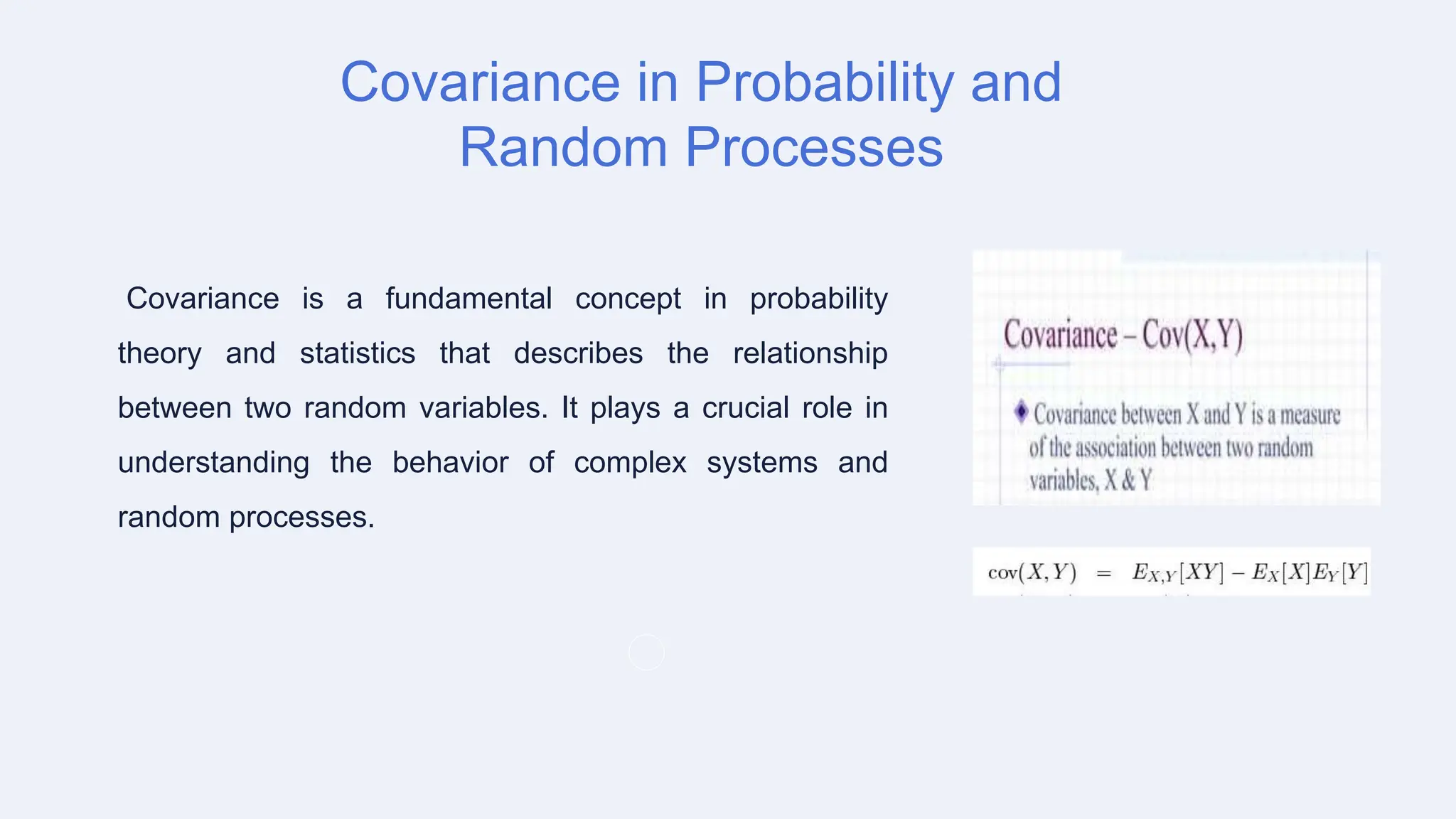
Covariance is a fundamental concept in probability
theory and statistics that describes the relationship
between two random variables. It plays a crucial role in
understanding the behavior of complex systems and
random processes.
Definition of Covariance
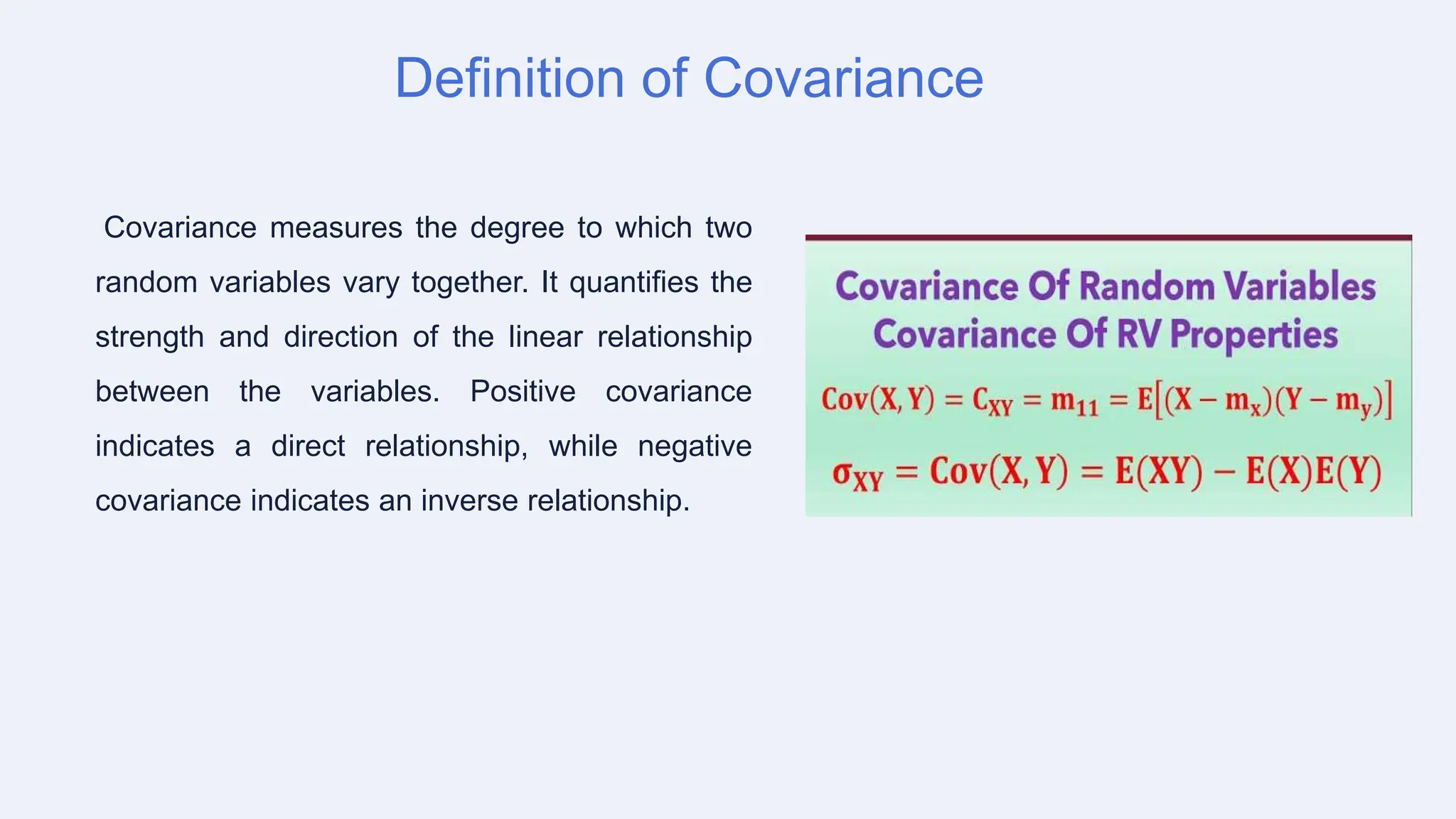
Covariance measures the degree to which two
random variables vary together. It quantifies the
strength and direction of the linear relationship
between the variables. Positive covariance
indicates a direct relationship, while negative
covariance indicates an inverse relationship.
Properties of Covariance
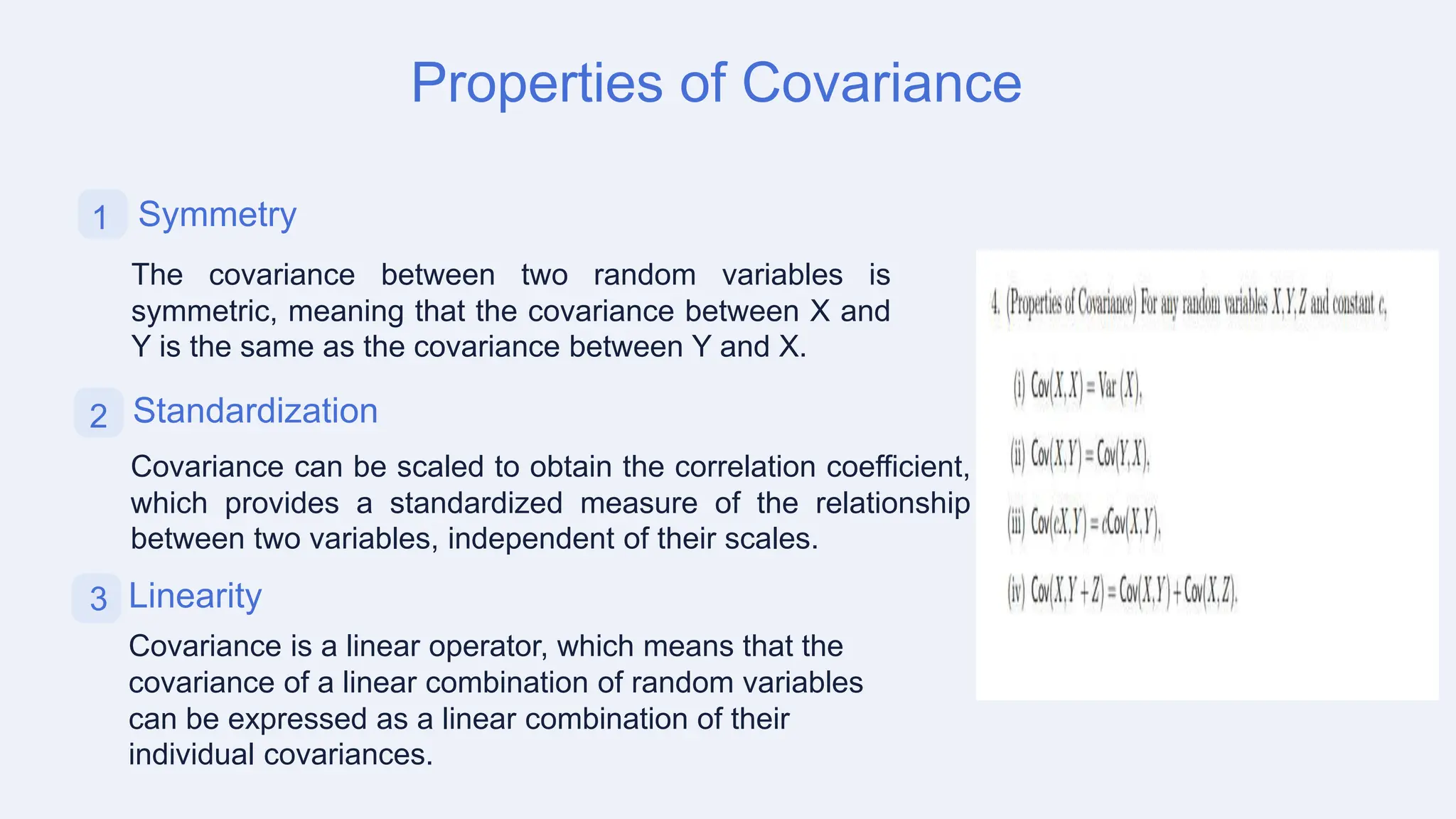
1 Symmetry
The covariance between two random variables is
symmetric, meaning that the covariance between X and
Y is the same as the covariance between Y and X.
3 Linearity
Covariance is a linear operator, which means that the
covariance of a linear combination of random variables
can be expressed as a linear combination of their
individual covariances.
2 Standardization
Covariance can be scaled to obtain the correlation coefficient,
which provides a standardized measure of the relationship
between two variables, independent of their scales.
Covariance and Correlation
Covariance
Covariance measures
the direction and
strength of the linear
relationship between
two random
variables.
Correlation
Correlation is a
normalized measure
of covariance,
ranging from -1 to 1,
which indicates the
strength of the linear
relationship between
two variables.
Relationship
Correlation is derived
from covariance and
provides a more
interpretable measure
of the relationship
between variables.
Covariance in Random Process
Stationarity
Covariance is a key property in the analysis of stationary random
processes, where the covariance function depends only on the
time lag between observations.
Autocorrelation
The autocorrelation function, which describes the correlation of
a random process with itself at different time lags, is directly
related to the covariance function.
Prediction and Filtering
Covariance and correlation are essential for optimal prediction
and filtering of random processes, as found in applications such
as signal processing and time series analysis.
Applications of Covariance
Portfolio
Optimization
Covariance is a key
input in modern portfolio
theory, used to
construct optimal
investment portfolios
that balance risk and
return.
Machine
Learning
Covariance matrices are used
in dimensionality reduction
techniques, such as principal
component analysis, and in
the design of regularized
machine learning models.
Signal Processing
Covariance and correlation
are fundamental to the
analysis and filtering of
signals, with applications in
areas like communications,
image processing, and audio
processing.
Applications of Transfer Functions in System
Design and Optimization
Filtering and Shaping
Transfer functions can be used to design filters and compensation
networks that shape the system's frequency response, allowing for noise
reduction, vibration control, and other performance enhancements.
System Optimization
Transfer functions enable the use of advanced optimization techniques,
such as root locus analysis and frequency-domain design methods, to
fine-tune system parameters and achieve the best possible
performance.
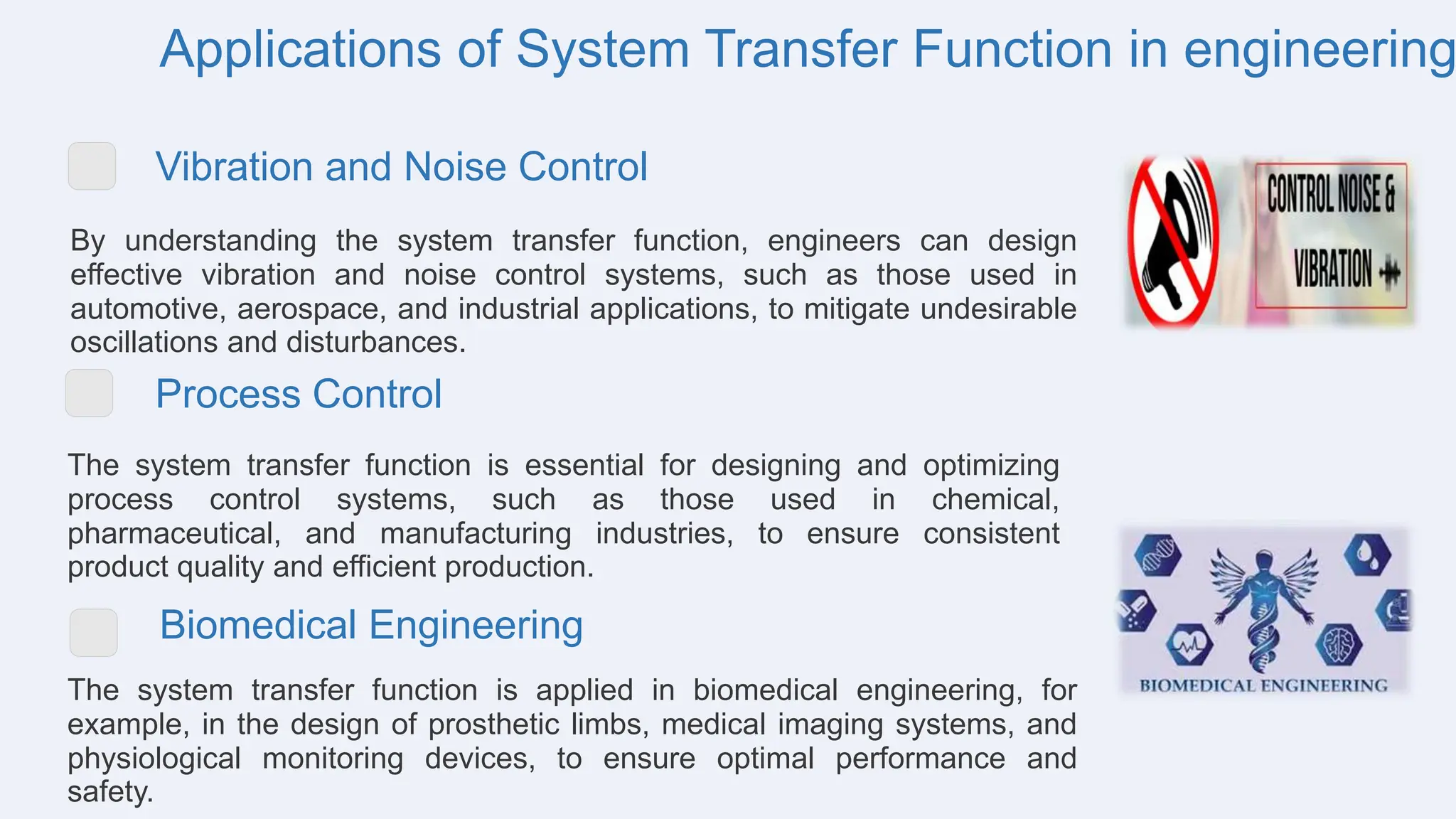
Feedback Control
By understanding the system's transfer function, engineers can design
effective feedback control systems that maintain stability, improve
disturbance rejection, and achieve desired dynamic behavior.
Applications of System Transfer Function in engineering
Vibration and Noise Control
By understanding the system transfer function, engineers can design
effective vibration and noise control systems, such as those used in
automotive, aerospace, and industrial applications, to mitigate undesirable
oscillations and disturbances.
Process Control
The system transfer function is essential for designing and optimizing
process control systems, such as those used in chemical,
pharmaceutical, and manufacturing industries, to ensure consistent
product quality and efficient production.
Biomedical Engineering
The system transfer function is applied in biomedical engineering, for
example, in the design of prosthetic limbs, medical imaging systems, and
physiological monitoring devices, to ensure optimal performance and
safety.
Practical Examples and Case Studies
Automotive Suspension
The transfer function is used to design
vehicle suspension systems for improved ride
comfort and handling.
Audio Amplifier
Transfer functions are crucial for the design of
high-performance audio amplifiers with desired
frequency response.
Robotic Manipulators
Transfer functions help model the dynamics of
robotic manipulators, enabling precise control
and coordination of their movements.
Conclusion and Key Takeaways
 Covariance is a fundamental concept in probability and statistics,
providing insights into the relationships between random variables.
 Covariance has numerous practical applications, from portfolio
analysis to signal processing and machine learning.
 The system transfer function remains a powerful and widely-used tool
in the analysis and design of complex systems, providing valuable
insights into system behavior.
 The integration of transfer function analysis with advanced computational
techniques, such as machine learning and digital signal processing, presents
exciting opportunities for enhanced system modeling and control.
Reference
https://images.app.goo.gl/mnm7kzEmH2y
XPH619
https://images.app.goo.gl/VMZUCSFYkou
mqjwY9
https://images.app.goo.gl/ooeRSw1J2fKtR
cgm9
https://1drv.ms/p/c/e57b198a9b96a5b4/ETt2S-
kjewBNseGrdPYOJlYBluj7WVTsrhcScjTwmm9eUg
?e=JTJrbm
Covariance-in-Probability-and-Random-Processes_(1)[1]  -  Read-Only.pptx

Covariance-in-Probability-and-Random-Processes_(1)[1] - Read-Only.pptx

  • 1.
    ESWARI ENGINEERING COLLEGE (AUTONOMOUS) GROUPPRESENTATION Subject Name: PROBABILITY AND RANDOM PROCESS Subjectcode:191MAB404T COVARIANCE AND SYSTEM TRANSFER FUNCTION NAME: SRIVARDHAN M.S (310622106154) SARANBALAJI S (310622106135) TAMILMANI M (310622106165) THIRUNAVUKARASU S (310622106170) SARAVANAKUMAR A (310622106136) GROUP: 9 SHASHEETH S (310622106140) DATE: 24/05/2024
  • 2.
    TABLE OF CONTENT Covariancein probability and random processes Definition of covariance Properties of covariance Covariance and correlation Covariance in random processes Application of covariance Application of system transfer function in system design and optimization Application of system transfer function in engineering  Practical examples and case studies Conclusion
  • 3.
    Covariance in Probabilityand Random Processes Covariance is a fundamental concept in probability theory and statistics that describes the relationship between two random variables. It plays a crucial role in understanding the behavior of complex systems and random processes.
  • 4.
    Definition of Covariance Covariancemeasures the degree to which two random variables vary together. It quantifies the strength and direction of the linear relationship between the variables. Positive covariance indicates a direct relationship, while negative covariance indicates an inverse relationship.
  • 5.
    Properties of Covariance 1Symmetry The covariance between two random variables is symmetric, meaning that the covariance between X and Y is the same as the covariance between Y and X. 3 Linearity Covariance is a linear operator, which means that the covariance of a linear combination of random variables can be expressed as a linear combination of their individual covariances. 2 Standardization Covariance can be scaled to obtain the correlation coefficient, which provides a standardized measure of the relationship between two variables, independent of their scales.
  • 6.
    Covariance and Correlation Covariance Covariancemeasures the direction and strength of the linear relationship between two random variables. Correlation Correlation is a normalized measure of covariance, ranging from -1 to 1, which indicates the strength of the linear relationship between two variables. Relationship Correlation is derived from covariance and provides a more interpretable measure of the relationship between variables.
  • 7.
    Covariance in RandomProcess Stationarity Covariance is a key property in the analysis of stationary random processes, where the covariance function depends only on the time lag between observations. Autocorrelation The autocorrelation function, which describes the correlation of a random process with itself at different time lags, is directly related to the covariance function. Prediction and Filtering Covariance and correlation are essential for optimal prediction and filtering of random processes, as found in applications such as signal processing and time series analysis.
  • 8.
    Applications of Covariance Portfolio Optimization Covarianceis a key input in modern portfolio theory, used to construct optimal investment portfolios that balance risk and return. Machine Learning Covariance matrices are used in dimensionality reduction techniques, such as principal component analysis, and in the design of regularized machine learning models. Signal Processing Covariance and correlation are fundamental to the analysis and filtering of signals, with applications in areas like communications, image processing, and audio processing.
  • 9.
    Applications of TransferFunctions in System Design and Optimization Filtering and Shaping Transfer functions can be used to design filters and compensation networks that shape the system's frequency response, allowing for noise reduction, vibration control, and other performance enhancements. System Optimization Transfer functions enable the use of advanced optimization techniques, such as root locus analysis and frequency-domain design methods, to fine-tune system parameters and achieve the best possible performance. Feedback Control By understanding the system's transfer function, engineers can design effective feedback control systems that maintain stability, improve disturbance rejection, and achieve desired dynamic behavior.
  • 10.
    Applications of SystemTransfer Function in engineering Vibration and Noise Control By understanding the system transfer function, engineers can design effective vibration and noise control systems, such as those used in automotive, aerospace, and industrial applications, to mitigate undesirable oscillations and disturbances. Process Control The system transfer function is essential for designing and optimizing process control systems, such as those used in chemical, pharmaceutical, and manufacturing industries, to ensure consistent product quality and efficient production. Biomedical Engineering The system transfer function is applied in biomedical engineering, for example, in the design of prosthetic limbs, medical imaging systems, and physiological monitoring devices, to ensure optimal performance and safety.
  • 11.
    Practical Examples andCase Studies Automotive Suspension The transfer function is used to design vehicle suspension systems for improved ride comfort and handling. Audio Amplifier Transfer functions are crucial for the design of high-performance audio amplifiers with desired frequency response. Robotic Manipulators Transfer functions help model the dynamics of robotic manipulators, enabling precise control and coordination of their movements.
  • 12.
    Conclusion and KeyTakeaways  Covariance is a fundamental concept in probability and statistics, providing insights into the relationships between random variables.  Covariance has numerous practical applications, from portfolio analysis to signal processing and machine learning.  The system transfer function remains a powerful and widely-used tool in the analysis and design of complex systems, providing valuable insights into system behavior.  The integration of transfer function analysis with advanced computational techniques, such as machine learning and digital signal processing, presents exciting opportunities for enhanced system modeling and control.
  • 13.