TRANSFER FUNCTION AND IT’S
APPLICATION
Submitted by
Name: -
University roll no: -
Semester: -
Department: -
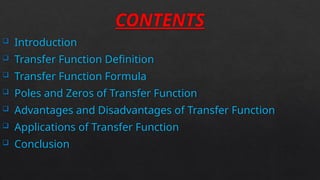
CONTENTS
 Introduction
 Transfer Function Definition
 Transfer Function Formula
 Poles and Zeros of Transfer Function
 Advantages and Disadvantages of Transfer Function
 Applications of Transfer Function
 Conclusion
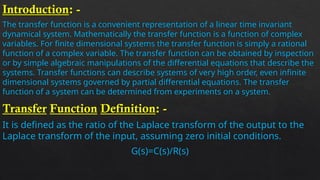
Introduction: -
The transfer function is a convenient representation of a linear time invariant
dynamical system. Mathematically the transfer function is a function of complex
variables. For finite dimensional systems the transfer function is simply a rational
function of a complex variable. The transfer function can be obtained by inspection
or by simple algebraic manipulations of the differential equations that describe the
systems. Transfer functions can describe systems of very high order, even infinite
dimensional systems governed by partial differential equations. The transfer
function of a system can be determined from experiments on a system.
Transfer Function Definition: -
It is defined as the ratio of the Laplace transform of the output to the
Laplace transform of the input, assuming zero initial conditions.
G(s)=C(s)/R(s)
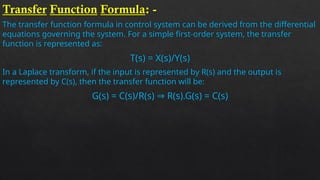
Transfer Function Formula: -
The transfer function formula in control system can be derived from the differential
equations governing the system. For a simple first-order system, the transfer
function is represented as:
T(s) = X(s)/Y(s)
In a Laplace transform, if the input is represented by R(s) and the output is
represented by C(s), then the transfer function will be:
G(s) = C(s)/R(s) ⇒ R(s).G(s) = C(s)

CONTROL SYSTEM TRANSFER FUNCTION PPT.pptx

  • 1.
    TRANSFER FUNCTION ANDIT’S APPLICATION Submitted by Name: - University roll no: - Semester: - Department: -
  • 2.
    CONTENTS  Introduction  TransferFunction Definition  Transfer Function Formula  Poles and Zeros of Transfer Function  Advantages and Disadvantages of Transfer Function  Applications of Transfer Function  Conclusion
  • 3.
    Introduction: - The transferfunction is a convenient representation of a linear time invariant dynamical system. Mathematically the transfer function is a function of complex variables. For finite dimensional systems the transfer function is simply a rational function of a complex variable. The transfer function can be obtained by inspection or by simple algebraic manipulations of the differential equations that describe the systems. Transfer functions can describe systems of very high order, even infinite dimensional systems governed by partial differential equations. The transfer function of a system can be determined from experiments on a system. Transfer Function Definition: - It is defined as the ratio of the Laplace transform of the output to the Laplace transform of the input, assuming zero initial conditions. G(s)=C(s)/R(s)
  • 4.
    Transfer Function Formula:- The transfer function formula in control system can be derived from the differential equations governing the system. For a simple first-order system, the transfer function is represented as: T(s) = X(s)/Y(s) In a Laplace transform, if the input is represented by R(s) and the output is represented by C(s), then the transfer function will be: G(s) = C(s)/R(s) ⇒ R(s).G(s) = C(s)