An Assignment
On
Course Learning Outcomes of Psychosocial Foundation of
Education
Prepared By
Name- Sujit Kumar Bhoi
Reg. No- 20maeduc15
Submitted To
Dr. Jubilee Padmanabhan
DEPARTMENT OF EDUCATION
CENTRAL UNIVERSITY OF PUNJAB, BATHINDA
CONTENT
Sl No. Topic Page No.
1
Introduction
2
Concept of Course Learning Outcome
3
Importance of Course Learning Outcome
4
Steps for Formulating Course Learning
Outcomes
5
Selected Course with Learning Outcome
Course Learning Outcome
Introduction
In the field of education, course learning outcomes are brief statements that describe
what students will be expected to learn or achieve by the end of course. In many cases, course
learning outcomes are the interim academic goals that teachers establish for students who are
working toward meeting more comprehensive learning standards. Students will be more
likely to achieve the provided goals if learning outcomes are properly explained to them. If
students may not know what is expected of them or learning outcomes are unclear, which can
lead to confusion, frustration, or other factors that obstruct the learning process. Therefore,
there is need to formulate the course learning outcomes which is more clear and precise.
Concept of Course Learning Outcome
To simply put, Course Learning Outcomes are any measurable skills, abilities,
knowledge or values that the student demonstrates as a result of completing a given course.
Effective learning outcomes can be articulated at several levels, including lesson, course,
program, degree, etc. It is completely learner-oriented and describes what both the students
have to learn and what the instructor will teach.
Importance of course learning outcomes
Even while designing a course, it is crucial to plan how its learning outcomes will
align with the given curriculum. The importances are;
1. It sets shared expectations between students and instructors
2. Let’s student set learning goals easily
3. Helps students learn more effectively
4. Instructors have a clear direction while making assessment decisions
5. Gives a program level overview of learning across courses and years
Steps for Formulating Course Learning Outcomes
The following are recommended steps for writing clear, observable and measurable
Course learning outcomes.
1. Begin with an Action Verb
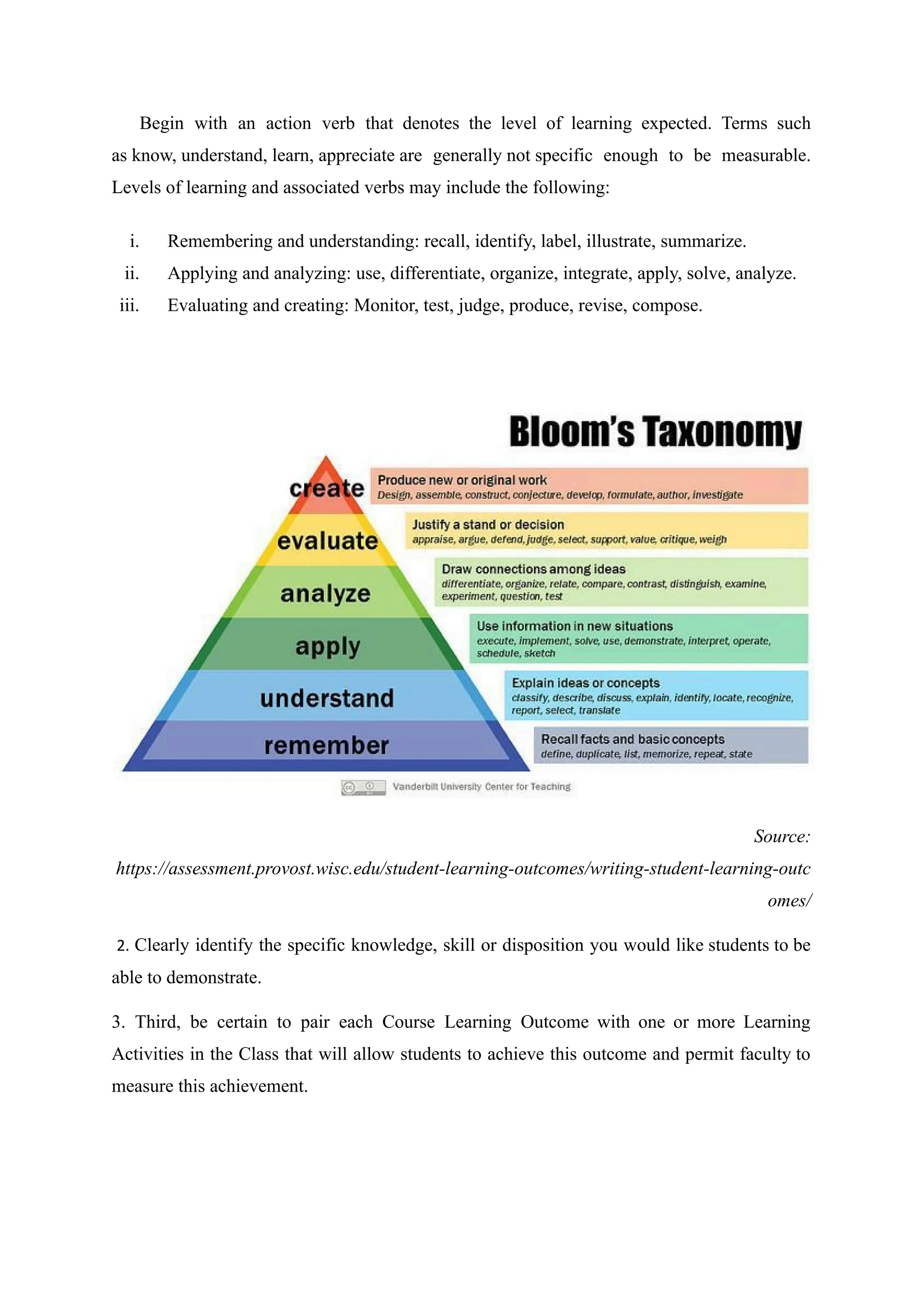
Begin with an action verb that denotes the level of learning expected. Terms such
as know, understand, learn, appreciate are generally not specific enough to be measurable.
Levels of learning and associated verbs may include the following:
i. Remembering and understanding: recall, identify, label, illustrate, summarize.
ii. Applying and analyzing: use, differentiate, organize, integrate, apply, solve, analyze.
iii. Evaluating and creating: Monitor, test, judge, produce, revise, compose.
Source:
https://assessment.provost.wisc.edu/student-learning-outcomes/writing-student-learning-outc
omes/
2. Clearly identify the specific knowledge, skill or disposition you would like students to be
able to demonstrate.
3. Third, be certain to pair each Course Learning Outcome with one or more Learning
Activities in the Class that will allow students to achieve this outcome and permit faculty to
measure this achievement.
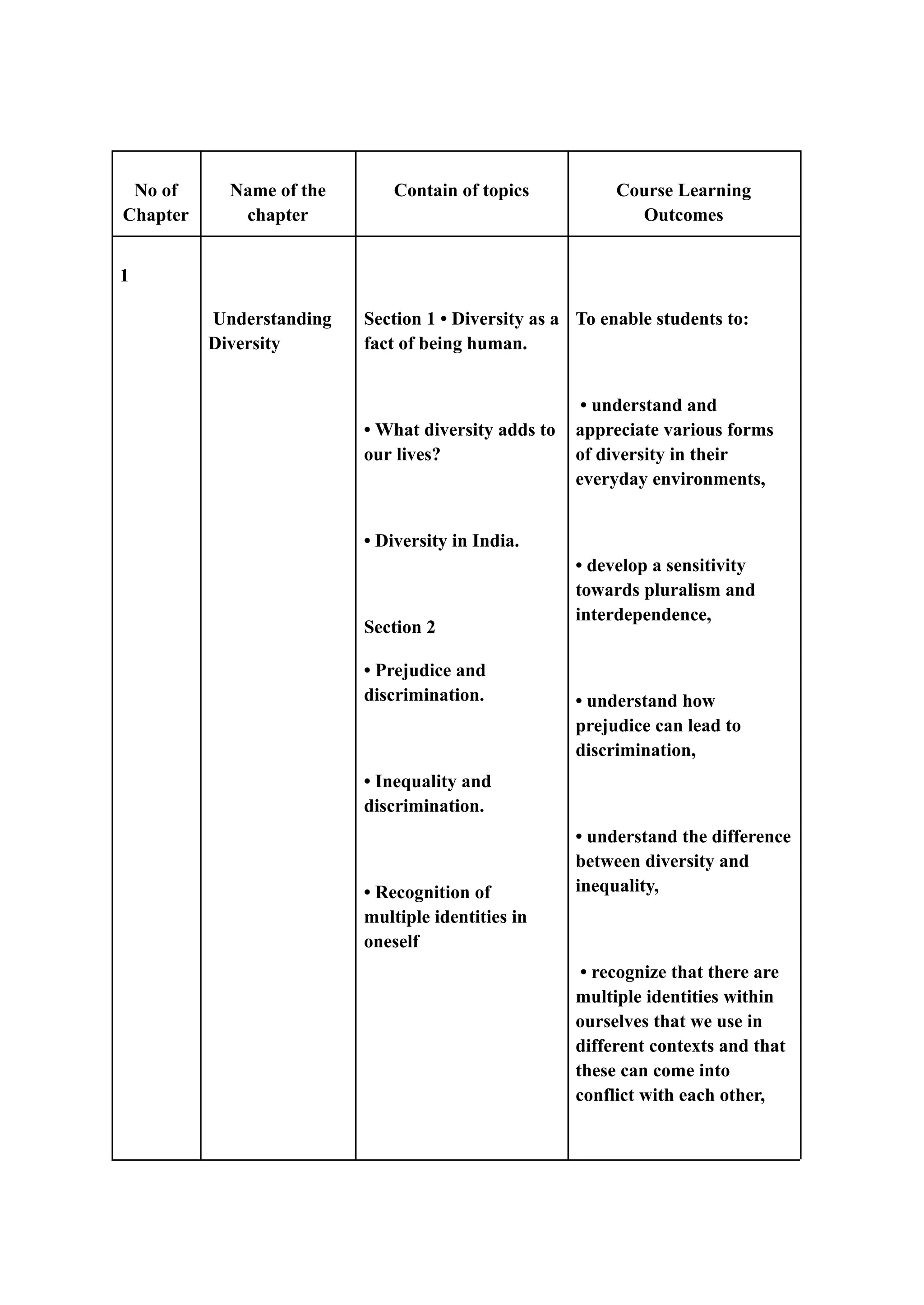
No of
Chapter
Name of the
chapter
Contain of topics Course Learning
Outcomes
1
Understanding
Diversity
Section 1 • Diversity as a
fact of being human.
• What diversity adds to
our lives?
• Diversity in India.
Section 2
• Prejudice and
discrimination.
• Inequality and
discrimination.
• Recognition of
multiple identities in
oneself
To enable students to:
• understand and
appreciate various forms
of diversity in their
everyday environments,
• develop a sensitivity
towards pluralism and
interdependence,
• understand how
prejudice can lead to
discrimination,
• understand the difference
between diversity and
inequality,
• recognize that there are
multiple identities within
ourselves that we use in
different contexts and that
these can come into
conflict with each other,
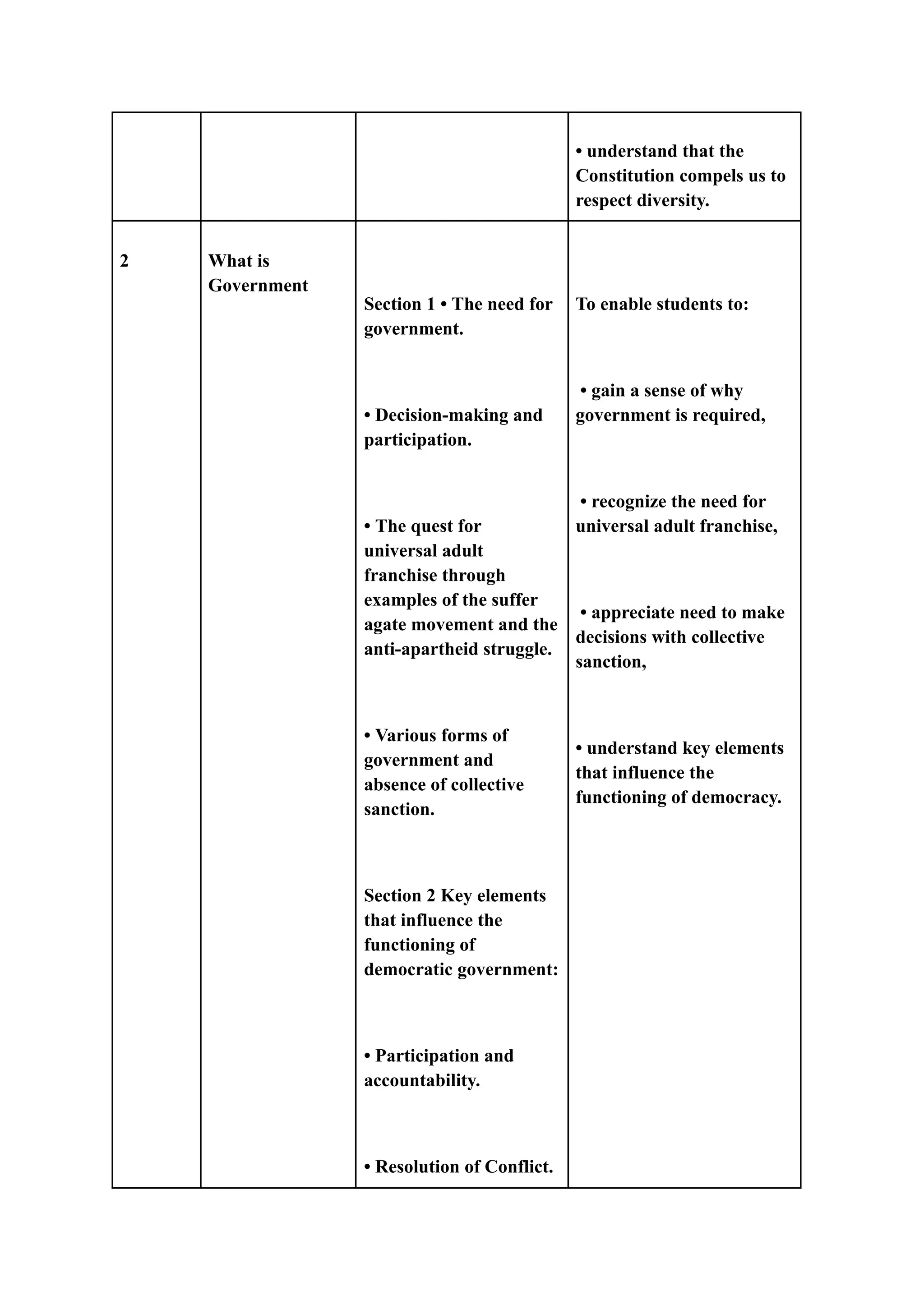
• understand that the
Constitution compels us to
respect diversity.
2 What is
Government
Section 1 • The need for
government.
• Decision-making and
participation.
• The quest for
universal adult
franchise through
examples of the suffer
agate movement and the
anti-apartheid struggle.
• Various forms of
government and
absence of collective
sanction.
Section 2 Key elements
that influence the
functioning of
democratic government:
• Participation and
accountability.
• Resolution of Conflict.
To enable students to:
• gain a sense of why
government is required,
• recognize the need for
universal adult franchise,
• appreciate need to make
decisions with collective
sanction,
• understand key elements
that influence the
functioning of democracy.
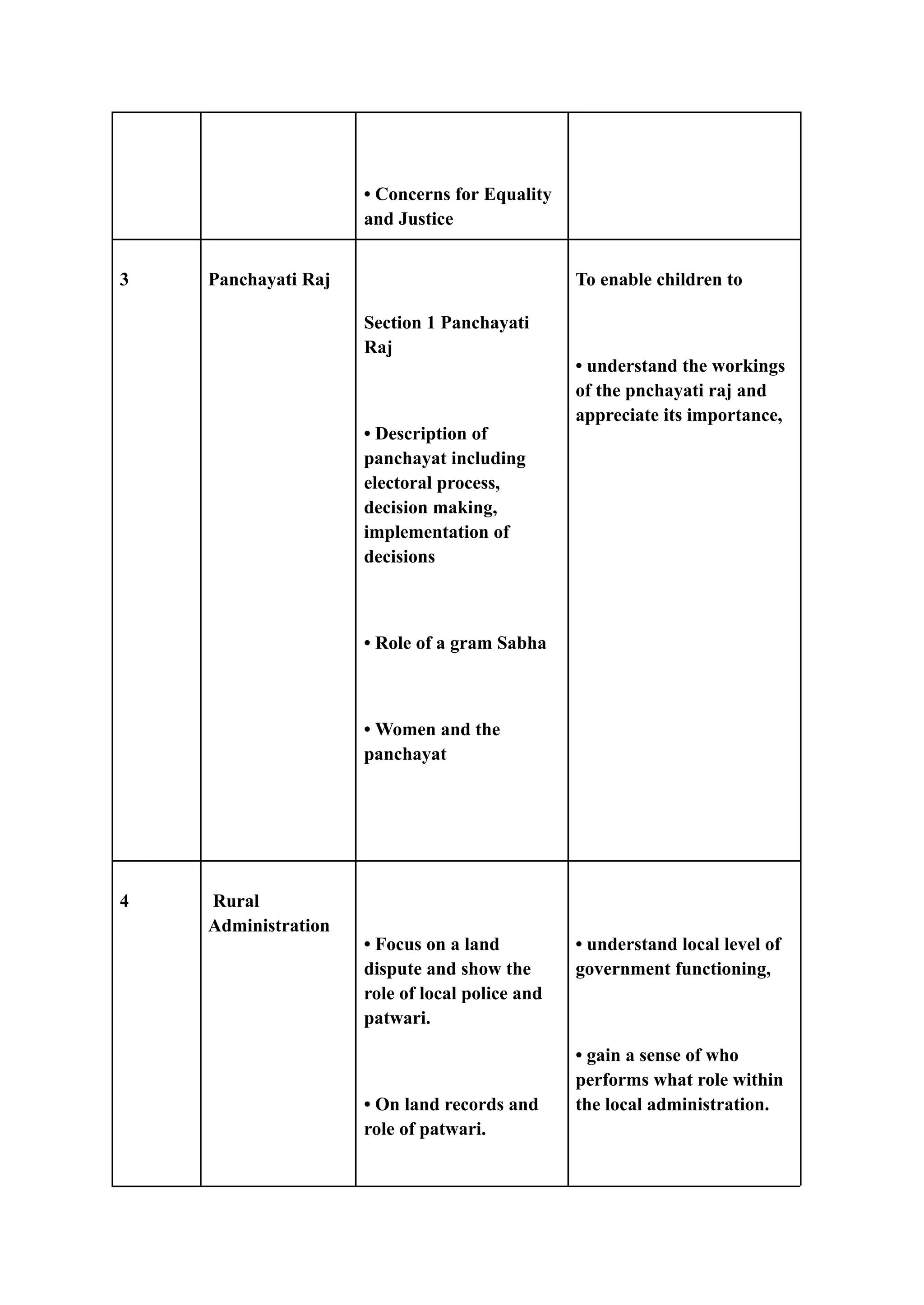
• Concerns for Equality
and Justice
3 Panchayati Raj
Section 1 Panchayati
Raj
• Description of
panchayat including
electoral process,
decision making,
implementation of
decisions
• Role of a gram Sabha
• Women and the
panchayat
To enable children to
• understand the workings
of the pnchayati raj and
appreciate its importance,
4 Rural
Administration
• Focus on a land
dispute and show the
role of local police and
patwari.
• On land records and
role of patwari.
• understand local level of
government functioning,
• gain a sense of who
performs what role within
the local administration.
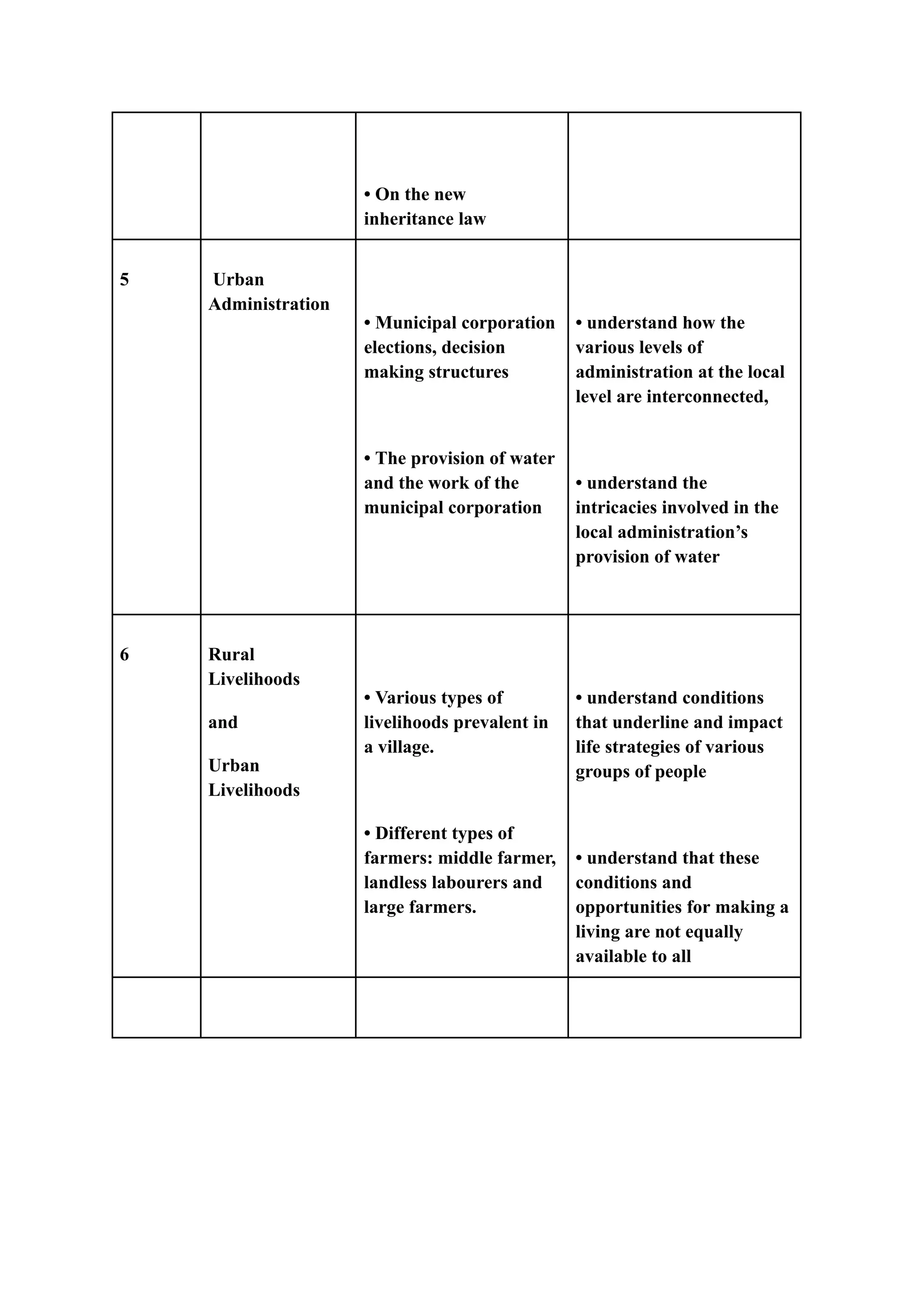
• On the new
inheritance law
5 Urban
Administration
• Municipal corporation
elections, decision
making structures
• The provision of water
and the work of the
municipal corporation
• understand how the
various levels of
administration at the local
level are interconnected,
• understand the
intricacies involved in the
local administration’s
provision of water
6 Rural
Livelihoods
and
Urban
Livelihoods
• Various types of
livelihoods prevalent in
a village.
• Different types of
farmers: middle farmer,
landless labourers and
large farmers.
• understand conditions
that underline and impact
life strategies of various
groups of people
• understand that these
conditions and
opportunities for making a
living are not equally
available to all

Course Learning Outcomes/ Learning Outcomes

  • 1.
    An Assignment On Course LearningOutcomes of Psychosocial Foundation of Education Prepared By Name- Sujit Kumar Bhoi Reg. No- 20maeduc15 Submitted To Dr. Jubilee Padmanabhan DEPARTMENT OF EDUCATION CENTRAL UNIVERSITY OF PUNJAB, BATHINDA
  • 2.
    CONTENT Sl No. TopicPage No. 1 Introduction 2 Concept of Course Learning Outcome 3 Importance of Course Learning Outcome 4 Steps for Formulating Course Learning Outcomes 5 Selected Course with Learning Outcome
  • 3.
    Course Learning Outcome Introduction Inthe field of education, course learning outcomes are brief statements that describe what students will be expected to learn or achieve by the end of course. In many cases, course learning outcomes are the interim academic goals that teachers establish for students who are working toward meeting more comprehensive learning standards. Students will be more likely to achieve the provided goals if learning outcomes are properly explained to them. If students may not know what is expected of them or learning outcomes are unclear, which can lead to confusion, frustration, or other factors that obstruct the learning process. Therefore, there is need to formulate the course learning outcomes which is more clear and precise. Concept of Course Learning Outcome To simply put, Course Learning Outcomes are any measurable skills, abilities, knowledge or values that the student demonstrates as a result of completing a given course. Effective learning outcomes can be articulated at several levels, including lesson, course, program, degree, etc. It is completely learner-oriented and describes what both the students have to learn and what the instructor will teach. Importance of course learning outcomes Even while designing a course, it is crucial to plan how its learning outcomes will align with the given curriculum. The importances are; 1. It sets shared expectations between students and instructors 2. Let’s student set learning goals easily 3. Helps students learn more effectively 4. Instructors have a clear direction while making assessment decisions 5. Gives a program level overview of learning across courses and years Steps for Formulating Course Learning Outcomes The following are recommended steps for writing clear, observable and measurable Course learning outcomes. 1. Begin with an Action Verb
  • 4.
    Begin with anaction verb that denotes the level of learning expected. Terms such as know, understand, learn, appreciate are generally not specific enough to be measurable. Levels of learning and associated verbs may include the following: i. Remembering and understanding: recall, identify, label, illustrate, summarize. ii. Applying and analyzing: use, differentiate, organize, integrate, apply, solve, analyze. iii. Evaluating and creating: Monitor, test, judge, produce, revise, compose. Source: https://assessment.provost.wisc.edu/student-learning-outcomes/writing-student-learning-outc omes/ 2. Clearly identify the specific knowledge, skill or disposition you would like students to be able to demonstrate. 3. Third, be certain to pair each Course Learning Outcome with one or more Learning Activities in the Class that will allow students to achieve this outcome and permit faculty to measure this achievement.
  • 5.
    No of Chapter Name ofthe chapter Contain of topics Course Learning Outcomes 1 Understanding Diversity Section 1 • Diversity as a fact of being human. • What diversity adds to our lives? • Diversity in India. Section 2 • Prejudice and discrimination. • Inequality and discrimination. • Recognition of multiple identities in oneself To enable students to: • understand and appreciate various forms of diversity in their everyday environments, • develop a sensitivity towards pluralism and interdependence, • understand how prejudice can lead to discrimination, • understand the difference between diversity and inequality, • recognize that there are multiple identities within ourselves that we use in different contexts and that these can come into conflict with each other,
  • 6.
    • understand thatthe Constitution compels us to respect diversity. 2 What is Government Section 1 • The need for government. • Decision-making and participation. • The quest for universal adult franchise through examples of the suffer agate movement and the anti-apartheid struggle. • Various forms of government and absence of collective sanction. Section 2 Key elements that influence the functioning of democratic government: • Participation and accountability. • Resolution of Conflict. To enable students to: • gain a sense of why government is required, • recognize the need for universal adult franchise, • appreciate need to make decisions with collective sanction, • understand key elements that influence the functioning of democracy.
  • 7.
    • Concerns forEquality and Justice 3 Panchayati Raj Section 1 Panchayati Raj • Description of panchayat including electoral process, decision making, implementation of decisions • Role of a gram Sabha • Women and the panchayat To enable children to • understand the workings of the pnchayati raj and appreciate its importance, 4 Rural Administration • Focus on a land dispute and show the role of local police and patwari. • On land records and role of patwari. • understand local level of government functioning, • gain a sense of who performs what role within the local administration.
  • 8.
    • On thenew inheritance law 5 Urban Administration • Municipal corporation elections, decision making structures • The provision of water and the work of the municipal corporation • understand how the various levels of administration at the local level are interconnected, • understand the intricacies involved in the local administration’s provision of water 6 Rural Livelihoods and Urban Livelihoods • Various types of livelihoods prevalent in a village. • Different types of farmers: middle farmer, landless labourers and large farmers. • understand conditions that underline and impact life strategies of various groups of people • understand that these conditions and opportunities for making a living are not equally available to all