Experience Name: Count Maths Bottles
Set up on: 1/8/14 Age Group: 8 – 24 Months
Set up by: Nuridawati Rush
Rationale
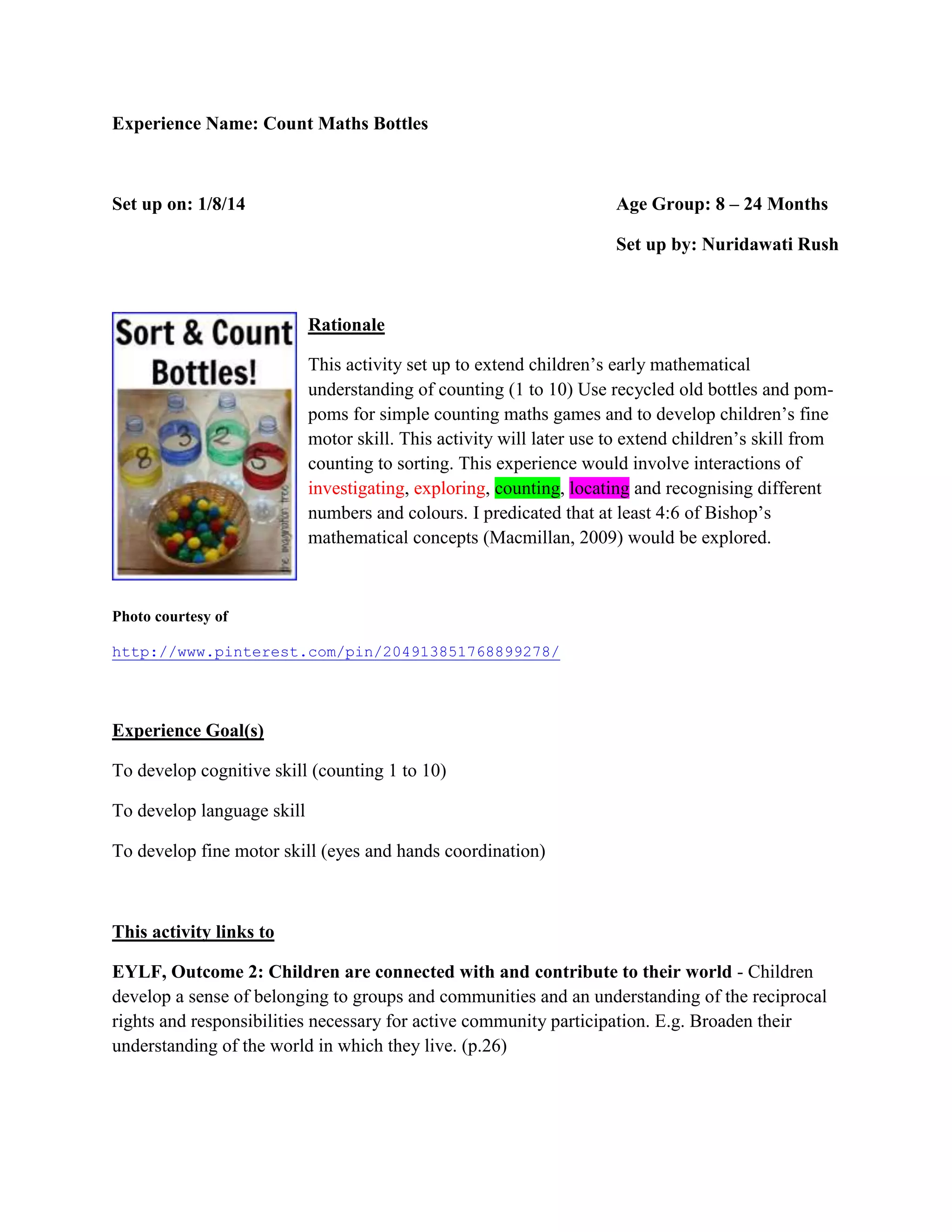
This activity set up to extend children’s early mathematical
understanding of counting (1 to 10) Use recycled old bottles and pom-
poms for simple counting maths games and to develop children’s fine
motor skill. This activity will later use to extend children’s skill from
counting to sorting. This experience would involve interactions of
investigating, exploring, counting, locating and recognising different
numbers and colours. I predicated that at least 4:6 of Bishop’s
mathematical concepts (Macmillan, 2009) would be explored.
Photo courtesy of
http://www.pinterest.com/pin/204913851768899278/
Experience Goal(s)
To develop cognitive skill (counting 1 to 10)
To develop language skill
To develop fine motor skill (eyes and hands coordination)
This activity links to
EYLF, Outcome 2: Children are connected with and contribute to their world - Children
develop a sense of belonging to groups and communities and an understanding of the reciprocal
rights and responsibilities necessary for active community participation. E.g. Broaden their
understanding of the world in which they live. (p.26)
EYLF, Outcome 5: Children are effective communicators - Children interact verbally and
non-verbally for a range of purposes. E.g. “model language and encourage children to express
themselves through language in a range of contexts and for a range of purposes.” (p.40)
Materials/ equipment lists
Use recycled old bottles
Pom-poms
References
http://www.pinterest.com/pin/204913851768899278/
Australian Government Department of Education, Employment and Workplace Relations for the
Council of Australian Governments. (2009). BELONGING, BEING & BECOMING; The Early
Years Learning Framework for Australia. Barton, ACT: Attorney-General's Department.
Macmillan, A. (2009). Numeracy in Early Childhood; Shared Contexts for Teaching & Learning.
South Melbourne: OXFORD, University Press.
20/8/14
The purpose of this observation is to identify the mathematical behavior observed in a child’s
initiated play and identify numeracy (counting) development that occurs naturally during this
activity. During this activity, I witnessed that children have learnt about investigating, exploring,
counting, locating and recognising numbers 1 to 10. I predicated that at least 4:6 of Bishop’s
mathematical concepts (Macmillan, 2009) would be explored. Children showed their curiosity,
cooperation, confidence, and creativity.
I invited one child to sit on the chair next to me, and encourage that child to pick the pom-pom
one each time, and asked that child to put the pom-pom into the bottle, while I do the counting
and repeat for her, then asked that child to follow after me. The activity set up and achieved the
goals, as evident that the most of the children would like to have their turns to play (EYLF,
Outcome 1, 2). Children learnt to count, and interacted with me (EYLF, Outcome 3, 5).
Children learnt to stay focus, and used their both hands to put pom-poms into the bottle, one
hand put the pom-poms into the bottle, while the other hand held the bottle (EYLF, Outcome 4).
Extension of learning is introducing a new activity which supporting children counting skill,
such as catching fish.

Counting activity

  • 1.
    Experience Name: CountMaths Bottles Set up on: 1/8/14 Age Group: 8 – 24 Months Set up by: Nuridawati Rush Rationale This activity set up to extend children’s early mathematical understanding of counting (1 to 10) Use recycled old bottles and pom- poms for simple counting maths games and to develop children’s fine motor skill. This activity will later use to extend children’s skill from counting to sorting. This experience would involve interactions of investigating, exploring, counting, locating and recognising different numbers and colours. I predicated that at least 4:6 of Bishop’s mathematical concepts (Macmillan, 2009) would be explored. Photo courtesy of http://www.pinterest.com/pin/204913851768899278/ Experience Goal(s) To develop cognitive skill (counting 1 to 10) To develop language skill To develop fine motor skill (eyes and hands coordination) This activity links to EYLF, Outcome 2: Children are connected with and contribute to their world - Children develop a sense of belonging to groups and communities and an understanding of the reciprocal rights and responsibilities necessary for active community participation. E.g. Broaden their understanding of the world in which they live. (p.26)
  • 2.
    EYLF, Outcome 5:Children are effective communicators - Children interact verbally and non-verbally for a range of purposes. E.g. “model language and encourage children to express themselves through language in a range of contexts and for a range of purposes.” (p.40) Materials/ equipment lists Use recycled old bottles Pom-poms References http://www.pinterest.com/pin/204913851768899278/ Australian Government Department of Education, Employment and Workplace Relations for the Council of Australian Governments. (2009). BELONGING, BEING & BECOMING; The Early Years Learning Framework for Australia. Barton, ACT: Attorney-General's Department. Macmillan, A. (2009). Numeracy in Early Childhood; Shared Contexts for Teaching & Learning. South Melbourne: OXFORD, University Press.
  • 3.
    20/8/14 The purpose ofthis observation is to identify the mathematical behavior observed in a child’s initiated play and identify numeracy (counting) development that occurs naturally during this activity. During this activity, I witnessed that children have learnt about investigating, exploring, counting, locating and recognising numbers 1 to 10. I predicated that at least 4:6 of Bishop’s mathematical concepts (Macmillan, 2009) would be explored. Children showed their curiosity, cooperation, confidence, and creativity. I invited one child to sit on the chair next to me, and encourage that child to pick the pom-pom one each time, and asked that child to put the pom-pom into the bottle, while I do the counting and repeat for her, then asked that child to follow after me. The activity set up and achieved the goals, as evident that the most of the children would like to have their turns to play (EYLF, Outcome 1, 2). Children learnt to count, and interacted with me (EYLF, Outcome 3, 5). Children learnt to stay focus, and used their both hands to put pom-poms into the bottle, one hand put the pom-poms into the bottle, while the other hand held the bottle (EYLF, Outcome 4). Extension of learning is introducing a new activity which supporting children counting skill, such as catching fish.