YPCG Key Concerns

  The hundreds of members of this group fully support
green energy initiatives, but we oppose the Ceres Project
    in its current location for a multitude of reasons.
  While development & employment in the region are
welcome, it cannot be to the detriment of the industries
                of agriculture and tourism.
 This would be the biggest wind turbine development in
 Australia, and the health, safety & financial position of
    thousands of YP residents would be jeopardised.
FIRE

 The CFS Chief, Greg Nettleton, has written in Jan 2013 that the CFS
  “would adopt a position that it is unlikely water bombing aircraft
  would operate in the immediate vicinity of a wind turbine farm if
  the risks exceed safe operating conditions.”
 David Pearce, Manager of the CFS Aviation Service has stated that
  “visibility in the vicinity of a fire is generally poor due to the
  smoke” and that “any obstacle in the airspace where we’re
  running aircraft is a problem for aircraft obviously”
 David Anderson, chief pilot & owner of Australian Helicopters
  (who operate the MedStar emergency Helicopters) said “In
  conditions where the visibility is reduced… we wouldn’t
  contemplate working in the vicinity of the turbines”
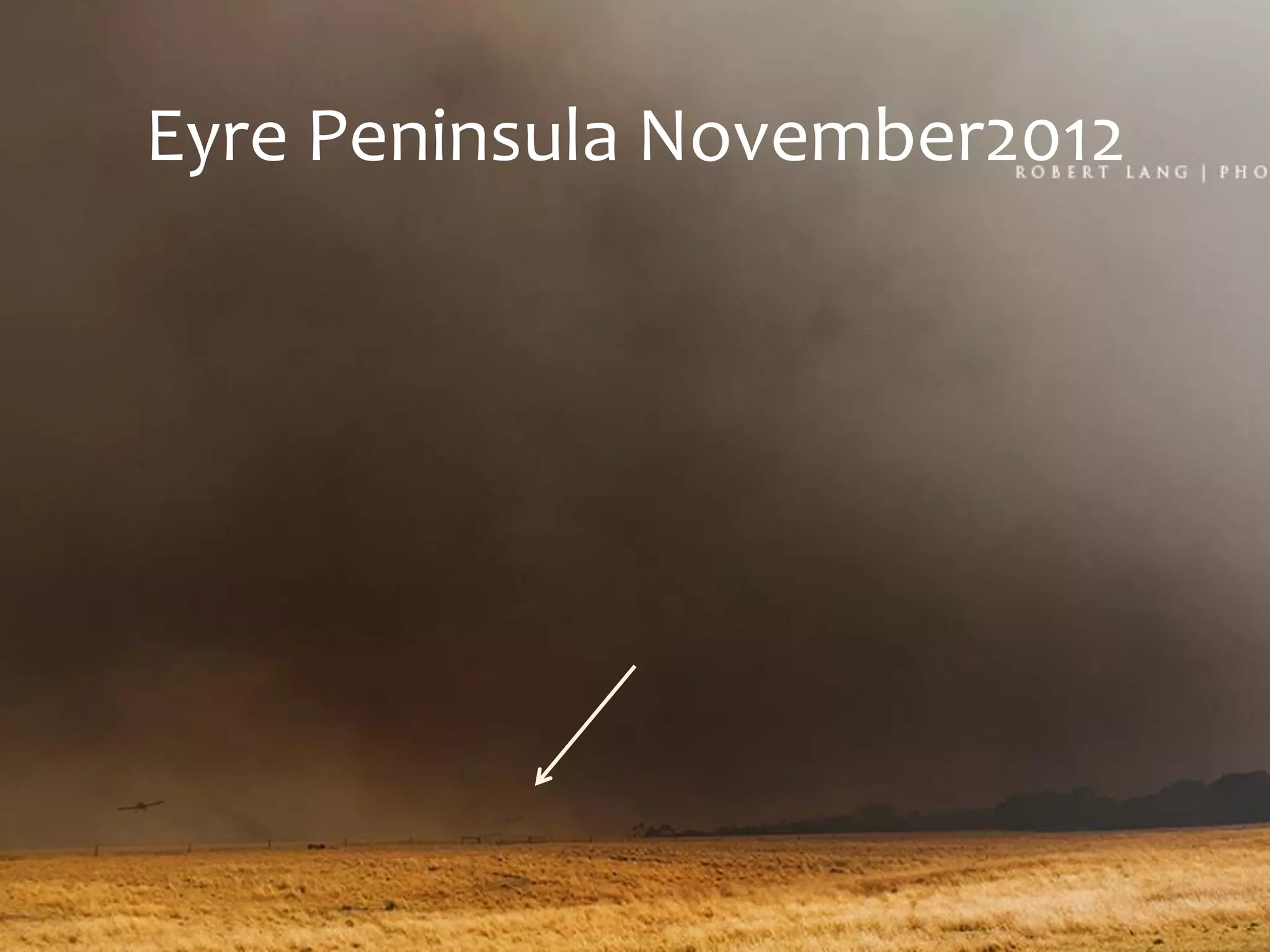
Eyre Peninsula November2012
FIRE


 Should this development go ahead it will impede aerial water
  bombing over 60,000 ha of heavily cropped land & adjoining
  coastal settlements and towns
 Aerial water bombing is a tool deemed necessary in maximising
  the CFS’ ability to protect life and property in the instance of a
  fire.
 The primary role of the CFS is to protect life & property from fire.
 In light of the 2005 EP fire & its ongoing litigation, questions
  arise as to who could be liable for loss of property or life within
  or adjacent to the Development zones if the Ceres Project goes
  ahead unopposed, despite this indisputable fact.
This photo of an aerial water bomber over
 Curramulka was taken on Nov 19 2009 from within
             the proposed turbine zone.
On 7 Dec 2012 a fire burned within a few kilometres of
the proposed wind farm, and 5 aerial water bombers
  were vital in saving homes & controlling the fire
Health


 In 2010 the National Health and Medical Research
  Centre did a rapid review on literature predating 2009
  on health concerns for people living near turbines.
  This review was considered inconclusive, & their
  current recommendation is that “relevant authorities
  should take a precautionary approach” to siting
  turbines near people until further research is
  undertaken.
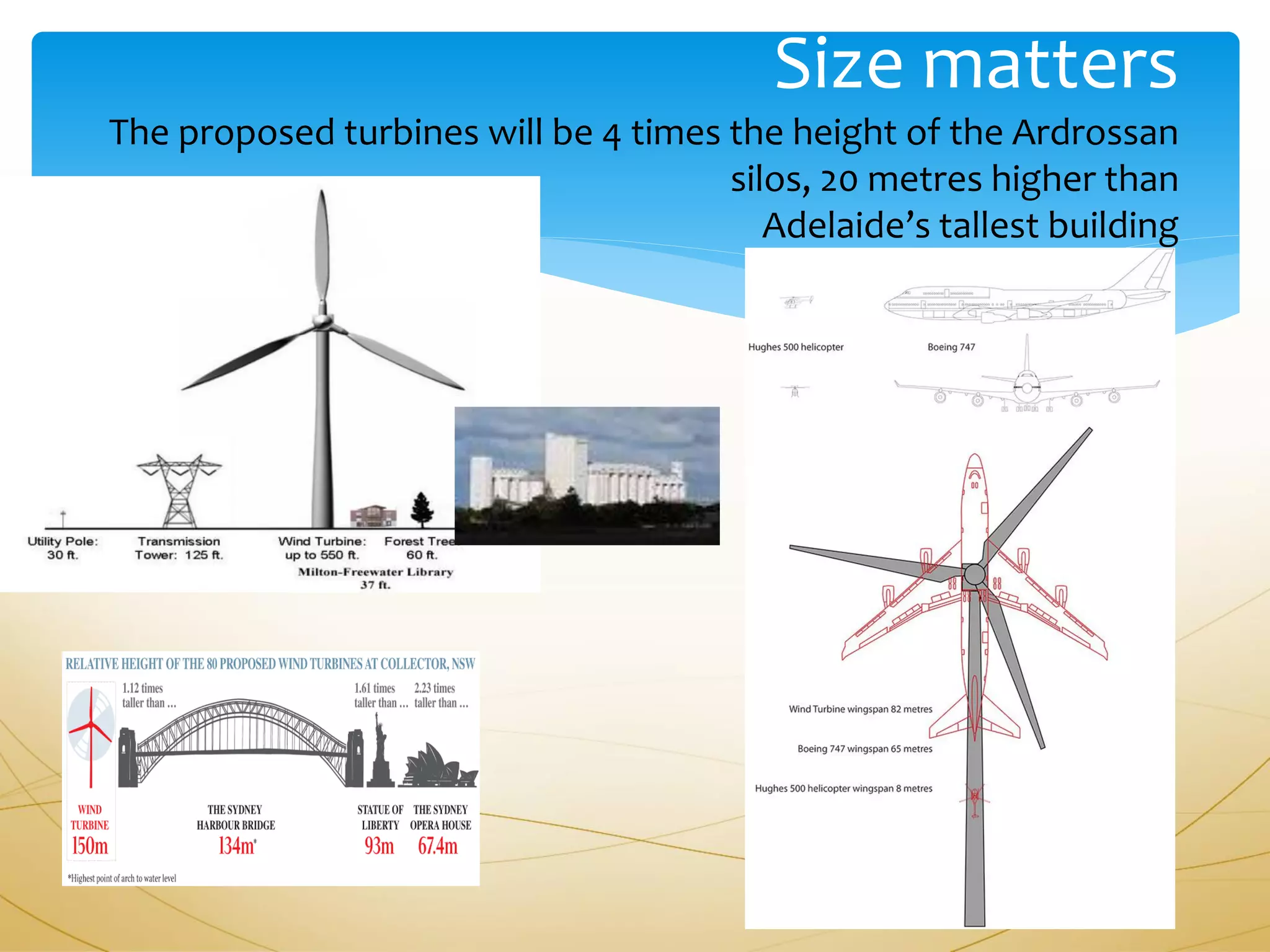
Size matters
The proposed turbines will be 4 times the height of the Ardrossan
                                      silos, 20 metres higher than
                                         Adelaide’s tallest building
Land Devaluation


Councils in the UK have decreased the council rates of
properties within sight of turbines, in line with the
decrease in the value of the properties.
In Denmark, it is legislated that neighbours must be
compensated for the devaluation of their properties.
Elders Rural National Sales Manager has written that
the towers could lead to a 30% to 50% drop in the value
of near by properties.
windturbinepropertyloss.org has current information
Agriculturally Rich
• Less than 10% of South Australia
  is cropped
• Central Yorke Peninsula is
  arguably some of the highest
  yielding, most reliable land in
  the state
• Australian farmers feed 60
  million people annually
• The world population is
  forecast to hit over 9 billion by
  2050
• Worldwide, land available for
  agriculture is decreasing by 10%
  per decade
Interference with prime cropping
              land

 Land values reflect the productivity of the land, and high yields call
  for higher financial inputs by farmers in the CYP
 This includes aerial spraying, baiting, fertilising & seeding. Aerotech
  inform us that the proposed development would impact over 600
  square km by limiting this tool.
 This is unprecedented in Australia, where WTDs like Wattle Point
  (11.5 square km) have been smaller in size & number, and placed in
  marginal cropping land, grazing country or on rocky/scrubby land.
 Prime cropping land is more densely populated with homesteads,
  increasing the number of people directly impacted.
 There is an increased fire risk in land under heavy crop.
Turbine turbulence may well cause
       excessive spray drift
Undersea or overhead?


 In the recent referral of the project to the Environmental Protection
  & Bio-Diversity Conservation Act, Ceres STILL put forward 98
  kilometres of traditional overhead 275kV single or double overhead
  LATTICE tower transmission line as a likely alternative.

 Developer John McFarlane has stated this will cost $100 million less
  than the undersea option. This would greatly expand the impact of
  the project and further decrease its popularity with local residents.

 If the undersea cabling is used, it will be from the base of the cliff
  below the observation point in Port Julia, despite this being
  recognised by the developers as an area of cultural sensitivity.

 Regardless of the method of power export, it will enable further
  turbine developments to become more feasible on other areas on
  the peninsula
Maps provided by Ceres to the EPBC
Proximity to the coast


 The submitted map indicates that the developers plan to install
  150m X115m turbines within
   2 km of Sheoak Flat residents
   2 km of Port Julia
   2.8 km of Pt Vincent residents
   4.5km of Black Point
   6.5km of Pine Point
   There will be a large converter station, shedding for
    staff, hazardous materials storage & power
    transformers 1.5km from Pt Julia, on the coast road.
Is greater spacing an advantage?


 The developers tout that with 600m spacing between turbines,
  this is the “least densely populated wind farm in Australia.”
 Ironically ‘population’ actually refers to inhabitants, not
  industrial machines, and over 1300 homes are in or within 10 km
  of the turbines, making it one of the most densely populated in
  Australia
 Because the development is spread over such a large area, more
  neighbouring residents , businesses & tourist based coastal
  areas are negatively impacted.
 The fact that the development is “spread over such a large
  area” reflects the distances developers had to travel to find
  farmers willing to be hosts. Surely a tighter group of turbines
  would be more cost efficient & less invasive?
Beneficial or detrimental?


 “Ceres developement will bring an opportunity for local farmers
  to diversify their income streams”
 But it will limit their neighbours opportunity to maximise their
  crop yields & it will decrease land values for all land and homes
  within sight of turbines
 It will speed up the NBN to the YP
 This is only a possibility, & only If the undersea cable is in fact
  used. The NBN official website states that metro-comparable
  internet is available to YP residents already, and that rollout to
  the YP is due for completion by 2016 anyway.
 It will also prevent homes within & west of the turbines from
  receiving digital television & radio signals from Adelaide.
Beneficial or detrimental


 “The development will generate large amounts of regional
  employment, one full time employee per 4 turbines”
 Being an employer myself, finding just one genuine
  jobseeker in the district is challenging.
 Employees may move in, but the number or residents who
  move away because of the turbines has the potential to be
  far greater.
 Tourism will likely be impacted at Pine Point through to Pt
  Vincent; where the turbines will be both visible & audible.
Social Benefits?


 Including “The establishment of a dedicated fund to
  support community programs”

 Residents are concerned that the possibility of
  implied ownership of the funds & their consequential
  purchases will further divide the community.
Public consultation….                                 .


 Developers are “required to consult with the public to
  provide accurate, relevant information and to maintain
  transparency in the project design”
 Their recent public meetings were limited to 25 people per
  session, and these people were locked into the room.
 They were described by many as “a disastrous public
  relations shambles”
 Very few genuine questions were answered in front of the
  small groups; with most people either directed to read the
  fact sheets, or with the developers requesting questions
  to be sent to them by email.
 For more information on why there are many
  residents, scientists, journalists & politicians opposed
  to this development, and
  For information on how to write a submission to the
      DAC opposing the Ceres Project, please email

                the12mile@netyp.com.au

Yorke Peninsula Community Group

  • 1.
    YPCG Key Concerns The hundreds of members of this group fully support green energy initiatives, but we oppose the Ceres Project in its current location for a multitude of reasons. While development & employment in the region are welcome, it cannot be to the detriment of the industries of agriculture and tourism. This would be the biggest wind turbine development in Australia, and the health, safety & financial position of thousands of YP residents would be jeopardised.
  • 2.
    FIRE  The CFSChief, Greg Nettleton, has written in Jan 2013 that the CFS “would adopt a position that it is unlikely water bombing aircraft would operate in the immediate vicinity of a wind turbine farm if the risks exceed safe operating conditions.”  David Pearce, Manager of the CFS Aviation Service has stated that “visibility in the vicinity of a fire is generally poor due to the smoke” and that “any obstacle in the airspace where we’re running aircraft is a problem for aircraft obviously”  David Anderson, chief pilot & owner of Australian Helicopters (who operate the MedStar emergency Helicopters) said “In conditions where the visibility is reduced… we wouldn’t contemplate working in the vicinity of the turbines”
  • 3.
  • 4.
    FIRE  Should thisdevelopment go ahead it will impede aerial water bombing over 60,000 ha of heavily cropped land & adjoining coastal settlements and towns  Aerial water bombing is a tool deemed necessary in maximising the CFS’ ability to protect life and property in the instance of a fire.  The primary role of the CFS is to protect life & property from fire.  In light of the 2005 EP fire & its ongoing litigation, questions arise as to who could be liable for loss of property or life within or adjacent to the Development zones if the Ceres Project goes ahead unopposed, despite this indisputable fact.
  • 5.
    This photo ofan aerial water bomber over Curramulka was taken on Nov 19 2009 from within the proposed turbine zone. On 7 Dec 2012 a fire burned within a few kilometres of the proposed wind farm, and 5 aerial water bombers were vital in saving homes & controlling the fire
  • 6.
    Health  In 2010the National Health and Medical Research Centre did a rapid review on literature predating 2009 on health concerns for people living near turbines. This review was considered inconclusive, & their current recommendation is that “relevant authorities should take a precautionary approach” to siting turbines near people until further research is undertaken.
  • 7.
    Size matters The proposedturbines will be 4 times the height of the Ardrossan silos, 20 metres higher than Adelaide’s tallest building
  • 8.
    Land Devaluation Councils inthe UK have decreased the council rates of properties within sight of turbines, in line with the decrease in the value of the properties. In Denmark, it is legislated that neighbours must be compensated for the devaluation of their properties. Elders Rural National Sales Manager has written that the towers could lead to a 30% to 50% drop in the value of near by properties. windturbinepropertyloss.org has current information
  • 9.
    Agriculturally Rich • Lessthan 10% of South Australia is cropped • Central Yorke Peninsula is arguably some of the highest yielding, most reliable land in the state • Australian farmers feed 60 million people annually • The world population is forecast to hit over 9 billion by 2050 • Worldwide, land available for agriculture is decreasing by 10% per decade
  • 10.
    Interference with primecropping land  Land values reflect the productivity of the land, and high yields call for higher financial inputs by farmers in the CYP  This includes aerial spraying, baiting, fertilising & seeding. Aerotech inform us that the proposed development would impact over 600 square km by limiting this tool.  This is unprecedented in Australia, where WTDs like Wattle Point (11.5 square km) have been smaller in size & number, and placed in marginal cropping land, grazing country or on rocky/scrubby land.  Prime cropping land is more densely populated with homesteads, increasing the number of people directly impacted.  There is an increased fire risk in land under heavy crop.
  • 11.
    Turbine turbulence maywell cause excessive spray drift
  • 13.
    Undersea or overhead? In the recent referral of the project to the Environmental Protection & Bio-Diversity Conservation Act, Ceres STILL put forward 98 kilometres of traditional overhead 275kV single or double overhead LATTICE tower transmission line as a likely alternative.  Developer John McFarlane has stated this will cost $100 million less than the undersea option. This would greatly expand the impact of the project and further decrease its popularity with local residents.  If the undersea cabling is used, it will be from the base of the cliff below the observation point in Port Julia, despite this being recognised by the developers as an area of cultural sensitivity.  Regardless of the method of power export, it will enable further turbine developments to become more feasible on other areas on the peninsula
  • 14.
    Maps provided byCeres to the EPBC
  • 15.
    Proximity to thecoast  The submitted map indicates that the developers plan to install 150m X115m turbines within  2 km of Sheoak Flat residents  2 km of Port Julia  2.8 km of Pt Vincent residents  4.5km of Black Point  6.5km of Pine Point  There will be a large converter station, shedding for staff, hazardous materials storage & power transformers 1.5km from Pt Julia, on the coast road.
  • 16.
    Is greater spacingan advantage?  The developers tout that with 600m spacing between turbines, this is the “least densely populated wind farm in Australia.”  Ironically ‘population’ actually refers to inhabitants, not industrial machines, and over 1300 homes are in or within 10 km of the turbines, making it one of the most densely populated in Australia  Because the development is spread over such a large area, more neighbouring residents , businesses & tourist based coastal areas are negatively impacted.  The fact that the development is “spread over such a large area” reflects the distances developers had to travel to find farmers willing to be hosts. Surely a tighter group of turbines would be more cost efficient & less invasive?
  • 17.
    Beneficial or detrimental? “Ceres developement will bring an opportunity for local farmers to diversify their income streams”  But it will limit their neighbours opportunity to maximise their crop yields & it will decrease land values for all land and homes within sight of turbines  It will speed up the NBN to the YP  This is only a possibility, & only If the undersea cable is in fact used. The NBN official website states that metro-comparable internet is available to YP residents already, and that rollout to the YP is due for completion by 2016 anyway.  It will also prevent homes within & west of the turbines from receiving digital television & radio signals from Adelaide.
  • 18.
    Beneficial or detrimental “The development will generate large amounts of regional employment, one full time employee per 4 turbines”  Being an employer myself, finding just one genuine jobseeker in the district is challenging.  Employees may move in, but the number or residents who move away because of the turbines has the potential to be far greater.  Tourism will likely be impacted at Pine Point through to Pt Vincent; where the turbines will be both visible & audible.
  • 19.
    Social Benefits?  Including“The establishment of a dedicated fund to support community programs”  Residents are concerned that the possibility of implied ownership of the funds & their consequential purchases will further divide the community.
  • 20.
    Public consultation…. .  Developers are “required to consult with the public to provide accurate, relevant information and to maintain transparency in the project design”  Their recent public meetings were limited to 25 people per session, and these people were locked into the room.  They were described by many as “a disastrous public relations shambles”  Very few genuine questions were answered in front of the small groups; with most people either directed to read the fact sheets, or with the developers requesting questions to be sent to them by email.
  • 21.
     For moreinformation on why there are many residents, scientists, journalists & politicians opposed to this development, and For information on how to write a submission to the DAC opposing the Ceres Project, please email the12mile@netyp.com.au