AUTHORS: Ashish Sakarkar | Utsav Bhatt


                Cost Reduction Approach
                ... IT Perspective


Abstract
The economic unbalance in recent times; be it the Eurozone crises, lack of consumer
confidence in the market or rising cost of compliance; has forced financial institutions across
the globe to be laser-focused on cost reduction initiatives. Information Technology, which has
been a transformational factor in the success of major financial organizations, is facing the
heat as IT budgets are getting skewed and there is a strong mandate to achieve more with
less.

As IT cost reduction makes it to the top of the CIO priorities, this article intends to highlight
the people, process & technology aspects of cost reduction. For instance improving the
employee life cycle management – the People aspect; using automation techniques for
redundant & routine tasks – the Process aspect; or using innovative technology as a backbone
to drive business – the Technology aspect can help organisations achieve cost supremacy.


Overview
The current economic situation has caused organizations of all scales to rigorously test their
cost structures. While organizations in some industries are impacted more than others, all are
actively pursuing cost containment as a priority. The stalling economy in the UK amidst a
continuing Euro crisis, lack of consumer confidence in the market, and increasing cost of
regulation is fuelling cost pressures on businesses across the globe. The building society sector
is not immune to it.

Over a period of time, building societies have taken steps to sustain cost pressures by
investing in new technologies, developing new products/services and growing their customer
base. The cost initiatives undertaken by building societies has been fragmented in nature,
and as a result the full benefits of the initiatives are yet to be realized. With the advent of
technologies like cloud, mobility, analytics and virtualisation, there exist opportunities like
never before to save costs. There have been plenty of cases where major banks have moved
legacy applications, tried various sourcing models (resource augmentation, managed services,
fixed deliverable), rationalised mammoth application landscape and tried other initiatives to
contain costs. The banks are moving fast to repair their balance sheets and are taking
innovative sourcing decisions. The mutual sector needs to act fast if it is to compete in the
new post crisis competitive landscape.

In this article we consider People, Process & Technology as three dimensions of cost reduction
& highlight the opportunities in subsequent segments.


                                                                                       Page 1 of 5
Cost Reduction Approach
... IT Perspective


Dimensions for Cost Savings
(People, Process & Technology)

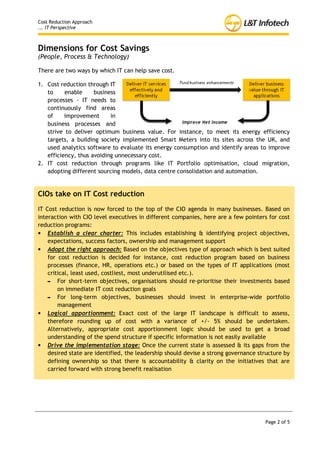
There are two ways by which IT can help save cost.

1. Cost reduction through
   IT to enable business
   processes - IT needs to
   continuously find areas
   of     improvement      in
   business processes and
   strive to deliver optimum
   business value. For instance, to meet its energy efficiency targets, a building society
   implemented Smart Meters into its sites across the UK, and used analytics software to
   evaluate its energy consumption and identify areas to improve efficiency, thus avoiding
   unnecessary cost.
2. IT cost reduction through programs like IT Portfolio optimisation, cloud migration,
   adopting different sourcing models, data centre consolidation and automation.


CIOs take on IT Cost reduction
IT Cost reduction is now forced to the top of the CIO agenda in many businesses. Based on
interaction with CIO level executives in different companies, here are a few pointers for cost
reduction programs:
• Establish a clear charter: This includes establishing & identifying project objectives,
    expectations, success factors, ownership and management support
• Adopt the right approach: Based on the objectives type of approach which is best suited
    for cost reduction is decided for instance, cost reduction program based on business
    processes (finance, HR, operations etc.) or based on the types of IT applications (most
    critical, least used, costliest, most underutilised etc.).
    - For short-term objectives, organisations should re-prioritise their investments based
        on immediate IT cost reduction goals
    - For long-term objectives, businesses should invest in enterprise-wide portfolio
        management
• Logical apportionment: Exact cost of the large IT landscape is difficult to assess,
    therefore rounding up of cost with a variance of +/- 5% should be undertaken.
    Alternatively, appropriate cost apportionment logic should be used to get a broad
    understanding of the spend structure if specific information is not easily available
• Drive the implementation stage: Once the current state is assessed & its gaps from the
    desired state are identified, the leadership should devise a strong governance structure by
    defining ownership so that there is accountability & clarity on the initiatives that are
    carried forward with strong benefit realisation


                                                                                     Page 2 of 5
Cost Reduction Approach
... IT Perspective


People
The people hired for specific roles and responsibilities are the cornerstone for any company’s
success. However, over a period of time, with the growth in size, the employees should be
trained to handle multiple tasks, which will also increase their flexibility. Post mergers &
acquisitions, there is an opportunity to relook at
the work functions and define a RACI matrix to Investing in an enterprise wide
determine who is Responsible, Accountable, Knowledge Management tool can enable
Consulted and Informed. Multi-skilling helps employees to efficiently search for
businesses to use the same resources for information, collaborate, get trained,
multiple tasks thereby reducing the need for mobilise ideal resources on the bench
unwanted recruitment. Organisations should also for projects and enable seamless flow of
have a clear training strategy for each information across the organisation. This
organisational level and job type. For support also           reduces    redundancy,    since
focused work, you need employees to be trained        employees do not invest time in
in their respective areas only; for functions activities already assigned to or
supporting business an organisation needs to completed by other colleague
invest in automating processes, boosting
productivity and equipping staff to improve the decision making process. At a strategic level,
investment needs to be done in identified leaders who can take the organisation to the next
level. By investing the right amount of money for the right employee in the right area helps
an organisation to plan effectively and ensure correct succession planning.

With a systematic organisation plan backed by IT systems which manage and track employee
performance, skill sets etc. significant cost reduction opportunities can be identified.

Process
IT systems can play an important role in improving the business processes by reducing
turnaround-time, increasing efficiency and boosting productivity. Often there are costly
processes which do not involve many employees of the organization, yet have a lot of
opportunities for automation.
A leading building society was unable to
                                               Let us take employee turnover as an example.
manage the customer service through its
                                               Once an employee decides to leave the
existing contact centres because of
                                               organisation, many departments like IT,
fluctuations in marketing activities and
                                               Finance, HR, and other support functions get
limited size of the contact centres. It
                                               engaged in completing the employee off-
then implemented a virtual contact
                                               boarding formalities. Simultaneously, there are
centre solution that helped them realise
                                               efforts made by the respective business group
immediate savings of more than £90,000
                                               and recruitment HR in finding and interviewing
per annum
                                               for     replacements.     Once     replacement
candidates are shortlisted, based on the business policy, resources are spent in interviews,
medical check-ups, negotiations, background checks etc. On selection of a candidate many
departments get lined up to on-board the employee. A typical on-boarding process involves
handing over the organisation’s IT assets (like communication devices, laptop/desktop and
office space), imparting basic training and providing required security accesses. Additionally,
there is an average amount of time that a new recruit takes to be completely productive.


                                                                                     Page 3 of 5
Cost Reduction Approach
... IT Perspective


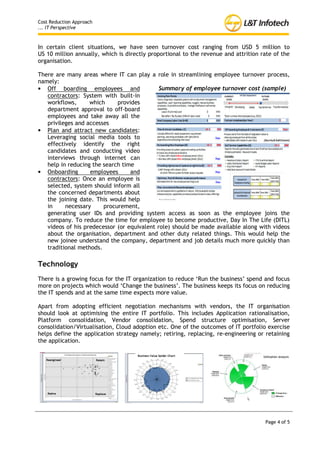
In certain client situations, we have seen turnover cost ranging from USD 5 million to
US 10 million annually, which is directly proportional to the revenue and attrition rate of the
organisation.

There are many areas where IT can play a role in streamlining employee turnover process,
namely:
• Off boarding employees and                 Summary of employee turnover cost (sample)
   contractors: System with built-in
   workflows,      which     provides
   department approval to off-
   board employees and take away
   all the privileges and accesses
• Plan and attract new candidates:
   Leveraging social media tools to
   effectively identify the right
   candidates and conducting video
   interviews through internet can
   help in reducing the search time
• Onboarding        employees     and
   contractors: Once an employee
   is selected, system should
   inform     all    the   concerned
   departments about the joining date. This would help in necessary procurement,
   generating user IDs and providing system access as soon as the employee joins the
   company. To reduce the time for employee to become productive, Day In The Life (DITL)
   videos of his predecessor (or equivalent role) should be made available along with videos
   about the organisation, department and other duty related things. This would help the
   new joinee understand the company, department and job details much more quickly than
   traditional methods.

Technology
There is a growing focus for the IT organization to reduce ‘Run the business’ spend and focus
more on projects which would ‘Change the business’. The business keeps its focus on reducing
the IT spends and at the same time expects more value.

Apart from adopting efficient negotiation mechanisms with vendors, the IT organisation
should look at optimising the entire IT portfolio. This includes Application rationalisation,
Platform consolidation, Vendor consolidation, Spend structure optimisation, Server
consolidation/Virtualisation, Cloud adoption etc. One of the outcomes of IT portfolio exercise
helps define the application strategy namely; retiring, replacing, re-engineering or retaining
the application.


                                                                                     Page 4 of 5
Cost Reduction Approach
... IT Perspective


The above sample charts depict critical information about the application portfolio of the
client. Measurements of areas like business criticality, technology maturity, total cost of
ownership and IT operating model amongst various others help in identifying:

•   Redundant applications which can be            A leading building society needed a self-
    retired, thus bringing in cost savings         service      portal   for     development
•   Applications which can be replaced by an       environments for its mortgage services
    Off-the-shelf tool or other application        division. Its IT shared service centre
    which is more cost-effective and efficient
                                                   helped discover a solution that allowed
    for the organisation
                                                   the building society to provision virtual
•   Applications which are critical and further
    investment in them could help in               machines to keep pace with its agile
    improving their performance and thereby        development requirements. By deploying
    improve efficiency of the process              virtualisation technology it avoided more
    supported by them                              than £40,000 expenditure on a proof of
•   User     education      opportunities    on    concept and licenses from the incumbent
    applications which are important, but          vendor
    have poor utilisation figures

Benefits
Often, cost reduction programs bring a pre-conceived notion of negativity & discomfort within
businesses. Job security, unfavourable work conditions etc. top the share of mind of
employees when they hear of such initiatives. However, this is not always true. Be it
utilisation of underperforming assets, upgrading the existing ones or retiring the non-
performing assets; a substantial benefit can be realised with a judicious cost reduction
initiative. The objectives of a good cost reduction program go beyond the concerns of job
risks and an unfavourable working environment. For example:

•   Embracing automation can save millions of pounds and at the same time improve
    efficiency & productivity
•   Moving towards open source helps to realise huge cost savings by reducing license &
    software procurement costs
•   Migrating from legacy to cost efficient technologies or platforms like cloud and mobility
    pose the potential to save cost and at the same time improve service delivery
•   Eliminating unwanted processes can help reduce licensing costs and sun-setting low
    performing applications
•   Ensuring alignment of the initiatives can help prioritize the spend on critical IT or business
    processes

 About L&T Infotech
 L&T Infotech is a wholly-owned subsidiary of the USD 13.5 billion Larsen & Toubro (ranked
 9th by Forbes among World’s Most Innovative Companies in a 2012 study of global
 corporations) which has a presence in construction, engineering, manufacturing and financial
 services.

 For more information, please contact Sreeram.Yegappan@lntinfotech.com or 020 7517 1617


                                                                                        Page 5 of 5

Cost Optimsation Approach from an IT Perspective

  • 1.
    AUTHORS: Ashish Sakarkar| Utsav Bhatt Cost Reduction Approach ... IT Perspective Abstract The economic unbalance in recent times; be it the Eurozone crises, lack of consumer confidence in the market or rising cost of compliance; has forced financial institutions across the globe to be laser-focused on cost reduction initiatives. Information Technology, which has been a transformational factor in the success of major financial organizations, is facing the heat as IT budgets are getting skewed and there is a strong mandate to achieve more with less. As IT cost reduction makes it to the top of the CIO priorities, this article intends to highlight the people, process & technology aspects of cost reduction. For instance improving the employee life cycle management – the People aspect; using automation techniques for redundant & routine tasks – the Process aspect; or using innovative technology as a backbone to drive business – the Technology aspect can help organisations achieve cost supremacy. Overview The current economic situation has caused organizations of all scales to rigorously test their cost structures. While organizations in some industries are impacted more than others, all are actively pursuing cost containment as a priority. The stalling economy in the UK amidst a continuing Euro crisis, lack of consumer confidence in the market, and increasing cost of regulation is fuelling cost pressures on businesses across the globe. The building society sector is not immune to it. Over a period of time, building societies have taken steps to sustain cost pressures by investing in new technologies, developing new products/services and growing their customer base. The cost initiatives undertaken by building societies has been fragmented in nature, and as a result the full benefits of the initiatives are yet to be realized. With the advent of technologies like cloud, mobility, analytics and virtualisation, there exist opportunities like never before to save costs. There have been plenty of cases where major banks have moved legacy applications, tried various sourcing models (resource augmentation, managed services, fixed deliverable), rationalised mammoth application landscape and tried other initiatives to contain costs. The banks are moving fast to repair their balance sheets and are taking innovative sourcing decisions. The mutual sector needs to act fast if it is to compete in the new post crisis competitive landscape. In this article we consider People, Process & Technology as three dimensions of cost reduction & highlight the opportunities in subsequent segments. Page 1 of 5
  • 2.
    Cost Reduction Approach ...IT Perspective Dimensions for Cost Savings (People, Process & Technology) There are two ways by which IT can help save cost. 1. Cost reduction through IT to enable business processes - IT needs to continuously find areas of improvement in business processes and strive to deliver optimum business value. For instance, to meet its energy efficiency targets, a building society implemented Smart Meters into its sites across the UK, and used analytics software to evaluate its energy consumption and identify areas to improve efficiency, thus avoiding unnecessary cost. 2. IT cost reduction through programs like IT Portfolio optimisation, cloud migration, adopting different sourcing models, data centre consolidation and automation. CIOs take on IT Cost reduction IT Cost reduction is now forced to the top of the CIO agenda in many businesses. Based on interaction with CIO level executives in different companies, here are a few pointers for cost reduction programs: • Establish a clear charter: This includes establishing & identifying project objectives, expectations, success factors, ownership and management support • Adopt the right approach: Based on the objectives type of approach which is best suited for cost reduction is decided for instance, cost reduction program based on business processes (finance, HR, operations etc.) or based on the types of IT applications (most critical, least used, costliest, most underutilised etc.). - For short-term objectives, organisations should re-prioritise their investments based on immediate IT cost reduction goals - For long-term objectives, businesses should invest in enterprise-wide portfolio management • Logical apportionment: Exact cost of the large IT landscape is difficult to assess, therefore rounding up of cost with a variance of +/- 5% should be undertaken. Alternatively, appropriate cost apportionment logic should be used to get a broad understanding of the spend structure if specific information is not easily available • Drive the implementation stage: Once the current state is assessed & its gaps from the desired state are identified, the leadership should devise a strong governance structure by defining ownership so that there is accountability & clarity on the initiatives that are carried forward with strong benefit realisation Page 2 of 5
  • 3.
    Cost Reduction Approach ...IT Perspective People The people hired for specific roles and responsibilities are the cornerstone for any company’s success. However, over a period of time, with the growth in size, the employees should be trained to handle multiple tasks, which will also increase their flexibility. Post mergers & acquisitions, there is an opportunity to relook at the work functions and define a RACI matrix to Investing in an enterprise wide determine who is Responsible, Accountable, Knowledge Management tool can enable Consulted and Informed. Multi-skilling helps employees to efficiently search for businesses to use the same resources for information, collaborate, get trained, multiple tasks thereby reducing the need for mobilise ideal resources on the bench unwanted recruitment. Organisations should also for projects and enable seamless flow of have a clear training strategy for each information across the organisation. This organisational level and job type. For support also reduces redundancy, since focused work, you need employees to be trained employees do not invest time in in their respective areas only; for functions activities already assigned to or supporting business an organisation needs to completed by other colleague invest in automating processes, boosting productivity and equipping staff to improve the decision making process. At a strategic level, investment needs to be done in identified leaders who can take the organisation to the next level. By investing the right amount of money for the right employee in the right area helps an organisation to plan effectively and ensure correct succession planning. With a systematic organisation plan backed by IT systems which manage and track employee performance, skill sets etc. significant cost reduction opportunities can be identified. Process IT systems can play an important role in improving the business processes by reducing turnaround-time, increasing efficiency and boosting productivity. Often there are costly processes which do not involve many employees of the organization, yet have a lot of opportunities for automation. A leading building society was unable to Let us take employee turnover as an example. manage the customer service through its Once an employee decides to leave the existing contact centres because of organisation, many departments like IT, fluctuations in marketing activities and Finance, HR, and other support functions get limited size of the contact centres. It engaged in completing the employee off- then implemented a virtual contact boarding formalities. Simultaneously, there are centre solution that helped them realise efforts made by the respective business group immediate savings of more than £90,000 and recruitment HR in finding and interviewing per annum for replacements. Once replacement candidates are shortlisted, based on the business policy, resources are spent in interviews, medical check-ups, negotiations, background checks etc. On selection of a candidate many departments get lined up to on-board the employee. A typical on-boarding process involves handing over the organisation’s IT assets (like communication devices, laptop/desktop and office space), imparting basic training and providing required security accesses. Additionally, there is an average amount of time that a new recruit takes to be completely productive. Page 3 of 5
  • 4.
    Cost Reduction Approach ...IT Perspective In certain client situations, we have seen turnover cost ranging from USD 5 million to US 10 million annually, which is directly proportional to the revenue and attrition rate of the organisation. There are many areas where IT can play a role in streamlining employee turnover process, namely: • Off boarding employees and Summary of employee turnover cost (sample) contractors: System with built-in workflows, which provides department approval to off- board employees and take away all the privileges and accesses • Plan and attract new candidates: Leveraging social media tools to effectively identify the right candidates and conducting video interviews through internet can help in reducing the search time • Onboarding employees and contractors: Once an employee is selected, system should inform all the concerned departments about the joining date. This would help in necessary procurement, generating user IDs and providing system access as soon as the employee joins the company. To reduce the time for employee to become productive, Day In The Life (DITL) videos of his predecessor (or equivalent role) should be made available along with videos about the organisation, department and other duty related things. This would help the new joinee understand the company, department and job details much more quickly than traditional methods. Technology There is a growing focus for the IT organization to reduce ‘Run the business’ spend and focus more on projects which would ‘Change the business’. The business keeps its focus on reducing the IT spends and at the same time expects more value. Apart from adopting efficient negotiation mechanisms with vendors, the IT organisation should look at optimising the entire IT portfolio. This includes Application rationalisation, Platform consolidation, Vendor consolidation, Spend structure optimisation, Server consolidation/Virtualisation, Cloud adoption etc. One of the outcomes of IT portfolio exercise helps define the application strategy namely; retiring, replacing, re-engineering or retaining the application. Page 4 of 5
  • 5.
    Cost Reduction Approach ...IT Perspective The above sample charts depict critical information about the application portfolio of the client. Measurements of areas like business criticality, technology maturity, total cost of ownership and IT operating model amongst various others help in identifying: • Redundant applications which can be A leading building society needed a self- retired, thus bringing in cost savings service portal for development • Applications which can be replaced by an environments for its mortgage services Off-the-shelf tool or other application division. Its IT shared service centre which is more cost-effective and efficient helped discover a solution that allowed for the organisation the building society to provision virtual • Applications which are critical and further investment in them could help in machines to keep pace with its agile improving their performance and thereby development requirements. By deploying improve efficiency of the process virtualisation technology it avoided more supported by them than £40,000 expenditure on a proof of • User education opportunities on concept and licenses from the incumbent applications which are important, but vendor have poor utilisation figures Benefits Often, cost reduction programs bring a pre-conceived notion of negativity & discomfort within businesses. Job security, unfavourable work conditions etc. top the share of mind of employees when they hear of such initiatives. However, this is not always true. Be it utilisation of underperforming assets, upgrading the existing ones or retiring the non- performing assets; a substantial benefit can be realised with a judicious cost reduction initiative. The objectives of a good cost reduction program go beyond the concerns of job risks and an unfavourable working environment. For example: • Embracing automation can save millions of pounds and at the same time improve efficiency & productivity • Moving towards open source helps to realise huge cost savings by reducing license & software procurement costs • Migrating from legacy to cost efficient technologies or platforms like cloud and mobility pose the potential to save cost and at the same time improve service delivery • Eliminating unwanted processes can help reduce licensing costs and sun-setting low performing applications • Ensuring alignment of the initiatives can help prioritize the spend on critical IT or business processes About L&T Infotech L&T Infotech is a wholly-owned subsidiary of the USD 13.5 billion Larsen & Toubro (ranked 9th by Forbes among World’s Most Innovative Companies in a 2012 study of global corporations) which has a presence in construction, engineering, manufacturing and financial services. For more information, please contact Sreeram.Yegappan@lntinfotech.com or 020 7517 1617 Page 5 of 5