Top of mind 
Keep your options open with loosely 
coupled deal integration 
It’s a chief development officer’s nightmare: complete a costly, complex, lengthy and emotionally challenging integration 
of a major acquisition, only to have the board decide to sell (or shutter) the operation after a few months of further study. 
Sadly, technology industry business strategy is evolving so fast nowadays that this nightmare scenario is increasingly likely. 
12 
In the current environment, company 
building is no longer a straight-line pursuit. 
Innovation based on the five megatrends 
(mobile, social, cloud, big data analytics 
and accelerated technology adaptation) is 
causing corporate dealmaking to accelerate 
dramatically (as the rest of this report 
attests). But that same innovation virtually 
guarantees that technology company business 
strategy will continue to change. In the past 
five years, one software company we know 
acquired approximately 60 companies while 
divesting a different set of 10 entities. 
“Integration practices have to catch up with 
the reality of an extremely fast-changing 
technology landscape,” says Dean 
McCauley, Principal, Transaction Advisory 
Services at Ernst & Young LLP. 
Traditional tight integration still 
technology’s default 
Many acquisitive technology companies 
default to tight, permanent integration 
even when the strategic rationale may 
be temporary, such as closing a market 
share gap or gaining access to content or 
intellectual property (IP). Integration 
activities still bias toward hard-wiring a 
target’s organization and processes into 
the parent in order to achieve key objectives 
(cost reduction, standardization and shared 
processes and systems). 
Loosely coupled, modular integration 
should be considered 
Technology companies may increasingly 
regret defaulting to tight integration as 
strategic priorities continue to shift, leading 
to divestiture of even recently acquired 
assets. Companies require new integration 
thinking that recognizes togetherness is not 
forever; what is bought might eventually 
be sold. In many technology deals, buyers 
should consider whether tight bonding 
Global technology M&A update: July–September 2014 
to the parent or a looser approach is 
preferable, on a function-by-function basis. 
In this approach, corporate entities are 
treated like Legos: modular and easy to 
move in and out of the corporate structure 
to meet changing strategic imperatives. 
Of note, this modular, “portfolio” approach 
is how PE firms always have treated their 
investments. It’s due, in part, to their 
“acquire, improve profitability, divest” 
business model, as well as restrictions on 
integrating companies within a PE firm. Of 
course, exit is a given for PE investors. But 
the loosely coupled integration approach 
described in this article enables technology 
companies, too, to maintain exit as an 
option. With this integration approach, 
companies can have the best of both 
worlds: emulate and enjoy the benefits of 
the “nothing is forever” PE mindset without 
being constrained in synergy attainment 
by PE strictures. 
Alternative success metrics for loosely 
coupled integration 
“Modular integration enables technology 
companies to keep their options 
open — but success with the approach 
demands rethinking integration success 
metrics,” explains EY’s McCauley. By 
themselves, traditional metrics such as 
maximizing cost synergies or minimizing 
the time to combining product road maps 
and processes are not enough to drive 
the modular approach. Equal importance 
should be given to minimizing the time to 
gaining strategic value, driving flexibility 
in repurposing the asset and maximizing 
the net value of a potential exit. 
Dean A. McCauley 
Principal 
Transaction Advisory Services 
Ernst & Young LLP 
dean.mccauley@ey.com 
Iddo Hadar 
Technology Transaction 
Integration Advisor 
Transaction Advisory Services 
Ernst & Young LLP 
iddo.hadar@ey.com
Target’s 
approach 
accepted by 
parent 
Target’s 
approach to 
be replaced 
(date TBD) 
Target’s 
approach to 
be replaced 
by day 100 
Global technology M&A update: July–September 2014 13 
Recommended practices for loosely 
coupled integration, by function 
Thinking through integration strategy 
function-by-function should enhance 
the flexibility of a business strategy. “But 
most acquirers do deal-specific integration 
thinking only for functions such as sales, 
marketing and product development, 
while relying on a standard playbook 
for everything else,” says Iddo Hadar, 
Technology Transaction Integration 
Advisor, Transaction Advisory Services, 
EY. The loosely coupled approach enables 
companies to avoid irreversible (or costly-to- 
reverse) integration steps — unless the 
business strategy warrants them. 
A sampling of our recommended integration 
practices, by function, includes: 
• Shared services: Set up shared services 
operations as truly arm’s-length 
relationships, with full commercial 
conditions and contracts and a willingness 
to service other companies. With this 
approach, sale of a business entity does 
not require fundamental change — merely 
new contracts for the buyer. The new 
owner would be able to rapidly gain the 
strategic benefit of the asset without 
wasting time on low-value, high-complexity 
work such as order-to-cash 
process migrations. 
• Human resources: On the HR front, 
a one-size-fits-all playbook is rarely 
effective. In many transactions, 
technology companies buy smaller, more 
agile companies as platforms for future 
growth. To enable such growth, HR 
integration should be “light-touch” and 
nuanced. This approach, for example, 
would allow a unique start-up culture to 
thrive, attracting new technical talent and 
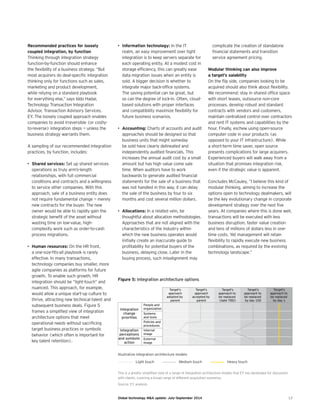
subsequent business deals. Figure 5 
frames a simplified view of integration 
architecture options that meet 
operational needs without sacrificing 
target business practices or symbolic 
behavior (which often is important for 
key talent retention). 
• Information technology: In the IT 
realm, an easy improvement over tight 
integration is to keep servers separate for 
each operating entity. At a modest cost in 
storage efficiency, this can greatly ease 
data migration issues when an entity is 
sold. A bigger decision is whether to 
integrate major back-office systems. 
The saving potential can be great, but 
so can the degree of lock-in. Often, cloud-based 
solutions with proper interfaces 
and compatibility maximize flexibility for 
future business scenarios. 
• Accounting: Charts of accounts and audit 
approaches should be designed so that 
business units that might someday 
be sold have clearly delineated and 
independently audited financials. This 
increases the annual audit cost by a small 
amount but has high value come sale 
time. When auditors have to work 
backwards to generate audited financial 
statements for the sale of a business that 
was not handled in this way, it can delay 
the sale of the business by four to six 
months and cost several million dollars. 
• Allocations: In a related vein, be 
thoughtful about allocation methodologies. 
Approaches that are not aligned with the 
characteristics of the industry within 
which the new business operates would 
initially create an inaccurate guide to 
profitability for potential buyers of the 
business, delaying close. Later in the 
buying process, such misalignment may 
complicate the creation of standalone 
financial statements and transition 
service agreement pricing. 
Modular thinking can also improve 
a target’s salability 
On the flip side, companies looking to be 
acquired should also think about flexibility. 
We recommend: stay in shared office space 
with short leases, outsource non-core 
processes, develop robust and standard 
contracts with vendors and customers, 
maintain centralized control over contractors 
and rent IT systems and capabilities by the 
hour. Finally, eschew using open-source 
computer code in your products (as 
opposed to your IT infrastructure). While 
a short-term time saver, open source 
presents complications for large acquirers. 
Experienced buyers will walk away from a 
situation that promises integration risk, 
even if the strategic value is apparent. 
Concludes McCauley, “I believe this kind of 
modular thinking, aiming to increase the 
options open to technology dealmakers, will 
be the key evolutionary change in corporate 
development strategy over the next five 
years. At companies where this is done well, 
transactions will be executed with less 
business disruption, faster value creation 
and tens of millions of dollars less in one-time 
costs. Yet management will retain 
flexibility to rapidly execute new business 
combinations, as required by the evolving 
technology landscape.” 
Figure 5: Integration architecture options 
Target’s 
approach 
adopted by 
parent 
People and 
organization 
Systems 
and tools 
Policies and 
procedures 
Internal 
image 
External 
image 
Integration 
change 
priorities 
Integration 
perceptions 
and symbolic 
action 
Illustrative integration architecture models 
Light touch Medium touch Heavy touch 
Target’s 
approach to 
be replaced 
by day 1 
This is a greatly simplified view of a range of integration architecture models that EY has developed for discussion 
with clients, covering a broad range of different acquisition scenarios. 
Source: EY analysis.

Maintain Strategic Flexibility

  • 1.
    Top of mind Keep your options open with loosely coupled deal integration It’s a chief development officer’s nightmare: complete a costly, complex, lengthy and emotionally challenging integration of a major acquisition, only to have the board decide to sell (or shutter) the operation after a few months of further study. Sadly, technology industry business strategy is evolving so fast nowadays that this nightmare scenario is increasingly likely. 12 In the current environment, company building is no longer a straight-line pursuit. Innovation based on the five megatrends (mobile, social, cloud, big data analytics and accelerated technology adaptation) is causing corporate dealmaking to accelerate dramatically (as the rest of this report attests). But that same innovation virtually guarantees that technology company business strategy will continue to change. In the past five years, one software company we know acquired approximately 60 companies while divesting a different set of 10 entities. “Integration practices have to catch up with the reality of an extremely fast-changing technology landscape,” says Dean McCauley, Principal, Transaction Advisory Services at Ernst & Young LLP. Traditional tight integration still technology’s default Many acquisitive technology companies default to tight, permanent integration even when the strategic rationale may be temporary, such as closing a market share gap or gaining access to content or intellectual property (IP). Integration activities still bias toward hard-wiring a target’s organization and processes into the parent in order to achieve key objectives (cost reduction, standardization and shared processes and systems). Loosely coupled, modular integration should be considered Technology companies may increasingly regret defaulting to tight integration as strategic priorities continue to shift, leading to divestiture of even recently acquired assets. Companies require new integration thinking that recognizes togetherness is not forever; what is bought might eventually be sold. In many technology deals, buyers should consider whether tight bonding Global technology M&A update: July–September 2014 to the parent or a looser approach is preferable, on a function-by-function basis. In this approach, corporate entities are treated like Legos: modular and easy to move in and out of the corporate structure to meet changing strategic imperatives. Of note, this modular, “portfolio” approach is how PE firms always have treated their investments. It’s due, in part, to their “acquire, improve profitability, divest” business model, as well as restrictions on integrating companies within a PE firm. Of course, exit is a given for PE investors. But the loosely coupled integration approach described in this article enables technology companies, too, to maintain exit as an option. With this integration approach, companies can have the best of both worlds: emulate and enjoy the benefits of the “nothing is forever” PE mindset without being constrained in synergy attainment by PE strictures. Alternative success metrics for loosely coupled integration “Modular integration enables technology companies to keep their options open — but success with the approach demands rethinking integration success metrics,” explains EY’s McCauley. By themselves, traditional metrics such as maximizing cost synergies or minimizing the time to combining product road maps and processes are not enough to drive the modular approach. Equal importance should be given to minimizing the time to gaining strategic value, driving flexibility in repurposing the asset and maximizing the net value of a potential exit. Dean A. McCauley Principal Transaction Advisory Services Ernst & Young LLP dean.mccauley@ey.com Iddo Hadar Technology Transaction Integration Advisor Transaction Advisory Services Ernst & Young LLP iddo.hadar@ey.com
  • 2.
    Target’s approach acceptedby parent Target’s approach to be replaced (date TBD) Target’s approach to be replaced by day 100 Global technology M&A update: July–September 2014 13 Recommended practices for loosely coupled integration, by function Thinking through integration strategy function-by-function should enhance the flexibility of a business strategy. “But most acquirers do deal-specific integration thinking only for functions such as sales, marketing and product development, while relying on a standard playbook for everything else,” says Iddo Hadar, Technology Transaction Integration Advisor, Transaction Advisory Services, EY. The loosely coupled approach enables companies to avoid irreversible (or costly-to- reverse) integration steps — unless the business strategy warrants them. A sampling of our recommended integration practices, by function, includes: • Shared services: Set up shared services operations as truly arm’s-length relationships, with full commercial conditions and contracts and a willingness to service other companies. With this approach, sale of a business entity does not require fundamental change — merely new contracts for the buyer. The new owner would be able to rapidly gain the strategic benefit of the asset without wasting time on low-value, high-complexity work such as order-to-cash process migrations. • Human resources: On the HR front, a one-size-fits-all playbook is rarely effective. In many transactions, technology companies buy smaller, more agile companies as platforms for future growth. To enable such growth, HR integration should be “light-touch” and nuanced. This approach, for example, would allow a unique start-up culture to thrive, attracting new technical talent and subsequent business deals. Figure 5 frames a simplified view of integration architecture options that meet operational needs without sacrificing target business practices or symbolic behavior (which often is important for key talent retention). • Information technology: In the IT realm, an easy improvement over tight integration is to keep servers separate for each operating entity. At a modest cost in storage efficiency, this can greatly ease data migration issues when an entity is sold. A bigger decision is whether to integrate major back-office systems. The saving potential can be great, but so can the degree of lock-in. Often, cloud-based solutions with proper interfaces and compatibility maximize flexibility for future business scenarios. • Accounting: Charts of accounts and audit approaches should be designed so that business units that might someday be sold have clearly delineated and independently audited financials. This increases the annual audit cost by a small amount but has high value come sale time. When auditors have to work backwards to generate audited financial statements for the sale of a business that was not handled in this way, it can delay the sale of the business by four to six months and cost several million dollars. • Allocations: In a related vein, be thoughtful about allocation methodologies. Approaches that are not aligned with the characteristics of the industry within which the new business operates would initially create an inaccurate guide to profitability for potential buyers of the business, delaying close. Later in the buying process, such misalignment may complicate the creation of standalone financial statements and transition service agreement pricing. Modular thinking can also improve a target’s salability On the flip side, companies looking to be acquired should also think about flexibility. We recommend: stay in shared office space with short leases, outsource non-core processes, develop robust and standard contracts with vendors and customers, maintain centralized control over contractors and rent IT systems and capabilities by the hour. Finally, eschew using open-source computer code in your products (as opposed to your IT infrastructure). While a short-term time saver, open source presents complications for large acquirers. Experienced buyers will walk away from a situation that promises integration risk, even if the strategic value is apparent. Concludes McCauley, “I believe this kind of modular thinking, aiming to increase the options open to technology dealmakers, will be the key evolutionary change in corporate development strategy over the next five years. At companies where this is done well, transactions will be executed with less business disruption, faster value creation and tens of millions of dollars less in one-time costs. Yet management will retain flexibility to rapidly execute new business combinations, as required by the evolving technology landscape.” Figure 5: Integration architecture options Target’s approach adopted by parent People and organization Systems and tools Policies and procedures Internal image External image Integration change priorities Integration perceptions and symbolic action Illustrative integration architecture models Light touch Medium touch Heavy touch Target’s approach to be replaced by day 1 This is a greatly simplified view of a range of integration architecture models that EY has developed for discussion with clients, covering a broad range of different acquisition scenarios. Source: EY analysis.