This presentation, including any supporting materials, is owned by Gartner, Inc. and/or its affiliates and is for the sole use of the intended Gartner audience or other
authorized recipients. This presentation may contain information that is confidential, proprietary or otherwise legally protected, and it may not be further copied,
distributed or publicly displayed without the express written permission of Gartner, Inc. or its affiliates.
© 2012 Gartner, Inc. and/or its affiliates. All rights reserved.
Increasing business value of your IT :
Value Optimization,
Enabling Innovation &
Business Restructuring
Aurelio Bastos
Executive Programs Director
aurelio.bastos@gartner.com
Jamir Lopes
Executive Programs Director
jamir.lopes@gartner.com
Gartner Executive Programs Latin America
April 2014
1
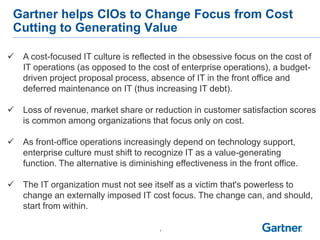
Gartner helps CIOs to Change Focus from Cost
Cutting to Generating Value
 A cost-focused IT culture is reflected in the obsessive focus on the cost of
IT operations (as opposed to the cost of enterprise operations), a budget-
driven project proposal process, absence of IT in the front office and
deferred maintenance on IT (thus increasing IT debt).
 Loss of revenue, market share or reduction in customer satisfaction scores
is common among organizations that focus only on cost.
 As front-office operations increasingly depend on technology support,
enterprise culture must shift to recognize IT as a value-generating
function. The alternative is diminishing effectiveness in the front office.
 The IT organization must not see itself as a victim that's powerless to
change an externally imposed IT cost focus. The change can, and should,
start from within.
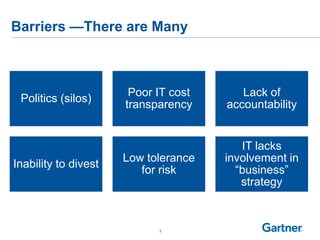
Barriers —There are Many
2
Politics (silos)
Poor IT cost
transparency
Lack of
accountability
Inability to divest
Low tolerance
for risk
IT lacks
involvement in
“business”
strategy
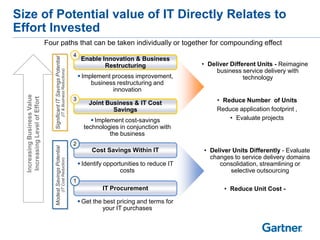
Enable Innovation & Business
Restructuring
Joint Business & IT Cost
Savings
 Implement process improvement,
business restructuring and
innovation
 Implement cost-savings
technologies in conjunction with
the business
IT Procurement
Cost Savings Within IT
 Identify opportunities to reduce IT
costs
 Get the best pricing and terms for
your IT purchases
SignificantITSavingsPotential
(IT&BusinessReductions)
ModestSavingsPotential
(ITCostReduction)
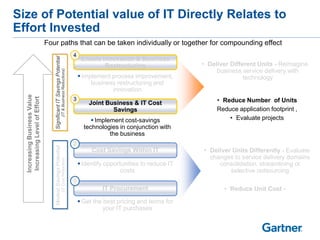
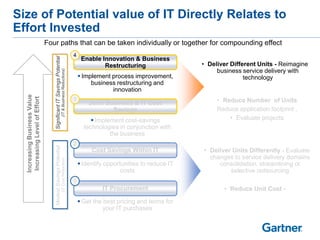
Size of Potential value of IT Directly Relates to
Effort Invested
• Deliver Units Differently - Evaluate
changes to service delivery domains
consolidation, streamlining or
selective outsourcing
• Reduce Unit Cost -
• Deliver Different Units - Reimagine
business service delivery with
technology
• Reduce Number of Units
Reduce application footprint ,
• Evaluate projects
IncreasingBusinessValue
IncreasingLevelofEffort
1
2
3
4
Four paths that can be taken individually or together for compounding effect
4
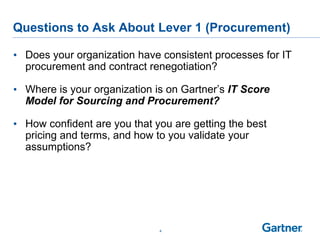
Questions to Ask About Lever 1 (Procurement)
• Does your organization have consistent processes for IT
procurement and contract renegotiation?
• Where is your organization is on Gartner’s IT Score
Model for Sourcing and Procurement?
• How confident are you that you are getting the best
pricing and terms, and how to you validate your
assumptions?
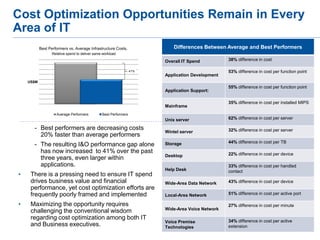
Cost Optimization Opportunities Remain in Every
Area of IT
- Best performers are decreasing costs
20% faster than average performers
- The resulting I&O performance gap alone
has now increased to 41% over the past
three years, even larger within
applications.
• There is a pressing need to ensure IT spend
drives business value and financial
performance, yet cost optimization efforts are
frequently poorly framed and implemented
• Maximizing the opportunity requires
challenging the conventional wisdom
regarding cost optimization among both IT
and Business executives.
US$M
Relative spend to deliver same workload
Best Performers vs. Average Infrastructure Costs,
Average Performers Best Performers
41%
Differences Between Average and Best Performers
Overall IT Spend 38% difference in cost
Application Development
53% difference in cost per function point
Application Support:
55% difference in cost per function point
Mainframe
35% difference in cost per installed MIPS
Unix server 62% difference in cost per server
Wintel server 32% difference in cost per server
Storage 44% difference in cost per TB
Desktop 22% difference in cost per device
Help Desk
33% difference in cost per handled
contact
Wide-Area Data Network 43% difference in cost per device
Local-Area Network 51% difference in cost per active port
Wide-Area Voice Network
27% difference in cost per minute
Voice Premise
Technologies
34% difference in cost per active
extension
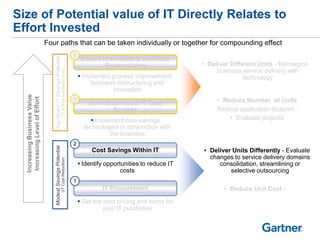
Enable Innovation & Business
Restructuring
Joint Business & IT Cost
Savings
 Implement process improvement,
business restructuring and
innovation
 Implement cost-savings
technologies in conjunction with
the business
IT Procurement
Cost Savings Within IT
 Identify opportunities to reduce IT
costs
 Get the best pricing and terms for
your IT purchases
SignificantITSavingsPotential
(IT&BusinessReductions)
ModestSavingsPotential
(ITCostReduction)
Size of Potential value of IT Directly Relates to
Effort Invested
• Deliver Units Differently - Evaluate
changes to service delivery domains
consolidation, streamlining or
selective outsourcing
• Reduce Unit Cost -
• Deliver Different Units - Reimagine
business service delivery with
technology
• Reduce Number of Units
Reduce application footprint ,
• Evaluate projects
IncreasingBusinessValue
IncreasingLevelofEffort
1
2
3
4
Four paths that can be taken individually or together for compounding effect
7
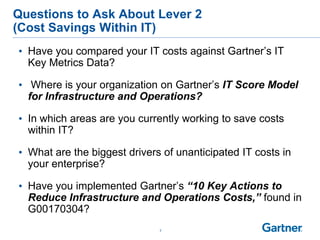
Questions to Ask About Lever 2
(Cost Savings Within IT)
• Have you compared your IT costs against Gartner’s IT
Key Metrics Data?
• Where is your organization on Gartner’s IT Score Model
for Infrastructure and Operations?
• In which areas are you currently working to save costs
within IT?
• What are the biggest drivers of unanticipated IT costs in
your enterprise?
• Have you implemented Gartner’s “10 Key Actions to
Reduce Infrastructure and Operations Costs,” found in
G00170304?
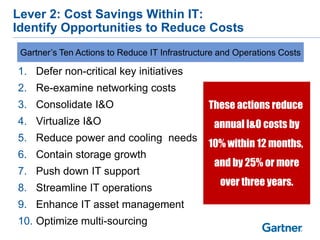
Lever 2: Cost Savings Within IT:
Identify Opportunities to Reduce Costs
1. Defer non-critical key initiatives
2. Re-examine networking costs
3. Consolidate I&O
4. Virtualize I&O
5. Reduce power and cooling needs
6. Contain storage growth
7. Push down IT support
8. Streamline IT operations
9. Enhance IT asset management
10. Optimize multi-sourcing
Gartner’s Ten Actions to Reduce IT Infrastructure and Operations Costs
These actions reduce
annual I&O costs by
10% within 12 months,
and by 25% or more
over three years.
Enable Innovation & Business
Restructuring
Joint Business & IT Cost
Savings
 Implement process improvement,
business restructuring and
innovation
 Implement cost-savings
technologies in conjunction with
the business
IT Procurement
Cost Savings Within IT
 Identify opportunities to reduce IT
costs
 Get the best pricing and terms for
your IT purchases
SignificantITSavingsPotential
(IT&BusinessReductions)
ModestSavingsPotential
(ITCostReduction)
Size of Potential value of IT Directly Relates to
Effort Invested
• Deliver Units Differently - Evaluate
changes to service delivery domains
consolidation, streamlining or
selective outsourcing
• Reduce Unit Cost -
• Deliver Different Units - Reimagine
business service delivery with
technology
• Reduce Number of Units
Reduce application footprint ,
• Evaluate projects
IncreasingBusinessValue
IncreasingLevelofEffort
1
2
3
4
Four paths that can be taken individually or together for compounding effect
10
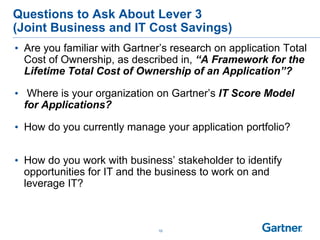
Questions to Ask About Lever 3
(Joint Business and IT Cost Savings)
• Are you familiar with Gartner’s research on application Total
Cost of Ownership, as described in, “A Framework for the
Lifetime Total Cost of Ownership of an Application”?
• Where is your organization on Gartner’s IT Score Model
for Applications?
• How do you currently manage your application portfolio?
• How do you work with business’ stakeholder to identify
opportunities for IT and the business to work on and
leverage IT?
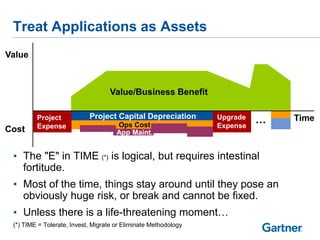
Treat Applications as Assets
• The "E" in TIME (*) is logical, but requires intestinal
fortitude.
• Most of the time, things stay around until they pose an
obviously huge risk, or break and cannot be fixed.
• Unless there is a life-threatening moment…
(*) TIME = Tolerate, Invest, Migrate or Eliminate Methodology
Value
Cost
Value/Business Benefit
TimeProject
Expense
Project Capital Depreciation Upgrade
ExpenseOps Cost
App Maint.
……
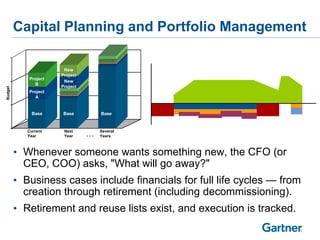
Capital Planning and Portfolio Management
• Whenever someone wants something new, the CFO (or
CEO, COO) asks, "What will go away?"
• Business cases include financials for full life cycles — from
creation through retirement (including decommissioning).
• Retirement and reuse lists exist, and execution is tracked.
Base Base
Project
A
Project
B
New
Project
New
Project
Current
Year
Next
Year …
Base
Several
Years
Budget
…
13
Take away for Lever 3
(Joint Business and IT Cost Savings)
• Application Rationalization; Identifying and retiring business
applications
• Business Process Optimization.
• Demand Governance: How do you ensure business projects
support business objectives
• Shared Services: How can business support be rationalized ?
• Sourcing strategy: Can processes be delivered in a different
way?
Enable Innovation & Business
Restructuring
Joint Business & IT Cost
Savings
 Implement process improvement,
business restructuring and
innovation
 Implement cost-savings
technologies in conjunction with
the business
IT Procurement
Cost Savings Within IT
 Identify opportunities to reduce IT
costs
 Get the best pricing and terms for
your IT purchases
SignificantITSavingsPotential
(IT&BusinessReductions)
ModestSavingsPotential
(ITCostReduction)
Size of Potential value of IT Directly Relates to
Effort Invested
• Deliver Units Differently - Evaluate
changes to service delivery domains
consolidation, streamlining or
selective outsourcing
• Reduce Unit Cost -
• Deliver Different Units - Reimagine
business service delivery with
technology
• Reduce Number of Units
Reduce application footprint ,
• Evaluate projects
IncreasingBusinessValue
IncreasingLevelofEffort
1
2
3
4
Four paths that can be taken individually or together for compounding effect
15
Questions to Ask About Lever 4
(Innovation and Business Transformation)
• Is the enterprise using information technology to support
new business models and/or new sources of revenue as
described in Gartner’s research on “In Emerging Markets,
CIOs Must Partner With the Business to Leverage
Innovation ?”
• Is the enterprise using information technology to create a
competitive advantage?
• How confident are you that the business is investing in the
right things?
• Where are your best opportunities to drive business
process improvement with information technology?
16
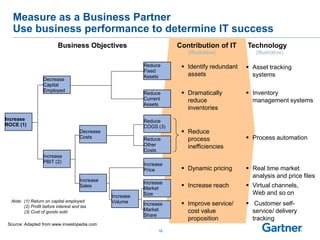
Measure as a Business Partner
Use business performance to determine IT success
Contribution of IT
 Dramatically
reduce
inventories
 Identify redundant
assets
 Reduce
process
inefficiencies
 Dynamic pricing
 Increase reach
 Improve service/
cost value
proposition
(Illustrative)
Technology
(Illustrative)
 Asset tracking
systems
 Inventory
management systems
 Process automation
 Real time market
analysis and price files
 Virtual channels,
Web and so on
 Customer self-
service/ delivery
tracking
Note: (1) Return on capital employed
(2) Profit before interest and tax
(3) Cost of goods sold
Business Objectives
Increase
ROCE (1)
Increase
Market
Share
Increase
Market
Size
Increase
Sales
Decrease
Costs
Increase
PBIT (2)
Reduce
Current
Assets
Reduce
Fixed
Assets
Decrease
Capital
Employed
Reduce
Other
Costs
Reduce
COGS (3)
Increase
Volume
Increase
Price
Source: Adapted from www.investopedia.com
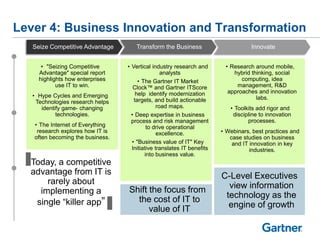
Lever 4: Business Innovation and Transformation
• "Seizing Competitive
Advantage" special report
highlights how enterprises
use IT to win.
• Hype Cycles and Emerging
Technologies research helps
identify game- changing
technologies.
• The Internet of Everything
research explores how IT is
often becoming the business.
• Research around mobile,
hybrid thinking, social
computing, idea
management, R&D
approaches and innovation
labs.
• Toolkits add rigor and
discipline to innovation
processes.
• Webinars, best practices and
case studies on business
and IT innovation in key
industries.
• Vertical industry research and
analysts
• The Gartner IT Market
Clock™ and Gartner ITScore
help identify modernization
targets, and build actionable
road maps.
• Deep expertise in business
process and risk management
to drive operational
excellence.
• "Business value of IT" Key
Initiative translates IT benefits
into business value.
Shift the focus from
the cost of IT to
value of IT
InnovateSeize Competitive Advantage Transform the Business
Today, a competitive
advantage from IT is
rarely about
implementing a
single “killer app”
C-Level Executives
view information
technology as the
engine of growth
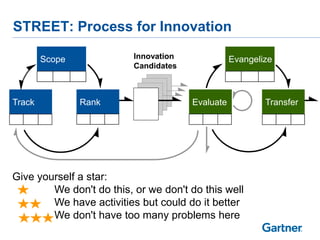
STREET: Process for Innovation
TransferEvaluateTrack
Scope EvangelizeInnovation
Candidates
Rank
Give yourself a star:
We don't do this, or we don't do this well
We have activities but could do it better
We don't have too many problems here
19
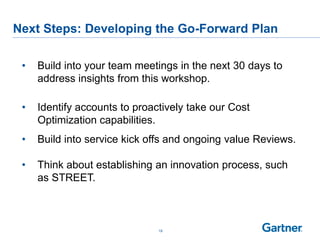
Next Steps: Developing the Go-Forward Plan
• Build into your team meetings in the next 30 days to
address insights from this workshop.
• Identify accounts to proactively take our Cost
Optimization capabilities.
• Build into service kick offs and ongoing value Reviews.
• Think about establishing an innovation process, such
as STREET.
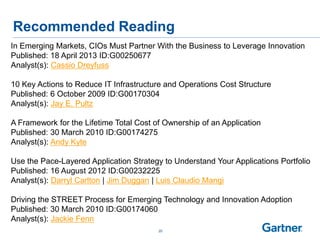
Recommended Reading
20
In Emerging Markets, CIOs Must Partner With the Business to Leverage Innovation
Published: 18 April 2013 ID:G00250677
Analyst(s): Cassio Dreyfuss
10 Key Actions to Reduce IT Infrastructure and Operations Cost Structure
Published: 6 October 2009 ID:G00170304
Analyst(s): Jay E. Pultz
A Framework for the Lifetime Total Cost of Ownership of an Application
Published: 30 March 2010 ID:G00174275
Analyst(s): Andy Kyte
Use the Pace-Layered Application Strategy to Understand Your Applications Portfolio
Published: 16 August 2012 ID:G00232225
Analyst(s): Darryl Carlton | Jim Duggan | Luis Claudio Mangi
Driving the STREET Process for Emerging Technology and Innovation Adoption
Published: 30 March 2010 ID:G00174060
Analyst(s): Jackie Fenn
This presentation, including any supporting materials, is owned by Gartner, Inc. and/or its affiliates and is for the sole use of the intended Gartner audience or other
authorized recipients. This presentation may contain information that is confidential, proprietary or otherwise legally protected, and it may not be further copied,
distributed or publicly displayed without the express written permission of Gartner, Inc. or its affiliates.
© 2012 Gartner, Inc. and/or its affiliates. All rights reserved.
Increasing business value of your IT :
Value Optimization,
Enabling Innovation &
Business Restructuring
Aurelio Bastos
Executive Programs Director
aurelio.bastos@gartner.com
Jamir Lopes
Executive Programs Director
aurelio.bastos@gartner.com
Executive Programs Latin America
April 2014

Central de Serviço e Governança de IT | Encontro de Cios CTIS e Sucesu Minas 08/04/2014

  • 1.
    This presentation, includingany supporting materials, is owned by Gartner, Inc. and/or its affiliates and is for the sole use of the intended Gartner audience or other authorized recipients. This presentation may contain information that is confidential, proprietary or otherwise legally protected, and it may not be further copied, distributed or publicly displayed without the express written permission of Gartner, Inc. or its affiliates. © 2012 Gartner, Inc. and/or its affiliates. All rights reserved. Increasing business value of your IT : Value Optimization, Enabling Innovation & Business Restructuring Aurelio Bastos Executive Programs Director aurelio.bastos@gartner.com Jamir Lopes Executive Programs Director jamir.lopes@gartner.com Gartner Executive Programs Latin America April 2014
  • 2.
    1 Gartner helps CIOsto Change Focus from Cost Cutting to Generating Value  A cost-focused IT culture is reflected in the obsessive focus on the cost of IT operations (as opposed to the cost of enterprise operations), a budget- driven project proposal process, absence of IT in the front office and deferred maintenance on IT (thus increasing IT debt).  Loss of revenue, market share or reduction in customer satisfaction scores is common among organizations that focus only on cost.  As front-office operations increasingly depend on technology support, enterprise culture must shift to recognize IT as a value-generating function. The alternative is diminishing effectiveness in the front office.  The IT organization must not see itself as a victim that's powerless to change an externally imposed IT cost focus. The change can, and should, start from within.
  • 3.
    Barriers —There areMany 2 Politics (silos) Poor IT cost transparency Lack of accountability Inability to divest Low tolerance for risk IT lacks involvement in “business” strategy
  • 4.
    Enable Innovation &Business Restructuring Joint Business & IT Cost Savings  Implement process improvement, business restructuring and innovation  Implement cost-savings technologies in conjunction with the business IT Procurement Cost Savings Within IT  Identify opportunities to reduce IT costs  Get the best pricing and terms for your IT purchases SignificantITSavingsPotential (IT&BusinessReductions) ModestSavingsPotential (ITCostReduction) Size of Potential value of IT Directly Relates to Effort Invested • Deliver Units Differently - Evaluate changes to service delivery domains consolidation, streamlining or selective outsourcing • Reduce Unit Cost - • Deliver Different Units - Reimagine business service delivery with technology • Reduce Number of Units Reduce application footprint , • Evaluate projects IncreasingBusinessValue IncreasingLevelofEffort 1 2 3 4 Four paths that can be taken individually or together for compounding effect
  • 5.
    4 Questions to AskAbout Lever 1 (Procurement) • Does your organization have consistent processes for IT procurement and contract renegotiation? • Where is your organization is on Gartner’s IT Score Model for Sourcing and Procurement? • How confident are you that you are getting the best pricing and terms, and how to you validate your assumptions?
  • 6.
    Cost Optimization OpportunitiesRemain in Every Area of IT - Best performers are decreasing costs 20% faster than average performers - The resulting I&O performance gap alone has now increased to 41% over the past three years, even larger within applications. • There is a pressing need to ensure IT spend drives business value and financial performance, yet cost optimization efforts are frequently poorly framed and implemented • Maximizing the opportunity requires challenging the conventional wisdom regarding cost optimization among both IT and Business executives. US$M Relative spend to deliver same workload Best Performers vs. Average Infrastructure Costs, Average Performers Best Performers 41% Differences Between Average and Best Performers Overall IT Spend 38% difference in cost Application Development 53% difference in cost per function point Application Support: 55% difference in cost per function point Mainframe 35% difference in cost per installed MIPS Unix server 62% difference in cost per server Wintel server 32% difference in cost per server Storage 44% difference in cost per TB Desktop 22% difference in cost per device Help Desk 33% difference in cost per handled contact Wide-Area Data Network 43% difference in cost per device Local-Area Network 51% difference in cost per active port Wide-Area Voice Network 27% difference in cost per minute Voice Premise Technologies 34% difference in cost per active extension
  • 7.
    Enable Innovation &Business Restructuring Joint Business & IT Cost Savings  Implement process improvement, business restructuring and innovation  Implement cost-savings technologies in conjunction with the business IT Procurement Cost Savings Within IT  Identify opportunities to reduce IT costs  Get the best pricing and terms for your IT purchases SignificantITSavingsPotential (IT&BusinessReductions) ModestSavingsPotential (ITCostReduction) Size of Potential value of IT Directly Relates to Effort Invested • Deliver Units Differently - Evaluate changes to service delivery domains consolidation, streamlining or selective outsourcing • Reduce Unit Cost - • Deliver Different Units - Reimagine business service delivery with technology • Reduce Number of Units Reduce application footprint , • Evaluate projects IncreasingBusinessValue IncreasingLevelofEffort 1 2 3 4 Four paths that can be taken individually or together for compounding effect
  • 8.
    7 Questions to AskAbout Lever 2 (Cost Savings Within IT) • Have you compared your IT costs against Gartner’s IT Key Metrics Data? • Where is your organization on Gartner’s IT Score Model for Infrastructure and Operations? • In which areas are you currently working to save costs within IT? • What are the biggest drivers of unanticipated IT costs in your enterprise? • Have you implemented Gartner’s “10 Key Actions to Reduce Infrastructure and Operations Costs,” found in G00170304?
  • 9.
    Lever 2: CostSavings Within IT: Identify Opportunities to Reduce Costs 1. Defer non-critical key initiatives 2. Re-examine networking costs 3. Consolidate I&O 4. Virtualize I&O 5. Reduce power and cooling needs 6. Contain storage growth 7. Push down IT support 8. Streamline IT operations 9. Enhance IT asset management 10. Optimize multi-sourcing Gartner’s Ten Actions to Reduce IT Infrastructure and Operations Costs These actions reduce annual I&O costs by 10% within 12 months, and by 25% or more over three years.
  • 10.
    Enable Innovation &Business Restructuring Joint Business & IT Cost Savings  Implement process improvement, business restructuring and innovation  Implement cost-savings technologies in conjunction with the business IT Procurement Cost Savings Within IT  Identify opportunities to reduce IT costs  Get the best pricing and terms for your IT purchases SignificantITSavingsPotential (IT&BusinessReductions) ModestSavingsPotential (ITCostReduction) Size of Potential value of IT Directly Relates to Effort Invested • Deliver Units Differently - Evaluate changes to service delivery domains consolidation, streamlining or selective outsourcing • Reduce Unit Cost - • Deliver Different Units - Reimagine business service delivery with technology • Reduce Number of Units Reduce application footprint , • Evaluate projects IncreasingBusinessValue IncreasingLevelofEffort 1 2 3 4 Four paths that can be taken individually or together for compounding effect
  • 11.
    10 Questions to AskAbout Lever 3 (Joint Business and IT Cost Savings) • Are you familiar with Gartner’s research on application Total Cost of Ownership, as described in, “A Framework for the Lifetime Total Cost of Ownership of an Application”? • Where is your organization on Gartner’s IT Score Model for Applications? • How do you currently manage your application portfolio? • How do you work with business’ stakeholder to identify opportunities for IT and the business to work on and leverage IT?
  • 12.
    Treat Applications asAssets • The "E" in TIME (*) is logical, but requires intestinal fortitude. • Most of the time, things stay around until they pose an obviously huge risk, or break and cannot be fixed. • Unless there is a life-threatening moment… (*) TIME = Tolerate, Invest, Migrate or Eliminate Methodology Value Cost Value/Business Benefit TimeProject Expense Project Capital Depreciation Upgrade ExpenseOps Cost App Maint. ……
  • 13.
    Capital Planning andPortfolio Management • Whenever someone wants something new, the CFO (or CEO, COO) asks, "What will go away?" • Business cases include financials for full life cycles — from creation through retirement (including decommissioning). • Retirement and reuse lists exist, and execution is tracked. Base Base Project A Project B New Project New Project Current Year Next Year … Base Several Years Budget …
  • 14.
    13 Take away forLever 3 (Joint Business and IT Cost Savings) • Application Rationalization; Identifying and retiring business applications • Business Process Optimization. • Demand Governance: How do you ensure business projects support business objectives • Shared Services: How can business support be rationalized ? • Sourcing strategy: Can processes be delivered in a different way?
  • 15.
    Enable Innovation &Business Restructuring Joint Business & IT Cost Savings  Implement process improvement, business restructuring and innovation  Implement cost-savings technologies in conjunction with the business IT Procurement Cost Savings Within IT  Identify opportunities to reduce IT costs  Get the best pricing and terms for your IT purchases SignificantITSavingsPotential (IT&BusinessReductions) ModestSavingsPotential (ITCostReduction) Size of Potential value of IT Directly Relates to Effort Invested • Deliver Units Differently - Evaluate changes to service delivery domains consolidation, streamlining or selective outsourcing • Reduce Unit Cost - • Deliver Different Units - Reimagine business service delivery with technology • Reduce Number of Units Reduce application footprint , • Evaluate projects IncreasingBusinessValue IncreasingLevelofEffort 1 2 3 4 Four paths that can be taken individually or together for compounding effect
  • 16.
    15 Questions to AskAbout Lever 4 (Innovation and Business Transformation) • Is the enterprise using information technology to support new business models and/or new sources of revenue as described in Gartner’s research on “In Emerging Markets, CIOs Must Partner With the Business to Leverage Innovation ?” • Is the enterprise using information technology to create a competitive advantage? • How confident are you that the business is investing in the right things? • Where are your best opportunities to drive business process improvement with information technology?
  • 17.
    16 Measure as aBusiness Partner Use business performance to determine IT success Contribution of IT  Dramatically reduce inventories  Identify redundant assets  Reduce process inefficiencies  Dynamic pricing  Increase reach  Improve service/ cost value proposition (Illustrative) Technology (Illustrative)  Asset tracking systems  Inventory management systems  Process automation  Real time market analysis and price files  Virtual channels, Web and so on  Customer self- service/ delivery tracking Note: (1) Return on capital employed (2) Profit before interest and tax (3) Cost of goods sold Business Objectives Increase ROCE (1) Increase Market Share Increase Market Size Increase Sales Decrease Costs Increase PBIT (2) Reduce Current Assets Reduce Fixed Assets Decrease Capital Employed Reduce Other Costs Reduce COGS (3) Increase Volume Increase Price Source: Adapted from www.investopedia.com
  • 18.
    Lever 4: BusinessInnovation and Transformation • "Seizing Competitive Advantage" special report highlights how enterprises use IT to win. • Hype Cycles and Emerging Technologies research helps identify game- changing technologies. • The Internet of Everything research explores how IT is often becoming the business. • Research around mobile, hybrid thinking, social computing, idea management, R&D approaches and innovation labs. • Toolkits add rigor and discipline to innovation processes. • Webinars, best practices and case studies on business and IT innovation in key industries. • Vertical industry research and analysts • The Gartner IT Market Clock™ and Gartner ITScore help identify modernization targets, and build actionable road maps. • Deep expertise in business process and risk management to drive operational excellence. • "Business value of IT" Key Initiative translates IT benefits into business value. Shift the focus from the cost of IT to value of IT InnovateSeize Competitive Advantage Transform the Business Today, a competitive advantage from IT is rarely about implementing a single “killer app” C-Level Executives view information technology as the engine of growth
  • 19.
    STREET: Process forInnovation TransferEvaluateTrack Scope EvangelizeInnovation Candidates Rank Give yourself a star: We don't do this, or we don't do this well We have activities but could do it better We don't have too many problems here
  • 20.
    19 Next Steps: Developingthe Go-Forward Plan • Build into your team meetings in the next 30 days to address insights from this workshop. • Identify accounts to proactively take our Cost Optimization capabilities. • Build into service kick offs and ongoing value Reviews. • Think about establishing an innovation process, such as STREET.
  • 21.
    Recommended Reading 20 In EmergingMarkets, CIOs Must Partner With the Business to Leverage Innovation Published: 18 April 2013 ID:G00250677 Analyst(s): Cassio Dreyfuss 10 Key Actions to Reduce IT Infrastructure and Operations Cost Structure Published: 6 October 2009 ID:G00170304 Analyst(s): Jay E. Pultz A Framework for the Lifetime Total Cost of Ownership of an Application Published: 30 March 2010 ID:G00174275 Analyst(s): Andy Kyte Use the Pace-Layered Application Strategy to Understand Your Applications Portfolio Published: 16 August 2012 ID:G00232225 Analyst(s): Darryl Carlton | Jim Duggan | Luis Claudio Mangi Driving the STREET Process for Emerging Technology and Innovation Adoption Published: 30 March 2010 ID:G00174060 Analyst(s): Jackie Fenn
  • 22.
    This presentation, includingany supporting materials, is owned by Gartner, Inc. and/or its affiliates and is for the sole use of the intended Gartner audience or other authorized recipients. This presentation may contain information that is confidential, proprietary or otherwise legally protected, and it may not be further copied, distributed or publicly displayed without the express written permission of Gartner, Inc. or its affiliates. © 2012 Gartner, Inc. and/or its affiliates. All rights reserved. Increasing business value of your IT : Value Optimization, Enabling Innovation & Business Restructuring Aurelio Bastos Executive Programs Director aurelio.bastos@gartner.com Jamir Lopes Executive Programs Director aurelio.bastos@gartner.com Executive Programs Latin America April 2014