Cost of delay
Is a month of delay
worth
1 Mio € or 1k €?
“
Most organisations don’t suffer
from a lack of innovative ideas,
they suffer from not being able to
pick and nurture the best ones,
and deliver them quickly enough.
“
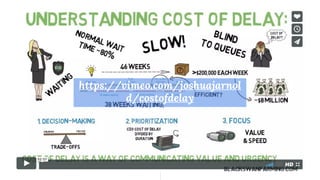
https://vimeo.com/joshuajarnol
d/costofdelay
“
The impact of time on value
(or rephrased: Impact of time on the
outcomes we hope to achieve)
“
It’s one thing for an organisation to be
blind to queues. It’s another layer of
blindness to have no clue what those
queues are costing. We need to understand
the Cost of Delay of the things flowing
through the system.
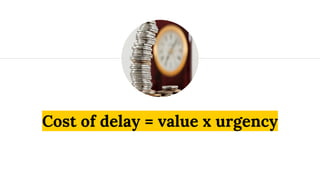
Cost of delay = value x urgency
What is it good for?
Drive economically based decisions
Help with prioritization
especially with CD3
cost of delay divided by duration
Focus discussions to speed and value
(instead of cost and efficiency)
About Value
The monetary worth of something
“
Having a number is better than
having no number at all, even if the
only output is to learn more about
what is valuable or not.
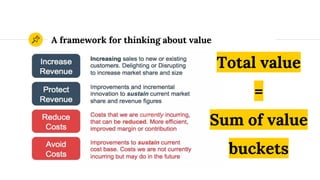
A framework for thinking about value
Total value
=
Sum of value
buckets
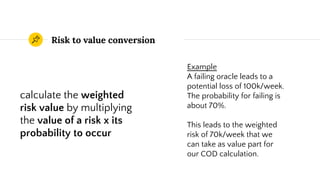
Risk to value conversion
calculate the weighted
risk value by multiplying
the value of a risk x its
probability to occur
Example
A failing oracle leads to a
potential loss of 100k/week.
The probability for failing is
about 70%.
This leads to the weighted
risk of 70k/week that we
can take as value part for
our COD calculation.
Describes the
development of value
over a given timeframe
About Urgency
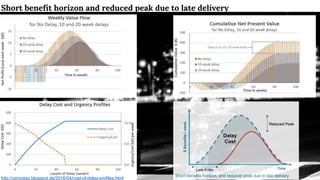
http://xprocess.blogspot.de/2016/04/cost-of-delay-profiles.html
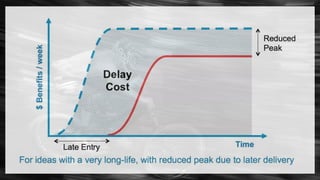
Short benefit horizon and reduced peak due to late delivery
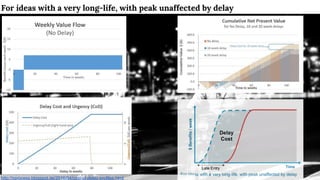
For ideas with a very long-life, with peak unaffected by delay
http://xprocess.blogspot.de/2016/04/cost-of-delay-profiles.html
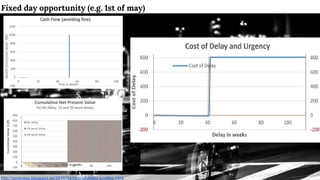
Fixed day opportunity (e.g. 1st of may)
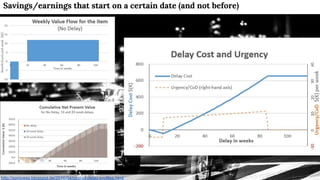
http://xprocess.blogspot.de/2016/04/cost-of-delay-profiles.html
Savings/earnings that start on a certain date (and not before)
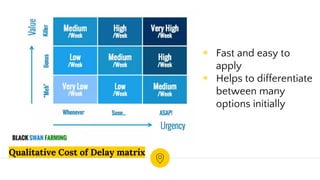
Qualitative Cost of Delay matrix
◉ Fast and easy to
apply
◉ Helps to differentiate
between many
options initially
Let’s exercise
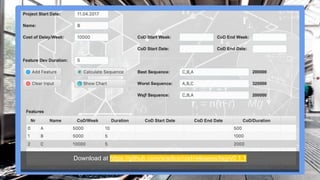
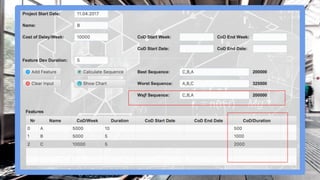
Download at https://github.com/sradics/cod/releases/tag/v0.1.1
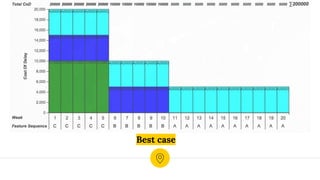
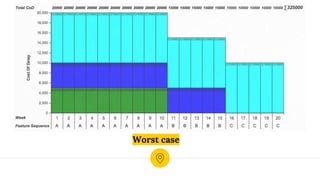
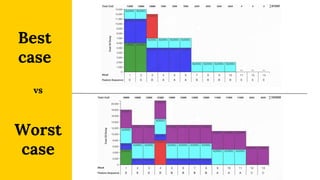
Best case
Worst case
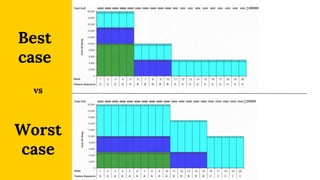
Worst
case
Best
case
vs
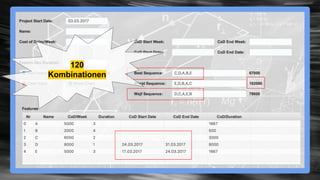
Example with different urgency profiles
120
Kombinationen
Worst
case
Best
case
vs
How to measure
anything
A short book teaser?
www.howtomeasureanything.com
“
Often, an important decision requires
better knowledge of the alleged intangible,
but when a [person] believes something to
be immeasurable, attempts to measure it
will not even be considered.
“
The standard approach to
measurement … is for smart people
being smart and have to invent the
method for a new measurement
themselves...
“
If outcome of a decision is highly
uncertain and has significant
consequences then measurements that
reduce uncertainty have a high value
(don’t confuse the proposition that anything that can be measured with everything
should be measured)
A universal approach to
measurement
1) Define the decision
2) Determine what you know now
3) Compute the value of additional information
4) Measure where information value is high
5) Make a decision and act on it
Measurement assumptions
4
Don’t reinvent the wheel
It’s been done before
It might just involve some
resourcefulness and
original observations.
You have access to more
data than you think
If you’re clever about how
to analyze it.
You need less data than you think
probably more accessible
than you first thought.
An adequate amount of new
data is...
And the winner is... ?
Sequential vs. Parallel
10 weeks
100% done
(on the last day)
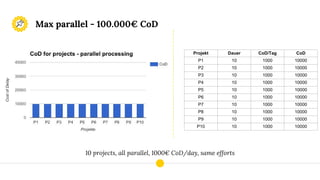
10 projects, all parallel, 1000€ CoD/day, same efforts
Projekt Dauer CoD/Tag CoD
P1 10 1000 10000
P2 10 1000 10000
P3 10 1000 10000
P4 10 1000 10000
P5 10 1000 10000
P6 10 1000 10000
P7 10 1000 10000
P8 10 1000 10000
P9 10 1000 10000
P10 10 1000 10000
Max parallel - 100.000€ CoD
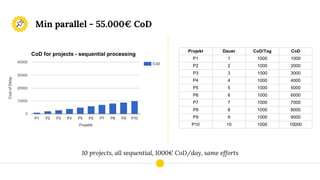
10 projects, all sequential, 1000€ CoD/day, same efforts
Min parallel - 55.000€ CoD
Projekt Dauer CoD/Tag CoD
P1 1 1000 1000
P2 2 1000 2000
P3 3 1000 3000
P4 4 1000 4000
P5 5 1000 5000
P6 6 1000 6000
P7 7 1000 7000
P8 8 1000 8000
P9 9 1000 9000
P10 10 1000 10000
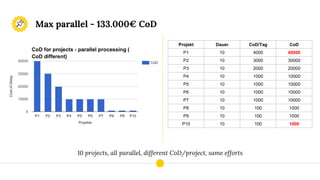
10 projects, all parallel, different CoD/project, same efforts
Max parallel - 133.000€ CoD
Projekt Dauer CoD/Tag CoD
P1 10 4000 40000
P2 10 3000 30000
P3 10 2000 20000
P4 10 1000 10000
P5 10 1000 10000
P6 10 1000 10000
P7 10 1000 10000
P8 10 100 1000
P9 10 100 1000
P10 10 100 1000
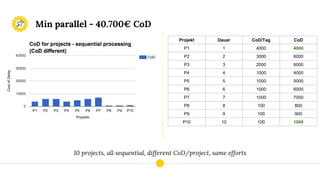
10 projects, all sequential, different CoD/project, same efforts
Min parallel - 40.700€ CoD
Projekt Dauer CoD/Tag CoD
P1 1 4000 4000
P2 2 3000 6000
P3 3 2000 6000
P4 4 1000 4000
P5 5 1000 5000
P6 6 1000 6000
P7 7 1000 7000
P8 8 100 800
P9 9 100 900
P10 10 100 1000
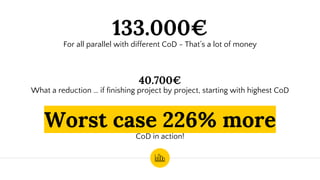
133.000€
For all parallel with different CoD - That’s a lot of money
Worst case 226% more
CoD in action!
40.700€
What a reduction … if finishing project by project, starting with highest CoD
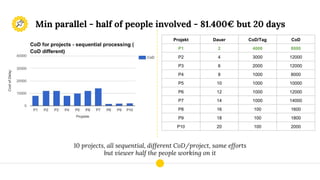
10 projects, all sequential, different CoD/project, same efforts
but viewer half the people working on it
Min parallel - half of people involved - 81.400€ but 20 days
Projekt Dauer CoD/Tag CoD
P1 2 4000 8000
P2 4 3000 12000
P3 6 2000 12000
P4 8 1000 8000
P5 10 1000 10000
P6 12 1000 12000
P7 14 1000 14000
P8 16 100 1600
P9 18 100 1800
P10 20 100 2000
Read more
◉ The Principles of Product Development Flow
◉ Great explanations by BlackSwanFarming
◉ How to measure anything by Douglas
Hubbard
◉ Cost of Delay - how to find the best sequence for your feature development
◉ Cost of Delay - a key economic metric
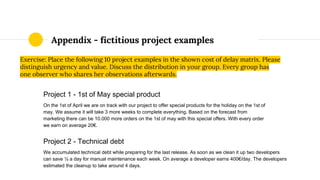
Appendix - fictitious project examples
Project 1 - 1st of May special product
On the 1st of April we are on track with our project to offer special products for the holiday on the 1st of
may. We assume it will take 3 more weeks to complete everything. Based on the forecast from
marketing there can be 10.000 more orders on the 1st of may with this special offers. With every order
we earn on average 20€.
Project 2 - Technical debt
We accumulated technical debt while preparing for the last release. As soon as we clean it up two developers
can save ½ a day for manual maintenance each week. On average a developer earns 400€/day. The developers
estimated the cleanup to take around 4 days.
Exercise: Place the following 10 project examples in the shown cost of delay matrix. Please
distinguish urgency and value. Discuss the distribution in your group. Every group has
one observer who shares her observations afterwards.
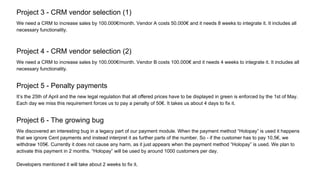
Project 3 - CRM vendor selection (1)
We need a CRM to increase sales by 100.000€/month. Vendor A costs 50.000€ and it needs 8 weeks to integrate it. It includes all
necessary functionality.
Project 4 - CRM vendor selection (2)
We need a CRM to increase sales by 100.000€/month. Vendor B costs 100.000€ and it needs 4 weeks to integrate it. It includes all
necessary functionality.
Project 5 - Penalty payments
It’s the 25th of April and the new legal regulation that all offered prices have to be displayed in green is enforced by the 1st of May.
Each day we miss this requirement forces us to pay a penalty of 50€. It takes us about 4 days to fix it.
Project 6 - The growing bug
We discovered an interesting bug in a legacy part of our payment module. When the payment method “Holopay” is used it happens
that we ignore Cent payments and instead interpret it as further parts of the number. So - if the customer has to pay 10,5€, we
withdraw 105€. Currently it does not cause any harm, as it just appears when the payment method “Holopay” is used. We plan to
activate this payment in 2 months. “Holopay” will be used by around 1000 customers per day.
Developers mentioned it will take about 2 weeks to fix it.
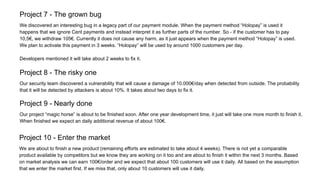
Project 7 - The grown bug
We discovered an interesting bug in a legacy part of our payment module. When the payment method “Holopay” is used it
happens that we ignore Cent payments and instead interpret it as further parts of the number. So - if the customer has to pay
10,5€, we withdraw 105€. Currently it does not cause any harm, as it just appears when the payment method “Holopay” is used.
We plan to activate this payment in 3 weeks. “Holopay” will be used by around 1000 customers per day.
Developers mentioned it will take about 2 weeks to fix it.
Project 8 - The risky one
Our security team discovered a vulnerability that will cause a damage of 10.000€/day when detected from outside. The probability
that it will be detected by attackers is about 10%. It takes about two days to fix it.
Project 9 - Nearly done
Our project “magic horse” is about to be finished soon. After one year development time, it just will take one more month to finish it.
When finished we expect an daily additional revenue of about 100€.
Project 10 - Enter the market
We are about to finish a new product (remaining efforts are estimated to take about 4 weeks). There is not yet a comparable
product available by competitors but we know they are working on it too and are about to finish it within the next 3 months. Based
on market analysis we can earn 100€/order and we expect that about 100 customers will use it daily. All based on the assumption
that we enter the market first. If we miss that, only about 10 customers will use it daily.

Cost of Delay, measurements and parallel vs. sequential project processing

  • 1.
  • 2.
    Is a monthof delay worth 1 Mio € or 1k €?
  • 3.
    “ Most organisations don’tsuffer from a lack of innovative ideas, they suffer from not being able to pick and nurture the best ones, and deliver them quickly enough.
  • 5.
  • 6.
    “ The impact oftime on value (or rephrased: Impact of time on the outcomes we hope to achieve)
  • 7.
    “ It’s one thingfor an organisation to be blind to queues. It’s another layer of blindness to have no clue what those queues are costing. We need to understand the Cost of Delay of the things flowing through the system.
  • 8.
    Cost of delay= value x urgency
  • 9.
    What is itgood for?
  • 10.
  • 11.
    Help with prioritization especiallywith CD3 cost of delay divided by duration
  • 12.
    Focus discussions tospeed and value (instead of cost and efficiency)
  • 13.
    About Value The monetaryworth of something
  • 14.
    “ Having a numberis better than having no number at all, even if the only output is to learn more about what is valuable or not.
  • 15.
    A framework forthinking about value Total value = Sum of value buckets
  • 16.
    Risk to valueconversion calculate the weighted risk value by multiplying the value of a risk x its probability to occur Example A failing oracle leads to a potential loss of 100k/week. The probability for failing is about 70%. This leads to the weighted risk of 70k/week that we can take as value part for our COD calculation.
  • 17.
    Describes the development ofvalue over a given timeframe About Urgency
  • 18.
  • 19.
    For ideas witha very long-life, with peak unaffected by delay http://xprocess.blogspot.de/2016/04/cost-of-delay-profiles.html
  • 20.
  • 21.
  • 25.
    Qualitative Cost ofDelay matrix ◉ Fast and easy to apply ◉ Helps to differentiate between many options initially
  • 26.
  • 27.
  • 28.
  • 29.
  • 30.
  • 32.
    Example with differenturgency profiles 120 Kombinationen
  • 33.
  • 34.
    How to measure anything Ashort book teaser? www.howtomeasureanything.com
  • 35.
    “ Often, an importantdecision requires better knowledge of the alleged intangible, but when a [person] believes something to be immeasurable, attempts to measure it will not even be considered.
  • 36.
    “ The standard approachto measurement … is for smart people being smart and have to invent the method for a new measurement themselves...
  • 37.
    “ If outcome ofa decision is highly uncertain and has significant consequences then measurements that reduce uncertainty have a high value (don’t confuse the proposition that anything that can be measured with everything should be measured)
  • 38.
    A universal approachto measurement
  • 39.
    1) Define thedecision
  • 40.
    2) Determine whatyou know now
  • 41.
    3) Compute thevalue of additional information
  • 42.
    4) Measure whereinformation value is high
  • 43.
    5) Make adecision and act on it
  • 44.
  • 45.
    Don’t reinvent thewheel It’s been done before
  • 46.
    It might justinvolve some resourcefulness and original observations. You have access to more data than you think
  • 47.
    If you’re cleverabout how to analyze it. You need less data than you think
  • 48.
    probably more accessible thanyou first thought. An adequate amount of new data is...
  • 49.
    And the winneris... ? Sequential vs. Parallel
  • 50.
  • 51.
    10 projects, allparallel, 1000€ CoD/day, same efforts Projekt Dauer CoD/Tag CoD P1 10 1000 10000 P2 10 1000 10000 P3 10 1000 10000 P4 10 1000 10000 P5 10 1000 10000 P6 10 1000 10000 P7 10 1000 10000 P8 10 1000 10000 P9 10 1000 10000 P10 10 1000 10000 Max parallel - 100.000€ CoD
  • 52.
    10 projects, allsequential, 1000€ CoD/day, same efforts Min parallel - 55.000€ CoD Projekt Dauer CoD/Tag CoD P1 1 1000 1000 P2 2 1000 2000 P3 3 1000 3000 P4 4 1000 4000 P5 5 1000 5000 P6 6 1000 6000 P7 7 1000 7000 P8 8 1000 8000 P9 9 1000 9000 P10 10 1000 10000
  • 53.
    10 projects, allparallel, different CoD/project, same efforts Max parallel - 133.000€ CoD Projekt Dauer CoD/Tag CoD P1 10 4000 40000 P2 10 3000 30000 P3 10 2000 20000 P4 10 1000 10000 P5 10 1000 10000 P6 10 1000 10000 P7 10 1000 10000 P8 10 100 1000 P9 10 100 1000 P10 10 100 1000
  • 54.
    10 projects, allsequential, different CoD/project, same efforts Min parallel - 40.700€ CoD Projekt Dauer CoD/Tag CoD P1 1 4000 4000 P2 2 3000 6000 P3 3 2000 6000 P4 4 1000 4000 P5 5 1000 5000 P6 6 1000 6000 P7 7 1000 7000 P8 8 100 800 P9 9 100 900 P10 10 100 1000
  • 55.
    133.000€ For all parallelwith different CoD - That’s a lot of money Worst case 226% more CoD in action! 40.700€ What a reduction … if finishing project by project, starting with highest CoD
  • 56.
    10 projects, allsequential, different CoD/project, same efforts but viewer half the people working on it Min parallel - half of people involved - 81.400€ but 20 days Projekt Dauer CoD/Tag CoD P1 2 4000 8000 P2 4 3000 12000 P3 6 2000 12000 P4 8 1000 8000 P5 10 1000 10000 P6 12 1000 12000 P7 14 1000 14000 P8 16 100 1600 P9 18 100 1800 P10 20 100 2000
  • 57.
    Read more ◉ ThePrinciples of Product Development Flow ◉ Great explanations by BlackSwanFarming ◉ How to measure anything by Douglas Hubbard ◉ Cost of Delay - how to find the best sequence for your feature development ◉ Cost of Delay - a key economic metric
  • 58.
    Appendix - fictitiousproject examples Project 1 - 1st of May special product On the 1st of April we are on track with our project to offer special products for the holiday on the 1st of may. We assume it will take 3 more weeks to complete everything. Based on the forecast from marketing there can be 10.000 more orders on the 1st of may with this special offers. With every order we earn on average 20€. Project 2 - Technical debt We accumulated technical debt while preparing for the last release. As soon as we clean it up two developers can save ½ a day for manual maintenance each week. On average a developer earns 400€/day. The developers estimated the cleanup to take around 4 days. Exercise: Place the following 10 project examples in the shown cost of delay matrix. Please distinguish urgency and value. Discuss the distribution in your group. Every group has one observer who shares her observations afterwards.
  • 59.
    Project 3 -CRM vendor selection (1) We need a CRM to increase sales by 100.000€/month. Vendor A costs 50.000€ and it needs 8 weeks to integrate it. It includes all necessary functionality. Project 4 - CRM vendor selection (2) We need a CRM to increase sales by 100.000€/month. Vendor B costs 100.000€ and it needs 4 weeks to integrate it. It includes all necessary functionality. Project 5 - Penalty payments It’s the 25th of April and the new legal regulation that all offered prices have to be displayed in green is enforced by the 1st of May. Each day we miss this requirement forces us to pay a penalty of 50€. It takes us about 4 days to fix it. Project 6 - The growing bug We discovered an interesting bug in a legacy part of our payment module. When the payment method “Holopay” is used it happens that we ignore Cent payments and instead interpret it as further parts of the number. So - if the customer has to pay 10,5€, we withdraw 105€. Currently it does not cause any harm, as it just appears when the payment method “Holopay” is used. We plan to activate this payment in 2 months. “Holopay” will be used by around 1000 customers per day. Developers mentioned it will take about 2 weeks to fix it.
  • 60.
    Project 7 -The grown bug We discovered an interesting bug in a legacy part of our payment module. When the payment method “Holopay” is used it happens that we ignore Cent payments and instead interpret it as further parts of the number. So - if the customer has to pay 10,5€, we withdraw 105€. Currently it does not cause any harm, as it just appears when the payment method “Holopay” is used. We plan to activate this payment in 3 weeks. “Holopay” will be used by around 1000 customers per day. Developers mentioned it will take about 2 weeks to fix it. Project 8 - The risky one Our security team discovered a vulnerability that will cause a damage of 10.000€/day when detected from outside. The probability that it will be detected by attackers is about 10%. It takes about two days to fix it. Project 9 - Nearly done Our project “magic horse” is about to be finished soon. After one year development time, it just will take one more month to finish it. When finished we expect an daily additional revenue of about 100€. Project 10 - Enter the market We are about to finish a new product (remaining efforts are estimated to take about 4 weeks). There is not yet a comparable product available by competitors but we know they are working on it too and are about to finish it within the next 3 months. Based on market analysis we can earn 100€/order and we expect that about 100 customers will use it daily. All based on the assumption that we enter the market first. If we miss that, only about 10 customers will use it daily.