Renewable energy and social responsibility 
The cost-energy-equivalence law 
Everything that arises, needs energy (2nd law of thermodynamics). 
This energy comes from the sun, from food, from manual labor, from 
conventional energy sources, etc. 
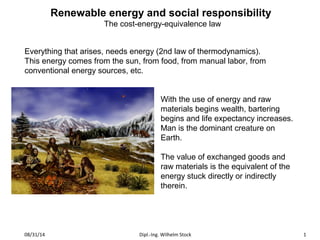
With the use of energy and raw 
materials begins wealth, bartering 
begins and life expectancy increases. 
Man is the dominant creature on 
Earth. 
The value of exchanged goods and 
raw materials is the equivalent of the 
energy stuck directly or indirectly 
therein. 
08/31/14 Dipl.-Ing. Wilhelm Stock 1
Renewable energy and social responsibility 
The cost-energy-equivalence law 
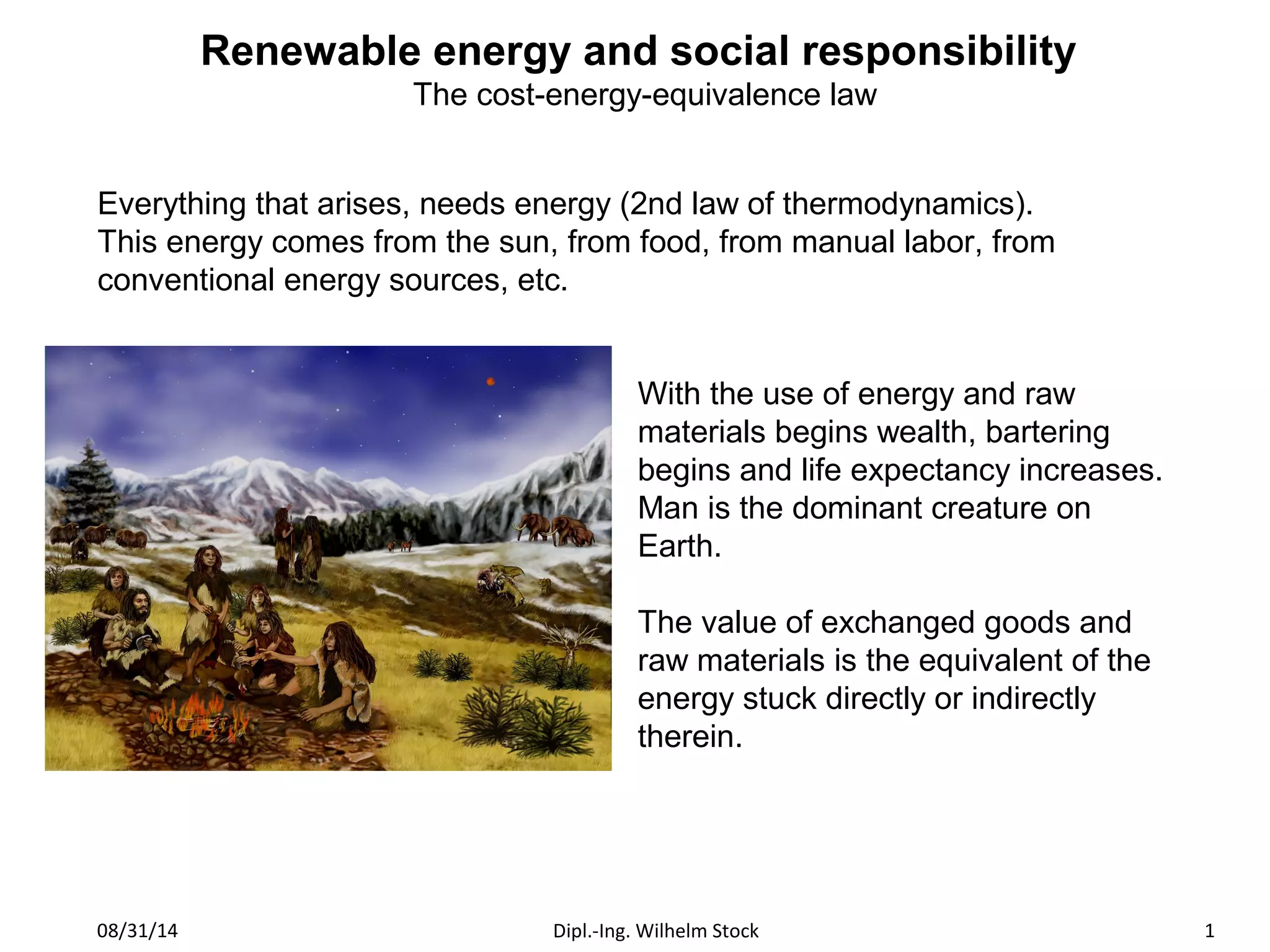
Energy is used more and more to tap raw materials. Slowly the barter trade 
is replaced by money transactions. As before, the products, money is now 
also an equivalent to the energy contained in the product. 
Only with the opening up of larger energy sources such as coal, oil and 
nuclear energy, manages the slow social upheaval to the affluent society. 
Social systems, democracy and decent life are accessible to more and more 
people of the rapidly growing world population. 
The increasing amount of money and commodities correlates to the value of 
the consumed energy. 
08/31/14 Dipl.-Ing. Wilhelm Stock 2
Renewable energy and social responsibility 
The cost-energy-equivalence law 
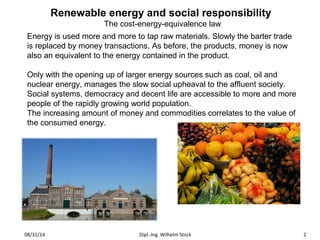
But goods and money (hence the energy) can also be destroyed: breaking 
the exchanged pitcher, crashes a hut purchased or whole regions are 
devastated in wars, the equivalent values o r parts of it are lost forever. 
08/31/14 Dipl.-Ing. Wilhelm Stock 3
Renewable energy and social responsibility 
The cost-energy-equivalence law 
To summarize, money, or the value of a commodity or product is always the 
equivalent of the energy contained in. 
The vast majority of this energy comes from conventional energy sources. 
Development of additional energy sources enables a society to achieve 
prosperity and decent life. Is not enough energy available, the society 
remains poor, malnourished and with low life expectancy (eg third world). 
08/31/14 Dipl.-Ing. Wilhelm Stock 4
Renewable energy and social responsibility 
The cost-energy-equivalence law 
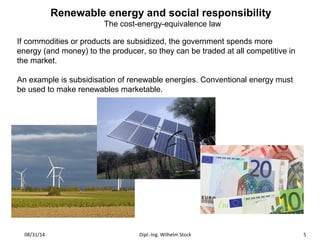
If commodities or products are subsidized, the government spends more 
energy (and money) to the producer, so they can be traded at all competitive in 
the market. 
An example is subsidisation of renewable energies. Conventional energy must 
be used to make renewables marketable. 
08/31/14 Dipl.-Ing. Wilhelm Stock 5
Renewable energy and social responsibility 
The cost-energy-equivalence law 
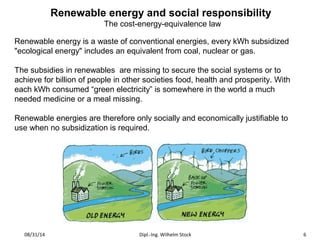
Renewable energy is a waste of conventional energies, every kWh subsidized 
"ecological energy" includes an equivalent from coal, nuclear or gas. 
The subsidies in renewables are missing to secure the social systems or to 
achieve for billion of people in other societies food, health and prosperity. With 
each kWh consumed “green electricity” is somewhere in the world a much 
needed medicine or a meal missing. 
Renewable energies are therefore only socially and economically justifiable to 
use when no subsidization is required. 
08/31/14 Dipl.-Ing. Wilhelm Stock 6
Renewable energy and social responsibility 
The cost-energy-equivalence law 
Conclusion: 
• The subsidy of inefficient renewable energy must be stopped immediately in 
order to protect the environment by reducing emissions 
• Research in energy efficiency technologies, renewables and nuclear fusion 
must be increased to reach market maturity beyond the need for subsidies 
• The third world has to be supported in developing their own energy 
ressources for their own benefit 
How do you tell your children, that you have taken 
away and destroyed limited existing resources to 
consume unlimited additional existing resources such 
as wind and sun? 
Thanks to Dr. Heinz Schütte, http://www.kosten-energie-aequivalenzgesetz.com/KEAG-e.pdf 
and 
08/31/14 Dipl.-Ing. Wilhelm Stock 7

Cost energy-equivalence law

  • 1.
    Renewable energy andsocial responsibility The cost-energy-equivalence law Everything that arises, needs energy (2nd law of thermodynamics). This energy comes from the sun, from food, from manual labor, from conventional energy sources, etc. With the use of energy and raw materials begins wealth, bartering begins and life expectancy increases. Man is the dominant creature on Earth. The value of exchanged goods and raw materials is the equivalent of the energy stuck directly or indirectly therein. 08/31/14 Dipl.-Ing. Wilhelm Stock 1
  • 2.
    Renewable energy andsocial responsibility The cost-energy-equivalence law Energy is used more and more to tap raw materials. Slowly the barter trade is replaced by money transactions. As before, the products, money is now also an equivalent to the energy contained in the product. Only with the opening up of larger energy sources such as coal, oil and nuclear energy, manages the slow social upheaval to the affluent society. Social systems, democracy and decent life are accessible to more and more people of the rapidly growing world population. The increasing amount of money and commodities correlates to the value of the consumed energy. 08/31/14 Dipl.-Ing. Wilhelm Stock 2
  • 3.
    Renewable energy andsocial responsibility The cost-energy-equivalence law But goods and money (hence the energy) can also be destroyed: breaking the exchanged pitcher, crashes a hut purchased or whole regions are devastated in wars, the equivalent values o r parts of it are lost forever. 08/31/14 Dipl.-Ing. Wilhelm Stock 3
  • 4.
    Renewable energy andsocial responsibility The cost-energy-equivalence law To summarize, money, or the value of a commodity or product is always the equivalent of the energy contained in. The vast majority of this energy comes from conventional energy sources. Development of additional energy sources enables a society to achieve prosperity and decent life. Is not enough energy available, the society remains poor, malnourished and with low life expectancy (eg third world). 08/31/14 Dipl.-Ing. Wilhelm Stock 4
  • 5.
    Renewable energy andsocial responsibility The cost-energy-equivalence law If commodities or products are subsidized, the government spends more energy (and money) to the producer, so they can be traded at all competitive in the market. An example is subsidisation of renewable energies. Conventional energy must be used to make renewables marketable. 08/31/14 Dipl.-Ing. Wilhelm Stock 5
  • 6.
    Renewable energy andsocial responsibility The cost-energy-equivalence law Renewable energy is a waste of conventional energies, every kWh subsidized "ecological energy" includes an equivalent from coal, nuclear or gas. The subsidies in renewables are missing to secure the social systems or to achieve for billion of people in other societies food, health and prosperity. With each kWh consumed “green electricity” is somewhere in the world a much needed medicine or a meal missing. Renewable energies are therefore only socially and economically justifiable to use when no subsidization is required. 08/31/14 Dipl.-Ing. Wilhelm Stock 6
  • 7.
    Renewable energy andsocial responsibility The cost-energy-equivalence law Conclusion: • The subsidy of inefficient renewable energy must be stopped immediately in order to protect the environment by reducing emissions • Research in energy efficiency technologies, renewables and nuclear fusion must be increased to reach market maturity beyond the need for subsidies • The third world has to be supported in developing their own energy ressources for their own benefit How do you tell your children, that you have taken away and destroyed limited existing resources to consume unlimited additional existing resources such as wind and sun? Thanks to Dr. Heinz Schütte, http://www.kosten-energie-aequivalenzgesetz.com/KEAG-e.pdf and 08/31/14 Dipl.-Ing. Wilhelm Stock 7