Module – 1
Costing Strategies
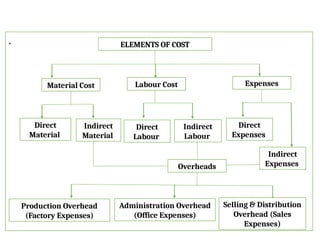
. ELEMENTS OF COST
Material Cost Labour Cost Expenses
Direct
Material
Indirect
Material
Direct
Labour
Indirect
Labour
Direct
Expenses
Indirect
Expenses
Overheads
Production Overhead
(Factory Expenses)
Administration Overhead
(Office Expenses)
Selling & Distribution
Overhead (Sales
Expenses)
Different Elements of Cost:
There are broadly three elements of cost - (1) material, (2)
labour and (3) expenses
• Material
The substance from which the product is made is known
as material. It may be in a raw state-raw material, e.g:
timber for furniture and leather for shoe, etc. It may also
be in manufactured state- components, e.g: battery for car,
speaker for radio, etc. Materials can be direct and indirect.
• Direct Material: All materials which become an integral part
of the finished product, the cost of which are directly and
completely assigned to the specific physical units and charged
to the prime cost, are known as direct material. The following
are some of the materials that fall under this category:
• Materials which are specifically purchased; acquired or produced for
a particular job, order or process.
• Primary packing material (e.g. carton, wrapping, cardboard, etc.)
• Materials passing from one process to another as inputs.
• In order to calculate the cost of material, expenses such as
import duties, dock charges, transport cost of materials are
added to the invoice price. Material considered direct at one
time may be indirect on other occasion. Nail used in
manufacturing wooden box is treated as direct material, but
treated as indirect material when used to repair the factory
building.
Indirect Material: All materials, which cannot be
conveniently assigned to specific physical units, are
termed as 'indirect materials'. Such commodities do
not form part of the finished products. Consumable
stores, lubrication oil, stationery and spare parts for
the machinery are termed as indirect materials.
Labour
Human efforts used for conversion of materials into finished products or
doing various jobs in the business are known as labour. Payment made
towards the labour is called labour cost. It can also be direct and indirect.
Direct Labour: Direct labour is all labour expended and directly involved in
altering the condition, composition or construction of the product. The wages
paid to skilled and unskilled workers for manual work or mechanical work for
operating machinery, which can be specifically allocated to a particular unit of
production, is known as direct wages or direct labour cost. Hence, 'direct wage'
may be defined as the measure of direct labour in terms of money. It is
specifically and conveniently traceable to the specific products Wages paid to
the goldsmith for making gold ornament is an example of direct labour.
Indirect Labour: Labour employed to perform work incidental to production
of goods or those engaged for office work, selling and distribution activities are
known as 'indirect labour'. The wages paid to such workers are known as
'indirect wages' or indirect labour cost. Example: Salary paid to the driver of
the delivery van used for distribution of the product.
Expenses
• All expenditures other than material and labour incurred for
manufacturing a product or rendering service are termed as
'expenses'. Expenses may be direct or indirect.
• Direct Expenses: Expenses which are specifically incurred and
can be directly and wholly allocated to a particular product, job
or service are termed as 'direct expenses'. Examples of such
expense are: hire charges of special machinery hired for the fob,
carriage inward, royalty, cost of special and specific drawings,
etc. These are also known as 'chargeable expenses'.
• Indirect Expenses: All expenses excluding indirect material and
indirect labour, which cannot be directly and wholly attributed
to a particular product, job or service, are termed as 'indirect
expenses'. Some examples of such expenses are: repairs to
machinery, insurance, lighting and rent of the buildings.
Module – 2
Activity Based Costing System
Overhead Cost
Overhead Cost are the cost of a business enterprises which
cannot be traced directly to a particular product,
department, process or a particular job. For example,
some common expenses like electricity, rent, Insurance
etc.
Apportionment of Overhead
There are certain overheads, which are common to a
number of departments or cost centers. They cannot be
directly identified or allocated to a particular department
or cost centre. The distribution of such overhead to several
departments or cost centers proportionately on some
equitable basis is known as apportionment of overheads.
Absorption of Overhead
In other words, it is the process of sharing of overheads
to a products or jobs of the department. A basis for
absorption of overhead for each department is found out
so that each job or product gets due share of overhead
for each department when it passes through that
department.
Features of Overheads
1. They are the sum total of Indirect materials, Indirect
wages, indirect expenses.
2. They cannot conveniently identified with any
particular cost centre.
3. They are expenses incurred for the organisation as a
whole & not for a particular job or a particular
product.
4. Overhead cost will incur in both production and
services departments.
5. Overhead cost have to be distributed to various
departments on a certain parameters.
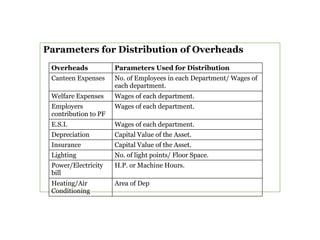
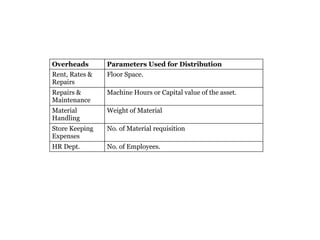
Parameters for Distribution of Overheads
Overheads Parameters Used for Distribution
Canteen Expenses No. of Employees in each Department/ Wages of
each department.
Welfare Expenses Wages of each department.
Employers
contribution to PF
Wages of each department.
E.S.I. Wages of each department.
Depreciation Capital Value of the Asset.
Insurance Capital Value of the Asset.
Lighting No. of light points/ Floor Space.
Power/Electricity
bill
H.P. or Machine Hours.
Heating/Air
Conditioning
Area of Dep
Overheads Parameters Used for Distribution
Rent, Rates &
Repairs
Floor Space.
Repairs &
Maintenance
Machine Hours or Capital value of the asset.
Material
Handling
Weight of Material
Store Keeping
Expenses
No. of Material requisition
HR Dept. No. of Employees.
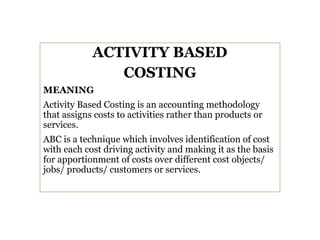
ACTIVITY BASED
COSTING
MEANING
Activity Based Costing is an accounting methodology
that assigns costs to activities rather than products or
services.
ABC is a technique which involves identification of cost
with each cost driving activity and making it as the basis
for apportionment of costs over different cost objects/
jobs/ products/ customers or services.
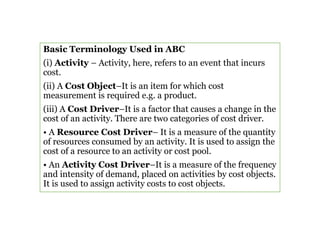
Basic Terminology Used in ABC
(i) Activity – Activity, here, refers to an event that incurs
cost.
(ii) A Cost Object–It is an item for which cost
measurement is required e.g. a product.
(iii) A Cost Driver–It is a factor that causes a change in the
cost of an activity. There are two categories of cost driver.
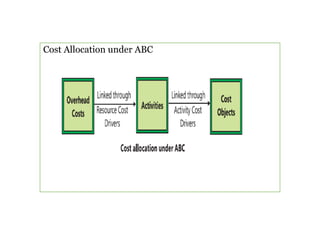
• A Resource Cost Driver– It is a measure of the quantity
of resources consumed by an activity. It is used to assign the
cost of a resource to an activity or cost pool.
• An Activity Cost Driver–It is a measure of the frequency
and intensity of demand, placed on activities by cost objects.
It is used to assign activity costs to cost objects.
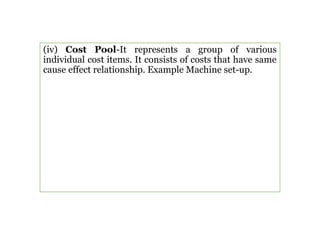
(iv) Cost Pool-It represents a group of various
individual cost items. It consists of costs that have same
cause effect relationship. Example Machine set-up.
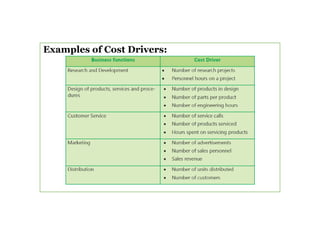
Examples of Cost Drivers:
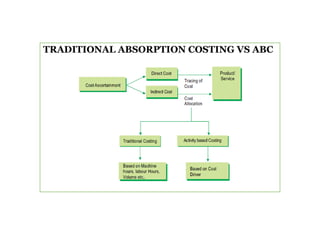
TRADITIONAL ABSORPTION COSTING VS ABC
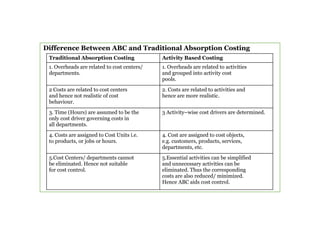
Difference Between ABC and Traditional Absorption Costing
Traditional Absorption Costing Activity Based Costing
1. Overheads are related to cost centers/
departments.
1. Overheads are related to activities
and grouped into activity cost
pools.
2 Costs are related to cost centers
and hence not realistic of cost
behaviour.
2. Costs are related to activities and
hence are more realistic.
3. Time (Hours) are assumed to be the
only cost driver governing costs in
all departments.
3 Activity–wise cost drivers are determined.
4. Costs are assigned to Cost Units i.e.
to products, or jobs or hours.
4. Cost are assigned to cost objects,
e.g. customers, products, services,
departments, etc.
5.Cost Centers/ departments cannot
be eliminated. Hence not suitable
for cost control.
5.Essential activities can be simplified
and unnecessary activities can be
eliminated. Thus the corresponding
costs are also reduced/ minimized.
Hence ABC aids cost control.
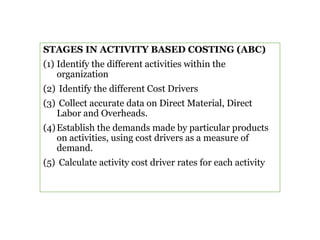
STAGES IN ACTIVITY BASED COSTING (ABC)
(1) Identify the different activities within the
organization
(2) Identify the different Cost Drivers
(3) Collect accurate data on Direct Material, Direct
Labor and Overheads.
(4)Establish the demands made by particular products
on activities, using cost drivers as a measure of
demand.
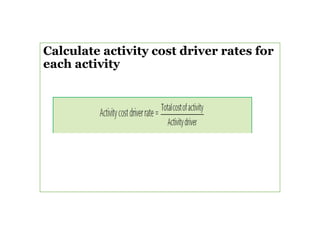
(5) Calculate activity cost driver rates for each activity
Calculate activity cost driver rates for
each activity
Cost Allocation under ABC
Module – 3
LIFE CYCLE COSTING
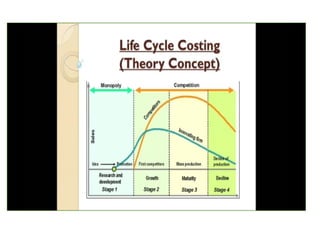
Product Life-Cycle
Products or Services typically pass through a
series of different phases is termed as
product life cycle.
Product Life-Cycle is the pattern of
expenditure, sales, profit over the period
from new idea generation to the deletion of
a product.
Life-Cycle costing
It includes the costs associated with
acquiring, using, caring for and disposing of
physical assets, including the feasibility
studies, research, design, development,
production, maintenance, replacement and
disposal, as well as support, training and
operating costs generated by the acquisition,
use, maintenance and replacement of
permanent physical asset
LCC is also known as CRADLE TO GRAVE
COSTING i.e. it considers all costs which
incurs from the inception of the idea till the
deletion of the product from the product
range
Why Life-Cycle Costing?
⮚LCC will help us to know the true
profitability of the product.(ex: pitfalls of
Projected Income Statement)
⮚LCC will help us to know whether product
should be launched or not.
⮚LCC estimates the life of the product and
life at each phase, costs and revenue for all
phases of the product.
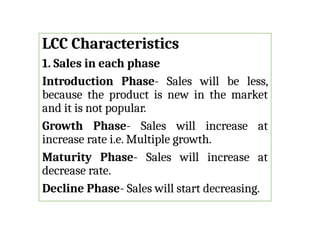
LCC Characteristics
1. Sales in each phase
Introduction Phase- Sales will be less,
because the product is new in the market
and it is not popular.
Growth Phase- Sales will increase at
increase rate i.e. Multiple growth.
Maturity Phase- Sales will increase at
decrease rate.
Decline Phase- Sales will start decreasing.
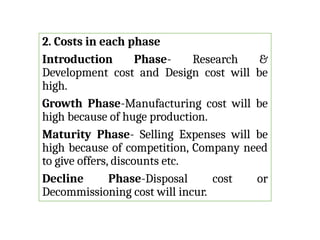
2. Costs in each phase
Introduction Phase- Research &
Development cost and Design cost will be
high.
Growth Phase-Manufacturing cost will be
high because of huge production.
Maturity Phase- Selling Expenses will be
high because of competition, Company need
to give offers, discounts etc.
Decline Phase-Disposal cost or
Decommissioning cost will incur.
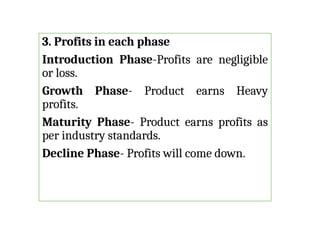
3. Profits in each phase
Introduction Phase-Profits are negligible
or loss.
Growth Phase- Product earns Heavy
profits.
Maturity Phase- Product earns profits as
per industry standards.
Decline Phase- Profits will come down.
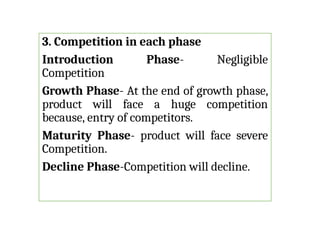
3. Competition in each phase
Introduction Phase- Negligible
Competition
Growth Phase- At the end of growth phase,
product will face a huge competition
because, entry of competitors.
Maturity Phase- product will face severe
Competition.
Decline Phase-Competition will decline.
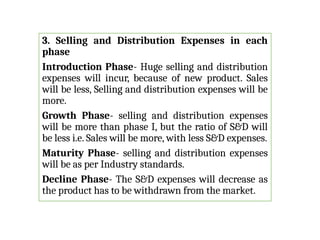
3. Selling and Distribution Expenses in each
phase
Introduction Phase- Huge selling and distribution
expenses will incur, because of new product. Sales
will be less, Selling and distribution expenses will be
more.
Growth Phase- selling and distribution expenses
will be more than phase I, but the ratio of S&D will
be less i.e. Sales will be more, with less S&D expenses.
Maturity Phase- selling and distribution expenses
will be as per Industry standards.
Decline Phase- The S&D expenses will decrease as
the product has to be withdrawn from the market.
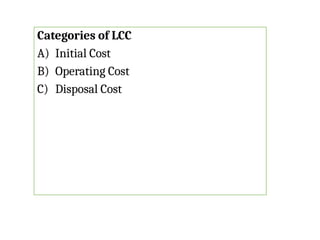
Categories of LCC
A) Initial Cost
B) Operating Cost
C) Disposal Cost
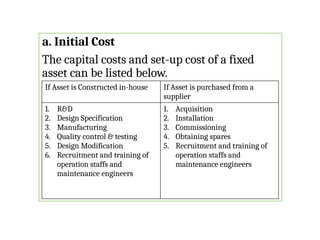
a. Initial Cost
The capital costs and set-up cost of a fixed
asset can be listed below.
If Asset is Constructed in-house If Asset is purchased from a
supplier
1. R&D
2. Design Specification
3. Manufacturing
4. Quality control & testing
5. Design Modification
6. Recruitment and training of
operation staffs and
maintenance engineers
1. Acquisition
2. Installation
3. Commissioning
4. Obtaining spares
5. Recruitment and training of
operation staffs and
maintenance engineers
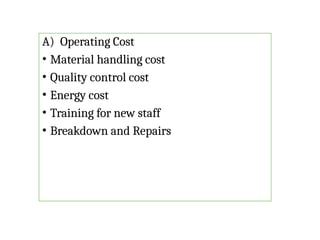
A) Operating Cost
• Material handling cost
• Quality control cost
• Energy cost
• Training for new staff
• Breakdown and Repairs
C. Disposal Cost
It is important for a fixed asset, because the
asset must be demolished or dismantled and
removed and the site made good for other
use.
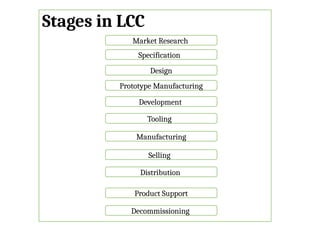
Stages in LCC
Market Research
Prototype Manufacturing
Development
Tooling
Manufacturing
Selling
Distribution
Specification
Design
Product Support
Decommissioning

Cost accounting and management control system

  • 1.
  • 2.
    . ELEMENTS OFCOST Material Cost Labour Cost Expenses Direct Material Indirect Material Direct Labour Indirect Labour Direct Expenses Indirect Expenses Overheads Production Overhead (Factory Expenses) Administration Overhead (Office Expenses) Selling & Distribution Overhead (Sales Expenses)
  • 3.
    Different Elements ofCost: There are broadly three elements of cost - (1) material, (2) labour and (3) expenses • Material The substance from which the product is made is known as material. It may be in a raw state-raw material, e.g: timber for furniture and leather for shoe, etc. It may also be in manufactured state- components, e.g: battery for car, speaker for radio, etc. Materials can be direct and indirect.
  • 4.
    • Direct Material:All materials which become an integral part of the finished product, the cost of which are directly and completely assigned to the specific physical units and charged to the prime cost, are known as direct material. The following are some of the materials that fall under this category: • Materials which are specifically purchased; acquired or produced for a particular job, order or process. • Primary packing material (e.g. carton, wrapping, cardboard, etc.) • Materials passing from one process to another as inputs. • In order to calculate the cost of material, expenses such as import duties, dock charges, transport cost of materials are added to the invoice price. Material considered direct at one time may be indirect on other occasion. Nail used in manufacturing wooden box is treated as direct material, but treated as indirect material when used to repair the factory building.
  • 5.
    Indirect Material: Allmaterials, which cannot be conveniently assigned to specific physical units, are termed as 'indirect materials'. Such commodities do not form part of the finished products. Consumable stores, lubrication oil, stationery and spare parts for the machinery are termed as indirect materials.
  • 6.
    Labour Human efforts usedfor conversion of materials into finished products or doing various jobs in the business are known as labour. Payment made towards the labour is called labour cost. It can also be direct and indirect. Direct Labour: Direct labour is all labour expended and directly involved in altering the condition, composition or construction of the product. The wages paid to skilled and unskilled workers for manual work or mechanical work for operating machinery, which can be specifically allocated to a particular unit of production, is known as direct wages or direct labour cost. Hence, 'direct wage' may be defined as the measure of direct labour in terms of money. It is specifically and conveniently traceable to the specific products Wages paid to the goldsmith for making gold ornament is an example of direct labour. Indirect Labour: Labour employed to perform work incidental to production of goods or those engaged for office work, selling and distribution activities are known as 'indirect labour'. The wages paid to such workers are known as 'indirect wages' or indirect labour cost. Example: Salary paid to the driver of the delivery van used for distribution of the product.
  • 7.
    Expenses • All expendituresother than material and labour incurred for manufacturing a product or rendering service are termed as 'expenses'. Expenses may be direct or indirect. • Direct Expenses: Expenses which are specifically incurred and can be directly and wholly allocated to a particular product, job or service are termed as 'direct expenses'. Examples of such expense are: hire charges of special machinery hired for the fob, carriage inward, royalty, cost of special and specific drawings, etc. These are also known as 'chargeable expenses'. • Indirect Expenses: All expenses excluding indirect material and indirect labour, which cannot be directly and wholly attributed to a particular product, job or service, are termed as 'indirect expenses'. Some examples of such expenses are: repairs to machinery, insurance, lighting and rent of the buildings.
  • 8.
    Module – 2 ActivityBased Costing System
  • 9.
    Overhead Cost Overhead Costare the cost of a business enterprises which cannot be traced directly to a particular product, department, process or a particular job. For example, some common expenses like electricity, rent, Insurance etc. Apportionment of Overhead There are certain overheads, which are common to a number of departments or cost centers. They cannot be directly identified or allocated to a particular department or cost centre. The distribution of such overhead to several departments or cost centers proportionately on some equitable basis is known as apportionment of overheads.
  • 10.
    Absorption of Overhead Inother words, it is the process of sharing of overheads to a products or jobs of the department. A basis for absorption of overhead for each department is found out so that each job or product gets due share of overhead for each department when it passes through that department.
  • 11.
    Features of Overheads 1.They are the sum total of Indirect materials, Indirect wages, indirect expenses. 2. They cannot conveniently identified with any particular cost centre. 3. They are expenses incurred for the organisation as a whole & not for a particular job or a particular product. 4. Overhead cost will incur in both production and services departments. 5. Overhead cost have to be distributed to various departments on a certain parameters.
  • 12.
    Parameters for Distributionof Overheads Overheads Parameters Used for Distribution Canteen Expenses No. of Employees in each Department/ Wages of each department. Welfare Expenses Wages of each department. Employers contribution to PF Wages of each department. E.S.I. Wages of each department. Depreciation Capital Value of the Asset. Insurance Capital Value of the Asset. Lighting No. of light points/ Floor Space. Power/Electricity bill H.P. or Machine Hours. Heating/Air Conditioning Area of Dep
  • 13.
    Overheads Parameters Usedfor Distribution Rent, Rates & Repairs Floor Space. Repairs & Maintenance Machine Hours or Capital value of the asset. Material Handling Weight of Material Store Keeping Expenses No. of Material requisition HR Dept. No. of Employees.
  • 14.
    ACTIVITY BASED COSTING MEANING Activity BasedCosting is an accounting methodology that assigns costs to activities rather than products or services. ABC is a technique which involves identification of cost with each cost driving activity and making it as the basis for apportionment of costs over different cost objects/ jobs/ products/ customers or services.
  • 15.
    Basic Terminology Usedin ABC (i) Activity – Activity, here, refers to an event that incurs cost. (ii) A Cost Object–It is an item for which cost measurement is required e.g. a product. (iii) A Cost Driver–It is a factor that causes a change in the cost of an activity. There are two categories of cost driver. • A Resource Cost Driver– It is a measure of the quantity of resources consumed by an activity. It is used to assign the cost of a resource to an activity or cost pool. • An Activity Cost Driver–It is a measure of the frequency and intensity of demand, placed on activities by cost objects. It is used to assign activity costs to cost objects.
  • 16.
    (iv) Cost Pool-Itrepresents a group of various individual cost items. It consists of costs that have same cause effect relationship. Example Machine set-up.
  • 17.
  • 18.
  • 19.
    Difference Between ABCand Traditional Absorption Costing Traditional Absorption Costing Activity Based Costing 1. Overheads are related to cost centers/ departments. 1. Overheads are related to activities and grouped into activity cost pools. 2 Costs are related to cost centers and hence not realistic of cost behaviour. 2. Costs are related to activities and hence are more realistic. 3. Time (Hours) are assumed to be the only cost driver governing costs in all departments. 3 Activity–wise cost drivers are determined. 4. Costs are assigned to Cost Units i.e. to products, or jobs or hours. 4. Cost are assigned to cost objects, e.g. customers, products, services, departments, etc. 5.Cost Centers/ departments cannot be eliminated. Hence not suitable for cost control. 5.Essential activities can be simplified and unnecessary activities can be eliminated. Thus the corresponding costs are also reduced/ minimized. Hence ABC aids cost control.
  • 20.
    STAGES IN ACTIVITYBASED COSTING (ABC) (1) Identify the different activities within the organization (2) Identify the different Cost Drivers (3) Collect accurate data on Direct Material, Direct Labor and Overheads. (4)Establish the demands made by particular products on activities, using cost drivers as a measure of demand. (5) Calculate activity cost driver rates for each activity
  • 21.
    Calculate activity costdriver rates for each activity
  • 22.
  • 23.
    Module – 3 LIFECYCLE COSTING
  • 24.
    Product Life-Cycle Products orServices typically pass through a series of different phases is termed as product life cycle. Product Life-Cycle is the pattern of expenditure, sales, profit over the period from new idea generation to the deletion of a product.
  • 25.
    Life-Cycle costing It includesthe costs associated with acquiring, using, caring for and disposing of physical assets, including the feasibility studies, research, design, development, production, maintenance, replacement and disposal, as well as support, training and operating costs generated by the acquisition, use, maintenance and replacement of permanent physical asset
  • 26.
    LCC is alsoknown as CRADLE TO GRAVE COSTING i.e. it considers all costs which incurs from the inception of the idea till the deletion of the product from the product range Why Life-Cycle Costing? ⮚LCC will help us to know the true profitability of the product.(ex: pitfalls of Projected Income Statement) ⮚LCC will help us to know whether product should be launched or not.
  • 27.
    ⮚LCC estimates thelife of the product and life at each phase, costs and revenue for all phases of the product.
  • 29.
    LCC Characteristics 1. Salesin each phase Introduction Phase- Sales will be less, because the product is new in the market and it is not popular. Growth Phase- Sales will increase at increase rate i.e. Multiple growth. Maturity Phase- Sales will increase at decrease rate. Decline Phase- Sales will start decreasing.
  • 30.
    2. Costs ineach phase Introduction Phase- Research & Development cost and Design cost will be high. Growth Phase-Manufacturing cost will be high because of huge production. Maturity Phase- Selling Expenses will be high because of competition, Company need to give offers, discounts etc. Decline Phase-Disposal cost or Decommissioning cost will incur.
  • 31.
    3. Profits ineach phase Introduction Phase-Profits are negligible or loss. Growth Phase- Product earns Heavy profits. Maturity Phase- Product earns profits as per industry standards. Decline Phase- Profits will come down.
  • 32.
    3. Competition ineach phase Introduction Phase- Negligible Competition Growth Phase- At the end of growth phase, product will face a huge competition because, entry of competitors. Maturity Phase- product will face severe Competition. Decline Phase-Competition will decline.
  • 33.
    3. Selling andDistribution Expenses in each phase Introduction Phase- Huge selling and distribution expenses will incur, because of new product. Sales will be less, Selling and distribution expenses will be more. Growth Phase- selling and distribution expenses will be more than phase I, but the ratio of S&D will be less i.e. Sales will be more, with less S&D expenses. Maturity Phase- selling and distribution expenses will be as per Industry standards. Decline Phase- The S&D expenses will decrease as the product has to be withdrawn from the market.
  • 34.
    Categories of LCC A)Initial Cost B) Operating Cost C) Disposal Cost
  • 35.
    a. Initial Cost Thecapital costs and set-up cost of a fixed asset can be listed below. If Asset is Constructed in-house If Asset is purchased from a supplier 1. R&D 2. Design Specification 3. Manufacturing 4. Quality control & testing 5. Design Modification 6. Recruitment and training of operation staffs and maintenance engineers 1. Acquisition 2. Installation 3. Commissioning 4. Obtaining spares 5. Recruitment and training of operation staffs and maintenance engineers
  • 36.
    A) Operating Cost •Material handling cost • Quality control cost • Energy cost • Training for new staff • Breakdown and Repairs
  • 37.
    C. Disposal Cost Itis important for a fixed asset, because the asset must be demolished or dismantled and removed and the site made good for other use.
  • 38.
    Stages in LCC MarketResearch Prototype Manufacturing Development Tooling Manufacturing Selling Distribution Specification Design Product Support Decommissioning