Reading and RespondingCosiby Louis Nowra
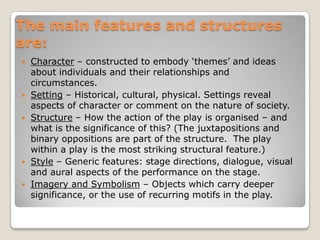
Three important ideas that Nowra aims to convey in CosiThe inhumanity and ineffectiveness of the mental health system in 20th Century Australia.The insanity of war; the need to condemn war; and to protest against Australia’s involvement in the Vietnam War.The importance of theatre – as a powerful form of political protest and as a way of enriching people’s lives with art.
Attitudes to mental illness can be seen in the language of ‘otherness’People are labelled as:Fool           NitwitPsychoSimpletonImbecileCrackpot IdiotWeirdoManiacTheir actions are:Crazy
Nutty
Insane
Barmy
Mad
BattyThey belong in the:Nut house
Loony Bin
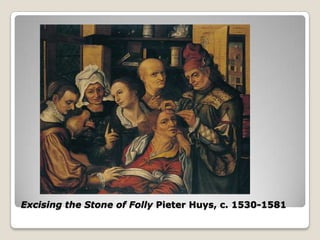
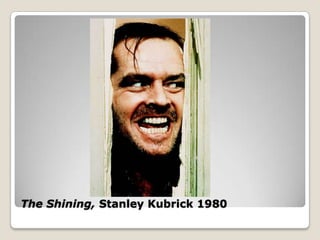
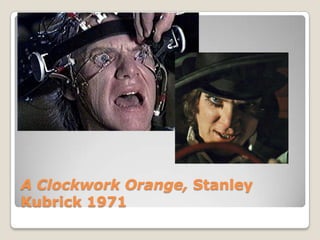
Funny FarmImages of MadnessLook at the following images of madness.How have they been portrayed by artists and film makers?Why might they be seen in these disturbing ways?Is ‘difference’ sometimes socially unacceptable? Why?
Excising the Stone of Folly Pieter Huys, c. 1530-1581
The Exorcist, William Friedkin 1973
The Shining, Stanley Kubrick 1980
A Clockwork Orange, Stanley Kubrick 1971
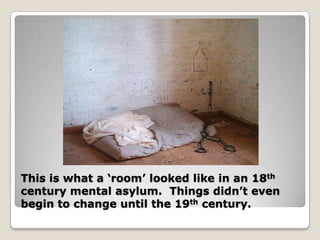
This is what a ‘room’ looked like in an 18th century mental asylum.  Things didn’t even begin to change until the 19th century.
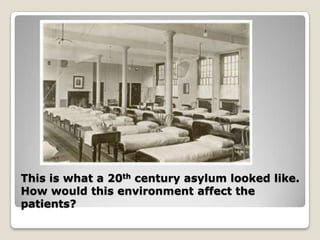
This is what a 20th century asylum looked like. How would this environment affect the patients?
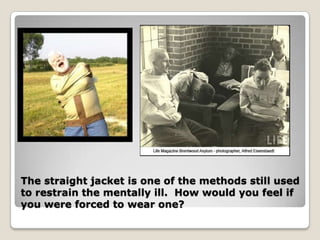
The straight jacket is one of the methods still used to restrain the mentally ill.  How would you feel if you were forced to wear one?
Electro-shock therapy: the patient’s body and brain are jolted with a powerful electric pulse.  Does it seem like a cure or punishment?
Over the years, mentally ill patients have been given various kinds of productive employment or occupational therapy.
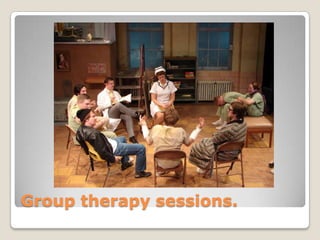
Group therapy sessions.
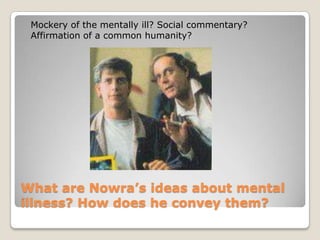
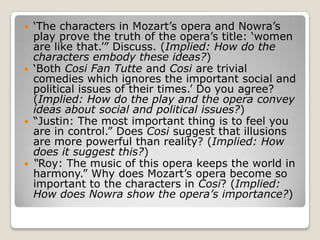
What are Nowra’s ideas about mental illness? How does he convey them?Mockery of the mentally ill? Social commentary? Affirmation of a common humanity?
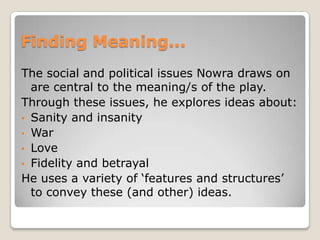
Finding meaning in CosiTreatments such as lobotomy (removal of part of the brain) and shock therapy were common practice until the mid-20th century.What meaning does Nowra convey through references to these practices?In Cosi, Nowra positions us to condemn the values of a society which treats its mentally ill in barbaric, condescending ways.HOW is this conveyed?Mentally ill characters are constructed sympathetically – an implicit condemnation of the society that has labelled and incarcerated them, and subjected them to inhumane treatment.
Meaning in Cosi (continued)Social and cultural contexts also helped Nowra create meaning.The Vietnam War (scene from Apocaplyse Now)http://www.youtube.com/watch?v=sx7XNb3Q9Ek&feature=relatedCosi Fan Tuttehttp://www.youtube.com/watch?v=YHwwbtD1eXM&feature=related
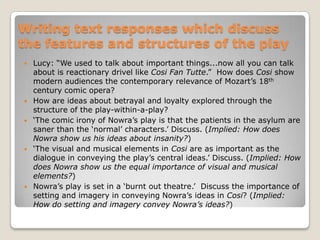
The startling differences between the worlds encapsulated in the previous clips make us aware of some of the ironic juxtapositions in Cosi.The squalor and despair of the asylum and the burnt out theatre is juxtaposed against the splendour of grand opera.The betrayals in the opera parallel the betrayals in the play.The ‘madness’ of the Vietnam war is implicitly compared with the chaos in the asylum (note the operatic music accompanying the helicopter assault – and Nowra refers to Wagner’s music in Cosi. Is there any significance in this?)Theseironic juxtapositions and parallels show HOW Nowra conveys some of his ideas.

Cosi powerpoint

  • 1.
  • 2.
    Three important ideasthat Nowra aims to convey in CosiThe inhumanity and ineffectiveness of the mental health system in 20th Century Australia.The insanity of war; the need to condemn war; and to protest against Australia’s involvement in the Vietnam War.The importance of theatre – as a powerful form of political protest and as a way of enriching people’s lives with art.
  • 3.
    Attitudes to mentalillness can be seen in the language of ‘otherness’People are labelled as:Fool NitwitPsychoSimpletonImbecileCrackpot IdiotWeirdoManiacTheir actions are:Crazy
  • 4.
  • 5.
  • 6.
  • 7.
  • 8.
    BattyThey belong inthe:Nut house
  • 9.
  • 10.
    Funny FarmImages ofMadnessLook at the following images of madness.How have they been portrayed by artists and film makers?Why might they be seen in these disturbing ways?Is ‘difference’ sometimes socially unacceptable? Why?
  • 11.
    Excising the Stoneof Folly Pieter Huys, c. 1530-1581
  • 12.
  • 13.
  • 14.
    A Clockwork Orange,Stanley Kubrick 1971
  • 15.
    This is whata ‘room’ looked like in an 18th century mental asylum. Things didn’t even begin to change until the 19th century.
  • 16.
    This is whata 20th century asylum looked like. How would this environment affect the patients?
  • 17.
    The straight jacketis one of the methods still used to restrain the mentally ill. How would you feel if you were forced to wear one?
  • 18.
    Electro-shock therapy: thepatient’s body and brain are jolted with a powerful electric pulse. Does it seem like a cure or punishment?
  • 19.
    Over the years,mentally ill patients have been given various kinds of productive employment or occupational therapy.
  • 20.
  • 21.
    What are Nowra’sideas about mental illness? How does he convey them?Mockery of the mentally ill? Social commentary? Affirmation of a common humanity?
  • 22.
    Finding meaning inCosiTreatments such as lobotomy (removal of part of the brain) and shock therapy were common practice until the mid-20th century.What meaning does Nowra convey through references to these practices?In Cosi, Nowra positions us to condemn the values of a society which treats its mentally ill in barbaric, condescending ways.HOW is this conveyed?Mentally ill characters are constructed sympathetically – an implicit condemnation of the society that has labelled and incarcerated them, and subjected them to inhumane treatment.
  • 23.
    Meaning in Cosi(continued)Social and cultural contexts also helped Nowra create meaning.The Vietnam War (scene from Apocaplyse Now)http://www.youtube.com/watch?v=sx7XNb3Q9Ek&feature=relatedCosi Fan Tuttehttp://www.youtube.com/watch?v=YHwwbtD1eXM&feature=related
  • 24.
    The startling differencesbetween the worlds encapsulated in the previous clips make us aware of some of the ironic juxtapositions in Cosi.The squalor and despair of the asylum and the burnt out theatre is juxtaposed against the splendour of grand opera.The betrayals in the opera parallel the betrayals in the play.The ‘madness’ of the Vietnam war is implicitly compared with the chaos in the asylum (note the operatic music accompanying the helicopter assault – and Nowra refers to Wagner’s music in Cosi. Is there any significance in this?)Theseironic juxtapositions and parallels show HOW Nowra conveys some of his ideas.