Correlation:
Understanding
Relationships
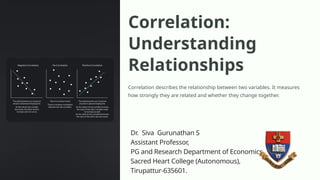
Correlation describes the relationship between two variables. It measures
how strongly they are related and whether they change together.
Dr. Siva Gurunathan S
Assistant Professor,
PG and Research Department of Economics,
Sacred Heart College (Autonomous),
Tirupattur-635601.
Correlation vs. Causation
Correlation
Correlation indicates a relationship between variables.
When one changes, the other tends to change as well.
But, it doesn't necessarily imply one causes the other.
Causation
Causation implies that one variable directly influences
another. A change in one directly causes a change in the
other. It establishes a clear cause-and-effect relationship.
Types of Correlation
1 Positive Correlation
Variables move in the
same direction. As one
increases, the other
tends to increase.
2 Negative
Correlation
Variables move in
opposite directions. As
one increases, the other
tends to decrease.
3 No Correlation
Variables show no relationship. Changes in one do not affect
the other.
Measuring Correlation
Pearson's Correlation
Coefficient (r)
Measures linear relationships
Spearman's Rank Correlation
Coefficient (ρ)
Measures monotonic
relationships
Interpreting Correlation
Coefficients
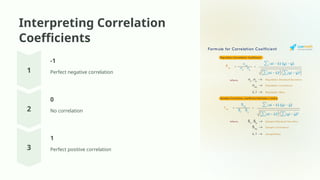
-1
Perfect negative correlation
0
No correlation
1
Perfect positive correlation
Assumptions of
Correlation Analysis
Linearity
The relationship between
variables should be linear.
Normality
Data should follow a normal
distribution.
Homoscedasticity
The variance of the data points should be equal across all values
of the independent variable.
Limitations of Correlation
Causation
Correlation does not prove causation. Other factors might influence the
relationship.
Outliers
Outliers can significantly affect correlation values.
Non-Linearity
Correlation analysis might not be suitable for non-linear relationships.
Applications of
Correlation
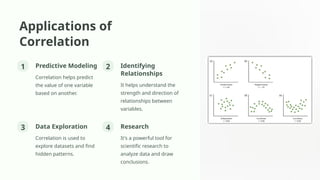
1 Predictive Modeling
Correlation helps predict
the value of one variable
based on another.
2 Identifying
Relationships
It helps understand the
strength and direction of
relationships between
variables.
3 Data Exploration
Correlation is used to
explore datasets and find
hidden patterns.
4 Research
It's a powerful tool for
scientific research to
analyze data and draw
conclusions.

Correlation Understanding Relationships.pptx

  • 1.
    Correlation: Understanding Relationships Correlation describes therelationship between two variables. It measures how strongly they are related and whether they change together. Dr. Siva Gurunathan S Assistant Professor, PG and Research Department of Economics, Sacred Heart College (Autonomous), Tirupattur-635601.
  • 2.
    Correlation vs. Causation Correlation Correlationindicates a relationship between variables. When one changes, the other tends to change as well. But, it doesn't necessarily imply one causes the other. Causation Causation implies that one variable directly influences another. A change in one directly causes a change in the other. It establishes a clear cause-and-effect relationship.
  • 3.
    Types of Correlation 1Positive Correlation Variables move in the same direction. As one increases, the other tends to increase. 2 Negative Correlation Variables move in opposite directions. As one increases, the other tends to decrease. 3 No Correlation Variables show no relationship. Changes in one do not affect the other.
  • 4.
    Measuring Correlation Pearson's Correlation Coefficient(r) Measures linear relationships Spearman's Rank Correlation Coefficient (ρ) Measures monotonic relationships
  • 5.
    Interpreting Correlation Coefficients -1 Perfect negativecorrelation 0 No correlation 1 Perfect positive correlation
  • 6.
    Assumptions of Correlation Analysis Linearity Therelationship between variables should be linear. Normality Data should follow a normal distribution. Homoscedasticity The variance of the data points should be equal across all values of the independent variable.
  • 7.
    Limitations of Correlation Causation Correlationdoes not prove causation. Other factors might influence the relationship. Outliers Outliers can significantly affect correlation values. Non-Linearity Correlation analysis might not be suitable for non-linear relationships.
  • 8.
    Applications of Correlation 1 PredictiveModeling Correlation helps predict the value of one variable based on another. 2 Identifying Relationships It helps understand the strength and direction of relationships between variables. 3 Data Exploration Correlation is used to explore datasets and find hidden patterns. 4 Research It's a powerful tool for scientific research to analyze data and draw conclusions.