YG
CSR REPORTING AND
SUSTAINABILITY
REPORTING
Subject - Coorporate Laws
GROUP MEMBERS
Yashdeep Garg
Manu Kumar Sharma
Samyak singh
Neeraj Pandey
What Is Corporate Social
Responsibility (CSR)
Corporate social responsibility (CSR) is a self-
regulating business model that helps a company
be socially accountable to itself, its stakeholders,
and the public. By practicing corporate social
responsibility, also called corporate citizenship,
companies can be conscious of the kind of impact
they are having on all aspects of society, including
economic, social, and environmental.
UNDERSTANDING
CORPORATE SOCIAL
RESPONSIBILITY (CSR)
Corporate social responsibility is a broad
concept that can take many forms depending
on the company and industry. Through CSR
programs & volunteer efforts, businesses can
benefit society while boosting their brands.
A c ompany to be soc ially responsible, it needs
to be accountable to itself & its shareholders.
Companies that adopt CSR programs have often
grown their business to the point where they
can give back to society.
TYPESOF CSR
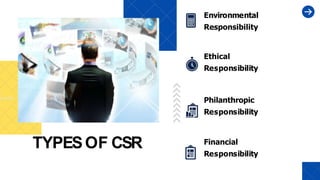
Environmental
Responsibility
Ethical
Responsibility
Philanthropic
Responsibility
Financial
Responsibility
Environmental
Responsibility
Environmental responsibility is the pillar
of corporate social responsibility rooted
in preserving mother nature. Through
optimal operations and support of
related causes, a company can ensure it
leaves natural resources better than
before its operations. 20
22
Ethical Responsibility
Fair treatment across all types of
customers regardless of age,
race, culture, or sexual
orientation.
Expansion of vendor use to utilize
different suppliers of different
races, genders, Veteran statuses,
or economic statuses.
20
22
Philanthropic
20
22
Responsibility
Philanthropic responsibility refers to how a
company spends its resources to make the
world a better place. This includes:
Whether a company donates profit to
charities or causes it believes in.
Whether a company only enters into
transactions with suppliers or vendors that
align with the company philanthropically.
Whether a company sponsors fundraising
events or has a presence in the community
for related events.
Financial Responsibility
Research and development for new products
that encourage sustainability.
Recruiting different types of talent to ensure a
diverse workforce.
Initiatives that train employees on DEI, social
awareness, or environmental concerns.
Processes that might be more expensive but
yield greater CSR results.
Need For CSR
TO Reduce the Social Cost.
To enhance the
performance of employees.
It leads to industrial peace.
It improvr the public image.
Can generate more profit.
It satisfies the
Stakeholders.
What is Sustainability
Reporting
sustainability reporting, companies
communicate their performance and impacts
on a wide range of sustainability topics,
spanning environmental, social and
governance parameters. It enables companies
to be more transparent about the risks and
opportunities they face, giving stakeholders
greater insight into performance beyond the
bottom line.
Benefits of Sustainability
Reporting:
Increases understanding of risks and
opportunities.
Emphasizes the link between financial and
non-financial performance.
Influences long-term management strategy,
policy and business plans.
Streamlines processes, reducing costs and
improving efficiency.
Helps companies avoid publicized
environmental, social and governance
failures.
The value of CSR and sustainability reporting is that it
ensures businesses take cognisance of their impacts on
sustainability matters and allows them to be transparent
about the risks and opportunities they face.
Furthermore, the Global Reporting Initiative (GRI)
describes sustainability reporting as an outline of an
organisation’s environmental, economic and social
impacts produced by its everyday business activities.
WHY ARE CSR AND SUSTAINABILITY
REPORTI
NG I
MPORTANT?
Thank you!

CSR REPORTING AND SUSTAINABILITY REPORTING.pptx

  • 1.
  • 2.
    GROUP MEMBERS Yashdeep Garg ManuKumar Sharma Samyak singh Neeraj Pandey
  • 3.
    What Is CorporateSocial Responsibility (CSR) Corporate social responsibility (CSR) is a self- regulating business model that helps a company be socially accountable to itself, its stakeholders, and the public. By practicing corporate social responsibility, also called corporate citizenship, companies can be conscious of the kind of impact they are having on all aspects of society, including economic, social, and environmental.
  • 4.
    UNDERSTANDING CORPORATE SOCIAL RESPONSIBILITY (CSR) Corporatesocial responsibility is a broad concept that can take many forms depending on the company and industry. Through CSR programs & volunteer efforts, businesses can benefit society while boosting their brands. A c ompany to be soc ially responsible, it needs to be accountable to itself & its shareholders. Companies that adopt CSR programs have often grown their business to the point where they can give back to society.
  • 5.
  • 6.
    Environmental Responsibility Environmental responsibility isthe pillar of corporate social responsibility rooted in preserving mother nature. Through optimal operations and support of related causes, a company can ensure it leaves natural resources better than before its operations. 20 22
  • 7.
    Ethical Responsibility Fair treatmentacross all types of customers regardless of age, race, culture, or sexual orientation. Expansion of vendor use to utilize different suppliers of different races, genders, Veteran statuses, or economic statuses. 20 22
  • 8.
    Philanthropic 20 22 Responsibility Philanthropic responsibility refersto how a company spends its resources to make the world a better place. This includes: Whether a company donates profit to charities or causes it believes in. Whether a company only enters into transactions with suppliers or vendors that align with the company philanthropically. Whether a company sponsors fundraising events or has a presence in the community for related events.
  • 9.
    Financial Responsibility Research anddevelopment for new products that encourage sustainability. Recruiting different types of talent to ensure a diverse workforce. Initiatives that train employees on DEI, social awareness, or environmental concerns. Processes that might be more expensive but yield greater CSR results.
  • 10.
    Need For CSR TOReduce the Social Cost. To enhance the performance of employees. It leads to industrial peace. It improvr the public image. Can generate more profit. It satisfies the Stakeholders.
  • 11.
    What is Sustainability Reporting sustainabilityreporting, companies communicate their performance and impacts on a wide range of sustainability topics, spanning environmental, social and governance parameters. It enables companies to be more transparent about the risks and opportunities they face, giving stakeholders greater insight into performance beyond the bottom line.
  • 12.
    Benefits of Sustainability Reporting: Increasesunderstanding of risks and opportunities. Emphasizes the link between financial and non-financial performance. Influences long-term management strategy, policy and business plans. Streamlines processes, reducing costs and improving efficiency. Helps companies avoid publicized environmental, social and governance failures.
  • 13.
    The value ofCSR and sustainability reporting is that it ensures businesses take cognisance of their impacts on sustainability matters and allows them to be transparent about the risks and opportunities they face. Furthermore, the Global Reporting Initiative (GRI) describes sustainability reporting as an outline of an organisation’s environmental, economic and social impacts produced by its everyday business activities. WHY ARE CSR AND SUSTAINABILITY REPORTI NG I MPORTANT?
  • 14.