Corporate Security:
An educational framework of
 integrated knowledge categories

Dr. David Brooks
Security Research Centre (SECAU)
Edith Cowan University, Australia


2009 ASIS International Security Conference
3-5 February 2009
Hong Kong
  Dave Brooks                                 1
Overview
• Understanding security?
• Research questions
• Foundation theories
     – Knowledge structure
     – Multidimensional scaling
• Study design
• Analysis
• Security science framework
Dave Brooks                       2
Understanding Security
• What is security?
• Security industry is broad and multi-
  disciplined
• Security has many layers
• Current international politics has further
  broadened security
• “every time we think we’ve got the
  definition of the security field nailed,
  somebody … starts taking some of the nails
  away” (ASIS International, 2003, p. 10)
Dave Brooks                                3
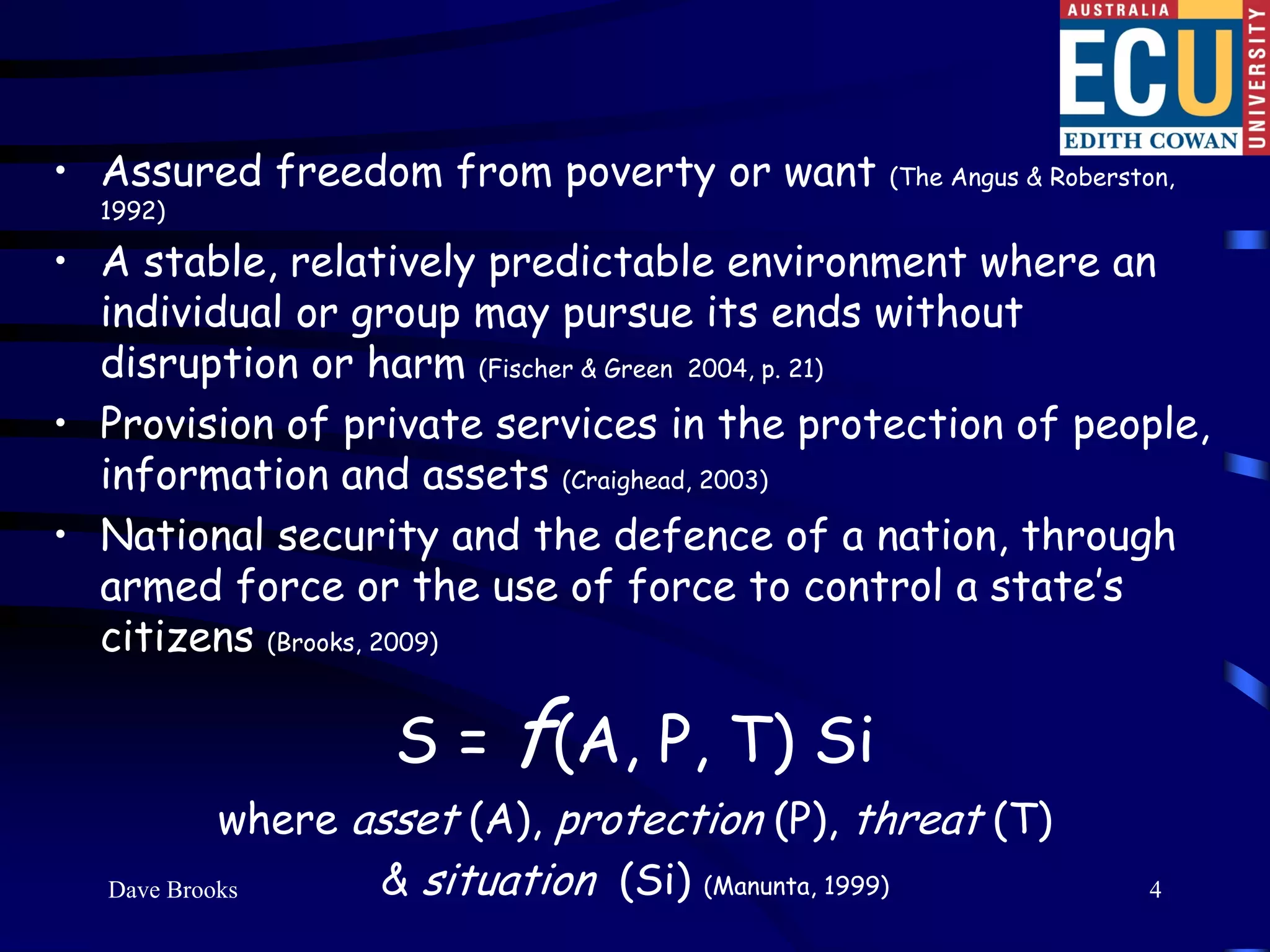
• Assured freedom from poverty or want       (The Angus & Roberston,
  1992)

• A stable, relatively predictable environment where an
  individual or group may pursue its ends without
  disruption or harm (Fischer & Green 2004, p. 21)
• Provision of private services in the protection of people,
  information and assets (Craighead, 2003)
• National security and the defence of a nation, through
  armed force or the use of force to control a state’s
  citizens (Brooks, 2009)

                 S = f(A, P, T) Si
           where asset (A), protection (P), threat (T)
  Dave Brooks     & situation (Si) (Manunta, 1999)               4
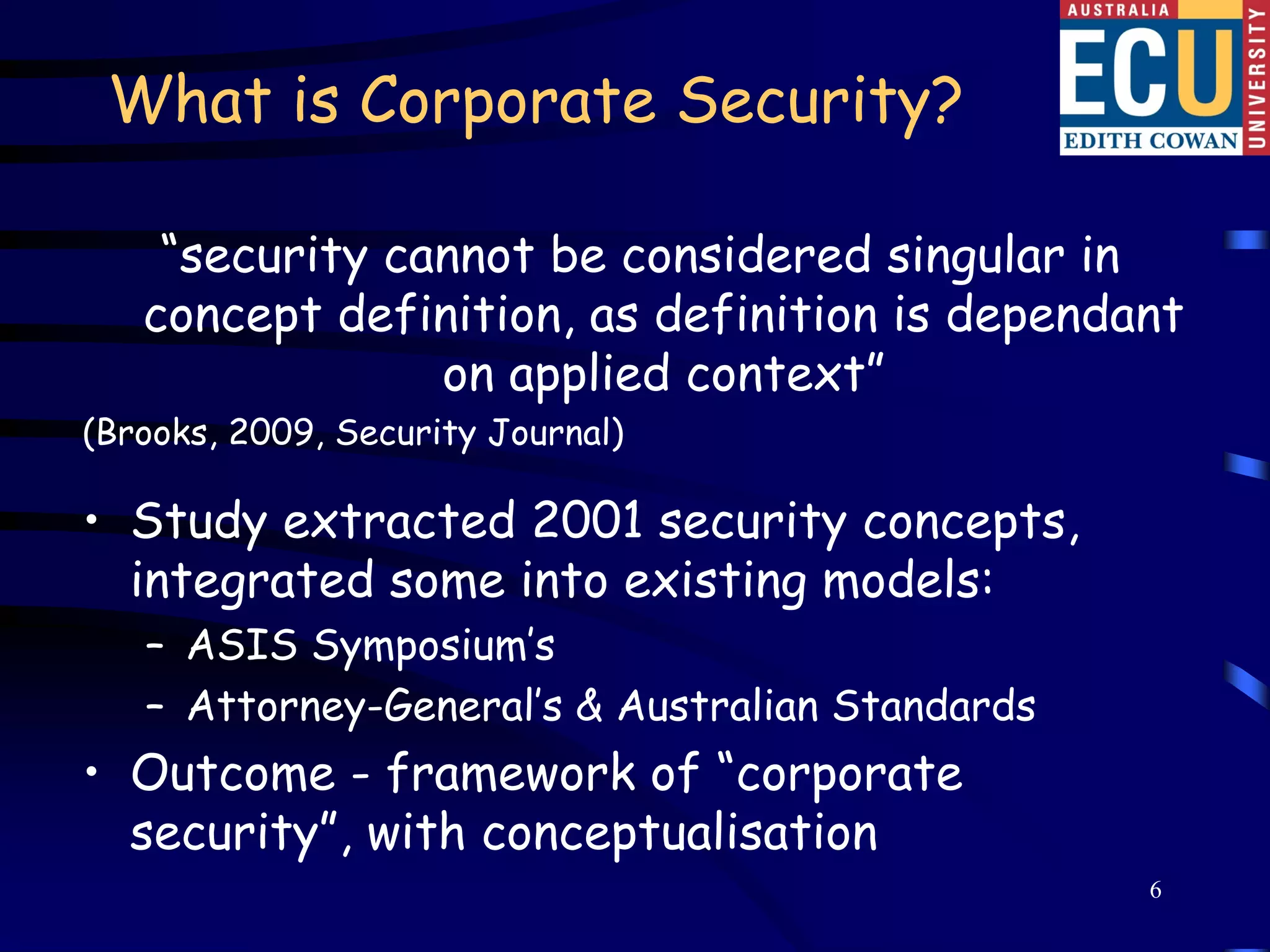
Importance of Definition
•   Career path – compulsory to tertiary
•   Direct higher education
•   Professional bodies
•   Applied research
•   Self regulation
•   Social understanding


Dave Brooks                                5
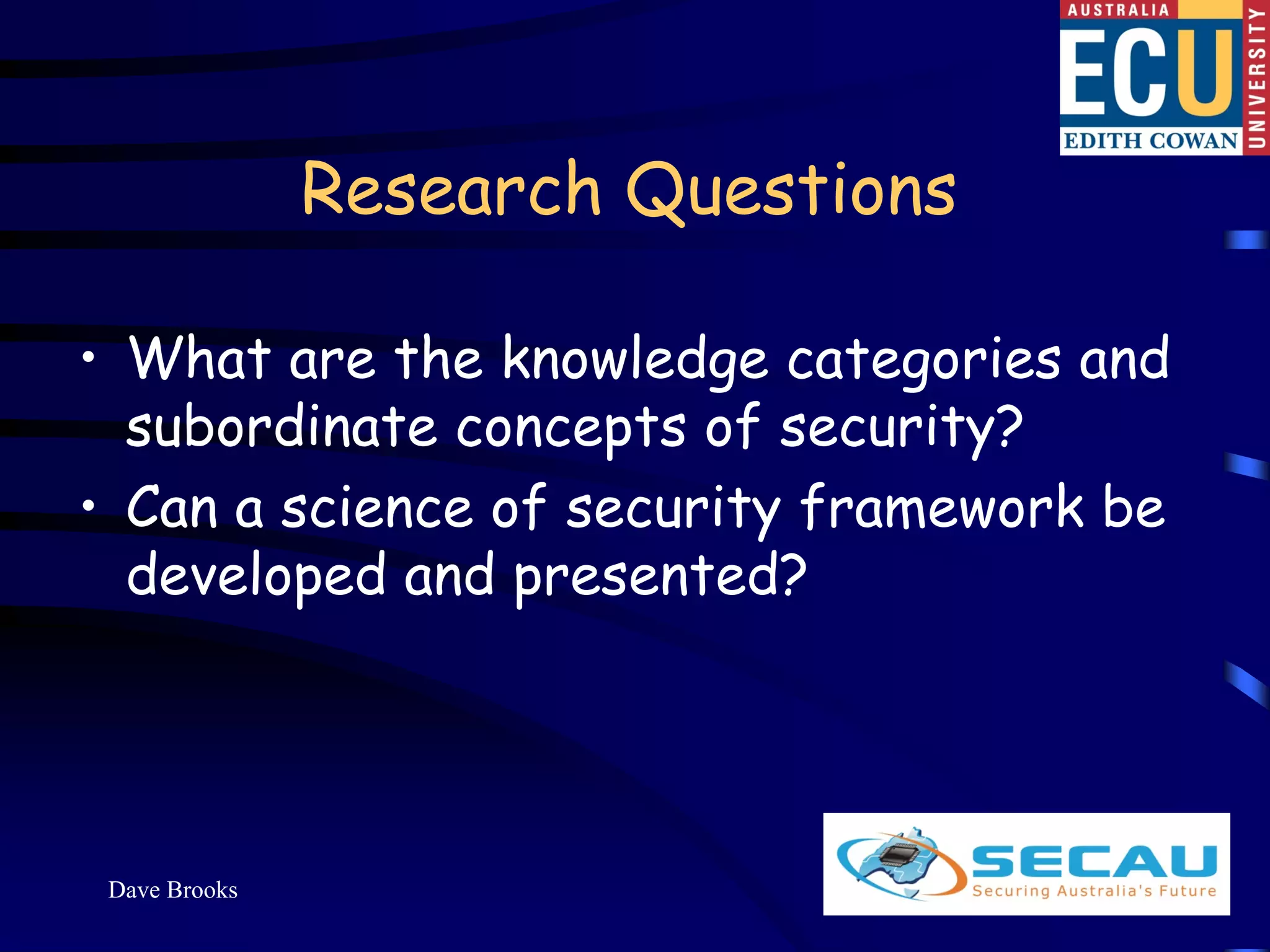
What is Corporate Security?

    “security cannot be considered singular in
   concept definition, as definition is dependant
                on applied context”
(Brooks, 2009, Security Journal)

• Study extracted 2001 security concepts,
  integrated some into existing models:
   – ASIS Symposium’s
   – Attorney-General’s & Australian Standards
• Outcome - framework of “corporate
  security”, with conceptualisation
                                                 6
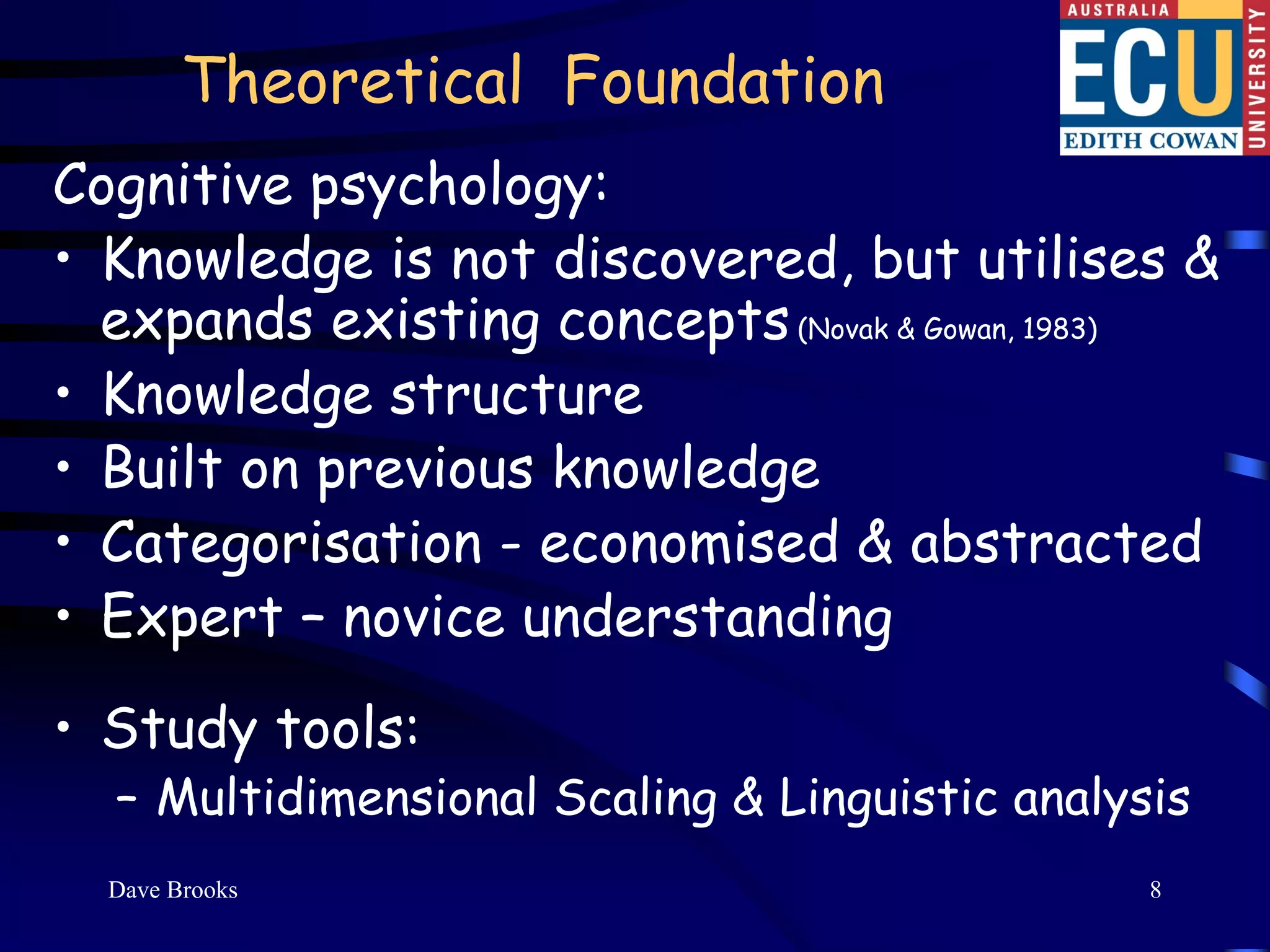
Research Questions

• What are the knowledge categories and
  subordinate concepts of security?
• Can a science of security framework be
  developed and presented?


 Dave Brooks                           7
Theoretical Foundation
Cognitive psychology:
• Knowledge is not discovered, but utilises &
  expands existing concepts (Novak & Gowan, 1983)
• Knowledge structure
• Built on previous knowledge
• Categorisation - economised & abstracted
• Expert – novice understanding
• Study tools:
  – Multidimensional Scaling & Linguistic analysis
  Dave Brooks                                   8
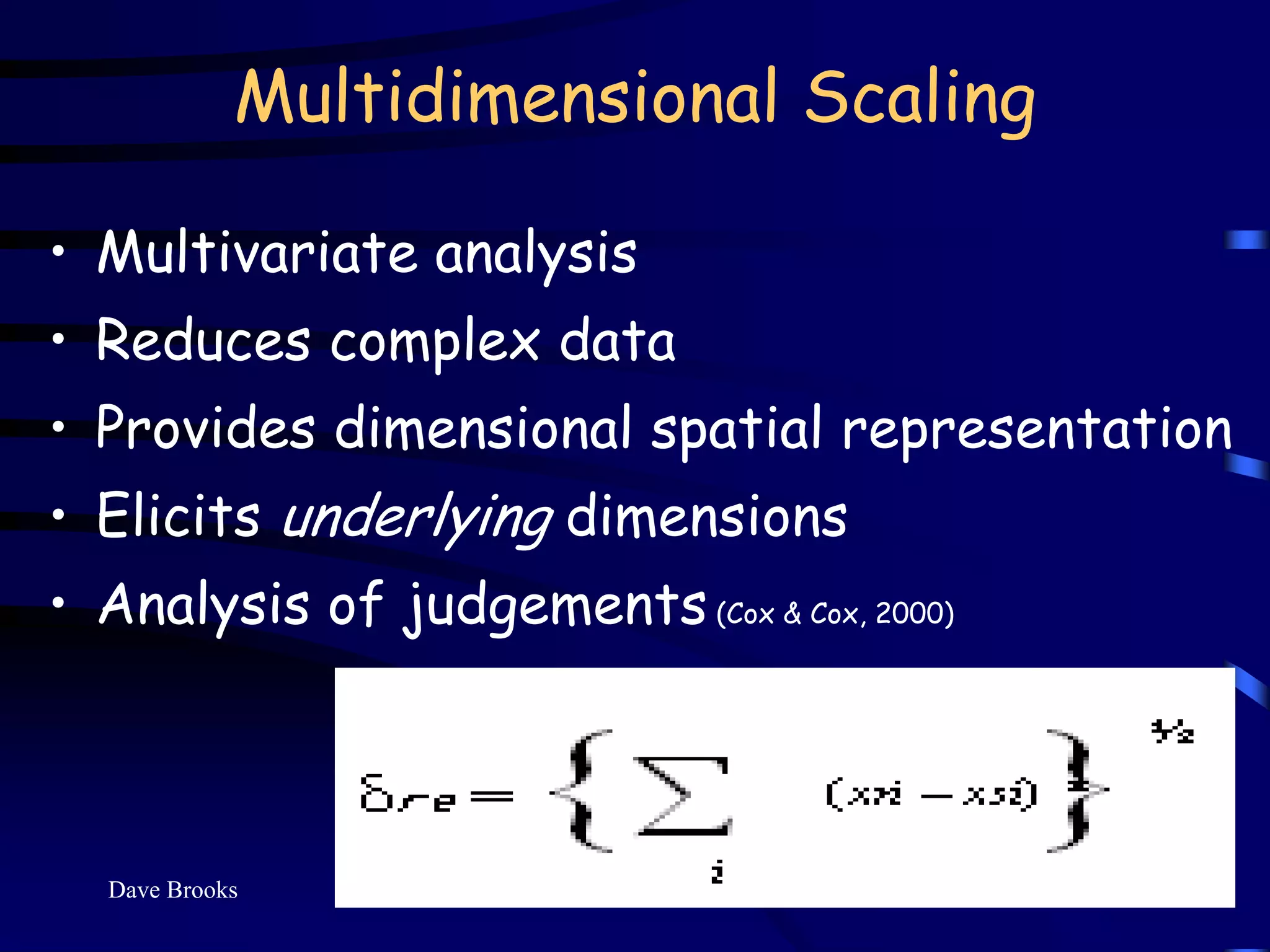
Multidimensional Scaling

• Multivariate analysis
• Reduces complex data
• Provides dimensional spatial representation
• Elicits underlying dimensions
• Analysis of judgements (Cox & Cox, 2000)


  Dave Brooks                                9
Initial Analysis
• 104 International tertiary security courses
  critiqued
• 9 Courses selected for content analysis
   & 7 syllabi sourced
• 2001 concepts extraction
• Most common concepts identified using
  Linguistic Inquiry & Word Count (Pennebaker, Francis &
  Booth, 2001)

• Expert validation (N=5)
 Dave Brooks                                         10
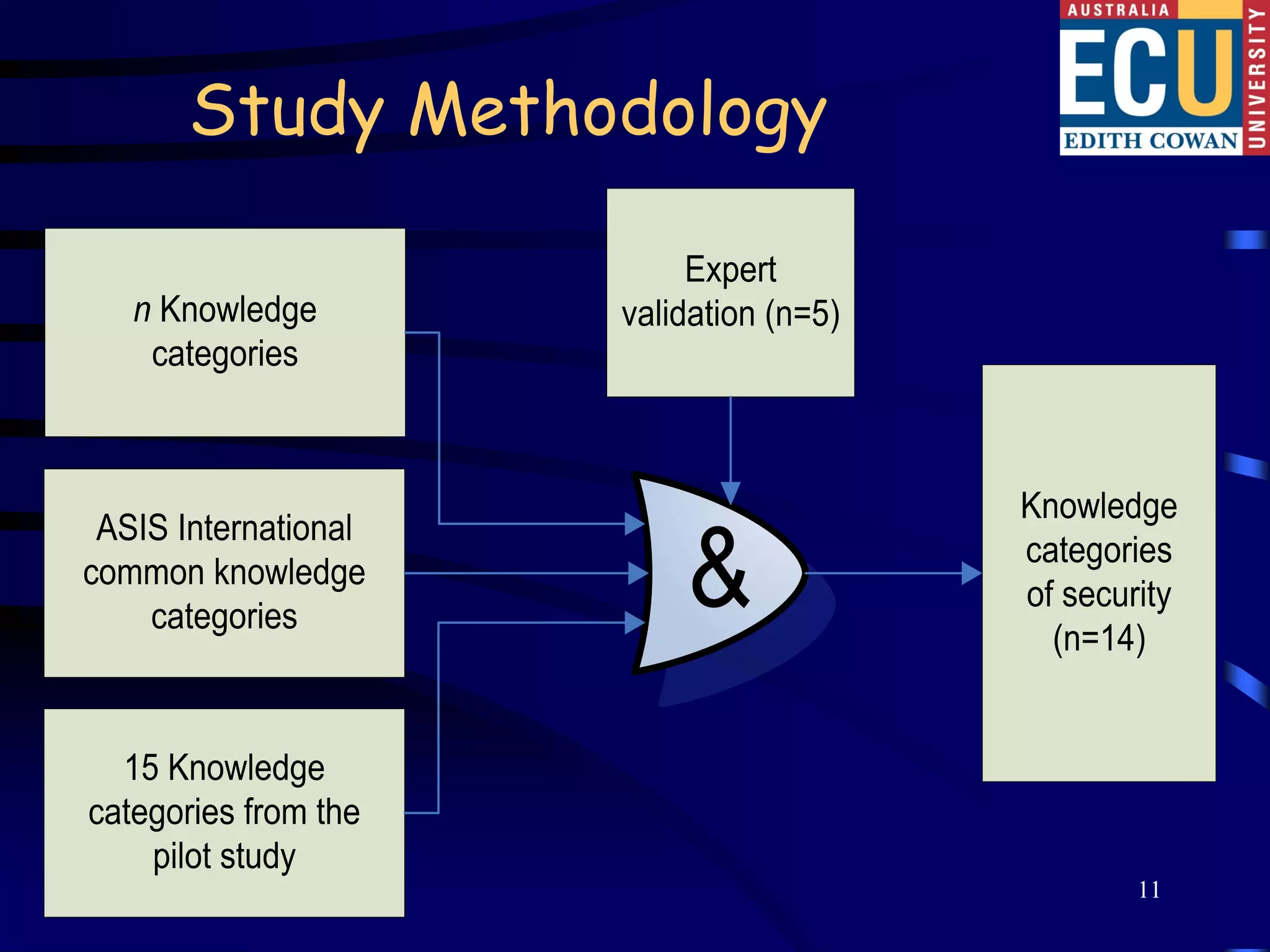
Study Methodology


Dave Brooks               11
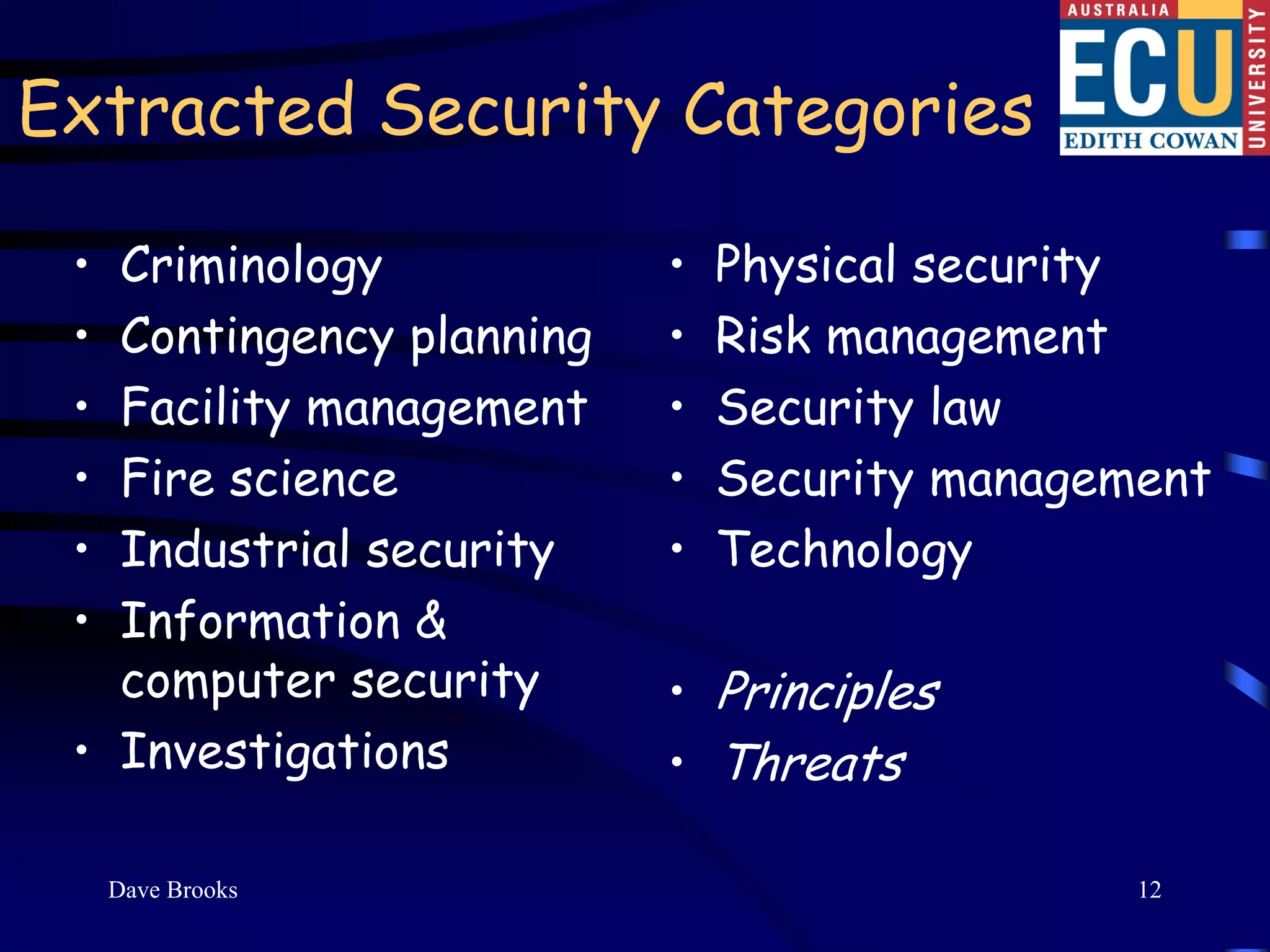
Extracted Security Categories

 • Criminology            •   Physical security
 • Contingency planning   •   Risk management
 • Facility management    •   Security law
 • Fire science           •   Security management
 • Industrial security    •   Technology
 • Information &
   computer security      • Principles
 • Investigations         • Threats

     Dave Brooks                              12
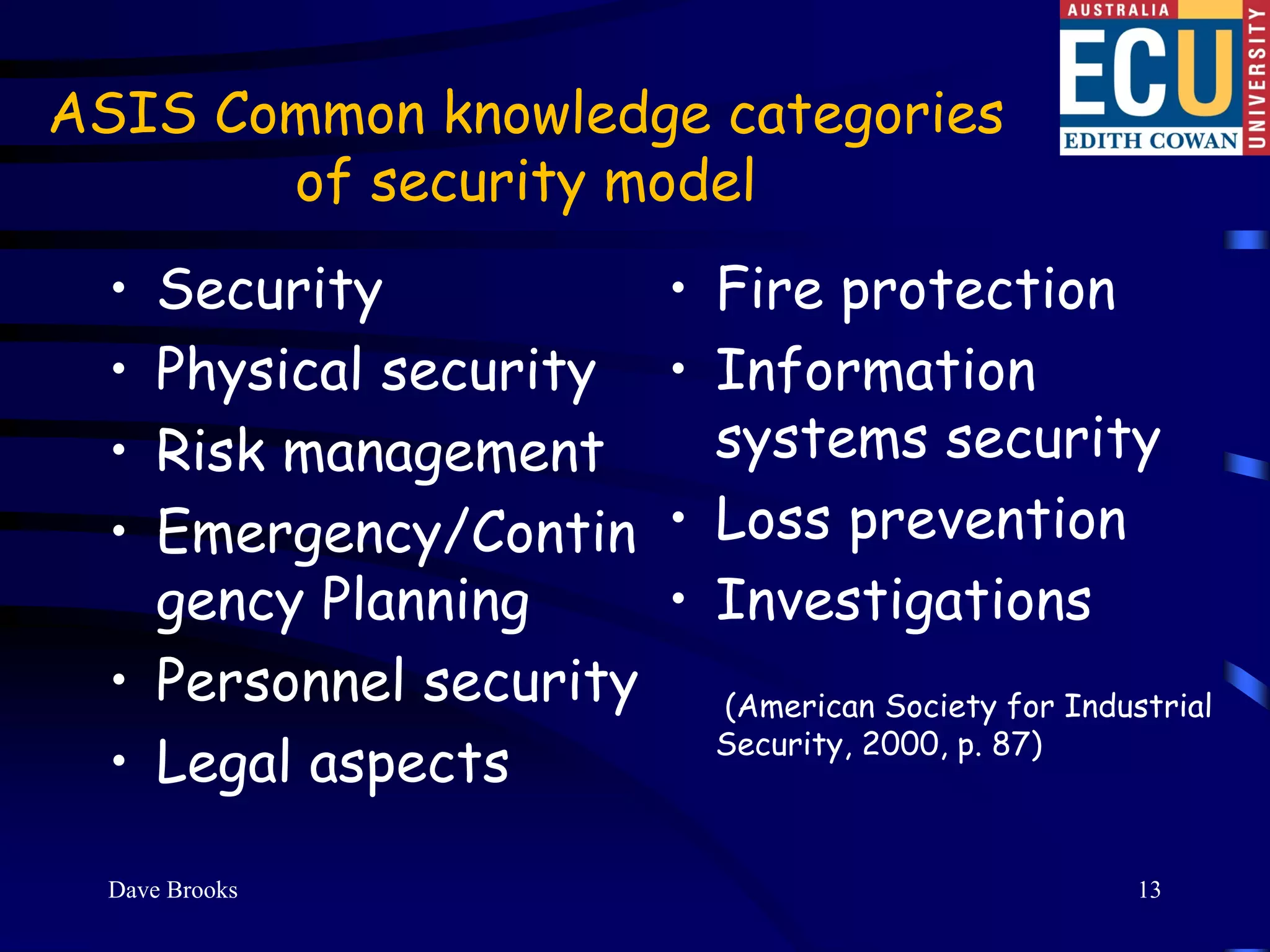
ASIS Common knowledge categories
       of security model
  • Security             • Fire protection
  • Physical security    • Information
  • Risk management        systems security
  • Emergency/Contin     • Loss prevention
    gency Planning       • Investigations
  • Personnel security    (American Society for Industrial

  • Legal aspects         Security, 2000, p. 87)


  Dave Brooks                                        13
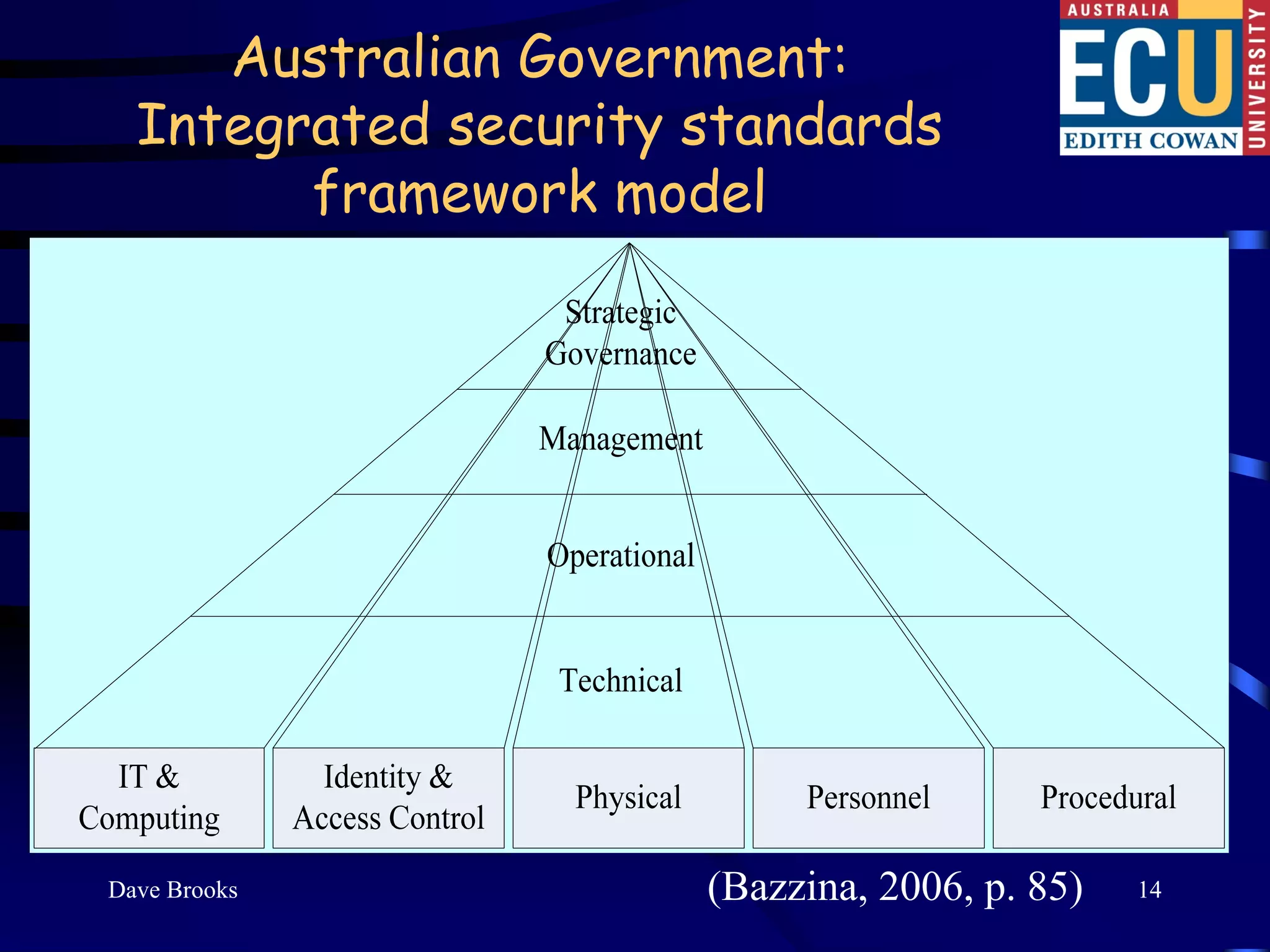
Australian Government:
  Integrated security standards
        framework model


Dave Brooks           (Bazzina, 2006, p. 85)   14
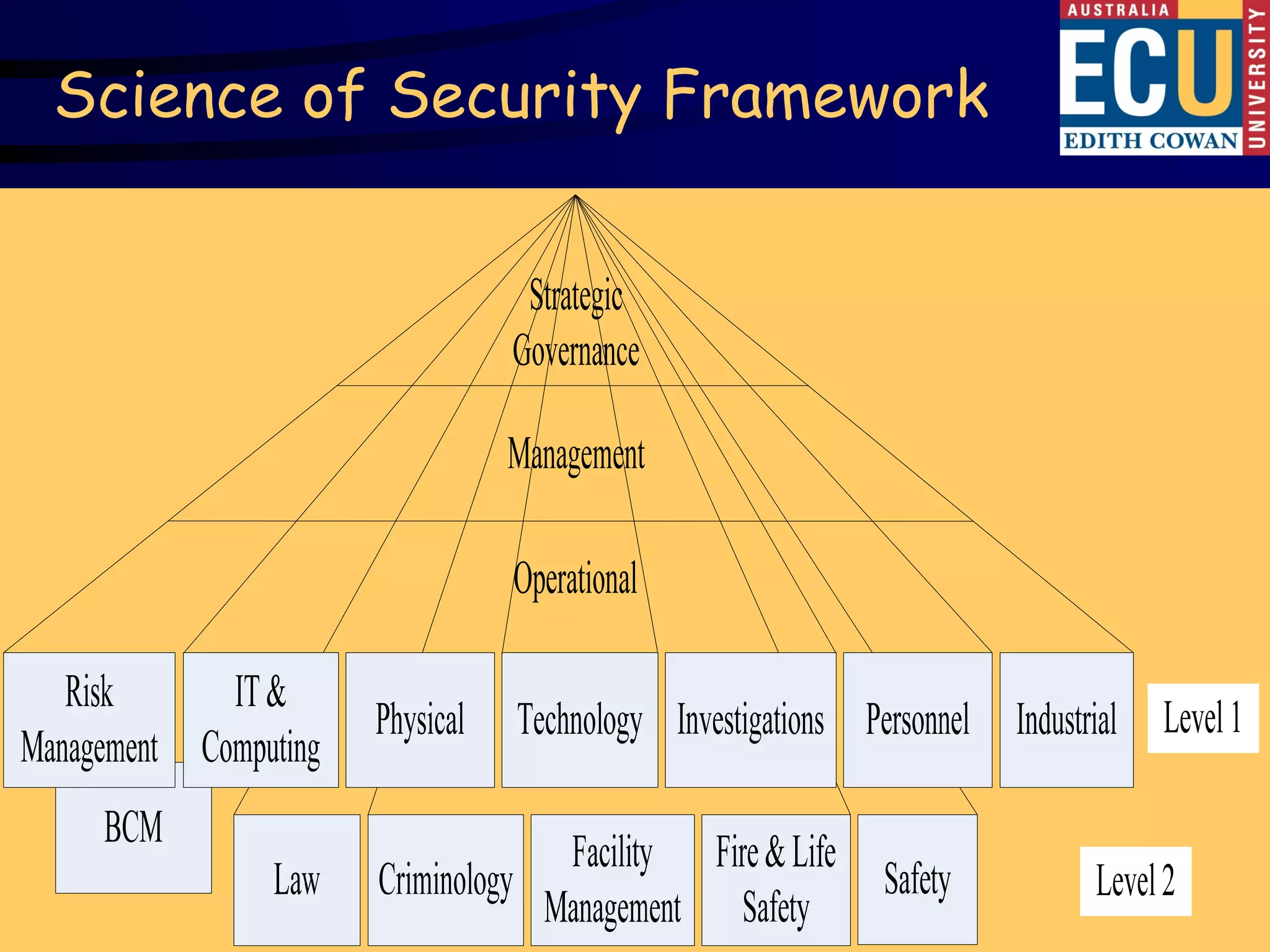
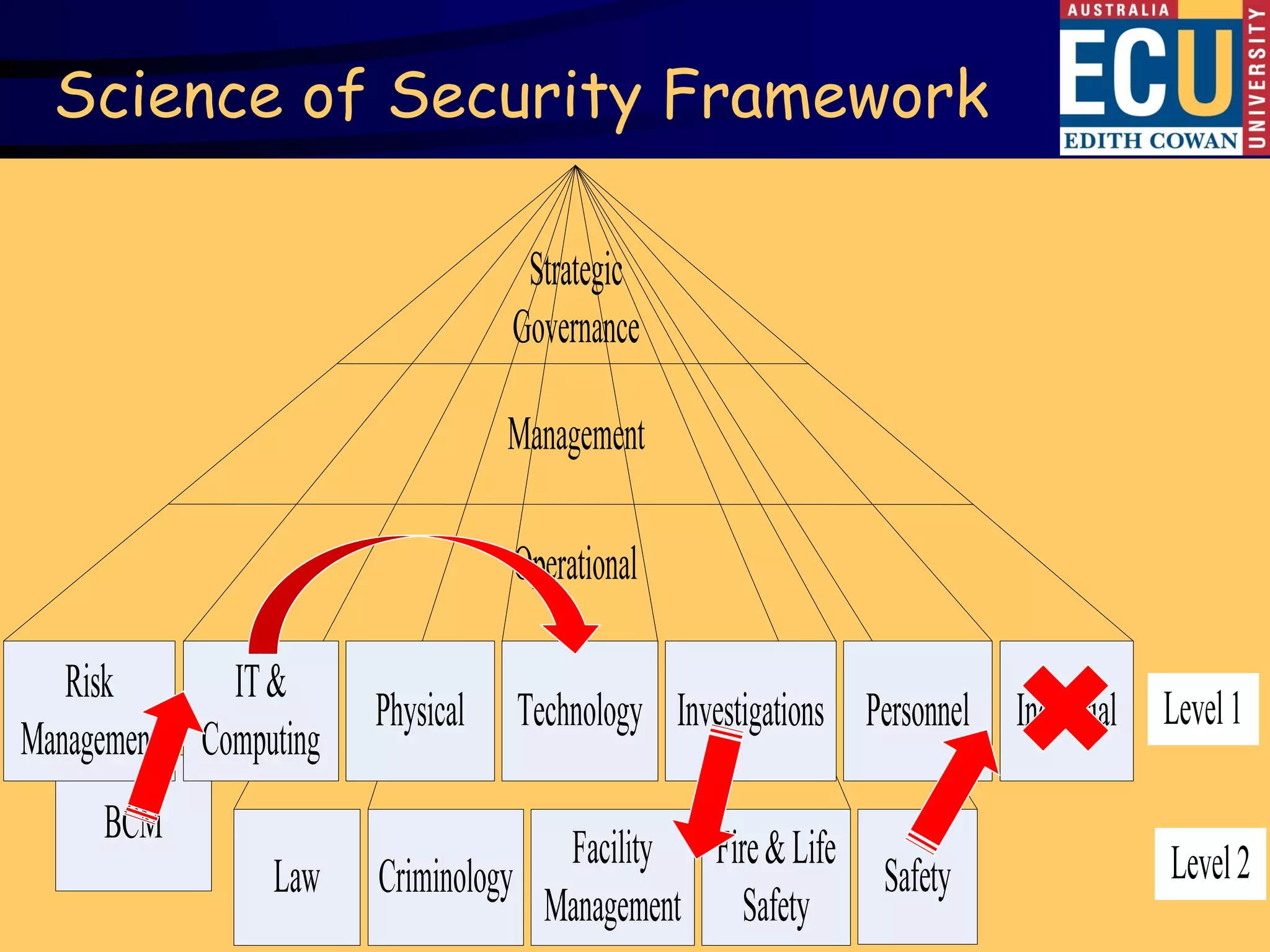
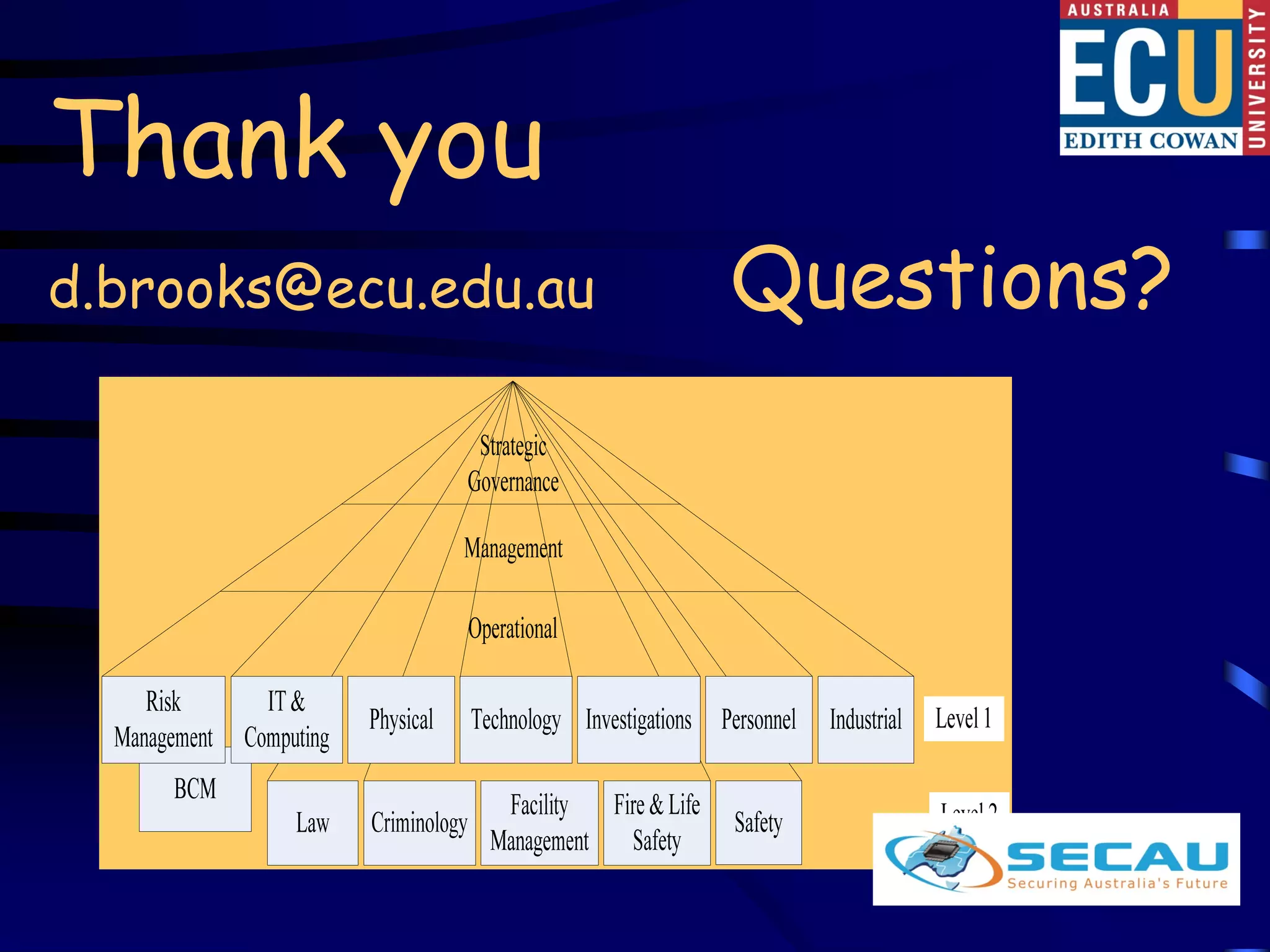
Science of Security Framework


                                15
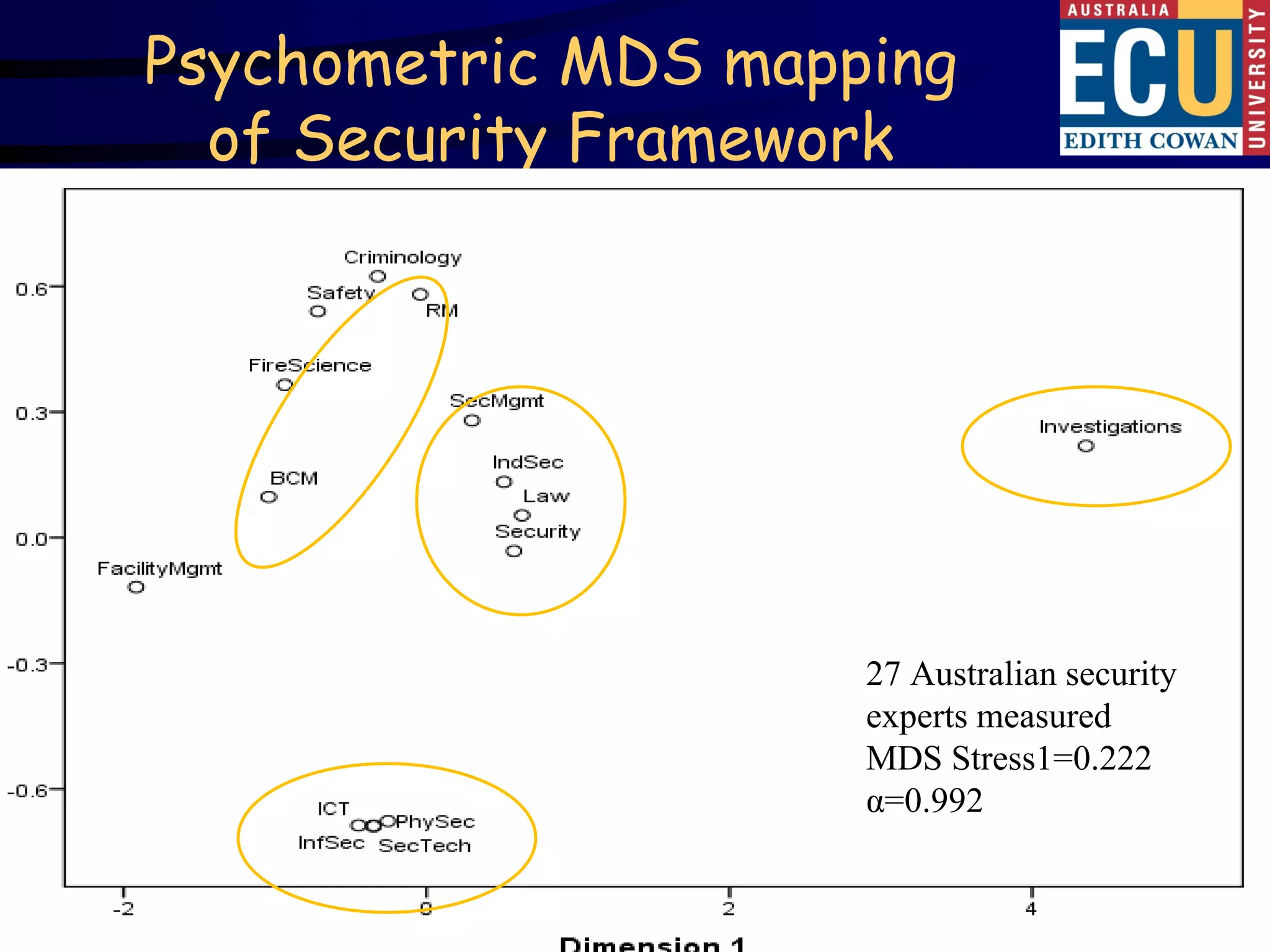
Psychometric MDS mapping
  of Security Framework


                     27 Australian security
                     experts measured
                     MDS Stress1=0.222
                     α=0.992

                                        16
Science of Security Framework


                                17
Concluding Remarks

• Framework of security presented
• Assist in developing a consensual body
  of knowledge
• Reversed engineered a definition of
  organisational security
• Gained a clear & common understanding?
• Further international research required

Dave Brooks                           18
Thank you
d.brooks@ecu.edu.au   Questions?


                               19
References
American Society for Industrial Security. (2000). Proceedings of the 2000 academic/practitioner
    symposium, The University of Oklahoma, Oklahoma: American Society for Industrial Security.
ASIS International. (2003). Proceedings of the 2003 academic/practitioner symposium, The
    University of Maryland, Maryland: ASIS International.
Bazzina, M. (2006). Security standards and support systems report: A collaborative project
    between the Commonwealth Attorney-General's Department and Standards Australia. Sydney:
    Standards Australia International Ltd.
Brooks, D. J. (2009 in print). What is security: Definition through knowledge categorisation.
    Security Journal.
Craighead, G. (2003). High-rise security and fire life safety. (2nd ed.). Woburn, MA: Butterworth-
    Heinemann.
Cox, T. F. & Cox, M. A. A. (2000). Multidimensional scaling: Monographs on statistics and applied
    probability. London: Chapman & Hall/CRC.
Ferguson, G. (2004, August). Homeland security: Emerging technologies: Policing conference
    returns to Adelaide. Australian Defence Magazine, 12(8), 54.
Fischer, R. J. & Green, G. (2004). Introduction to security. (7th ed.). Boston: Butterworth
    Heinemann.
Novak, J.D. & Gowin, D. B. (1984). Learning how to learn. Cambridge: Cambridge University Press.
Pennebaker, J. W., Francis, M. E. & Booth, R. J. (2001). Linguistic inquiry and word count
    (LIWC2001). Mahwah, NJ: Erlbaum Publishers.
The Angus & Roberston. (1992). Dictionary and thesaurus. Sydney: Harper Collins Publishers.
Yates, A. (2004). Australia's homeland security market and industry's role. Canberra: Australian
    Homeland Security Research Centre.
  Dave Brooks                                                                              20

Corporate Security-Training and Education

  • 1.
    Corporate Security: An educationalframework of integrated knowledge categories Dr. David Brooks Security Research Centre (SECAU) Edith Cowan University, Australia 2009 ASIS International Security Conference 3-5 February 2009 Hong Kong Dave Brooks 1
  • 2.
    Overview • Understanding security? •Research questions • Foundation theories – Knowledge structure – Multidimensional scaling • Study design • Analysis • Security science framework Dave Brooks 2
  • 3.
    Understanding Security • Whatis security? • Security industry is broad and multi- disciplined • Security has many layers • Current international politics has further broadened security • “every time we think we’ve got the definition of the security field nailed, somebody … starts taking some of the nails away” (ASIS International, 2003, p. 10) Dave Brooks 3
  • 4.
    • Assured freedomfrom poverty or want (The Angus & Roberston, 1992) • A stable, relatively predictable environment where an individual or group may pursue its ends without disruption or harm (Fischer & Green 2004, p. 21) • Provision of private services in the protection of people, information and assets (Craighead, 2003) • National security and the defence of a nation, through armed force or the use of force to control a state’s citizens (Brooks, 2009) S = f(A, P, T) Si where asset (A), protection (P), threat (T) Dave Brooks & situation (Si) (Manunta, 1999) 4
  • 5.
    Importance of Definition • Career path – compulsory to tertiary • Direct higher education • Professional bodies • Applied research • Self regulation • Social understanding Dave Brooks 5
  • 6.
    What is CorporateSecurity? “security cannot be considered singular in concept definition, as definition is dependant on applied context” (Brooks, 2009, Security Journal) • Study extracted 2001 security concepts, integrated some into existing models: – ASIS Symposium’s – Attorney-General’s & Australian Standards • Outcome - framework of “corporate security”, with conceptualisation 6
  • 7.
    Research Questions • Whatare the knowledge categories and subordinate concepts of security? • Can a science of security framework be developed and presented? Dave Brooks 7
  • 8.
    Theoretical Foundation Cognitive psychology: •Knowledge is not discovered, but utilises & expands existing concepts (Novak & Gowan, 1983) • Knowledge structure • Built on previous knowledge • Categorisation - economised & abstracted • Expert – novice understanding • Study tools: – Multidimensional Scaling & Linguistic analysis Dave Brooks 8
  • 9.
    Multidimensional Scaling • Multivariateanalysis • Reduces complex data • Provides dimensional spatial representation • Elicits underlying dimensions • Analysis of judgements (Cox & Cox, 2000) Dave Brooks 9
  • 10.
    Initial Analysis • 104International tertiary security courses critiqued • 9 Courses selected for content analysis & 7 syllabi sourced • 2001 concepts extraction • Most common concepts identified using Linguistic Inquiry & Word Count (Pennebaker, Francis & Booth, 2001) • Expert validation (N=5) Dave Brooks 10
  • 11.
  • 12.
    Extracted Security Categories • Criminology • Physical security • Contingency planning • Risk management • Facility management • Security law • Fire science • Security management • Industrial security • Technology • Information & computer security • Principles • Investigations • Threats Dave Brooks 12
  • 13.
    ASIS Common knowledgecategories of security model • Security • Fire protection • Physical security • Information • Risk management systems security • Emergency/Contin • Loss prevention gency Planning • Investigations • Personnel security (American Society for Industrial • Legal aspects Security, 2000, p. 87) Dave Brooks 13
  • 14.
    Australian Government: Integrated security standards framework model Dave Brooks (Bazzina, 2006, p. 85) 14
  • 15.
    Science of SecurityFramework 15
  • 16.
    Psychometric MDS mapping of Security Framework 27 Australian security experts measured MDS Stress1=0.222 α=0.992 16
  • 17.
    Science of SecurityFramework 17
  • 18.
    Concluding Remarks • Frameworkof security presented • Assist in developing a consensual body of knowledge • Reversed engineered a definition of organisational security • Gained a clear & common understanding? • Further international research required Dave Brooks 18
  • 19.
  • 20.
    References American Society forIndustrial Security. (2000). Proceedings of the 2000 academic/practitioner symposium, The University of Oklahoma, Oklahoma: American Society for Industrial Security. ASIS International. (2003). Proceedings of the 2003 academic/practitioner symposium, The University of Maryland, Maryland: ASIS International. Bazzina, M. (2006). Security standards and support systems report: A collaborative project between the Commonwealth Attorney-General's Department and Standards Australia. Sydney: Standards Australia International Ltd. Brooks, D. J. (2009 in print). What is security: Definition through knowledge categorisation. Security Journal. Craighead, G. (2003). High-rise security and fire life safety. (2nd ed.). Woburn, MA: Butterworth- Heinemann. Cox, T. F. & Cox, M. A. A. (2000). Multidimensional scaling: Monographs on statistics and applied probability. London: Chapman & Hall/CRC. Ferguson, G. (2004, August). Homeland security: Emerging technologies: Policing conference returns to Adelaide. Australian Defence Magazine, 12(8), 54. Fischer, R. J. & Green, G. (2004). Introduction to security. (7th ed.). Boston: Butterworth Heinemann. Novak, J.D. & Gowin, D. B. (1984). Learning how to learn. Cambridge: Cambridge University Press. Pennebaker, J. W., Francis, M. E. & Booth, R. J. (2001). Linguistic inquiry and word count (LIWC2001). Mahwah, NJ: Erlbaum Publishers. The Angus & Roberston. (1992). Dictionary and thesaurus. Sydney: Harper Collins Publishers. Yates, A. (2004). Australia's homeland security market and industry's role. Canberra: Australian Homeland Security Research Centre. Dave Brooks 20