Corporate Responsibility in
Advertisement
Group Members
 Abdullah Hamid
 Mehtab Artas
 Danish Aftab
Ethics and Advertising
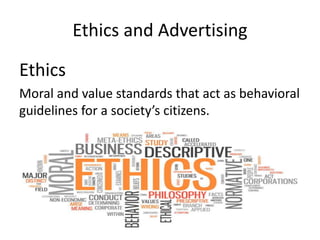
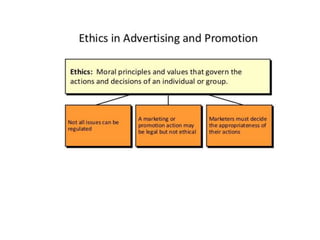
Ethics
Moral and value standards that act as behavioral
guidelines for a society’s citizens.
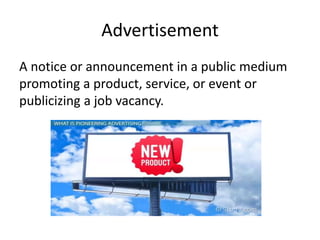
Advertisement
A notice or announcement in a public medium
promoting a product, service, or event or
publicizing a job vacancy.
Vedio
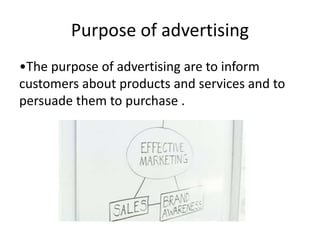
Purpose of advertising
•The purpose of advertising are to inform
customers about products and services and to
persuade them to purchase .
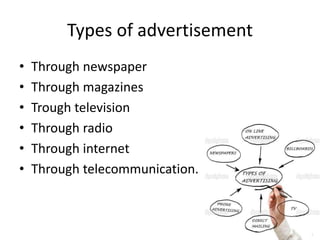
Types of advertisement
• Through newspaper
• Through magazines
• Trough television
• Through radio
• Through internet
• Through telecommunication.
Ethics and Advertising
• Is the consumer being treated as a mean to an end
or as an end ?what and whose end ?
• Whose rights are being protected or violated
intentionally and inadvertently ? at what and whose
cost ?
• Are consumer being justly and fairly treated
• Are the public welfare and good taken into
consideration for the effects as well as the intention
of advertisement?
Advertising Ethics & Principles
Advertising Federation’s (AF) Code of Ethics
• Truth
• Substantiation
• Comparisons
• Guarantees and warranties
• Price claims
• Testimonials
• Taste and decency
A corporation’s ethical responsibility in
advertising
Ethical responsibility in advertising is to Inform
and persuade consumer stakeholder in ways
that
• Do not lie
• Deceive
• Conceal
• Withhold the truth
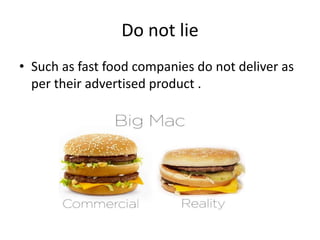
Do not lie
• Such as fast food companies do not deliver as
per their advertised product .
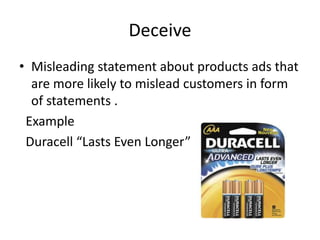
Deceive
• Misleading statement about products ads that
are more likely to mislead customers in form
of statements .
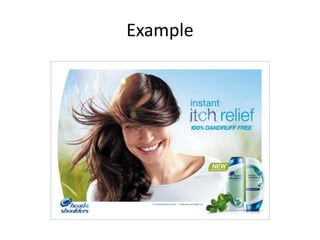
Example
Duracell “Lasts Even Longer”
Conceal
• Concealment of truth means that companies
do not tell the truth about their product
capacity and performance.
Example
Unethical Advertisement
• False Advertising
• Puffery
• Bait and Switch
• Advertising to Children
• Telemarketing
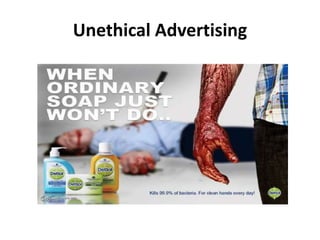
Unethical Advertising
Unethical According to direct targeting
Unethical according to culture
False Advertising
• Practice of making statements about a
product that the advertiser knows are not
true.
• May be about how product works, how it is
made, or how it will affect people who buy or
use it. Unethical and dishonest Public reaction
can be severe
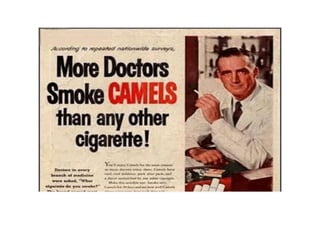
• Example: Tobacco Industry
Tobacco and Alcohol Advertisement
• In the past tobacco industry spent
approximately $8.2 billion in 1999 for
advertisement targeting directly college
graduates and poor people.
• Now government banned alcohol and tobacco
related ads but these industries are doing
advertisement on low level by promoting their
products on ground level targeting youth
directly.
Case Study
Puffery
• Puffery – term used to describe statements that
are not outright lies, but merely exaggerations.
• Example: Amusement park claiming to be “the
best time you’ll ever have in one day”.
• Unethical? Illegal? Federal Trade Commission
(FTC) regulates advertising and advertisers.
• FTC allows puffery, defining it as “exaggerations
reasonably to be expected of a seller as to the
degree of quality of his product, the truth or
falsity of which cannot be determined.”
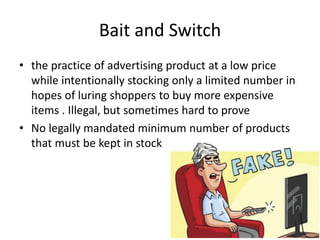
Bait and Switch
• the practice of advertising product at a low price
while intentionally stocking only a limited number in
hopes of luring shoppers to buy more expensive
items . Illegal, but sometimes hard to prove
• No legally mandated minimum number of products
that must be kept in stock
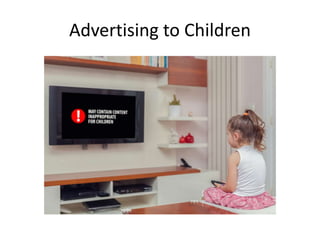
Advertising to Children
• Vulnerable to deceptive advertising.
• Believe claims on TV.
• Children have difficulty differentiating between
fantasy and reality.
• Laws passed to protect children.
• Prohibits creators/producers of children’s cartoon
from advertising products related to the
characters of that program during the broadcast.
• Buy Me That
Advertising to Children
Telemarketing
• Telemarketers are selling their products by
directly calling people and persuading them to
buy their product this type of marketing is not
appreciated because people consider it as
privacy breach .
Federal Trade commission (FTC)
Federal Trade Commission enforces laws that
prohibit harmful business techniques. The
agency also handles complaints that are made
against businesses involved in scams or
advertising that is deceptive.
FTC functions
• Is to stop companies from misleading
customers.
• Affect consumer behavior about the product
or service.
• Make sellers responsible for their claims.
Advertisement and internet
• Online advertising, also called online
marketing or Internet advertising or web
advertising, is a form of marketing and
advertising which uses the Internet to
deliver promotional marketing messages to
consumers.
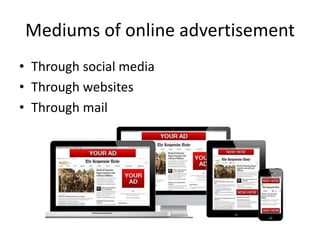
Mediums of online advertisement
• Through social media
• Through websites
• Through mail
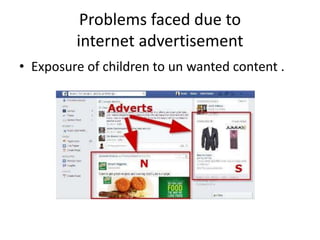
Problems faced due to
internet advertisement
• Exposure of children to un wanted content .
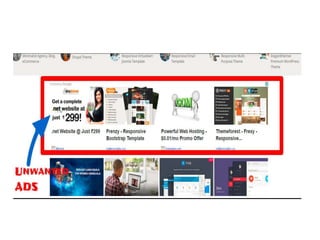
Un wanted popups
• While using internet the un wanted boxes
appear on screen or sometimes the website
take you to un desired web to show you
promotion of products which is against your
will and un ethical .
Businesses must do the following
• Clearly state the number of products in stock
Offer rain checks to customers who request
them
• Rain check – written guarantee that customers
can have the product at the discounted price
when more are delivered to the store.
Protecting consumer privacy
online
• The internet provides unprecedented
opportunities for the collection and sharing of
information from and about consumers.
Importance of privacy
• The first is that privacy helps individuals
maintain their autonomy and individuality.
• Personal information is what anyone do not
want to give anyone because it is personal.
How to protect consumer privacy
Step 1
• Data Privacy Audit This first step when it comes to
protecting customer’s personal information is to
conduct a data privacy audit. While many businesses
collect more data than they realize, it is essential to
understand what data your business needs and what
data it’s collecting, how that data is being stored, and
how securely that data is protected. Remember: a lack
of attention to data collection is what often sparks a
major crisis like the one we’ve recently seen involving
Facebook.
Step 2
• Data Collection Minimization As the role of
producers in protecting customer rights has
increased, companies have taken on more
responsibility for keeping customer data secure.
The best way to ensure that you’re properly
protecting your customer’s data is to only keep
data that is necessary on file. Many privacy
advocates recommend that companies collect
and store only the data they absolutely need to
deliver their product or service.
Step 3
• Secure Data As you only collect the data that
is necessary for your business to be successful,
it is essential to protect all data you collect.
Data can easily be lost or stolen by hackers
and when this happens, it will be a very costly
mistake for your company. Make sure your
network, databases, and website are all
secure to keep your customer’s data out of the
hands of online hackers.
Step 4
• Privacy Policy An essential step to follow when
verifying the security of your customer’s data is
to post a privacy policy on your website. This is
not only required by law but will also help save
you if any future discrepancies were to happen.
Make sure, though, that you don’t just copy and
paste a boilerplate policy. Your privacy policy is a
legally binding agreement between you and your
customers, so make sure it will properly protect
you if anything malicious were to happen to their
data.
Step 5
• Communication While a privacy policy is a
legally binding agreement, customers rarely
read it. At the same time, though, they expect
simple and clear descriptions of company data
practices at key moments like when they’re
asked to provide their data, when you add
new features to your product or service, and
when you make policy changes. Keep
communication about data you collect direct
and upfront with your customers.
Step 6
• Provide a Customer Forum Many customers
today expect you to offer them settings and
features that will let them choose whether to
share data. Make sure you offer these features so
your customers know that you’re serving them
and not selling them. Also, provide a customer
forum to allow customers to communicate their
privacy problems or concerns with you. Be sure
to respond to their messages though. If not, they
will likely take to social media to voice their
concerns, letting the whole world know, instead
of just your company.
Paternalism and manipulation
• the policy or practice on the part of people in
authority of restricting the freedom .
• Usually government plays the role of big
brother and controls the advertisement too
much protection leads to too much control
and enforcement playing the role of big
brother.
Types of Paternalism
• Strong Paternalism
• Weak Paternalism
Strong Paternalism
• Strong Paternalism intentionally override
patient’s wishes openly or through deception
• Morally unacceptable.
• Should be rare and limited to a situation in
which there is no other way of managing a
situation and in which the person is in danger
of serious harm if the doctor does not act.
Weak Paternalism
• Commoner in practice This is assuming that
patient is unable to understand medical
information or deciding ‘not to worry’ with
information that doctor think is burdensome
to patient.
• The assumption is paternalistic
Arguments in favor of
paternalism
• Government bans the ads which are not in
favor of public which helps to eliminate the
harmful products related information.
• Organizations make deceptive and cleverly
researched ads in order to grab customers
government ban these kind of ads.
Arguments against paternalism
• This is note desirable in democratic society
people want a free liberty of their own
choices.
• enforcement of advertising also can be viewed
along this continuum outright bans on ads can
results in courts decisions that rule that
consumer free choice have been violated and
that a third party was or could be harmed .
Arguments for advertising
• Advertisement informs people about new products
otherwise people will be uninformed.
• It helps companies to be competitive.
• It helps the nation to maintain prosperous economy.
• Helps a nation to balance of trade and debt payments.
• Proponents of advertising argue that customers lives
are enriched by the images and metaphors advertising
creates.
• Those who defend the general practice of advertising
claim consumers are ignorant .
Arguments against (questionable)
advertising
• Controversial Advertisements have been
successful in gaining attention and increasing
profits Despite being controversial, there
appears to be an increment in the amount of
such advertisements printed and shown.
These Ads bring out reactions of
embarrassment , distaste, disgust, offence, or
outrage from people when viewed
Corporate Responsibility in Advertisement

Corporate Responsibility in Advertisement

  • 1.
    Corporate Responsibility in Advertisement GroupMembers  Abdullah Hamid  Mehtab Artas  Danish Aftab
  • 2.
    Ethics and Advertising Ethics Moraland value standards that act as behavioral guidelines for a society’s citizens.
  • 3.
    Advertisement A notice orannouncement in a public medium promoting a product, service, or event or publicizing a job vacancy.
  • 4.
  • 5.
    Purpose of advertising •Thepurpose of advertising are to inform customers about products and services and to persuade them to purchase .
  • 6.
    Types of advertisement •Through newspaper • Through magazines • Trough television • Through radio • Through internet • Through telecommunication.
  • 8.
    Ethics and Advertising •Is the consumer being treated as a mean to an end or as an end ?what and whose end ? • Whose rights are being protected or violated intentionally and inadvertently ? at what and whose cost ? • Are consumer being justly and fairly treated • Are the public welfare and good taken into consideration for the effects as well as the intention of advertisement?
  • 9.
    Advertising Ethics &Principles Advertising Federation’s (AF) Code of Ethics • Truth • Substantiation • Comparisons • Guarantees and warranties • Price claims • Testimonials • Taste and decency
  • 10.
    A corporation’s ethicalresponsibility in advertising Ethical responsibility in advertising is to Inform and persuade consumer stakeholder in ways that • Do not lie • Deceive • Conceal • Withhold the truth
  • 11.
    Do not lie •Such as fast food companies do not deliver as per their advertised product .
  • 12.
    Deceive • Misleading statementabout products ads that are more likely to mislead customers in form of statements . Example Duracell “Lasts Even Longer”
  • 13.
    Conceal • Concealment oftruth means that companies do not tell the truth about their product capacity and performance.
  • 14.
  • 16.
    Unethical Advertisement • FalseAdvertising • Puffery • Bait and Switch • Advertising to Children • Telemarketing
  • 17.
  • 18.
    Unethical According todirect targeting
  • 19.
  • 20.
    False Advertising • Practiceof making statements about a product that the advertiser knows are not true. • May be about how product works, how it is made, or how it will affect people who buy or use it. Unethical and dishonest Public reaction can be severe • Example: Tobacco Industry
  • 22.
    Tobacco and AlcoholAdvertisement • In the past tobacco industry spent approximately $8.2 billion in 1999 for advertisement targeting directly college graduates and poor people. • Now government banned alcohol and tobacco related ads but these industries are doing advertisement on low level by promoting their products on ground level targeting youth directly.
  • 23.
  • 24.
    Puffery • Puffery –term used to describe statements that are not outright lies, but merely exaggerations. • Example: Amusement park claiming to be “the best time you’ll ever have in one day”. • Unethical? Illegal? Federal Trade Commission (FTC) regulates advertising and advertisers. • FTC allows puffery, defining it as “exaggerations reasonably to be expected of a seller as to the degree of quality of his product, the truth or falsity of which cannot be determined.”
  • 26.
    Bait and Switch •the practice of advertising product at a low price while intentionally stocking only a limited number in hopes of luring shoppers to buy more expensive items . Illegal, but sometimes hard to prove • No legally mandated minimum number of products that must be kept in stock
  • 27.
    Advertising to Children •Vulnerable to deceptive advertising. • Believe claims on TV. • Children have difficulty differentiating between fantasy and reality. • Laws passed to protect children. • Prohibits creators/producers of children’s cartoon from advertising products related to the characters of that program during the broadcast. • Buy Me That
  • 28.
  • 29.
    Telemarketing • Telemarketers areselling their products by directly calling people and persuading them to buy their product this type of marketing is not appreciated because people consider it as privacy breach .
  • 31.
    Federal Trade commission(FTC) Federal Trade Commission enforces laws that prohibit harmful business techniques. The agency also handles complaints that are made against businesses involved in scams or advertising that is deceptive.
  • 32.
    FTC functions • Isto stop companies from misleading customers. • Affect consumer behavior about the product or service. • Make sellers responsible for their claims.
  • 33.
    Advertisement and internet •Online advertising, also called online marketing or Internet advertising or web advertising, is a form of marketing and advertising which uses the Internet to deliver promotional marketing messages to consumers.
  • 34.
    Mediums of onlineadvertisement • Through social media • Through websites • Through mail
  • 35.
    Problems faced dueto internet advertisement • Exposure of children to un wanted content .
  • 36.
    Un wanted popups •While using internet the un wanted boxes appear on screen or sometimes the website take you to un desired web to show you promotion of products which is against your will and un ethical .
  • 38.
    Businesses must dothe following • Clearly state the number of products in stock Offer rain checks to customers who request them • Rain check – written guarantee that customers can have the product at the discounted price when more are delivered to the store.
  • 40.
    Protecting consumer privacy online •The internet provides unprecedented opportunities for the collection and sharing of information from and about consumers.
  • 41.
    Importance of privacy •The first is that privacy helps individuals maintain their autonomy and individuality. • Personal information is what anyone do not want to give anyone because it is personal.
  • 42.
    How to protectconsumer privacy Step 1 • Data Privacy Audit This first step when it comes to protecting customer’s personal information is to conduct a data privacy audit. While many businesses collect more data than they realize, it is essential to understand what data your business needs and what data it’s collecting, how that data is being stored, and how securely that data is protected. Remember: a lack of attention to data collection is what often sparks a major crisis like the one we’ve recently seen involving Facebook.
  • 43.
    Step 2 • DataCollection Minimization As the role of producers in protecting customer rights has increased, companies have taken on more responsibility for keeping customer data secure. The best way to ensure that you’re properly protecting your customer’s data is to only keep data that is necessary on file. Many privacy advocates recommend that companies collect and store only the data they absolutely need to deliver their product or service.
  • 44.
    Step 3 • SecureData As you only collect the data that is necessary for your business to be successful, it is essential to protect all data you collect. Data can easily be lost or stolen by hackers and when this happens, it will be a very costly mistake for your company. Make sure your network, databases, and website are all secure to keep your customer’s data out of the hands of online hackers.
  • 45.
    Step 4 • PrivacyPolicy An essential step to follow when verifying the security of your customer’s data is to post a privacy policy on your website. This is not only required by law but will also help save you if any future discrepancies were to happen. Make sure, though, that you don’t just copy and paste a boilerplate policy. Your privacy policy is a legally binding agreement between you and your customers, so make sure it will properly protect you if anything malicious were to happen to their data.
  • 46.
    Step 5 • CommunicationWhile a privacy policy is a legally binding agreement, customers rarely read it. At the same time, though, they expect simple and clear descriptions of company data practices at key moments like when they’re asked to provide their data, when you add new features to your product or service, and when you make policy changes. Keep communication about data you collect direct and upfront with your customers.
  • 47.
    Step 6 • Providea Customer Forum Many customers today expect you to offer them settings and features that will let them choose whether to share data. Make sure you offer these features so your customers know that you’re serving them and not selling them. Also, provide a customer forum to allow customers to communicate their privacy problems or concerns with you. Be sure to respond to their messages though. If not, they will likely take to social media to voice their concerns, letting the whole world know, instead of just your company.
  • 49.
    Paternalism and manipulation •the policy or practice on the part of people in authority of restricting the freedom . • Usually government plays the role of big brother and controls the advertisement too much protection leads to too much control and enforcement playing the role of big brother.
  • 50.
    Types of Paternalism •Strong Paternalism • Weak Paternalism
  • 51.
    Strong Paternalism • StrongPaternalism intentionally override patient’s wishes openly or through deception • Morally unacceptable. • Should be rare and limited to a situation in which there is no other way of managing a situation and in which the person is in danger of serious harm if the doctor does not act.
  • 52.
    Weak Paternalism • Commonerin practice This is assuming that patient is unable to understand medical information or deciding ‘not to worry’ with information that doctor think is burdensome to patient. • The assumption is paternalistic
  • 53.
    Arguments in favorof paternalism • Government bans the ads which are not in favor of public which helps to eliminate the harmful products related information. • Organizations make deceptive and cleverly researched ads in order to grab customers government ban these kind of ads.
  • 54.
    Arguments against paternalism •This is note desirable in democratic society people want a free liberty of their own choices. • enforcement of advertising also can be viewed along this continuum outright bans on ads can results in courts decisions that rule that consumer free choice have been violated and that a third party was or could be harmed .
  • 55.
    Arguments for advertising •Advertisement informs people about new products otherwise people will be uninformed. • It helps companies to be competitive. • It helps the nation to maintain prosperous economy. • Helps a nation to balance of trade and debt payments. • Proponents of advertising argue that customers lives are enriched by the images and metaphors advertising creates. • Those who defend the general practice of advertising claim consumers are ignorant .
  • 56.
  • 57.
    • Controversial Advertisementshave been successful in gaining attention and increasing profits Despite being controversial, there appears to be an increment in the amount of such advertisements printed and shown. These Ads bring out reactions of embarrassment , distaste, disgust, offence, or outrage from people when viewed