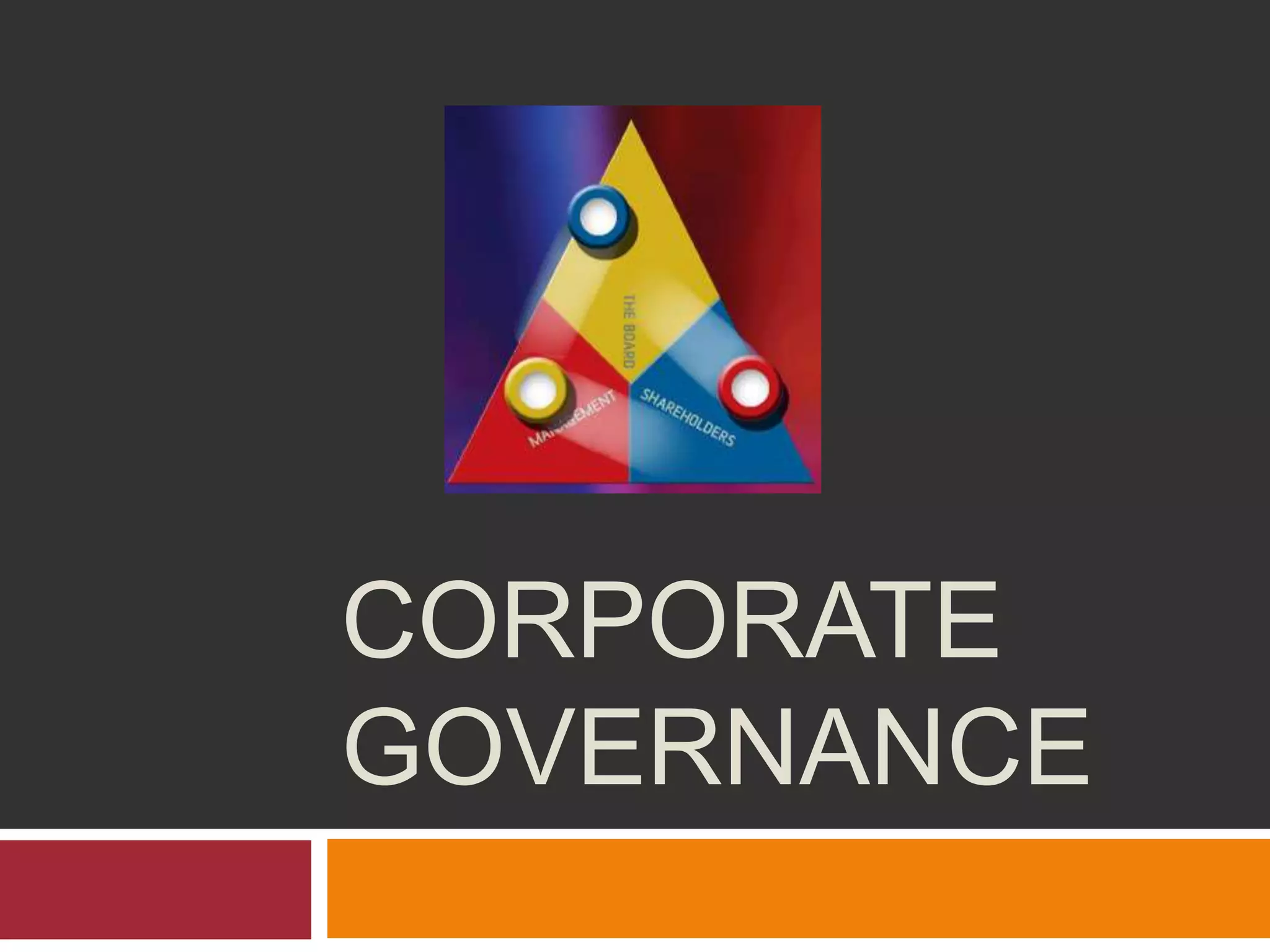
CORPORATE
GOVERNANCE
Introduction
   Corporate Governance

   Principles, Objectives, Parties

   Legal environment, ownership patterns and
    Corporate Governance

   Ministry of Corporate Affairs(MCA)

   MCA 21
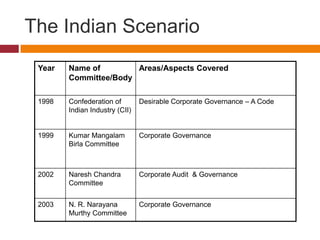
The Indian Scenario
 Year   Name of        Areas/Aspects Covered
        Committee/Body

 1998   Confederation of        Desirable Corporate Governance – A Code
        Indian Industry (CII)


 1999   Kumar Mangalam          Corporate Governance
        Birla Committee


 2002   Naresh Chandra          Corporate Audit & Governance
        Committee


 2003   N. R. Narayana          Corporate Governance
        Murthy Committee
                                                                    3
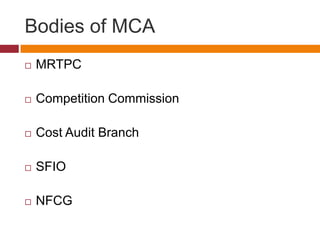
Bodies of MCA
   MRTPC

   Competition Commission

   Cost Audit Branch

   SFIO

   NFCG
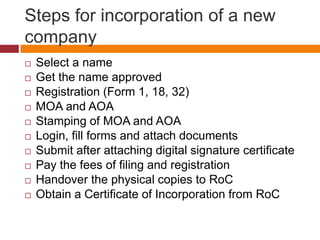
Steps for incorporation of a new
company
   Select a name
   Get the name approved
   Registration (Form 1, 18, 32)
   MOA and AOA
   Stamping of MOA and AOA
   Login, fill forms and attach documents
   Submit after attaching digital signature certificate
   Pay the fees of filing and registration
   Handover the physical copies to RoC
   Obtain a Certificate of Incorporation from RoC
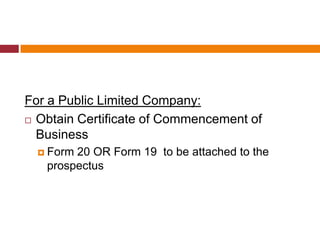
For a Public Limited Company:
 Obtain Certificate of Commencement of

  Business
   Form20 OR Form 19 to be attached to the
   prospectus
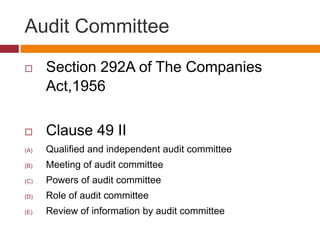
Audit Committee

     Section 292A of The Companies
      Act,1956

     Clause 49 II
(A)   Qualified and independent audit committee
(B)   Meeting of audit committee
(C)   Powers of audit committee
(D)   Role of audit committee
(E)   Review of information by audit committee
Section 292A Companies
Act,1956
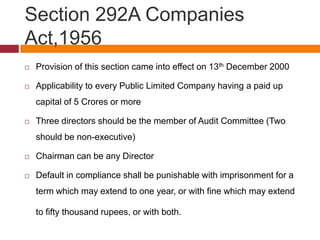
   Provision of this section came into effect on 13th December 2000

   Applicability to every Public Limited Company having a paid up
    capital of 5 Crores or more

   Three directors should be the member of Audit Committee (Two
    should be non-executive)

   Chairman can be any Director

   Default in compliance shall be punishable with imprisonment for a
    term which may extend to one year, or with fine which may extend

    to fifty thousand rupees, or with both.
49 II (A) Qualified and independent
Audit committee
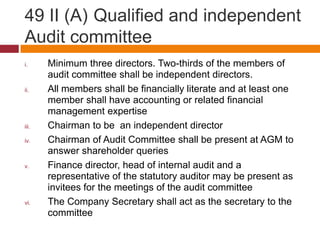
i.     Minimum three directors. Two-thirds of the members of
       audit committee shall be independent directors.
ii.    All members shall be financially literate and at least one
       member shall have accounting or related financial
       management expertise
iii.   Chairman to be an independent director
iv.    Chairman of Audit Committee shall be present at AGM to
       answer shareholder queries
v.     Finance director, head of internal audit and a
       representative of the statutory auditor may be present as
       invitees for the meetings of the audit committee
vi.    The Company Secretary shall act as the secretary to the
       committee
49 II (B) Meeting of Audit
Committee
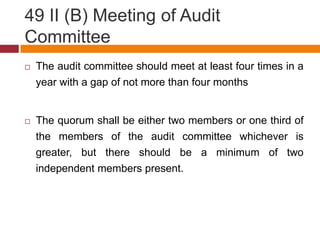
   The audit committee should meet at least four times in a
    year with a gap of not more than four months


   The quorum shall be either two members or one third of
    the members of the audit committee whichever is
    greater, but there should be a minimum of two
    independent members present.
49 II (C) Powers of Audit
Committee
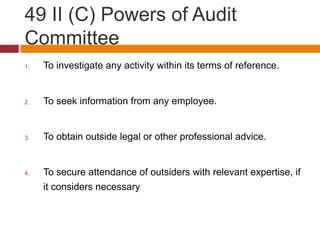
1.   To investigate any activity within its terms of reference.


2.   To seek information from any employee.


3.   To obtain outside legal or other professional advice.


4.   To secure attendance of outsiders with relevant expertise, if
     it considers necessary
49 II (D) Role of Audit
Committee
1.   Oversight of the company’s financial reporting
     process
2.   Recommending to the Board, the appointment,
     re-appointment and, if required, the replacement
     or removal of the statutory auditor and the
     fixation of audit fees.
3.   Approval of payment to statutory auditors for
     any other services rendered by the statutory
     auditors.
4.        Reviewing, with the management, the annual financial
          statements before submission to the board for approval, with
          particular reference to:
     a)     Matters required to be included in the Director’s Responsibility Statement to
            be included in the Board’s report in terms of clause (2AA) of section 217 of the
            Companies Act, 1956

     b)     Changes, if any, in accounting policies and practices and reasons for the
            same

     c)     Major accounting entries involving estimates based on the exercise of
            judgment by management

     d)     Significant adjustments made in the financial statements arising out of audit
            findings

     e)     Compliance with listing and other legal requirements relating to financial
5.   Reviewing, with the management, the quarterly financial statements
     before submission to the board for approval

6.   Reviewing, with the management, performance of statutory and internal
     auditors, adequacy of the internal control systems

7.   Reviewing the adequacy of internal audit function, if any, including the
     structure of the internal audit department, staffing and seniority of the
     official heading the department, reporting structure coverage and
     frequency of internal audit

8.   Discussion with internal auditors any significant findings and follow up
     there on

9.   Reviewing the findings of any internal investigations by the internal
     auditors into matters where there is suspected fraud or irregularity or a
10.   Discussion with statutory auditors before the audit
      commences, about the nature and scope of audit as well
      as post-audit discussion to ascertain any area of concern.
11.   To look into the reasons for substantial defaults in the
      payment to the depositors, debenture holders,
      shareholders (in case of non payment of declared
      dividends) and creditors.
12.   To review the functioning of the Whistle Blower
      mechanism, in case the same is existing.
13.   Carrying out any other function as is mentioned in the
      terms of reference of the audit committee.
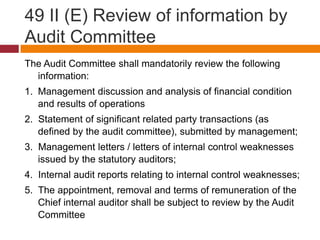
49 II (E) Review of information by
Audit Committee
The Audit Committee shall mandatorily review the following
  information:
1. Management discussion and analysis of financial condition
   and results of operations
2. Statement of significant related party transactions (as
   defined by the audit committee), submitted by management;
3. Management letters / letters of internal control weaknesses
   issued by the statutory auditors;
4. Internal audit reports relating to internal control weaknesses;
5. The appointment, removal and terms of remuneration of the
   Chief internal auditor shall be subject to review by the Audit
   Committee
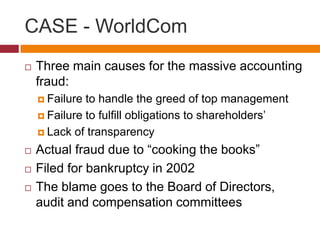
CASE - WorldCom
   Three main causes for the massive accounting
    fraud:
     Failure to handle the greed of top management
     Failure to fulfill obligations to shareholders’

     Lack of transparency

   Actual fraud due to “cooking the books”
   Filed for bankruptcy in 2002
   The blame goes to the Board of Directors,
    audit and compensation committees
THANK YOU

Corporate governance

  • 1.
  • 2.
    Introduction  Corporate Governance  Principles, Objectives, Parties  Legal environment, ownership patterns and Corporate Governance  Ministry of Corporate Affairs(MCA)  MCA 21
  • 3.
    The Indian Scenario Year Name of Areas/Aspects Covered Committee/Body 1998 Confederation of Desirable Corporate Governance – A Code Indian Industry (CII) 1999 Kumar Mangalam Corporate Governance Birla Committee 2002 Naresh Chandra Corporate Audit & Governance Committee 2003 N. R. Narayana Corporate Governance Murthy Committee 3
  • 4.
    Bodies of MCA  MRTPC  Competition Commission  Cost Audit Branch  SFIO  NFCG
  • 5.
    Steps for incorporationof a new company  Select a name  Get the name approved  Registration (Form 1, 18, 32)  MOA and AOA  Stamping of MOA and AOA  Login, fill forms and attach documents  Submit after attaching digital signature certificate  Pay the fees of filing and registration  Handover the physical copies to RoC  Obtain a Certificate of Incorporation from RoC
  • 6.
    For a PublicLimited Company:  Obtain Certificate of Commencement of Business  Form20 OR Form 19 to be attached to the prospectus
  • 7.
    Audit Committee  Section 292A of The Companies Act,1956  Clause 49 II (A) Qualified and independent audit committee (B) Meeting of audit committee (C) Powers of audit committee (D) Role of audit committee (E) Review of information by audit committee
  • 8.
    Section 292A Companies Act,1956  Provision of this section came into effect on 13th December 2000  Applicability to every Public Limited Company having a paid up capital of 5 Crores or more  Three directors should be the member of Audit Committee (Two should be non-executive)  Chairman can be any Director  Default in compliance shall be punishable with imprisonment for a term which may extend to one year, or with fine which may extend to fifty thousand rupees, or with both.
  • 9.
    49 II (A)Qualified and independent Audit committee i. Minimum three directors. Two-thirds of the members of audit committee shall be independent directors. ii. All members shall be financially literate and at least one member shall have accounting or related financial management expertise iii. Chairman to be an independent director iv. Chairman of Audit Committee shall be present at AGM to answer shareholder queries v. Finance director, head of internal audit and a representative of the statutory auditor may be present as invitees for the meetings of the audit committee vi. The Company Secretary shall act as the secretary to the committee
  • 10.
    49 II (B)Meeting of Audit Committee  The audit committee should meet at least four times in a year with a gap of not more than four months  The quorum shall be either two members or one third of the members of the audit committee whichever is greater, but there should be a minimum of two independent members present.
  • 11.
    49 II (C)Powers of Audit Committee 1. To investigate any activity within its terms of reference. 2. To seek information from any employee. 3. To obtain outside legal or other professional advice. 4. To secure attendance of outsiders with relevant expertise, if it considers necessary
  • 12.
    49 II (D)Role of Audit Committee 1. Oversight of the company’s financial reporting process 2. Recommending to the Board, the appointment, re-appointment and, if required, the replacement or removal of the statutory auditor and the fixation of audit fees. 3. Approval of payment to statutory auditors for any other services rendered by the statutory auditors.
  • 13.
    4. Reviewing, with the management, the annual financial statements before submission to the board for approval, with particular reference to: a) Matters required to be included in the Director’s Responsibility Statement to be included in the Board’s report in terms of clause (2AA) of section 217 of the Companies Act, 1956 b) Changes, if any, in accounting policies and practices and reasons for the same c) Major accounting entries involving estimates based on the exercise of judgment by management d) Significant adjustments made in the financial statements arising out of audit findings e) Compliance with listing and other legal requirements relating to financial
  • 14.
    5. Reviewing, with the management, the quarterly financial statements before submission to the board for approval 6. Reviewing, with the management, performance of statutory and internal auditors, adequacy of the internal control systems 7. Reviewing the adequacy of internal audit function, if any, including the structure of the internal audit department, staffing and seniority of the official heading the department, reporting structure coverage and frequency of internal audit 8. Discussion with internal auditors any significant findings and follow up there on 9. Reviewing the findings of any internal investigations by the internal auditors into matters where there is suspected fraud or irregularity or a
  • 15.
    10. Discussion with statutory auditors before the audit commences, about the nature and scope of audit as well as post-audit discussion to ascertain any area of concern. 11. To look into the reasons for substantial defaults in the payment to the depositors, debenture holders, shareholders (in case of non payment of declared dividends) and creditors. 12. To review the functioning of the Whistle Blower mechanism, in case the same is existing. 13. Carrying out any other function as is mentioned in the terms of reference of the audit committee.
  • 16.
    49 II (E)Review of information by Audit Committee The Audit Committee shall mandatorily review the following information: 1. Management discussion and analysis of financial condition and results of operations 2. Statement of significant related party transactions (as defined by the audit committee), submitted by management; 3. Management letters / letters of internal control weaknesses issued by the statutory auditors; 4. Internal audit reports relating to internal control weaknesses; 5. The appointment, removal and terms of remuneration of the Chief internal auditor shall be subject to review by the Audit Committee
  • 17.
    CASE - WorldCom  Three main causes for the massive accounting fraud:  Failure to handle the greed of top management  Failure to fulfill obligations to shareholders’  Lack of transparency  Actual fraud due to “cooking the books”  Filed for bankruptcy in 2002  The blame goes to the Board of Directors, audit and compensation committees
  • 18.