+
The Principles of Valuation of Merges and Takeovers
AOL-Time Warner Analysis
Chompunud Phiromjit 15659
Thi Trang Nhung Nguyen 15714
Thien Ai Nguyen 15838
+
Agenda
 Definition
 Types of Merger and Acquisition
 Motives for Merger and Acquisition
 Mechanics of a Merger
 Merger Gains and Cost
 Q&A
2
+
Definition
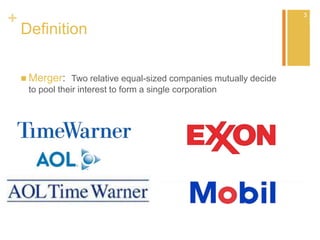
 Merger: Two relative equal-sized companies mutually decide
to pool their interest to form a single corporation
3
3
+
Definition
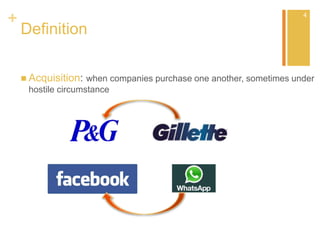
 Acquisition: when companies purchase one another, sometimes under
hostile circumstance
4
+
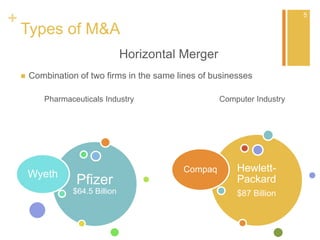
Types of M&A
Pfizer
$64.5 Billion
Wyeth
Horizontal Merger
 Combination of two firms in the same lines of businesses
Pharmaceuticals Industry Computer Industry
Hewlett-
Packard
$87 Billion
Compaq
5
+
Types of M&A
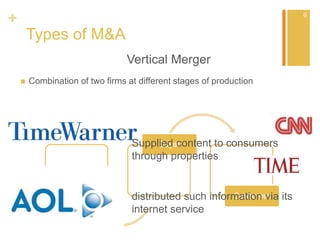
Vertical Merger
 Combination of two firms at different stages of production
Source of
Raw Materials
Buyer
Consumer
Supplied content to consumers
through properties
distributed such information via its
internet service
6
+
Types of M&A
Conglomerate Merger
 Combination of two firms in unrelated lines of businesses
7
+
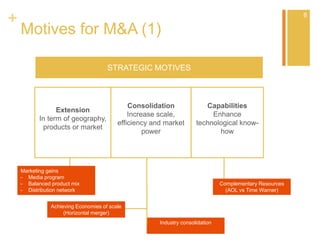
Motives for M&A (1)
STRATEGIC MOTIVES
Extension
In term of geography,
products or market
Consolidation
Increase scale,
efficiency and market
power
Capabilities
Enhance
technological know-
how
8
Achieving Economies of scale
(Horizontal merger)
Industry consolidation
Complementary Resources
(AOL vs Time Warner)
Marketing gains
- Media program
- Balanced product mix
- Distribution network
+
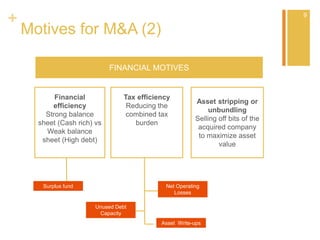
Motives for M&A (2)
FINANCIAL MOTIVES
Financial
efficiency
Strong balance
sheet (Cash rich) vs
Weak balance
sheet (High debt)
Tax efficiency
Reducing the
combined tax
burden
Asset stripping or
unbundling
Selling off bits of the
acquired company
to maximize asset
value
9
Surplus fund Net Operating
Losses
Unused Debt
Capacity
Asset Write-ups
+
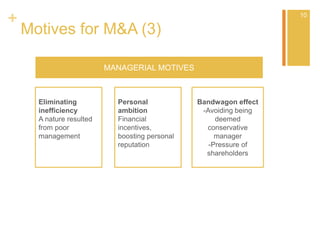
Motives for M&A (3)
MANAGERIAL MOTIVES
Personal
ambition
Financial
incentives,
boosting personal
reputation
Bandwagon effect
-Avoiding being
deemed
conservative
manager
-Pressure of
shareholders
10
Eliminating
inefficiency
A nature resulted
from poor
management
+
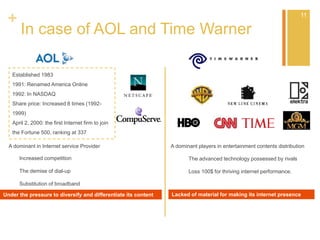
In case of AOL and Time Warner
A dominant players in entertainment contents distribution
Lacked of material for making its internet presence
A dominant in Internet service Provider
Increased competition
The demise of dial-up
Substitution of broadband
Under the pressure to diversify and differentiate its content
11
The advanced technology possessed by rivals
Loss 100$ for thriving internet performance.
Established 1983
1991: Renamed America Online
1992: In NASDAQ
Share price: Increased 8 times (1992-
1999)
April 2, 2000: the first Internet firm to join
the Fortune 500, ranking at 337
+
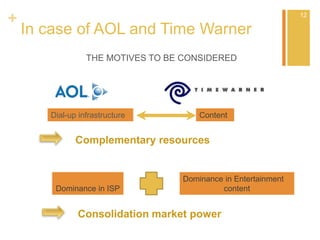
In case of AOL and Time Warner
THE MOTIVES TO BE CONSIDERED
Complementary resources
12
Dial-up infrastructure Content
Dominance in ISP
Dominance in Entertainment
content
Consolidation market power
+
Mechanics of a Merger
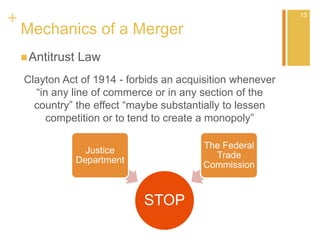
Antitrust Law
Clayton Act of 1914 - forbids an acquisition whenever
“in any line of commerce or in any section of the
country” the effect “maybe substantially to lessen
competition or to tend to create a monopoly”
STOP
Justice
Department
The Federal
Trade
Commission
13
+
Mechanics of a Merger
Antitrust Law : AOL and Time Warner
 27th July 2000 : AOL and Time Warner combined control 20
percent of the nation's cable lines and 40 percent of the
Internet access market.
 4th Sep 2000 : FTC is preparing to block the merger unless
the two companies agree to keep cable lines open to
competitors
 14th Dec 2000 : FTC approves AOL's merger with Time
Warner but commissioners still wrestle over potential
conditions to the deal
 11th Jan 2001 : FTC clears the way for the merger.
14
+
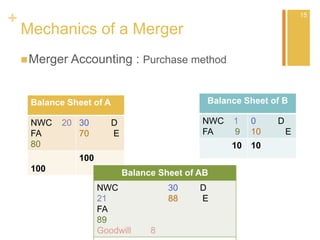
Merger Accounting : Purchase method
Mechanics of a Merger
Balance Sheet of A
NWC 20
FA
80
30 D
70 E
100
100
Balance Sheet of B
NWC 1
FA 9
0 D
10 E
10 10
Balance Sheet of AB
NWC
21
FA
89
Goodwill 8
30 D
88 E
15
+
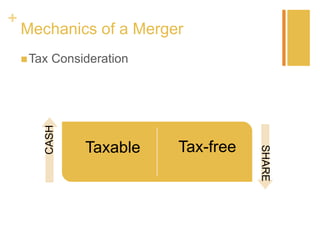
Tax Consideration
Mechanics of a Merger
Taxable Tax-free
CASH
SHARE
+
Evaluating bids
 Cost of merger: premium that buyer pays over the seller’s
stand-alone value, equals Target shareholders’ gain
 Stand-alone value
- Intrinsic/present value (PV)
- Market value (MV) (May be wrong estimated)
17
+
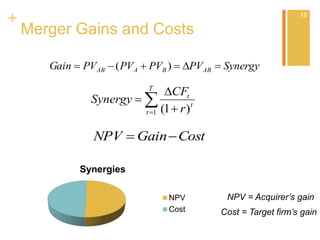
Merger Gains and Costs
SynergyPVPVPVPVGain ABBAAB  )(
 


T
t
t
t
r
CF
Synergy
1 )1(
NPV = Acquirer’s gain
Synergies
NPV
Cost Cost = Target firm’s gain
CostGainNPV 
18
18
+
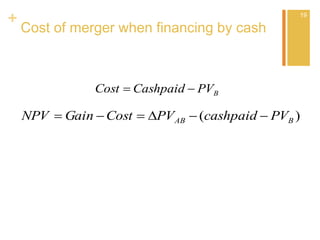
Cost of merger when financing by cash
BPVCashpaidCost 
)( BAB PVcashpaidPVCostGainNPV 
19
19
+
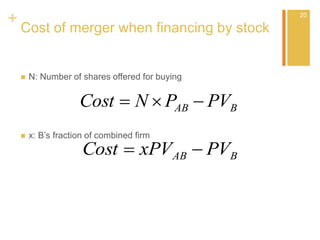
Cost of merger when financing by stock
 N: Number of shares offered for buying
 x: B’s fraction of combined firm
20
BAB PVPNCost 
BAB PVxPVCost 
+
Case study: Company valuation
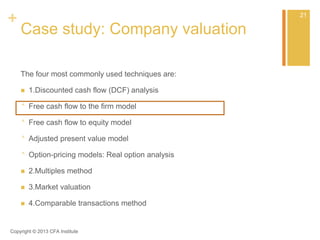
The four most commonly used techniques are:
 1.Discounted cash flow (DCF) analysis
 Free cash flow to the firm model
 Free cash flow to equity model
 Adjusted present value model
 Option-pricing models: Real option analysis
 2.Multiples method
 3.Market valuation
 4.Comparable transactions method
Copyright © 2013 CFA Institute
21
+
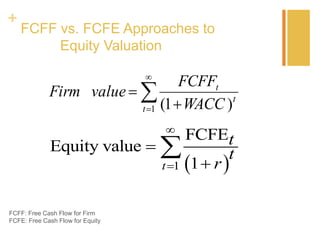
FCFF vs. FCFE Approaches to
Equity Valuation
 1
FCFE
Equity value
1





t
t
t
r
22


 

1 )1(t
t
t
WACC
FCFF
valueFirm
FCFF: Free Cash Flow for Firm
FCFE: Free Cash Flow for Equity
+
1
1
FCFF
Firm value
WACC
Equity value Firm value Debt value
FCFE
Equity value


 


g
r g
MV(Debt) MV(Equity)
WACC (1 Tax rate)
MV(Equity) MV(Debt) MV(Equity) MV(Debt)
      
           
          
r rd
23
23
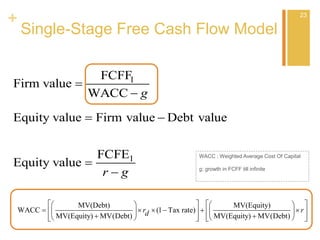
WACC : Weighted Average Cost Of Capital
g: growth in FCFF till infinite
Single-Stage Free Cash Flow Model
+
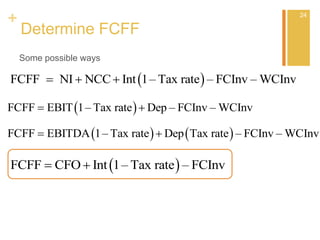
Determine FCFF
Some possible ways
24
 FCFF NI NCC Int 1– Tax rate – FCInv – WCInv  
 
   
FCFF EBIT 1– Tax rate Dep – FCInv – WCInv
FCFF EBITDA 1– Tax rate Dep Tax rate – FCInv – WCInv
 
 
 FCFF CFO Int 1– Tax rate – FCInv 
+
Case study: Company valuation
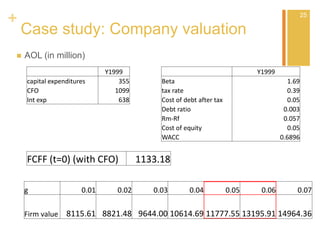
 AOL (in million)
Y1999 Y1999
capital expenditures 355 Beta 1.69
CFO 1099 tax rate 0.39
Int exp 638 Cost of debt after tax 0.05
Debt ratio 0.003
Rm-Rf 0.057
Cost of equity 0.05
WACC 0.6896
FCFF (t=0) (with CFO) 1133.18
g 0.01 0.02 0.03 0.04 0.05 0.06 0.07
Firm value 8115.61 8821.48 9644.00 10614.69 11777.55 13195.91 14964.36
25
25
+
Case study: Company valuation
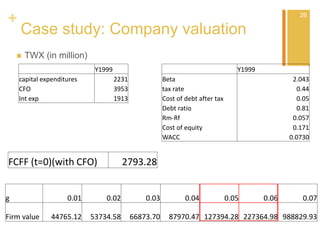
 TWX (in million)
26
Y1999 Y1999
capital expenditures 2231 Beta 2.043
CFO 3953 tax rate 0.44
Int exp 1913 Cost of debt after tax 0.05
Debt ratio 0.81
Rm-Rf 0.057
Cost of equity 0.171
WACC 0.0730
FCFF (t=0)(with CFO) 2793.28
g 0.01 0.02 0.03 0.04 0.05 0.06 0.07
Firm value 44765.12 53734.58 66873.70 87970.47 127394.28 227364.98 988829.93
+
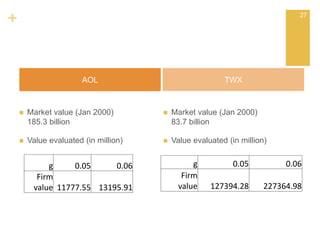
AOL TWX
 Market value (Jan 2000)
185.3 billion
 Value evaluated (in million)
 Market value (Jan 2000)
83.7 billion
 Value evaluated (in million)
g 0.05 0.06
Firm
value 11777.55 13195.91
g 0.05 0.06
Firm
value 127394.28 227364.98
27
+
Case study: AOL–Time Warner Merger
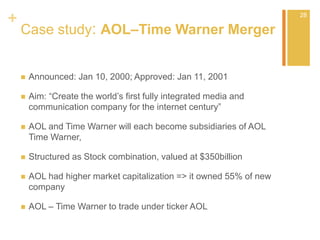
 Announced: Jan 10, 2000; Approved: Jan 11, 2001
 Aim: “Create the world’s first fully integrated media and
communication company for the internet century”
 AOL and Time Warner will each become subsidiaries of AOL
Time Warner,
 Structured as Stock combination, valued at $350billion
 AOL had higher market capitalization => it owned 55% of new
company
 AOL – Time Warner to trade under ticker AOL
28
+
Case study: AOL – TWX (Cont)
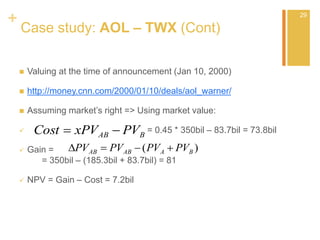
 Valuing at the time of announcement (Jan 10, 2000)
 http://money.cnn.com/2000/01/10/deals/aol_warner/
 Assuming market’s right => Using market value:
 = 0.45 * 350bil – 83.7bil = 73.8bil
 Gain =
= 350bil – (185.3bil + 83.7bil) = 81
 NPV = Gain – Cost = 7.2bil
BAB PVxPVCost 
)( BAABAB PVPVPVPV 
29
29
+
Case study: AOL - TWX
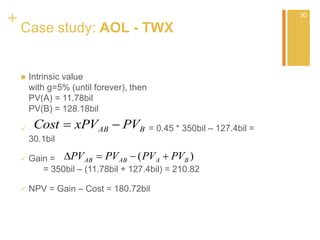
 Intrinsic value
with g=5% (until forever), then
PV(A) = 11.78bil
PV(B) = 128.18bil
 = 0.45 * 350bil – 127.4bil =
30.1bil
 Gain =
= 350bil – (11.78bil + 127.4bil) = 210.82
 NPV = Gain – Cost = 180.72bil
30
BAB PVxPVCost 
)( BAABAB PVPVPVPV 
+
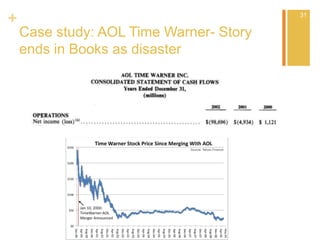
Case study: AOL Time Warner- Story
ends in Books as disaster
31
+
Q & A
32
+
Reference
Book
 Brealey R.A., Myers S.C., Allen F. (2011) Principles of Corporate Finance,10th edition, McGraw Hill,
P.792-816
 Stephen, A.Ross, Randolph W.Westerfield (2002) Fundamentals of Corporate Finance, 6th Edition,
McGaw Hill, P.846-854
 Newyork University (Fall 2009), AOL-Time Warner: Leadership in Organizations, Newyork University
 David Hillier, M.Grinblatt, S.Titman (2012) Financial Markets and Corporate Strategy, 2nd Edition, McGraw
Hill, P.646-675.
33
+
Reference
Website
 Hewlett-Packard (2001) Hewlett-Packard and Compaq agree to merge, creating $87 billion global technology leader,
Available from http://www8.hp.com/us/en/hp-news/press-release.html?id=230610#.U3-QKFiSxy8 [Accessed 21 May
2014]
 Investopedia (2009) The wonderful world of Mergers , Available from
http://www.investopedia.com/articles/stocks/09/merger-acquisitions-types.asp [Accessed 15 May 2014]
 Washingtonpost (2005) Timeline: AOL and Time Warner, Available from http://www.washingtonpost.com/wp-
dyn/content/article/2005/10/28/AR2005102800747_pf.html [Accessed 20 May 2014]
 Federal Communications Commission (2014) America Online-Time Warner Merger Page, Available from
http://www.fcc.gov/encyclopedia/america-online-time-warner-merger-page [Accessed 20 May 2014]
 Boston College (2005) Valuation Techniques, Available from
http://www.bc.edu/clubs/bcfa/docs/vault/Valuation%20Techniques.pdf [Accessed 23 May 2014]
 CFA Institute (2010) Free Cash Flow Valuation, Available from
http://www.cfainstitute.org/learning/products/publications/inv/Documents/equity_chapter4.pptx [Accessed 21 May 2015]
 Business Insider (2009) Chart of the day: AOL Time Warner’s Marriage Made in Hell, Available from
http://www.businessinsider.com/chart-of-the-day-time-warner-aol-2009-5 , [Accessed 19 May 2014]
+
 The Newyork times (2009) 10th Anniversary of AOL-Time Warner Merger, Available from
http://www.nytimes.com/interactive/2010/01/11/business/20100111-merger-timeline.html?_r=0 [Accessed 19 May
2014]
 McGraw Hill (2007) Behavioral Corporate Finance, Available from http://highered.mcgraw-
hill.com/sites/dl/free/0072848650/315497/Chap10.ppt [Accessed 18 May 2014]
 Imaa Institute (?) Statistics Merger and Acquisition, Available from http://www.imaa-institute.org/statistics-mergers-
acquisitions.html#TopMergersAcquisitions_Worldwide [Accessed 18 May 2014]
 CNN (2000) That’s AOL folks, Available from http://money.cnn.com/2000/01/10/deals/aol_warner/ [Accessed 20
May 2014]

corporate finance - Valuation of M&A - AOL-Time Warner

  • 1.
    + The Principles ofValuation of Merges and Takeovers AOL-Time Warner Analysis Chompunud Phiromjit 15659 Thi Trang Nhung Nguyen 15714 Thien Ai Nguyen 15838
  • 2.
    + Agenda  Definition  Typesof Merger and Acquisition  Motives for Merger and Acquisition  Mechanics of a Merger  Merger Gains and Cost  Q&A 2
  • 3.
    + Definition  Merger: Tworelative equal-sized companies mutually decide to pool their interest to form a single corporation 3 3
  • 4.
    + Definition  Acquisition: whencompanies purchase one another, sometimes under hostile circumstance 4
  • 5.
    + Types of M&A Pfizer $64.5Billion Wyeth Horizontal Merger  Combination of two firms in the same lines of businesses Pharmaceuticals Industry Computer Industry Hewlett- Packard $87 Billion Compaq 5
  • 6.
    + Types of M&A VerticalMerger  Combination of two firms at different stages of production Source of Raw Materials Buyer Consumer Supplied content to consumers through properties distributed such information via its internet service 6
  • 7.
    + Types of M&A ConglomerateMerger  Combination of two firms in unrelated lines of businesses 7
  • 8.
    + Motives for M&A(1) STRATEGIC MOTIVES Extension In term of geography, products or market Consolidation Increase scale, efficiency and market power Capabilities Enhance technological know- how 8 Achieving Economies of scale (Horizontal merger) Industry consolidation Complementary Resources (AOL vs Time Warner) Marketing gains - Media program - Balanced product mix - Distribution network
  • 9.
    + Motives for M&A(2) FINANCIAL MOTIVES Financial efficiency Strong balance sheet (Cash rich) vs Weak balance sheet (High debt) Tax efficiency Reducing the combined tax burden Asset stripping or unbundling Selling off bits of the acquired company to maximize asset value 9 Surplus fund Net Operating Losses Unused Debt Capacity Asset Write-ups
  • 10.
    + Motives for M&A(3) MANAGERIAL MOTIVES Personal ambition Financial incentives, boosting personal reputation Bandwagon effect -Avoiding being deemed conservative manager -Pressure of shareholders 10 Eliminating inefficiency A nature resulted from poor management
  • 11.
    + In case ofAOL and Time Warner A dominant players in entertainment contents distribution Lacked of material for making its internet presence A dominant in Internet service Provider Increased competition The demise of dial-up Substitution of broadband Under the pressure to diversify and differentiate its content 11 The advanced technology possessed by rivals Loss 100$ for thriving internet performance. Established 1983 1991: Renamed America Online 1992: In NASDAQ Share price: Increased 8 times (1992- 1999) April 2, 2000: the first Internet firm to join the Fortune 500, ranking at 337
  • 12.
    + In case ofAOL and Time Warner THE MOTIVES TO BE CONSIDERED Complementary resources 12 Dial-up infrastructure Content Dominance in ISP Dominance in Entertainment content Consolidation market power
  • 13.
    + Mechanics of aMerger Antitrust Law Clayton Act of 1914 - forbids an acquisition whenever “in any line of commerce or in any section of the country” the effect “maybe substantially to lessen competition or to tend to create a monopoly” STOP Justice Department The Federal Trade Commission 13
  • 14.
    + Mechanics of aMerger Antitrust Law : AOL and Time Warner  27th July 2000 : AOL and Time Warner combined control 20 percent of the nation's cable lines and 40 percent of the Internet access market.  4th Sep 2000 : FTC is preparing to block the merger unless the two companies agree to keep cable lines open to competitors  14th Dec 2000 : FTC approves AOL's merger with Time Warner but commissioners still wrestle over potential conditions to the deal  11th Jan 2001 : FTC clears the way for the merger. 14
  • 15.
    + Merger Accounting :Purchase method Mechanics of a Merger Balance Sheet of A NWC 20 FA 80 30 D 70 E 100 100 Balance Sheet of B NWC 1 FA 9 0 D 10 E 10 10 Balance Sheet of AB NWC 21 FA 89 Goodwill 8 30 D 88 E 15
  • 16.
    + Tax Consideration Mechanics ofa Merger Taxable Tax-free CASH SHARE
  • 17.
    + Evaluating bids  Costof merger: premium that buyer pays over the seller’s stand-alone value, equals Target shareholders’ gain  Stand-alone value - Intrinsic/present value (PV) - Market value (MV) (May be wrong estimated) 17
  • 18.
    + Merger Gains andCosts SynergyPVPVPVPVGain ABBAAB  )(     T t t t r CF Synergy 1 )1( NPV = Acquirer’s gain Synergies NPV Cost Cost = Target firm’s gain CostGainNPV  18 18
  • 19.
    + Cost of mergerwhen financing by cash BPVCashpaidCost  )( BAB PVcashpaidPVCostGainNPV  19 19
  • 20.
    + Cost of mergerwhen financing by stock  N: Number of shares offered for buying  x: B’s fraction of combined firm 20 BAB PVPNCost  BAB PVxPVCost 
  • 21.
    + Case study: Companyvaluation The four most commonly used techniques are:  1.Discounted cash flow (DCF) analysis  Free cash flow to the firm model  Free cash flow to equity model  Adjusted present value model  Option-pricing models: Real option analysis  2.Multiples method  3.Market valuation  4.Comparable transactions method Copyright © 2013 CFA Institute 21
  • 22.
    + FCFF vs. FCFEApproaches to Equity Valuation  1 FCFE Equity value 1      t t t r 22      1 )1(t t t WACC FCFF valueFirm FCFF: Free Cash Flow for Firm FCFE: Free Cash Flow for Equity
  • 23.
    + 1 1 FCFF Firm value WACC Equity valueFirm value Debt value FCFE Equity value       g r g MV(Debt) MV(Equity) WACC (1 Tax rate) MV(Equity) MV(Debt) MV(Equity) MV(Debt)                               r rd 23 23 WACC : Weighted Average Cost Of Capital g: growth in FCFF till infinite Single-Stage Free Cash Flow Model
  • 24.
    + Determine FCFF Some possibleways 24  FCFF NI NCC Int 1– Tax rate – FCInv – WCInv         FCFF EBIT 1– Tax rate Dep – FCInv – WCInv FCFF EBITDA 1– Tax rate Dep Tax rate – FCInv – WCInv      FCFF CFO Int 1– Tax rate – FCInv 
  • 25.
    + Case study: Companyvaluation  AOL (in million) Y1999 Y1999 capital expenditures 355 Beta 1.69 CFO 1099 tax rate 0.39 Int exp 638 Cost of debt after tax 0.05 Debt ratio 0.003 Rm-Rf 0.057 Cost of equity 0.05 WACC 0.6896 FCFF (t=0) (with CFO) 1133.18 g 0.01 0.02 0.03 0.04 0.05 0.06 0.07 Firm value 8115.61 8821.48 9644.00 10614.69 11777.55 13195.91 14964.36 25 25
  • 26.
    + Case study: Companyvaluation  TWX (in million) 26 Y1999 Y1999 capital expenditures 2231 Beta 2.043 CFO 3953 tax rate 0.44 Int exp 1913 Cost of debt after tax 0.05 Debt ratio 0.81 Rm-Rf 0.057 Cost of equity 0.171 WACC 0.0730 FCFF (t=0)(with CFO) 2793.28 g 0.01 0.02 0.03 0.04 0.05 0.06 0.07 Firm value 44765.12 53734.58 66873.70 87970.47 127394.28 227364.98 988829.93
  • 27.
    + AOL TWX  Marketvalue (Jan 2000) 185.3 billion  Value evaluated (in million)  Market value (Jan 2000) 83.7 billion  Value evaluated (in million) g 0.05 0.06 Firm value 11777.55 13195.91 g 0.05 0.06 Firm value 127394.28 227364.98 27
  • 28.
    + Case study: AOL–TimeWarner Merger  Announced: Jan 10, 2000; Approved: Jan 11, 2001  Aim: “Create the world’s first fully integrated media and communication company for the internet century”  AOL and Time Warner will each become subsidiaries of AOL Time Warner,  Structured as Stock combination, valued at $350billion  AOL had higher market capitalization => it owned 55% of new company  AOL – Time Warner to trade under ticker AOL 28
  • 29.
    + Case study: AOL– TWX (Cont)  Valuing at the time of announcement (Jan 10, 2000)  http://money.cnn.com/2000/01/10/deals/aol_warner/  Assuming market’s right => Using market value:  = 0.45 * 350bil – 83.7bil = 73.8bil  Gain = = 350bil – (185.3bil + 83.7bil) = 81  NPV = Gain – Cost = 7.2bil BAB PVxPVCost  )( BAABAB PVPVPVPV  29 29
  • 30.
    + Case study: AOL- TWX  Intrinsic value with g=5% (until forever), then PV(A) = 11.78bil PV(B) = 128.18bil  = 0.45 * 350bil – 127.4bil = 30.1bil  Gain = = 350bil – (11.78bil + 127.4bil) = 210.82  NPV = Gain – Cost = 180.72bil 30 BAB PVxPVCost  )( BAABAB PVPVPVPV 
  • 31.
    + Case study: AOLTime Warner- Story ends in Books as disaster 31
  • 32.
  • 33.
    + Reference Book  Brealey R.A.,Myers S.C., Allen F. (2011) Principles of Corporate Finance,10th edition, McGraw Hill, P.792-816  Stephen, A.Ross, Randolph W.Westerfield (2002) Fundamentals of Corporate Finance, 6th Edition, McGaw Hill, P.846-854  Newyork University (Fall 2009), AOL-Time Warner: Leadership in Organizations, Newyork University  David Hillier, M.Grinblatt, S.Titman (2012) Financial Markets and Corporate Strategy, 2nd Edition, McGraw Hill, P.646-675. 33
  • 34.
    + Reference Website  Hewlett-Packard (2001)Hewlett-Packard and Compaq agree to merge, creating $87 billion global technology leader, Available from http://www8.hp.com/us/en/hp-news/press-release.html?id=230610#.U3-QKFiSxy8 [Accessed 21 May 2014]  Investopedia (2009) The wonderful world of Mergers , Available from http://www.investopedia.com/articles/stocks/09/merger-acquisitions-types.asp [Accessed 15 May 2014]  Washingtonpost (2005) Timeline: AOL and Time Warner, Available from http://www.washingtonpost.com/wp- dyn/content/article/2005/10/28/AR2005102800747_pf.html [Accessed 20 May 2014]  Federal Communications Commission (2014) America Online-Time Warner Merger Page, Available from http://www.fcc.gov/encyclopedia/america-online-time-warner-merger-page [Accessed 20 May 2014]  Boston College (2005) Valuation Techniques, Available from http://www.bc.edu/clubs/bcfa/docs/vault/Valuation%20Techniques.pdf [Accessed 23 May 2014]  CFA Institute (2010) Free Cash Flow Valuation, Available from http://www.cfainstitute.org/learning/products/publications/inv/Documents/equity_chapter4.pptx [Accessed 21 May 2015]  Business Insider (2009) Chart of the day: AOL Time Warner’s Marriage Made in Hell, Available from http://www.businessinsider.com/chart-of-the-day-time-warner-aol-2009-5 , [Accessed 19 May 2014]
  • 35.
    +  The Newyorktimes (2009) 10th Anniversary of AOL-Time Warner Merger, Available from http://www.nytimes.com/interactive/2010/01/11/business/20100111-merger-timeline.html?_r=0 [Accessed 19 May 2014]  McGraw Hill (2007) Behavioral Corporate Finance, Available from http://highered.mcgraw- hill.com/sites/dl/free/0072848650/315497/Chap10.ppt [Accessed 18 May 2014]  Imaa Institute (?) Statistics Merger and Acquisition, Available from http://www.imaa-institute.org/statistics-mergers- acquisitions.html#TopMergersAcquisitions_Worldwide [Accessed 18 May 2014]  CNN (2000) That’s AOL folks, Available from http://money.cnn.com/2000/01/10/deals/aol_warner/ [Accessed 20 May 2014]

Editor's Notes

  • #15 In
  • #18 Principles of corporate finance 10th ed. P.803 Brealey, Myers, Allen, McGraw-Hill Irwin
  • #19 Principles of corporate finance 10th ed. P.803 Brealey, Myers, Allen, McGraw-Hill Irwin
  • #21 Principles of corporate finance 10th ed. P.803 Brealey, Myers, Allen, McGraw-Hill Irwin When a merger is financed by stock, cost depends on the value of the shares in the new company received by the shareholders of the selling company. If the sellers receive N shares, each worth P(AB), the cost is … B’s shareholders are given the fraction x of the combined firms, cost is…
  • #22 http://www.bc.edu/clubs/bcfa/docs/vault/Valuation%20Techniques.pdf
  • #23 http://www.cfainstitute.org/learning/products/publications/inv/Documents/equity_chapter4.pptx The FCFF approach says that the value of the firm is equal to the infinite stream of FCFF discounted by the WACC. The market value of debt is then subtracted to arrive at the equity value. The FCFE approach says that the value of equity is equal to the infinite stream of FCFE discounted by the required return on equity (r).
  • #24 http://www.cfainstitute.org/learning/products/publications/inv/Documents/equity_chapter4.pptx If we assume that free cash flows grow at a constant rate forever, the FCFF and FCFE valuation models can be rewritten in a form that is very similar to the Gordon growth model On this slide, we show the single-stage (stable-growth) valuation formulas using the FCFF approach The FCFF approach says that the value of the firm is equal to next period’s FCFF divided by the WACC minus the growth in FCFF (g). The market value of debt is then subtracted to arrive at the equity value. The FCFE approach says that the value of equity is equal to next period’s FCFE divided by the required return on equity (r) minus the growth in FCFE (g). Note that the growth rate for FCFF and FCFE need not be and frequently are not the same. On the next slide, we’ll do an example using the FCFF approach.
  • #25 http://www.cfainstitute.org/learning/products/publications/inv/Documents/equity_chapter4.pptx
  • #26 acquisition valuation.xlsx
  • #27 acquisition valuation.xlsx
  • #28 acquisition valuation.xlsx http://www.businessinsider.com/chart-of-the-day-time-warner-aol-2009-5 http://highered.mcgraw-hill.com/sites/dl/free/0072848650/315497/Chap10.ppt
  • #29 http://www.nytimes.com/interactive/2010/01/11/business/20100111-merger-timeline.html?_r=0 http://www.washingtonpost.com/wp-dyn/content/article/2005/10/28/AR2005102800747_pf.html http://www.slideshare.net/magamawi/aol-time-warnercase-analysis PUBLIC INTEREST STATEMENT http://www.fcc.gov/encyclopedia/america-online-time-warner-merger-page http://www.imaa-institute.org/statistics-mergers-acquisitions.html#TopMergersAcquisitions_Worldwide
  • #30 http://money.cnn.com/2000/01/10/deals/aol_warner/ http://www.thefreelibrary.com/The+merger+of+AOL+and+Time+Warner%3A+a+case+study.-a0243526743