INTERPRETING CORONARY
ANGIOGRAPHY
EXPECTATION
REALITY
EYE EXERCISE
ORIENTATION
THE LEFT CORONARY SYSTEM
• 4 MAIN VIEWS
• RAO CRANIAL
• LAO CRANIAL
• RAO CAUDAL
• LAO CAUDAL
• 2 SUPPLEMENTARY VIEWS
• AP CRANIAL
• AP CAUDAL
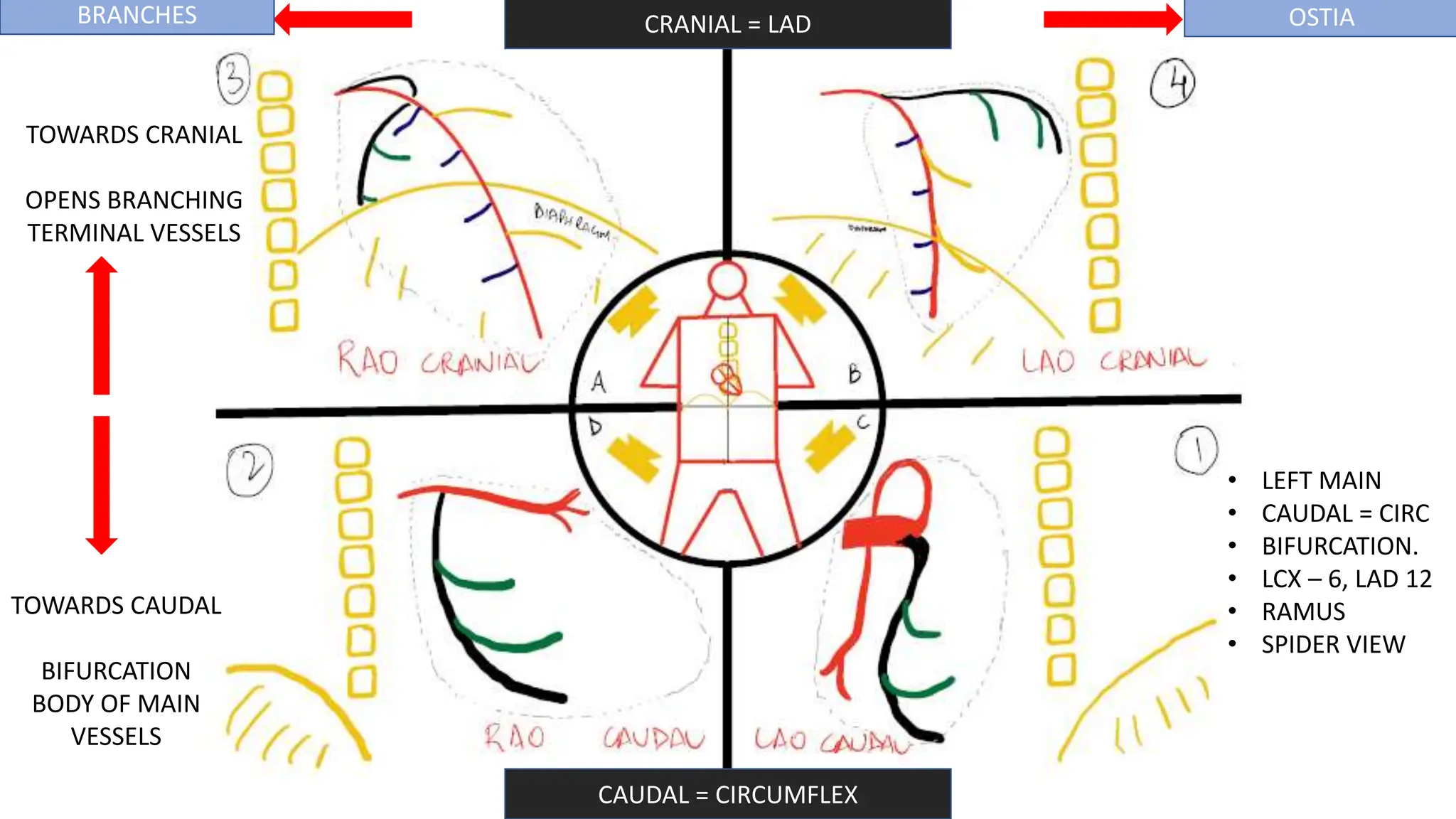
CAUDAL = CIRCUMFLEX
CRANIAL = LAD
BRANCHES OSTIA
TOWARDS CRANIAL
OPENS BRANCHING
TERMINAL VESSELS
TOWARDS CAUDAL
BIFURCATION
BODY OF MAIN
VESSELS
CAUDAL = CIRCUMFLEX
CRANIAL = LAD
BRANCHES OSTIA
TOWARDS CRANIAL
OPENS BRANCHING
TERMINAL VESSELS
TOWARDS CAUDAL
BIFURCATION
BODY OF MAIN
VESSELS
• LEFT MAIN
• CAUDAL = CIRC
• BIFURCATION.
• LCX – 6, LAD 12
• RAMUS
• SPIDER VIEW
LAO Caudal
CAUDAL = CIRCUMFLEX
CRANIAL = LAD
BRANCHES OSTIA
TOWARDS CRANIAL
OPENS BRANCHING
TERMINAL VESSELS
TOWARDS CAUDAL
BIFURCATION
BODY OF MAIN
VESSELS
• CAUDAL = CIRC
• BEST FOR OM
• BODY OF LCx
• PROX LAD –
STRAIGHT AND
ACROSS
RAO Caudal
CAUDAL = CIRCUMFLEX
CRANIAL = LAD
BRANCHES OSTIA
TOWARDS CRANIAL
OPENS BRANCHING
TERMINAL VESSELS
TOWARDS CAUDAL
BIFURCATION
BODY OF MAIN
VESSELS
• CRANIAL = LAD.
• LAD = MIDDLE.
• CIRC = AWAY.
• DIAGONALS.
• SEPTALS.
RAO Cranial
CAUDAL = CIRCUMFLEX
CRANIAL = LAD
BRANCHES OSTIA
TOWARDS CRANIAL
OPENS BRANCHING
TERMINAL VESSELS
TOWARDS CAUDAL
BIFURCATION
BODY OF MAIN
VESSELS
• CRANIAL = LAD.
• LAD = STRAIGHT
DOWN.
• DIAGONALS =
GOOD.
• TERMINAL =
GOOD.
• OSTIUM = GOOD.
LAO Cranial
THE RIGHT CORONARY SYSTEM
• 2 views.
• LAO View
• RAO View
• LAO = C SHAPED RCA.
• BODY = GOOD.
• DISTAL AND
BRANCHING = NOT
GOOD.
LAO
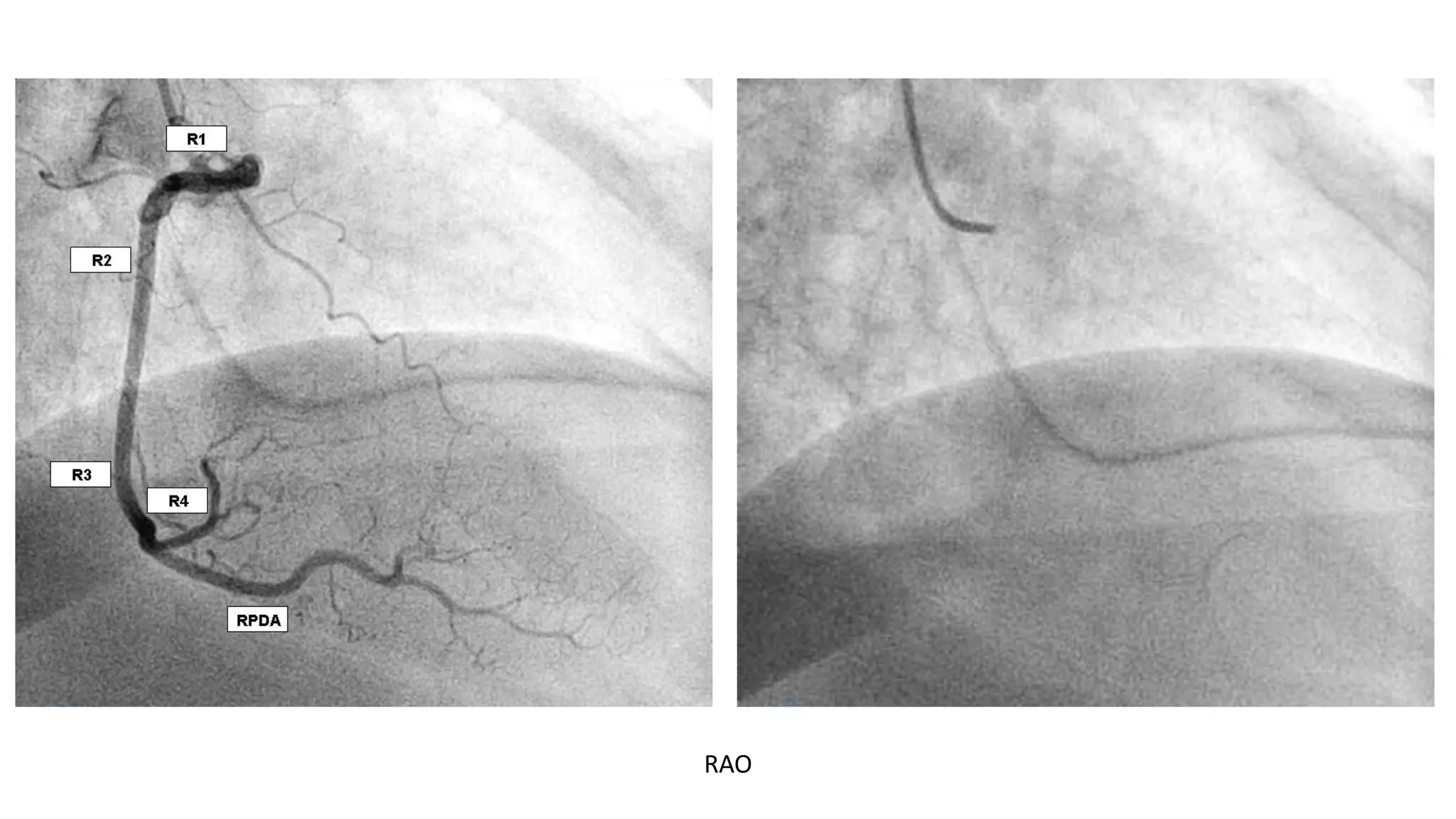
• RAO = L SHAPED
• BIFURCATION = GOOD.
• PDA TOWARDS; PLV AWAY
RAO
• LEFT MAIN
• CAUDAL = CIRC
• BIFURCATION.
• LCX – 6, LAD 12
• RAMUS
• SPIDER VIEW
• CAUDAL = CIRC
• BEST FOR OM
• BODY OF LCx
• PROX LAD –
STRAIGHT AND
ACROSS
• CRANIAL = LAD.
• LAD = MIDDLE.
• CIRC = AWAY.
• DIAGONALS.
• SEPTALS.
• CRANIAL = LAD.
• LAD = STRAIGHT
DOWN.
• DIAGONALS =
GOOD.
• TERMINAL =
GOOD.
• OSTIUM = GOOD.
CAUDAL = CIRCUMFLEX
CRANIAL = LAD
BRANCHES OSTIA
• LAO = C SHAPED RCA.
• BODY = GOOD.
• DISTAL AND BRANCHING = NOT GOOD.
• RAO = L SHAPED
• BIFURCATION = GOOD.
• PDA SEPTALS.
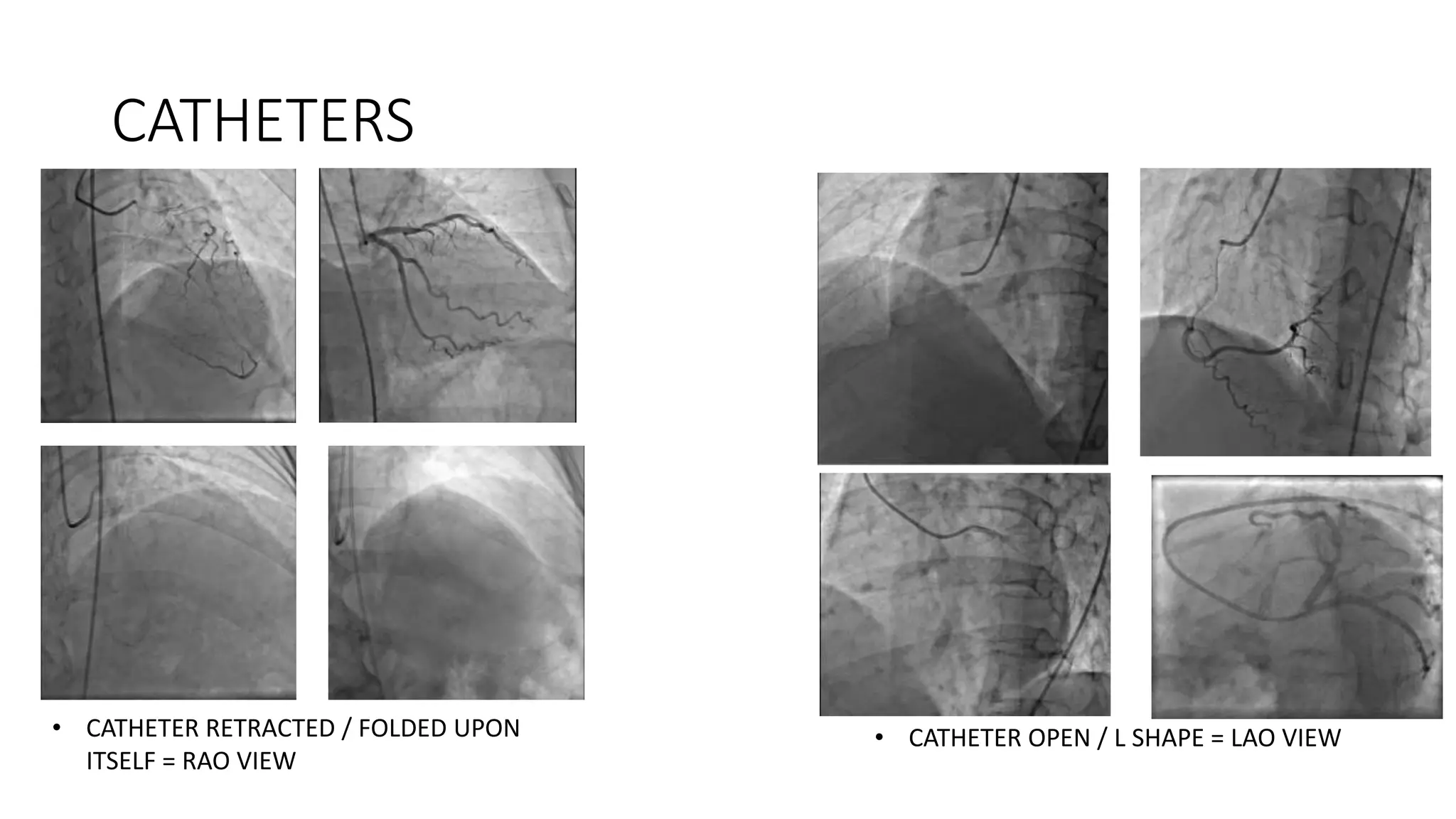
CATHETERS
• CATHETER RETRACTED / FOLDED UPON
ITSELF = RAO VIEW
• CATHETER OPEN / L SHAPE = LAO VIEW
PRACTICE ANGIOS.
FRACTIONAL FLOW RESERVE
It takes into account the following
factors before providing a functional
severity of the coronary artery stenosis.
• The length and degree of narrowing of
the coronary stenosis
• Presence of serial stenosis along the
same vessel
• Presence of collateral circulation
• Size of the perfusion territory
• Size of the vessel
Thank you…. Again.

CORONARY ANGIOGRAPHY INTERPRET(Coronary Angios).pptx

  • 1.
  • 2.
  • 3.
  • 4.
  • 5.
  • 8.
    THE LEFT CORONARYSYSTEM • 4 MAIN VIEWS • RAO CRANIAL • LAO CRANIAL • RAO CAUDAL • LAO CAUDAL • 2 SUPPLEMENTARY VIEWS • AP CRANIAL • AP CAUDAL
  • 10.
    CAUDAL = CIRCUMFLEX CRANIAL= LAD BRANCHES OSTIA TOWARDS CRANIAL OPENS BRANCHING TERMINAL VESSELS TOWARDS CAUDAL BIFURCATION BODY OF MAIN VESSELS
  • 11.
    CAUDAL = CIRCUMFLEX CRANIAL= LAD BRANCHES OSTIA TOWARDS CRANIAL OPENS BRANCHING TERMINAL VESSELS TOWARDS CAUDAL BIFURCATION BODY OF MAIN VESSELS • LEFT MAIN • CAUDAL = CIRC • BIFURCATION. • LCX – 6, LAD 12 • RAMUS • SPIDER VIEW
  • 12.
  • 13.
    CAUDAL = CIRCUMFLEX CRANIAL= LAD BRANCHES OSTIA TOWARDS CRANIAL OPENS BRANCHING TERMINAL VESSELS TOWARDS CAUDAL BIFURCATION BODY OF MAIN VESSELS • CAUDAL = CIRC • BEST FOR OM • BODY OF LCx • PROX LAD – STRAIGHT AND ACROSS
  • 14.
  • 15.
    CAUDAL = CIRCUMFLEX CRANIAL= LAD BRANCHES OSTIA TOWARDS CRANIAL OPENS BRANCHING TERMINAL VESSELS TOWARDS CAUDAL BIFURCATION BODY OF MAIN VESSELS • CRANIAL = LAD. • LAD = MIDDLE. • CIRC = AWAY. • DIAGONALS. • SEPTALS.
  • 16.
  • 17.
    CAUDAL = CIRCUMFLEX CRANIAL= LAD BRANCHES OSTIA TOWARDS CRANIAL OPENS BRANCHING TERMINAL VESSELS TOWARDS CAUDAL BIFURCATION BODY OF MAIN VESSELS • CRANIAL = LAD. • LAD = STRAIGHT DOWN. • DIAGONALS = GOOD. • TERMINAL = GOOD. • OSTIUM = GOOD.
  • 18.
  • 20.
    THE RIGHT CORONARYSYSTEM • 2 views. • LAO View • RAO View
  • 21.
    • LAO =C SHAPED RCA. • BODY = GOOD. • DISTAL AND BRANCHING = NOT GOOD.
  • 22.
  • 23.
    • RAO =L SHAPED • BIFURCATION = GOOD. • PDA TOWARDS; PLV AWAY
  • 24.
  • 25.
    • LEFT MAIN •CAUDAL = CIRC • BIFURCATION. • LCX – 6, LAD 12 • RAMUS • SPIDER VIEW • CAUDAL = CIRC • BEST FOR OM • BODY OF LCx • PROX LAD – STRAIGHT AND ACROSS • CRANIAL = LAD. • LAD = MIDDLE. • CIRC = AWAY. • DIAGONALS. • SEPTALS. • CRANIAL = LAD. • LAD = STRAIGHT DOWN. • DIAGONALS = GOOD. • TERMINAL = GOOD. • OSTIUM = GOOD. CAUDAL = CIRCUMFLEX CRANIAL = LAD BRANCHES OSTIA
  • 26.
    • LAO =C SHAPED RCA. • BODY = GOOD. • DISTAL AND BRANCHING = NOT GOOD. • RAO = L SHAPED • BIFURCATION = GOOD. • PDA SEPTALS.
  • 27.
    CATHETERS • CATHETER RETRACTED/ FOLDED UPON ITSELF = RAO VIEW • CATHETER OPEN / L SHAPE = LAO VIEW
  • 28.
  • 29.
  • 30.
    It takes intoaccount the following factors before providing a functional severity of the coronary artery stenosis. • The length and degree of narrowing of the coronary stenosis • Presence of serial stenosis along the same vessel • Presence of collateral circulation • Size of the perfusion territory • Size of the vessel
  • 31.

Editor's Notes

  • #3 Wouldn’t it be nice to see a heart with such perfectly laid out coronaries.
  • #4 But in reality, this is what we see.. The Aorta, with the RCA going right behind and gives off a Marginal branch at the acute margin of the heart And the Left main and LAD going behind on the other side and needing to reflect the heart using sponges and hands to visualize it properly.
  • #6 starting with the first anatomical plane looking from the feet of the patient towards the patient's head. if the x-ray source is situated directly below the patient with the image intensifier directly above the patient this is referred to as a standard starting position or zero degrees. You can see that the image intensifier can then rotate around the patient towards the right known as the right anterior oblique or RAO view. Image intensifier can also rotate to the left known as the left anterior oblique or LAO. the second plane we can now see that the image intensifier can move towards the head of the patient known as a cranial angulation or towards the feet of the patient known as a caudal angulation
  • #7 AXIAL VIEW
  • #8 SAGGITAL VIEW
  • #12 Lets start with the image labelled 1 here, the LAO Caudal View. Lao caudal view is BEST for the left main. Since it is a CAUDAL view, it is best for Circumflex.. Which comes down and is in the centre of the main picture. It opens up the bifurcation. Left main to lad and circumflex. It seperates the lad and lcx very well.. Lcx descends down to the 6 0 clock position and lad turns away from you at the 12 o clock position. If the ramus is present, it can be seen very well. AKA SPIDER VIEW ADDITIONAL : OSTIUM OF LAD AND CIRC SEEN WELL, BODY OF MAIN VESSELS, LAD AND LCX SEEN VERY WELL.
  • #13 Lets start with the image labelled 1 here, the LAO Caudal View. Lao caudal view is BEST for the left main. Since it is a CAUDAL view, it is best for Circumflex.. Which comes down and is in the centre of the main picture. It opens up the bifurcation. Left main to lad and circumflex. It seperates the lad and lcx very well.. Lcx descends down to the 6 0 clock position and lad turns away from you at the 12 o clock position. If the ramus is present, it can be seen very well. AKA SPIDER VIEW ADDITIONAL : OSTIUM OF LAD AND CIRC SEEN WELL, BODY OF MAIN VESSELS, LAD AND LCX SEEN VERY WELL.
  • #14 Now Coming to the image labelled 2 here, the RAO Caudal View. Since it is a CAUDAL view, it is best for Circumflex.. Which comes down and is in the centre of the main picture. OM branches are best seen in this view. Body of the left circumflex is seen well. Proximal LAD goes straight, right across the screen. NOT a good view for the true ostia.
  • #15 Now Coming to the image labelled 2 here, the RAO Caudal View. Since it is a CAUDAL view, it is best for Circumflex.. Which comes down and is in the centre of the main picture. OM branches are best seen in this view. Body of the left circumflex is seen well. Proximal LAD goes straight, right across the screen. NOT a good view for the true ostia.
  • #16 Now Coming to the image labelled 3 here, the RAO CRANIAL View. Cranial views are good for visualizing the LAD. LAD goes in the middle of the screen, comes to you at 5 o clock position. Circumflex artery goes away from you. Diagonals can be seen but their ostia can hide behind the body of the LAD. Septals can be seen. Branching pattern of both LAD and LCX can be seen. This view is not good for ostium and lcx.
  • #17 Cranial views are good for visualizing the LAD. LAD goes in the middle of the screen, comes to you at 5 o clock position. Circumflex artery goes away from you. Diagonals can be seen but their ostia can hide behind the body of the LAD. Septals can be seen. Branching pattern of both LAD and LCX can be seen. This view is not good for ostium and lcx.
  • #18 Looking at the last image labelled 4 here, the LAO CRANIAL View. Since it is a Cranial view, it is good for the LAD. LAD goes straight down. View that opens up the diagonals. Good for terminal portion. Ostium is clearly seen.
  • #19 Since it is a Cranial view, it is good for the LAD. LAD goes straight down. View that opens up the diagonals. Good for terminal portion OF BOTH LAD AND LCX. Ostium is clearly seen.
  • #20 2 ADDITIONAL VIEWS AP CAUDAL VIEW Hybrid between the RAO Caudal and LAO Caudal. Not a standard view. Everyones coronary anatomy is not the same and the heart might be rotated. If we encounter a vessel which is not clear in the RAO or LAO view, we can use the AP caudal view. Again, since it is a Caudal view, the CIRCumflex is most prominent. Diaphragm appears small. AP CRANIAL VIEW. Can see the LAD clearly. TIE BREAKER. Can be used if there is overlap in proximal LAD and standard views are not helping you. Here Diaphragm appears in the Middle of the Screen.
  • #22 IN the LAO View which is usually a straight LAO View, RCA Assumes the shape of the Letter C. Good for the RCA Ostium. Most importantly, the body of the RCA, if any disease, can be seen easily here, RV Marginal and Conus branches are well seen. IN the distal portion, the terminal branches overlap, hence it is not a good view. R MEIN L L MEIN C
  • #23 IN the LAO View which is usually a straight LAO View, RCA Assumes the shape of the Letter C. Good for the RCA Ostium. Most importantly, the body of the RCA, if any disease, can be seen easily here, RV Marginal and Conus branches are well seen. R MEIN L L MEIN C IN the distal portion, the terminal branches overlap, hence it is not a good view.
  • #24 RAO View RCA ASSUMES AN L SHAPE. Good for the Body of the RCA, which can be seen from a different plane. Good for bifurcation. PDA and PLV. PDA provides septals. R MEIN L L MEIN C
  • #25 RAO View RCA ASSUMES AN L SHAPE. Good for the Body of the RCA, which can be seen from a different plane. Good for bifurcation. PDA and PLV. PDA PROVED SEPTALS R MEIN L L MEIN C
  • #28 Notice these Judkins LEFT Catheters. If the Catheter is RETRACTED or FOLDED upon Itself, it is PROBABLY an RAO View. If the Catheter is OPEN as an L Shape, Probably it is an LAO View.
  • #30 FFR is a lesion specific physiological index that defines the hemodynamic severity of the coronary stenosis. It accurately identifies blockages responsible for ischemia (lack of oxygen to the heart muscles) that in many cases coronary angiography or intravascular ultrasound (IVUS) would not have detected or correctly assessed. FFR is determined by a carefully calibrated sensor that measures the blood pressure upstream and downstream (before and after the block) after the administration of medicine like adenosine to induce maximum flow.
  • #31 FFR measurement correlates to the likelihood of ischemia with a validated cut-off value of: > 0.75 : Functionally insignificant If the FFR is >0.75, the interventional cardiologist can safely defer stenting the moderately narrowed but hemodynamically insignificant blocked artery. Medications with blood thinners like Aspirin or Clopidogrel and cholesterol lowering medications like statins will be sufficient.