1
1 www.mynotebook.in
Chapter 1.
Copy
INTRODUCTION
What is Copywriting?
Copywriting is essentially selling with words. Copywriting is using words to
convince readers they will benefit (come out ahead) by using a certain product
or service and then motivating them to take action (buy).
Copywriting is the words used in advertisements, TV commercials, and
brochures. Whenever a business promotes itself (through a press release, a
leaflet or a newsletter), it needs a copywriter. That’s why copywriting is
everywhere - on big posters, local newspaper ads, and every clever slogan. And
when you put a postcard in a newsagent's window, to sell your old hi-fi, you're
using copywriting again.
Copywriting is probably the most creative and demanding branch of
writing. You start with a blank sheet of paper. You may have only a couple
of days to meet the client’s deadline. And your work could be read by
millions of people.
Who needs copywriters?
The market is vast. Every business, small and large, has to promote itself. Every
company needs leaflets or direct mail letters. And every new product needs a
pack that will entice us to buy it.
These days all organizations need to communicate. That includes hospitals, local
authorities and charities. So the opportunities for the copywriter are infinite.
Because organizations constantly alter, their literature and ads need regularly
changing, too. That keeps copywriters busy!
I. Attributes of a good copywriter
1. A good copy writer has an excellent and well-rounded portfolio - Take a look at
a copywriter's past work. Is it professional? Do you see some good concepts?
Are the projects high-caliber? You don't necessarily have to see work that is
specific to your particular industry. A broad spectrum of work demonstrates a
copywriter's talent and skill as well as the ability to adapt her knowledge to just
about any market. A good portfolio will also show experience in a range of
formats, such as print, web, outdoor, direct mail, press releases and corporate
communications.
2
2 www.mynotebook.in
2. has plenty of marketing and public relations savvy - Pretty words are, well,
pretty. But they don't necessarily do what you want them to do for you. Look for a
copywriter who has a rich background in marketing and public relations. That
person will have a quicker and deeper grasp of what the copy needs to do and
how to make it do it.
3. Listens to clients - When a copywriter listens to a client, wheels are turning.
He's making observations about the "who, what, when, where and why" of your
company, product or service. Questions come to his mind. He will have things he
wants to discuss and find out more about. But first, he listens carefully to what
you have to say.
4. Asks the right questions - You don't want an order taker; you want a copywriter
who knows how to find out what she needs to in order to do the best job. What is
your goal? Who do you need to sell to? Why should people care about your
product or service? What sets you apart from your competition? What does your
product or service does and how does it do it? How are you already reaching out
to your audience with marketing and public relations?
5. Doesn't always take your word for it - Sure, it's important for a copywriter to
understand the client's take on the situation. But a thorough copywriter will do a
little digging on his own to find out things like how the competition brands itself,
what's being said about your company, product or service and what is generally
important to your customers' buying decision.
6. Brings ideas to the table - You tell your copywriter you want content for your
web site, just your basic About Us, Products & Services and How to Contact Us.
A good copywriter will make suggestions, like "Have you thought about featuring
some case studies?", "Have you had a key word analysis yet?" or "How about
doing a newsletter that will let you capture email information?"
7. Can develop concepts - The copywriter's approach to a project is often
determined by the client's process. Sometimes a graphic designer has already
created a look and feel, determined what the tone should be. Other times, the
copywriter is called upon to help shape the message from the beginning. Find a
copywriter who has experience developing concepts and you'll have someone
who can make a broader contribution to the project.
8. A good copy writer is empathetic - Read something written by a good writer
and you can tell that she truly becomes the customer, brings that person right
into her head. When she writes about a new home, she imagines walking
through her dream house. When the reader will be a business person who has
been thinking seriously about going back to school for that MBA, the copywriter
feels that person's restlessness and desire to move up.
3
3 www.mynotebook.in
9. Offers flexibility - You need someone who will meet your time constraints and
deadlines. Or maybe the copywriter will need to be proactive and persistent
about getting information from some very busy, hard to reach people. Whether
it's patience or persistence you require in your copywriter, she should be
someone who can deliver.
10. Is someone you enjoy working with - In the end, when you've determined that
a copywriter has what it takes--talent, skill, experience, savvy--it comes down to
whether or not she is someone you respect and enjoy working with. The work will
thrive if you're a good team.
II. PRINCIPLES OF COPYWRITING
1. Use Attention Getting Headlines
For example – print ad for DHL uses only one word as it’s headline – “URGENT”,
which is underlined in red, and is enough to attract anyone’s attention.
Star TV print ad for The Big Fight does not use words, but uses a pair of boxing
gloves as headline.
2. Expand Headline with Lead Paragraph
Follow up the headline immediately with the first paragraph. If you ask a
question, answer it. If you propose a thought, explain it. Don't leave them
hanging too long; you may end up hanging yourself.
The ad for Maruti N2N fleet solutions uses the headline “ Who says managing a
huge fleet of company cars is hard work? This is followed by the lead paragraph
which explains how Maruti N2N works
3. Draw the Reader In
Avoid page and advertising layouts that are confusing or hard to read. Reading
your message should be a pleasure to read. Keep your copy simple, clear and
concise. Talk to your reader as you would a friend or family member. Be straight
and sincere with them. Spell it out and explain points that need explaining. Don't
leave your reader second-guessing your copy.
4
4 www.mynotebook.in
4. Focus on the Reader, not the Product
Of course your copy must contain information and facts about your product or
service, but that is not your focal point. You must focus the reader. Use their
needs, wants, desires, fears, weaknesses, concerns, and even fantasies to sell
your product or service.
The ad for Lakme Deep Pore Cleansing begins with the headline “There's a lot
that shows on your face”.
The body copy includes - Now, one-and-a-half minutes is all it takes to
uncover the real you. Presenting the complete Deep Pore Cleansing
Regimen from Lakme. Simply because your face says it all.
Thus, not only does the ad talk about the product, it also focuses equally
on the reader. Using words like “you” would make the reader feel good,
rather than an ad that boasts about the product but says nothing about
how to use it, how it could make your life better, etc.
5. Use the "That's Right!" Principle
Get your prospect to agree with you. Tell them something they know already. Get
them to say to themselves, "That's Right!"
The print ad for JW Marriott starts with the headline -: Your mom knows exactly
how you like your bed, your toast, and your coffee….
This headline will indeed make the target exclaim – that’s right!
6. Ask Provocative Questions:
Leading into your copy or headline with thought provoking questions will grab the
reader's interest and move them to read more for the answer.
The ad for Deccan Chronicle uses an attractive female model asking a
provocative question like – “Want to play the number Game?”. The ad actually
talks about the impressive figures of circulation of the Deccan Chronicle.
7. Move Quickly from Intro to the Pitch:
Don't waste your reader's time trying to "warm them up". If they got that far,
there's blood flowing already. People are busy creatures. If you lose their
interest, you neither sell nor profit. Get on with it!
8. Be Sincere:
What's the number one fallback for sales on the web? Fear! Fear of being
scammed or ripped-off. The more sincere you are the better your chance of
building a "selling" relationship.
5
5 www.mynotebook.in
The sincerity and genuineness of Air Sahara comes across in its ad where the
body copy says – as hard as we may try at this time of the year (winter), there
are chances of flight delays due to weather conditions. Every step is taken to
help passengers get to their destinations on time. To make this process easier,
we need your help too.
9. Don't Contradict Yourself:
Double-check your copy. You would be surprised to know that many copywriters
unknowingly contradict themselves leaving the reader suspicious, thus
destroying your credibility with them.
10. Keep Your Focus Aligned
The more focused your target group, the better your chance of meeting their
needs. Don't try to sell everyone!
11. Make Your Product Irresistible
Dress it up. Your product should sound like the cream of the crop. Focus on your
selling point (price, quality, etc) and make it impossible for the reader to imagine
another in comparison.
12. Use Fear as Motivation:
Fear is both a weakness and strength, but also a powerful selling tool. Fear of
injury, death or missed opportunity. If you sell a safety product you would use this
fear to your advantage. If you're offering an opportunity, the fear of missing their
chance is a strong seller.
Many ads for financial services use fear to motivate their target.
For example in the ad for New India Assurance – Shop Owners Policy, a shop
owner imagines a riot occurring near his shop, which causes damage to his shop
I.e. the physical property. Thus fear is used to motivate shop owners to get their
shops insured under the policy offered by NIA.
13. Flattery will get you everywhere
Yes, everyone likes to hear a little flattery. Keyword here is "little". Don't overdo it!
14. Be Personable
Let them know that there is a kind, honest and real person behind the page.
People would rather deal with people, not companies, corporations or
conglomerates. Add the "Human Touch" to your copy.
Ex: the institutional ad for Eureka Forbes which shows model Aditi Gowatrikar
with her child has a human touch to it, what with the body copy saying – “…times
have changed. Yet your dreams remain the same. So open up. Say ‘yes’ to
life…”
6
6 www.mynotebook.in
15. Its Guaranteed
A guarantee reassures the reader that you are reputable and will live up to your
promises.
For example, in the Vim Bar TVC, the anchor promises that if “your” detergent is
better than Vim Bar, you will get a year’s supply of your detergent free. This
guarantee lends credibility to the offering and induces the viewer to act.
16. Use "Power"ful Words:
"Power" words are words that move a buyer by enhancing and reinforcing your
presented idea. Certain words have proven to be movers and shakers in the
advertising world.
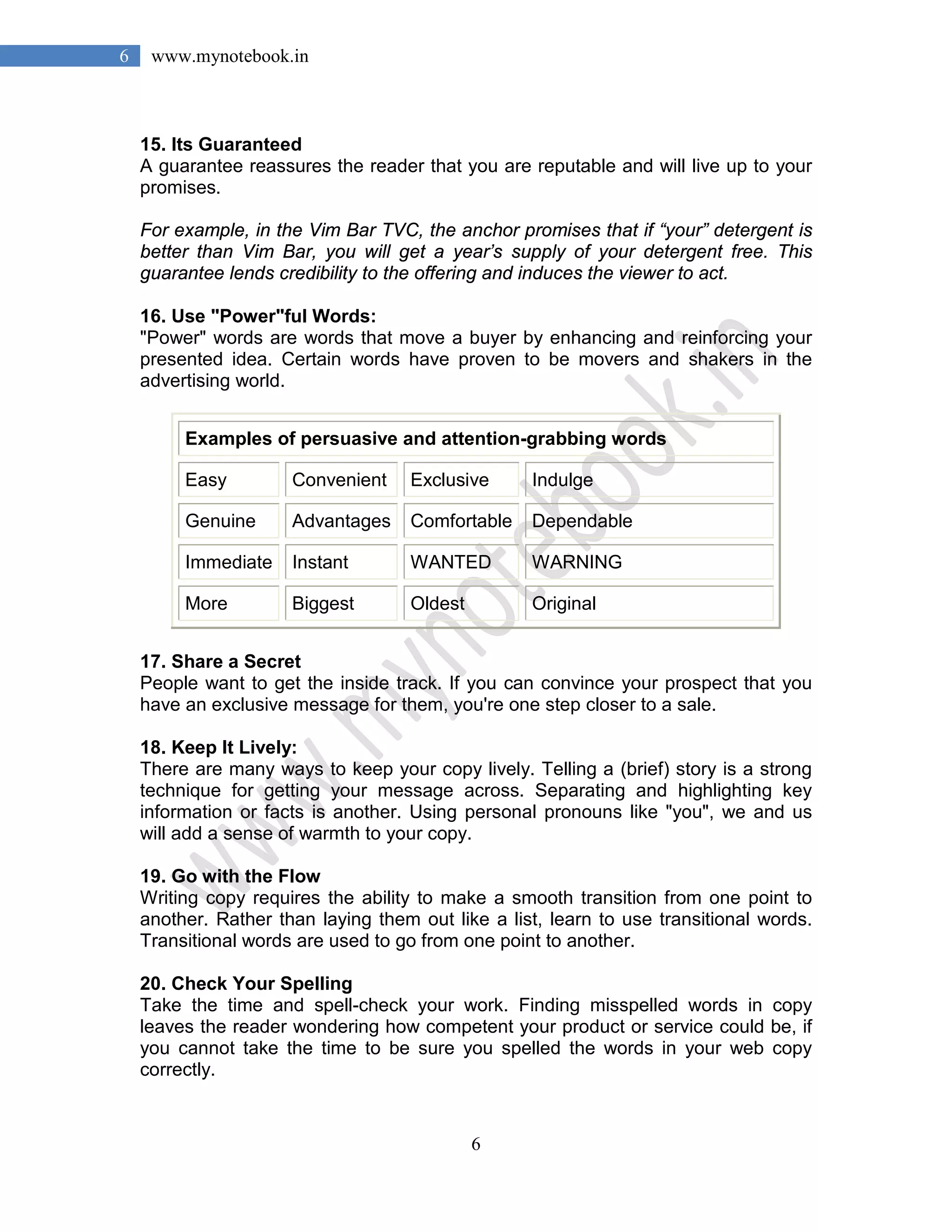
Examples of persuasive and attention-grabbing words
Easy Convenient Exclusive Indulge
Genuine Advantages Comfortable Dependable
Immediate Instant WANTED WARNING
More Biggest Oldest Original
17. Share a Secret
People want to get the inside track. If you can convince your prospect that you
have an exclusive message for them, you're one step closer to a sale.
18. Keep It Lively:
There are many ways to keep your copy lively. Telling a (brief) story is a strong
technique for getting your message across. Separating and highlighting key
information or facts is another. Using personal pronouns like "you", we and us
will add a sense of warmth to your copy.
19. Go with the Flow
Writing copy requires the ability to make a smooth transition from one point to
another. Rather than laying them out like a list, learn to use transitional words.
Transitional words are used to go from one point to another.
20. Check Your Spelling
Take the time and spell-check your work. Finding misspelled words in copy
leaves the reader wondering how competent your product or service could be, if
you cannot take the time to be sure you spelled the words in your web copy
correctly.
7
7 www.mynotebook.in
21. Use Photo's to Demonstrate:
Use photos to demonstrate your product or service. If used correctly a picture
really is worth a thousand words.
Ads for cosmetics generally use photographs to demonstrate the benefits of
using the product – smooth skin, fairness, etc.
22. Use Graphics to get Attention:
Using buttons, icons and arrows can help direct the reader's attention to
important details. If organized correctly they can also help sort facts or messages
into categories.
The ad for Toyota Qualis uses arrows to draw the readers’ attention to the unique
features of the vehicle such as integrated bumper; wood finishes paneling,
captain seats, etc.
23. Offer Testimonials
Offer short, reputable testimonials. People want to hear what others have to say
about your product or service.
Diana Hayden – Miss World 1996 offers testimonial for Loreal Hair color.
24 Create a Memorable Logo
Create a simple, but memorable logo or custom graphic that your visitor can
easily relate to your product or service
Examples:
Nike swoosh
Tata
Mercedes
McDonald Golden Arches
25. Create an Unforgettable Slogan
Use a short, easy to remember slogan that a reader will walk away with on his or
her lips.
Nike – Just Do It.
Visa – Go get it
Pepsi – Yeh Dil Maange More
Asian Paints – Merawalla….
26. Get a response
There are many techniques for getting a prospect to respond. Spell it out for
them. Tell them to respond. Tell them why they should respond. Give them a
reason they should respond now. Offer a bonus or freebie if they respond.
8
8 www.mynotebook.in
This can be done by using words like – order now, order today, for a short time
only, last chance, etc.
Ex:
Service – ICICI Bank – Two Wheeler Loans
“Take Home Passion (Hero Honda Passion) by just paying Rs. 3999 only
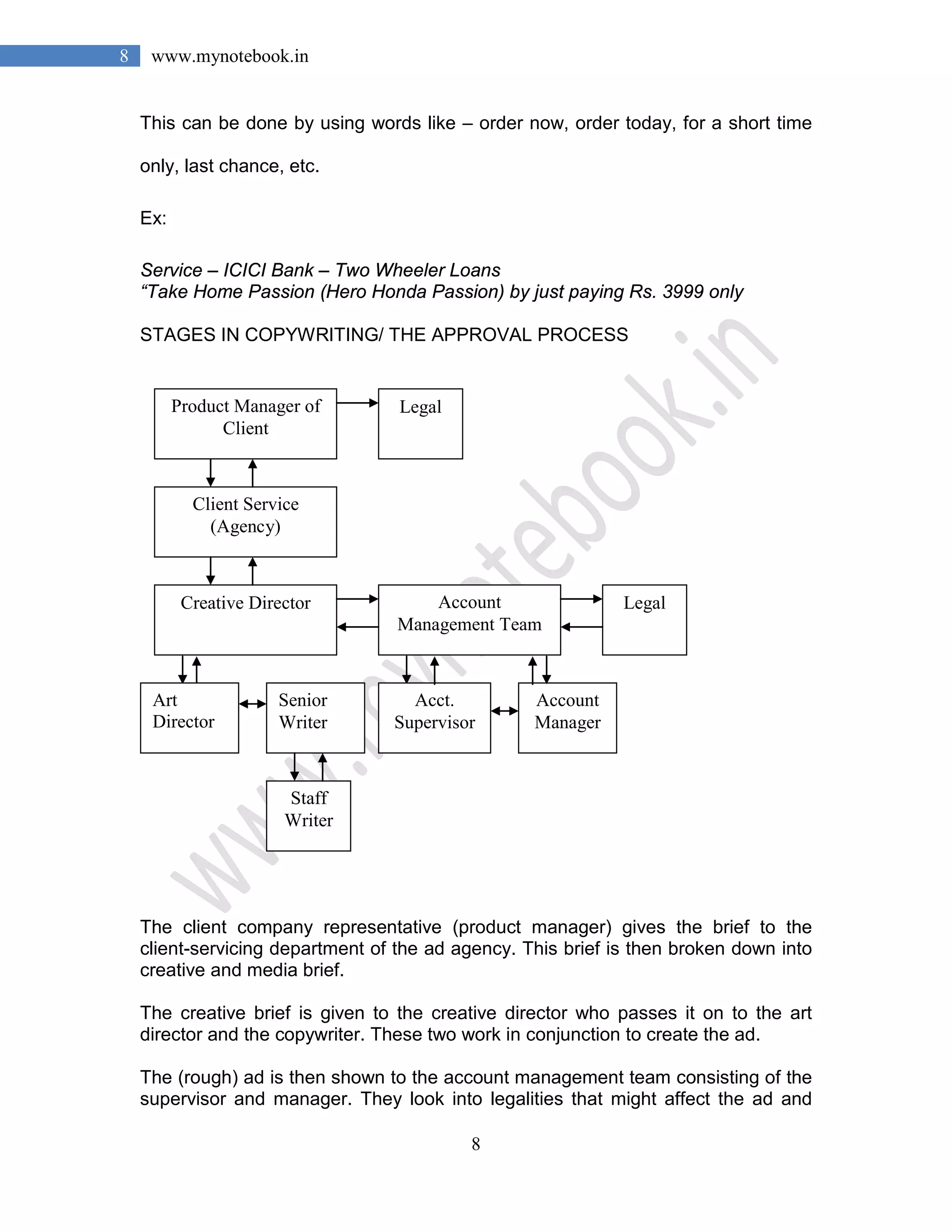
STAGES IN COPYWRITING/ THE APPROVAL PROCESS
The client company representative (product manager) gives the brief to the
client-servicing department of the ad agency. This brief is then broken down into
creative and media brief.
The creative brief is given to the creative director who passes it on to the art
director and the copywriter. These two work in conjunction to create the ad.
The (rough) ad is then shown to the account management team consisting of the
supervisor and manager. They look into legalities that might affect the ad and
Product Manager of
Client
Client Service
(Agency)
Creative Director
Art
Director
Staff
Writer
Senior
Writer
Acct.
Supervisor
Account
Manager
Account
Management Team
Legal
Legal
9
9 www.mynotebook.in
whether the ad meets the client’s brief and budget. Changes, if any, are
communicated to the creative department
The (rough) ad is then shown to the client servicing dept. The dept. might also
suggest changes. The ad is finally shown to the client for his approval. Once the
approval is received, the creative department goes ahead with the actual
production of the ad.
10
10 www.mynotebook.in
Chapter 2.
Creative Strategy: Planning and Development
I. Developing an Advertising Plan: An advertising plan is a document
created with the goal of matching the most effective message to your
audience
Definition: An outline of what goals an advertising campaign should achieve,
how to accomplish those goals, and how to determine whether or not the
campaign was successful in obtaining those goals.
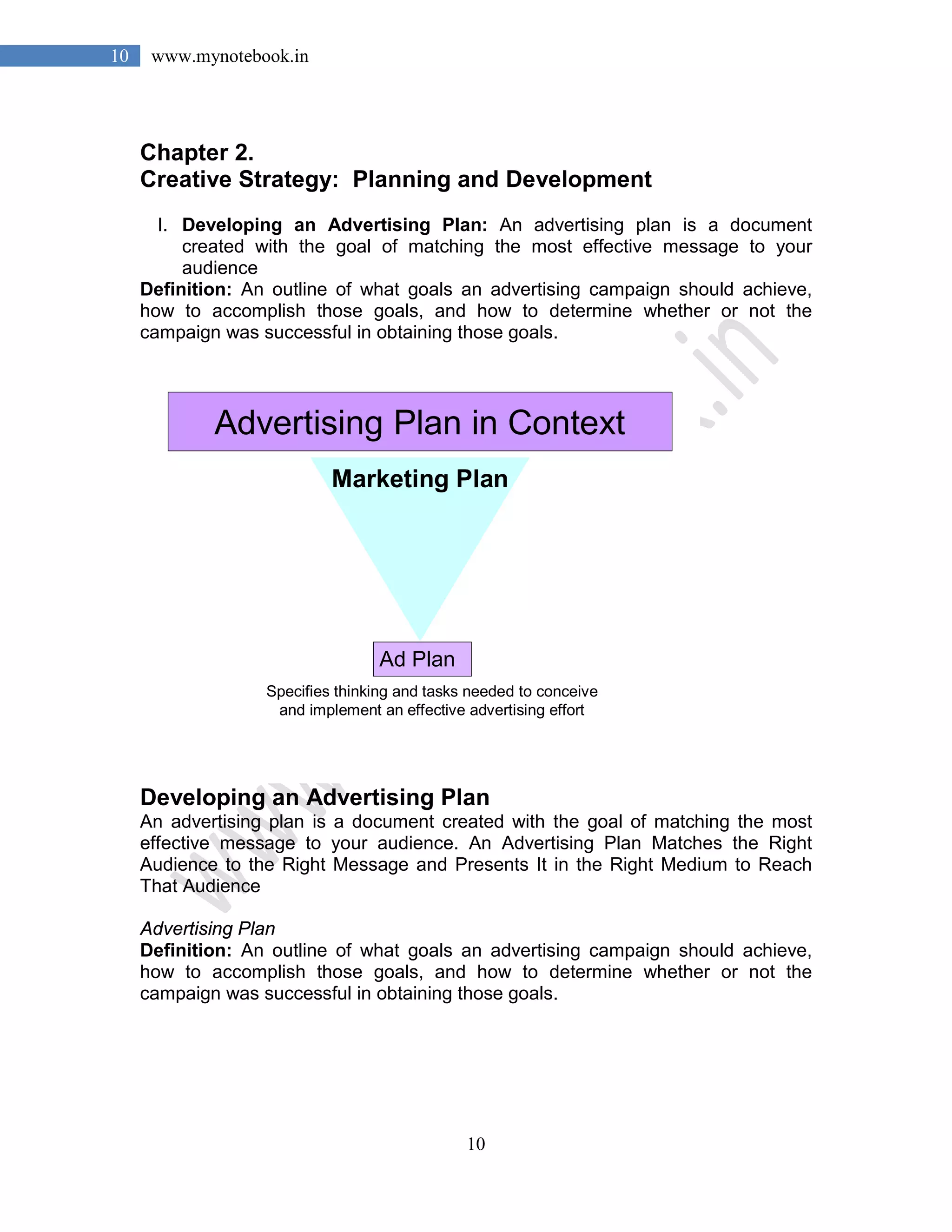
Advertising Plan in Context
Ad Plan
Specifies thinking and tasks needed to conceive
and implement an effective advertising effort
Marketing Plan
Developing an Advertising Plan
An advertising plan is a document created with the goal of matching the most
effective message to your audience. An Advertising Plan Matches the Right
Audience to the Right Message and Presents It in the Right Medium to Reach
That Audience
Advertising Plan
Definition: An outline of what goals an advertising campaign should achieve,
how to accomplish those goals, and how to determine whether or not the
campaign was successful in obtaining those goals.
11
11 www.mynotebook.in
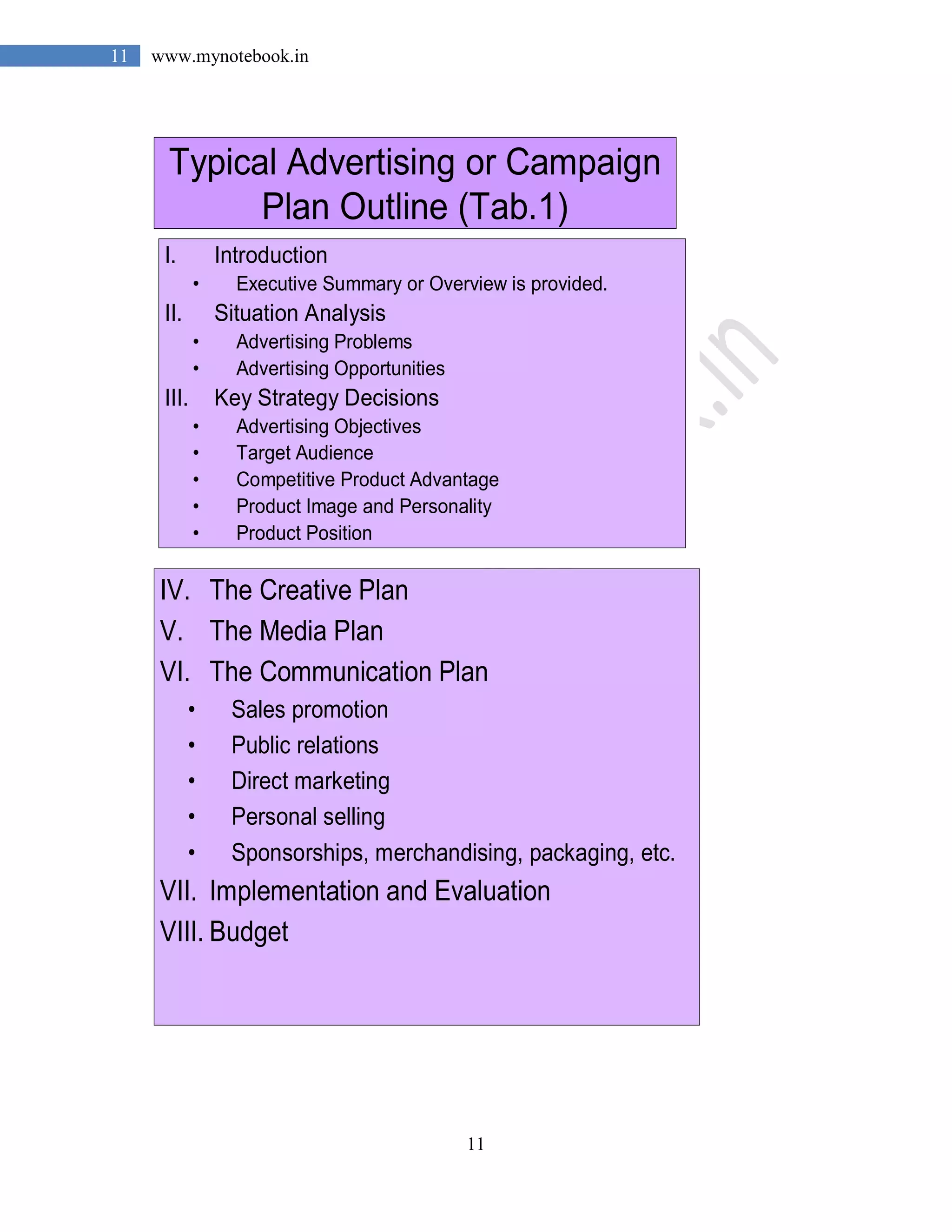
Typical Advertising or Campaign
Plan Outline (Tab.1)
I. Introduction
• Executive Summary or Overview is provided.
II. Situation Analysis
• Advertising Problems
• Advertising Opportunities
III. Key Strategy Decisions
• Advertising Objectives
• Target Audience
• Competitive Product Advantage
• Product Image and Personality
• Product Position
IV. The Creative Plan
V. The Media Plan
VI. The Communication Plan
• Sales promotion
• Public relations
• Direct marketing
• Personal selling
• Sponsorships, merchandising, packaging, etc.
VII. Implementation and Evaluation
VIII. Budget
12
12 www.mynotebook.in
II. Advertising Creativity: The five stages of creativity,
Creative Thought Process,
What Is Creativity?
Creativity is a mental process involving the generation of new ideas or concepts,
or new associations of the creative mind between existing ideas or concepts
More than 60 different definitions of creativity can be found in the psychological
literature
Definitions of creativity are typically descriptive of activity that results:
1. In producing or bringing about something partly or wholly new
2. In investing an existing object with new properties or characteristics
3. In imagining new possibilities that were not conceived of before
4. In seeing or performing something in a manner different from what was
thought possible or normal previously.
Distinguishing between creativity and innovation
Creativity is typically used to refer to the act of producing new ideas, approaches
or actions, while innovation is the process of both generating and applying such
creative ideas in some specific context.
Advertising Creativity involves two processes:
1. Thinking,
2. Producing.
Getting Raw Material, Data,
Immersing One's Self in the Problem
to Get the Background.
Getting Raw Material, Data,
Immersing One's Self in the Problem
to Get the Background.
ImmersionImmersion
Ruminating on the Data Acquired,
Turning It This Way and That in the
Mind.
Ruminating on the Data Acquired,
Turning It This Way and That in the
Mind.
DigestionDigestion
Ceasing Analysis and Putting the
Problem Out of Conscious Mind for
a Time.
Ceasing Analysis and Putting the
Problem Out of Conscious Mind for
a Time.
IncubationIncubation
A Sudden Inspiration or Intuitive
Revelation About a Potential Solution.
A Sudden Inspiration or Intuitive
Revelation About a Potential Solution.IlluminationIllumination
Studying the Idea, Evaluating It, and
Developing It for Practical Usefulness.
Studying the Idea, Evaluating It, and
Developing It for Practical Usefulness.VerificationVerification
Getting Raw Material, Data,
Immersing One's Self in the Problem
to Get the Background.
Getting Raw Material, Data,
Immersing One's Self in the Problem
to Get the Background.
ImmersionImmersion
Ruminating on the Data Acquired,
Turning It This Way and That in the
Mind.
Ruminating on the Data Acquired,
Turning It This Way and That in the
Mind.
DigestionDigestion
Ceasing Analysis and Putting the
Problem Out of Conscious Mind for
a Time.
Ceasing Analysis and Putting the
Problem Out of Conscious Mind for
a Time.
IncubationIncubation
A Sudden Inspiration or Intuitive
Revelation About a Potential Solution.
A Sudden Inspiration or Intuitive
Revelation About a Potential Solution.IlluminationIllumination
Young's Creative Process
13
13 www.mynotebook.in
III. Components of the Creative Strategy:
“ The Ultimate
Driving
Machine”
“ The Ultimate
Driving
Machine”
BMWBMW
“ Taste of
India”
“ Taste of
India”
Miller
Lite
Miller
Lite
“Like a Rock”“Like a Rock”
Chevy
Trucks
Chevy
TrucksBMWBMWAMULAMUL
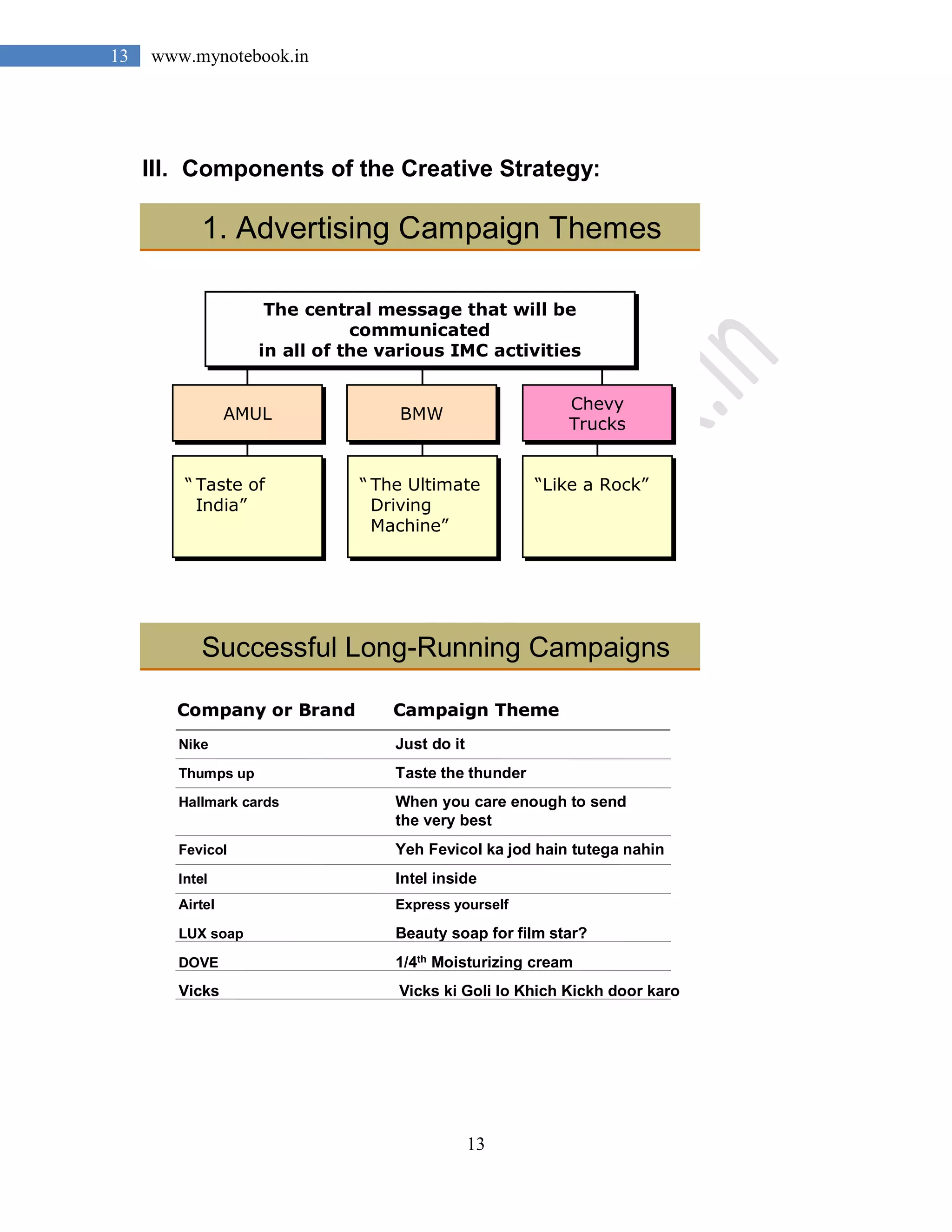
1. Advertising Campaign Themes
The central message that will be
communicated
in all of the various IMC activities
The central message that will be
communicated
in all of the various IMC activities
Successful Long-Running Campaigns
Nike Just do it
Thumps up Taste the thunder
Hallmark cards When you care enough to send
the very best
Fevicol Yeh Fevicol ka jod hain tutega nahin
Intel Intel inside
Airtel Express yourself
LUX soap Beauty soap for film star?
DOVE 1/4th Moisturizing cream
Vicks Vicks ki Goli lo Khich Kickh door karo
Company or BrandCompany or Brand Campaign ThemeCampaign Theme
14
14 www.mynotebook.in
Positioning the
Brand
Positioning the
Brand
Use a Unique
Selling Position
Use a Unique
Selling Position
Create the Brand
Image
Create the Brand
ImagePositioningPositioning Find the Inherent
Drama
Find the Inherent
Drama
Create a Brand
Image
Create a Brand
Image
Use a Unique
Selling Position
Use a Unique
Selling Position
2. Major Selling Ideas
Seeking the
Major Idea
Seeking the
Major Idea
Buy this
produce and
you'll benefit
this way or
enjoy this
reward
Buy this
produce and
you'll benefit
this way or
enjoy this
reward
Must be unique
to this brand or
claim; something
rivals can't or
don't offer
Must be unique
to this brand or
claim; something
rivals can't or
don't offer
UniqueUniqueBenefitBenefit UniqueUniqueBenefitBenefit
Approaches to the Major Selling Idea: USP
Unique Selling
Proposition
Unique Selling
Proposition
The promise
must be strong
enough or
attractive
enough to move
people
The promise
must be strong
enough or
attractive
enough to move
people
PotentPotent
15
15 www.mynotebook.in
Brand image or
personality is particularly
important when brands
are similar
Brand image or
personality is particularly
important when brands
are similar
“Every ad must contribute
to the complex symbol
that is the brand image.”
“Every ad must contribute
to the complex symbol
that is the brand image.”
Brand image or
personality is particularly
important when brands
are similar
Brand image or
personality is particularly
important when brands
are similar
Perspectives of Great Ad Men on the Major Selling Idea
David OgilvyDavid Ogilvy
Find the inherent drama or
characteristic of the
product that makes
consumers buy it
Find the inherent drama or
characteristic of the
product that makes
consumers buy it
“(Inherent drama) is often
hard to find but it is always
there, and once found it is
the most interesting and
believable of all
advertising appeals.”
“(Inherent drama) is often
hard to find but it is always
there, and once found it is
the most interesting and
believable of all
advertising appeals.”
Leo BurnettLeo Burnett
Often used for products such as soft
drinks, perfume, liquor, clothing, airlines
Often used for products such as soft
drinks, perfume, liquor, clothing, airlines
The creativity sales strategy is based on a
strong, memorable brand identity through
image advertising
The creativity sales strategy is based on a
strong, memorable brand identity through
image advertisingimage advertising
Used when competing brands are so
similar it is difficult to find or create a
unique attribute
Used when competing brands are so
similar it is difficult to find or create a
unique attribute
The creativity sales strategy is based on a
strong, memorable brand identity through
image advertising
The creativity sales strategy is based on a
strong, memorable brand identity through
image advertisingimage advertising
Used when competing brands are so
similar it is difficult to find or create a
unique attribute
Used when competing brands are so
similar it is difficult to find or create a
unique attribute
3. Creating a Brand Image
16
16 www.mynotebook.in
Approaches to the Major Selling
Idea: Inherent Drama
Inherent
Drama
Inherent
Drama
Messages generally presented
in a warm, emotional way
Hallmark, Maytag, Kellog
Messages generally presented
in a warm, emotional way
Hallmark, Maytag, Kellog
Focus on consumer benefits
with an emphasis on the
dramatic element in
expressing them
Focus on consumer benefits
with an emphasis on the
dramatic element in
expressing them
Messages generally presented
in a warm, emotional way
Hallmark, Maytag, Kellog
Messages generally presented
in a warm, emotional way
Hallmark, Maytag, Kellog
4. Appeals and Execution Style
4. A. Advertising appeals
Appeals are broadly classified as rational, emotional and moral appeals:
17
17 www.mynotebook.in
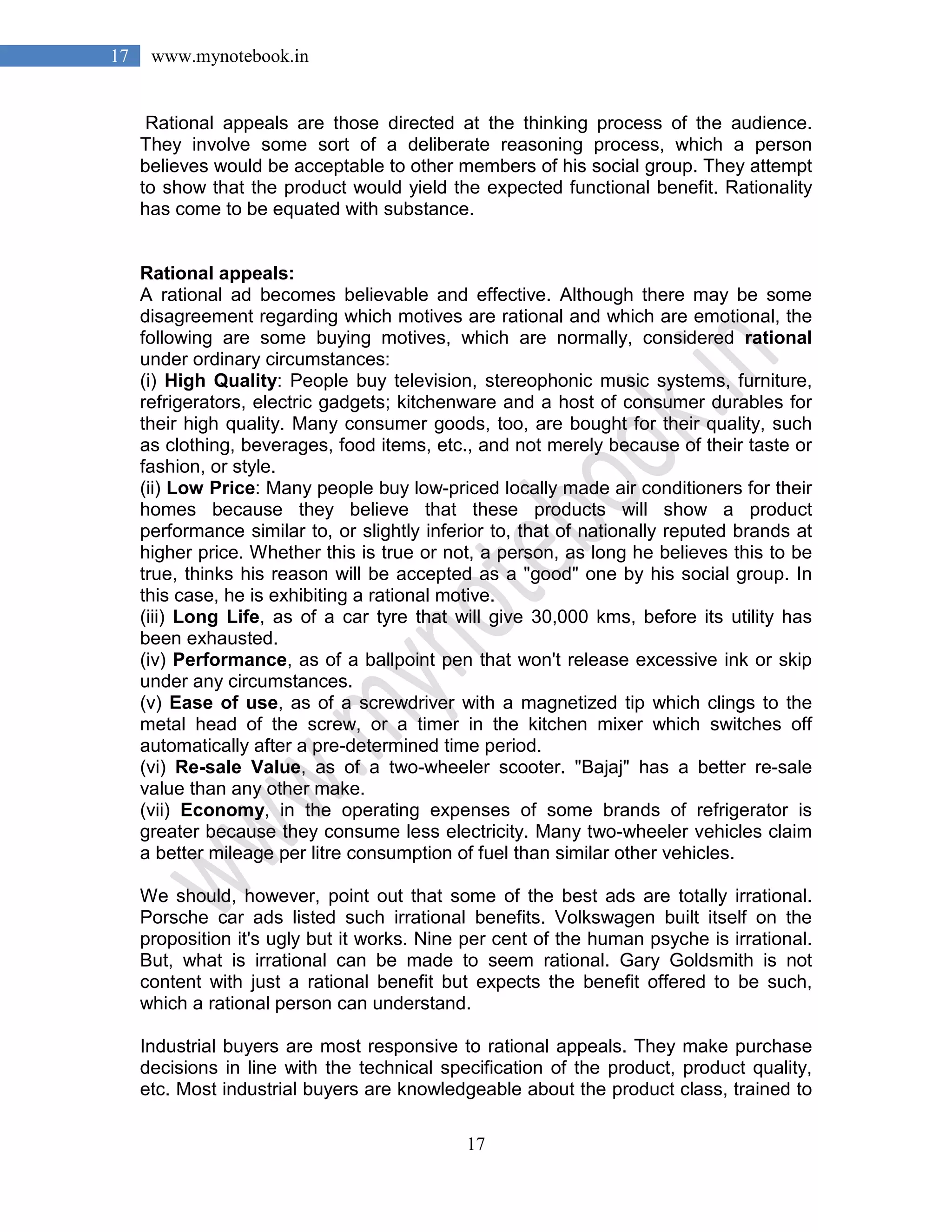
Rational appeals are those directed at the thinking process of the audience.
They involve some sort of a deliberate reasoning process, which a person
believes would be acceptable to other members of his social group. They attempt
to show that the product would yield the expected functional benefit. Rationality
has come to be equated with substance.
Rational appeals:
A rational ad becomes believable and effective. Although there may be some
disagreement regarding which motives are rational and which are emotional, the
following are some buying motives, which are normally, considered rational
under ordinary circumstances:
(i) High Quality: People buy television, stereophonic music systems, furniture,
refrigerators, electric gadgets; kitchenware and a host of consumer durables for
their high quality. Many consumer goods, too, are bought for their quality, such
as clothing, beverages, food items, etc., and not merely because of their taste or
fashion, or style.
(ii) Low Price: Many people buy low-priced locally made air conditioners for their
homes because they believe that these products will show a product
performance similar to, or slightly inferior to, that of nationally reputed brands at
higher price. Whether this is true or not, a person, as long he believes this to be
true, thinks his reason will be accepted as a "good" one by his social group. In
this case, he is exhibiting a rational motive.
(iii) Long Life, as of a car tyre that will give 30,000 kms, before its utility has
been exhausted.
(iv) Performance, as of a ballpoint pen that won't release excessive ink or skip
under any circumstances.
(v) Ease of use, as of a screwdriver with a magnetized tip which clings to the
metal head of the screw, or a timer in the kitchen mixer which switches off
automatically after a pre-determined time period.
(vi) Re-sale Value, as of a two-wheeler scooter. "Bajaj" has a better re-sale
value than any other make.
(vii) Economy, in the operating expenses of some brands of refrigerator is
greater because they consume less electricity. Many two-wheeler vehicles claim
a better mileage per litre consumption of fuel than similar other vehicles.
We should, however, point out that some of the best ads are totally irrational.
Porsche car ads listed such irrational benefits. Volkswagen built itself on the
proposition it's ugly but it works. Nine per cent of the human psyche is irrational.
But, what is irrational can be made to seem rational. Gary Goldsmith is not
content with just a rational benefit but expects the benefit offered to be such,
which a rational person can understand.
Industrial buyers are most responsive to rational appeals. They make purchase
decisions in line with the technical specification of the product, product quality,
etc. Most industrial buyers are knowledgeable about the product class, trained to
18
18 www.mynotebook.in
recognize value and are responsible to others about their choice. Often, industrial
buying decisions are made after a thorough comparison of various offers and
after evaluating the various benefits of different makes.
Consumer durables of high value 'are also often bought on the basis of rational
appeals. People are ready and willing to give rational motives if asked why they
have made a particular [purchase. Those who buy Playboy or Debonair are likely
to say they buy them for the articles. Even when decisions are made on
emotional grounds, people like to rationalize their decision~ to show that they are
based on sound rational grounds. Strong emotional propositions need rational
underpinnings. Most of us want others to regard us as rational human beings.
That is why we like to give socially acceptable reasons for our buying decisions.
We feel that rational motives will raise our status in the eyes of our associates
and colleagues.
Emotional appeals:
Emotional appeals are those appeals, which are not preceded by careful
analysis of the pros and cons of making a buying. Emotions are those mental
agitations or excited states of feeling which prompt us to make a purchase.
Emotional motives may be below the level of consciousness, and may not be
recognized by a person; or even if he is fully aware that such a motive is
operating, he is unwilling to admit it to others because he feels that it would be
unacceptable as a "proper" reason for buying among his associates and
colleagues.
Emotional appeals are designed to stir up some negative or positive emotions
that will motivate product interest or purchase. Different emotional appeals, which
are particularly important from the advertising point of view, are listed below.
Following several motivation research studies, it has been found that negative
emotional appeals are more effective than positive ones. We shall also,
therefore, name the negative appeals first.
All brands have rational and emotional credentials. Levi's is youthful,
rebellious and sexy. But it offers rational benefits like strength too. One has to
balance between rational and emotional arguments. Singapore Airlines
presents the Singapore girl, an emotional icon. But it also emphasizes in-flight
service that other airlines talk about, which is a rational proposition.
Negative Emotional Appeals: An advertiser may try to induce a particular
behavioral change by emphasizing either positive or negative appeals, or a
combination of both. For example, an advertising campaign to get the target
audience to buy fire insurance may stress the positive aspect -low cost relative to
other investment, the services the insurance company provides, early settlement
of claims, and so on; or it may stress the negative aspect of not getting insurance
- the danger of losing one's possessions or the ravages of fire. Positive appeals
use the strategy of "reducing" a person's anxiety about "buying and using" a
19
19 www.mynotebook.in
product, while negative appeals use the strategy of "increasing" a person's
anxiety about "not using" a product or service. In general, a positive appeal
stresses the positive gains to a person from complying with the persuasive
message; the negative appeal stresses his loss if he fails to comply.
Emotions are those mental agitations or excited states of feeling which prompt us
to make a purchase. Emotional motives may be below the level of
consciousness, and may not be recognized by a person; or even if he is fully
aware that such a motive is operating, he is unwilling to admit it to others
because he feels that it would be unacceptable as a "proper" reason for buying
among his associates and colleagues.
Emotional appeals are designed to stir up some negative or positive emotions
that will motivate product interest or purchase. Different emotional appeals, which
are particularly important from the advertising point of view, are listed below.
Following several motivation research studies, it has been found that negative
emotional appeals are more effective than positive ones. We shall also,
therefore, name the negative appeals first.
All brands have rational and emotional credentials. Levi's is youthful,
rebellious and sexy. But it offers rational benefits like strength too. One has to
balance between rational and emotional arguments. Singapore Airlines
presents the Singapore girl, an emotional icon. But it also emphasizes in-flight
service that other airlines talk about, which is a rational proposition.
Negative Emotional Appeals: An advertiser may try to induce a particular
behavioral change by emphasizing either positive or negative appeals, or a
combination of both. For example, an advertising campaign to get the target
audience to buy fire insurance may stress the positive aspect -low cost relative to
other investment, the services the insurance company provides, early settlement
of claims, and so on; or it may stress the negative aspect of not getting insurance
- the danger of losing one's possessions or the ravages of fire. Positive appeals
use the strategy of "reducing" a person's anxiety about "buying and using" a
product, while negative appeals use the strategy of "increasing" a person's
anxiety about "not using" a product or service. In general, a positive appeal
stresses the positive gains to a person from complying with the persuasive
message; the negative appeal stresses his loss if he fails to comply.
Precautions while using the Emotional Route:
1. The advertising should have relevance. If the product needs attribute-based
rational advertising, emotional appeals should be avoided.
2. There should be a natural flow of feelings.
3. Execution should not be exaggerated. The level of emotionality should not
exceed that experienced by the consumer.
20
20 www.mynotebook.in
4. There is a difference between a consumer's emotions associated with the
product / brand and a consumer's emotional reaction to the ad copy itself.
Preferably, these two should be compatible.
Fear Appeals: The fear appeal is most important among emotional appeals, and
also the most effective. It is said that the message's effectiveness increases with
the level of fear it generates. The use of fear appeal in getting people to start
doing things they should is very common.
Many ad messages of toothpaste employ this appeal. They present the fear of
tooth decay or unhealthy gums or bad breath, and then suggest the use of a
specific brand of toothpaste to get rid of such fears. A recent ad of "Promise"
shows a boy weeping because of severe toothache, and then suggests the use
of "Promise" to avoid a recurrence of toothache.
A fear appeal of this kind is used in a wide variety of product categories. When
products are designed to protect an individual from some loss of health (medical
or life insurance), the fear appeal of the type illustrated above can be effectively
employed. Then there are products designed to protect an individual from loss of
property (automobile or home), which successfully employ fear appeals to induce
a particular buying behavior.
Fear appeals are at times used in ad messages in connection with getting people
to stop doing the things they shouldn't do. The advertisements relating to
prohibition, prevention of losses and conservation of energy fall in this category.
The warning on the cigarette packet that smoking is injurious to health is a typical
example, even though this is a statutory warning and advertisers themselves
would not like to include it is the ad on their own.
Then there are many products that are, directly or indirectly, involved in the
avoidance of a fearful situation. A large number of advertisements employ the
fear appeal in their ad messages of products, which relate to more subtle social
and psychological motivations, such as loss of status, friendship, job,
position, and so forth. Personal-care products (soaps, cosmetics,
deodorants, shave lotions, mouthwash, etc.) fall in this category. Fear is the
higher level of tension; but anxiety has been used to promote the sale of a large
number of instant foods, other food products and home appliances. Think of ads
wherein the housewife's anxieties are fully exploited to get the message across
to the target audience.
The more carefully fear is built, the greater is the tension resulting in a greater
drive from within to reduce the tension. Research studies have proved that
extremely great fear appeals ate less effective than moderate ones in motivating
people to adopt the product and eliminate fear. However, very weak fear appeals
21
21 www.mynotebook.in
are not effective either in evoking the desired response. Therefore, a selection of
the appropriate fear level is important; it should be strong enough to heighten the
drive of the people to buy a particular product.
But if an excessively strong fear is pictured, it is possible that people would
exhibit a defensive behavior, and tries to avoid the ad, and may not be prepared
to accept the threat. They may even take the view that the solution
recommended in the ad may be inadequate to deal with so great a fear.
However, some researchers have found cases where strong fear appeals have
worked beautifully. They feel that buyers have different tolerances for fear and
that therefore, different levels of the fear message should be set for the various
segments of the audience. However, the underlying concept that every message
should promise to relieve, in a believable way, the fear it arouses should be the
ultimate guide in the selection of the levels of fear appeals. A general principle of
"not too much and not too little" is most relevant in the selection of appropriate
fear appeals.
CARE (an American conducted a methodical study in rural north India (mainly
UP) ad agency) to discover which of the two appeals - positive or negative-would
work better in getting a nutritive food accepted. The positive appeal was love of
children and the negative one was fear of the consequences of malnutrition. The
"love" campaign featured a proud mother rearing her thriving child on the
prescribed food. The "fear" approach created a frightening devil (rakshas),
symbolizing the disease and misfortune arising from wrong food habits. These
campaigns were run for a full year in two different areas.
The evaluation of these campaigns clearly showed that the fear appeal created
a great deal more awareness of the value of the nutritive food. The negative
proposition aroused immediate reaction because of the fact that an unpleasant
bang is more likely to make one sit up than the melodious strains of soothing
music. Some authors and experts in the field of advertising, however, may
disagree with this view. But fear appeals are seldom composed entirely of
negatives. The warnings generally pave the way for positive advice and
exhortation, and in this form the negative appeals appear to be just as effective
on the average as positive appeals.
Take, for example, the recent advertisement of Khaitan Kitchen fans employing a
negative appeal. The headline states: "Are you cooking or being cooked?" It
goes on: "Every housewife knows how miserable she feels when she cooks. It
makes her irritable and saps her energy. Khaitan presents a simple, efficient and
inexpensive answer. ‘The Khaitan Fresh Air Fan.’ It drives out smoke, smells and
heat, and brings in fresh air. Not only that; thanks to the continuous inflow of
fresh air, the chances of dampness are eliminated. And this prevents
cockroaches and other insects from breeding in your kitchen."
22
22 www.mynotebook.in
The headline and the initial part of the body of the copy effectively create fear;
but the latter part of the copy presents the solution and the positive appeal of the
product. Such is the most common form of the advertising message - first
building up fear and then offering a solution with other positive appeals of the
product advertised. On the level of fear, Aaker and Myer, in their book,
Advertising Management, rightly state that fear or anxiety has two kinds of
possible effects on message reception and yielding. As a stimulus, its effect
tends to be negative; and as a drive, it tends to be positive.
Furthermore, too little anxiety tends to provide an insufficient drive, and too much
anxiety tends to make the stimulus aspect predominant. The net result of these
two factors is to make the relationship between anxiety level and message
effectiveness non-monotonic, with maximum effectiveness occurring at the
intermediate levels of anxiety.
And, lastly, so far as appeals to fear are concerned, this approach is useful for
products that are of little interest to consumers when rational appeals are
employed. Even in cases where the product fulfils a generally recognized need,
fear appeals are effective. Take the case of life insurance. Fear appeals are still
required to sell policies. However, fear appeals fail in the case of the cancer
hazard of cigarette smoking, which is often rejected by most smokers.
Fear Appeal and Market Segmentation: We have just now stated that, in some
cases, big doses of fear are recommended, whereas, in others, the use of low
levels of fear is the logical strategy. We have also given examples of an ad about
dental health, where the degree of associated fear is high, and an ad about
smoking and cancer, where the level of fear is low. Furthermore, apart from the
differences in product categories, the age and personality differences in the
target audience vary the effectiveness of each level of fear appeal. That is why it
has been recommended that both the market segment and product category
groupings should be taken into consideration before designing appropriate fear
appeals.
Let us take an in-depth look at the use of fear appeals and their relationship
with the market segment, for this will provide a valuable insight to advertisers. It
is important to note that although people generally prefer positive arguments, a
fear appeal can make an advertisement stand out from others. For individuals
whose aroused fear or anxiety about the product is low, and those who would not
normally search for information about the product, the fear appeal can be
particularly effective if these individuals have been previously exposed to positive
arguments.
It has been found that it is better to put fear first in the order of presentation, to
threaten someone close to the prospect rather than the prospect himself. While
advertising a helmet for scooter-riders, the fear of injury to the head is the most
appealing to the wife and to someone close to the rider. The rider himself may
23
23 www.mynotebook.in
not accept the idea promptly because of self-esteem and of ego consciousness.
The appeal of intense fear might be best for people who tend to be of low-anxiety
and high self-esteem people, who exhibit a copying behavior, and who find the
product to be of low relevance.
There are many who have a low vulnerability to fear and anxiety. For example,
life insurance companies find that fear appeals work beautifully with those who
feel that they do not need coverage for their lives. Fear appeals are appropriate
for breaking into new market segments. In fact, the susceptibility to fear appeals
is one more approach to the market segmentation process.
A careful analysis of those potential fear appeals, designed to arouse emotion in
a group or audience, should be made a part of advertising strategy, wherein all
ads addressed to this audience will incorporate such fear appeals. Thus, if
appropriate fear appeals are defined, they become a useful tool in market
segmentation.
Positive Emotional Appeals: Positive appeals highlight product benefits and
attributes capable of influencing consumer behavior. They are love, humor, pride,
prestige and joy. Most baby food products have a mother's love appeal. Love for
family is perfectly employed in an ad of Dettol soap that has been called "The
Love & Care Soap." In the closing sentence, the ad appeals by saying: "Give
your family the Loving Care of Dettol Soap." Mother's love for the baby has
been appealed to in ad of Johnson's baby soap. It says: "Gentle as a kiss on
your baby's tender skin." It further, goes on to say: ''Johnson's Baby Soap.
Because Johnson & Johnson care for your baby almost as I much as you
do." Is this positive appeal not effective, when the advertiser shows as much
care for a child as its mother does?
Advertisers have also successfully used messages communicating the joy and
thrill (all, those soft drink, ads) associated with using the product. A humorous
message attracts more attention and creates more liking and belief in the source,
though it reduces comprehension. David Ogilvy, a well-known personality in the
advertising profession, believes that humour has been over-used: "People are
amused by clowns - they don't buy from them…So many people in
advertising are compulsive entertainers who seek applause rather than
sales."
Other positive emotional appeals involving price, prestige or exclusiveness are
often used in ads of suitings. Advertisements of suitings by Raymonds, Digjam,
Dinesh etc., employ emotional motives, "Suitings for the Connoisseur," a Digjam
ad campaign, is an example of appealing to those individuals who are experts in
matters of taste and choice of clothing. Other emotional motives are illustrated in
the following list:
(i) Desire to be different, as illustrated by people who build an ultra modem
home in an area of traditional homes.
24
24 www.mynotebook.in
(ii) Desire to confirm, as in the case of teenage boy and girls who want to be "in
jeans" because all their friends wear jeans.
(iii) Desire to attract the opposite sex, as shown by a teenage girl who buys a
new cosmetic in order to make her skin more beautiful.
(iv) Desire for prestige, as shown by a person who buys the most expensive
automobile (Mercedes, Toyota, etc.) he can afford in order to impress his friends.
In making purchases, many combine both rational and emotional motives. In fact,
a blend of buying motives usually is the basis of a purchase: An engineer may
take up a management course at any of the prestigious schools because he feels
it will make him look important in the eyes of his associates and help him in
securing a better job in the industry and business. A woman may want to buy a
new home in posh locality because it will improve her family's social status and
because it is within walking distance of a good school for her children.
Moral appeals are those appeals to the audience that appeal to their sense of
right and wrong. These are often used in messages to arouse a favorable
response to social causes, such as prohibition, adult literacy, social forestry, anti-
smuggling and hoarding, consumer protection, equal rights for women, social
responsibility projects of corporations, rural development, siding weaker sections
of society, employment generation, and so on. There are messages that appeal
for generous donations for flood victims and for famine relief operations - these
are often based on moral appeal. Many commercial advertisements are criticized
on moral grounds. The most controversial ad campaigns are by multinational
companies marketing baby food products. Many WHO experts are critical of
these corporations that promote bottle-feeding against breast- feeding.
Sex Appeals in Advertising: Sex appeal is being increasingly used in Indian
advertising to overcome the culture in the print as well as broadcast media and to
grab attention. Sex appeals in contraceptive ads have become explicit, and are
more visual than verbal. Does sex really sell? Or is it a negative influence on
consumer? The answer is not either affirmative or negative for these questions,
and depends upon a number of factors.
Effectiveness of ads is measured in terms of the objectives - creating awareness
may be the objective, and then brand recall is a measure of effectiveness. The
advertising objective may be to make the consumer buy - here buying intention is
a measure of effectiveness.
The following summarizes the research studies in this context.
Research shows that non-sexual illustrations are more effective than sexual ones
while undergoing brand recall. Men remember the sexy illustration and neglect
the brand. Favorably disposed people to the use of sex had a higher brand recall
of brand names that used sex appeals in their ads.
Negatively inclined people to sex had a lower brand recall. .
25
25 www.mynotebook.in
Research also shows that nude illustrations of female are least appealing, are
associated with lowest quality product and least reputable company. Recently
Seven's research shows that explicit sex appeals do not interfere with the ability
to recall brand names.
It has also been observed that visual which is highly sexual interferes with the
cognitive processing of the message since readers tend to spend more time on
the ad as a whole. Information transmission is definitely adversely affected by
sex appeal. Functional sex appeals have highest recall and so also symbolism.
Inappropriate sex appeals have lowest recall. Fantasies are also used as sex
appeals. Appeal that are consistent with the product, lead to a higher recall.
There might be gender-related responses to sex appeal. Females may find the
sexual ad offensive and so its use for a female-targeted product runs a risk. A
lipstick ad showing a female model that is seductive may grab the attention of the
male-audience rather than the targeted female audience.
Connotative sexual appeals like symbolism are more acceptable than
explicit appeals.
The sexual appeals are justified in case of products like personal products,
panties, bras, undergarments, and swimsuits. They may not go well with
industrial products. The relevance of the appeal to the product is very important.
The manner of sex portrayal, the sex of the models and the target segment also
affect the effectiveness of the ad. Blatant references to sex are suddenly the in-
thing in American advertising. Marketers promoting perfumes, jeans, alcohols,
gloves, watches and cars are resorting to this route. Media clutter may be one
reason that leads to the explosion of sexual imagery in advertising. Ads of
perfumes have traditionally focused on the sensuous. For Calvin Klein, sex has
always been a favorite selling point.
The late Justice Hidayatullah had ruled "where obscenity and art are mixed, art
must be so prepondering as to throw the obscenity into the shadow." We tend to
agree with him. There is a thin line between nudity and crudity. Even an act of
kissing has both sexual and non-sexual content. "Of no use to one, yet it is
absolute bliss to two. The small boy gets it for nothing, the young man has to
steal it and the old man has to buy it. The baby's right, the lover's privilege, the
hypocrite's mask. To a young girl, faith; to a married woman, hope and to an old
maid; charity."
Sex appeals are interpreted differently from time to time, region to region, person
to person, country to country, and society to society. Even the same person
reacts to them differently at different stages of his life cycle.
26
26 www.mynotebook.in
Humour
Humour has always been a great way to sell, especially if used tastefully. one
has traditionally seen humour being used to sell either FMCG or durables.
Conventional wisdom had it that you don't use humour to sell serious products
like insurance or products where the technology and value proposition seemed to
be the hero.
And of course the Government thought that the entire populace was a morose
mass of morons who did not have a sense of humour. As they say, "you can
think like only you can".
That's why Centre Shock and Alpenliebe successfully used humour and other
`serious' service industries didn't. Well, these days, the joke is on those who did
not dare to use humour. For one, humour is light, elevating, rejuvenating and has
great repeat value.
On a more practical level, humour is a great differentiator, more so, when others
don't have the guts to use it. Remember any advertising for batteries? Odds on,
you have forgotten all the serious stuff about technical specs and the like. The
Standard Furukawa advertising where the campaign used humour in small-sized
print advertising (Why is a Standard battery like a mother-in-law? Because it
goes "on and on and on".)
The fantastic animation and humour packaged tightly with superb art direction for
Amaron Batteries. From the `sing-song' narrative to the `ting-tong' sign off, the
advertisement is a winner all the way. Hutch and Nokia have discovered the joys
of entertaining customers not just with their products but also with their
advertising. A recent TV commercial has an animated family that is `shrunk' to
watch movies on their handsets.
One would of course, wish that recognised songs are not directly lifted and used.
Nokia, in fact, had another memorable commercial where an army of clowns
scrambles to put a smile on a dreary customer's face. That's entertainment for
you. Dominos and Reliance Infocomm have been using the amazing width of
expression that Paresh Rawal can bring to any role he graces to keep their
audiences smiling. Paresh really brings the RIM commercial to life with his
persona.
For many years (yes, private insurers have been advertising for about four years
now) insurance companies thought that since they dealt with `morbid' subjects
like death and injury, they should put on a black hat, hold a sickle in their hands
and act as if the grim reaper had come to collect the insurance premium from the
hapless customers.
27
27 www.mynotebook.in
Fortunately, they seem to be breaking out of that mindset now. ICICI Prudential
deserves to be congratulated for leading the charge in the right direction. The
fact that its `Chintamani' advertisement in its TV and print versions is doing an
encore this year proves that there is no `chinta', only money for ICICI and Lowe
in persisting with this lighter approach.
Tata AIG has also decided that a smile is a good policy and has created its
second TVC in the `smile genre.' All in all, the message seems to be clear. Make
the customer smile and you can laugh all the way to the bank.
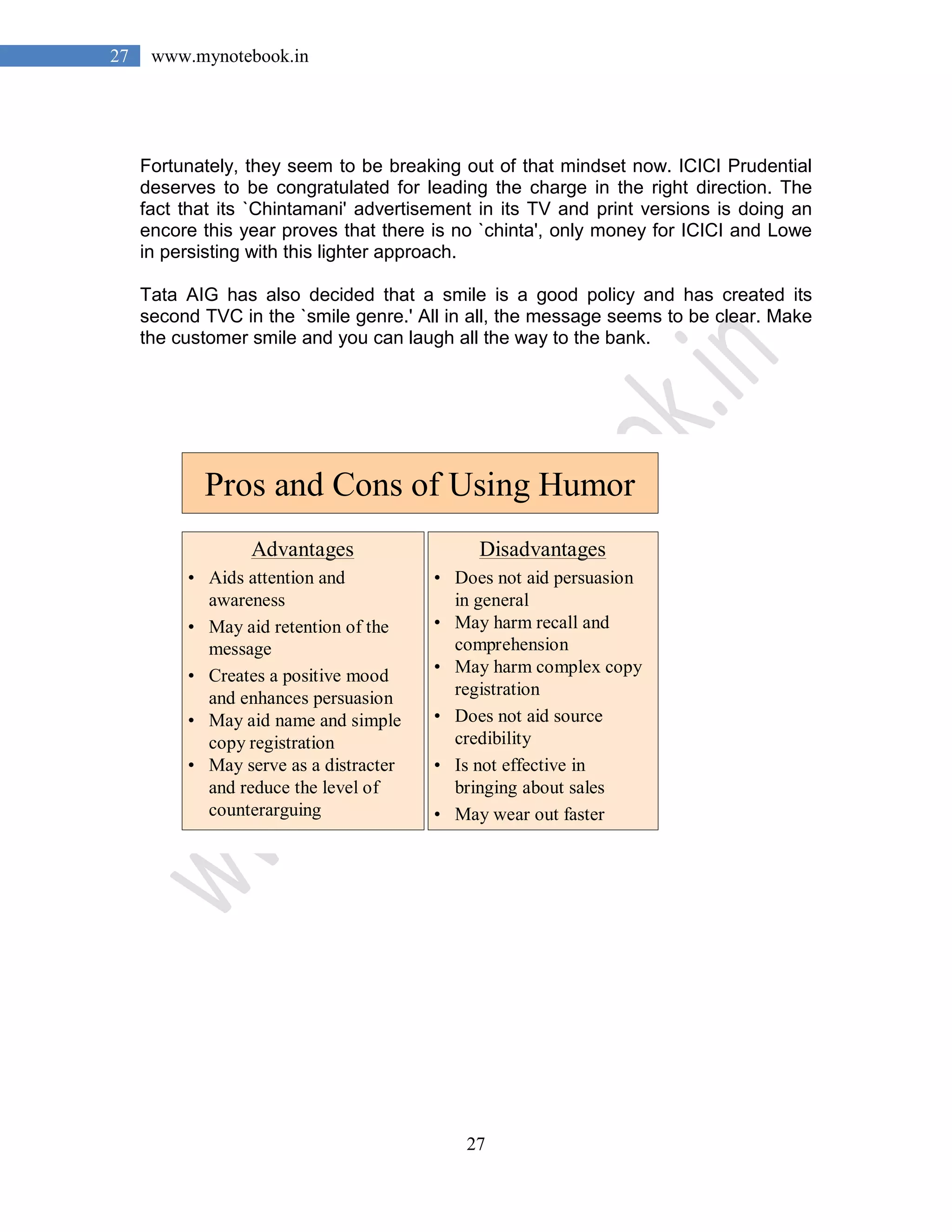
Pros and Cons of Using Humor
Advantages
• Aids attention and
awareness
• May aid retention of the
message
• Creates a positive mood
and enhances persuasion
• May aid name and simple
copy registration
• May serve as a distracter
and reduce the level of
counterarguing
Disadvantages
• Does not aid persuasion
in general
• May harm recall and
comprehension
• May harm complex copy
registration
• Does not aid source
credibility
• Is not effective in
bringing about sales
• May wear out faster
28
28 www.mynotebook.in
UNFAVORABLE TOWARD
HUMOR
• Research directors
• Direct mail, newspapers
• Corporate advertising
• Industrial products
• Goods or services of a sensitive
nature
• Audiences that are:
– Older
– Less educated
– Down-scale
– Female
– Semi- or Unskilled
FAVORABLE TOWARD
HUMOR
• Creative personnel
• Radio and television
• Consumer non-durables
• Business services
• Products related to the
humorous ploy
• Audiences that are:
– Younger
– Better educated
– Up-scale
– Male
– Professional
Use of Humor
All brands have rational and emotional credentials.
Levi's is youthful, rebellious and sexy. But it offers rational benefits like strength
too. One has to balance between rational and emotional arguments. Singapore
Airlines presents the Singapore girl, an emotional icon. But it also emphasizes in-
flight service that other airlines talk about, which is a rational proposition.
4. B. Advertising Execution Techniques
Execution style – the way the particular appeal is turned into an advertising
message presented to the consumer
29
29 www.mynotebook.in
Personality SymbolPersonality Symbol8. Personality
Symbol
8. Personality
Symbol
Straight sellStraight sell
ScientificScientific
DemonstrationDemonstration
ComparisonComparison
TestimonialTestimonial HumorHumor
Slice of lifeSlice of life
ImageryImagery
AnimationAnimation
DramatizationDramatization10. Dramatization10. Dramatization
5. Testimonial5. Testimonial
4. Comparison4. Comparison
7. Animation7. Animation
3. Demonstration3. Demonstration 9. Imagery or
Light Fantasy
9. Imagery or
Light Fantasy
2. Scientific2. Scientific
6. Slice of life6. Slice of life
1. Straight sell1. Straight sell
Ad Execution Techniques
11. Reason why
copy:
11. Reason why
copy:
12. Combinations12. Combinations
1. Straight-Sell Copy: A type of body copy in which the text immediately
explains or develops the headline and visual in a straightforward attempt
to sell the product. The technique consists of a straightforward and clear
presentation of the product and its benefits. The advertisement clearly
explains the features of the product such as its USP and features,
differentiating it from other products.
1. Scientific / technical: the presentation focus on the scientific and
technological aspect of the product. Example while promoting digital
cameras the focus is on picture quality and the mega pixel.
2. Demonstration: Demonstration advertising is designed to illustrate the
key advantages of the product/ service by showing it in actual use or in
some staged situation. Demonstration executions can be very effective in
convincing consumers of a products utility or quality and of the benefits of
owning or using the brand. TV is particularly well suited for demonstration
executions, since the benefits a little less dramatic than TV demonstration
ads can also work in print.
3. Comparative copy: Comparative advertising, as a special form of
advertising, is a sales promotion device that compares the products or
services of one undertaking with those of another, or with those of other
competitors. All comparative advertising is designed to highlight the
advantages of the goods or services offered by the advertiser as
compared to those of a competitor. In order to achieve this objective, the
message of the advertisement must necessarily underline the differences
between the goods or services compared by describing their main
30
30 www.mynotebook.in
characteristics. The comparison made by the advertiser will necessarily
flow from such a description.
Function of comparative advertising
Comparative advertising should enable advertisers to objectively demonstrate
the merits of their products. Comparative advertising improves the quality of
information available to consumers enabling them to make well-founded and
more informed decisions relating to the choice between competing
products/services by demonstrating the merits of various comparable products.
Based on this information, consumers may make informed and therefore efficient
choices. (These statements are true only if the comparative advertising is
objective.)
Comparative advertising which aims to objectively and truthfully inform the
consumer promotes the transparency of the market. Market transparency is also
deemed to benefit the public interest as the functioning of competition is
improved resulting in keeping down prices and improving products. Comparative
advertising can stimulate competition between suppliers of goods and services to
the consumer's advantage.
4. Testimonials: Many advertisers prefer to have their messages presented
by ways of testimonials, where a person praises the product or service on
the basis of his or her personal experience with it. Testimonial executions
can have ordinary satisfied customers discuss their own experiences with
the brand and the benefits of using it.
This approach can be very effective where the person delivering the
testimonial is someone with whom the target audience can identify or who
has an interesting story to tell. The testimonial must be based on actual use
of the product or service to avoid legal problems and the spokesperson must
be credible.Apple Computer made effective use of testimonials as part of its
“Switch” campaign, which features computer users from various walks of life
discusing why they switch from Windows-based machines to Macintoshes.
The people giving the testimonials in the ads are from various walks of
life.Switch was an advertising campaign launched by Apple Computer on
June 10, 2002. It featured what the company referred to as "real people" who
had "switched" from the Microsoft Windows platform to the Mac. An
international television and print ad campaign directed users to a website
where various myths about the Mac platform were dispelled. The television
commercials were directed by Errol Morris.
5. Slice of Life: Advertising-copy technique where a real-life problem is
presented in a dramatic situation and the item being advertised becomes
the solution to the problem.
31
31 www.mynotebook.in
Detergent manufacturers rely upon this advertising format heavily. These
types of advertisements connect with consumers on a personal level. The ads
usually portray a family scene occurring (a "slice of life") during a typical day.
These advertisements create a positive feeling about specific products in the
minds of consumers because they can relate to these everyday situations
which they too face.
Widely used in print advertising formats, this execution shows a real life
problem and what the person in the ad does to overcome it. This execution is
a combination of the demonstration and the testimonial executions. Ads for
consumer products use this method effectively. An example is a housewife
who is having trouble cleaning her kitchen floor, with a product offered which
can solve this problem.
6. Animation: This technique used animated characters or scenes drawn by
artists or on computer. Animation is extremely effective when marketing a
product aimed at children. They relate well to cartoon-like imagery
therefore commercials that utilise animation grab their attention easily. A
good example is the Kellogg’s Coco Pops adverts. They depict an
imaginary island inhabited by eccentric animals. Generations of children
have found this to be extremely appealing.
Animation is an inherently creative medium. The human mind goes through a
thought process of depicting meaning from an animated aesthetic. It instigates
thought in the way that advertisers can use to their advantage by inspiring
thoughts of desire. When harnessed well, animation is one of the most
multipurpose tools for increasing sales of any product or business or simply
getting a message across.
When dealing with concepts that can not be expressed in words or with
illustrations can be extremely frustrating for advertisers and marketers - This is
where animation steps in. The fact that these concepts can be portrayed
successfully and can make it easy for the consumer to grasp your idea or
concept without any kind of explanations is unparallel tool in the advertising
industry.
7. Personality symbol—this type of execution involves the use of a central
character or personality symbol to deliver the advertising message and
with which the product or service can be identified. The personality symbol
can take the form of a person who is used as a spokesperson, animated
characters or even animals.
8. Imagery / Fantasy—this type of appeal is often used for image
advertising by showing an imaginary situation or illusion involving a
consumer and the product or service. Cosmetic companies often use
32
32 www.mynotebook.in
fantasy executions although the technique has also been used in
advertising for other products such as automobiles and beer.’
9. Dramatization—this execution technique creates a suspenseful situation
or scenario in the form of a short story. Dramatizations often use the
problem/solution approach as they show how the advertised brand can
help resolve a problem.
10."Reason Why" was the answer of Kennedy to what makes people
purchase a particular good. "True 'Reason-Why' copy is logic plus
persuasion plus conviction, all woven into a certain simplicity of thought-
pre-digested for the average mind, so that it is easier to understand than
to misunderstand it.In addition, the growing importance of national
advertising of branded products produced a perfect condition for growth of
"reason-why" adverting. The need to stimulate interest and desire seemed
to be fully satisfied by "Reason-Why" ads, which aimed to present the
consumer with convincing arguments to purchase the advertised brand.
Ads had the task of pointing out the distinctive characteristics of a brand
and explaining its superiority. In this sense, "reason-why" advertising was
the appropriate method of implementing a strategy of product
differentiation.
11.Combinations—many of these execution techniques can be combined in
presenting an advertising message. For example, slice-of-life ads are
often used to demonstrate a product or make brand comparisons.
12.Feel good Ads: "Feel good" ads are those ads which do not have a
specific call for a response: to buy something, to do something, to take
action, or to vote. As this term is used here, "feel good ads" can describe
the many different ads and sponsorships which generate good will, or
create a feeling of warmth and pleasantness, so that we know and like the
product or the company.In advertising, any individual "feel good" ad must
be put into a wider context, as a small part of a larger ad campaign. For
example, most ads targeted at kids not only seek an immediate response
(kids or their parents buy something, now), but also to build long-term
good will for "later" because kids will grow up to be adults. Note how often
kids will say "When I grow up, I'm going to get a ...."People buy from
people they know, and like.
13.Fund raising copy:The fund raising copy is all about inspiring potential
donors to believe in a cause. The copy says unexpected things in elegant
ways, which moves readers and stirred thier emotions, which angered
them or made them proud, a copy which they want to read from beginning
to end. But fine words alone don’t make for good fundraising copy, as
Smith knows. It’s how you use them that count. Remember the old Roman
aphorism, ‘When Cauis spoke in the Senate the people said, “That was a
33
33 www.mynotebook.in
remarkably fine speech”, but when Marcellus spoke they shouted, “Let us
now march on Byzantium!”.’
For Marcellus’ powerfully put words had moved his listeners not to sympathy but
to action. You need to know to write more clearly, more convincingly and more
accessibly with clarity and precision.
IV. Combining Creativity and Strategy:
In advertising, different creative strategies are used in order to obtain consumer
attention and provoke shoppers to purchase or use a specific product.
Advertisers use different ways of thinking to create catchy slogans that capture
consumer attention. Creative strategies promote publicity, public relations,
personal selling and sales promotion.
These ways of thinking are divided into three basic descriptions: Weak
strategies, mid-strength strategies and strong strategies. The strategies labeled
"strong, mid-strength, and weak are generic phrases used in the text books
referenced below to help students understand the intensity of each different type
of advertising strategy. Advertisements, weak, mid-strength, and strong can be
found in television, radio, and magazines/print.
Since the beginning of advertising, strategies have been created, starting with
the simplest (weak) strategies in the 1940s.
V. Organizing the Creative Task
Strategy and Creativity?
Strategy: What is an advertising strategy? Basically, it is the formulation of a
message that communicates to the market the benefits or problem solution
characteristics of the product or service. What you are trying to convey through
your advertising and state in your strategy is what your product offers to meet the
consumer's need; how your product has more beneficial characteristics than the
competition's; and what the beneficial characteristics are.
The advertising strategy is a direct result of the market strategy. The market
strategy focuses on the improvement of operations and the positioning of the
storefront, while the advertising strategy concentrates on reaching out to the
marketplace and conveying what the market strategy has accomplished
internally.
The first step in formulating an advertising strategy is to determine the product or
service you have to offer to the marketplace and the objective of the campaign.
Creativity:
Creativity is simply the ability of a person to create. To understand creativity one
can simply refer to a person with unique ideas and willing to bring new things into
34
34 www.mynotebook.in
the life. Usually creativity is considered as the natural ability of a person.
However, the creativity can also be developed in a person.
Weak strategies
Generic and Pre-emptive strategies describe the two weakest forms of
advertising that were most popular through the 1940s.
• A generic strategy gives a product attribution. An example of this would be
how the Milk industry chose to advertise their product. With their slogan,
“Milk, it's good for health, have it with dinner,” consumers aren't learning
anything new about the product.
• The Milk slogan simply states milk as a dinner item. It enhances the
product in no other way.
A pre-emptive strategy is a form of advertising that makes a generic claim
stronger. An example of a pre-emptive strategy can be found in Folgers Coffee.
As many of us know, most all coffee is grown in the mountains. Folgers took that
fact and claimed it as their own with their slogan, “Folgers: Mountain Grown
Coffee.”
Middle-strength strategies
Secondly, are the mid-strength strategies: 1.
1. Unique positioning strategy
2. Brand image and
3. Positioning?
1. A unique positioning strategy is proving that something about your product
is truly unique. This is commonly found when producers take an average product
and add a new, unique element to it. An example of Unique Positioning Strategy
would be in Dove soap. Dove added the unique feature of moisturizing cream in
their product to differentiate it from other brands of soaps.
A downfall in Unique positioning strategy advertising is that if a unique feature
increases sales on one product, many other brands are likely to adopt the
“unique” feature, making the end product not so unique.
2. Brand Image is another very common way companies choose to advertise. In
brand image, an advertiser is not trying to create rational thinking. This type of
advertising strives to create emotion and give a brand a personality. A common
way of doing this is by using a celebrity as a spokesperson.
35
35 www.mynotebook.in
A great example of brand image is found in Proactive Acne Solutions. In each of
their commercials they have celebrities sharing their Proactive experiences,
giving the brand a face people want to be.
3. Positioning is one of the most common forms of advertising. It was developed
in the 1970s and is still widely used today. In positioning one brand will take its
product and “position” it against a competing product.
An example of positioning can be found in the rental car company “Avis'” store
slogan. With “Hertz” car company being the leader in rental car services, Avis
took their number two position and used it to their advantage by creating the
slogan, “When you're number two, you try harder.”
Positioning
Positioning is another basic concept in strategy design. Position is defined as the
perception that the targeted consumers have of a firm's products or services
relative to competitive products or services. Positioning is based on product or
service attributes or characteristics that are potentially relevant to the audience.
One methodology suggests that positioning strategy may be approached via one
of six positioning trait sets, shown in Table 2. We'll look briefly at each of these.
Positioning Trait Sets
1. By Attributes
2. By Price and Quality
3. By Use or Application
4. By Product User
5. By Product Class
6. By Competitor
Positioning by Attribute
Positioning by attribute is probably the most often used positioning approach. An
attribute is a characteristic feature or benefit of the product or service. To use this
method, you begin by defining a relevant set of attributes, usually in pairs. These
attributes can be anything as long as the consumer of the products or services
perceives the attribute as an important characteristic of the product or service.
36
36 www.mynotebook.in
Positioning by Price/Quality
This may be thought of as a set of attributes, but they are of such importance to
all consumers that they probably should be considered their own category for
positioning purposes. The price/quality set reflects a perception in consumers'
minds that brands which offer more features, and/or better service performance,
are often priced higher. Higher prices tend to signal a higher quality of product or
service. The relationship of the price/quality judgment made by consumers about
products creates the positioning on these specialized attributes.
Positioning by Application
In this process, positioning is established by attributes or characteristics of the
product's use. For example, Gatorade, a fruit-based drink, positioned itself as "for
use during strenuous workouts" when it was introduced. It became established in
the market for this use and is still primarily seen as a workout thirst quencher and
bodily fluid replenisher.
The downside to this application-specific type of positioning is that later attempts
to reposition the product or service to another application may fail because of
deeply entrenched consumer positioning. For example, Seven-up, a soft drink
product, was positioned at its introduction as a mixer for alcoholic cocktails.
Attempts to position it as a soft drink were not successful. It was only with its
repositioning as an alternative to cola drinks that Seven-up was able to shake its
position as a mixer.
Positioning by Product User
This is product positioning by a specific type of user or class of users. Some
kinds of cosmetics for women associate themselves with well-known models and
are positioned in the minds of consumers as appropriate for women who want to
be associated with that type of beauty.
Or, what about the Thai potato chip company who depicted Hitler eating their
chips, then becoming transformed into a good person? Some ideas are just bad.
Positioning by Product Class
This is a rare and potentially dangerous product positioning technique. Here the
product is positioned against competing products in other associated classes.
For example, a brand of margarine called "I can't believe it's not butter" positions
itself against butter, rather than against other brands of margarines.
37
37 www.mynotebook.in
Positioning by Competitor
An established image of a competitor can serve as the basis for positioning. As
an example, Avis Rent-A-Car was made famous for its advertising campaign
based on the positioning against a well-established competitor, Hertz. The now-
famous "We're number two so we try harder" advertising slogan established Avis
in the minds of consumers as second largest firm, but one from whom the
consumer could expect better service. The some notion is now used in the "not
exactly..." commercials by Hertz.
Strong strategies
The third and strongest form of creative strategy includes affective advertising
and resonance advertising.
Making people feel really good about a product is called affective advertising.
This is difficult to do, but often humor and an honest character can make
affective advertising possible.
A great example of affective advertising is found in the “Vodaphone”
commercials. By creating a friendly, honest, funny Zoozoo as a spokesperson,
consumers tend to trust what the Zoozoo is saying and find humor in his actions.
This creates a good feeling about the actual service “Vodaphone” offers.
Lastly, resonance advertising is a way of identifying with consumers. If an
advertiser can create a campaign that certain target markets identify with, then
resonance advertising has been achieved.
An example of resonance advertising is in “Tide” detergent ads. Many times
mothers are busy doing laundry in between sports practices and driving their
children around in mini vans. Their recognition with soccer moms makes “Tide” a
favorite pick among women with children who are very involved in activities.
VI. CREATIVE PROCESS
Writing the Creative brief or Copy platform
In developing the message strategy, the copywriter needs to create a copy
platform, a document that serves as the creative team’s guide for writing and
producing the ad. The copy platform is the written strategy statement of the most
important issues to be considered in the ad or campaign – the who, why, what,
where, when and how of the ad:
38
38 www.mynotebook.in
1. Who is the most likely prospect for the product?
The copy platform must define the prospect in terms of geographic,
demographic, psychographic, and/or behavioristic qualities.
2. Why? Does the consumer have specific wants or needs that the ad
should appeal to?
Advertisers use two broad categories of appeals. Rational appeals are directed
at the consumer’s practical, functional need for the product or service; emotional
appeals are directed at the consumer’s psychological, social, or symbolic needs.
3. What product features satisfy the consumers’ needs?
What factors support the product claim? What is the product’s position? What
personality or image – of the product or the company – can be or has been
created? What perceived strengths or weaknesses need to be dealt with?
4. When and where will the messages be communicated? What medium?
What time of the year? What area of the country?
5. How should this be communicated?
What style, approach or tone will the campaign use? And generally what will the
copy say?
The answers to these questions help make up the copy platform. After writing the
first ad, the copywriter should review the copy platform to see if the ad measures
up. If it doesn’t, the writer must start again.
Who is a creative person?
Creative Strategy: Components of the Creative Strategy, Putting the Strategy in
writing:
39
39 www.mynotebook.in
CREATIVE BRIEF (Copy Platform) FORMAT
6. Supporting Information and Requirements6. Supporting Information and Requirements
5. Creative Strategy Statement5. Creative Strategy Statement
4. Selling Idea or Key Benefits to Communicate4. Selling Idea or Key Benefits to Communicate
3. Specify Target Audience3. Specify Target Audience
2. Advertising and Communications Objectives2. Advertising and Communications Objectives
1. Basic Problem Advertising Must Address1. Basic Problem Advertising Must Address
5. Creative Strategy Statement5. Creative Strategy Statement
4. Selling Idea or Key Benefits to Communicate4. Selling Idea or Key Benefits to Communicate
3. Specify Target Audience3. Specify Target Audience
2. Advertising and Communications Objectives2. Advertising and Communications Objectives
1. Basic Problem Advertising Must Address1. Basic Problem Advertising Must Address
Building a Copy Platform Outline
40
40 www.mynotebook.in
Chapter: 3
Phases of campaign creation:
Understanding Campaigns
41
41 www.mynotebook.in
Three Phases of Campaign Creation
There are three phases involved in the creation of any campaign.
(i) Strategy Development Phase,
(ii) The Briefing Phase and
(iii) The Creative
(i) Strategy Development Phase
This phase decides the objectives and contents of communication. It analyses
the research data and decides positioning of a brand. The strategy formulation is
in modern day's agencies a team effort. The creative persons form a part of this
team not as creative persons but as a mind. There are brain- storming sessions.
The team throws up the ideas.
These ideas ultimately make up the strategy. The brilliant in the team pick up one
or two ideas from the total ideas generated and develop them. Our strategy
should give us a competitive edge.
AI Ries and Jack Trout started focusing on the strategy side of advertising
business in the late 60s when they first started writing about positioning.
Everybody else was talking about creativity, whereas they decided to talk about
strategy. They found that clients did not want to buy strategy from an ad agency.
It is essential that advertising professional should appreciate the importance of
strategy development phase. If the strategy is wrong, no amount of creativity will
help. If the strategy is right, despite the poor creative work, one can sell due to
right strategy. However, right strategy and creative campaign is a winning
combination.
Mere creativity and no strategy never work. To agency should tell what they are
trying to achieve in their communication. The strategist is the left-brain oriented,
very linear in thinking, very logical in deduction. The strategy formulation leads to
an advertising brief.
If you want to catch fish, you have to think like a fish. If you want to catch a
consumer, you have to think like a consumer. That's the first principle. What most
companies do is they think like themselves. They spend all their time with
themselves' (AI Ries and Jack Trout).
Bob Isherwood, creative director, Saatchi & Saatchi, Australia emphasizes that a
good effective ad has to be married to the right strategy, if it has to sell. He is
also a strong believer of the theory that a creative director is as important a
member of the strategizing team as the account director is especially if it involves
a product launch.
42
42 www.mynotebook.in
II. Advertising Brief to the Creative
As a matter of fact, the client has to brief the agency about the strategy.
However, most of the time this does not happen. The agency is supposed to brief
itself. The strategy formulated is communicated to the creative people. They are
briefed about how to create the advertising the product needs. The strategy
should be communicated with clarity. The strategist should be a good motivator
for the creative team.
Proper briefing is going halfway as far as creativity is concerned. Bad brief to the
creative team results into bad work. Good brief ensures good work. Within the
creative team, the copywriter and visualiser work together and it is difficult to
attribute the final product to either of them. Yes, when they are working, there are
sparks of creativity. Please appreciate that briefing completes half the job.
Creative campaigns are creative due to a good brief.
It is critically very important to question the brief. Very often, a brief is a set of
clichés. We have to get the real situation. Creative brief of strategy contains a
key consumer insight. If the brief acquaints you with the consumer, and how
his mind works, it has the seeds of creativity in it. It gives stimulus to creative
team.
Success or failure of the advertisement is largely dictated by the brief. It is the job
of a client to tell the agency what he wants to say and it is the agency's job to
decide how to say it. Great briefs inspire great work. Briefs should have clarity
and single-minded objective. They should aim at a target person. The idea is to
have the desired response. All briefs must suggest a benefit or a product plus.
III. The Creative Phase
Here the lateral thinkers come on the scene. They leap from a single
unidirectional idea of the strategist to an advertising idea that will add value to the
product/brand. The creative persons are supposed to be right-brained - lateral
thinkers, irrational thinkers as against the accounts director who is left brained,
i.e., logical. They make connections that had not existed before. They rearrange
the order of things.
They create abruptions in the consumer mind. There should be a beautiful
marriage between the strategy and the lateral thinking by the creative people.
The creative director's post has become a more responsible one. He does not
remain content with a clever copy or stimulating visuals. He is required to
understand the product and its market completely.
He is now an overall ad man, an all-rounder. He participates in research and has
active role in positioning. He does not follow a policy of art for the sake of art any
more. He sits at briefings alongside the client servicing people. Creative are
involved in the whole campaign - right from the concept to the commissioning
stage.
43
43 www.mynotebook.in
Spink of the Lowe group says "Strong creatives are probably the cheapest
competitive advantage that a company can have." The best creatives are derived
from a complete understanding of the product and the benefits it offers. But a
thorough understanding of the target audience provides an edge. Norman Berry
of O & M says, "It is the sensitive understanding of the audience that takes one's
creative from logic to magic."
I. Understanding the psychographics of target audience
Psychographics are a way to measure consumers’ beliefs, opinions, and buying
habits. Rather than demographics which use age, income, gender and other
quantitative data, psychographics provide a way to understand more qualitative
data. Psychographics can be extremely helpful to predict differences in buying
patterns and stimulating ideas for communicating with the target group.
44
44 www.mynotebook.in
Psychographics of various audiences and writing Copy for them
1. Copy for Youth
Youth Marketing is a term used in the marketing and advertising industry to
describe activities to communicate with young people, typically in the age range
of 12 to 34. More specifically, there is the Tween Marketing, targeting people in
the 8 to 12 year-old range, Teen Marketing, targeting people age 13 to 19,
College Marketing, targeting college-age consumers, typically ages 18 to 21,
Young Adult Marketing, targeting young professionals, typically ages 22 and
above.
The youth market is critical because of the demographic's buying power and its
members' influence on the spending of family members. In addition, teens and
young adults often set trends that are adopted by other demographic groups.
The youth market is viewed as a difficult group to connect with and sell to, based
on the fragmented media landscape and young people's keen ability to identify
and reject marketing messages that lack credibility. Nonetheless, many brands
market to youth by offering relevant products and services while communicating
a brand message in an appropriate voice and tone. Successful brands marketing
to youth have a foundation in or association with key interests and drivers among
youth: music, sports, fashion, video gaming and technology, among others.
Youth marketing strategies commonly include television advertising, magazine
advertising and online marketing. Today young people expect to be able to learn
about, interact and be entertained by with brands or services targeting them
online. Other common youth marketing tactics include entertainment marketing,
music marketing, sports marketing, event marketing, viral marketing, school and
college programs, product sampling and influencer marketing.
Essentials for writing copy for youth:
1. The key to tapping into this coveted market is to understand why young
consumers choose one product over another in the first place.
2. the most important factor is the never-ending desire to be accepted, to belong.
For many members of Generation Y (now aged around 12–20 years), this is by
far one of the most pressing issues confronting them in daily life.
3. In essence, it is a fear of not belonging that drives the youth market to adopt
the consumer patterns that are unique to their demographic group. Marketers
should be aware of the impact these desires have on this demographic’s decision
45
45 www.mynotebook.in
to purchase a product or service. The flow-on effects of having a sense of
belonging and control are the feelings of empowerment, confidence and
independence—emotions highly sought by young people.
4. Marketers must emphasize the elements within their product that evoke these
emotions when communicating to this market.
5. So how can one use these factors to drive sales?
Take mobile phones as an example. Among the youth market, mobile phones
are an absolute necessity. They are tools that give the user control,
independence and important information.
Those companies that understand this inherent desire for acceptance have in
their back pocket one of the keys to success within the youth market. As well as
promoting the emotional aspect of a product or brand that gives the user the
desired feelings, it is also important for marketers to analyze their product
placement when pitching to this demographic.
6. In the youth marketplace more so than any other, being seen on the cutting
edge has a major impact on the attention that a brand, product or service
receives. The use of SMS and the Internet as media of cutting edge
communication are avenues that the youth market is very comfortable with.
7. Marketing to the younger members of the consumer world is based around the
age-old concepts of wants and needs. Empower your market, give them the
confidence to take control, provide them with a sense of belonging and don’t
forget to stand on the cutting edge.
2. Copy for women- Homemakers, modern women
It's no secret that men and women have different communication and decision
making styles as well as different priorities and preferences.
Your communications need to be sensitive to them. Your services need to
reassure a woman that you will be around in a predictable way when she needs
help. If she needs her washing machine repaired, assure her that the mechanic
would not just be courteous, but that he would come home at her convenience
with tools and cleaning cloth. Assure her that he would leave only after he clears
the mess. This is a basic expectation. Women simply care more for these things
than men do. If she tries your spices and the dish doesn’t taste quite the way she
expected, she will be relieved if she can talk to someone. She might forgive you
for some mistakes, if only she can speak what is on her mind and be understood.
Women have different needs as compared to men. They take extra-ordinary
efforts to satisfy their needs. A woman will travel to another end of town to buy
46
46 www.mynotebook.in
something like rice, dry fruits, or vegetables if they believe that they are getting
something special. Few
men will take such efforts on their own.
What do women need?
At a fundamental level a woman yearns to be understood. The way a woman
narrates happenings in a day with the finest of details to anyone close to her
holds a significant lesson to those connected with marketing. A woman needs
attention. She needs to be listened to. She will be happy to be waited on, to be
fussed over.
Small things matter to women. These could be matching of colors, co-
ordination of accessories, a texture, or a pretty hairclip. Take care of those small
things, and they will shower you with their favors.
A woman has an uncanny ability to spot what she wants amidst clutter and
chaos. Look at the way women go through the hustle and bustle of shopping
areas. A woman will take whatever it takes to get such small things. She does all
this to feel herself.
Women have very strong need to enter into relationships; even if they are of
-I love you, I hate you -kind.
Factors to keep in mind while writing copy for women
1. “Brand Lite” isn’t the answer:
Many companies make the mistake of thinking they need to create a separate
brand to reach women, one that is softer and more accessible. And let’s be
honest, they’re also afraid that feminizing the core brand will alienate the guys.
The reality is that marketing to women is just smarter marketing strategy,
grounded in meeting and exceeding high standards and consistently delivering
on your brand promise.
One of the best examples of a great company that gets it right with women is
Apple. Terrific design, easy-to-use technology, and a passionate lifestyle brand
message hold strong appeal for women and for consumers overall. No need to
invest money in making and marketing her Pod when iPod is pretty damn great
the way it is.
2. Communicate product value instead of listing features:
Sounds simple, but many organizations develop and market products without
ever asking their female customers what features they think are most important
and why. Volvo has made gaining women’s input a key part of its development
process since the late 1980s, leading to such improvements as color coding of
fluid lids under the hood, easier-to-fold-away rear seats and easier-to-load
trunks. But rather than make its marketing message an endless list of “look at all
our cool stuff,” the “Volvo for Life” slogan conveys the two umbrella messages
47
47 www.mynotebook.in
that are especially important to women: safety and dependability. Online
research and a visit to the dealership reveal all the terrific features Volvo has
developed to back their message up.
3. Understand that she’s always watching: Women are great at detecting
inconsistencies. If your marketing message doesn’t match up with your product
performance and your retail experience, you’ve lost her trust and she’ll go
somewhere else.
4. Respect her
In Fara Warner’s new book, The Power of the Purse, she chronicles the
substantial shift McDonald’s began making following a 2002 sales slump, when
the company was forced to realize that it was still talking to women as if it was
1955. Up until that point, the company had viewed women mainly as a conduit to
kids. This “mom marketing” no longer fit with modern women and they were
taking their kids and their dollars elsewhere. McDonald’s quest to “find the
woman inside the mom” led them to the highly successful launch of Premium
Salads, healthier Happy Meal options and a revamping of Play Places to include
comfortable seating and wireless internet access. A willingness to solicit and
listen to women’s input and understand that women didn’t see themselves only
through the “mom” lens allowed McDonald’s to redefine its relationship with its
most important consumer, ultimately winning her business back.
5. Embrace high standards
Women are suckers for quality and, more importantly, when they find it they’re
willing to pay for it. Consider Whole Foods, which has enjoyed a 1,552 percent
increase in its stock price over the last decade. Affectionately nicknamed “Whole
Paycheck” by some, Whole Foods is able to charge higher prices in a notoriously
low margin industry because they have created a lifestyle brand that delivers on
its promise. With high quality, hard-to-find products, a pleasant atmosphere,
knowledgeable, courteous sales people, and even chair massage in some
locations, Whole Foods has transformed something uninspiring and mundane
into a premium experience.
6. Be willing to commit
There it is, the dreaded “c” word. The reason? It goes both ways. This isn’t a
market you can just dip your toes into. Wyndham Hotels recently celebrated the
ten-year anniversary of its award-winning Women On Their Way initiative,
launched in 1995 to better serve the needs of women business travelers with
improved services and amenities, such as healthier menu options and a courtesy
call announcing room service. When the program began women accounted for
19 percent of Wyndham’s business travelers. Today that number has increased
to over 35 percent. When you consider that, according to the Center for Women’s
Business Research, 86 percent of women entrepreneurs say they use the same
products and services at home as they do in their business it’s clearly no
48
48 www.mynotebook.in
accident that women also now make up 50 percent of Wyndham’s customer base
overall.
7. They wish to be themselves: Women crave to look good. They wish to be
independent and mobile. They wish they could do without help from men. They
wish to be themselves. Few manufacturers care.
A Kinetic Honda came around with electric start and gearless driving. It looked
feminine.
Kinetic Honda was a huge success. An Activa rode in with nicer looks, good
power, better brakes, and decent fuel efficiency. Activa became a runaway
success without so much of bragging and boasting by Honda. These were mere
happy coincidences on a long road littered with products born to insensitive
design and brought to customers by arrogant marketing.
There are many more examples –a ketchup bottle with a crown cap which needs
a man to open, a tin with tough metal seal that requires a hacksaw for cutting, a
sachet of shampoo that requires a pair of scissors, a coconut oil bottle that drips
with oil despite all the fancy packaging, a cell phone requiring complex menu
navigating abilities and that comes with complicated telephone bills, cars with too
low roofs requiring crawling to get inside, and movie theaters where women can
not walk between two rows without feeling embarrassed.
Women no doubt can manage all above creations by men. They do it with
minimum fuss. But you would earn their gratitude and loyalty if you free them
from such men-made mess. They will enthusiastically recommend your products
to many other equally enthusiastic women. Women constitute about half of the
market. If their influence in buying decisions is considered women control much
more than half the market.
8. Needs of women –bonding, sharing, looking and feeling beautiful, and
dreaming about all this
3. Writing copy for children
Marketers pay special attention to children, who are considered as the most
vulnerable audiences because they enjoy advertisement to the maximum extent.
Children initially take advertisement as entertainment and having soft heart; force
their parents for product purchase. This is called as a ‘Nag Factor’.
Industry spending on advertising to children has exploded in the past decade.
Parents today are willing to buy more for their kids because trends such as
smaller family size, dual incomes and postponing children until later in life mean
that families have more disposable income. As well, guilt can play a role in
spending decisions as time-stressed parents substitute material goods for time
spent with their kids.
49
49 www.mynotebook.in
Children represent an important demographic to marketers because they have
their own
purchasing power, they influence their parents' buying decisions and they're the
adult consumers of the future. Marketer tries to draw children’s attention through
various means like TV, Magazines, Stickers, etc.
Young children, in particular, have difficulty in distinguishing between advertising
and reality in ads, and ads can distort their view of the world.
Why Marketers target Children?
Children represent three different markets. In addition to the direct money that
children spend and the money they influence, children also represent a third
major market and perhaps the most significant and that is the future market.
Advertisers recognise that brand loyalties and consumer habits formed when
children are young and vulnerable will be carried through to adulthood.
Factors to keep in mind while writing copy for children
1. "Pester power”: Today's kids have more autonomy and decision-making
power within the family than in previous generations, so it follows that kids are
vocal about what they want their parents to buy. "Pester power" refers to
children's ability to nag their parents into purchasing items they may not
otherwise buy. Marketing to children is all about creating pester power, because
advertisers know what a powerful force it can be.
2. Nagging can be divided into two categories—"persistence" and "importance."
Persistence nagging is not as effective as the more sophisticated "importance
nagging." This latter method appeals to parents' desire to provide the best for
their children, and plays on any guilt they may have about not having enough
time for their kids
3. Host selling: Advertisers not only feature cartoon or other characters from
children's television programmes to gain their endorsement for their products
(known as host selling) but they sometimes even place those advertisements in
the breaks of the television programmes about those characters, thus blurring the
distinction between programming and advertising and taking advantage of the
affection children feel for those characters.
4. Speak to both kids and parents: The conventional wisdom for reaching
children is to frame a marketing message in a manner that speaks to both kids
and parents. From an ethical standpoint marketers are reminded constantly that
offers need to specifically address parents, since it's the adult who will be forking
over a credit card.
50
50 www.mynotebook.in
5. Keep the positioning simple and childlike: Keep the positioning simple and
childlike: The communication message must be based on simple ideas and
appeal to the kids’ imagination
6. Compared to adults, kids are less capable of processing product
information:
They have lesser product experience to realize in their decision-making process.
They search for bits and pieces of information that they can make sense of and
tend to develop brand loyalty based on these.
7. Use Fear appeal: Fears and worries are powerful emotions and marketers
who can help comfort a child by resolving a fear will have gained a loyal patron.
4. Copy writing for the mature market
Growing old is a physical as well as an emotional condition. Research shows that
some attitudinal or psychographic segments in the mature market are more
brand loyal than others and their loyalties are to specific classes of products, not
to all products across the board
The mature market is extremely varied and will only reward marketers who are
willing to deal with its complexities and pursue a targeted strategy.
The characteristic of senior citizens are:
1. Special needs
2. High discretionary incomes
3. Spare time
But how can copy effectively target senior market?
1. "The key elements are to keep message direct: The over-50s are experienced
consumers, so they don't want to read flowery language.
2. You also need to give them a lot of information.
Seniors have a lot of time on their hands and so you must be prepared for
answering many more detailed questions than you would for 20-year-olds.
3. Copy writers must avoid depicting older consumers in negative ways
Even Matures who are not as active and healthy as they would like to be dislike
advertising assaults that remind them of their problems.
4. Copy writers commonly err by emphasizing the biological age of their
consumers.
Marketers can reach this practical, hard-working generation as they enjoy their
retirement but not by selling products for "old people
They have to be smarter than that.
51
51 www.mynotebook.in
Focus instead on themes that leverage the way Matures are motivated to buy.
6. Play to the notion that this generation overcame daunting odds to achieve their
successes. Don't be loud or brash; they already get the point. After working hard
and sacrificing for so many years, they have reached a level of financial comfort
and a time in their lives where they can feel freer to spend money on themselves
. . . because they've earned it.
Their style of spending, however, reflected the more cautious, disciplined values
of their savings-focused outlook. Even as Matures spent, they actually saved a
lot of money. And much of this spending was for others anyway, especially their
children.
8. As they age, satisfied and secure, Matures will begin to spend more money on
themselves. But they won't turn into recklessly wasteful spendthrifts in the mold
of their Boomer children.
9. Nevertheless, [Matures'] interest in pleasurable or exciting experiences for
their own sake is low. They want to enjoy life, but they don't want to go
overboard. The overriding attitude here is that they have enough money to enjoy
their retirement, and they plan to do so - wisely and responsibly.
5. Writing copy for Executives
An executive always buy for personal desires, selfish reasons and self-interested
motives. Why?
Because people are people. Period. It's been that way for millions of years. Your
job is to express your offer in terms that trigger their emotions, press their hot
buttons, jerk their tears, tug at their heartstrings and nudge them into taking
action. If not, you're only telling. Not selling.
1. Be prepared.
This is the most important strategy if you want to successfully sell to an
executive. Research the company before your meeting. Gain as much
information as you can before writing copy for executives.
2. Avoid details.
The majority of executives are not interested in the details. Executives are big
picture thinkers so be prepared to discuss your product/service on a macro level.
3. Respect their time.
The most precious commodity to an executive is time. The average senior-level
businessperson has at least 52 hours of uncompleted work on their desk at any
52
52 www.mynotebook.in
given time. Plus, they usually have only one or two of unscheduled time in a
typical week.
Most executives get to the point very quickly and expect others to do the same.
Be direct, concise, and to the point.
4. Have A Relevant Message.
Deliver a Real Solution that Solves a Critical Challenge.
5. Business people are often so tied to their businesses or products that they get
tunnel vision and fail to look at their copy from their readers' perspective.
6. Be benefit-rich, of course. But more important, be ego-driven when
describing those benefits.
7. Appeals to Their Ego: Executives people are still the ones Okaying the deal,
whipping out their credit cards or signing the checks. And executives always buy
for personal, selfish reasons.
8. Copy using convoluted, complex, pretentious language doesn't sell product to
executives. When executives can visualize the process of doing what you want
them to do, including the enjoyment of the benefits of your offer, you drive their
actions almost instinctively.
9. Follow the "3 C's" Rule: Express your offer
as Clearly,
as convincingly and
as compellingly as possible.
10. Be enthusiastic. Be energetic. Be excited about your offering, because
your job is to transfer that excitement into the minds of your buyers.
11. Use words, phrases and imagery that help paint vivid mental pictures.
12. You need to make them feel important. Write as if you were speaking with
your prospect, right in front of them, in a comfortable, conversational manner
13. When you do, your copy will imply that you understand them, you feel for
them and their "suffering" (for which you have a solution), and you're ready to
nurture and take care of them.
14. Forget things like "best," "fastest," "cheapest" and other, broad claims.
Because the worst thing you can do, second to making broad claims, is to
express those claims broadly.
53
53 www.mynotebook.in
15. If you want to tell people how better or different or superior or unique your
offering is, make sure you express those claims in your sales message in a way
that directly benefits your buyer and appeals to her ego.
16. Being different is important.
But don't focus on how better or unique you are. Focus on how that uniqueness
directly benefits executives; even to the point they can almost taste it.
II. Purchase Logic: The Foundation of Marketing Strategy
The foundation of a successful marketing strategy is an understanding of what
product/service should be offered, how it should be presented, and to whom.
Determining these three things is the essence of the marketing function.
Purchase Logic is marketing’s primary tool for coming up with the answers.
What is Purchase Logic?
Definition: Purchase Logic is the description of how and why someone buys a
particular product or service. Purchase Logic is an understanding of customer
motivation that goes far beyond industry or demographic classifications.
Purchase Logic defines what an individual customer wants and how he or she
sorts among different alternatives.
What Determines Purchase Logic: The more factors involved in a purchase
decision, the more complicated Purchase Logic becomes. Small, routine
purchases have simple Purchase Logics.
The complexity of Purchase Logic increases as any of the following variables
Increase:
• The number of needs and wants to be satisfied
• Length of commitment to or longevity of the product/service
• Number of people involved in the decision
• Number of alternatives
• Price
Two examples illustrate how Purchase Logic becomes complex. First, think
about buying a meal for lunch at work. You are hungry, have half an hour to
spend and have no plans to meet anyone. The decision is simple. You run
downstairs to the cafeteria and pick up a sandwich for four dollars. This choice
was easy because you had few options and a very simple need to satisfy your
hunger and perhaps also take a little break. The price was also insignificant.
Now think about buying a meal on Saturday night. Because you are going out
with your family, you sort through many more factors to arrive at a decision about
where to go. Hunger is only one need to satisfy. You also seek some kind of
entertainment or atmosphere. You have four people’s tastes to blend and will
54
54 www.mynotebook.in
spend a significant amount of money. Further, you have many more options.
Even if you are not aware of it, you use a fairly complicated Purchase Logic in
selecting the restaurant.
This latter scenario is still quite straightforward compared with most purchase
decisions. Thus, in order to succeed in selling a product or service, it is important
to take a systematic and formal approach to looking at Purchase Logic.
COMPONENTS OF PURCHASE LOGIC
A systematic approach to examining Purchase Logic will look at each of its four
components: Benefits, Barriers, Trade-offs and Price.
PURCHASE LOGIC IS A PROCESS
Every purchase decision involves a number of steps. These steps may not be
clearly discrete or particularly conscious, but they do exist. They represent the
order in which alternatives are sorted and decisions are made. The more factors
involved in a purchase decision, the more complicated Purchase Logic becomes.
Sellers need to understand each step of Purchase Logic in order to make sure
they are talking about the right thing at the right time. Clearly, a seller will benefit
by understanding what is on the buyer’s mind and how he or she is approaching
the purchase decision. Purchase Logic reveals how a prospect will react to what
is offered.
Purchase Logic also defines the sequence in which issues must be confronted.
Benefits must be addressed first. After the benefit ts have been established, it is
time to address barriers to purchase. Next come trade-offs and price. After an
individual weighs all these factors, a purchase decision is made.
BENEFITS
We all buy benefits. Even if we have a specific idea of what features will deliver
them, benefits are what we seek. Benefits fulfill needs and wants. Purchase
Logic defines all relevant needs and wants. Purchase Logic allows us to
understand how important each benefit is to an individual buyer and why it is so
important.
Wants can be particularly tricky to identify. Often they are emotional and may
appear irrational. Buyers are often reluctant to share their wants with a seller;
55
55 www.mynotebook.in
frequently they are not even conscious of some of them. Nevertheless, wants are
usually most influential in a buying decision.
Think about purchasing a watch. The desire for prestige or some other very
emotional need or want justifies the choice of a Rolex over some much lower
priced alternative. Both do an equally good job of satisfying the basic need—to
tell time reliably.
BARRIERS
Barriers to purchase are those factors that may prevent a customer from
purchasing.
We need to design our products or services so that they overcome these
barriers. They can be at least as important as the desired benefits. Overcoming
barriers can become the most important benefit. Barriers to purchase can be
hard to discover.
Because people want to avoid conflict, they usually do not offer objections and
criticism freely. Sometimes barriers may seem irrational or unfair; thus, the buyer
will not mention them. However, barriers must be dealt with. The seller needs to
know what they are in order to address them.
One highly motivating barrier in business-to-business situations is the fear of
criticism. This fear causes buyers to select the safest choice, the “one that can
not be criticized.” Usually that is the brand leader. In this situation, demonstrating
product superiority is not enough. In order to win, the seller must also provide
evidence that the buyer can use to defend his choice.
56
56 www.mynotebook.in
TRADE-OFFS
Trade-off analysis is the process of assessing the relative value of different
offerings. Customers do not buy individual features, functions or benefits. They
choose among services or products that offer bundles of benefits. The trade-off is
a comparison of these different bundles. What a customer concludes from the
trade-off evaluation directly determines how that customer will react to different
prices.
57
57 www.mynotebook.in
PRICE
Price is the mechanism by which sellers capture some of the economic value of
the product or service being offered. Price is a function of the benefits provided.
The value of those benefit is to a specific customer determines the maximum
price that a customer will pay.
Cost does not determine price unless you are selling a commodity. However,
what a customer will pay is very much influenced by the relative value of
alternative products or services. Cheaper acceptable alternatives put limits on
how high a price a customer will pay.
PURCHASE DECISION
As the customer completes the Purchase Logic process, the answers to three
questions determine the final purchase decision:
1. What is the relative value of the options I am still considering?
2. Is the value of one choice enough to justify a higher price?
3. Since nothing is perfect, which minuses am I willing to live with?
58
58 www.mynotebook.in
Part 2. Why Should You Care About Purchase Logic?
There are four specific areas in which a seller can apply an understanding of
a Purchase Logic to enhance the likelihood of success:
1. Analyzing the Market,
2. Communicating,
3. Identifying Qualified Prospects and
4. Altering Offerings for Stronger Appeal.
ANALYZING THE MARKET
You will gain a clearer picture of the kinds of people who are likely to be
interested in what you have to offer. In addition, you will have a deeper
understanding of what your current customers seek. This gives you power to
change your offering or approach, and thereby strengthen or defend your
position.
COMMUNICATING
No matter what communication vehicle is used, knowing your prospects
Purchase Logic will help you talk about the right topic at the right time. You will
know what benefits to stress in order to motivate purchase. Also, you will know
how to “position your product” for greater appeal versus others in its market.
IDENTIFYING QUALIFIED PROSPECTS
From Purchase Logic you can pull out some salient questions or characteristics
that will help you identify good prospects. In some cases you may even be able
to construct selling messages that will prompt buyers to self select and identify
themselves to you.
ALTERING OFFERINGS FOR STRONGER APPEAL
59
59 www.mynotebook.in
As we have already suggested, Purchase Logic can also help you revise or
improve your products and services to give them stronger appeal. Clear
understanding of your market’s needs and wants and their relative importance
will give you the guidance you require to make effective changes.
Part 3. How Is Purchase Logic Turned Into Positive Action?
Understanding precisely what your customers want and why they want it is a
powerful tool for managing the marketing of your product or service. Specifically,
your understanding of Purchase Logic enables you to choose the most
compelling features, marketing programs and sales message.
These choices become clear because Purchase Logic defines what products and
services to offer and how to talk about these offerings. Once you have identified
the Purchase Logic(s) in your marketplace, the direction in which you need to
move will be evident.
We close with two brief examples of how an understanding of Purchase Logic
can make a difference.
The first focuses on how Purchase Logic may be used to redefine product
offerings. The second illustrates how understanding Purchase Logic can increase
the power of your communications.
• Understand the barriers to purchase
Unless brands owners know what is preventing people from buying their brand in
store, then they have no hope in being able to change their ways in the last few
feet. Some of the barriers may not be brand related, they can be environmental,
such as not being able to find or locate the product. Maybe the packaging and
product design does not reflect the premium image the brand claims, or makes it
standout against the others around it. Or has the brand failed to deliver its
benefits sufficiently to the shopper thereby not arming them with the reasons why
it should be chosen over competitors. Marketers used to rely on advertising to do
this work for them, but increasingly it will be the last 3 feet that delivers the
reasons to buy.
Barriers to purchase, as the name suggests are the various barriers that the
consumers have to overcome in order to buy a service or a product. The barriers
can be physical, psychological or financial. It always makes sense to list down
the various barriers that your clients may have to overcome in order to reach you.
Once you know the barriers, you can dismantle them one by one and make it
easy for the clients.
How the to overcome the Barriers to purchase:
Influencing barriers to purchase is not always a case of running a brand or price
promotion. If the barrier is “I don’t believe in this brand” then some sort of brand
in store campaign that talks about brand benefits might be a good idea, but if the
60
60 www.mynotebook.in
barrier is “I don’t know what it’s for or don’t see the point”, then delivering an in
store campaign that helps the shopper to understand why they should buy is the
way forward. In short, brands need to align their assets to overcoming these
barriers in way that best leverages what they know about how the shopper is
shopping.
1. Why should I buy it?
2. So what’s different?
3. It sound too good to be true
4. Its not worth the price
5. where’s the buzz
III. Developing an ear for ‘human insights’
What is a brand? ‘We live in a brand world, but its not just what it does to you,
but how it makes you feel’. A brand is a set of memories; however these
memories don’t even need to be your own memory for you to be able to identify a
brand as associations can be thought. Even when you have never been in Paris,
you still could recognize it by just seeing the words romantic, elegant and
fashionable.
To understand brands, it’s important to know that strong brands have unique
personalities, are consistent in spirit and have anchored themselves on powerful
universal human emotions or insights, e.g. Apple, Marlboro & Harley Davidson.
It’s almost impossible to copy strong brands, as they go beyond the product like
the Marlboro man or the Singapore girl. The ultimate feeling one could have with
a brand is a feeling of unification: ‘I am Harley Davidson.’ According to experts
no. 1 brands have (on average) 3 times higher gross margins than no.2 brands
and 6 times higher than no. 3 brands.
As in every successful marketing campaign, actionable human insights are
critical to its success. Understanding the passions, expectations, needs and
desires of the people you want to talk to -- or inspire to talk about you -- is vital.
Marketers (and those of us who serve them) need to take a close look at what's
going on in the consumer's world. We need to listen.
Sweet spot
In marketing, there is also a sweet spot like in sports, and this is what makes a
consumer relate to a brand. A sweet spot is met when the relevant benefit fuses
with the right consumer insight. The insight can be slightly below the surface, it’s
a personal truth about a consumer, in order to have effect. It is a revelation about
human behavior or human emotions that can be leveraged to build a brand. An
insight makes advertising meaningful, relevant and helps connect with the target.
Important to bare in mind is that it springs from an understanding of people, not
products.
61
61 www.mynotebook.in
Take for example the powerful insight on chocolate: women who are depressed
like chocolate, ‘it puts a smile back on her day’. Understanding Indian Living in
India everybody knows that it is very diverse, with many different cultures,
languages, geography and races. India is extremely complex and paradoxical,
and what you see is not what you get.
To understand India the single biggest problem is that the many professional
people who create Indian advertisements have not been exposed to the diverse
Indian culture, and don’t know a thing about how or where their target group
lives. They have difficulty to relate and fall regularly into clichés. Golden rule is
that one cannot write creative, if you don’t know whom you write it for. Much
research is done by people whom have a different value system from the target
group.
So what makes India different? Is there a common set of values for the whole of
India? And very important, can we appeal to all Indian through one
communication?
There are two solutions to communicate with Asians:
1. Leverage universal human insights but localize them to fit each region;
2. Forget globalization and take a completely localized approach.
Brands like McDonald’s and Pepsi approach Asian countries with universal
human insights, but with a local flavour. McDonalds brings out the child in you
and focused on the knowledge between parents and children. They talk to the
parent through the child.
On the other hand, the localised commercials had a sense of humour and value
to them that was very different for each country.
Understanding Malays
• Rustic simplicity
• Unhurried approach to life
• Family orientation
• Sensitive sophistication
• Gentleness
• Focus on play rather than work
• Graciousness rather than frantic pace
Understanding Indians
• Spirituality over materialism
• Sentimentality and drama
• Respect for elders
• Intellectual orientation
• Family honor before personal honor
• Spontaneity, joy and passion
• Mythology over history
• Fatalism
62
62 www.mynotebook.in
• Stronger individuality compared to the rest
Understanding Chinese
• Materialism over spirituality
• Pragmatism over sentimentality or abstractions
• Action orientation over intellectual orientation
• Premium on face value
• Ambition / success orientation
• Hard work ethic
Even though the Asian people are very different, there are some common Asian
values that would make it possible to create an Asian localised’ commercial or
advertisement:
• Harmony and order
• Institution above individual
• Respect for elders
• Strong family and community ties
• Fear of losing face / honour
• Team above self
• Consensus based approach
• Strong traditional anchors
• Premium on relationships rather than objectivity
One should not be misled by appearances. Do look beyond the surface; what
you see is not what you get! People may look westernized with miniskirts etc, but
their values can still be conservative. Never underestimate the sophistication of
Indian culture. And last, but not least you can’t talk to Indian if you don’t master
“the nuance”.
An insight makes advertising meaningful, relevant and helps connect with the
target. ... Universal human insights, but with a local flavour. ..
IV. How to get an idea
What does “Idea Generation” really mean?
The term idea generation is a blanket description referring to any means of
creating or developing ideas. There are various different techniques for
generating ideas; from free association to mind mapping, with brainstorming
arguably being the best known and most often utilized.
1. Brainstorming is a group creativity technique for generating ideas to
solve a problem. The results of a brainstorming session can be a complete
solution to the problem or a list of ideas resulting in a plan, but more often
than not is a list of potential ideas. Brainstorming originated in 1957 with
63
63 www.mynotebook.in
advertising executive, Alex Osborn’s book, Applied Imagination. Today the
term brainstorming is often generically applied to the many differing forms
of advertising creativity processes based upon this original concept.
2. Free Association, another type of idea generation process, depends
largely on a mental ‘stream of consciousness’ of which there are two
major varieties- serial and centered. Serial Association starts with a
trigger, recording the flow of ideas that come to mind, each idea triggering
the next until ultimately reaching a potentially useful one. Centered
Association, which is closest to classic brainstorming, is meant to
generate multiple associations of the one original trigger so it can be more
fully explored.
3. Mind or Thought Mapping are the various processes based upon a mind
map; a hand-drawn diagram used to represent words, ideas, tasks or
other items linked to and arranged around a central key word or idea. This
graphic version of the classic brainstorming method is used to generate,
visualize, structure and classify ideas. It is a visual aid in organization,
problem solving, and decision-making processes. Many software
companies are now selling versions of Mind or Thought Mapping tools
which supposedly aid in facilitating and recording this process.
4. Six Thinking Hats was a method developed in the 1980’s by Dr. Edward
de Bono. The method is meant to promote fuller input from more people.
In de Bono's words it "separates ego from performance". The key point is
a “hat” represents a direction to think rather than a label for thinking. There
are six metaphorical hats and the thinker can put on or take off one of
these hats to indicate the type of thinking being used. The criticism of Six
Thinking Hats is it has to be learned and practiced, and the process
supplies and training materials can only be written and authorized by Dr.
de Bono.
5. Convergent thinking: Problem solving technique in which ideas from
different fields or participants are brought together (synthesized) to find a
single optimum solution to a clearly defined problem.
6. Divergent thinking: In contrast to convergent thinking, (which aims at
solving a specific problem) divergent thinking is creative, open-ended
thinking aimed at generating fresh views and novel solutions. Divergent
thinking uses exploration to search for all possible alternatives
7. Analogies and metaphor: Used to see new patterns or relationships. An
analogy means Similarity in some respects between things that are
otherwise dissimilar. A comparison based on such similarity. Thus it’s a
form of logical inference or an instance of it, based on the assumption that
64
64 www.mynotebook.in
if two things are known to be alike in some respects, then they must be
alike in other respects. Metaphor means something used, or regarded as
being used, to represent something else; emblem; symbol.
The problem with any of these idea generation processes is the lack of
understanding, time or focus of participants. The knowledge and problem-
solving expertise required make idea generation successful are often simply
not available within the organization.
• Choosing the idea that effectively communicates the
emotional/rational benefit
65
65 www.mynotebook.in
Chapter 4:
Brief
A brief is one of the most important aspects of Client servicing executive. Critical
to the creative process is developing a clear understanding of our clients' needs
and expectations. At the important initial meetings we listen and ask a lot of
questions to help us establish the full scope of the project, budget parameters
and timelines.
So what should we ask for?
More often than not we are not given a written brief from the client instead we
need to extract a brief. This can be painful and pointless if we are not asking the
correct questions and more importantly the correct person.
Before you get into asking the usual questions of how big, how much and where,
try starting at the beginning.
It helps to find out about your customer. This can be done before the
appointment via the web where you might find out what they do, how big they
are, and how many people work for the company and how many offices they
have. If they are a foreign owned company it is quite possible that the decision
will be made abroad. You can pick up product ranges, departments and
divisions. You might even be able to see a picture of a previous stand. It’s
information like this that the smart client servicing executive gathers without
thinking.
If they don’t have a web site ask them to send you a brochure before your
meeting.
Initial Proposal
Inspiration is what our clients expect so we spend time refining the initial brief
and make sure our proposals will deliver it. This is our opportunity to shape a
vision for the project and to set out the means for achieving it, as well as realistic
deadlines for every stage.
Strategy and Research
If appropriate and practical, we like to include careful market analysis through
customer and competitor research. This helps us to fully understand where our
clients are coming from and where we can help them go
Creative Concepts
This is the stage when all the groundwork produces the first buds of creativity
and culminates in our first major presentation. Together we discuss and agree
which of our ideas are worth developing.
66
66 www.mynotebook.in
Development and Application
Even the greatest ideas require careful implementation to achieve their full
potential. Following client feedback, we develop and polish our ideas into
carefully crafted final Creative strategy. Whatever the required deliverable, Its
essential that highest quality work is delivered.
• Product Brief:
The product brief (initial information provided by the contracting company that
dictates what they require from me). A product brief is a document designed to
focus on specific benefits and attributes of clients’ products.
• Marketing brief:
The purpose of marketing brief is to help assess client’s current situation, both
internally and relative to its competition. It’s the starting point for any work agency
do for their customers. The details elicited in marketing brief provide the
foundation for refining clients marketing message and revising and updating their
marketing and advertising program.
A marketing brief is the best way for the marketer to clearly lay out a framework
for the creative team. The process can be driven by either side - creative or
marketing - but both sides need to agree on the brief before the work can
commence.
Marketing brief is a document outlining the expectations by a company's
marketing team regarding a finished project. The marketing team can clearly
define what they want the creative team to create. Follow these tips to create a
marketing brief so all parties involved will know what work is expected of them.
a) Where are we? (situational analysis - the market, trends, competitive analysis,
etc.)
b) Where are we going? (opportunities, objectives & strategy)
c) How are we going to get there? (actions, plans & controls)
Instructions for creative Marketing brief:
Step 1
Write a summary of the project including any background information. Include all
areas and all players who will be involved in the project. Know the prices of each
part of the project and the total cost.
67
67 www.mynotebook.in
Step 2
Outline the expectations of each party involved. Know the individual jobs of each
player and include these job expectations in your creative marketing brief. You
want everyone to be clear about the job at hand.
Step 3
Include the dates of each part of the project. Know who is completing what and
when it should be completed. Have a date for the final project.
Step 4
State your goals and objectives. so that everyone knows the purpose of your
project. You have a better chance of succeeding if everyone is clear on this point.
Step 5
Know your target group. The more you know about the target, the more
successful your project will be. Once you know the target group, you can tailor
the project to that group.
Step 6
Write your brief in project format with clear headings and sections for each part of
the project. Include plenty of white space between sections so readers can scan
for information.
10 Point Marketing Brief (Brief)
1. Background
you have to supply enough detailed information, regarding your needs.
We will have little or no knowledge of your market and will have to
understand the key elements that need to be focused on by the marketing
campaign. Remember, you are the expert in your field.
2. Research
Include any and all relevant research that could support the marketing
campaign.
3. Previous Marketing Material
If you have tried marketing and advertising previously, provide full details
of the targeted markets, details of your previous campaigns and the
results.
4. Aims
What are the required results of your marketing campaign? Confirm your
expectations and aims.
5. Objectives
Will your objective be:
o Raising awareness of your products or service?
o Changing preconceived attitudes
68
68 www.mynotebook.in
Your objectives must be comprehensible, specific and quantifiable. They
should be conceived in simple detail, as they will present the principal
concept for your campaign.
6. Target Market
Know exactly who you want your message aimed at. The target audience
can be portrayed in terms of current market behaviour, degree of
awareness, product/service knowledge, favoured method of receiving info
and clients/customers enthusiasm /obstruction to take notice of and
accept the information.
The more comprehensively you recognise your target audience, the
greater the prospect of a successful campaign.
7. Key Message
Be clear and concise concerning the purpose of your marketing campaign.
An unclear message may result in an ineffectual strategy and an
unsuccessful campaign.
8. Budget
Define your marketing budget. If you do not specify a budget in your brief
then a marketing strategy may be proposed that exceeds what you had in
mind.
9. Timescale
Provide an approximate schedule for the campaign. Results will take time
and we need to know the timescales we are working to.
10.Evaluation
If you do not build in a stratagem to appraise the campaign, you will not
know if it was successful and if your money was well spent. Equally, if the
campaign doesn’t produce the required results, evaluation will help identify
where things went wrong
• Agency brief
This comprehensive guide provides, in outline form, essential questions and
topics of discussion necessary for informing outside agency about clients
marketing communication needs, both short and long term. This document will
serve as a broad-based reference tool for both focus and direction of your
marketing efforts.
What’s fascinating is that this is true. The agency brief document purpose is to
involve advertisement agency within clients marketing strategies –from the
beginning until the end.
69
69 www.mynotebook.in
The oft-used word, partnership, is a good benchmark for defining the relationship
between agency and client. It is fundamental to a healthy client-agency
relationship that the agency be seen as a fully engaged partner with client.
By partnership we mean complete and thorough disclosure, prompt response to
requests, and the commitment by both client and agency to see the creative
process as one of collaboration, not driven by ego and private agenda. At the
end of the day, if the campaign is highly successful, who cares where the idea
emanated from? If the campaign is less than successful, then both sides must
take mutual accountability
A good advertisement agency will ask client for a briefing. A briefing is crucial for
good advertisement. The agency must really understand clients issues, its
product and the vision clients want to communicate.
Since agency brief is very detailed and goes into great depth, its recommend that
a team complete this briefing. A single person would provide the agency with just
one view that may be skewed by his or her specific discipline.
• Converting into creative brief
Once an effective appeal is found, the advertiser should prepare a creative brief,
typically covering one or two pages, it is an elaboration of the positioning
statement, and it should include:
a. Key message
b. Target audience
c. Communication objectives
d. Benefits to promise
e. Supports for the promise
f. Media to be used.
Note boxes will expand to accommodate verbiage. Try to keep Creative Brief as
concise as possible..
(Client Name) Creative Brief Format
Agency/Graphic Designer: ____________________________________
Agency Phone:______________ Fax: _____________ Email:
______________________
AgencyAddress:
______________________________________________________________
Street City State Pin Code
70
70 www.mynotebook.in
Project Summary: Clear, concise description of project – keep brief.
Target Audience: Whom are you trying to attract? Be specific.
Key Messages: One or two key “thrusts” – those most important to the project’s
success.
Key Benefits: What’s in it for the audience?
Background/Competitive Positioning: Briefly discuss the competition, market
realities, obstacles, etc.
71
71 www.mynotebook.in
Communication Strategy: Indicate any specific elements to be included
(logos, key visual images,key words and phrases, key contact information,
specific internet links etc.)
Desired Message Tone: How do you want the message perceived -- creative,
fun, warm, active?
Project Timeline: Indicate major milestones.
Anticipated Budget:
Other: Add any key information not covered under the above items.
Prepared by :
_________________________________________Date:___________________
_____
Accepted by:
72
72 www.mynotebook.in
Agency/Graphic Designer Signature: ______________________________
Title: ______________________________
Date: ______________________________
73
73 www.mynotebook.in
Chapter: 5
The BIG IDEA
A BIG IDEA can be used to provide a basis for the campaign. e.g. a “hook” that
you can use for multiple executions. Does the ad position the product simply?
…and with unmistakable clarity? Does this ad bolt the brand to a benefit? Does
this ad contain a power idea? Does this ad have brand personality?
Is how the Advertising meets its promotional objectives given its audience and
constraints? Translates the ads purpose into its Creative Strategy (how it will do
what it is supposed to). The Creative Strategy is built around a theme that
contains an appeal. The theme is the ad’s context, or setting. The appeal taps
into the audiences’ motives to initiate and guide behavior / learning.
Big idea—“The flash of insight that synthesizes the purpose of the strategy, joins
the product benefit with consumer desire in a fresh, involving way, brings the
subject to life, and makes the reader or audience stop, look, and listen.”
David Ogilvy’s Quotes 1
It takes a big idea to attract the attention of consumers and get them to buy your
product. Unless your advertising contains a big idea, it will pass like a ship in the
night. I admire people with gentle manners who treat other people as human
beings. I abhor quarrelsome people. I abhor people who wage paper-warfare.
David Ogilvy’s Quotes 2
The consumer is not a moron. She is your wife. Never insult her intelligence
You will never win fame and fortune unless you invent big ideas
Creative Strategy
The search for the “BIG IDEA.” The concept or central theme that will bind the
campaign together.
Tone of Voice
Tone of Voice often communicates so much more than even the expression on
your face.
You are constantly engaged in changing your tone of your voice as you speak.
You admonish a naughty child in on tone, and use another if the child is
frightened and needs comforting.
You can use Tone of Voice to give orders, raise an alarm, and evoke pity; In
short, use Tone of Voice to generate a mood, or to impel action. So when you
communicate through an ad, first decide when Tone of Voice you wish to use
when talking to your target audience.
What sort of feelings do you wish to inspire in the housewife’s heart? Should you
inspire confidence, or evoke fear? What sort of voice will make the reader of your
74
74 www.mynotebook.in
ad eventually respond as you want him or her to respond? Tone of Voice is a
crucial element in designing communication message.
75
75 www.mynotebook.in
Chapter: 6
Writing for Print Media- Parts of a press ad- the headline,
subhead, body copy
WRITING THE COPY
The elements of the copy, from headline to closing should follow the 4 steps in
the selling process – “A-I-D-A” in a logical progression.
THE HEADLINE PROVIDES THE “A” AND “I”
In copywriting, the attention and interest of the potential customer must be
caught by the headline, or the page will be turned and the possible sale lost.
The headline has 3 functions:
1. To capture attention.
Ex: Axe effect – red lips creating a sensuous appeal are a very attention
seeking ad and the visual acts as the headline.
2. To awaken the interest of the reader in learning more about the
product.
The ad for Intelligent Investor, which uses the headline “Why being a
regular reader of Intelligent Investor is such a healthy habit”, would
awaken the interest of the readers.
3. To select the special readers who might have a specific interest in
what you are selling.
Eanadu Pradesh ad targets media planners, hence the headline –
“Perhaps the first ad written with the belief that a media planner is human,
and not a counting machine”.
Once the dominant selling point and copy appeal have been determined, there
are several grammatical forms the headline can take. It may be determined as:
 A statement or part of a statement
The Business Standard ad uses a statement the headline:” Its tough being a
Business Standard reporter”.
 A question
Onida TV ad- Headline – “should the new Onida TV be banned?”
Surf excel – sample laaney ki kya zaroorat hai
 A command.
get it! – Visa
76
76 www.mynotebook.in
Ad for Star News that has a headline, which just says
“Stop”
Onida TV – headline - “Don’t!”
Sub-headline – “don’t just envy the Ondia TV, buy it”
What a headline contains is more important than the form in which it does it.
Headlines may be classified by performance as follows:
Headline Types
• Benefit
• News and Information
• Command
• Provocative
• Question
• Reason why
• Caution headline
• How-to-type
• Selective headline
• Solution to problem
• Advice headline
• Gimmick headline
1) Promise of a Major Benefit
This is the safest, most widely used type of headline. And for it to be as effective
as possible, it must display the #1 benefit your prospect will receive buy
purchasing your product or service.
The most effective way to determine this benefit is to survey your customers - by
phone, email, or postal mail. Ask them the top 3 reasons for purchasing your
product or service, and have them rank them in order. It's a good idea to offer
your customers an incentive for providing you with this information.
2. News or Information:
Conveys real news or important information about a product.. If your product or
service offers something newsworthy, announce it in your headline. Newsworthy
is usually the introduction of a new product or the improvement of an existing
product. Here are some words you can use in your News Headline: New...
Announcing... Introducing... Finally... Just Released... Now... Now Available... At
Last...
77
77 www.mynotebook.in
Examples:
Eg. The Times of India ad that boasts of the circulation of TOI as
compared to that of Deccan Herald.
“ The Times of India: 301927 copies.
Deccan Herald : 147538 copies”
3. The Command Headline. The Command Headline tells your customer what
to do.
Your command should encourage action by offering your prospect a benefit that
will help them. Effective Command Headlines start out with action verbs.
Examples:
♦“Trade In Your Old Motor cycle for-Bye to Maintenance Headaches!”
4. Provocative
5. The Question Headline. Here again, to use this headline, you must really
know your market. You need to know what your prospect is thinking, what their
anxieties are, and what they’re hoping to accomplish. If you know your target
audience this well, then the Question Headline is an effective headline to use.
The Question Headline should focus on your prospect’s self interest and ask a
question they want to know the answer to. The best type of questions to ask are
questions that get your prospect involved.
Examples:
♦ “What Does the Space Shuttle Have To Do With LaZer Runner’s 7 Year
Premium Protection Warranty?”
♦ “Can Half of All Laser Tag Owners in America Be Wrong?”
♦ “What Do The Giant Entertainment Companies Know That You Don’t?”
6. The “Reason Why” Headline. With the “Reason Why” headline, you give our
prospect specific reasons why they should read your ad. “Reason Why”
headlines are effective because they contain facts and specific numbers.
“Reasons why” headlines don’t need to include the words “reason why”.
Examples:
• “7 Reasons Why IBM Provides You With a More Reliable System”
7. The How-To Headline. These two words -- “how to”, are very powerful words.
You can never go wrong using a How To Headline. (Over 7,000 book titles start
out with How To.) How To Headlines promise your prospect a source for
information, advice, and solutions to their problems. If you ever get stumped for
a headline, use the How To Headline -- it works!
78
78 www.mynotebook.in
Examples:
♦ “How To Expand Your Customer Base and Increase Your Profits”
8. Selective
Select a specific audience with specific language and words.
The Malaya Manorama ad, which addresses advertisers. The print ad starts
with the headline which says – “A few commandments to advertisers this
Xmas.”
Media planer ad of Eenadu Pradesh.
9) Solution to a problem
This type of headline is a slight variation of the #1 benefit headline. The problem
solved by your product or service is the #1 benefit - it's just presented in a
problem/ solution format.
Example:
"Now You Can Melt at Least 3 Inches of Fat from Your Waist in 30 Days or Less
- Guaranteed!"
This headline presents the benefit of reducing fat in the waist as the #1 solution
to the problem of having excess fat in the waist area.
10) The Flag Headline
A flag is a phrase calling for the attention of a particular person or group. Use a
flag headline to attract your target audience - those most likely to buy your
product or service. For example…
Attention: New Mothers!
New Exercise Safely Burns the Fat You Gained During Your Pregnancy in Less
than 60 Days - Guaranteed!
You can also use the flag headline to increase response by catering your offer to
readers of the publication you're advertising in. Example…
Attention: Newborn Journal Readers!
New, Exercise Safely Burns the Fat You Gained During Your Pregnancy in Less
than 60 Days - Guaranteed!
79
79 www.mynotebook.in
11) The Warning Headline
This type of headline can yield tremendous results when use properly. There are
a few ways to use this approach. Your headline can propose a warning to read
your message before making a purchase. Or you can use the warning to flag a
specific audience. The following example uses both of these techniques.
* Warning: Dieters *
Don't eat another reduced calorie meal until you read this startling message…
Why Your Current Eating Habits May be Doing More Damage to Your Body Than
Good!
12) The Testimonial Headline
This is simply a satisfied customer testimonial used as a headline. Here's an
example:
"Big Boulder Protein Powder helped me pack on 11 pounds of muscle and
reduce my body fat by 6.4% in only 37 days, without changing my exercise
routine, and I'm convinced it can do the same for you too."
The quotes around the headline signify that it's an actual quote from a customer,
giving it added validity.
When using this method, it's important that the testimonial has a strong impact. It
must make a significant claim related to a major benefit of your product or
service. Don't just use an "average" testimonial, or it won't have the desired
effect.
13.Claim:
Insist that this product has an outstanding record or performs in a certain
way. It should not be overly blatant and boastful, if so then it is called
Horn-Blowing.
DHL: “when sending shipments to the US, more of India’s companies
choose us”.
Horn blowing – the Asian Paints yamaraj ad – this ad just exaggerates the
durability aspect of the paints which kind of sounds boastful.
14.Advice or Promise:
Promise a real benefit if the product is used.
80
80 www.mynotebook.in
Ex: Don’t get a credit card from us and you may end up with the wrong
one in your hands - timesofmoney.com ad.
15.Logo Or Slogan:
Stress the reputation of the company behind it.
Toyota, Tata both use their logos for most of the ads for their automobiles
– Camry and Indica respectively.
16.Mood-Setting:
Set a mood to create receptivity in the reader.
Eg. The JW Marriott ad, which uses the headline –“The earth is mostly
water. So is the view from our hotel. A picturesque scene of girl relaxing
supports this
17.Provocative:
It must provoke the reader into probing further. It means startling or
interrupting in order to capture attention. If a provocative headline is used
it must be pertinent to the product. If it presents a question, the answer
must lie in the subheadline or body copy and in the product’s
characteristics, features, and performance. Sometimes it presents a
contradiction or an apparent paradox to the reader, with the explanation
provided in the body copy. There are exceptions: Those messages where
a headline and very descriptive visuals are able to tell the whole story.
The advertisement for HLL looking for baby models –
Headline – “Nude models wanted”
Ad for Amitasha Foundation – Her parents cursed the day she was born”
18.Visuals are as much a part of headlines as are verbal concepts.
Eg. The “bad night – Goodknight” ad with Lisa Ray …….her face tells the whole
story and there’s no body copy!
Sub-headlines:
Sub-headlines are sectional headlines. There are over lines and underlines. An
over line is a sub-head that leads into headline.
An underline is a sub-headline that follows the main headline and leads the
reader into the copy test.
81
81 www.mynotebook.in
Generally the purpose of the sub-headline is to support the main headline and
complete the meaning of the headline. It may also be used to bring out related
but additional or different appeals. It can also be used to break up a lengthy
copy.
Functions of Sub-headline:
•Include important information not communicated in the headline
• Communicate key selling points or information quickly
• Stimulate more complete reading of the ad
BODY COPY
Body copy carries the selling message.
Once the headline and visual have attracted attention and aroused interest, the
body copy attempts further to develop the interest of the potential customer, to
awaken the desire to own the product, and to close with a “call to action”.
Body copy can be extremely important to the success of an ad. It allows you to
fully convince the target audience of the benefits of the product. But unless you
can get them to read it, it's a huge waste of your time and your client's money.
And most people won’t read body copy--in fact, 80% of readers won't read it. So
what do you do? You can leave it out of the ad and hope that the ad will compel
readers to seek more product information elsewhere (at the Web site, at the
showroom, etc.) But sometimes advertising is the most efficient way of
communicating all the product information so you have to write good body copy.
In that case, you must try to entice readers into the body copy. And the best way
to do that is with a great "lead." This is the first sentence of the body copy. No
matter what style of copy you're writing, it should draw the reader from the
headline and into the text.
The copy approach is the way the copy and its appeal are presented.
Copy approaches, various as they seem, can be grouped into three
categories:
1. Factual, direct or rational approach
LIC – The LIC ad states the benefits of the Komal Jeevan policy, the
eligibility, minimum sum assured, etc.
82
82 www.mynotebook.in
Several ways to work out this approach
• a. Direct selling information
Ads that offer information on products like music cassettes, books, CDs, etc,
which are sold by the newspaper/magazine in which the ads feature,
provide direct selling information.
For example – The Economic Times Entertainment 2001-2002 report.
• b. Implied suggestion (“soft sell”)
Amway – the ad does not urge you to “ buy today” or “hurry”, instead, it lays
down the benefits of using Amway products in a subtle way. Besides, since
Amway products are made available through personal selling, the body
copy does not state any contact address or number. Rather, it states – “
someday soon, someone will suggest that you find out for yourself how
exquisite our personal care products are.
• c. Testimonial copy
1. When Sachin Tendulkar says – “Boost is the secret of my energy”, he is
offering testimony to the benefit offered by Boost, i.e. energy.
2. Ratan Tata lends credibility to the plea made by Dept of Electronics –
Govt. of India by ratifying the seriousness of the Y2K Bug.
Body copy developed for the factual approach:
1. Amplification of headline in the lead (1st
sentence (s) of body copy)
2. Proof or evidence
3. Additional details
4. Closing
The ad by Infosys seeking recruits starts with the Headline – “ We need
Though Leaders who can assert our Domain Competence.”
1. Amplification of headline – “As a global IT consulting and
services organization, Infosys is at the cutting edge of IT development and a
thought leader in business and technology domains…”
2. Proof or evidence: a seal is shown in the ad which states –
Best employer to work for in India
83
83 www.mynotebook.in
Business today – Hewitt Associates survey – Jan 2001
Software’s Best Employer
Dataquest – NFO – MBL Study
May 2001
3. Additional details: details about Domain Competency, the focus
areas of the project, eligibility criteria are given.
4.
5. Closing: So, if you are a though leader who wants to fly high, act
now!
Mail your resume…
2. Narrative approach story board
Ex: om kotak mahindra
A man joins a party and is bewildered by what he sees. He moves forward
in a daze and recognizes his own image as an old man. "Ek din, main apne aap
se mila. Aur apna bhavishya dekha." He dances together with his vision, and
enjoys the carefree moment. "Aatmanirbhar, surakshith. Azaad." They become
the life of the party as... ...the MVO adds, "Om Kotak Mahindra Life Insurance.
Jeene
ki azaadi."
The ad uses the narrative approach to emphasize the USP of Om Kotak
Mahindra Life Insurance, i.e. Independence.
Several ways to work out this approach:
• a. Descriptive or human interest story
Most NGOs use this approach to elicit a favorable response from the
readers.
For example, ad for the Amitasha foundation - Nurturing the girl child,
show the photograph of a girl in rags, with the headline – “Her parents
cursed the day she was born. So does she.”
• b. “Slice of life” – slice of life ads depict situations that one can relate
to, situations that could have occurred in anyone’s life. McDonald,
Cadburys dairy milk, etc use this approach
84
84 www.mynotebook.in
• c. Fictional testimony
In the ad for Dove, women who have used Dove narrate the positive
effects of using Dove in their lives.
• d. Monologue or dialogue
Hindustan Times
• e. Humor
Most of the Fevicol ads have used humor to make the ads noticeable,
interesting as well as memorable. Even the feviqwick ad where two
men are shown fishing, has the same effect.
The ad - a suave gentleman is shown fishing in a lake for hours, but
could not catch a single fish. Then comes a rustic local, who applies
Feviqwick at a few places on his fishing rod, dips it in the water and out
comes with five fish stuck to his rod. Thus, humor gave high noticibility
as well as recall to the ad.
Body copy developed for the narrative approach:
• Predicament
Most fair and lovely ads start with a predicament – the girl faces problem/s
because of her complexion. like the ad in which the father wishes that he had a
son and not a daughter. The daufghter comes across an offer for the job of an
airhostess, but a after look at her dark complexion in the mirror, only ends up
cursing herself.
• Transition to the product.
But things change when she uses Fair and Lovely
• Happy ending
Not only does she become beautiful (fair) and confident, she even becomes an
airhostess.
The ad ends with the female taking her father out for coffee to a five star hotel,
and the father proudly calling her ‘beta’ (son).
• Closing (suggestion to the reader)
Ads, which end with words, like – “jaldi kijiye”, hurry now, etc.
Example – Safal ad – jaldi kijiye - mahurat nikal na jaye
85
85 www.mynotebook.in
3. Projective or emotional approach
This approach puts the reader realistically into the situation, involving him
emotionally through a projected “factual story” or through fictional story about
fictional characters. This approach relies on the customer’s association with
the characters in the story – as if it were happening to him.
Eg. The emotional impact of this type is often felt in copy written about
perfume, cosmetics, lingerie, cars and travel.
McDonald’s ad.
A little boy takes a last look around his old home. Everything is being
packed up and stashed away to be moved Saying good-bye to his best
friend he gets into the car and they drive out. On the way, he spots a
McDonald’s restaurant and....he recalls all the fun they had here. The
occasions celebrated and the good times come flashing back to him. Cut
to the new house. His sister drags him to the window to show him
something. The father draws a Mac logo in the air. As they look out, the
kid sees a McDonald's restaurant opposite and his gloom disappears. The
ad ends with the jingle - McDonald's mein hai kuch baat.
BOXES AND PANELS
Boxes and panels are great tools for the copywriter. In the information age,
writers can access huge amounts of information to support their product’s utility
and demonstrate why customers need it. To avoid having the ad’s text become a
glut of testimonials, data, and off-the-issue discussions, copywriters segregate
information of a secondary and supportive nature into boxes and panels next to
the main body copy. This allows readers to first focus on the main issues and
later study the detailed facts.
A box is copy with a line around all four sides. A panel is an elongated box that
runs the whole length or width of an ad.
Boxes are useful for framing information that the prospect must read – e.g.
coupons, special offers, contest rules, and the order blanks.
Quick tips for Body copy;
1. A writer must put conviction into their own copy.
2. Never oversell in your body copy
86
86 www.mynotebook.in
3. Get quickly to the crux of your body copy message.
4. Keep your line of thought on track.
Address arguments before they arise.
6.Write for your audience-not yourself.
7. Keep your copy user friendly
8. Present your body copy in a logical sequence that relates to the rest of the
text.
9. Use one of the twelve slogans for constructive persuasion.
SLOGANS
A slogan is a small attractive phrase used in the ad to sum up the advertising
message in a few words. Ideally the slogan should be short, preferably 5 to 7
words or even less than 5 words.
The words must be simple, clear and easy to remember. It should be so
designed that it can be repeated , perhaps a year or years together. The slogan
should be such that it can be used in any media, whether on TV, radio, press and
outdoor. Slogans are not easy to create.
Sometimes, they just come along but most often slogans are the result of hard
work of days together put in by the creative marketing people/advertising people.
Great slogans are like great ideas, they don't come overnight.
Basis for writing a slogan: Techniques/factors
1. Slogans can be based on the Quality of the product.
Example: ‘The best tobacco money can buy’-Rothmans.
2. Slogan can be based on the Life of the company.
Example: ‘ A trusted household name for over fifty years’-Philips.
3.Slogans can be used to build Trust and confidence.
Example: ‘The name you can trust’- Mafatlal.
4.slogans to guard against substitutes.
Example: ‘when it’s Philips, you can be sure’.
5. Slogans emphasizing sales of the product.
Example: ‘India’s largest selling soft drink concentrate’. Rasna.
6. Slogans emphasizing International reputation of the product.
87
87 www.mynotebook.in
Example: ‘The world’s favorite airline’- British Airways.
7. Slogans can place emphasis on Advanced technology of the company.
Example: ‘In tune with tomorrow.’- Bush.
Example: Dunlop is Dunlop, always ahead’.
8. Slogans emphasizing the use of the product.
Example: ‘A pocket doctor for aches and pains-Amrutanjan pain balm.
Example: ‘Real relief, real fast-Moov.
9. Slogans expressing Love and Affection
Example: ‘A gift for someone you love-Amul chocolates.
10. Slogans expressing Joy and happiness.
Example: ‘ Happy days are here again.-Thumps up
11. Slogans emphasizing the choice of specific class.
Example: ‘The choice of new generation’- Lehar Pepsi.
12. Slogans emphasizing the comfort and convenience.
Example: ‘Arrive in better shape’-Cathay Pacific.
13.Slogans based on pride and possession.
Example: Neighbours envy, Owners’ pride’.
14.Slogans emphasizing name of the brand company.
Example: ‘Only Vimal’
15. Slogan based on the headline of the ad.
Example: ‘Filter and tobacco perfectly matched’-Wills. (headline: ‘Made for each
other),
The twelve slogans of constructive persuasion:
1. Slogan are about you: Successful slogans tend to use the word ‘you’ some
where in the copy.
2. Slogan make promises
3. Slogans call for action
4. Slogans create ideals: Zindagi ke saath bhi Zindagi ke baad bhi.
5. Slogans are it: Go for it, It’s here, you can’t beat it.
6. Slogans are in a world of their own. Enter a new world of writing.
7. Slogan may rhyme: Top for shops, meals that appeals.
8.Slogans can be full of alliterations
Supremely Scottish Salmon
Buy better. Buy bigger, by far.
9. In order to sell, slogans don’t have to be clever.
The writer’s choice
88
88 www.mynotebook.in
The best pen you can buy.
10. Slogans conveniently package everything in one sentence.
Affordable reliability in your pocket.
11. Slogans repeat key word patterns.
The right price. The best quality.
12. ‘The’ slogan is king
The best; The one;the Answer, The shape.
Functions of Slogan:
1. Aid memory recall: It should be easy and pleasant to remember.
“ I love you Rasna”.
2. To describe the use of a product.
“ The weekly update on the hospitality industry- Express Hotelier & caterer
Magazine.
3. To suggest the product’s special advantage or unique benefit. "
On time, every time.” DHL.
4. To suggest increased use or frequency of use.
5. To stress the quality of the product
“ Greater Reliability through Better Technology”. Rane ( Madras Limited).
6.To build name and goodwill of the company.
“ The world’s favorite airline.” British Airways.
7. To stress market leadership
“ India’s No.1 Radial.” JK Tyre.
8. To emphasize international standards.
“ World Champion Lubricants.” Castrol.
Many slogans – also called theme lines or tag lines – begin as successful
headlines. Through continuous use, they become standard statements, not just
in advertising but also for salespeople and company employees. Slogans
become a battle cry for the company.
Slogans have two basic purposes: to provide continuity to a series of ads in a
campaign and to reduce an advertising message strategy to a brief, repeatable
and memorable positioning statement.
De Beers ads still use the slogan – “Diamonds Are Forever/Heera Hai Sada Ke
Liye”
89
89 www.mynotebook.in
Because of their use in positioning a company or product, many slogans are
developed at the same time the product or company is conceived.
Slogans should be like old friends- recognized instantly year after year.
Effective slogans are short, simple, memorable and easy to repeat, and most
important, help differentiate the product or the company from its competitors.
Rhyme, rhythm, and reason – not to mention alliteration – are valuable tricks of
the trade for slogan writing.
SEALS, LOGOTYPES AND SIGNATURES
The concise Oxford Dictionary describes the word ‘Logo’ simply as ‘logo type’. In
turn, logotype is describe as:
Word, or more letters than one, cast in one piece.
Non-heraldic device chosen as company symbols or badge of organization
and used in advertisements, on note paper, etc.
The company’s logo is the corporate signature. It reposes in itself the collective
pride of the company and is designed with great care to represent the personality
of the company and its product. In other words, the corporate logo embodies the
company with a personality, a human quality and character.
Apart from lending personality to the Company’s public image, logo styles also
incorporate nuances about the company. Movement related corporations like Air
India, Indian Airlines, and a host of other airline and travel agencies prefer their
logotypes to move from left to right and underline the sense of motion through
Italicised typefaces.
A seal is awarded only when a product meets standards established by a
particular institution or organization.
Sunsilk claimed that it had passed the rigid tests and had received the approval
of Elida Hair Institute of Paris
.
Companies claiming to be ISO approved
Since these organizations have credibility as recognized authorities, their seals
provide an independent, valued endorsement for the advertiser’s product.
The term Seal is sometimes interpreted to mean the company seal or trademark.
They are actually called logotypes. Logotypes and signature are special designs
of the advertiser’s company name or product name. They appear in all company
ads and, like trademarks, give the product individuality and provide quick
recognition at the point of purchase.
90
90 www.mynotebook.in
Captions:
Captions do form part of copy text. Captions are small sentences that seem to
come out the mouth of the people shown in the ads. Comic strip type of copy
make use of captions.
For example, you must have come across such captions in the print ads of
Tortoise Mosquito Coil.
Essentials/ Characteristics/ Attributes of a Good copy:
1. Be Concise
2. Be Simple
3. Be specific
4. Be Personal
5. Make it believable
6. Be clear
7.Make it interesting
8.Make it persuasive
9.Keep a surprise in the copy
10. Follow the headline and illustration.
Creative Tactics: Print Ad Layout
3. Jingles
These are catchy little tunes, which we pick up and hum quite unconsciously
most of the times, like a refrain registered in our brain, which refuses to go away.
Jingles make possible the association of memorable phrases with the product or
with the company.
As David Ogilvy once said, “ If you have nothing to say, sing it.” A jingle with its
repeat phrases has a far higher recall value than the visuals do. The signature
tunes immediately conjure up their products. The music catches the attention of
children and teenagers. It is important to know the target audience when
composing a jingle. It is important to know the target audience when composing
a jingle.
The mood briefs are generally given to the jingle singer by the Agency. They tell
whether a tune should be ‘peppy’ or ‘romantic’, or ‘joyous’. They also give a
profile of the target audience. Sometimes a story-board is given by the Agency to
make the singer aware of the characters expected to be mouthing the jingle.
Jingle composing, singing and making it work is highly creative art. Jingle
composing involves co-ordination with client, composer, musician, recording
studio, singer, voice over person and host of others.
91
91 www.mynotebook.in
Chapter: 7
I. Writing for Television:
Stages of producing a TV Commercial
1) Writing scripts and developing storyboards
2) Briefing the producer
3) Pre-production
4) Shooting
5) Post-production
The Two elements that make TV so exiting are:
(1) Sight
(2) Sound
Focus on single big idea:
TVC are generally use for launching the single Big Idea to leave its impression.
Effective TV commercials merge video and audio into a powerful sales tool. But
don't think one is more important than the other. Audio and video go hand-in-
hand.
For example, turn down the volume on any commercial. You should be able to
identify the benefits of purchasing a product just from the video. The same holds
true for audio. Close your eyes and listen to the announcer. If the audio doesn't
explain the product in detail, then the commercial isn't effective.
Potential customers should be able to hear your message even if they're not in
the room to see it. Always use a strong audio and video combination when
creating your own commercial.
Say you're selling a handheld vacuum cleaner:
Your video could actually demonstrate the product vacuuming the stairs, hard to
reach places and inside a car.
You'd also use video to show someone struggling with a regular, bulky vacuum
cleaner - fussing with cords and heavy equipment. Use your audio to explain the
advantages of owning your product. You'd use words like "convenient, portable,
and lightweight."
However, there are no words more important than your call to action. What do
you want your viewer to do? Tell them to call now. Order now. Visit their local
dealer. Your video must match your audio to drive home your selling points. For
92
92 www.mynotebook.in
instance, you wouldn't want to see video of a woman struggling with a large
vacuum cleaner while you hear audio claiming, "Our handheld vacuum cleaner is
great for cleaning the inside of your car!" Your message gets distorted. The
viewer gets confused. And you lose the sale.
Think of television as an intimate medium.
1. If you're advertising a restaurant, don't just use a shot of your building's
exterior. Use a close-up of your food in your commercial. And show
people eating your food.
2. If you're producing a Public Service Announcement (PSA) about drunk
driving, don't just use a shot of a crowd of people at a funeral. Show a tear
streaming down a child's face.
3. Combining sight and sound should spark your viewers' emotions and help
them identify with your product. And if they can identify with your product,
you're more likely to get
Successful television advertising sells through emotions:
1. Motivate viewers: Television viewers rarely remember the details of an
ad, but they can recall how the ad made them feel. Make sure they feel
motivated after viewing yours.
2. Get to the point. You have about two seconds to grab the television
viewer's attention, so use a strong opening image - the visual equivalent of
a strong headline. You then have a total of maybe five seconds to say
what the ad is about - if it's not clear you've lost the viewer for the entire
ad.
3. Keep your message simple. Stress your benefits. And remember to
stress them visually. You can do this by "showing" what they are, rather
than just "telling" what they are.
4. Be sure to tell the viewer your name visually. Put it right there up on
the screen, along with your logo, and your address and phone number.
Better yet, hit them twice by having the voice-over announcer read it aloud
at the same time.
5. Don't forget your call to action. Tell the viewer what to do - Call now!!!;
Visit your local dealer; Compare the value; Come see us; etc.
Television has a tremendous advantage over radio:
In that action as well as sound can be used in the message. The ability to create
a mood or demonstrate a brand in use gives television it superior capability.
93
93 www.mynotebook.in
But this also changes the whole concept of copy for the copywriting effort. Copy
for television must be highly sensitive to the ads visual aspects as specified by
the creative director.
The opportunities inherent to television as an advertising medium represent
challenges for the copywriter as well. The copywriter must remember that words
do not stand alone. Visuals, special effects, and sound techniques may ultimately
convey a message far better than the cleverest turn of a phrase.
Television commercials represent a difficult timing challenge for the copywriter.
Copy must be precisely coordinated with the video. The road map for this
coordination effort is known as a storyboard. A storyboard is a frame-by-frame
sketch depicting in sequence the visual scenes and copy that will be used in a
television advertisement.
Writing TV Copy
Television Advertising Formats:
Because of the broad creative capability of the television medium, there are
several alternative formats for a television ad:
Demonstration. Demonstrating a brand in action is an obvious format for a
television ad. Brands whose benefits result from some tangible function can
effectively use this format. Demonstration with sight and sound lets viewers
appreciate the full range of features of a brand.
Problem and Solution. A brand is introduced as the savior in a difficult situation.
This format often takes shape as a slice-of-life message, in which a consumer
solves a problem with the advertised brand. A variation is to promote a brand on
the basis of problem prevention.
Music and Song. Many television commercials use music and singing as a
creative technique. The beverage industries (soft drinks, beer, and wine)
frequently use this format to create the desired mood for their brands.
Spokesperson. The delivery of a message by a spokesperson can place a
heavy emphasis on the copy. The copy is given precedence over the visual and
is supported by the visual, rather than vice-versa. Expert, average-person, and
celebrity testimonials fall into this category.
Dialogue. As in a radio commercial, a television ad may feature a dialogue
between two or more people. Dialogue format ads pressure a copywriter to
compose dialogue that is believable and keeps the ad moving forward. Most
94
94 www.mynotebook.in
slice-of-life ads in which a husband and wife or friends are depicted using a
brand employ a dialogue format.
Vignette. A vignette format uses a sequence of related advertisements as a
device to maintain viewer interest. Vignettes also give the advertising a
recognizable look, which can help achieve awareness and recognition. The
Taster's Choice couple featured in a series of advertisements in the United
States and Great Britain is an example of the vignette format.
Narrative. A narrative is similar to a vignette but is not part of a series of related
ads. Narrative is distinct in that it tells a story, like a vignette, but the mood of the
ad is highly personal, emotional, and involving. A narrative ad often focuses on
storytelling and only indirectly touches on the benefits of the brand. Many of the
"heart-sell" ads by Kodak and Hallmark use the narrative technique to great
effect.
Guidelines for Writing Television Copy
1. Use the video.
2. Support the video. Make sure that the copy doesn't simply hitchhike on the
video.
3. If all the copy does is verbally describe what the audience is watching, an
opportunity to either communicate additional information or strengthen the
video communication has been lost.
4. Coordinate the audio with the video.
5. Sell the product as well as entertain the audience.
6. Be flexible. Due to media-scheduling strategies, commercials are
produced to run as 10- 15-, 20-, 30-, or 60-second spots. The copywriter
may need to ensure that the audio portion of an ad is complete and
comprehensive within varying time lengths.
7. Use copy judiciously.
8. Reflect the brand personality and image.
9. Build campaigns. When copy for a particular advertisement is being
written, evaluate its potential as a sustainable idea.
Common Mistakes in Copywriting
Beyond the guidelines for effective copy in each media area, there are common
mistakes made in copywriting that should be avoided:
1. Vagueness. Avoid generalizations and words that are imprecise in
meaning.
2. Wordiness. Being economical with descriptions is paramount. Copy has
to fit in a limited time frame (or space), and receivers bore easily.
3. Unoriginality. Using clichés and worn out superlatives was mentioned as
a threat to print copywriting. The same threat (to a lesser degree, due to
audio and audiovisual capabilities) exists in radio and television
95
95 www.mynotebook.in
advertising. Trite copy creates a boring, outdated image for a brand or
firm.
4. Creativity for creativity's sake. Some copywriters get carried away with
a clever idea. It’s essential that the copy in an ad remain true to its primary
responsibility: communicating the selling message.
The Copy Approval Process
In copy approval, copy may be subjected to research scrutiny. Developmental
copy research provides audience interpretations and reactions to the proposed
copy. Evaluative copy research is where the audience expresses its approval or
disapproval of the copy used in an ad.
The final step in copywriting is getting the copy approved. A typical copy approval
process goes as follows.
In the advertising agency, a copywriter submits draft copy to either the senior
writer or the creative director, or both. A redrafted copy is forwarded to the
account management team within the agency. A main concern at this level is to
evaluate the copy on legal grounds.
After the account management team has made recommendations, a meeting is
likely held to present the copy marketing staff. Inevitably, the client feels
compelled to make recommendations for altering the copy. Finally, copy should
always be submitted for final approval to the advertiser's senior executives.
Often, these executives have little interest in evaluating advertising and they
leave this responsibility to middle managers.
Storyboard
Creating the Storyboard is the second level of making a television commercial
(TVC). Storyboard is a series of visuals which convey the story or the idea
behind the commercial. Once the concept behind a TVC is ideated, presented to
the client, approved and researched, the storyboard artist is called upon to
present the ideas visually with a brief from the creative department. In
Advertising, these visuals are usually hand-drawn. The artist is given a detailed
description on the commercial viz. Socio-economic profile of the protagonists ,
their age group, their costumes, the place / location where the TVC is set in and
so on. The artist then presents his interpretation of the commercial in visuals as
various shots conceived by the creative team. The dialogues / lyrics of the jingle
are written against each corresponding visual. This storyboard is in turn
forwarded to the producer /director of the TVC.
After the initial discussions on the TVC with the creative, the director then takes
over the mantle and in consultation with the director of photography, visualizes
the entire film shot by shot. His interpretation of the commercial is again
96
96 www.mynotebook.in
presented by a storyboard artist as various shots, locales, look of the models etc
on a storyboard but this time in a more detailed version.
For a TVC, a storyboard makes things easier for all parties involved. It makes the
director's job much easier once he has his well-defined visual representation.
The Director of photography too, with the help of a storyboard knows his shots
and the angles much in advance and this helps his planning with the kind of
equipment, lenses , the lighting technique which could be used to make the
frames look interesting. The editor, even before the film gets shot, gets a fair idea
on the editing pattern, thanks to the storyboard. From the advertising agency's
perspective, the director's storyboard helps them understand what exactly the
director's visualization is, of their script.
II. Cinema:
Art of script writing
In a good screenplay, dialogue tends to be used frugally. Too much dialogue
clutters up and slows down the impact of the film, especially when it slows down
or reduces visually showing the audience what is happening. So one of the most
important lessons a screenwriter can learn is to show rather than tell.
Dialogue is only used to add subtlety to characters and action and to provide
additional information that will help the audience better understand what is going
on and why.
The Elements of The Screenplay
i. Drama: First we are telling a story in the form of DRAMA. In presenting
our story on the screen through the medium of photographed action we
have SCREEN DRAMA. The story is about people, giving us characters.
ii. CHARACTERIZATION: The portrayal of these characters gives us
CHARACTERIZATION. The characters, being human, have desires.
iii. MOTIVE: These desires cause them to do certain things--and the causes
are called MOTIVE.
iv. Motive finds its outlet in deeds, which are the effects of the causes, giving
us ACTION.
v. CONFLICT and STRUGGLE: The various motives, clashing, give us
CONFLICT and STRUGGLE.
vi. Waiting for the outcome of the conflict gives us SUSPENSE
vii. CONTRAST: To be interesting the characters must be dissimilar, giving us
CONTRAST.
viii. CLIMAX. The various minor happenings throughout are INCIDENTS.
Incident by incident the conflict grows into SITUATIONS. Each situation
builds up to a CRISIS. There must be several situations and crises,
following one after another, giving us SEQUENCE. The sequence of
97
97 www.mynotebook.in
situations builds to the final situation and the greatest crisis in the story,
which culminates in the CLIMAX. After which we gather the various
threads of the story together and reach the ENDING.
DIALOGUE is used throughout to add subtlety and to convey information that
fleshes out what is being communicated visually. In addition to these
components, there are
other fundamentals which are important:
The OBJECT of conflict must be of sufficient importance to possess
SIGNIFICANCE. The story usually involves a single general SUBJECT known as
THEME.
III. Radio:
Writing Radio Copy
1. Characteristics of Radio environment
2. Message strategy
3. Writing script
4. Radio production process
1. Characteristics of Radio environment
1. Radio has been called the Rodney Dangerfield of media because it gets no
respect from many advertisers.
2. Radio is capable of presenting words and “theatre of the mind.
3.Radio has also become a medium characterized by highly specialized
programming appealing to very narrow segments of the population.
4. Radio has survived and flourished as an advertising medium because it offers
advertisers certain advantages for communicating messages to their potential
customers.
However, radio has inherent limitations that affect its role in the advertiser’s
media strategy:
a. Creative Limitations: Absence of visual image. A radio commercial is like a
TV ad, a short-lived and fleeting message that is externally paced and does not
allow the receiver to control the rate at which it is processed.
b. Fragmentation: The high level of audience fragmentation due to large
number of stations.
c. Limited Research Data. Audience research data are often limited, particular
compared with TV, magazines, or newspapers.
d. Limited Listener Attention: It is difficult to retain listener attention to
commercials. Radio programming, particularly music, is often the background to
some other activity and may not receive the listener’s full attention. Thus they
may miss all or some of the commercials.
98
98 www.mynotebook.in
Advantages:
Cost and efficacy: Radio commercials are very inexpensive to produce. They
require only a script of the commercial to be read by the radio announcer or a
copy pf a prerecorded message that can be broadcast by the station.
Flexibility: Radio is probably the most flexible of all the advertising media
because it has a very short closing period, which means advertisers can change
their message almost up to the time it goes on the air. Radio commercials can
easily adjust their messages to local market conditions and marketing situations.
2. Message strategy
Deciding the message is the one of the important activity in the advertising
decisions, it includes:
1. Message generation
2. Message evaluation and selection
3. Message execution
4. Social responsibility review
Message generation:
An important component of communication is the message what is said or
written. In order to understand communication, it is useful to understand the
characteristics of messages and how to construct the most effective messages.
Advertising people have proposed different theories for creating an effective
message.
• Reeves of the Ted Bates advertising agency favoured linking the brand
directly.
• Leo Burnett and his agency preferred to create a character that expressed
the product’s benefits.
• The Doyle, Dane and Bern Bach agency favoured developing a narrative
story with a problem, episodes related to the problem and outcomes.
Whatever the method is used, creative people should talk to consumers, dealers
and experts and experts, to have suitability to the message and to understand
likes and dislikes of the customers and the middlemen’s.
Some creative people use a deductive framework for generating a advertising
messages.
John Maloney proposed one framework, he saw buyers as expecting one of the
four types of reward from a product:
a. Rational
b. Sensory
99
99 www.mynotebook.in
c. Social
d. Ego satisfaction
Buyers might visualize these rewards from:
1. Results of use experience
2. Product in use experience
3. Incidental to use experience.
Crossing the four types of rewards with the three types of experience
generate twelve types advertising message.
For example the appeal ‘get cloths cleaner’ is a rational reward promise following
the results of use experience.
Message Appeal:
Message appeal is the feature that brings about attitude change on the part of
the audience; the message appeal can be:
a. Informative message: This is to create awareness and knowledge
of new products or new features of existing products or service.
b. Persuasive message: This type is to create liking, preference,
conviction and purchase of product or service.
c. Reminder message: This type is to create liking, preference,
conviction and purchase of product or services.
d. Reinforcement message: This is to convince current purchases that
they made the right choice.
Message evaluation and selection:
The good advertisement normally focuses on one core-selling proposition, but
DIK Twedt suggested that messages be rated on desirability, exclusiveness
and believability.
The advertiser should conduct market research to determine which appeal works
best with its target audience.
Message execution:
The message impact depends not only on what is said, but often more important,
on how it is said. Some aim for rational positioning and others for emotional
positioning.
Social responsibility review:
Advertiser and their agency must be sure their creative advertising does not
overlap social and legal norms.
100
100 www.mynotebook.in
Writing Radio script
1. When you place a radio ad, you're speaking to a captive audience –
The listener has to take an action (actively change the station) to pass by your
ad. Because listeners are often sitting alone (frequently in their cars), speak to
them like you're having a one-on-one conversation. Address them directly, and
your message will get across.
2. On radio, you need to keep your message simple and focused.
Choose one theme and stick to it. Remember that it takes longer to say
something out loud than it does to read it. The average 30-second radio spot
contains only about 70 words. Mention your company name at least three times
in those 30 seconds.
3. Different radio stations require different types of ads.
In "Guerrilla Advertising," Jay Levinson identifies two basic types of stations.
"Background" stations are on in the background and are typically music stations
that are listened to passively. Foreground" stations require active listening. They
would include talk radio, all-news radio, call-in shows, and the like. Make your ad
sensitive to the format to keep the listener's attention - don't use a "voice-only" ad
on a music station; don't put a country and western jingle on a classical music
station; and don't use a music-driven ad on talk radio.
4. You have two basic choices when it comes to creating a radio ad.
You can provide a script and have it read by the announcer. Or you can provide
a tape. If you choose the latter, have a professional announcer read the copy;
and consider using background music or sound effects as a way of making the
ad stand out.
5. If you're using a script, consider placing your ads on the show of a well-known
radio personality.
By having the personality read your ad, it will sound like a testimonial. And make
sure the personality is familiar with your product or service - send them a sample,
if appropriate.
6. Repetition is very important in radio:
Because it takes several airings for the listener to become familiar with your
name and product or service. Frequency helps you break through the clutter.
Consider running your spots at the same time every day for a week. Take a week
off and then run it for another week.
7. Entertaining Commercials sell
Humor, much of the “mad variety, holds audience just as well as the surrounding
program material. Music is used skillfully to capture attention or to create moods.
101
101 www.mynotebook.in
The good radio writer knows that in this era of half-listening radio audiences it is
vital to give the listener just one principal idea to carry away. Details should be
kept to a minimum.
8. Words are your illustrations
Radio scriptwriter job is to make those-listening to your commercial see the
product through you’re his words alone, smell it, taste it, want it. If you are asked
to prepare radio commercials for an automobile you must deftly use description,
put your audience in the driver’s seat of that car-make them feel its surging
strength-its ease of handling-make them see its handsome lines. Description is
vital in a great many radio commercial. In radio the writer is the artist as well as
the writer.
9. Try them out loud
The one most important rule to learn about writing for radio is that every single
word you set down on paper for use over the air must be read aloud by you
before you give it your personal approval.
10. Length of words and sentences
Short words are usually the best radio words. Regardless of their pronunciation
or ease of understanding, words that contain more than three of four syllables
should be used only when absolutely necessary. Thus a “great car” is better than
“an exceptional car”- “Lovely” preferable to “beautiful”- “ good” to “ outstanding”,
and so on
METHODS OF DELIVERY:
1. The Live Commercials
2. Station Announcers
3. The prerecorded commercials
4. Music
5. Dialog
6. Announcement
7. Celebrity announcer
IV. Writing for Innovative medium
Innovative media focuses on alternative platforms of advertising which open up
new avenues for advertisers. As technological breakthroughs facilitate better
modes of communication, the emergence of new media has enhanced reach on
several levels.
The result is new advertising vehicles which are wider in reach, specific in
targeting and most of all lower in cost.
102
102 www.mynotebook.in
1. The copy for innovative medium should reflect Newness, creativity, novelty
and timing which are key themes in innovative medium advertising
2. being different is important. But don't focus on how better or unique you are.
Focus on how that uniqueness directly benefits target group; even to the point
they can almost taste it.
3. Use words, phrases and imagery that help paint vivid mental pictures.
4. Since innovative medium grab attention the copy should use Positive
Emotional Appeals: Positive appeals highlight product benefits and attributes
capable of influencing consumer behavior. They are love, humor, pride, prestige
and joy. Most baby food products have a mother's love appeal.
5. Other positive emotional appeals involving price, prestige or exclusiveness
6. Direct Appeals: Direct appeals are those that clearly communicate with the
consumers about a given need, followed by a message that extols the advertised
brand as a product that satisfies that need.
V. Copywriting for Internet
Writing for Web
How to make websites and web pages popular and attract more traffic.
Listed below are some valuable tips to write effective copy for web pages and
web sites.
1. Write for people’s interest: Writing articles for newspaper or magazine is
different to writing for Internet. It should be kept in mind and strictly adhere to the
principles of online copywriting to make headlines and copy appeal the online
traffic.
Unlike writing for print media, writing for web pages is very different in as much
as the web traffic is very impatient and any thing less appealing is not likely to
generate any interest.
Web posts that captivate reader’s mind and that are understandable, curt and
laconic share good ranking from search engine optimizers as well as from the
readers’. Keep copy stick to one topic and the topic should be burning and
topical.
2. Search Engine Optimization: Write copy that is keyword rich. Write copy
around the in-demand keywords for your product or service. This enhances the
visibility of web page on the search engines, thereby increasing success rate.
Also adhere to following norms:
i. URL must contain the primary keyword to increase your search engine
ranking.
ii. Primary keywords that you use in the URL should also be included in
headline of the copy.
iii. The body of copy should have sufficient secondary keywords.
iv. The anchor text of links in the body of text should also contain keywords.
103
103 www.mynotebook.in
3. Since customers can not touch, feel or try the products chosen on Internet,
companies that have online shops should offer warranties for products sold. This
practice increases customers’ confidence thereby their willingness to buy on
Internet
4. The Internet leads to faster discovery of customer needs, greater
customization of the products to the customer needs, faster product testing, and
shorter product life cycles.
5. Internet offers the opportunity of developing new products or services. To
develop a product, there is a need for research on customers’ needs.
Internet provides the opportunity of offering a core product that satisfies the
customers’ fundamental needs, but it also enables the companies to offer
additional services such as interactivity or more information about the company’s
core product.
6. On Internet, a picture or description will replace the physical product offered in
the traditional marketplace or in stores. Providing complete and relevant product
information is crucial in order for the customers to get a realistic picture of the
product and to make the product offered more attractive.
VI. Writing copy for SMS campaigns
Critical success factors for writing copy for sms campaigns:
1. Relevance: Advertising content must be targeted. The target group would
consider downloading and paying for the sponsored content as long as it was
relevant.
2. Cost: Target group for sms campaign are generally extremely price sensitive,
they will pay for content that they perceive as valuable.
3. Awareness: Target group should be able to recognize that there is a
relationship between brands and associated content that they have experienced
via other channels, "This is just like on TV."
4. Brand Loyalty: Target group for sms campaign perceive some brands as
"trusted," and would enjoy receiving content they requested via opt-in customer
acquisition methods.
5. Appropriate: Video content must be designed to meet the needs of the mobile
handset. Participants did not like the ads that were originally filmed for television
and not formatted to their phone
104
104 www.mynotebook.in
Chapter: 8
Principles of writing press release copy.
Whatever your objective, you can deploy PR tactics such as press releases to
your advantage. To succeed, you need to understand a few things about the
media and how it works.
Understanding what the Media Want
It is important to establish a working relationship between the organisation and
the media (both local and national). It’s not enough to want attention. The media
have to want to give that attention to you. The secret to successful media
relations is to serve your interests by serving the media’s interests. The more you
can match your story to their needs, the more likely they are to publish
You need to think about what they want:
i. they want news
ii. They want reader relevance
iii. They want fresh insights.
Often success in PR terms comes from a well-crafted, one-page press release.
This press release should be a short fact-filled document that tells editors the
‘who’, ‘what’, ‘where’, ‘when’, ‘how’, and sometimes ‘why’ of your story.
Within its handful of paragraphs, the press release makes a compelling case for:
a. Newsworthiness
b. Reader relevance
c. The organization’s credibility
A press release should be able to attract further inquiry and generate publicity
around your offer.
Writing a Press Release
Follow three basic steps when writing your press release:
1) Get a grip on the content – be sure you have clear understanding of your
story and all the facts that support it
2) Follow the standard format – press releases have evolved into fast, easily
skimmed documents for the media’s convenience
3) Turn your content into compelling news – explain ‘why it’s important’ to the
editor’s readers. Think of it as the ‘so what’ rule.
4) For every statement you wish to include in the press release, answer, ‘so
what?’
What is it adding to the different parties?
5) Preparing Yourself: If you want to capture the attention of a journalist,
think like a journalist!
105
105 www.mynotebook.in
6) Ask pertinent questions that go to the heart of the story.
7) Collect answers to the following questions:
• Who is your product/service (offer) useful for or meaningful to?
• How and why is this offer used, deployed or valued?
• How or where can the offer be obtained?
8) In addition to asking the big questions that capture the core idea of your
press release, you also have to consider smaller issues such as:
• Who – Who’s involved? Includes both the readers or the audience
for whom the story is relevant
• What – The bulk of your press release – the ‘what’ – covers all the
specifics of your statement
• How – May include both the offer and ‘how’ the prospects can
acquire/ use it
• Why – The key question is ‘why is this important?’
Explain the significance of your statement to the editor’s readers.
9) One of the easiest ways to liven up a press release and to give it added
credibility is to include a direct quote from a person connected to the story
-preferably someone who is not a member of your organisation.
Constructing the Elements of the Press Release
1. Formatting the top of the release.
The press release begins with:
a. Release date – here you have two options; to make the release, ‘for
immediate release’, or, to be ‘embargoed’ until a particular
publication date (which you can specify)
b. Contact information – how can the editor/journalist contact the
organization and to whom should they speak?
2. Creating catch headlines
In many ways, press release headlines are like any other headlines. They have
to communicate the essence of your story right away. However, a press release
headline is not a place to make an offer (i.e. selling) – instead it must get right to
the point and inform.
Your headline must summarise the essence of the release, providing the editor
with enough information to provide reassurance that this announcement is both
newsworthy and relevant for the publication’s readers. How do you write a good
headline?
Write about the news plus the benefit the news provides. Think of the news as
the actual announcement and the benefit as the reason why the announcement
is important to your target audience.
3. The Body: The press release starts out with the fundamentals of your
story.
The opening paragraph should cover:
• The facts – establish the fundamental facts of your story – the who, what,
when, where, why and how
106
106 www.mynotebook.in
• The reason – why this announcement is newsworthy – articulate why this
news is important to the publication’s readers
• Proof points – articulate evidence that validates your claims.
Following the opening paragraph, you now have room to elaborate with the
‘middle’ of the release. This is your chance to really back-up the promises made
in the release with just enough detail to create a watertight case for the value and
meaning of your story.
Some ways to do this include using:
1. Subheads – to help smooth the transition into another element of your story or
to highlight another key benefit or newsworthy item
2. Quotes – weave the quotes into the story in as seamless and natural a manner
as possible
The end of the release
The purpose of the close of the press release is to signal to the editor that this is
the end of the release. You do this by adding a ‘boilerplate’.
Boilerplate’
A ‘boilerplate’ is a brief paragraph, with no more than two or three sentences,
about the organisation represented in the release. This information remains the
same in every press release your organisation produces, regardless of its
contents, and it simply states ‘who you are’ and ‘what you do’.
107
107 www.mynotebook.in
Chapter: 9
I. Mail Order Advertising:
Mail Order
It is a distribution channel. Consumer buy direct by post either in response to an
advertisement or from a sales promotional catalogue. Deliveries are made
through the mail, by carrier direct from warehouse or factory, or sometimes
through a local agent.
Definition: Mail order advertising means the ads you place in all the publications
catering to your potential customers. It also includes the sales letters and/or
circulars you send out via direct mail or as follow-up materials with your orders.
And, it also encompasses any radio/television as well as word of mouth or free
publicity blurbs you might get.
In today's marketplace, most customers can easily access any number of retail
stores, but they don't have the time. Instead of spending their precious free time
at the mall, they can pore through the pages of mail order catalogs that offer just
about everything they can imagine.
Factors to keep in mind while writing copy for Mail order advertising:
1. Mail order advertising is always set in small type. It is usually set in smaller
type than ordinary print. That economy of space is universal.
(2) Every line is utilized. Borders are rarely used.
(3) In mail order advertising there is no boasting, save of super-service. There is
no useless talk. There is no attempt at entertainment. There is nothing to amuse.
Mail order advertising usually contains a coupon. That is there to cut out as a
reminder of something the reader has decided to do.
(4) Mail order advertisers know that readers forget. They are reading a magazine
of interest. They may be absorbed in a story. A large percentage of people who
read an ad and decide to act will forget that decision in five minutes. The mail
order advertisers that waste by tests, and he does not propose to accept it. So he
inserts that reminder to be cut out, and it turns when the reader is ready to act.
(5) In mail order advertising the pictures are always to the point. They are
salesmen in themselves. They earn space they occupy.
108
108 www.mynotebook.in
(6) The size is gauged by their importance. The picture of a dress one is trying to
sell may occupy much space. Less important things get smaller spaces. Pictures
in ordinary advertising may teach little. They probably result in whims.
But pictures in mail order advertising may form half the cost of selling. And you
may be sure that everything about them has been decided by many comparative
tests. Before you use useless pictures, merely to decorate or interest, look over
some mail order ads. Mark what their verdict is.
(7) Mail order advertising tells a complete story if the purpose is to make an
immediate sale. You see no limitations there are on amount of copy. The motto
there is, "The more you tell the more you sell." And it has never failed to prove
out so in any test we know.
(8)Sometimes the advertiser uses small ads, sometimes-large ads. None are to
small to tell a reasonable story. But an ad twice larger brings twice the returns.
A four times larger ad brings four times the returns, and usually some in
addition. But this occurs only when the larger space is utilized as well as the
small space. Set half-page copy in a page space and you double the cost in
returns. We have seen many a test prove that.
II. Copywriting for Direct Mail-letters
Writing for direct mail-letters, product brochures, leaflets, folders etc
1. Direct mail works because it is "conversation in writing." No matter what you
have heard, read, or believe most people look forward to receiving and reading
their mail.
2. Have something to say----- and say it in a way that's understandable by your
audience.
3. Keep the opening paragraph of a direct mail letter short-absolutely no more
than 17 words.
4. Whenever you go to second page in a letter, split the last sentence in half.
Begin it at the bottom of the first page; end it at the top of the next page. Why?
To pull the reader with you and "make" them turn the page.
5. Write about benefits. Not the features that you offer….. But the benefits that
readers gain from these features.
6. Of your first-time readers, 79%- almost 4 out of 5 – will read the P.S. in your
letter first, before they read your letter. The P.S. is a repeat of earlier key
benefits, opportunities, offers, how to respond.
109
109 www.mynotebook.in
7. Never, but never tell a lie. Tell funny stories. Be entertaining. Weave a scene.
Make a point. Be dramatic. Share a case history. Include testimonials. But never
exaggerate. Always be true.
Often when people are confronted by a long letter (and long letters almost always
sell more), they'll go to the end of the letter because they know that the whole
letter will be summed up in the offer and the P.S.
At least usually. You P.S. can do everything that your headline can do. Keep that
in mind.
Ø You can use it to:
Ø Bring up the big promise again
Ø Add more benefits
Ø Powerfully state the offer
Ø Create curiosity
Ø Build urgency
Ø Add even more credibility and proof
Ø any or all of the above
Primary purpose of Direct Mailer
Ø To motivate the reader to read the message.
Ø To have the reader act ( Order the product, schedule a demonstration,
send a donation).
Ø To provide enough information so that the reader knows exactly what to
do.
Ø To overcome any objections that might prevent or delay action.
Ø Secondary Purpose
Ø To build a good image of the writer's organization. i.e. to strengthen the
commitment of readers who act, and make readers who do not act more
likely to respond positively next time.
Components of Good Direct Mail
Good direct mail has three components:
Ø A good product, service, or cause appeal
Ø A good mailing list
Ø A good appeal
A good product appeals to a specific segment, can be mailed, and provides an
adequate profit margin.
A good Service or cause fills an identifiable need.
A good mailing list has accurate addresses and is a good match to the product.
A good appeal offers a believable description of benefits, link the benefits of the
product or service to a need or desire that motivates the reader.
Makes the reader want to read the letter, and motivates the reader to act.
110
110 www.mynotebook.in
The appeal is made up of the words in the letter, the pictures in the brochure,
and all the parts of the package, from outer envelop to reply card.
Direct Mail strategies start with three basic steps:
1. Learn about the product, service, or organization
2. Choose and analyze the target audience
3. Choose a central selling point. These steps interact
How to organize a Direct Mailer:
Opener (Star): The opener of your letter gives you 30 seconds to motivate
readers to read the rest or thrown away.
A very successful subscription letter for Psychology Today started out:
Do you still close the bathroom door when there's no one in the house?
To brain storm possible openers, use the four basic modes:
1. Questions
2. Narration
3. Starling statements a
4. Quotations
1. Questions
Dear writer
What is the best way to start writing?
This letter selling subscriptions to Writer's digest goes on the discuss
Hemingway's strategy for getting started on his novels and short stories. Writer's
Digest offers practical advice to writers who want to be published. This
information in the letter is useful to any writer, so the recipient keeps reading; the
information also helps to prove the claim that the magazine will be useful.
Good question challenge but don't threaten the reader. They're interesting
enough that readers want the answers, so they read the letter.
Poor question: do you want information about investments?
Better question: can you still make money investing in land?
I. Narration, stories, anecdotes
Dear membership candidate:
1. I'm writing to offer you a job.
111
111 www.mynotebook.in
2. It's not a permanent job, understand. You'll be working for only as much
time as you find it rewarding and fun.
3. It's even a paying job. On the contrary, it will cost you money.
This fund- raising letter from earth watch invites readers to participate in its
expeditions, subscribe to its journal, and donate to its programs. Earth watch's
volunteers help scientists and scholars dig for ruins, count bighorns, and monitor
changes in water; they can work as long as they like; they pay their own(tax
deductible)expenses.
Variations of this mode include special opportunities, twists, and challenges.
3. Startling Statements
This fund-rising letter from Earth watch invites readers to participate in its
expeditions, subscribe to its journal, and donat its programs. Earth watch's
volunteers help scientists and scholars diag for ruins, count bighorns, and
monitor changes in water; they can work as long as they like, they pay their own
(tax-deductible) expenses.
Variations of this mode include special opportunities, twists, and
challenges.
4. Quotations
"I never tell my partner that my ankle is sore or my back hurts. You can't give
in to pain and still perform."
The series of which this letter is a part sells season tickets to the Atlanta
ballet by focusing on the people who work to create the season. Each letter
quotes a different member of the company. The opening quote is used on the
envelope over a picture of the ballerina and as an opener for the letter. The
letters encourage readers to see the artists as individuals, to appreciate their
hard work, and to share their excitement about each performance.
Body (Chain)
The chain is the body of the letter. It provides the logical and emotional
links that moves readers from their first flicker of interest to the action that is
wanted. A good chain answers reader's questions, overcomes their
objections, and involves them emotionally.
Content for the body of the letter can include
1. Information readers will find useful even if they do not buy or give.
2. Stories about how the product was developed or what the organization
has done.
3. Stories about people who have used the product or who need the
organization's help
4. Word pictures of readers using the product and enjoying its benefits.
112
112 www.mynotebook.in
Action Close (Knot)
The action close in the letter must do four things:
Tell the reader what to do: Respond. Avoid if ("if you'd like to try…"). And why
not ("why not send in a check?"). They lack positive emphasis and encourage
your reader to say no. Make the action sound of easy: fill in the information on
the reply card, sign the card (for credit sales), put the card and check (if
payment is to accompany the order) in the envelope, and mail the envelope. If
you provide an envelope and pay postage, stress those facts. Offer a reason
for acting promptly: Readers who think they are convinced but wait to act are
less likely to buy or contribute. Reasons for acting promptly are easy to
identify when a product is seasonal or there is a genuine limit on the offer –
time limit, price rise scheduled, limited supply, and so on. Sometimes you can
offer a premium or a discount if the reader acts quickly. When these condition
do not exit, remind readers that the sooner they get the product, the sooner
they can benefits from it; the sooner they contribute funds, the sooner their
dollars can go to work to solve the problem. End with a positive picture: of the
reader enjoying the product (in a sales letter) or of the reader's money
working to solve the problem (in a fund raising letter). The last sentence
should never be a selfish request for money.
The action close can also remind readers of the central selling point,
stress the guarantee, and mention when the customer will get the product.
III. Writing copy for yellow pages:
a. Tell your customers the benefits of buying your products/services
immediately! There's not much time so you have to grab a potential
customer's attention. Tell them how long you've been in business, why
you are different from your competitors and what associations you
belong to.
b. Set the business name big and bold but not in all caps. All caps are
harder to read. The larger font makes the name stand out.
c. Summarize the scope of the business (and a key selling point) in the
'Year Round Yard Maintenance' subheading.
d. Arrange the main services in columns instead of that centered
paragraph with bullets. One column of short words, one column of
phrases - more contrast that's easier to scan.
e. Used contrast (size) and placement/alignment (lower right corner) to
emphasize the telephone number (call to action).
f. Copy should be descriptive. People are usually ready to make a
purchase or get more information when they use the Yellow Pages.
g. Proof read: Once your ad goes in the Yellow Pages, it's going to stay
that way for an entire year. Proofread! Proofread! Proofread! If you sell
113
113 www.mynotebook.in
"dogs" and your ad says you sell "dots" then you'll have to wait until
next year to fix the error.
IV. Writing copy for trade directory
a. Give Them What They Want.
You have to look through the eyes of the consumer - imagine that they're
interested in the product but... but what? They may worry about the safety
of using a credit card, ordering online, privacy, system compatibility,
getting unwanted junk mail and so on.
b. And make sure you put your message across with the right tone.
Business users have very different needs and ways of expressing
themselves from the average home user. Make sure you don't throw
street-slang at the IT guy, or CPU usage patterns at the young game
player.
c. Another universal technique that works is the use of testimonials.
If a target group scanning a trade directory looking at a product/ service
that appeals to him, the testimonials can swing it. But make sure they look
genuine, or you're wasting your time. A three sentence praise of features,
attributed to a person's full name and company.
d. Copy for trade directory should be short, to the point, and lots of them!
e. The copy should be benefit- Copy using complicated, complex,
pretentious language doesn't sell.
f. Follow the "3 C's" Rule: Express your offer
as Clearly,
as convincingly and
as compellingly as possible.
g. Forget things like "best," "fastest," "cheapest" and other, broad claims.
Because the worst thing you can do, second to making broad claims, is to
express those claims broadly.
V. Writing copy for classified advertisement,
The art of writing a powerful advertisement, in three or four lines in such a way
that it conveys the message and induces the reader to buy the product, is not
easy.
a. The classified advertisement if written well could at times substitute
a display advertisement which would be much more expensive.
b. Whether it is newspaper, any other print media or internet, the
classified advertisement is a powerful way of conveying your
message and sell a product.
c. Classified advertisement gives you very little room to convey your
message. But art of conveying a powerful, attractive, attention
grabbing message is a challenge in itself.
d. The readers will be scanning hundreds of advertisements at a
furious pace. Your advertisement has to make him stop and get the
114
114 www.mynotebook.in
attention. The first two or three words have to be really catchy. It
should induce the reader to read the advertisement.
e. You should remember that the reader is not looking at what you
say, but what he wants. There would be other advertisements vying
with you with equally catchy words to lure him away. The choice of
your words should make him to believe it is exactly what he is
looking for.
6. There are four important ingredients in good classified advertisement.
i. It has to grab the attention of the reader.
ii. Next it has to make him interested in the product.
iii. Then create a desire in him to possess the product.
iv. Then it has to induce him to take action, to buy the product.
v. Generally readers respond to advertisements with names
and phone numbers than blind advertisements.
Advertisements in bold letters would get more attention but
more expensive.
VI. B2B Advertising
Business-to-business advertising is where business houses uses advertising to
attract custom from other businesses rather the general public.
Definition: Advertising directed to other businesses, rather than to consumers
An area of advertising for products, services, resources, materials, and supplies
purchased and used by businesses.
This area includes:
(1) Industrial advertising, which involves goods, services, resources, and
supplies used in the production of other goods and services;
(2) Trade advertising, which is directed to wholesalers and retailers who buy the
advertised product for resale to consumers;
(3) Professional advertising, which is directed to members of various professions
who might use or recommend the advertised product; and,
(4) Agricultural advertising, which is directed to farmers as business customers of
various products and services.
B2B is traditionally focused on relationships. That means less emphasis on
generating transactions and more on providing customers with a consistent
stream of information and service.
Basing B2B appeals on facts and logic is no longer considered the only way to
market. Gaining attention and market share through emotional appeals to
business buyers is now emphasize.
115
115 www.mynotebook.in
For example, AT&T advertised its services to businesses through emotion-
packed scenarios where managers desperately rue their decisions to switch
phone companies.
This approach appeals to those who value reliability, a rational way to be, but it
does so by striking fear in their hearts.
What type is your target?
Understanding the psychographics or logic system of your particular business
target, whether chemists, doctors or data systems managers, may be expedited
by convening several focus groups of typical prospects.
Some believe that the online medium will shift the B2B paradigm, as B2B
customer behavior is precisely tracked, analyzed, and responded to with
advertising that more directly galvanizes sales.
Factors to keep in mind while writing copy for B2B Advertisement:
1. Consumer online advertising works because they are on their own time and
are more willing to be diverted to different types of activities. But the same
Internet users (B2B Target), on the job during the day, are better focused. They
are involved in solving a specific problem. The goal of advertising should be to
make that job easier. An advertiser that properly targets the message will be
successful. People are receptive to appropriate marketing messages at work.
With B2C, the advertisers are after instant transactions. In B2B, customers don't
usually click and purchase.
2. Because B2B advertisers are not necessarily looking for an instant purchase,
they must look at a longer time line to determine the effectiveness of their
approach. That is why click-through rates are not particularly effective in
measuring B2B ad effectiveness.
3. Not only is the B2B purchasing cycle longer, but also there is usually more
than one person making the decision. The ad viewer might pass the information
along to someone else or save the information for future reference."
4. Lately, however, other aspects of B2C advertising – such as positioning and
brand awareness – are being increasingly emphasized also in B2B advertising.
116
116 www.mynotebook.in
Creating B2B Advertising
117
117 www.mynotebook.in
Chapter: 10
Different types of copy
I. Advertorial
An advertorial is an advertisement written in the form of an objective opinion
editorial, and presented in a printed publication —usually designed to look like a
legitimately and independent news story. The term "advertorial" is a portmanteau
of "advertisement" and "editorial."
Advertorials differ from publicity advertisements because the marketer must pay
a fee to the media company for the ad placement, whereas publicity is placed
without payment to the media company and with no control over the copy. Most
publications will not accept advertisements that look exactly like stories from the
newspaper or magazine they are appearing in. The differences may be subtle,
and disclaimers—such as the word "advertisement"—may or may not appear.
Sometimes euphemisms describing the advertorial as a "special promotional
feature" or the like is used.
Advertorials commonly advertise new products or techniques—such as a new
design for golf equipment or a new form of laser surgery. The tone is usually
closer to that of a press release than of an objective news story: advertisers will
not spend money to describe the flaws of their products.
Many newspapers and magazines will assign staff writers or freelancers to write
advertorials, usually without a byline credit. A major difference between regular
editorial and advertorial is that clients usually have content approval of
advertorials, a luxury usually not provided with regular editorial.
A related practice is the creation of material that looks like traditional media (for
instance, a newspaper or magazine) which is in fact created by a company to
market its products. One familiar example are airline in-flight magazines which
usually feature reports about travel destinations to which the airline flies.
Product placement is another form of non-obvious paid-for advertising.
This strategy was first popularized during the energy crisis of the 1970s. Mobil Oil
felt its efforts to gets its side of the story out through the American press was
failing. Political and media advisor Fred Dutton developed a strategy to publish
Mobil Oil's opinion as an advertisement on editorial pages across the country.
The strategy proved successful in getting its message out to both the public as
well as politicians and Mobil Oil quickly became identified with this unique
advertising strategy.
118
118 www.mynotebook.in
II. Infomercial
Infomercials are television commercials that run as long as a typical television
program (roughly 28 minutes, 30 seconds). Infomercials, also known as paid
programming (or teleshopping in Europe), are normally shown outside of peak
hours, such as late at night or early in the morning. The word infomercial is a
portmanteau, which is formed by combining the words "information" and
"commercial". As in any other form of advertisement, the content is a commercial
message designed to represent the viewpoints and to serve the interest of the
sponsor. Infomercials are often made to closely resemble actual television
programming, usually talk shows, with minimal acknowledgement that the
program is actually an advertisement.
Infomercials are designed to solicit a direct response, which is specific and
quantifiable, and are, therefore, a form of direct response marketing (not to be
confused with direct marketing). The ad response is delivered directly to
television viewers by infomercial advertisers through the television ad. In normal
commercials, advertisers do not solicit a direct response from viewers, but,
instead, brand their product in the market place amongst potential buyers.
Infomercial advertisers may make use of flashy catchphrases (such as "Set it and
Forget it"), repeat basic ideas, and/or employ scientist-like characters or
celebrities as guests or hosts in their ad. Famous infomercial personalities
include: Cher, George Foreman (with the George Foreman Grill), Daisy Fuentes,
Jack Lalanne, Chuck Norris, Ron Popeil, Tony Robbins, Cheryl Tiegs, and
Kevin_Trudeau. The book As Seen on TV (Quirk Books) by Lou Harry, Sam Stall
and Julia Spalding highlights the history of such memorable products as the
Flowbee, the Chia Pet, and Ginsu knives.
Because of the sometimes sensational nature of the ad form, consumer
advocates recommend careful investigation of the claims made within any
infomercial ad and investigation of the company sponsoring the subject product
of the infomercial before purchasing the featured product or products.
Infomercials are for the largest part shown late night to early morning between
2:00am and 6:00am.
III. Comparative advertising,
Comparative advertising is a special form of advertising. It is a sales
promotion device that compares the products or services of one undertaking
with those of another, or with those of other competitors. All comparative
advertising is designed to highlight the advantages of the goods or services
offered by the advertiser as compared to those of a competitor. In order to
achieve this objective, the message of the advertisement must necessarily
119
119 www.mynotebook.in
underline the differences between the goods or services compared by
describing their main characteristics. The comparison made by the advertiser
will necessarily flow from such a description.
Function of comparative advertising
Comparative advertising should enable advertisers to objectively demonstrate
the merits of their products. Comparative advertising improves the quality of
information available to consumers enabling them to make well-founded and
more informed decisions relating to the choice between competing
products/services by demonstrating the merits of various comparable products.
Based on this information, consumers may make informed and therefore efficient
choices. (These statements are true only if the comparative advertising is
objective.)
Comparative advertising which aims to objectively and truthfully inform the
consumer promotes the transparency of the market. Market transparency is also
deemed to benefit the public interest as the functioning of competition is
improved resulting in keeping down prices and improving products. Comparative
advertising can stimulate competition between suppliers of goods and services to
the consumer's advantage.
IV. Copy for different languages The most important factor to be kept in mind
for writing copy for different language is the context of the readers' general
knowledge of language.
1. A copy writer must have some conception of what is meant by "normal
language". Every language has evolved to have many different kinds of
functionality, each of which corresponds to different situations and styles of use.
From an analytic point of view, it seems to make most sense to understand
"normal language" to include the variety of styles of language that mature
speakers and readers control. This will form the backdrop of everyday language
in its many functions, against which we can view advertising language.
2. Like many aspects of human being and human behavior, our unconscious
knowledge of language is much greater than our conscious knowledge of it.
While writing copy the facts about language that are immediately accessible to
the average person only should be use.
3. Focus on creative possibilities language allows,

Copyrighting Notes

  • 1.
    1 1 www.mynotebook.in Chapter 1. Copy INTRODUCTION Whatis Copywriting? Copywriting is essentially selling with words. Copywriting is using words to convince readers they will benefit (come out ahead) by using a certain product or service and then motivating them to take action (buy). Copywriting is the words used in advertisements, TV commercials, and brochures. Whenever a business promotes itself (through a press release, a leaflet or a newsletter), it needs a copywriter. That’s why copywriting is everywhere - on big posters, local newspaper ads, and every clever slogan. And when you put a postcard in a newsagent's window, to sell your old hi-fi, you're using copywriting again. Copywriting is probably the most creative and demanding branch of writing. You start with a blank sheet of paper. You may have only a couple of days to meet the client’s deadline. And your work could be read by millions of people. Who needs copywriters? The market is vast. Every business, small and large, has to promote itself. Every company needs leaflets or direct mail letters. And every new product needs a pack that will entice us to buy it. These days all organizations need to communicate. That includes hospitals, local authorities and charities. So the opportunities for the copywriter are infinite. Because organizations constantly alter, their literature and ads need regularly changing, too. That keeps copywriters busy! I. Attributes of a good copywriter 1. A good copy writer has an excellent and well-rounded portfolio - Take a look at a copywriter's past work. Is it professional? Do you see some good concepts? Are the projects high-caliber? You don't necessarily have to see work that is specific to your particular industry. A broad spectrum of work demonstrates a copywriter's talent and skill as well as the ability to adapt her knowledge to just about any market. A good portfolio will also show experience in a range of formats, such as print, web, outdoor, direct mail, press releases and corporate communications.
  • 2.
    2 2 www.mynotebook.in 2. hasplenty of marketing and public relations savvy - Pretty words are, well, pretty. But they don't necessarily do what you want them to do for you. Look for a copywriter who has a rich background in marketing and public relations. That person will have a quicker and deeper grasp of what the copy needs to do and how to make it do it. 3. Listens to clients - When a copywriter listens to a client, wheels are turning. He's making observations about the "who, what, when, where and why" of your company, product or service. Questions come to his mind. He will have things he wants to discuss and find out more about. But first, he listens carefully to what you have to say. 4. Asks the right questions - You don't want an order taker; you want a copywriter who knows how to find out what she needs to in order to do the best job. What is your goal? Who do you need to sell to? Why should people care about your product or service? What sets you apart from your competition? What does your product or service does and how does it do it? How are you already reaching out to your audience with marketing and public relations? 5. Doesn't always take your word for it - Sure, it's important for a copywriter to understand the client's take on the situation. But a thorough copywriter will do a little digging on his own to find out things like how the competition brands itself, what's being said about your company, product or service and what is generally important to your customers' buying decision. 6. Brings ideas to the table - You tell your copywriter you want content for your web site, just your basic About Us, Products & Services and How to Contact Us. A good copywriter will make suggestions, like "Have you thought about featuring some case studies?", "Have you had a key word analysis yet?" or "How about doing a newsletter that will let you capture email information?" 7. Can develop concepts - The copywriter's approach to a project is often determined by the client's process. Sometimes a graphic designer has already created a look and feel, determined what the tone should be. Other times, the copywriter is called upon to help shape the message from the beginning. Find a copywriter who has experience developing concepts and you'll have someone who can make a broader contribution to the project. 8. A good copy writer is empathetic - Read something written by a good writer and you can tell that she truly becomes the customer, brings that person right into her head. When she writes about a new home, she imagines walking through her dream house. When the reader will be a business person who has been thinking seriously about going back to school for that MBA, the copywriter feels that person's restlessness and desire to move up.
  • 3.
    3 3 www.mynotebook.in 9. Offersflexibility - You need someone who will meet your time constraints and deadlines. Or maybe the copywriter will need to be proactive and persistent about getting information from some very busy, hard to reach people. Whether it's patience or persistence you require in your copywriter, she should be someone who can deliver. 10. Is someone you enjoy working with - In the end, when you've determined that a copywriter has what it takes--talent, skill, experience, savvy--it comes down to whether or not she is someone you respect and enjoy working with. The work will thrive if you're a good team. II. PRINCIPLES OF COPYWRITING 1. Use Attention Getting Headlines For example – print ad for DHL uses only one word as it’s headline – “URGENT”, which is underlined in red, and is enough to attract anyone’s attention. Star TV print ad for The Big Fight does not use words, but uses a pair of boxing gloves as headline. 2. Expand Headline with Lead Paragraph Follow up the headline immediately with the first paragraph. If you ask a question, answer it. If you propose a thought, explain it. Don't leave them hanging too long; you may end up hanging yourself. The ad for Maruti N2N fleet solutions uses the headline “ Who says managing a huge fleet of company cars is hard work? This is followed by the lead paragraph which explains how Maruti N2N works 3. Draw the Reader In Avoid page and advertising layouts that are confusing or hard to read. Reading your message should be a pleasure to read. Keep your copy simple, clear and concise. Talk to your reader as you would a friend or family member. Be straight and sincere with them. Spell it out and explain points that need explaining. Don't leave your reader second-guessing your copy.
  • 4.
    4 4 www.mynotebook.in 4. Focuson the Reader, not the Product Of course your copy must contain information and facts about your product or service, but that is not your focal point. You must focus the reader. Use their needs, wants, desires, fears, weaknesses, concerns, and even fantasies to sell your product or service. The ad for Lakme Deep Pore Cleansing begins with the headline “There's a lot that shows on your face”. The body copy includes - Now, one-and-a-half minutes is all it takes to uncover the real you. Presenting the complete Deep Pore Cleansing Regimen from Lakme. Simply because your face says it all. Thus, not only does the ad talk about the product, it also focuses equally on the reader. Using words like “you” would make the reader feel good, rather than an ad that boasts about the product but says nothing about how to use it, how it could make your life better, etc. 5. Use the "That's Right!" Principle Get your prospect to agree with you. Tell them something they know already. Get them to say to themselves, "That's Right!" The print ad for JW Marriott starts with the headline -: Your mom knows exactly how you like your bed, your toast, and your coffee…. This headline will indeed make the target exclaim – that’s right! 6. Ask Provocative Questions: Leading into your copy or headline with thought provoking questions will grab the reader's interest and move them to read more for the answer. The ad for Deccan Chronicle uses an attractive female model asking a provocative question like – “Want to play the number Game?”. The ad actually talks about the impressive figures of circulation of the Deccan Chronicle. 7. Move Quickly from Intro to the Pitch: Don't waste your reader's time trying to "warm them up". If they got that far, there's blood flowing already. People are busy creatures. If you lose their interest, you neither sell nor profit. Get on with it! 8. Be Sincere: What's the number one fallback for sales on the web? Fear! Fear of being scammed or ripped-off. The more sincere you are the better your chance of building a "selling" relationship.
  • 5.
    5 5 www.mynotebook.in The sincerityand genuineness of Air Sahara comes across in its ad where the body copy says – as hard as we may try at this time of the year (winter), there are chances of flight delays due to weather conditions. Every step is taken to help passengers get to their destinations on time. To make this process easier, we need your help too. 9. Don't Contradict Yourself: Double-check your copy. You would be surprised to know that many copywriters unknowingly contradict themselves leaving the reader suspicious, thus destroying your credibility with them. 10. Keep Your Focus Aligned The more focused your target group, the better your chance of meeting their needs. Don't try to sell everyone! 11. Make Your Product Irresistible Dress it up. Your product should sound like the cream of the crop. Focus on your selling point (price, quality, etc) and make it impossible for the reader to imagine another in comparison. 12. Use Fear as Motivation: Fear is both a weakness and strength, but also a powerful selling tool. Fear of injury, death or missed opportunity. If you sell a safety product you would use this fear to your advantage. If you're offering an opportunity, the fear of missing their chance is a strong seller. Many ads for financial services use fear to motivate their target. For example in the ad for New India Assurance – Shop Owners Policy, a shop owner imagines a riot occurring near his shop, which causes damage to his shop I.e. the physical property. Thus fear is used to motivate shop owners to get their shops insured under the policy offered by NIA. 13. Flattery will get you everywhere Yes, everyone likes to hear a little flattery. Keyword here is "little". Don't overdo it! 14. Be Personable Let them know that there is a kind, honest and real person behind the page. People would rather deal with people, not companies, corporations or conglomerates. Add the "Human Touch" to your copy. Ex: the institutional ad for Eureka Forbes which shows model Aditi Gowatrikar with her child has a human touch to it, what with the body copy saying – “…times have changed. Yet your dreams remain the same. So open up. Say ‘yes’ to life…”
  • 6.
    6 6 www.mynotebook.in 15. ItsGuaranteed A guarantee reassures the reader that you are reputable and will live up to your promises. For example, in the Vim Bar TVC, the anchor promises that if “your” detergent is better than Vim Bar, you will get a year’s supply of your detergent free. This guarantee lends credibility to the offering and induces the viewer to act. 16. Use "Power"ful Words: "Power" words are words that move a buyer by enhancing and reinforcing your presented idea. Certain words have proven to be movers and shakers in the advertising world. Examples of persuasive and attention-grabbing words Easy Convenient Exclusive Indulge Genuine Advantages Comfortable Dependable Immediate Instant WANTED WARNING More Biggest Oldest Original 17. Share a Secret People want to get the inside track. If you can convince your prospect that you have an exclusive message for them, you're one step closer to a sale. 18. Keep It Lively: There are many ways to keep your copy lively. Telling a (brief) story is a strong technique for getting your message across. Separating and highlighting key information or facts is another. Using personal pronouns like "you", we and us will add a sense of warmth to your copy. 19. Go with the Flow Writing copy requires the ability to make a smooth transition from one point to another. Rather than laying them out like a list, learn to use transitional words. Transitional words are used to go from one point to another. 20. Check Your Spelling Take the time and spell-check your work. Finding misspelled words in copy leaves the reader wondering how competent your product or service could be, if you cannot take the time to be sure you spelled the words in your web copy correctly.
  • 7.
    7 7 www.mynotebook.in 21. UsePhoto's to Demonstrate: Use photos to demonstrate your product or service. If used correctly a picture really is worth a thousand words. Ads for cosmetics generally use photographs to demonstrate the benefits of using the product – smooth skin, fairness, etc. 22. Use Graphics to get Attention: Using buttons, icons and arrows can help direct the reader's attention to important details. If organized correctly they can also help sort facts or messages into categories. The ad for Toyota Qualis uses arrows to draw the readers’ attention to the unique features of the vehicle such as integrated bumper; wood finishes paneling, captain seats, etc. 23. Offer Testimonials Offer short, reputable testimonials. People want to hear what others have to say about your product or service. Diana Hayden – Miss World 1996 offers testimonial for Loreal Hair color. 24 Create a Memorable Logo Create a simple, but memorable logo or custom graphic that your visitor can easily relate to your product or service Examples: Nike swoosh Tata Mercedes McDonald Golden Arches 25. Create an Unforgettable Slogan Use a short, easy to remember slogan that a reader will walk away with on his or her lips. Nike – Just Do It. Visa – Go get it Pepsi – Yeh Dil Maange More Asian Paints – Merawalla…. 26. Get a response There are many techniques for getting a prospect to respond. Spell it out for them. Tell them to respond. Tell them why they should respond. Give them a reason they should respond now. Offer a bonus or freebie if they respond.
  • 8.
    8 8 www.mynotebook.in This canbe done by using words like – order now, order today, for a short time only, last chance, etc. Ex: Service – ICICI Bank – Two Wheeler Loans “Take Home Passion (Hero Honda Passion) by just paying Rs. 3999 only STAGES IN COPYWRITING/ THE APPROVAL PROCESS The client company representative (product manager) gives the brief to the client-servicing department of the ad agency. This brief is then broken down into creative and media brief. The creative brief is given to the creative director who passes it on to the art director and the copywriter. These two work in conjunction to create the ad. The (rough) ad is then shown to the account management team consisting of the supervisor and manager. They look into legalities that might affect the ad and Product Manager of Client Client Service (Agency) Creative Director Art Director Staff Writer Senior Writer Acct. Supervisor Account Manager Account Management Team Legal Legal
  • 9.
    9 9 www.mynotebook.in whether thead meets the client’s brief and budget. Changes, if any, are communicated to the creative department The (rough) ad is then shown to the client servicing dept. The dept. might also suggest changes. The ad is finally shown to the client for his approval. Once the approval is received, the creative department goes ahead with the actual production of the ad.
  • 10.
    10 10 www.mynotebook.in Chapter 2. CreativeStrategy: Planning and Development I. Developing an Advertising Plan: An advertising plan is a document created with the goal of matching the most effective message to your audience Definition: An outline of what goals an advertising campaign should achieve, how to accomplish those goals, and how to determine whether or not the campaign was successful in obtaining those goals. Advertising Plan in Context Ad Plan Specifies thinking and tasks needed to conceive and implement an effective advertising effort Marketing Plan Developing an Advertising Plan An advertising plan is a document created with the goal of matching the most effective message to your audience. An Advertising Plan Matches the Right Audience to the Right Message and Presents It in the Right Medium to Reach That Audience Advertising Plan Definition: An outline of what goals an advertising campaign should achieve, how to accomplish those goals, and how to determine whether or not the campaign was successful in obtaining those goals.
  • 11.
    11 11 www.mynotebook.in Typical Advertisingor Campaign Plan Outline (Tab.1) I. Introduction • Executive Summary or Overview is provided. II. Situation Analysis • Advertising Problems • Advertising Opportunities III. Key Strategy Decisions • Advertising Objectives • Target Audience • Competitive Product Advantage • Product Image and Personality • Product Position IV. The Creative Plan V. The Media Plan VI. The Communication Plan • Sales promotion • Public relations • Direct marketing • Personal selling • Sponsorships, merchandising, packaging, etc. VII. Implementation and Evaluation VIII. Budget
  • 12.
    12 12 www.mynotebook.in II. AdvertisingCreativity: The five stages of creativity, Creative Thought Process, What Is Creativity? Creativity is a mental process involving the generation of new ideas or concepts, or new associations of the creative mind between existing ideas or concepts More than 60 different definitions of creativity can be found in the psychological literature Definitions of creativity are typically descriptive of activity that results: 1. In producing or bringing about something partly or wholly new 2. In investing an existing object with new properties or characteristics 3. In imagining new possibilities that were not conceived of before 4. In seeing or performing something in a manner different from what was thought possible or normal previously. Distinguishing between creativity and innovation Creativity is typically used to refer to the act of producing new ideas, approaches or actions, while innovation is the process of both generating and applying such creative ideas in some specific context. Advertising Creativity involves two processes: 1. Thinking, 2. Producing. Getting Raw Material, Data, Immersing One's Self in the Problem to Get the Background. Getting Raw Material, Data, Immersing One's Self in the Problem to Get the Background. ImmersionImmersion Ruminating on the Data Acquired, Turning It This Way and That in the Mind. Ruminating on the Data Acquired, Turning It This Way and That in the Mind. DigestionDigestion Ceasing Analysis and Putting the Problem Out of Conscious Mind for a Time. Ceasing Analysis and Putting the Problem Out of Conscious Mind for a Time. IncubationIncubation A Sudden Inspiration or Intuitive Revelation About a Potential Solution. A Sudden Inspiration or Intuitive Revelation About a Potential Solution.IlluminationIllumination Studying the Idea, Evaluating It, and Developing It for Practical Usefulness. Studying the Idea, Evaluating It, and Developing It for Practical Usefulness.VerificationVerification Getting Raw Material, Data, Immersing One's Self in the Problem to Get the Background. Getting Raw Material, Data, Immersing One's Self in the Problem to Get the Background. ImmersionImmersion Ruminating on the Data Acquired, Turning It This Way and That in the Mind. Ruminating on the Data Acquired, Turning It This Way and That in the Mind. DigestionDigestion Ceasing Analysis and Putting the Problem Out of Conscious Mind for a Time. Ceasing Analysis and Putting the Problem Out of Conscious Mind for a Time. IncubationIncubation A Sudden Inspiration or Intuitive Revelation About a Potential Solution. A Sudden Inspiration or Intuitive Revelation About a Potential Solution.IlluminationIllumination Young's Creative Process
  • 13.
    13 13 www.mynotebook.in III. Componentsof the Creative Strategy: “ The Ultimate Driving Machine” “ The Ultimate Driving Machine” BMWBMW “ Taste of India” “ Taste of India” Miller Lite Miller Lite “Like a Rock”“Like a Rock” Chevy Trucks Chevy TrucksBMWBMWAMULAMUL 1. Advertising Campaign Themes The central message that will be communicated in all of the various IMC activities The central message that will be communicated in all of the various IMC activities Successful Long-Running Campaigns Nike Just do it Thumps up Taste the thunder Hallmark cards When you care enough to send the very best Fevicol Yeh Fevicol ka jod hain tutega nahin Intel Intel inside Airtel Express yourself LUX soap Beauty soap for film star? DOVE 1/4th Moisturizing cream Vicks Vicks ki Goli lo Khich Kickh door karo Company or BrandCompany or Brand Campaign ThemeCampaign Theme
  • 14.
    14 14 www.mynotebook.in Positioning the Brand Positioningthe Brand Use a Unique Selling Position Use a Unique Selling Position Create the Brand Image Create the Brand ImagePositioningPositioning Find the Inherent Drama Find the Inherent Drama Create a Brand Image Create a Brand Image Use a Unique Selling Position Use a Unique Selling Position 2. Major Selling Ideas Seeking the Major Idea Seeking the Major Idea Buy this produce and you'll benefit this way or enjoy this reward Buy this produce and you'll benefit this way or enjoy this reward Must be unique to this brand or claim; something rivals can't or don't offer Must be unique to this brand or claim; something rivals can't or don't offer UniqueUniqueBenefitBenefit UniqueUniqueBenefitBenefit Approaches to the Major Selling Idea: USP Unique Selling Proposition Unique Selling Proposition The promise must be strong enough or attractive enough to move people The promise must be strong enough or attractive enough to move people PotentPotent
  • 15.
    15 15 www.mynotebook.in Brand imageor personality is particularly important when brands are similar Brand image or personality is particularly important when brands are similar “Every ad must contribute to the complex symbol that is the brand image.” “Every ad must contribute to the complex symbol that is the brand image.” Brand image or personality is particularly important when brands are similar Brand image or personality is particularly important when brands are similar Perspectives of Great Ad Men on the Major Selling Idea David OgilvyDavid Ogilvy Find the inherent drama or characteristic of the product that makes consumers buy it Find the inherent drama or characteristic of the product that makes consumers buy it “(Inherent drama) is often hard to find but it is always there, and once found it is the most interesting and believable of all advertising appeals.” “(Inherent drama) is often hard to find but it is always there, and once found it is the most interesting and believable of all advertising appeals.” Leo BurnettLeo Burnett Often used for products such as soft drinks, perfume, liquor, clothing, airlines Often used for products such as soft drinks, perfume, liquor, clothing, airlines The creativity sales strategy is based on a strong, memorable brand identity through image advertising The creativity sales strategy is based on a strong, memorable brand identity through image advertisingimage advertising Used when competing brands are so similar it is difficult to find or create a unique attribute Used when competing brands are so similar it is difficult to find or create a unique attribute The creativity sales strategy is based on a strong, memorable brand identity through image advertising The creativity sales strategy is based on a strong, memorable brand identity through image advertisingimage advertising Used when competing brands are so similar it is difficult to find or create a unique attribute Used when competing brands are so similar it is difficult to find or create a unique attribute 3. Creating a Brand Image
  • 16.
    16 16 www.mynotebook.in Approaches tothe Major Selling Idea: Inherent Drama Inherent Drama Inherent Drama Messages generally presented in a warm, emotional way Hallmark, Maytag, Kellog Messages generally presented in a warm, emotional way Hallmark, Maytag, Kellog Focus on consumer benefits with an emphasis on the dramatic element in expressing them Focus on consumer benefits with an emphasis on the dramatic element in expressing them Messages generally presented in a warm, emotional way Hallmark, Maytag, Kellog Messages generally presented in a warm, emotional way Hallmark, Maytag, Kellog 4. Appeals and Execution Style 4. A. Advertising appeals Appeals are broadly classified as rational, emotional and moral appeals:
  • 17.
    17 17 www.mynotebook.in Rational appealsare those directed at the thinking process of the audience. They involve some sort of a deliberate reasoning process, which a person believes would be acceptable to other members of his social group. They attempt to show that the product would yield the expected functional benefit. Rationality has come to be equated with substance. Rational appeals: A rational ad becomes believable and effective. Although there may be some disagreement regarding which motives are rational and which are emotional, the following are some buying motives, which are normally, considered rational under ordinary circumstances: (i) High Quality: People buy television, stereophonic music systems, furniture, refrigerators, electric gadgets; kitchenware and a host of consumer durables for their high quality. Many consumer goods, too, are bought for their quality, such as clothing, beverages, food items, etc., and not merely because of their taste or fashion, or style. (ii) Low Price: Many people buy low-priced locally made air conditioners for their homes because they believe that these products will show a product performance similar to, or slightly inferior to, that of nationally reputed brands at higher price. Whether this is true or not, a person, as long he believes this to be true, thinks his reason will be accepted as a "good" one by his social group. In this case, he is exhibiting a rational motive. (iii) Long Life, as of a car tyre that will give 30,000 kms, before its utility has been exhausted. (iv) Performance, as of a ballpoint pen that won't release excessive ink or skip under any circumstances. (v) Ease of use, as of a screwdriver with a magnetized tip which clings to the metal head of the screw, or a timer in the kitchen mixer which switches off automatically after a pre-determined time period. (vi) Re-sale Value, as of a two-wheeler scooter. "Bajaj" has a better re-sale value than any other make. (vii) Economy, in the operating expenses of some brands of refrigerator is greater because they consume less electricity. Many two-wheeler vehicles claim a better mileage per litre consumption of fuel than similar other vehicles. We should, however, point out that some of the best ads are totally irrational. Porsche car ads listed such irrational benefits. Volkswagen built itself on the proposition it's ugly but it works. Nine per cent of the human psyche is irrational. But, what is irrational can be made to seem rational. Gary Goldsmith is not content with just a rational benefit but expects the benefit offered to be such, which a rational person can understand. Industrial buyers are most responsive to rational appeals. They make purchase decisions in line with the technical specification of the product, product quality, etc. Most industrial buyers are knowledgeable about the product class, trained to
  • 18.
    18 18 www.mynotebook.in recognize valueand are responsible to others about their choice. Often, industrial buying decisions are made after a thorough comparison of various offers and after evaluating the various benefits of different makes. Consumer durables of high value 'are also often bought on the basis of rational appeals. People are ready and willing to give rational motives if asked why they have made a particular [purchase. Those who buy Playboy or Debonair are likely to say they buy them for the articles. Even when decisions are made on emotional grounds, people like to rationalize their decision~ to show that they are based on sound rational grounds. Strong emotional propositions need rational underpinnings. Most of us want others to regard us as rational human beings. That is why we like to give socially acceptable reasons for our buying decisions. We feel that rational motives will raise our status in the eyes of our associates and colleagues. Emotional appeals: Emotional appeals are those appeals, which are not preceded by careful analysis of the pros and cons of making a buying. Emotions are those mental agitations or excited states of feeling which prompt us to make a purchase. Emotional motives may be below the level of consciousness, and may not be recognized by a person; or even if he is fully aware that such a motive is operating, he is unwilling to admit it to others because he feels that it would be unacceptable as a "proper" reason for buying among his associates and colleagues. Emotional appeals are designed to stir up some negative or positive emotions that will motivate product interest or purchase. Different emotional appeals, which are particularly important from the advertising point of view, are listed below. Following several motivation research studies, it has been found that negative emotional appeals are more effective than positive ones. We shall also, therefore, name the negative appeals first. All brands have rational and emotional credentials. Levi's is youthful, rebellious and sexy. But it offers rational benefits like strength too. One has to balance between rational and emotional arguments. Singapore Airlines presents the Singapore girl, an emotional icon. But it also emphasizes in-flight service that other airlines talk about, which is a rational proposition. Negative Emotional Appeals: An advertiser may try to induce a particular behavioral change by emphasizing either positive or negative appeals, or a combination of both. For example, an advertising campaign to get the target audience to buy fire insurance may stress the positive aspect -low cost relative to other investment, the services the insurance company provides, early settlement of claims, and so on; or it may stress the negative aspect of not getting insurance - the danger of losing one's possessions or the ravages of fire. Positive appeals use the strategy of "reducing" a person's anxiety about "buying and using" a
  • 19.
    19 19 www.mynotebook.in product, whilenegative appeals use the strategy of "increasing" a person's anxiety about "not using" a product or service. In general, a positive appeal stresses the positive gains to a person from complying with the persuasive message; the negative appeal stresses his loss if he fails to comply. Emotions are those mental agitations or excited states of feeling which prompt us to make a purchase. Emotional motives may be below the level of consciousness, and may not be recognized by a person; or even if he is fully aware that such a motive is operating, he is unwilling to admit it to others because he feels that it would be unacceptable as a "proper" reason for buying among his associates and colleagues. Emotional appeals are designed to stir up some negative or positive emotions that will motivate product interest or purchase. Different emotional appeals, which are particularly important from the advertising point of view, are listed below. Following several motivation research studies, it has been found that negative emotional appeals are more effective than positive ones. We shall also, therefore, name the negative appeals first. All brands have rational and emotional credentials. Levi's is youthful, rebellious and sexy. But it offers rational benefits like strength too. One has to balance between rational and emotional arguments. Singapore Airlines presents the Singapore girl, an emotional icon. But it also emphasizes in-flight service that other airlines talk about, which is a rational proposition. Negative Emotional Appeals: An advertiser may try to induce a particular behavioral change by emphasizing either positive or negative appeals, or a combination of both. For example, an advertising campaign to get the target audience to buy fire insurance may stress the positive aspect -low cost relative to other investment, the services the insurance company provides, early settlement of claims, and so on; or it may stress the negative aspect of not getting insurance - the danger of losing one's possessions or the ravages of fire. Positive appeals use the strategy of "reducing" a person's anxiety about "buying and using" a product, while negative appeals use the strategy of "increasing" a person's anxiety about "not using" a product or service. In general, a positive appeal stresses the positive gains to a person from complying with the persuasive message; the negative appeal stresses his loss if he fails to comply. Precautions while using the Emotional Route: 1. The advertising should have relevance. If the product needs attribute-based rational advertising, emotional appeals should be avoided. 2. There should be a natural flow of feelings. 3. Execution should not be exaggerated. The level of emotionality should not exceed that experienced by the consumer.
  • 20.
    20 20 www.mynotebook.in 4. Thereis a difference between a consumer's emotions associated with the product / brand and a consumer's emotional reaction to the ad copy itself. Preferably, these two should be compatible. Fear Appeals: The fear appeal is most important among emotional appeals, and also the most effective. It is said that the message's effectiveness increases with the level of fear it generates. The use of fear appeal in getting people to start doing things they should is very common. Many ad messages of toothpaste employ this appeal. They present the fear of tooth decay or unhealthy gums or bad breath, and then suggest the use of a specific brand of toothpaste to get rid of such fears. A recent ad of "Promise" shows a boy weeping because of severe toothache, and then suggests the use of "Promise" to avoid a recurrence of toothache. A fear appeal of this kind is used in a wide variety of product categories. When products are designed to protect an individual from some loss of health (medical or life insurance), the fear appeal of the type illustrated above can be effectively employed. Then there are products designed to protect an individual from loss of property (automobile or home), which successfully employ fear appeals to induce a particular buying behavior. Fear appeals are at times used in ad messages in connection with getting people to stop doing the things they shouldn't do. The advertisements relating to prohibition, prevention of losses and conservation of energy fall in this category. The warning on the cigarette packet that smoking is injurious to health is a typical example, even though this is a statutory warning and advertisers themselves would not like to include it is the ad on their own. Then there are many products that are, directly or indirectly, involved in the avoidance of a fearful situation. A large number of advertisements employ the fear appeal in their ad messages of products, which relate to more subtle social and psychological motivations, such as loss of status, friendship, job, position, and so forth. Personal-care products (soaps, cosmetics, deodorants, shave lotions, mouthwash, etc.) fall in this category. Fear is the higher level of tension; but anxiety has been used to promote the sale of a large number of instant foods, other food products and home appliances. Think of ads wherein the housewife's anxieties are fully exploited to get the message across to the target audience. The more carefully fear is built, the greater is the tension resulting in a greater drive from within to reduce the tension. Research studies have proved that extremely great fear appeals ate less effective than moderate ones in motivating people to adopt the product and eliminate fear. However, very weak fear appeals
  • 21.
    21 21 www.mynotebook.in are noteffective either in evoking the desired response. Therefore, a selection of the appropriate fear level is important; it should be strong enough to heighten the drive of the people to buy a particular product. But if an excessively strong fear is pictured, it is possible that people would exhibit a defensive behavior, and tries to avoid the ad, and may not be prepared to accept the threat. They may even take the view that the solution recommended in the ad may be inadequate to deal with so great a fear. However, some researchers have found cases where strong fear appeals have worked beautifully. They feel that buyers have different tolerances for fear and that therefore, different levels of the fear message should be set for the various segments of the audience. However, the underlying concept that every message should promise to relieve, in a believable way, the fear it arouses should be the ultimate guide in the selection of the levels of fear appeals. A general principle of "not too much and not too little" is most relevant in the selection of appropriate fear appeals. CARE (an American conducted a methodical study in rural north India (mainly UP) ad agency) to discover which of the two appeals - positive or negative-would work better in getting a nutritive food accepted. The positive appeal was love of children and the negative one was fear of the consequences of malnutrition. The "love" campaign featured a proud mother rearing her thriving child on the prescribed food. The "fear" approach created a frightening devil (rakshas), symbolizing the disease and misfortune arising from wrong food habits. These campaigns were run for a full year in two different areas. The evaluation of these campaigns clearly showed that the fear appeal created a great deal more awareness of the value of the nutritive food. The negative proposition aroused immediate reaction because of the fact that an unpleasant bang is more likely to make one sit up than the melodious strains of soothing music. Some authors and experts in the field of advertising, however, may disagree with this view. But fear appeals are seldom composed entirely of negatives. The warnings generally pave the way for positive advice and exhortation, and in this form the negative appeals appear to be just as effective on the average as positive appeals. Take, for example, the recent advertisement of Khaitan Kitchen fans employing a negative appeal. The headline states: "Are you cooking or being cooked?" It goes on: "Every housewife knows how miserable she feels when she cooks. It makes her irritable and saps her energy. Khaitan presents a simple, efficient and inexpensive answer. ‘The Khaitan Fresh Air Fan.’ It drives out smoke, smells and heat, and brings in fresh air. Not only that; thanks to the continuous inflow of fresh air, the chances of dampness are eliminated. And this prevents cockroaches and other insects from breeding in your kitchen."
  • 22.
    22 22 www.mynotebook.in The headlineand the initial part of the body of the copy effectively create fear; but the latter part of the copy presents the solution and the positive appeal of the product. Such is the most common form of the advertising message - first building up fear and then offering a solution with other positive appeals of the product advertised. On the level of fear, Aaker and Myer, in their book, Advertising Management, rightly state that fear or anxiety has two kinds of possible effects on message reception and yielding. As a stimulus, its effect tends to be negative; and as a drive, it tends to be positive. Furthermore, too little anxiety tends to provide an insufficient drive, and too much anxiety tends to make the stimulus aspect predominant. The net result of these two factors is to make the relationship between anxiety level and message effectiveness non-monotonic, with maximum effectiveness occurring at the intermediate levels of anxiety. And, lastly, so far as appeals to fear are concerned, this approach is useful for products that are of little interest to consumers when rational appeals are employed. Even in cases where the product fulfils a generally recognized need, fear appeals are effective. Take the case of life insurance. Fear appeals are still required to sell policies. However, fear appeals fail in the case of the cancer hazard of cigarette smoking, which is often rejected by most smokers. Fear Appeal and Market Segmentation: We have just now stated that, in some cases, big doses of fear are recommended, whereas, in others, the use of low levels of fear is the logical strategy. We have also given examples of an ad about dental health, where the degree of associated fear is high, and an ad about smoking and cancer, where the level of fear is low. Furthermore, apart from the differences in product categories, the age and personality differences in the target audience vary the effectiveness of each level of fear appeal. That is why it has been recommended that both the market segment and product category groupings should be taken into consideration before designing appropriate fear appeals. Let us take an in-depth look at the use of fear appeals and their relationship with the market segment, for this will provide a valuable insight to advertisers. It is important to note that although people generally prefer positive arguments, a fear appeal can make an advertisement stand out from others. For individuals whose aroused fear or anxiety about the product is low, and those who would not normally search for information about the product, the fear appeal can be particularly effective if these individuals have been previously exposed to positive arguments. It has been found that it is better to put fear first in the order of presentation, to threaten someone close to the prospect rather than the prospect himself. While advertising a helmet for scooter-riders, the fear of injury to the head is the most appealing to the wife and to someone close to the rider. The rider himself may
  • 23.
    23 23 www.mynotebook.in not acceptthe idea promptly because of self-esteem and of ego consciousness. The appeal of intense fear might be best for people who tend to be of low-anxiety and high self-esteem people, who exhibit a copying behavior, and who find the product to be of low relevance. There are many who have a low vulnerability to fear and anxiety. For example, life insurance companies find that fear appeals work beautifully with those who feel that they do not need coverage for their lives. Fear appeals are appropriate for breaking into new market segments. In fact, the susceptibility to fear appeals is one more approach to the market segmentation process. A careful analysis of those potential fear appeals, designed to arouse emotion in a group or audience, should be made a part of advertising strategy, wherein all ads addressed to this audience will incorporate such fear appeals. Thus, if appropriate fear appeals are defined, they become a useful tool in market segmentation. Positive Emotional Appeals: Positive appeals highlight product benefits and attributes capable of influencing consumer behavior. They are love, humor, pride, prestige and joy. Most baby food products have a mother's love appeal. Love for family is perfectly employed in an ad of Dettol soap that has been called "The Love & Care Soap." In the closing sentence, the ad appeals by saying: "Give your family the Loving Care of Dettol Soap." Mother's love for the baby has been appealed to in ad of Johnson's baby soap. It says: "Gentle as a kiss on your baby's tender skin." It further, goes on to say: ''Johnson's Baby Soap. Because Johnson & Johnson care for your baby almost as I much as you do." Is this positive appeal not effective, when the advertiser shows as much care for a child as its mother does? Advertisers have also successfully used messages communicating the joy and thrill (all, those soft drink, ads) associated with using the product. A humorous message attracts more attention and creates more liking and belief in the source, though it reduces comprehension. David Ogilvy, a well-known personality in the advertising profession, believes that humour has been over-used: "People are amused by clowns - they don't buy from them…So many people in advertising are compulsive entertainers who seek applause rather than sales." Other positive emotional appeals involving price, prestige or exclusiveness are often used in ads of suitings. Advertisements of suitings by Raymonds, Digjam, Dinesh etc., employ emotional motives, "Suitings for the Connoisseur," a Digjam ad campaign, is an example of appealing to those individuals who are experts in matters of taste and choice of clothing. Other emotional motives are illustrated in the following list: (i) Desire to be different, as illustrated by people who build an ultra modem home in an area of traditional homes.
  • 24.
    24 24 www.mynotebook.in (ii) Desireto confirm, as in the case of teenage boy and girls who want to be "in jeans" because all their friends wear jeans. (iii) Desire to attract the opposite sex, as shown by a teenage girl who buys a new cosmetic in order to make her skin more beautiful. (iv) Desire for prestige, as shown by a person who buys the most expensive automobile (Mercedes, Toyota, etc.) he can afford in order to impress his friends. In making purchases, many combine both rational and emotional motives. In fact, a blend of buying motives usually is the basis of a purchase: An engineer may take up a management course at any of the prestigious schools because he feels it will make him look important in the eyes of his associates and help him in securing a better job in the industry and business. A woman may want to buy a new home in posh locality because it will improve her family's social status and because it is within walking distance of a good school for her children. Moral appeals are those appeals to the audience that appeal to their sense of right and wrong. These are often used in messages to arouse a favorable response to social causes, such as prohibition, adult literacy, social forestry, anti- smuggling and hoarding, consumer protection, equal rights for women, social responsibility projects of corporations, rural development, siding weaker sections of society, employment generation, and so on. There are messages that appeal for generous donations for flood victims and for famine relief operations - these are often based on moral appeal. Many commercial advertisements are criticized on moral grounds. The most controversial ad campaigns are by multinational companies marketing baby food products. Many WHO experts are critical of these corporations that promote bottle-feeding against breast- feeding. Sex Appeals in Advertising: Sex appeal is being increasingly used in Indian advertising to overcome the culture in the print as well as broadcast media and to grab attention. Sex appeals in contraceptive ads have become explicit, and are more visual than verbal. Does sex really sell? Or is it a negative influence on consumer? The answer is not either affirmative or negative for these questions, and depends upon a number of factors. Effectiveness of ads is measured in terms of the objectives - creating awareness may be the objective, and then brand recall is a measure of effectiveness. The advertising objective may be to make the consumer buy - here buying intention is a measure of effectiveness. The following summarizes the research studies in this context. Research shows that non-sexual illustrations are more effective than sexual ones while undergoing brand recall. Men remember the sexy illustration and neglect the brand. Favorably disposed people to the use of sex had a higher brand recall of brand names that used sex appeals in their ads. Negatively inclined people to sex had a lower brand recall. .
  • 25.
    25 25 www.mynotebook.in Research alsoshows that nude illustrations of female are least appealing, are associated with lowest quality product and least reputable company. Recently Seven's research shows that explicit sex appeals do not interfere with the ability to recall brand names. It has also been observed that visual which is highly sexual interferes with the cognitive processing of the message since readers tend to spend more time on the ad as a whole. Information transmission is definitely adversely affected by sex appeal. Functional sex appeals have highest recall and so also symbolism. Inappropriate sex appeals have lowest recall. Fantasies are also used as sex appeals. Appeal that are consistent with the product, lead to a higher recall. There might be gender-related responses to sex appeal. Females may find the sexual ad offensive and so its use for a female-targeted product runs a risk. A lipstick ad showing a female model that is seductive may grab the attention of the male-audience rather than the targeted female audience. Connotative sexual appeals like symbolism are more acceptable than explicit appeals. The sexual appeals are justified in case of products like personal products, panties, bras, undergarments, and swimsuits. They may not go well with industrial products. The relevance of the appeal to the product is very important. The manner of sex portrayal, the sex of the models and the target segment also affect the effectiveness of the ad. Blatant references to sex are suddenly the in- thing in American advertising. Marketers promoting perfumes, jeans, alcohols, gloves, watches and cars are resorting to this route. Media clutter may be one reason that leads to the explosion of sexual imagery in advertising. Ads of perfumes have traditionally focused on the sensuous. For Calvin Klein, sex has always been a favorite selling point. The late Justice Hidayatullah had ruled "where obscenity and art are mixed, art must be so prepondering as to throw the obscenity into the shadow." We tend to agree with him. There is a thin line between nudity and crudity. Even an act of kissing has both sexual and non-sexual content. "Of no use to one, yet it is absolute bliss to two. The small boy gets it for nothing, the young man has to steal it and the old man has to buy it. The baby's right, the lover's privilege, the hypocrite's mask. To a young girl, faith; to a married woman, hope and to an old maid; charity." Sex appeals are interpreted differently from time to time, region to region, person to person, country to country, and society to society. Even the same person reacts to them differently at different stages of his life cycle.
  • 26.
    26 26 www.mynotebook.in Humour Humour hasalways been a great way to sell, especially if used tastefully. one has traditionally seen humour being used to sell either FMCG or durables. Conventional wisdom had it that you don't use humour to sell serious products like insurance or products where the technology and value proposition seemed to be the hero. And of course the Government thought that the entire populace was a morose mass of morons who did not have a sense of humour. As they say, "you can think like only you can". That's why Centre Shock and Alpenliebe successfully used humour and other `serious' service industries didn't. Well, these days, the joke is on those who did not dare to use humour. For one, humour is light, elevating, rejuvenating and has great repeat value. On a more practical level, humour is a great differentiator, more so, when others don't have the guts to use it. Remember any advertising for batteries? Odds on, you have forgotten all the serious stuff about technical specs and the like. The Standard Furukawa advertising where the campaign used humour in small-sized print advertising (Why is a Standard battery like a mother-in-law? Because it goes "on and on and on".) The fantastic animation and humour packaged tightly with superb art direction for Amaron Batteries. From the `sing-song' narrative to the `ting-tong' sign off, the advertisement is a winner all the way. Hutch and Nokia have discovered the joys of entertaining customers not just with their products but also with their advertising. A recent TV commercial has an animated family that is `shrunk' to watch movies on their handsets. One would of course, wish that recognised songs are not directly lifted and used. Nokia, in fact, had another memorable commercial where an army of clowns scrambles to put a smile on a dreary customer's face. That's entertainment for you. Dominos and Reliance Infocomm have been using the amazing width of expression that Paresh Rawal can bring to any role he graces to keep their audiences smiling. Paresh really brings the RIM commercial to life with his persona. For many years (yes, private insurers have been advertising for about four years now) insurance companies thought that since they dealt with `morbid' subjects like death and injury, they should put on a black hat, hold a sickle in their hands and act as if the grim reaper had come to collect the insurance premium from the hapless customers.
  • 27.
    27 27 www.mynotebook.in Fortunately, theyseem to be breaking out of that mindset now. ICICI Prudential deserves to be congratulated for leading the charge in the right direction. The fact that its `Chintamani' advertisement in its TV and print versions is doing an encore this year proves that there is no `chinta', only money for ICICI and Lowe in persisting with this lighter approach. Tata AIG has also decided that a smile is a good policy and has created its second TVC in the `smile genre.' All in all, the message seems to be clear. Make the customer smile and you can laugh all the way to the bank. Pros and Cons of Using Humor Advantages • Aids attention and awareness • May aid retention of the message • Creates a positive mood and enhances persuasion • May aid name and simple copy registration • May serve as a distracter and reduce the level of counterarguing Disadvantages • Does not aid persuasion in general • May harm recall and comprehension • May harm complex copy registration • Does not aid source credibility • Is not effective in bringing about sales • May wear out faster
  • 28.
    28 28 www.mynotebook.in UNFAVORABLE TOWARD HUMOR •Research directors • Direct mail, newspapers • Corporate advertising • Industrial products • Goods or services of a sensitive nature • Audiences that are: – Older – Less educated – Down-scale – Female – Semi- or Unskilled FAVORABLE TOWARD HUMOR • Creative personnel • Radio and television • Consumer non-durables • Business services • Products related to the humorous ploy • Audiences that are: – Younger – Better educated – Up-scale – Male – Professional Use of Humor All brands have rational and emotional credentials. Levi's is youthful, rebellious and sexy. But it offers rational benefits like strength too. One has to balance between rational and emotional arguments. Singapore Airlines presents the Singapore girl, an emotional icon. But it also emphasizes in- flight service that other airlines talk about, which is a rational proposition. 4. B. Advertising Execution Techniques Execution style – the way the particular appeal is turned into an advertising message presented to the consumer
  • 29.
    29 29 www.mynotebook.in Personality SymbolPersonalitySymbol8. Personality Symbol 8. Personality Symbol Straight sellStraight sell ScientificScientific DemonstrationDemonstration ComparisonComparison TestimonialTestimonial HumorHumor Slice of lifeSlice of life ImageryImagery AnimationAnimation DramatizationDramatization10. Dramatization10. Dramatization 5. Testimonial5. Testimonial 4. Comparison4. Comparison 7. Animation7. Animation 3. Demonstration3. Demonstration 9. Imagery or Light Fantasy 9. Imagery or Light Fantasy 2. Scientific2. Scientific 6. Slice of life6. Slice of life 1. Straight sell1. Straight sell Ad Execution Techniques 11. Reason why copy: 11. Reason why copy: 12. Combinations12. Combinations 1. Straight-Sell Copy: A type of body copy in which the text immediately explains or develops the headline and visual in a straightforward attempt to sell the product. The technique consists of a straightforward and clear presentation of the product and its benefits. The advertisement clearly explains the features of the product such as its USP and features, differentiating it from other products. 1. Scientific / technical: the presentation focus on the scientific and technological aspect of the product. Example while promoting digital cameras the focus is on picture quality and the mega pixel. 2. Demonstration: Demonstration advertising is designed to illustrate the key advantages of the product/ service by showing it in actual use or in some staged situation. Demonstration executions can be very effective in convincing consumers of a products utility or quality and of the benefits of owning or using the brand. TV is particularly well suited for demonstration executions, since the benefits a little less dramatic than TV demonstration ads can also work in print. 3. Comparative copy: Comparative advertising, as a special form of advertising, is a sales promotion device that compares the products or services of one undertaking with those of another, or with those of other competitors. All comparative advertising is designed to highlight the advantages of the goods or services offered by the advertiser as compared to those of a competitor. In order to achieve this objective, the message of the advertisement must necessarily underline the differences between the goods or services compared by describing their main
  • 30.
    30 30 www.mynotebook.in characteristics. Thecomparison made by the advertiser will necessarily flow from such a description. Function of comparative advertising Comparative advertising should enable advertisers to objectively demonstrate the merits of their products. Comparative advertising improves the quality of information available to consumers enabling them to make well-founded and more informed decisions relating to the choice between competing products/services by demonstrating the merits of various comparable products. Based on this information, consumers may make informed and therefore efficient choices. (These statements are true only if the comparative advertising is objective.) Comparative advertising which aims to objectively and truthfully inform the consumer promotes the transparency of the market. Market transparency is also deemed to benefit the public interest as the functioning of competition is improved resulting in keeping down prices and improving products. Comparative advertising can stimulate competition between suppliers of goods and services to the consumer's advantage. 4. Testimonials: Many advertisers prefer to have their messages presented by ways of testimonials, where a person praises the product or service on the basis of his or her personal experience with it. Testimonial executions can have ordinary satisfied customers discuss their own experiences with the brand and the benefits of using it. This approach can be very effective where the person delivering the testimonial is someone with whom the target audience can identify or who has an interesting story to tell. The testimonial must be based on actual use of the product or service to avoid legal problems and the spokesperson must be credible.Apple Computer made effective use of testimonials as part of its “Switch” campaign, which features computer users from various walks of life discusing why they switch from Windows-based machines to Macintoshes. The people giving the testimonials in the ads are from various walks of life.Switch was an advertising campaign launched by Apple Computer on June 10, 2002. It featured what the company referred to as "real people" who had "switched" from the Microsoft Windows platform to the Mac. An international television and print ad campaign directed users to a website where various myths about the Mac platform were dispelled. The television commercials were directed by Errol Morris. 5. Slice of Life: Advertising-copy technique where a real-life problem is presented in a dramatic situation and the item being advertised becomes the solution to the problem.
  • 31.
    31 31 www.mynotebook.in Detergent manufacturersrely upon this advertising format heavily. These types of advertisements connect with consumers on a personal level. The ads usually portray a family scene occurring (a "slice of life") during a typical day. These advertisements create a positive feeling about specific products in the minds of consumers because they can relate to these everyday situations which they too face. Widely used in print advertising formats, this execution shows a real life problem and what the person in the ad does to overcome it. This execution is a combination of the demonstration and the testimonial executions. Ads for consumer products use this method effectively. An example is a housewife who is having trouble cleaning her kitchen floor, with a product offered which can solve this problem. 6. Animation: This technique used animated characters or scenes drawn by artists or on computer. Animation is extremely effective when marketing a product aimed at children. They relate well to cartoon-like imagery therefore commercials that utilise animation grab their attention easily. A good example is the Kellogg’s Coco Pops adverts. They depict an imaginary island inhabited by eccentric animals. Generations of children have found this to be extremely appealing. Animation is an inherently creative medium. The human mind goes through a thought process of depicting meaning from an animated aesthetic. It instigates thought in the way that advertisers can use to their advantage by inspiring thoughts of desire. When harnessed well, animation is one of the most multipurpose tools for increasing sales of any product or business or simply getting a message across. When dealing with concepts that can not be expressed in words or with illustrations can be extremely frustrating for advertisers and marketers - This is where animation steps in. The fact that these concepts can be portrayed successfully and can make it easy for the consumer to grasp your idea or concept without any kind of explanations is unparallel tool in the advertising industry. 7. Personality symbol—this type of execution involves the use of a central character or personality symbol to deliver the advertising message and with which the product or service can be identified. The personality symbol can take the form of a person who is used as a spokesperson, animated characters or even animals. 8. Imagery / Fantasy—this type of appeal is often used for image advertising by showing an imaginary situation or illusion involving a consumer and the product or service. Cosmetic companies often use
  • 32.
    32 32 www.mynotebook.in fantasy executionsalthough the technique has also been used in advertising for other products such as automobiles and beer.’ 9. Dramatization—this execution technique creates a suspenseful situation or scenario in the form of a short story. Dramatizations often use the problem/solution approach as they show how the advertised brand can help resolve a problem. 10."Reason Why" was the answer of Kennedy to what makes people purchase a particular good. "True 'Reason-Why' copy is logic plus persuasion plus conviction, all woven into a certain simplicity of thought- pre-digested for the average mind, so that it is easier to understand than to misunderstand it.In addition, the growing importance of national advertising of branded products produced a perfect condition for growth of "reason-why" adverting. The need to stimulate interest and desire seemed to be fully satisfied by "Reason-Why" ads, which aimed to present the consumer with convincing arguments to purchase the advertised brand. Ads had the task of pointing out the distinctive characteristics of a brand and explaining its superiority. In this sense, "reason-why" advertising was the appropriate method of implementing a strategy of product differentiation. 11.Combinations—many of these execution techniques can be combined in presenting an advertising message. For example, slice-of-life ads are often used to demonstrate a product or make brand comparisons. 12.Feel good Ads: "Feel good" ads are those ads which do not have a specific call for a response: to buy something, to do something, to take action, or to vote. As this term is used here, "feel good ads" can describe the many different ads and sponsorships which generate good will, or create a feeling of warmth and pleasantness, so that we know and like the product or the company.In advertising, any individual "feel good" ad must be put into a wider context, as a small part of a larger ad campaign. For example, most ads targeted at kids not only seek an immediate response (kids or their parents buy something, now), but also to build long-term good will for "later" because kids will grow up to be adults. Note how often kids will say "When I grow up, I'm going to get a ...."People buy from people they know, and like. 13.Fund raising copy:The fund raising copy is all about inspiring potential donors to believe in a cause. The copy says unexpected things in elegant ways, which moves readers and stirred thier emotions, which angered them or made them proud, a copy which they want to read from beginning to end. But fine words alone don’t make for good fundraising copy, as Smith knows. It’s how you use them that count. Remember the old Roman aphorism, ‘When Cauis spoke in the Senate the people said, “That was a
  • 33.
    33 33 www.mynotebook.in remarkably finespeech”, but when Marcellus spoke they shouted, “Let us now march on Byzantium!”.’ For Marcellus’ powerfully put words had moved his listeners not to sympathy but to action. You need to know to write more clearly, more convincingly and more accessibly with clarity and precision. IV. Combining Creativity and Strategy: In advertising, different creative strategies are used in order to obtain consumer attention and provoke shoppers to purchase or use a specific product. Advertisers use different ways of thinking to create catchy slogans that capture consumer attention. Creative strategies promote publicity, public relations, personal selling and sales promotion. These ways of thinking are divided into three basic descriptions: Weak strategies, mid-strength strategies and strong strategies. The strategies labeled "strong, mid-strength, and weak are generic phrases used in the text books referenced below to help students understand the intensity of each different type of advertising strategy. Advertisements, weak, mid-strength, and strong can be found in television, radio, and magazines/print. Since the beginning of advertising, strategies have been created, starting with the simplest (weak) strategies in the 1940s. V. Organizing the Creative Task Strategy and Creativity? Strategy: What is an advertising strategy? Basically, it is the formulation of a message that communicates to the market the benefits or problem solution characteristics of the product or service. What you are trying to convey through your advertising and state in your strategy is what your product offers to meet the consumer's need; how your product has more beneficial characteristics than the competition's; and what the beneficial characteristics are. The advertising strategy is a direct result of the market strategy. The market strategy focuses on the improvement of operations and the positioning of the storefront, while the advertising strategy concentrates on reaching out to the marketplace and conveying what the market strategy has accomplished internally. The first step in formulating an advertising strategy is to determine the product or service you have to offer to the marketplace and the objective of the campaign. Creativity: Creativity is simply the ability of a person to create. To understand creativity one can simply refer to a person with unique ideas and willing to bring new things into
  • 34.
    34 34 www.mynotebook.in the life.Usually creativity is considered as the natural ability of a person. However, the creativity can also be developed in a person. Weak strategies Generic and Pre-emptive strategies describe the two weakest forms of advertising that were most popular through the 1940s. • A generic strategy gives a product attribution. An example of this would be how the Milk industry chose to advertise their product. With their slogan, “Milk, it's good for health, have it with dinner,” consumers aren't learning anything new about the product. • The Milk slogan simply states milk as a dinner item. It enhances the product in no other way. A pre-emptive strategy is a form of advertising that makes a generic claim stronger. An example of a pre-emptive strategy can be found in Folgers Coffee. As many of us know, most all coffee is grown in the mountains. Folgers took that fact and claimed it as their own with their slogan, “Folgers: Mountain Grown Coffee.” Middle-strength strategies Secondly, are the mid-strength strategies: 1. 1. Unique positioning strategy 2. Brand image and 3. Positioning? 1. A unique positioning strategy is proving that something about your product is truly unique. This is commonly found when producers take an average product and add a new, unique element to it. An example of Unique Positioning Strategy would be in Dove soap. Dove added the unique feature of moisturizing cream in their product to differentiate it from other brands of soaps. A downfall in Unique positioning strategy advertising is that if a unique feature increases sales on one product, many other brands are likely to adopt the “unique” feature, making the end product not so unique. 2. Brand Image is another very common way companies choose to advertise. In brand image, an advertiser is not trying to create rational thinking. This type of advertising strives to create emotion and give a brand a personality. A common way of doing this is by using a celebrity as a spokesperson.
  • 35.
    35 35 www.mynotebook.in A greatexample of brand image is found in Proactive Acne Solutions. In each of their commercials they have celebrities sharing their Proactive experiences, giving the brand a face people want to be. 3. Positioning is one of the most common forms of advertising. It was developed in the 1970s and is still widely used today. In positioning one brand will take its product and “position” it against a competing product. An example of positioning can be found in the rental car company “Avis'” store slogan. With “Hertz” car company being the leader in rental car services, Avis took their number two position and used it to their advantage by creating the slogan, “When you're number two, you try harder.” Positioning Positioning is another basic concept in strategy design. Position is defined as the perception that the targeted consumers have of a firm's products or services relative to competitive products or services. Positioning is based on product or service attributes or characteristics that are potentially relevant to the audience. One methodology suggests that positioning strategy may be approached via one of six positioning trait sets, shown in Table 2. We'll look briefly at each of these. Positioning Trait Sets 1. By Attributes 2. By Price and Quality 3. By Use or Application 4. By Product User 5. By Product Class 6. By Competitor Positioning by Attribute Positioning by attribute is probably the most often used positioning approach. An attribute is a characteristic feature or benefit of the product or service. To use this method, you begin by defining a relevant set of attributes, usually in pairs. These attributes can be anything as long as the consumer of the products or services perceives the attribute as an important characteristic of the product or service.
  • 36.
    36 36 www.mynotebook.in Positioning byPrice/Quality This may be thought of as a set of attributes, but they are of such importance to all consumers that they probably should be considered their own category for positioning purposes. The price/quality set reflects a perception in consumers' minds that brands which offer more features, and/or better service performance, are often priced higher. Higher prices tend to signal a higher quality of product or service. The relationship of the price/quality judgment made by consumers about products creates the positioning on these specialized attributes. Positioning by Application In this process, positioning is established by attributes or characteristics of the product's use. For example, Gatorade, a fruit-based drink, positioned itself as "for use during strenuous workouts" when it was introduced. It became established in the market for this use and is still primarily seen as a workout thirst quencher and bodily fluid replenisher. The downside to this application-specific type of positioning is that later attempts to reposition the product or service to another application may fail because of deeply entrenched consumer positioning. For example, Seven-up, a soft drink product, was positioned at its introduction as a mixer for alcoholic cocktails. Attempts to position it as a soft drink were not successful. It was only with its repositioning as an alternative to cola drinks that Seven-up was able to shake its position as a mixer. Positioning by Product User This is product positioning by a specific type of user or class of users. Some kinds of cosmetics for women associate themselves with well-known models and are positioned in the minds of consumers as appropriate for women who want to be associated with that type of beauty. Or, what about the Thai potato chip company who depicted Hitler eating their chips, then becoming transformed into a good person? Some ideas are just bad. Positioning by Product Class This is a rare and potentially dangerous product positioning technique. Here the product is positioned against competing products in other associated classes. For example, a brand of margarine called "I can't believe it's not butter" positions itself against butter, rather than against other brands of margarines.
  • 37.
    37 37 www.mynotebook.in Positioning byCompetitor An established image of a competitor can serve as the basis for positioning. As an example, Avis Rent-A-Car was made famous for its advertising campaign based on the positioning against a well-established competitor, Hertz. The now- famous "We're number two so we try harder" advertising slogan established Avis in the minds of consumers as second largest firm, but one from whom the consumer could expect better service. The some notion is now used in the "not exactly..." commercials by Hertz. Strong strategies The third and strongest form of creative strategy includes affective advertising and resonance advertising. Making people feel really good about a product is called affective advertising. This is difficult to do, but often humor and an honest character can make affective advertising possible. A great example of affective advertising is found in the “Vodaphone” commercials. By creating a friendly, honest, funny Zoozoo as a spokesperson, consumers tend to trust what the Zoozoo is saying and find humor in his actions. This creates a good feeling about the actual service “Vodaphone” offers. Lastly, resonance advertising is a way of identifying with consumers. If an advertiser can create a campaign that certain target markets identify with, then resonance advertising has been achieved. An example of resonance advertising is in “Tide” detergent ads. Many times mothers are busy doing laundry in between sports practices and driving their children around in mini vans. Their recognition with soccer moms makes “Tide” a favorite pick among women with children who are very involved in activities. VI. CREATIVE PROCESS Writing the Creative brief or Copy platform In developing the message strategy, the copywriter needs to create a copy platform, a document that serves as the creative team’s guide for writing and producing the ad. The copy platform is the written strategy statement of the most important issues to be considered in the ad or campaign – the who, why, what, where, when and how of the ad:
  • 38.
    38 38 www.mynotebook.in 1. Whois the most likely prospect for the product? The copy platform must define the prospect in terms of geographic, demographic, psychographic, and/or behavioristic qualities. 2. Why? Does the consumer have specific wants or needs that the ad should appeal to? Advertisers use two broad categories of appeals. Rational appeals are directed at the consumer’s practical, functional need for the product or service; emotional appeals are directed at the consumer’s psychological, social, or symbolic needs. 3. What product features satisfy the consumers’ needs? What factors support the product claim? What is the product’s position? What personality or image – of the product or the company – can be or has been created? What perceived strengths or weaknesses need to be dealt with? 4. When and where will the messages be communicated? What medium? What time of the year? What area of the country? 5. How should this be communicated? What style, approach or tone will the campaign use? And generally what will the copy say? The answers to these questions help make up the copy platform. After writing the first ad, the copywriter should review the copy platform to see if the ad measures up. If it doesn’t, the writer must start again. Who is a creative person? Creative Strategy: Components of the Creative Strategy, Putting the Strategy in writing:
  • 39.
    39 39 www.mynotebook.in CREATIVE BRIEF(Copy Platform) FORMAT 6. Supporting Information and Requirements6. Supporting Information and Requirements 5. Creative Strategy Statement5. Creative Strategy Statement 4. Selling Idea or Key Benefits to Communicate4. Selling Idea or Key Benefits to Communicate 3. Specify Target Audience3. Specify Target Audience 2. Advertising and Communications Objectives2. Advertising and Communications Objectives 1. Basic Problem Advertising Must Address1. Basic Problem Advertising Must Address 5. Creative Strategy Statement5. Creative Strategy Statement 4. Selling Idea or Key Benefits to Communicate4. Selling Idea or Key Benefits to Communicate 3. Specify Target Audience3. Specify Target Audience 2. Advertising and Communications Objectives2. Advertising and Communications Objectives 1. Basic Problem Advertising Must Address1. Basic Problem Advertising Must Address Building a Copy Platform Outline
  • 40.
    40 40 www.mynotebook.in Chapter: 3 Phasesof campaign creation: Understanding Campaigns
  • 41.
    41 41 www.mynotebook.in Three Phasesof Campaign Creation There are three phases involved in the creation of any campaign. (i) Strategy Development Phase, (ii) The Briefing Phase and (iii) The Creative (i) Strategy Development Phase This phase decides the objectives and contents of communication. It analyses the research data and decides positioning of a brand. The strategy formulation is in modern day's agencies a team effort. The creative persons form a part of this team not as creative persons but as a mind. There are brain- storming sessions. The team throws up the ideas. These ideas ultimately make up the strategy. The brilliant in the team pick up one or two ideas from the total ideas generated and develop them. Our strategy should give us a competitive edge. AI Ries and Jack Trout started focusing on the strategy side of advertising business in the late 60s when they first started writing about positioning. Everybody else was talking about creativity, whereas they decided to talk about strategy. They found that clients did not want to buy strategy from an ad agency. It is essential that advertising professional should appreciate the importance of strategy development phase. If the strategy is wrong, no amount of creativity will help. If the strategy is right, despite the poor creative work, one can sell due to right strategy. However, right strategy and creative campaign is a winning combination. Mere creativity and no strategy never work. To agency should tell what they are trying to achieve in their communication. The strategist is the left-brain oriented, very linear in thinking, very logical in deduction. The strategy formulation leads to an advertising brief. If you want to catch fish, you have to think like a fish. If you want to catch a consumer, you have to think like a consumer. That's the first principle. What most companies do is they think like themselves. They spend all their time with themselves' (AI Ries and Jack Trout). Bob Isherwood, creative director, Saatchi & Saatchi, Australia emphasizes that a good effective ad has to be married to the right strategy, if it has to sell. He is also a strong believer of the theory that a creative director is as important a member of the strategizing team as the account director is especially if it involves a product launch.
  • 42.
    42 42 www.mynotebook.in II. AdvertisingBrief to the Creative As a matter of fact, the client has to brief the agency about the strategy. However, most of the time this does not happen. The agency is supposed to brief itself. The strategy formulated is communicated to the creative people. They are briefed about how to create the advertising the product needs. The strategy should be communicated with clarity. The strategist should be a good motivator for the creative team. Proper briefing is going halfway as far as creativity is concerned. Bad brief to the creative team results into bad work. Good brief ensures good work. Within the creative team, the copywriter and visualiser work together and it is difficult to attribute the final product to either of them. Yes, when they are working, there are sparks of creativity. Please appreciate that briefing completes half the job. Creative campaigns are creative due to a good brief. It is critically very important to question the brief. Very often, a brief is a set of clichés. We have to get the real situation. Creative brief of strategy contains a key consumer insight. If the brief acquaints you with the consumer, and how his mind works, it has the seeds of creativity in it. It gives stimulus to creative team. Success or failure of the advertisement is largely dictated by the brief. It is the job of a client to tell the agency what he wants to say and it is the agency's job to decide how to say it. Great briefs inspire great work. Briefs should have clarity and single-minded objective. They should aim at a target person. The idea is to have the desired response. All briefs must suggest a benefit or a product plus. III. The Creative Phase Here the lateral thinkers come on the scene. They leap from a single unidirectional idea of the strategist to an advertising idea that will add value to the product/brand. The creative persons are supposed to be right-brained - lateral thinkers, irrational thinkers as against the accounts director who is left brained, i.e., logical. They make connections that had not existed before. They rearrange the order of things. They create abruptions in the consumer mind. There should be a beautiful marriage between the strategy and the lateral thinking by the creative people. The creative director's post has become a more responsible one. He does not remain content with a clever copy or stimulating visuals. He is required to understand the product and its market completely. He is now an overall ad man, an all-rounder. He participates in research and has active role in positioning. He does not follow a policy of art for the sake of art any more. He sits at briefings alongside the client servicing people. Creative are involved in the whole campaign - right from the concept to the commissioning stage.
  • 43.
    43 43 www.mynotebook.in Spink ofthe Lowe group says "Strong creatives are probably the cheapest competitive advantage that a company can have." The best creatives are derived from a complete understanding of the product and the benefits it offers. But a thorough understanding of the target audience provides an edge. Norman Berry of O & M says, "It is the sensitive understanding of the audience that takes one's creative from logic to magic." I. Understanding the psychographics of target audience Psychographics are a way to measure consumers’ beliefs, opinions, and buying habits. Rather than demographics which use age, income, gender and other quantitative data, psychographics provide a way to understand more qualitative data. Psychographics can be extremely helpful to predict differences in buying patterns and stimulating ideas for communicating with the target group.
  • 44.
    44 44 www.mynotebook.in Psychographics ofvarious audiences and writing Copy for them 1. Copy for Youth Youth Marketing is a term used in the marketing and advertising industry to describe activities to communicate with young people, typically in the age range of 12 to 34. More specifically, there is the Tween Marketing, targeting people in the 8 to 12 year-old range, Teen Marketing, targeting people age 13 to 19, College Marketing, targeting college-age consumers, typically ages 18 to 21, Young Adult Marketing, targeting young professionals, typically ages 22 and above. The youth market is critical because of the demographic's buying power and its members' influence on the spending of family members. In addition, teens and young adults often set trends that are adopted by other demographic groups. The youth market is viewed as a difficult group to connect with and sell to, based on the fragmented media landscape and young people's keen ability to identify and reject marketing messages that lack credibility. Nonetheless, many brands market to youth by offering relevant products and services while communicating a brand message in an appropriate voice and tone. Successful brands marketing to youth have a foundation in or association with key interests and drivers among youth: music, sports, fashion, video gaming and technology, among others. Youth marketing strategies commonly include television advertising, magazine advertising and online marketing. Today young people expect to be able to learn about, interact and be entertained by with brands or services targeting them online. Other common youth marketing tactics include entertainment marketing, music marketing, sports marketing, event marketing, viral marketing, school and college programs, product sampling and influencer marketing. Essentials for writing copy for youth: 1. The key to tapping into this coveted market is to understand why young consumers choose one product over another in the first place. 2. the most important factor is the never-ending desire to be accepted, to belong. For many members of Generation Y (now aged around 12–20 years), this is by far one of the most pressing issues confronting them in daily life. 3. In essence, it is a fear of not belonging that drives the youth market to adopt the consumer patterns that are unique to their demographic group. Marketers should be aware of the impact these desires have on this demographic’s decision
  • 45.
    45 45 www.mynotebook.in to purchasea product or service. The flow-on effects of having a sense of belonging and control are the feelings of empowerment, confidence and independence—emotions highly sought by young people. 4. Marketers must emphasize the elements within their product that evoke these emotions when communicating to this market. 5. So how can one use these factors to drive sales? Take mobile phones as an example. Among the youth market, mobile phones are an absolute necessity. They are tools that give the user control, independence and important information. Those companies that understand this inherent desire for acceptance have in their back pocket one of the keys to success within the youth market. As well as promoting the emotional aspect of a product or brand that gives the user the desired feelings, it is also important for marketers to analyze their product placement when pitching to this demographic. 6. In the youth marketplace more so than any other, being seen on the cutting edge has a major impact on the attention that a brand, product or service receives. The use of SMS and the Internet as media of cutting edge communication are avenues that the youth market is very comfortable with. 7. Marketing to the younger members of the consumer world is based around the age-old concepts of wants and needs. Empower your market, give them the confidence to take control, provide them with a sense of belonging and don’t forget to stand on the cutting edge. 2. Copy for women- Homemakers, modern women It's no secret that men and women have different communication and decision making styles as well as different priorities and preferences. Your communications need to be sensitive to them. Your services need to reassure a woman that you will be around in a predictable way when she needs help. If she needs her washing machine repaired, assure her that the mechanic would not just be courteous, but that he would come home at her convenience with tools and cleaning cloth. Assure her that he would leave only after he clears the mess. This is a basic expectation. Women simply care more for these things than men do. If she tries your spices and the dish doesn’t taste quite the way she expected, she will be relieved if she can talk to someone. She might forgive you for some mistakes, if only she can speak what is on her mind and be understood. Women have different needs as compared to men. They take extra-ordinary efforts to satisfy their needs. A woman will travel to another end of town to buy
  • 46.
    46 46 www.mynotebook.in something likerice, dry fruits, or vegetables if they believe that they are getting something special. Few men will take such efforts on their own. What do women need? At a fundamental level a woman yearns to be understood. The way a woman narrates happenings in a day with the finest of details to anyone close to her holds a significant lesson to those connected with marketing. A woman needs attention. She needs to be listened to. She will be happy to be waited on, to be fussed over. Small things matter to women. These could be matching of colors, co- ordination of accessories, a texture, or a pretty hairclip. Take care of those small things, and they will shower you with their favors. A woman has an uncanny ability to spot what she wants amidst clutter and chaos. Look at the way women go through the hustle and bustle of shopping areas. A woman will take whatever it takes to get such small things. She does all this to feel herself. Women have very strong need to enter into relationships; even if they are of -I love you, I hate you -kind. Factors to keep in mind while writing copy for women 1. “Brand Lite” isn’t the answer: Many companies make the mistake of thinking they need to create a separate brand to reach women, one that is softer and more accessible. And let’s be honest, they’re also afraid that feminizing the core brand will alienate the guys. The reality is that marketing to women is just smarter marketing strategy, grounded in meeting and exceeding high standards and consistently delivering on your brand promise. One of the best examples of a great company that gets it right with women is Apple. Terrific design, easy-to-use technology, and a passionate lifestyle brand message hold strong appeal for women and for consumers overall. No need to invest money in making and marketing her Pod when iPod is pretty damn great the way it is. 2. Communicate product value instead of listing features: Sounds simple, but many organizations develop and market products without ever asking their female customers what features they think are most important and why. Volvo has made gaining women’s input a key part of its development process since the late 1980s, leading to such improvements as color coding of fluid lids under the hood, easier-to-fold-away rear seats and easier-to-load trunks. But rather than make its marketing message an endless list of “look at all our cool stuff,” the “Volvo for Life” slogan conveys the two umbrella messages
  • 47.
    47 47 www.mynotebook.in that areespecially important to women: safety and dependability. Online research and a visit to the dealership reveal all the terrific features Volvo has developed to back their message up. 3. Understand that she’s always watching: Women are great at detecting inconsistencies. If your marketing message doesn’t match up with your product performance and your retail experience, you’ve lost her trust and she’ll go somewhere else. 4. Respect her In Fara Warner’s new book, The Power of the Purse, she chronicles the substantial shift McDonald’s began making following a 2002 sales slump, when the company was forced to realize that it was still talking to women as if it was 1955. Up until that point, the company had viewed women mainly as a conduit to kids. This “mom marketing” no longer fit with modern women and they were taking their kids and their dollars elsewhere. McDonald’s quest to “find the woman inside the mom” led them to the highly successful launch of Premium Salads, healthier Happy Meal options and a revamping of Play Places to include comfortable seating and wireless internet access. A willingness to solicit and listen to women’s input and understand that women didn’t see themselves only through the “mom” lens allowed McDonald’s to redefine its relationship with its most important consumer, ultimately winning her business back. 5. Embrace high standards Women are suckers for quality and, more importantly, when they find it they’re willing to pay for it. Consider Whole Foods, which has enjoyed a 1,552 percent increase in its stock price over the last decade. Affectionately nicknamed “Whole Paycheck” by some, Whole Foods is able to charge higher prices in a notoriously low margin industry because they have created a lifestyle brand that delivers on its promise. With high quality, hard-to-find products, a pleasant atmosphere, knowledgeable, courteous sales people, and even chair massage in some locations, Whole Foods has transformed something uninspiring and mundane into a premium experience. 6. Be willing to commit There it is, the dreaded “c” word. The reason? It goes both ways. This isn’t a market you can just dip your toes into. Wyndham Hotels recently celebrated the ten-year anniversary of its award-winning Women On Their Way initiative, launched in 1995 to better serve the needs of women business travelers with improved services and amenities, such as healthier menu options and a courtesy call announcing room service. When the program began women accounted for 19 percent of Wyndham’s business travelers. Today that number has increased to over 35 percent. When you consider that, according to the Center for Women’s Business Research, 86 percent of women entrepreneurs say they use the same products and services at home as they do in their business it’s clearly no
  • 48.
    48 48 www.mynotebook.in accident thatwomen also now make up 50 percent of Wyndham’s customer base overall. 7. They wish to be themselves: Women crave to look good. They wish to be independent and mobile. They wish they could do without help from men. They wish to be themselves. Few manufacturers care. A Kinetic Honda came around with electric start and gearless driving. It looked feminine. Kinetic Honda was a huge success. An Activa rode in with nicer looks, good power, better brakes, and decent fuel efficiency. Activa became a runaway success without so much of bragging and boasting by Honda. These were mere happy coincidences on a long road littered with products born to insensitive design and brought to customers by arrogant marketing. There are many more examples –a ketchup bottle with a crown cap which needs a man to open, a tin with tough metal seal that requires a hacksaw for cutting, a sachet of shampoo that requires a pair of scissors, a coconut oil bottle that drips with oil despite all the fancy packaging, a cell phone requiring complex menu navigating abilities and that comes with complicated telephone bills, cars with too low roofs requiring crawling to get inside, and movie theaters where women can not walk between two rows without feeling embarrassed. Women no doubt can manage all above creations by men. They do it with minimum fuss. But you would earn their gratitude and loyalty if you free them from such men-made mess. They will enthusiastically recommend your products to many other equally enthusiastic women. Women constitute about half of the market. If their influence in buying decisions is considered women control much more than half the market. 8. Needs of women –bonding, sharing, looking and feeling beautiful, and dreaming about all this 3. Writing copy for children Marketers pay special attention to children, who are considered as the most vulnerable audiences because they enjoy advertisement to the maximum extent. Children initially take advertisement as entertainment and having soft heart; force their parents for product purchase. This is called as a ‘Nag Factor’. Industry spending on advertising to children has exploded in the past decade. Parents today are willing to buy more for their kids because trends such as smaller family size, dual incomes and postponing children until later in life mean that families have more disposable income. As well, guilt can play a role in spending decisions as time-stressed parents substitute material goods for time spent with their kids.
  • 49.
    49 49 www.mynotebook.in Children representan important demographic to marketers because they have their own purchasing power, they influence their parents' buying decisions and they're the adult consumers of the future. Marketer tries to draw children’s attention through various means like TV, Magazines, Stickers, etc. Young children, in particular, have difficulty in distinguishing between advertising and reality in ads, and ads can distort their view of the world. Why Marketers target Children? Children represent three different markets. In addition to the direct money that children spend and the money they influence, children also represent a third major market and perhaps the most significant and that is the future market. Advertisers recognise that brand loyalties and consumer habits formed when children are young and vulnerable will be carried through to adulthood. Factors to keep in mind while writing copy for children 1. "Pester power”: Today's kids have more autonomy and decision-making power within the family than in previous generations, so it follows that kids are vocal about what they want their parents to buy. "Pester power" refers to children's ability to nag their parents into purchasing items they may not otherwise buy. Marketing to children is all about creating pester power, because advertisers know what a powerful force it can be. 2. Nagging can be divided into two categories—"persistence" and "importance." Persistence nagging is not as effective as the more sophisticated "importance nagging." This latter method appeals to parents' desire to provide the best for their children, and plays on any guilt they may have about not having enough time for their kids 3. Host selling: Advertisers not only feature cartoon or other characters from children's television programmes to gain their endorsement for their products (known as host selling) but they sometimes even place those advertisements in the breaks of the television programmes about those characters, thus blurring the distinction between programming and advertising and taking advantage of the affection children feel for those characters. 4. Speak to both kids and parents: The conventional wisdom for reaching children is to frame a marketing message in a manner that speaks to both kids and parents. From an ethical standpoint marketers are reminded constantly that offers need to specifically address parents, since it's the adult who will be forking over a credit card.
  • 50.
    50 50 www.mynotebook.in 5. Keepthe positioning simple and childlike: Keep the positioning simple and childlike: The communication message must be based on simple ideas and appeal to the kids’ imagination 6. Compared to adults, kids are less capable of processing product information: They have lesser product experience to realize in their decision-making process. They search for bits and pieces of information that they can make sense of and tend to develop brand loyalty based on these. 7. Use Fear appeal: Fears and worries are powerful emotions and marketers who can help comfort a child by resolving a fear will have gained a loyal patron. 4. Copy writing for the mature market Growing old is a physical as well as an emotional condition. Research shows that some attitudinal or psychographic segments in the mature market are more brand loyal than others and their loyalties are to specific classes of products, not to all products across the board The mature market is extremely varied and will only reward marketers who are willing to deal with its complexities and pursue a targeted strategy. The characteristic of senior citizens are: 1. Special needs 2. High discretionary incomes 3. Spare time But how can copy effectively target senior market? 1. "The key elements are to keep message direct: The over-50s are experienced consumers, so they don't want to read flowery language. 2. You also need to give them a lot of information. Seniors have a lot of time on their hands and so you must be prepared for answering many more detailed questions than you would for 20-year-olds. 3. Copy writers must avoid depicting older consumers in negative ways Even Matures who are not as active and healthy as they would like to be dislike advertising assaults that remind them of their problems. 4. Copy writers commonly err by emphasizing the biological age of their consumers. Marketers can reach this practical, hard-working generation as they enjoy their retirement but not by selling products for "old people They have to be smarter than that.
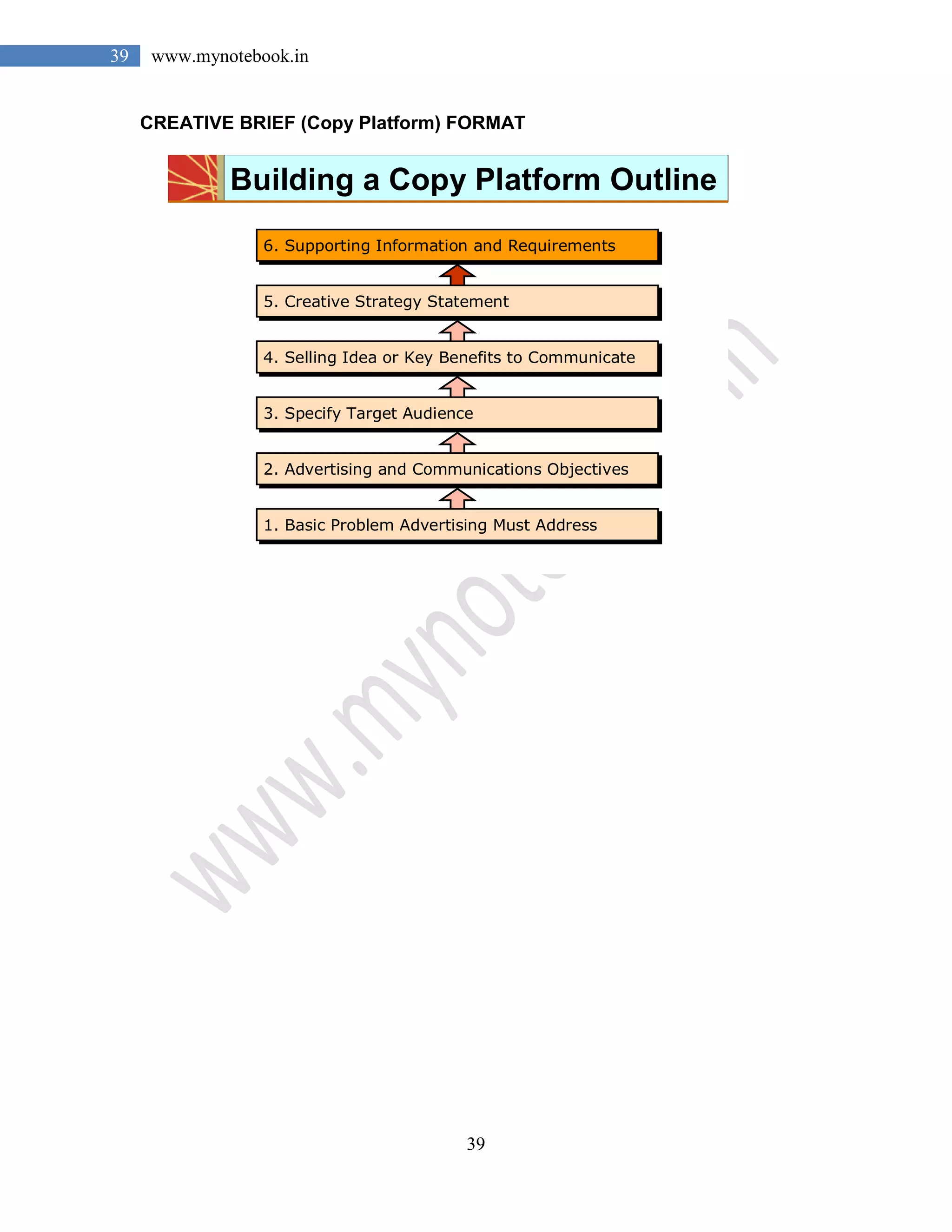
  • 51.
    51 51 www.mynotebook.in Focus insteadon themes that leverage the way Matures are motivated to buy. 6. Play to the notion that this generation overcame daunting odds to achieve their successes. Don't be loud or brash; they already get the point. After working hard and sacrificing for so many years, they have reached a level of financial comfort and a time in their lives where they can feel freer to spend money on themselves . . . because they've earned it. Their style of spending, however, reflected the more cautious, disciplined values of their savings-focused outlook. Even as Matures spent, they actually saved a lot of money. And much of this spending was for others anyway, especially their children. 8. As they age, satisfied and secure, Matures will begin to spend more money on themselves. But they won't turn into recklessly wasteful spendthrifts in the mold of their Boomer children. 9. Nevertheless, [Matures'] interest in pleasurable or exciting experiences for their own sake is low. They want to enjoy life, but they don't want to go overboard. The overriding attitude here is that they have enough money to enjoy their retirement, and they plan to do so - wisely and responsibly. 5. Writing copy for Executives An executive always buy for personal desires, selfish reasons and self-interested motives. Why? Because people are people. Period. It's been that way for millions of years. Your job is to express your offer in terms that trigger their emotions, press their hot buttons, jerk their tears, tug at their heartstrings and nudge them into taking action. If not, you're only telling. Not selling. 1. Be prepared. This is the most important strategy if you want to successfully sell to an executive. Research the company before your meeting. Gain as much information as you can before writing copy for executives. 2. Avoid details. The majority of executives are not interested in the details. Executives are big picture thinkers so be prepared to discuss your product/service on a macro level. 3. Respect their time. The most precious commodity to an executive is time. The average senior-level businessperson has at least 52 hours of uncompleted work on their desk at any
  • 52.
    52 52 www.mynotebook.in given time.Plus, they usually have only one or two of unscheduled time in a typical week. Most executives get to the point very quickly and expect others to do the same. Be direct, concise, and to the point. 4. Have A Relevant Message. Deliver a Real Solution that Solves a Critical Challenge. 5. Business people are often so tied to their businesses or products that they get tunnel vision and fail to look at their copy from their readers' perspective. 6. Be benefit-rich, of course. But more important, be ego-driven when describing those benefits. 7. Appeals to Their Ego: Executives people are still the ones Okaying the deal, whipping out their credit cards or signing the checks. And executives always buy for personal, selfish reasons. 8. Copy using convoluted, complex, pretentious language doesn't sell product to executives. When executives can visualize the process of doing what you want them to do, including the enjoyment of the benefits of your offer, you drive their actions almost instinctively. 9. Follow the "3 C's" Rule: Express your offer as Clearly, as convincingly and as compellingly as possible. 10. Be enthusiastic. Be energetic. Be excited about your offering, because your job is to transfer that excitement into the minds of your buyers. 11. Use words, phrases and imagery that help paint vivid mental pictures. 12. You need to make them feel important. Write as if you were speaking with your prospect, right in front of them, in a comfortable, conversational manner 13. When you do, your copy will imply that you understand them, you feel for them and their "suffering" (for which you have a solution), and you're ready to nurture and take care of them. 14. Forget things like "best," "fastest," "cheapest" and other, broad claims. Because the worst thing you can do, second to making broad claims, is to express those claims broadly.
  • 53.
    53 53 www.mynotebook.in 15. Ifyou want to tell people how better or different or superior or unique your offering is, make sure you express those claims in your sales message in a way that directly benefits your buyer and appeals to her ego. 16. Being different is important. But don't focus on how better or unique you are. Focus on how that uniqueness directly benefits executives; even to the point they can almost taste it. II. Purchase Logic: The Foundation of Marketing Strategy The foundation of a successful marketing strategy is an understanding of what product/service should be offered, how it should be presented, and to whom. Determining these three things is the essence of the marketing function. Purchase Logic is marketing’s primary tool for coming up with the answers. What is Purchase Logic? Definition: Purchase Logic is the description of how and why someone buys a particular product or service. Purchase Logic is an understanding of customer motivation that goes far beyond industry or demographic classifications. Purchase Logic defines what an individual customer wants and how he or she sorts among different alternatives. What Determines Purchase Logic: The more factors involved in a purchase decision, the more complicated Purchase Logic becomes. Small, routine purchases have simple Purchase Logics. The complexity of Purchase Logic increases as any of the following variables Increase: • The number of needs and wants to be satisfied • Length of commitment to or longevity of the product/service • Number of people involved in the decision • Number of alternatives • Price Two examples illustrate how Purchase Logic becomes complex. First, think about buying a meal for lunch at work. You are hungry, have half an hour to spend and have no plans to meet anyone. The decision is simple. You run downstairs to the cafeteria and pick up a sandwich for four dollars. This choice was easy because you had few options and a very simple need to satisfy your hunger and perhaps also take a little break. The price was also insignificant. Now think about buying a meal on Saturday night. Because you are going out with your family, you sort through many more factors to arrive at a decision about where to go. Hunger is only one need to satisfy. You also seek some kind of entertainment or atmosphere. You have four people’s tastes to blend and will
  • 54.
    54 54 www.mynotebook.in spend asignificant amount of money. Further, you have many more options. Even if you are not aware of it, you use a fairly complicated Purchase Logic in selecting the restaurant. This latter scenario is still quite straightforward compared with most purchase decisions. Thus, in order to succeed in selling a product or service, it is important to take a systematic and formal approach to looking at Purchase Logic. COMPONENTS OF PURCHASE LOGIC A systematic approach to examining Purchase Logic will look at each of its four components: Benefits, Barriers, Trade-offs and Price. PURCHASE LOGIC IS A PROCESS Every purchase decision involves a number of steps. These steps may not be clearly discrete or particularly conscious, but they do exist. They represent the order in which alternatives are sorted and decisions are made. The more factors involved in a purchase decision, the more complicated Purchase Logic becomes. Sellers need to understand each step of Purchase Logic in order to make sure they are talking about the right thing at the right time. Clearly, a seller will benefit by understanding what is on the buyer’s mind and how he or she is approaching the purchase decision. Purchase Logic reveals how a prospect will react to what is offered. Purchase Logic also defines the sequence in which issues must be confronted. Benefits must be addressed first. After the benefit ts have been established, it is time to address barriers to purchase. Next come trade-offs and price. After an individual weighs all these factors, a purchase decision is made. BENEFITS We all buy benefits. Even if we have a specific idea of what features will deliver them, benefits are what we seek. Benefits fulfill needs and wants. Purchase Logic defines all relevant needs and wants. Purchase Logic allows us to understand how important each benefit is to an individual buyer and why it is so important. Wants can be particularly tricky to identify. Often they are emotional and may appear irrational. Buyers are often reluctant to share their wants with a seller;
  • 55.
    55 55 www.mynotebook.in frequently theyare not even conscious of some of them. Nevertheless, wants are usually most influential in a buying decision. Think about purchasing a watch. The desire for prestige or some other very emotional need or want justifies the choice of a Rolex over some much lower priced alternative. Both do an equally good job of satisfying the basic need—to tell time reliably. BARRIERS Barriers to purchase are those factors that may prevent a customer from purchasing. We need to design our products or services so that they overcome these barriers. They can be at least as important as the desired benefits. Overcoming barriers can become the most important benefit. Barriers to purchase can be hard to discover. Because people want to avoid conflict, they usually do not offer objections and criticism freely. Sometimes barriers may seem irrational or unfair; thus, the buyer will not mention them. However, barriers must be dealt with. The seller needs to know what they are in order to address them. One highly motivating barrier in business-to-business situations is the fear of criticism. This fear causes buyers to select the safest choice, the “one that can not be criticized.” Usually that is the brand leader. In this situation, demonstrating product superiority is not enough. In order to win, the seller must also provide evidence that the buyer can use to defend his choice.
  • 56.
    56 56 www.mynotebook.in TRADE-OFFS Trade-off analysisis the process of assessing the relative value of different offerings. Customers do not buy individual features, functions or benefits. They choose among services or products that offer bundles of benefits. The trade-off is a comparison of these different bundles. What a customer concludes from the trade-off evaluation directly determines how that customer will react to different prices.
  • 57.
    57 57 www.mynotebook.in PRICE Price isthe mechanism by which sellers capture some of the economic value of the product or service being offered. Price is a function of the benefits provided. The value of those benefit is to a specific customer determines the maximum price that a customer will pay. Cost does not determine price unless you are selling a commodity. However, what a customer will pay is very much influenced by the relative value of alternative products or services. Cheaper acceptable alternatives put limits on how high a price a customer will pay. PURCHASE DECISION As the customer completes the Purchase Logic process, the answers to three questions determine the final purchase decision: 1. What is the relative value of the options I am still considering? 2. Is the value of one choice enough to justify a higher price? 3. Since nothing is perfect, which minuses am I willing to live with?
  • 58.
    58 58 www.mynotebook.in Part 2.Why Should You Care About Purchase Logic? There are four specific areas in which a seller can apply an understanding of a Purchase Logic to enhance the likelihood of success: 1. Analyzing the Market, 2. Communicating, 3. Identifying Qualified Prospects and 4. Altering Offerings for Stronger Appeal. ANALYZING THE MARKET You will gain a clearer picture of the kinds of people who are likely to be interested in what you have to offer. In addition, you will have a deeper understanding of what your current customers seek. This gives you power to change your offering or approach, and thereby strengthen or defend your position. COMMUNICATING No matter what communication vehicle is used, knowing your prospects Purchase Logic will help you talk about the right topic at the right time. You will know what benefits to stress in order to motivate purchase. Also, you will know how to “position your product” for greater appeal versus others in its market. IDENTIFYING QUALIFIED PROSPECTS From Purchase Logic you can pull out some salient questions or characteristics that will help you identify good prospects. In some cases you may even be able to construct selling messages that will prompt buyers to self select and identify themselves to you. ALTERING OFFERINGS FOR STRONGER APPEAL
  • 59.
    59 59 www.mynotebook.in As wehave already suggested, Purchase Logic can also help you revise or improve your products and services to give them stronger appeal. Clear understanding of your market’s needs and wants and their relative importance will give you the guidance you require to make effective changes. Part 3. How Is Purchase Logic Turned Into Positive Action? Understanding precisely what your customers want and why they want it is a powerful tool for managing the marketing of your product or service. Specifically, your understanding of Purchase Logic enables you to choose the most compelling features, marketing programs and sales message. These choices become clear because Purchase Logic defines what products and services to offer and how to talk about these offerings. Once you have identified the Purchase Logic(s) in your marketplace, the direction in which you need to move will be evident. We close with two brief examples of how an understanding of Purchase Logic can make a difference. The first focuses on how Purchase Logic may be used to redefine product offerings. The second illustrates how understanding Purchase Logic can increase the power of your communications. • Understand the barriers to purchase Unless brands owners know what is preventing people from buying their brand in store, then they have no hope in being able to change their ways in the last few feet. Some of the barriers may not be brand related, they can be environmental, such as not being able to find or locate the product. Maybe the packaging and product design does not reflect the premium image the brand claims, or makes it standout against the others around it. Or has the brand failed to deliver its benefits sufficiently to the shopper thereby not arming them with the reasons why it should be chosen over competitors. Marketers used to rely on advertising to do this work for them, but increasingly it will be the last 3 feet that delivers the reasons to buy. Barriers to purchase, as the name suggests are the various barriers that the consumers have to overcome in order to buy a service or a product. The barriers can be physical, psychological or financial. It always makes sense to list down the various barriers that your clients may have to overcome in order to reach you. Once you know the barriers, you can dismantle them one by one and make it easy for the clients. How the to overcome the Barriers to purchase: Influencing barriers to purchase is not always a case of running a brand or price promotion. If the barrier is “I don’t believe in this brand” then some sort of brand in store campaign that talks about brand benefits might be a good idea, but if the
  • 60.
    60 60 www.mynotebook.in barrier is“I don’t know what it’s for or don’t see the point”, then delivering an in store campaign that helps the shopper to understand why they should buy is the way forward. In short, brands need to align their assets to overcoming these barriers in way that best leverages what they know about how the shopper is shopping. 1. Why should I buy it? 2. So what’s different? 3. It sound too good to be true 4. Its not worth the price 5. where’s the buzz III. Developing an ear for ‘human insights’ What is a brand? ‘We live in a brand world, but its not just what it does to you, but how it makes you feel’. A brand is a set of memories; however these memories don’t even need to be your own memory for you to be able to identify a brand as associations can be thought. Even when you have never been in Paris, you still could recognize it by just seeing the words romantic, elegant and fashionable. To understand brands, it’s important to know that strong brands have unique personalities, are consistent in spirit and have anchored themselves on powerful universal human emotions or insights, e.g. Apple, Marlboro & Harley Davidson. It’s almost impossible to copy strong brands, as they go beyond the product like the Marlboro man or the Singapore girl. The ultimate feeling one could have with a brand is a feeling of unification: ‘I am Harley Davidson.’ According to experts no. 1 brands have (on average) 3 times higher gross margins than no.2 brands and 6 times higher than no. 3 brands. As in every successful marketing campaign, actionable human insights are critical to its success. Understanding the passions, expectations, needs and desires of the people you want to talk to -- or inspire to talk about you -- is vital. Marketers (and those of us who serve them) need to take a close look at what's going on in the consumer's world. We need to listen. Sweet spot In marketing, there is also a sweet spot like in sports, and this is what makes a consumer relate to a brand. A sweet spot is met when the relevant benefit fuses with the right consumer insight. The insight can be slightly below the surface, it’s a personal truth about a consumer, in order to have effect. It is a revelation about human behavior or human emotions that can be leveraged to build a brand. An insight makes advertising meaningful, relevant and helps connect with the target. Important to bare in mind is that it springs from an understanding of people, not products.
  • 61.
    61 61 www.mynotebook.in Take forexample the powerful insight on chocolate: women who are depressed like chocolate, ‘it puts a smile back on her day’. Understanding Indian Living in India everybody knows that it is very diverse, with many different cultures, languages, geography and races. India is extremely complex and paradoxical, and what you see is not what you get. To understand India the single biggest problem is that the many professional people who create Indian advertisements have not been exposed to the diverse Indian culture, and don’t know a thing about how or where their target group lives. They have difficulty to relate and fall regularly into clichés. Golden rule is that one cannot write creative, if you don’t know whom you write it for. Much research is done by people whom have a different value system from the target group. So what makes India different? Is there a common set of values for the whole of India? And very important, can we appeal to all Indian through one communication? There are two solutions to communicate with Asians: 1. Leverage universal human insights but localize them to fit each region; 2. Forget globalization and take a completely localized approach. Brands like McDonald’s and Pepsi approach Asian countries with universal human insights, but with a local flavour. McDonalds brings out the child in you and focused on the knowledge between parents and children. They talk to the parent through the child. On the other hand, the localised commercials had a sense of humour and value to them that was very different for each country. Understanding Malays • Rustic simplicity • Unhurried approach to life • Family orientation • Sensitive sophistication • Gentleness • Focus on play rather than work • Graciousness rather than frantic pace Understanding Indians • Spirituality over materialism • Sentimentality and drama • Respect for elders • Intellectual orientation • Family honor before personal honor • Spontaneity, joy and passion • Mythology over history • Fatalism
  • 62.
    62 62 www.mynotebook.in • Strongerindividuality compared to the rest Understanding Chinese • Materialism over spirituality • Pragmatism over sentimentality or abstractions • Action orientation over intellectual orientation • Premium on face value • Ambition / success orientation • Hard work ethic Even though the Asian people are very different, there are some common Asian values that would make it possible to create an Asian localised’ commercial or advertisement: • Harmony and order • Institution above individual • Respect for elders • Strong family and community ties • Fear of losing face / honour • Team above self • Consensus based approach • Strong traditional anchors • Premium on relationships rather than objectivity One should not be misled by appearances. Do look beyond the surface; what you see is not what you get! People may look westernized with miniskirts etc, but their values can still be conservative. Never underestimate the sophistication of Indian culture. And last, but not least you can’t talk to Indian if you don’t master “the nuance”. An insight makes advertising meaningful, relevant and helps connect with the target. ... Universal human insights, but with a local flavour. .. IV. How to get an idea What does “Idea Generation” really mean? The term idea generation is a blanket description referring to any means of creating or developing ideas. There are various different techniques for generating ideas; from free association to mind mapping, with brainstorming arguably being the best known and most often utilized. 1. Brainstorming is a group creativity technique for generating ideas to solve a problem. The results of a brainstorming session can be a complete solution to the problem or a list of ideas resulting in a plan, but more often than not is a list of potential ideas. Brainstorming originated in 1957 with
  • 63.
    63 63 www.mynotebook.in advertising executive,Alex Osborn’s book, Applied Imagination. Today the term brainstorming is often generically applied to the many differing forms of advertising creativity processes based upon this original concept. 2. Free Association, another type of idea generation process, depends largely on a mental ‘stream of consciousness’ of which there are two major varieties- serial and centered. Serial Association starts with a trigger, recording the flow of ideas that come to mind, each idea triggering the next until ultimately reaching a potentially useful one. Centered Association, which is closest to classic brainstorming, is meant to generate multiple associations of the one original trigger so it can be more fully explored. 3. Mind or Thought Mapping are the various processes based upon a mind map; a hand-drawn diagram used to represent words, ideas, tasks or other items linked to and arranged around a central key word or idea. This graphic version of the classic brainstorming method is used to generate, visualize, structure and classify ideas. It is a visual aid in organization, problem solving, and decision-making processes. Many software companies are now selling versions of Mind or Thought Mapping tools which supposedly aid in facilitating and recording this process. 4. Six Thinking Hats was a method developed in the 1980’s by Dr. Edward de Bono. The method is meant to promote fuller input from more people. In de Bono's words it "separates ego from performance". The key point is a “hat” represents a direction to think rather than a label for thinking. There are six metaphorical hats and the thinker can put on or take off one of these hats to indicate the type of thinking being used. The criticism of Six Thinking Hats is it has to be learned and practiced, and the process supplies and training materials can only be written and authorized by Dr. de Bono. 5. Convergent thinking: Problem solving technique in which ideas from different fields or participants are brought together (synthesized) to find a single optimum solution to a clearly defined problem. 6. Divergent thinking: In contrast to convergent thinking, (which aims at solving a specific problem) divergent thinking is creative, open-ended thinking aimed at generating fresh views and novel solutions. Divergent thinking uses exploration to search for all possible alternatives 7. Analogies and metaphor: Used to see new patterns or relationships. An analogy means Similarity in some respects between things that are otherwise dissimilar. A comparison based on such similarity. Thus it’s a form of logical inference or an instance of it, based on the assumption that
  • 64.
    64 64 www.mynotebook.in if twothings are known to be alike in some respects, then they must be alike in other respects. Metaphor means something used, or regarded as being used, to represent something else; emblem; symbol. The problem with any of these idea generation processes is the lack of understanding, time or focus of participants. The knowledge and problem- solving expertise required make idea generation successful are often simply not available within the organization. • Choosing the idea that effectively communicates the emotional/rational benefit
  • 65.
    65 65 www.mynotebook.in Chapter 4: Brief Abrief is one of the most important aspects of Client servicing executive. Critical to the creative process is developing a clear understanding of our clients' needs and expectations. At the important initial meetings we listen and ask a lot of questions to help us establish the full scope of the project, budget parameters and timelines. So what should we ask for? More often than not we are not given a written brief from the client instead we need to extract a brief. This can be painful and pointless if we are not asking the correct questions and more importantly the correct person. Before you get into asking the usual questions of how big, how much and where, try starting at the beginning. It helps to find out about your customer. This can be done before the appointment via the web where you might find out what they do, how big they are, and how many people work for the company and how many offices they have. If they are a foreign owned company it is quite possible that the decision will be made abroad. You can pick up product ranges, departments and divisions. You might even be able to see a picture of a previous stand. It’s information like this that the smart client servicing executive gathers without thinking. If they don’t have a web site ask them to send you a brochure before your meeting. Initial Proposal Inspiration is what our clients expect so we spend time refining the initial brief and make sure our proposals will deliver it. This is our opportunity to shape a vision for the project and to set out the means for achieving it, as well as realistic deadlines for every stage. Strategy and Research If appropriate and practical, we like to include careful market analysis through customer and competitor research. This helps us to fully understand where our clients are coming from and where we can help them go Creative Concepts This is the stage when all the groundwork produces the first buds of creativity and culminates in our first major presentation. Together we discuss and agree which of our ideas are worth developing.
  • 66.
    66 66 www.mynotebook.in Development andApplication Even the greatest ideas require careful implementation to achieve their full potential. Following client feedback, we develop and polish our ideas into carefully crafted final Creative strategy. Whatever the required deliverable, Its essential that highest quality work is delivered. • Product Brief: The product brief (initial information provided by the contracting company that dictates what they require from me). A product brief is a document designed to focus on specific benefits and attributes of clients’ products. • Marketing brief: The purpose of marketing brief is to help assess client’s current situation, both internally and relative to its competition. It’s the starting point for any work agency do for their customers. The details elicited in marketing brief provide the foundation for refining clients marketing message and revising and updating their marketing and advertising program. A marketing brief is the best way for the marketer to clearly lay out a framework for the creative team. The process can be driven by either side - creative or marketing - but both sides need to agree on the brief before the work can commence. Marketing brief is a document outlining the expectations by a company's marketing team regarding a finished project. The marketing team can clearly define what they want the creative team to create. Follow these tips to create a marketing brief so all parties involved will know what work is expected of them. a) Where are we? (situational analysis - the market, trends, competitive analysis, etc.) b) Where are we going? (opportunities, objectives & strategy) c) How are we going to get there? (actions, plans & controls) Instructions for creative Marketing brief: Step 1 Write a summary of the project including any background information. Include all areas and all players who will be involved in the project. Know the prices of each part of the project and the total cost.
  • 67.
    67 67 www.mynotebook.in Step 2 Outlinethe expectations of each party involved. Know the individual jobs of each player and include these job expectations in your creative marketing brief. You want everyone to be clear about the job at hand. Step 3 Include the dates of each part of the project. Know who is completing what and when it should be completed. Have a date for the final project. Step 4 State your goals and objectives. so that everyone knows the purpose of your project. You have a better chance of succeeding if everyone is clear on this point. Step 5 Know your target group. The more you know about the target, the more successful your project will be. Once you know the target group, you can tailor the project to that group. Step 6 Write your brief in project format with clear headings and sections for each part of the project. Include plenty of white space between sections so readers can scan for information. 10 Point Marketing Brief (Brief) 1. Background you have to supply enough detailed information, regarding your needs. We will have little or no knowledge of your market and will have to understand the key elements that need to be focused on by the marketing campaign. Remember, you are the expert in your field. 2. Research Include any and all relevant research that could support the marketing campaign. 3. Previous Marketing Material If you have tried marketing and advertising previously, provide full details of the targeted markets, details of your previous campaigns and the results. 4. Aims What are the required results of your marketing campaign? Confirm your expectations and aims. 5. Objectives Will your objective be: o Raising awareness of your products or service? o Changing preconceived attitudes
  • 68.
    68 68 www.mynotebook.in Your objectivesmust be comprehensible, specific and quantifiable. They should be conceived in simple detail, as they will present the principal concept for your campaign. 6. Target Market Know exactly who you want your message aimed at. The target audience can be portrayed in terms of current market behaviour, degree of awareness, product/service knowledge, favoured method of receiving info and clients/customers enthusiasm /obstruction to take notice of and accept the information. The more comprehensively you recognise your target audience, the greater the prospect of a successful campaign. 7. Key Message Be clear and concise concerning the purpose of your marketing campaign. An unclear message may result in an ineffectual strategy and an unsuccessful campaign. 8. Budget Define your marketing budget. If you do not specify a budget in your brief then a marketing strategy may be proposed that exceeds what you had in mind. 9. Timescale Provide an approximate schedule for the campaign. Results will take time and we need to know the timescales we are working to. 10.Evaluation If you do not build in a stratagem to appraise the campaign, you will not know if it was successful and if your money was well spent. Equally, if the campaign doesn’t produce the required results, evaluation will help identify where things went wrong • Agency brief This comprehensive guide provides, in outline form, essential questions and topics of discussion necessary for informing outside agency about clients marketing communication needs, both short and long term. This document will serve as a broad-based reference tool for both focus and direction of your marketing efforts. What’s fascinating is that this is true. The agency brief document purpose is to involve advertisement agency within clients marketing strategies –from the beginning until the end.
  • 69.
    69 69 www.mynotebook.in The oft-usedword, partnership, is a good benchmark for defining the relationship between agency and client. It is fundamental to a healthy client-agency relationship that the agency be seen as a fully engaged partner with client. By partnership we mean complete and thorough disclosure, prompt response to requests, and the commitment by both client and agency to see the creative process as one of collaboration, not driven by ego and private agenda. At the end of the day, if the campaign is highly successful, who cares where the idea emanated from? If the campaign is less than successful, then both sides must take mutual accountability A good advertisement agency will ask client for a briefing. A briefing is crucial for good advertisement. The agency must really understand clients issues, its product and the vision clients want to communicate. Since agency brief is very detailed and goes into great depth, its recommend that a team complete this briefing. A single person would provide the agency with just one view that may be skewed by his or her specific discipline. • Converting into creative brief Once an effective appeal is found, the advertiser should prepare a creative brief, typically covering one or two pages, it is an elaboration of the positioning statement, and it should include: a. Key message b. Target audience c. Communication objectives d. Benefits to promise e. Supports for the promise f. Media to be used. Note boxes will expand to accommodate verbiage. Try to keep Creative Brief as concise as possible.. (Client Name) Creative Brief Format Agency/Graphic Designer: ____________________________________ Agency Phone:______________ Fax: _____________ Email: ______________________ AgencyAddress: ______________________________________________________________ Street City State Pin Code
  • 70.
    70 70 www.mynotebook.in Project Summary:Clear, concise description of project – keep brief. Target Audience: Whom are you trying to attract? Be specific. Key Messages: One or two key “thrusts” – those most important to the project’s success. Key Benefits: What’s in it for the audience? Background/Competitive Positioning: Briefly discuss the competition, market realities, obstacles, etc.
  • 71.
    71 71 www.mynotebook.in Communication Strategy:Indicate any specific elements to be included (logos, key visual images,key words and phrases, key contact information, specific internet links etc.) Desired Message Tone: How do you want the message perceived -- creative, fun, warm, active? Project Timeline: Indicate major milestones. Anticipated Budget: Other: Add any key information not covered under the above items. Prepared by : _________________________________________Date:___________________ _____ Accepted by:
  • 72.
    72 72 www.mynotebook.in Agency/Graphic DesignerSignature: ______________________________ Title: ______________________________ Date: ______________________________
  • 73.
    73 73 www.mynotebook.in Chapter: 5 TheBIG IDEA A BIG IDEA can be used to provide a basis for the campaign. e.g. a “hook” that you can use for multiple executions. Does the ad position the product simply? …and with unmistakable clarity? Does this ad bolt the brand to a benefit? Does this ad contain a power idea? Does this ad have brand personality? Is how the Advertising meets its promotional objectives given its audience and constraints? Translates the ads purpose into its Creative Strategy (how it will do what it is supposed to). The Creative Strategy is built around a theme that contains an appeal. The theme is the ad’s context, or setting. The appeal taps into the audiences’ motives to initiate and guide behavior / learning. Big idea—“The flash of insight that synthesizes the purpose of the strategy, joins the product benefit with consumer desire in a fresh, involving way, brings the subject to life, and makes the reader or audience stop, look, and listen.” David Ogilvy’s Quotes 1 It takes a big idea to attract the attention of consumers and get them to buy your product. Unless your advertising contains a big idea, it will pass like a ship in the night. I admire people with gentle manners who treat other people as human beings. I abhor quarrelsome people. I abhor people who wage paper-warfare. David Ogilvy’s Quotes 2 The consumer is not a moron. She is your wife. Never insult her intelligence You will never win fame and fortune unless you invent big ideas Creative Strategy The search for the “BIG IDEA.” The concept or central theme that will bind the campaign together. Tone of Voice Tone of Voice often communicates so much more than even the expression on your face. You are constantly engaged in changing your tone of your voice as you speak. You admonish a naughty child in on tone, and use another if the child is frightened and needs comforting. You can use Tone of Voice to give orders, raise an alarm, and evoke pity; In short, use Tone of Voice to generate a mood, or to impel action. So when you communicate through an ad, first decide when Tone of Voice you wish to use when talking to your target audience. What sort of feelings do you wish to inspire in the housewife’s heart? Should you inspire confidence, or evoke fear? What sort of voice will make the reader of your
  • 74.
    74 74 www.mynotebook.in ad eventuallyrespond as you want him or her to respond? Tone of Voice is a crucial element in designing communication message.
  • 75.
    75 75 www.mynotebook.in Chapter: 6 Writingfor Print Media- Parts of a press ad- the headline, subhead, body copy WRITING THE COPY The elements of the copy, from headline to closing should follow the 4 steps in the selling process – “A-I-D-A” in a logical progression. THE HEADLINE PROVIDES THE “A” AND “I” In copywriting, the attention and interest of the potential customer must be caught by the headline, or the page will be turned and the possible sale lost. The headline has 3 functions: 1. To capture attention. Ex: Axe effect – red lips creating a sensuous appeal are a very attention seeking ad and the visual acts as the headline. 2. To awaken the interest of the reader in learning more about the product. The ad for Intelligent Investor, which uses the headline “Why being a regular reader of Intelligent Investor is such a healthy habit”, would awaken the interest of the readers. 3. To select the special readers who might have a specific interest in what you are selling. Eanadu Pradesh ad targets media planners, hence the headline – “Perhaps the first ad written with the belief that a media planner is human, and not a counting machine”. Once the dominant selling point and copy appeal have been determined, there are several grammatical forms the headline can take. It may be determined as:  A statement or part of a statement The Business Standard ad uses a statement the headline:” Its tough being a Business Standard reporter”.  A question Onida TV ad- Headline – “should the new Onida TV be banned?” Surf excel – sample laaney ki kya zaroorat hai  A command. get it! – Visa
  • 76.
    76 76 www.mynotebook.in Ad forStar News that has a headline, which just says “Stop” Onida TV – headline - “Don’t!” Sub-headline – “don’t just envy the Ondia TV, buy it” What a headline contains is more important than the form in which it does it. Headlines may be classified by performance as follows: Headline Types • Benefit • News and Information • Command • Provocative • Question • Reason why • Caution headline • How-to-type • Selective headline • Solution to problem • Advice headline • Gimmick headline 1) Promise of a Major Benefit This is the safest, most widely used type of headline. And for it to be as effective as possible, it must display the #1 benefit your prospect will receive buy purchasing your product or service. The most effective way to determine this benefit is to survey your customers - by phone, email, or postal mail. Ask them the top 3 reasons for purchasing your product or service, and have them rank them in order. It's a good idea to offer your customers an incentive for providing you with this information. 2. News or Information: Conveys real news or important information about a product.. If your product or service offers something newsworthy, announce it in your headline. Newsworthy is usually the introduction of a new product or the improvement of an existing product. Here are some words you can use in your News Headline: New... Announcing... Introducing... Finally... Just Released... Now... Now Available... At Last...
  • 77.
    77 77 www.mynotebook.in Examples: Eg. TheTimes of India ad that boasts of the circulation of TOI as compared to that of Deccan Herald. “ The Times of India: 301927 copies. Deccan Herald : 147538 copies” 3. The Command Headline. The Command Headline tells your customer what to do. Your command should encourage action by offering your prospect a benefit that will help them. Effective Command Headlines start out with action verbs. Examples: ♦“Trade In Your Old Motor cycle for-Bye to Maintenance Headaches!” 4. Provocative 5. The Question Headline. Here again, to use this headline, you must really know your market. You need to know what your prospect is thinking, what their anxieties are, and what they’re hoping to accomplish. If you know your target audience this well, then the Question Headline is an effective headline to use. The Question Headline should focus on your prospect’s self interest and ask a question they want to know the answer to. The best type of questions to ask are questions that get your prospect involved. Examples: ♦ “What Does the Space Shuttle Have To Do With LaZer Runner’s 7 Year Premium Protection Warranty?” ♦ “Can Half of All Laser Tag Owners in America Be Wrong?” ♦ “What Do The Giant Entertainment Companies Know That You Don’t?” 6. The “Reason Why” Headline. With the “Reason Why” headline, you give our prospect specific reasons why they should read your ad. “Reason Why” headlines are effective because they contain facts and specific numbers. “Reasons why” headlines don’t need to include the words “reason why”. Examples: • “7 Reasons Why IBM Provides You With a More Reliable System” 7. The How-To Headline. These two words -- “how to”, are very powerful words. You can never go wrong using a How To Headline. (Over 7,000 book titles start out with How To.) How To Headlines promise your prospect a source for information, advice, and solutions to their problems. If you ever get stumped for a headline, use the How To Headline -- it works!
  • 78.
    78 78 www.mynotebook.in Examples: ♦ “HowTo Expand Your Customer Base and Increase Your Profits” 8. Selective Select a specific audience with specific language and words. The Malaya Manorama ad, which addresses advertisers. The print ad starts with the headline which says – “A few commandments to advertisers this Xmas.” Media planer ad of Eenadu Pradesh. 9) Solution to a problem This type of headline is a slight variation of the #1 benefit headline. The problem solved by your product or service is the #1 benefit - it's just presented in a problem/ solution format. Example: "Now You Can Melt at Least 3 Inches of Fat from Your Waist in 30 Days or Less - Guaranteed!" This headline presents the benefit of reducing fat in the waist as the #1 solution to the problem of having excess fat in the waist area. 10) The Flag Headline A flag is a phrase calling for the attention of a particular person or group. Use a flag headline to attract your target audience - those most likely to buy your product or service. For example… Attention: New Mothers! New Exercise Safely Burns the Fat You Gained During Your Pregnancy in Less than 60 Days - Guaranteed! You can also use the flag headline to increase response by catering your offer to readers of the publication you're advertising in. Example… Attention: Newborn Journal Readers! New, Exercise Safely Burns the Fat You Gained During Your Pregnancy in Less than 60 Days - Guaranteed!
  • 79.
    79 79 www.mynotebook.in 11) TheWarning Headline This type of headline can yield tremendous results when use properly. There are a few ways to use this approach. Your headline can propose a warning to read your message before making a purchase. Or you can use the warning to flag a specific audience. The following example uses both of these techniques. * Warning: Dieters * Don't eat another reduced calorie meal until you read this startling message… Why Your Current Eating Habits May be Doing More Damage to Your Body Than Good! 12) The Testimonial Headline This is simply a satisfied customer testimonial used as a headline. Here's an example: "Big Boulder Protein Powder helped me pack on 11 pounds of muscle and reduce my body fat by 6.4% in only 37 days, without changing my exercise routine, and I'm convinced it can do the same for you too." The quotes around the headline signify that it's an actual quote from a customer, giving it added validity. When using this method, it's important that the testimonial has a strong impact. It must make a significant claim related to a major benefit of your product or service. Don't just use an "average" testimonial, or it won't have the desired effect. 13.Claim: Insist that this product has an outstanding record or performs in a certain way. It should not be overly blatant and boastful, if so then it is called Horn-Blowing. DHL: “when sending shipments to the US, more of India’s companies choose us”. Horn blowing – the Asian Paints yamaraj ad – this ad just exaggerates the durability aspect of the paints which kind of sounds boastful. 14.Advice or Promise: Promise a real benefit if the product is used.
  • 80.
    80 80 www.mynotebook.in Ex: Don’tget a credit card from us and you may end up with the wrong one in your hands - timesofmoney.com ad. 15.Logo Or Slogan: Stress the reputation of the company behind it. Toyota, Tata both use their logos for most of the ads for their automobiles – Camry and Indica respectively. 16.Mood-Setting: Set a mood to create receptivity in the reader. Eg. The JW Marriott ad, which uses the headline –“The earth is mostly water. So is the view from our hotel. A picturesque scene of girl relaxing supports this 17.Provocative: It must provoke the reader into probing further. It means startling or interrupting in order to capture attention. If a provocative headline is used it must be pertinent to the product. If it presents a question, the answer must lie in the subheadline or body copy and in the product’s characteristics, features, and performance. Sometimes it presents a contradiction or an apparent paradox to the reader, with the explanation provided in the body copy. There are exceptions: Those messages where a headline and very descriptive visuals are able to tell the whole story. The advertisement for HLL looking for baby models – Headline – “Nude models wanted” Ad for Amitasha Foundation – Her parents cursed the day she was born” 18.Visuals are as much a part of headlines as are verbal concepts. Eg. The “bad night – Goodknight” ad with Lisa Ray …….her face tells the whole story and there’s no body copy! Sub-headlines: Sub-headlines are sectional headlines. There are over lines and underlines. An over line is a sub-head that leads into headline. An underline is a sub-headline that follows the main headline and leads the reader into the copy test.
  • 81.
    81 81 www.mynotebook.in Generally thepurpose of the sub-headline is to support the main headline and complete the meaning of the headline. It may also be used to bring out related but additional or different appeals. It can also be used to break up a lengthy copy. Functions of Sub-headline: •Include important information not communicated in the headline • Communicate key selling points or information quickly • Stimulate more complete reading of the ad BODY COPY Body copy carries the selling message. Once the headline and visual have attracted attention and aroused interest, the body copy attempts further to develop the interest of the potential customer, to awaken the desire to own the product, and to close with a “call to action”. Body copy can be extremely important to the success of an ad. It allows you to fully convince the target audience of the benefits of the product. But unless you can get them to read it, it's a huge waste of your time and your client's money. And most people won’t read body copy--in fact, 80% of readers won't read it. So what do you do? You can leave it out of the ad and hope that the ad will compel readers to seek more product information elsewhere (at the Web site, at the showroom, etc.) But sometimes advertising is the most efficient way of communicating all the product information so you have to write good body copy. In that case, you must try to entice readers into the body copy. And the best way to do that is with a great "lead." This is the first sentence of the body copy. No matter what style of copy you're writing, it should draw the reader from the headline and into the text. The copy approach is the way the copy and its appeal are presented. Copy approaches, various as they seem, can be grouped into three categories: 1. Factual, direct or rational approach LIC – The LIC ad states the benefits of the Komal Jeevan policy, the eligibility, minimum sum assured, etc.
  • 82.
    82 82 www.mynotebook.in Several waysto work out this approach • a. Direct selling information Ads that offer information on products like music cassettes, books, CDs, etc, which are sold by the newspaper/magazine in which the ads feature, provide direct selling information. For example – The Economic Times Entertainment 2001-2002 report. • b. Implied suggestion (“soft sell”) Amway – the ad does not urge you to “ buy today” or “hurry”, instead, it lays down the benefits of using Amway products in a subtle way. Besides, since Amway products are made available through personal selling, the body copy does not state any contact address or number. Rather, it states – “ someday soon, someone will suggest that you find out for yourself how exquisite our personal care products are. • c. Testimonial copy 1. When Sachin Tendulkar says – “Boost is the secret of my energy”, he is offering testimony to the benefit offered by Boost, i.e. energy. 2. Ratan Tata lends credibility to the plea made by Dept of Electronics – Govt. of India by ratifying the seriousness of the Y2K Bug. Body copy developed for the factual approach: 1. Amplification of headline in the lead (1st sentence (s) of body copy) 2. Proof or evidence 3. Additional details 4. Closing The ad by Infosys seeking recruits starts with the Headline – “ We need Though Leaders who can assert our Domain Competence.” 1. Amplification of headline – “As a global IT consulting and services organization, Infosys is at the cutting edge of IT development and a thought leader in business and technology domains…” 2. Proof or evidence: a seal is shown in the ad which states – Best employer to work for in India
  • 83.
    83 83 www.mynotebook.in Business today– Hewitt Associates survey – Jan 2001 Software’s Best Employer Dataquest – NFO – MBL Study May 2001 3. Additional details: details about Domain Competency, the focus areas of the project, eligibility criteria are given. 4. 5. Closing: So, if you are a though leader who wants to fly high, act now! Mail your resume… 2. Narrative approach story board Ex: om kotak mahindra A man joins a party and is bewildered by what he sees. He moves forward in a daze and recognizes his own image as an old man. "Ek din, main apne aap se mila. Aur apna bhavishya dekha." He dances together with his vision, and enjoys the carefree moment. "Aatmanirbhar, surakshith. Azaad." They become the life of the party as... ...the MVO adds, "Om Kotak Mahindra Life Insurance. Jeene ki azaadi." The ad uses the narrative approach to emphasize the USP of Om Kotak Mahindra Life Insurance, i.e. Independence. Several ways to work out this approach: • a. Descriptive or human interest story Most NGOs use this approach to elicit a favorable response from the readers. For example, ad for the Amitasha foundation - Nurturing the girl child, show the photograph of a girl in rags, with the headline – “Her parents cursed the day she was born. So does she.” • b. “Slice of life” – slice of life ads depict situations that one can relate to, situations that could have occurred in anyone’s life. McDonald, Cadburys dairy milk, etc use this approach
  • 84.
    84 84 www.mynotebook.in • c.Fictional testimony In the ad for Dove, women who have used Dove narrate the positive effects of using Dove in their lives. • d. Monologue or dialogue Hindustan Times • e. Humor Most of the Fevicol ads have used humor to make the ads noticeable, interesting as well as memorable. Even the feviqwick ad where two men are shown fishing, has the same effect. The ad - a suave gentleman is shown fishing in a lake for hours, but could not catch a single fish. Then comes a rustic local, who applies Feviqwick at a few places on his fishing rod, dips it in the water and out comes with five fish stuck to his rod. Thus, humor gave high noticibility as well as recall to the ad. Body copy developed for the narrative approach: • Predicament Most fair and lovely ads start with a predicament – the girl faces problem/s because of her complexion. like the ad in which the father wishes that he had a son and not a daughter. The daufghter comes across an offer for the job of an airhostess, but a after look at her dark complexion in the mirror, only ends up cursing herself. • Transition to the product. But things change when she uses Fair and Lovely • Happy ending Not only does she become beautiful (fair) and confident, she even becomes an airhostess. The ad ends with the female taking her father out for coffee to a five star hotel, and the father proudly calling her ‘beta’ (son). • Closing (suggestion to the reader) Ads, which end with words, like – “jaldi kijiye”, hurry now, etc. Example – Safal ad – jaldi kijiye - mahurat nikal na jaye
  • 85.
    85 85 www.mynotebook.in 3. Projectiveor emotional approach This approach puts the reader realistically into the situation, involving him emotionally through a projected “factual story” or through fictional story about fictional characters. This approach relies on the customer’s association with the characters in the story – as if it were happening to him. Eg. The emotional impact of this type is often felt in copy written about perfume, cosmetics, lingerie, cars and travel. McDonald’s ad. A little boy takes a last look around his old home. Everything is being packed up and stashed away to be moved Saying good-bye to his best friend he gets into the car and they drive out. On the way, he spots a McDonald’s restaurant and....he recalls all the fun they had here. The occasions celebrated and the good times come flashing back to him. Cut to the new house. His sister drags him to the window to show him something. The father draws a Mac logo in the air. As they look out, the kid sees a McDonald's restaurant opposite and his gloom disappears. The ad ends with the jingle - McDonald's mein hai kuch baat. BOXES AND PANELS Boxes and panels are great tools for the copywriter. In the information age, writers can access huge amounts of information to support their product’s utility and demonstrate why customers need it. To avoid having the ad’s text become a glut of testimonials, data, and off-the-issue discussions, copywriters segregate information of a secondary and supportive nature into boxes and panels next to the main body copy. This allows readers to first focus on the main issues and later study the detailed facts. A box is copy with a line around all four sides. A panel is an elongated box that runs the whole length or width of an ad. Boxes are useful for framing information that the prospect must read – e.g. coupons, special offers, contest rules, and the order blanks. Quick tips for Body copy; 1. A writer must put conviction into their own copy. 2. Never oversell in your body copy
  • 86.
    86 86 www.mynotebook.in 3. Getquickly to the crux of your body copy message. 4. Keep your line of thought on track. Address arguments before they arise. 6.Write for your audience-not yourself. 7. Keep your copy user friendly 8. Present your body copy in a logical sequence that relates to the rest of the text. 9. Use one of the twelve slogans for constructive persuasion. SLOGANS A slogan is a small attractive phrase used in the ad to sum up the advertising message in a few words. Ideally the slogan should be short, preferably 5 to 7 words or even less than 5 words. The words must be simple, clear and easy to remember. It should be so designed that it can be repeated , perhaps a year or years together. The slogan should be such that it can be used in any media, whether on TV, radio, press and outdoor. Slogans are not easy to create. Sometimes, they just come along but most often slogans are the result of hard work of days together put in by the creative marketing people/advertising people. Great slogans are like great ideas, they don't come overnight. Basis for writing a slogan: Techniques/factors 1. Slogans can be based on the Quality of the product. Example: ‘The best tobacco money can buy’-Rothmans. 2. Slogan can be based on the Life of the company. Example: ‘ A trusted household name for over fifty years’-Philips. 3.Slogans can be used to build Trust and confidence. Example: ‘The name you can trust’- Mafatlal. 4.slogans to guard against substitutes. Example: ‘when it’s Philips, you can be sure’. 5. Slogans emphasizing sales of the product. Example: ‘India’s largest selling soft drink concentrate’. Rasna. 6. Slogans emphasizing International reputation of the product.
  • 87.
    87 87 www.mynotebook.in Example: ‘Theworld’s favorite airline’- British Airways. 7. Slogans can place emphasis on Advanced technology of the company. Example: ‘In tune with tomorrow.’- Bush. Example: Dunlop is Dunlop, always ahead’. 8. Slogans emphasizing the use of the product. Example: ‘A pocket doctor for aches and pains-Amrutanjan pain balm. Example: ‘Real relief, real fast-Moov. 9. Slogans expressing Love and Affection Example: ‘A gift for someone you love-Amul chocolates. 10. Slogans expressing Joy and happiness. Example: ‘ Happy days are here again.-Thumps up 11. Slogans emphasizing the choice of specific class. Example: ‘The choice of new generation’- Lehar Pepsi. 12. Slogans emphasizing the comfort and convenience. Example: ‘Arrive in better shape’-Cathay Pacific. 13.Slogans based on pride and possession. Example: Neighbours envy, Owners’ pride’. 14.Slogans emphasizing name of the brand company. Example: ‘Only Vimal’ 15. Slogan based on the headline of the ad. Example: ‘Filter and tobacco perfectly matched’-Wills. (headline: ‘Made for each other), The twelve slogans of constructive persuasion: 1. Slogan are about you: Successful slogans tend to use the word ‘you’ some where in the copy. 2. Slogan make promises 3. Slogans call for action 4. Slogans create ideals: Zindagi ke saath bhi Zindagi ke baad bhi. 5. Slogans are it: Go for it, It’s here, you can’t beat it. 6. Slogans are in a world of their own. Enter a new world of writing. 7. Slogan may rhyme: Top for shops, meals that appeals. 8.Slogans can be full of alliterations Supremely Scottish Salmon Buy better. Buy bigger, by far. 9. In order to sell, slogans don’t have to be clever. The writer’s choice
  • 88.
    88 88 www.mynotebook.in The bestpen you can buy. 10. Slogans conveniently package everything in one sentence. Affordable reliability in your pocket. 11. Slogans repeat key word patterns. The right price. The best quality. 12. ‘The’ slogan is king The best; The one;the Answer, The shape. Functions of Slogan: 1. Aid memory recall: It should be easy and pleasant to remember. “ I love you Rasna”. 2. To describe the use of a product. “ The weekly update on the hospitality industry- Express Hotelier & caterer Magazine. 3. To suggest the product’s special advantage or unique benefit. " On time, every time.” DHL. 4. To suggest increased use or frequency of use. 5. To stress the quality of the product “ Greater Reliability through Better Technology”. Rane ( Madras Limited). 6.To build name and goodwill of the company. “ The world’s favorite airline.” British Airways. 7. To stress market leadership “ India’s No.1 Radial.” JK Tyre. 8. To emphasize international standards. “ World Champion Lubricants.” Castrol. Many slogans – also called theme lines or tag lines – begin as successful headlines. Through continuous use, they become standard statements, not just in advertising but also for salespeople and company employees. Slogans become a battle cry for the company. Slogans have two basic purposes: to provide continuity to a series of ads in a campaign and to reduce an advertising message strategy to a brief, repeatable and memorable positioning statement. De Beers ads still use the slogan – “Diamonds Are Forever/Heera Hai Sada Ke Liye”
  • 89.
    89 89 www.mynotebook.in Because oftheir use in positioning a company or product, many slogans are developed at the same time the product or company is conceived. Slogans should be like old friends- recognized instantly year after year. Effective slogans are short, simple, memorable and easy to repeat, and most important, help differentiate the product or the company from its competitors. Rhyme, rhythm, and reason – not to mention alliteration – are valuable tricks of the trade for slogan writing. SEALS, LOGOTYPES AND SIGNATURES The concise Oxford Dictionary describes the word ‘Logo’ simply as ‘logo type’. In turn, logotype is describe as: Word, or more letters than one, cast in one piece. Non-heraldic device chosen as company symbols or badge of organization and used in advertisements, on note paper, etc. The company’s logo is the corporate signature. It reposes in itself the collective pride of the company and is designed with great care to represent the personality of the company and its product. In other words, the corporate logo embodies the company with a personality, a human quality and character. Apart from lending personality to the Company’s public image, logo styles also incorporate nuances about the company. Movement related corporations like Air India, Indian Airlines, and a host of other airline and travel agencies prefer their logotypes to move from left to right and underline the sense of motion through Italicised typefaces. A seal is awarded only when a product meets standards established by a particular institution or organization. Sunsilk claimed that it had passed the rigid tests and had received the approval of Elida Hair Institute of Paris . Companies claiming to be ISO approved Since these organizations have credibility as recognized authorities, their seals provide an independent, valued endorsement for the advertiser’s product. The term Seal is sometimes interpreted to mean the company seal or trademark. They are actually called logotypes. Logotypes and signature are special designs of the advertiser’s company name or product name. They appear in all company ads and, like trademarks, give the product individuality and provide quick recognition at the point of purchase.
  • 90.
    90 90 www.mynotebook.in Captions: Captions doform part of copy text. Captions are small sentences that seem to come out the mouth of the people shown in the ads. Comic strip type of copy make use of captions. For example, you must have come across such captions in the print ads of Tortoise Mosquito Coil. Essentials/ Characteristics/ Attributes of a Good copy: 1. Be Concise 2. Be Simple 3. Be specific 4. Be Personal 5. Make it believable 6. Be clear 7.Make it interesting 8.Make it persuasive 9.Keep a surprise in the copy 10. Follow the headline and illustration. Creative Tactics: Print Ad Layout 3. Jingles These are catchy little tunes, which we pick up and hum quite unconsciously most of the times, like a refrain registered in our brain, which refuses to go away. Jingles make possible the association of memorable phrases with the product or with the company. As David Ogilvy once said, “ If you have nothing to say, sing it.” A jingle with its repeat phrases has a far higher recall value than the visuals do. The signature tunes immediately conjure up their products. The music catches the attention of children and teenagers. It is important to know the target audience when composing a jingle. It is important to know the target audience when composing a jingle. The mood briefs are generally given to the jingle singer by the Agency. They tell whether a tune should be ‘peppy’ or ‘romantic’, or ‘joyous’. They also give a profile of the target audience. Sometimes a story-board is given by the Agency to make the singer aware of the characters expected to be mouthing the jingle. Jingle composing, singing and making it work is highly creative art. Jingle composing involves co-ordination with client, composer, musician, recording studio, singer, voice over person and host of others.
  • 91.
    91 91 www.mynotebook.in Chapter: 7 I.Writing for Television: Stages of producing a TV Commercial 1) Writing scripts and developing storyboards 2) Briefing the producer 3) Pre-production 4) Shooting 5) Post-production The Two elements that make TV so exiting are: (1) Sight (2) Sound Focus on single big idea: TVC are generally use for launching the single Big Idea to leave its impression. Effective TV commercials merge video and audio into a powerful sales tool. But don't think one is more important than the other. Audio and video go hand-in- hand. For example, turn down the volume on any commercial. You should be able to identify the benefits of purchasing a product just from the video. The same holds true for audio. Close your eyes and listen to the announcer. If the audio doesn't explain the product in detail, then the commercial isn't effective. Potential customers should be able to hear your message even if they're not in the room to see it. Always use a strong audio and video combination when creating your own commercial. Say you're selling a handheld vacuum cleaner: Your video could actually demonstrate the product vacuuming the stairs, hard to reach places and inside a car. You'd also use video to show someone struggling with a regular, bulky vacuum cleaner - fussing with cords and heavy equipment. Use your audio to explain the advantages of owning your product. You'd use words like "convenient, portable, and lightweight." However, there are no words more important than your call to action. What do you want your viewer to do? Tell them to call now. Order now. Visit their local dealer. Your video must match your audio to drive home your selling points. For
  • 92.
    92 92 www.mynotebook.in instance, youwouldn't want to see video of a woman struggling with a large vacuum cleaner while you hear audio claiming, "Our handheld vacuum cleaner is great for cleaning the inside of your car!" Your message gets distorted. The viewer gets confused. And you lose the sale. Think of television as an intimate medium. 1. If you're advertising a restaurant, don't just use a shot of your building's exterior. Use a close-up of your food in your commercial. And show people eating your food. 2. If you're producing a Public Service Announcement (PSA) about drunk driving, don't just use a shot of a crowd of people at a funeral. Show a tear streaming down a child's face. 3. Combining sight and sound should spark your viewers' emotions and help them identify with your product. And if they can identify with your product, you're more likely to get Successful television advertising sells through emotions: 1. Motivate viewers: Television viewers rarely remember the details of an ad, but they can recall how the ad made them feel. Make sure they feel motivated after viewing yours. 2. Get to the point. You have about two seconds to grab the television viewer's attention, so use a strong opening image - the visual equivalent of a strong headline. You then have a total of maybe five seconds to say what the ad is about - if it's not clear you've lost the viewer for the entire ad. 3. Keep your message simple. Stress your benefits. And remember to stress them visually. You can do this by "showing" what they are, rather than just "telling" what they are. 4. Be sure to tell the viewer your name visually. Put it right there up on the screen, along with your logo, and your address and phone number. Better yet, hit them twice by having the voice-over announcer read it aloud at the same time. 5. Don't forget your call to action. Tell the viewer what to do - Call now!!!; Visit your local dealer; Compare the value; Come see us; etc. Television has a tremendous advantage over radio: In that action as well as sound can be used in the message. The ability to create a mood or demonstrate a brand in use gives television it superior capability.
  • 93.
    93 93 www.mynotebook.in But thisalso changes the whole concept of copy for the copywriting effort. Copy for television must be highly sensitive to the ads visual aspects as specified by the creative director. The opportunities inherent to television as an advertising medium represent challenges for the copywriter as well. The copywriter must remember that words do not stand alone. Visuals, special effects, and sound techniques may ultimately convey a message far better than the cleverest turn of a phrase. Television commercials represent a difficult timing challenge for the copywriter. Copy must be precisely coordinated with the video. The road map for this coordination effort is known as a storyboard. A storyboard is a frame-by-frame sketch depicting in sequence the visual scenes and copy that will be used in a television advertisement. Writing TV Copy Television Advertising Formats: Because of the broad creative capability of the television medium, there are several alternative formats for a television ad: Demonstration. Demonstrating a brand in action is an obvious format for a television ad. Brands whose benefits result from some tangible function can effectively use this format. Demonstration with sight and sound lets viewers appreciate the full range of features of a brand. Problem and Solution. A brand is introduced as the savior in a difficult situation. This format often takes shape as a slice-of-life message, in which a consumer solves a problem with the advertised brand. A variation is to promote a brand on the basis of problem prevention. Music and Song. Many television commercials use music and singing as a creative technique. The beverage industries (soft drinks, beer, and wine) frequently use this format to create the desired mood for their brands. Spokesperson. The delivery of a message by a spokesperson can place a heavy emphasis on the copy. The copy is given precedence over the visual and is supported by the visual, rather than vice-versa. Expert, average-person, and celebrity testimonials fall into this category. Dialogue. As in a radio commercial, a television ad may feature a dialogue between two or more people. Dialogue format ads pressure a copywriter to compose dialogue that is believable and keeps the ad moving forward. Most
  • 94.
    94 94 www.mynotebook.in slice-of-life adsin which a husband and wife or friends are depicted using a brand employ a dialogue format. Vignette. A vignette format uses a sequence of related advertisements as a device to maintain viewer interest. Vignettes also give the advertising a recognizable look, which can help achieve awareness and recognition. The Taster's Choice couple featured in a series of advertisements in the United States and Great Britain is an example of the vignette format. Narrative. A narrative is similar to a vignette but is not part of a series of related ads. Narrative is distinct in that it tells a story, like a vignette, but the mood of the ad is highly personal, emotional, and involving. A narrative ad often focuses on storytelling and only indirectly touches on the benefits of the brand. Many of the "heart-sell" ads by Kodak and Hallmark use the narrative technique to great effect. Guidelines for Writing Television Copy 1. Use the video. 2. Support the video. Make sure that the copy doesn't simply hitchhike on the video. 3. If all the copy does is verbally describe what the audience is watching, an opportunity to either communicate additional information or strengthen the video communication has been lost. 4. Coordinate the audio with the video. 5. Sell the product as well as entertain the audience. 6. Be flexible. Due to media-scheduling strategies, commercials are produced to run as 10- 15-, 20-, 30-, or 60-second spots. The copywriter may need to ensure that the audio portion of an ad is complete and comprehensive within varying time lengths. 7. Use copy judiciously. 8. Reflect the brand personality and image. 9. Build campaigns. When copy for a particular advertisement is being written, evaluate its potential as a sustainable idea. Common Mistakes in Copywriting Beyond the guidelines for effective copy in each media area, there are common mistakes made in copywriting that should be avoided: 1. Vagueness. Avoid generalizations and words that are imprecise in meaning. 2. Wordiness. Being economical with descriptions is paramount. Copy has to fit in a limited time frame (or space), and receivers bore easily. 3. Unoriginality. Using clichés and worn out superlatives was mentioned as a threat to print copywriting. The same threat (to a lesser degree, due to audio and audiovisual capabilities) exists in radio and television
  • 95.
    95 95 www.mynotebook.in advertising. Tritecopy creates a boring, outdated image for a brand or firm. 4. Creativity for creativity's sake. Some copywriters get carried away with a clever idea. It’s essential that the copy in an ad remain true to its primary responsibility: communicating the selling message. The Copy Approval Process In copy approval, copy may be subjected to research scrutiny. Developmental copy research provides audience interpretations and reactions to the proposed copy. Evaluative copy research is where the audience expresses its approval or disapproval of the copy used in an ad. The final step in copywriting is getting the copy approved. A typical copy approval process goes as follows. In the advertising agency, a copywriter submits draft copy to either the senior writer or the creative director, or both. A redrafted copy is forwarded to the account management team within the agency. A main concern at this level is to evaluate the copy on legal grounds. After the account management team has made recommendations, a meeting is likely held to present the copy marketing staff. Inevitably, the client feels compelled to make recommendations for altering the copy. Finally, copy should always be submitted for final approval to the advertiser's senior executives. Often, these executives have little interest in evaluating advertising and they leave this responsibility to middle managers. Storyboard Creating the Storyboard is the second level of making a television commercial (TVC). Storyboard is a series of visuals which convey the story or the idea behind the commercial. Once the concept behind a TVC is ideated, presented to the client, approved and researched, the storyboard artist is called upon to present the ideas visually with a brief from the creative department. In Advertising, these visuals are usually hand-drawn. The artist is given a detailed description on the commercial viz. Socio-economic profile of the protagonists , their age group, their costumes, the place / location where the TVC is set in and so on. The artist then presents his interpretation of the commercial in visuals as various shots conceived by the creative team. The dialogues / lyrics of the jingle are written against each corresponding visual. This storyboard is in turn forwarded to the producer /director of the TVC. After the initial discussions on the TVC with the creative, the director then takes over the mantle and in consultation with the director of photography, visualizes the entire film shot by shot. His interpretation of the commercial is again
  • 96.
    96 96 www.mynotebook.in presented bya storyboard artist as various shots, locales, look of the models etc on a storyboard but this time in a more detailed version. For a TVC, a storyboard makes things easier for all parties involved. It makes the director's job much easier once he has his well-defined visual representation. The Director of photography too, with the help of a storyboard knows his shots and the angles much in advance and this helps his planning with the kind of equipment, lenses , the lighting technique which could be used to make the frames look interesting. The editor, even before the film gets shot, gets a fair idea on the editing pattern, thanks to the storyboard. From the advertising agency's perspective, the director's storyboard helps them understand what exactly the director's visualization is, of their script. II. Cinema: Art of script writing In a good screenplay, dialogue tends to be used frugally. Too much dialogue clutters up and slows down the impact of the film, especially when it slows down or reduces visually showing the audience what is happening. So one of the most important lessons a screenwriter can learn is to show rather than tell. Dialogue is only used to add subtlety to characters and action and to provide additional information that will help the audience better understand what is going on and why. The Elements of The Screenplay i. Drama: First we are telling a story in the form of DRAMA. In presenting our story on the screen through the medium of photographed action we have SCREEN DRAMA. The story is about people, giving us characters. ii. CHARACTERIZATION: The portrayal of these characters gives us CHARACTERIZATION. The characters, being human, have desires. iii. MOTIVE: These desires cause them to do certain things--and the causes are called MOTIVE. iv. Motive finds its outlet in deeds, which are the effects of the causes, giving us ACTION. v. CONFLICT and STRUGGLE: The various motives, clashing, give us CONFLICT and STRUGGLE. vi. Waiting for the outcome of the conflict gives us SUSPENSE vii. CONTRAST: To be interesting the characters must be dissimilar, giving us CONTRAST. viii. CLIMAX. The various minor happenings throughout are INCIDENTS. Incident by incident the conflict grows into SITUATIONS. Each situation builds up to a CRISIS. There must be several situations and crises, following one after another, giving us SEQUENCE. The sequence of
  • 97.
    97 97 www.mynotebook.in situations buildsto the final situation and the greatest crisis in the story, which culminates in the CLIMAX. After which we gather the various threads of the story together and reach the ENDING. DIALOGUE is used throughout to add subtlety and to convey information that fleshes out what is being communicated visually. In addition to these components, there are other fundamentals which are important: The OBJECT of conflict must be of sufficient importance to possess SIGNIFICANCE. The story usually involves a single general SUBJECT known as THEME. III. Radio: Writing Radio Copy 1. Characteristics of Radio environment 2. Message strategy 3. Writing script 4. Radio production process 1. Characteristics of Radio environment 1. Radio has been called the Rodney Dangerfield of media because it gets no respect from many advertisers. 2. Radio is capable of presenting words and “theatre of the mind. 3.Radio has also become a medium characterized by highly specialized programming appealing to very narrow segments of the population. 4. Radio has survived and flourished as an advertising medium because it offers advertisers certain advantages for communicating messages to their potential customers. However, radio has inherent limitations that affect its role in the advertiser’s media strategy: a. Creative Limitations: Absence of visual image. A radio commercial is like a TV ad, a short-lived and fleeting message that is externally paced and does not allow the receiver to control the rate at which it is processed. b. Fragmentation: The high level of audience fragmentation due to large number of stations. c. Limited Research Data. Audience research data are often limited, particular compared with TV, magazines, or newspapers. d. Limited Listener Attention: It is difficult to retain listener attention to commercials. Radio programming, particularly music, is often the background to some other activity and may not receive the listener’s full attention. Thus they may miss all or some of the commercials.
  • 98.
    98 98 www.mynotebook.in Advantages: Cost andefficacy: Radio commercials are very inexpensive to produce. They require only a script of the commercial to be read by the radio announcer or a copy pf a prerecorded message that can be broadcast by the station. Flexibility: Radio is probably the most flexible of all the advertising media because it has a very short closing period, which means advertisers can change their message almost up to the time it goes on the air. Radio commercials can easily adjust their messages to local market conditions and marketing situations. 2. Message strategy Deciding the message is the one of the important activity in the advertising decisions, it includes: 1. Message generation 2. Message evaluation and selection 3. Message execution 4. Social responsibility review Message generation: An important component of communication is the message what is said or written. In order to understand communication, it is useful to understand the characteristics of messages and how to construct the most effective messages. Advertising people have proposed different theories for creating an effective message. • Reeves of the Ted Bates advertising agency favoured linking the brand directly. • Leo Burnett and his agency preferred to create a character that expressed the product’s benefits. • The Doyle, Dane and Bern Bach agency favoured developing a narrative story with a problem, episodes related to the problem and outcomes. Whatever the method is used, creative people should talk to consumers, dealers and experts and experts, to have suitability to the message and to understand likes and dislikes of the customers and the middlemen’s. Some creative people use a deductive framework for generating a advertising messages. John Maloney proposed one framework, he saw buyers as expecting one of the four types of reward from a product: a. Rational b. Sensory
  • 99.
    99 99 www.mynotebook.in c. Social d.Ego satisfaction Buyers might visualize these rewards from: 1. Results of use experience 2. Product in use experience 3. Incidental to use experience. Crossing the four types of rewards with the three types of experience generate twelve types advertising message. For example the appeal ‘get cloths cleaner’ is a rational reward promise following the results of use experience. Message Appeal: Message appeal is the feature that brings about attitude change on the part of the audience; the message appeal can be: a. Informative message: This is to create awareness and knowledge of new products or new features of existing products or service. b. Persuasive message: This type is to create liking, preference, conviction and purchase of product or service. c. Reminder message: This type is to create liking, preference, conviction and purchase of product or services. d. Reinforcement message: This is to convince current purchases that they made the right choice. Message evaluation and selection: The good advertisement normally focuses on one core-selling proposition, but DIK Twedt suggested that messages be rated on desirability, exclusiveness and believability. The advertiser should conduct market research to determine which appeal works best with its target audience. Message execution: The message impact depends not only on what is said, but often more important, on how it is said. Some aim for rational positioning and others for emotional positioning. Social responsibility review: Advertiser and their agency must be sure their creative advertising does not overlap social and legal norms.
  • 100.
    100 100 www.mynotebook.in Writing Radioscript 1. When you place a radio ad, you're speaking to a captive audience – The listener has to take an action (actively change the station) to pass by your ad. Because listeners are often sitting alone (frequently in their cars), speak to them like you're having a one-on-one conversation. Address them directly, and your message will get across. 2. On radio, you need to keep your message simple and focused. Choose one theme and stick to it. Remember that it takes longer to say something out loud than it does to read it. The average 30-second radio spot contains only about 70 words. Mention your company name at least three times in those 30 seconds. 3. Different radio stations require different types of ads. In "Guerrilla Advertising," Jay Levinson identifies two basic types of stations. "Background" stations are on in the background and are typically music stations that are listened to passively. Foreground" stations require active listening. They would include talk radio, all-news radio, call-in shows, and the like. Make your ad sensitive to the format to keep the listener's attention - don't use a "voice-only" ad on a music station; don't put a country and western jingle on a classical music station; and don't use a music-driven ad on talk radio. 4. You have two basic choices when it comes to creating a radio ad. You can provide a script and have it read by the announcer. Or you can provide a tape. If you choose the latter, have a professional announcer read the copy; and consider using background music or sound effects as a way of making the ad stand out. 5. If you're using a script, consider placing your ads on the show of a well-known radio personality. By having the personality read your ad, it will sound like a testimonial. And make sure the personality is familiar with your product or service - send them a sample, if appropriate. 6. Repetition is very important in radio: Because it takes several airings for the listener to become familiar with your name and product or service. Frequency helps you break through the clutter. Consider running your spots at the same time every day for a week. Take a week off and then run it for another week. 7. Entertaining Commercials sell Humor, much of the “mad variety, holds audience just as well as the surrounding program material. Music is used skillfully to capture attention or to create moods.
  • 101.
    101 101 www.mynotebook.in The goodradio writer knows that in this era of half-listening radio audiences it is vital to give the listener just one principal idea to carry away. Details should be kept to a minimum. 8. Words are your illustrations Radio scriptwriter job is to make those-listening to your commercial see the product through you’re his words alone, smell it, taste it, want it. If you are asked to prepare radio commercials for an automobile you must deftly use description, put your audience in the driver’s seat of that car-make them feel its surging strength-its ease of handling-make them see its handsome lines. Description is vital in a great many radio commercial. In radio the writer is the artist as well as the writer. 9. Try them out loud The one most important rule to learn about writing for radio is that every single word you set down on paper for use over the air must be read aloud by you before you give it your personal approval. 10. Length of words and sentences Short words are usually the best radio words. Regardless of their pronunciation or ease of understanding, words that contain more than three of four syllables should be used only when absolutely necessary. Thus a “great car” is better than “an exceptional car”- “Lovely” preferable to “beautiful”- “ good” to “ outstanding”, and so on METHODS OF DELIVERY: 1. The Live Commercials 2. Station Announcers 3. The prerecorded commercials 4. Music 5. Dialog 6. Announcement 7. Celebrity announcer IV. Writing for Innovative medium Innovative media focuses on alternative platforms of advertising which open up new avenues for advertisers. As technological breakthroughs facilitate better modes of communication, the emergence of new media has enhanced reach on several levels. The result is new advertising vehicles which are wider in reach, specific in targeting and most of all lower in cost.
  • 102.
    102 102 www.mynotebook.in 1. Thecopy for innovative medium should reflect Newness, creativity, novelty and timing which are key themes in innovative medium advertising 2. being different is important. But don't focus on how better or unique you are. Focus on how that uniqueness directly benefits target group; even to the point they can almost taste it. 3. Use words, phrases and imagery that help paint vivid mental pictures. 4. Since innovative medium grab attention the copy should use Positive Emotional Appeals: Positive appeals highlight product benefits and attributes capable of influencing consumer behavior. They are love, humor, pride, prestige and joy. Most baby food products have a mother's love appeal. 5. Other positive emotional appeals involving price, prestige or exclusiveness 6. Direct Appeals: Direct appeals are those that clearly communicate with the consumers about a given need, followed by a message that extols the advertised brand as a product that satisfies that need. V. Copywriting for Internet Writing for Web How to make websites and web pages popular and attract more traffic. Listed below are some valuable tips to write effective copy for web pages and web sites. 1. Write for people’s interest: Writing articles for newspaper or magazine is different to writing for Internet. It should be kept in mind and strictly adhere to the principles of online copywriting to make headlines and copy appeal the online traffic. Unlike writing for print media, writing for web pages is very different in as much as the web traffic is very impatient and any thing less appealing is not likely to generate any interest. Web posts that captivate reader’s mind and that are understandable, curt and laconic share good ranking from search engine optimizers as well as from the readers’. Keep copy stick to one topic and the topic should be burning and topical. 2. Search Engine Optimization: Write copy that is keyword rich. Write copy around the in-demand keywords for your product or service. This enhances the visibility of web page on the search engines, thereby increasing success rate. Also adhere to following norms: i. URL must contain the primary keyword to increase your search engine ranking. ii. Primary keywords that you use in the URL should also be included in headline of the copy. iii. The body of copy should have sufficient secondary keywords. iv. The anchor text of links in the body of text should also contain keywords.
  • 103.
    103 103 www.mynotebook.in 3. Sincecustomers can not touch, feel or try the products chosen on Internet, companies that have online shops should offer warranties for products sold. This practice increases customers’ confidence thereby their willingness to buy on Internet 4. The Internet leads to faster discovery of customer needs, greater customization of the products to the customer needs, faster product testing, and shorter product life cycles. 5. Internet offers the opportunity of developing new products or services. To develop a product, there is a need for research on customers’ needs. Internet provides the opportunity of offering a core product that satisfies the customers’ fundamental needs, but it also enables the companies to offer additional services such as interactivity or more information about the company’s core product. 6. On Internet, a picture or description will replace the physical product offered in the traditional marketplace or in stores. Providing complete and relevant product information is crucial in order for the customers to get a realistic picture of the product and to make the product offered more attractive. VI. Writing copy for SMS campaigns Critical success factors for writing copy for sms campaigns: 1. Relevance: Advertising content must be targeted. The target group would consider downloading and paying for the sponsored content as long as it was relevant. 2. Cost: Target group for sms campaign are generally extremely price sensitive, they will pay for content that they perceive as valuable. 3. Awareness: Target group should be able to recognize that there is a relationship between brands and associated content that they have experienced via other channels, "This is just like on TV." 4. Brand Loyalty: Target group for sms campaign perceive some brands as "trusted," and would enjoy receiving content they requested via opt-in customer acquisition methods. 5. Appropriate: Video content must be designed to meet the needs of the mobile handset. Participants did not like the ads that were originally filmed for television and not formatted to their phone
  • 104.
    104 104 www.mynotebook.in Chapter: 8 Principlesof writing press release copy. Whatever your objective, you can deploy PR tactics such as press releases to your advantage. To succeed, you need to understand a few things about the media and how it works. Understanding what the Media Want It is important to establish a working relationship between the organisation and the media (both local and national). It’s not enough to want attention. The media have to want to give that attention to you. The secret to successful media relations is to serve your interests by serving the media’s interests. The more you can match your story to their needs, the more likely they are to publish You need to think about what they want: i. they want news ii. They want reader relevance iii. They want fresh insights. Often success in PR terms comes from a well-crafted, one-page press release. This press release should be a short fact-filled document that tells editors the ‘who’, ‘what’, ‘where’, ‘when’, ‘how’, and sometimes ‘why’ of your story. Within its handful of paragraphs, the press release makes a compelling case for: a. Newsworthiness b. Reader relevance c. The organization’s credibility A press release should be able to attract further inquiry and generate publicity around your offer. Writing a Press Release Follow three basic steps when writing your press release: 1) Get a grip on the content – be sure you have clear understanding of your story and all the facts that support it 2) Follow the standard format – press releases have evolved into fast, easily skimmed documents for the media’s convenience 3) Turn your content into compelling news – explain ‘why it’s important’ to the editor’s readers. Think of it as the ‘so what’ rule. 4) For every statement you wish to include in the press release, answer, ‘so what?’ What is it adding to the different parties? 5) Preparing Yourself: If you want to capture the attention of a journalist, think like a journalist!
  • 105.
    105 105 www.mynotebook.in 6) Askpertinent questions that go to the heart of the story. 7) Collect answers to the following questions: • Who is your product/service (offer) useful for or meaningful to? • How and why is this offer used, deployed or valued? • How or where can the offer be obtained? 8) In addition to asking the big questions that capture the core idea of your press release, you also have to consider smaller issues such as: • Who – Who’s involved? Includes both the readers or the audience for whom the story is relevant • What – The bulk of your press release – the ‘what’ – covers all the specifics of your statement • How – May include both the offer and ‘how’ the prospects can acquire/ use it • Why – The key question is ‘why is this important?’ Explain the significance of your statement to the editor’s readers. 9) One of the easiest ways to liven up a press release and to give it added credibility is to include a direct quote from a person connected to the story -preferably someone who is not a member of your organisation. Constructing the Elements of the Press Release 1. Formatting the top of the release. The press release begins with: a. Release date – here you have two options; to make the release, ‘for immediate release’, or, to be ‘embargoed’ until a particular publication date (which you can specify) b. Contact information – how can the editor/journalist contact the organization and to whom should they speak? 2. Creating catch headlines In many ways, press release headlines are like any other headlines. They have to communicate the essence of your story right away. However, a press release headline is not a place to make an offer (i.e. selling) – instead it must get right to the point and inform. Your headline must summarise the essence of the release, providing the editor with enough information to provide reassurance that this announcement is both newsworthy and relevant for the publication’s readers. How do you write a good headline? Write about the news plus the benefit the news provides. Think of the news as the actual announcement and the benefit as the reason why the announcement is important to your target audience. 3. The Body: The press release starts out with the fundamentals of your story. The opening paragraph should cover: • The facts – establish the fundamental facts of your story – the who, what, when, where, why and how
  • 106.
    106 106 www.mynotebook.in • Thereason – why this announcement is newsworthy – articulate why this news is important to the publication’s readers • Proof points – articulate evidence that validates your claims. Following the opening paragraph, you now have room to elaborate with the ‘middle’ of the release. This is your chance to really back-up the promises made in the release with just enough detail to create a watertight case for the value and meaning of your story. Some ways to do this include using: 1. Subheads – to help smooth the transition into another element of your story or to highlight another key benefit or newsworthy item 2. Quotes – weave the quotes into the story in as seamless and natural a manner as possible The end of the release The purpose of the close of the press release is to signal to the editor that this is the end of the release. You do this by adding a ‘boilerplate’. Boilerplate’ A ‘boilerplate’ is a brief paragraph, with no more than two or three sentences, about the organisation represented in the release. This information remains the same in every press release your organisation produces, regardless of its contents, and it simply states ‘who you are’ and ‘what you do’.
  • 107.
    107 107 www.mynotebook.in Chapter: 9 I.Mail Order Advertising: Mail Order It is a distribution channel. Consumer buy direct by post either in response to an advertisement or from a sales promotional catalogue. Deliveries are made through the mail, by carrier direct from warehouse or factory, or sometimes through a local agent. Definition: Mail order advertising means the ads you place in all the publications catering to your potential customers. It also includes the sales letters and/or circulars you send out via direct mail or as follow-up materials with your orders. And, it also encompasses any radio/television as well as word of mouth or free publicity blurbs you might get. In today's marketplace, most customers can easily access any number of retail stores, but they don't have the time. Instead of spending their precious free time at the mall, they can pore through the pages of mail order catalogs that offer just about everything they can imagine. Factors to keep in mind while writing copy for Mail order advertising: 1. Mail order advertising is always set in small type. It is usually set in smaller type than ordinary print. That economy of space is universal. (2) Every line is utilized. Borders are rarely used. (3) In mail order advertising there is no boasting, save of super-service. There is no useless talk. There is no attempt at entertainment. There is nothing to amuse. Mail order advertising usually contains a coupon. That is there to cut out as a reminder of something the reader has decided to do. (4) Mail order advertisers know that readers forget. They are reading a magazine of interest. They may be absorbed in a story. A large percentage of people who read an ad and decide to act will forget that decision in five minutes. The mail order advertisers that waste by tests, and he does not propose to accept it. So he inserts that reminder to be cut out, and it turns when the reader is ready to act. (5) In mail order advertising the pictures are always to the point. They are salesmen in themselves. They earn space they occupy.
  • 108.
    108 108 www.mynotebook.in (6) Thesize is gauged by their importance. The picture of a dress one is trying to sell may occupy much space. Less important things get smaller spaces. Pictures in ordinary advertising may teach little. They probably result in whims. But pictures in mail order advertising may form half the cost of selling. And you may be sure that everything about them has been decided by many comparative tests. Before you use useless pictures, merely to decorate or interest, look over some mail order ads. Mark what their verdict is. (7) Mail order advertising tells a complete story if the purpose is to make an immediate sale. You see no limitations there are on amount of copy. The motto there is, "The more you tell the more you sell." And it has never failed to prove out so in any test we know. (8)Sometimes the advertiser uses small ads, sometimes-large ads. None are to small to tell a reasonable story. But an ad twice larger brings twice the returns. A four times larger ad brings four times the returns, and usually some in addition. But this occurs only when the larger space is utilized as well as the small space. Set half-page copy in a page space and you double the cost in returns. We have seen many a test prove that. II. Copywriting for Direct Mail-letters Writing for direct mail-letters, product brochures, leaflets, folders etc 1. Direct mail works because it is "conversation in writing." No matter what you have heard, read, or believe most people look forward to receiving and reading their mail. 2. Have something to say----- and say it in a way that's understandable by your audience. 3. Keep the opening paragraph of a direct mail letter short-absolutely no more than 17 words. 4. Whenever you go to second page in a letter, split the last sentence in half. Begin it at the bottom of the first page; end it at the top of the next page. Why? To pull the reader with you and "make" them turn the page. 5. Write about benefits. Not the features that you offer….. But the benefits that readers gain from these features. 6. Of your first-time readers, 79%- almost 4 out of 5 – will read the P.S. in your letter first, before they read your letter. The P.S. is a repeat of earlier key benefits, opportunities, offers, how to respond.
  • 109.
    109 109 www.mynotebook.in 7. Never,but never tell a lie. Tell funny stories. Be entertaining. Weave a scene. Make a point. Be dramatic. Share a case history. Include testimonials. But never exaggerate. Always be true. Often when people are confronted by a long letter (and long letters almost always sell more), they'll go to the end of the letter because they know that the whole letter will be summed up in the offer and the P.S. At least usually. You P.S. can do everything that your headline can do. Keep that in mind. Ø You can use it to: Ø Bring up the big promise again Ø Add more benefits Ø Powerfully state the offer Ø Create curiosity Ø Build urgency Ø Add even more credibility and proof Ø any or all of the above Primary purpose of Direct Mailer Ø To motivate the reader to read the message. Ø To have the reader act ( Order the product, schedule a demonstration, send a donation). Ø To provide enough information so that the reader knows exactly what to do. Ø To overcome any objections that might prevent or delay action. Ø Secondary Purpose Ø To build a good image of the writer's organization. i.e. to strengthen the commitment of readers who act, and make readers who do not act more likely to respond positively next time. Components of Good Direct Mail Good direct mail has three components: Ø A good product, service, or cause appeal Ø A good mailing list Ø A good appeal A good product appeals to a specific segment, can be mailed, and provides an adequate profit margin. A good Service or cause fills an identifiable need. A good mailing list has accurate addresses and is a good match to the product. A good appeal offers a believable description of benefits, link the benefits of the product or service to a need or desire that motivates the reader. Makes the reader want to read the letter, and motivates the reader to act.
  • 110.
    110 110 www.mynotebook.in The appealis made up of the words in the letter, the pictures in the brochure, and all the parts of the package, from outer envelop to reply card. Direct Mail strategies start with three basic steps: 1. Learn about the product, service, or organization 2. Choose and analyze the target audience 3. Choose a central selling point. These steps interact How to organize a Direct Mailer: Opener (Star): The opener of your letter gives you 30 seconds to motivate readers to read the rest or thrown away. A very successful subscription letter for Psychology Today started out: Do you still close the bathroom door when there's no one in the house? To brain storm possible openers, use the four basic modes: 1. Questions 2. Narration 3. Starling statements a 4. Quotations 1. Questions Dear writer What is the best way to start writing? This letter selling subscriptions to Writer's digest goes on the discuss Hemingway's strategy for getting started on his novels and short stories. Writer's Digest offers practical advice to writers who want to be published. This information in the letter is useful to any writer, so the recipient keeps reading; the information also helps to prove the claim that the magazine will be useful. Good question challenge but don't threaten the reader. They're interesting enough that readers want the answers, so they read the letter. Poor question: do you want information about investments? Better question: can you still make money investing in land? I. Narration, stories, anecdotes Dear membership candidate: 1. I'm writing to offer you a job.
  • 111.
    111 111 www.mynotebook.in 2. It'snot a permanent job, understand. You'll be working for only as much time as you find it rewarding and fun. 3. It's even a paying job. On the contrary, it will cost you money. This fund- raising letter from earth watch invites readers to participate in its expeditions, subscribe to its journal, and donate to its programs. Earth watch's volunteers help scientists and scholars dig for ruins, count bighorns, and monitor changes in water; they can work as long as they like; they pay their own(tax deductible)expenses. Variations of this mode include special opportunities, twists, and challenges. 3. Startling Statements This fund-rising letter from Earth watch invites readers to participate in its expeditions, subscribe to its journal, and donat its programs. Earth watch's volunteers help scientists and scholars diag for ruins, count bighorns, and monitor changes in water; they can work as long as they like, they pay their own (tax-deductible) expenses. Variations of this mode include special opportunities, twists, and challenges. 4. Quotations "I never tell my partner that my ankle is sore or my back hurts. You can't give in to pain and still perform." The series of which this letter is a part sells season tickets to the Atlanta ballet by focusing on the people who work to create the season. Each letter quotes a different member of the company. The opening quote is used on the envelope over a picture of the ballerina and as an opener for the letter. The letters encourage readers to see the artists as individuals, to appreciate their hard work, and to share their excitement about each performance. Body (Chain) The chain is the body of the letter. It provides the logical and emotional links that moves readers from their first flicker of interest to the action that is wanted. A good chain answers reader's questions, overcomes their objections, and involves them emotionally. Content for the body of the letter can include 1. Information readers will find useful even if they do not buy or give. 2. Stories about how the product was developed or what the organization has done. 3. Stories about people who have used the product or who need the organization's help 4. Word pictures of readers using the product and enjoying its benefits.
  • 112.
    112 112 www.mynotebook.in Action Close(Knot) The action close in the letter must do four things: Tell the reader what to do: Respond. Avoid if ("if you'd like to try…"). And why not ("why not send in a check?"). They lack positive emphasis and encourage your reader to say no. Make the action sound of easy: fill in the information on the reply card, sign the card (for credit sales), put the card and check (if payment is to accompany the order) in the envelope, and mail the envelope. If you provide an envelope and pay postage, stress those facts. Offer a reason for acting promptly: Readers who think they are convinced but wait to act are less likely to buy or contribute. Reasons for acting promptly are easy to identify when a product is seasonal or there is a genuine limit on the offer – time limit, price rise scheduled, limited supply, and so on. Sometimes you can offer a premium or a discount if the reader acts quickly. When these condition do not exit, remind readers that the sooner they get the product, the sooner they can benefits from it; the sooner they contribute funds, the sooner their dollars can go to work to solve the problem. End with a positive picture: of the reader enjoying the product (in a sales letter) or of the reader's money working to solve the problem (in a fund raising letter). The last sentence should never be a selfish request for money. The action close can also remind readers of the central selling point, stress the guarantee, and mention when the customer will get the product. III. Writing copy for yellow pages: a. Tell your customers the benefits of buying your products/services immediately! There's not much time so you have to grab a potential customer's attention. Tell them how long you've been in business, why you are different from your competitors and what associations you belong to. b. Set the business name big and bold but not in all caps. All caps are harder to read. The larger font makes the name stand out. c. Summarize the scope of the business (and a key selling point) in the 'Year Round Yard Maintenance' subheading. d. Arrange the main services in columns instead of that centered paragraph with bullets. One column of short words, one column of phrases - more contrast that's easier to scan. e. Used contrast (size) and placement/alignment (lower right corner) to emphasize the telephone number (call to action). f. Copy should be descriptive. People are usually ready to make a purchase or get more information when they use the Yellow Pages. g. Proof read: Once your ad goes in the Yellow Pages, it's going to stay that way for an entire year. Proofread! Proofread! Proofread! If you sell
  • 113.
    113 113 www.mynotebook.in "dogs" andyour ad says you sell "dots" then you'll have to wait until next year to fix the error. IV. Writing copy for trade directory a. Give Them What They Want. You have to look through the eyes of the consumer - imagine that they're interested in the product but... but what? They may worry about the safety of using a credit card, ordering online, privacy, system compatibility, getting unwanted junk mail and so on. b. And make sure you put your message across with the right tone. Business users have very different needs and ways of expressing themselves from the average home user. Make sure you don't throw street-slang at the IT guy, or CPU usage patterns at the young game player. c. Another universal technique that works is the use of testimonials. If a target group scanning a trade directory looking at a product/ service that appeals to him, the testimonials can swing it. But make sure they look genuine, or you're wasting your time. A three sentence praise of features, attributed to a person's full name and company. d. Copy for trade directory should be short, to the point, and lots of them! e. The copy should be benefit- Copy using complicated, complex, pretentious language doesn't sell. f. Follow the "3 C's" Rule: Express your offer as Clearly, as convincingly and as compellingly as possible. g. Forget things like "best," "fastest," "cheapest" and other, broad claims. Because the worst thing you can do, second to making broad claims, is to express those claims broadly. V. Writing copy for classified advertisement, The art of writing a powerful advertisement, in three or four lines in such a way that it conveys the message and induces the reader to buy the product, is not easy. a. The classified advertisement if written well could at times substitute a display advertisement which would be much more expensive. b. Whether it is newspaper, any other print media or internet, the classified advertisement is a powerful way of conveying your message and sell a product. c. Classified advertisement gives you very little room to convey your message. But art of conveying a powerful, attractive, attention grabbing message is a challenge in itself. d. The readers will be scanning hundreds of advertisements at a furious pace. Your advertisement has to make him stop and get the
  • 114.
    114 114 www.mynotebook.in attention. Thefirst two or three words have to be really catchy. It should induce the reader to read the advertisement. e. You should remember that the reader is not looking at what you say, but what he wants. There would be other advertisements vying with you with equally catchy words to lure him away. The choice of your words should make him to believe it is exactly what he is looking for. 6. There are four important ingredients in good classified advertisement. i. It has to grab the attention of the reader. ii. Next it has to make him interested in the product. iii. Then create a desire in him to possess the product. iv. Then it has to induce him to take action, to buy the product. v. Generally readers respond to advertisements with names and phone numbers than blind advertisements. Advertisements in bold letters would get more attention but more expensive. VI. B2B Advertising Business-to-business advertising is where business houses uses advertising to attract custom from other businesses rather the general public. Definition: Advertising directed to other businesses, rather than to consumers An area of advertising for products, services, resources, materials, and supplies purchased and used by businesses. This area includes: (1) Industrial advertising, which involves goods, services, resources, and supplies used in the production of other goods and services; (2) Trade advertising, which is directed to wholesalers and retailers who buy the advertised product for resale to consumers; (3) Professional advertising, which is directed to members of various professions who might use or recommend the advertised product; and, (4) Agricultural advertising, which is directed to farmers as business customers of various products and services. B2B is traditionally focused on relationships. That means less emphasis on generating transactions and more on providing customers with a consistent stream of information and service. Basing B2B appeals on facts and logic is no longer considered the only way to market. Gaining attention and market share through emotional appeals to business buyers is now emphasize.
  • 115.
    115 115 www.mynotebook.in For example,AT&T advertised its services to businesses through emotion- packed scenarios where managers desperately rue their decisions to switch phone companies. This approach appeals to those who value reliability, a rational way to be, but it does so by striking fear in their hearts. What type is your target? Understanding the psychographics or logic system of your particular business target, whether chemists, doctors or data systems managers, may be expedited by convening several focus groups of typical prospects. Some believe that the online medium will shift the B2B paradigm, as B2B customer behavior is precisely tracked, analyzed, and responded to with advertising that more directly galvanizes sales. Factors to keep in mind while writing copy for B2B Advertisement: 1. Consumer online advertising works because they are on their own time and are more willing to be diverted to different types of activities. But the same Internet users (B2B Target), on the job during the day, are better focused. They are involved in solving a specific problem. The goal of advertising should be to make that job easier. An advertiser that properly targets the message will be successful. People are receptive to appropriate marketing messages at work. With B2C, the advertisers are after instant transactions. In B2B, customers don't usually click and purchase. 2. Because B2B advertisers are not necessarily looking for an instant purchase, they must look at a longer time line to determine the effectiveness of their approach. That is why click-through rates are not particularly effective in measuring B2B ad effectiveness. 3. Not only is the B2B purchasing cycle longer, but also there is usually more than one person making the decision. The ad viewer might pass the information along to someone else or save the information for future reference." 4. Lately, however, other aspects of B2C advertising – such as positioning and brand awareness – are being increasingly emphasized also in B2B advertising.
  • 116.
  • 117.
    117 117 www.mynotebook.in Chapter: 10 Differenttypes of copy I. Advertorial An advertorial is an advertisement written in the form of an objective opinion editorial, and presented in a printed publication —usually designed to look like a legitimately and independent news story. The term "advertorial" is a portmanteau of "advertisement" and "editorial." Advertorials differ from publicity advertisements because the marketer must pay a fee to the media company for the ad placement, whereas publicity is placed without payment to the media company and with no control over the copy. Most publications will not accept advertisements that look exactly like stories from the newspaper or magazine they are appearing in. The differences may be subtle, and disclaimers—such as the word "advertisement"—may or may not appear. Sometimes euphemisms describing the advertorial as a "special promotional feature" or the like is used. Advertorials commonly advertise new products or techniques—such as a new design for golf equipment or a new form of laser surgery. The tone is usually closer to that of a press release than of an objective news story: advertisers will not spend money to describe the flaws of their products. Many newspapers and magazines will assign staff writers or freelancers to write advertorials, usually without a byline credit. A major difference between regular editorial and advertorial is that clients usually have content approval of advertorials, a luxury usually not provided with regular editorial. A related practice is the creation of material that looks like traditional media (for instance, a newspaper or magazine) which is in fact created by a company to market its products. One familiar example are airline in-flight magazines which usually feature reports about travel destinations to which the airline flies. Product placement is another form of non-obvious paid-for advertising. This strategy was first popularized during the energy crisis of the 1970s. Mobil Oil felt its efforts to gets its side of the story out through the American press was failing. Political and media advisor Fred Dutton developed a strategy to publish Mobil Oil's opinion as an advertisement on editorial pages across the country. The strategy proved successful in getting its message out to both the public as well as politicians and Mobil Oil quickly became identified with this unique advertising strategy.
  • 118.
    118 118 www.mynotebook.in II. Infomercial Infomercialsare television commercials that run as long as a typical television program (roughly 28 minutes, 30 seconds). Infomercials, also known as paid programming (or teleshopping in Europe), are normally shown outside of peak hours, such as late at night or early in the morning. The word infomercial is a portmanteau, which is formed by combining the words "information" and "commercial". As in any other form of advertisement, the content is a commercial message designed to represent the viewpoints and to serve the interest of the sponsor. Infomercials are often made to closely resemble actual television programming, usually talk shows, with minimal acknowledgement that the program is actually an advertisement. Infomercials are designed to solicit a direct response, which is specific and quantifiable, and are, therefore, a form of direct response marketing (not to be confused with direct marketing). The ad response is delivered directly to television viewers by infomercial advertisers through the television ad. In normal commercials, advertisers do not solicit a direct response from viewers, but, instead, brand their product in the market place amongst potential buyers. Infomercial advertisers may make use of flashy catchphrases (such as "Set it and Forget it"), repeat basic ideas, and/or employ scientist-like characters or celebrities as guests or hosts in their ad. Famous infomercial personalities include: Cher, George Foreman (with the George Foreman Grill), Daisy Fuentes, Jack Lalanne, Chuck Norris, Ron Popeil, Tony Robbins, Cheryl Tiegs, and Kevin_Trudeau. The book As Seen on TV (Quirk Books) by Lou Harry, Sam Stall and Julia Spalding highlights the history of such memorable products as the Flowbee, the Chia Pet, and Ginsu knives. Because of the sometimes sensational nature of the ad form, consumer advocates recommend careful investigation of the claims made within any infomercial ad and investigation of the company sponsoring the subject product of the infomercial before purchasing the featured product or products. Infomercials are for the largest part shown late night to early morning between 2:00am and 6:00am. III. Comparative advertising, Comparative advertising is a special form of advertising. It is a sales promotion device that compares the products or services of one undertaking with those of another, or with those of other competitors. All comparative advertising is designed to highlight the advantages of the goods or services offered by the advertiser as compared to those of a competitor. In order to achieve this objective, the message of the advertisement must necessarily
  • 119.
    119 119 www.mynotebook.in underline thedifferences between the goods or services compared by describing their main characteristics. The comparison made by the advertiser will necessarily flow from such a description. Function of comparative advertising Comparative advertising should enable advertisers to objectively demonstrate the merits of their products. Comparative advertising improves the quality of information available to consumers enabling them to make well-founded and more informed decisions relating to the choice between competing products/services by demonstrating the merits of various comparable products. Based on this information, consumers may make informed and therefore efficient choices. (These statements are true only if the comparative advertising is objective.) Comparative advertising which aims to objectively and truthfully inform the consumer promotes the transparency of the market. Market transparency is also deemed to benefit the public interest as the functioning of competition is improved resulting in keeping down prices and improving products. Comparative advertising can stimulate competition between suppliers of goods and services to the consumer's advantage. IV. Copy for different languages The most important factor to be kept in mind for writing copy for different language is the context of the readers' general knowledge of language. 1. A copy writer must have some conception of what is meant by "normal language". Every language has evolved to have many different kinds of functionality, each of which corresponds to different situations and styles of use. From an analytic point of view, it seems to make most sense to understand "normal language" to include the variety of styles of language that mature speakers and readers control. This will form the backdrop of everyday language in its many functions, against which we can view advertising language. 2. Like many aspects of human being and human behavior, our unconscious knowledge of language is much greater than our conscious knowledge of it. While writing copy the facts about language that are immediately accessible to the average person only should be use. 3. Focus on creative possibilities language allows,