Amy Smyers Wilkes University June 11, 2011 Copyright in the Classroom
What is Copyright? Exclusive right to make copies, license, and otherwise exploit a literary, musical, or artistic work, whether printed, audio, video, etc. Works must be tangible Works must be creative Image from: http://www.flickr.com/photos/mikeblogs/3020135683/ http://www.education-world.com/a_curr/curr280a.shtml
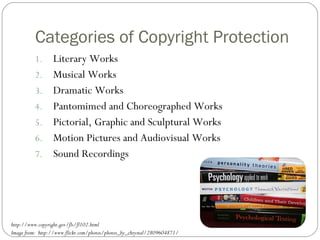
Categories of Copyright Protection Literary Works Musical Works Dramatic Works Pantomimed and Choreographed Works Pictorial, Graphic and Sculptural Works Motion Pictures and Audiovisual Works Sound Recordings http://www.copyright.gov/fls/fl102.html Image from:  http://www.flickr.com/photos/photos_by_chrystal/2809604871/
Can You Use Copyrighted Material? Copyrighted works can be used or copied under a few conditions: Public Domain Permission Legal Exception Fair Use http://www.copyright.gov/fls/fl102.html Image from:  http://www.flickr.com/photos/breakfastcore/269400995/
What is Fair Use? Allows copyrighted works to be used explicitly  for educational purposes Four standards to determine if fair use applies Purpose of Use Nature of Work Proportion/Extent of Material Used Effect on Marketability http://home.earthlink.net/~cnew/research.htm. Image from:  http://www.flickr.com/photos/katrinasagemuller/3751402009/
The TEACH Act The Technology, Education, and Copyright Harmonization Act Signed into law on November 2, 2002 TEACH updated copyright law when referring to the area of digital distance education Allows the use of copyrighted works in digital distance education without having to have prior permission http://www.utsystem.edu/OGC/IntellectualProperty/teachact.htm. Image from:  http://www.flickr.com/photos/31092106@N02/3750223348/
Limitations of TEACH and Fair Use Still necessary to appropriately cite all sources of information Not citing sources is considered to be plagiarism TEACH Act and Fair Use do not allow teachers to us all copyrighted works Ignorance of copyright law is not a defense Many school districts will not defend you if copyright laws are broken
Further Reading Classroom Copyright Chart http://halldavidson.net/chartshort.html The United States Copyright Office http://www.copyright.gov/fls/fl102.html More Information Concerning the TEACH Act http://www.utsystem.edu/OGC/IntellectualProperty/teachact.htm

Copyright in the Classroom

  • 1.
    Amy Smyers WilkesUniversity June 11, 2011 Copyright in the Classroom
  • 2.
    What is Copyright?Exclusive right to make copies, license, and otherwise exploit a literary, musical, or artistic work, whether printed, audio, video, etc. Works must be tangible Works must be creative Image from: http://www.flickr.com/photos/mikeblogs/3020135683/ http://www.education-world.com/a_curr/curr280a.shtml
  • 3.
    Categories of CopyrightProtection Literary Works Musical Works Dramatic Works Pantomimed and Choreographed Works Pictorial, Graphic and Sculptural Works Motion Pictures and Audiovisual Works Sound Recordings http://www.copyright.gov/fls/fl102.html Image from: http://www.flickr.com/photos/photos_by_chrystal/2809604871/
  • 4.
    Can You UseCopyrighted Material? Copyrighted works can be used or copied under a few conditions: Public Domain Permission Legal Exception Fair Use http://www.copyright.gov/fls/fl102.html Image from: http://www.flickr.com/photos/breakfastcore/269400995/
  • 5.
    What is FairUse? Allows copyrighted works to be used explicitly for educational purposes Four standards to determine if fair use applies Purpose of Use Nature of Work Proportion/Extent of Material Used Effect on Marketability http://home.earthlink.net/~cnew/research.htm. Image from: http://www.flickr.com/photos/katrinasagemuller/3751402009/
  • 6.
    The TEACH ActThe Technology, Education, and Copyright Harmonization Act Signed into law on November 2, 2002 TEACH updated copyright law when referring to the area of digital distance education Allows the use of copyrighted works in digital distance education without having to have prior permission http://www.utsystem.edu/OGC/IntellectualProperty/teachact.htm. Image from: http://www.flickr.com/photos/31092106@N02/3750223348/
  • 7.
    Limitations of TEACHand Fair Use Still necessary to appropriately cite all sources of information Not citing sources is considered to be plagiarism TEACH Act and Fair Use do not allow teachers to us all copyrighted works Ignorance of copyright law is not a defense Many school districts will not defend you if copyright laws are broken
  • 8.
    Further Reading ClassroomCopyright Chart http://halldavidson.net/chartshort.html The United States Copyright Office http://www.copyright.gov/fls/fl102.html More Information Concerning the TEACH Act http://www.utsystem.edu/OGC/IntellectualProperty/teachact.htm