Know your Butterflies: Coppers, Lycaeninae
The second largest group of butterflies are the
Lycaenids or the Gossamer-winged butterflies with
more than 4000 species world-wide.
In this group there are the Hairstreaks, Blues and
Coppers which are easily recognizable because of
their distinct wings. The Blues are obviously blue and
beyond that, the observer may be puzzled regarding
the identity of the insect. Hairstreaks are known for
their white streaks that appear on the underwing
which identify them and the Coppers are the
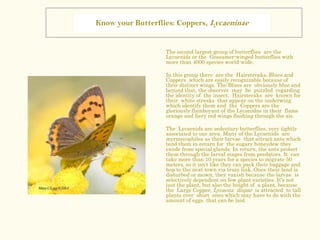
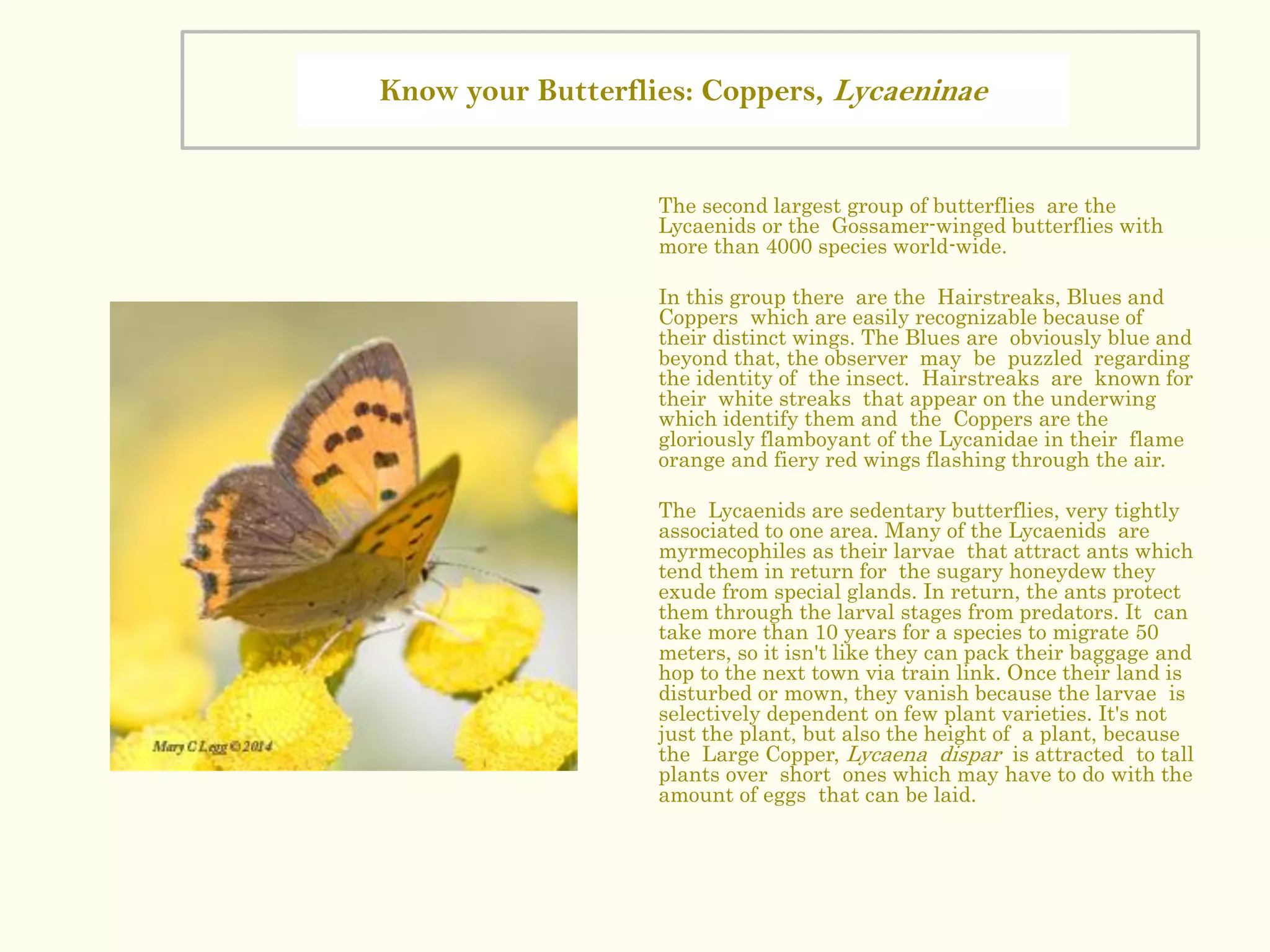
gloriously flamboyant of the Lycanidae in their flame
orange and fiery red wings flashing through the air.
The Lycaenids are sedentary butterflies, very tightly
associated to one area. Many of the Lycaenids are
myrmecophiles as their larvae that attract ants which
tend them in return for the sugary honeydew they
exude from special glands. In return, the ants protect
them through the larval stages from predators. It can
take more than 10 years for a species to migrate 50
meters, so it isn't like they can pack their baggage and
hop to the next town via train link. Once their land is
disturbed or mown, they vanish because the larvae is
selectively dependent on few plant varieties. It's not
just the plant, but also the height of a plant, because
the Large Copper, Lycaena dispar is attracted to tall
plants over short ones which may have to do with the
amount of eggs that can be laid.
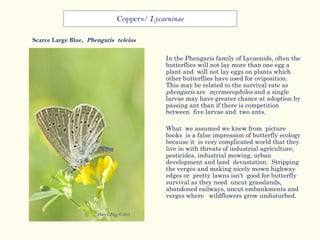
Scarce Large Blue, Phengaris teleius
In the Phengaris family of Lycaenids, often the
butterflies will not lay more than one egg a
plant and will not lay eggs on plants which
other butterflies have used for oviposition.
This may be related to the survival rate as
phengaris are myrmecophiles and a single
larvae may have greater chance at adoption by
passing ant than if there is competition
between five larvae and two ants.
What we assumed we knew from picture
books is a false impression of butterfly ecology
because it is very complicated world that they
live in with threats of industrial agriculture,
pesticides, industrial mowing, urban
development and land devastation. Stripping
the verges and making nicely mown highway
edges or pretty lawns isn't good for butterfly
survival as they need uncut grasslands,
abandoned railways, uncut embankments and
verges where wildflowers grow undisturbed.
Coppers/ Lycaeninae
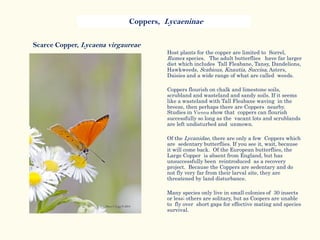
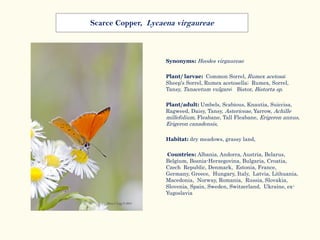
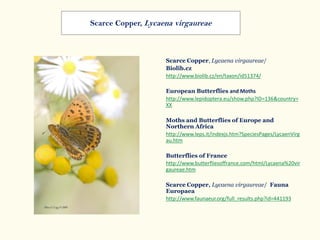
Scarce Copper, Lycaena virgaureae
Host plants for the copper are limited to Sorrel,
Rumex species. The adult butterflies have far larger
diet which includes Tall Fleabane, Tansy, Dandelions,
Hawkweeds, Scabious, Knautia, Succisa, Asters,
Daisies and a wide range of what are called weeds.
Coppers flourish on chalk and limestone soils,
scrubland and wasteland and sandy soils. If it seems
like a wasteland with Tall Fleabane waving in the
breeze, then perhaps there are Coppers nearby.
Studies in Vienna show that coppers can flourish
successfully so long as the vacant lots and scrublands
are left undisturbed and unmown.
Of the Lycanidae, there are only a few Coppers which
are sedentary butterflies. If you see it, wait, because
it will come back. Of the European butterflies, the
Large Copper is absent from England, but has
unsuccessfully been reintroduced as a recovery
project. Because the Coppers are sedentary and do
not fly very far from their larval site, they are
threatened by land disturbance.
Many species only live in small colonies of 30 insects
or less; others are solitary, but as Coopers are unable
to fly over short gaps for effective mating and species
survival.
Coppers, Lycaeninae
Coppers, Lycaeninae
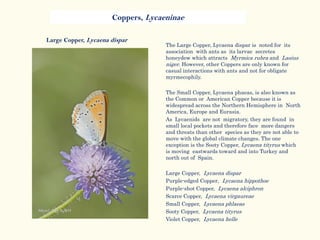
Large Copper, Lycaena dispar
The Large Copper, Lycaena dispar is noted for its
association with ants as its larvae secretes
honeydew which attracts Myrmica rubra and Lasius
niger. However, other Coppers are only known for
casual interactions with ants and not for obligate
myrmecophily.
The Small Copper, Lycaena phaeas, is also known as
the Common or American Copper because it is
widespread across the Northern Hemisphere in North
America, Europe and Eurasia.
As Lycaenids are not migratory, they are found in
small local pockets and therefore face more dangers
and threats than other species as they are not able to
move with the global climate changes. The one
exception is the Sooty Copper, Lycaena tityrus which
is moving eastwards toward and into Turkey and
north out of Spain.
Large Copper, Lycaena dispar
Purple-edged Copper, Lycaena hippothoe
Purple-shot Copper, Lycaena alciphron
Scarce Copper, Lycaena virgaureae
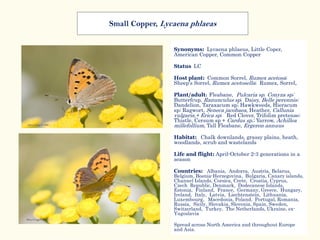
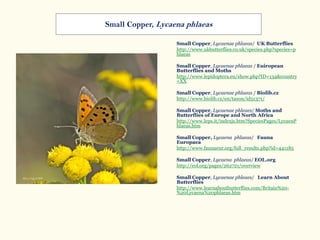
Small Copper, Lycaena phlaeas
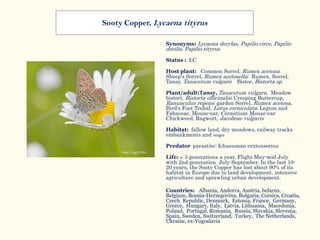
Sooty Copper, Lycaena tityrus
Violet Copper, Lycaena helle
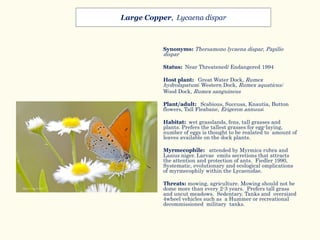
Synonyms: Thersamono lycaena dispar, Papilio
dispar
Status: Near Threatened/ Endangered 1994
Host plant: Great Water Dock, Rumex
hydrolapatum; Western Dock, Rumex aquaticus;
Wood Dock, Rumex sanguineus
Plant/adult: Scabious, Succusa, Knautia, Button
flowers, Tall Fleabane, Erigeron annuus;
Habitat: wet grasslands, fens, tall grasses and
plants. Prefers the tallest grasses for egg-laying,
number of eggs is thought to be realated to amount of
leaves available on the dock plants.
Myrmecophile: attended by Myrmica rubra and
Lasius niger. Larvae emits secretions that attracts
the attention and protection of ants. Fiedler 1990,
Systematic, evolutionary and ecological omplications
of myrmecophily within the Lycaenidae.
Threats: mowing, agriculture. Mowing should not be
dome more than every 2-3 years. Prefers tall grass
and uncut meadows. Sedentary. Tanks and oversized
4wheel vehicles such as a Hummer or recreational
decommissioned military tanks.
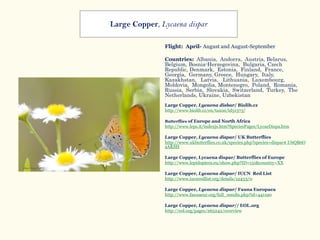
Large Copper, Lycaena dispar
Flight: April- August and August-September
Countries: Albania, Andorra, Austria, Belarus,
Belgium, Bosnia-Herzegovina, Bulgaria, Czech
Republic, Denmark, Estonia, Finland, France,
Georgia, Germany, Greece, Hungary, Italy,
Kazakhstan, Latvia, Lithuania, Luxembourg,
Moldovia, Mongolia, Montenegro, Poland, Romania,
Russia, Serbia, Slovakia, Switzerland, Turkey, The
Netherlands, Ukraine, Uzbekistan
•
Large Copper, Lycaena disbar/ Biolib.cz
http://www.biolib.cz/en/taxon/id51373/
Butterflies of Europe and North Africa
http://www.leps.it/indexjs.htm?SpeciesPages/LycaeDispa.htm
Large Copper, Lycaena dispar/ UK Butterflies
http://www.ukbutterflies.co.uk/species.php?species=dispar#.U6QB6O
aAKSH
Large Copper, Lycaena dispar/ Butterflies of Europe
http://www.lepidoptera.eu/show.php?ID=131&country=XX
Large Copper, Lycaena dispar/ IUCN Red List
http://www.iucnredlist.org/details/12433/0
Large Copper, Lycaena dispar/ Fauna Europaea
http://www.faunaeur.org/full_results.php?id=441190
Large Copper, Lycaena dispar// EOL.org
http://eol.org/pages/265242/overview
Large Copper, Lycaena dispar
Synonyms: Heodes virgaureae
Plant/ larvae: Common Sorrel, Rumex acetosa;
Sheep's Sorrel, Rumex acetosella; Rumex, Sorrel,
Tansy, Tanacetum vulgare; Bistor, Bistorta sp.
Plant/adult: Umbels, Scabious, Knautia, Suiccisa,
Ragweed, Daisy, Tansy, Astericeae, Yarrow, Achille
millefolium, Fleabane, Tall Fleabane, Erigeron annus,
Erigeron canadensis,
Habitat: dry meadows, grassy land,
Countries: Albania, Andorra, Austria, Belarus,
Belgium, Bosnia-Herzegovina, Bulgaria, Croatia,
Czech Republic, Denmark, Estonia, France,
Germany, Greece, Hungary, Italy, Latvia, Lithuania,
Macedonia, Norway, Romania, Russia, Slovakia,
Slovenia, Spain, Sweden, Switzerland, Ukraine, ex-
Yugoslavia
Scarce Copper, Lycaena virgaureae
Scarce Copper, Lycaena virgaureae/
Biolib.cz
http://www.biolib.cz/en/taxon/id51374/
European Butterflies and Moths
http://www.lepidoptera.eu/show.php?ID=136&country=
XX
Moths and Butterflies of Europe and
Northern Africa
http://www.leps.it/indexjs.htm?SpeciesPages/LycaenVirg
au.htm
Butterflies of France
http://www.butterfliesoffrance.com/html/Lycaena%20vir
gaureae.htm
Scarce Copper, Lycaena virgaureae/ Fauna
Europaea
http://www.faunaeur.org/full_results.php?id=441193
Scarce Copper, Lycaena virgaureae
Synonyms: Lycaena phlaeus, Little Coper,
American Copper, Common Copper
Status LC
Host plant: Common Sorrel, Rumex acetosa;
Sheep's Sorrel, Rumex acetosella; Rumex, Sorrel,
Plant/adult: Fleabane, Pulcaria sp. Conyza sp;
Butterfcup, Ranunculus sp; Daisy, Belle perennis;
Dandelion, Taraxacum sp; Hawkweeds, Hieracum
sp; Ragwort, Seneca jacobaea, Heather, Callunia
vulgaris,+ Erica sp; Red Clover, Trifolim pretense;
Thistle, Cersum sp + Cardus sp.; Yarrow, Achillea
millefollium, Tall Fleabane, Ergeron annuus
Habitat: Chalk downlands, grassy plains, heath,
woodlands, scrub and wastelands
Life and flight: April-October 2-3 generations in a
season
Countries: Albania, Andorra, Austria, Belarus,
Belgium, Bosnia-Herzegovina, Bulgaria, Canary islands,
Channel Islands, Corsica, Crete, Croatia, Cyprus,
Czech Republic, Denmark, Dodecanese Islands,
Estonia, Finland, France, Germany, Greece, Hungary,
Ireland, Italy, Latvia, Liechtenstein, Lithuania,
Luxembourg, Macedonia, Poland, Portugal, Romania,
Russia, Sicily, Slovakia, Slovenia, Spain, Sweden,
Switzerland, Turkey, The Netherlands, Ukraine, ex-
Yugoslavia
Spread across North America and throughout Europe
and Asia.
Small Copper, Lycaena phlaeas
Small Copper, Lycaenae phlaeas/ UK Butterflies
http://www.ukbutterflies.co.uk/species.php?species=p
hlaeas
Small Copper, Lycaenae phlaeas / Euiropean
Butterflies and Moths
http://www.lepidoptera.eu/show.php?ID=134&country
=XX
Small Copper, Lycaenae phlaeas / Biolib.cz
http://www.biolib.cz/en/taxon/id51371/
Small Copper, Lycaenae phleaes/ Moths and
Butterflies of Europe and North Africa
http://www.leps.it/indexjs.htm?SpeciesPages/LycaenP
hlaeas.htm
Small Copper, Lycaena phlaeas/ Fauna
Europaea
http://www.faunaeur.org/full_results.php?id=441185
Small Copper, Lycaena phlaeas/ EOL.org
http://eol.org/pages/262721/overview
Small Copper, Lycaenae phleaes/ Learn About
Butterflies
http://www.learnaboutbutterflies.com/Britain%20-
%20Lycaena%20phlaeas.htm
Small Copper, Lycaena phlaeas
Synonyms: Lycaena dorylas, Papilio circe, Papilio
dorilis, Papilio tityrus
Status : LC
Host plant: Common Sorrel, Rumex acetosa;
Sheep's Sorrel, Rumex acetosella; Rumex, Sorrel,
Tansy, Tanacetum vulgare; Bistor, Bistorta sp.
Plant/adult:Tansy, Tanacetum vulgare, Meadow
bistort, Bistorta officinalis; Creeping Buttercup,
Ranunculus repens; garden Sorrel, Rumex acetosa,
Bird's Foot Trefoil, Lotus corniculata; Legum and
Fabaceae, Mouse-ear, Cerastium; Mouse-ear
Chickweed, Ragwort, Jacobeae vulgaris
Habitat: fallow land, dry meadows, railway tracks
embankments and verges
Predator parastite: Ichneuman erxtensorius
Life: 2- 3 generations a year. Flight May-mid July
with 2nd generation July-September. In the last 10-
20 years, the Sooty Copper has lost about 90% of its
habitat in Europe due to land development, intensive
agriculture and sprawling urban development.
Countries: Albania, Andorra, Austria, belarus,
Belgium, Bosnia-Herzegovina, Bulgaria, Corsica, Croatia,
Czech Republic, Denmark, Estonia, France, Germany,
Greece, Hungary, Italy, Latvia, Lithuania, Macedonia,
Poland, Portugal, Romania, Russia, Slovakia, Slovenia,
Spain, Sweden, Switzerland, Turkey, The Netherlands,
Ukraine, ex-Yugoslavia
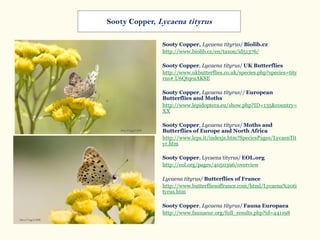
Sooty Copper, Lycaena tityrus
Sooty Copper, Lycaena tityrus/ Biolib.cz
http://www.biolib.cz/en/taxon/id51376/
Sooty Copper, Lycaena tityrus/ UK Butterflies
http://www.ukbutterflies.co.uk/species.php?species=tity
rus#.U6QtqeaAKSE
Sooty Copper, Lycaena tityrus// European
Butterflies and Moths
http://www.lepidoptera.eu/show.php?ID=135&country=
XX
Sooty Copper, Lycaena tityrus/ Moths and
Butterflies of Europe and North Africa
http://www.leps.it/indexjs.htm?SpeciesPages/LycaenTit
yr.htm
Sooty Copper, Lycaena tityrus/ EOL.org
http://eol.org/pages/4050396/overview
Lycaena tityrus/ Butterflies of France
http://www.butterfliesoffrance.com/html/Lycaena%20ti
tyrus.htm
Sooty Copper, Lycaena tityrus/ Fauna Europaea
http://www.faunaeur.org/full_results.php?id=441198
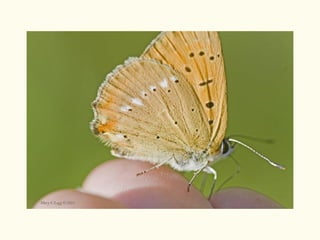
Sooty Copper, Lycaena tityrus
Know Your Butterflies: Coppers, Lycaeninae

Know Your Butterflies: Coppers, Lycaeninae

  • 1.
    Know your Butterflies:Coppers, Lycaeninae The second largest group of butterflies are the Lycaenids or the Gossamer-winged butterflies with more than 4000 species world-wide. In this group there are the Hairstreaks, Blues and Coppers which are easily recognizable because of their distinct wings. The Blues are obviously blue and beyond that, the observer may be puzzled regarding the identity of the insect. Hairstreaks are known for their white streaks that appear on the underwing which identify them and the Coppers are the gloriously flamboyant of the Lycanidae in their flame orange and fiery red wings flashing through the air. The Lycaenids are sedentary butterflies, very tightly associated to one area. Many of the Lycaenids are myrmecophiles as their larvae that attract ants which tend them in return for the sugary honeydew they exude from special glands. In return, the ants protect them through the larval stages from predators. It can take more than 10 years for a species to migrate 50 meters, so it isn't like they can pack their baggage and hop to the next town via train link. Once their land is disturbed or mown, they vanish because the larvae is selectively dependent on few plant varieties. It's not just the plant, but also the height of a plant, because the Large Copper, Lycaena dispar is attracted to tall plants over short ones which may have to do with the amount of eggs that can be laid.
  • 2.
    Scarce Large Blue,Phengaris teleius In the Phengaris family of Lycaenids, often the butterflies will not lay more than one egg a plant and will not lay eggs on plants which other butterflies have used for oviposition. This may be related to the survival rate as phengaris are myrmecophiles and a single larvae may have greater chance at adoption by passing ant than if there is competition between five larvae and two ants. What we assumed we knew from picture books is a false impression of butterfly ecology because it is very complicated world that they live in with threats of industrial agriculture, pesticides, industrial mowing, urban development and land devastation. Stripping the verges and making nicely mown highway edges or pretty lawns isn't good for butterfly survival as they need uncut grasslands, abandoned railways, uncut embankments and verges where wildflowers grow undisturbed. Coppers/ Lycaeninae
  • 3.
    Scarce Copper, Lycaenavirgaureae Host plants for the copper are limited to Sorrel, Rumex species. The adult butterflies have far larger diet which includes Tall Fleabane, Tansy, Dandelions, Hawkweeds, Scabious, Knautia, Succisa, Asters, Daisies and a wide range of what are called weeds. Coppers flourish on chalk and limestone soils, scrubland and wasteland and sandy soils. If it seems like a wasteland with Tall Fleabane waving in the breeze, then perhaps there are Coppers nearby. Studies in Vienna show that coppers can flourish successfully so long as the vacant lots and scrublands are left undisturbed and unmown. Of the Lycanidae, there are only a few Coppers which are sedentary butterflies. If you see it, wait, because it will come back. Of the European butterflies, the Large Copper is absent from England, but has unsuccessfully been reintroduced as a recovery project. Because the Coppers are sedentary and do not fly very far from their larval site, they are threatened by land disturbance. Many species only live in small colonies of 30 insects or less; others are solitary, but as Coopers are unable to fly over short gaps for effective mating and species survival. Coppers, Lycaeninae
  • 4.
    Coppers, Lycaeninae Large Copper,Lycaena dispar The Large Copper, Lycaena dispar is noted for its association with ants as its larvae secretes honeydew which attracts Myrmica rubra and Lasius niger. However, other Coppers are only known for casual interactions with ants and not for obligate myrmecophily. The Small Copper, Lycaena phaeas, is also known as the Common or American Copper because it is widespread across the Northern Hemisphere in North America, Europe and Eurasia. As Lycaenids are not migratory, they are found in small local pockets and therefore face more dangers and threats than other species as they are not able to move with the global climate changes. The one exception is the Sooty Copper, Lycaena tityrus which is moving eastwards toward and into Turkey and north out of Spain. Large Copper, Lycaena dispar Purple-edged Copper, Lycaena hippothoe Purple-shot Copper, Lycaena alciphron Scarce Copper, Lycaena virgaureae Small Copper, Lycaena phlaeas Sooty Copper, Lycaena tityrus Violet Copper, Lycaena helle
  • 5.
    Synonyms: Thersamono lycaenadispar, Papilio dispar Status: Near Threatened/ Endangered 1994 Host plant: Great Water Dock, Rumex hydrolapatum; Western Dock, Rumex aquaticus; Wood Dock, Rumex sanguineus Plant/adult: Scabious, Succusa, Knautia, Button flowers, Tall Fleabane, Erigeron annuus; Habitat: wet grasslands, fens, tall grasses and plants. Prefers the tallest grasses for egg-laying, number of eggs is thought to be realated to amount of leaves available on the dock plants. Myrmecophile: attended by Myrmica rubra and Lasius niger. Larvae emits secretions that attracts the attention and protection of ants. Fiedler 1990, Systematic, evolutionary and ecological omplications of myrmecophily within the Lycaenidae. Threats: mowing, agriculture. Mowing should not be dome more than every 2-3 years. Prefers tall grass and uncut meadows. Sedentary. Tanks and oversized 4wheel vehicles such as a Hummer or recreational decommissioned military tanks. Large Copper, Lycaena dispar
  • 6.
    Flight: April- Augustand August-September Countries: Albania, Andorra, Austria, Belarus, Belgium, Bosnia-Herzegovina, Bulgaria, Czech Republic, Denmark, Estonia, Finland, France, Georgia, Germany, Greece, Hungary, Italy, Kazakhstan, Latvia, Lithuania, Luxembourg, Moldovia, Mongolia, Montenegro, Poland, Romania, Russia, Serbia, Slovakia, Switzerland, Turkey, The Netherlands, Ukraine, Uzbekistan • Large Copper, Lycaena disbar/ Biolib.cz http://www.biolib.cz/en/taxon/id51373/ Butterflies of Europe and North Africa http://www.leps.it/indexjs.htm?SpeciesPages/LycaeDispa.htm Large Copper, Lycaena dispar/ UK Butterflies http://www.ukbutterflies.co.uk/species.php?species=dispar#.U6QB6O aAKSH Large Copper, Lycaena dispar/ Butterflies of Europe http://www.lepidoptera.eu/show.php?ID=131&country=XX Large Copper, Lycaena dispar/ IUCN Red List http://www.iucnredlist.org/details/12433/0 Large Copper, Lycaena dispar/ Fauna Europaea http://www.faunaeur.org/full_results.php?id=441190 Large Copper, Lycaena dispar// EOL.org http://eol.org/pages/265242/overview Large Copper, Lycaena dispar
  • 7.
    Synonyms: Heodes virgaureae Plant/larvae: Common Sorrel, Rumex acetosa; Sheep's Sorrel, Rumex acetosella; Rumex, Sorrel, Tansy, Tanacetum vulgare; Bistor, Bistorta sp. Plant/adult: Umbels, Scabious, Knautia, Suiccisa, Ragweed, Daisy, Tansy, Astericeae, Yarrow, Achille millefolium, Fleabane, Tall Fleabane, Erigeron annus, Erigeron canadensis, Habitat: dry meadows, grassy land, Countries: Albania, Andorra, Austria, Belarus, Belgium, Bosnia-Herzegovina, Bulgaria, Croatia, Czech Republic, Denmark, Estonia, France, Germany, Greece, Hungary, Italy, Latvia, Lithuania, Macedonia, Norway, Romania, Russia, Slovakia, Slovenia, Spain, Sweden, Switzerland, Ukraine, ex- Yugoslavia Scarce Copper, Lycaena virgaureae
  • 8.
    Scarce Copper, Lycaenavirgaureae/ Biolib.cz http://www.biolib.cz/en/taxon/id51374/ European Butterflies and Moths http://www.lepidoptera.eu/show.php?ID=136&country= XX Moths and Butterflies of Europe and Northern Africa http://www.leps.it/indexjs.htm?SpeciesPages/LycaenVirg au.htm Butterflies of France http://www.butterfliesoffrance.com/html/Lycaena%20vir gaureae.htm Scarce Copper, Lycaena virgaureae/ Fauna Europaea http://www.faunaeur.org/full_results.php?id=441193 Scarce Copper, Lycaena virgaureae
  • 9.
    Synonyms: Lycaena phlaeus,Little Coper, American Copper, Common Copper Status LC Host plant: Common Sorrel, Rumex acetosa; Sheep's Sorrel, Rumex acetosella; Rumex, Sorrel, Plant/adult: Fleabane, Pulcaria sp. Conyza sp; Butterfcup, Ranunculus sp; Daisy, Belle perennis; Dandelion, Taraxacum sp; Hawkweeds, Hieracum sp; Ragwort, Seneca jacobaea, Heather, Callunia vulgaris,+ Erica sp; Red Clover, Trifolim pretense; Thistle, Cersum sp + Cardus sp.; Yarrow, Achillea millefollium, Tall Fleabane, Ergeron annuus Habitat: Chalk downlands, grassy plains, heath, woodlands, scrub and wastelands Life and flight: April-October 2-3 generations in a season Countries: Albania, Andorra, Austria, Belarus, Belgium, Bosnia-Herzegovina, Bulgaria, Canary islands, Channel Islands, Corsica, Crete, Croatia, Cyprus, Czech Republic, Denmark, Dodecanese Islands, Estonia, Finland, France, Germany, Greece, Hungary, Ireland, Italy, Latvia, Liechtenstein, Lithuania, Luxembourg, Macedonia, Poland, Portugal, Romania, Russia, Sicily, Slovakia, Slovenia, Spain, Sweden, Switzerland, Turkey, The Netherlands, Ukraine, ex- Yugoslavia Spread across North America and throughout Europe and Asia. Small Copper, Lycaena phlaeas
  • 10.
    Small Copper, Lycaenaephlaeas/ UK Butterflies http://www.ukbutterflies.co.uk/species.php?species=p hlaeas Small Copper, Lycaenae phlaeas / Euiropean Butterflies and Moths http://www.lepidoptera.eu/show.php?ID=134&country =XX Small Copper, Lycaenae phlaeas / Biolib.cz http://www.biolib.cz/en/taxon/id51371/ Small Copper, Lycaenae phleaes/ Moths and Butterflies of Europe and North Africa http://www.leps.it/indexjs.htm?SpeciesPages/LycaenP hlaeas.htm Small Copper, Lycaena phlaeas/ Fauna Europaea http://www.faunaeur.org/full_results.php?id=441185 Small Copper, Lycaena phlaeas/ EOL.org http://eol.org/pages/262721/overview Small Copper, Lycaenae phleaes/ Learn About Butterflies http://www.learnaboutbutterflies.com/Britain%20- %20Lycaena%20phlaeas.htm Small Copper, Lycaena phlaeas
  • 11.
    Synonyms: Lycaena dorylas,Papilio circe, Papilio dorilis, Papilio tityrus Status : LC Host plant: Common Sorrel, Rumex acetosa; Sheep's Sorrel, Rumex acetosella; Rumex, Sorrel, Tansy, Tanacetum vulgare; Bistor, Bistorta sp. Plant/adult:Tansy, Tanacetum vulgare, Meadow bistort, Bistorta officinalis; Creeping Buttercup, Ranunculus repens; garden Sorrel, Rumex acetosa, Bird's Foot Trefoil, Lotus corniculata; Legum and Fabaceae, Mouse-ear, Cerastium; Mouse-ear Chickweed, Ragwort, Jacobeae vulgaris Habitat: fallow land, dry meadows, railway tracks embankments and verges Predator parastite: Ichneuman erxtensorius Life: 2- 3 generations a year. Flight May-mid July with 2nd generation July-September. In the last 10- 20 years, the Sooty Copper has lost about 90% of its habitat in Europe due to land development, intensive agriculture and sprawling urban development. Countries: Albania, Andorra, Austria, belarus, Belgium, Bosnia-Herzegovina, Bulgaria, Corsica, Croatia, Czech Republic, Denmark, Estonia, France, Germany, Greece, Hungary, Italy, Latvia, Lithuania, Macedonia, Poland, Portugal, Romania, Russia, Slovakia, Slovenia, Spain, Sweden, Switzerland, Turkey, The Netherlands, Ukraine, ex-Yugoslavia Sooty Copper, Lycaena tityrus
  • 12.
    Sooty Copper, Lycaenatityrus/ Biolib.cz http://www.biolib.cz/en/taxon/id51376/ Sooty Copper, Lycaena tityrus/ UK Butterflies http://www.ukbutterflies.co.uk/species.php?species=tity rus#.U6QtqeaAKSE Sooty Copper, Lycaena tityrus// European Butterflies and Moths http://www.lepidoptera.eu/show.php?ID=135&country= XX Sooty Copper, Lycaena tityrus/ Moths and Butterflies of Europe and North Africa http://www.leps.it/indexjs.htm?SpeciesPages/LycaenTit yr.htm Sooty Copper, Lycaena tityrus/ EOL.org http://eol.org/pages/4050396/overview Lycaena tityrus/ Butterflies of France http://www.butterfliesoffrance.com/html/Lycaena%20ti tyrus.htm Sooty Copper, Lycaena tityrus/ Fauna Europaea http://www.faunaeur.org/full_results.php?id=441198 Sooty Copper, Lycaena tityrus