Coordination-aware Elasticity 
Stefano Mariani1, Hong-Linh Truong2, Georgiana Copil2, Andrea Omicini1, 
Schahram Dustdar2 
1DISI, Alma Mater Studiorum, Università di Bologna 
2Distributed Systems Group, Vienna University of Technology 
truong@dsg.tuwien.ac.at 
http://dsg.tuwien.ac.at/research/viecom 
7th IEEE/ACM International Conference on Utility and Cloud Computing (UCC 2014) 
11 Dec 2014, London 
1
Outline 
 Motivation 
 Coordination-aware elasticity approach 
 Integrating elasticity and coordination 
 Prototype and examples 
 Conclusions and future work 
UCC 2014, 11 Dec 2014, London 2
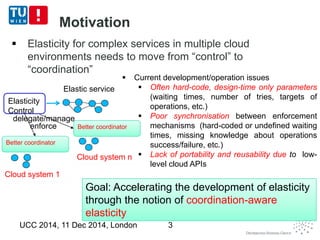
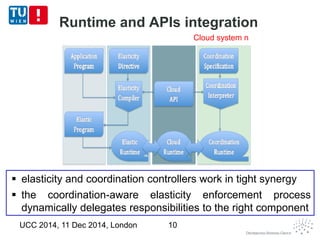
Cloud system n 
Motivation 
 Elasticity for complex services in multiple cloud 
environments needs to move from “control” to 
“coordination” 
UCC 2014, 11 Dec 2014, London 3 
Cloud system 1 
Better coordinator 
Elasticity 
Control 
Goal: Accelerating the development of elasticity 
through the notion of coordination-aware 
elasticity 
 Current development/operation issues 
 Often hard-code, design-time only parameters 
(waiting times, number of tries, targets of 
operations, etc.) 
 Poor synchronisation between enforcement 
mechanisms (hard-coded or undefined waiting 
times, missing knowledge about operations 
success/failure, etc.) 
 Lack of portability and reusability due to low-level 
cloud APIs 
Elastic service 
enforce Better coordinator 
delegate/manage
Coordination-aware Elasticity 
approach 
 We need better ways to support flexibility, safety and 
encapsulation, and separation and delegation of 
concerns 
 the new way to develop elasticity and coordination interactions in 
clouds 
 Elasticity programming directives 
 delegate elasticity actions to infrastructures and separate 
elasticity control from application logic 
 Coordination laws 
 delegation of interaction management to middleware and 
separation of interactive behaviour from computational one 
UCC 2014, 11 Dec 2014, London 4
Coordination-aware Elasticity 
approach 
 Separate concerns between elasticity and coordination 
 Each cloud system has its own coordination models 
 Elasticity exploits coordination features 
 Both deal with managing run-time dependencies in their own 
scopes 
 Benefits 
 Support run-time delegation and separation of concerns 
 Guarantee safety of interactions between elasticity controllers 
and cloud components/services/plugins 
 Improve availability of elasticity controllers, by delegating 
coordination-related computations 
 Ease development process, by enabling and supporting 
separation of duties and responsibilities 
UCC 2014, 11 Dec 2014, London 5
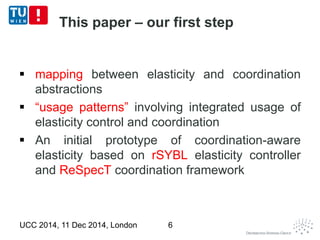
This paper – our first step 
 mapping between elasticity and coordination 
abstractions 
 “usage patterns” involving integrated usage of 
elasticity control and coordination 
 An initial prototype of coordination-aware 
elasticity based on rSYBL elasticity controller 
and ReSpecT coordination framework 
UCC 2014, 11 Dec 2014, London 6
Integrating concepts 
UCC 2014, 11 Dec 2014, London 7 
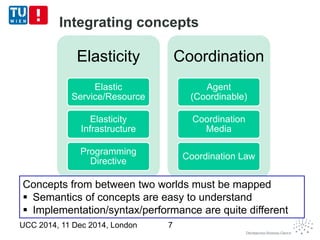
Elasticity 
Elastic 
Service/Resource 
Elasticity 
Infrastructure 
Programming 
Directive 
Coordination 
Agent 
(Coordinable) 
Coordination 
Media 
Coordination Law 
Concepts from between two worlds must be mapped 
 Semantics of concepts are easy to understand 
 Implementation/syntax/performance are quite different
Integrating concepts 
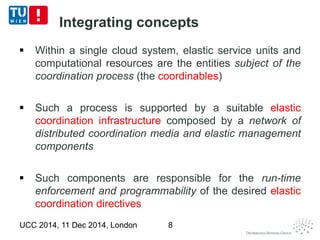
 Within a single cloud system, elastic service units and 
computational resources are the entities subject of the 
coordination process (the coordinables) 
 Such a process is supported by a suitable elastic 
coordination infrastructure composed by a network of 
distributed coordination media and elastic management 
components 
 Such components are responsible for the run-time 
enforcement and programmability of the desired elastic 
coordination directives 
UCC 2014, 11 Dec 2014, London 8
Integrating languages 
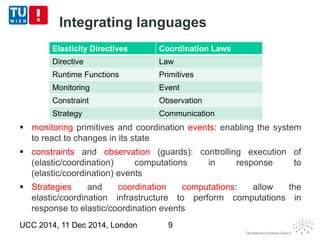
 monitoring primitives and coordination events: enabling the system 
to react to changes in its state 
 constraints and observation (guards): controlling execution of 
(elastic/coordination) computations in response to 
(elastic/coordination) events 
 Strategies and coordination computations: allow the 
elastic/coordination infrastructure to perform computations in 
response to elastic/coordination events 
UCC 2014, 11 Dec 2014, London 9 
Elasticity Directives Coordination Laws 
Directive Law 
Runtime Functions Primitives 
Monitoring Event 
Constraint Observation 
Strategy Communication
Cloud system n 
Runtime and APIs integration 
UCC 2014, 11 Dec 2014, London 10 
 elasticity and coordination controllers work in tight synergy 
 the coordination-aware elasticity enforcement process 
dynamically delegates responsibilities to the right component
Prototype and examples 
 Prototype 
 SYBL language and runtime (rSYBL) - for elasticity 
 the ReSpecT language and runtime (TuCSoN) — for 
coordination 
 TuCSoN is used for coordinating resources in a 
single cloud system 
 rSYBL is used to control elasticity across systems 
 GITs 
 https://github.com/tuwiendsg/rSYBL 
 https://github.com/tuwiendsg/rSYBL/tree/coordination 
UCC 2014, 11 Dec 2014, London 11
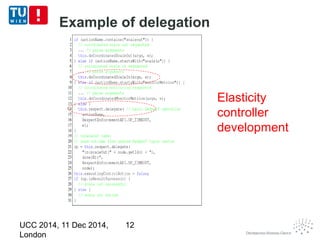
Example of delegation 
UCC 2014, 11 Dec 2014, 
London 
12 
Elasticity 
controller 
development
Run-time benefits 
UCC 2014, 11 Dec 2014, London 13 
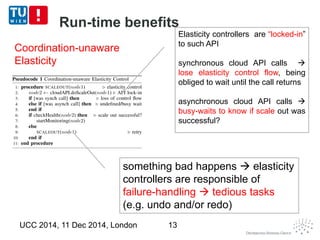
Elasticity controllers are “locked-in” 
to such API 
synchronous cloud API calls  
lose elasticity control flow, being 
obliged to wait until the call returns 
asynchronous cloud API calls  
busy-waits to know if scale out was 
successful? 
something bad happens  elasticity 
controllers are responsible of 
failure-handling  tedious tasks 
(e.g. undo and/or redo) 
Coordination-unaware 
Elasticity
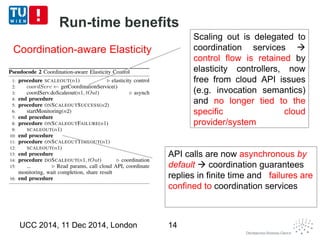
Run-time benefits 
UCC 2014, 11 Dec 2014, London 14 
Scaling out is delegated to 
coordination services  
control flow is retained by 
elasticity controllers, now 
free from cloud API issues 
(e.g. invocation semantics) 
and no longer tied to the 
specific cloud 
provider/system 
API calls are now asynchronous by 
default  coordination guarantees 
replies in finite time and failures are 
confined to coordination services 
Coordination-aware Elasticity
Conclusions and future work 
 A new approach: coordination-aware elasticity 
 Programming and engineering elasticity across multiple clouds 
need better software engineering techniques 
 Elasticity languages and runtimes should leverage coordination 
capabilities of underlying cloud systems to deal with complex 
elasticity scenarios  delegation and separation of concerns 
 However, it is just an early stage with simple 
coordination models 
 Cloud systems would have complex coordination 
models/languages for their services/resources 
 Future work 
 Real-world coordination models for single cloud systems 
 Elasticity-coordination interaction protocols 
UCC 2014, 11 Dec 2014, London 15
Thanks for your attention! 
Hong-Linh Truong 
Distributed Systems Group 
TU Wien 
truong@dsg.tuwien.ac.at 
dsg.tuwien.ac.at/research/viecom 
UCC 2014, 11 Dec 2014, London 16

Coordination-aware Elasticity

  • 1.
    Coordination-aware Elasticity StefanoMariani1, Hong-Linh Truong2, Georgiana Copil2, Andrea Omicini1, Schahram Dustdar2 1DISI, Alma Mater Studiorum, Università di Bologna 2Distributed Systems Group, Vienna University of Technology truong@dsg.tuwien.ac.at http://dsg.tuwien.ac.at/research/viecom 7th IEEE/ACM International Conference on Utility and Cloud Computing (UCC 2014) 11 Dec 2014, London 1
  • 2.
    Outline  Motivation  Coordination-aware elasticity approach  Integrating elasticity and coordination  Prototype and examples  Conclusions and future work UCC 2014, 11 Dec 2014, London 2
  • 3.
    Cloud system n Motivation  Elasticity for complex services in multiple cloud environments needs to move from “control” to “coordination” UCC 2014, 11 Dec 2014, London 3 Cloud system 1 Better coordinator Elasticity Control Goal: Accelerating the development of elasticity through the notion of coordination-aware elasticity  Current development/operation issues  Often hard-code, design-time only parameters (waiting times, number of tries, targets of operations, etc.)  Poor synchronisation between enforcement mechanisms (hard-coded or undefined waiting times, missing knowledge about operations success/failure, etc.)  Lack of portability and reusability due to low-level cloud APIs Elastic service enforce Better coordinator delegate/manage
  • 4.
    Coordination-aware Elasticity approach  We need better ways to support flexibility, safety and encapsulation, and separation and delegation of concerns  the new way to develop elasticity and coordination interactions in clouds  Elasticity programming directives  delegate elasticity actions to infrastructures and separate elasticity control from application logic  Coordination laws  delegation of interaction management to middleware and separation of interactive behaviour from computational one UCC 2014, 11 Dec 2014, London 4
  • 5.
    Coordination-aware Elasticity approach  Separate concerns between elasticity and coordination  Each cloud system has its own coordination models  Elasticity exploits coordination features  Both deal with managing run-time dependencies in their own scopes  Benefits  Support run-time delegation and separation of concerns  Guarantee safety of interactions between elasticity controllers and cloud components/services/plugins  Improve availability of elasticity controllers, by delegating coordination-related computations  Ease development process, by enabling and supporting separation of duties and responsibilities UCC 2014, 11 Dec 2014, London 5
  • 6.
    This paper –our first step  mapping between elasticity and coordination abstractions  “usage patterns” involving integrated usage of elasticity control and coordination  An initial prototype of coordination-aware elasticity based on rSYBL elasticity controller and ReSpecT coordination framework UCC 2014, 11 Dec 2014, London 6
  • 7.
    Integrating concepts UCC2014, 11 Dec 2014, London 7 Elasticity Elastic Service/Resource Elasticity Infrastructure Programming Directive Coordination Agent (Coordinable) Coordination Media Coordination Law Concepts from between two worlds must be mapped  Semantics of concepts are easy to understand  Implementation/syntax/performance are quite different
  • 8.
    Integrating concepts Within a single cloud system, elastic service units and computational resources are the entities subject of the coordination process (the coordinables)  Such a process is supported by a suitable elastic coordination infrastructure composed by a network of distributed coordination media and elastic management components  Such components are responsible for the run-time enforcement and programmability of the desired elastic coordination directives UCC 2014, 11 Dec 2014, London 8
  • 9.
    Integrating languages monitoring primitives and coordination events: enabling the system to react to changes in its state  constraints and observation (guards): controlling execution of (elastic/coordination) computations in response to (elastic/coordination) events  Strategies and coordination computations: allow the elastic/coordination infrastructure to perform computations in response to elastic/coordination events UCC 2014, 11 Dec 2014, London 9 Elasticity Directives Coordination Laws Directive Law Runtime Functions Primitives Monitoring Event Constraint Observation Strategy Communication
  • 10.
    Cloud system n Runtime and APIs integration UCC 2014, 11 Dec 2014, London 10  elasticity and coordination controllers work in tight synergy  the coordination-aware elasticity enforcement process dynamically delegates responsibilities to the right component
  • 11.
    Prototype and examples  Prototype  SYBL language and runtime (rSYBL) - for elasticity  the ReSpecT language and runtime (TuCSoN) — for coordination  TuCSoN is used for coordinating resources in a single cloud system  rSYBL is used to control elasticity across systems  GITs  https://github.com/tuwiendsg/rSYBL  https://github.com/tuwiendsg/rSYBL/tree/coordination UCC 2014, 11 Dec 2014, London 11
  • 12.
    Example of delegation UCC 2014, 11 Dec 2014, London 12 Elasticity controller development
  • 13.
    Run-time benefits UCC2014, 11 Dec 2014, London 13 Elasticity controllers are “locked-in” to such API synchronous cloud API calls  lose elasticity control flow, being obliged to wait until the call returns asynchronous cloud API calls  busy-waits to know if scale out was successful? something bad happens  elasticity controllers are responsible of failure-handling  tedious tasks (e.g. undo and/or redo) Coordination-unaware Elasticity
  • 14.
    Run-time benefits UCC2014, 11 Dec 2014, London 14 Scaling out is delegated to coordination services  control flow is retained by elasticity controllers, now free from cloud API issues (e.g. invocation semantics) and no longer tied to the specific cloud provider/system API calls are now asynchronous by default  coordination guarantees replies in finite time and failures are confined to coordination services Coordination-aware Elasticity
  • 15.
    Conclusions and futurework  A new approach: coordination-aware elasticity  Programming and engineering elasticity across multiple clouds need better software engineering techniques  Elasticity languages and runtimes should leverage coordination capabilities of underlying cloud systems to deal with complex elasticity scenarios  delegation and separation of concerns  However, it is just an early stage with simple coordination models  Cloud systems would have complex coordination models/languages for their services/resources  Future work  Real-world coordination models for single cloud systems  Elasticity-coordination interaction protocols UCC 2014, 11 Dec 2014, London 15
  • 16.
    Thanks for yourattention! Hong-Linh Truong Distributed Systems Group TU Wien truong@dsg.tuwien.ac.at dsg.tuwien.ac.at/research/viecom UCC 2014, 11 Dec 2014, London 16