What was our
previous lesson?
Very good! We had
talked about the
Methods of Cooking.
1. What are the two
methods of cooking?
2. How do the two differs?
3. What is Maillard
Reaction?
I AM THE EXPLORER
Instructions:
The students will guess the missing
letters based on the picture shown on
the monitor to complete the given
words.
C _ _ K I _ G
COOKING
G _ I _ L I _ G
GRILLING
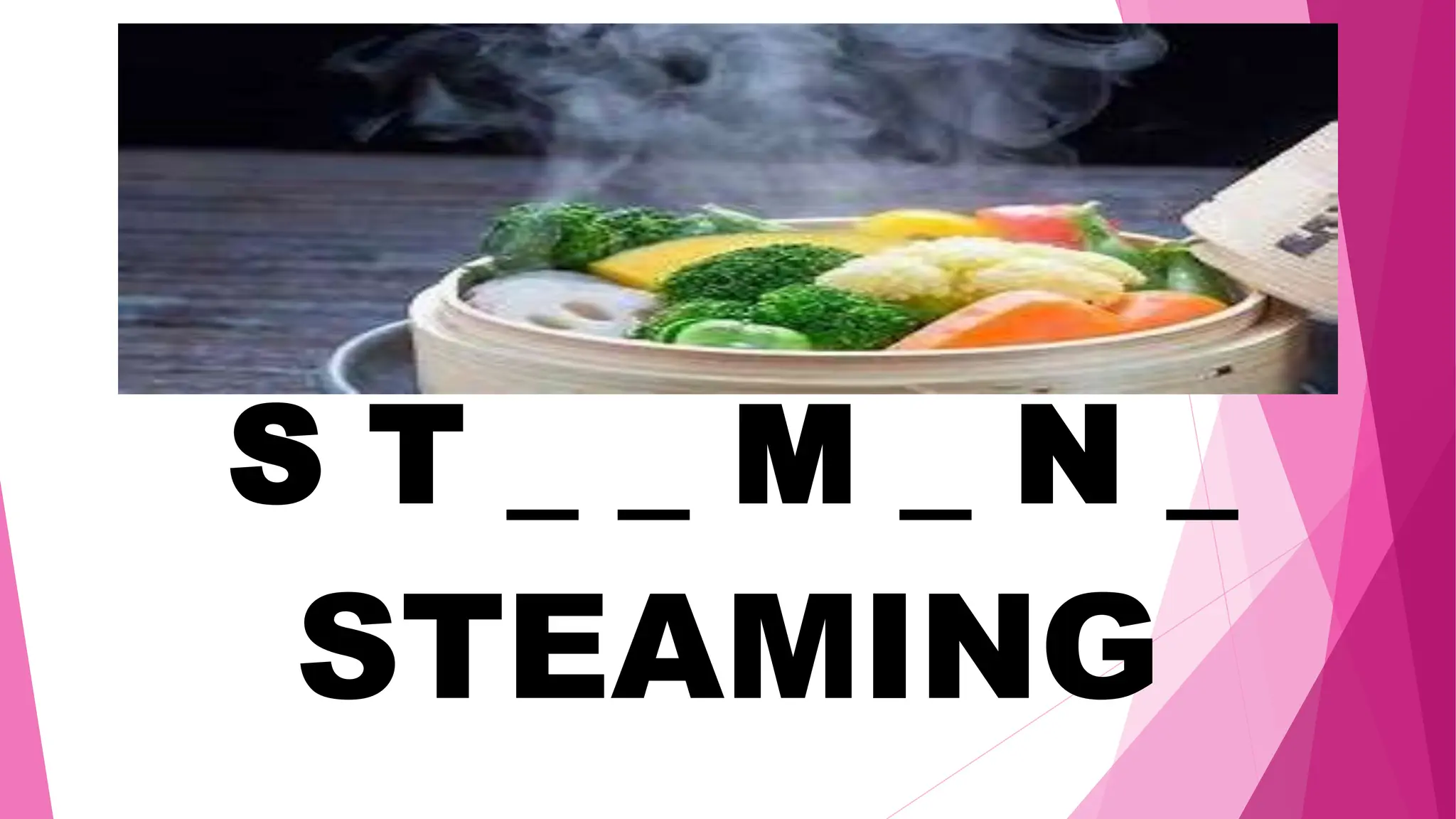
STEAMING
S T _ _ M _ N _
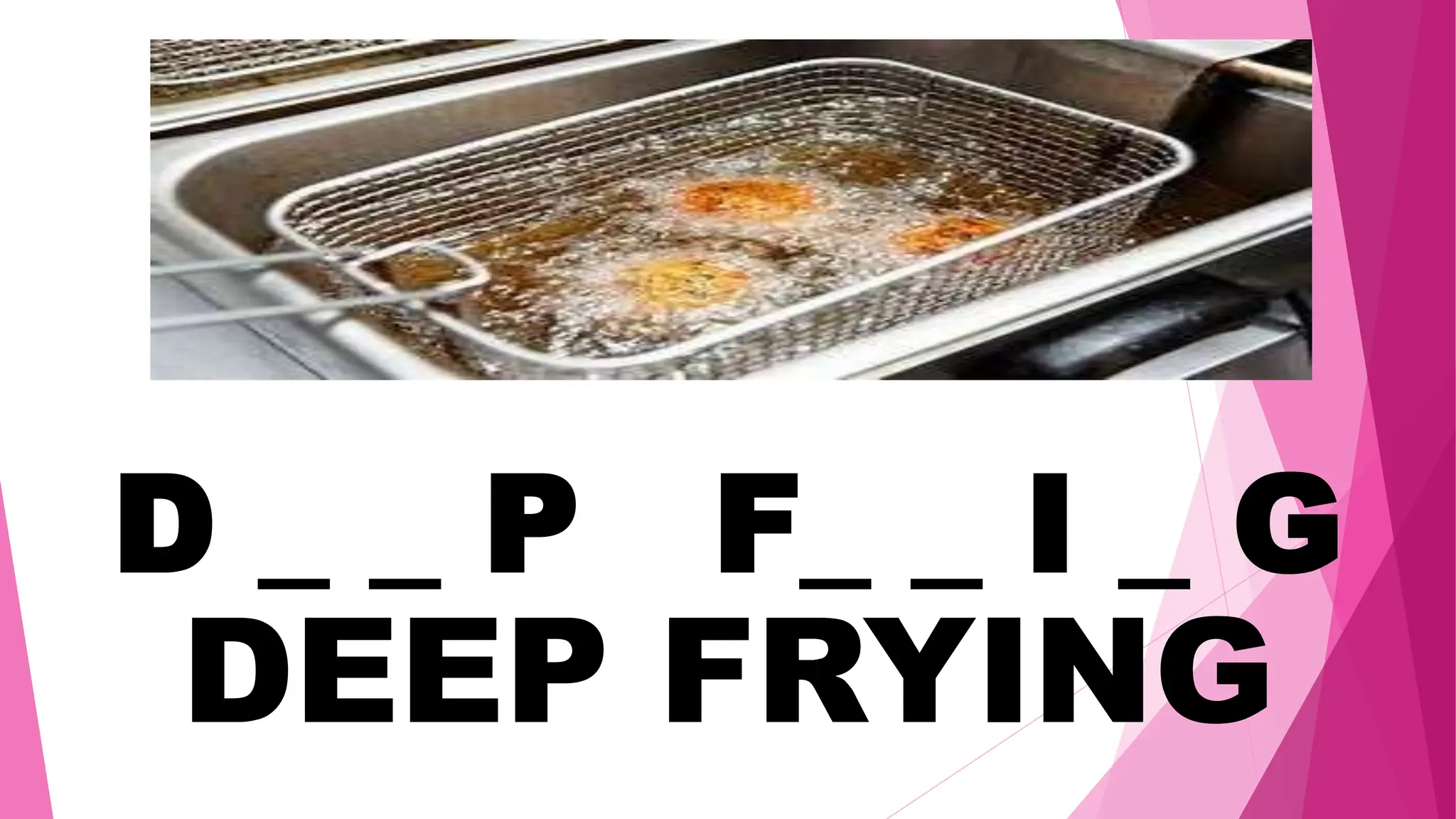
D _ _ P F_ _ I _ G
DEEP FRYING
P_ A C _ I _G
POACHING
WHAT EXACTLY AM I?
Instructions;
In this activity, you will be divided into four
groups. You will guess the methods of
cooking through context clues. The activity
is good for 5 minutes.
1. I am a cooking method that uses dry
heat to prepare food, typically in an oven,
but it can also be done in hot ashes or on
hot stones....... WHAT EXACTLY AM I?
2. I am a cooking method that uses
a very hot pan and a small amount
of fat to cook the food quickly........
WHAT EXACTLY AM I?
3. I am a cooking method that uses
hot steam to conduct heat to the
food...... WHAT EXACTLY AM I?
4. I am a cooking method in which the
item to be cooked is partially covered
with liquid and then slowly simmered
at a low temperature........ WHAT
EXACTLY AM I?
5. I am a method of cooking that
uses radiant heat from above to
cook the food, similar to upside-
down grilling........ WHAT EXACTLY
AM I?
1. Discuss the different basic
methods of cooking.
Appreciate cooking methods in preparing foods.
DRY HEAT COOKING
Dry heat cooking refers to any cooking
technique where the heat is transferred to the
food item without using any moisture. Dry-
heat cooking typically involves high heat, with
temperatures of 300°F or hotter.
Maillard Reaction The
browning of food
(including the
process by which
meat is browned, it
can only be
achieved through
dry-heat cooking.
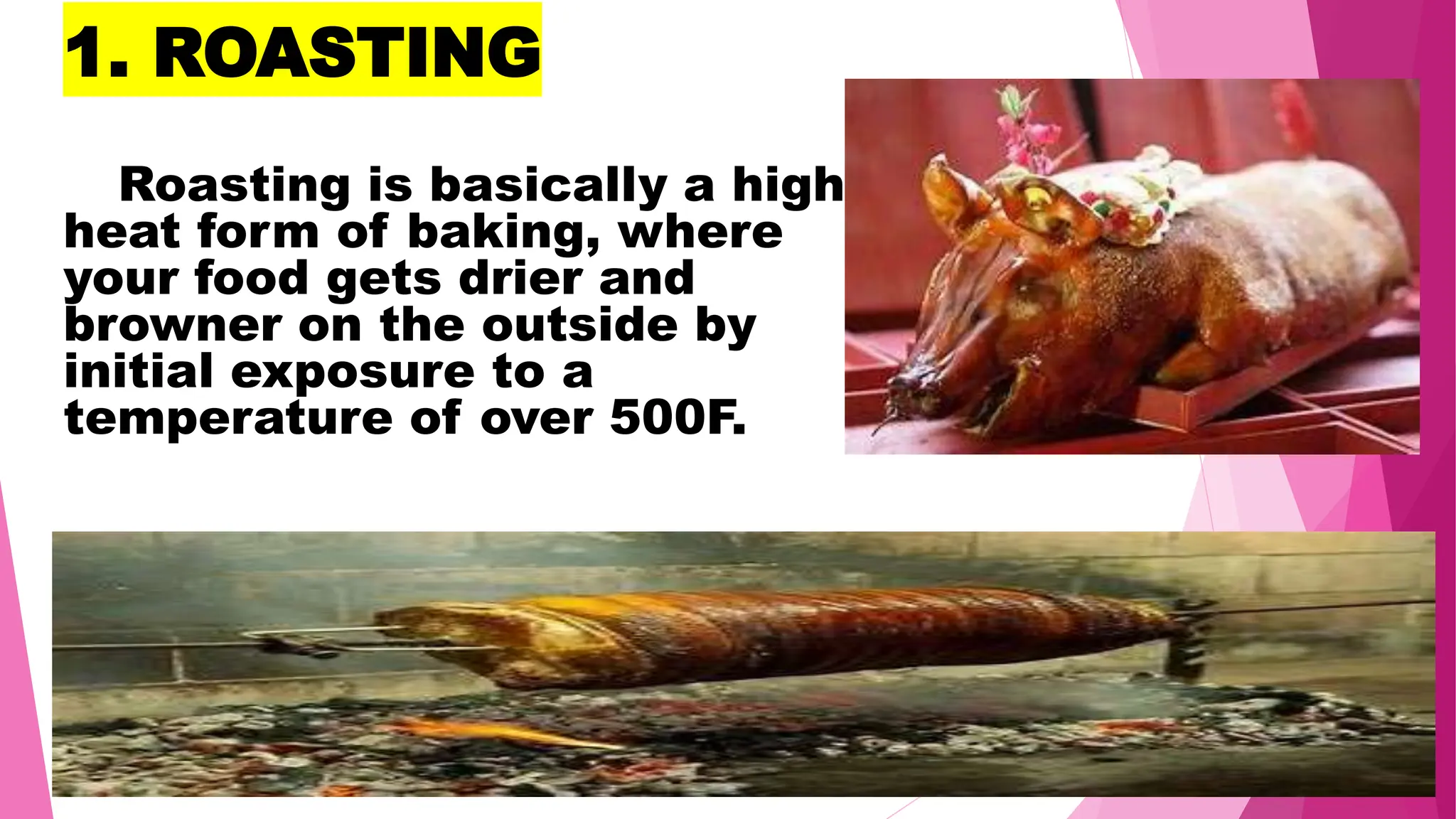
1. ROASTING
Roasting is basically a high
heat form of baking, where
your food gets drier and
browner on the outside by
initial exposure to a
temperature of over 500F.
2. BAKING
A method of preparing
food that uses dry heat,
typically in an oven, but
can also be done in hot
ashes, or on hot stones.
The most common
baked item is bread but
many other types of
foods are baked.
GRILLING AND BROILING
Dry heat cooking method rely on heat being
conducted through the air from an open flame are
grilling and broiling. This type of cooking produces
browning reactions on the surface of the food, thus
encouraging the development of complex flavors and
aromas.
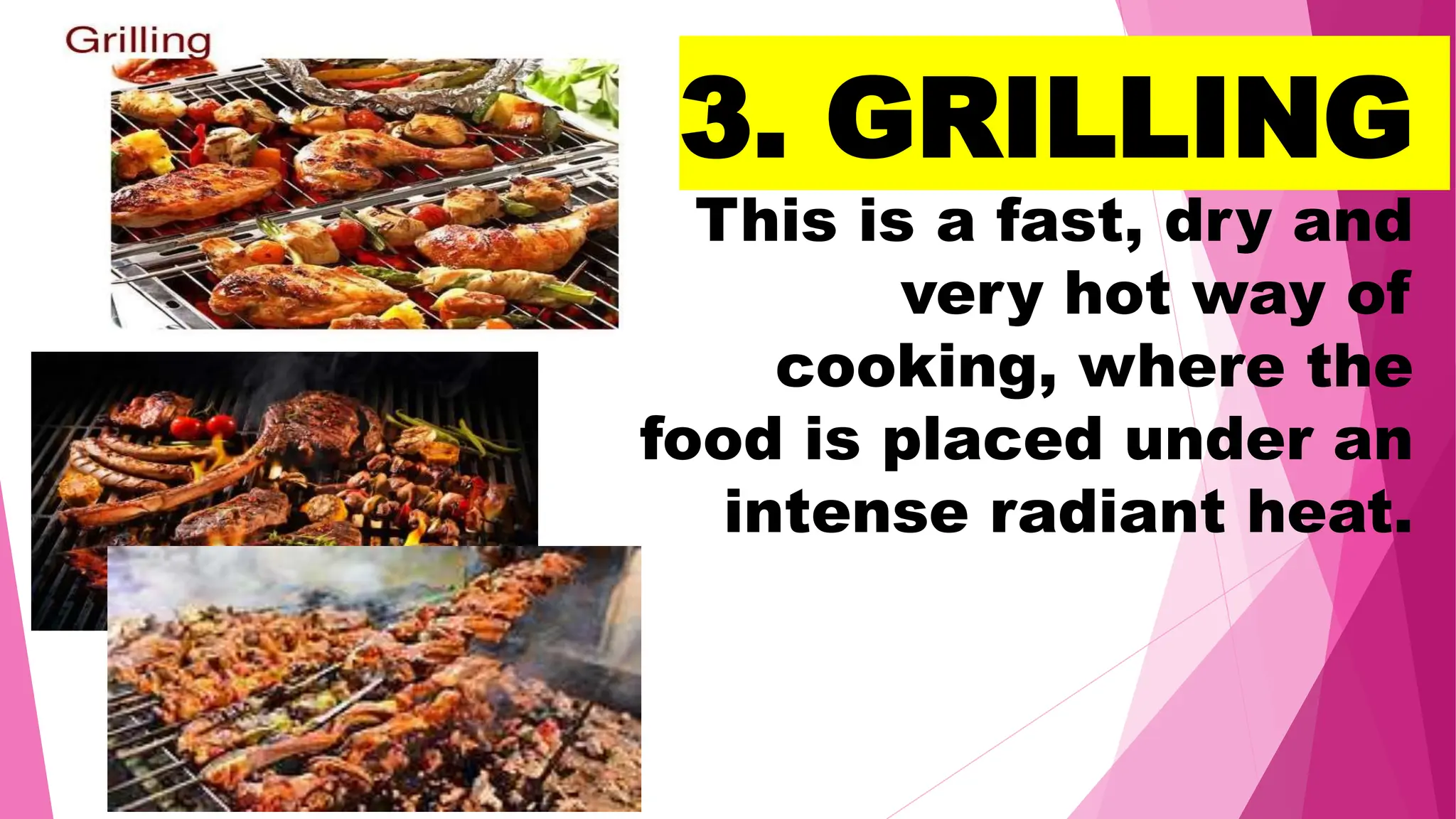
3. GRILLING
This is a fast, dry and
very hot way of
cooking, where the
food is placed under an
intense radiant heat.
4. BROILING
A cooking technique that uses
radiant heat from above to cook your
food, so it’s like upside-down grilling.
Broiling is a good method to use for
thinner, leaner cuts of meat like
butterflied chicken breasts, pork
tenderloin medallions, strip steaks,
kabobs and vegetables.
Take note:
Broiling and grilling require the food to be quite close to
the heat source, which in this case, is likely to be an open
flame.
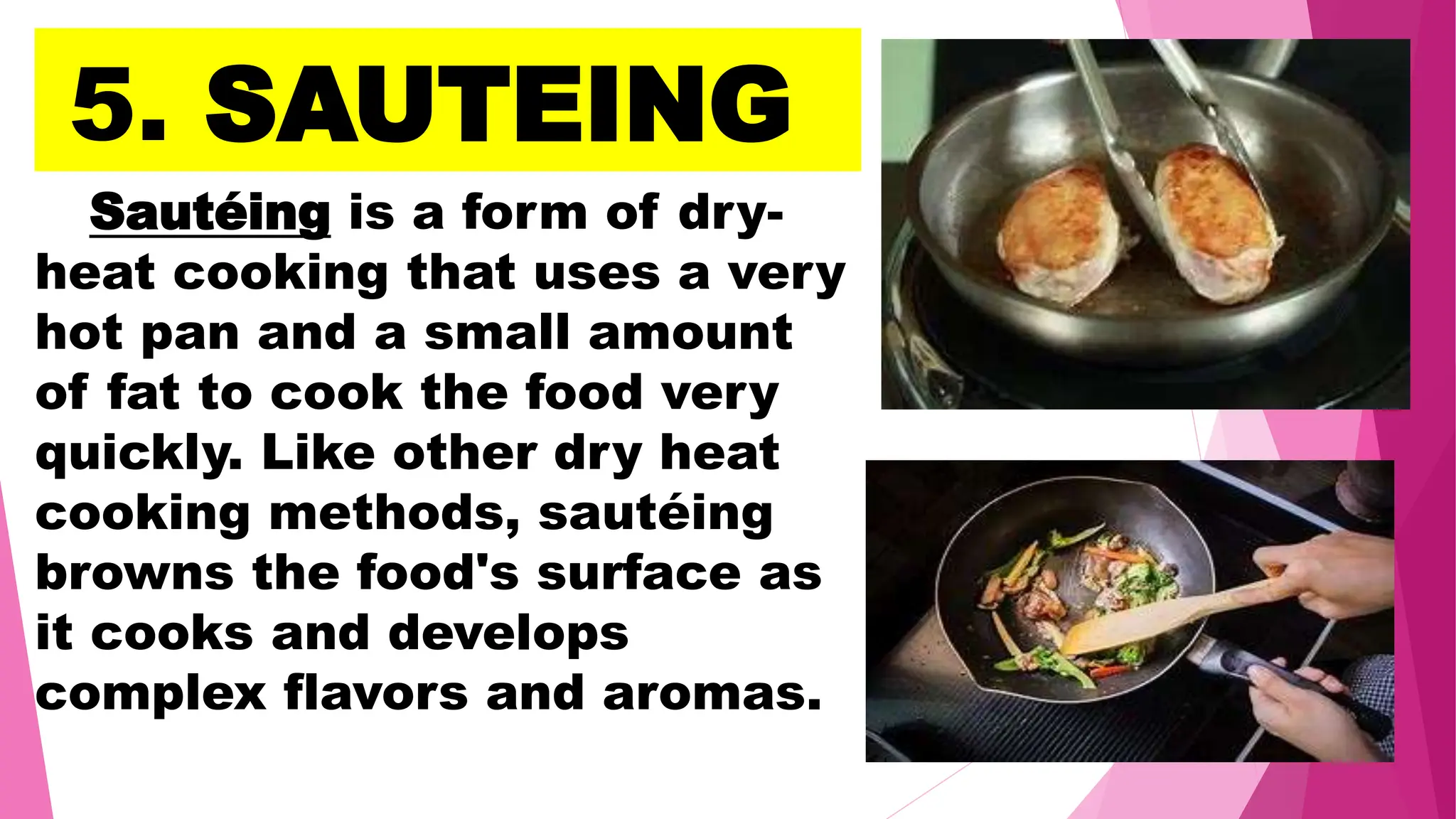
5. SAUTEING
Sautéing is a form of dry-
heat cooking that uses a very
hot pan and a small amount
of fat to cook the food very
quickly. Like other dry heat
cooking methods, sautéing
browns the food's surface as
it cooks and develops
complex flavors and aromas.
6. FRYING
One of the quickest
ways to cook food,
with temperatures
typically reaching
between 175 –
225ºC.
THE THREE TYPES OF
FRYING
Pan-frying, where food is cooked in
a frying pan with oil.
Deep-frying, where the food is
completely immersed in hot oil.
Stir-frying, where you fry the food
very quickly on a high heat in an oiled
pan
 Moist heat cooking methods include any technique that
involves cooking with moisture — whether it's steam,
water, stock, wine or some other liquid. Cooking
temperatures are much lower, anywhere from 140°F to
a maximum of 212°F, because water doesn't get any
hotter than that.
MOIST HEAT COOKING METHODS
Braising, Simmering, Boiling,
Stewing, Steaming, Poaching
The Examples of
Moist Heat
Cooking Methods
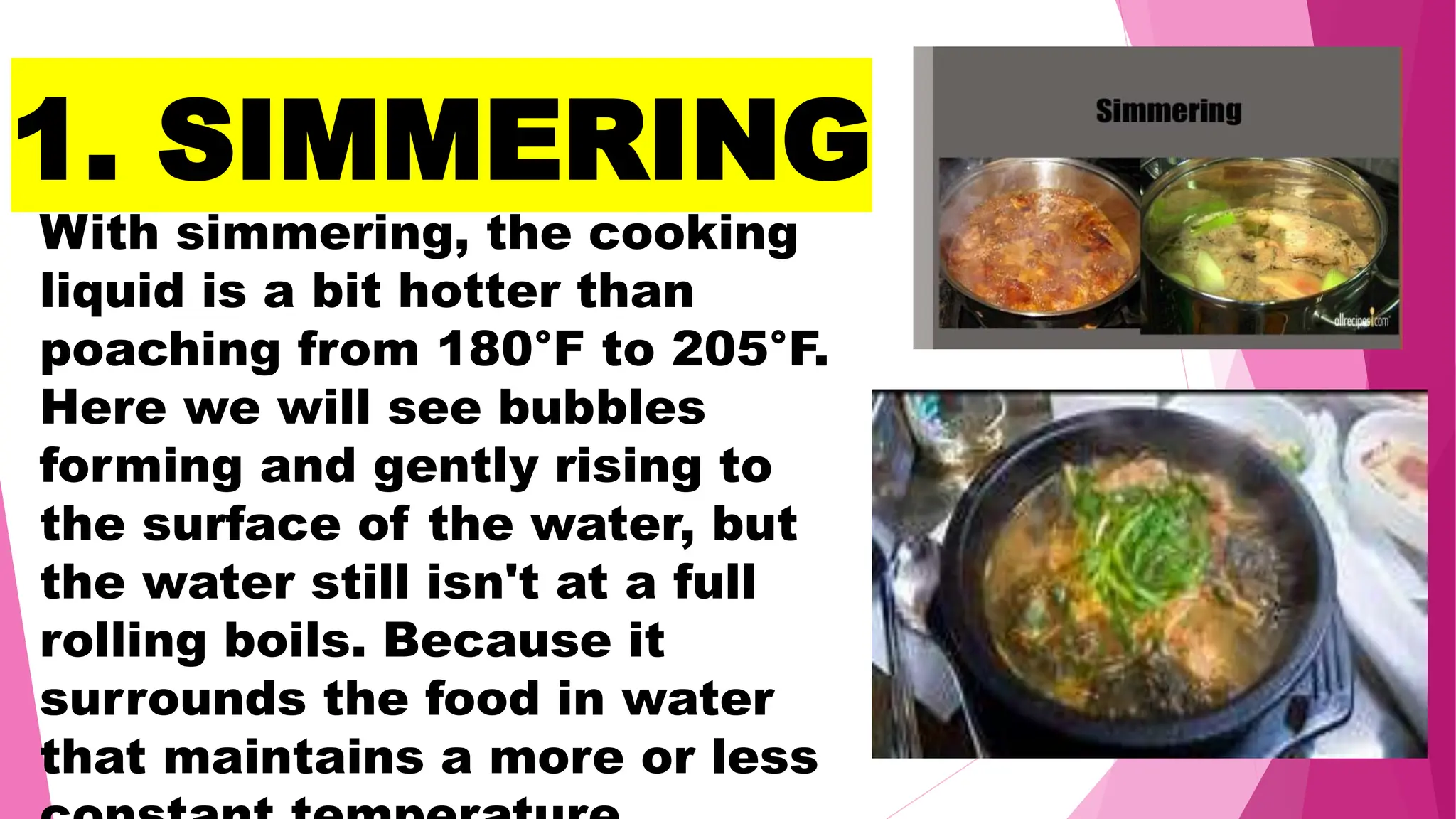
1. SIMMERING
With simmering, the cooking
liquid is a bit hotter than
poaching from 180°F to 205°F.
Here we will see bubbles
forming and gently rising to
the surface of the water, but
the water still isn't at a full
rolling boils. Because it
surrounds the food in water
that maintains a more or less
2. BOILING
The hottest of these three stages is
boiling, where the water reaches its highest
possible temperature of 212°F. It's actually
the least likely of the three to be used for
cooking. That's because the violent
agitation caused by the rolling boil can be
too rough on food and will often damage it.
3. POACHING
A moist heat method
of cooking
by submerging food in
some kind of liquid
and heating at a low
temperature. This is a
technique that is used
to cook delicate
proteins such as fish,
chicken, and eggs, as
well as some fruits
and vegetables.
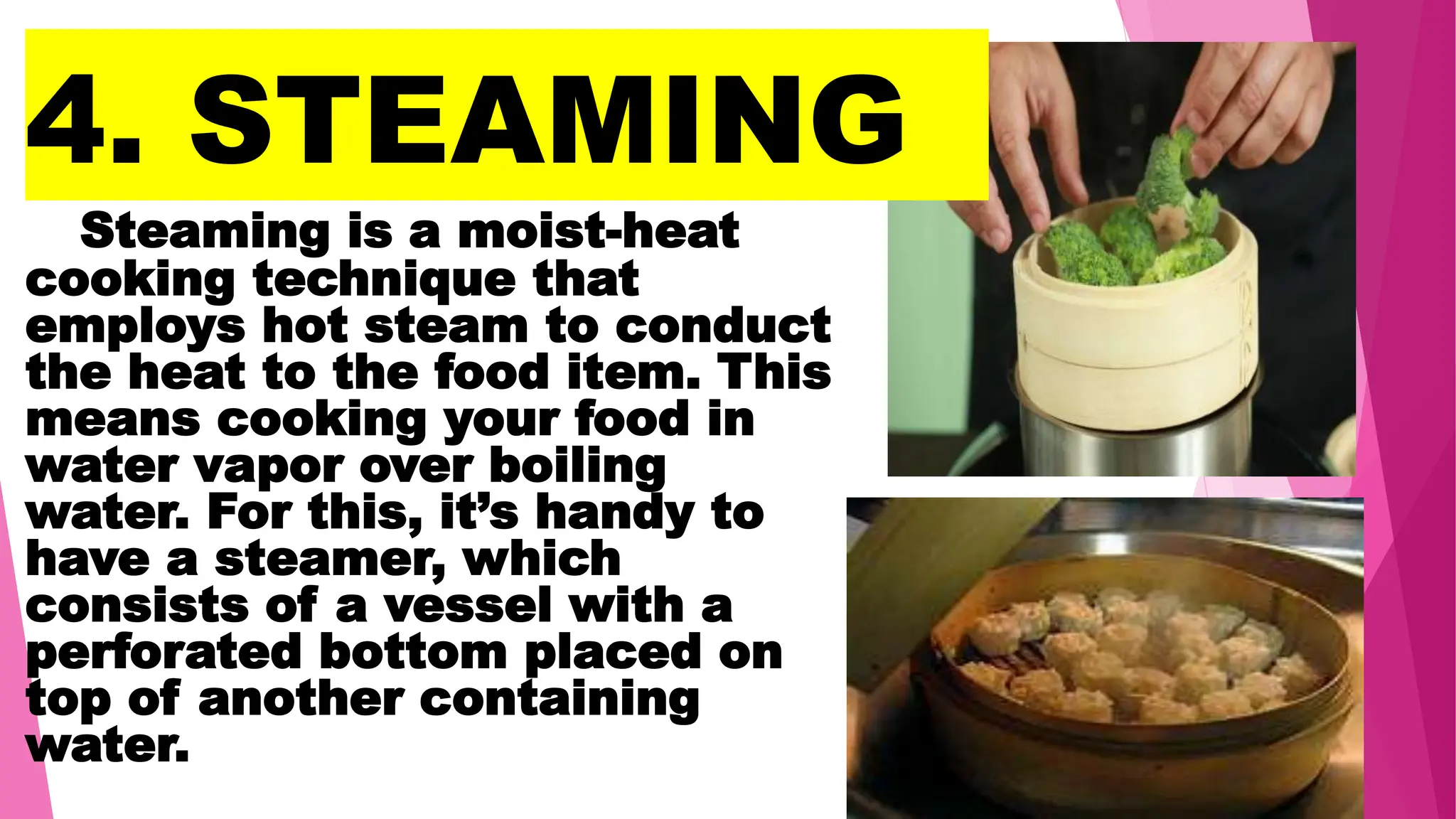
4. STEAMING
Steaming is a moist-heat
cooking technique that
employs hot steam to conduct
the heat to the food item. This
means cooking your food in
water vapor over boiling
water. For this, it’s handy to
have a steamer, which
consists of a vessel with a
perforated bottom placed on
top of another containing
water.
Stewing is the moist heat
method which is similar to
simmering in that the liquid
is heated until it forms
gentle, yet quickly moving
bubbles. The difference
between stewing and
simmering is that stewing
generally involves a much
smaller amount of liquid that
is retained and served with
the food as a sauce.
5. STEWING
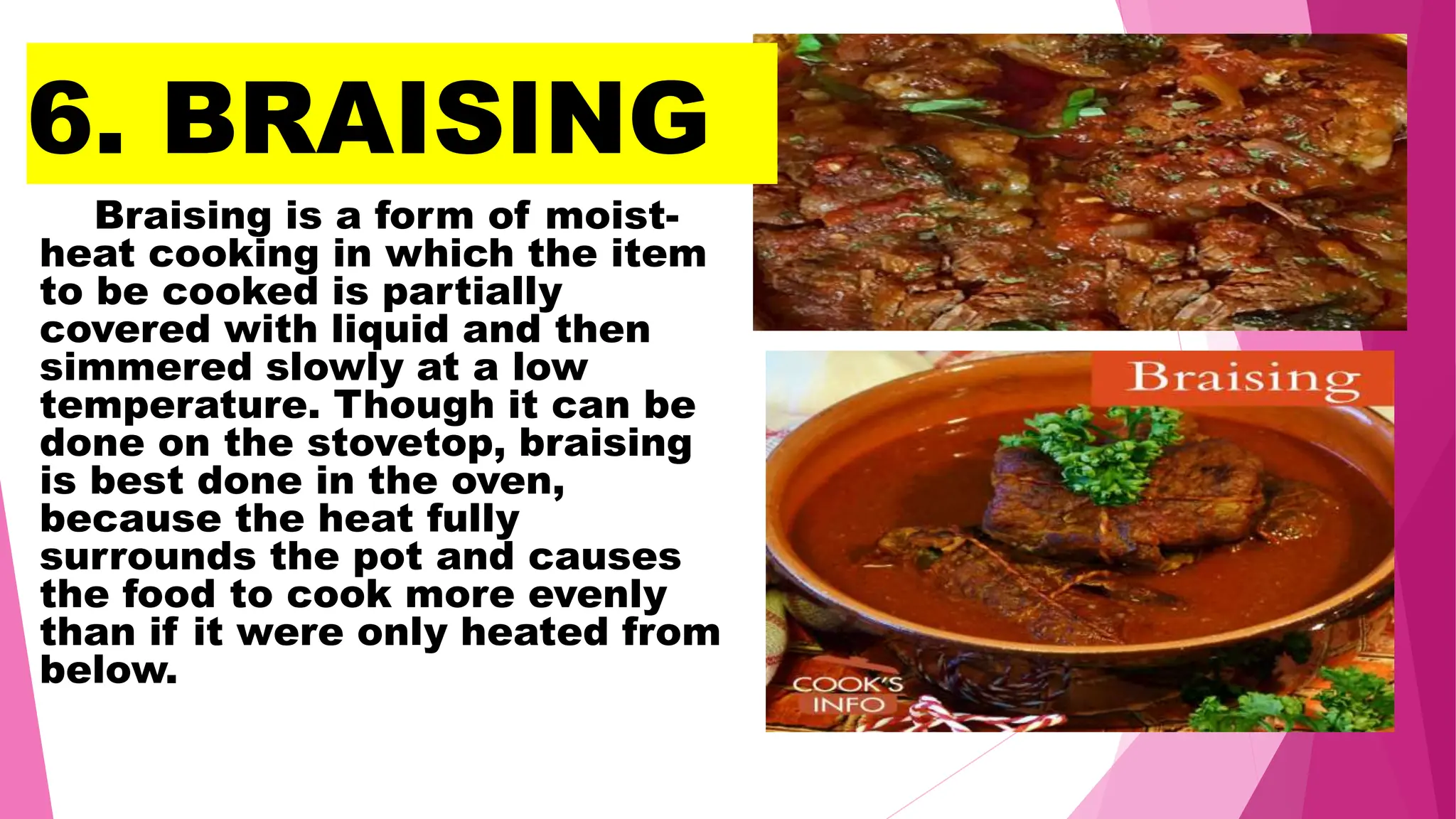
6. BRAISING
Braising is a form of moist-
heat cooking in which the item
to be cooked is partially
covered with liquid and then
simmered slowly at a low
temperature. Though it can be
done on the stovetop, braising
is best done in the oven,
because the heat fully
surrounds the pot and causes
the food to cook more evenly
than if it were only heated from
below.
Begin by Searing Because moist heat does not
permit the various browning reactions that dry heat
produces, giving cooked meats the brown, outer crust
that also helps to develop complex flavors and aromas,
it's customary to sear meat in a pan with a small
amount of hot fat before braising it.
How Braising Works
Braising is a good choice of cooking method for
cuts of meat that are tougher or from older animals. The
connective tissues that are more prevalent in cuts like this,
and which can make meats tough and chewy when
improperly cooked, are slowly dissolved through long, slow
application of moist heat. So, you end up with a tender piece
of meat.
Instructions;
You will be set into pair. The different methods
of cooking will be written in a piece of paper
and you will draw the lot as to who will be
assigned to discuss the methods of cooking.
You will be given 7 minutes to brainstorm with
your partner and another 5 minutes for the
reporting.
THINK, PLAN AND
PRESENT
The following are the guide questions in the activity:
1. What are the basic cooking preparation methods
found in your assigned topic?
2. What do you think are the steps to be followed in
preparing the cooking methods assigned to you?
3. Why do you think is the important to understand
the cooking methods that have been assigned to
you?
Rubrics:
Presentation =10%
Relevance =10%
Content =10%
Total =30%
Your parents returned home from Calbayog City,
having brought with them 1kg of pork meat,
cabbage, carrots, bay leaf, onion, ginger, salt, and
pepper. He asked you to get the dinner ready. What
do you believe will be the best cooking methods to
use? What steps will you take to ensure a high-
quality and tasty dinner?
1. Why do you think is the
importance of knowing the
different methods in cooking?
2. How can you say that cooking
methods are very useful in our
daily lives?
I. MULTIPLE CHOICE
Direction: Read the following item carefully and choose the letter
that corresponds to your answer.
1. Which of the cooking methods does
not belong to the dry heat method?
A. Stewing B. Roasting C. Deep Frying D. Grilling
2. It is a moist heat cooking
method that employs hot
steam to conduct the heat to
the food item.
A. Simmering B. Steaming
C. Boiling D. Stewing
3. It is a dry heat cooking method
of preparing food that uses dry
heat, typically in an oven, but can
also be done in hot ashes, or on
hot stones.
A. Baking B. Roasting
C. Deep Frying D. Grilling
4. It is a moist heat cooking
method that involves heating
food submerged in a liquid, such
as water, stock or wine.
A. Simmering B. Poaching
C. Boiling D. Stewing
5. What cooking method is
performed when meat is cooked in
steaming liquid and bubbles are
breaking on the surface.
A. Simmering B. Grilling
C. Braising D. Baking
B. ESSAY
Among the fundamental cooking
methods choose at least one dry heat
method and one moist heat method in
which is the simplest for you to apply.
Discuss your answer comprehensively.
(5pts)
1. What are the three factors affecting
choice of cooking methods in meat. Explain
each briefly.
2. What are the basic principles of platter
presentation. Explain each briefly.
THE-COOKING-METHODS-2 Food Selection, Preparation and Nutrition

THE-COOKING-METHODS-2 Food Selection, Preparation and Nutrition

  • 2.
  • 3.
    Very good! Wehad talked about the Methods of Cooking.
  • 4.
    1. What arethe two methods of cooking? 2. How do the two differs? 3. What is Maillard Reaction?
  • 5.
    I AM THEEXPLORER Instructions: The students will guess the missing letters based on the picture shown on the monitor to complete the given words.
  • 6.
    C _ _K I _ G COOKING
  • 7.
    G _ I_ L I _ G GRILLING
  • 8.
    STEAMING S T __ M _ N _
  • 9.
    D _ _P F_ _ I _ G DEEP FRYING
  • 10.
    P_ A C_ I _G POACHING
  • 11.
    WHAT EXACTLY AMI? Instructions; In this activity, you will be divided into four groups. You will guess the methods of cooking through context clues. The activity is good for 5 minutes.
  • 12.
    1. I ama cooking method that uses dry heat to prepare food, typically in an oven, but it can also be done in hot ashes or on hot stones....... WHAT EXACTLY AM I? 2. I am a cooking method that uses a very hot pan and a small amount of fat to cook the food quickly........ WHAT EXACTLY AM I?
  • 13.
    3. I ama cooking method that uses hot steam to conduct heat to the food...... WHAT EXACTLY AM I? 4. I am a cooking method in which the item to be cooked is partially covered with liquid and then slowly simmered at a low temperature........ WHAT EXACTLY AM I?
  • 14.
    5. I ama method of cooking that uses radiant heat from above to cook the food, similar to upside- down grilling........ WHAT EXACTLY AM I?
  • 15.
    1. Discuss thedifferent basic methods of cooking. Appreciate cooking methods in preparing foods.
  • 17.
    DRY HEAT COOKING Dryheat cooking refers to any cooking technique where the heat is transferred to the food item without using any moisture. Dry- heat cooking typically involves high heat, with temperatures of 300°F or hotter.
  • 18.
    Maillard Reaction The browningof food (including the process by which meat is browned, it can only be achieved through dry-heat cooking.
  • 20.
    1. ROASTING Roasting isbasically a high heat form of baking, where your food gets drier and browner on the outside by initial exposure to a temperature of over 500F.
  • 21.
    2. BAKING A methodof preparing food that uses dry heat, typically in an oven, but can also be done in hot ashes, or on hot stones. The most common baked item is bread but many other types of foods are baked.
  • 22.
    GRILLING AND BROILING Dryheat cooking method rely on heat being conducted through the air from an open flame are grilling and broiling. This type of cooking produces browning reactions on the surface of the food, thus encouraging the development of complex flavors and aromas.
  • 23.
    3. GRILLING This isa fast, dry and very hot way of cooking, where the food is placed under an intense radiant heat.
  • 24.
    4. BROILING A cookingtechnique that uses radiant heat from above to cook your food, so it’s like upside-down grilling. Broiling is a good method to use for thinner, leaner cuts of meat like butterflied chicken breasts, pork tenderloin medallions, strip steaks, kabobs and vegetables. Take note: Broiling and grilling require the food to be quite close to the heat source, which in this case, is likely to be an open flame.
  • 25.
    5. SAUTEING Sautéing isa form of dry- heat cooking that uses a very hot pan and a small amount of fat to cook the food very quickly. Like other dry heat cooking methods, sautéing browns the food's surface as it cooks and develops complex flavors and aromas.
  • 26.
    6. FRYING One ofthe quickest ways to cook food, with temperatures typically reaching between 175 – 225ºC.
  • 27.
    THE THREE TYPESOF FRYING Pan-frying, where food is cooked in a frying pan with oil. Deep-frying, where the food is completely immersed in hot oil. Stir-frying, where you fry the food very quickly on a high heat in an oiled pan
  • 28.
     Moist heatcooking methods include any technique that involves cooking with moisture — whether it's steam, water, stock, wine or some other liquid. Cooking temperatures are much lower, anywhere from 140°F to a maximum of 212°F, because water doesn't get any hotter than that. MOIST HEAT COOKING METHODS Braising, Simmering, Boiling, Stewing, Steaming, Poaching
  • 29.
    The Examples of MoistHeat Cooking Methods
  • 30.
    1. SIMMERING With simmering,the cooking liquid is a bit hotter than poaching from 180°F to 205°F. Here we will see bubbles forming and gently rising to the surface of the water, but the water still isn't at a full rolling boils. Because it surrounds the food in water that maintains a more or less
  • 31.
    2. BOILING The hottestof these three stages is boiling, where the water reaches its highest possible temperature of 212°F. It's actually the least likely of the three to be used for cooking. That's because the violent agitation caused by the rolling boil can be too rough on food and will often damage it.
  • 32.
    3. POACHING A moistheat method of cooking by submerging food in some kind of liquid and heating at a low temperature. This is a technique that is used to cook delicate proteins such as fish, chicken, and eggs, as well as some fruits and vegetables.
  • 33.
    4. STEAMING Steaming isa moist-heat cooking technique that employs hot steam to conduct the heat to the food item. This means cooking your food in water vapor over boiling water. For this, it’s handy to have a steamer, which consists of a vessel with a perforated bottom placed on top of another containing water.
  • 34.
    Stewing is themoist heat method which is similar to simmering in that the liquid is heated until it forms gentle, yet quickly moving bubbles. The difference between stewing and simmering is that stewing generally involves a much smaller amount of liquid that is retained and served with the food as a sauce. 5. STEWING
  • 35.
    6. BRAISING Braising isa form of moist- heat cooking in which the item to be cooked is partially covered with liquid and then simmered slowly at a low temperature. Though it can be done on the stovetop, braising is best done in the oven, because the heat fully surrounds the pot and causes the food to cook more evenly than if it were only heated from below.
  • 36.
    Begin by SearingBecause moist heat does not permit the various browning reactions that dry heat produces, giving cooked meats the brown, outer crust that also helps to develop complex flavors and aromas, it's customary to sear meat in a pan with a small amount of hot fat before braising it. How Braising Works Braising is a good choice of cooking method for cuts of meat that are tougher or from older animals. The connective tissues that are more prevalent in cuts like this, and which can make meats tough and chewy when improperly cooked, are slowly dissolved through long, slow application of moist heat. So, you end up with a tender piece of meat.
  • 38.
    Instructions; You will beset into pair. The different methods of cooking will be written in a piece of paper and you will draw the lot as to who will be assigned to discuss the methods of cooking. You will be given 7 minutes to brainstorm with your partner and another 5 minutes for the reporting. THINK, PLAN AND PRESENT
  • 39.
    The following arethe guide questions in the activity: 1. What are the basic cooking preparation methods found in your assigned topic? 2. What do you think are the steps to be followed in preparing the cooking methods assigned to you? 3. Why do you think is the important to understand the cooking methods that have been assigned to you?
  • 40.
  • 41.
    Your parents returnedhome from Calbayog City, having brought with them 1kg of pork meat, cabbage, carrots, bay leaf, onion, ginger, salt, and pepper. He asked you to get the dinner ready. What do you believe will be the best cooking methods to use? What steps will you take to ensure a high- quality and tasty dinner?
  • 42.
    1. Why doyou think is the importance of knowing the different methods in cooking? 2. How can you say that cooking methods are very useful in our daily lives?
  • 43.
    I. MULTIPLE CHOICE Direction:Read the following item carefully and choose the letter that corresponds to your answer. 1. Which of the cooking methods does not belong to the dry heat method? A. Stewing B. Roasting C. Deep Frying D. Grilling
  • 44.
    2. It isa moist heat cooking method that employs hot steam to conduct the heat to the food item. A. Simmering B. Steaming C. Boiling D. Stewing
  • 45.
    3. It isa dry heat cooking method of preparing food that uses dry heat, typically in an oven, but can also be done in hot ashes, or on hot stones. A. Baking B. Roasting C. Deep Frying D. Grilling
  • 46.
    4. It isa moist heat cooking method that involves heating food submerged in a liquid, such as water, stock or wine. A. Simmering B. Poaching C. Boiling D. Stewing
  • 47.
    5. What cookingmethod is performed when meat is cooked in steaming liquid and bubbles are breaking on the surface. A. Simmering B. Grilling C. Braising D. Baking
  • 48.
    B. ESSAY Among thefundamental cooking methods choose at least one dry heat method and one moist heat method in which is the simplest for you to apply. Discuss your answer comprehensively. (5pts)
  • 49.
    1. What arethe three factors affecting choice of cooking methods in meat. Explain each briefly. 2. What are the basic principles of platter presentation. Explain each briefly.