MECHANICAL
ENGINEERING
Convolution and Fourier
Transforms
matlabassignmentexperts.com
info@matlabassignmentexperts.com +1 (315) 557-6473
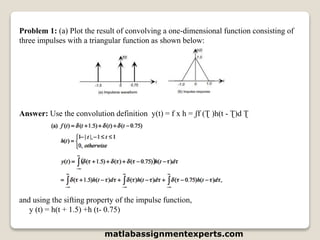
Problem 1: (a) Plot the result of convolving a one-dimensional function consisting of
three impulses with a triangular function as shown below:
Answer: Use the convolution definition y(t) = f x h = ʃf (Ʈ )h(t - Ʈ)d Ʈ
and using the sifting property of the impulse function,
y (t) = h(t + 1.5) +h (t- 0.75)
matlabassignmentexperts.com
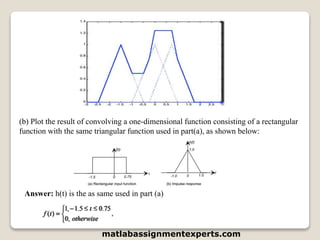
Answer: h(t) is the as same used in part (a)
(b) Plot the result of convolving a one-dimensional function consisting of a rectangular
function with the same triangular function used in part(a), as shown below:
matlabassignmentexperts.com
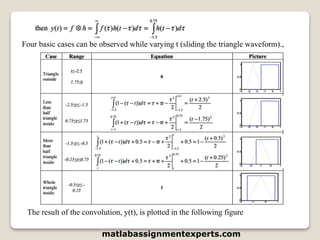
The result of the convolution, y(t), is plotted in the following figure
Four basic cases can be observed while varying t (sliding the triangle waveform).,
matlabassignmentexperts.com
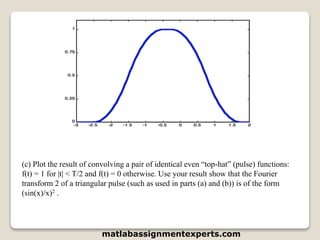
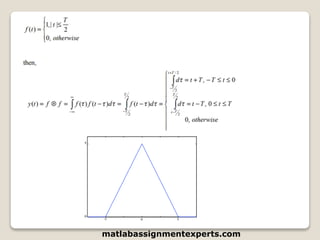
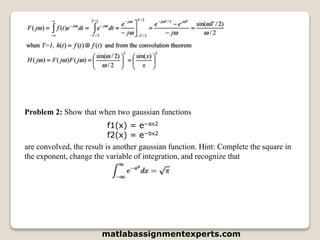
(c) Plot the result of convolving a pair of identical even “top-hat” (pulse) functions:
f(t) = 1 for |t| < T/2 and f(t) = 0 otherwise. Use your result show that the Fourier
transform 2 of a triangular pulse (such as used in parts (a) and (b)) is of the form
(sin(x)/x)2 .
matlabassignmentexperts.com
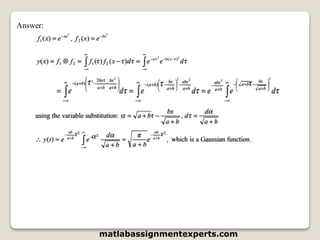
Problem 2: Show that when two gaussian functions
f1(x) = e−ax2
f2(x) = e−bx2
are convolved, the result is another gaussian function. Hint: Complete the square in
the exponent, change the variable of integration, and recognize that
matlabassignmentexperts.com
Answer:
matlabassignmentexperts.com

Convolution and Fourier Transforms

  • 1.
  • 2.
    Problem 1: (a)Plot the result of convolving a one-dimensional function consisting of three impulses with a triangular function as shown below: Answer: Use the convolution definition y(t) = f x h = ʃf (Ʈ )h(t - Ʈ)d Ʈ and using the sifting property of the impulse function, y (t) = h(t + 1.5) +h (t- 0.75) matlabassignmentexperts.com
  • 3.
    Answer: h(t) isthe as same used in part (a) (b) Plot the result of convolving a one-dimensional function consisting of a rectangular function with the same triangular function used in part(a), as shown below: matlabassignmentexperts.com
  • 4.
    The result ofthe convolution, y(t), is plotted in the following figure Four basic cases can be observed while varying t (sliding the triangle waveform)., matlabassignmentexperts.com
  • 5.
    (c) Plot theresult of convolving a pair of identical even “top-hat” (pulse) functions: f(t) = 1 for |t| < T/2 and f(t) = 0 otherwise. Use your result show that the Fourier transform 2 of a triangular pulse (such as used in parts (a) and (b)) is of the form (sin(x)/x)2 . matlabassignmentexperts.com
  • 6.
  • 7.
    Problem 2: Showthat when two gaussian functions f1(x) = e−ax2 f2(x) = e−bx2 are convolved, the result is another gaussian function. Hint: Complete the square in the exponent, change the variable of integration, and recognize that matlabassignmentexperts.com
  • 8.