CONVERSATIONS IN THE
INTERNATIONAL LIBRARIAN
NETWORKING PROGRAM: USA
AND LITHUANIA
AND LITHUANIA
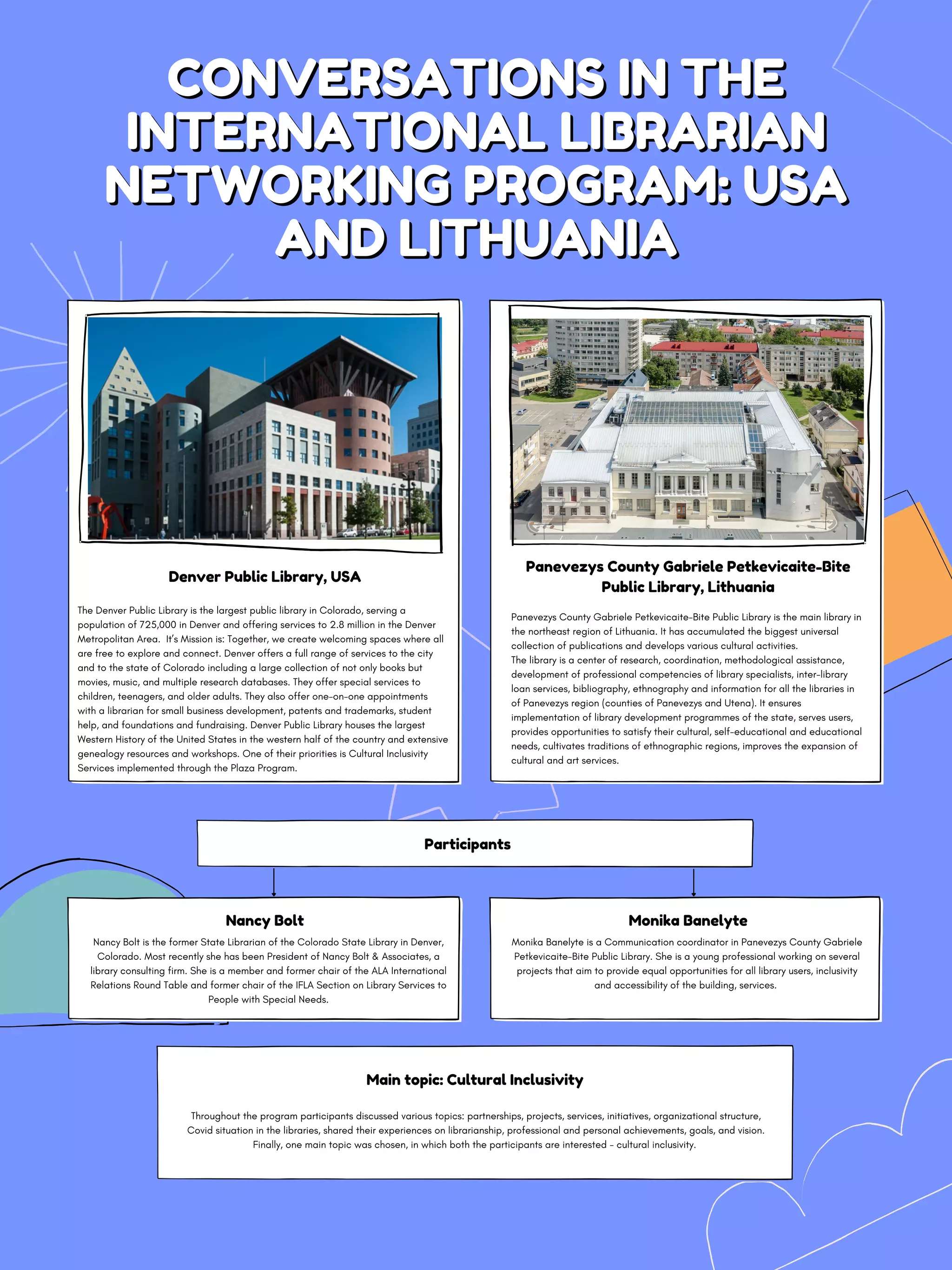
Denver Public Library, USA
Panevezys County Gabriele Petkevicaite-Bite
Public Library, Lithuania
Participants
Monika Banelyte is a Communication coordinator in Panevezys County Gabriele
Petkevicaite-Bite Public Library. She is a young professional working on several
projects that aim to provide equal opportunities for all library users, inclusivity
and accessibility of the building, services.
Nancy Bolt is the former State Librarian of the Colorado State Library in Denver,
Colorado. Most recently she has been President of Nancy Bolt & Associates, a
library consulting firm. She is a member and former chair of the ALA International
Relations Round Table and former chair of the IFLA Section on Library Services to
People with Special Needs.
Panevezys County Gabriele Petkevicaite-Bite Public Library is the main library in
the northeast region of Lithuania. It has accumulated the biggest universal
collection of publications and develops various cultural activities.
The library is a center of research, coordination, methodological assistance,
development of professional competencies of library specialists, inter-library
loan services, bibliography, ethnography and information for all the libraries in
of Panevezys region (counties of Panevezys and Utena). It ensures
implementation of library development programmes of the state, serves users,
provides opportunities to satisfy their cultural, self-educational and educational
needs, cultivates traditions of ethnographic regions, improves the expansion of
cultural and art services.
The Denver Public Library is the largest public library in Colorado, serving a
population of 725,000 in Denver and offering services to 2.8 million in the Denver
Metropolitan Area. It’s Mission is: Together, we create welcoming spaces where all
are free to explore and connect. Denver offers a full range of services to the city
and to the state of Colorado including a large collection of not only books but
movies, music, and multiple research databases. They offer special services to
children, teenagers, and older adults. They also offer one-on-one appointments
with a librarian for small business development, patents and trademarks, student
help, and foundations and fundraising. Denver Public Library houses the largest
Western History of the United States in the western half of the country and extensive
genealogy resources and workshops. One of their priorities is Cultural Inclusivity
Services implemented through the Plaza Program.
Monika Banelyte
Nancy Bolt
Main topic: Cultural Inclusivity
Throughout the program participants discussed various topics: partnerships, projects, services, initiatives, organizational structure,
Covid situation in the libraries, shared their experiences on librarianship, professional and personal achievements, goals, and vision.
Finally, one main topic was chosen, in which both the participants are interested - cultural inclusivity.
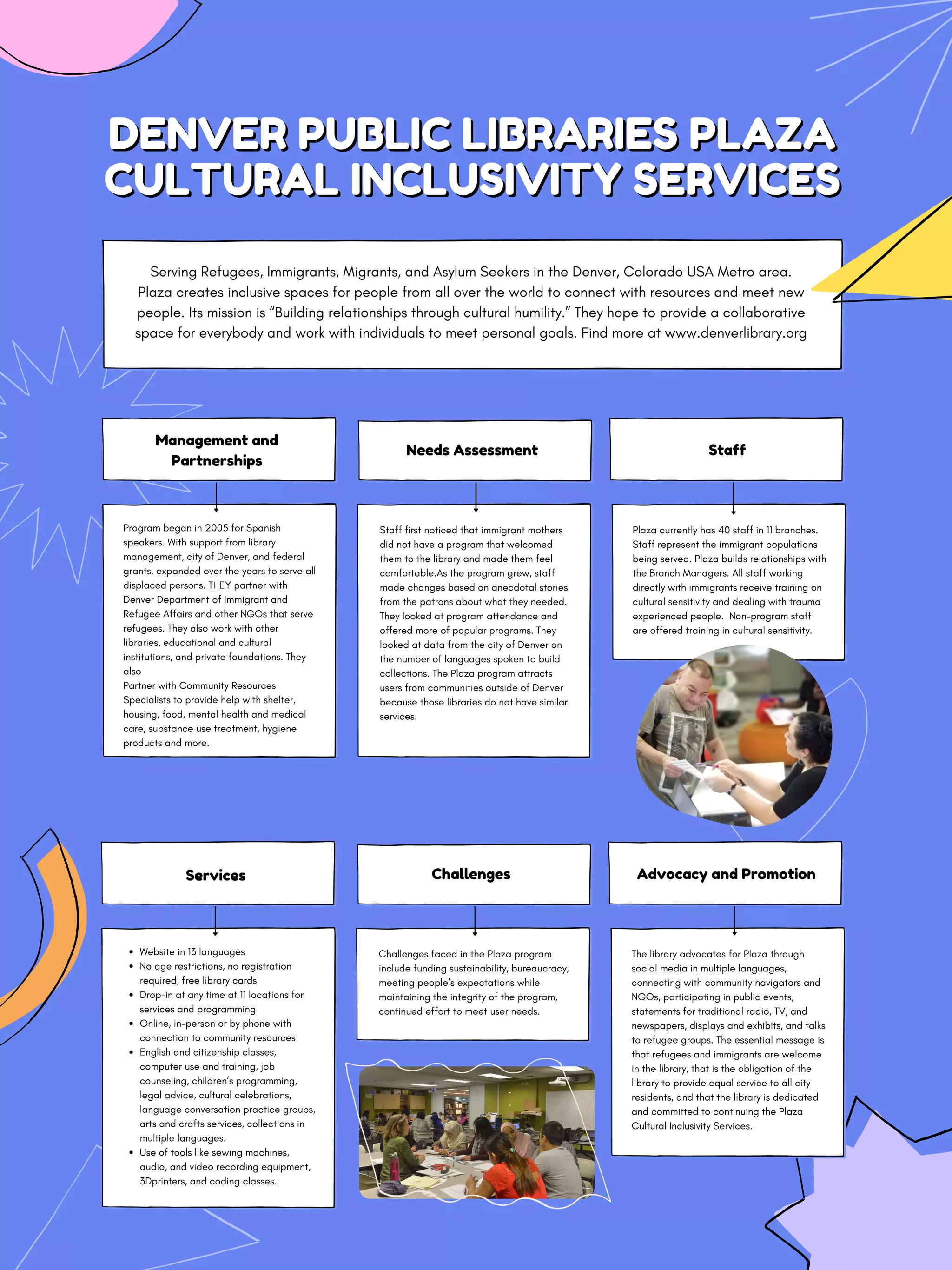
DENVER PUBLIC LIBRARIES PLAZA
CULTURAL INCLUSIVITY SERVICES


Serving Refugees, Immigrants, Migrants, and Asylum Seekers in the Denver, Colorado USA Metro area.
Plaza creates inclusive spaces for people from all over the world to connect with resources and meet new
people. Its mission is “Building relationships through cultural humility.” They hope to provide a collaborative
space for everybody and work with individuals to meet personal goals. Find more at www.denverlibrary.org
Program began in 2005 for Spanish
speakers. With support from library
management, city of Denver, and federal
grants, expanded over the years to serve all
displaced persons. THEY partner with
Denver Department of Immigrant and
Refugee Affairs and other NGOs that serve
refugees. They also work with other
libraries, educational and cultural
institutions, and private foundations. They
also
Partner with Community Resources
Specialists to provide help with shelter,
housing, food, mental health and medical
care, substance use treatment, hygiene
products and more.
Management and
Partnerships
Staff
Needs Assessment
Staff first noticed that immigrant mothers
did not have a program that welcomed
them to the library and made them feel
comfortable.As the program grew, staff
made changes based on anecdotal stories
from the patrons about what they needed.
They looked at program attendance and
offered more of popular programs. They
looked at data from the city of Denver on
the number of languages spoken to build
collections. The Plaza program attracts
users from communities outside of Denver
because those libraries do not have similar
services.
Plaza currently has 40 staff in 11 branches.
Staff represent the immigrant populations
being served. Plaza builds relationships with
the Branch Managers. All staff working
directly with immigrants receive training on
cultural sensitivity and dealing with trauma
experienced people. Non-program staff
are offered training in cultural sensitivity.
Website in 13 languages
No age restrictions, no registration
required, free library cards
Drop-in at any time at 11 locations for
services and programming
Online, in-person or by phone with
connection to community resources
English and citizenship classes,
computer use and training, job
counseling, children’s programming,
legal advice, cultural celebrations,
language conversation practice groups,
arts and crafts services, collections in
multiple languages.
Use of tools like sewing machines,
audio, and video recording equipment,
3Dprinters, and coding classes.
Services Advocacy and Promotion
Challenges
Challenges faced in the Plaza program
include funding sustainability, bureaucracy,
meeting people’s expectations while
maintaining the integrity of the program,
continued effort to meet user needs.
The library advocates for Plaza through
social media in multiple languages,
connecting with community navigators and
NGOs, participating in public events,
statements for traditional radio, TV, and
newspapers, displays and exhibits, and talks
to refugee groups. The essential message is
that refugees and immigrants are welcome
in the library, that is the obligation of the
library to provide equal service to all city
residents, and that the library is dedicated
and committed to continuing the Plaza
Cultural Inclusivity Services.
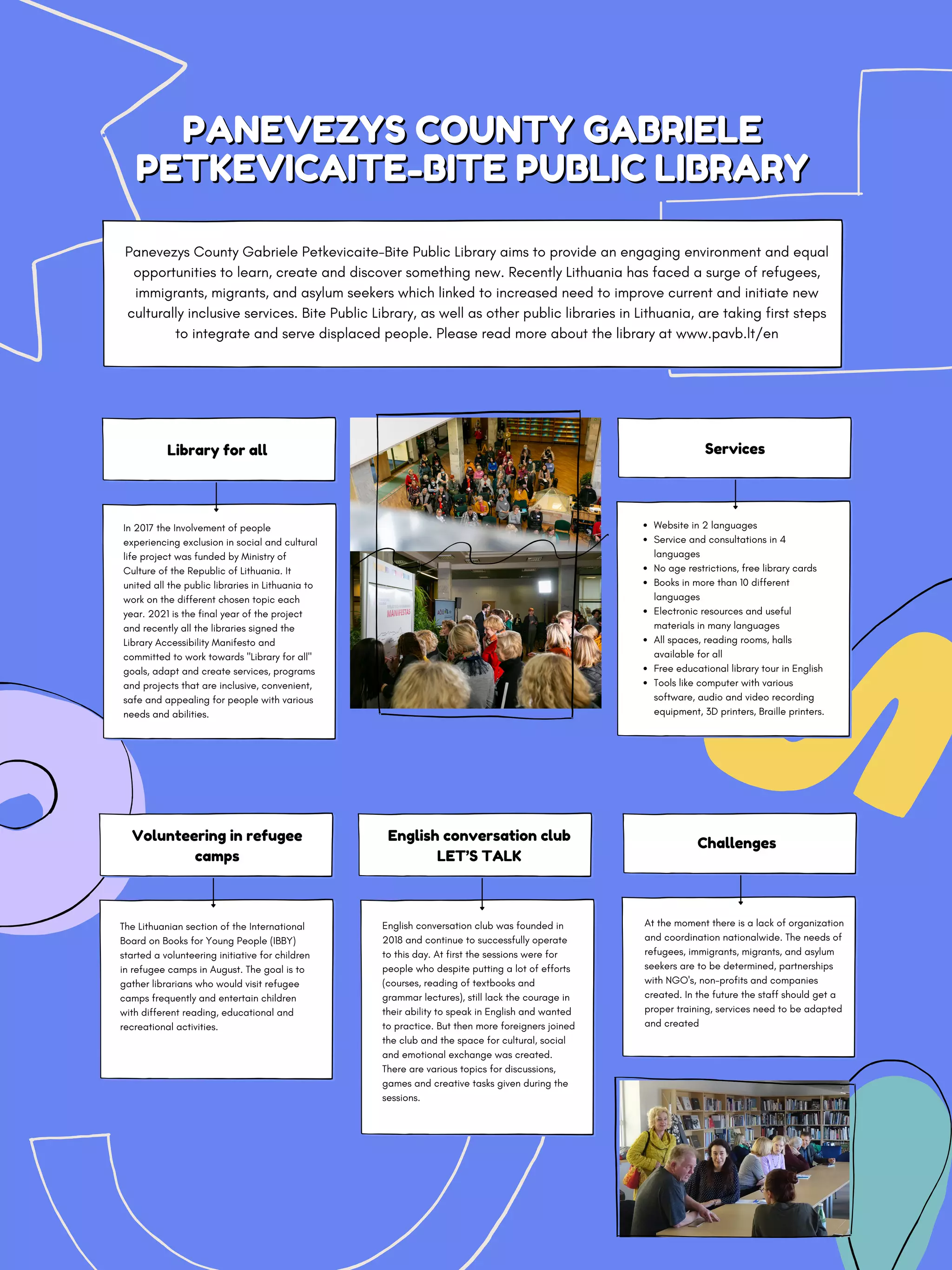
PANEVEZYS COUNTY GABRIELE
PETKEVICAITE-BITE PUBLIC LIBRARY
Panevezys County Gabriele Petkevicaite-Bite Public Library aims to provide an engaging environment and equal
opportunities to learn, create and discover something new. Recently Lithuania has faced a surge of refugees,
immigrants, migrants, and asylum seekers which linked to increased need to improve current and initiate new
culturally inclusive services. Bite Public Library, as well as other public libraries in Lithuania, are taking first steps
to integrate and serve displaced people. Please read more about the library at www.pavb.lt/en
In 2017 the Involvement of people
experiencing exclusion in social and cultural
life project was funded by Ministry of
Culture of the Republic of Lithuania. It
united all the public libraries in Lithuania to
work on the different chosen topic each
year. 2021 is the final year of the project
and recently all the libraries signed the
Library Accessibility Manifesto and
committed to work towards "Library for all"
goals, adapt and create services, programs
and projects that are inclusive, convenient,
safe and appealing for people with various
needs and abilities.
Library for all Services
English conversation club
LET’S TALK
English conversation club was founded in
2018 and continue to successfully operate
to this day. At first the sessions were for
people who despite putting a lot of efforts
(courses, reading of textbooks and
grammar lectures), still lack the courage in
their ability to speak in English and wanted
to practice. But then more foreigners joined
the club and the space for cultural, social
and emotional exchange was created.
There are various topics for discussions,
games and creative tasks given during the
sessions.
Volunteering in refugee
camps
The Lithuanian section of the International
Board on Books for Young People (IBBY)
started a volunteering initiative for children
in refugee camps in August. The goal is to
gather librarians who would visit refugee
camps frequently and entertain children
with different reading, educational and
recreational activities.
Website in 2 languages
Service and consultations in 4
languages
No age restrictions, free library cards
Books in more than 10 different
languages
Electronic resources and useful
materials in many languages
All spaces, reading rooms, halls
available for all
Free educational library tour in English
Tools like computer with various
software, audio and video recording
equipment, 3D printers, Braille printers.
Challenges
At the moment there is a lack of organization
and coordination nationalwide. The needs of
refugees, immigrants, migrants, and asylum
seekers are to be determined, partnerships
with NGO's, non-profits and companies
created. In the future the staff should get a
proper training, services need to be adapted
and created
CONCLUSION
CONCLUSION
There were many similarities between the needs of immigrants and
refugees in Lithuania and Denver, Colorado. Both countries are
experiencing an influx of refugees and immigrants, and, in both countries,
libraries decided to respond and become involved. Both libraries have a
previous emphasis on cultural inclusivity. Both libraries offer free services
to refugees and immigrants and offer them in multiple languages. The
Denver Public Library, however, has 40 staff and a multi-year program in
place, while the Lithuania program is just being developed.


The IFLA Section on Library Services for People with Special Needs is
currently developing a Guidelines of Library Service to Refugees,
Immigrants, Migrants, and Asylum. When these Guidelines are published
early next year, they will provide guidance and advice to libraries around
the world seeking to develop or improve library services to this displaced
population.

Conversations in the International Librarian Networking Program: USA and Lithuania

  • 1.
    CONVERSATIONS IN THE CONVERSATIONSIN THE INTERNATIONAL LIBRARIAN INTERNATIONAL LIBRARIAN NETWORKING PROGRAM: USA NETWORKING PROGRAM: USA AND LITHUANIA AND LITHUANIA Denver Public Library, USA Panevezys County Gabriele Petkevicaite-Bite Public Library, Lithuania Participants Monika Banelyte is a Communication coordinator in Panevezys County Gabriele Petkevicaite-Bite Public Library. She is a young professional working on several projects that aim to provide equal opportunities for all library users, inclusivity and accessibility of the building, services. Nancy Bolt is the former State Librarian of the Colorado State Library in Denver, Colorado. Most recently she has been President of Nancy Bolt & Associates, a library consulting firm. She is a member and former chair of the ALA International Relations Round Table and former chair of the IFLA Section on Library Services to People with Special Needs. Panevezys County Gabriele Petkevicaite-Bite Public Library is the main library in the northeast region of Lithuania. It has accumulated the biggest universal collection of publications and develops various cultural activities. The library is a center of research, coordination, methodological assistance, development of professional competencies of library specialists, inter-library loan services, bibliography, ethnography and information for all the libraries in of Panevezys region (counties of Panevezys and Utena). It ensures implementation of library development programmes of the state, serves users, provides opportunities to satisfy their cultural, self-educational and educational needs, cultivates traditions of ethnographic regions, improves the expansion of cultural and art services. The Denver Public Library is the largest public library in Colorado, serving a population of 725,000 in Denver and offering services to 2.8 million in the Denver Metropolitan Area. It’s Mission is: Together, we create welcoming spaces where all are free to explore and connect. Denver offers a full range of services to the city and to the state of Colorado including a large collection of not only books but movies, music, and multiple research databases. They offer special services to children, teenagers, and older adults. They also offer one-on-one appointments with a librarian for small business development, patents and trademarks, student help, and foundations and fundraising. Denver Public Library houses the largest Western History of the United States in the western half of the country and extensive genealogy resources and workshops. One of their priorities is Cultural Inclusivity Services implemented through the Plaza Program. Monika Banelyte Nancy Bolt Main topic: Cultural Inclusivity Throughout the program participants discussed various topics: partnerships, projects, services, initiatives, organizational structure, Covid situation in the libraries, shared their experiences on librarianship, professional and personal achievements, goals, and vision. Finally, one main topic was chosen, in which both the participants are interested - cultural inclusivity.
  • 2.
    DENVER PUBLIC LIBRARIESPLAZA DENVER PUBLIC LIBRARIES PLAZA CULTURAL INCLUSIVITY SERVICES CULTURAL INCLUSIVITY SERVICES Serving Refugees, Immigrants, Migrants, and Asylum Seekers in the Denver, Colorado USA Metro area. Plaza creates inclusive spaces for people from all over the world to connect with resources and meet new people. Its mission is “Building relationships through cultural humility.” They hope to provide a collaborative space for everybody and work with individuals to meet personal goals. Find more at www.denverlibrary.org Program began in 2005 for Spanish speakers. With support from library management, city of Denver, and federal grants, expanded over the years to serve all displaced persons. THEY partner with Denver Department of Immigrant and Refugee Affairs and other NGOs that serve refugees. They also work with other libraries, educational and cultural institutions, and private foundations. They also Partner with Community Resources Specialists to provide help with shelter, housing, food, mental health and medical care, substance use treatment, hygiene products and more. Management and Partnerships Staff Needs Assessment Staff first noticed that immigrant mothers did not have a program that welcomed them to the library and made them feel comfortable.As the program grew, staff made changes based on anecdotal stories from the patrons about what they needed. They looked at program attendance and offered more of popular programs. They looked at data from the city of Denver on the number of languages spoken to build collections. The Plaza program attracts users from communities outside of Denver because those libraries do not have similar services. Plaza currently has 40 staff in 11 branches. Staff represent the immigrant populations being served. Plaza builds relationships with the Branch Managers. All staff working directly with immigrants receive training on cultural sensitivity and dealing with trauma experienced people. Non-program staff are offered training in cultural sensitivity. Website in 13 languages No age restrictions, no registration required, free library cards Drop-in at any time at 11 locations for services and programming Online, in-person or by phone with connection to community resources English and citizenship classes, computer use and training, job counseling, children’s programming, legal advice, cultural celebrations, language conversation practice groups, arts and crafts services, collections in multiple languages. Use of tools like sewing machines, audio, and video recording equipment, 3Dprinters, and coding classes. Services Advocacy and Promotion Challenges Challenges faced in the Plaza program include funding sustainability, bureaucracy, meeting people’s expectations while maintaining the integrity of the program, continued effort to meet user needs. The library advocates for Plaza through social media in multiple languages, connecting with community navigators and NGOs, participating in public events, statements for traditional radio, TV, and newspapers, displays and exhibits, and talks to refugee groups. The essential message is that refugees and immigrants are welcome in the library, that is the obligation of the library to provide equal service to all city residents, and that the library is dedicated and committed to continuing the Plaza Cultural Inclusivity Services.
  • 3.
    PANEVEZYS COUNTY GABRIELE PANEVEZYSCOUNTY GABRIELE PETKEVICAITE-BITE PUBLIC LIBRARY PETKEVICAITE-BITE PUBLIC LIBRARY Panevezys County Gabriele Petkevicaite-Bite Public Library aims to provide an engaging environment and equal opportunities to learn, create and discover something new. Recently Lithuania has faced a surge of refugees, immigrants, migrants, and asylum seekers which linked to increased need to improve current and initiate new culturally inclusive services. Bite Public Library, as well as other public libraries in Lithuania, are taking first steps to integrate and serve displaced people. Please read more about the library at www.pavb.lt/en In 2017 the Involvement of people experiencing exclusion in social and cultural life project was funded by Ministry of Culture of the Republic of Lithuania. It united all the public libraries in Lithuania to work on the different chosen topic each year. 2021 is the final year of the project and recently all the libraries signed the Library Accessibility Manifesto and committed to work towards "Library for all" goals, adapt and create services, programs and projects that are inclusive, convenient, safe and appealing for people with various needs and abilities. Library for all Services English conversation club LET’S TALK English conversation club was founded in 2018 and continue to successfully operate to this day. At first the sessions were for people who despite putting a lot of efforts (courses, reading of textbooks and grammar lectures), still lack the courage in their ability to speak in English and wanted to practice. But then more foreigners joined the club and the space for cultural, social and emotional exchange was created. There are various topics for discussions, games and creative tasks given during the sessions. Volunteering in refugee camps The Lithuanian section of the International Board on Books for Young People (IBBY) started a volunteering initiative for children in refugee camps in August. The goal is to gather librarians who would visit refugee camps frequently and entertain children with different reading, educational and recreational activities. Website in 2 languages Service and consultations in 4 languages No age restrictions, free library cards Books in more than 10 different languages Electronic resources and useful materials in many languages All spaces, reading rooms, halls available for all Free educational library tour in English Tools like computer with various software, audio and video recording equipment, 3D printers, Braille printers. Challenges At the moment there is a lack of organization and coordination nationalwide. The needs of refugees, immigrants, migrants, and asylum seekers are to be determined, partnerships with NGO's, non-profits and companies created. In the future the staff should get a proper training, services need to be adapted and created
  • 4.
    CONCLUSION CONCLUSION There were manysimilarities between the needs of immigrants and refugees in Lithuania and Denver, Colorado. Both countries are experiencing an influx of refugees and immigrants, and, in both countries, libraries decided to respond and become involved. Both libraries have a previous emphasis on cultural inclusivity. Both libraries offer free services to refugees and immigrants and offer them in multiple languages. The Denver Public Library, however, has 40 staff and a multi-year program in place, while the Lithuania program is just being developed. The IFLA Section on Library Services for People with Special Needs is currently developing a Guidelines of Library Service to Refugees, Immigrants, Migrants, and Asylum. When these Guidelines are published early next year, they will provide guidance and advice to libraries around the world seeking to develop or improve library services to this displaced population.