Conventions Of The
     RomCom/Comedy Genre
   An analyitacal investigation into the
 comedy genre and all of ts most popular
  conventions in order to give me a solid
understanding of the genre beforre starting
              my main task
Research
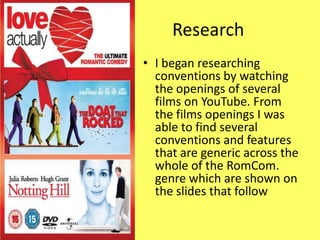
• I began researching
  conventions by watching
  the openings of several
  films on YouTube. From
  the films openings I was
  able to find several
  conventions and features
  that are generic across the
  whole of the RomCom.
  genre which are shown on
  the slides that follow
Characters
•      This genre has four main character types which are
  generic across most of the genre these types are:
• The Protagonist, either a played straight character, or a hapless foolish character
• The Antagonist, the opposition to the protagonist getting the romantic intrest
• The Love/Romantic Intrest, the object of enamour for the protagonist and
    the main goal is to be with at the end of the film

• The Deuteragonist (sidekick) mentor/fool/comic relief,
    the ying to the protagonists yang, this charecter compliments the protagonist, usually having the
    opposite charecteristics. They can mentor the charecter in trying to get the romantic intrest or
    just be the comic relief to the intensity of the main charecter.
Narrative Structure


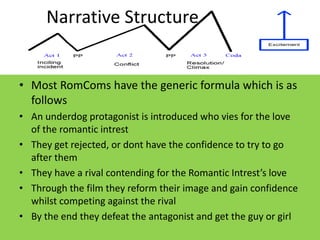
• Most RomComs have the generic formula which is as
  follows
• An underdog protagonist is introduced who vies for the love
  of the romantic intrest
• They get rejected, or dont have the confidence to try to go
  after them
• They have a rival contending for the Romantic Intrest’s love
• Through the film they reform their image and gain confidence
  whilst competing against the rival
• By the end they defeat the antagonist and get the guy or girl
Representations

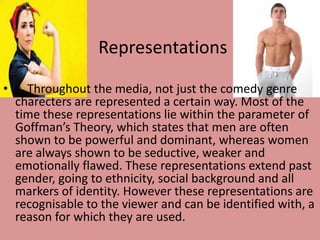
•     Throughout the media, not just the comedy genre
    charecters are represented a certain way. Most of the
    time these representations lie within the parameter of
    Goffman’s Theory, which states that men are often
    shown to be powerful and dominant, whereas women
    are always shown to be seductive, weaker and
    emotionally flawed. These representations extend past
    gender, going to ethnicity, social background and all
    markers of identity. However these representations are
    recognisable to the viewer and can be identified with, a
    reason for which they are used.
Diegetic Sounds
Non Diegetic Sounds
Foleys
Atmospheric Music
Conclusion
In synopsis, my investigation of this genre, has
made me more aware of it’s conventions and
features. I feel that now that I am familiar with
these, I would like to do this genre for my main
task as I enjoy RomCom films and thus feel that
it would be relatively simple and quite fun for
me to create a RomCom opening for my main
task

Conventions of the RomCom

  • 1.
    Conventions Of The RomCom/Comedy Genre An analyitacal investigation into the comedy genre and all of ts most popular conventions in order to give me a solid understanding of the genre beforre starting my main task
  • 2.
    Research • I beganresearching conventions by watching the openings of several films on YouTube. From the films openings I was able to find several conventions and features that are generic across the whole of the RomCom. genre which are shown on the slides that follow
  • 3.
    Characters • This genre has four main character types which are generic across most of the genre these types are: • The Protagonist, either a played straight character, or a hapless foolish character • The Antagonist, the opposition to the protagonist getting the romantic intrest • The Love/Romantic Intrest, the object of enamour for the protagonist and the main goal is to be with at the end of the film • The Deuteragonist (sidekick) mentor/fool/comic relief, the ying to the protagonists yang, this charecter compliments the protagonist, usually having the opposite charecteristics. They can mentor the charecter in trying to get the romantic intrest or just be the comic relief to the intensity of the main charecter.
  • 4.
    Narrative Structure • MostRomComs have the generic formula which is as follows • An underdog protagonist is introduced who vies for the love of the romantic intrest • They get rejected, or dont have the confidence to try to go after them • They have a rival contending for the Romantic Intrest’s love • Through the film they reform their image and gain confidence whilst competing against the rival • By the end they defeat the antagonist and get the guy or girl
  • 5.
    Representations • Throughout the media, not just the comedy genre charecters are represented a certain way. Most of the time these representations lie within the parameter of Goffman’s Theory, which states that men are often shown to be powerful and dominant, whereas women are always shown to be seductive, weaker and emotionally flawed. These representations extend past gender, going to ethnicity, social background and all markers of identity. However these representations are recognisable to the viewer and can be identified with, a reason for which they are used.
  • 6.
    Diegetic Sounds Non DiegeticSounds Foleys Atmospheric Music
  • 7.
    Conclusion In synopsis, myinvestigation of this genre, has made me more aware of it’s conventions and features. I feel that now that I am familiar with these, I would like to do this genre for my main task as I enjoy RomCom films and thus feel that it would be relatively simple and quite fun for me to create a RomCom opening for my main task

Editor's Notes

  • #4 Protagonist -this is the character that the audience routes for, he/she is usually the new kid in school,the new employee, or generally the “rookie” character in any setting. The audience is meant to connect emotionally with this figure, as they are able to identify with their feelings of exclusion and inability to get the girl or guy. Conventionally, the protagonist starts off in the film as the geeky nerdy charecter with little status or apparent beauty, yet as the film progresses they gain status and in chick flick comedys, get a makeover, and finsh the film as the sexy convident charecter that they wicherd they were at the start of the film, as in “The Princess Diaries” with Anne Hathaway’s role. This character can be played straight, meaning that they lack of comedy and generally don’t react to or notice the comedy in other aspects of the film, as in Adam Sandeler’s role in the RomCom “50 Firsts Dates”. Playing straight doesnt mean the charecter isn’t funny, ratehr that they are not the main spource of the humour rather their reactions to the sometimes bizzare charactersand situations they encounter is, as Adam Sandeler was to the humourous charecter of Drew Barrymore. On the otherhand, they may be the comedic charecter in the film whose social awkwardness, or backfired efforts can create lots of humour in the film. Regardless of which way the charecter is played they are very endearing for the audience as the viewer asscoiates with the charecters plight and wants them to succeed.Antagonist- thischaracter has usually been round the block a few times and has been able to establish themselves as the king or queen of the situation and the top of the pile. In RomComs they are usually the current jerkass boyfriend or cheating girlfriend of the protagonists love intrest, or they too are competing for the love of the love intrest. They always seem to be the more obvious choice for the romantic intrest, as they start the film usually as the high status, fit of form Jock or Popular Girl but nearly always by the denonument are portryed as petty and lacking in beauty compared to the newly reformed protagonist. This character traditionally sees the entrance of the protagonist as a threat to their status anddoes all that they can to cement it by pushing the protagonist down. By the end of the film the antagonist usually gets their comeuppance as their efforts backfire and they end up on the bottom of the social heirarchy and the protagonist at the top. In a series we have more time to explore characters, so usually we discover what it was that turned them so evil or petty in the first place, as with the mother charecter in the tv sit-com Miranda. This can partially be seen in movies yet to to sucha deep extent as they dont have the time, as in Mean Girls, where we discover it was all parental pushiness that drove the antagonist to act in a certain way. In some films instead of ending up at the bottom they may reform and become a friend of the protagonist once they set aside their differences and work together to reach a goal.The Romantic Intrest- this is a key stock charecter in the RomCom genre being an object of attraction for the protagonist. Conventionally this charecter is often a female friendof the protagonist, who might have freindzoned him or doesn’t think he likes her, yet the charecter can be a male, as in Disney’s Cinderella. Thisromantic love interest can be divided into two characters, as in the case of along came Polly wherein Ben Stiller cant decide between two girls.Deuteragonist (sidekick)- this is the ying to the protagonists yang, this charecter compliments the protagonist, usually having the opposite charecteristics. They can mentor the charecter in trying to get the romantic intrest or just be the comic relief to the intensity of the main charecter.
  • #6 In RomComs these conventions of representations are as follows: The protagonist: this character in RomComs is nearly always a white male, as demonstrated by the films Along Came Polly,50 First Dates among many others. This is usually done because it is society’s perception that it is the guy that should go after the girl and certainly in western society, white ethnicity is the majority so is the one that is portrayed most often. However in more modern films, such as The Proposal and Leap Year, this idea of the male falling hopelessly in love is being subverted, with the girl chasing the guy in correspondence to rising feminist views. However films portraying this idea is still relatively rare. Antagonist: This character is conventionally the handsome Jock or the beautiful popular girl. Representations of these characters tend to portray the beautiful as brainless and stupid, all brawn no brain, and the reverse is true, ugly but smart (however these “ugly” characters usually end up beautiful at the end). These characters are also portrayed as spiteful and mean even beyond the point of realism, just to distinguish for the audience that this is “the baddie” so to speak.Ethnicity: This plays a great part of the modern media. Although now removed from its racist roots, characters of different origins tend to conform to stereotypes, especially in this genre, as this is where comic relief can be found. A prime example of this the Sassy Black Woman stock character, wherein any fat black woman will be portrayed as vivaciousand loud and unafraid to speak her mind. In comedies where the female is the lead, they often play the deuteragonist as they can make a good counterpoint to the more grim or snarky members of the cast. A male example shows all black males to be good at basketball and smooth with the ladies, a reason to be made the protagonists sidekick/mentor. It is also very rare to see ethnic characters made the standalone lead in these films without a point being made of the fact they are ethnic, again a nod to society's previously, and perhaps currently racist views.Sexuality: in the media, especially RomComs there sexuality nearly always means heterosexuality. Gay characters are nearly always male and there is the strong representation of the “camp gay” who will often speak with a lisp, and is given to flouncing, prancing, and standing with one hand on his hip as the other is held out in a limp-wristed gesture. Although attitudes are slowly changing, as demonstrated by media such as the TV program “Glee”, this is representation is still extremly prominent.
  • #7 In the RomCom genre, many different sound devices are use to create effect. The most common of these is atmospheric music. This usually takes the form of lively upbeat songs, such as in the opening to 50 First Dates, which it begins with a slow romantic ukulele strum, a reference to the Rom of RomCom, which is quickly juxtaposed by a lively upbeat track, setting the tone for the comical fast paced events to follow. It’s not just music that’s used however, Directors like to make use of diegetic sounds, particularly bird song, to infer the natural love that is forming on the screen. However in the comedy and RomCom genre atmospheric music is the main audio device, as Foleys and other sounds are more typical in the thriller/horror genre as they seem to be slightly out of place in the romantic RomCom world.