Control Theory
11/2/23 Control Theory, Lecture-4: Modeling in time domain 1
Fatma Yildiz Tascikaraoglu
Mugla Sitki Kocman Univeristy
Electrical and Electronics Engineering
fatmayildiz@mu.edu.tr,
2023-2024 / Fall semester
Lecture-4
Modeling in the time domain
11/2/23 2
Control Theory, Lecture-4: Modeling in time domain
Modeling in the time domain
11/2/23 3
Two approaches are available for the analysis and design of feedback control
systems.
• The first is known as the classical or frequency-domain technique which is
based on converting a system’s differential equation to a transfer function,
thus generating a mathematical model of the system that algebraically
relates a representation of the output to a representation of the input.
• The second is known as the state-space approach (also referred to as the
modern, or time-domain approach) which is a unified method for modeling,
analyzing, and designing a wide range of systems.
• The state-space approach can be used to represent
• nonlinear systems that have backlash, saturation, and dead zone
• systems with nonzero initial conditions
• time-varying systems
• multiple-input, multiple-output systems
Control Theory, Lecture-4: Modeling in time domain
The general state space representation
11/2/23 4
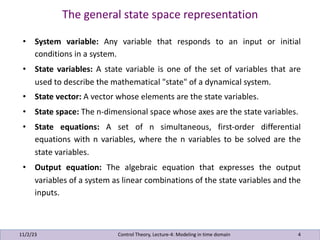
• System variable: Any variable that responds to an input or initial
conditions in a system.
• State variables: A state variable is one of the set of variables that are
used to describe the mathematical "state" of a dynamical system.
• State vector: A vector whose elements are the state variables.
• State space: The n-dimensional space whose axes are the state variables.
• State equations: A set of n simultaneous, first-order differential
equations with n variables, where the n variables to be solved are the
state variables.
• Output equation: The algebraic equation that expresses the output
variables of a system as linear combinations of the state variables and the
inputs.
Control Theory, Lecture-4: Modeling in time domain
The general state space representation
11/2/23 5
Control Theory, Lecture-4: Modeling in time domain
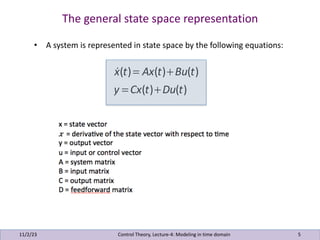
• A system is represented in state space by the following equations:
!
x(t)= Ax(t)+Bu(t)
y = Cx(t)+Du(t)
Applying the state space representation
11/2/23 6
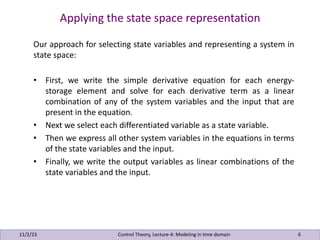
Our approach for selecting state variables and representing a system in
state space:
• First, we write the simple derivative equation for each energy-
storage element and solve for each derivative term as a linear
combination of any of the system variables and the input that are
present in the equation.
• Next we select each differentiated variable as a state variable.
• Then we express all other system variables in the equations in terms
of the state variables and the input.
• Finally, we write the output variables as linear combinations of the
state variables and the input.
Control Theory, Lecture-4: Modeling in time domain
Example 1 - Representing an Electrical Network, (1)
11/2/23 7
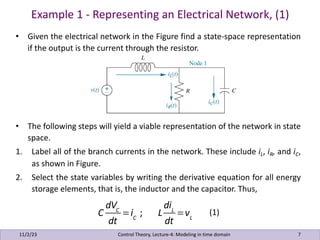
• Given the electrical network in the Figure find a state-space representation
if the output is the current through the resistor.
• The following steps will yield a viable representation of the network in state
space.
1. Label all of the branch currents in the network. These include iL, iR, and iC,
as shown in Figure.
2. Select the state variables by writing the derivative equation for all energy
storage elements, that is, the inductor and the capacitor. Thus,
Control Theory, Lecture-4: Modeling in time domain
C
dVC
dt
= iC
; L
diL
dt
= vL
(1)
Example 1 - Representing an Electrical Network, (2)
11/2/23 8
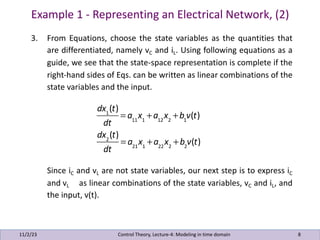
3. From Equations, choose the state variables as the quantities that
are differentiated, namely vC and iL. Using following equations as a
guide, we see that the state-space representation is complete if the
right-hand sides of Eqs. can be written as linear combinations of the
state variables and the input.
Since iC and vL are not state variables, our next step is to express iC
and vL as linear combinations of the state variables, vC and iL, and
the input, v(t).
Control Theory, Lecture-4: Modeling in time domain
dx1
(t)
dt
= a11
x1
+a12
x2
+b1
v(t)
dx2
(t)
dt
= a21
x1
+a22
x2
+b2
v(t)
Example 1 - Representing an Electrical Network, (3)
11/2/23 9
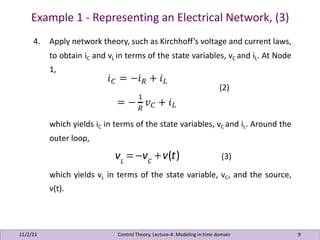
4. Apply network theory, such as Kirchhoff’s voltage and current laws,
to obtain iC and vL in terms of the state variables, vC and iL. At Node
1,
(2)
which yields iC in terms of the state variables, vC and iL. Around the
outer loop,
(3)
which yields vL in terms of the state variable, vC, and the source,
v(t).
Control Theory, Lecture-4: Modeling in time domain
vL
= −vC
+v(t)
Example 1 - Representing an Electrical Network, (4)
11/2/23 10
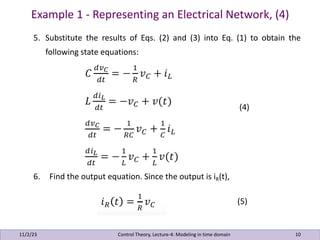
5. Substitute the results of Eqs. (2) and (3) into Eq. (1) to obtain the
following state equations:
(4)
6. Find the output equation. Since the output is iR(t),
(5)
Control Theory, Lecture-4: Modeling in time domain
Example 1 - Representing an Electrical Network, (5)
11/2/23 11
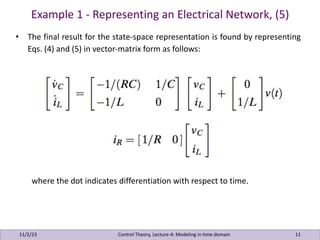
• The final result for the state-space representation is found by representing
Eqs. (4) and (5) in vector-matrix form as follows:
where the dot indicates differentiation with respect to time.
Control Theory, Lecture-4: Modeling in time domain
Example 2 - Representing an Electrical Network, (1)
11/2/23 12
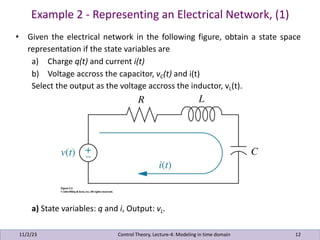
• Given the electrical network in the following figure, obtain a state space
representation if the state variables are
a) Charge q(t) and current i(t)
b) Voltage accross the capacitor, vC(t) and i(t)
Select the output as the voltage accross the inductor, vL(t).
a) State variables: q and i, Output: vL.
Control Theory, Lecture-4: Modeling in time domain
Example 2 - Representing an Electrical Network, (2)
11/2/23 13
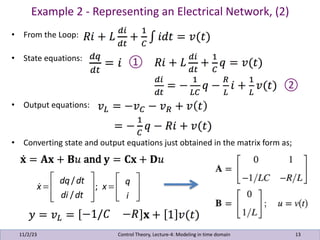
• From the Loop:
• State equations:
• Output equations:
• Converting state and output equations just obtained in the matrix form as;
Control Theory, Lecture-4: Modeling in time domain
①
②
!
x =
dq/dt
di /dt
⎡
⎣
⎢
⎢
⎤
⎦
⎥
⎥
; x =
q
i
⎡
⎣
⎢
⎢
⎤
⎦
⎥
⎥
Example 2 - Representing an Electrical Network, (3)
11/2/23 14
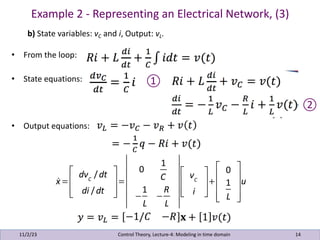
b) State variables: vC and i, Output: vL.
• From the loop:
• State equations:
• Output equations:
Control Theory, Lecture-4: Modeling in time domain
①
②
!
x =
dvC
/dt
di /dt
⎡
⎣
⎢
⎢
⎤
⎦
⎥
⎥
=
0
1
C
−
1
L
−
R
L
⎡
⎣
⎢
⎢
⎢
⎢
⎤
⎦
⎥
⎥
⎥
⎥
vC
i
⎡
⎣
⎢
⎢
⎤
⎦
⎥
⎥
+
0
1
L
⎡
⎣
⎢
⎢
⎢
⎤
⎦
⎥
⎥
⎥
u
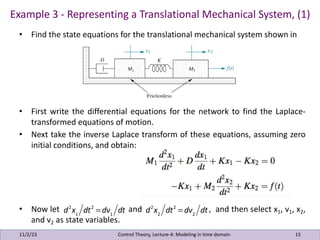
• Find the state equations for the translational mechanical system shown in
• First write the differential equations for the network to find the Laplace-
transformed equations of motion.
• Next take the inverse Laplace transform of these equations, assuming zero
initial conditions, and obtain:
• Now let and , and then select x1, v1, x2,
and v2 as state variables.
Example 3 - Representing a Translational Mechanical System, (1)
11/2/23 15
Control Theory, Lecture-4: Modeling in time domain
d2
x1
dt2
= dv1
dt d2
x2
dt2
= dv2
dt
Example 3 - Representing a Translational Mechanical System, (2)
11/2/23 16
Control Theory, Lecture-4: Modeling in time domain
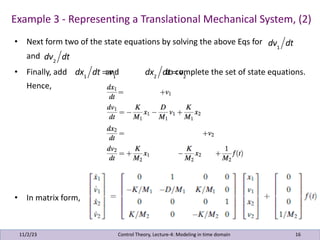
• Next form two of the state equations by solving the above Eqs for
and
• Finally, add and to complete the set of state equations.
Hence,
• In matrix form,
dv1
dt
dv2
dt
dx1
dt = v1
dx2
dt = v2
Example 4 - Converting a Transfer Function with
Constant Term in Numerator, (1)
11/2/23 17
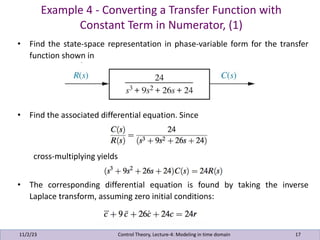
• Find the state-space representation in phase-variable form for the transfer
function shown in
• Find the associated differential equation. Since
cross-multiplying yields
• The corresponding differential equation is found by taking the inverse
Laplace transform, assuming zero initial conditions:
Control Theory, Lecture-4: Modeling in time domain
Example 4 - Converting a Transfer Function with
Constant Term in Numerator, (2)
11/2/23 18
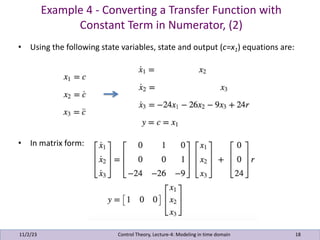
• Using the following state variables, state and output (c=x1) equations are:
• In matrix form:
Control Theory, Lecture-4: Modeling in time domain
Example 4 - Converting a Transfer Function with
Constant Term in Numerator, (3)
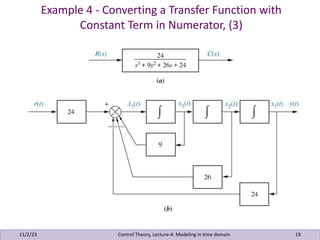
11/2/23 19
Control Theory, Lecture-4: Modeling in time domain
Example 5 - Converting a Transfer Function with Polynomial in
Numerator, (1)
11/2/23 20
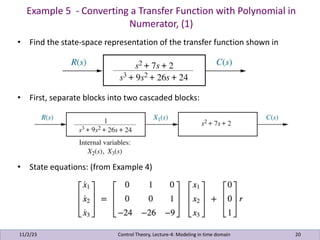
• Find the state-space representation of the transfer function shown in
• First, separate blocks into two cascaded blocks:
• State equations: (from Example 4)
Control Theory, Lecture-4: Modeling in time domain
Example 5 - Converting a Transfer Function with Polynomial in
Numerator, (2)
11/2/23 21
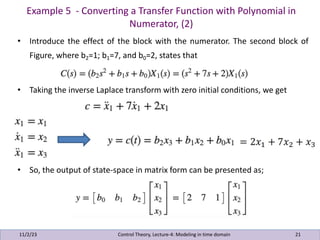
• Introduce the effect of the block with the numerator. The second block of
Figure, where b2=1; b1=7, and b0=2, states that
• Taking the inverse Laplace transform with zero initial conditions, we get
• So, the output of state-space in matrix form can be presented as;
Control Theory, Lecture-4: Modeling in time domain
Example 5 - Converting a Transfer Function with Polynomial in
Numerator, (3)
11/2/23 22
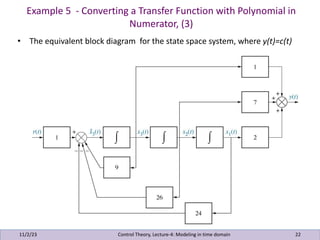
• The equivalent block diagram for the state space system, where y(t)=c(t)
Control Theory, Lecture-4: Modeling in time domain
Converting from State Space to a Transfer Function
11/2/23 23
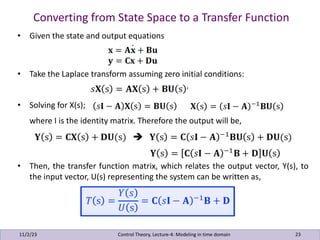
• Given the state and output equations
• Take the Laplace transform assuming zero initial conditions:
• Solving for X(s);
where I is the identity matrix. Therefore the output will be,
• Then, the transfer function matrix, which relates the output vector, Y(s), to
the input vector, U(s) representing the system can be written as,
Control Theory, Lecture-4: Modeling in time domain
Example 6 – SS to TF, (1)
11/2/23 24
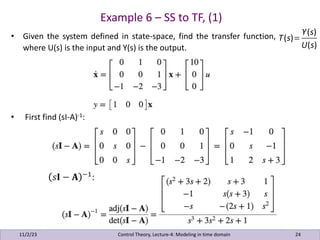
• Given the system defined in state-space, find the transfer function,
where U(s) is the input and Y(s) is the output.
• First find (sI-A)-1:
Control Theory, Lecture-4: Modeling in time domain
T(s)=
Y(s)
U(s)
Example 6 – SS to TF, (2)
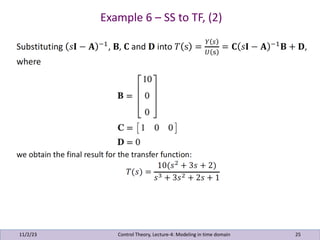
11/2/23 25
Control Theory, Lecture-4: Modeling in time domain

Control Theory Lecture 4: State-Space Representation

  • 1.
    Control Theory 11/2/23 ControlTheory, Lecture-4: Modeling in time domain 1 Fatma Yildiz Tascikaraoglu Mugla Sitki Kocman Univeristy Electrical and Electronics Engineering fatmayildiz@mu.edu.tr, 2023-2024 / Fall semester
  • 2.
    Lecture-4 Modeling in thetime domain 11/2/23 2 Control Theory, Lecture-4: Modeling in time domain
  • 3.
    Modeling in thetime domain 11/2/23 3 Two approaches are available for the analysis and design of feedback control systems. • The first is known as the classical or frequency-domain technique which is based on converting a system’s differential equation to a transfer function, thus generating a mathematical model of the system that algebraically relates a representation of the output to a representation of the input. • The second is known as the state-space approach (also referred to as the modern, or time-domain approach) which is a unified method for modeling, analyzing, and designing a wide range of systems. • The state-space approach can be used to represent • nonlinear systems that have backlash, saturation, and dead zone • systems with nonzero initial conditions • time-varying systems • multiple-input, multiple-output systems Control Theory, Lecture-4: Modeling in time domain
  • 4.
    The general statespace representation 11/2/23 4 • System variable: Any variable that responds to an input or initial conditions in a system. • State variables: A state variable is one of the set of variables that are used to describe the mathematical "state" of a dynamical system. • State vector: A vector whose elements are the state variables. • State space: The n-dimensional space whose axes are the state variables. • State equations: A set of n simultaneous, first-order differential equations with n variables, where the n variables to be solved are the state variables. • Output equation: The algebraic equation that expresses the output variables of a system as linear combinations of the state variables and the inputs. Control Theory, Lecture-4: Modeling in time domain
  • 5.
    The general statespace representation 11/2/23 5 Control Theory, Lecture-4: Modeling in time domain • A system is represented in state space by the following equations: ! x(t)= Ax(t)+Bu(t) y = Cx(t)+Du(t)
  • 6.
    Applying the statespace representation 11/2/23 6 Our approach for selecting state variables and representing a system in state space: • First, we write the simple derivative equation for each energy- storage element and solve for each derivative term as a linear combination of any of the system variables and the input that are present in the equation. • Next we select each differentiated variable as a state variable. • Then we express all other system variables in the equations in terms of the state variables and the input. • Finally, we write the output variables as linear combinations of the state variables and the input. Control Theory, Lecture-4: Modeling in time domain
  • 7.
    Example 1 -Representing an Electrical Network, (1) 11/2/23 7 • Given the electrical network in the Figure find a state-space representation if the output is the current through the resistor. • The following steps will yield a viable representation of the network in state space. 1. Label all of the branch currents in the network. These include iL, iR, and iC, as shown in Figure. 2. Select the state variables by writing the derivative equation for all energy storage elements, that is, the inductor and the capacitor. Thus, Control Theory, Lecture-4: Modeling in time domain C dVC dt = iC ; L diL dt = vL (1)
  • 8.
    Example 1 -Representing an Electrical Network, (2) 11/2/23 8 3. From Equations, choose the state variables as the quantities that are differentiated, namely vC and iL. Using following equations as a guide, we see that the state-space representation is complete if the right-hand sides of Eqs. can be written as linear combinations of the state variables and the input. Since iC and vL are not state variables, our next step is to express iC and vL as linear combinations of the state variables, vC and iL, and the input, v(t). Control Theory, Lecture-4: Modeling in time domain dx1 (t) dt = a11 x1 +a12 x2 +b1 v(t) dx2 (t) dt = a21 x1 +a22 x2 +b2 v(t)
  • 9.
    Example 1 -Representing an Electrical Network, (3) 11/2/23 9 4. Apply network theory, such as Kirchhoff’s voltage and current laws, to obtain iC and vL in terms of the state variables, vC and iL. At Node 1, (2) which yields iC in terms of the state variables, vC and iL. Around the outer loop, (3) which yields vL in terms of the state variable, vC, and the source, v(t). Control Theory, Lecture-4: Modeling in time domain vL = −vC +v(t)
  • 10.
    Example 1 -Representing an Electrical Network, (4) 11/2/23 10 5. Substitute the results of Eqs. (2) and (3) into Eq. (1) to obtain the following state equations: (4) 6. Find the output equation. Since the output is iR(t), (5) Control Theory, Lecture-4: Modeling in time domain
  • 11.
    Example 1 -Representing an Electrical Network, (5) 11/2/23 11 • The final result for the state-space representation is found by representing Eqs. (4) and (5) in vector-matrix form as follows: where the dot indicates differentiation with respect to time. Control Theory, Lecture-4: Modeling in time domain
  • 12.
    Example 2 -Representing an Electrical Network, (1) 11/2/23 12 • Given the electrical network in the following figure, obtain a state space representation if the state variables are a) Charge q(t) and current i(t) b) Voltage accross the capacitor, vC(t) and i(t) Select the output as the voltage accross the inductor, vL(t). a) State variables: q and i, Output: vL. Control Theory, Lecture-4: Modeling in time domain
  • 13.
    Example 2 -Representing an Electrical Network, (2) 11/2/23 13 • From the Loop: • State equations: • Output equations: • Converting state and output equations just obtained in the matrix form as; Control Theory, Lecture-4: Modeling in time domain ① ② ! x = dq/dt di /dt ⎡ ⎣ ⎢ ⎢ ⎤ ⎦ ⎥ ⎥ ; x = q i ⎡ ⎣ ⎢ ⎢ ⎤ ⎦ ⎥ ⎥
  • 14.
    Example 2 -Representing an Electrical Network, (3) 11/2/23 14 b) State variables: vC and i, Output: vL. • From the loop: • State equations: • Output equations: Control Theory, Lecture-4: Modeling in time domain ① ② ! x = dvC /dt di /dt ⎡ ⎣ ⎢ ⎢ ⎤ ⎦ ⎥ ⎥ = 0 1 C − 1 L − R L ⎡ ⎣ ⎢ ⎢ ⎢ ⎢ ⎤ ⎦ ⎥ ⎥ ⎥ ⎥ vC i ⎡ ⎣ ⎢ ⎢ ⎤ ⎦ ⎥ ⎥ + 0 1 L ⎡ ⎣ ⎢ ⎢ ⎢ ⎤ ⎦ ⎥ ⎥ ⎥ u
  • 15.
    • Find thestate equations for the translational mechanical system shown in • First write the differential equations for the network to find the Laplace- transformed equations of motion. • Next take the inverse Laplace transform of these equations, assuming zero initial conditions, and obtain: • Now let and , and then select x1, v1, x2, and v2 as state variables. Example 3 - Representing a Translational Mechanical System, (1) 11/2/23 15 Control Theory, Lecture-4: Modeling in time domain d2 x1 dt2 = dv1 dt d2 x2 dt2 = dv2 dt
  • 16.
    Example 3 -Representing a Translational Mechanical System, (2) 11/2/23 16 Control Theory, Lecture-4: Modeling in time domain • Next form two of the state equations by solving the above Eqs for and • Finally, add and to complete the set of state equations. Hence, • In matrix form, dv1 dt dv2 dt dx1 dt = v1 dx2 dt = v2
  • 17.
    Example 4 -Converting a Transfer Function with Constant Term in Numerator, (1) 11/2/23 17 • Find the state-space representation in phase-variable form for the transfer function shown in • Find the associated differential equation. Since cross-multiplying yields • The corresponding differential equation is found by taking the inverse Laplace transform, assuming zero initial conditions: Control Theory, Lecture-4: Modeling in time domain
  • 18.
    Example 4 -Converting a Transfer Function with Constant Term in Numerator, (2) 11/2/23 18 • Using the following state variables, state and output (c=x1) equations are: • In matrix form: Control Theory, Lecture-4: Modeling in time domain
  • 19.
    Example 4 -Converting a Transfer Function with Constant Term in Numerator, (3) 11/2/23 19 Control Theory, Lecture-4: Modeling in time domain
  • 20.
    Example 5 -Converting a Transfer Function with Polynomial in Numerator, (1) 11/2/23 20 • Find the state-space representation of the transfer function shown in • First, separate blocks into two cascaded blocks: • State equations: (from Example 4) Control Theory, Lecture-4: Modeling in time domain
  • 21.
    Example 5 -Converting a Transfer Function with Polynomial in Numerator, (2) 11/2/23 21 • Introduce the effect of the block with the numerator. The second block of Figure, where b2=1; b1=7, and b0=2, states that • Taking the inverse Laplace transform with zero initial conditions, we get • So, the output of state-space in matrix form can be presented as; Control Theory, Lecture-4: Modeling in time domain
  • 22.
    Example 5 -Converting a Transfer Function with Polynomial in Numerator, (3) 11/2/23 22 • The equivalent block diagram for the state space system, where y(t)=c(t) Control Theory, Lecture-4: Modeling in time domain
  • 23.
    Converting from StateSpace to a Transfer Function 11/2/23 23 • Given the state and output equations • Take the Laplace transform assuming zero initial conditions: • Solving for X(s); where I is the identity matrix. Therefore the output will be, • Then, the transfer function matrix, which relates the output vector, Y(s), to the input vector, U(s) representing the system can be written as, Control Theory, Lecture-4: Modeling in time domain
  • 24.
    Example 6 –SS to TF, (1) 11/2/23 24 • Given the system defined in state-space, find the transfer function, where U(s) is the input and Y(s) is the output. • First find (sI-A)-1: Control Theory, Lecture-4: Modeling in time domain T(s)= Y(s) U(s)
  • 25.
    Example 6 –SS to TF, (2) 11/2/23 25 Control Theory, Lecture-4: Modeling in time domain