Contract farmingCONTRACT FARMINGMADE BY :PINKI GAUR
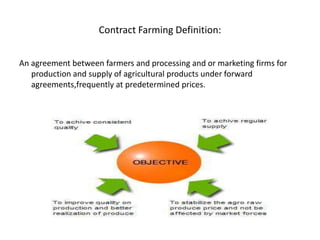
Contract Farming Definition:An agreement between farmers and processing and or marketing firms for production and supply of agricultural products under forward agreements,frequently at predetermined prices.
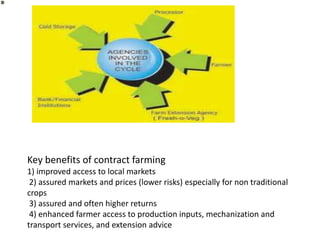
Key benefits of contract farming1) improved access to local markets 2) assured markets and prices (lower risks) especially for non traditional crops 3) assured and often higher returns 4) enhanced farmer access to production inputs, mechanization and transport services, and extension advice
Additional key benefits for contract partners and rural development often include: 1) assured quality and timeliness in delivery of farmers’ products 2) improved local infrastructure, such as roads and irrigation facilities in sugar outgrower areas, tea roads, dairy coolers/collection centres, etc. 3) lower transport costs, as coordinated and larger loads are planned, an especially important feature in the case of more dispersed producers..
Issues of concern related to contract farmingIf the terms of the contract are not respected by one of the contracting parties, then the affected party stands to loseCommon contractual problems include farmer sales to a different buyer (side selling or extra-contractual marketing), a company's refusal to buy products at the agreed prices, or the downgrading of produce quality by the buyer.Contractors also may default by failing to pay agreed prices or by buying less than the pre-agreed quantities.

Contract farming

  • 1.
  • 2.
    Contract Farming Definition:Anagreement between farmers and processing and or marketing firms for production and supply of agricultural products under forward agreements,frequently at predetermined prices.
  • 4.
    Key benefits ofcontract farming1) improved access to local markets 2) assured markets and prices (lower risks) especially for non traditional crops 3) assured and often higher returns 4) enhanced farmer access to production inputs, mechanization and transport services, and extension advice
  • 5.
    Additional key benefitsfor contract partners and rural development often include: 1) assured quality and timeliness in delivery of farmers’ products 2) improved local infrastructure, such as roads and irrigation facilities in sugar outgrower areas, tea roads, dairy coolers/collection centres, etc. 3) lower transport costs, as coordinated and larger loads are planned, an especially important feature in the case of more dispersed producers..
  • 6.
    Issues of concernrelated to contract farmingIf the terms of the contract are not respected by one of the contracting parties, then the affected party stands to loseCommon contractual problems include farmer sales to a different buyer (side selling or extra-contractual marketing), a company's refusal to buy products at the agreed prices, or the downgrading of produce quality by the buyer.Contractors also may default by failing to pay agreed prices or by buying less than the pre-agreed quantities.