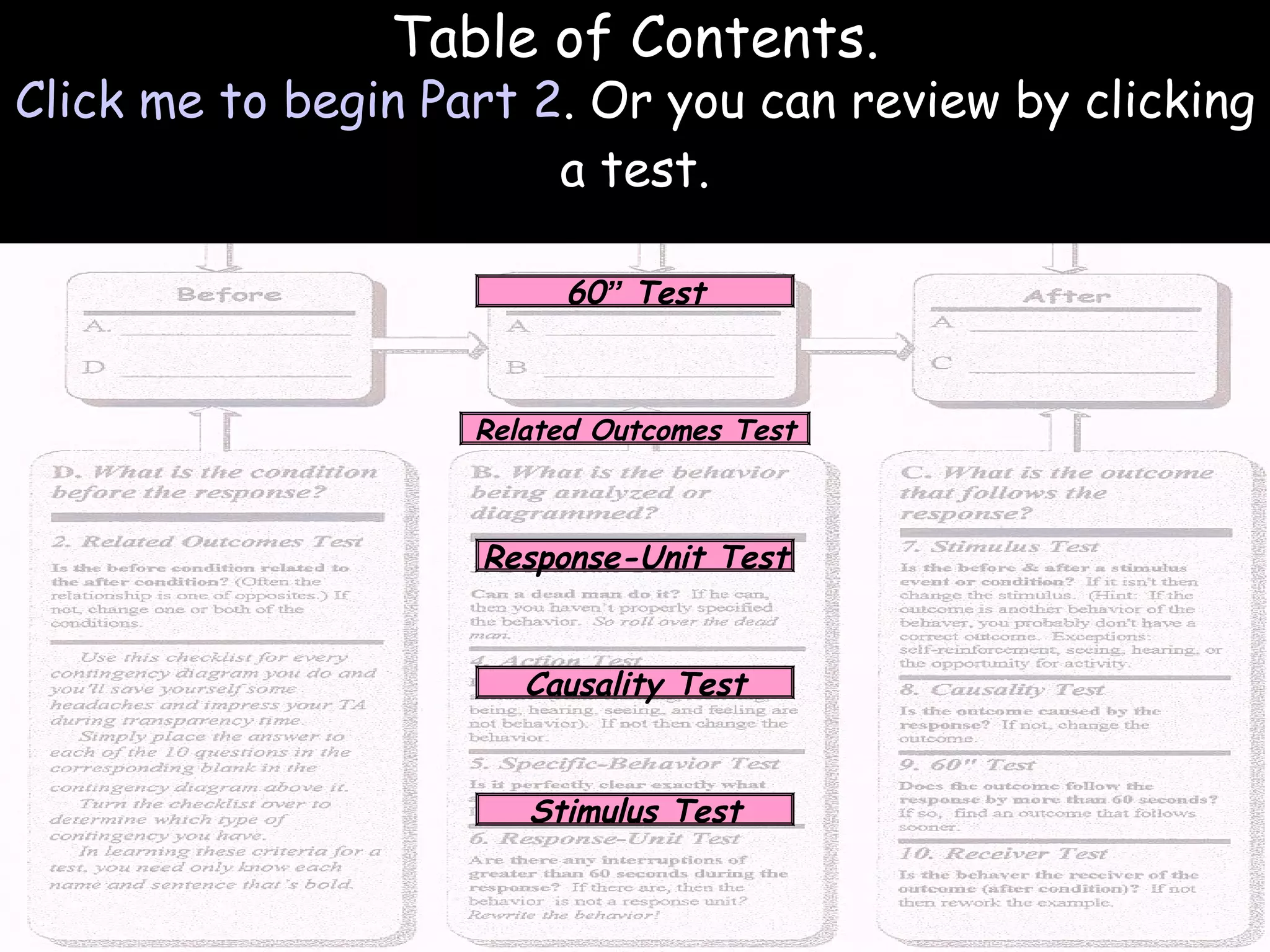
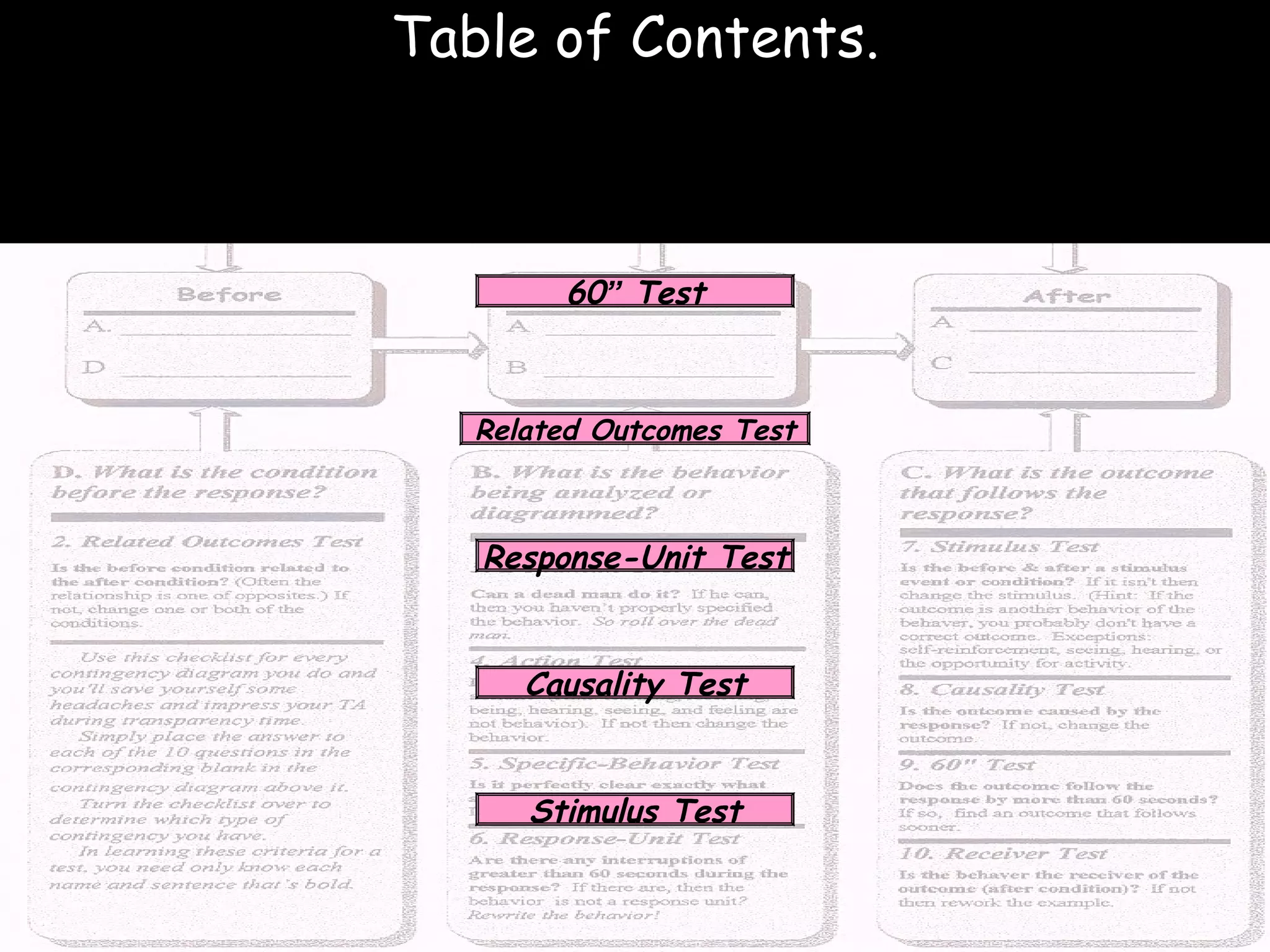
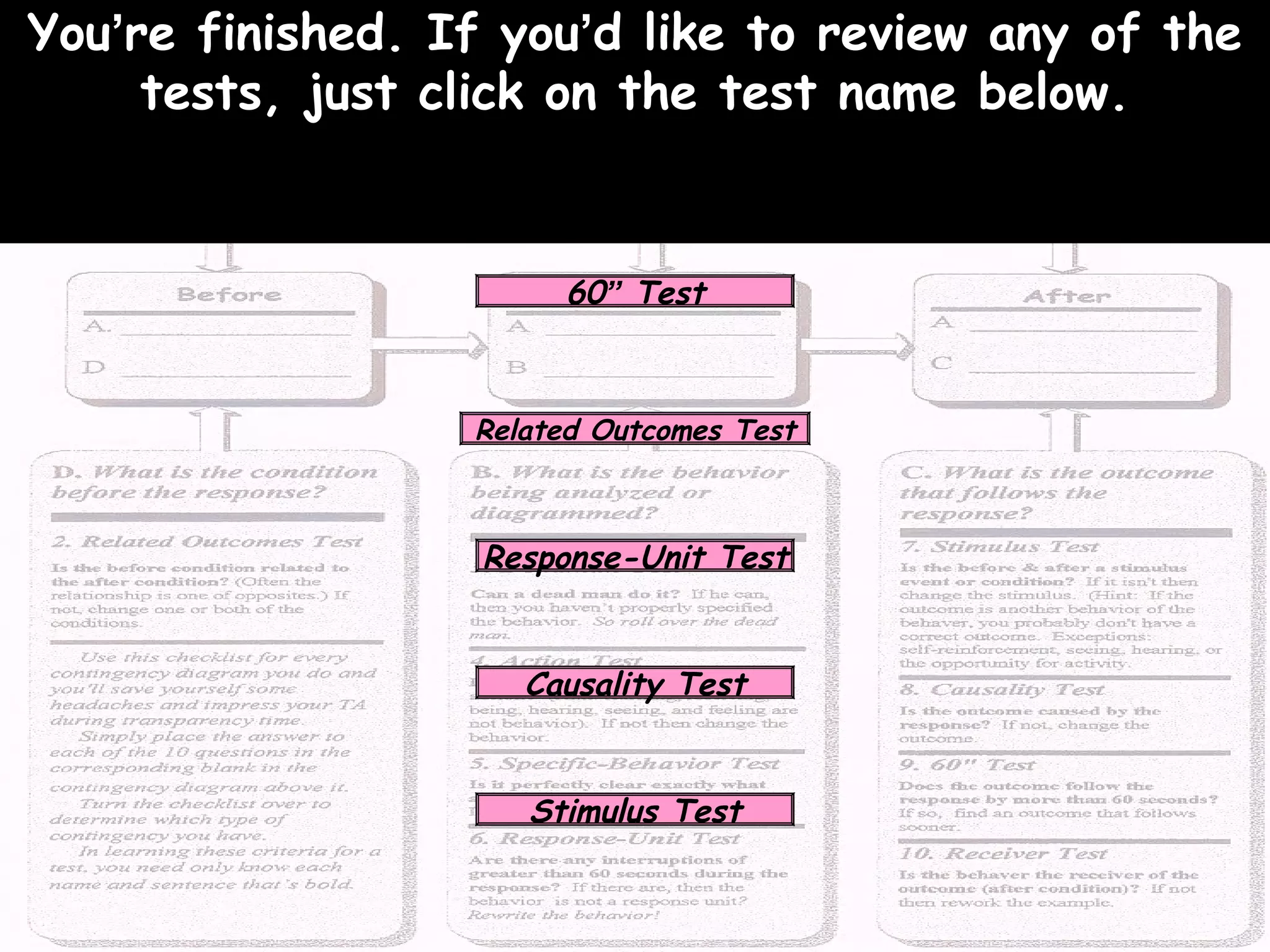
Causality Test Stimulus Test Related Outcomes Test 60 ”  Test Response-Unit Test Table of Contents. Click me to begin Part 2 . Or you can review by clicking a test.
Sixty-Second Test Does the outcome follow the response by more than sixty seconds?
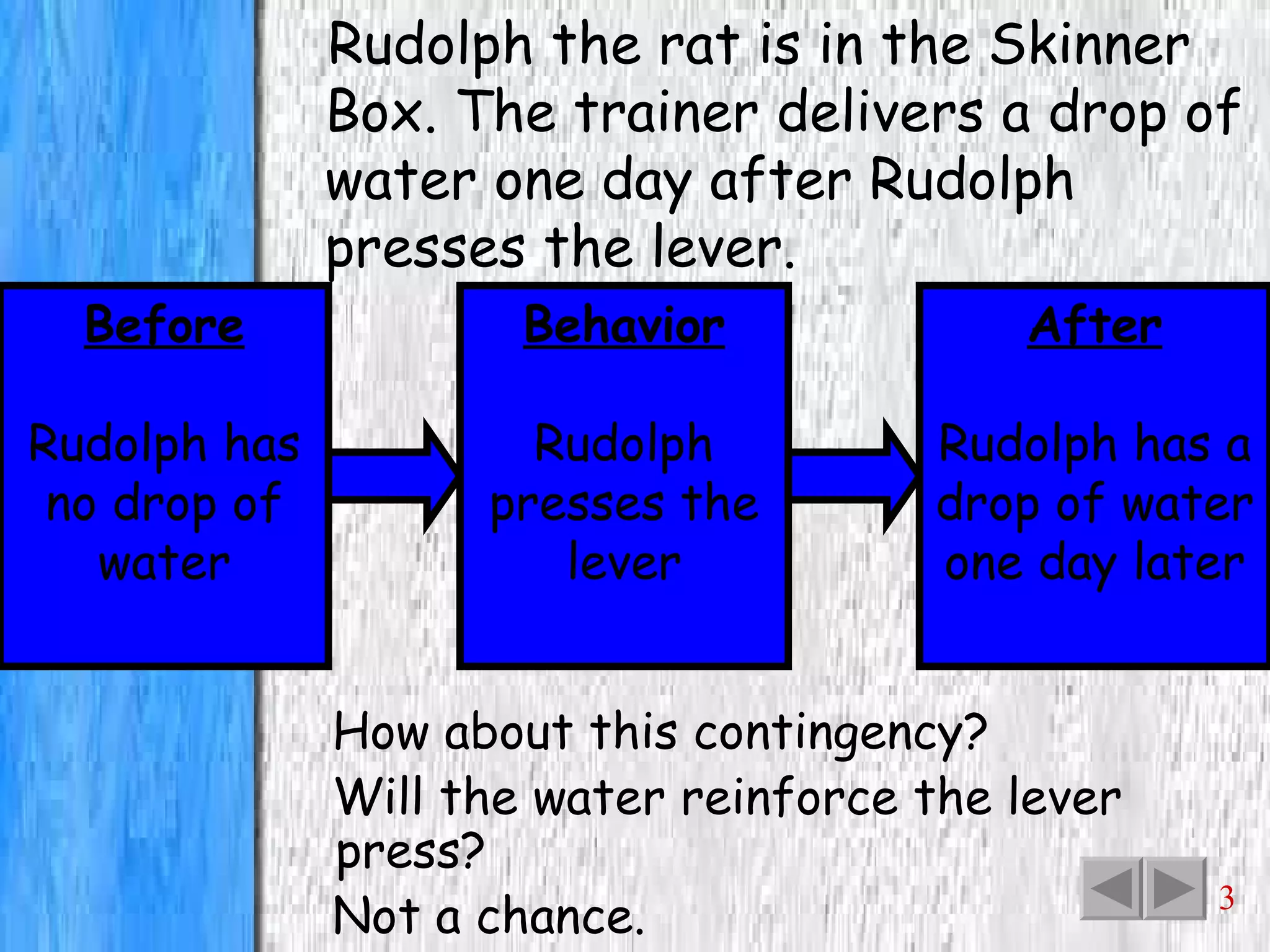
Rudolph the rat is in the Skinner Box. The trainer delivers a drop of water one day after Rudolph presses the lever. Before Rudolph has no drop of water How about this contingency? Will the water reinforce the lever press? Not a chance. Behavior Rudolph presses the lever After Rudolph has a drop of water one day later
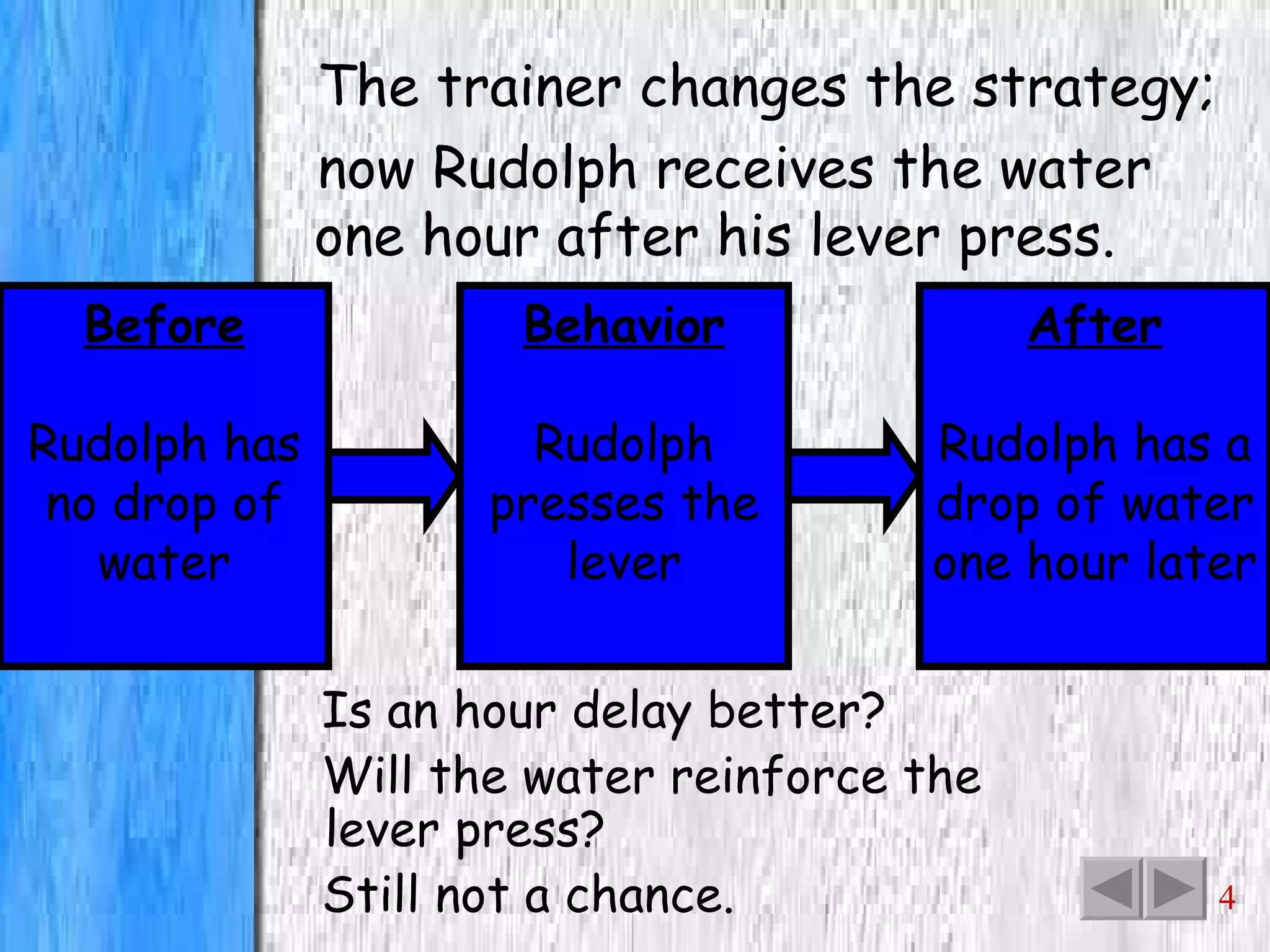
The trainer changes the strategy; now Rudolph receives the water one hour after his lever press. Before Rudolph has no drop of water Is an hour delay better? Will the water reinforce the lever press? Still not a chance. Behavior Rudolph presses the lever After Rudolph has a drop of water one hour later
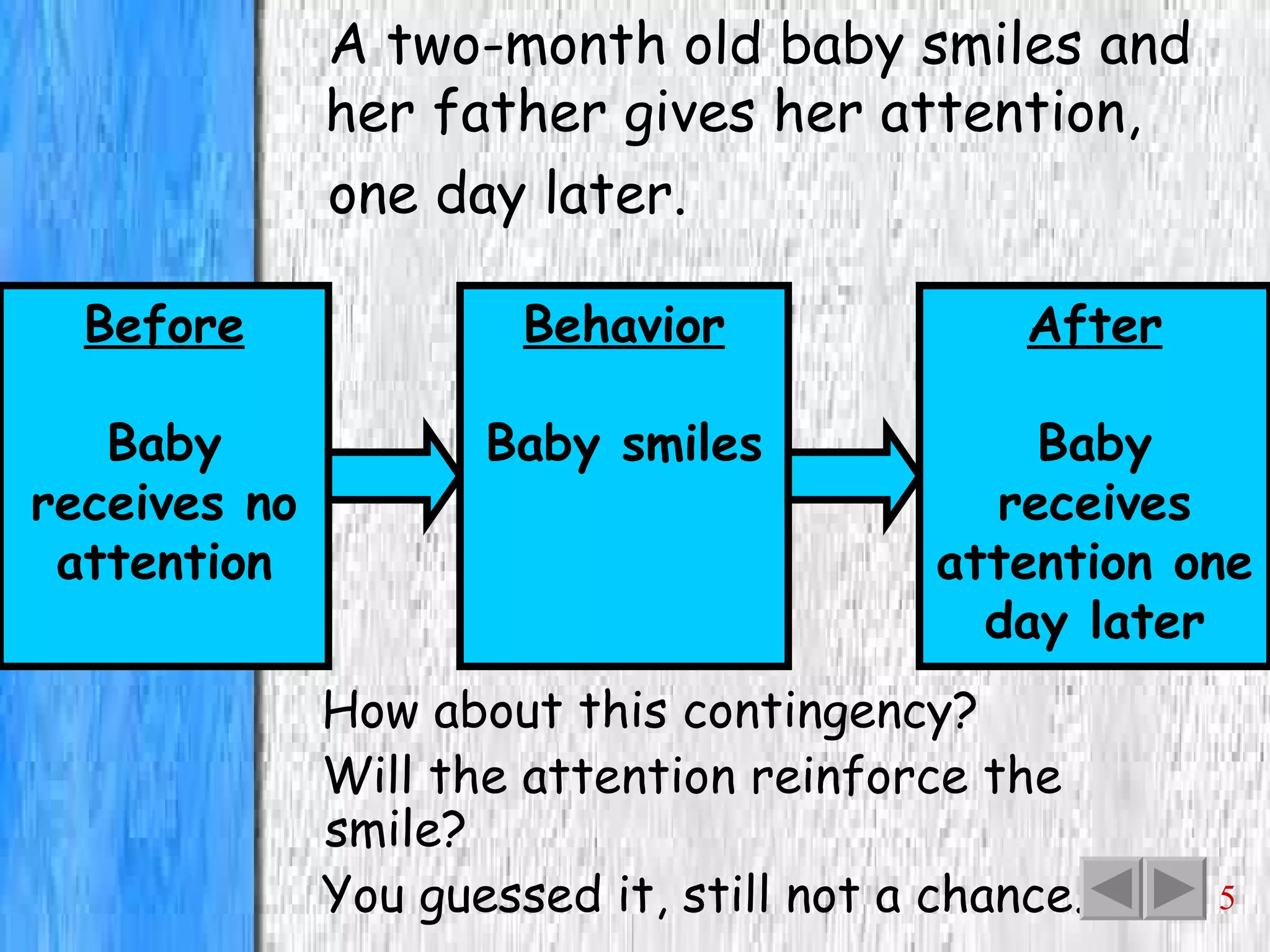
A two-month old baby smiles and her father gives her attention, one day later. Before Baby receives no attention How about this contingency? Will the attention reinforce the smile? You guessed it, still not a chance. Behavior Baby smiles After Baby receives attention one day later
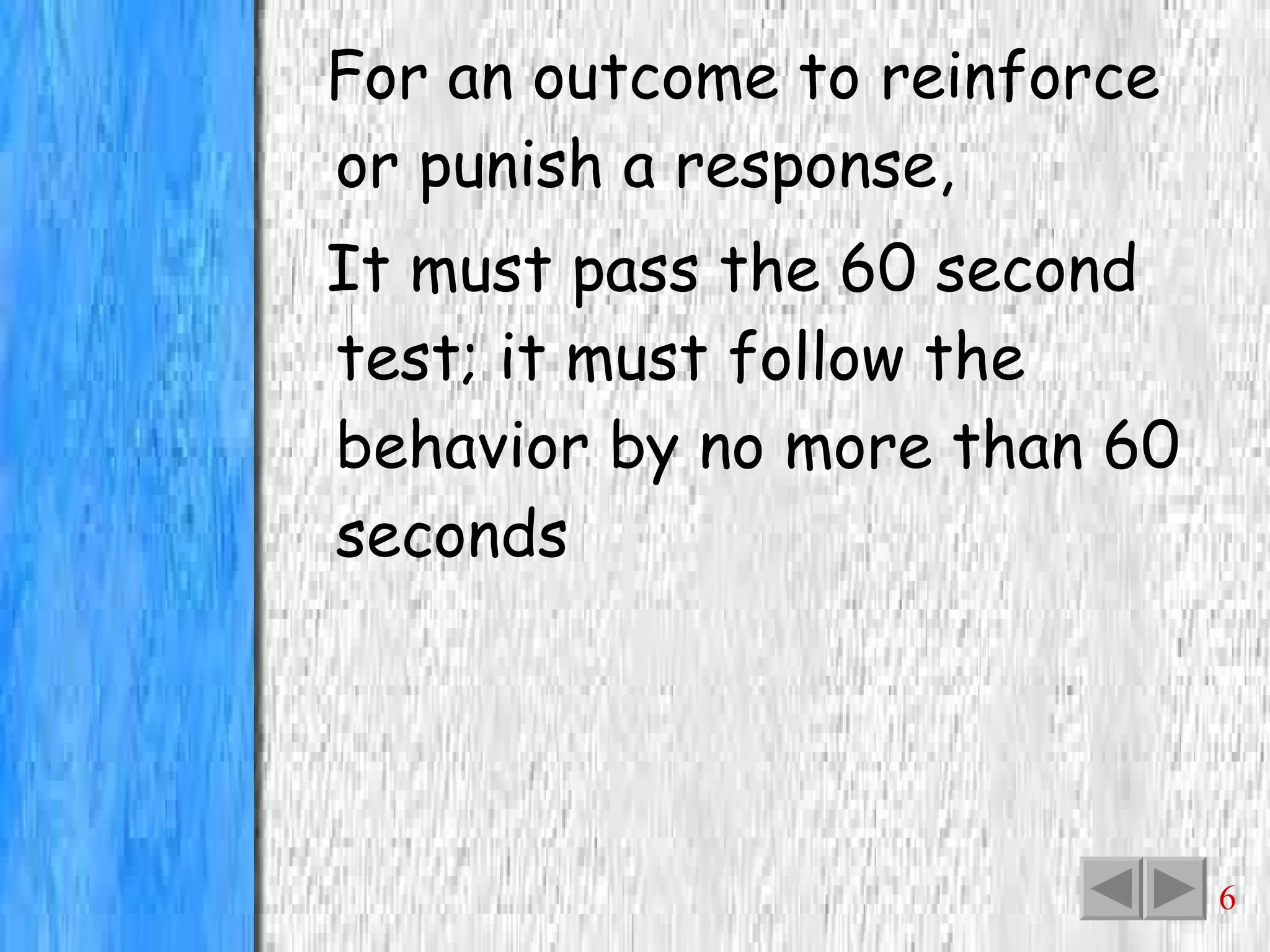
For an outcome to reinforce or punish a response, It must pass the 60 second test; it must follow the behavior by no more than 60 seconds
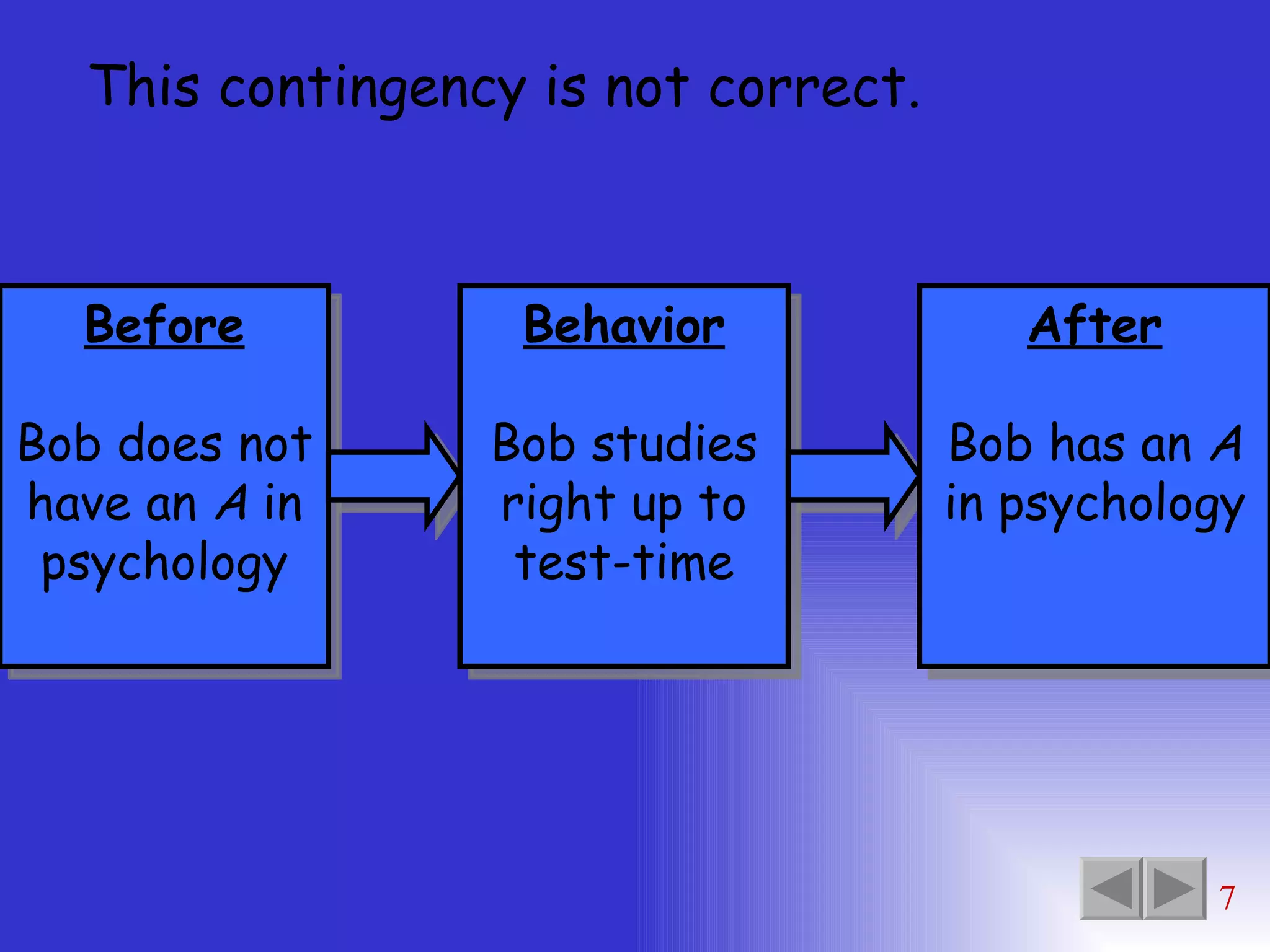
This contingency is not correct. Before Bob does not have an  A  in psychology Behavior Bob studies right up to test-time After Bob has an  A  in psychology
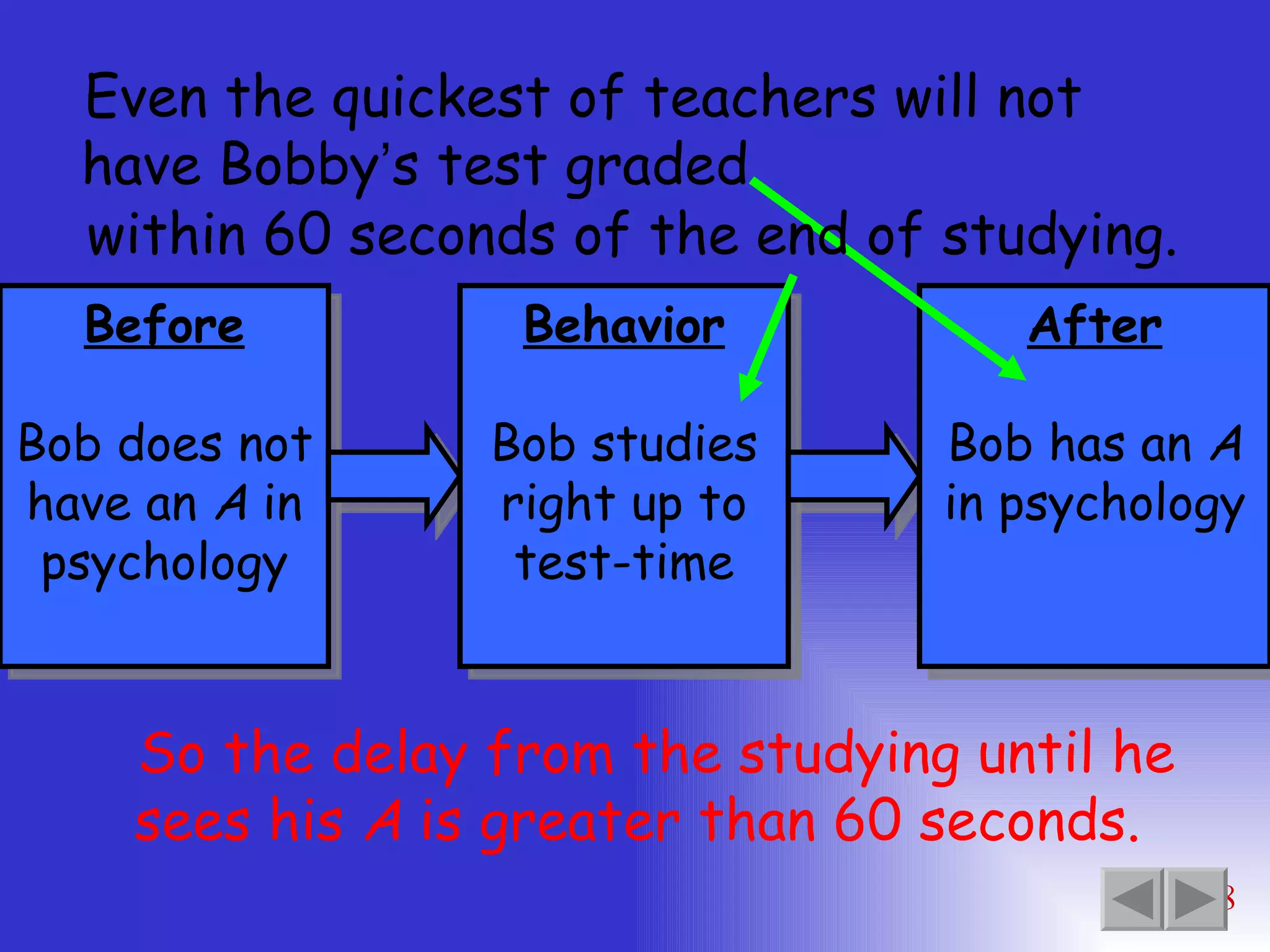
Before Bob does not have an  A  in psychology Even the quickest of teachers will not have Bobby ’ s test graded within 60 seconds of the end of studying. So the delay from the studying until he sees his  A  is greater than 60 seconds. Behavior Bob studies right up to test-time After Bob has an  A  in psychology
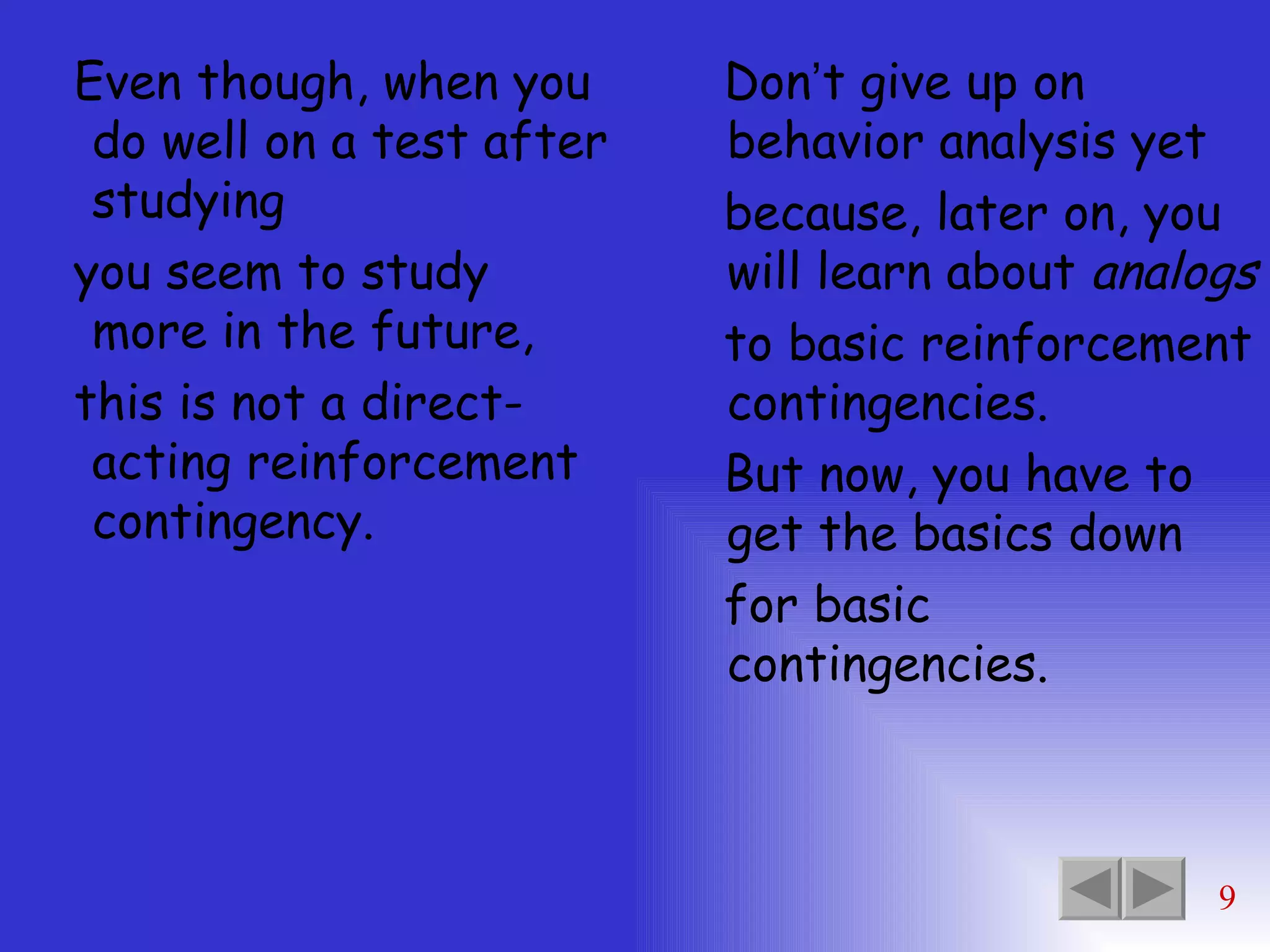
Even though, when you do well on a test after studying you seem to study more in the future, this is not a direct-acting reinforcement contingency. Don ’ t give up on behavior analysis yet because, later on, you will learn about  analogs to basic reinforcement contingencies. But now, you have to get the basics down  for basic contingencies.
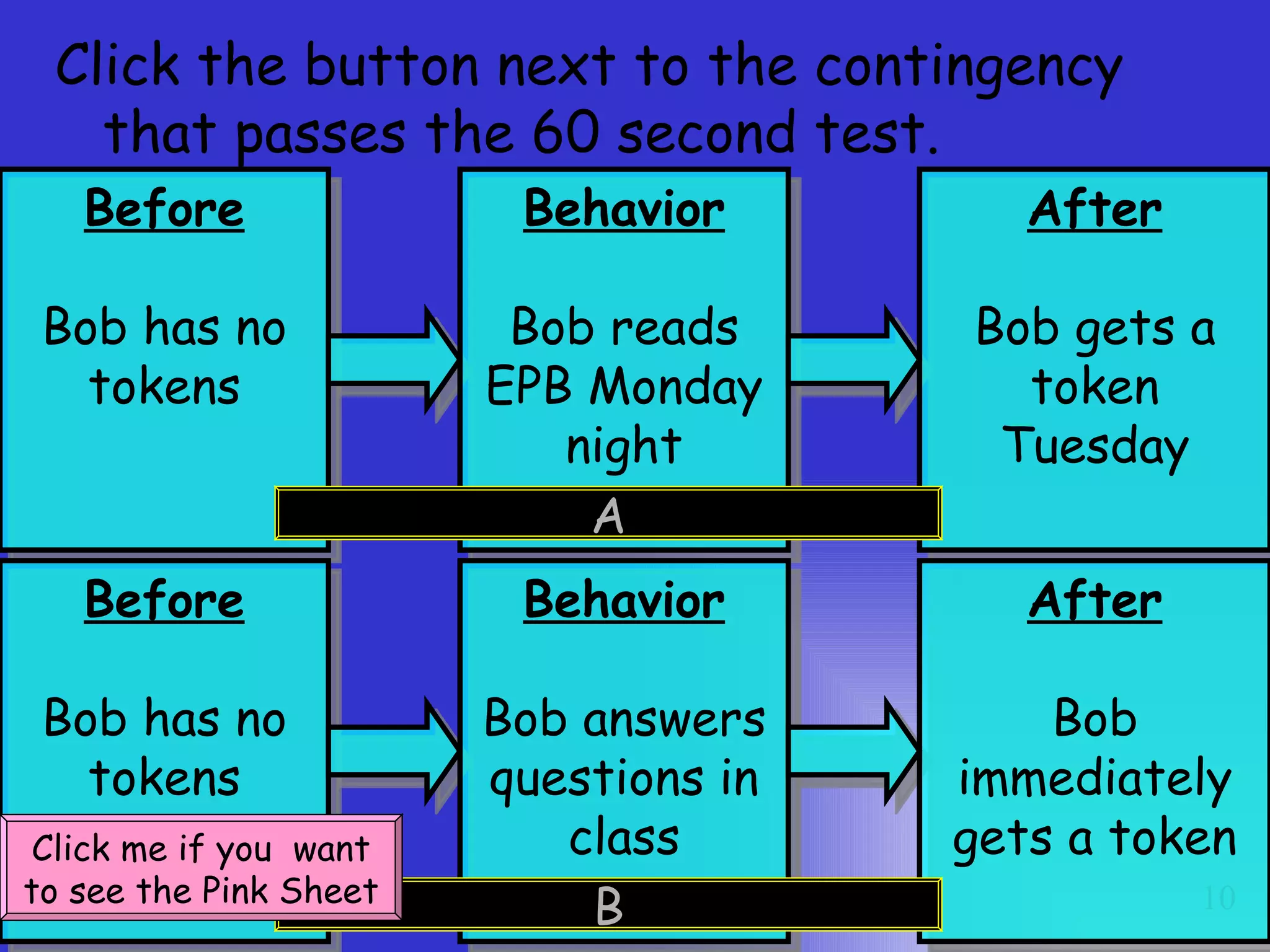
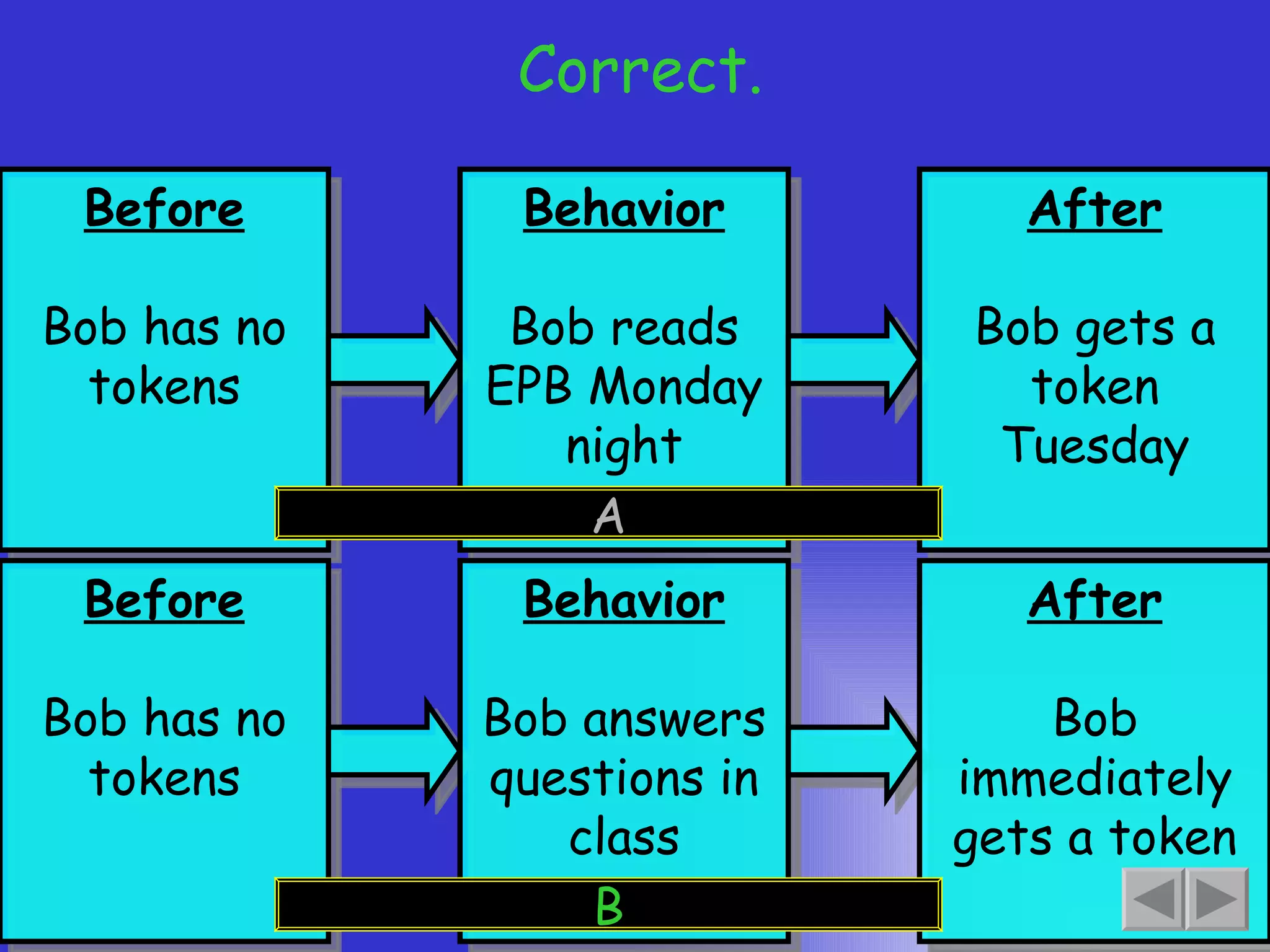
Click the button next to the contingency that passes the 60 second test. A B Click me if you  want to see the Pink Sheet Before Bob has no tokens Behavior Bob reads EPB Monday night After Bob gets a token Tuesday Before Bob has no tokens Behavior Bob answers questions in class After Bob immediately gets a token
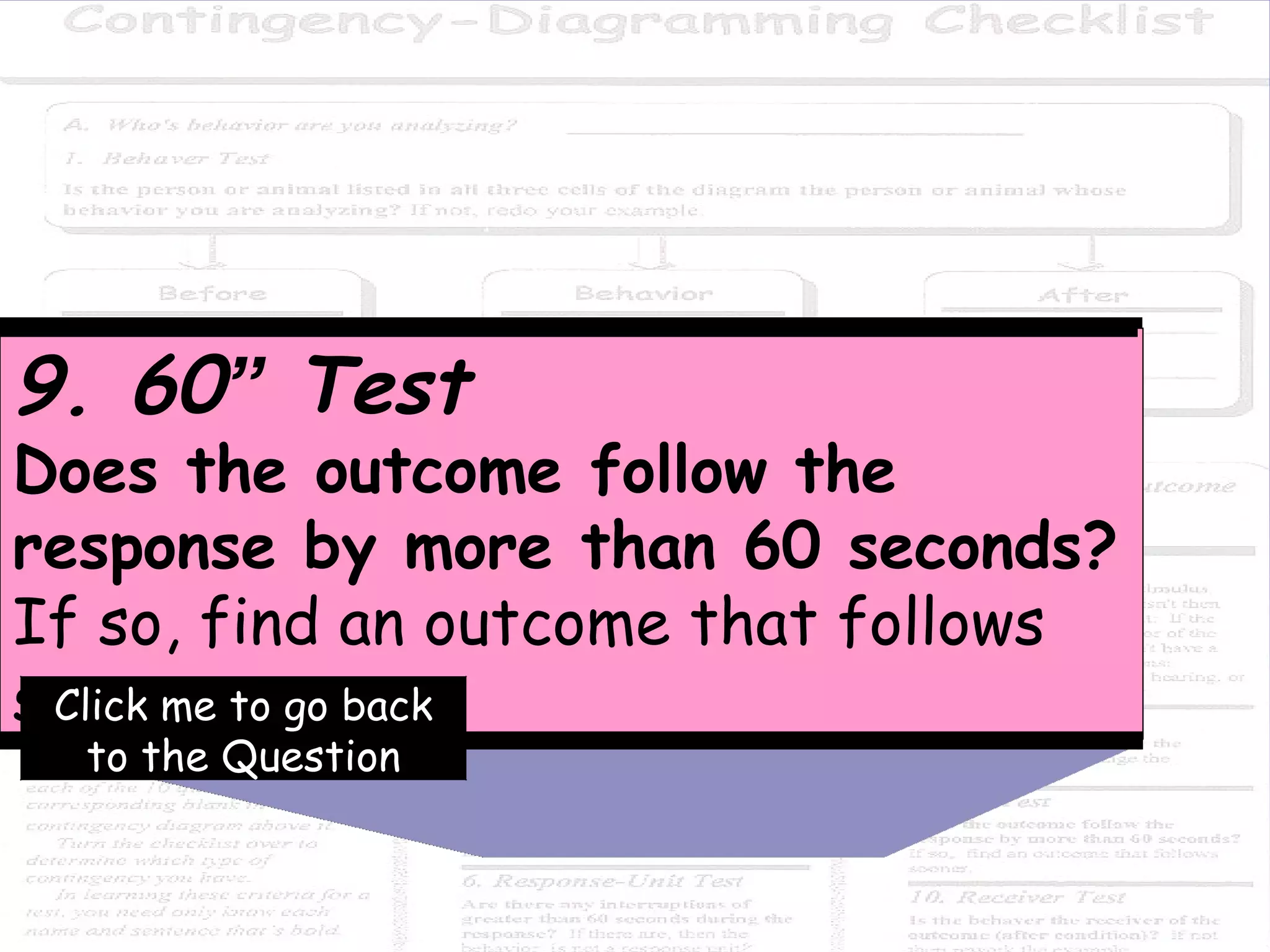
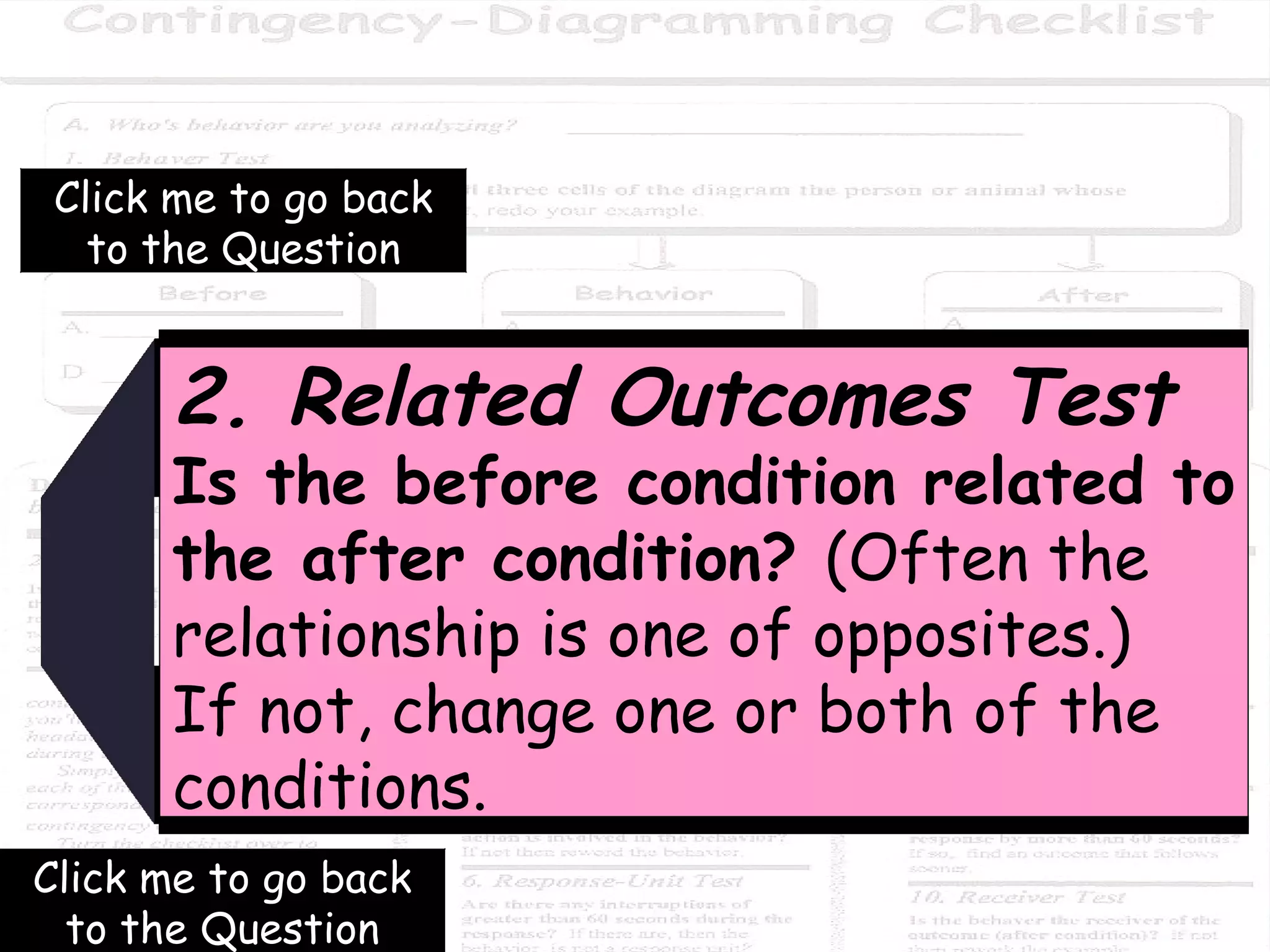
9. 60 ”  Test Does the outcome follow the response by more than 60 seconds? If so, find an outcome that follows sooner. Click me to go back to the Question
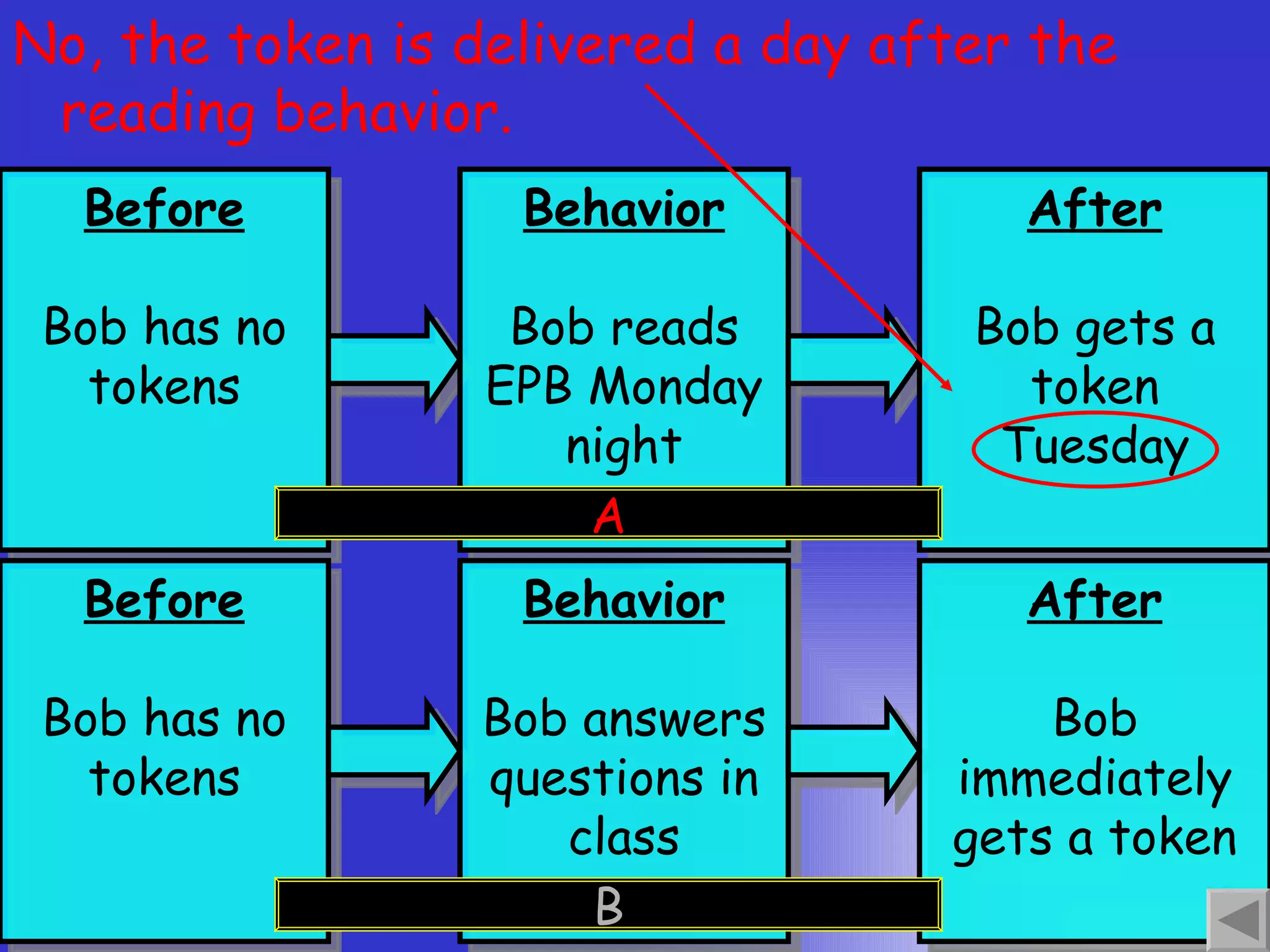
No, the token is delivered a day after the reading behavior. A B Before Bob has no tokens Behavior Bob reads EPB Monday night After Bob gets a token Tuesday Before Bob has no tokens Behavior Bob answers questions in class After Bob immediately gets a token
Correct. A B Before Bob has no tokens Behavior Bob reads EPB Monday night After Bob gets a token Tuesday Before Bob has no tokens Behavior Bob answers questions in class After Bob immediately gets a token
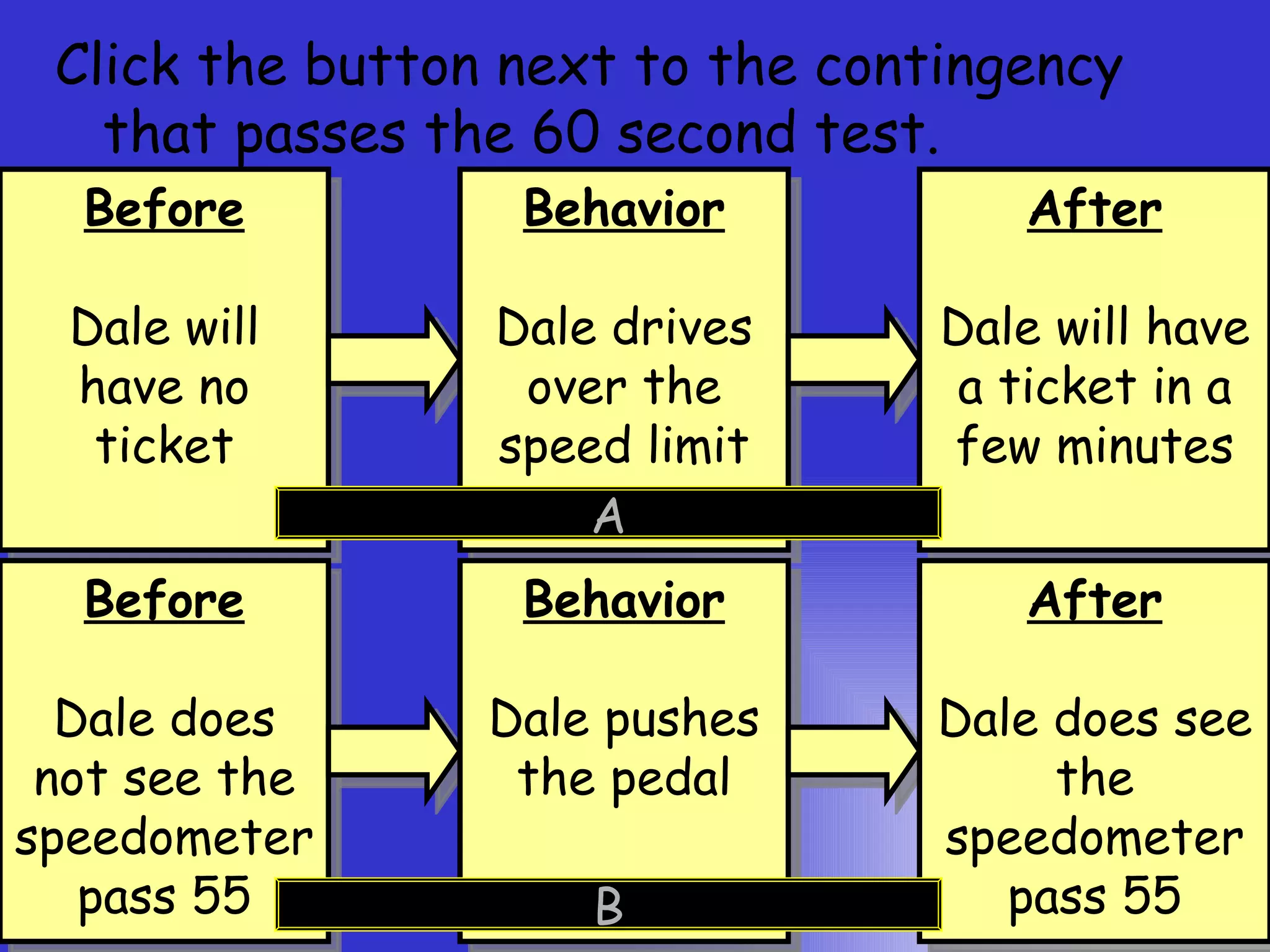
Click the button next to the contingency that passes the 60 second test. A B Before Dale will have no ticket Behavior Dale drives over the speed limit After Dale will have a ticket in a few minutes Before Dale does not see the speedometer pass 55 Behavior Dale pushes the pedal After Dale does see the speedometer pass 55
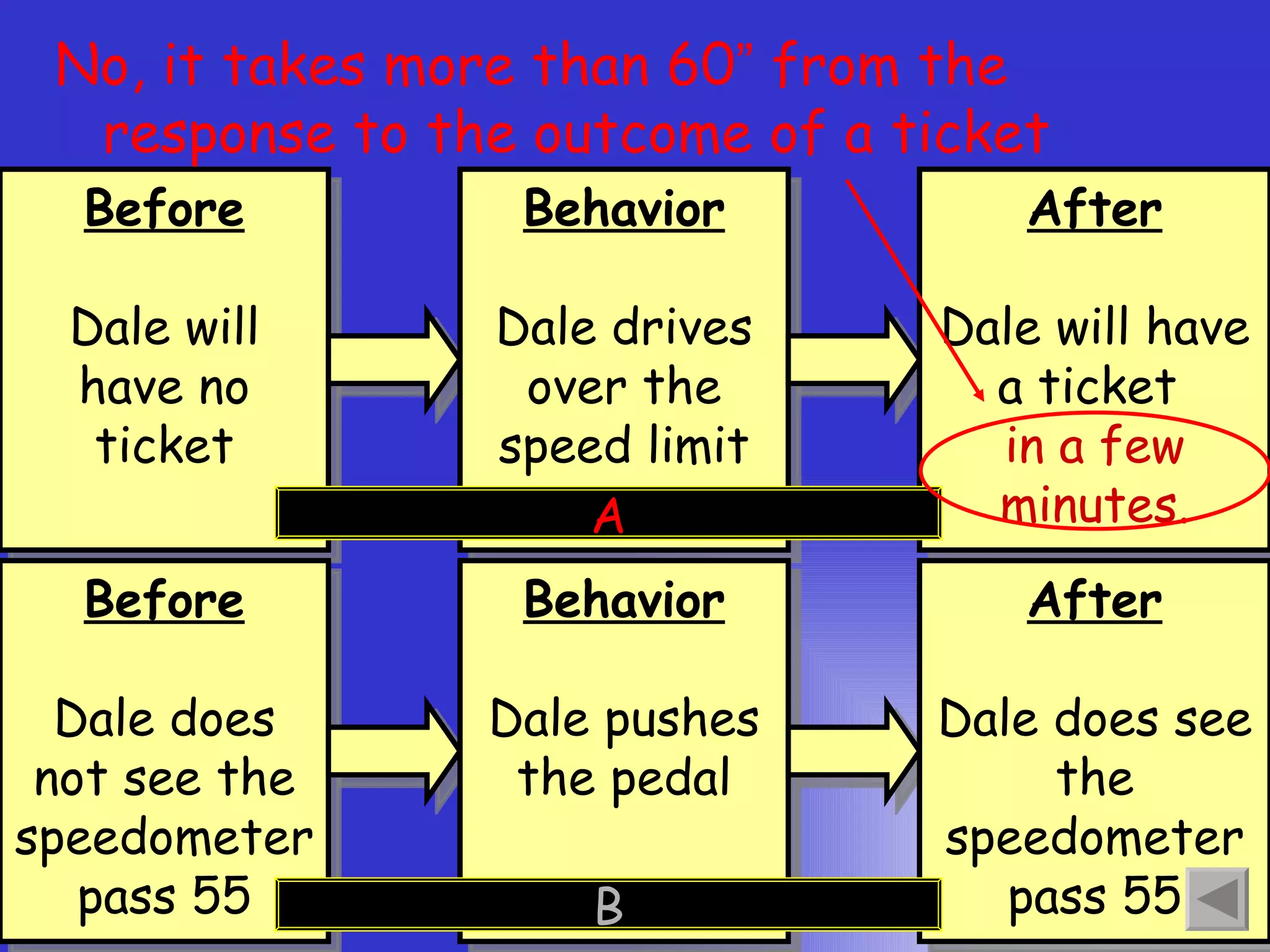
No, it takes more than 60 ”  from the response to the outcome of a ticket A B Before Dale will have no ticket Behavior Dale drives over the speed limit After Dale will have a ticket  in a few minutes. Before Dale does not see the speedometer pass 55 Behavior Dale pushes the pedal After Dale does see the speedometer pass 55
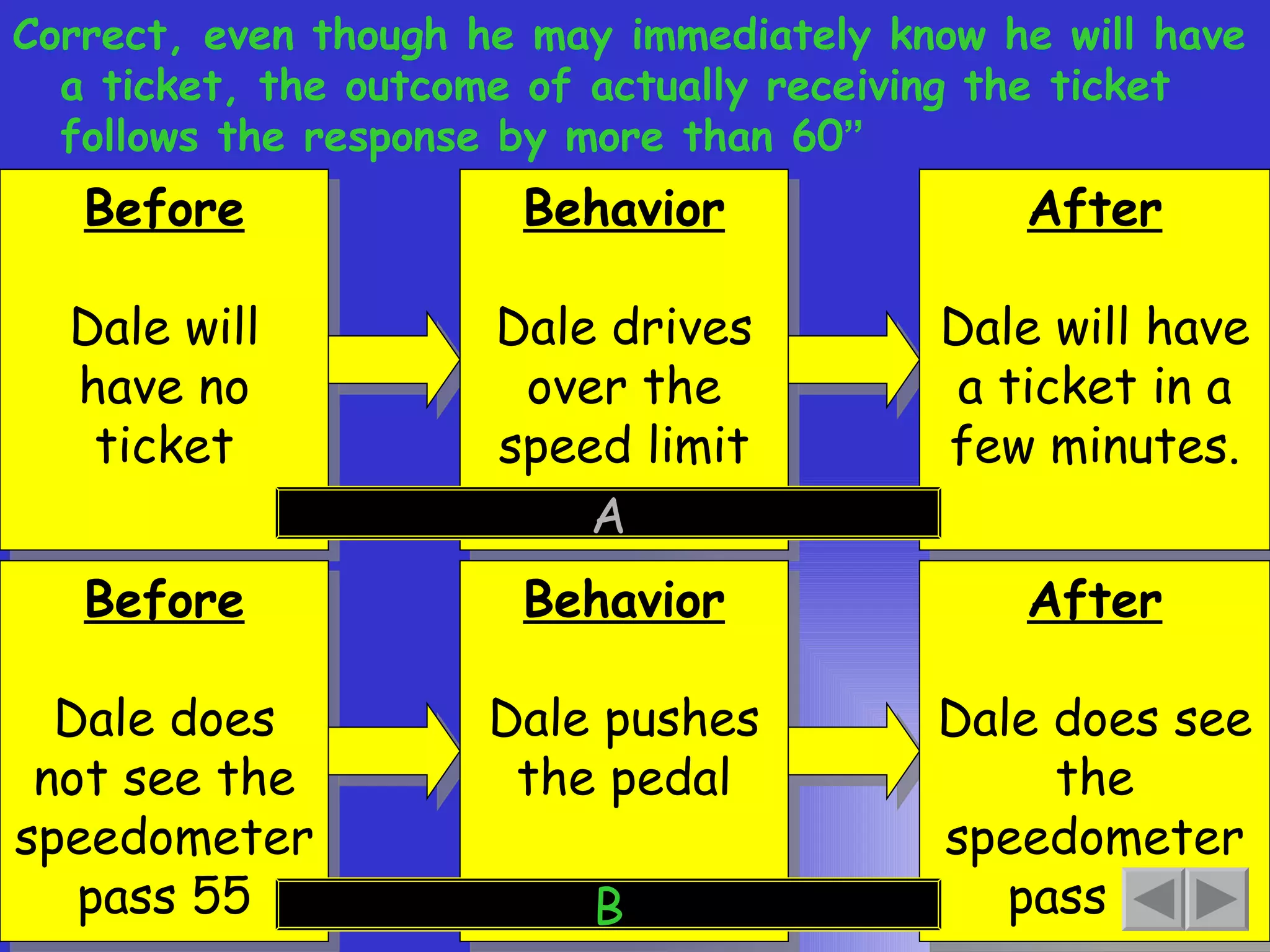
A B Correct, even though he may immediately know he will have a ticket, the outcome of actually receiving the ticket follows the response by more than 60 ” Before Dale will have no ticket Behavior Dale drives over the speed limit After Dale will have a ticket in a few minutes. Before Dale does not see the speedometer pass 55 Behavior Dale pushes the pedal After Dale does see the speedometer pass 55
Did you see the use of future tense? Don ’ t be caught making the mistake in thinking that it passes the test because he immediately knows he will have a ticket (he even knows it will cost money later too). Ask yourself when the  observable  outcome (ticket or money) is delivered, not when he  “ knows ”  when it will be delivered.
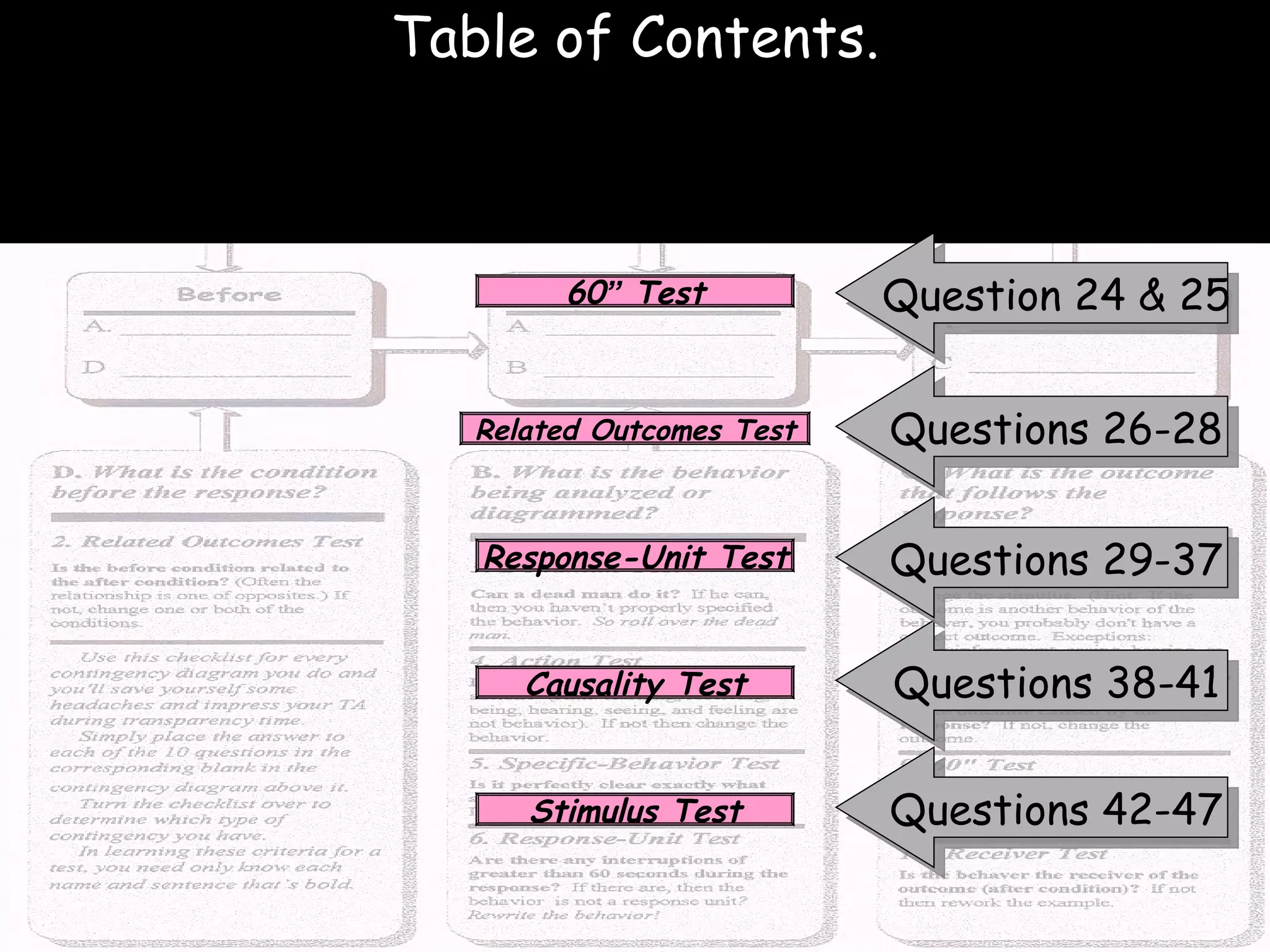
Causality Test Stimulus Test Related Outcomes Test 60 ”  Test Response-Unit Test Table of Contents. Question 24 & 25 Questions 42-47 Questions 38-41 Questions 29-37 Questions 26-28
Related Outcomes Test Is the before condition related to the after condition?
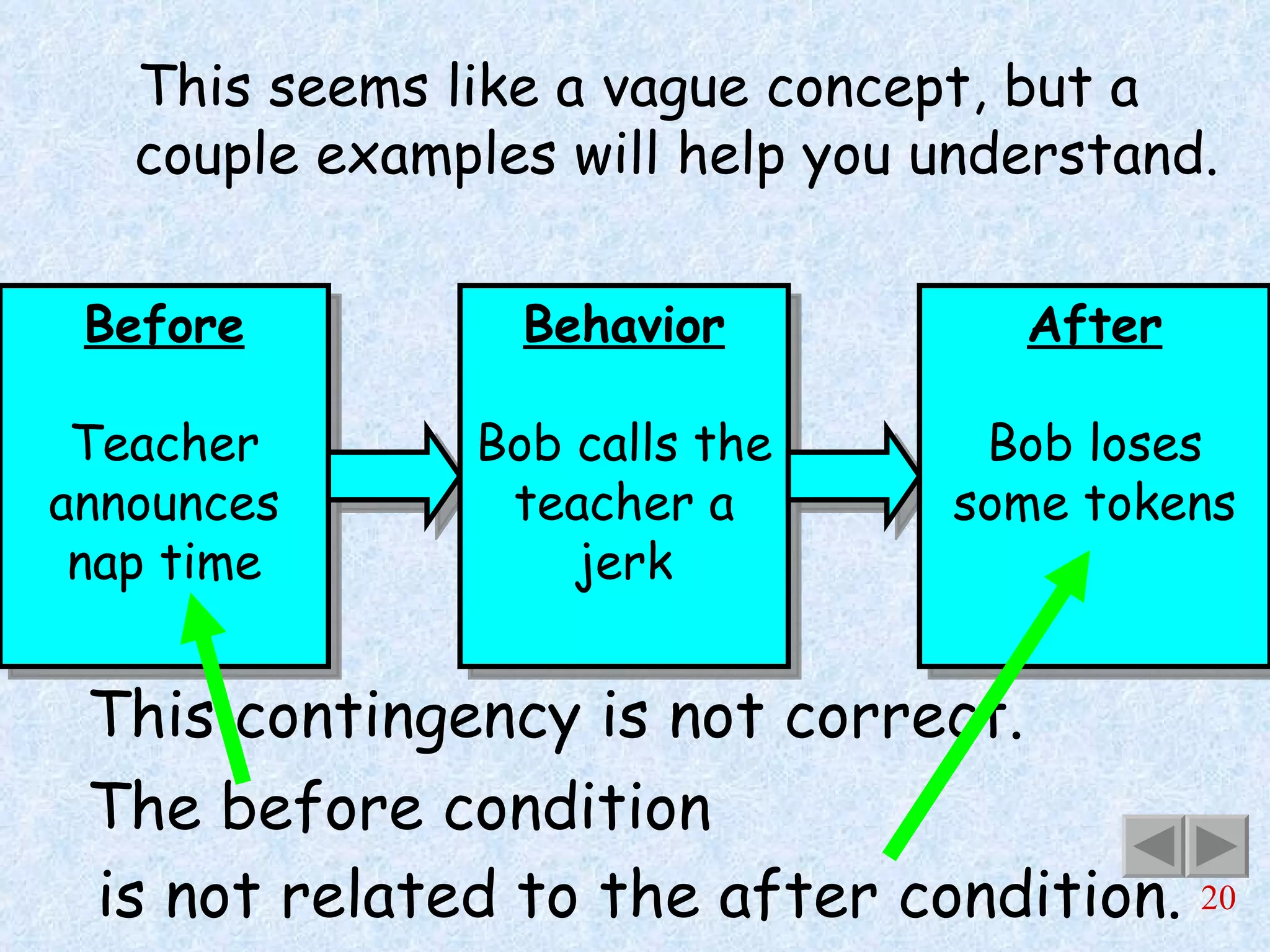
This seems like a vague concept, but a couple examples will help you understand. Before Teacher announces nap time This contingency is not correct. The before condition is not related to the after condition. Behavior Bob calls the teacher a jerk After Bob loses some tokens
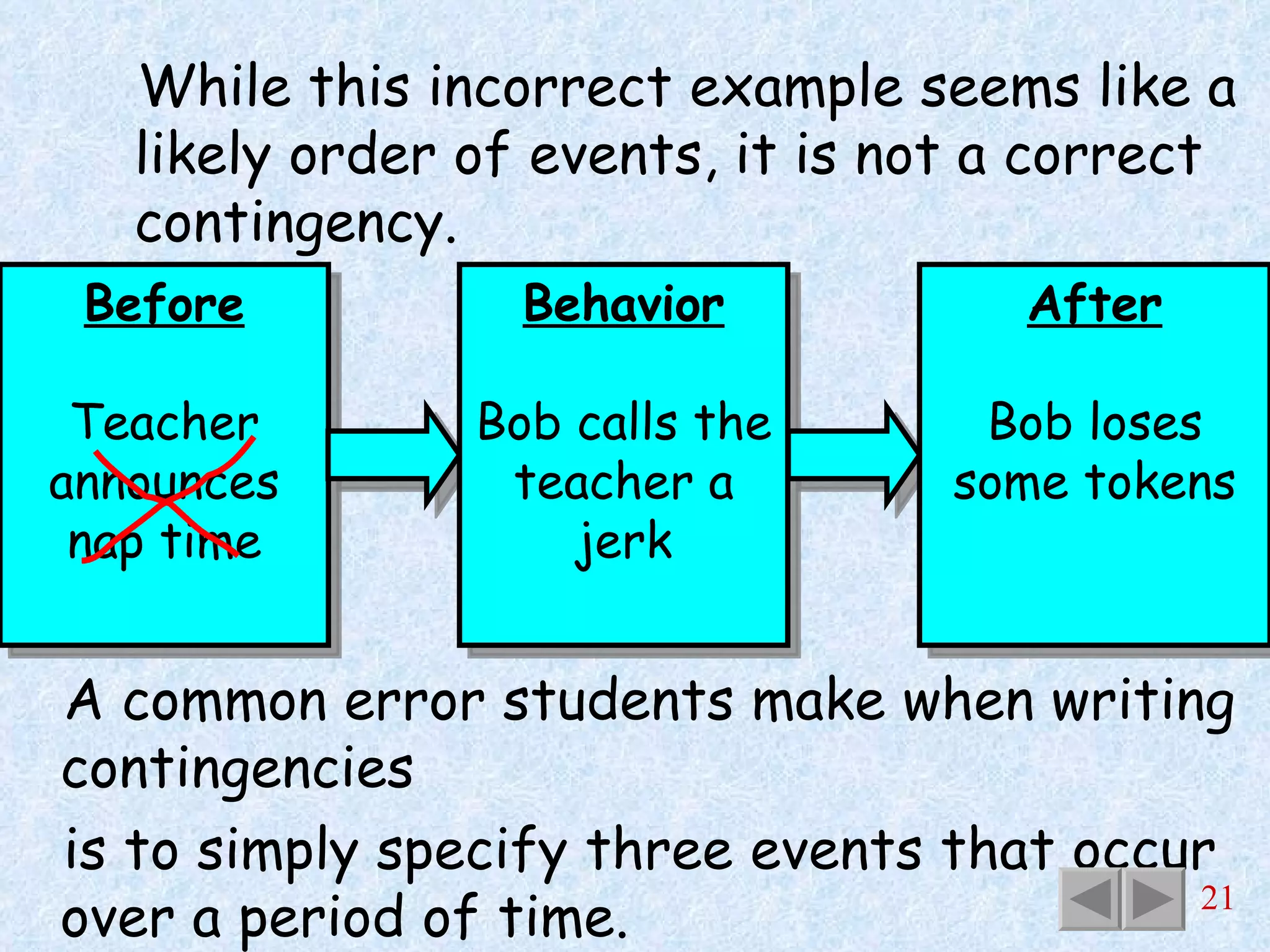
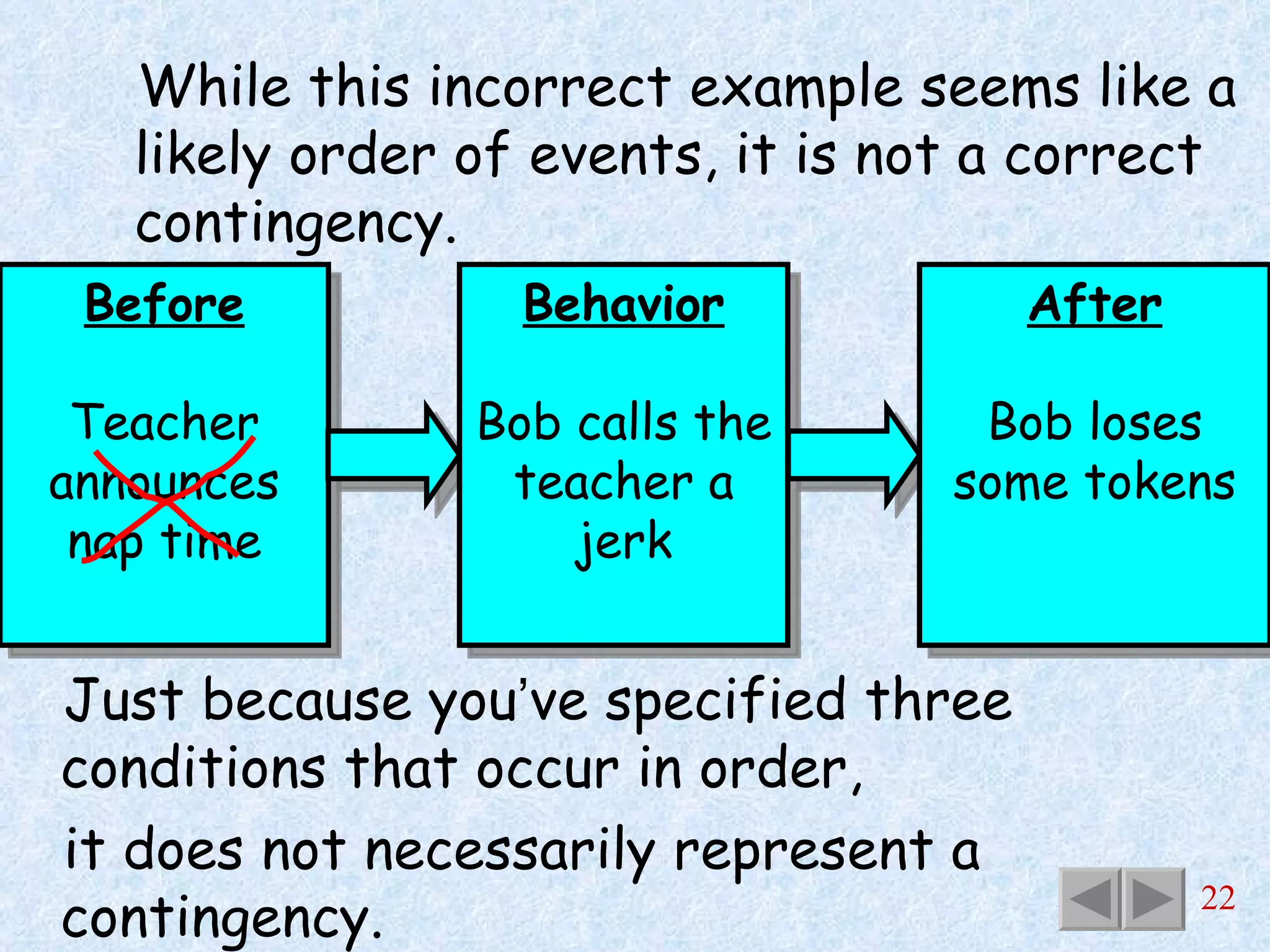
While this incorrect example seems like a likely order of events, it is not a correct contingency. Before Teacher announces nap time A common error students make when writing contingencies is to simply specify three events that occur over a period of time. Behavior Bob calls the teacher a jerk After Bob loses some tokens
While this incorrect example seems like a likely order of events, it is not a correct contingency. Before Teacher announces nap time Just because you ’ ve specified three conditions that occur in order, it does not necessarily represent a contingency. Behavior Bob calls the teacher a jerk After Bob loses some tokens
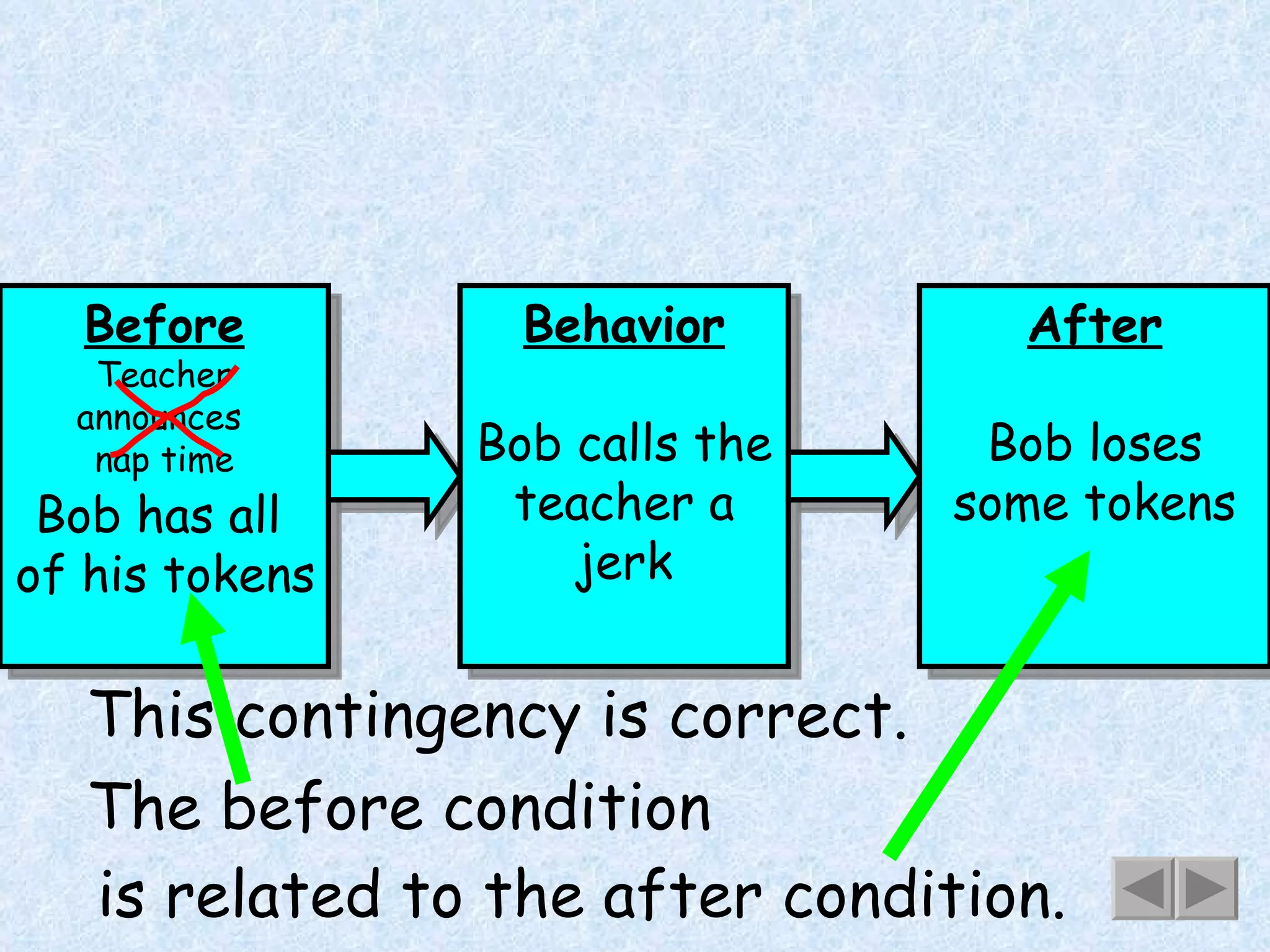
Before Teacher announces  nap   time This contingency is correct. The before condition is related to the after condition. Bob has all  of his tokens Behavior Bob calls the teacher a jerk After Bob loses some tokens
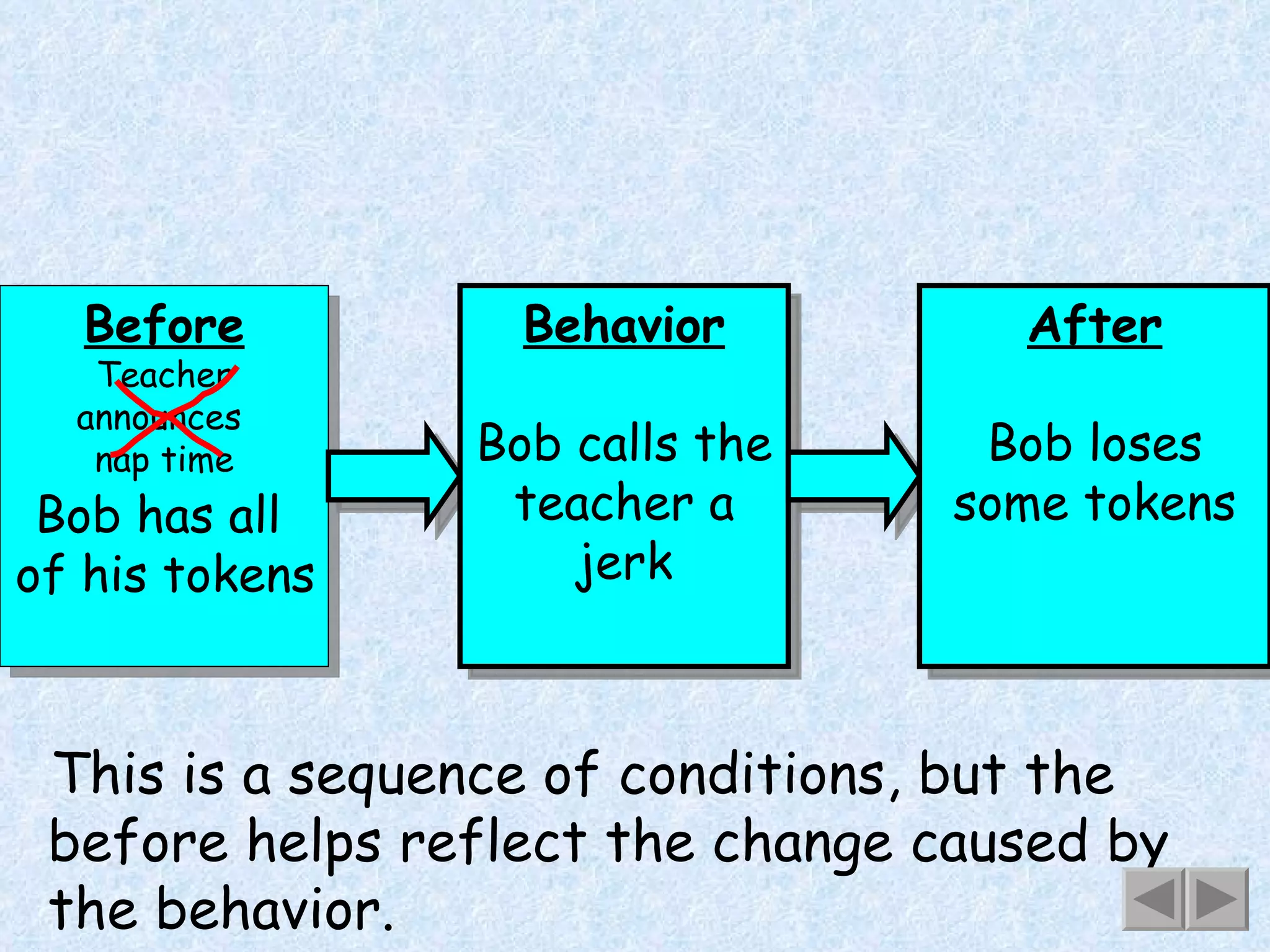
Before Teacher announces  nap time Bob has all  of his tokens This is a sequence of conditions, but the before helps reflect the change caused by the behavior. Behavior Bob calls the teacher a jerk After Bob loses some tokens
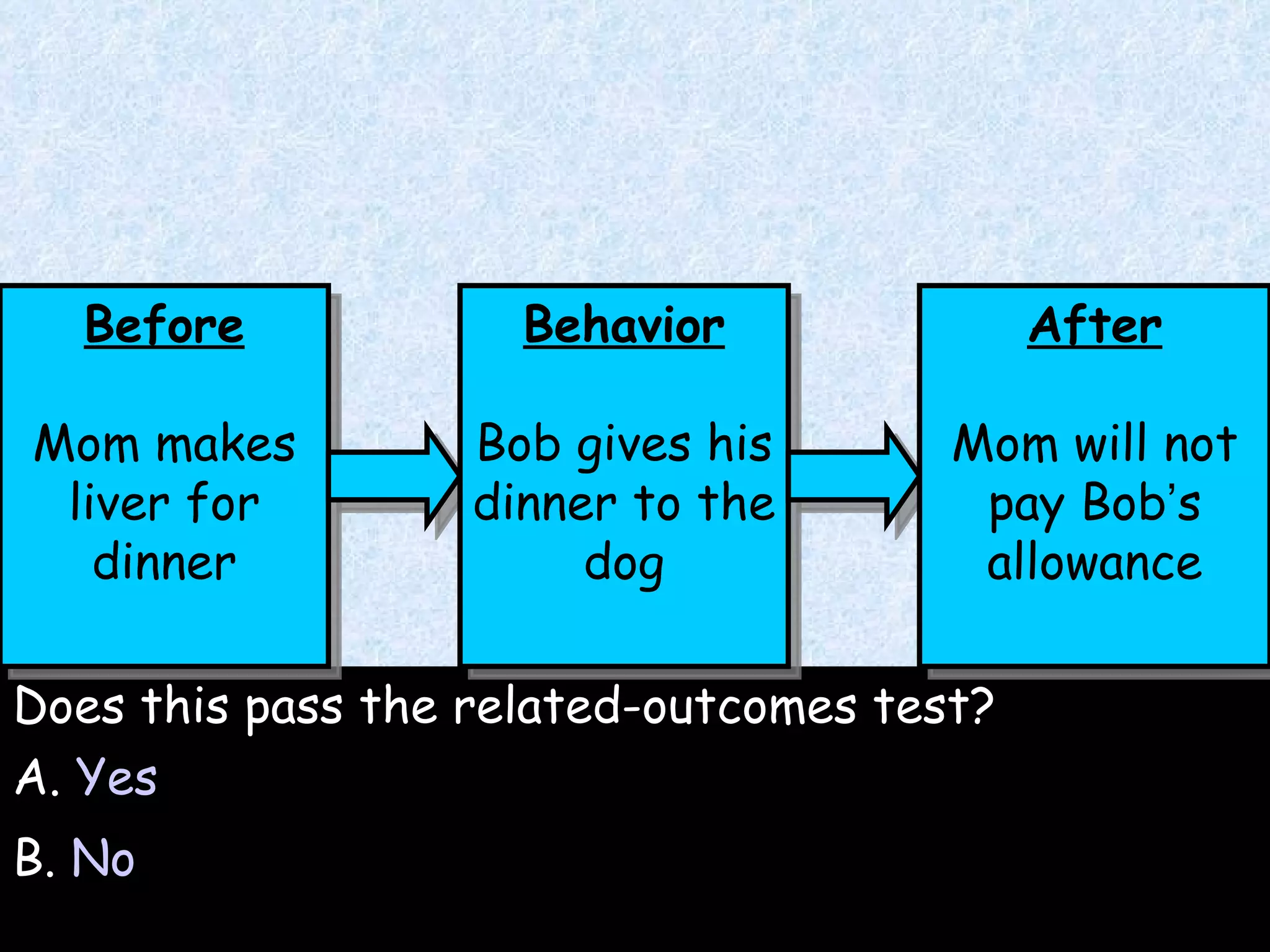
Does this pass the related-outcomes test? A.  Yes B.  No Before Mom makes liver for dinner Behavior Bob gives his dinner to the dog After Mom will not pay Bob ’ s allowance
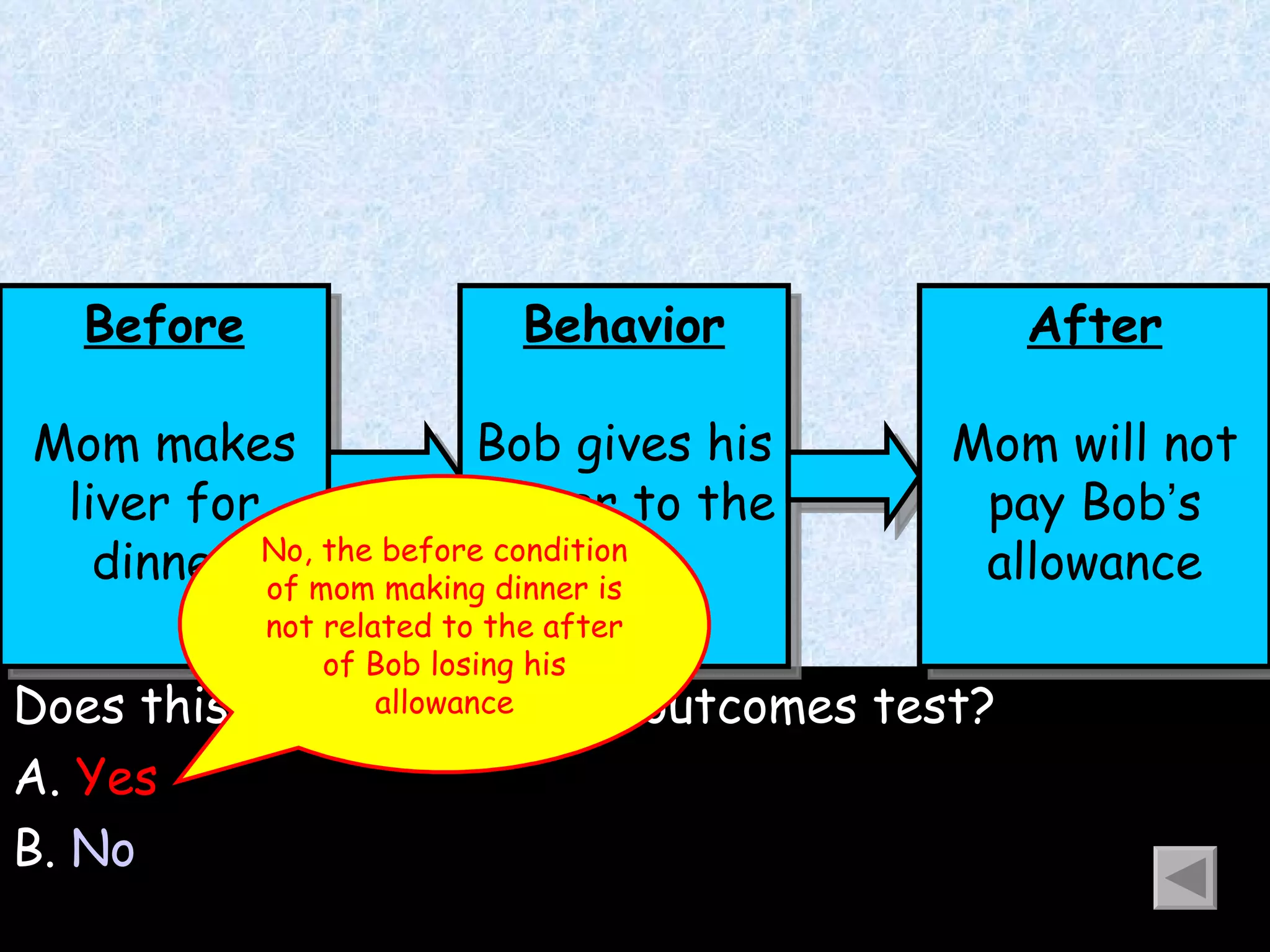
Does this pass the related-outcomes test? A.  Yes B.  No Before Mom makes liver for dinner No, the before condition of mom making dinner is not related to the after of Bob losing his allowance Behavior Bob gives his dinner to the dog After Mom will not pay Bob ’ s allowance
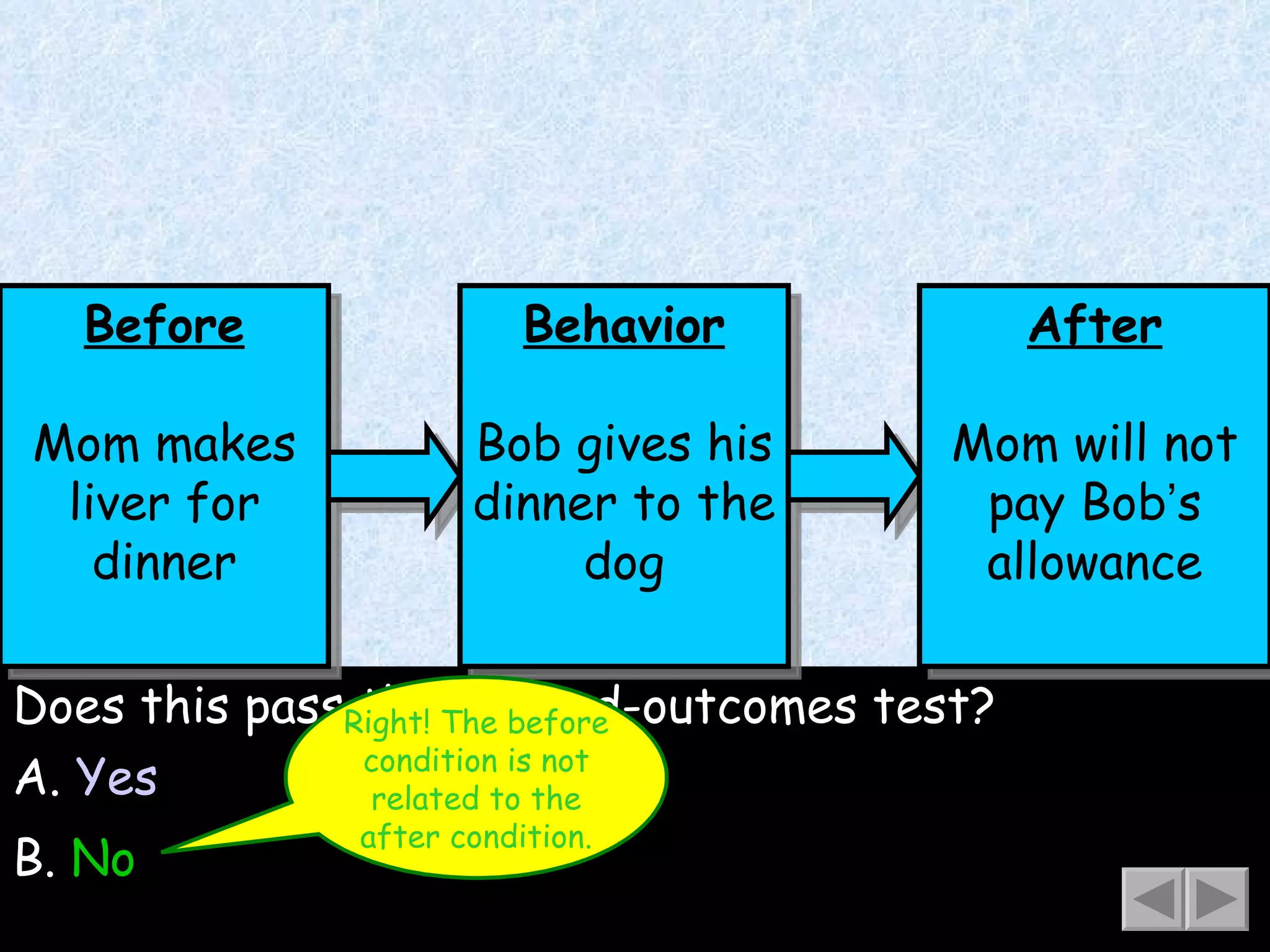
Does this pass the related-outcomes test? A.  Yes B.  No Before Mom makes liver for dinner Right! The before condition is not related to the after condition. Behavior Bob gives his dinner to the dog After Mom will not pay Bob ’ s allowance
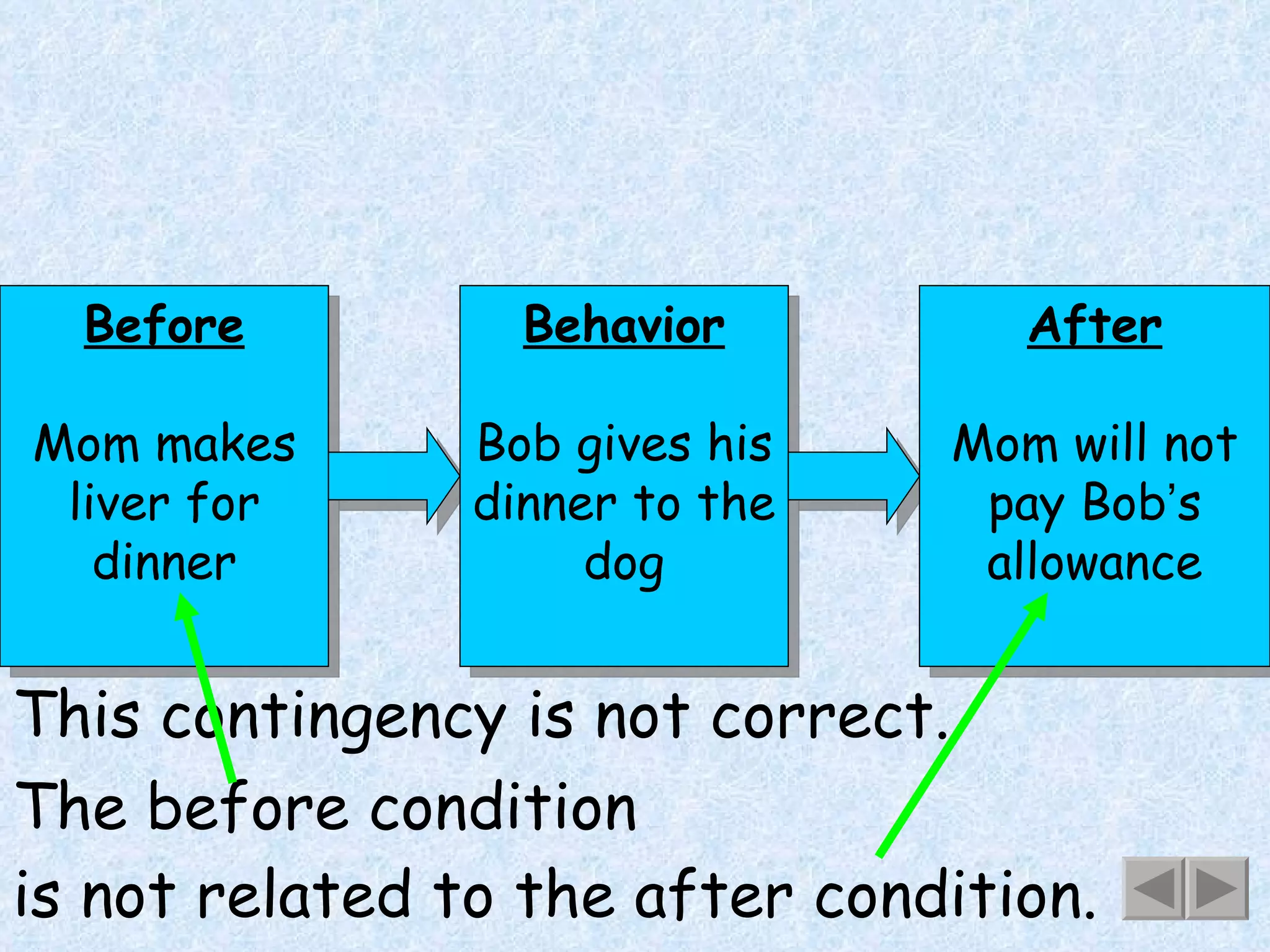
Before Mom makes liver for dinner This contingency is not correct. The before condition is not related to the after condition. Behavior Bob gives his dinner to the dog After Mom will not pay Bob ’ s allowance
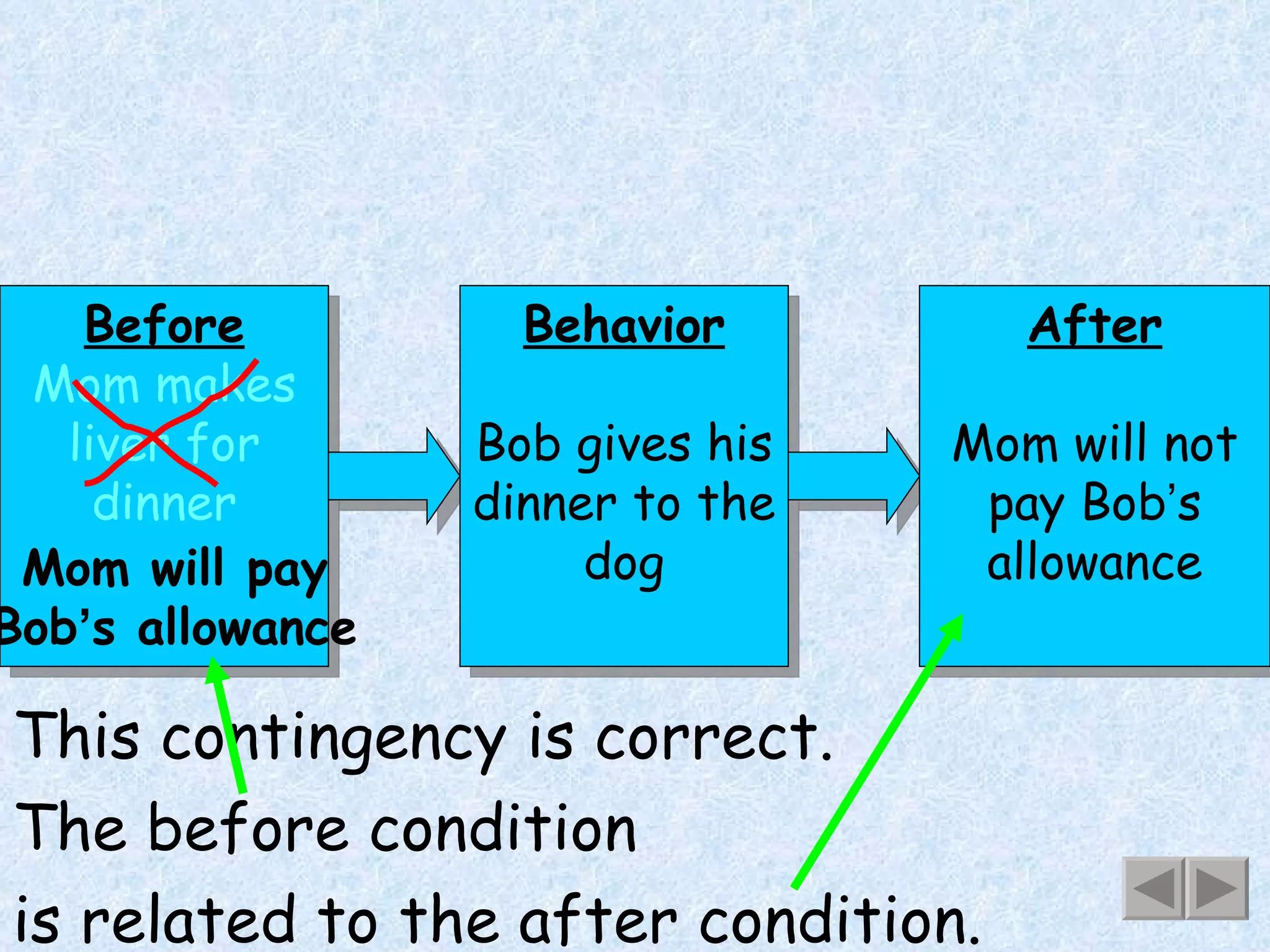
Before Mom makes liver for dinner Mom will pay Bob ’ s allowance This contingency is correct. The before condition is related to the after condition. Behavior Bob gives his dinner to the dog After Mom will not pay Bob ’ s allowance
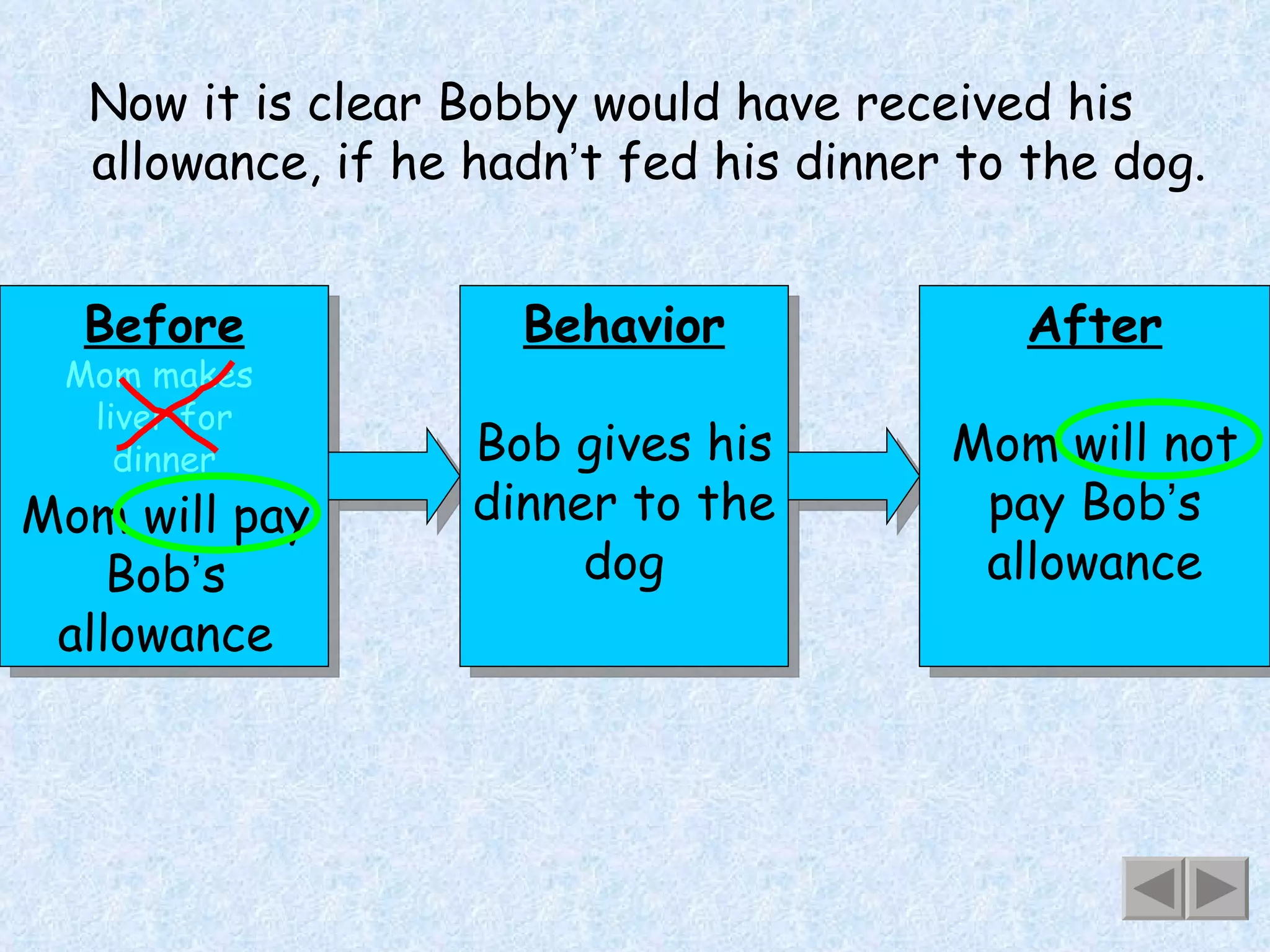
Before Mom makes  liver for dinner Mom will pay Bob ’ s  allowance Now it is clear Bobby would have received his allowance, if he hadn ’ t fed his dinner to the dog. Behavior Bob gives his dinner to the dog After Mom will not pay Bob ’ s allowance
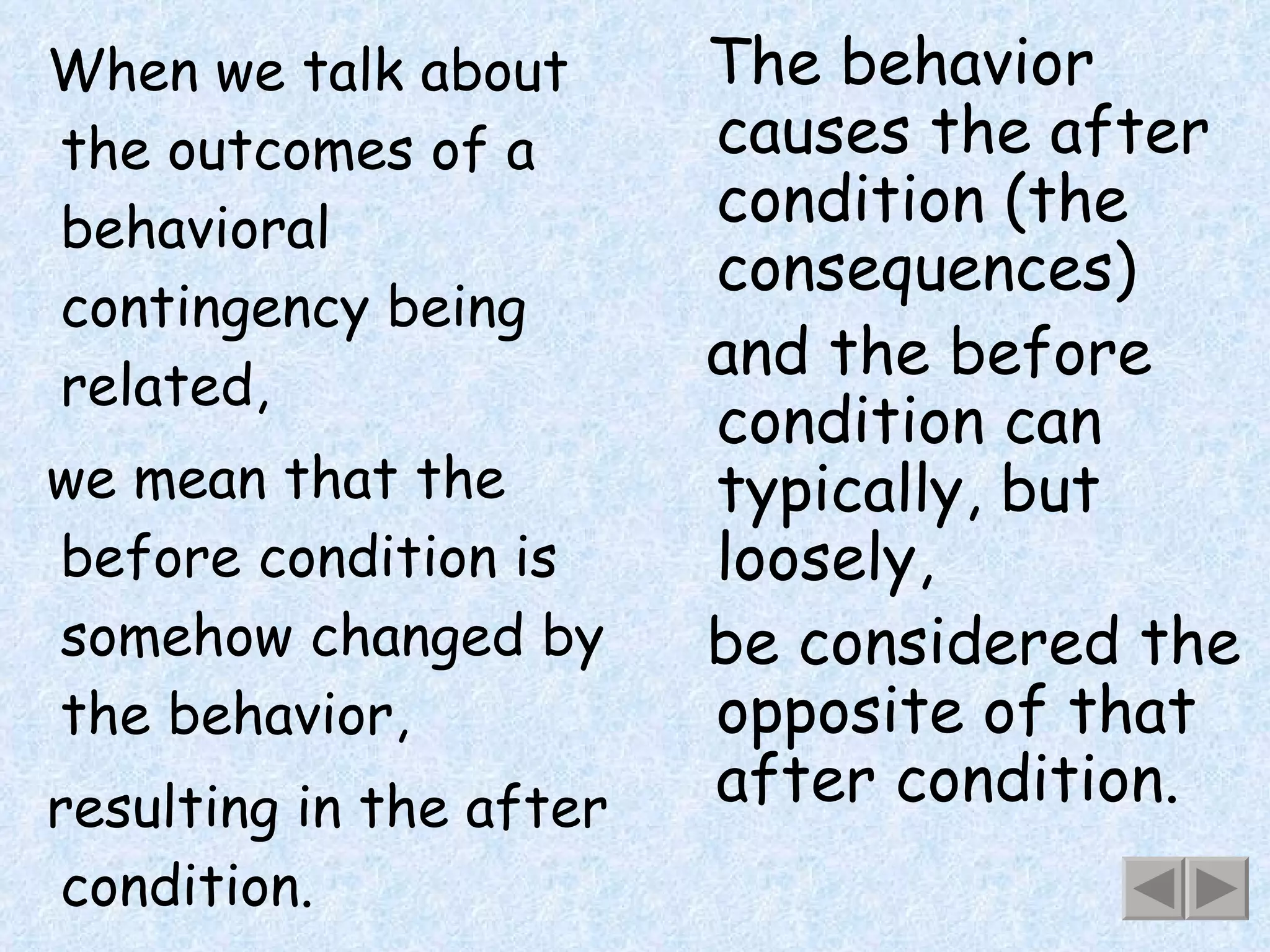
When we talk about the outcomes of a behavioral contingency being related, we mean that the before condition is somehow changed by the behavior, resulting in the after condition. The behavior causes the after condition (the consequences) and the before condition can typically, but loosely,  be considered the opposite of that after condition.
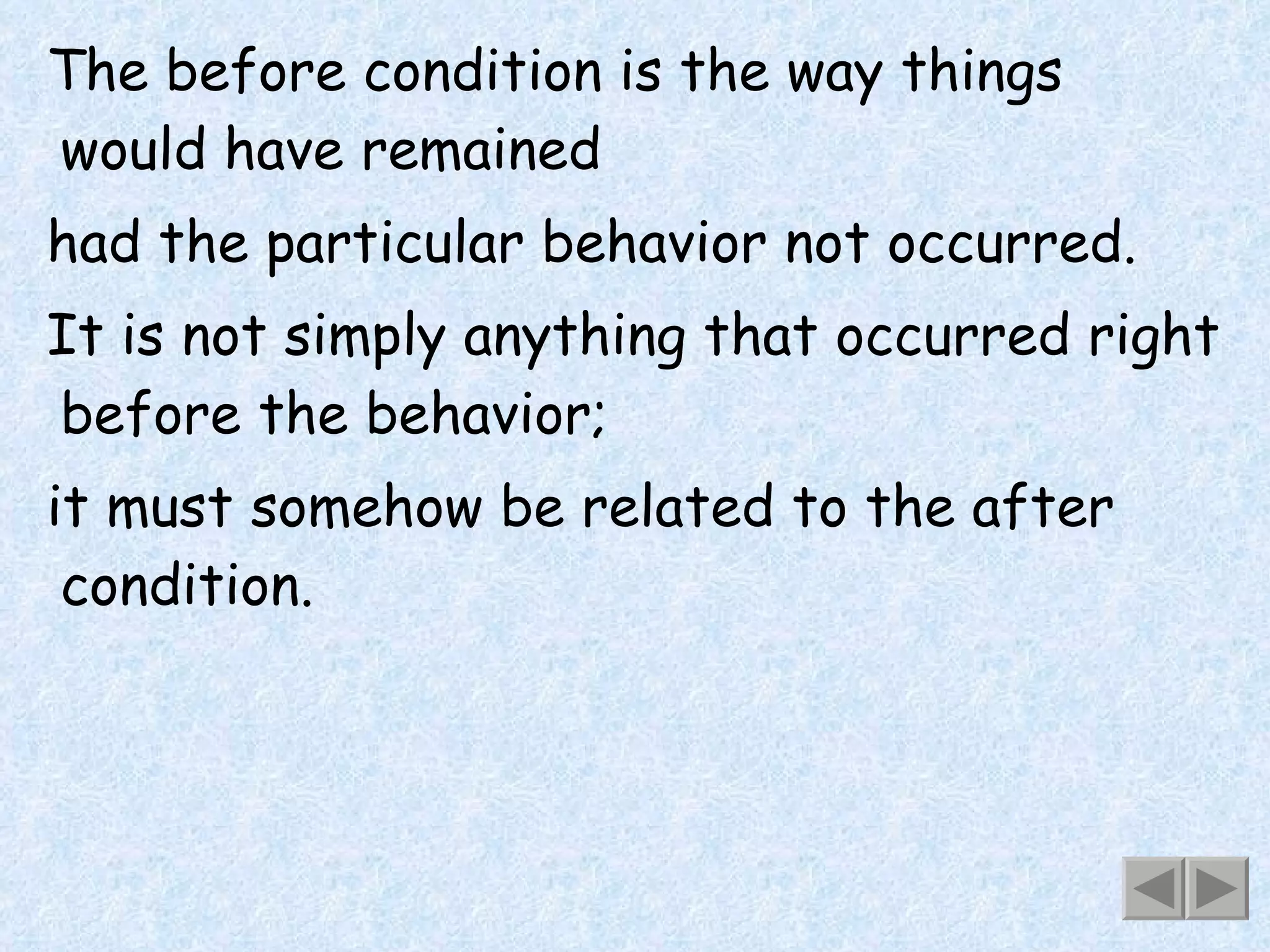
The before condition is the way things would have remained had the particular behavior not occurred. It is not simply anything that occurred right before the behavior; it must somehow be related to the after condition.
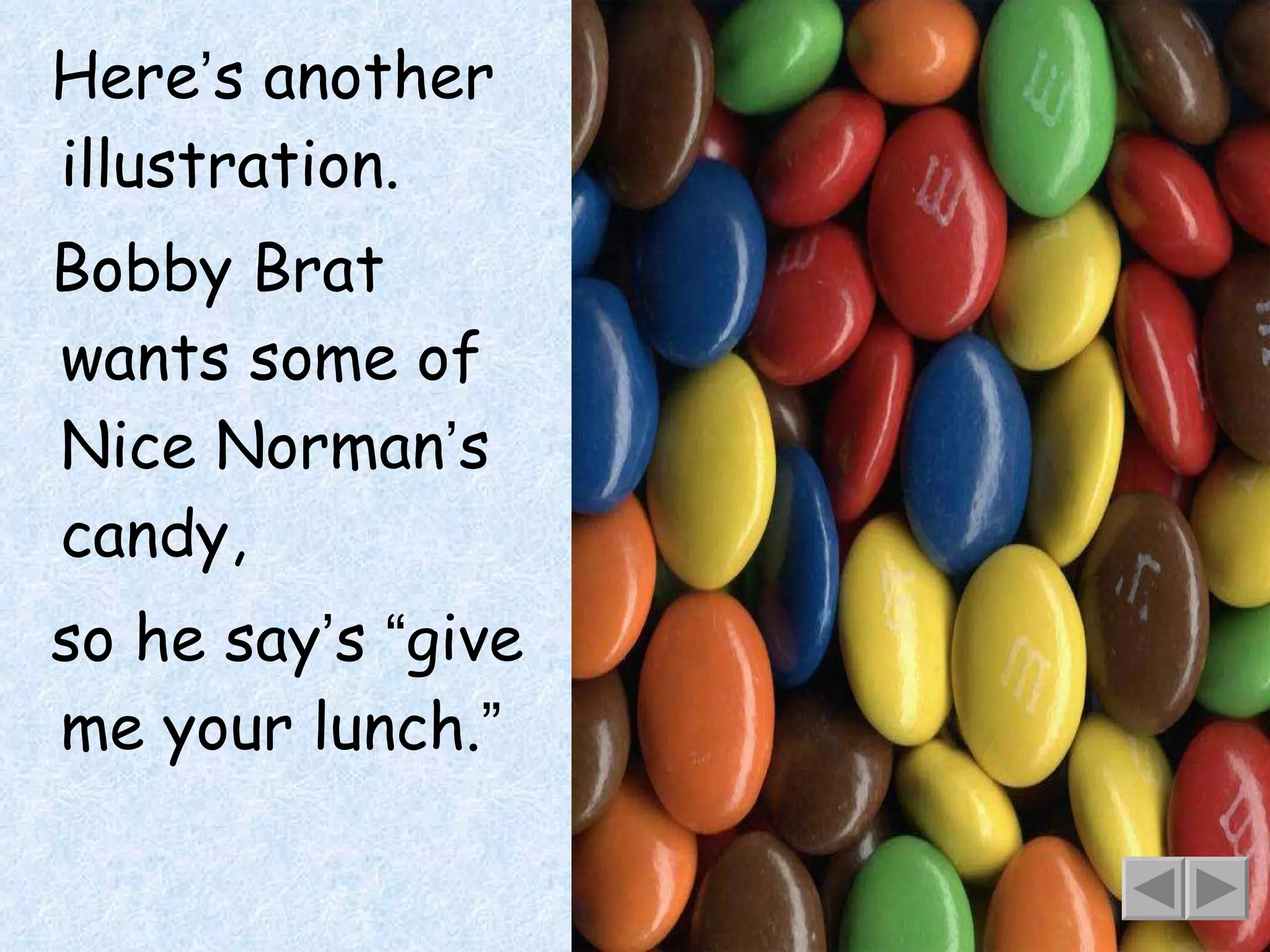
Here ’ s another illustration. Bobby Brat wants some of Nice Norman ’ s candy, so he say ’ s  “ give me your lunch. ”
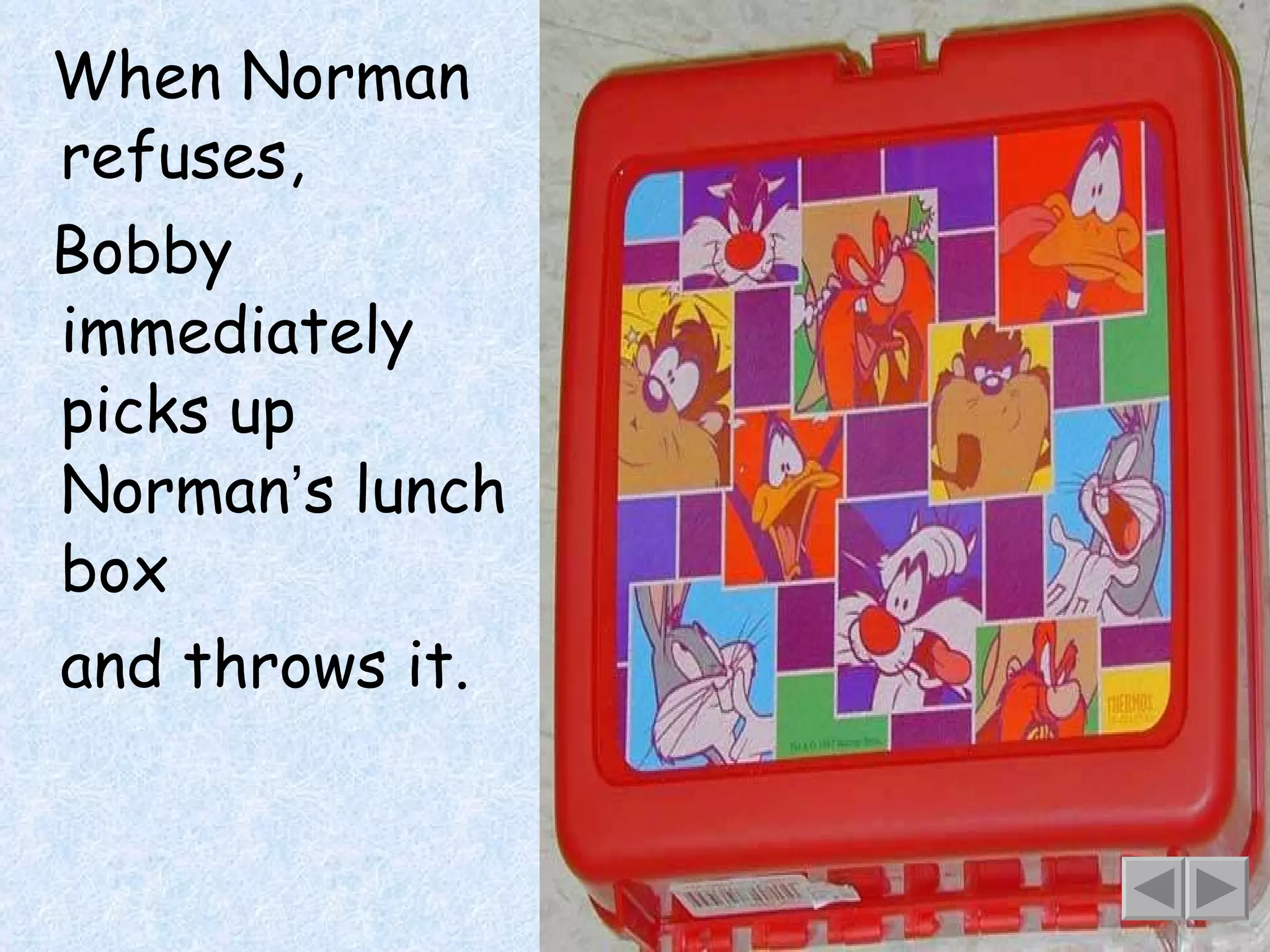
When Norman refuses, Bobby immediately picks up Norman ’ s lunch box and throws it.
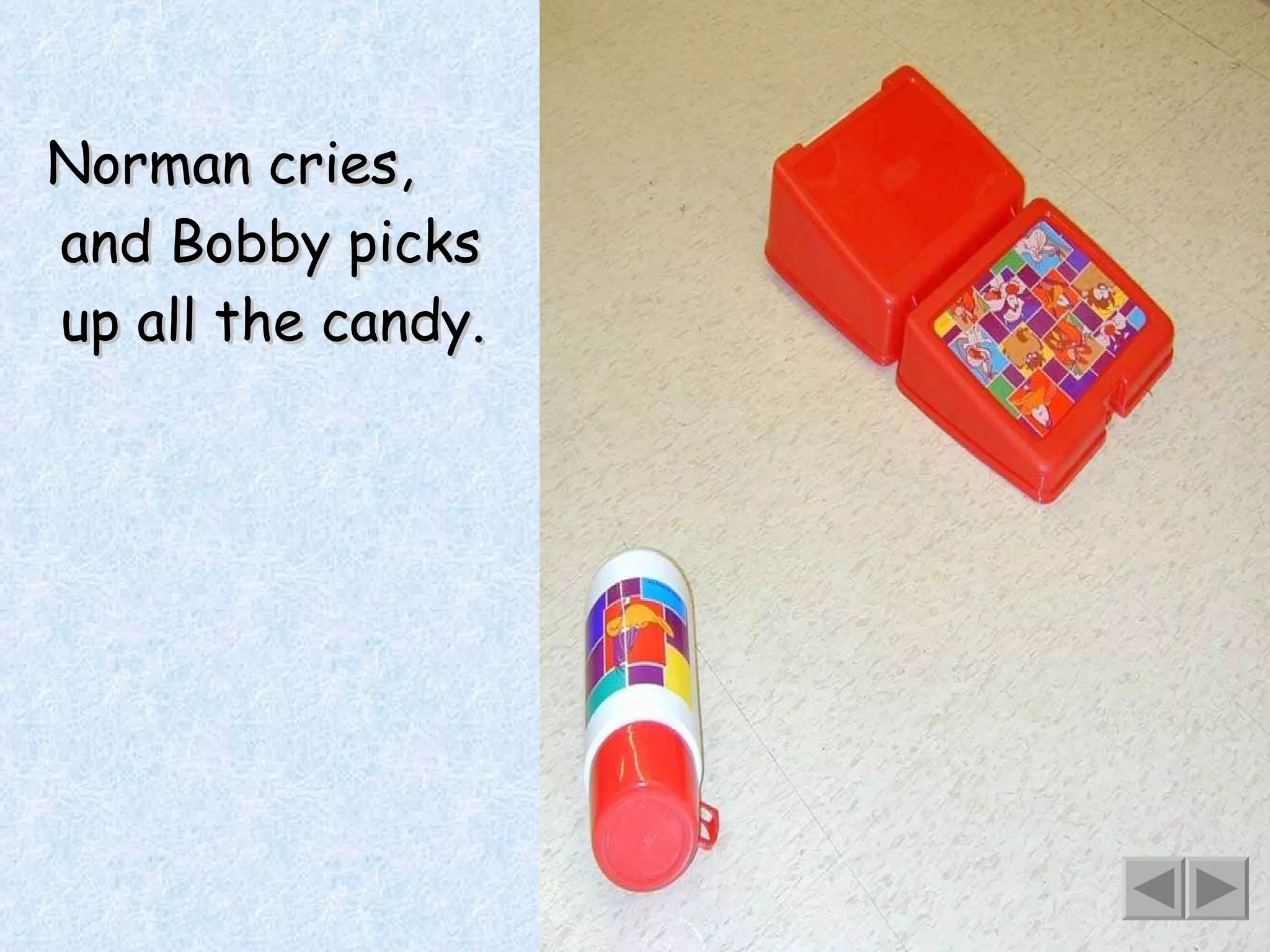
Norman cries,  and Bobby picks up all the candy.
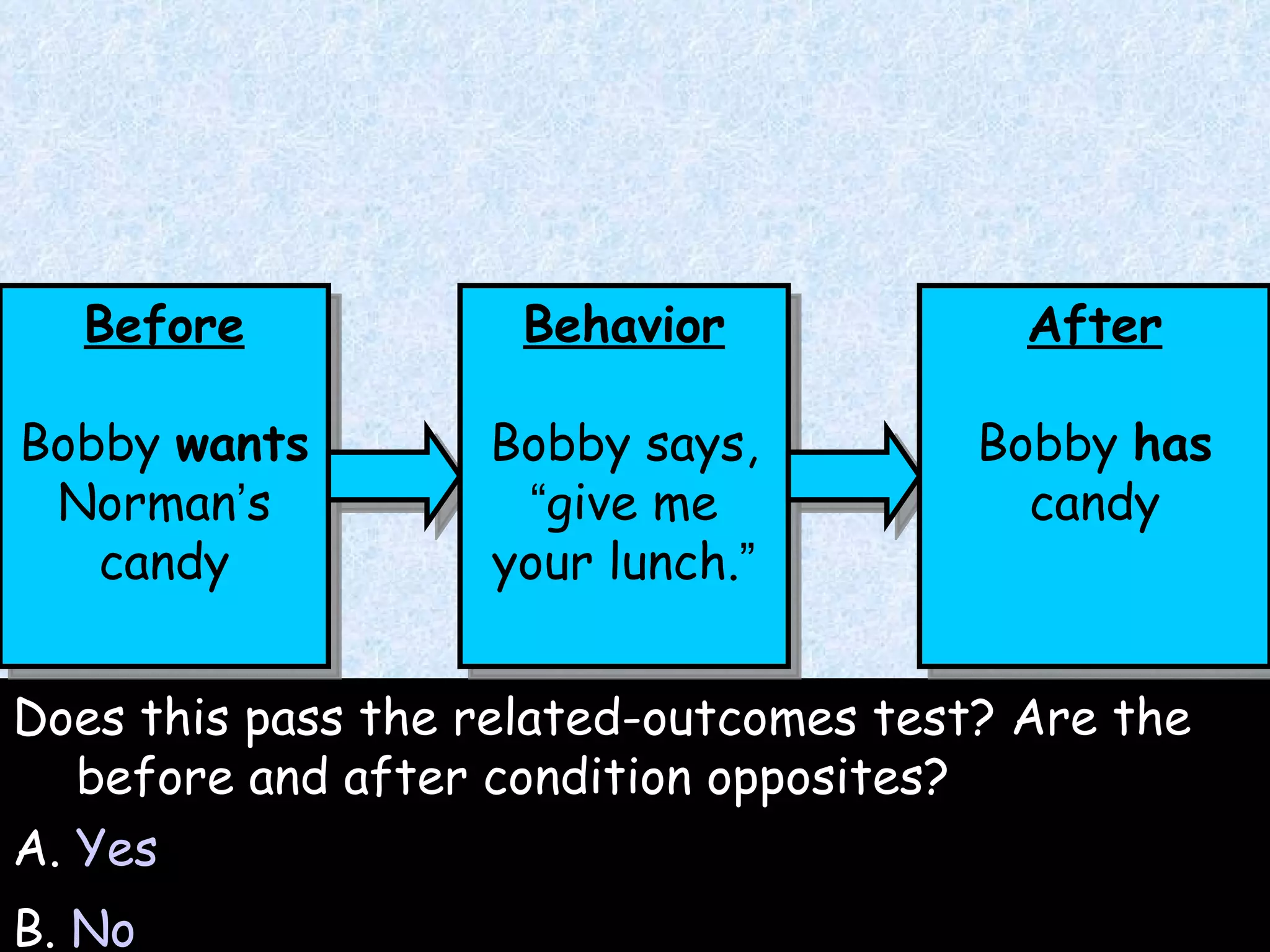
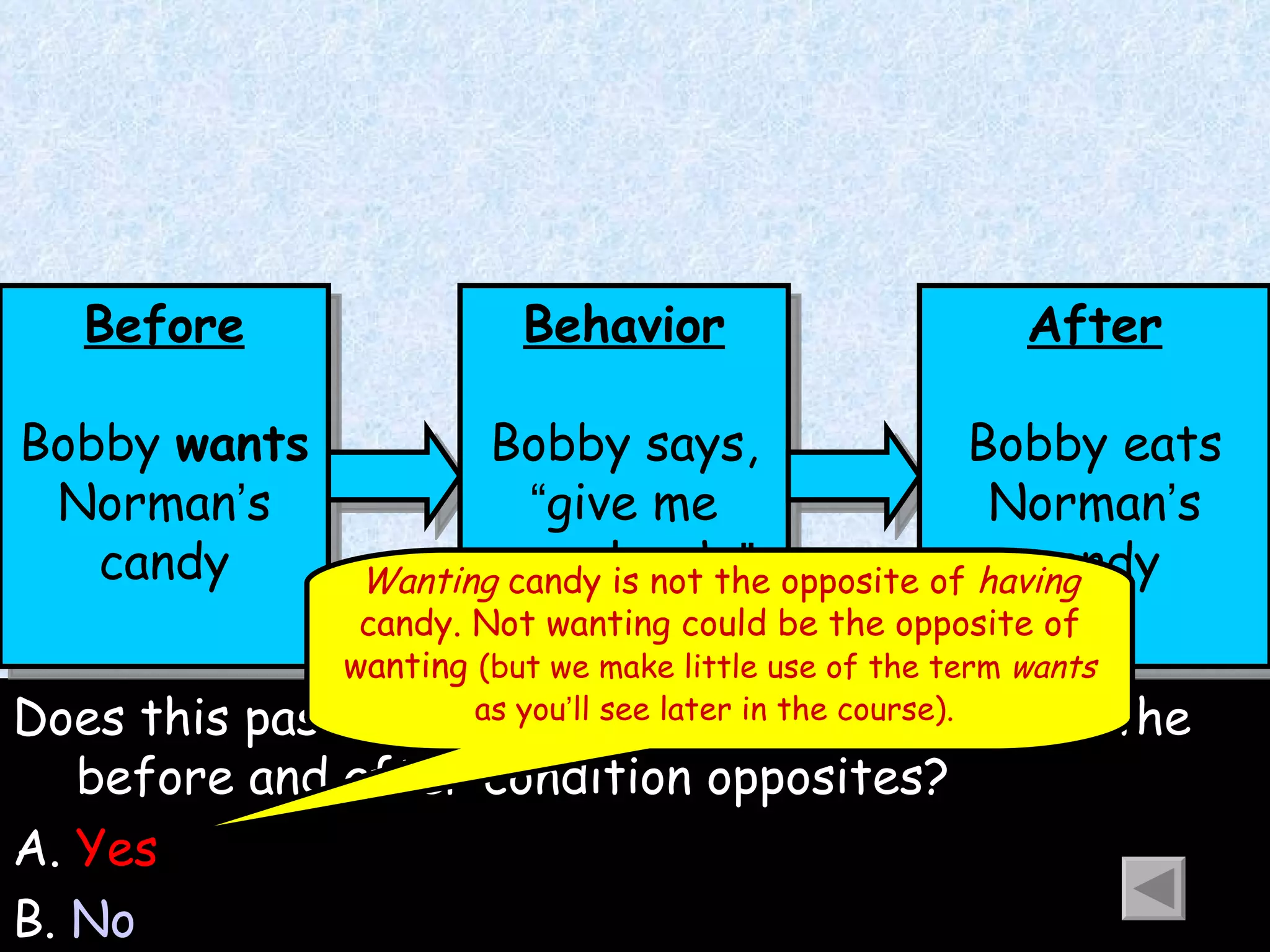
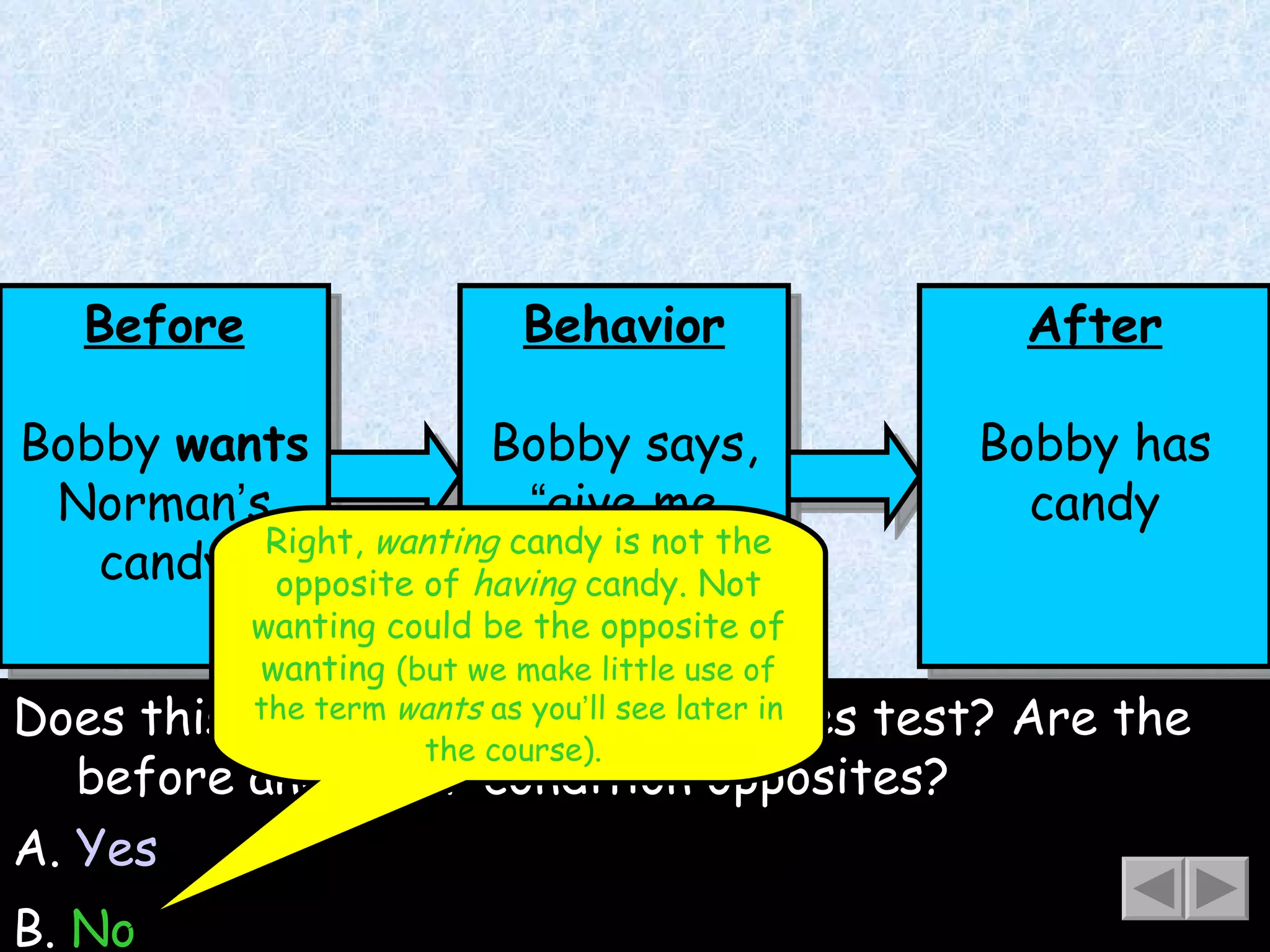
Does this pass the related-outcomes test? Are the before and after condition opposites? A.  Yes B.  No Before Bobby  wants  Norman ’ s candy Behavior Bobby says,  “ give me your lunch. ” After Bobby  has  candy
Does this pass the related-outcomes test? Are the before and after condition opposites? A.  Yes B.  No Before Bobby  wants  Norman ’ s candy Wanting  candy is not the opposite of  having  candy. Not wanting could be the opposite of wanting  (but we make little use of the term  wants  as you ’ ll see later in the course).   Behavior Bobby says,  “ give me your lunch. ” After Bobby eats Norman ’ s candy
Does this pass the related-outcomes test? Are the before and after condition opposites? A.  Yes B.  No Before Bobby  wants  Norman ’ s candy Right,  wanting  candy is not the opposite of  having  candy. Not wanting could be the opposite of wanting  (but we make little use of the term  wants  as you ’ ll see later in the course).   Behavior Bobby says,  “ give me your lunch. ” After Bobby has candy
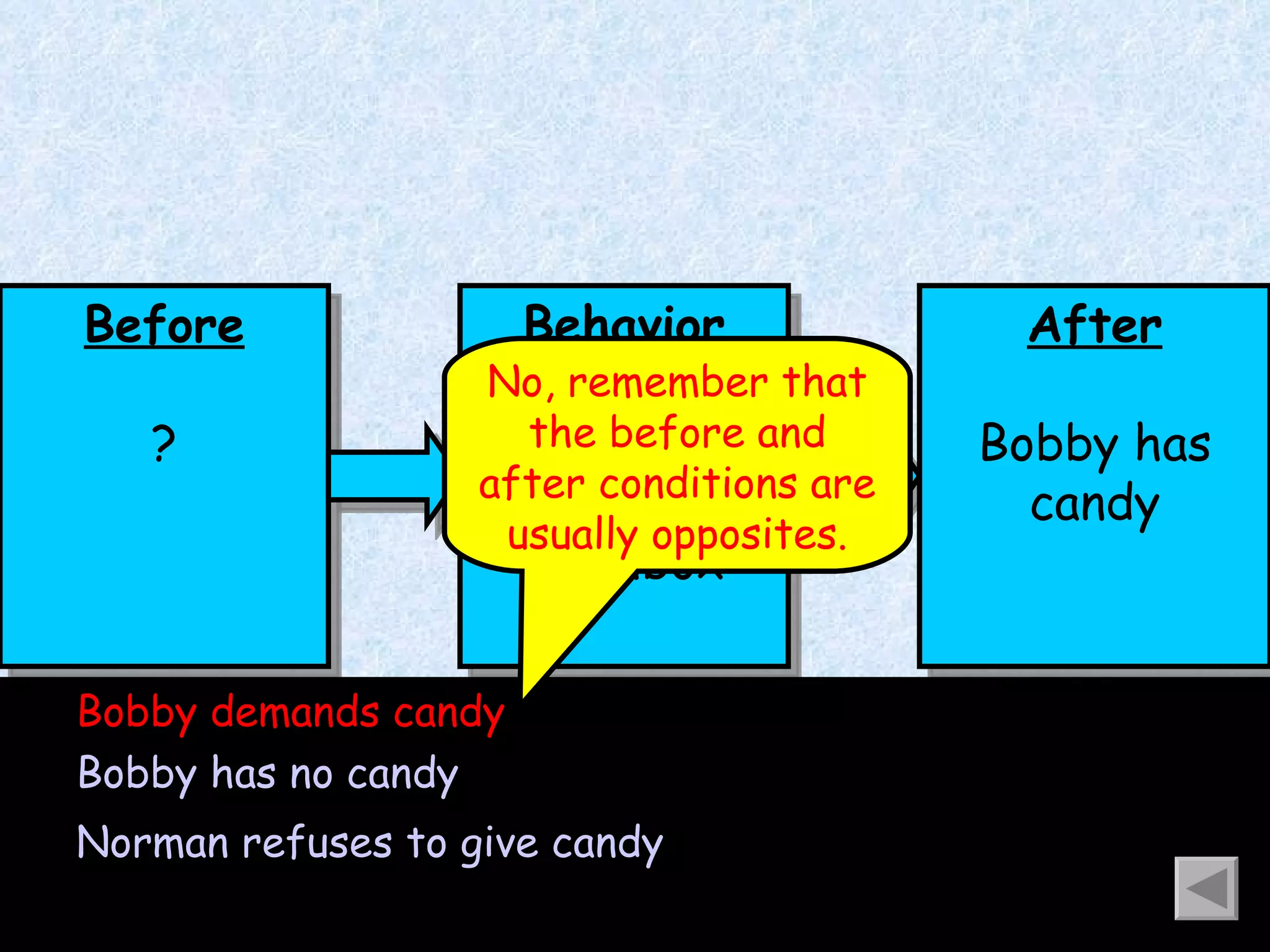
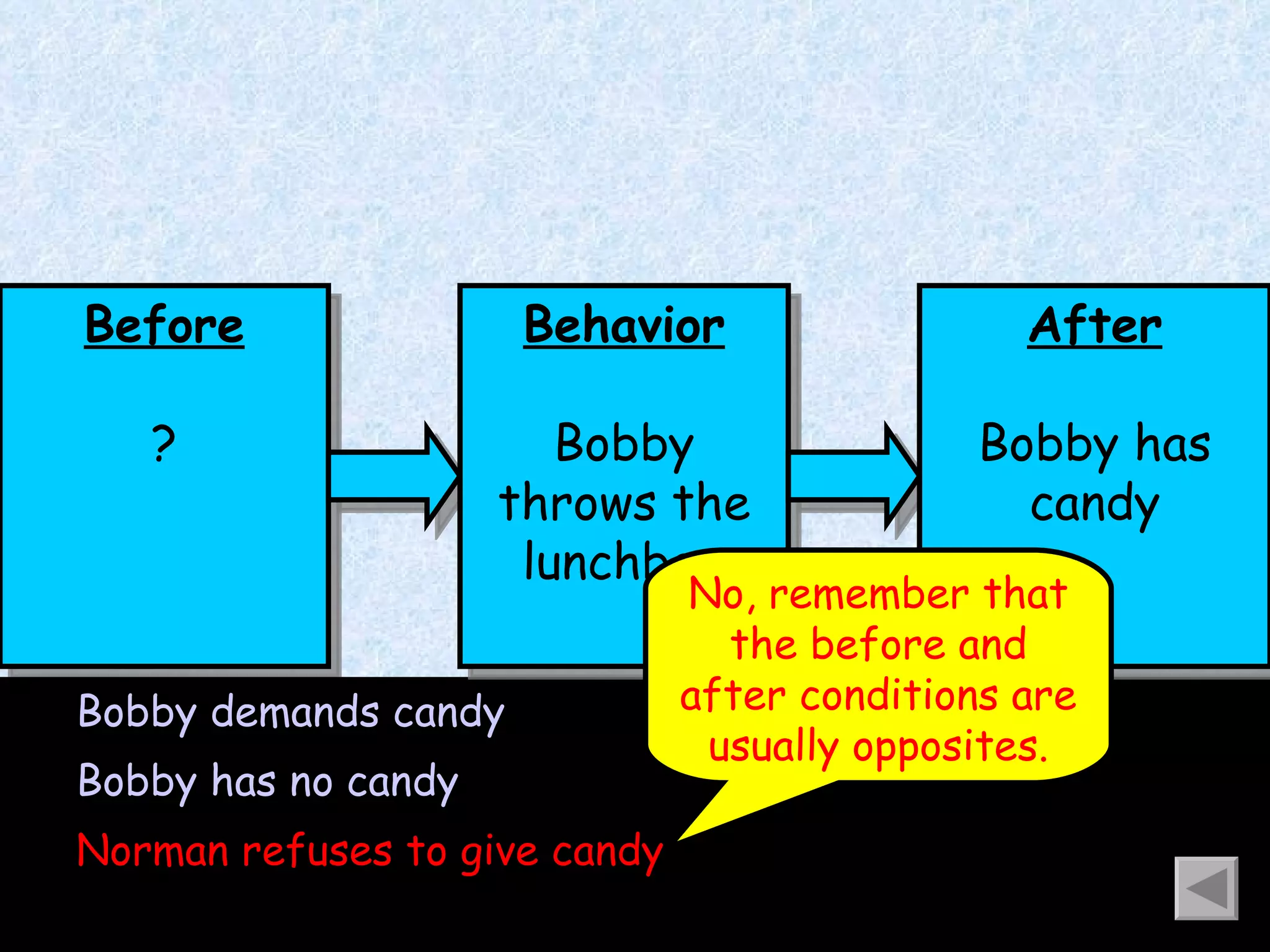
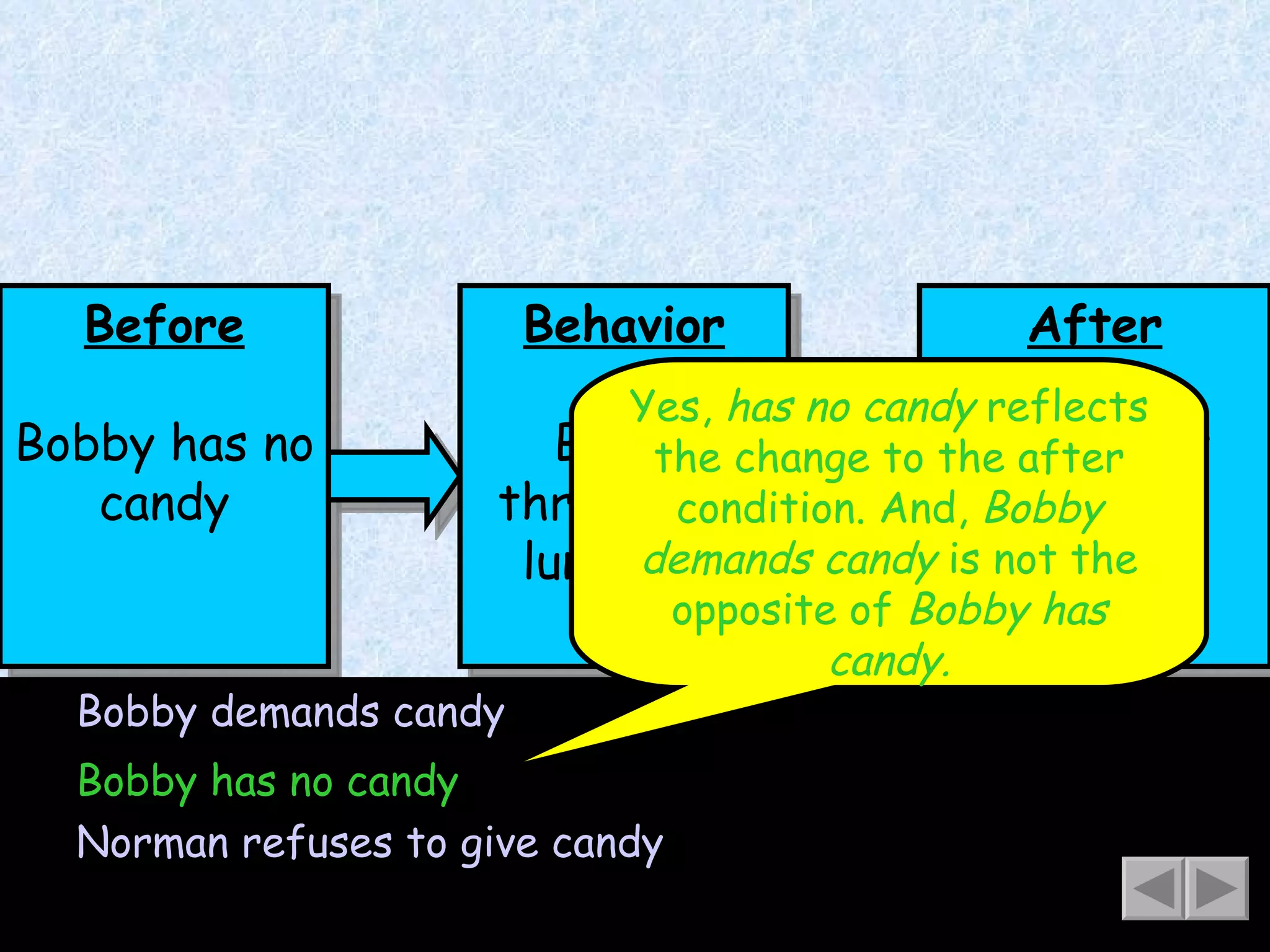
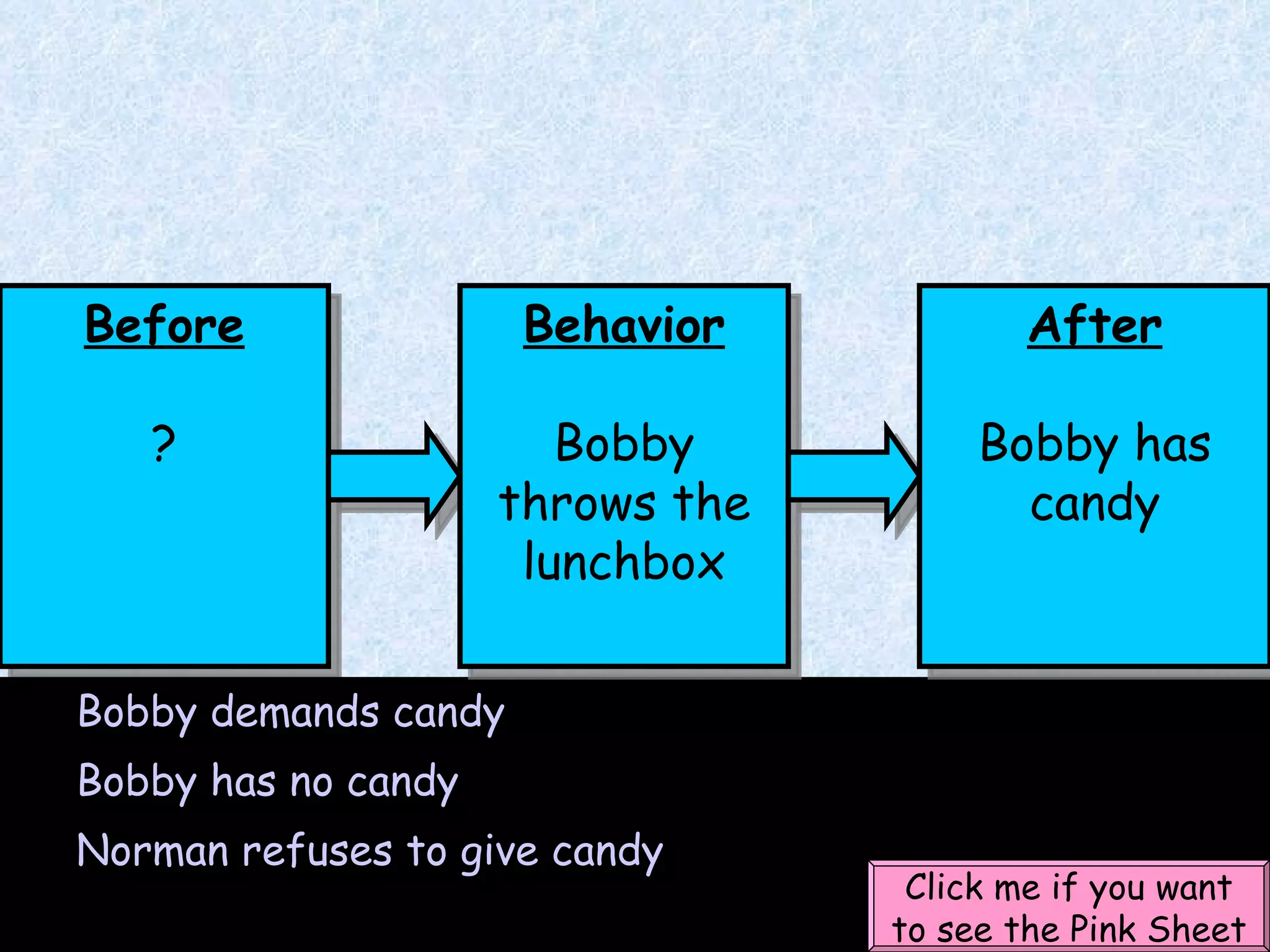
Before ? Bobby demands candy Bobby has no candy Norman refuses to give candy Click me if you want to see the Pink Sheet Behavior Bobby throws the lunchbox After Bobby has candy
2. Related Outcomes Test Is the before condition related to the after condition?  (Often the relationship is one of opposites.)  If not, change one or both of the conditions. Click me to go back to the Question Click me to go back to the Question
Before ? Bobby demands candy Bobby has no candy Norman refuses to give candy No, remember that the before and after conditions are usually opposites. Behavior Bobby throws the lunchbox After Bobby has candy
Before Bobby has no candy Bobby demands candy Bobby has no candy Norman refuses to give candy Yes,  has no candy  reflects the change to the after condition. And,  Bobby demands candy  is not the opposite of  Bobby has candy. Behavior Bobby throws the lunchbox After Bobby has candy
Response-Unit Test Are there any interruptions of greater than 60 seconds during the response?
Jaci has an entire research paper to write and she finishes the entire paper in three days of hard work.
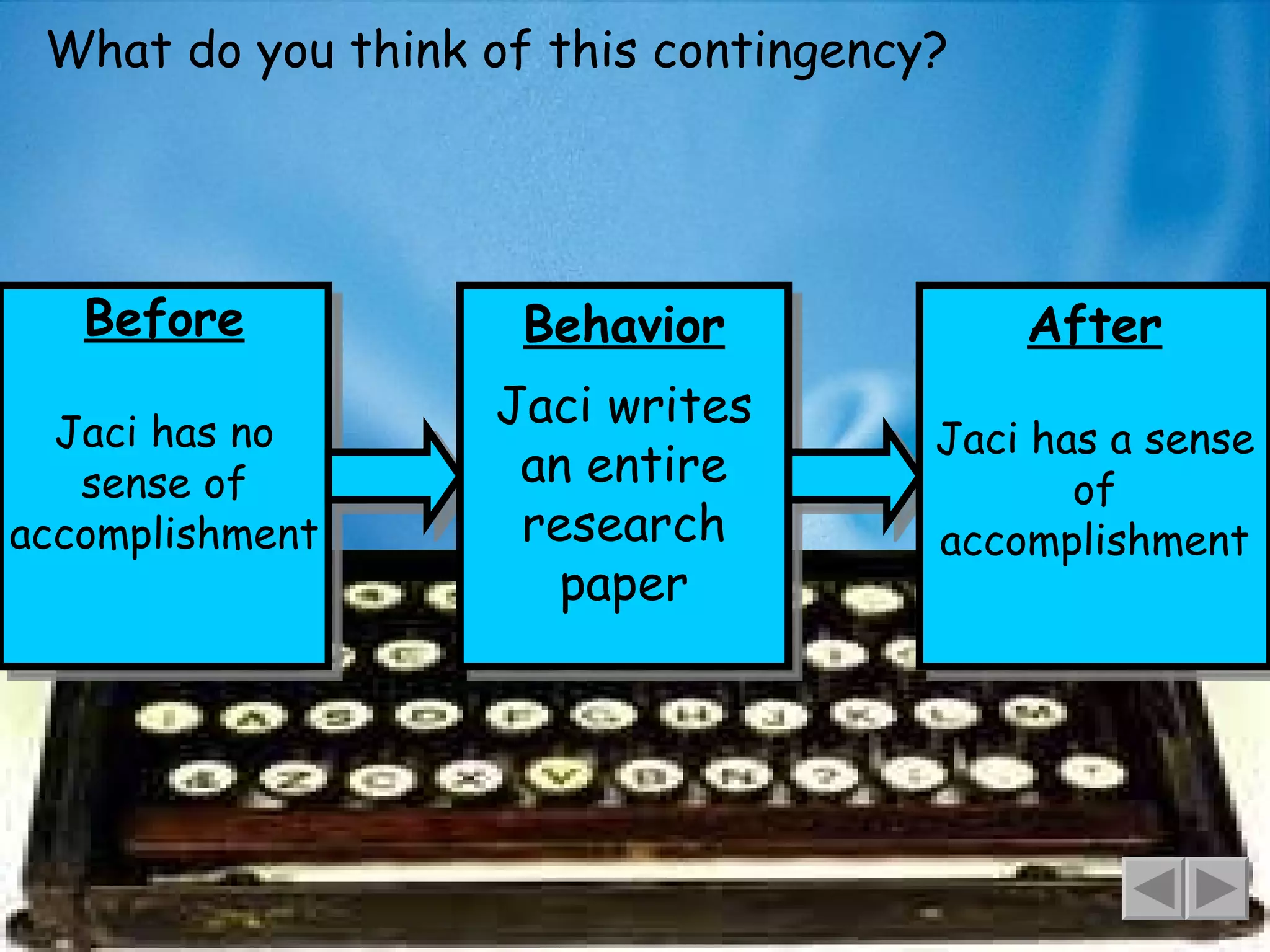
What do you think of this contingency? Before Jaci has no sense of accomplishment Behavior Jaci writes an entire research paper After Jaci has a sense of accomplishment
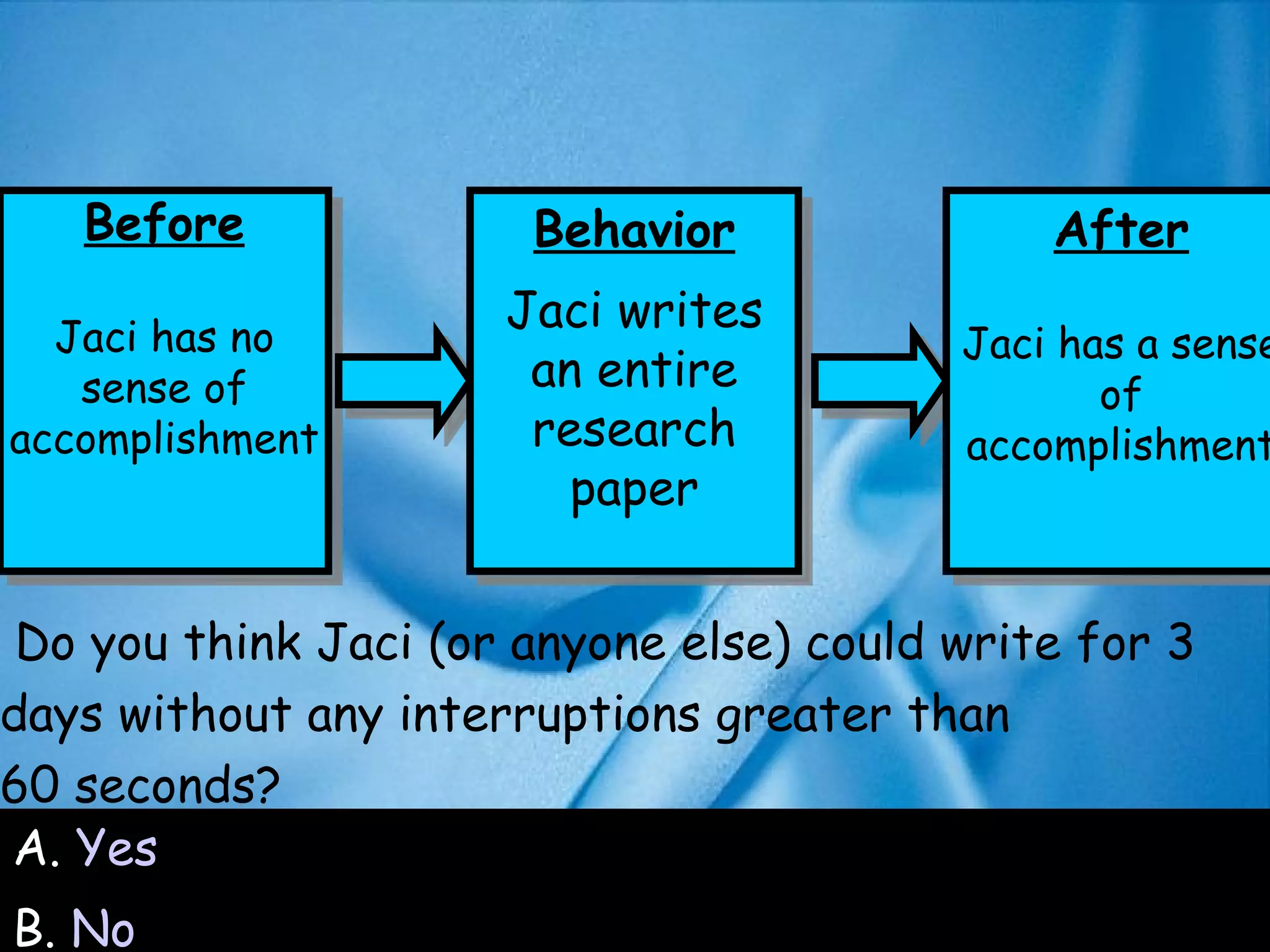
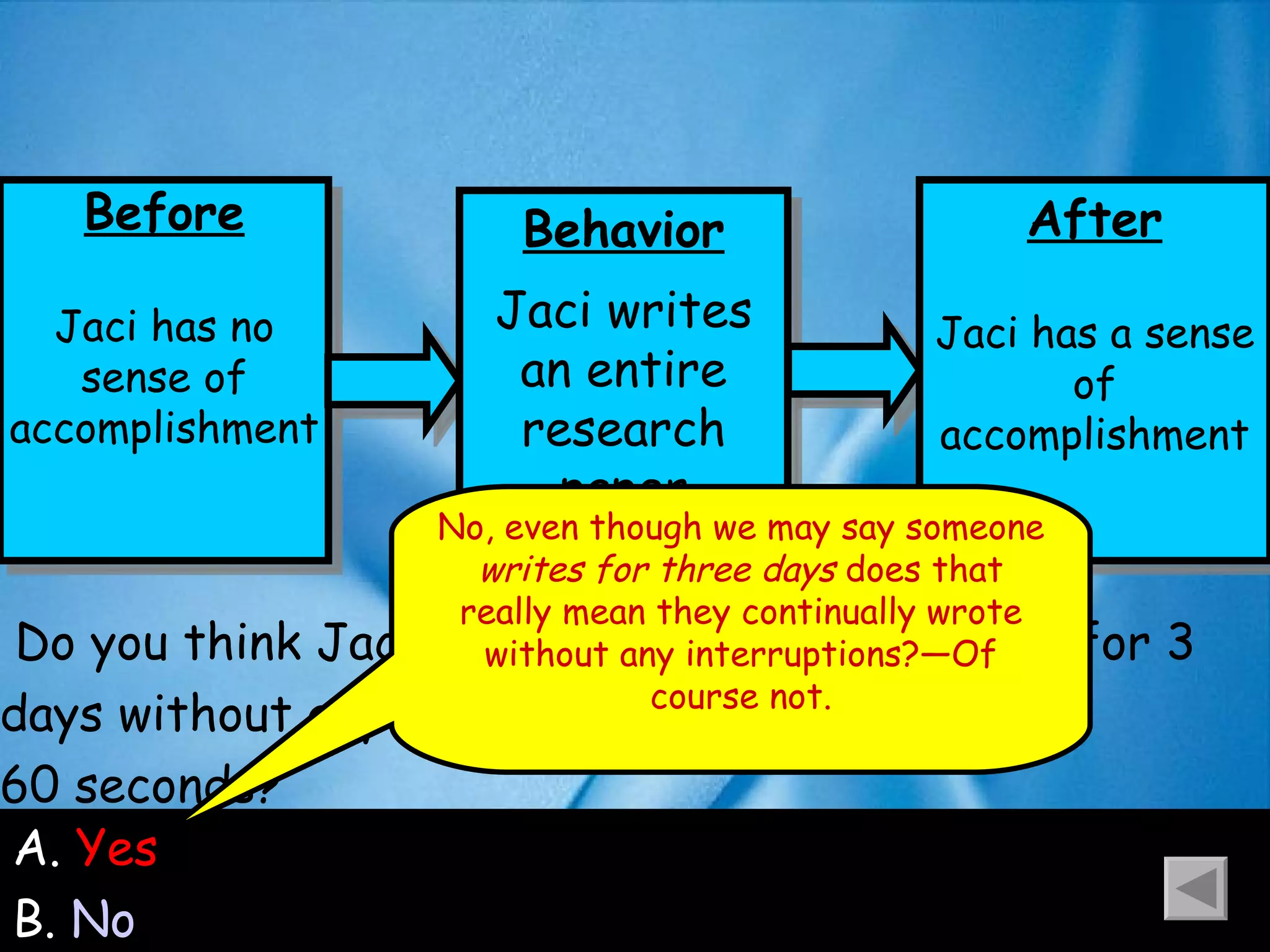
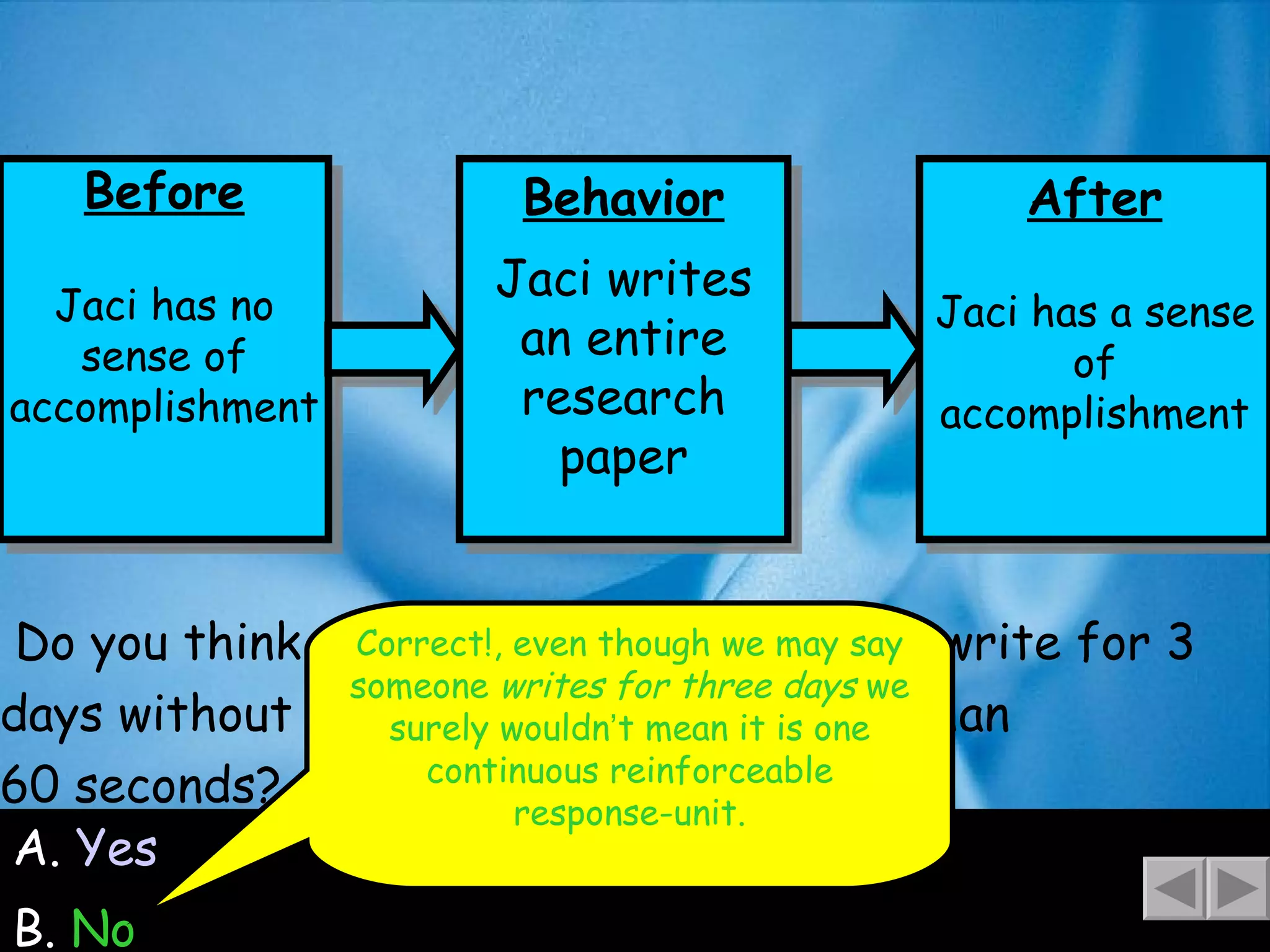
Do you think Jaci (or anyone else) could write for 3  days without any interruptions greater than  60 seconds? Before Jaci has no sense of accomplishment A.  Yes B.  No Behavior Jaci writes an entire research paper After Jaci has a sense of accomplishment
Before Jaci has no sense of accomplishment A.  Yes B.  No Do you think Jaci (or anyone else) could write for 3  days without any interruptions greater than  60 seconds? No, even though we may say someone  writes for three days  does that really mean they continually wrote without any interruptions?—Of course not. Behavior Jaci writes an entire research paper After Jaci has a sense of accomplishment
Before Jaci has no sense of accomplishment A.  Yes B.  No Do you think Jaci (or anyone else) could write for 3  days without any interruptions greater than  60 seconds? Correct!, even though we may say someone  writes for three days  we surely wouldn ’ t mean it is one continuous reinforceable response-unit. Behavior Jaci writes an entire research paper After Jaci has a sense of accomplishment
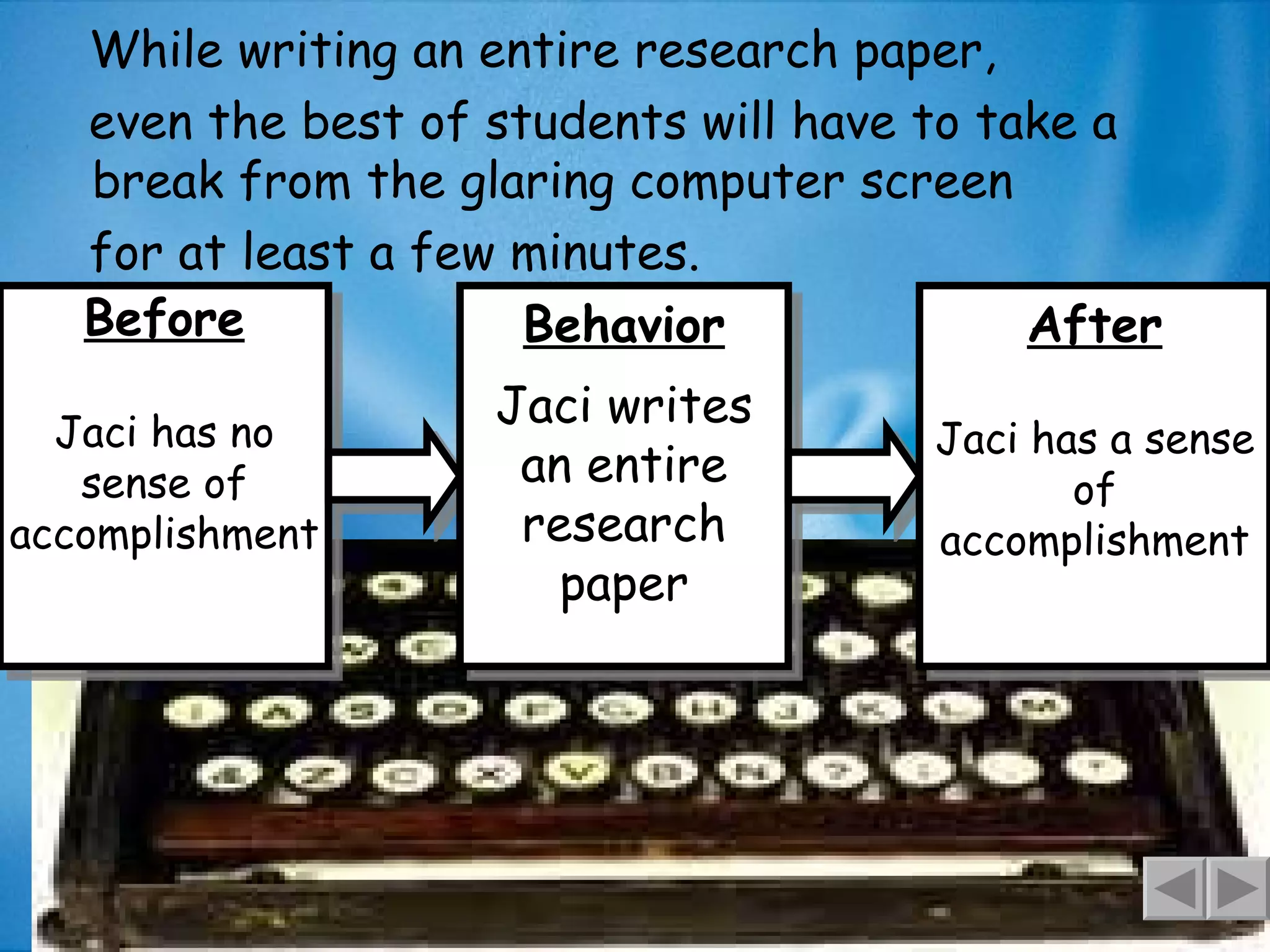
Before Jaci has no sense of accomplishment While writing an entire research paper,  even the best of students will have to take a break from the glaring computer screen for at least a few minutes. Behavior Jaci writes an entire research paper After Jaci has a sense of accomplishment
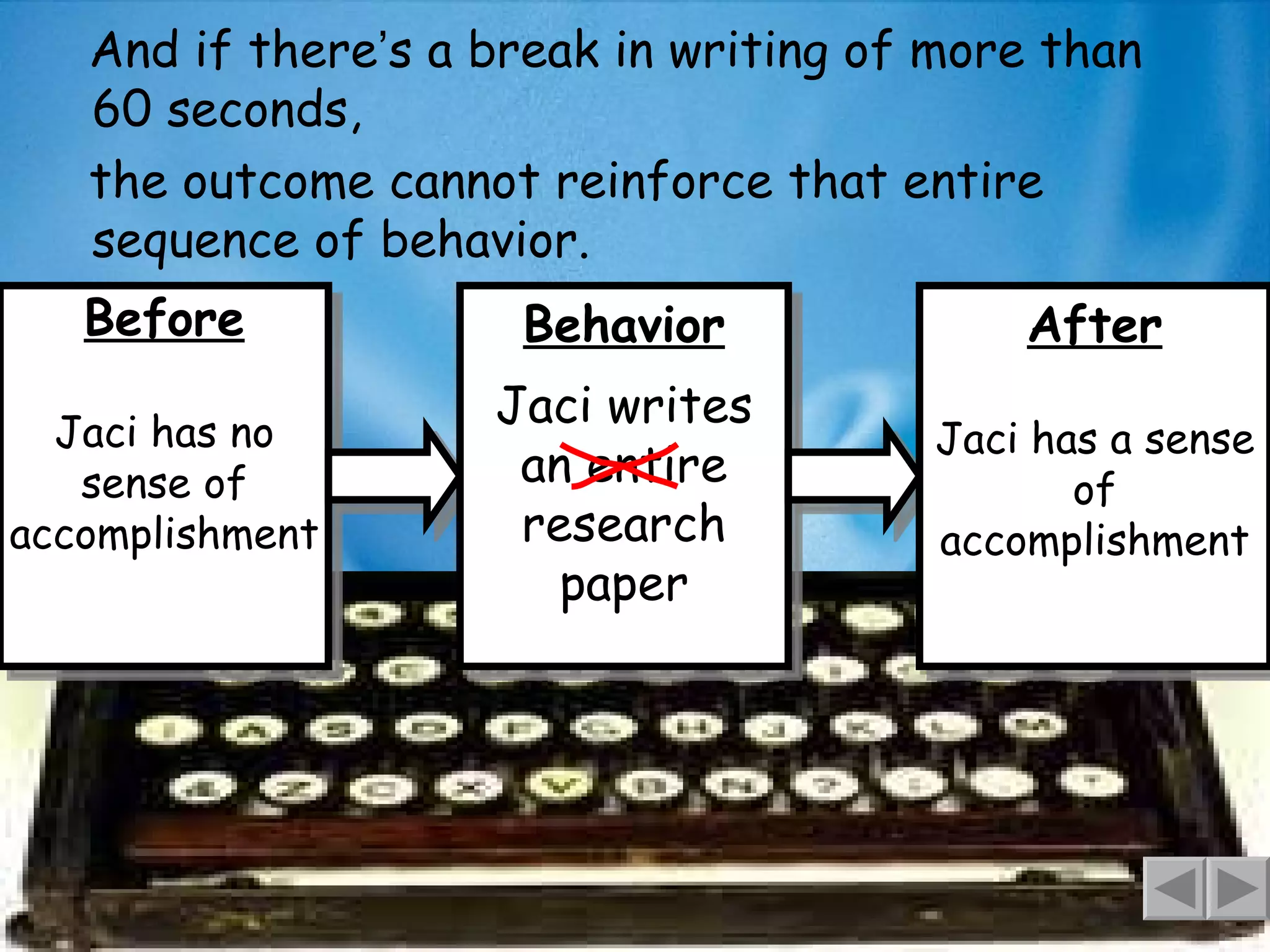
And if there ’ s a break in writing of more than 60 seconds, the outcome cannot reinforce that entire sequence of behavior. Before Jaci has no sense of accomplishment Behavior Jaci writes an entire research paper After Jaci has a sense of accomplishment
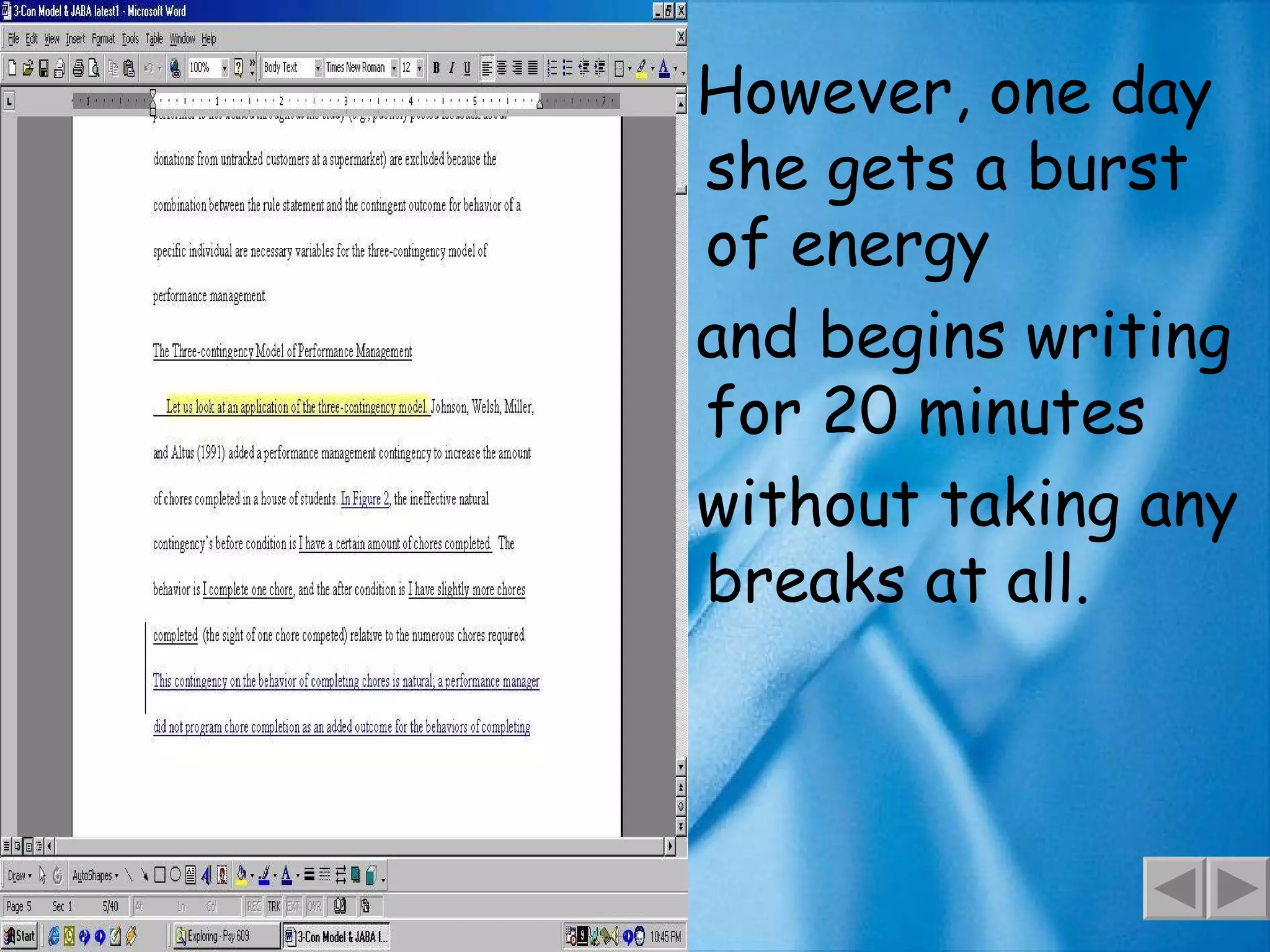
However, one day she gets a burst of energy and begins writing for 20 minutes without taking any breaks at all.
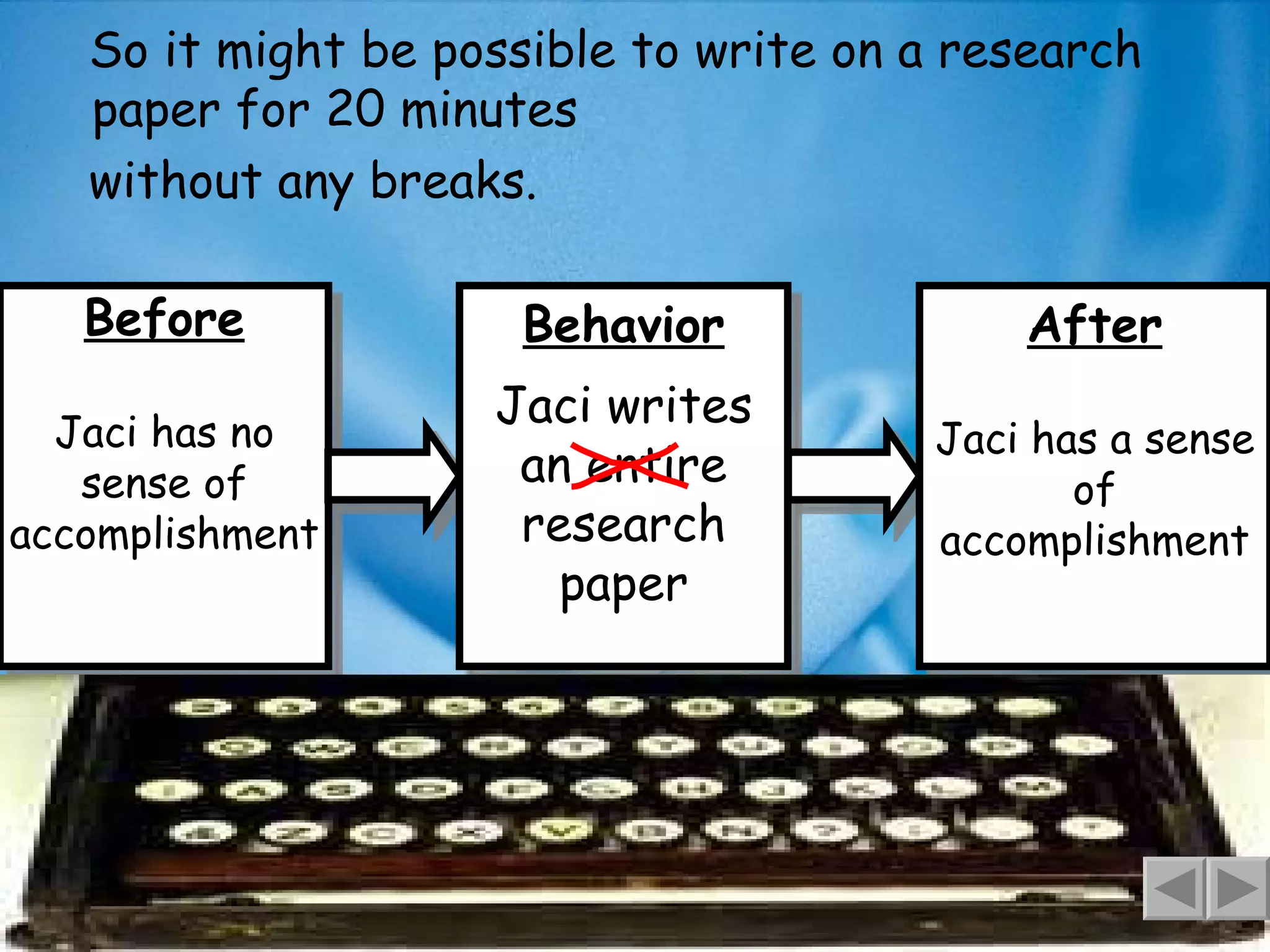
So it might be possible to write on a research paper for 20 minutes  without any breaks. Before Jaci has no sense of accomplishment Behavior Jaci writes an entire research paper After Jaci has a sense of accomplishment
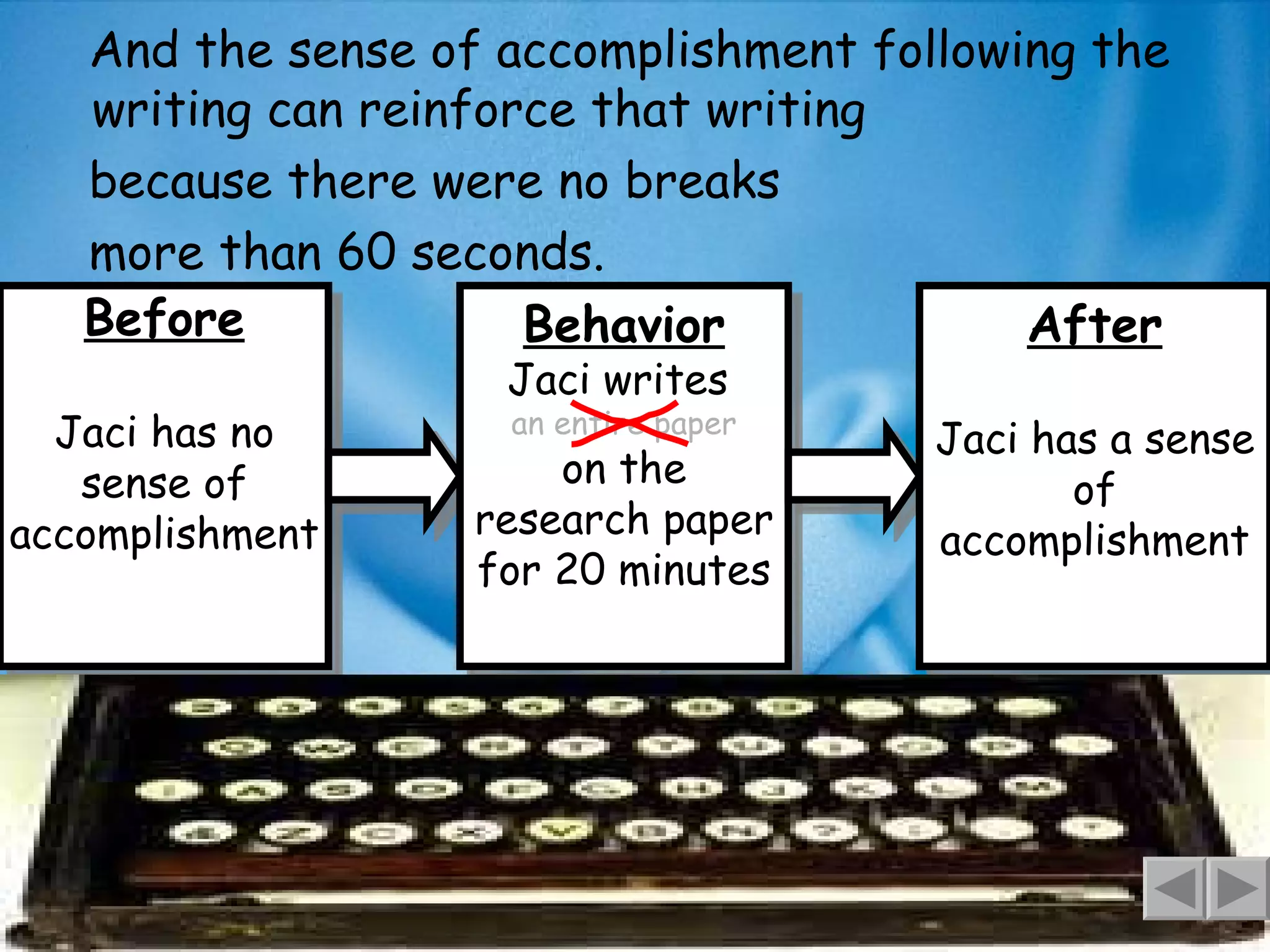
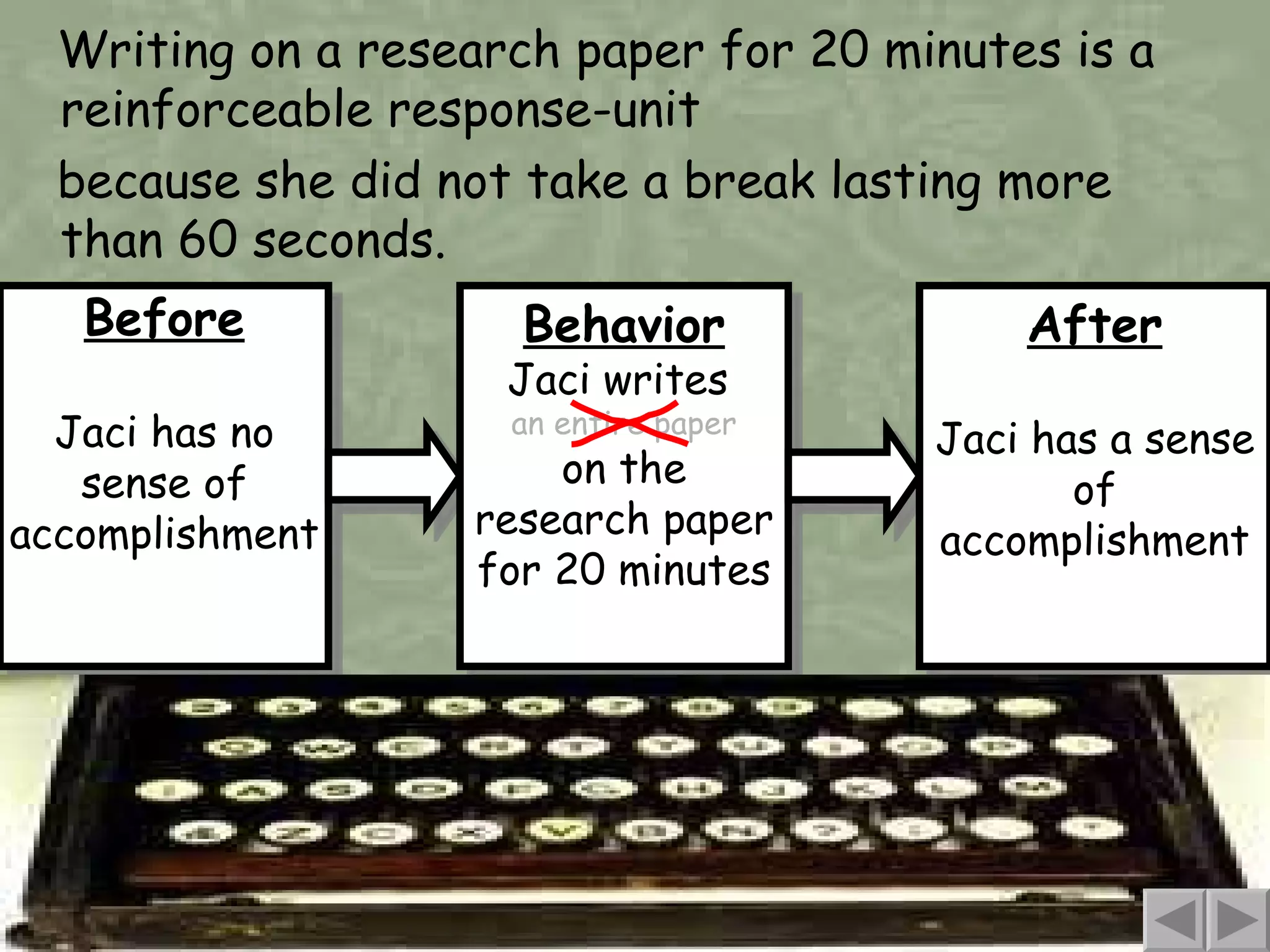
And the sense of accomplishment following the writing can reinforce that writing because there were no breaks more than 60 seconds. Before Jaci has no sense of accomplishment Behavior Jaci writes  an entire paper on the research paper for 20 minutes After Jaci has a sense of accomplishment
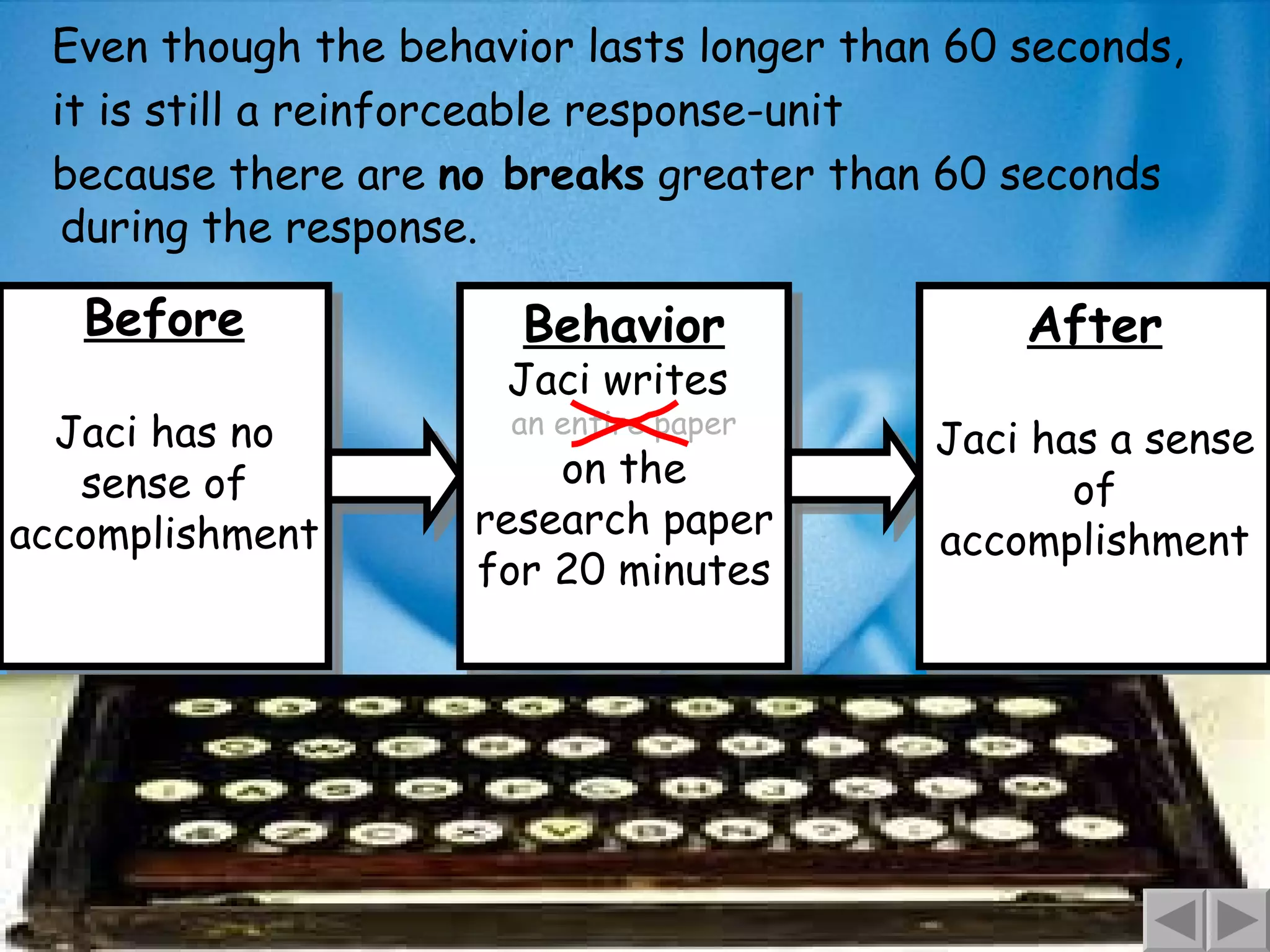
Even though the behavior lasts longer than 60 seconds, it is still a reinforceable response-unit because there are  no breaks  greater than 60 seconds during the response. Before Jaci has no sense of accomplishment Behavior Jaci writes  an entire paper on the research paper for 20 minutes After Jaci has a sense of accomplishment
Writing on a research paper for 20 minutes is a reinforceable response-unit  because she did not take a break lasting more than 60 seconds. Before Jaci has no sense of accomplishment Behavior Jaci writes  an entire paper on the research paper for 20 minutes After Jaci has a sense of accomplishment
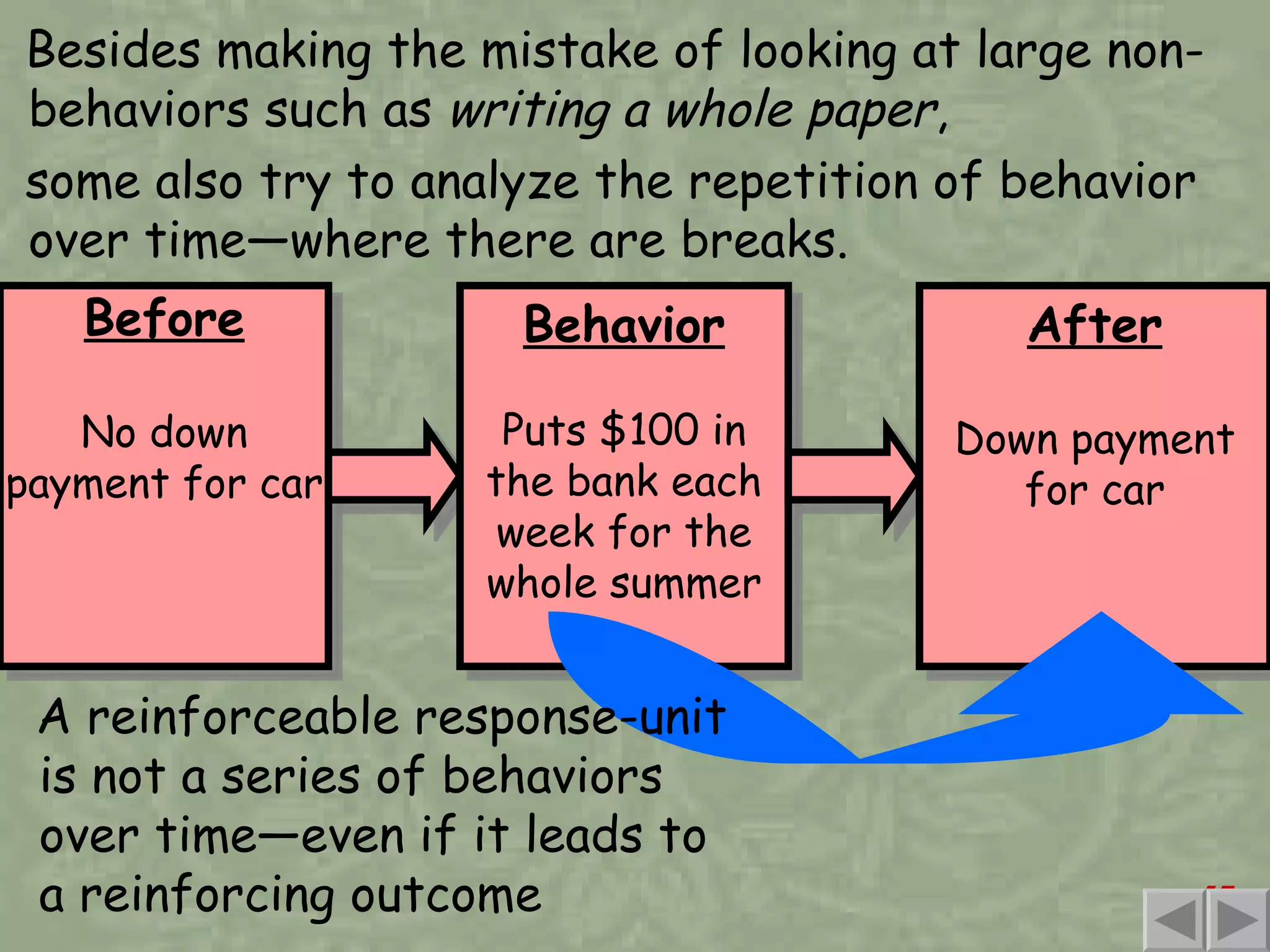
Besides making the mistake of looking at large non-behaviors such as  writing a whole paper , some also try to analyze the repetition of behavior over time—where there are breaks. Before No down payment for car A reinforceable response-unit is not a series of behaviors over time—even if it leads to a reinforcing outcome Behavior Puts $100 in the bank each week for the whole summer After Down payment for car
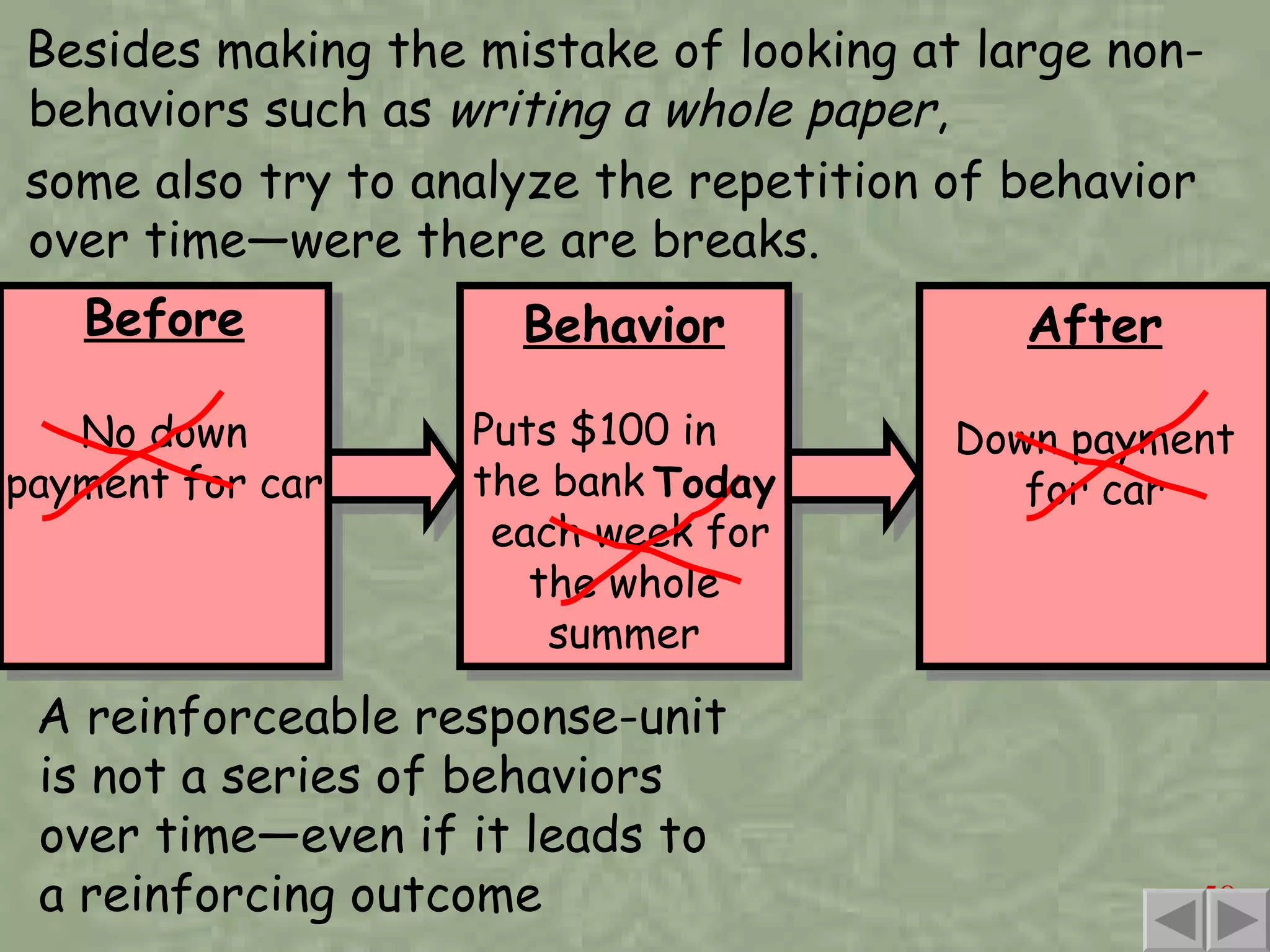
Besides making the mistake of looking at large non-behaviors such as  writing a whole paper , some also try to analyze the repetition of behavior over time—were there are breaks. Before No down payment for car A reinforceable response-unit is not a series of behaviors over time—even if it leads to a reinforcing outcome Today Behavior Puts $100 in the bank each week for the whole summer After Down payment for car
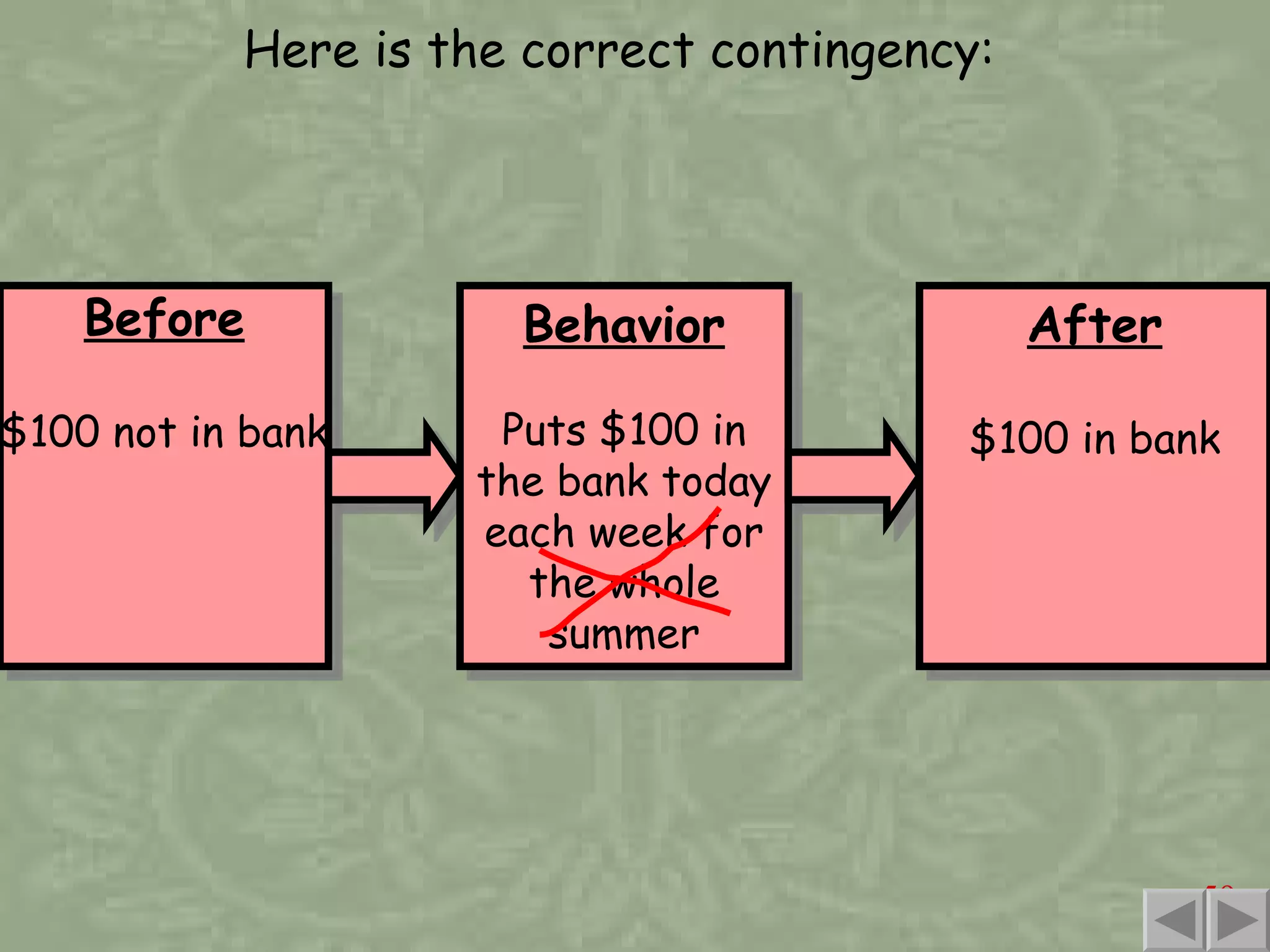
Here is the correct contingency: Before $100 not in bank Behavior Puts $100 in the bank today  each week for the whole summer After $100 in bank
This test is designed to help ensure the behavior you are analyzing is actually one reinforceable response-unit.
When we talk about the reinforceable response-unit, we are only concerned with the behavior box; keep this in mind. Behavior Bob studies
Often students confuse this test with the 60 second test. When checking the behavior listed in the behavior box, ask yourself  “ Are there any interruptions of greater than 60 seconds during the response? ”
If there are long breaks, you don ’ t have a true reinforceable response-unit, you actually have something else, an analog to a reinforceable response-unit (you ’ ll get to that starting in chapter 22).
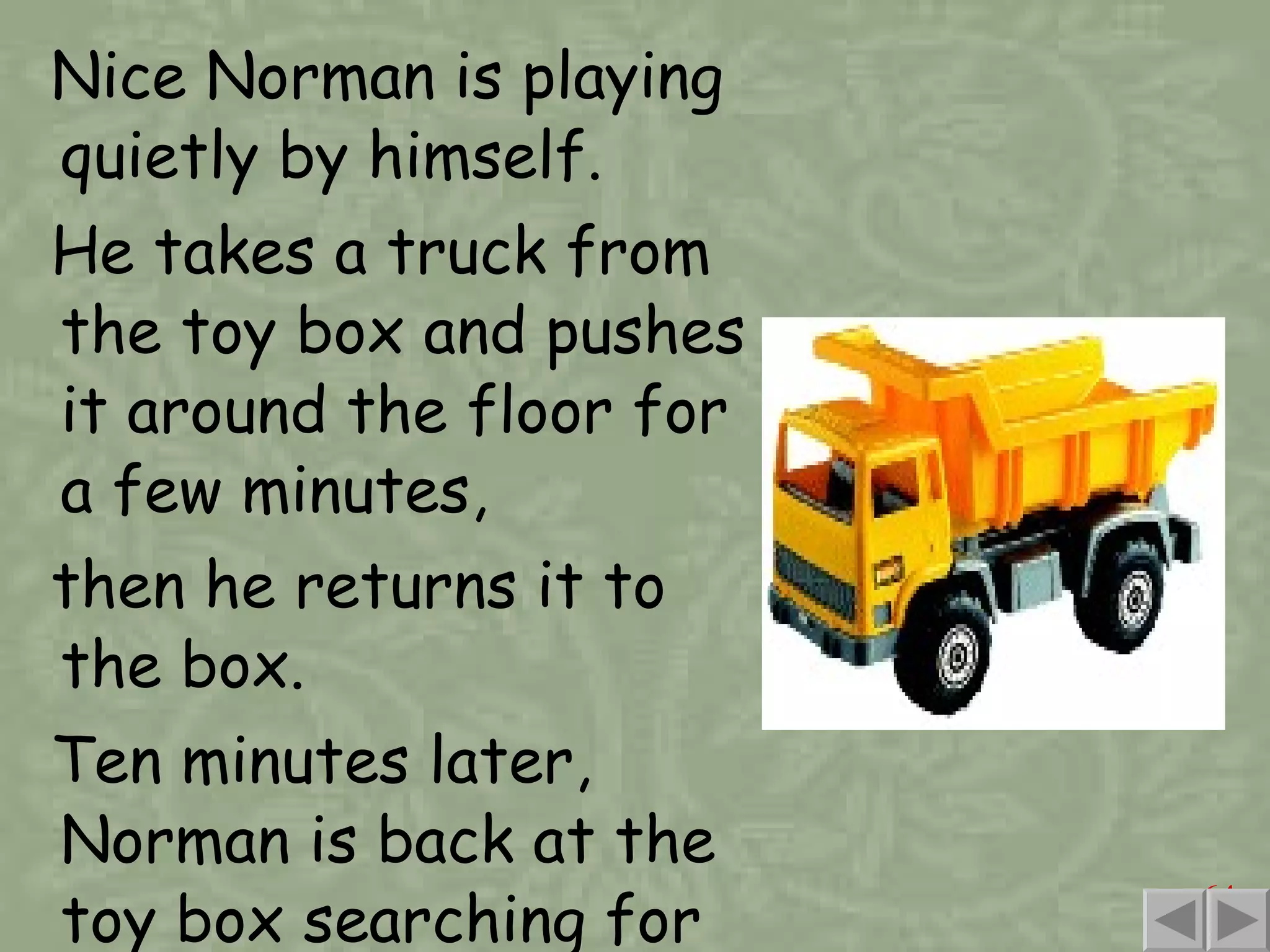
Nice Norman is playing quietly by himself. He takes a truck from the toy box and pushes it around the floor for a few minutes, then he returns it to the box. Ten minutes later, Norman is back at the toy box searching for another toy.
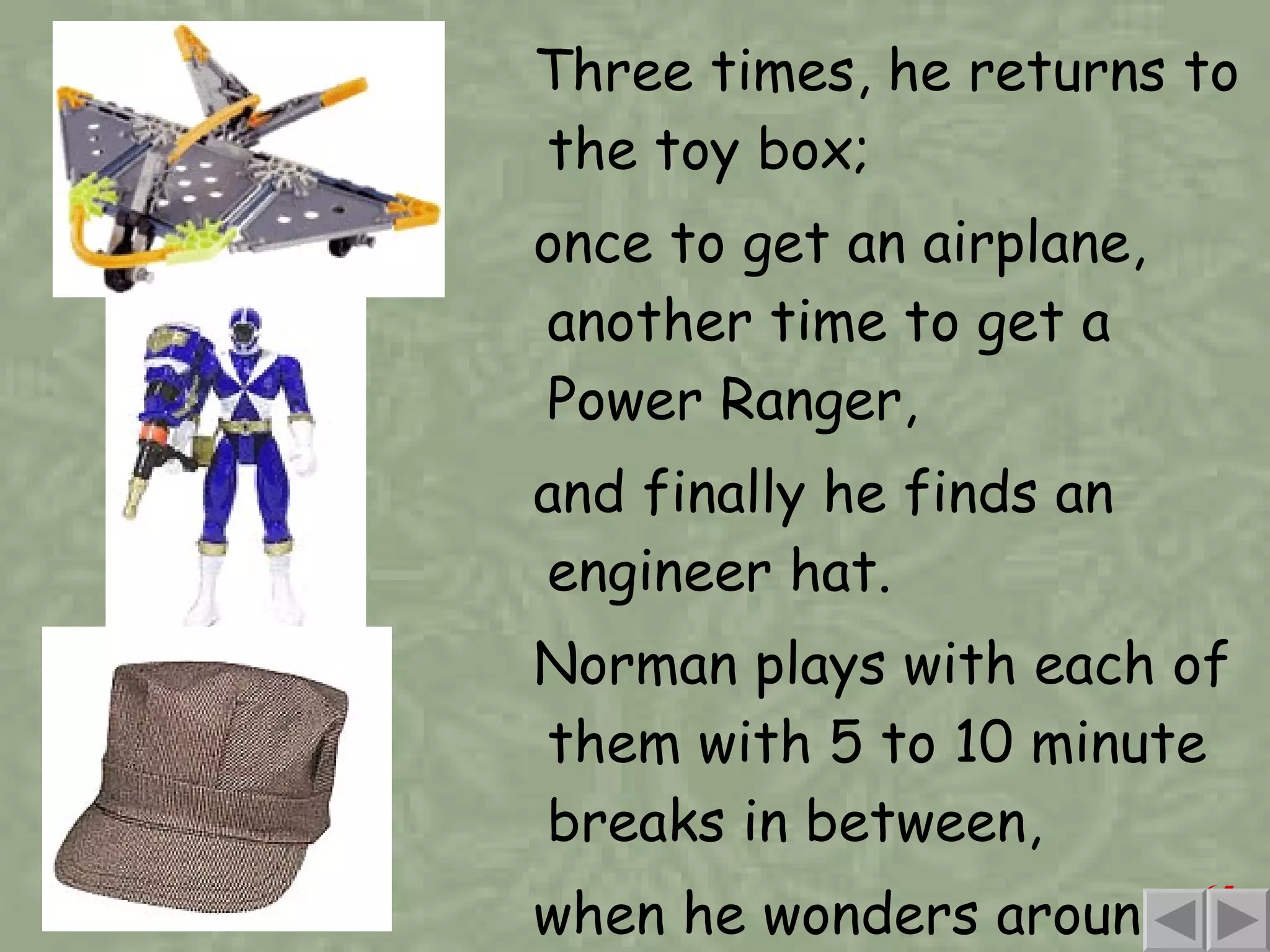
Three times, he returns to the toy box;  once to get an airplane, another time to get a Power Ranger,  and finally he finds an engineer hat. Norman plays with each of them with 5 to 10 minute breaks in between, when he wonders around the room, looking for fun.
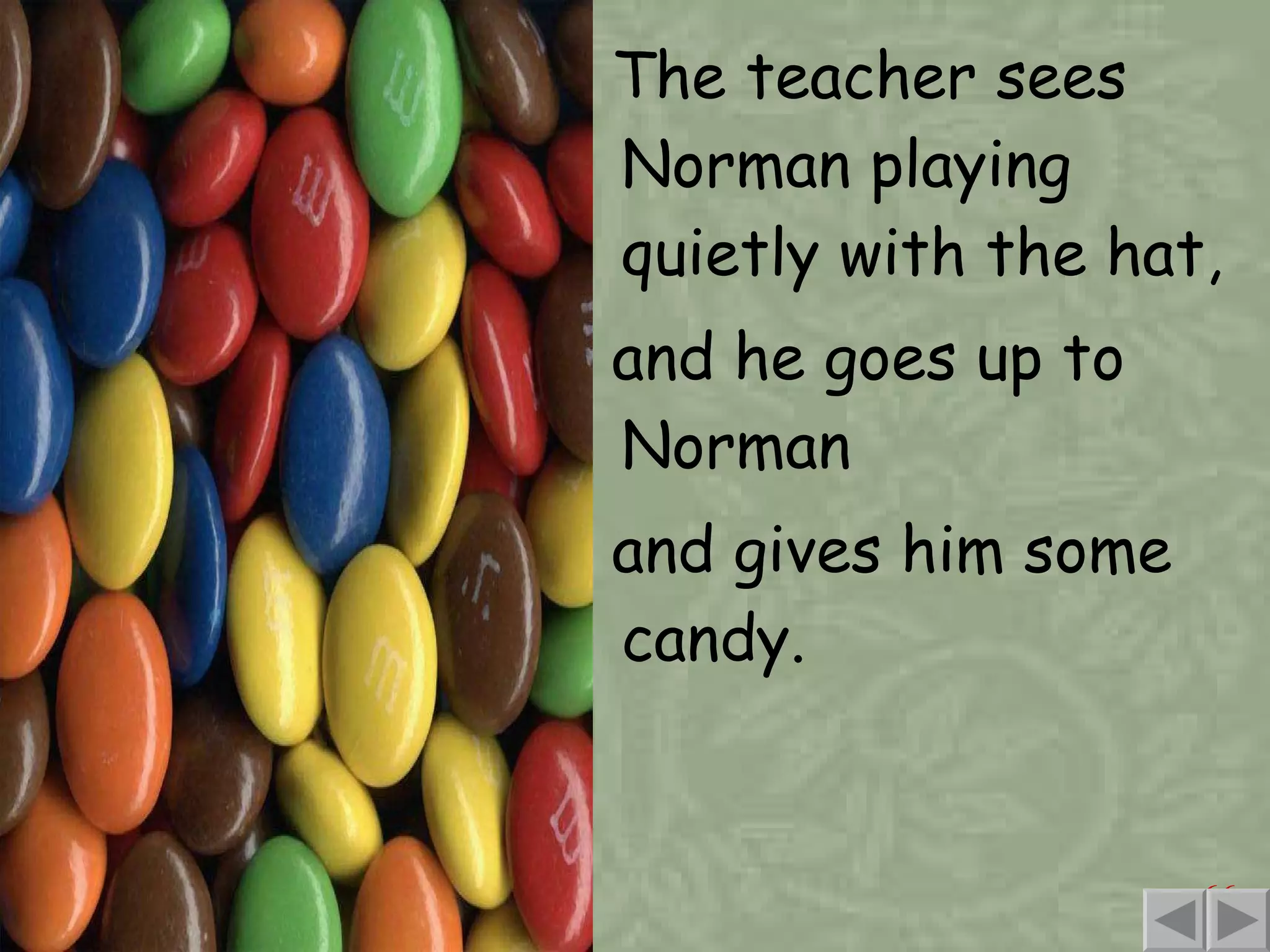
The teacher sees Norman playing quietly with the hat, and he goes up to Norman and gives him some candy.
Do you think the candy will reinforce  all  of Norman ’ s playing? A.  Yes B.  No
Do you think the candy will reinforce  all  of Norman ’ s playing? A.  Yes B.  No It probably wouldn ’ t because of the numerous long breaks he took.
Do you think the candy will reinforce  all  of Norman ’ s playing? A.  Yes B.  No Correct! It probably wouldn ’ t because of the numerous long breaks he took.
Just to make sure you are getting this concept down, here ’ s another scenario to test your behavior-analytic repertoire.
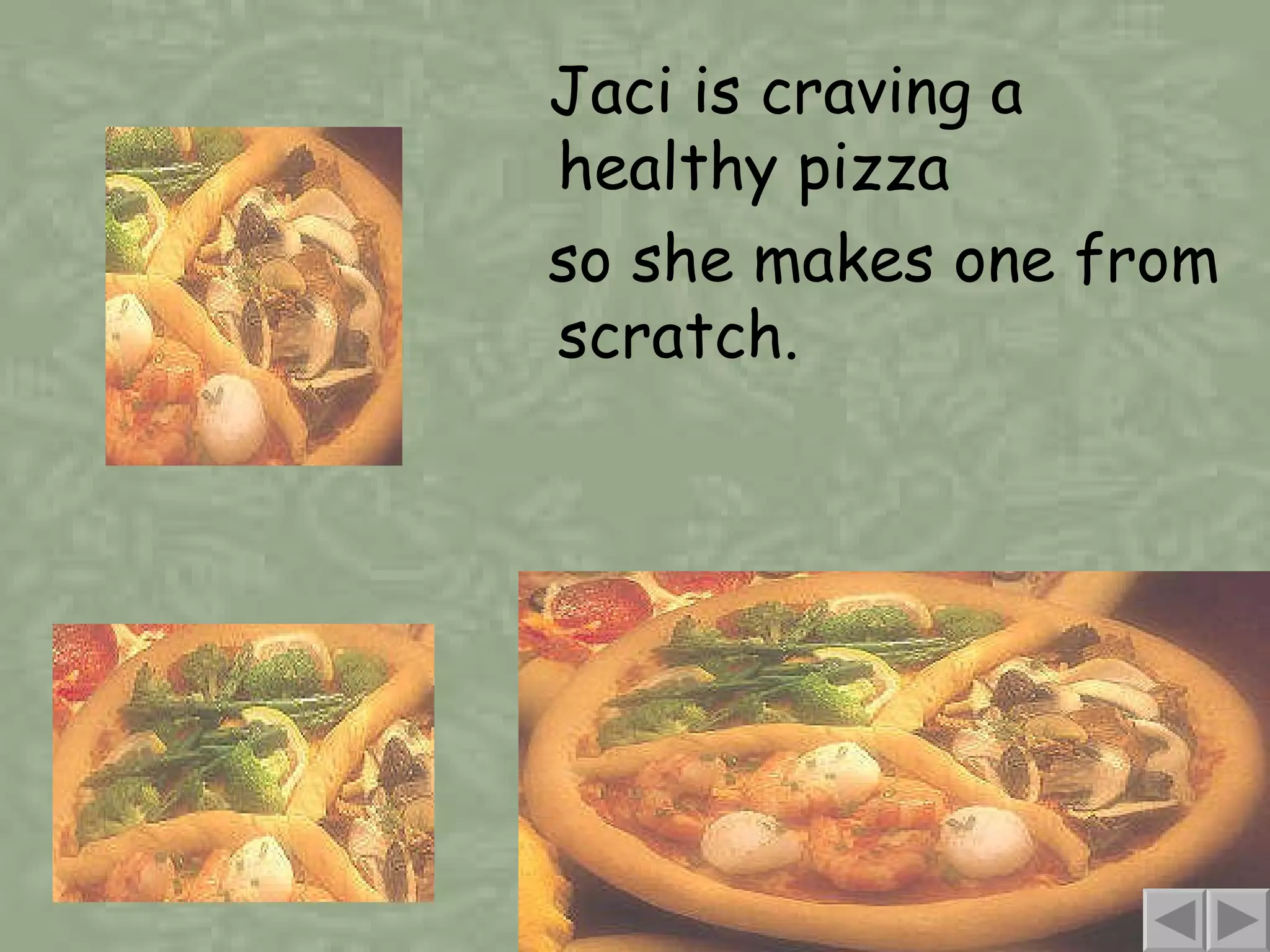
Jaci is craving a healthy pizza so she makes one from scratch.
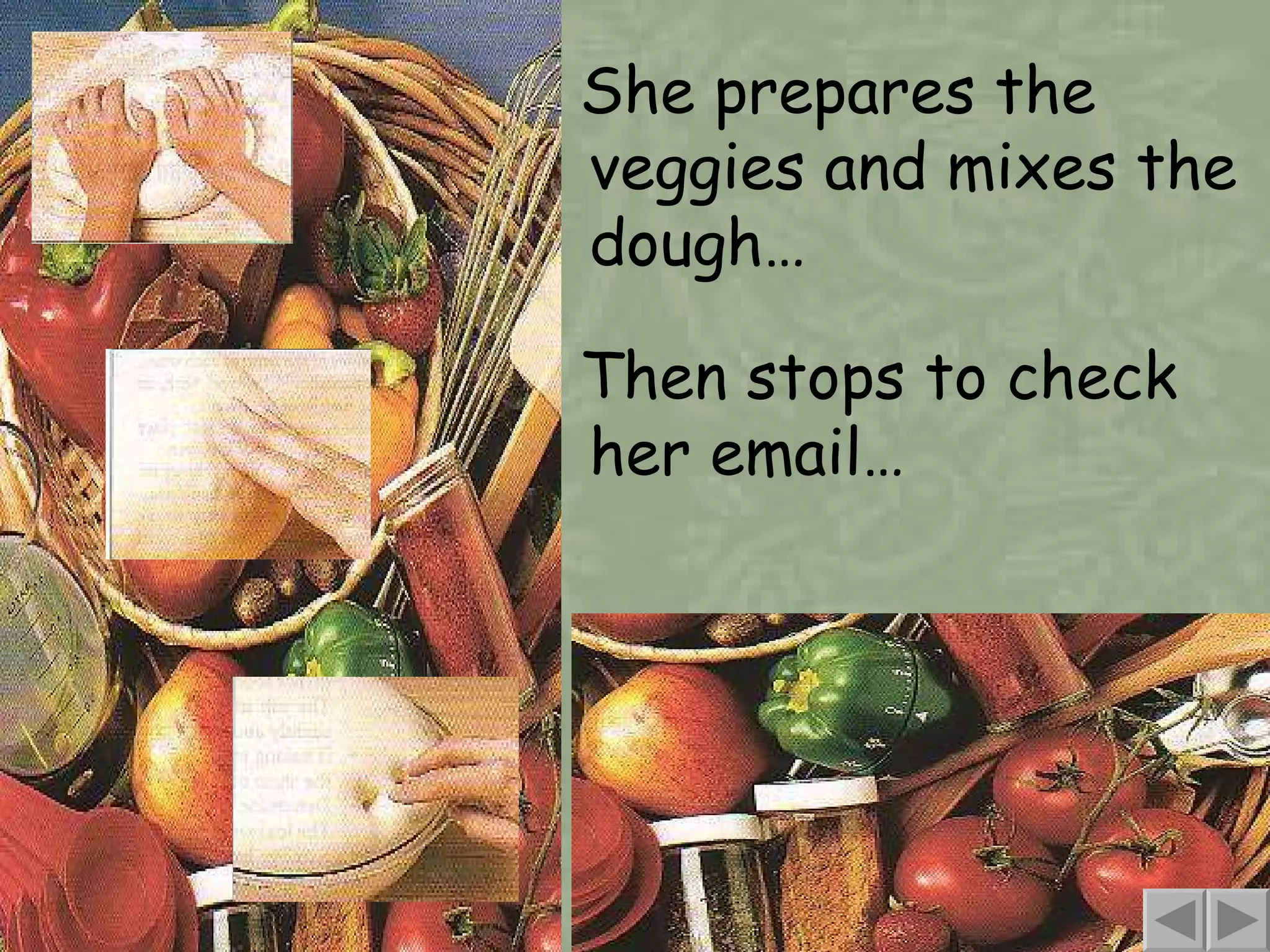
She prepares the veggies and mixes the dough… Then stops to check her email…
And 15 minutes later she puts on the veggies and low-fat cheese. Finally, with the pizza made, she puts it in the preheated oven.
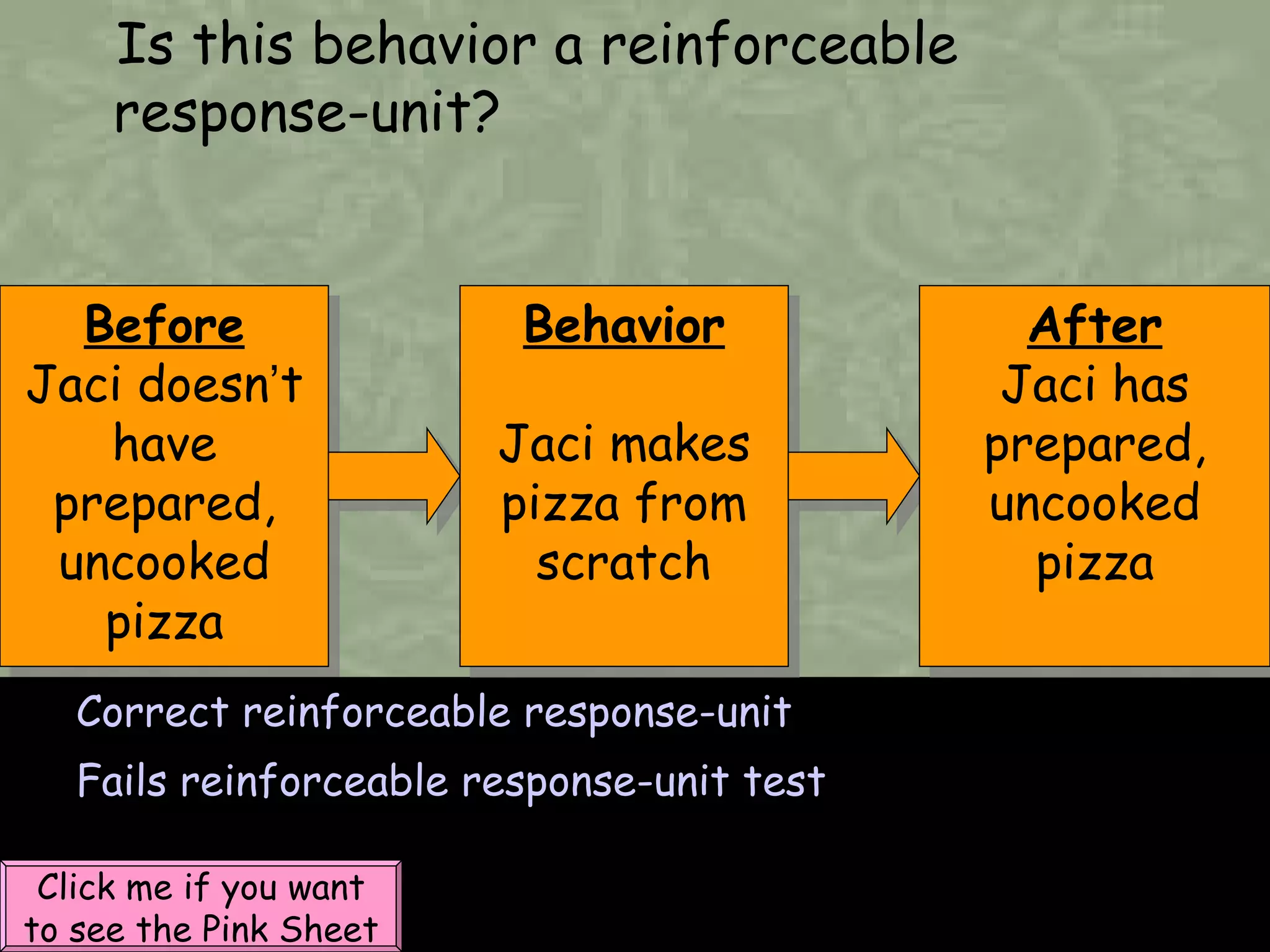
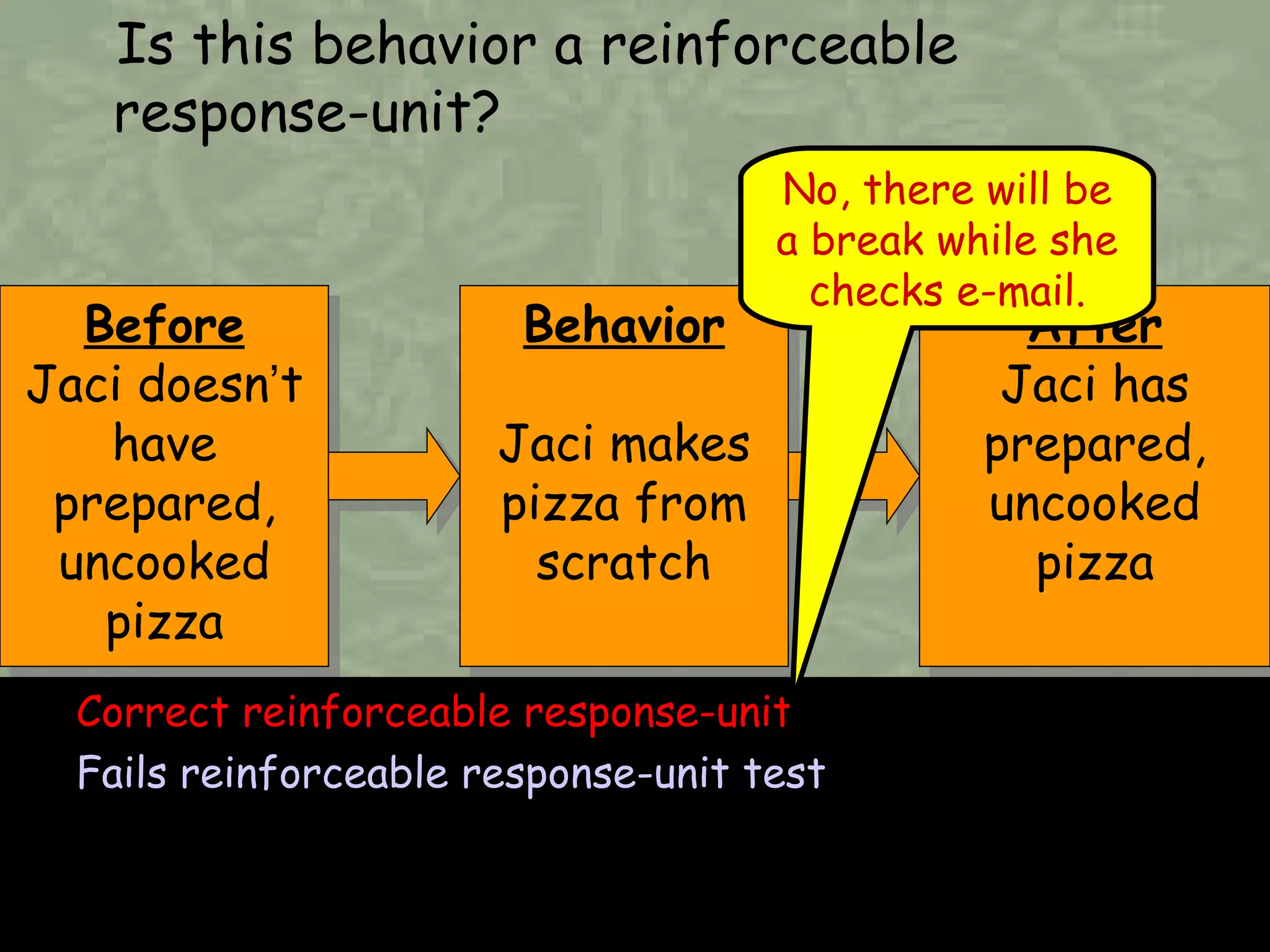
Before Jaci doesn ’ t have prepared, uncooked pizza Is this behavior a reinforceable response-unit? Correct reinforceable response-unit Fails reinforceable response-unit test Click me if you want to see the Pink Sheet Behavior Jaci makes pizza from scratch After Jaci has prepared, uncooked pizza
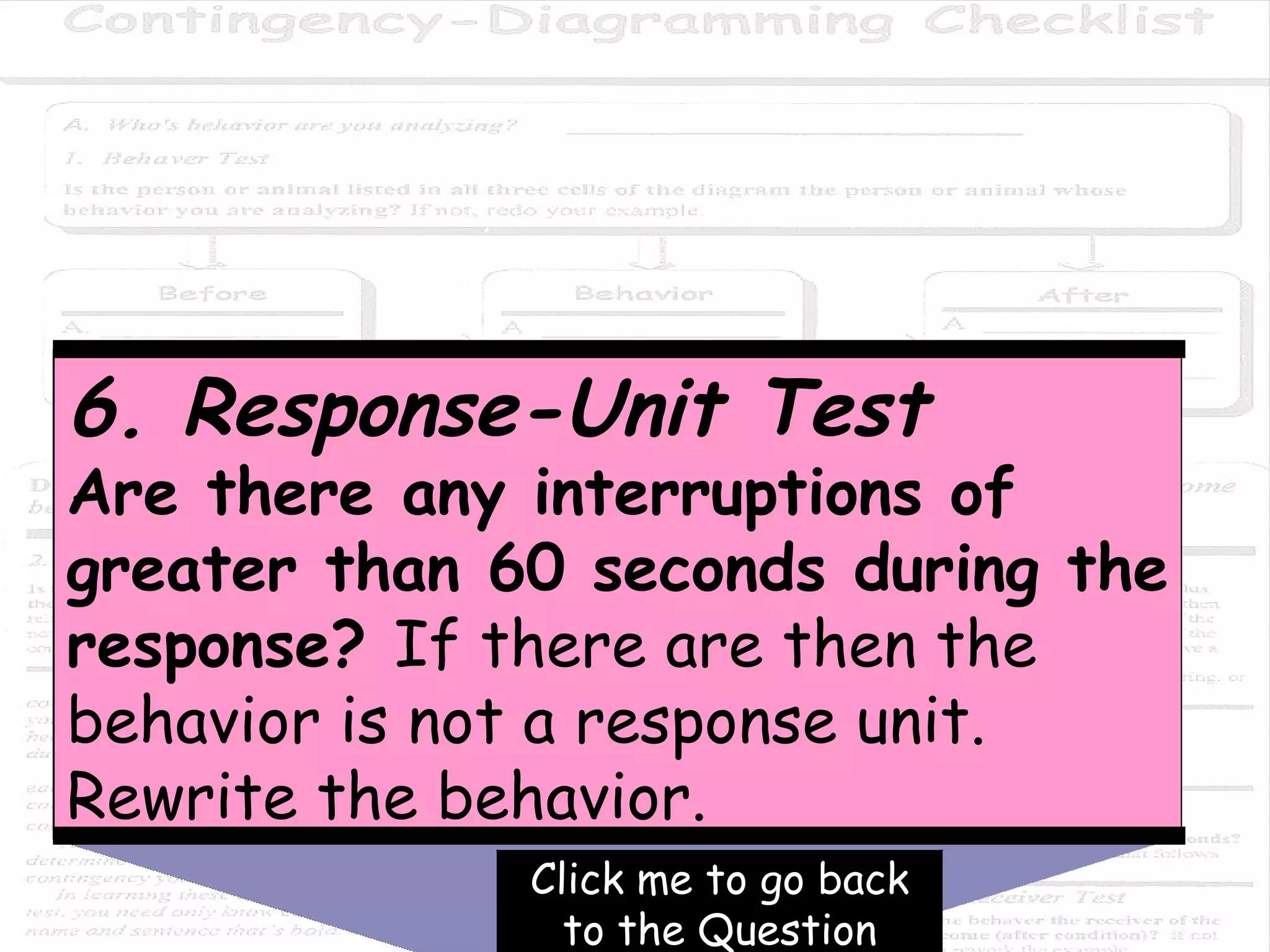
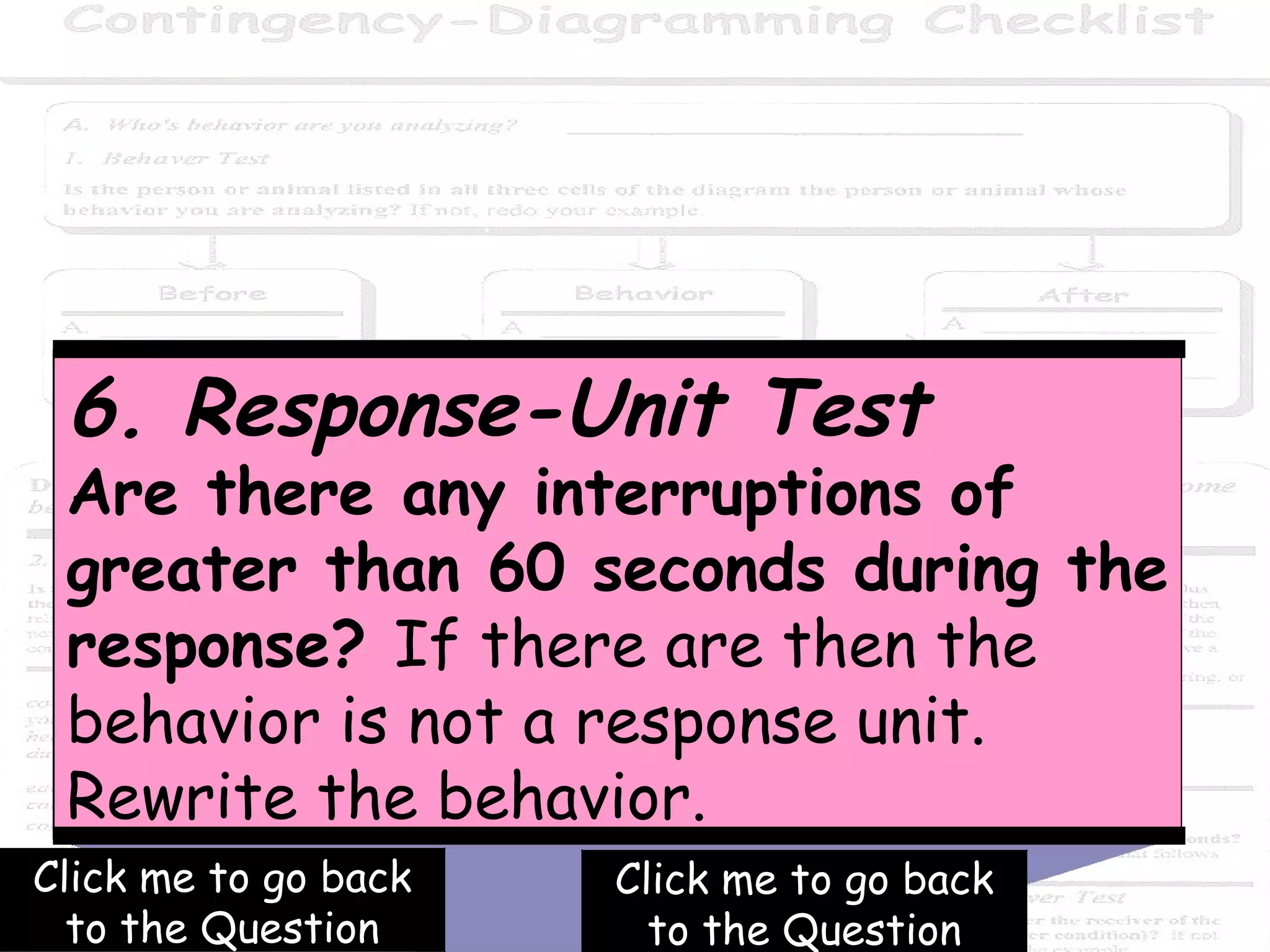
Click me to go back to the Question 6. Response-Unit Test Are there any interruptions of greater than 60 seconds during the response?  If there are then the behavior is not a response unit. Rewrite the behavior.
Before Jaci doesn ’ t have prepared, uncooked pizza Correct reinforceable response-unit Fails reinforceable response-unit test No, there will be a break while she checks e-mail. Is this behavior a reinforceable response-unit? Behavior Jaci makes pizza from scratch After Jaci has prepared, uncooked pizza
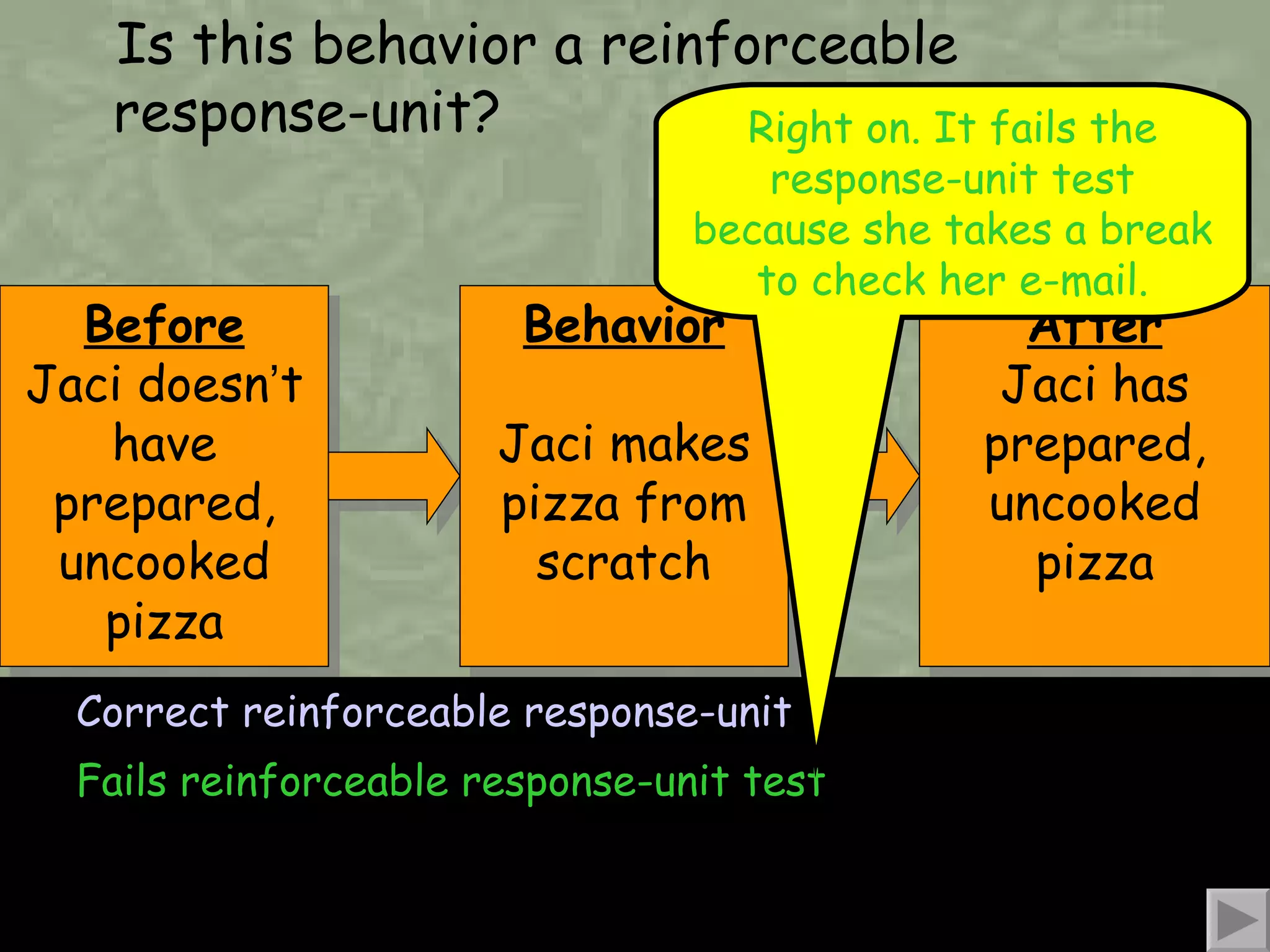
Before Jaci doesn ’ t have prepared, uncooked pizza Correct reinforceable response-unit Fails reinforceable response-unit test Right on. It fails the response-unit test because she takes a break to check her e-mail. Is this behavior a reinforceable response-unit? Behavior Jaci makes pizza from scratch After Jaci has prepared, uncooked pizza
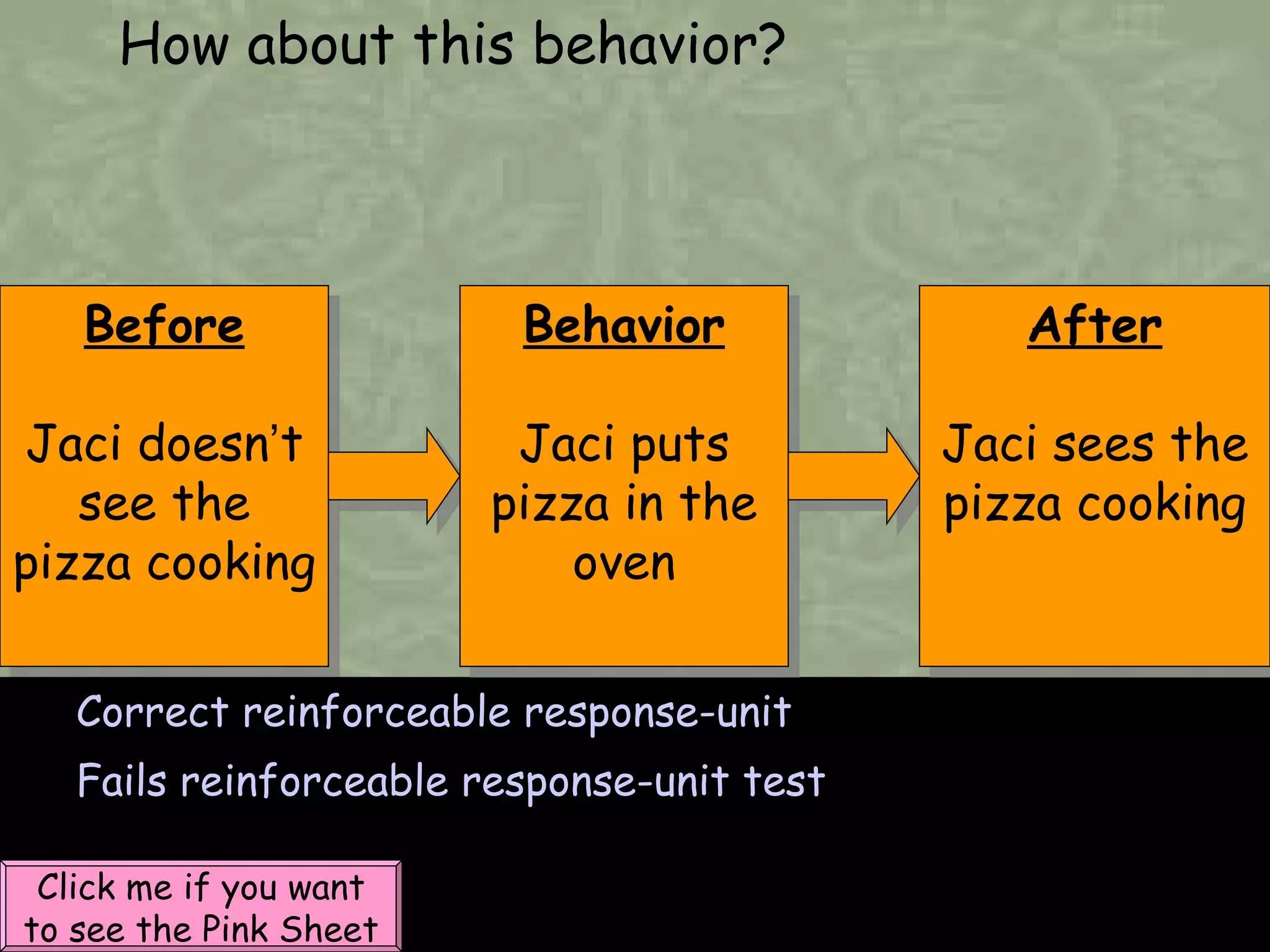
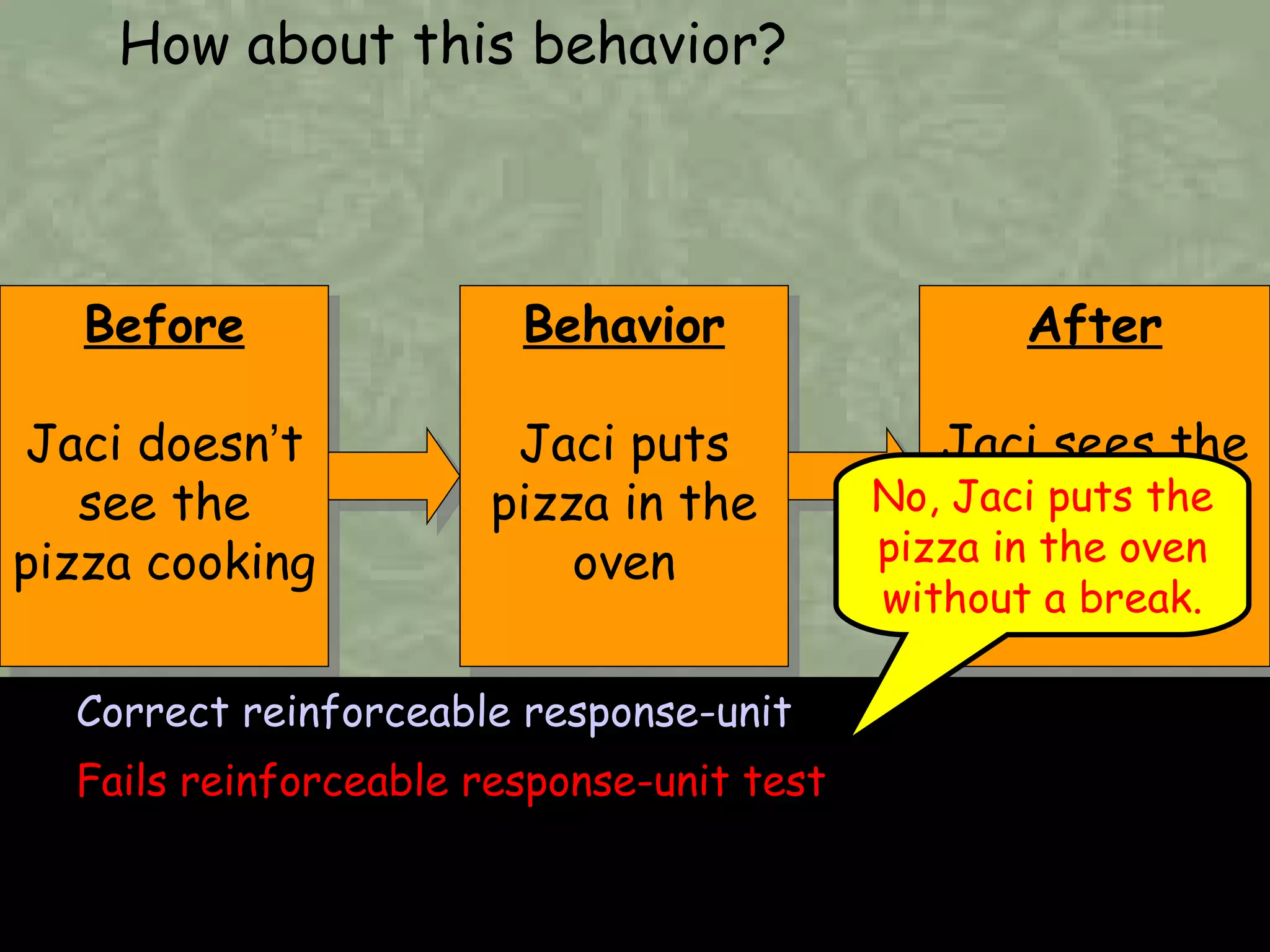
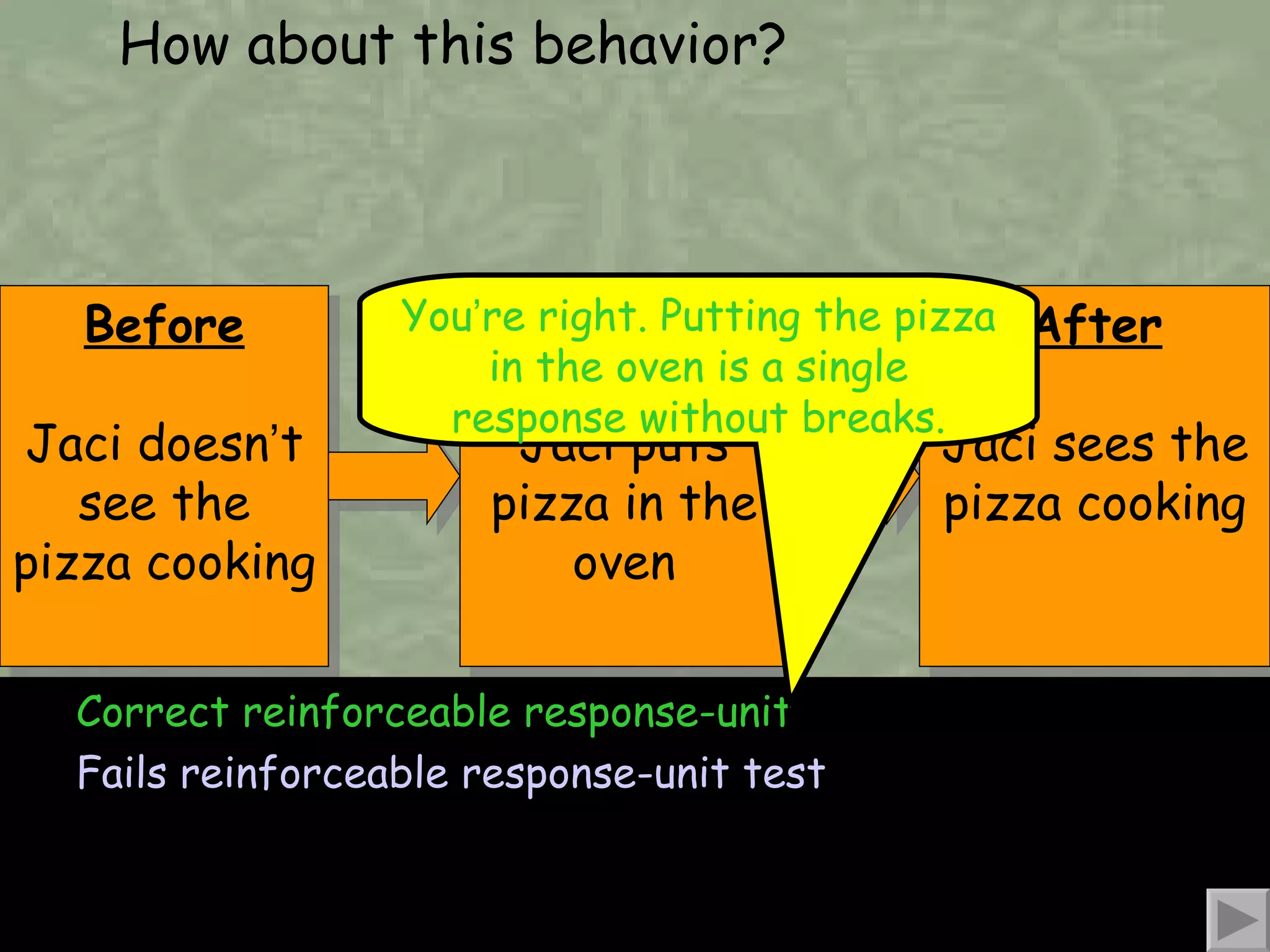
Before Jaci doesn ’ t see the pizza cooking How about this behavior? Correct reinforceable response-unit Fails reinforceable response-unit test Click me if you want to see the Pink Sheet Behavior Jaci puts pizza in the oven After Jaci sees the pizza cooking
Click me to go back to the Question Click me to go back to the Question 6. Response-Unit Test Are there any interruptions of greater than 60 seconds during the response?  If there are then the behavior is not a response unit. Rewrite the behavior.
Before Jaci doesn ’ t see the pizza cooking How about this behavior? Correct reinforceable response-unit Fails reinforceable response-unit test No, Jaci puts the pizza in the oven without a break. Behavior Jaci puts pizza in the oven After Jaci sees the pizza cooking
Before Jaci doesn ’ t see the pizza cooking How about this behavior? Correct reinforceable response-unit Fails reinforceable response-unit test You ’ re right. Putting the pizza in the oven is a single response without breaks. Behavior Jaci puts pizza in the oven After Jaci sees the pizza cooking
Let ’ s try and clarify the difference between the 60 second test and the reinforceable response unit test.
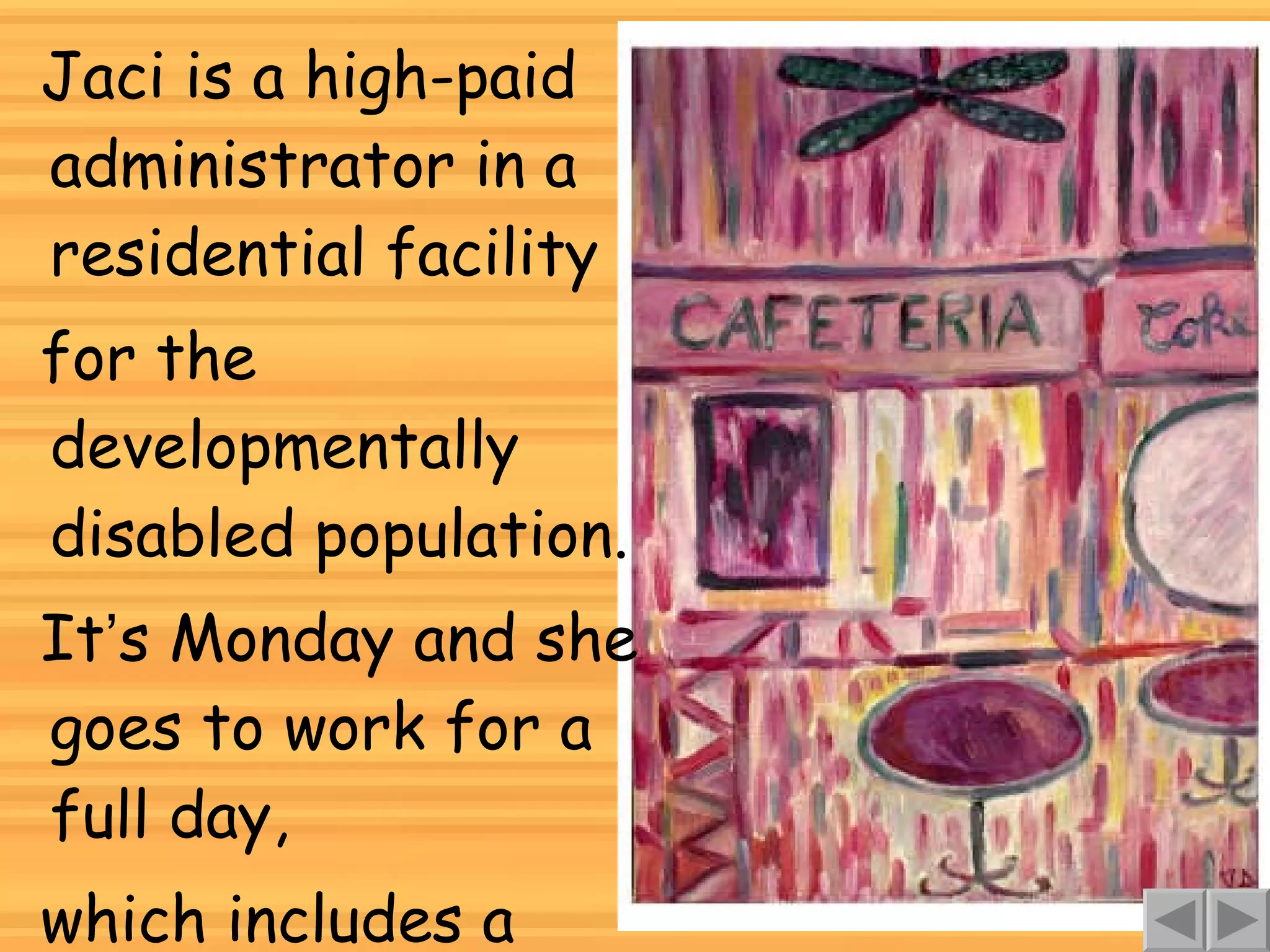
Jaci is a high-paid administrator in a residential facility for the developmentally disabled population. It ’ s Monday and she goes to work for a full day, which includes a lunch break.
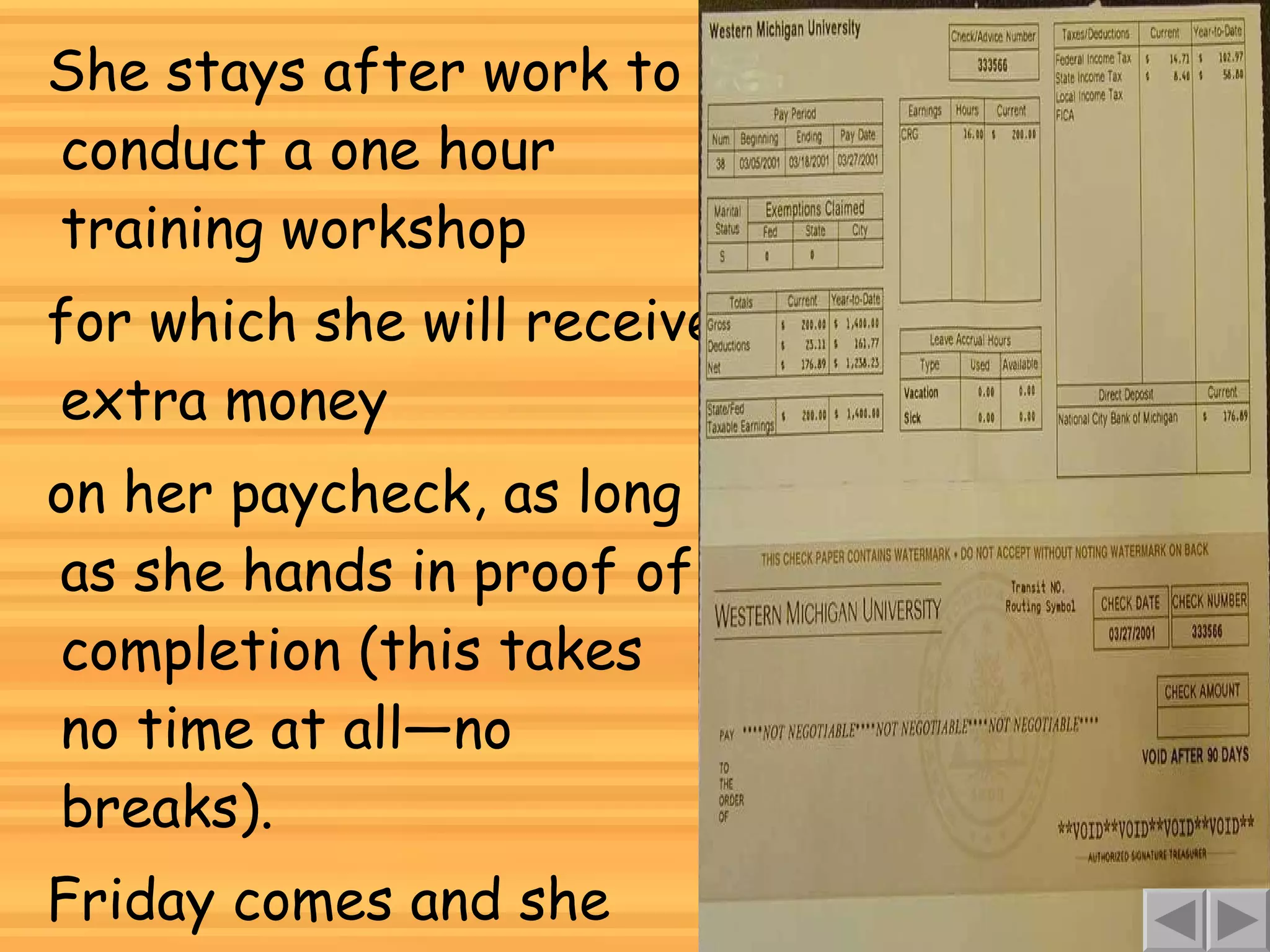
She stays after work to conduct a one hour training workshop for which she will receive extra money on her paycheck, as long as she hands in proof of completion (this takes no time at all—no breaks). Friday comes and she picks up her pay- check.
She then treats herself to an evening of shopping for new clothes before going home to sip some warm Earl Gray tea.
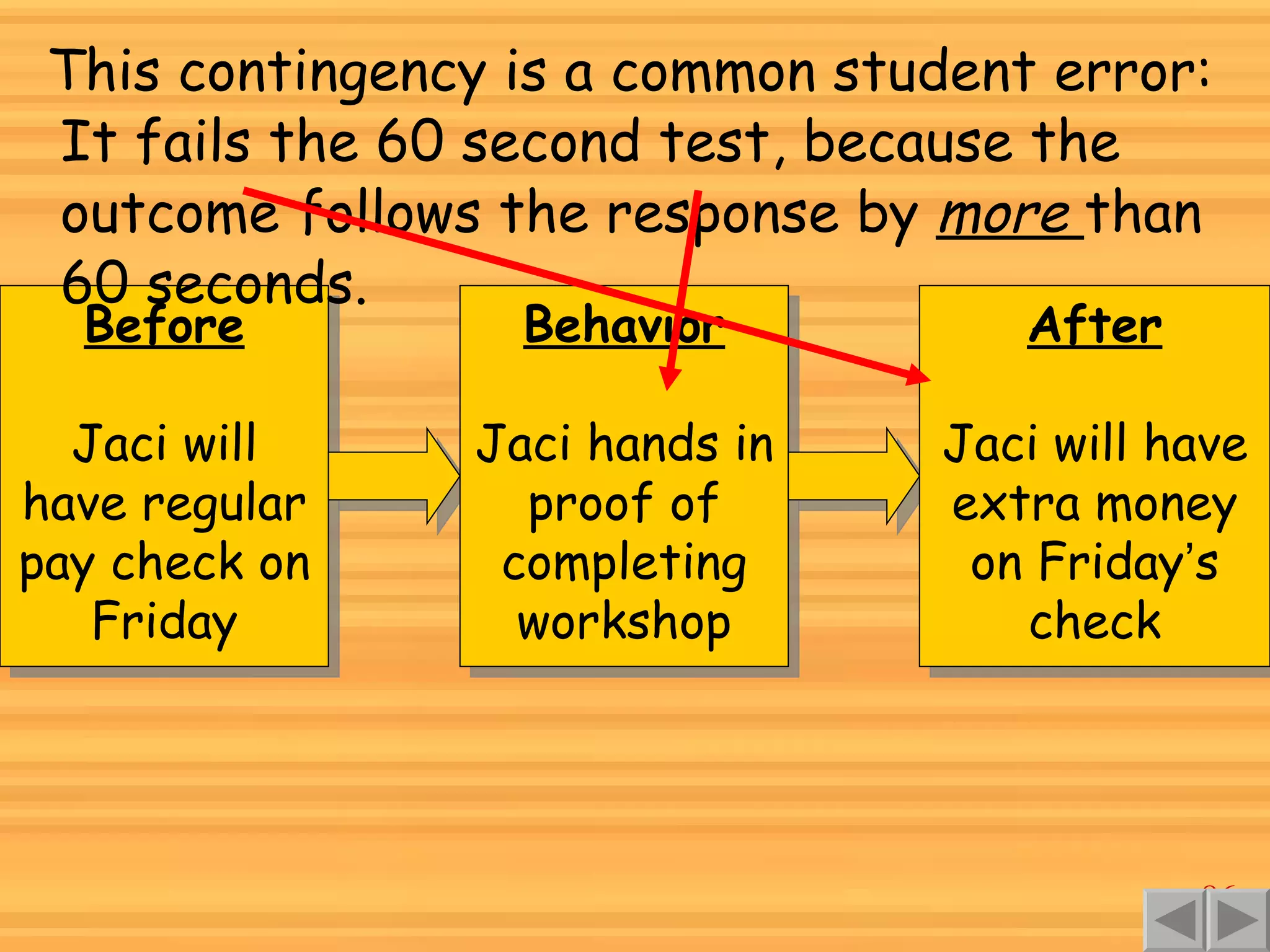
This contingency is a common student error: It fails the 60 second test, because the outcome follows the response by  more  than 60 seconds. Before Jaci will have regular pay check on Friday Behavior Jaci hands in proof of completing workshop After Jaci will have extra money on Friday ’ s check
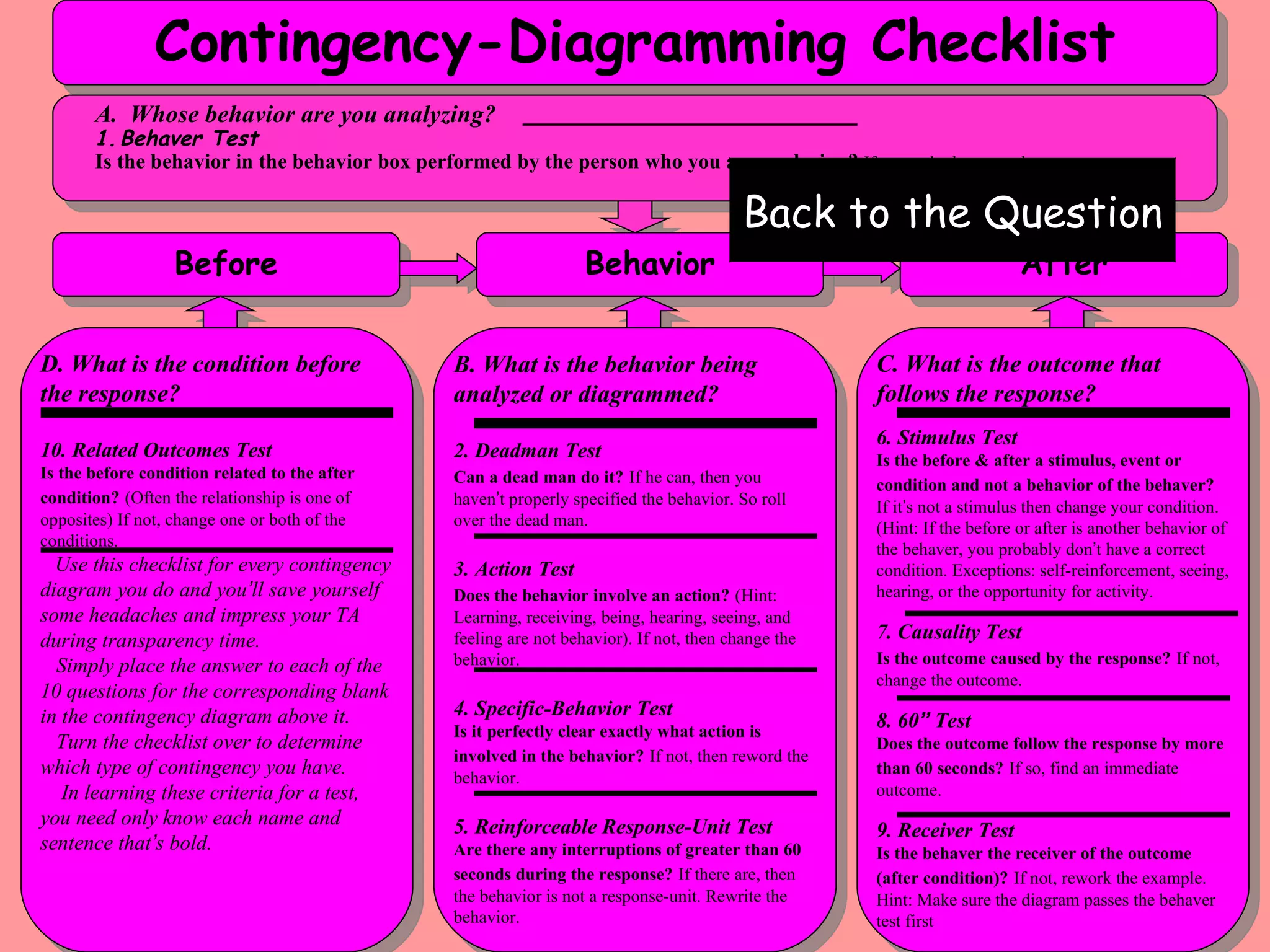
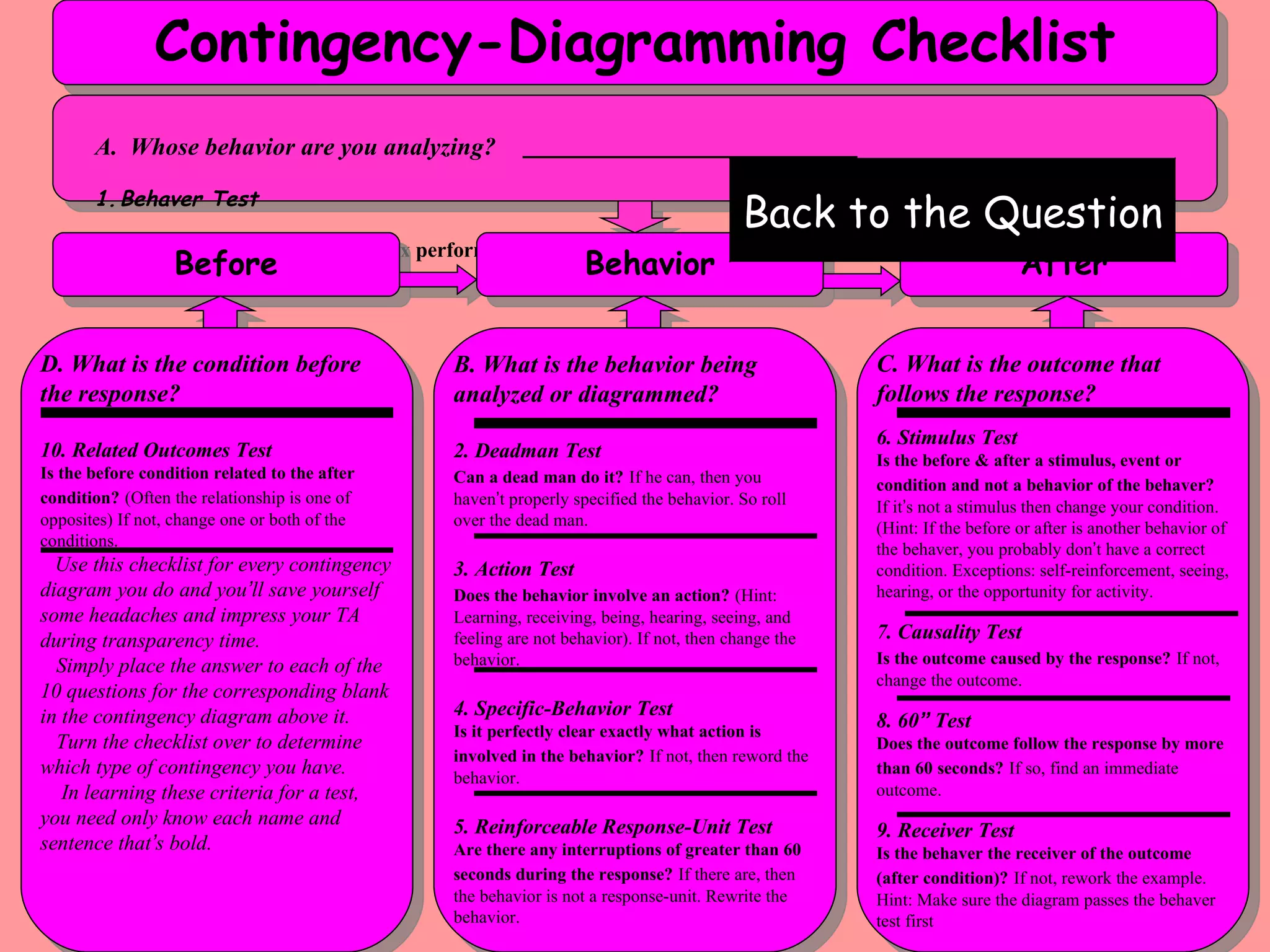
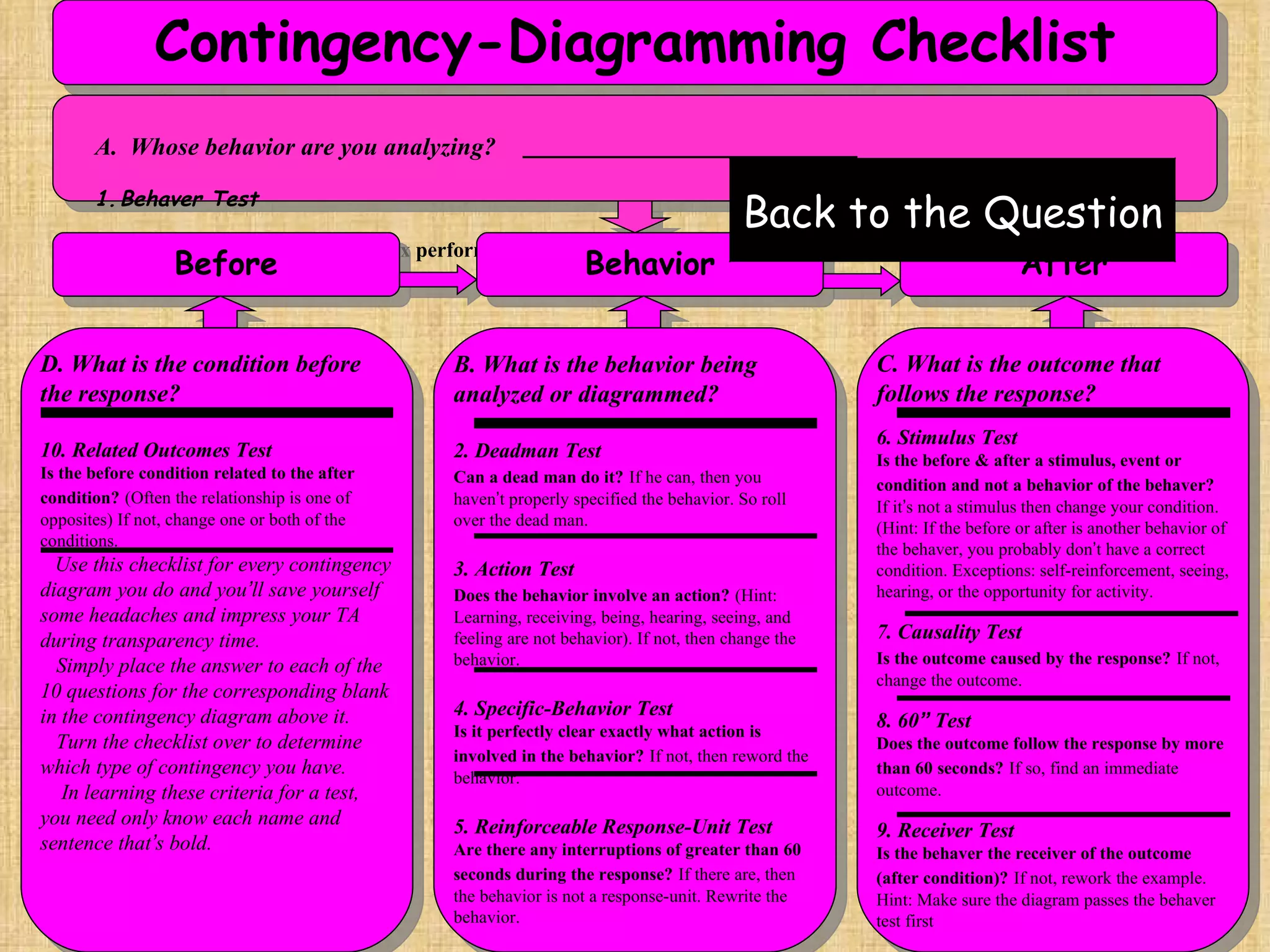
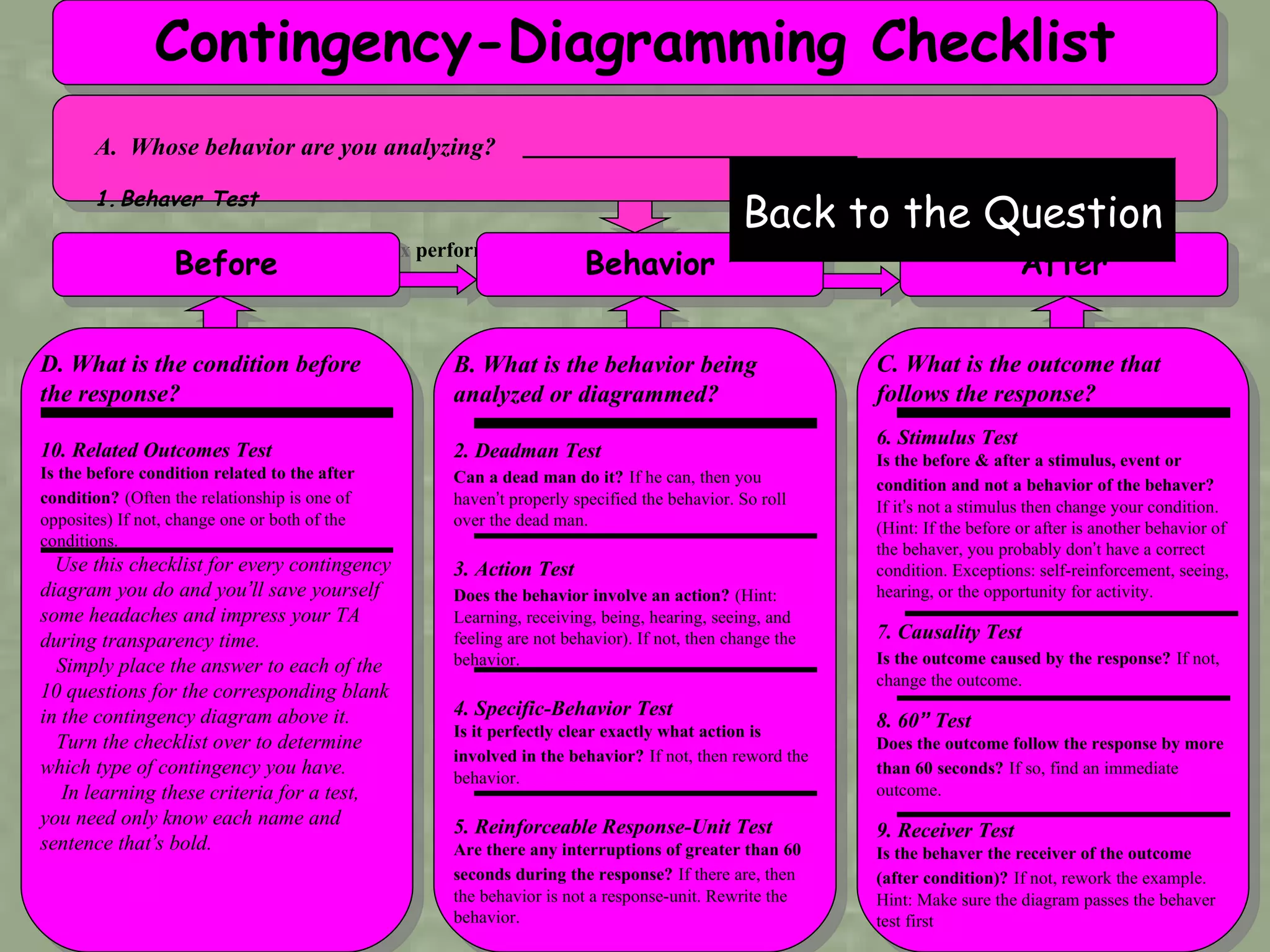
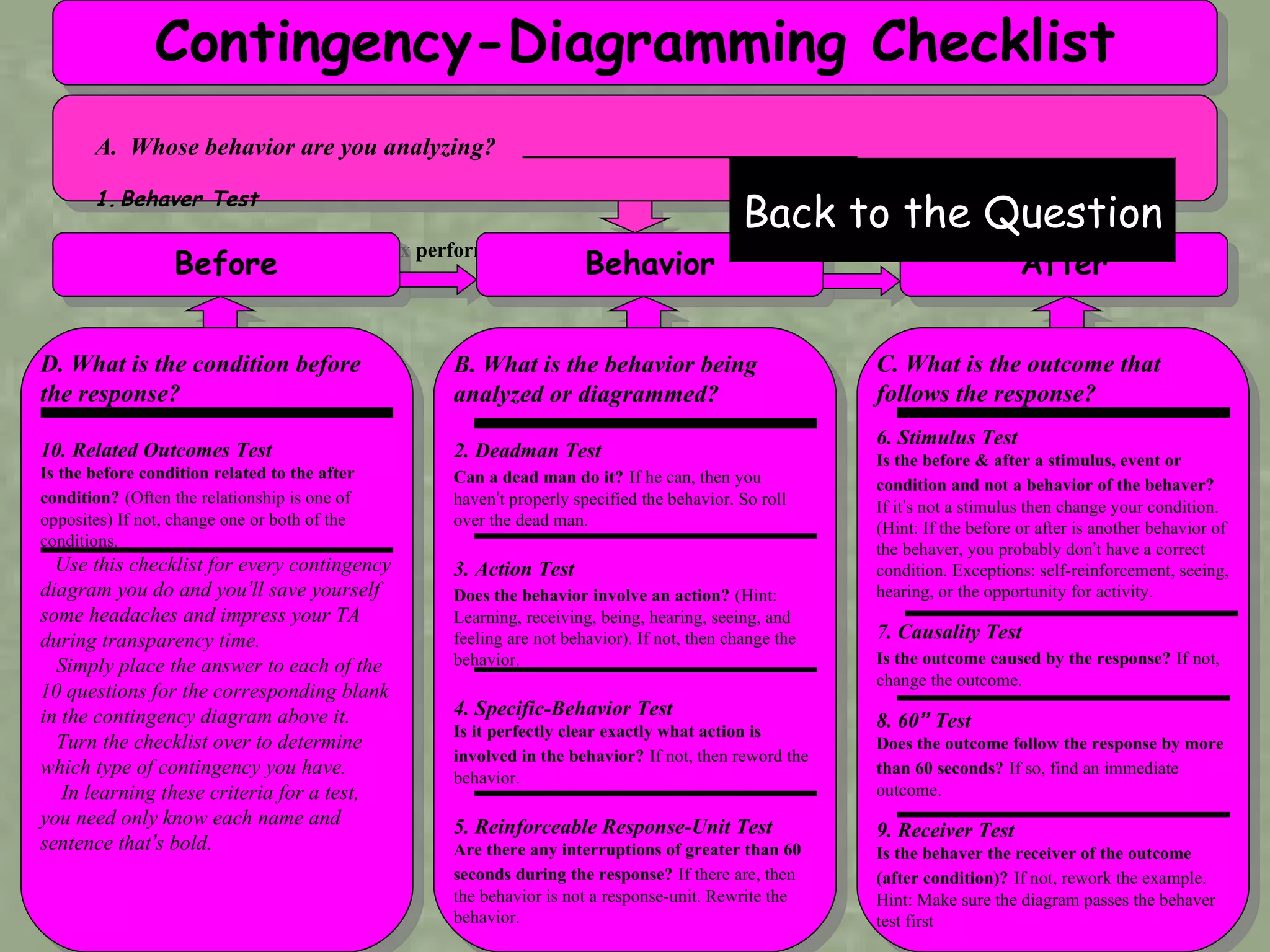
Contingency-Diagramming Checklist A.  Whose behavior are you analyzing?   _________________________  1.   Behaver Test Is the behavior in the behavior box performed by the person who you are analyzing?   If not, redo the example. Before Behavior After D. What is the condition before the response? 10. Related Outcomes Test Is the before condition related to the after condition?   (Often the relationship is one of opposites) If not, change one or both of the conditions. Use this checklist for every contingency diagram you do and you ’ ll save yourself some headaches and impress your TA during transparency time. Simply place the answer to each of the 10 questions for the corresponding blank in the contingency diagram above it. Turn the checklist over to determine which type of contingency you have. In learning these criteria for a test, you need only know each name and sentence that ’ s bold. B. What is the behavior being analyzed or diagrammed? 2. Deadman Test Can a dead man do it?   If he can, then you haven ’ t properly specified the behavior. So roll over the dead man. 3. Action Test Does the behavior involve an action?   (Hint: Learning, receiving, being, hearing, seeing, and feeling are not behavior). If not, then change the behavior. 4. Specific-Behavior Test Is it perfectly clear exactly what action is involved in the behavior?   If not, then reword the behavior. 5. Reinforceable Response-Unit Test Are there any interruptions of greater than 60 seconds during the response?   If there are, then the behavior is not a response-unit. Rewrite the behavior. C. What is the outcome that follows the response? 6. Stimulus Test Is the before & after a stimulus, event or condition and not a behavior of the behaver?   If it ’ s not a stimulus then change your condition. (Hint: If the before or after is another behavior of the behaver, you probably don ’ t have a correct condition. Exceptions: self-reinforcement, seeing, hearing, or the opportunity for activity. 7. Causality Test Is the outcome caused by the response?   If not, change the outcome. 8. 60 ”  Test Does the outcome follow the response by more than 60 seconds?   If so, find an immediate outcome. 9. Receiver Test Is the behaver the receiver of the outcome (after condition)?   If not, rework the example. Hint: Make sure the diagram passes the behaver test first Back to the Question
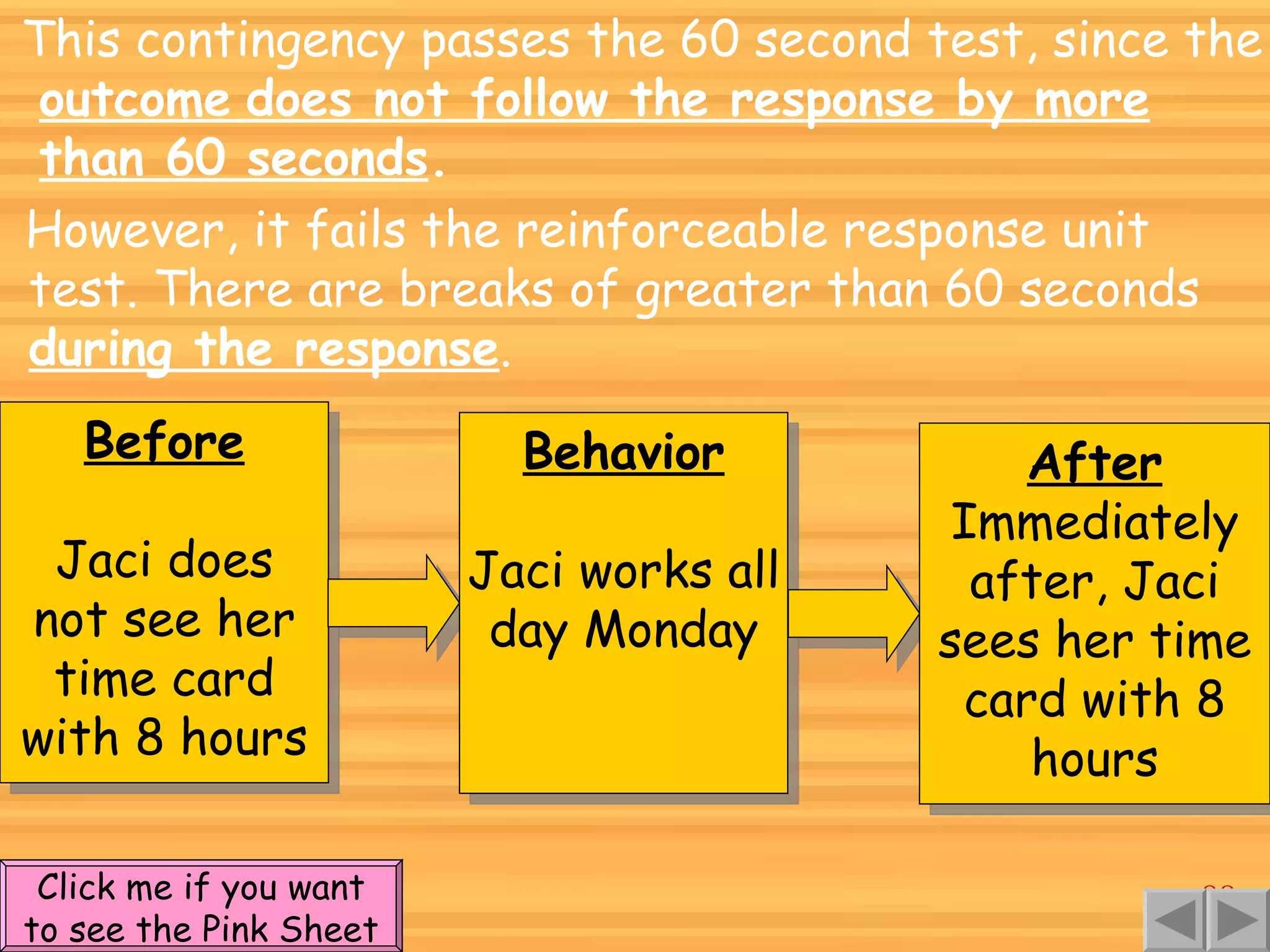
Before Jaci does not see her time card with 8 hours Click me if you want to see the Pink Sheet This contingency passes the 60 second test, since the  outcome   does not follow the response by more than 60 seconds .   However, it fails the reinforceable response unit test. There are breaks of greater than 60 seconds   during the response . Behavior Jaci works all day Monday After Immediately after, Jaci sees her time card with 8 hours
Contingency-Diagramming Checklist A.  Whose behavior are you analyzing?   _________________________  1.   Behaver Test Is the behavior in the behavior box performed by the person who you are analyzing?   If not, redo the example. Before Behavior After D. What is the condition before the response? 10. Related Outcomes Test Is the before condition related to the after condition?   (Often the relationship is one of opposites) If not, change one or both of the conditions. Use this checklist for every contingency diagram you do and you ’ ll save yourself some headaches and impress your TA during transparency time. Simply place the answer to each of the 10 questions for the corresponding blank in the contingency diagram above it. Turn the checklist over to determine which type of contingency you have. In learning these criteria for a test, you need only know each name and sentence that ’ s bold. B. What is the behavior being analyzed or diagrammed? 2. Deadman Test Can a dead man do it?   If he can, then you haven ’ t properly specified the behavior. So roll over the dead man. 3. Action Test Does the behavior involve an action?   (Hint: Learning, receiving, being, hearing, seeing, and feeling are not behavior). If not, then change the behavior. 4. Specific-Behavior Test Is it perfectly clear exactly what action is involved in the behavior?   If not, then reword the behavior. 5. Reinforceable Response-Unit Test Are there any interruptions of greater than 60 seconds during the response?   If there are, then the behavior is not a response-unit. Rewrite the behavior. C. What is the outcome that follows the response? 6. Stimulus Test Is the before & after a stimulus, event or condition and not a behavior of the behaver?   If it ’ s not a stimulus then change your condition. (Hint: If the before or after is another behavior of the behaver, you probably don ’ t have a correct condition. Exceptions: self-reinforcement, seeing, hearing, or the opportunity for activity. 7. Causality Test Is the outcome caused by the response?   If not, change the outcome. 8. 60 ”  Test Does the outcome follow the response by more than 60 seconds?   If so, find an immediate outcome. 9. Receiver Test Is the behaver the receiver of the outcome (after condition)?   If not, rework the example. Hint: Make sure the diagram passes the behaver test first Back to the Question
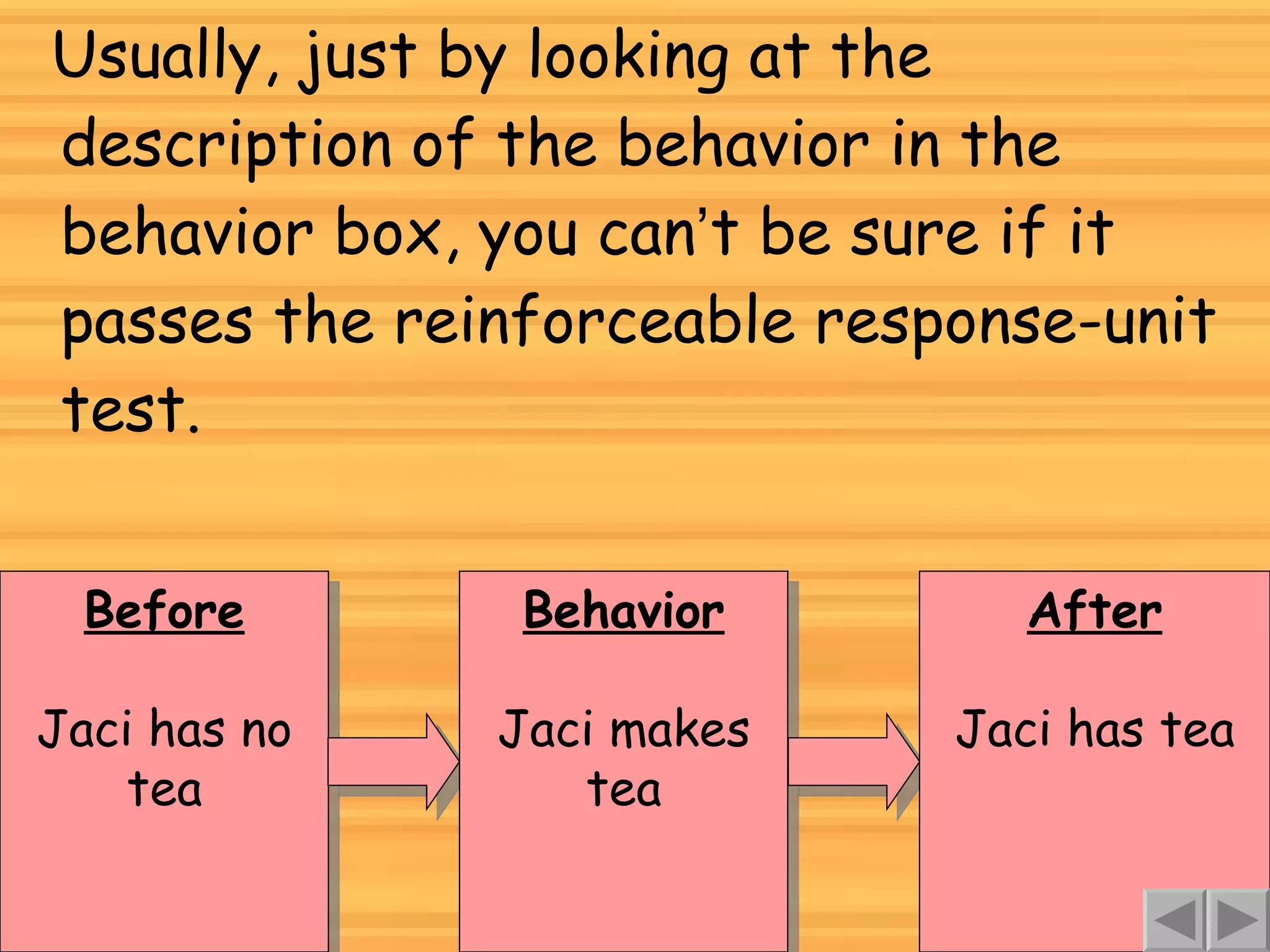
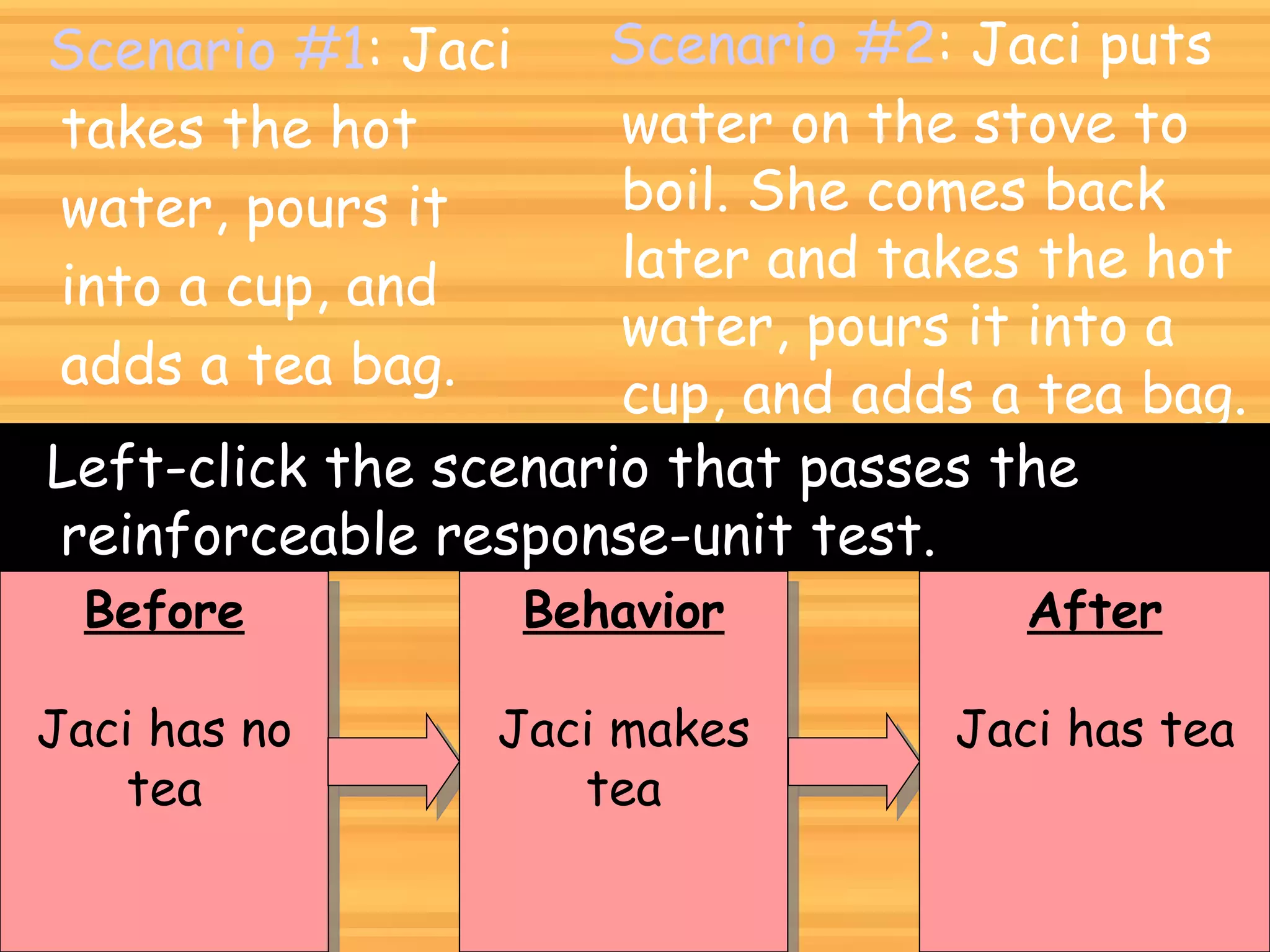
Usually, just by looking at the description of the behavior in the behavior box, you can ’ t be sure if it passes the reinforceable response-unit test. Before Jaci has no tea Behavior Jaci makes tea After Jaci has tea
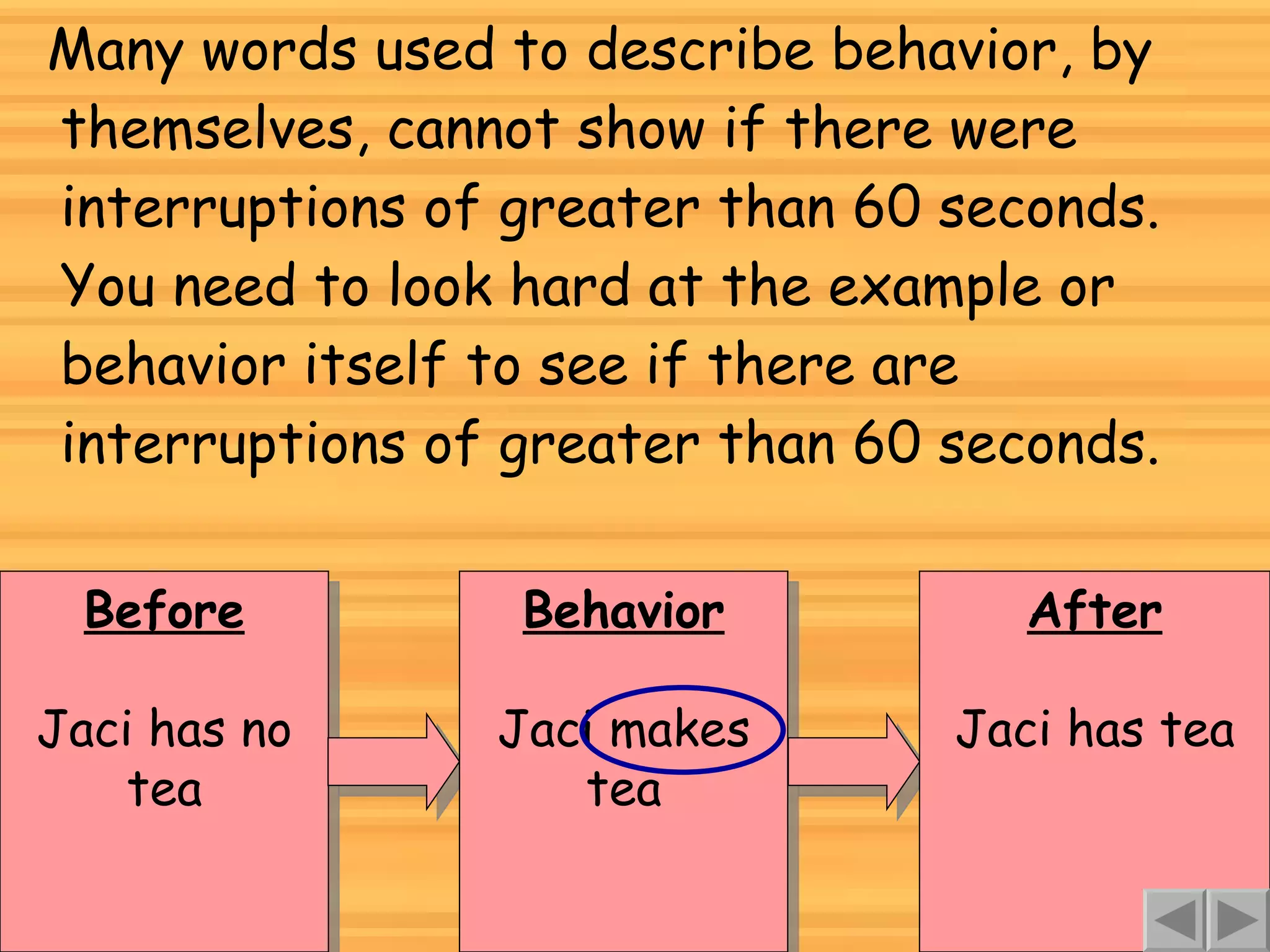
Many words used to describe behavior, by themselves, cannot show if there were interruptions of greater than 60 seconds. You need to look hard at the example or behavior itself to see if there are interruptions of greater than 60 seconds. Before Jaci has no tea Behavior Jaci makes tea After Jaci has tea
In the next example choose the scenario that describes the behavior that passes the reinforceable response-unit test.
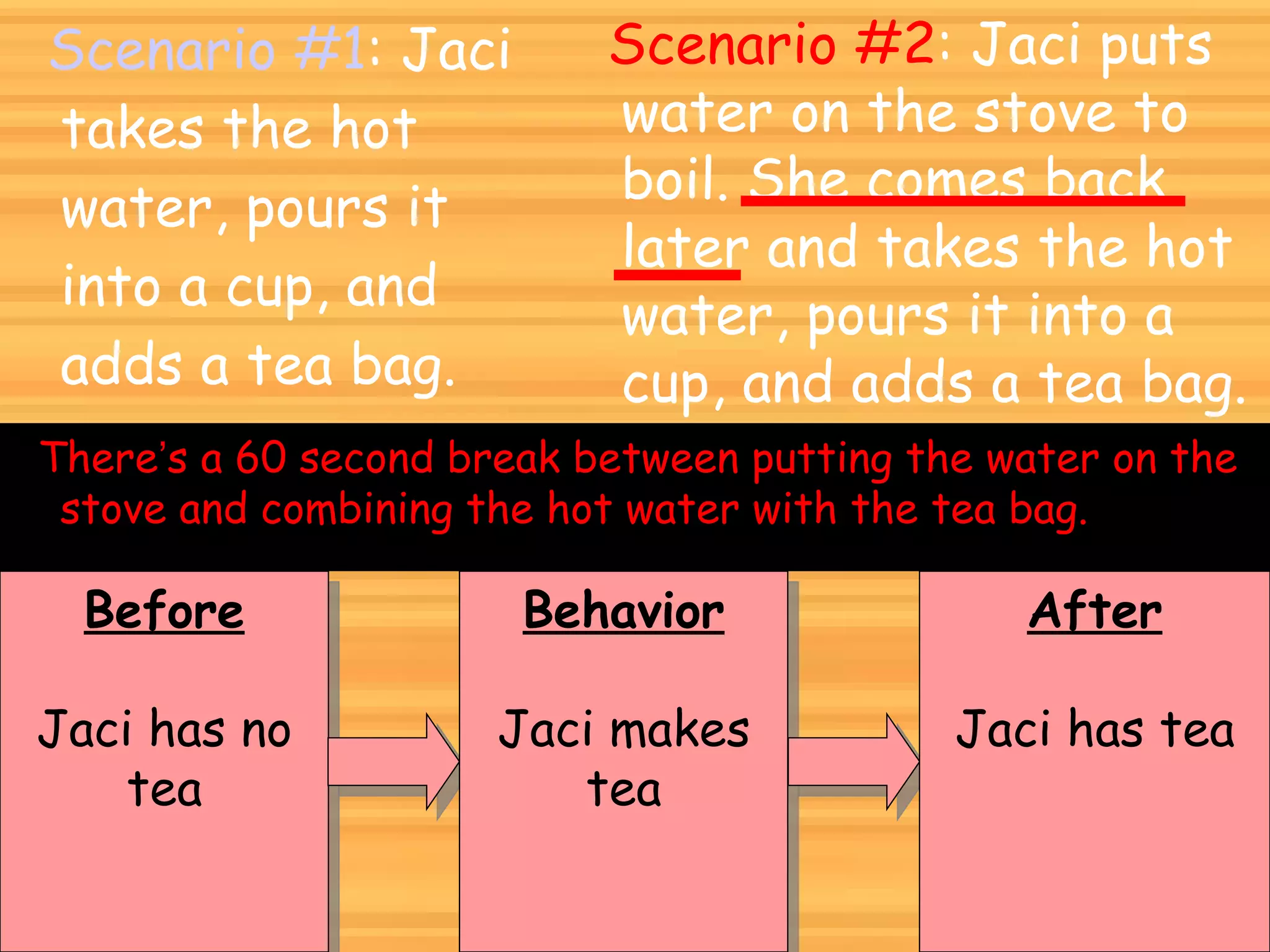
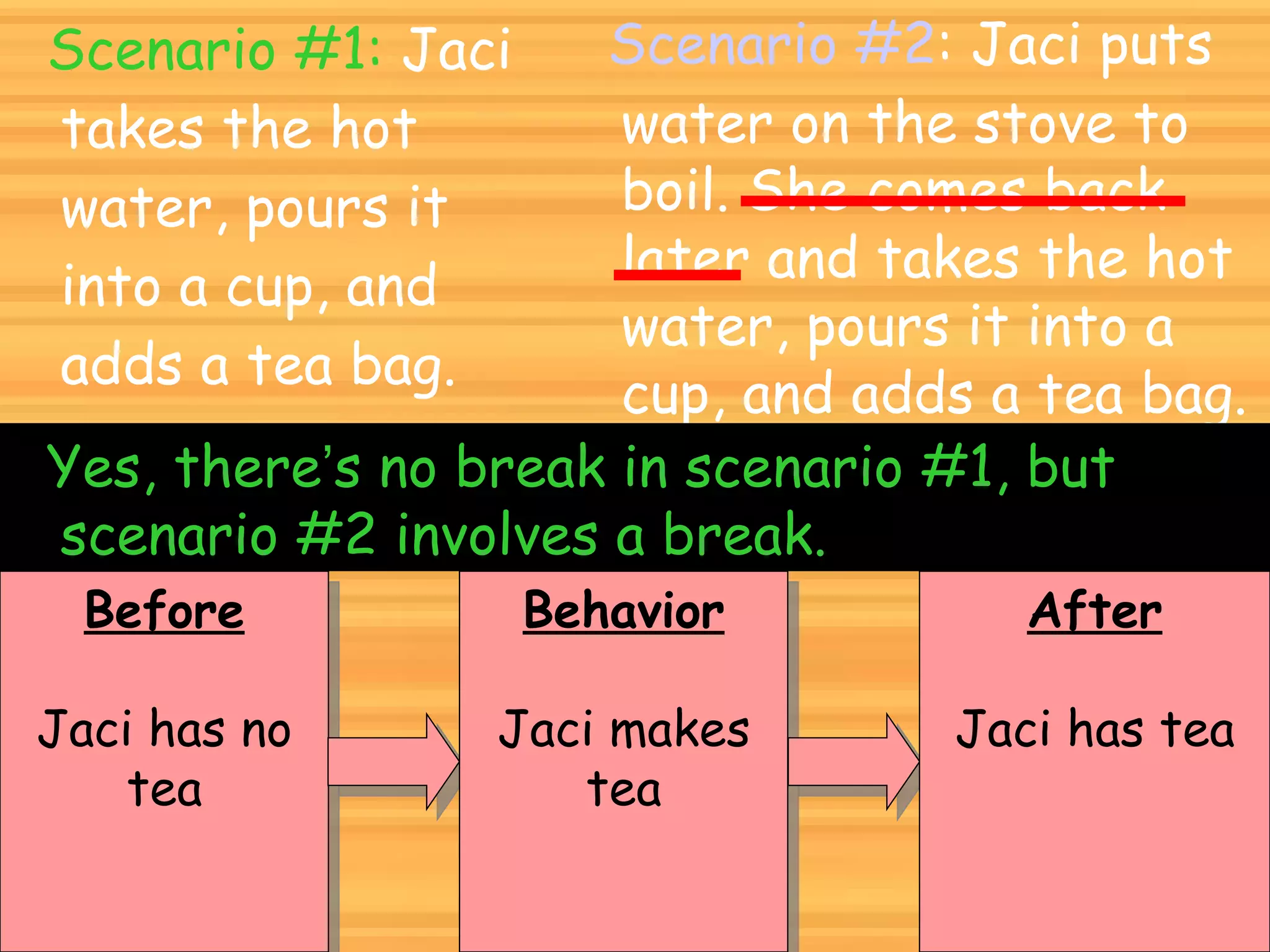
Scenario #1 : Jaci takes the hot water, pours it into a cup, and adds a tea bag.  Before Jaci has no tea Scenario #2 : Jaci puts water on the stove to boil. She comes back later and takes the hot water, pours it into a cup, and adds a tea bag.  Left-click the scenario that passes the reinforceable response-unit test.  Behavior Jaci makes tea After Jaci has tea
Scenario #1 : Jaci takes the hot water, pours it into a cup, and adds a tea bag.  Before Jaci has no tea Scenario #2 : Jaci puts water on the stove to boil. She comes back later and takes the hot water, pours it into a cup, and adds a tea bag.  There ’ s a 60 second break between putting the water on the stove and combining the hot water with the tea bag.   Behavior Jaci makes tea After Jaci has tea
Scenario #1:  Jaci takes the hot water, pours it into a cup, and adds a tea bag.  Before Jaci has no tea Scenario #2 : Jaci puts water on the stove to boil. She comes back later and takes the hot water, pours it into a cup, and adds a tea bag.  Yes, there ’ s no break in scenario #1, but scenario #2 involves a break. Behavior Jaci makes tea After Jaci has tea
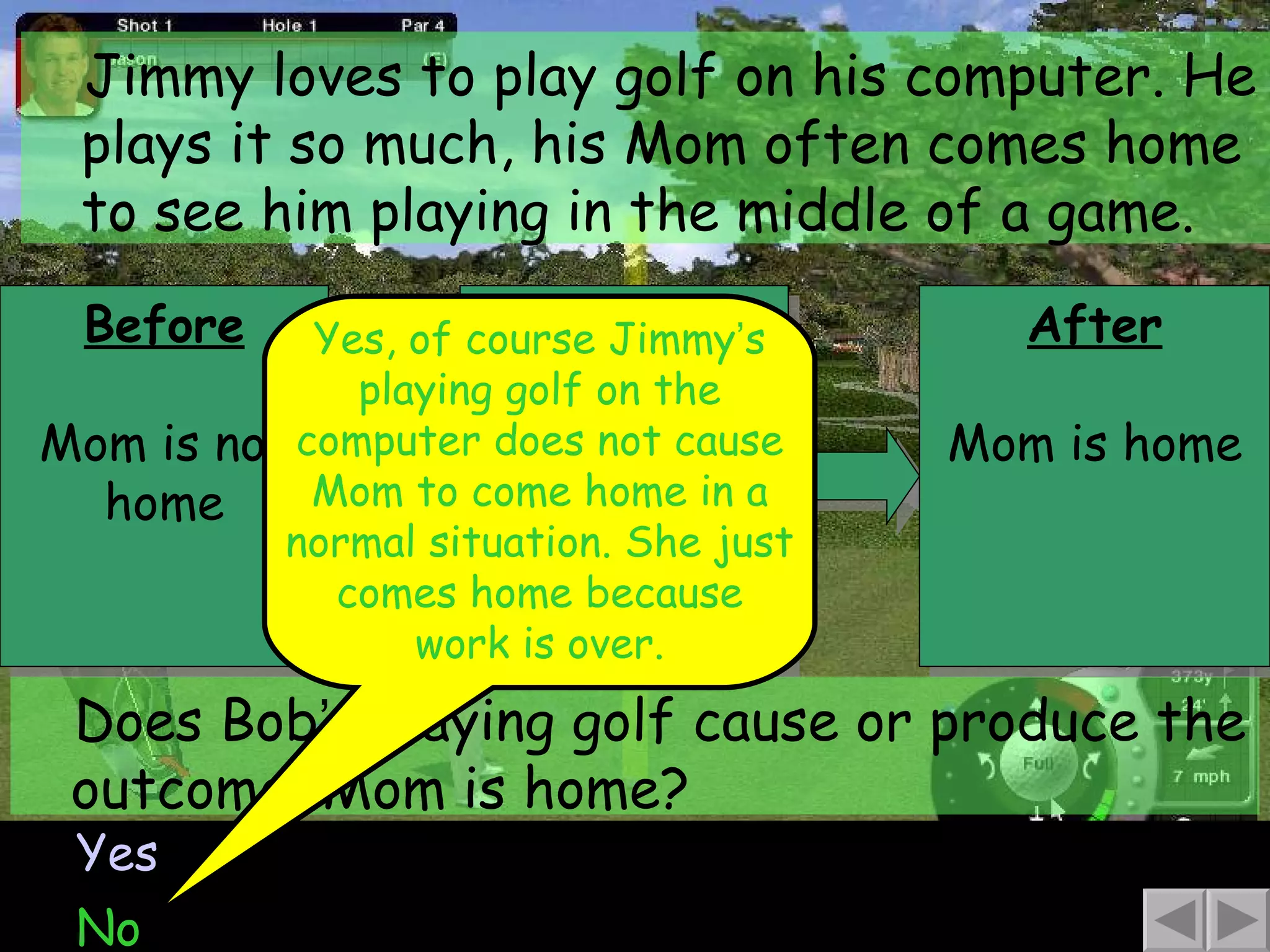
Causality Test Is the outcome caused by the response?
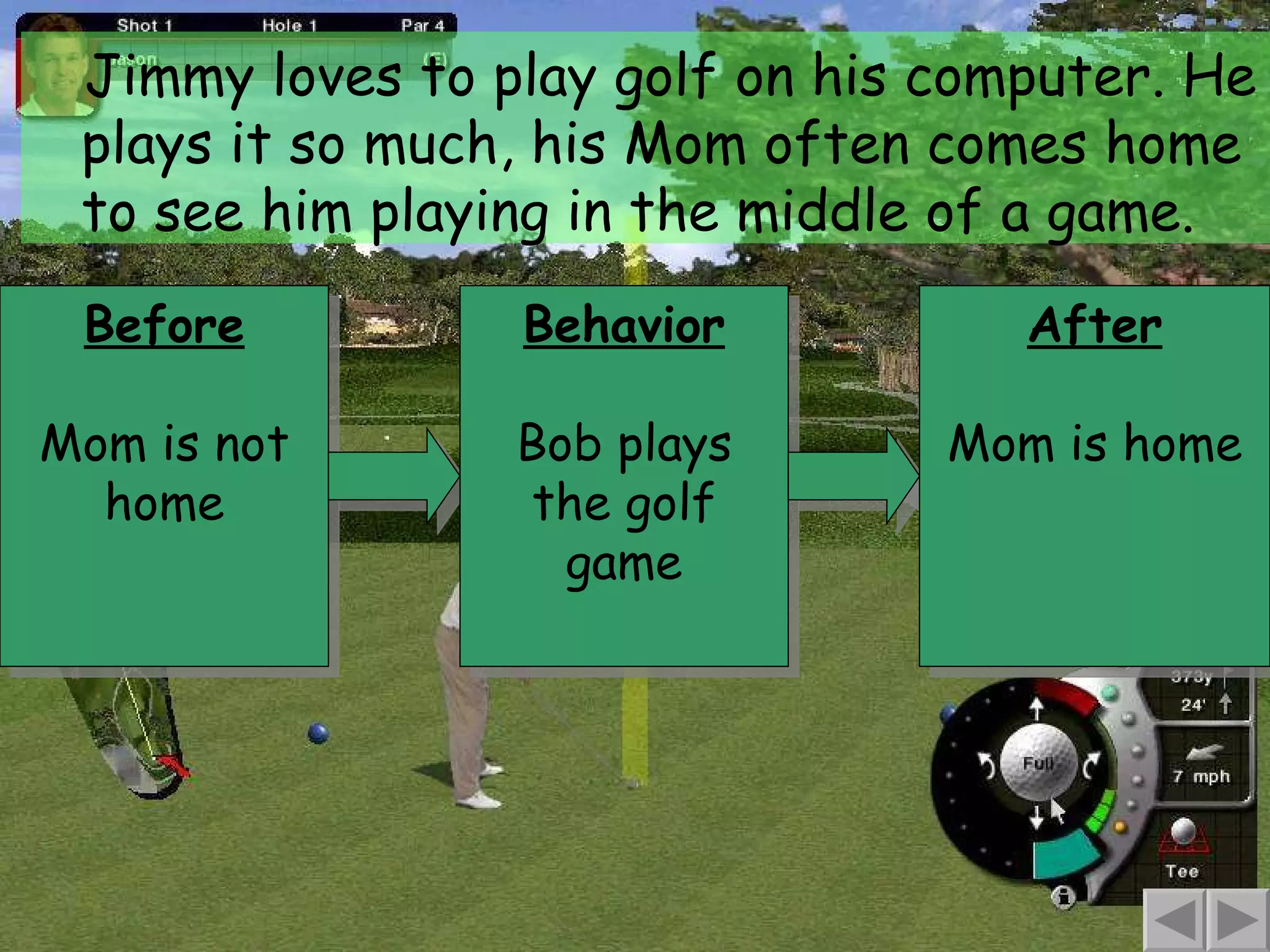
Before Mom is not home Jimmy loves to play golf on his computer. He plays it so much, his Mom often comes home to see him playing in the middle of a game. Behavior Bob plays the golf game After Mom is home
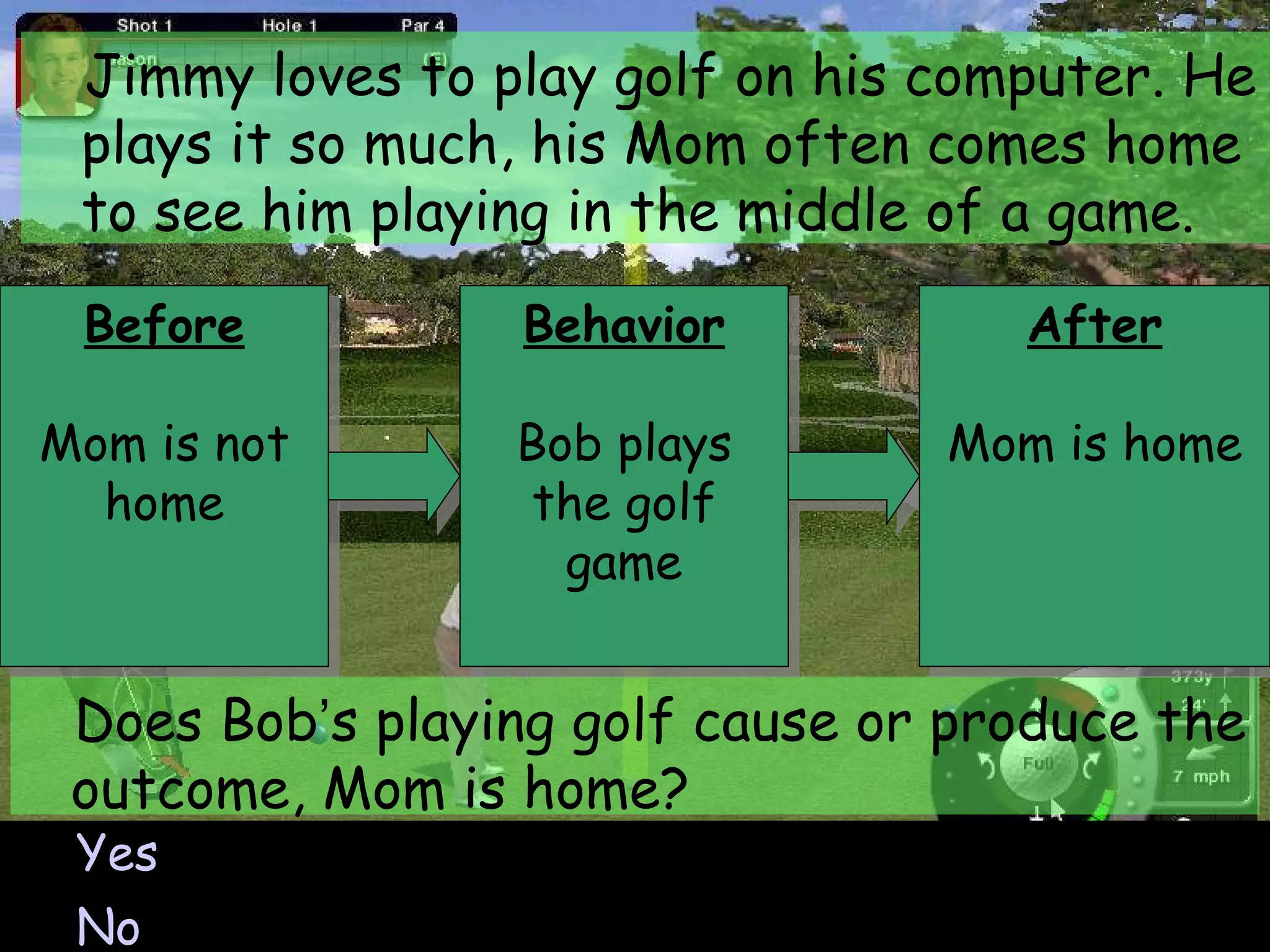
Before Mom is not home Jimmy loves to play golf on his computer. He plays it so much, his Mom often comes home to see him playing in the middle of a game. Yes No Does Bob ’ s playing golf cause or produce the outcome, Mom is home? Behavior Bob plays the golf game After Mom is home
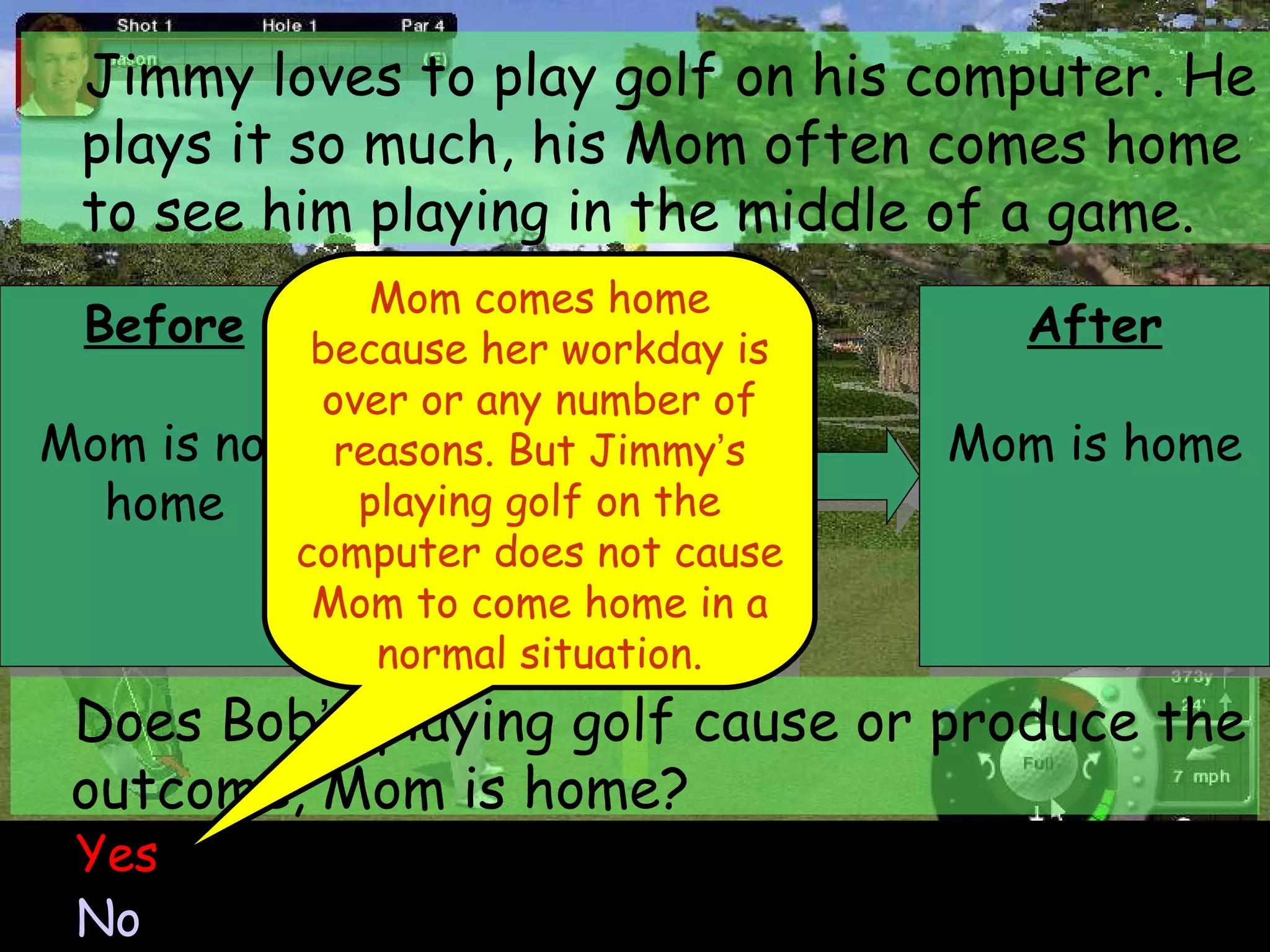
Before Mom is not home Jimmy loves to play golf on his computer. He plays it so much, his Mom often comes home to see him playing in the middle of a game. Yes No Does Bob ’ s playing golf cause or produce the outcome, Mom is home? Mom comes home because her workday is over or any number of reasons. But Jimmy ’ s playing golf on the computer does not cause Mom to come home in a normal situation. Behavior Bob plays the golf game After Mom is home
Before Mom is not home Jimmy loves to play golf on his computer. He plays it so much, his Mom often comes home to see him playing in the middle of a game. Yes No Does Bob ’ s playing golf cause or produce the outcome, Mom is home? Yes, of course Jimmy ’ s playing golf on the computer does not cause Mom to come home in a normal situation. She just comes home because work is over. Behavior Bob plays the golf game After Mom is home
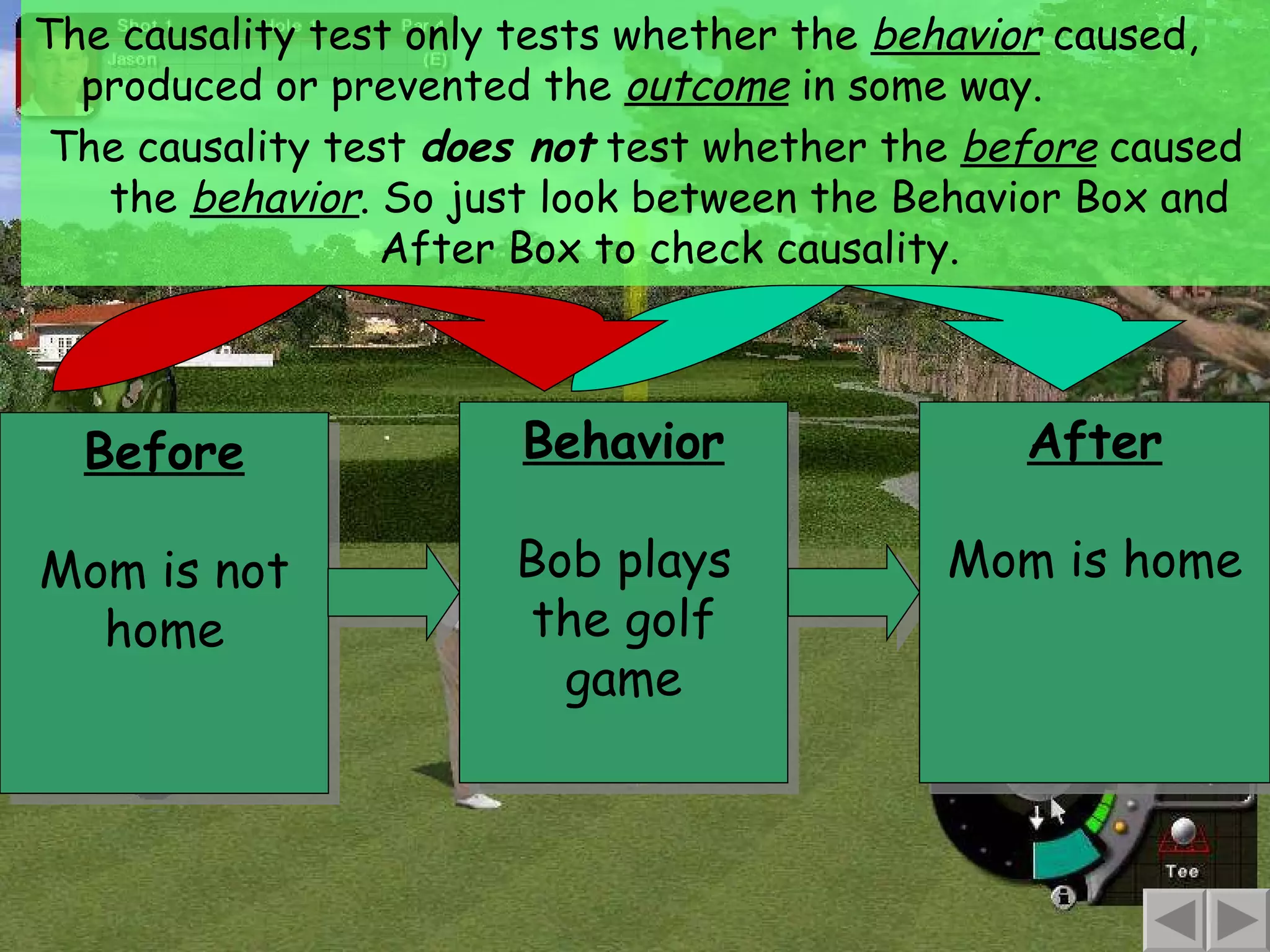
Before Mom is not home The causality test only tests whether the  behavior   caused, produced or prevented the  outcome  in some way. The causality test  does not  test whether the  before  caused the  behavior . So just look between the Behavior Box and After Box to check causality. Behavior Bob plays the golf game After Mom is home
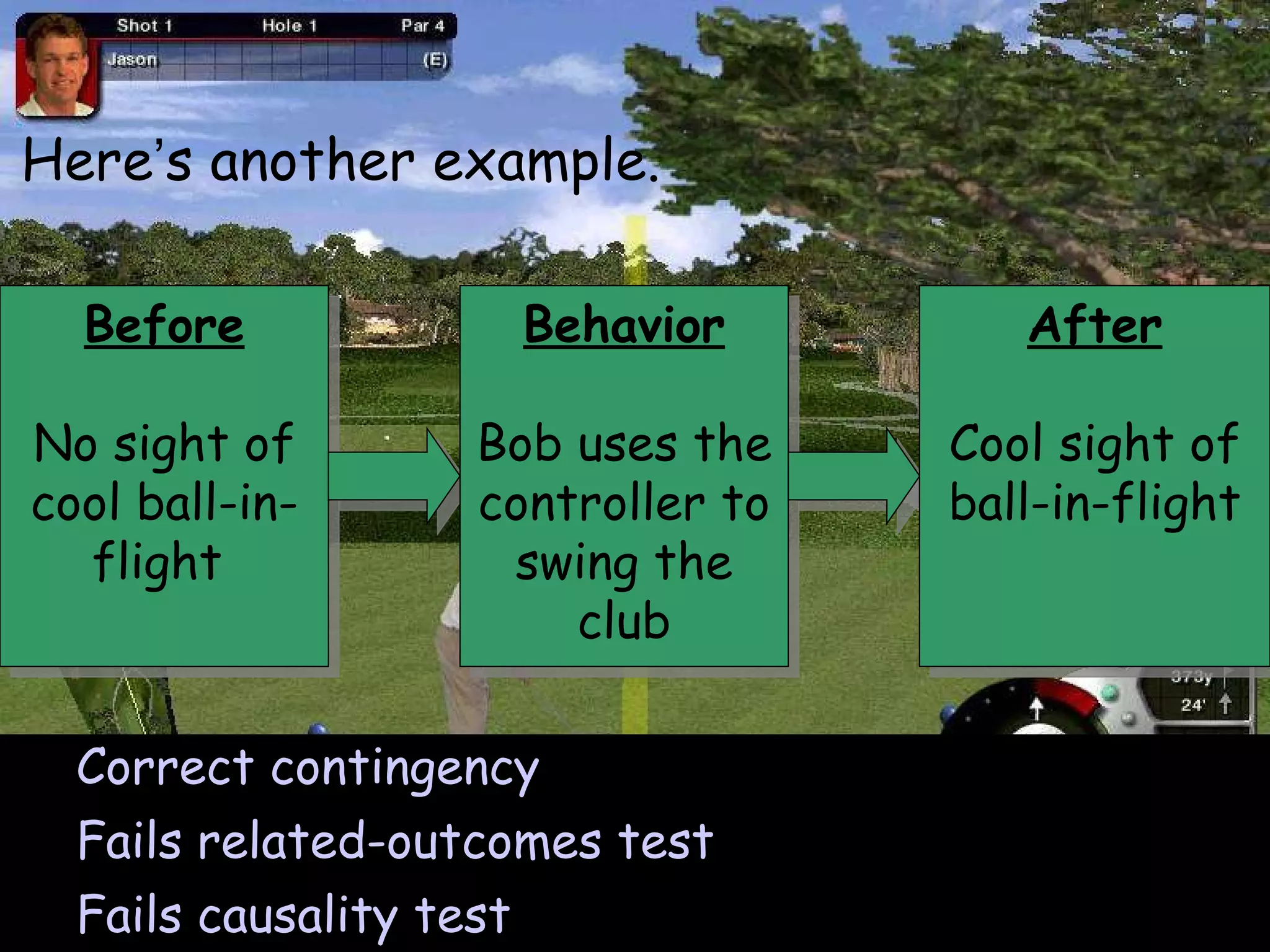
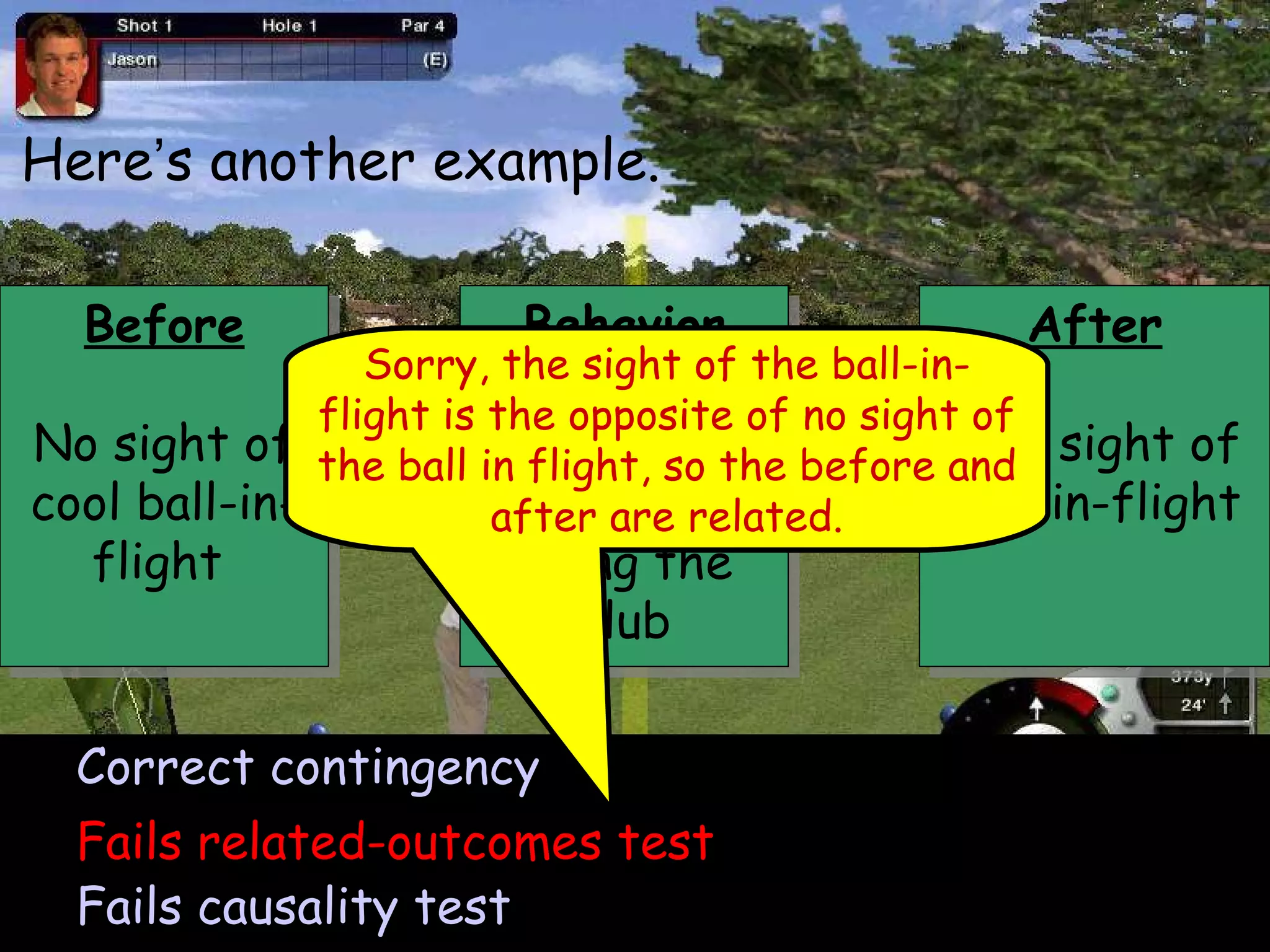
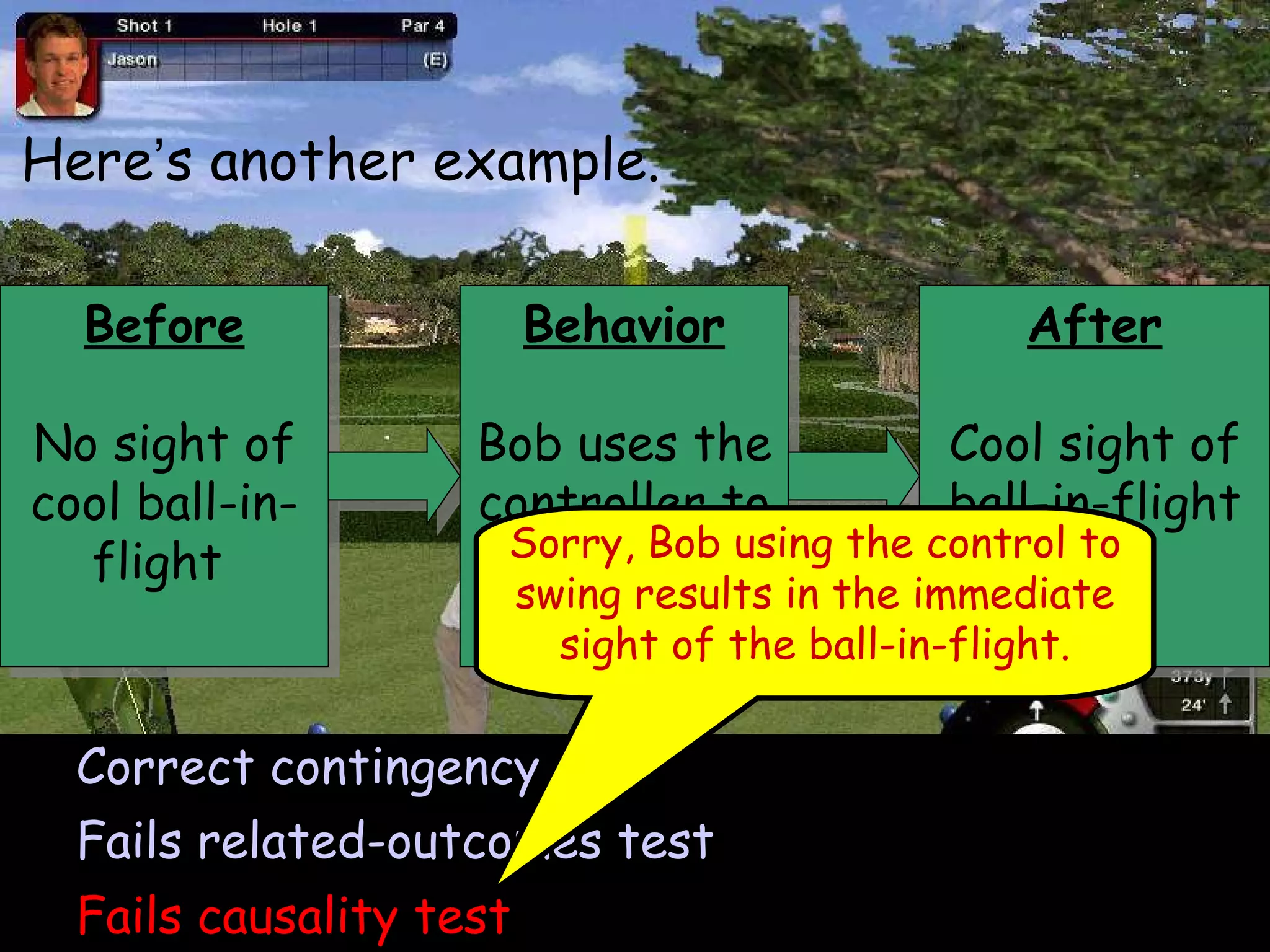
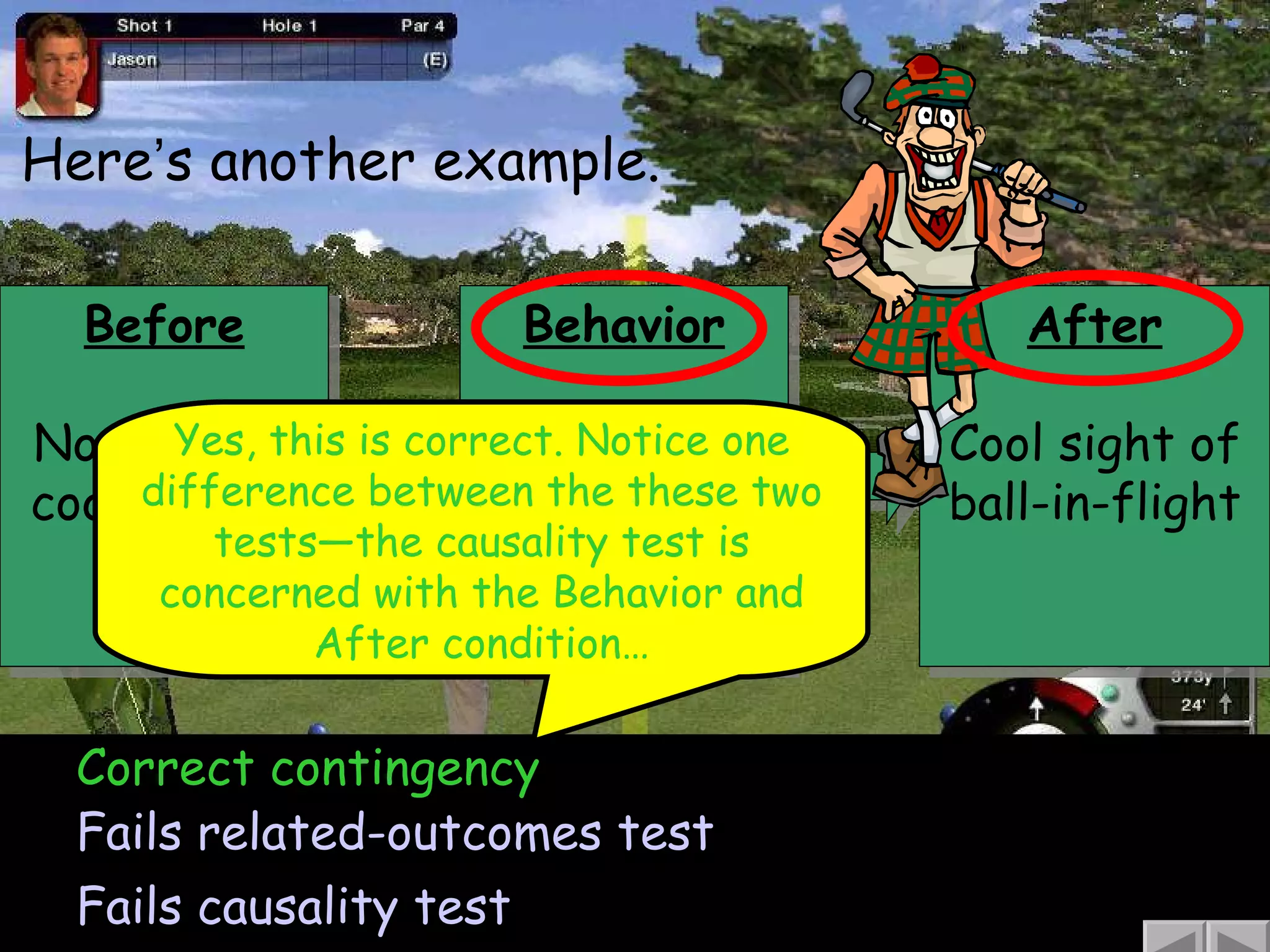
Before No sight of cool ball-in-flight  Here ’ s another example. Correct contingency Fails related-outcomes test Fails causality test Behavior Bob uses the controller to swing the club After Cool sight of ball-in-flight
Before No sight of cool ball-in-flight  Here ’ s another example. Correct contingency Fails related-outcomes test Fails causality test Sorry, the sight of the ball-in-flight is the opposite of no sight of the ball in flight, so the before and after are related. Behavior Bob uses the controller to swing the club After Cool sight of ball-in-flight
Before No sight of cool ball-in-flight  Here ’ s another example. Correct contingency Fails related-outcomes test Fails causality test Sorry, Bob using the control to swing results in the immediate sight of the ball-in-flight. Behavior Bob uses the controller to swing the club After Cool sight of ball-in-flight
Before No sight of cool ball-in-flight  Here ’ s another example. Correct contingency Fails related-outcomes test Fails causality test Yes, this is correct. Notice one difference between the these two tests—the causality test is concerned with the Behavior and After condition… Behavior Bob uses the controller to swing the club After Cool sight of ball-in-flight
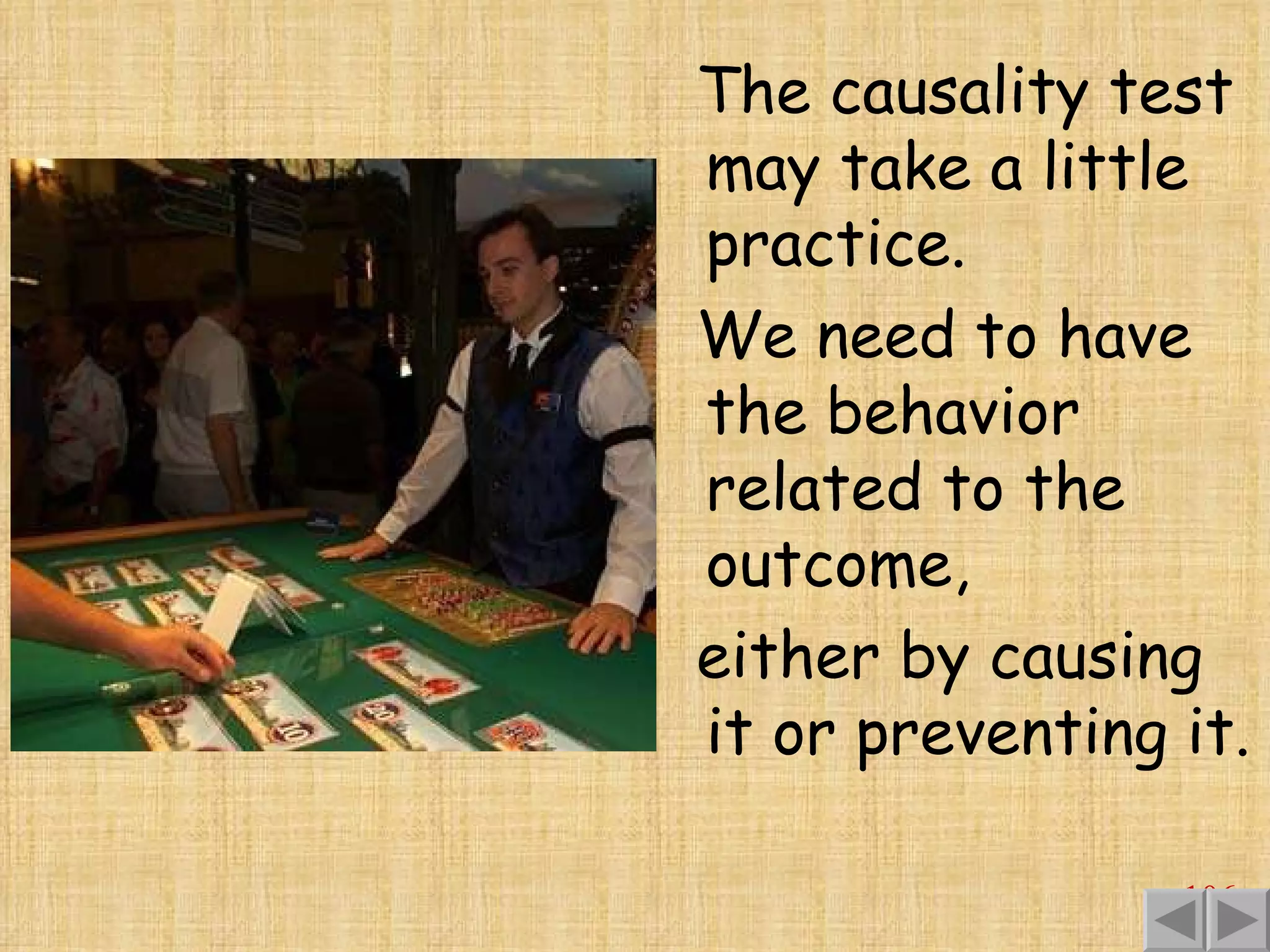
The causality test may take a little practice. We need to have the behavior related to the outcome, either by causing it or preventing it.
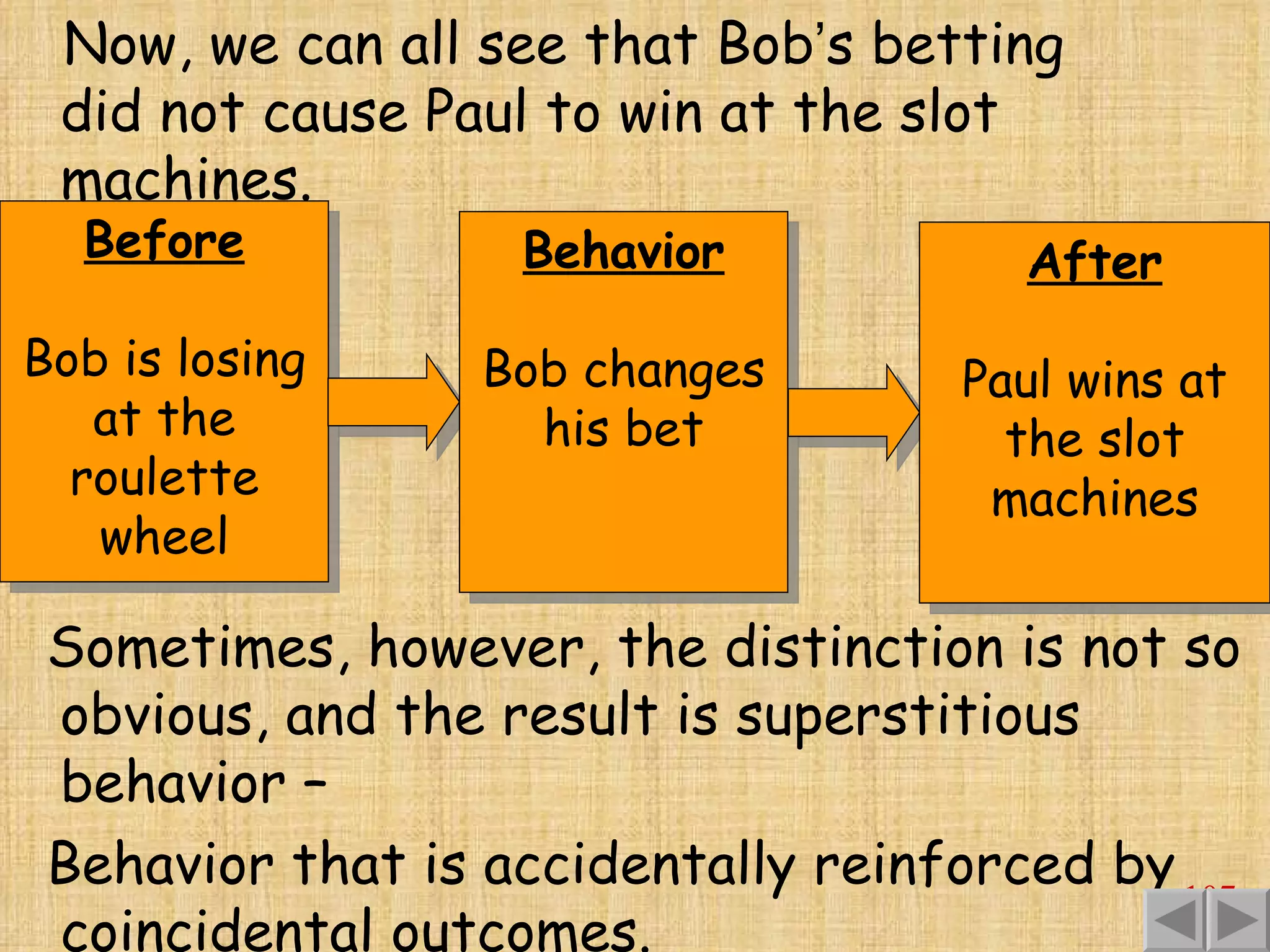
Before Bob is losing at the roulette wheel Now, we can all see that Bob ’ s betting did not cause Paul to win at the slot machines. Sometimes, however, the distinction is not so obvious, and the result is superstitious behavior –  Behavior that is accidentally reinforced by coincidental outcomes. Behavior Bob changes his bet After Paul wins at the slot machines
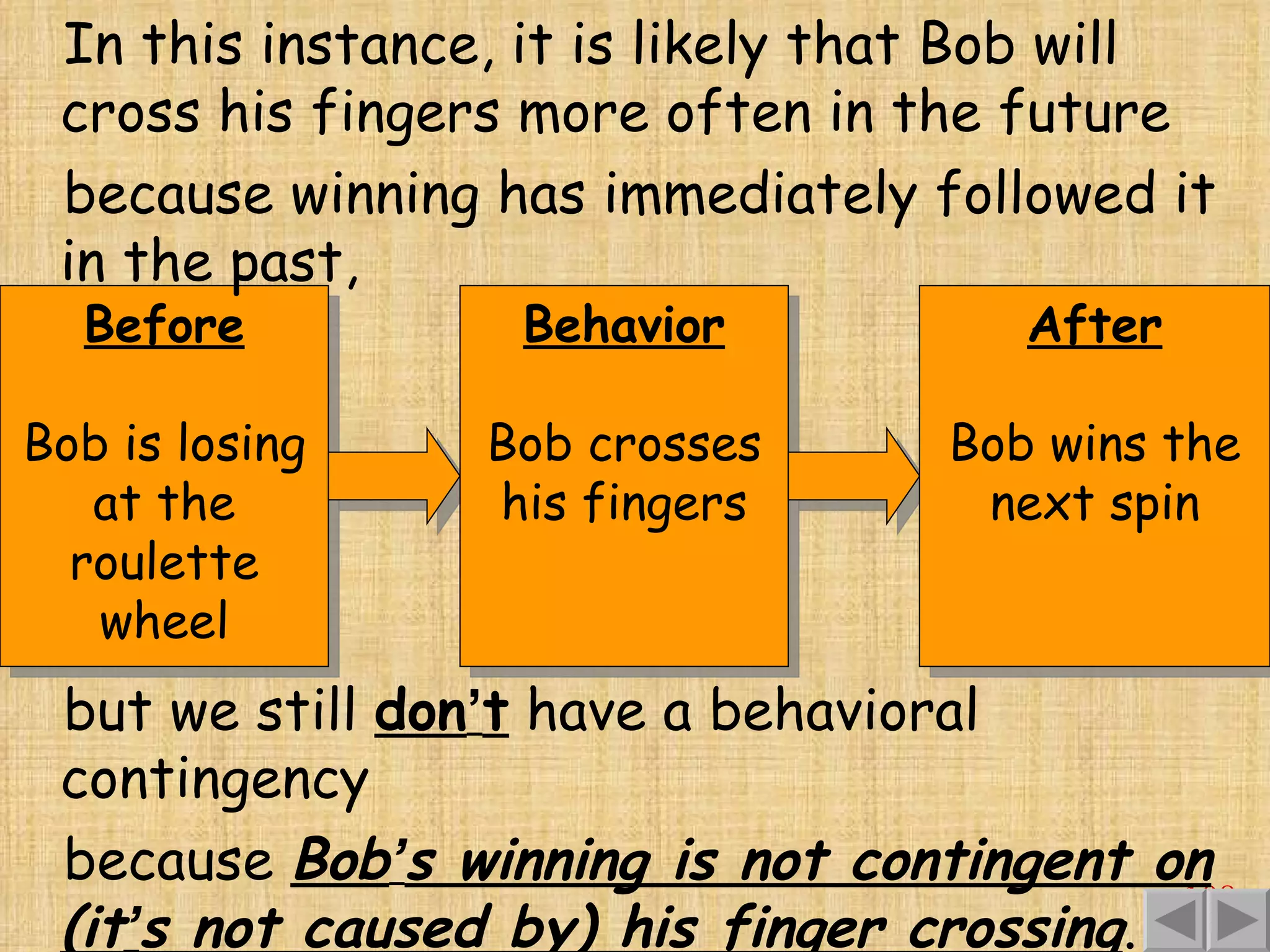
Before Bob is losing at the roulette wheel In this instance, it is likely that Bob will cross his fingers more often in the future because winning has immediately followed it in the past, but we still  don ’ t  have a behavioral contingency because  Bob ’ s winning is not contingent on (it ’ s not caused by) his finger crossing . Behavior Bob crosses his fingers After Bob wins the next spin
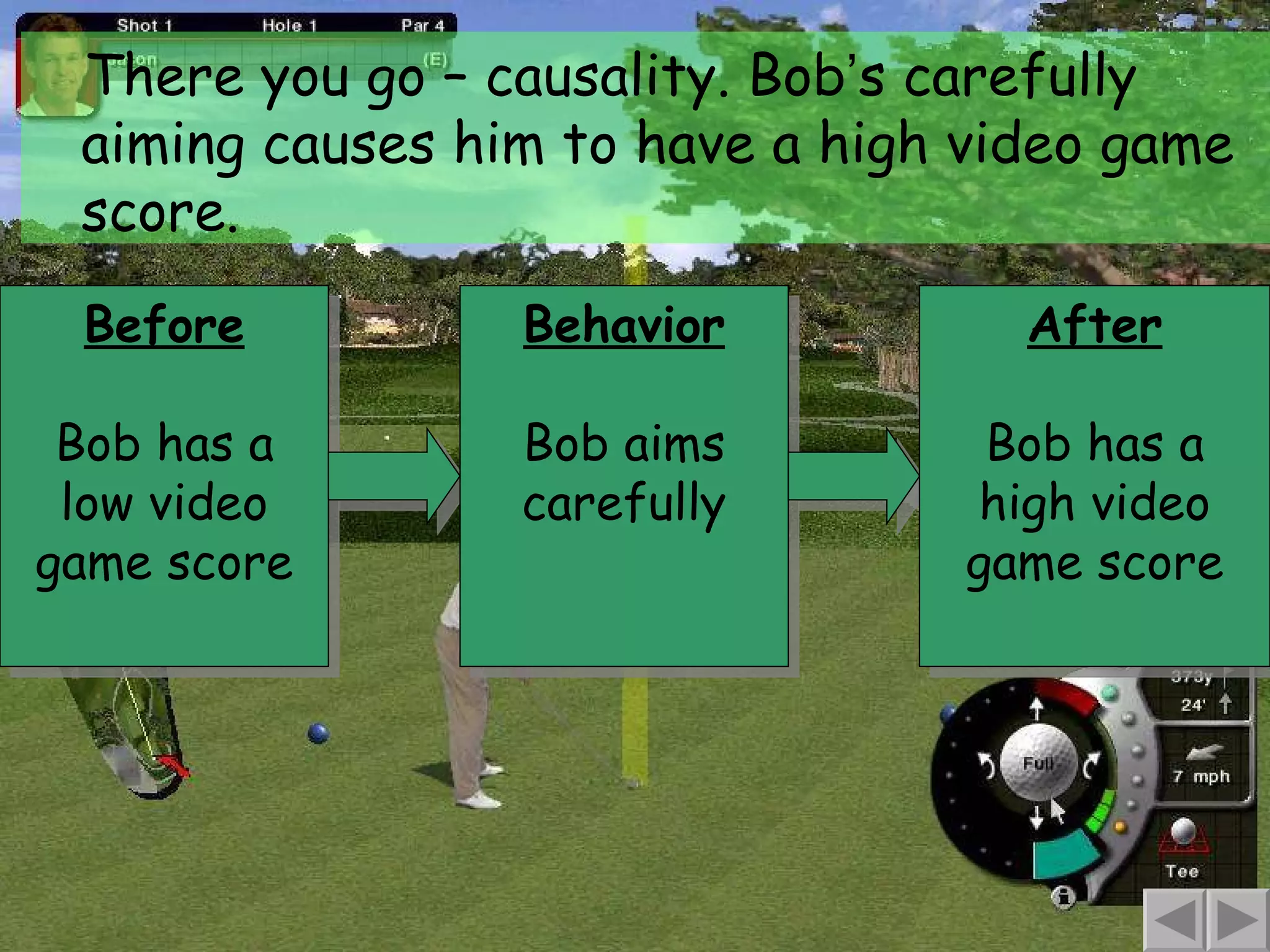
Before Bob has a low video game score There you go – causality. Bob ’ s carefully aiming causes him to have a high video game score. Behavior Bob aims carefully After Bob has a high video game score
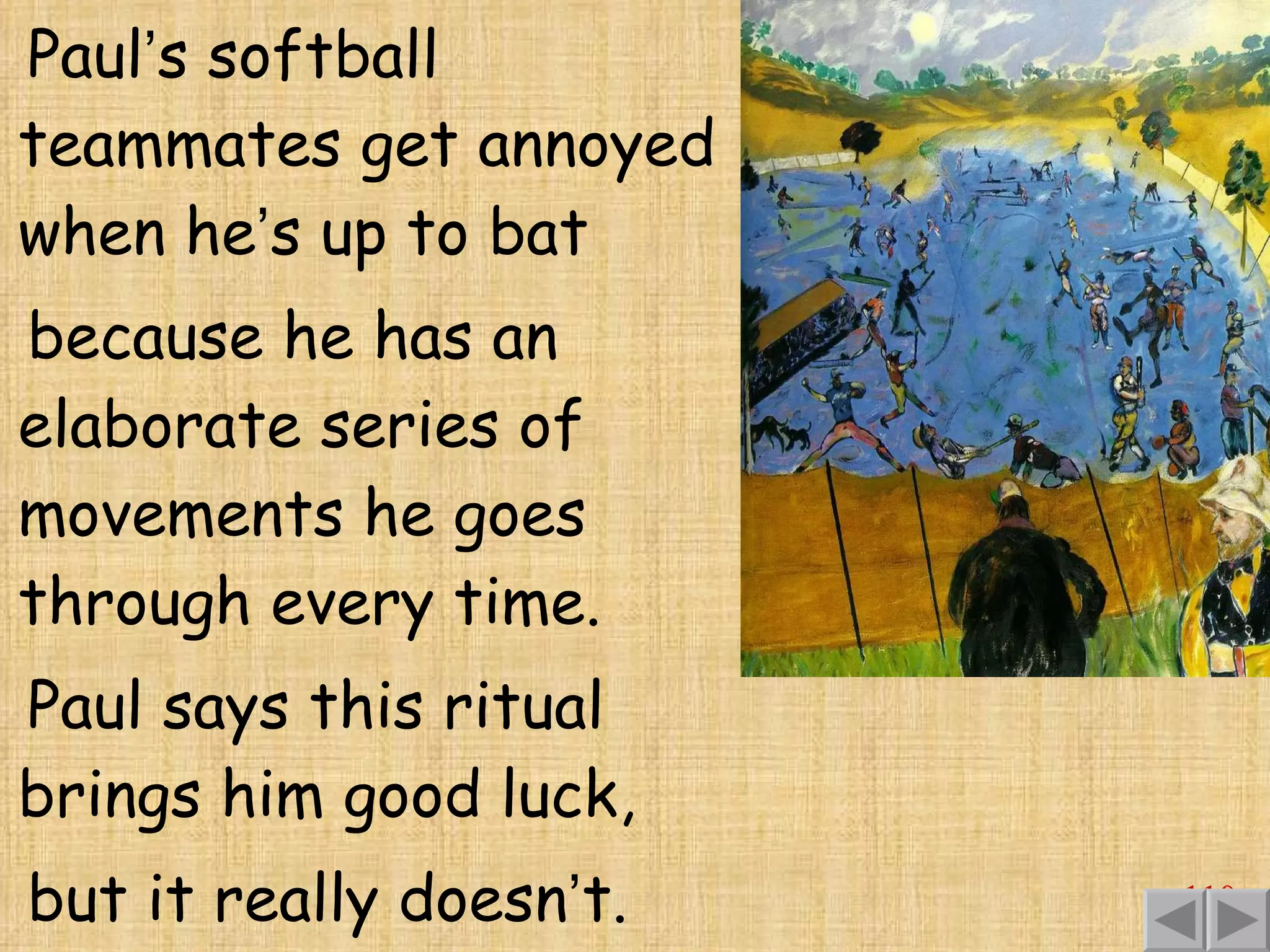
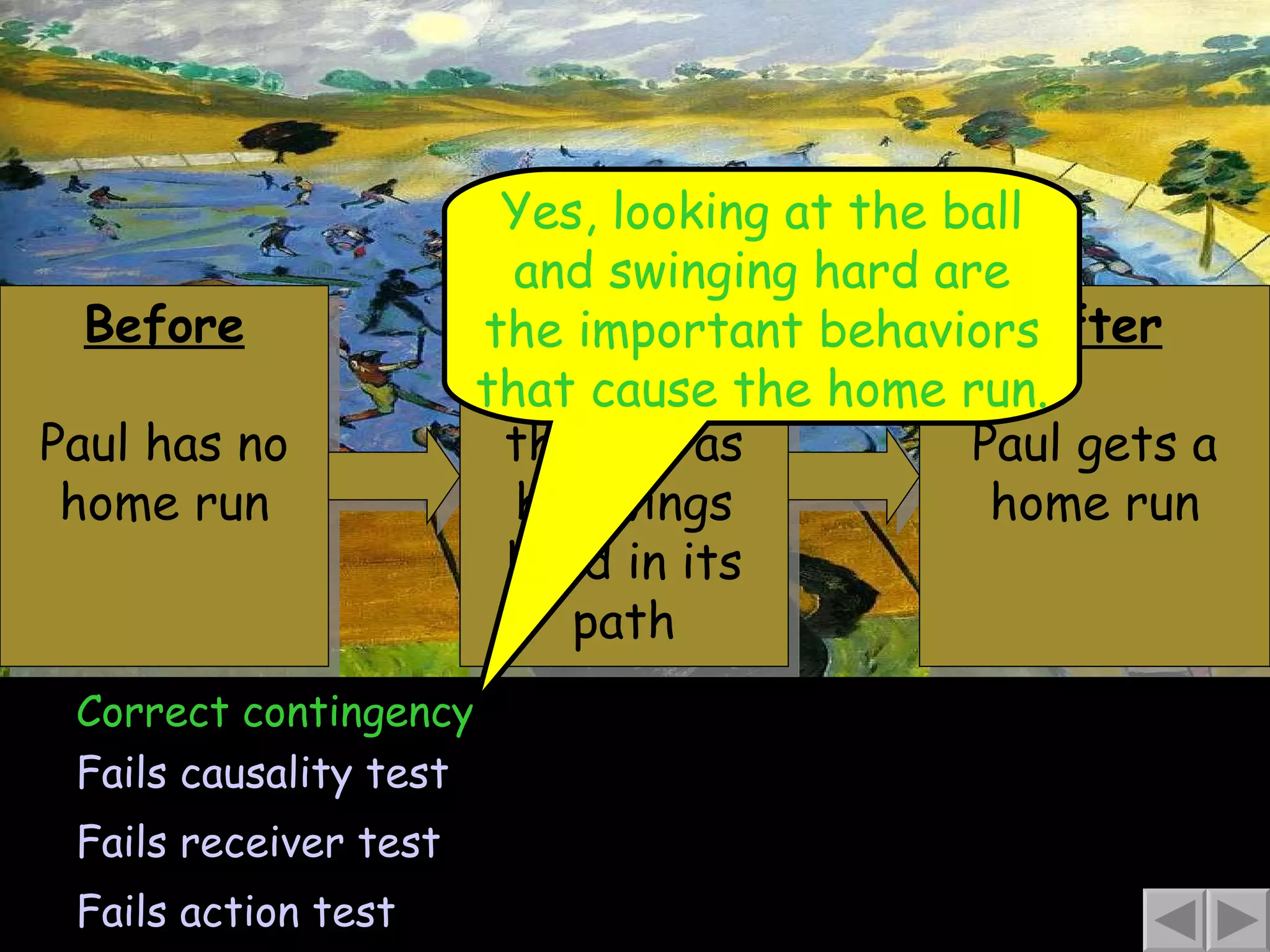
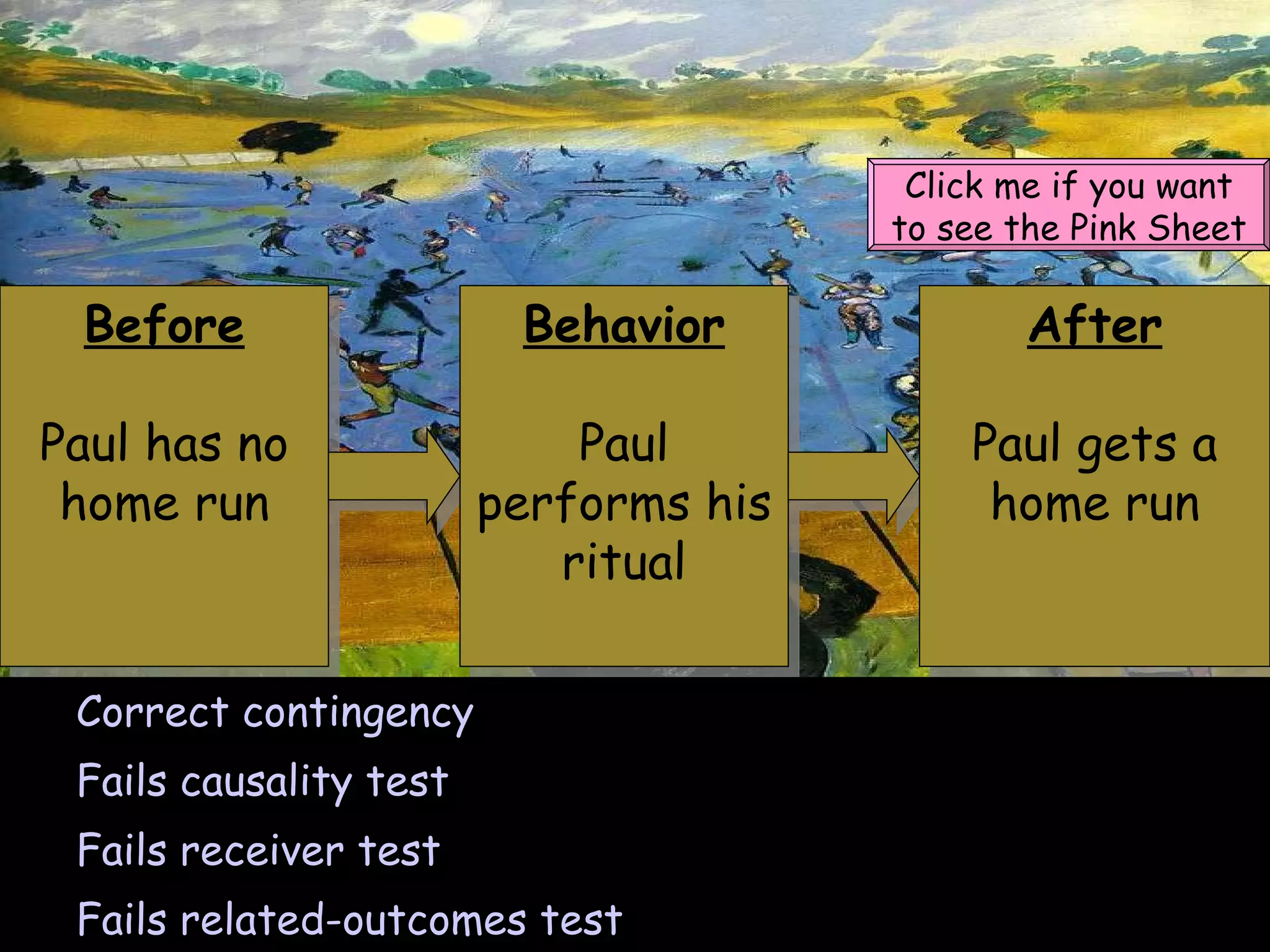
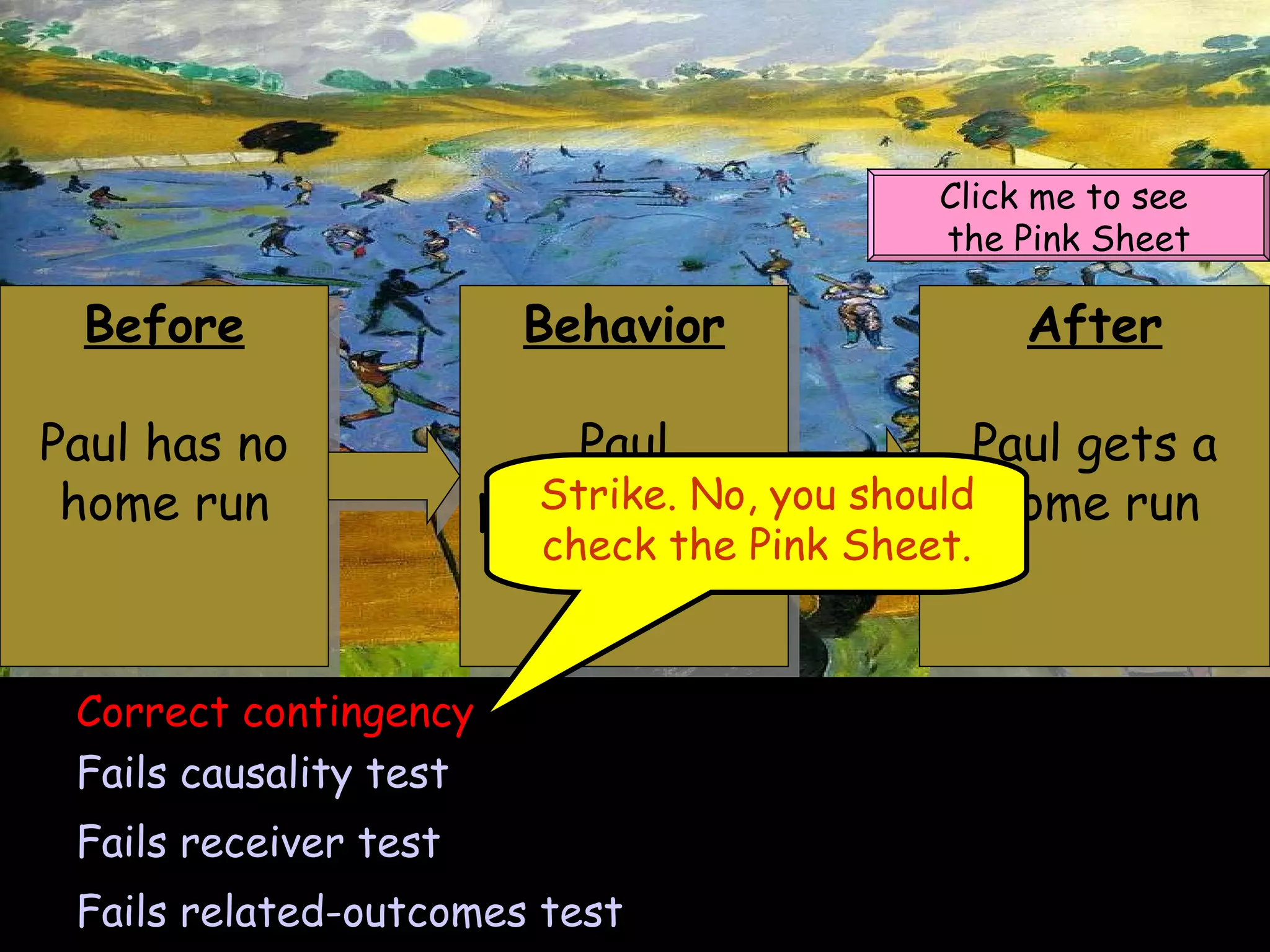
Paul ’ s softball teammates get annoyed when he ’ s up to bat because he has an elaborate series of movements he goes through every time. Paul says this ritual brings him good luck,  but it really doesn ’ t.
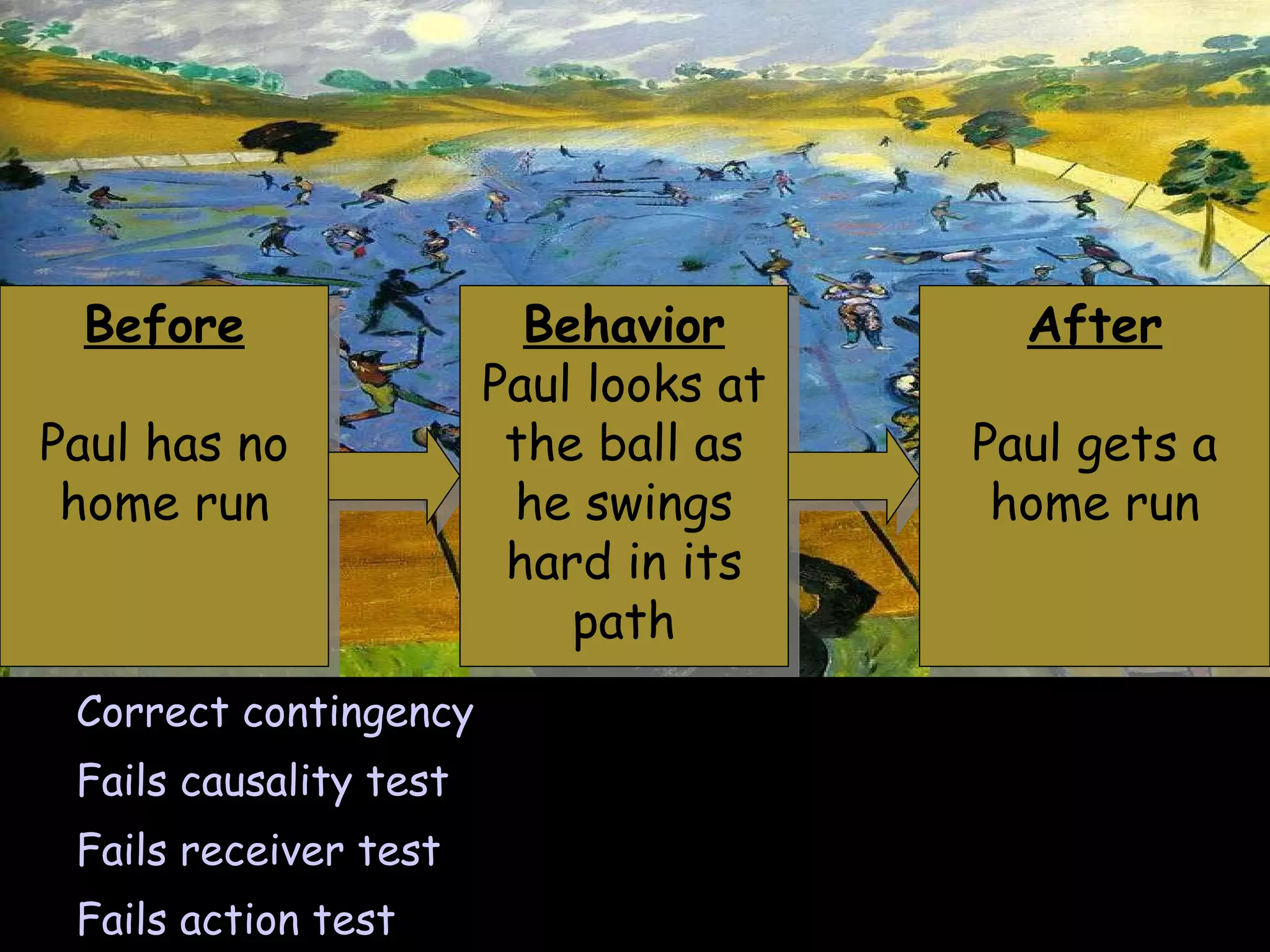
Before Paul has no home run Correct contingency Fails causality test Fails receiver test Fails action test Behavior Paul looks at the ball as he swings hard in its path After Paul gets a home run
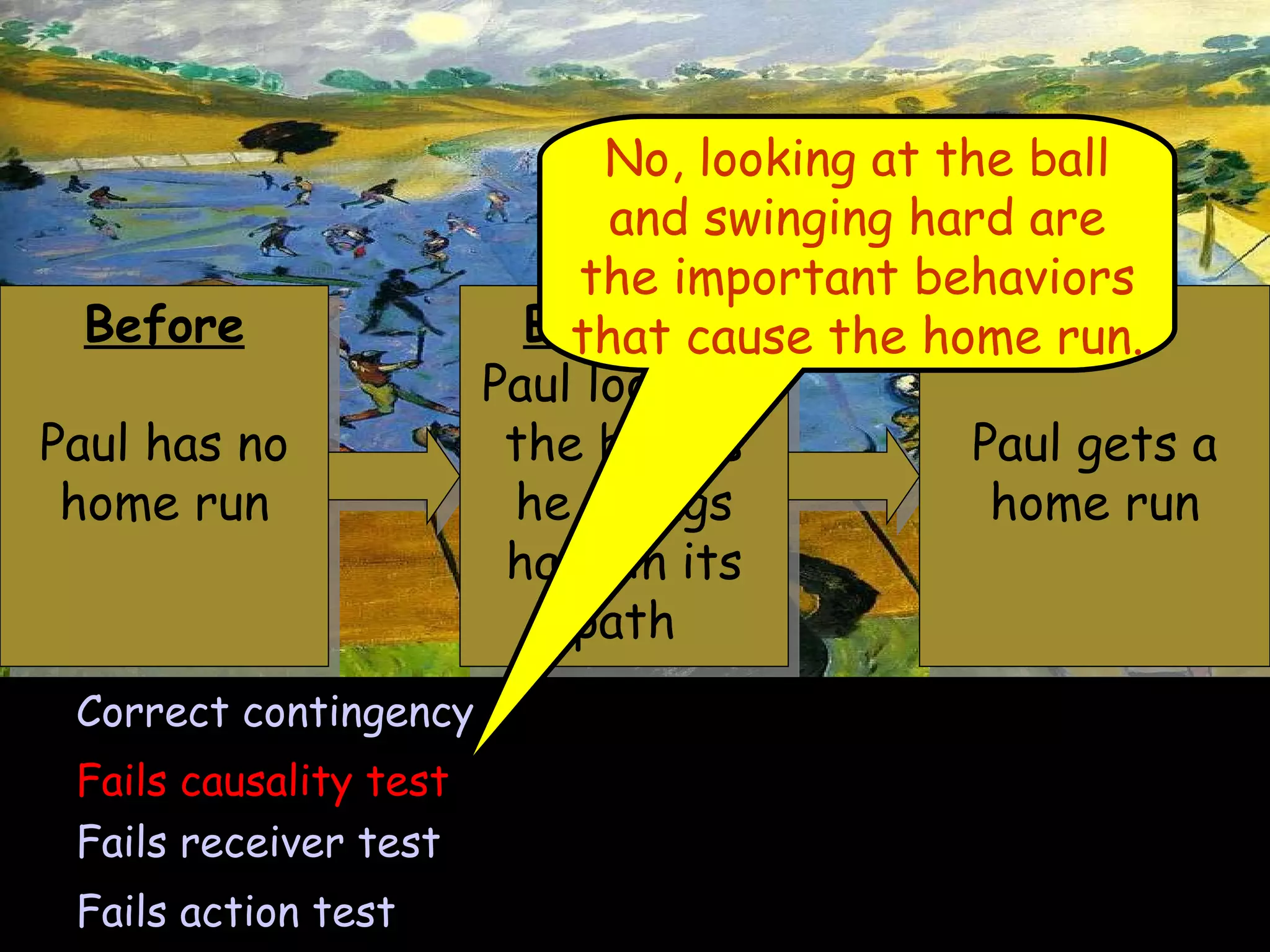
Before Paul has no home run Correct contingency Fails causality test Fails receiver test Fails action test No, looking at the ball and swinging hard are the important behaviors that cause the home run. Behavior Paul looks at the ball as he swings hard in its path After Paul gets a home run
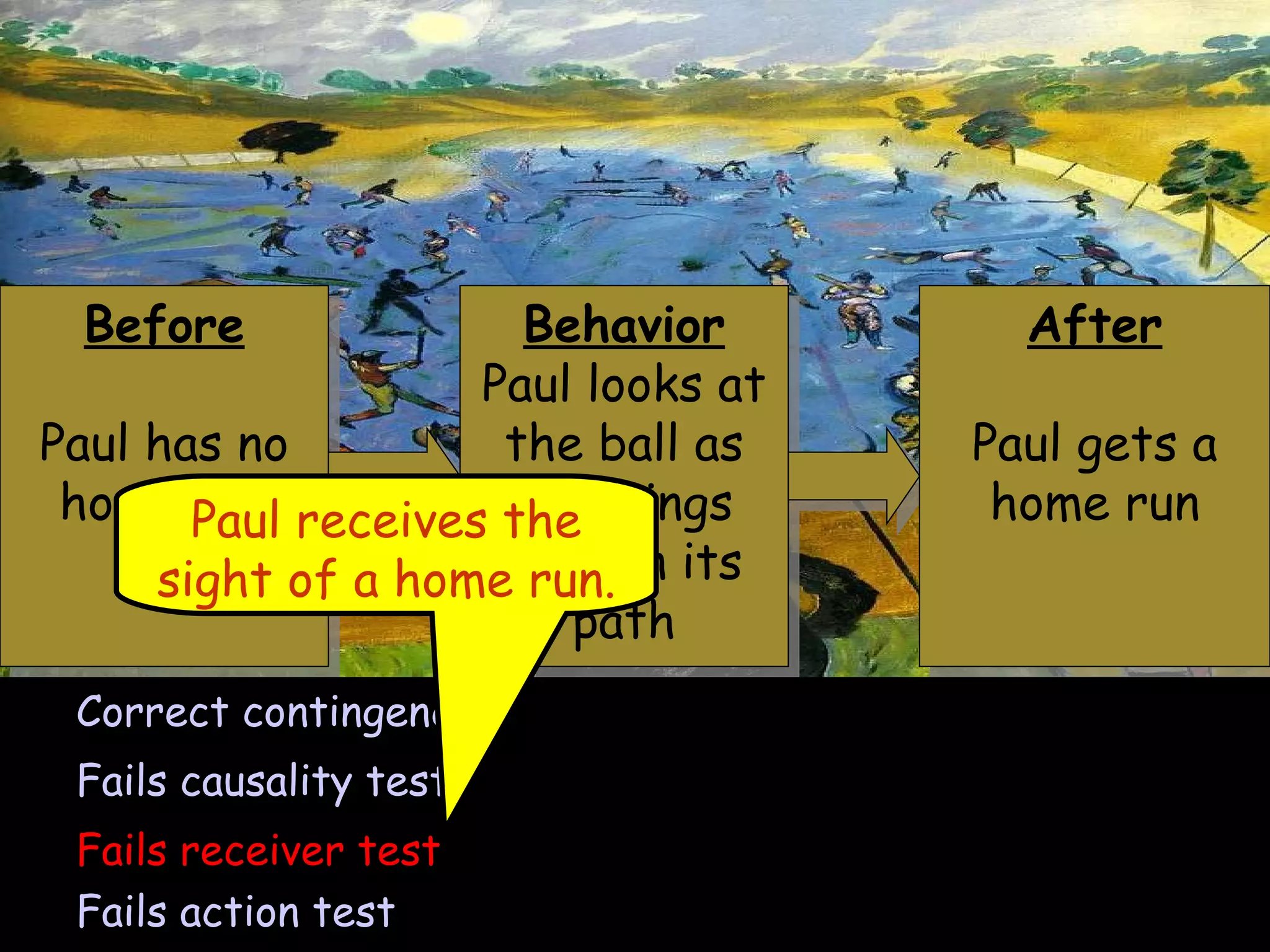
Before Paul has no home run Correct contingency Fails causality test Fails receiver test Fails action test Paul receives the sight of a home run. Behavior Paul looks at the ball as he swings hard in its path After Paul gets a home run
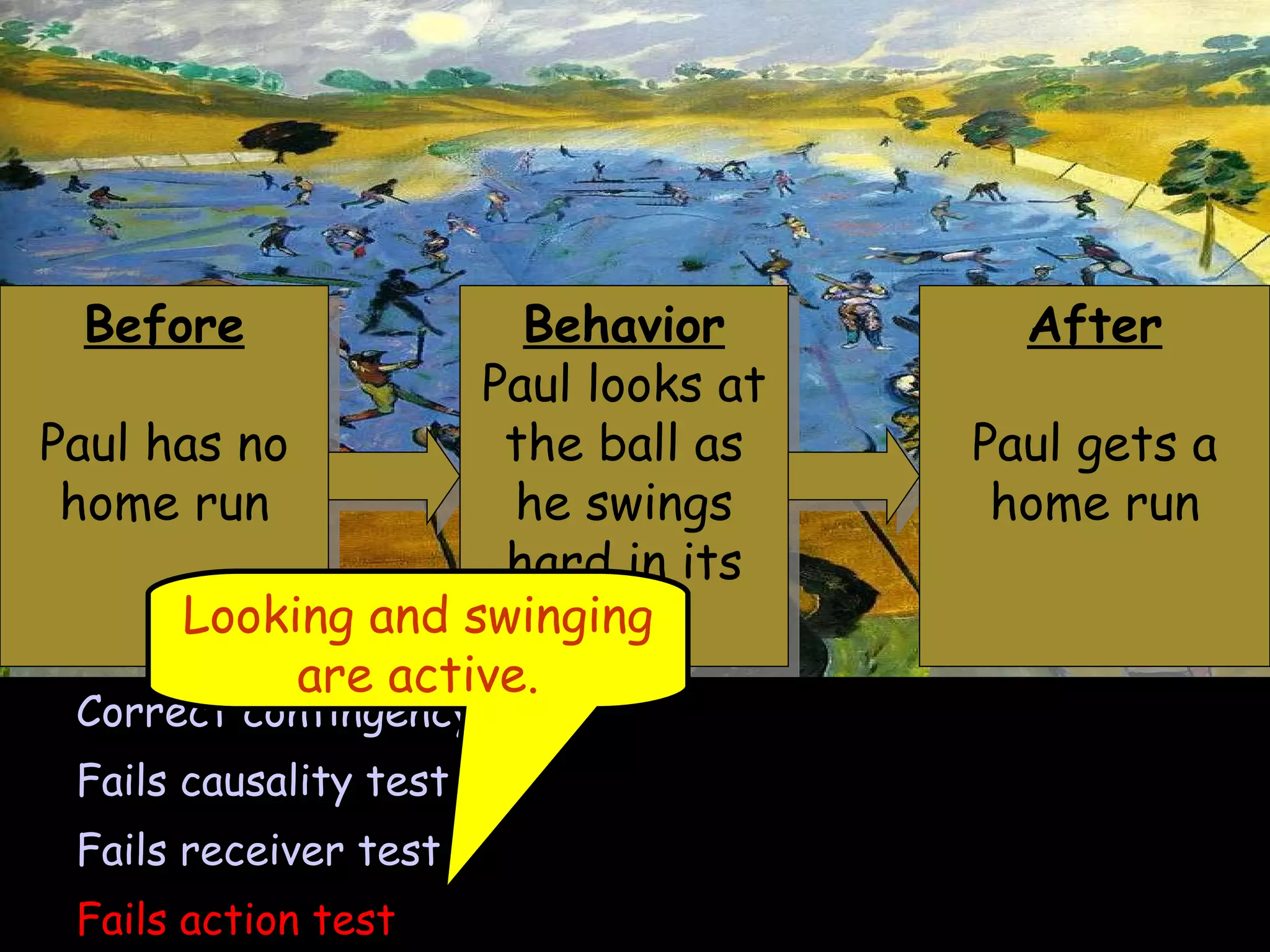
Before Paul has no home run Correct contingency Fails causality test Fails receiver test Fails action test Looking and swinging are active. Behavior Paul looks at the ball as he swings hard in its path After Paul gets a home run
Before Paul has no home run Correct contingency Fails causality test Fails receiver test Fails action test Yes, looking at the ball and swinging hard are the important behaviors that cause the home run. Behavior Paul looks at the ball as he swings hard in its path After Paul gets a home run
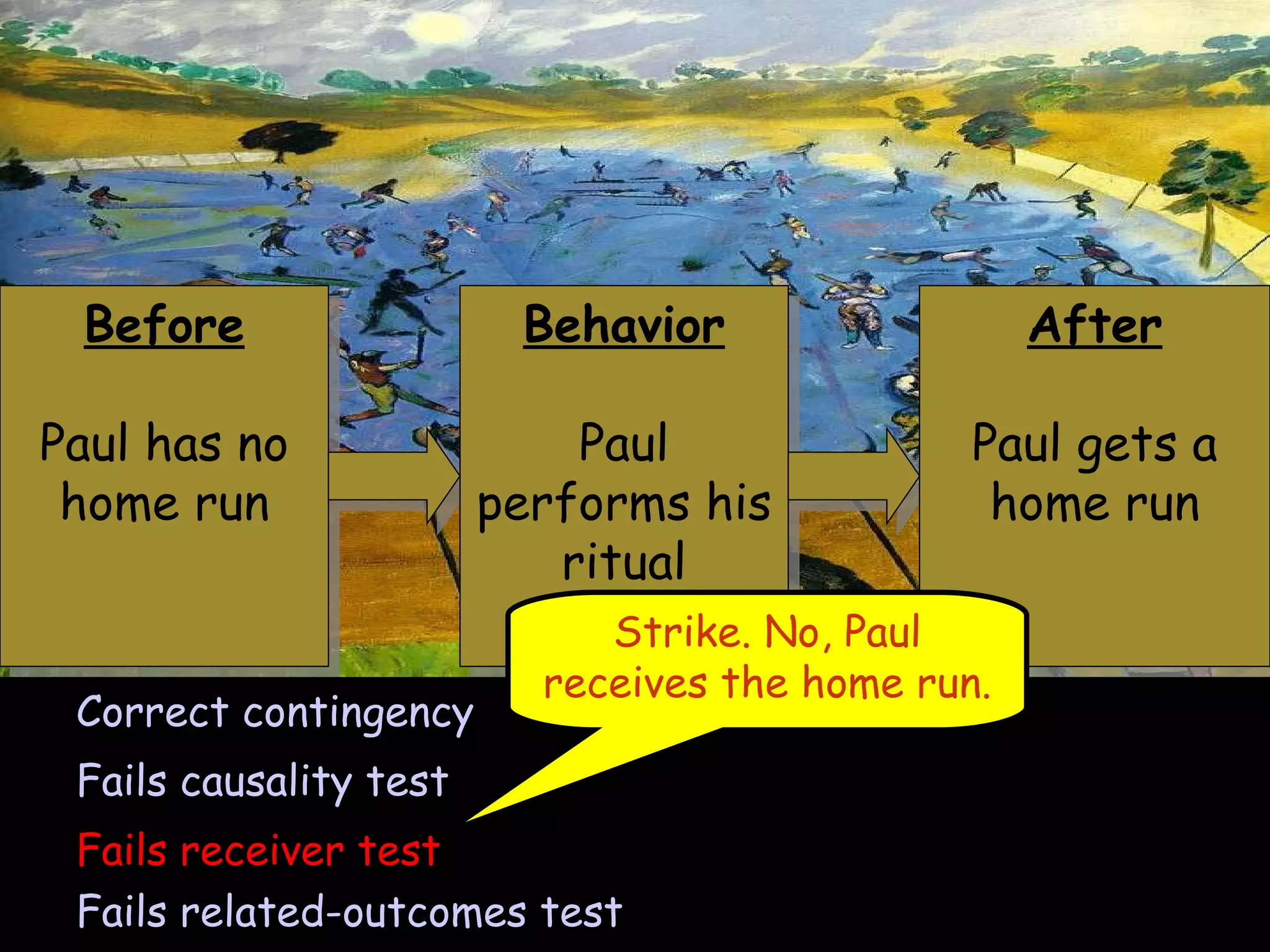
Before Paul has no home run Correct contingency Fails causality test Fails receiver test Fails related-outcomes test Click me if you want to see the Pink Sheet Behavior Paul performs his ritual After Paul gets a home run
Contingency-Diagramming Checklist A.  Whose behavior are you analyzing?   _________________________  1.   Behaver Test Is the behavior in the behavior box performed by the person who you are analyzing?   If not, redo the example. Before Behavior After D. What is the condition before the response? 10. Related Outcomes Test Is the before condition related to the after condition?   (Often the relationship is one of opposites) If not, change one or both of the conditions. Use this checklist for every contingency diagram you do and you ’ ll save yourself some headaches and impress your TA during transparency time. Simply place the answer to each of the 10 questions for the corresponding blank in the contingency diagram above it. Turn the checklist over to determine which type of contingency you have. In learning these criteria for a test, you need only know each name and sentence that ’ s bold. B. What is the behavior being analyzed or diagrammed? 2. Deadman Test Can a dead man do it?   If he can, then you haven ’ t properly specified the behavior. So roll over the dead man. 3. Action Test Does the behavior involve an action?   (Hint: Learning, receiving, being, hearing, seeing, and feeling are not behavior). If not, then change the behavior. 4. Specific-Behavior Test Is it perfectly clear exactly what action is involved in the behavior?   If not, then reword the behavior. 5. Reinforceable Response-Unit Test Are there any interruptions of greater than 60 seconds during the response?   If there are, then the behavior is not a response-unit. Rewrite the behavior. C. What is the outcome that follows the response? 6. Stimulus Test Is the before & after a stimulus, event or condition and not a behavior of the behaver?   If it ’ s not a stimulus then change your condition. (Hint: If the before or after is another behavior of the behaver, you probably don ’ t have a correct condition. Exceptions: self-reinforcement, seeing, hearing, or the opportunity for activity. 7. Causality Test Is the outcome caused by the response?   If not, change the outcome. 8. 60 ”  Test Does the outcome follow the response by more than 60 seconds?   If so, find an immediate outcome. 9. Receiver Test Is the behaver the receiver of the outcome (after condition)?   If not, rework the example. Hint: Make sure the diagram passes the behaver test first Back to the Question
Before Paul has no home run Correct contingency Fails causality test Fails receiver test Fails related-outcomes test Strike. No, you should check the Pink Sheet. Click me to see  the Pink Sheet Behavior Paul performs his ritual After Paul gets a home run
Before Paul has no home run Correct contingency Fails causality test Fails receiver test Fails related-outcomes test Strike. No, Paul receives the home run. Behavior Paul performs his ritual After Paul gets a home run
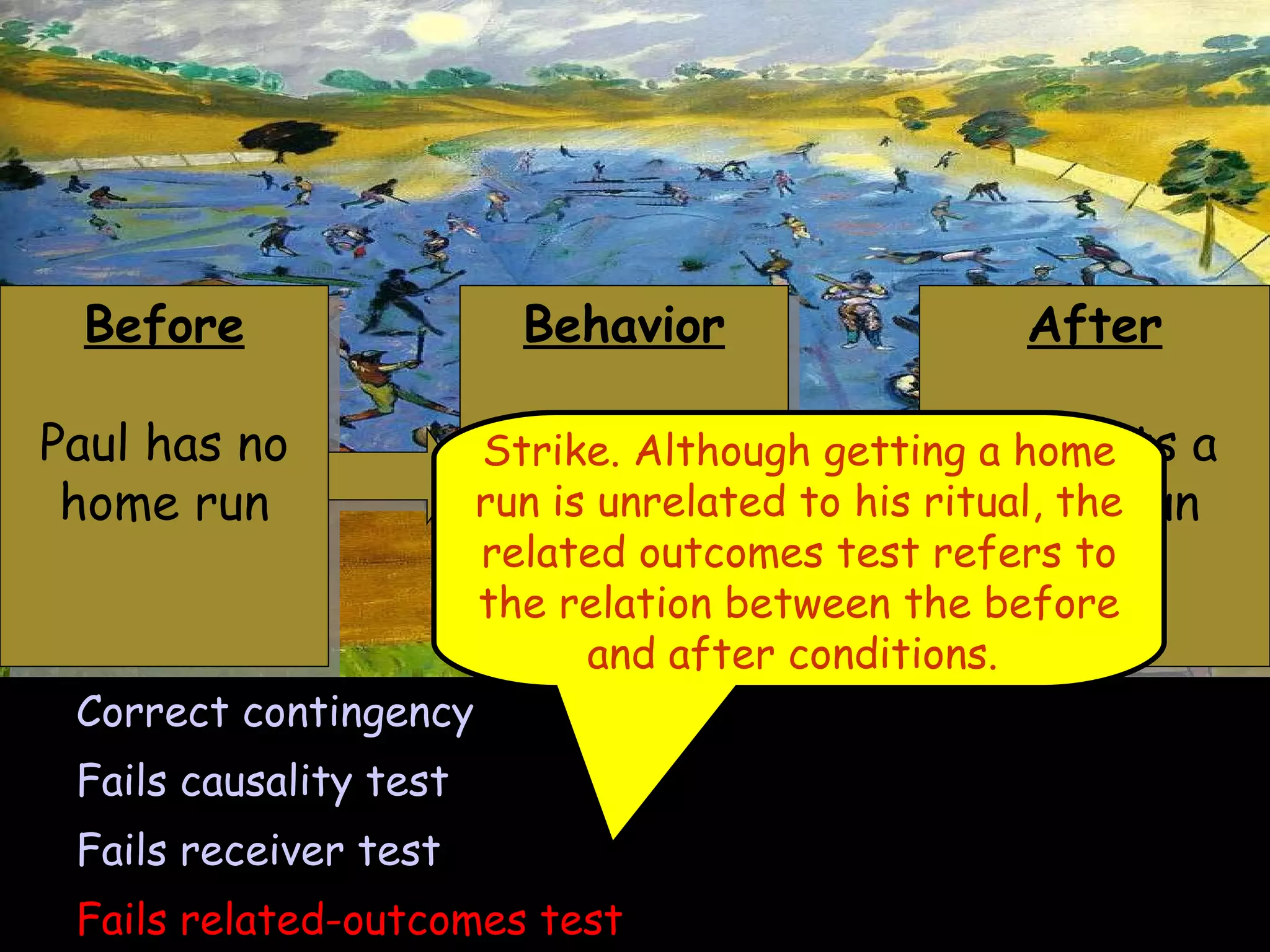
Before Paul has no home run Correct contingency Fails causality test Fails receiver test Fails related-outcomes test Strike. Although getting a home run is unrelated to his ritual, the related outcomes test refers to the relation between the before and after conditions.  Behavior Paul performs his ritual After Paul gets a home run
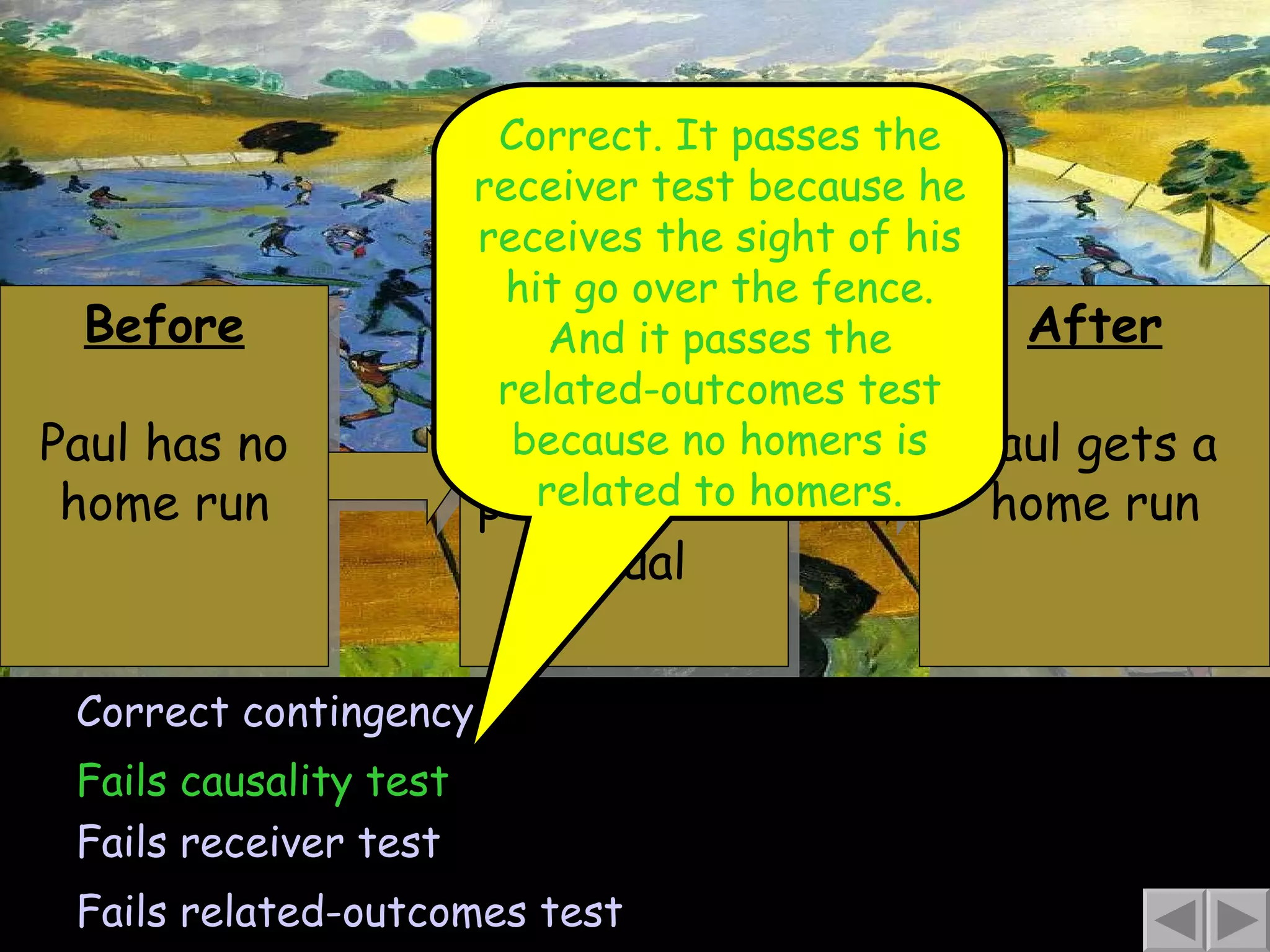
Before Paul has no home run Correct contingency Fails causality test Fails receiver test Fails related-outcomes test Correct. It passes the receiver test because he receives the sight of his hit go over the fence. And it passes the related-outcomes test because no homers is related to homers. Behavior Paul performs his ritual After Paul gets a home run
Warning: Don ’ t be a casualty of mispronouncing  causality .  It ’ s easy to misread  causality  as  casualty ,  but then the  “ casualty ”  criterion doesn ’ t make a heck of a lot of sense.
Causality Test Stimulus Test Related Outcomes Test 60 ”  Test Response-Unit Test Table of Contents.
Stimulus Test Is the before and after a stimulus, event or condition?
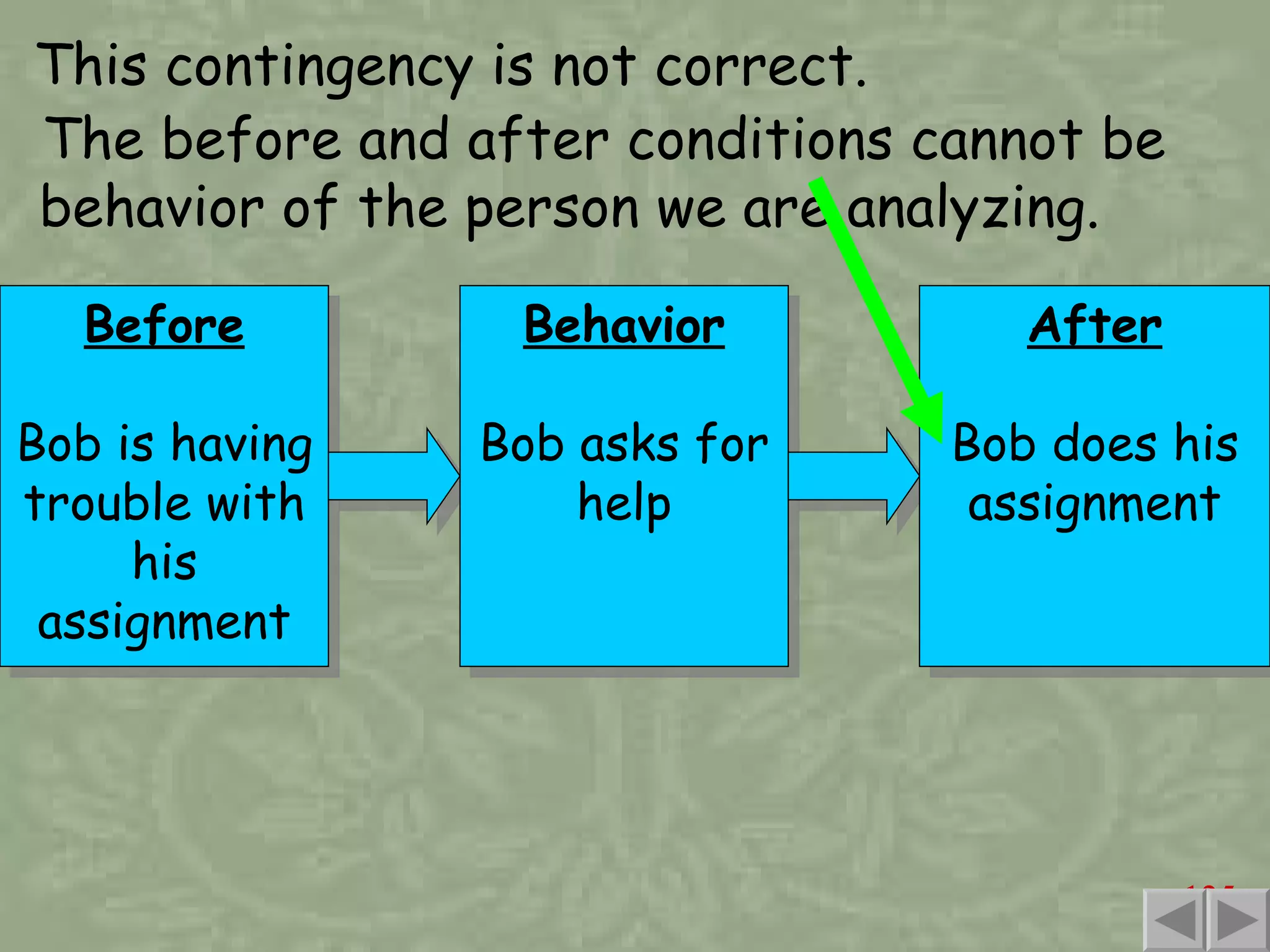
This contingency is not correct. Before Bob is having trouble with his assignment The before and after conditions cannot be behavior of the person we are analyzing. Behavior Bob asks for help After Bob does his assignment
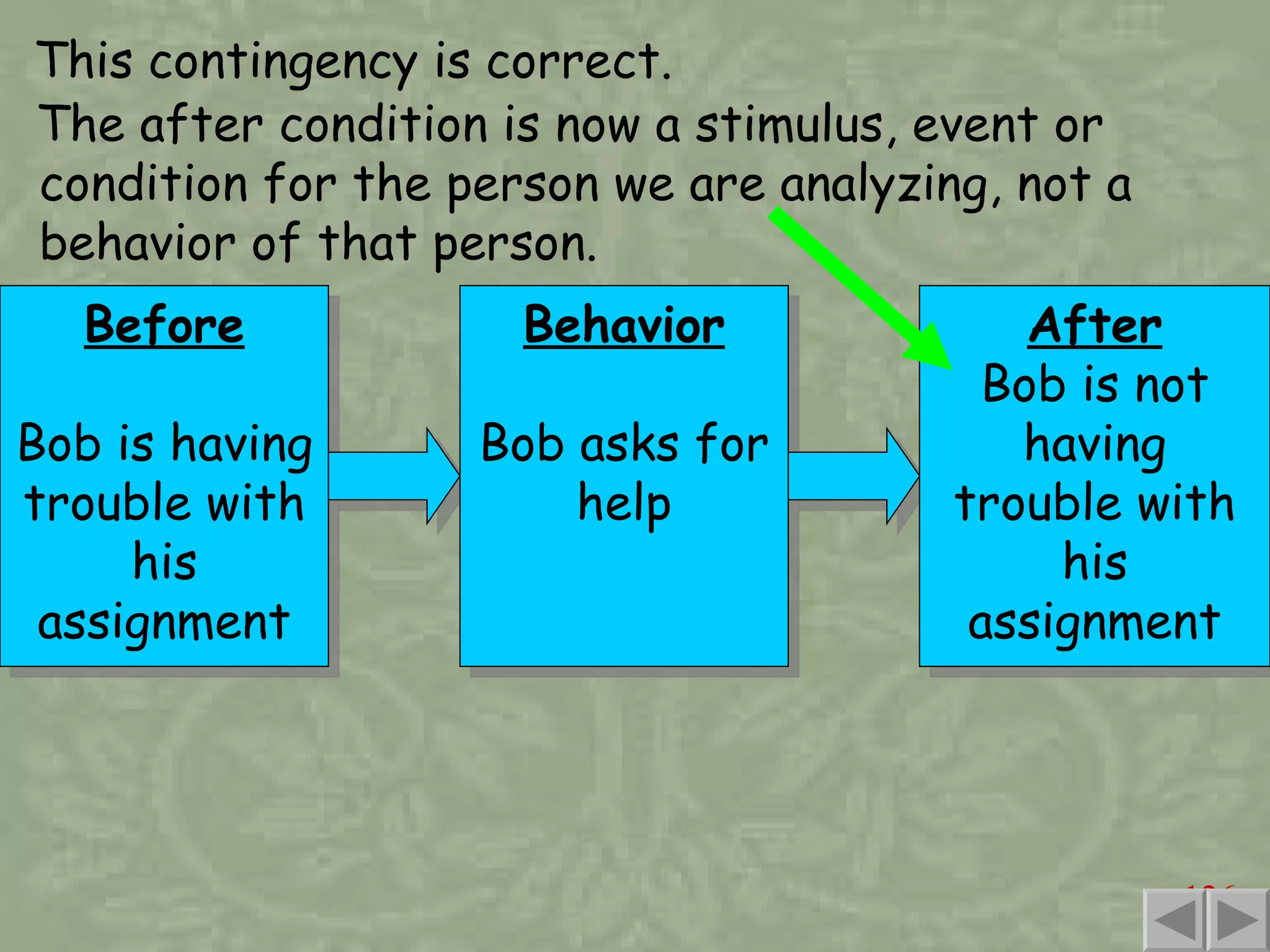
This contingency is correct. Before Bob is having trouble with his assignment The after condition is now a stimulus, event or condition for the person we are analyzing, not a behavior of that person. Behavior Bob asks for help After Bob is not having trouble with his assignment
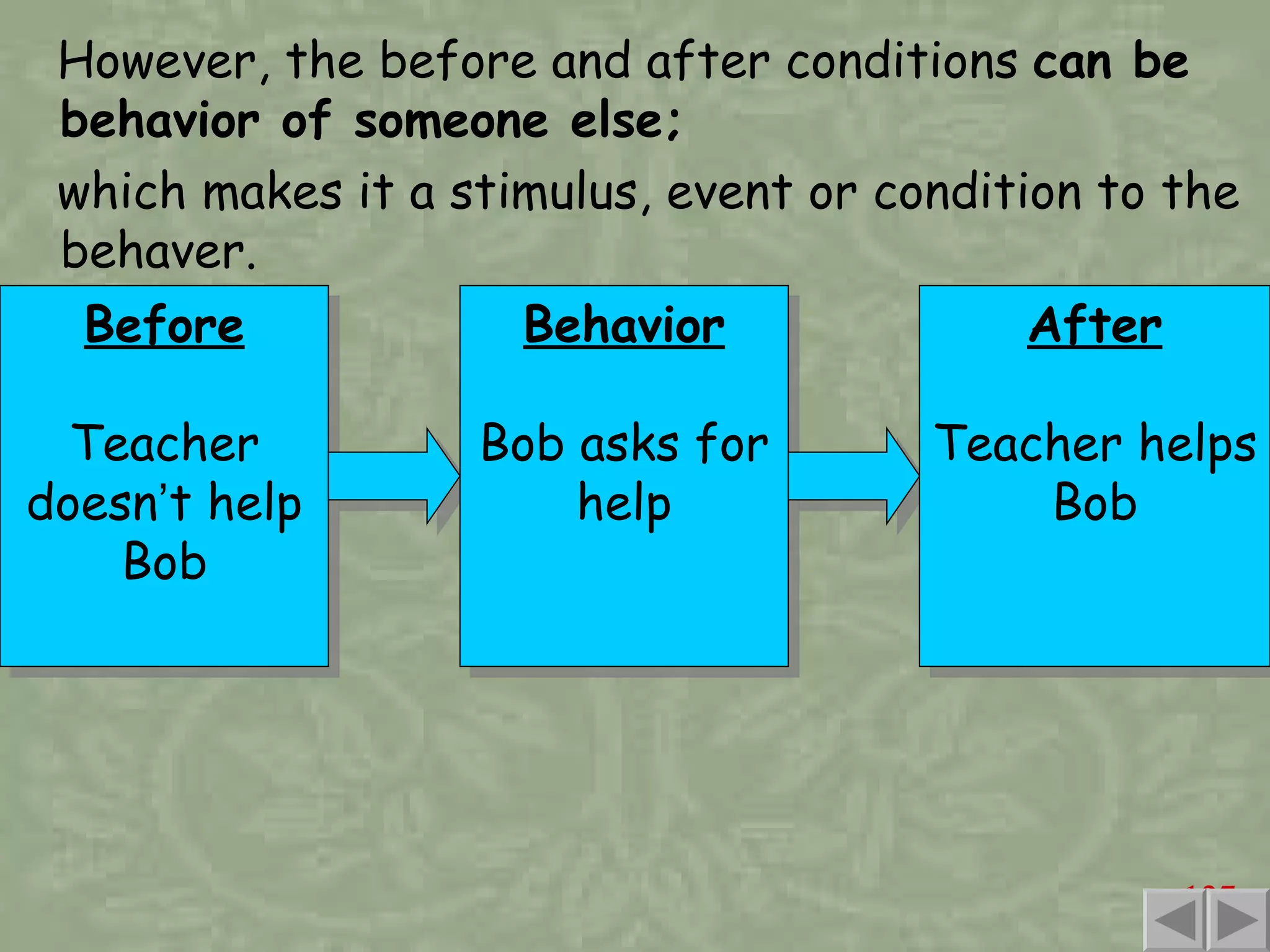
However, the before and after conditions  can be behavior of someone else; which makes it a stimulus, event or condition to the behaver. Before Teacher doesn ’ t help Bob Behavior Bob asks for help After Teacher helps Bob
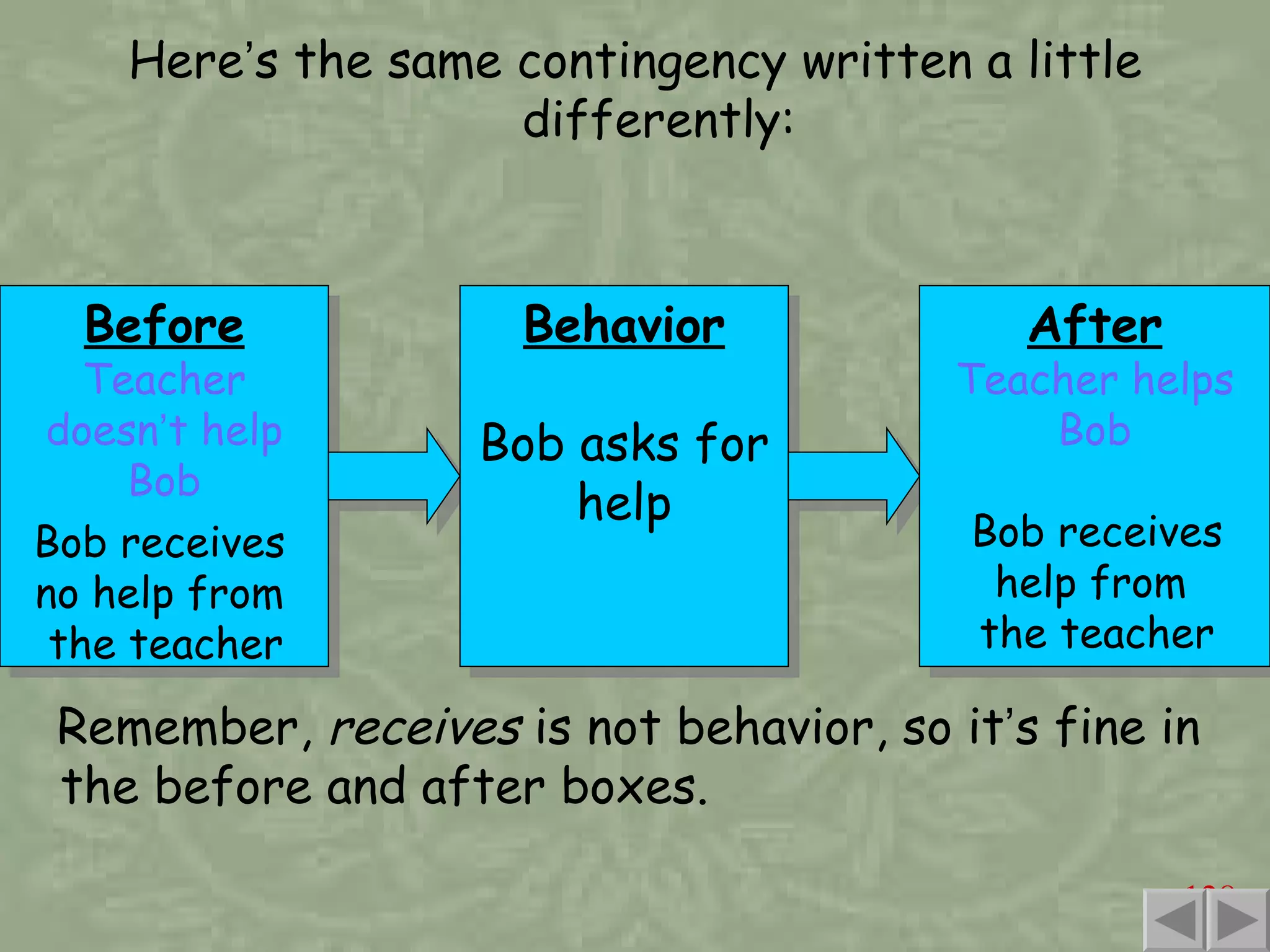
Here ’ s the same contingency written a little differently: Before Teacher doesn ’ t help Bob Remember,  receives  is not behavior, so it ’ s fine in the before and after boxes. Bob receives  no help from  the teacher Bob receives help from  the teacher Behavior Bob asks for help After Teacher helps Bob
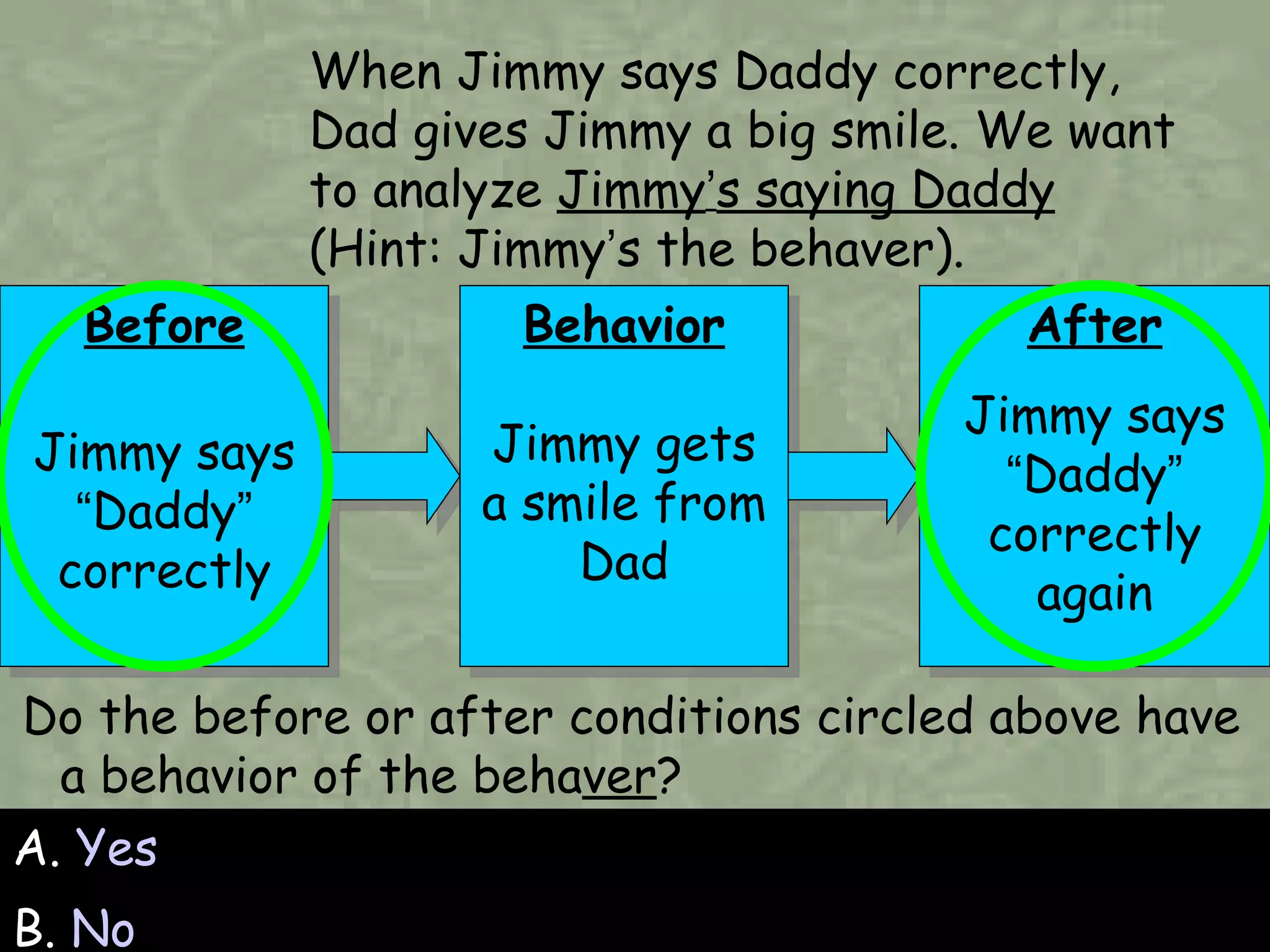
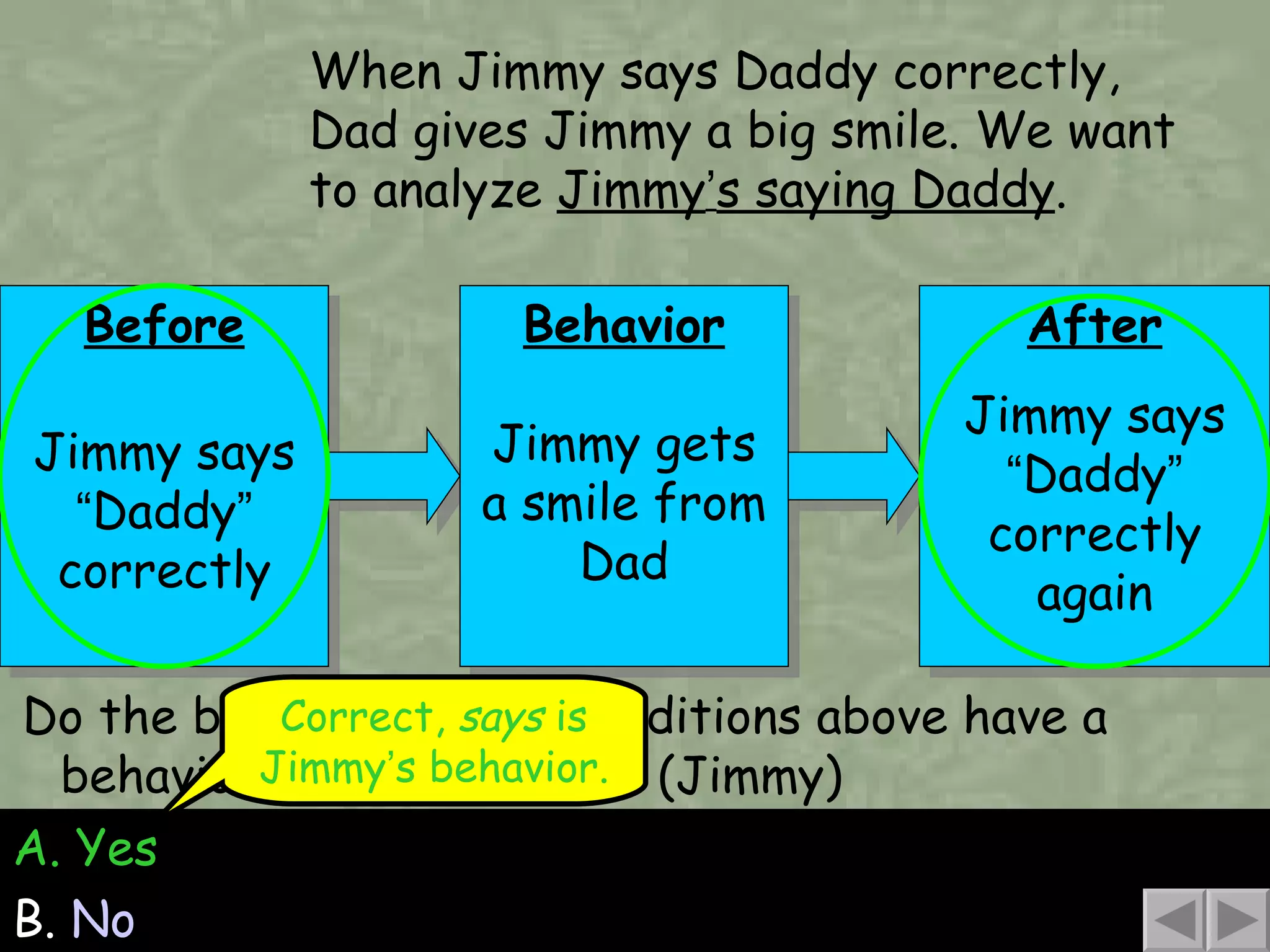
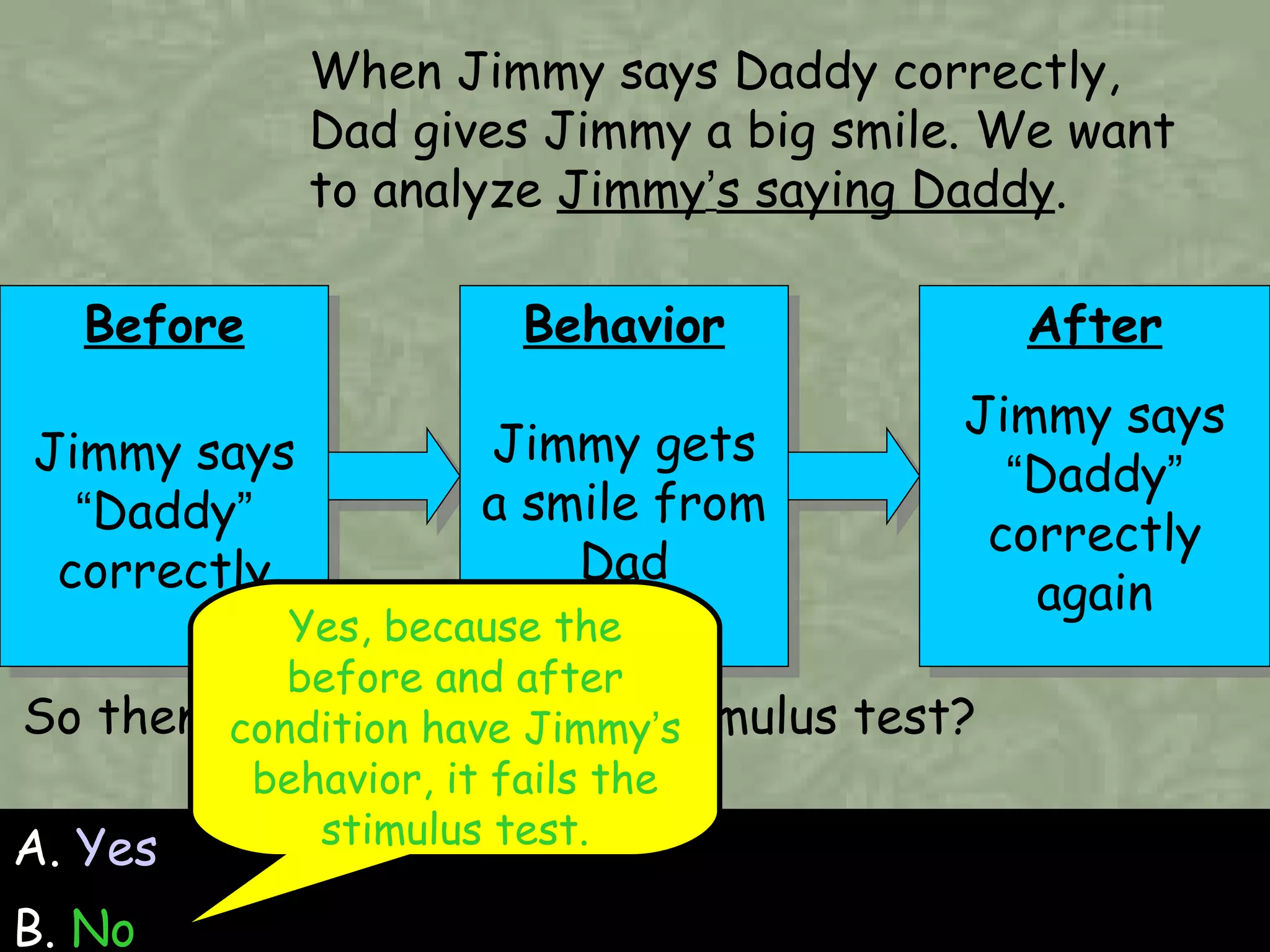
A.  Yes B.  No Do the before or after conditions circled above have a behavior of the beha ver ?  Before Jimmy says  “ Daddy ”  correctly When Jimmy says Daddy correctly, Dad gives Jimmy a big smile. We want to analyze  Jimmy ’ s saying Daddy  (Hint: Jimmy ’ s the behaver).  Behavior Jimmy gets a smile from Dad After Jimmy says  “ Daddy ”  correctly again
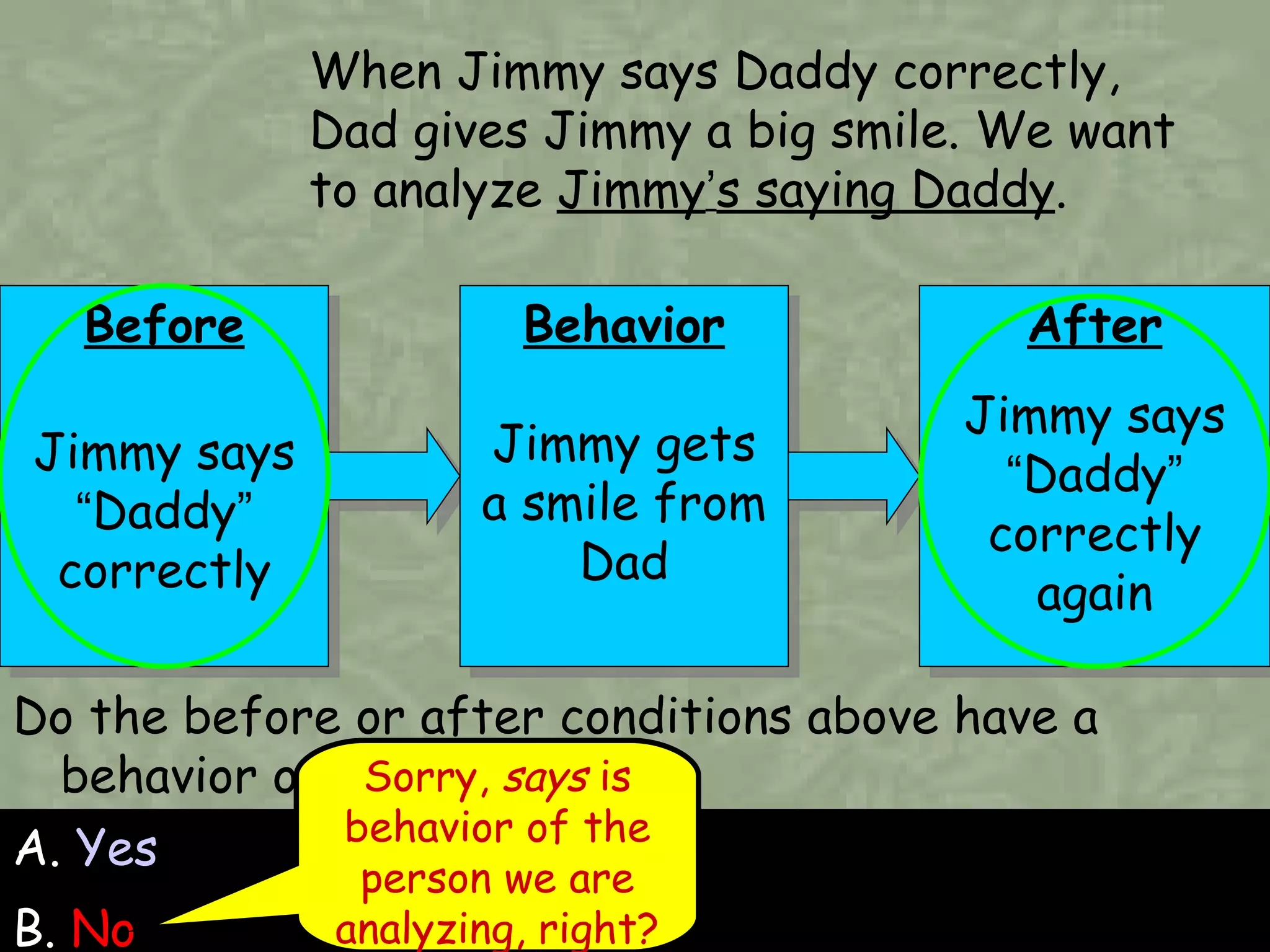
A.  Yes B.  No Do the before or after conditions above have a behavior of the beha ver ? Before Jimmy says  “ Daddy ”  correctly Sorry,  says  is behavior of the person we are analyzing, right? When Jimmy says Daddy correctly, Dad gives Jimmy a big smile. We want to analyze  Jimmy ’ s saying Daddy .  Behavior Jimmy gets a smile from Dad After Jimmy says  “ Daddy ”  correctly again
A. Yes B.  No Do the before or after conditions above have a behavior of the beha ver ? (Jimmy) Before Jimmy says  “ Daddy ”  correctly Correct,  says  is Jimmy ’ s behavior. When Jimmy says Daddy correctly, Dad gives Jimmy a big smile. We want to analyze  Jimmy ’ s saying Daddy .  Behavior Jimmy gets a smile from Dad After Jimmy says  “ Daddy ”  correctly again
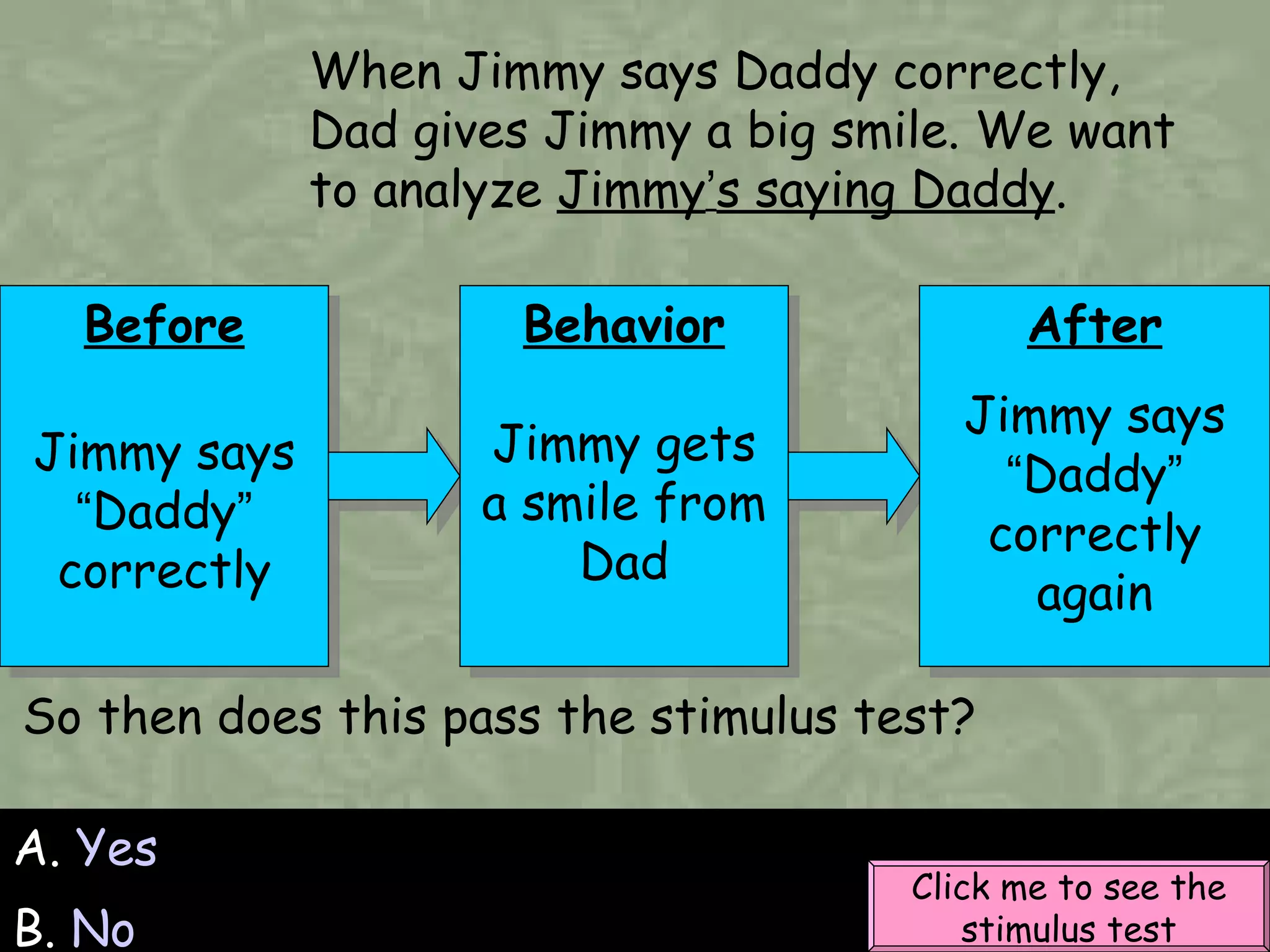
A.  Yes B.  No So then does this pass the stimulus test? Before Jimmy says  “ Daddy ”  correctly When Jimmy says Daddy correctly, Dad gives Jimmy a big smile. We want to analyze  Jimmy ’ s saying Daddy .  Click me to see the stimulus test Behavior Jimmy gets a smile from Dad After Jimmy says  “ Daddy ”  correctly again
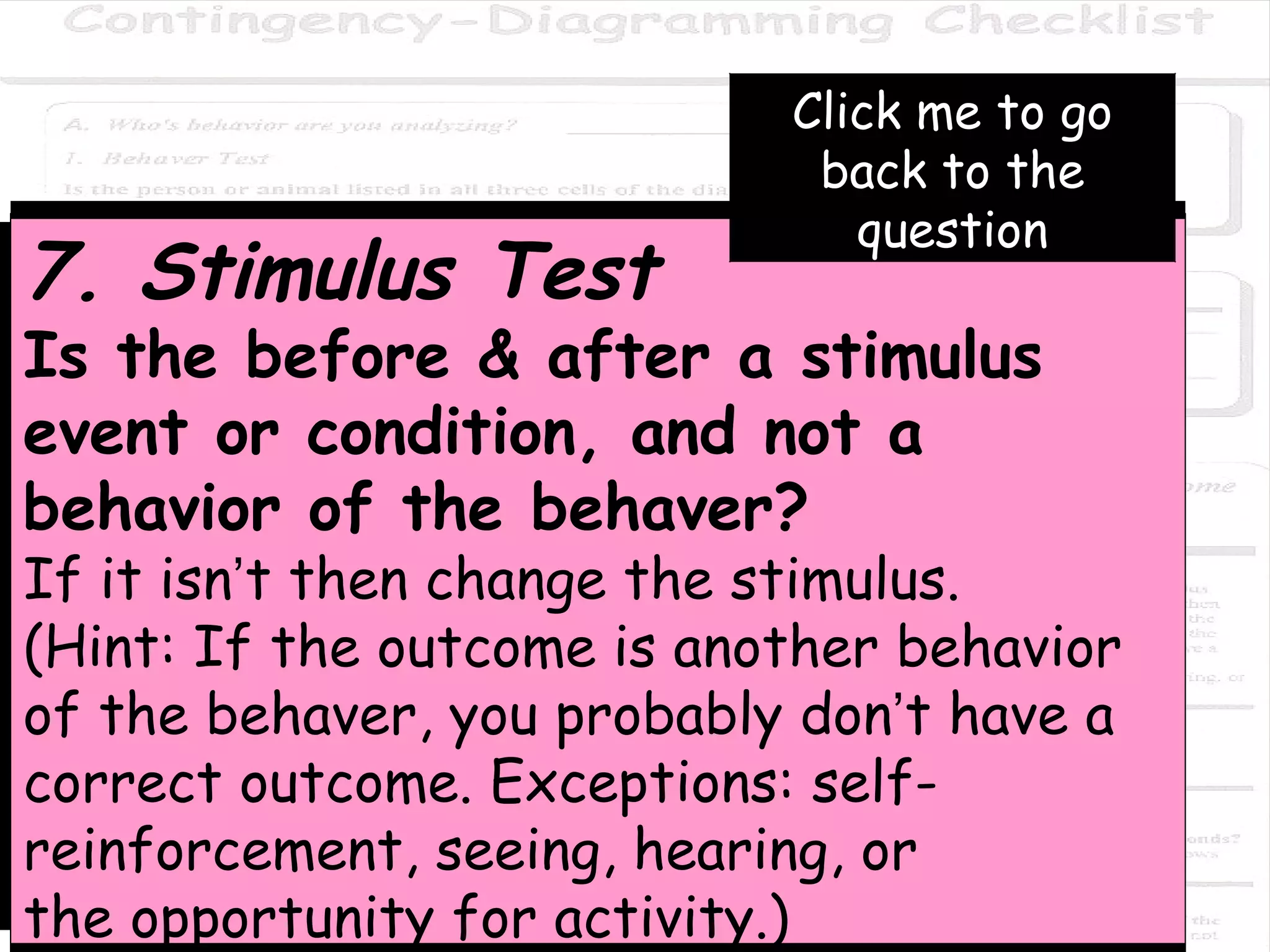
7. Stimulus Test Is the before & after a stimulus event or condition, and not a  behavior of the behaver?  If it isn ’ t then change the stimulus.  (Hint: If the outcome is another behavior of the behaver, you probably don ’ t have a correct outcome. Exceptions: self-reinforcement, seeing, hearing, or the opportunity for activity.) Click me to go back to the question
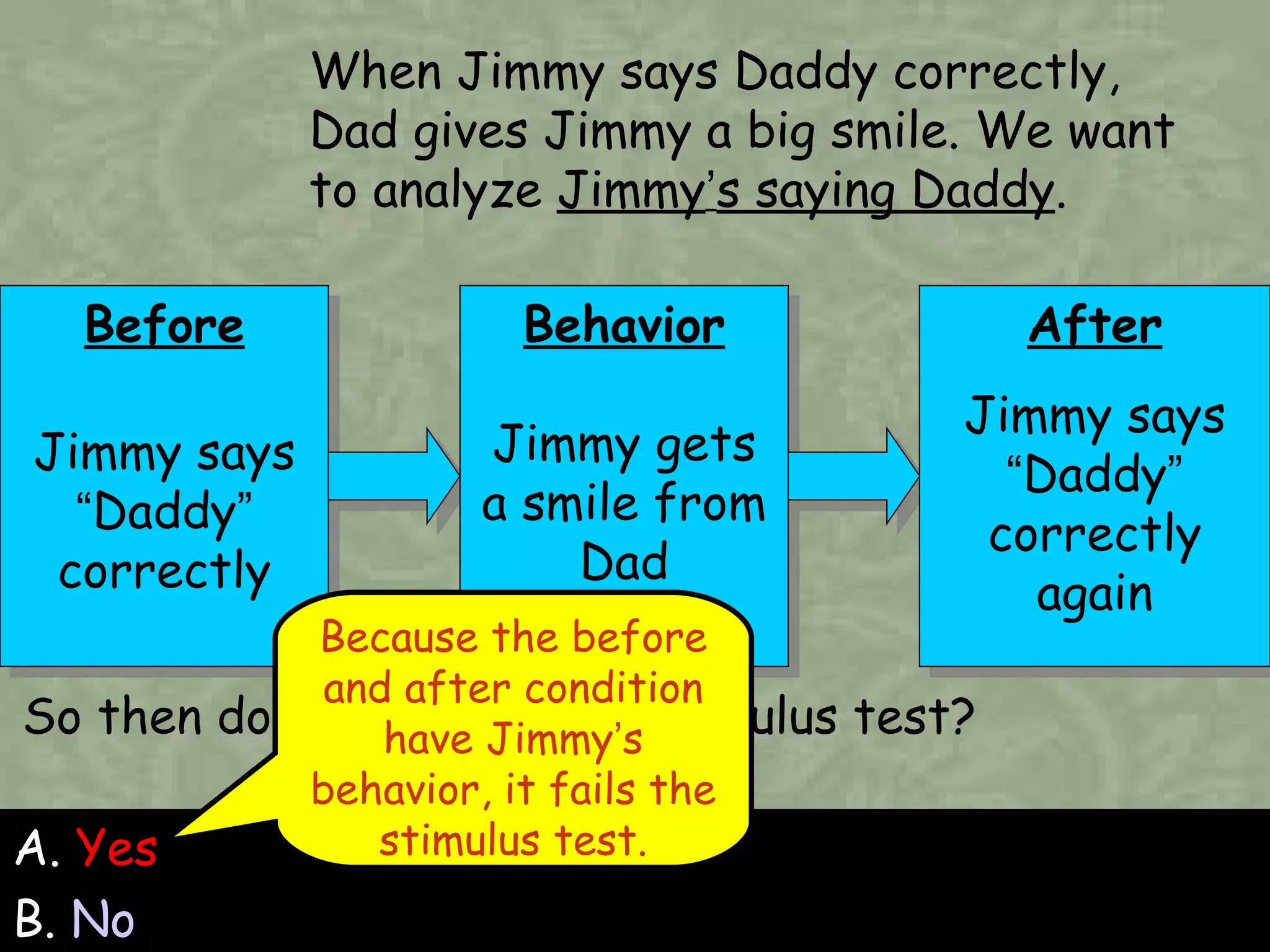
A.  Yes B.  No So then does this pass the stimulus test?  Before Jimmy says  “ Daddy ”  correctly Because the before and after condition have Jimmy ’ s behavior, it fails the stimulus test. When Jimmy says Daddy correctly, Dad gives Jimmy a big smile. We want to analyze  Jimmy ’ s saying Daddy .  Behavior Jimmy gets a smile from Dad After Jimmy says  “ Daddy ”  correctly again
A.  Yes B.  No So then does this pass the stimulus test?  Before Jimmy says  “ Daddy ”  correctly Yes, because the before and after condition have Jimmy ’ s behavior, it fails the stimulus test. When Jimmy says Daddy correctly, Dad gives Jimmy a big smile. We want to analyze  Jimmy ’ s saying Daddy .  Behavior Jimmy gets a smile from Dad After Jimmy says  “ Daddy ”  correctly again
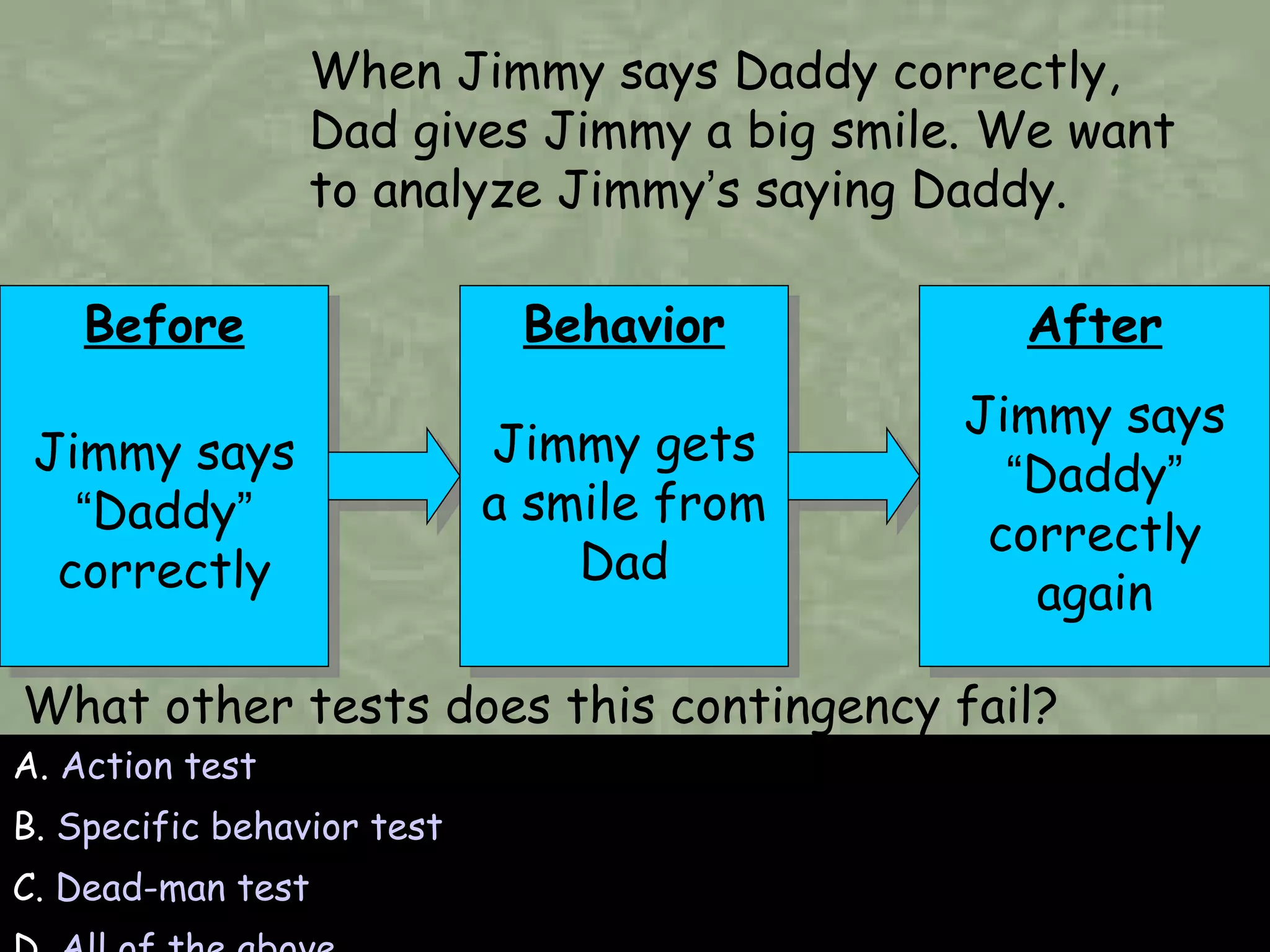
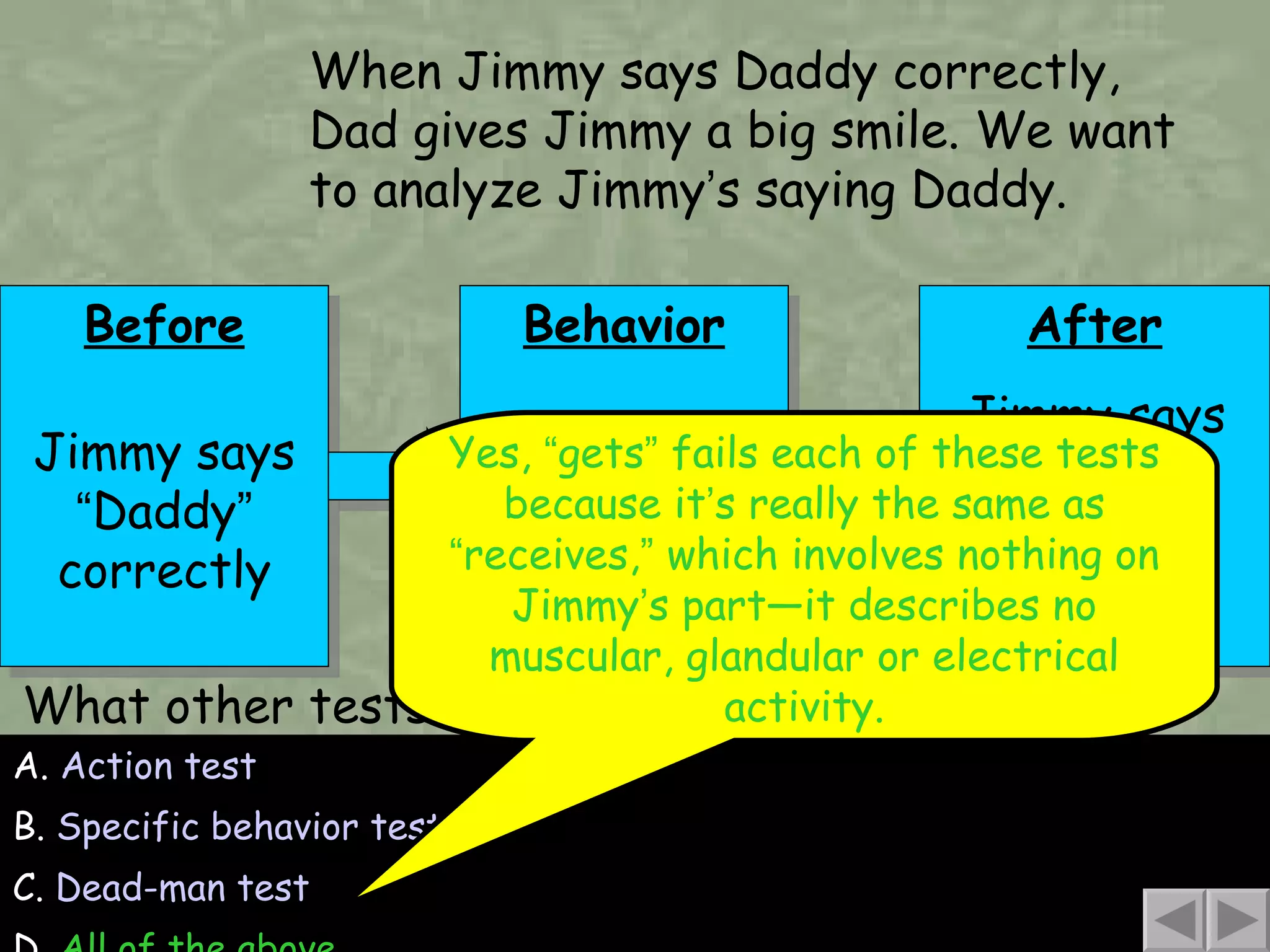
A.  Action test B.  Specific behavior test C.  Dead-man test D.  All of the above What other tests does this contingency fail? Before Jimmy says  “ Daddy ”  correctly When Jimmy says Daddy correctly, Dad gives Jimmy a big smile. We want to analyze Jimmy ’ s saying Daddy.  Behavior Jimmy gets a smile from Dad After Jimmy says  “ Daddy ”  correctly again
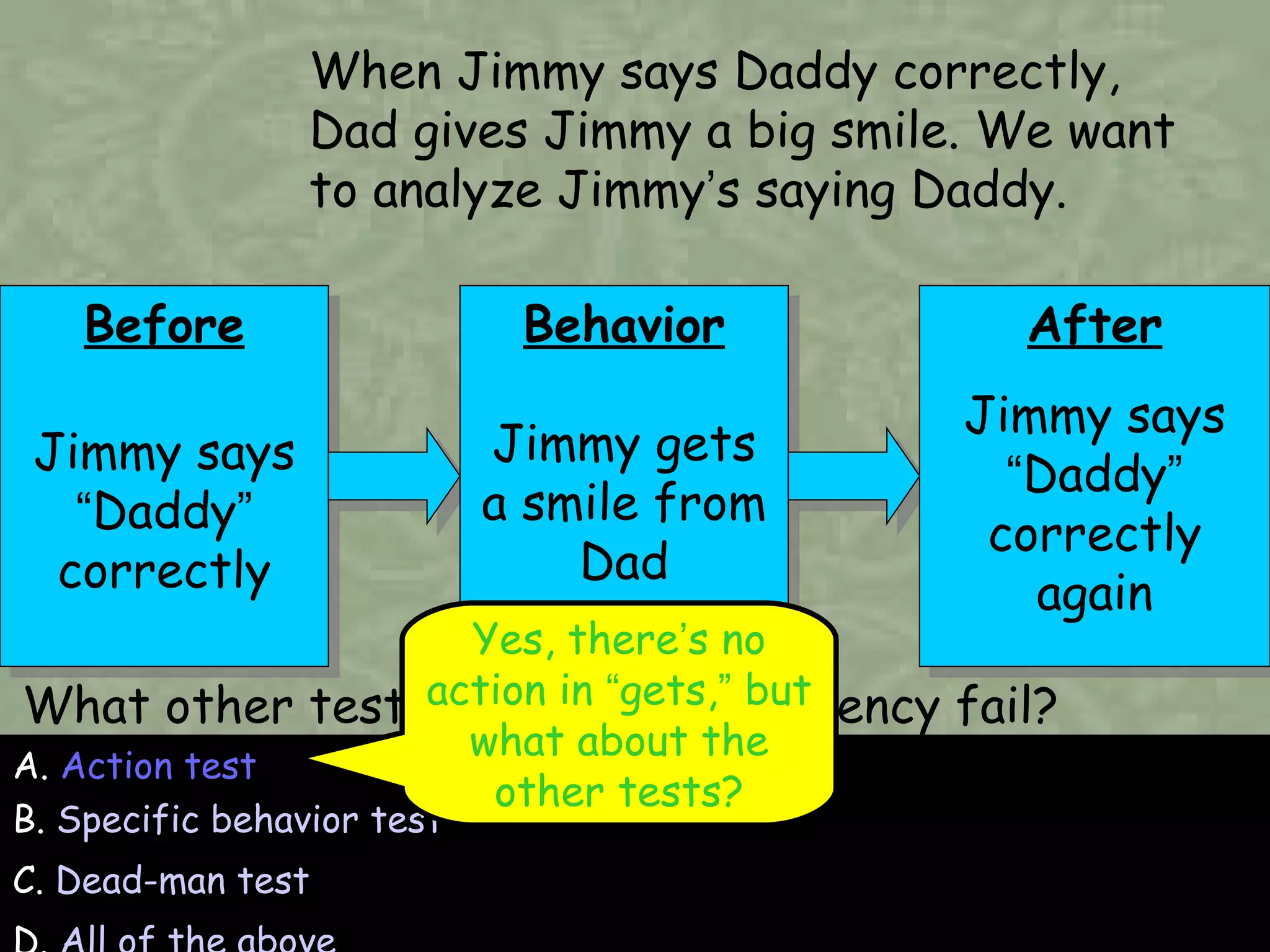
A.  Action test B.  Specific behavior test C.  Dead-man test D.  All of the above What other tests does this contingency fail?  Before Jimmy says  “ Daddy ”  correctly Yes, there ’ s no action in  “ gets, ”  but what about the other tests? When Jimmy says Daddy correctly, Dad gives Jimmy a big smile. We want to analyze Jimmy ’ s saying Daddy.  Behavior Jimmy gets a smile from Dad After Jimmy says  “ Daddy ”  correctly again
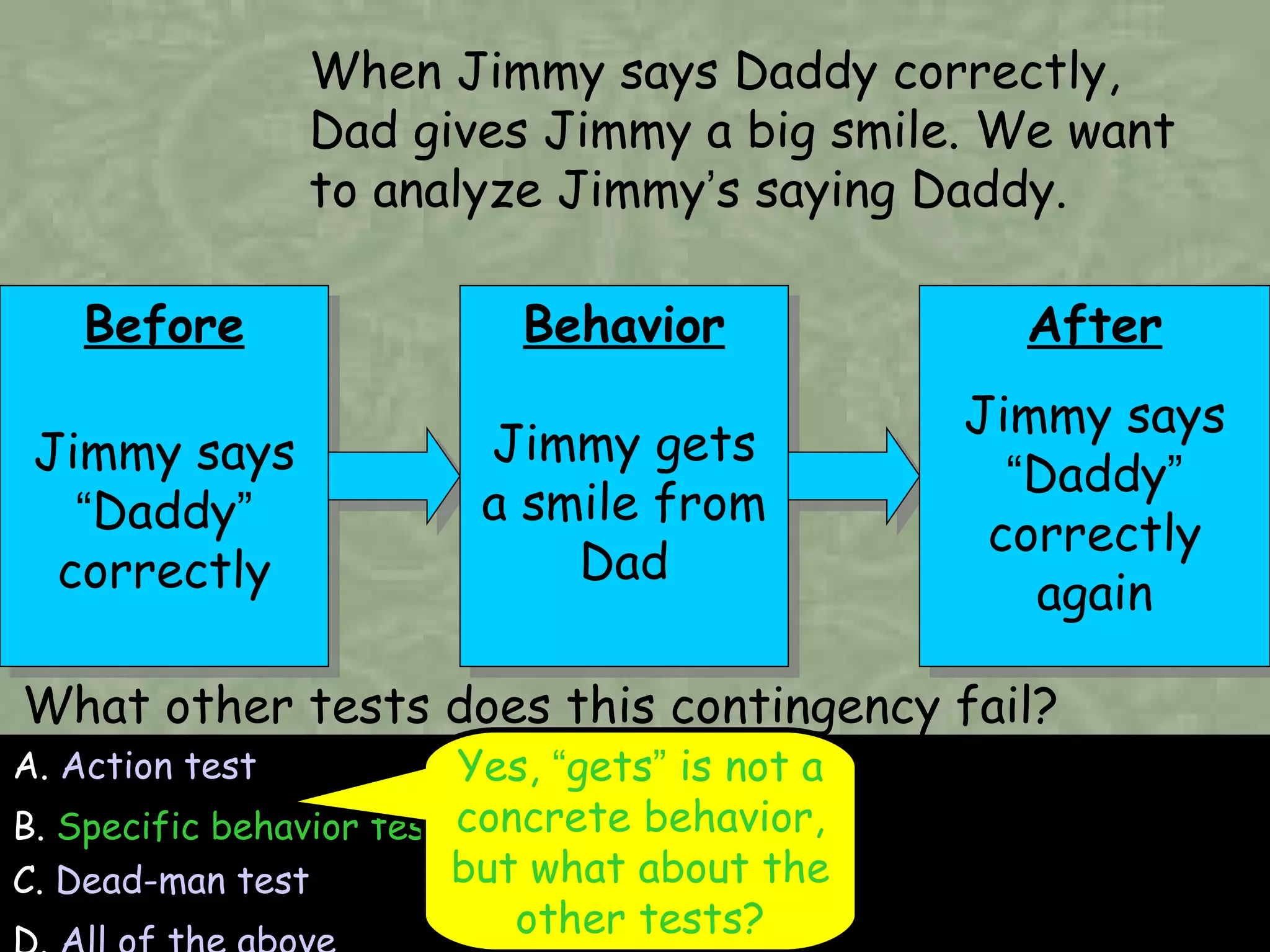
A.  Action test B.  Specific behavior test C.  Dead-man test D.  All of the above What other tests does this contingency fail?  Before Jimmy says  “ Daddy ”  correctly Yes,  “ gets ”  is not a concrete behavior, but what about the other tests? When Jimmy says Daddy correctly, Dad gives Jimmy a big smile. We want to analyze Jimmy ’ s saying Daddy.  Behavior Jimmy gets a smile from Dad After Jimmy says  “ Daddy ”  correctly again
A.  Action test B.  Specific behavior test C.  Dead-man test D.  All of the above What other tests does this contingency fail?  Before Jimmy says  “ Daddy ”  correctly Yes, a dead man can  “ get, ”  but what about the other tests? When Jimmy says Daddy correctly, Dad gives Jimmy a big smile. We want to analyze Jimmy ’ s saying Daddy.  Behavior Jimmy gets a smile from Dad After Jimmy says  “ Daddy ”  correctly again
A.  Action test B.  Specific behavior test C.  Dead-man test D.  All of the above What other tests does this contingency fail?  Before Jimmy says  “ Daddy ”  correctly Yes,  “ gets ”  fails each of these tests because it ’ s really the same as  “ receives, ”  which involves nothing on Jimmy ’ s part—it describes no muscular, glandular or electrical activity. When Jimmy says Daddy correctly, Dad gives Jimmy a big smile. We want to analyze Jimmy ’ s saying Daddy.  Behavior Jimmy gets a smile from Dad After Jimmy says  “ Daddy ”  correctly again
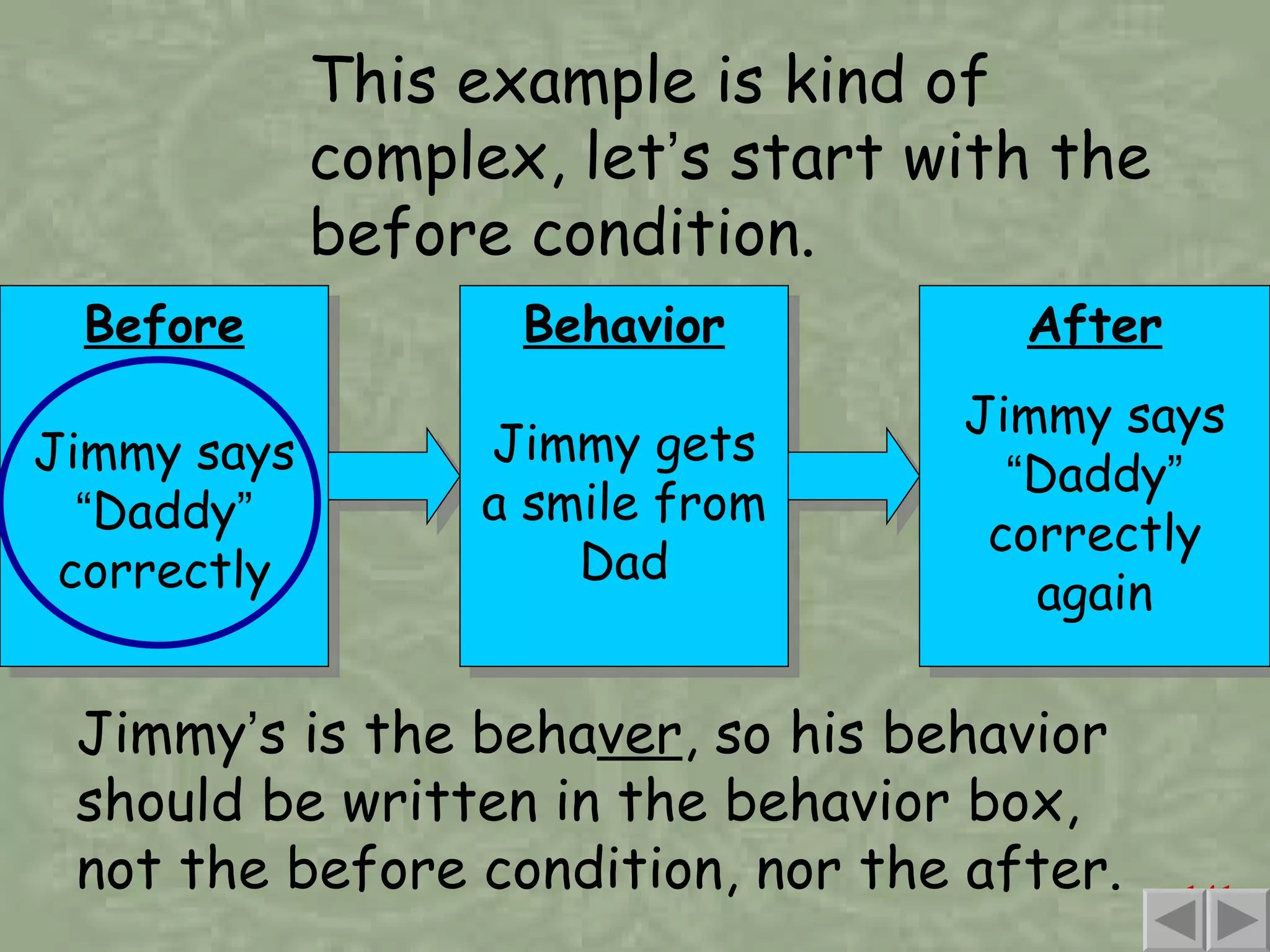
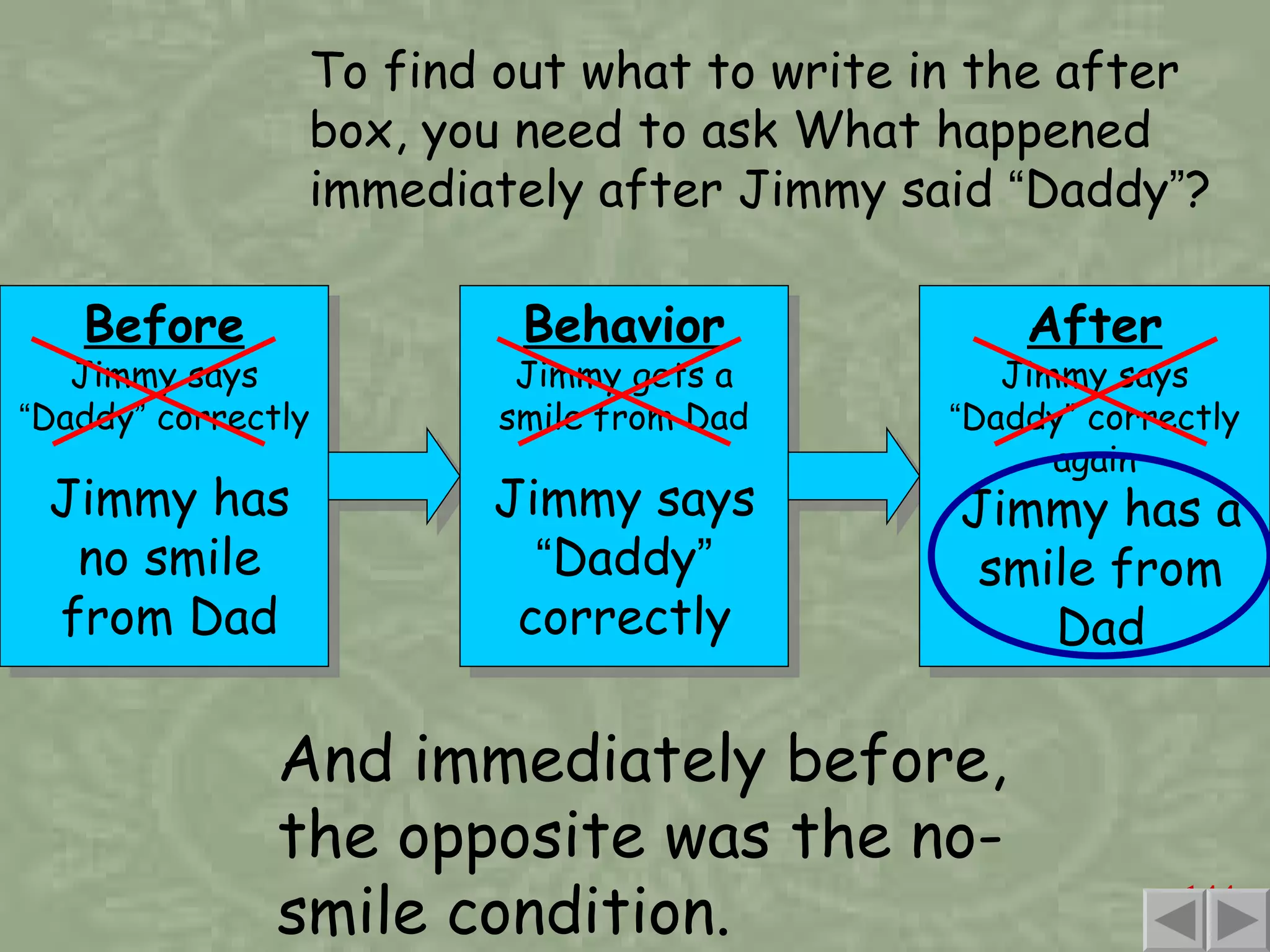
This example is kind of complex, let ’ s start with the before condition. Before Jimmy says  “ Daddy ”  correctly Jimmy ’ s is the beha ver , so his behavior should be written in the behavior box, not the before condition, nor the after. Behavior Jimmy gets a smile from Dad After Jimmy says  “ Daddy ”  correctly again
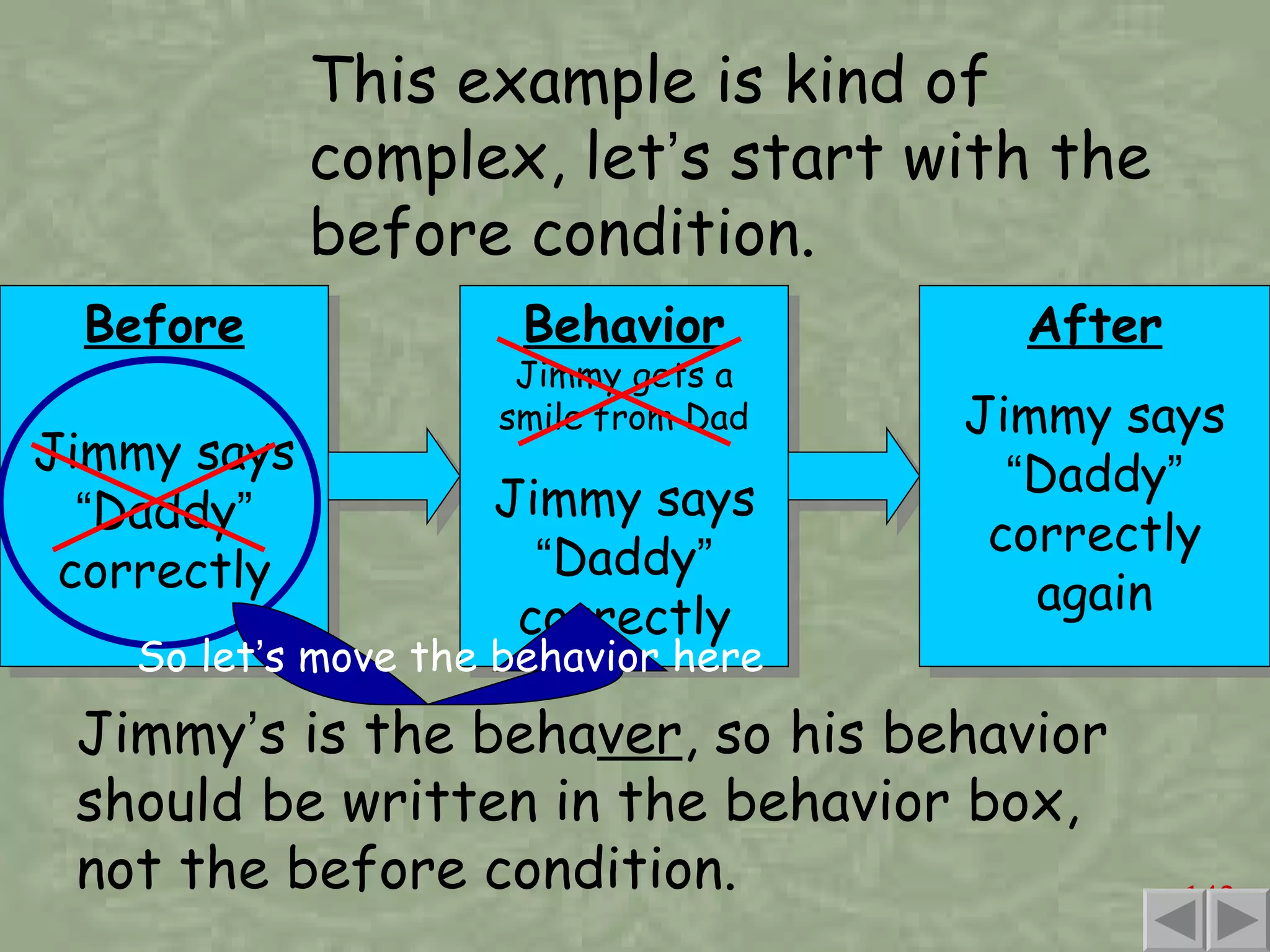
This example is kind of complex, let ’ s start with the before condition. Before Jimmy says  “ Daddy ”  correctly Jimmy says  “ Daddy ”  correctly So let ’ s move the behavior here Jimmy ’ s is the beha ver , so his behavior should be written in the behavior box, not the before condition. Behavior Jimmy gets a smile from Dad After Jimmy says  “ Daddy ”  correctly again
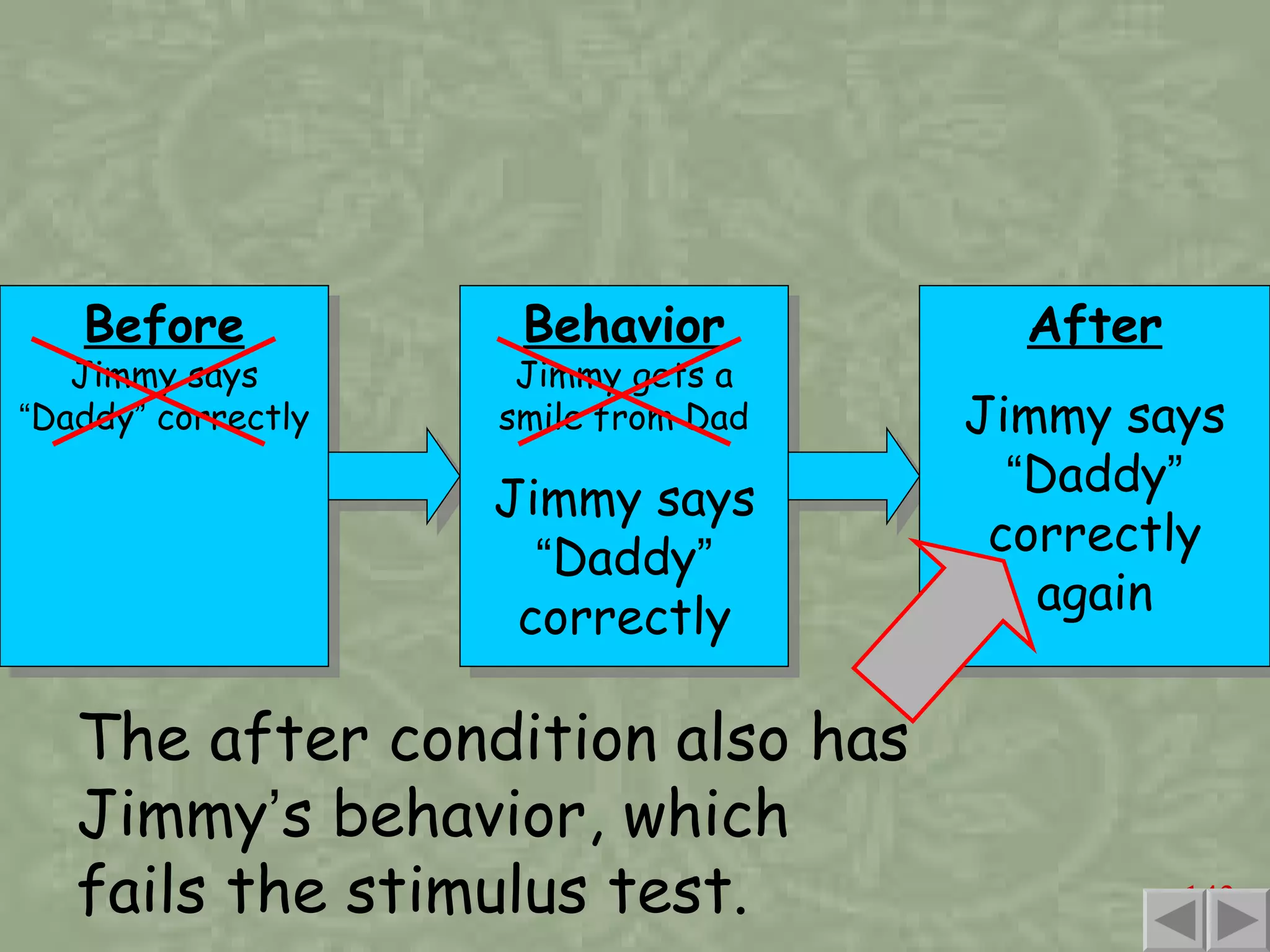
Before Jimmy says  “ Daddy ”  correctly The after condition also has Jimmy ’ s behavior, which fails the stimulus test. Jimmy says  “ Daddy ”  correctly Behavior Jimmy gets a smile from Dad After Jimmy says  “ Daddy ”  correctly again
Before Jimmy says  “ Daddy ”  correctly To find out what to write in the after box, you need to ask What happened immediately after Jimmy said  “ Daddy ” ? Jimmy says  “ Daddy ”  correctly Jimmy has a smile from Dad Jimmy has no smile from Dad And immediately before, the opposite was the no-smile condition. Behavior Jimmy gets a smile from Dad After Jimmy says  “ Daddy ”  correctly again
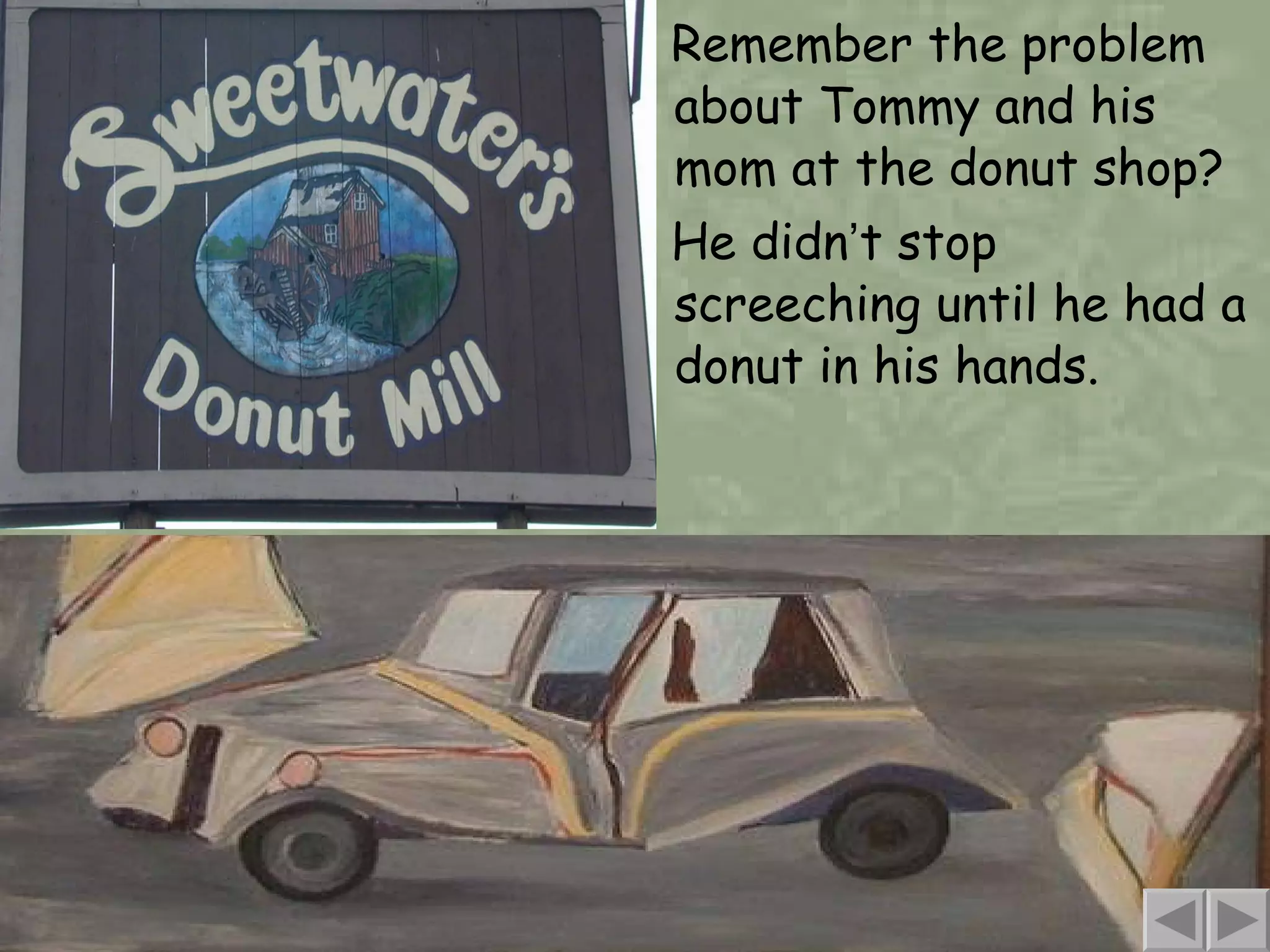
Remember the problem about Tommy and his mom at the donut shop? He didn ’ t stop screeching until he had a donut in his hands.
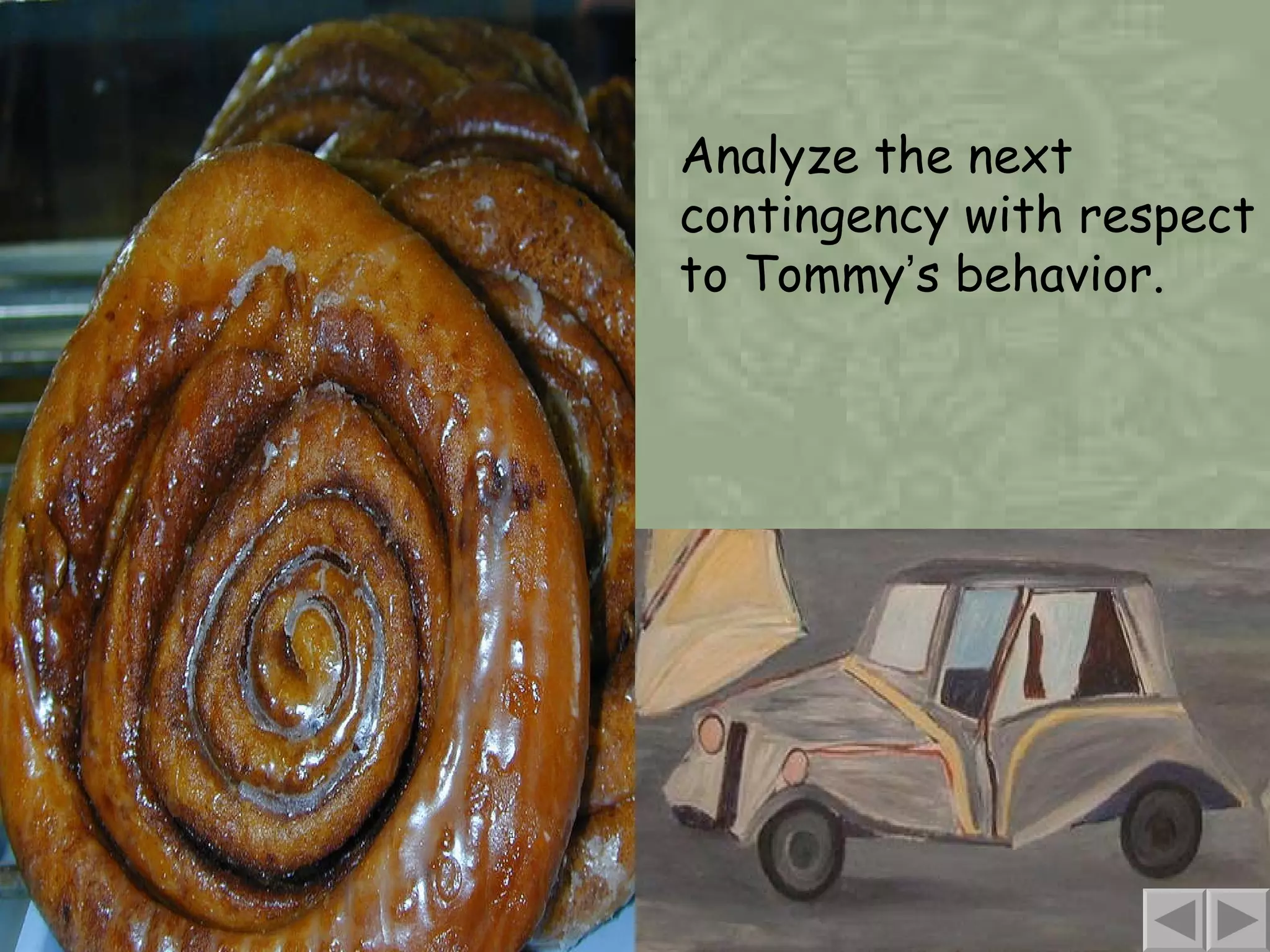
. Analyze the next contingency with respect to Tommy ’ s behavior.
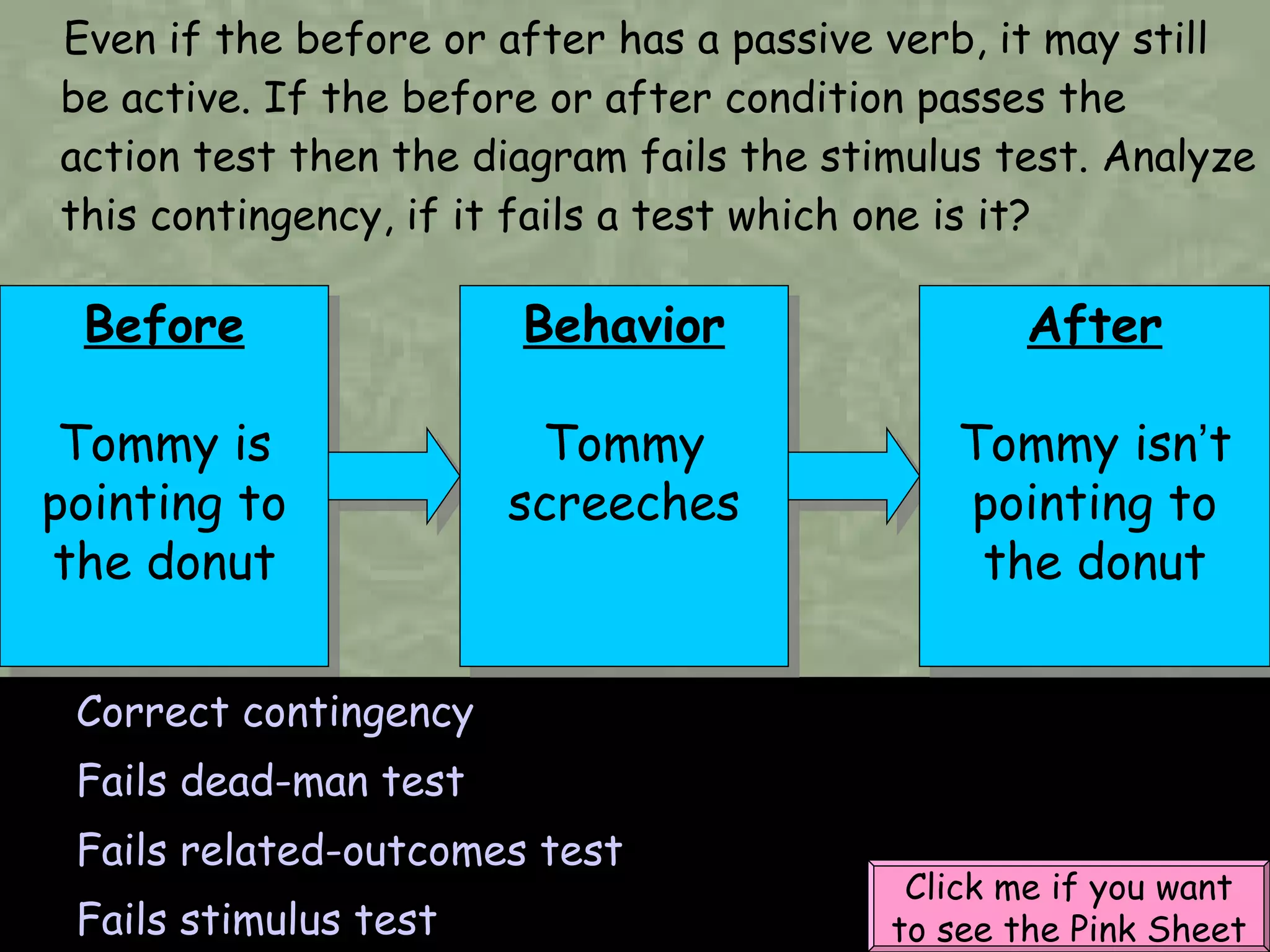
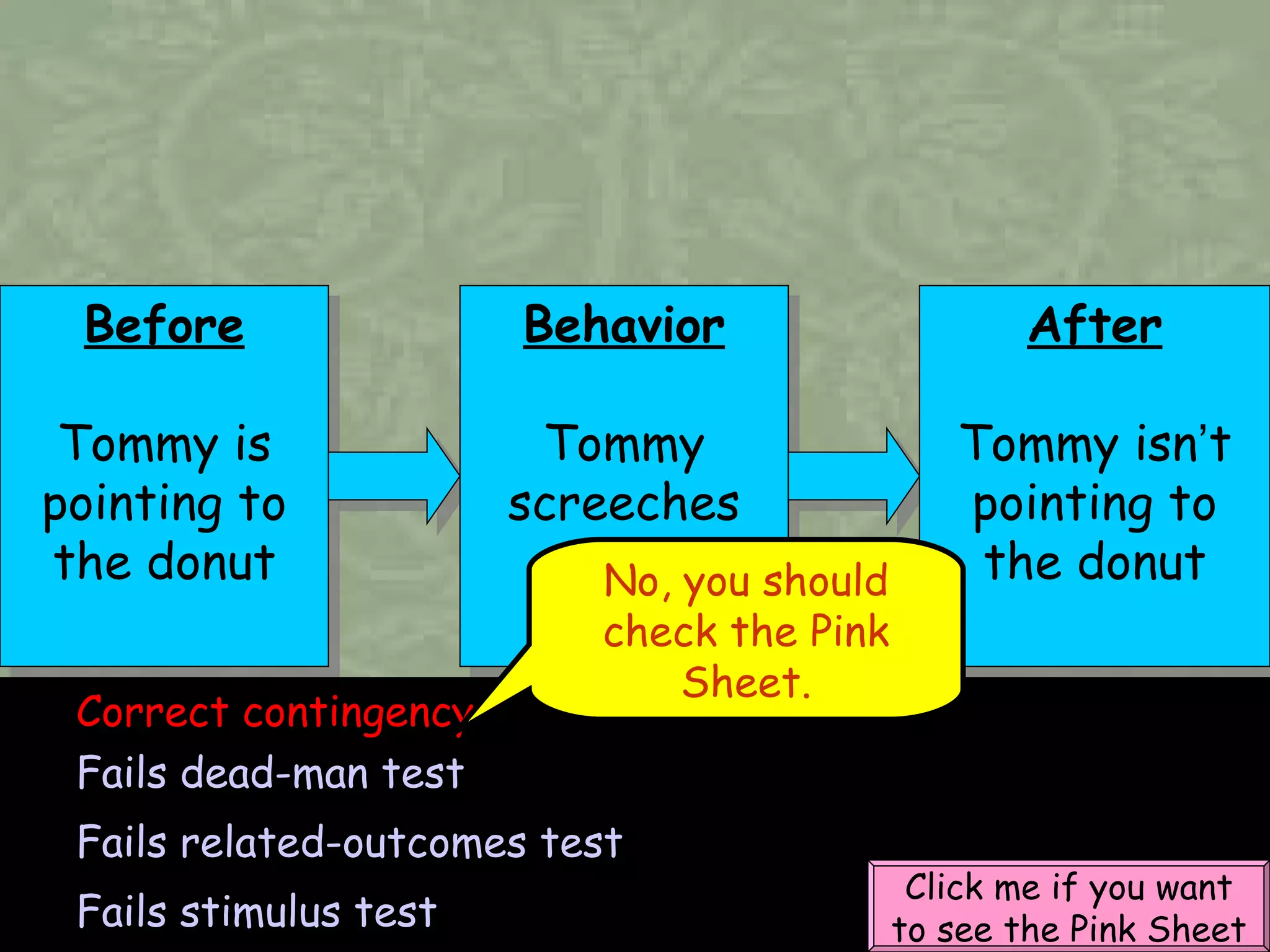
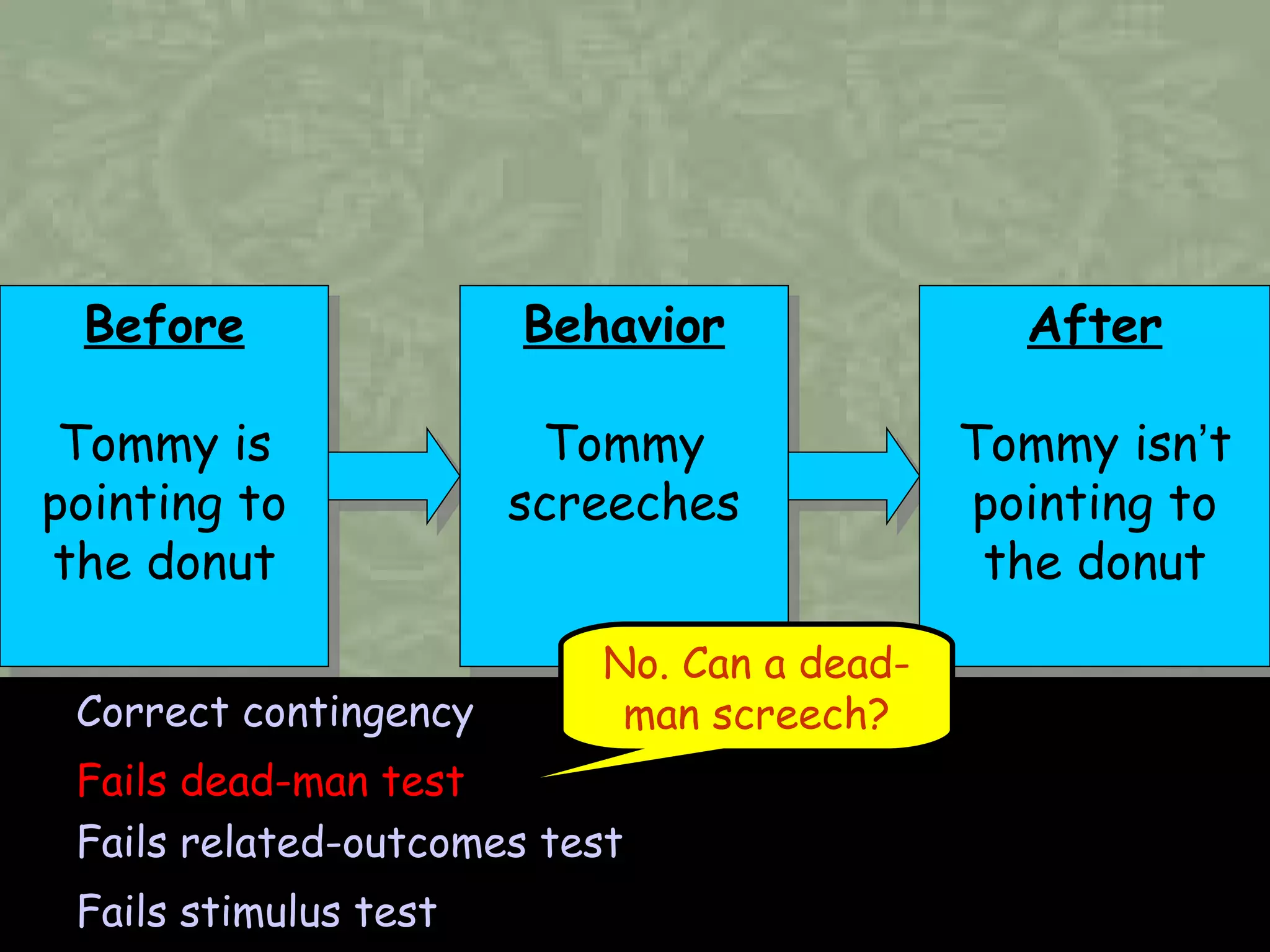
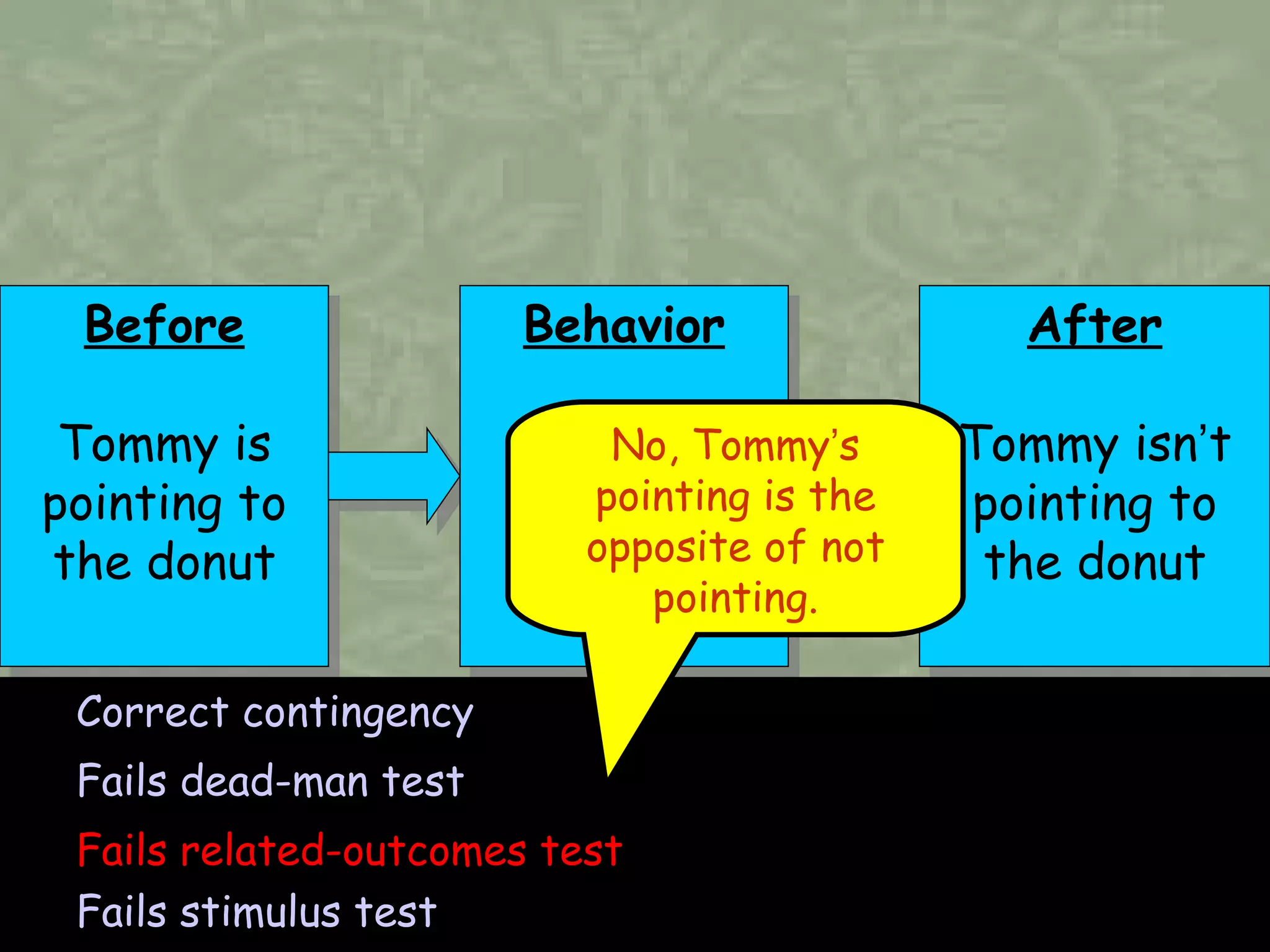
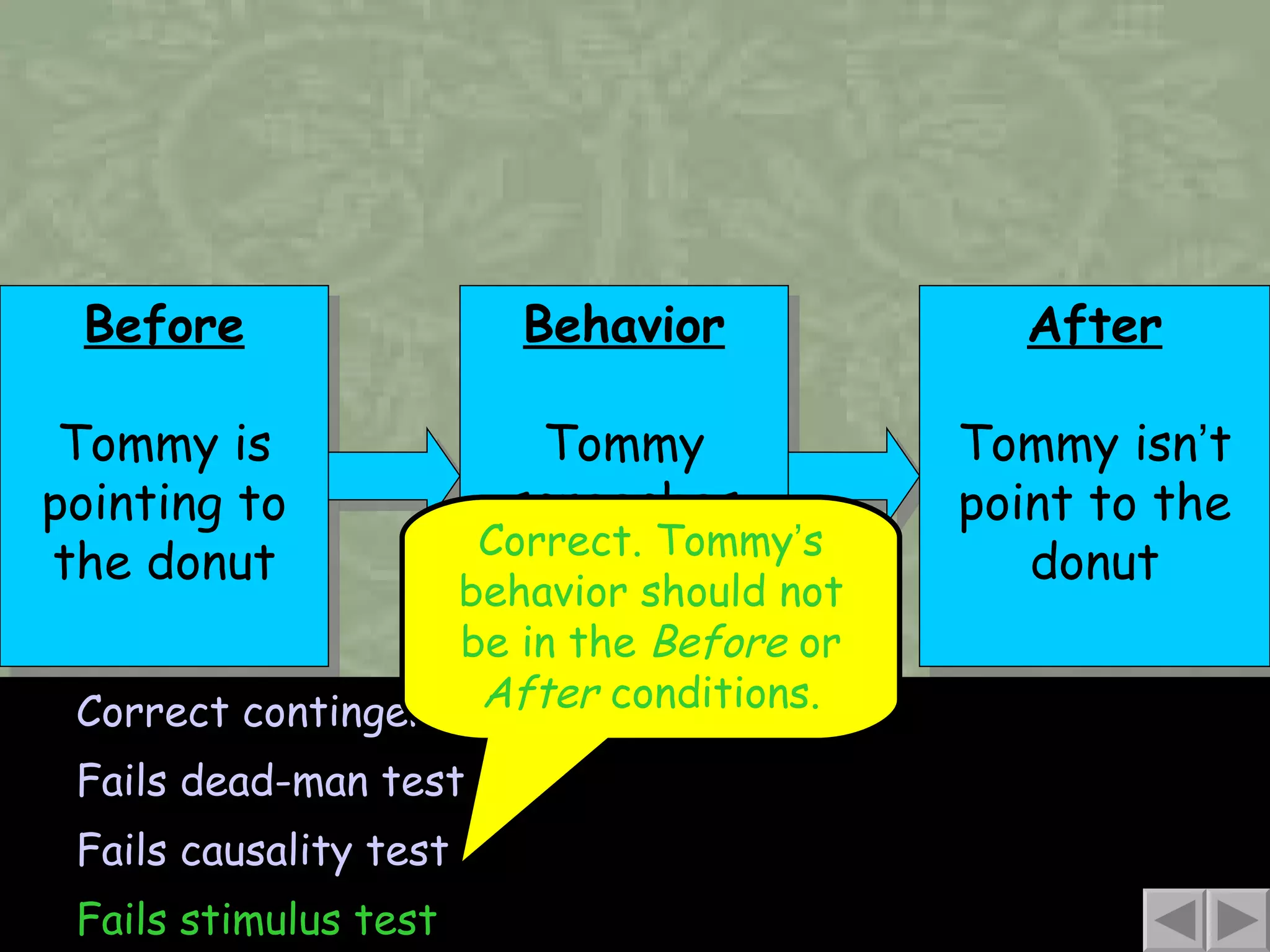
Even if the before or after has a passive verb, it may still be active. If the before or after condition passes the action test then the diagram fails the stimulus test. Analyze this contingency, if it fails a test which one is it? Before Tommy is pointing to the donut Correct contingency Fails dead-man test Fails related-outcomes test Fails stimulus test Click me if you want to see the Pink Sheet Behavior Tommy screeches After Tommy isn ’ t pointing to the donut
Contingency-Diagramming Checklist A.  Whose behavior are you analyzing?   _________________________  1.   Behaver Test Is the behavior in the behavior box performed by the person who you are analyzing?   If not, redo the example. Before Behavior After D. What is the condition before the response? 10. Related Outcomes Test Is the before condition related to the after condition?   (Often the relationship is one of opposites) If not, change one or both of the conditions. Use this checklist for every contingency diagram you do and you ’ ll save yourself some headaches and impress your TA during transparency time. Simply place the answer to each of the 10 questions for the corresponding blank in the contingency diagram above it. Turn the checklist over to determine which type of contingency you have. In learning these criteria for a test, you need only know each name and sentence that ’ s bold. B. What is the behavior being analyzed or diagrammed? 2. Deadman Test Can a dead man do it?   If he can, then you haven ’ t properly specified the behavior. So roll over the dead man. 3. Action Test Does the behavior involve an action?   (Hint: Learning, receiving, being, hearing, seeing, and feeling are not behavior). If not, then change the behavior. 4. Specific-Behavior Test Is it perfectly clear exactly what action is involved in the behavior?   If not, then reword the behavior. 5. Reinforceable Response-Unit Test Are there any interruptions of greater than 60 seconds during the response?   If there are, then the behavior is not a response-unit. Rewrite the behavior. C. What is the outcome that follows the response? 6. Stimulus Test Is the before & after a stimulus, event or condition and not a behavior of the behaver?   If it ’ s not a stimulus then change your condition. (Hint: If the before or after is another behavior of the behaver, you probably don ’ t have a correct condition. Exceptions: self-reinforcement, seeing, hearing, or the opportunity for activity. 7. Causality Test Is the outcome caused by the response?   If not, change the outcome. 8. 60 ”  Test Does the outcome follow the response by more than 60 seconds?   If so, find an immediate outcome. 9. Receiver Test Is the behaver the receiver of the outcome (after condition)?   If not, rework the example. Hint: Make sure the diagram passes the behaver test first Back to the Question
Before Tommy is pointing to the donut Correct contingency Fails dead-man test Fails related-outcomes test Fails stimulus test No, you should check the Pink Sheet. Click me if you want to see the Pink Sheet Behavior Tommy screeches After Tommy isn ’ t pointing to the donut
Before Tommy is pointing to the donut Correct contingency Fails dead-man test Fails related-outcomes test Fails stimulus test No. Can a dead-man screech? Behavior Tommy screeches After Tommy isn ’ t pointing to the donut
Before Tommy is pointing to the donut Correct contingency Fails dead-man test Fails related-outcomes test Fails stimulus test No, Tommy ’ s pointing is the opposite of not pointing. Behavior Tommy screeches After Tommy isn ’ t pointing to the donut
Before Tommy is pointing to the donut Correct contingency Fails dead-man test Fails causality test Fails stimulus test Correct. Tommy ’ s behavior should not be in the  Before  or  After  conditions. Behavior Tommy screeches After Tommy isn ’ t point to the donut
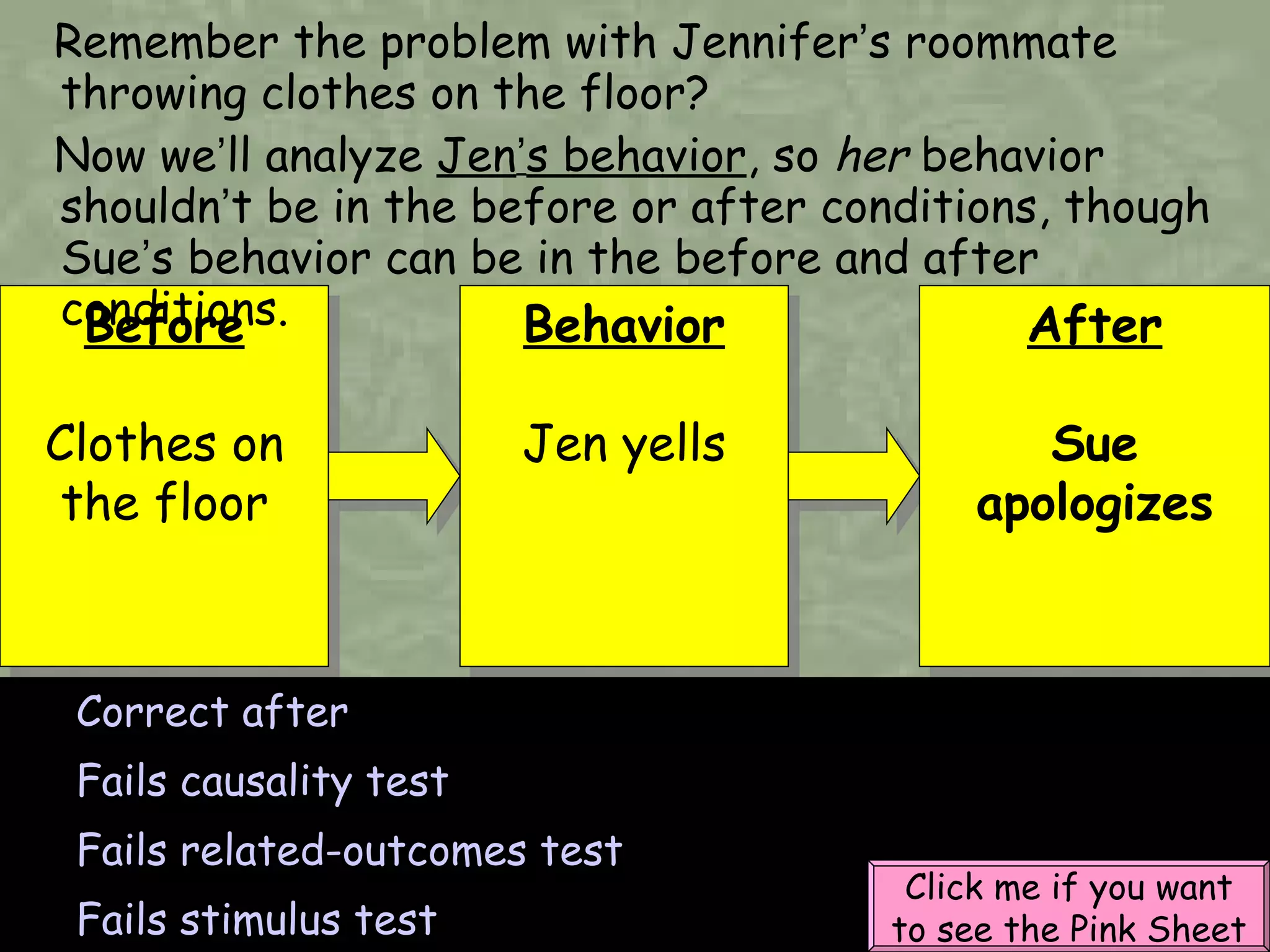
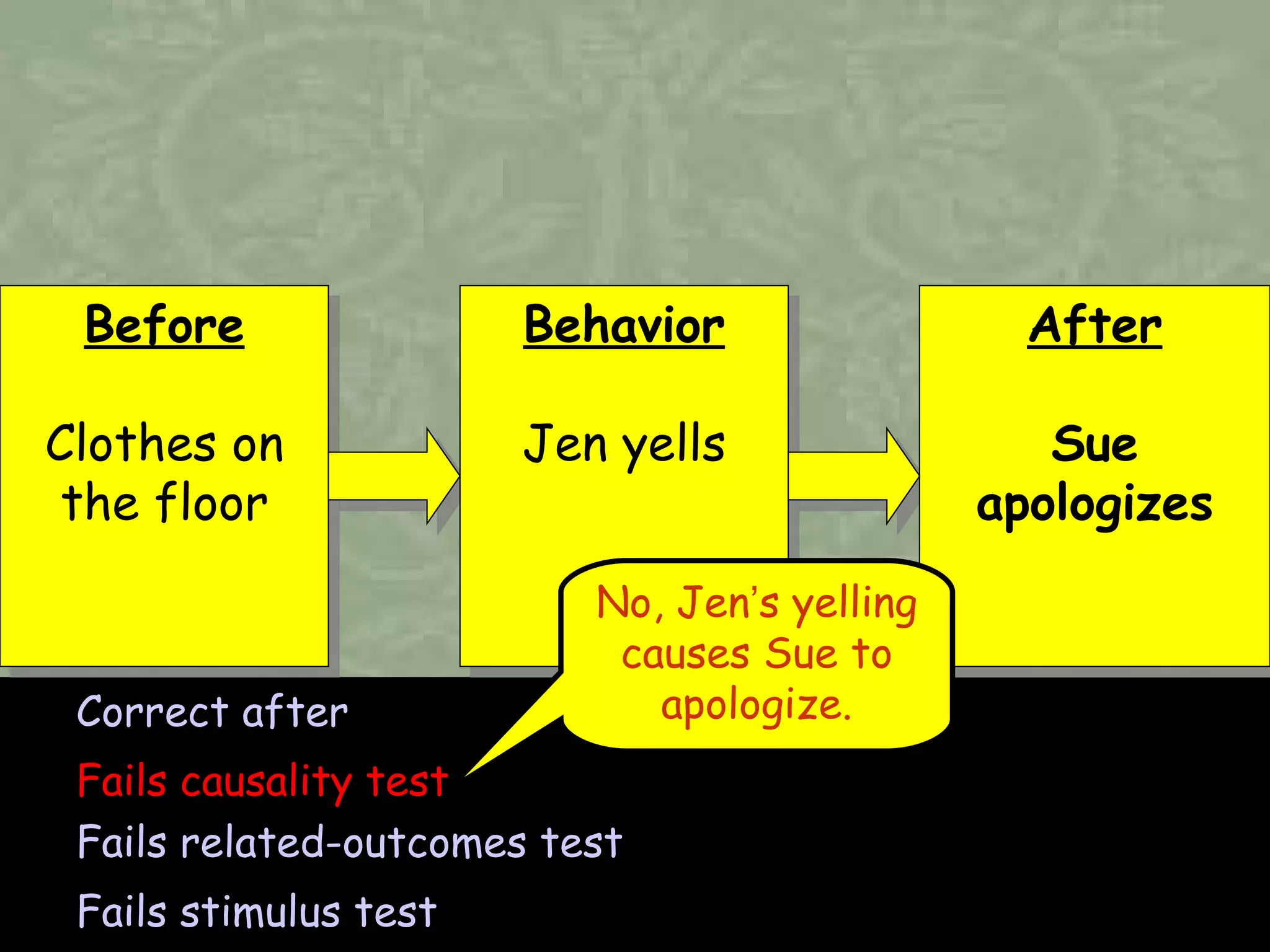
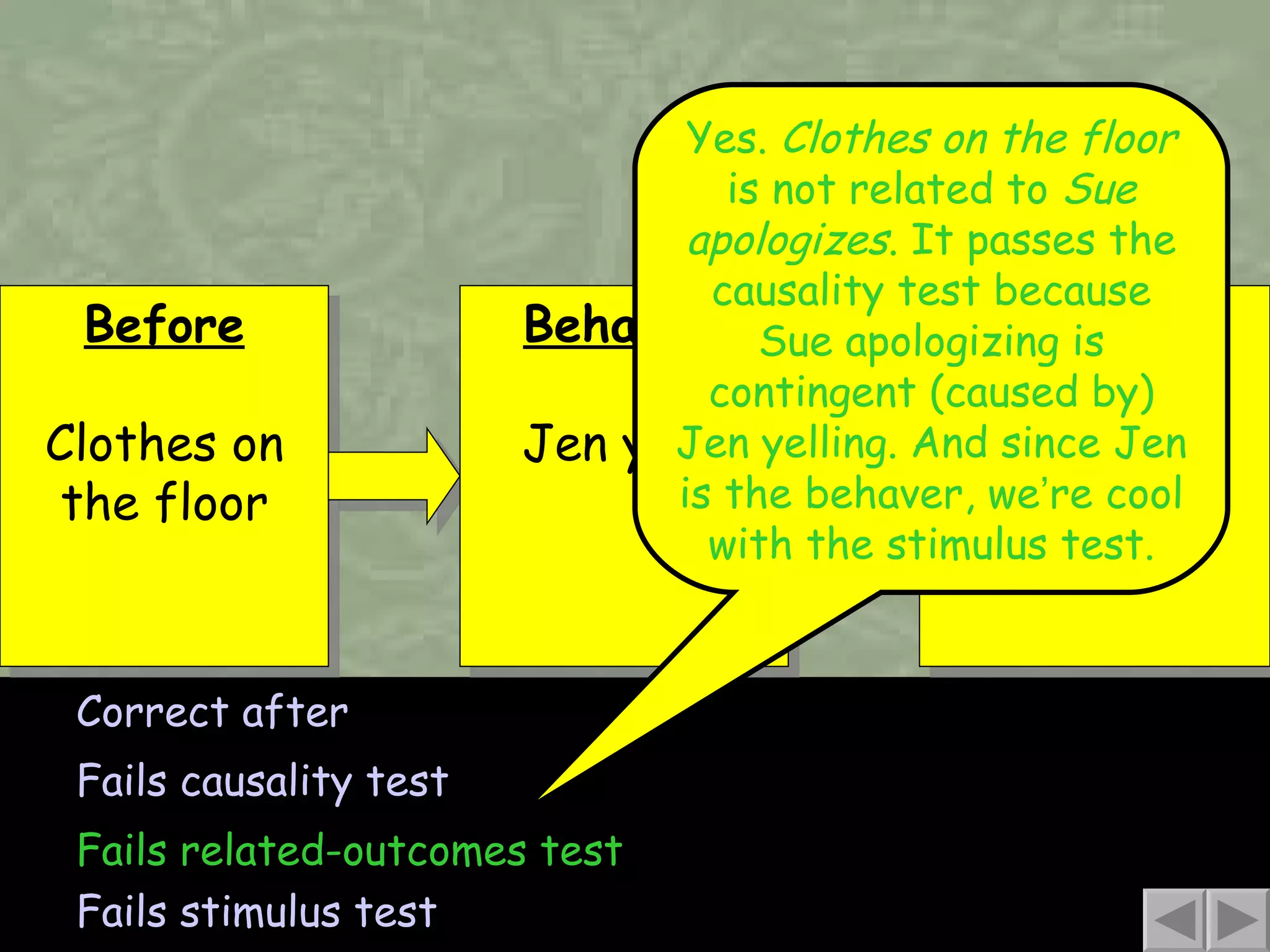
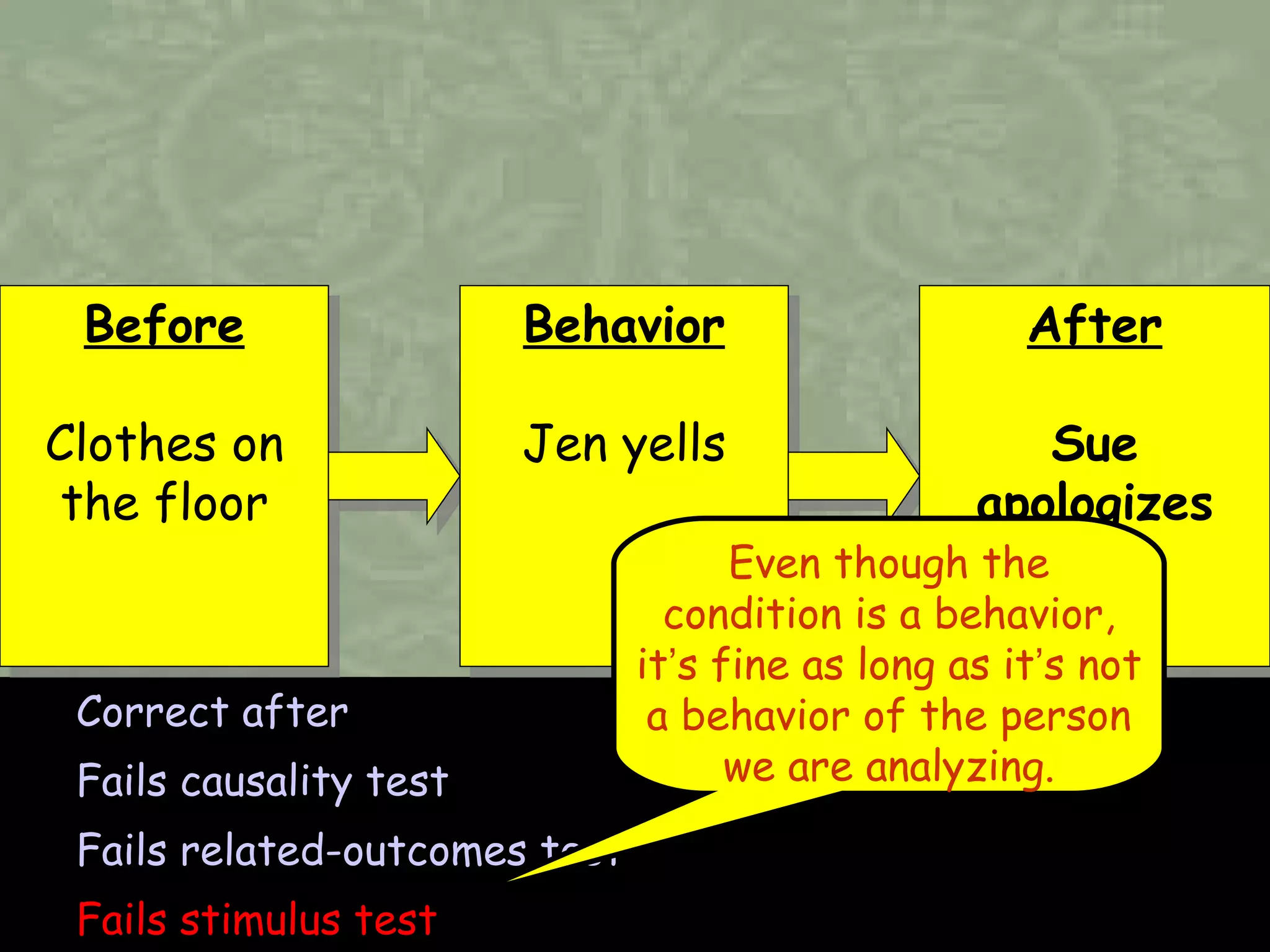
Remember the problem with Jennifer ’ s roommate throwing clothes on the floor? Now we ’ ll analyze  Jen ’ s behavior , so  her  behavior shouldn ’ t be in the before or after conditions, though Sue ’ s behavior can be in the before and after conditions. Before Clothes on the floor Correct after Fails causality test Fails related-outcomes test Fails stimulus test Click me if you want to see the Pink Sheet Behavior Jen yells After Sue apologizes
Contingency-Diagramming Checklist A.  Whose behavior are you analyzing?   _________________________  1.   Behaver Test Is the behavior in the behavior box performed by the person who you are analyzing?   If not, redo the example. Before Behavior After D. What is the condition before the response? 10. Related Outcomes Test Is the before condition related to the after condition?   (Often the relationship is one of opposites) If not, change one or both of the conditions. Use this checklist for every contingency diagram you do and you ’ ll save yourself some headaches and impress your TA during transparency time. Simply place the answer to each of the 10 questions for the corresponding blank in the contingency diagram above it. Turn the checklist over to determine which type of contingency you have. In learning these criteria for a test, you need only know each name and sentence that ’ s bold. B. What is the behavior being analyzed or diagrammed? 2. Deadman Test Can a dead man do it?   If he can, then you haven ’ t properly specified the behavior. So roll over the dead man. 3. Action Test Does the behavior involve an action?   (Hint: Learning, receiving, being, hearing, seeing, and feeling are not behavior). If not, then change the behavior. 4. Specific-Behavior Test Is it perfectly clear exactly what action is involved in the behavior?   If not, then reword the behavior. 5. Reinforceable Response-Unit Test Are there any interruptions of greater than 60 seconds during the response?   If there are, then the behavior is not a response-unit. Rewrite the behavior. C. What is the outcome that follows the response? 6. Stimulus Test Is the before & after a stimulus, event or condition and not a behavior of the behaver?   If it ’ s not a stimulus then change your condition. (Hint: If the before or after is another behavior of the behaver, you probably don ’ t have a correct condition. Exceptions: self-reinforcement, seeing, hearing, or the opportunity for activity. 7. Causality Test Is the outcome caused by the response?   If not, change the outcome. 8. 60 ”  Test Does the outcome follow the response by more than 60 seconds?   If so, find an immediate outcome. 9. Receiver Test Is the behaver the receiver of the outcome (after condition)?   If not, rework the example. Hint: Make sure the diagram passes the behaver test first Back to the Question
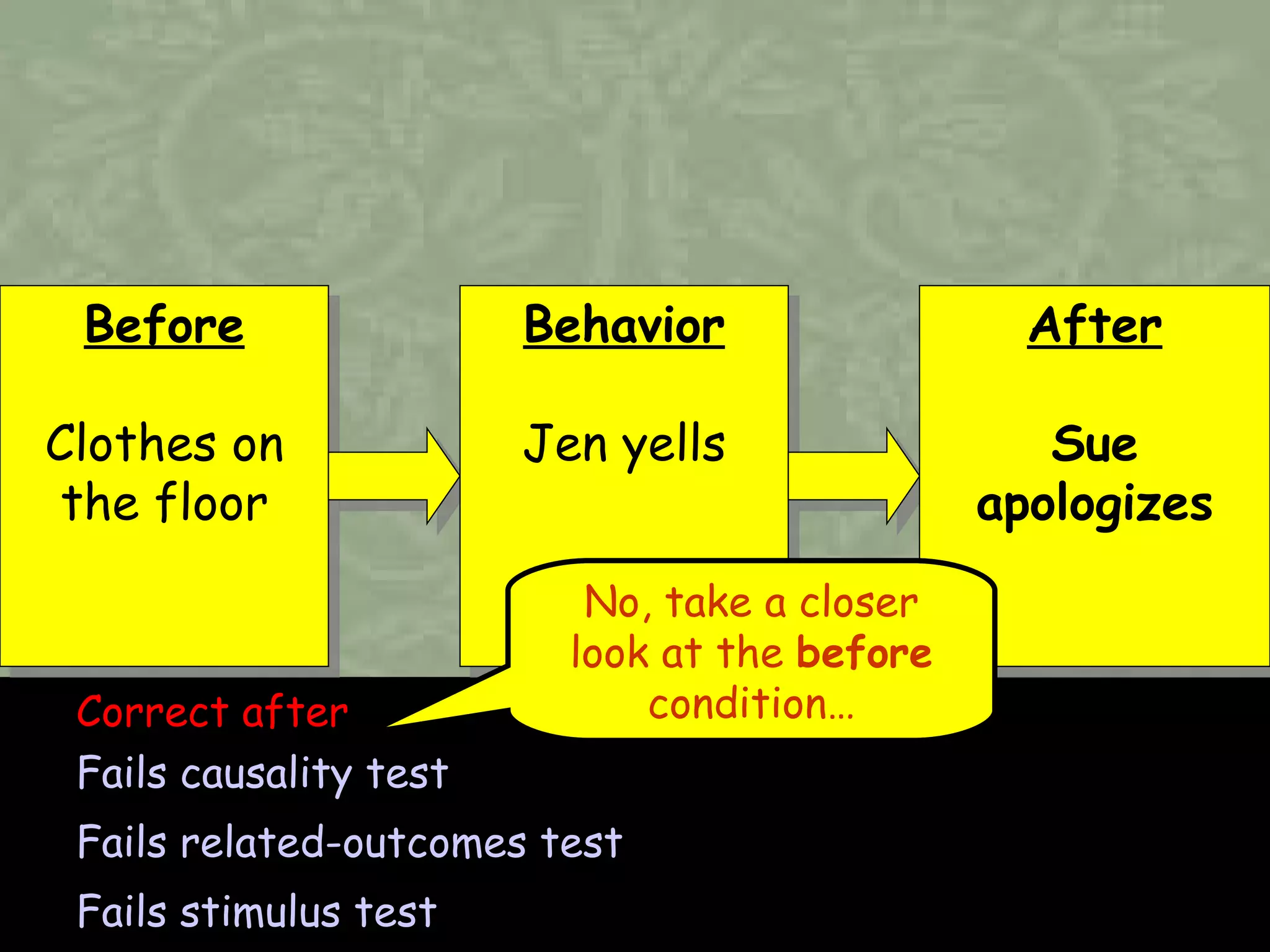
Correct after Fails causality test Fails related-outcomes test Fails stimulus test Before Clothes on the floor No, take a closer look at the  before  condition… Behavior Jen yells After Sue apologizes
Correct after Fails causality test Fails related-outcomes test Fails stimulus test Before Clothes on the floor No, Jen ’ s yelling causes Sue to apologize. Behavior Jen yells After Sue apologizes
Correct after Fails causality test Fails related-outcomes test Fails stimulus test Before Clothes on the floor Yes.  Clothes on the floor  is not related to  Sue apologizes . It passes the causality test because Sue apologizing is contingent (caused by) Jen yelling. And since Jen is the behaver, we ’ re cool with the stimulus test. Behavior Jen yells After Sue apologizes
Correct after Fails causality test Fails related-outcomes test Fails stimulus test Before Clothes on the floor Even though the condition is a behavior, it ’ s fine as long as it ’ s not a behavior of the person we are analyzing. Behavior Jen yells After Sue apologizes
You ’ re finished. So now you can relax If you want to review any of the tests you can continue to the next slide and choose one. Or you can hit  “ Esc ”  to finish.
Causality Test Stimulus Test Related Outcomes Test 60 ”  Test Response-Unit Test You ’ re finished. If you ’ d like to review any of the tests, just click on the test name below.
Action Items Owner Due Date Description Otto 6/5/2002 Stimulus test Jimmy and Daddy animation Otto 6/5/2002 Why do students pick causality for Tommy "eats" after he screeches Otto 6/5/2002 Need to state rule someplace about other people's behavior okay in after condition

Contingency Diagramming 2

  • 1.
    Causality Test StimulusTest Related Outcomes Test 60 ” Test Response-Unit Test Table of Contents. Click me to begin Part 2 . Or you can review by clicking a test.
  • 2.
    Sixty-Second Test Doesthe outcome follow the response by more than sixty seconds?
  • 3.
    Rudolph the ratis in the Skinner Box. The trainer delivers a drop of water one day after Rudolph presses the lever. Before Rudolph has no drop of water How about this contingency? Will the water reinforce the lever press? Not a chance. Behavior Rudolph presses the lever After Rudolph has a drop of water one day later
  • 4.
    The trainer changesthe strategy; now Rudolph receives the water one hour after his lever press. Before Rudolph has no drop of water Is an hour delay better? Will the water reinforce the lever press? Still not a chance. Behavior Rudolph presses the lever After Rudolph has a drop of water one hour later
  • 5.
    A two-month oldbaby smiles and her father gives her attention, one day later. Before Baby receives no attention How about this contingency? Will the attention reinforce the smile? You guessed it, still not a chance. Behavior Baby smiles After Baby receives attention one day later
  • 6.
    For an outcometo reinforce or punish a response, It must pass the 60 second test; it must follow the behavior by no more than 60 seconds
  • 7.
    This contingency isnot correct. Before Bob does not have an A in psychology Behavior Bob studies right up to test-time After Bob has an A in psychology
  • 8.
    Before Bob doesnot have an A in psychology Even the quickest of teachers will not have Bobby ’ s test graded within 60 seconds of the end of studying. So the delay from the studying until he sees his A is greater than 60 seconds. Behavior Bob studies right up to test-time After Bob has an A in psychology
  • 9.
    Even though, whenyou do well on a test after studying you seem to study more in the future, this is not a direct-acting reinforcement contingency. Don ’ t give up on behavior analysis yet because, later on, you will learn about analogs to basic reinforcement contingencies. But now, you have to get the basics down for basic contingencies.
  • 10.
    Click the buttonnext to the contingency that passes the 60 second test. A B Click me if you want to see the Pink Sheet Before Bob has no tokens Behavior Bob reads EPB Monday night After Bob gets a token Tuesday Before Bob has no tokens Behavior Bob answers questions in class After Bob immediately gets a token
  • 11.
    9. 60 ” Test Does the outcome follow the response by more than 60 seconds? If so, find an outcome that follows sooner. Click me to go back to the Question
  • 12.
    No, the tokenis delivered a day after the reading behavior. A B Before Bob has no tokens Behavior Bob reads EPB Monday night After Bob gets a token Tuesday Before Bob has no tokens Behavior Bob answers questions in class After Bob immediately gets a token
  • 13.
    Correct. A BBefore Bob has no tokens Behavior Bob reads EPB Monday night After Bob gets a token Tuesday Before Bob has no tokens Behavior Bob answers questions in class After Bob immediately gets a token
  • 14.
    Click the buttonnext to the contingency that passes the 60 second test. A B Before Dale will have no ticket Behavior Dale drives over the speed limit After Dale will have a ticket in a few minutes Before Dale does not see the speedometer pass 55 Behavior Dale pushes the pedal After Dale does see the speedometer pass 55
  • 15.
    No, it takesmore than 60 ” from the response to the outcome of a ticket A B Before Dale will have no ticket Behavior Dale drives over the speed limit After Dale will have a ticket in a few minutes. Before Dale does not see the speedometer pass 55 Behavior Dale pushes the pedal After Dale does see the speedometer pass 55
  • 16.
    A B Correct,even though he may immediately know he will have a ticket, the outcome of actually receiving the ticket follows the response by more than 60 ” Before Dale will have no ticket Behavior Dale drives over the speed limit After Dale will have a ticket in a few minutes. Before Dale does not see the speedometer pass 55 Behavior Dale pushes the pedal After Dale does see the speedometer pass 55
  • 17.
    Did you seethe use of future tense? Don ’ t be caught making the mistake in thinking that it passes the test because he immediately knows he will have a ticket (he even knows it will cost money later too). Ask yourself when the observable outcome (ticket or money) is delivered, not when he “ knows ” when it will be delivered.
  • 18.
    Causality Test StimulusTest Related Outcomes Test 60 ” Test Response-Unit Test Table of Contents. Question 24 & 25 Questions 42-47 Questions 38-41 Questions 29-37 Questions 26-28
  • 19.
    Related Outcomes TestIs the before condition related to the after condition?
  • 20.
    This seems likea vague concept, but a couple examples will help you understand. Before Teacher announces nap time This contingency is not correct. The before condition is not related to the after condition. Behavior Bob calls the teacher a jerk After Bob loses some tokens
  • 21.
    While this incorrectexample seems like a likely order of events, it is not a correct contingency. Before Teacher announces nap time A common error students make when writing contingencies is to simply specify three events that occur over a period of time. Behavior Bob calls the teacher a jerk After Bob loses some tokens
  • 22.
    While this incorrectexample seems like a likely order of events, it is not a correct contingency. Before Teacher announces nap time Just because you ’ ve specified three conditions that occur in order, it does not necessarily represent a contingency. Behavior Bob calls the teacher a jerk After Bob loses some tokens
  • 23.
    Before Teacher announces nap time This contingency is correct. The before condition is related to the after condition. Bob has all of his tokens Behavior Bob calls the teacher a jerk After Bob loses some tokens
  • 24.
    Before Teacher announces nap time Bob has all of his tokens This is a sequence of conditions, but the before helps reflect the change caused by the behavior. Behavior Bob calls the teacher a jerk After Bob loses some tokens
  • 25.
    Does this passthe related-outcomes test? A. Yes B. No Before Mom makes liver for dinner Behavior Bob gives his dinner to the dog After Mom will not pay Bob ’ s allowance
  • 26.
    Does this passthe related-outcomes test? A. Yes B. No Before Mom makes liver for dinner No, the before condition of mom making dinner is not related to the after of Bob losing his allowance Behavior Bob gives his dinner to the dog After Mom will not pay Bob ’ s allowance
  • 27.
    Does this passthe related-outcomes test? A. Yes B. No Before Mom makes liver for dinner Right! The before condition is not related to the after condition. Behavior Bob gives his dinner to the dog After Mom will not pay Bob ’ s allowance
  • 28.
    Before Mom makesliver for dinner This contingency is not correct. The before condition is not related to the after condition. Behavior Bob gives his dinner to the dog After Mom will not pay Bob ’ s allowance
  • 29.
    Before Mom makesliver for dinner Mom will pay Bob ’ s allowance This contingency is correct. The before condition is related to the after condition. Behavior Bob gives his dinner to the dog After Mom will not pay Bob ’ s allowance
  • 30.
    Before Mom makes liver for dinner Mom will pay Bob ’ s allowance Now it is clear Bobby would have received his allowance, if he hadn ’ t fed his dinner to the dog. Behavior Bob gives his dinner to the dog After Mom will not pay Bob ’ s allowance
  • 31.
    When we talkabout the outcomes of a behavioral contingency being related, we mean that the before condition is somehow changed by the behavior, resulting in the after condition. The behavior causes the after condition (the consequences) and the before condition can typically, but loosely, be considered the opposite of that after condition.
  • 32.
    The before conditionis the way things would have remained had the particular behavior not occurred. It is not simply anything that occurred right before the behavior; it must somehow be related to the after condition.
  • 33.
    Here ’ sanother illustration. Bobby Brat wants some of Nice Norman ’ s candy, so he say ’ s “ give me your lunch. ”
  • 34.
    When Norman refuses,Bobby immediately picks up Norman ’ s lunch box and throws it.
  • 35.
    Norman cries, and Bobby picks up all the candy.
  • 36.
    Does this passthe related-outcomes test? Are the before and after condition opposites? A. Yes B. No Before Bobby wants Norman ’ s candy Behavior Bobby says, “ give me your lunch. ” After Bobby has candy
  • 37.
    Does this passthe related-outcomes test? Are the before and after condition opposites? A. Yes B. No Before Bobby wants Norman ’ s candy Wanting candy is not the opposite of having candy. Not wanting could be the opposite of wanting (but we make little use of the term wants as you ’ ll see later in the course). Behavior Bobby says, “ give me your lunch. ” After Bobby eats Norman ’ s candy
  • 38.
    Does this passthe related-outcomes test? Are the before and after condition opposites? A. Yes B. No Before Bobby wants Norman ’ s candy Right, wanting candy is not the opposite of having candy. Not wanting could be the opposite of wanting (but we make little use of the term wants as you ’ ll see later in the course). Behavior Bobby says, “ give me your lunch. ” After Bobby has candy
  • 39.
    Before ? Bobbydemands candy Bobby has no candy Norman refuses to give candy Click me if you want to see the Pink Sheet Behavior Bobby throws the lunchbox After Bobby has candy
  • 40.
    2. Related OutcomesTest Is the before condition related to the after condition? (Often the relationship is one of opposites.) If not, change one or both of the conditions. Click me to go back to the Question Click me to go back to the Question
  • 41.
    Before ? Bobbydemands candy Bobby has no candy Norman refuses to give candy No, remember that the before and after conditions are usually opposites. Behavior Bobby throws the lunchbox After Bobby has candy
  • 42.
    Before ? Bobbydemands candy Bobby has no candy Norman refuses to give candy No, remember that the before and after conditions are usually opposites. Behavior Bobby throws the lunchbox After Bobby has candy
  • 43.
    Before Bobby hasno candy Bobby demands candy Bobby has no candy Norman refuses to give candy Yes, has no candy reflects the change to the after condition. And, Bobby demands candy is not the opposite of Bobby has candy. Behavior Bobby throws the lunchbox After Bobby has candy
  • 44.
    Response-Unit Test Arethere any interruptions of greater than 60 seconds during the response?
  • 45.
    Jaci has anentire research paper to write and she finishes the entire paper in three days of hard work.
  • 46.
    What do youthink of this contingency? Before Jaci has no sense of accomplishment Behavior Jaci writes an entire research paper After Jaci has a sense of accomplishment
  • 47.
    Do you thinkJaci (or anyone else) could write for 3 days without any interruptions greater than 60 seconds? Before Jaci has no sense of accomplishment A. Yes B. No Behavior Jaci writes an entire research paper After Jaci has a sense of accomplishment
  • 48.
    Before Jaci hasno sense of accomplishment A. Yes B. No Do you think Jaci (or anyone else) could write for 3 days without any interruptions greater than 60 seconds? No, even though we may say someone writes for three days does that really mean they continually wrote without any interruptions?—Of course not. Behavior Jaci writes an entire research paper After Jaci has a sense of accomplishment
  • 49.
    Before Jaci hasno sense of accomplishment A. Yes B. No Do you think Jaci (or anyone else) could write for 3 days without any interruptions greater than 60 seconds? Correct!, even though we may say someone writes for three days we surely wouldn ’ t mean it is one continuous reinforceable response-unit. Behavior Jaci writes an entire research paper After Jaci has a sense of accomplishment
  • 50.
    Before Jaci hasno sense of accomplishment While writing an entire research paper, even the best of students will have to take a break from the glaring computer screen for at least a few minutes. Behavior Jaci writes an entire research paper After Jaci has a sense of accomplishment
  • 51.
    And if there’ s a break in writing of more than 60 seconds, the outcome cannot reinforce that entire sequence of behavior. Before Jaci has no sense of accomplishment Behavior Jaci writes an entire research paper After Jaci has a sense of accomplishment
  • 52.
    However, one dayshe gets a burst of energy and begins writing for 20 minutes without taking any breaks at all.
  • 53.
    So it mightbe possible to write on a research paper for 20 minutes without any breaks. Before Jaci has no sense of accomplishment Behavior Jaci writes an entire research paper After Jaci has a sense of accomplishment
  • 54.
    And the senseof accomplishment following the writing can reinforce that writing because there were no breaks more than 60 seconds. Before Jaci has no sense of accomplishment Behavior Jaci writes an entire paper on the research paper for 20 minutes After Jaci has a sense of accomplishment
  • 55.
    Even though thebehavior lasts longer than 60 seconds, it is still a reinforceable response-unit because there are no breaks greater than 60 seconds during the response. Before Jaci has no sense of accomplishment Behavior Jaci writes an entire paper on the research paper for 20 minutes After Jaci has a sense of accomplishment
  • 56.
    Writing on aresearch paper for 20 minutes is a reinforceable response-unit because she did not take a break lasting more than 60 seconds. Before Jaci has no sense of accomplishment Behavior Jaci writes an entire paper on the research paper for 20 minutes After Jaci has a sense of accomplishment
  • 57.
    Besides making themistake of looking at large non-behaviors such as writing a whole paper , some also try to analyze the repetition of behavior over time—where there are breaks. Before No down payment for car A reinforceable response-unit is not a series of behaviors over time—even if it leads to a reinforcing outcome Behavior Puts $100 in the bank each week for the whole summer After Down payment for car
  • 58.
    Besides making themistake of looking at large non-behaviors such as writing a whole paper , some also try to analyze the repetition of behavior over time—were there are breaks. Before No down payment for car A reinforceable response-unit is not a series of behaviors over time—even if it leads to a reinforcing outcome Today Behavior Puts $100 in the bank each week for the whole summer After Down payment for car
  • 59.
    Here is thecorrect contingency: Before $100 not in bank Behavior Puts $100 in the bank today each week for the whole summer After $100 in bank
  • 60.
    This test isdesigned to help ensure the behavior you are analyzing is actually one reinforceable response-unit.
  • 61.
    When we talkabout the reinforceable response-unit, we are only concerned with the behavior box; keep this in mind. Behavior Bob studies
  • 62.
    Often students confusethis test with the 60 second test. When checking the behavior listed in the behavior box, ask yourself “ Are there any interruptions of greater than 60 seconds during the response? ”
  • 63.
    If there arelong breaks, you don ’ t have a true reinforceable response-unit, you actually have something else, an analog to a reinforceable response-unit (you ’ ll get to that starting in chapter 22).
  • 64.
    Nice Norman isplaying quietly by himself. He takes a truck from the toy box and pushes it around the floor for a few minutes, then he returns it to the box. Ten minutes later, Norman is back at the toy box searching for another toy.
  • 65.
    Three times, hereturns to the toy box; once to get an airplane, another time to get a Power Ranger, and finally he finds an engineer hat. Norman plays with each of them with 5 to 10 minute breaks in between, when he wonders around the room, looking for fun.
  • 66.
    The teacher seesNorman playing quietly with the hat, and he goes up to Norman and gives him some candy.
  • 67.
    Do you thinkthe candy will reinforce all of Norman ’ s playing? A. Yes B. No
  • 68.
    Do you thinkthe candy will reinforce all of Norman ’ s playing? A. Yes B. No It probably wouldn ’ t because of the numerous long breaks he took.
  • 69.
    Do you thinkthe candy will reinforce all of Norman ’ s playing? A. Yes B. No Correct! It probably wouldn ’ t because of the numerous long breaks he took.
  • 70.
    Just to makesure you are getting this concept down, here ’ s another scenario to test your behavior-analytic repertoire.
  • 71.
    Jaci is cravinga healthy pizza so she makes one from scratch.
  • 72.
    She prepares theveggies and mixes the dough… Then stops to check her email…
  • 73.
    And 15 minuteslater she puts on the veggies and low-fat cheese. Finally, with the pizza made, she puts it in the preheated oven.
  • 74.
    Before Jaci doesn’ t have prepared, uncooked pizza Is this behavior a reinforceable response-unit? Correct reinforceable response-unit Fails reinforceable response-unit test Click me if you want to see the Pink Sheet Behavior Jaci makes pizza from scratch After Jaci has prepared, uncooked pizza
  • 75.
    Click me togo back to the Question 6. Response-Unit Test Are there any interruptions of greater than 60 seconds during the response? If there are then the behavior is not a response unit. Rewrite the behavior.
  • 76.
    Before Jaci doesn’ t have prepared, uncooked pizza Correct reinforceable response-unit Fails reinforceable response-unit test No, there will be a break while she checks e-mail. Is this behavior a reinforceable response-unit? Behavior Jaci makes pizza from scratch After Jaci has prepared, uncooked pizza
  • 77.
    Before Jaci doesn’ t have prepared, uncooked pizza Correct reinforceable response-unit Fails reinforceable response-unit test Right on. It fails the response-unit test because she takes a break to check her e-mail. Is this behavior a reinforceable response-unit? Behavior Jaci makes pizza from scratch After Jaci has prepared, uncooked pizza
  • 78.
    Before Jaci doesn’ t see the pizza cooking How about this behavior? Correct reinforceable response-unit Fails reinforceable response-unit test Click me if you want to see the Pink Sheet Behavior Jaci puts pizza in the oven After Jaci sees the pizza cooking
  • 79.
    Click me togo back to the Question Click me to go back to the Question 6. Response-Unit Test Are there any interruptions of greater than 60 seconds during the response? If there are then the behavior is not a response unit. Rewrite the behavior.
  • 80.
    Before Jaci doesn’ t see the pizza cooking How about this behavior? Correct reinforceable response-unit Fails reinforceable response-unit test No, Jaci puts the pizza in the oven without a break. Behavior Jaci puts pizza in the oven After Jaci sees the pizza cooking
  • 81.
    Before Jaci doesn’ t see the pizza cooking How about this behavior? Correct reinforceable response-unit Fails reinforceable response-unit test You ’ re right. Putting the pizza in the oven is a single response without breaks. Behavior Jaci puts pizza in the oven After Jaci sees the pizza cooking
  • 82.
    Let ’ stry and clarify the difference between the 60 second test and the reinforceable response unit test.
  • 83.
    Jaci is ahigh-paid administrator in a residential facility for the developmentally disabled population. It ’ s Monday and she goes to work for a full day, which includes a lunch break.
  • 84.
    She stays afterwork to conduct a one hour training workshop for which she will receive extra money on her paycheck, as long as she hands in proof of completion (this takes no time at all—no breaks). Friday comes and she picks up her pay- check.
  • 85.
    She then treatsherself to an evening of shopping for new clothes before going home to sip some warm Earl Gray tea.
  • 86.
    This contingency isa common student error: It fails the 60 second test, because the outcome follows the response by more than 60 seconds. Before Jaci will have regular pay check on Friday Behavior Jaci hands in proof of completing workshop After Jaci will have extra money on Friday ’ s check
  • 87.
    Contingency-Diagramming Checklist A. Whose behavior are you analyzing? _________________________ 1. Behaver Test Is the behavior in the behavior box performed by the person who you are analyzing? If not, redo the example. Before Behavior After D. What is the condition before the response? 10. Related Outcomes Test Is the before condition related to the after condition? (Often the relationship is one of opposites) If not, change one or both of the conditions. Use this checklist for every contingency diagram you do and you ’ ll save yourself some headaches and impress your TA during transparency time. Simply place the answer to each of the 10 questions for the corresponding blank in the contingency diagram above it. Turn the checklist over to determine which type of contingency you have. In learning these criteria for a test, you need only know each name and sentence that ’ s bold. B. What is the behavior being analyzed or diagrammed? 2. Deadman Test Can a dead man do it? If he can, then you haven ’ t properly specified the behavior. So roll over the dead man. 3. Action Test Does the behavior involve an action? (Hint: Learning, receiving, being, hearing, seeing, and feeling are not behavior). If not, then change the behavior. 4. Specific-Behavior Test Is it perfectly clear exactly what action is involved in the behavior? If not, then reword the behavior. 5. Reinforceable Response-Unit Test Are there any interruptions of greater than 60 seconds during the response? If there are, then the behavior is not a response-unit. Rewrite the behavior. C. What is the outcome that follows the response? 6. Stimulus Test Is the before & after a stimulus, event or condition and not a behavior of the behaver? If it ’ s not a stimulus then change your condition. (Hint: If the before or after is another behavior of the behaver, you probably don ’ t have a correct condition. Exceptions: self-reinforcement, seeing, hearing, or the opportunity for activity. 7. Causality Test Is the outcome caused by the response? If not, change the outcome. 8. 60 ” Test Does the outcome follow the response by more than 60 seconds? If so, find an immediate outcome. 9. Receiver Test Is the behaver the receiver of the outcome (after condition)? If not, rework the example. Hint: Make sure the diagram passes the behaver test first Back to the Question
  • 88.
    Before Jaci doesnot see her time card with 8 hours Click me if you want to see the Pink Sheet This contingency passes the 60 second test, since the outcome does not follow the response by more than 60 seconds . However, it fails the reinforceable response unit test. There are breaks of greater than 60 seconds during the response . Behavior Jaci works all day Monday After Immediately after, Jaci sees her time card with 8 hours
  • 89.
    Contingency-Diagramming Checklist A. Whose behavior are you analyzing? _________________________ 1. Behaver Test Is the behavior in the behavior box performed by the person who you are analyzing? If not, redo the example. Before Behavior After D. What is the condition before the response? 10. Related Outcomes Test Is the before condition related to the after condition? (Often the relationship is one of opposites) If not, change one or both of the conditions. Use this checklist for every contingency diagram you do and you ’ ll save yourself some headaches and impress your TA during transparency time. Simply place the answer to each of the 10 questions for the corresponding blank in the contingency diagram above it. Turn the checklist over to determine which type of contingency you have. In learning these criteria for a test, you need only know each name and sentence that ’ s bold. B. What is the behavior being analyzed or diagrammed? 2. Deadman Test Can a dead man do it? If he can, then you haven ’ t properly specified the behavior. So roll over the dead man. 3. Action Test Does the behavior involve an action? (Hint: Learning, receiving, being, hearing, seeing, and feeling are not behavior). If not, then change the behavior. 4. Specific-Behavior Test Is it perfectly clear exactly what action is involved in the behavior? If not, then reword the behavior. 5. Reinforceable Response-Unit Test Are there any interruptions of greater than 60 seconds during the response? If there are, then the behavior is not a response-unit. Rewrite the behavior. C. What is the outcome that follows the response? 6. Stimulus Test Is the before & after a stimulus, event or condition and not a behavior of the behaver? If it ’ s not a stimulus then change your condition. (Hint: If the before or after is another behavior of the behaver, you probably don ’ t have a correct condition. Exceptions: self-reinforcement, seeing, hearing, or the opportunity for activity. 7. Causality Test Is the outcome caused by the response? If not, change the outcome. 8. 60 ” Test Does the outcome follow the response by more than 60 seconds? If so, find an immediate outcome. 9. Receiver Test Is the behaver the receiver of the outcome (after condition)? If not, rework the example. Hint: Make sure the diagram passes the behaver test first Back to the Question
  • 90.
    Usually, just bylooking at the description of the behavior in the behavior box, you can ’ t be sure if it passes the reinforceable response-unit test. Before Jaci has no tea Behavior Jaci makes tea After Jaci has tea
  • 91.
    Many words usedto describe behavior, by themselves, cannot show if there were interruptions of greater than 60 seconds. You need to look hard at the example or behavior itself to see if there are interruptions of greater than 60 seconds. Before Jaci has no tea Behavior Jaci makes tea After Jaci has tea
  • 92.
    In the nextexample choose the scenario that describes the behavior that passes the reinforceable response-unit test.
  • 93.
    Scenario #1 :Jaci takes the hot water, pours it into a cup, and adds a tea bag. Before Jaci has no tea Scenario #2 : Jaci puts water on the stove to boil. She comes back later and takes the hot water, pours it into a cup, and adds a tea bag. Left-click the scenario that passes the reinforceable response-unit test. Behavior Jaci makes tea After Jaci has tea
  • 94.
    Scenario #1 :Jaci takes the hot water, pours it into a cup, and adds a tea bag. Before Jaci has no tea Scenario #2 : Jaci puts water on the stove to boil. She comes back later and takes the hot water, pours it into a cup, and adds a tea bag. There ’ s a 60 second break between putting the water on the stove and combining the hot water with the tea bag. Behavior Jaci makes tea After Jaci has tea
  • 95.
    Scenario #1: Jaci takes the hot water, pours it into a cup, and adds a tea bag. Before Jaci has no tea Scenario #2 : Jaci puts water on the stove to boil. She comes back later and takes the hot water, pours it into a cup, and adds a tea bag. Yes, there ’ s no break in scenario #1, but scenario #2 involves a break. Behavior Jaci makes tea After Jaci has tea
  • 96.
    Causality Test Isthe outcome caused by the response?
  • 97.
    Before Mom isnot home Jimmy loves to play golf on his computer. He plays it so much, his Mom often comes home to see him playing in the middle of a game. Behavior Bob plays the golf game After Mom is home
  • 98.
    Before Mom isnot home Jimmy loves to play golf on his computer. He plays it so much, his Mom often comes home to see him playing in the middle of a game. Yes No Does Bob ’ s playing golf cause or produce the outcome, Mom is home? Behavior Bob plays the golf game After Mom is home
  • 99.
    Before Mom isnot home Jimmy loves to play golf on his computer. He plays it so much, his Mom often comes home to see him playing in the middle of a game. Yes No Does Bob ’ s playing golf cause or produce the outcome, Mom is home? Mom comes home because her workday is over or any number of reasons. But Jimmy ’ s playing golf on the computer does not cause Mom to come home in a normal situation. Behavior Bob plays the golf game After Mom is home
  • 100.
    Before Mom isnot home Jimmy loves to play golf on his computer. He plays it so much, his Mom often comes home to see him playing in the middle of a game. Yes No Does Bob ’ s playing golf cause or produce the outcome, Mom is home? Yes, of course Jimmy ’ s playing golf on the computer does not cause Mom to come home in a normal situation. She just comes home because work is over. Behavior Bob plays the golf game After Mom is home
  • 101.
    Before Mom isnot home The causality test only tests whether the behavior caused, produced or prevented the outcome in some way. The causality test does not test whether the before caused the behavior . So just look between the Behavior Box and After Box to check causality. Behavior Bob plays the golf game After Mom is home
  • 102.
    Before No sightof cool ball-in-flight Here ’ s another example. Correct contingency Fails related-outcomes test Fails causality test Behavior Bob uses the controller to swing the club After Cool sight of ball-in-flight
  • 103.
    Before No sightof cool ball-in-flight Here ’ s another example. Correct contingency Fails related-outcomes test Fails causality test Sorry, the sight of the ball-in-flight is the opposite of no sight of the ball in flight, so the before and after are related. Behavior Bob uses the controller to swing the club After Cool sight of ball-in-flight
  • 104.
    Before No sightof cool ball-in-flight Here ’ s another example. Correct contingency Fails related-outcomes test Fails causality test Sorry, Bob using the control to swing results in the immediate sight of the ball-in-flight. Behavior Bob uses the controller to swing the club After Cool sight of ball-in-flight
  • 105.
    Before No sightof cool ball-in-flight Here ’ s another example. Correct contingency Fails related-outcomes test Fails causality test Yes, this is correct. Notice one difference between the these two tests—the causality test is concerned with the Behavior and After condition… Behavior Bob uses the controller to swing the club After Cool sight of ball-in-flight
  • 106.
    The causality testmay take a little practice. We need to have the behavior related to the outcome, either by causing it or preventing it.
  • 107.
    Before Bob islosing at the roulette wheel Now, we can all see that Bob ’ s betting did not cause Paul to win at the slot machines. Sometimes, however, the distinction is not so obvious, and the result is superstitious behavior – Behavior that is accidentally reinforced by coincidental outcomes. Behavior Bob changes his bet After Paul wins at the slot machines
  • 108.
    Before Bob islosing at the roulette wheel In this instance, it is likely that Bob will cross his fingers more often in the future because winning has immediately followed it in the past, but we still don ’ t have a behavioral contingency because Bob ’ s winning is not contingent on (it ’ s not caused by) his finger crossing . Behavior Bob crosses his fingers After Bob wins the next spin
  • 109.
    Before Bob hasa low video game score There you go – causality. Bob ’ s carefully aiming causes him to have a high video game score. Behavior Bob aims carefully After Bob has a high video game score
  • 110.
    Paul ’ ssoftball teammates get annoyed when he ’ s up to bat because he has an elaborate series of movements he goes through every time. Paul says this ritual brings him good luck, but it really doesn ’ t.
  • 111.
    Before Paul hasno home run Correct contingency Fails causality test Fails receiver test Fails action test Behavior Paul looks at the ball as he swings hard in its path After Paul gets a home run
  • 112.
    Before Paul hasno home run Correct contingency Fails causality test Fails receiver test Fails action test No, looking at the ball and swinging hard are the important behaviors that cause the home run. Behavior Paul looks at the ball as he swings hard in its path After Paul gets a home run
  • 113.
    Before Paul hasno home run Correct contingency Fails causality test Fails receiver test Fails action test Paul receives the sight of a home run. Behavior Paul looks at the ball as he swings hard in its path After Paul gets a home run
  • 114.
    Before Paul hasno home run Correct contingency Fails causality test Fails receiver test Fails action test Looking and swinging are active. Behavior Paul looks at the ball as he swings hard in its path After Paul gets a home run
  • 115.
    Before Paul hasno home run Correct contingency Fails causality test Fails receiver test Fails action test Yes, looking at the ball and swinging hard are the important behaviors that cause the home run. Behavior Paul looks at the ball as he swings hard in its path After Paul gets a home run
  • 116.
    Before Paul hasno home run Correct contingency Fails causality test Fails receiver test Fails related-outcomes test Click me if you want to see the Pink Sheet Behavior Paul performs his ritual After Paul gets a home run
  • 117.
    Contingency-Diagramming Checklist A. Whose behavior are you analyzing? _________________________ 1. Behaver Test Is the behavior in the behavior box performed by the person who you are analyzing? If not, redo the example. Before Behavior After D. What is the condition before the response? 10. Related Outcomes Test Is the before condition related to the after condition? (Often the relationship is one of opposites) If not, change one or both of the conditions. Use this checklist for every contingency diagram you do and you ’ ll save yourself some headaches and impress your TA during transparency time. Simply place the answer to each of the 10 questions for the corresponding blank in the contingency diagram above it. Turn the checklist over to determine which type of contingency you have. In learning these criteria for a test, you need only know each name and sentence that ’ s bold. B. What is the behavior being analyzed or diagrammed? 2. Deadman Test Can a dead man do it? If he can, then you haven ’ t properly specified the behavior. So roll over the dead man. 3. Action Test Does the behavior involve an action? (Hint: Learning, receiving, being, hearing, seeing, and feeling are not behavior). If not, then change the behavior. 4. Specific-Behavior Test Is it perfectly clear exactly what action is involved in the behavior? If not, then reword the behavior. 5. Reinforceable Response-Unit Test Are there any interruptions of greater than 60 seconds during the response? If there are, then the behavior is not a response-unit. Rewrite the behavior. C. What is the outcome that follows the response? 6. Stimulus Test Is the before & after a stimulus, event or condition and not a behavior of the behaver? If it ’ s not a stimulus then change your condition. (Hint: If the before or after is another behavior of the behaver, you probably don ’ t have a correct condition. Exceptions: self-reinforcement, seeing, hearing, or the opportunity for activity. 7. Causality Test Is the outcome caused by the response? If not, change the outcome. 8. 60 ” Test Does the outcome follow the response by more than 60 seconds? If so, find an immediate outcome. 9. Receiver Test Is the behaver the receiver of the outcome (after condition)? If not, rework the example. Hint: Make sure the diagram passes the behaver test first Back to the Question
  • 118.
    Before Paul hasno home run Correct contingency Fails causality test Fails receiver test Fails related-outcomes test Strike. No, you should check the Pink Sheet. Click me to see the Pink Sheet Behavior Paul performs his ritual After Paul gets a home run
  • 119.
    Before Paul hasno home run Correct contingency Fails causality test Fails receiver test Fails related-outcomes test Strike. No, Paul receives the home run. Behavior Paul performs his ritual After Paul gets a home run
  • 120.
    Before Paul hasno home run Correct contingency Fails causality test Fails receiver test Fails related-outcomes test Strike. Although getting a home run is unrelated to his ritual, the related outcomes test refers to the relation between the before and after conditions. Behavior Paul performs his ritual After Paul gets a home run
  • 121.
    Before Paul hasno home run Correct contingency Fails causality test Fails receiver test Fails related-outcomes test Correct. It passes the receiver test because he receives the sight of his hit go over the fence. And it passes the related-outcomes test because no homers is related to homers. Behavior Paul performs his ritual After Paul gets a home run
  • 122.
    Warning: Don ’t be a casualty of mispronouncing causality . It ’ s easy to misread causality as casualty , but then the “ casualty ” criterion doesn ’ t make a heck of a lot of sense.
  • 123.
    Causality Test StimulusTest Related Outcomes Test 60 ” Test Response-Unit Test Table of Contents.
  • 124.
    Stimulus Test Isthe before and after a stimulus, event or condition?
  • 125.
    This contingency isnot correct. Before Bob is having trouble with his assignment The before and after conditions cannot be behavior of the person we are analyzing. Behavior Bob asks for help After Bob does his assignment
  • 126.
    This contingency iscorrect. Before Bob is having trouble with his assignment The after condition is now a stimulus, event or condition for the person we are analyzing, not a behavior of that person. Behavior Bob asks for help After Bob is not having trouble with his assignment
  • 127.
    However, the beforeand after conditions can be behavior of someone else; which makes it a stimulus, event or condition to the behaver. Before Teacher doesn ’ t help Bob Behavior Bob asks for help After Teacher helps Bob
  • 128.
    Here ’ sthe same contingency written a little differently: Before Teacher doesn ’ t help Bob Remember, receives is not behavior, so it ’ s fine in the before and after boxes. Bob receives no help from the teacher Bob receives help from the teacher Behavior Bob asks for help After Teacher helps Bob
  • 129.
    A. YesB. No Do the before or after conditions circled above have a behavior of the beha ver ? Before Jimmy says “ Daddy ” correctly When Jimmy says Daddy correctly, Dad gives Jimmy a big smile. We want to analyze Jimmy ’ s saying Daddy (Hint: Jimmy ’ s the behaver). Behavior Jimmy gets a smile from Dad After Jimmy says “ Daddy ” correctly again
  • 130.
    A. YesB. No Do the before or after conditions above have a behavior of the beha ver ? Before Jimmy says “ Daddy ” correctly Sorry, says is behavior of the person we are analyzing, right? When Jimmy says Daddy correctly, Dad gives Jimmy a big smile. We want to analyze Jimmy ’ s saying Daddy . Behavior Jimmy gets a smile from Dad After Jimmy says “ Daddy ” correctly again
  • 131.
    A. Yes B. No Do the before or after conditions above have a behavior of the beha ver ? (Jimmy) Before Jimmy says “ Daddy ” correctly Correct, says is Jimmy ’ s behavior. When Jimmy says Daddy correctly, Dad gives Jimmy a big smile. We want to analyze Jimmy ’ s saying Daddy . Behavior Jimmy gets a smile from Dad After Jimmy says “ Daddy ” correctly again
  • 132.
    A. YesB. No So then does this pass the stimulus test? Before Jimmy says “ Daddy ” correctly When Jimmy says Daddy correctly, Dad gives Jimmy a big smile. We want to analyze Jimmy ’ s saying Daddy . Click me to see the stimulus test Behavior Jimmy gets a smile from Dad After Jimmy says “ Daddy ” correctly again
  • 133.
    7. Stimulus TestIs the before & after a stimulus event or condition, and not a behavior of the behaver? If it isn ’ t then change the stimulus. (Hint: If the outcome is another behavior of the behaver, you probably don ’ t have a correct outcome. Exceptions: self-reinforcement, seeing, hearing, or the opportunity for activity.) Click me to go back to the question
  • 134.
    A. YesB. No So then does this pass the stimulus test? Before Jimmy says “ Daddy ” correctly Because the before and after condition have Jimmy ’ s behavior, it fails the stimulus test. When Jimmy says Daddy correctly, Dad gives Jimmy a big smile. We want to analyze Jimmy ’ s saying Daddy . Behavior Jimmy gets a smile from Dad After Jimmy says “ Daddy ” correctly again
  • 135.
    A. YesB. No So then does this pass the stimulus test? Before Jimmy says “ Daddy ” correctly Yes, because the before and after condition have Jimmy ’ s behavior, it fails the stimulus test. When Jimmy says Daddy correctly, Dad gives Jimmy a big smile. We want to analyze Jimmy ’ s saying Daddy . Behavior Jimmy gets a smile from Dad After Jimmy says “ Daddy ” correctly again
  • 136.
    A. Actiontest B. Specific behavior test C. Dead-man test D. All of the above What other tests does this contingency fail? Before Jimmy says “ Daddy ” correctly When Jimmy says Daddy correctly, Dad gives Jimmy a big smile. We want to analyze Jimmy ’ s saying Daddy. Behavior Jimmy gets a smile from Dad After Jimmy says “ Daddy ” correctly again
  • 137.
    A. Actiontest B. Specific behavior test C. Dead-man test D. All of the above What other tests does this contingency fail? Before Jimmy says “ Daddy ” correctly Yes, there ’ s no action in “ gets, ” but what about the other tests? When Jimmy says Daddy correctly, Dad gives Jimmy a big smile. We want to analyze Jimmy ’ s saying Daddy. Behavior Jimmy gets a smile from Dad After Jimmy says “ Daddy ” correctly again
  • 138.
    A. Actiontest B. Specific behavior test C. Dead-man test D. All of the above What other tests does this contingency fail? Before Jimmy says “ Daddy ” correctly Yes, “ gets ” is not a concrete behavior, but what about the other tests? When Jimmy says Daddy correctly, Dad gives Jimmy a big smile. We want to analyze Jimmy ’ s saying Daddy. Behavior Jimmy gets a smile from Dad After Jimmy says “ Daddy ” correctly again
  • 139.
    A. Actiontest B. Specific behavior test C. Dead-man test D. All of the above What other tests does this contingency fail? Before Jimmy says “ Daddy ” correctly Yes, a dead man can “ get, ” but what about the other tests? When Jimmy says Daddy correctly, Dad gives Jimmy a big smile. We want to analyze Jimmy ’ s saying Daddy. Behavior Jimmy gets a smile from Dad After Jimmy says “ Daddy ” correctly again
  • 140.
    A. Actiontest B. Specific behavior test C. Dead-man test D. All of the above What other tests does this contingency fail? Before Jimmy says “ Daddy ” correctly Yes, “ gets ” fails each of these tests because it ’ s really the same as “ receives, ” which involves nothing on Jimmy ’ s part—it describes no muscular, glandular or electrical activity. When Jimmy says Daddy correctly, Dad gives Jimmy a big smile. We want to analyze Jimmy ’ s saying Daddy. Behavior Jimmy gets a smile from Dad After Jimmy says “ Daddy ” correctly again
  • 141.
    This example iskind of complex, let ’ s start with the before condition. Before Jimmy says “ Daddy ” correctly Jimmy ’ s is the beha ver , so his behavior should be written in the behavior box, not the before condition, nor the after. Behavior Jimmy gets a smile from Dad After Jimmy says “ Daddy ” correctly again
  • 142.
    This example iskind of complex, let ’ s start with the before condition. Before Jimmy says “ Daddy ” correctly Jimmy says “ Daddy ” correctly So let ’ s move the behavior here Jimmy ’ s is the beha ver , so his behavior should be written in the behavior box, not the before condition. Behavior Jimmy gets a smile from Dad After Jimmy says “ Daddy ” correctly again
  • 143.
    Before Jimmy says “ Daddy ” correctly The after condition also has Jimmy ’ s behavior, which fails the stimulus test. Jimmy says “ Daddy ” correctly Behavior Jimmy gets a smile from Dad After Jimmy says “ Daddy ” correctly again
  • 144.
    Before Jimmy says “ Daddy ” correctly To find out what to write in the after box, you need to ask What happened immediately after Jimmy said “ Daddy ” ? Jimmy says “ Daddy ” correctly Jimmy has a smile from Dad Jimmy has no smile from Dad And immediately before, the opposite was the no-smile condition. Behavior Jimmy gets a smile from Dad After Jimmy says “ Daddy ” correctly again
  • 145.
    Remember the problemabout Tommy and his mom at the donut shop? He didn ’ t stop screeching until he had a donut in his hands.
  • 146.
    . Analyze thenext contingency with respect to Tommy ’ s behavior.
  • 147.
    Even if thebefore or after has a passive verb, it may still be active. If the before or after condition passes the action test then the diagram fails the stimulus test. Analyze this contingency, if it fails a test which one is it? Before Tommy is pointing to the donut Correct contingency Fails dead-man test Fails related-outcomes test Fails stimulus test Click me if you want to see the Pink Sheet Behavior Tommy screeches After Tommy isn ’ t pointing to the donut
  • 148.
    Contingency-Diagramming Checklist A. Whose behavior are you analyzing? _________________________ 1. Behaver Test Is the behavior in the behavior box performed by the person who you are analyzing? If not, redo the example. Before Behavior After D. What is the condition before the response? 10. Related Outcomes Test Is the before condition related to the after condition? (Often the relationship is one of opposites) If not, change one or both of the conditions. Use this checklist for every contingency diagram you do and you ’ ll save yourself some headaches and impress your TA during transparency time. Simply place the answer to each of the 10 questions for the corresponding blank in the contingency diagram above it. Turn the checklist over to determine which type of contingency you have. In learning these criteria for a test, you need only know each name and sentence that ’ s bold. B. What is the behavior being analyzed or diagrammed? 2. Deadman Test Can a dead man do it? If he can, then you haven ’ t properly specified the behavior. So roll over the dead man. 3. Action Test Does the behavior involve an action? (Hint: Learning, receiving, being, hearing, seeing, and feeling are not behavior). If not, then change the behavior. 4. Specific-Behavior Test Is it perfectly clear exactly what action is involved in the behavior? If not, then reword the behavior. 5. Reinforceable Response-Unit Test Are there any interruptions of greater than 60 seconds during the response? If there are, then the behavior is not a response-unit. Rewrite the behavior. C. What is the outcome that follows the response? 6. Stimulus Test Is the before & after a stimulus, event or condition and not a behavior of the behaver? If it ’ s not a stimulus then change your condition. (Hint: If the before or after is another behavior of the behaver, you probably don ’ t have a correct condition. Exceptions: self-reinforcement, seeing, hearing, or the opportunity for activity. 7. Causality Test Is the outcome caused by the response? If not, change the outcome. 8. 60 ” Test Does the outcome follow the response by more than 60 seconds? If so, find an immediate outcome. 9. Receiver Test Is the behaver the receiver of the outcome (after condition)? If not, rework the example. Hint: Make sure the diagram passes the behaver test first Back to the Question
  • 149.
    Before Tommy ispointing to the donut Correct contingency Fails dead-man test Fails related-outcomes test Fails stimulus test No, you should check the Pink Sheet. Click me if you want to see the Pink Sheet Behavior Tommy screeches After Tommy isn ’ t pointing to the donut
  • 150.
    Before Tommy ispointing to the donut Correct contingency Fails dead-man test Fails related-outcomes test Fails stimulus test No. Can a dead-man screech? Behavior Tommy screeches After Tommy isn ’ t pointing to the donut
  • 151.
    Before Tommy ispointing to the donut Correct contingency Fails dead-man test Fails related-outcomes test Fails stimulus test No, Tommy ’ s pointing is the opposite of not pointing. Behavior Tommy screeches After Tommy isn ’ t pointing to the donut
  • 152.
    Before Tommy ispointing to the donut Correct contingency Fails dead-man test Fails causality test Fails stimulus test Correct. Tommy ’ s behavior should not be in the Before or After conditions. Behavior Tommy screeches After Tommy isn ’ t point to the donut
  • 153.
    Remember the problemwith Jennifer ’ s roommate throwing clothes on the floor? Now we ’ ll analyze Jen ’ s behavior , so her behavior shouldn ’ t be in the before or after conditions, though Sue ’ s behavior can be in the before and after conditions. Before Clothes on the floor Correct after Fails causality test Fails related-outcomes test Fails stimulus test Click me if you want to see the Pink Sheet Behavior Jen yells After Sue apologizes
  • 154.
    Contingency-Diagramming Checklist A. Whose behavior are you analyzing? _________________________ 1. Behaver Test Is the behavior in the behavior box performed by the person who you are analyzing? If not, redo the example. Before Behavior After D. What is the condition before the response? 10. Related Outcomes Test Is the before condition related to the after condition? (Often the relationship is one of opposites) If not, change one or both of the conditions. Use this checklist for every contingency diagram you do and you ’ ll save yourself some headaches and impress your TA during transparency time. Simply place the answer to each of the 10 questions for the corresponding blank in the contingency diagram above it. Turn the checklist over to determine which type of contingency you have. In learning these criteria for a test, you need only know each name and sentence that ’ s bold. B. What is the behavior being analyzed or diagrammed? 2. Deadman Test Can a dead man do it? If he can, then you haven ’ t properly specified the behavior. So roll over the dead man. 3. Action Test Does the behavior involve an action? (Hint: Learning, receiving, being, hearing, seeing, and feeling are not behavior). If not, then change the behavior. 4. Specific-Behavior Test Is it perfectly clear exactly what action is involved in the behavior? If not, then reword the behavior. 5. Reinforceable Response-Unit Test Are there any interruptions of greater than 60 seconds during the response? If there are, then the behavior is not a response-unit. Rewrite the behavior. C. What is the outcome that follows the response? 6. Stimulus Test Is the before & after a stimulus, event or condition and not a behavior of the behaver? If it ’ s not a stimulus then change your condition. (Hint: If the before or after is another behavior of the behaver, you probably don ’ t have a correct condition. Exceptions: self-reinforcement, seeing, hearing, or the opportunity for activity. 7. Causality Test Is the outcome caused by the response? If not, change the outcome. 8. 60 ” Test Does the outcome follow the response by more than 60 seconds? If so, find an immediate outcome. 9. Receiver Test Is the behaver the receiver of the outcome (after condition)? If not, rework the example. Hint: Make sure the diagram passes the behaver test first Back to the Question
  • 155.
    Correct after Failscausality test Fails related-outcomes test Fails stimulus test Before Clothes on the floor No, take a closer look at the before condition… Behavior Jen yells After Sue apologizes
  • 156.
    Correct after Failscausality test Fails related-outcomes test Fails stimulus test Before Clothes on the floor No, Jen ’ s yelling causes Sue to apologize. Behavior Jen yells After Sue apologizes
  • 157.
    Correct after Failscausality test Fails related-outcomes test Fails stimulus test Before Clothes on the floor Yes. Clothes on the floor is not related to Sue apologizes . It passes the causality test because Sue apologizing is contingent (caused by) Jen yelling. And since Jen is the behaver, we ’ re cool with the stimulus test. Behavior Jen yells After Sue apologizes
  • 158.
    Correct after Failscausality test Fails related-outcomes test Fails stimulus test Before Clothes on the floor Even though the condition is a behavior, it ’ s fine as long as it ’ s not a behavior of the person we are analyzing. Behavior Jen yells After Sue apologizes
  • 159.
    You ’ refinished. So now you can relax If you want to review any of the tests you can continue to the next slide and choose one. Or you can hit “ Esc ” to finish.
  • 160.
    Causality Test StimulusTest Related Outcomes Test 60 ” Test Response-Unit Test You ’ re finished. If you ’ d like to review any of the tests, just click on the test name below.
  • 161.
    Action Items OwnerDue Date Description Otto 6/5/2002 Stimulus test Jimmy and Daddy animation Otto 6/5/2002 Why do students pick causality for Tommy "eats" after he screeches Otto 6/5/2002 Need to state rule someplace about other people's behavior okay in after condition

Editor's Notes

  • #17 Added for F02: added feedback too because high error rate on Jaci ’ s check eg.
  • #18 Added for F02: added feedback too because high error rate on Jaci ’ s check eg.
  • #21 Do we need to have them decide what the important outcome is before they can determine related outcomes? Yes, but for our test, for now we are just training them to discriminate related and unrelated outcomes. We ’ ll have to deal with this in a later chapter.
  • #26 SUM02 Group: move options up bc no is too close to PowerPoint ’ s slide show menu.
  • #40 Was 37
  • #46 verbatim
  • #47 verbatim
  • #48 Was 38
  • #49 verbatim
  • #50 verbatim
  • #54 Work on this
  • #58 Added this sequence for W03 (no question though)
  • #68 Was 40 in F02
  • #85 On the posttests, students often put correct contingency for responses that fail the response-unit test, we think because our training examples are too easy. The failure to discriminate/identify failures on the tests indicate under generalization (loosly put, as Markle would), so we need close-in examples, ones that are more difficult. We also think that some verbs (maybe most) can be looked at both as passing or failing (e.g., work, draw, write)
  • #87 For F01: Added question in 60 ” test section to address this. Was 43 in F02
  • #89 W02 many picked correct contingency. For F02 (was #42), added top text-box rule. For W03 added realistically…
  • #91 W02 many picked correct contingency.
  • #92 W02 many picked correct contingency.
  • #93 W02 many picked correct contingency.
  • #94 New in F02
  • #95 W02 many picked correct contingency.
  • #96 W02 many picked correct contingency.
  • #99 Was 47 in F02.
  • #103 New in W03 b/c some put related outcomes for causality failure egs.
  • #112 Was 48 in F02
  • #117 For W03, added option D related-outcomes b/c confusion with causality
  • #130 Make sure that you go through this example one step at a time.—about 20%+ error rate, W02—could have thought we wanted to analyze Daddy ’ s behavior. Clarified prior to S02 F02, underlined Jimmy ’ s saying Daddy. F02, added “ above ” in case the students thought it was a rule. For W03, added hint. Was #50 in F02
  • #131 Make sure that you go through this example one step at a time.
  • #132 Make sure that you go through this example one step at a time.
  • #133 Make sure that you go through this example one step at a time. Added pink sheet button, F02. Added, “ so then ”
  • #135 Make sure that you go through this example one step at a time.
  • #136 Make sure that you go through this example one step at a time.
  • #137 Make sure that you go through this example one step at a time. Changed warning from be careful to consider each answer, knowing this will be a formal prompt, but I ’ m getting all sorts of errors—changed for W03. Was 52 in F02.
  • #138 Make sure that you go through this example one step at a time.
  • #139 Make sure that you go through this example one step at a time.
  • #140 Make sure that you go through this example one step at a time.
  • #141 Make sure that you go through this example one step at a time.
  • #142 Animation is messed up.
  • #146 Didn ’ t Tommy know the rule? The donut follows the first screech at least minutes later. He was verbal enough to read “ donut. ” The inferred theoretical contingency would be the escape of the fear of the loss of donuts. Unless they always do laundry next door and got donuts at that time. But only locals would believe it, and non-locals would have a good point if they said it fails the 60 ” test. Change to Meijer. Tommy ’ s in the cart with his Mom. As they go to the deli and bakery area, Tommy screeches when he sees the donuts (in contrast with the sign with donut written on it).
  • #148 For F01 changed after from “ receives donut ” to “ doesn ’ t point ” to emphasis Tommy ’ s behavior. For W03, changed c option from causality test.
  • #152 Many students pick fails causality and I don ’ t have good reason to disagree and don ’ t think it ’ s worth trying here, so I ’ m removing it as an option for W03.
  • #154 For F02 added “ so her behavior shouldn ’ t be in the before or after conditions. ” Also left this whole text up, where before it was removed. For W03, added italics to her and added though Sue ’ s behavior….