Guiding Your Strong Willed Child
0   1   2   3   4   5   6   7   8   9   10
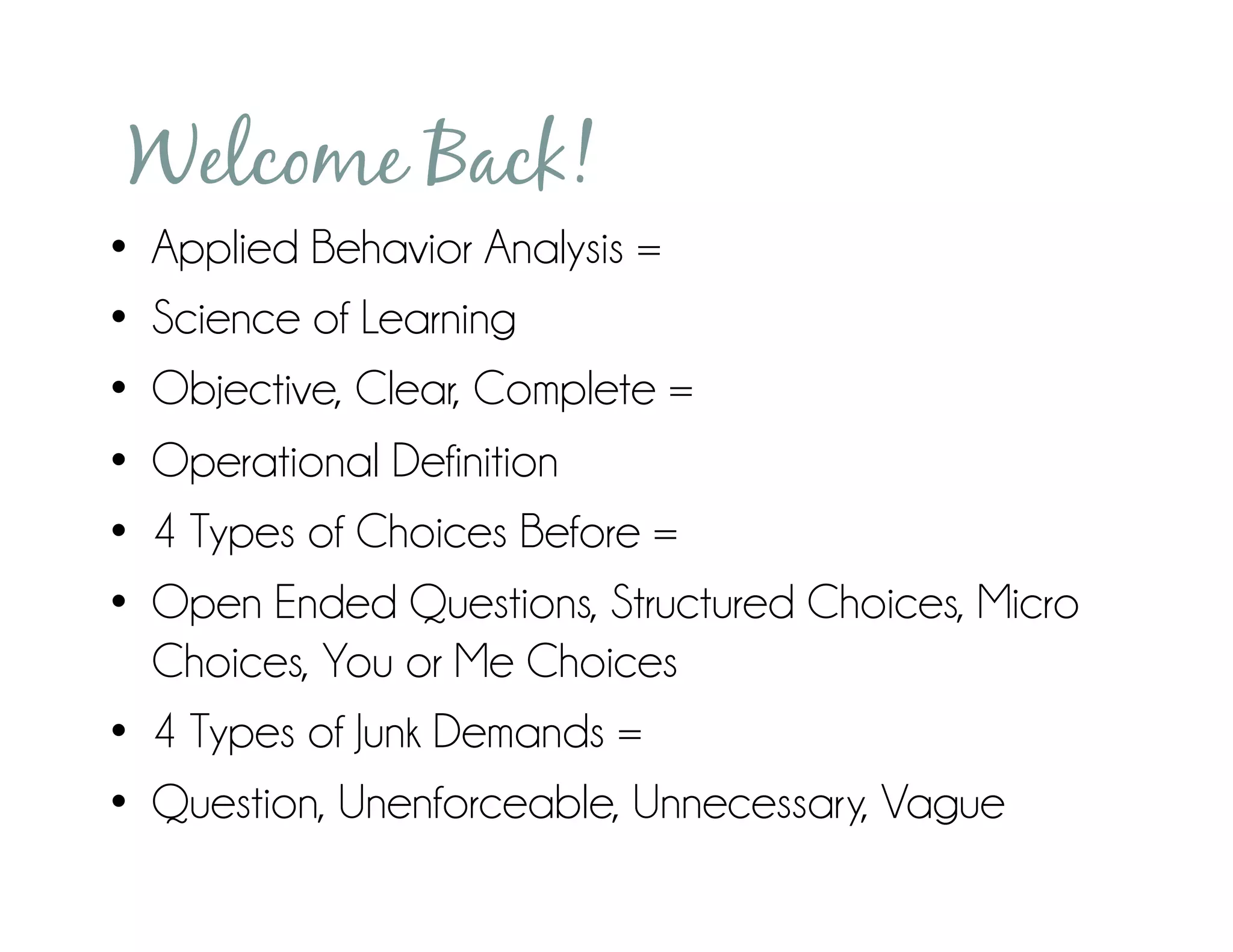
Welcome Back!
•  Applied Behavior Analysis =
•  Science of Learning
•  Objective, Clear, Complete =
•  Operational Definition
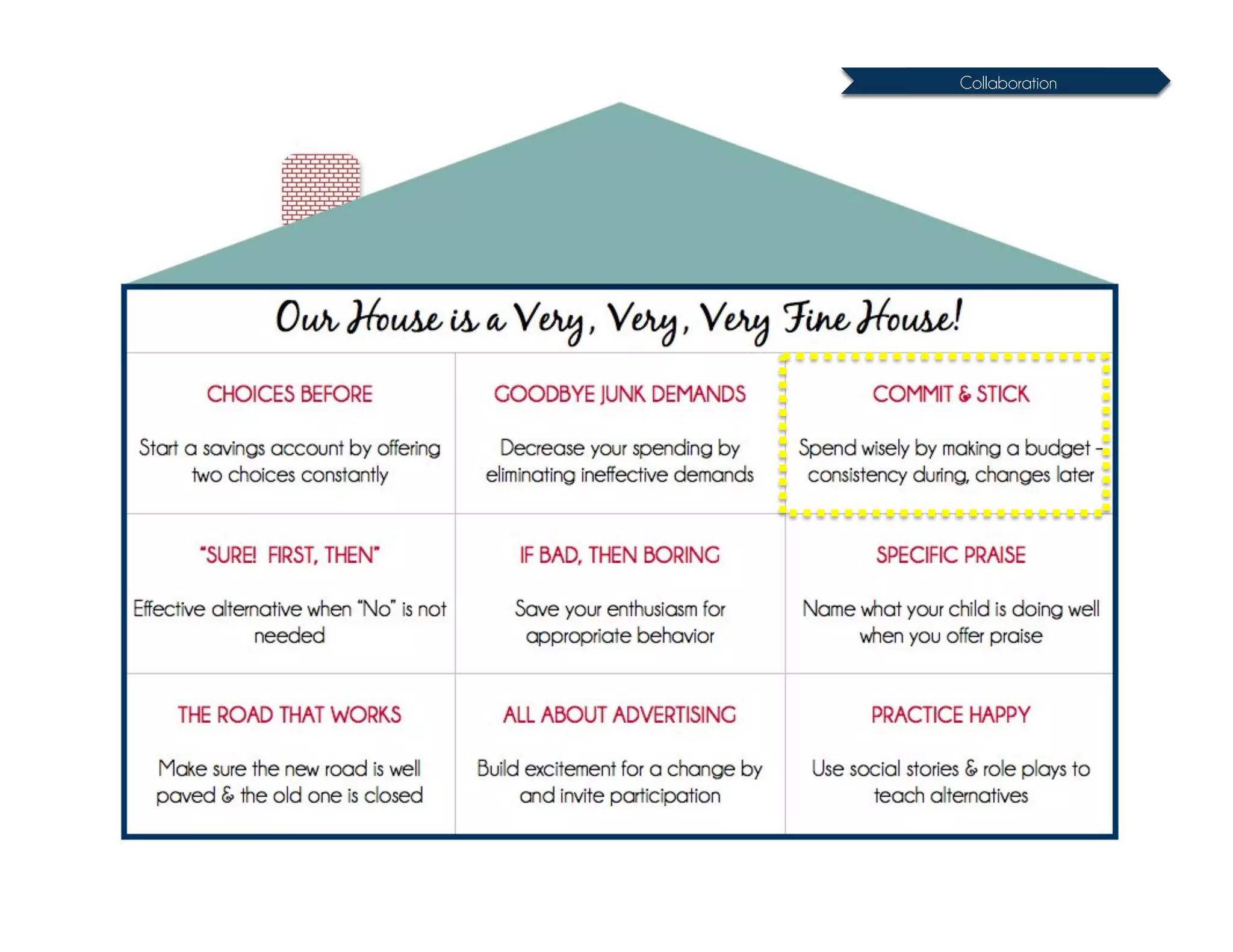
•  4 Types of Choices Before =
•  Open Ended Questions, Structured Choices, Micro
   Choices, You or Me Choices
•  4 Types of Junk Demands =
•  Question, Unenforceable, Unnecessary, Vague
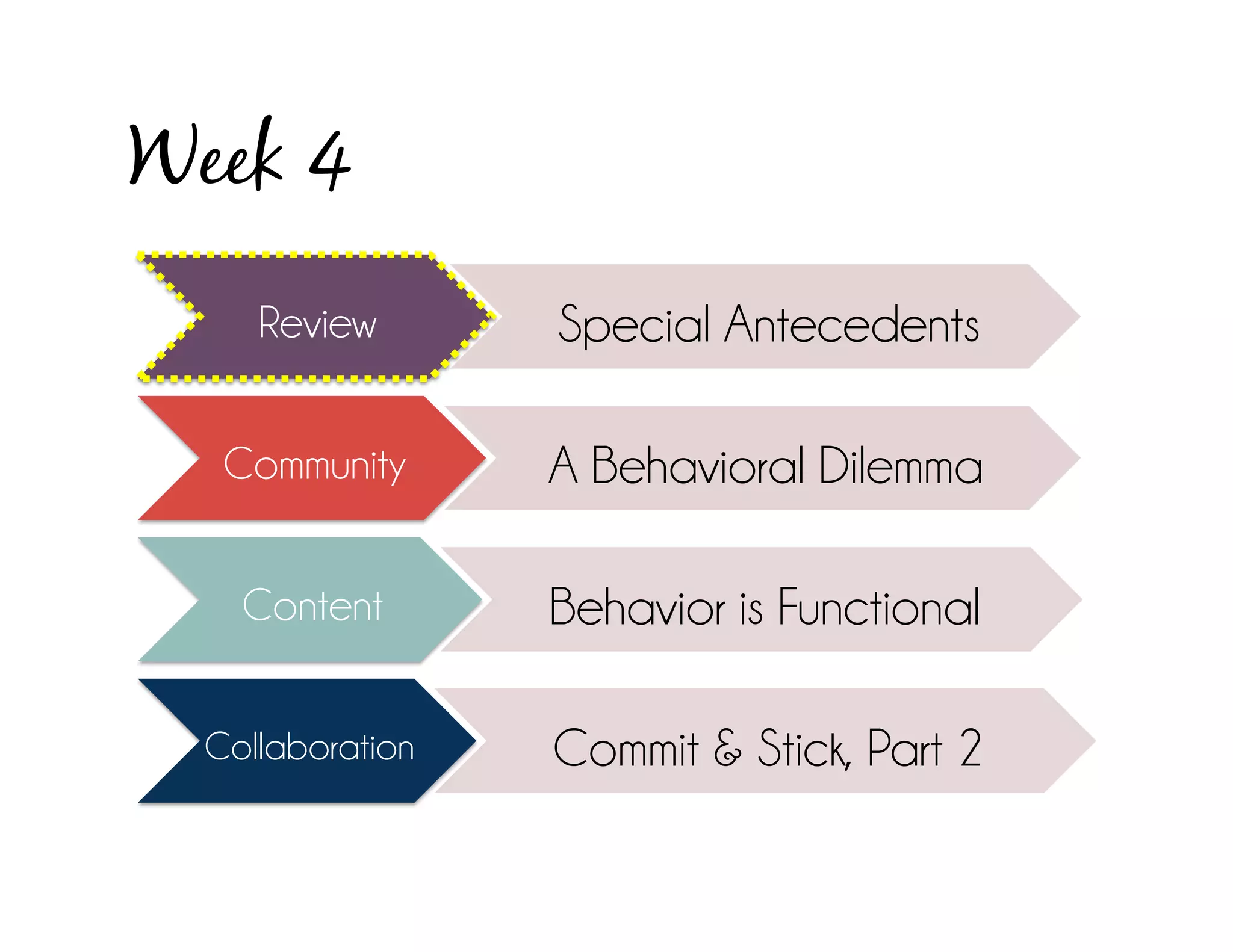
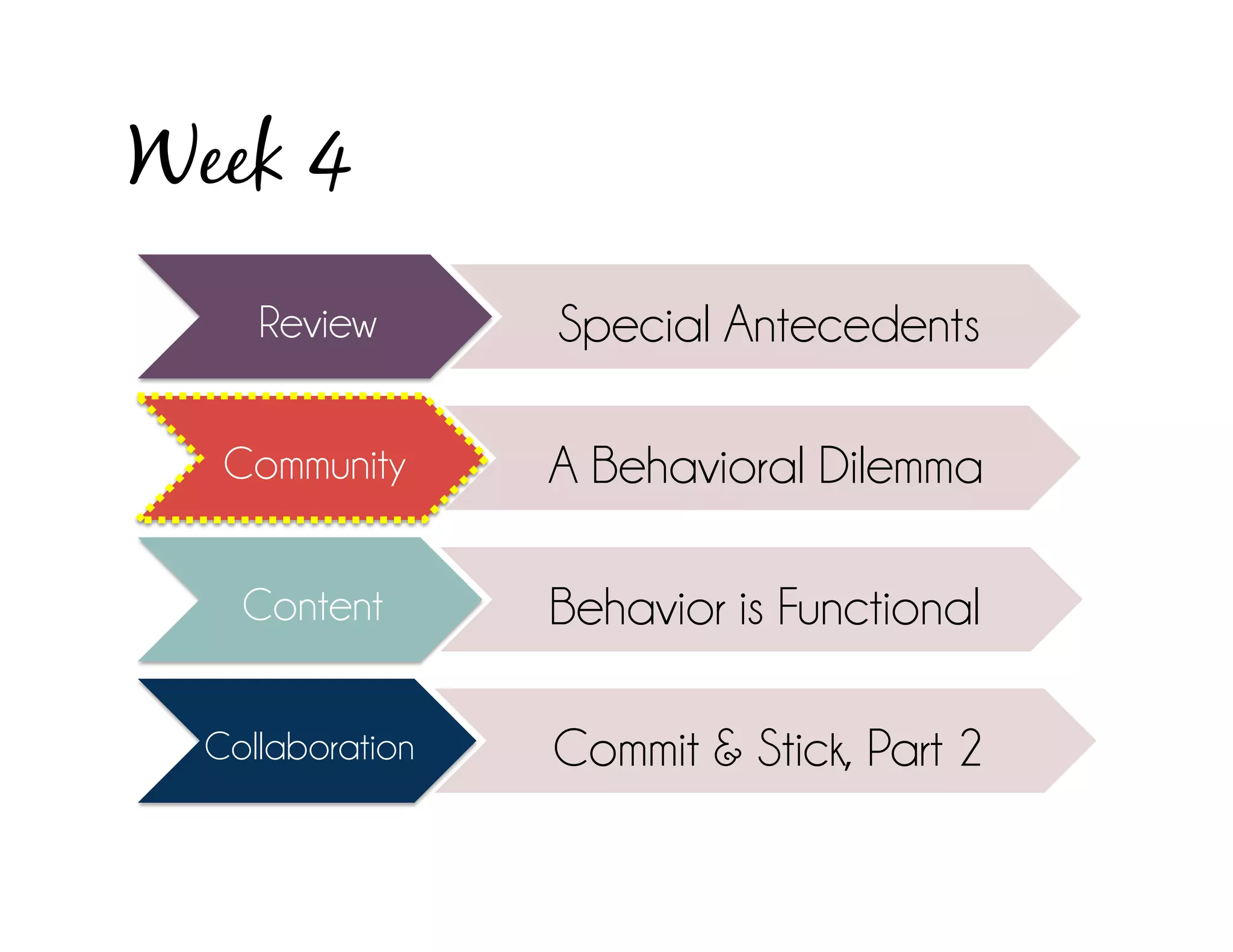
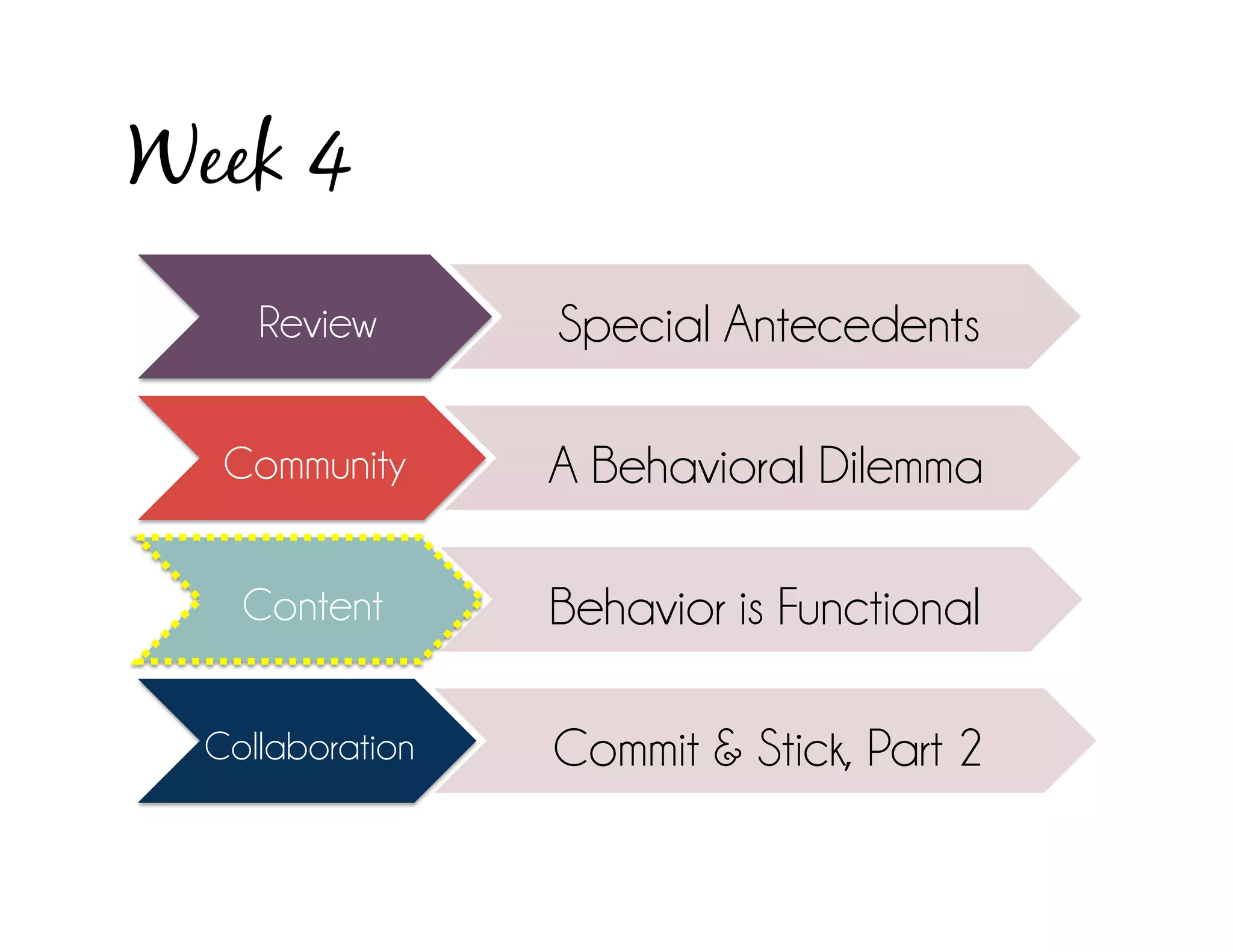
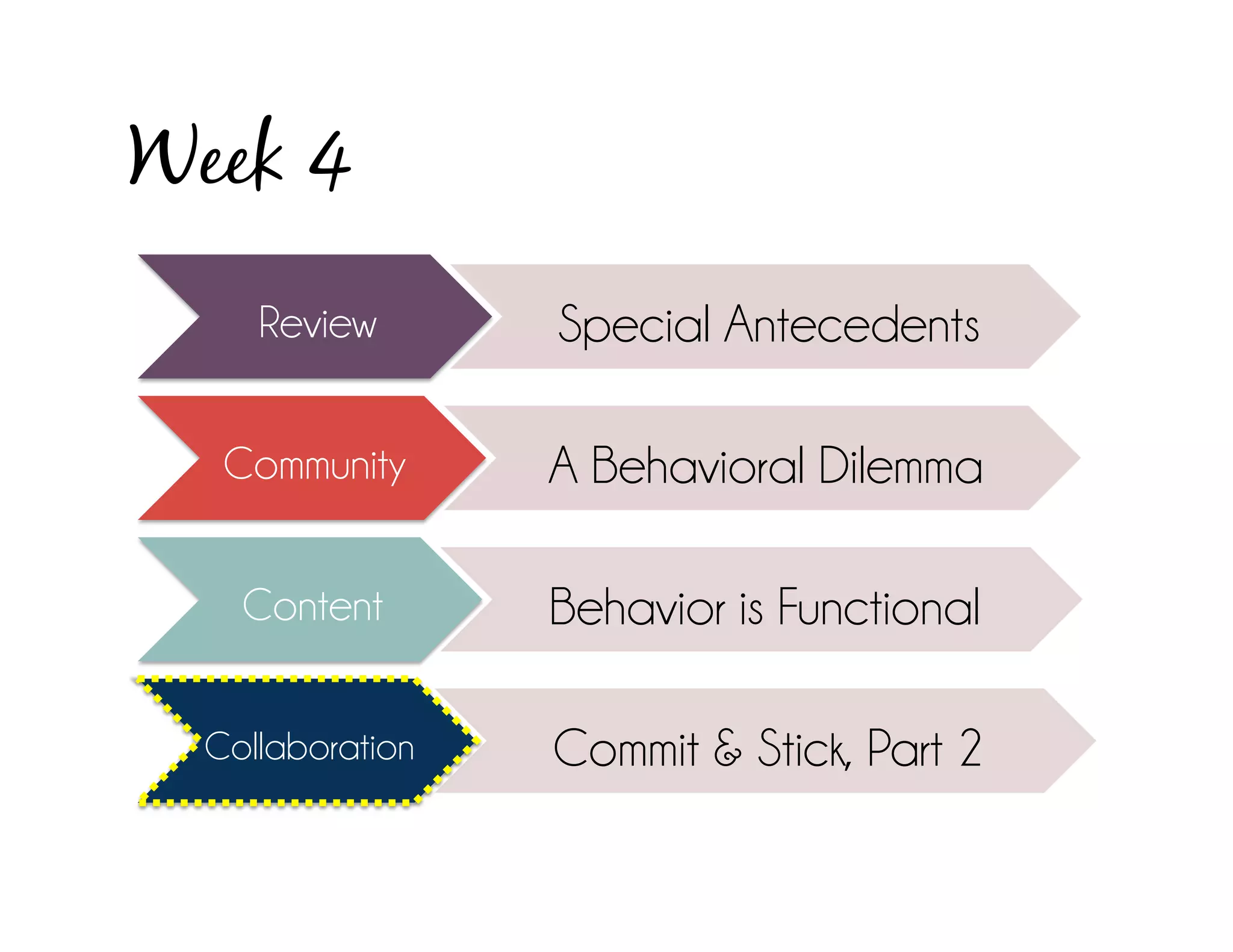
Week 4
     Review       Special Antecedents

   Community      A Behavioral Dilemma

    Content       Behavior is Functional

  Collaboration   Commit & Stick, Part 2
Review


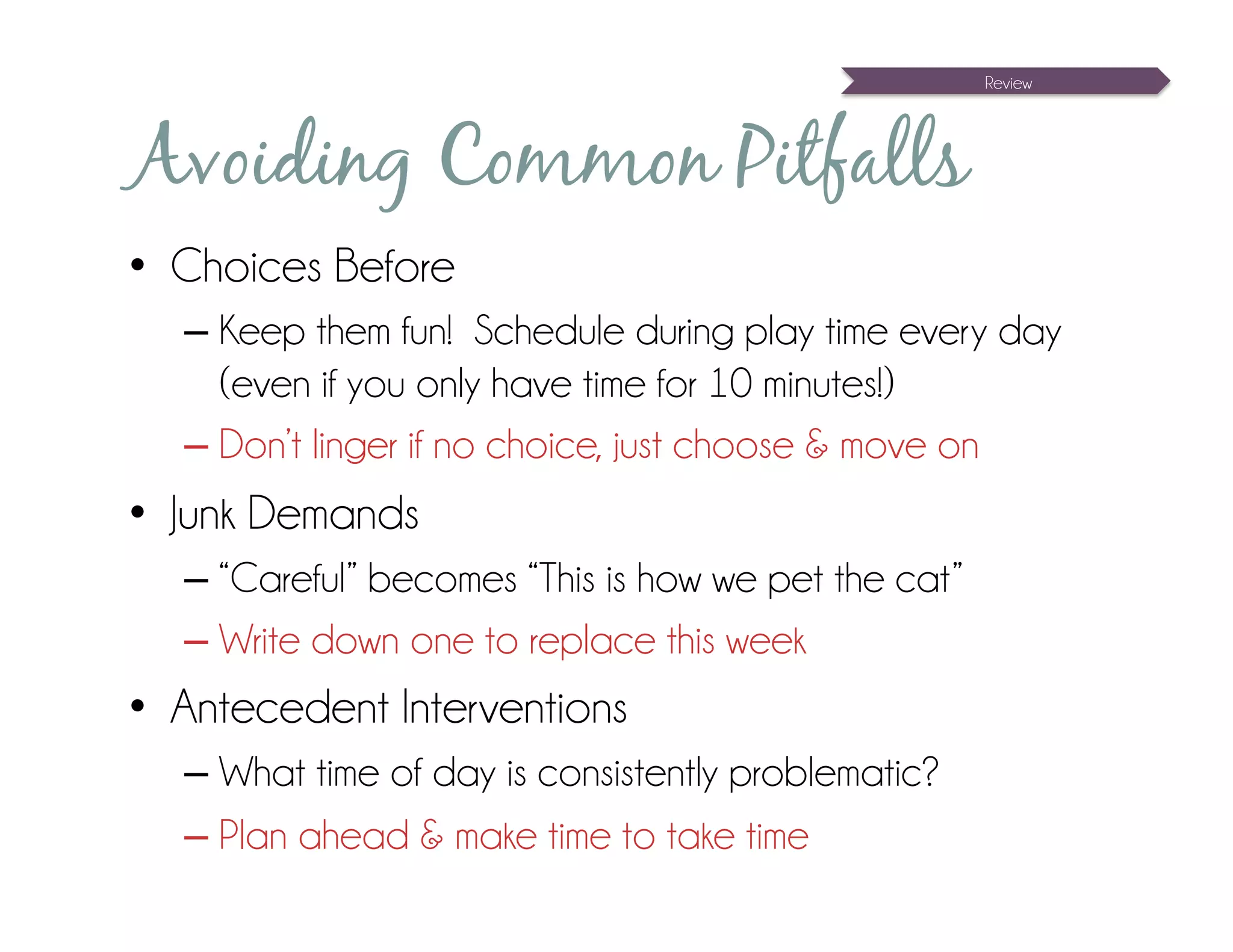
Avoiding Common Pitfalls
•  Choices Before
  – Keep them fun! Schedule during play time every day
    (even if you only have time for 10 minutes!)
  – Don’t linger if no choice, just choose & move on
•  Junk Demands
  – “Careful” becomes “This is how we pet the cat”
  – Write down one to replace this week
•  Antecedent Interventions
  – What time of day is consistently problematic?
  – Plan ahead & make time to take time
Review


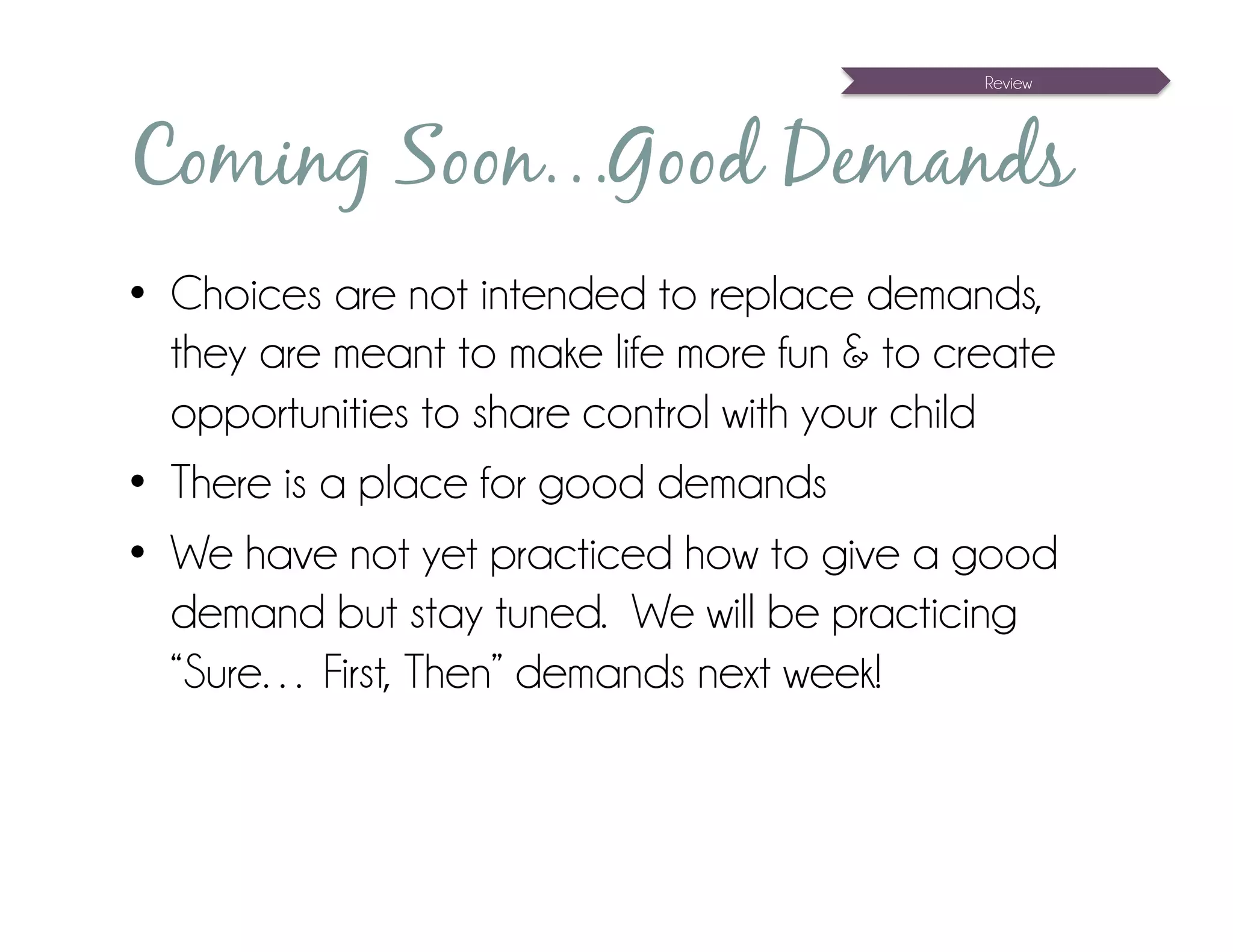
Coming Soon…Good Demands
•  Choices are not intended to replace demands,
   they are meant to make life more fun & to create
   opportunities to share control with your child
•  There is a place for good demands
•  We have not yet practiced how to give a good
   demand but stay tuned. We will be practicing
   “Sure… First, Then” demands next week!
Review


 Play: Spot the Difference
           I need 4 volunteer actors.
Two to act as parents and two to act as children!
Review


                                   So Close
  Parent: Do you want to have apples or pears with dinner?
                      Child: Bananas.
•  Okay, bananas are a healthy option but        •  Wish you had made it open-
   you need to have apples or pears next
   time ok?                                         ended? Make a note for next
•  OK                                               time but commit & stick this time!
•  You need to sit down, okay so you can         •  A sneaky “okay?” turned it into
   eat them?
                                                    a (question) demand
•  [still walking around]
•  Please sit down. It isn’t safe to eat while   •  Gave (unenforced) demand
   you are walking around.                          from a distance without follow
•  [still walking around]                           through
•  Do you want to sit down in two minutes or
   in three minutes?
                                                 •  Choice offered AFTER the
•  Five minutes!                                    demand
Review


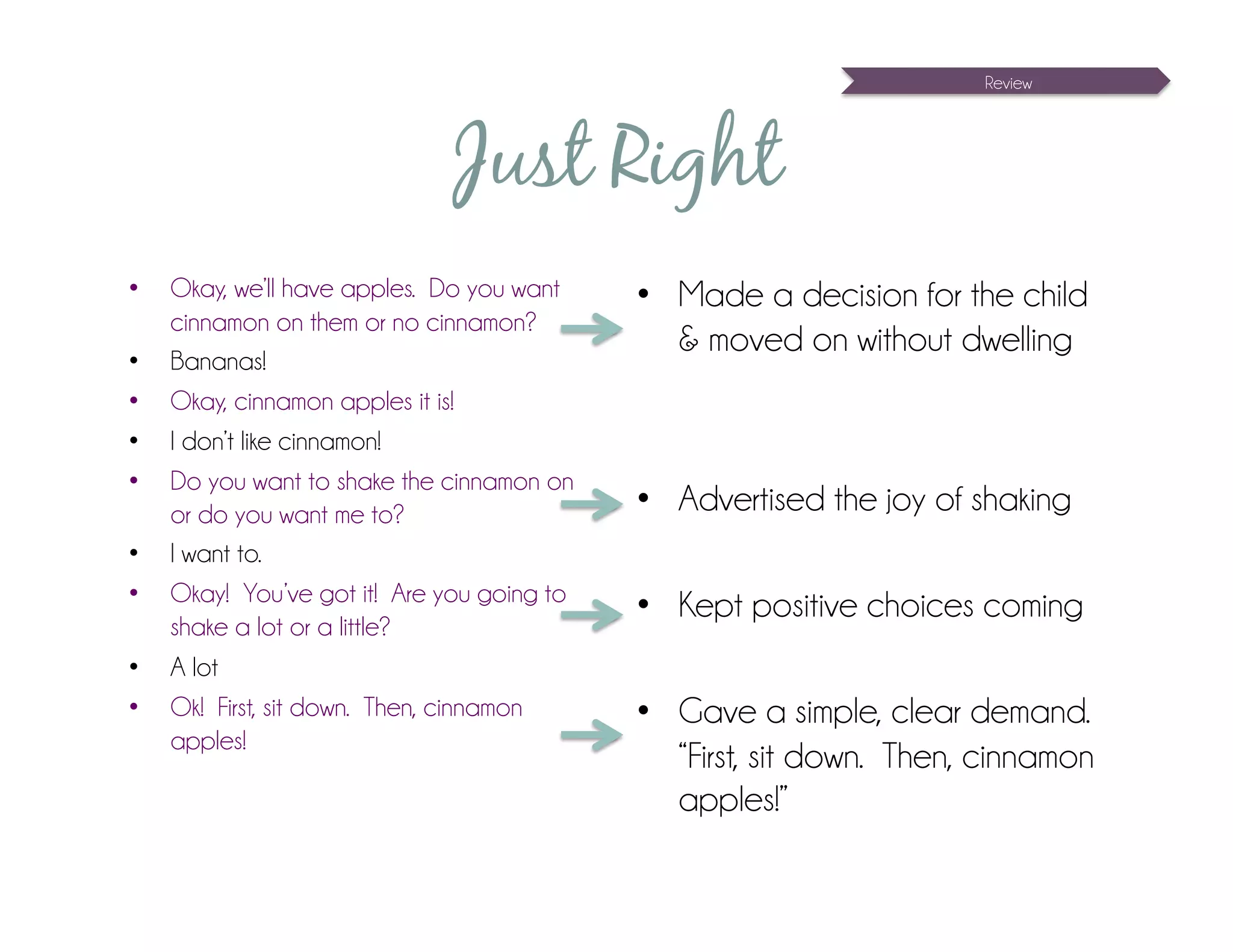
                             Just Right
•  Okay, we’ll have apples. Do you want    •  Made a decision for the child
   cinnamon on them or no cinnamon?
                                              & moved on without dwelling
•  Bananas!
•  Okay, cinnamon apples it is!
•  I don’t like cinnamon!
•  Do you want to shake the cinnamon on
   or do you want me to?                   •  Advertised the joy of shaking
•  I want to.
•  Okay! You’ve got it! Are you going to
                                           •  Kept positive choices coming
   shake a lot or a little?
•  A lot
•  Ok! First, sit down. Then, cinnamon     •  Gave a simple, clear demand.
   apples!
                                              “First, sit down. Then, cinnamon
                                              apples!”
Review


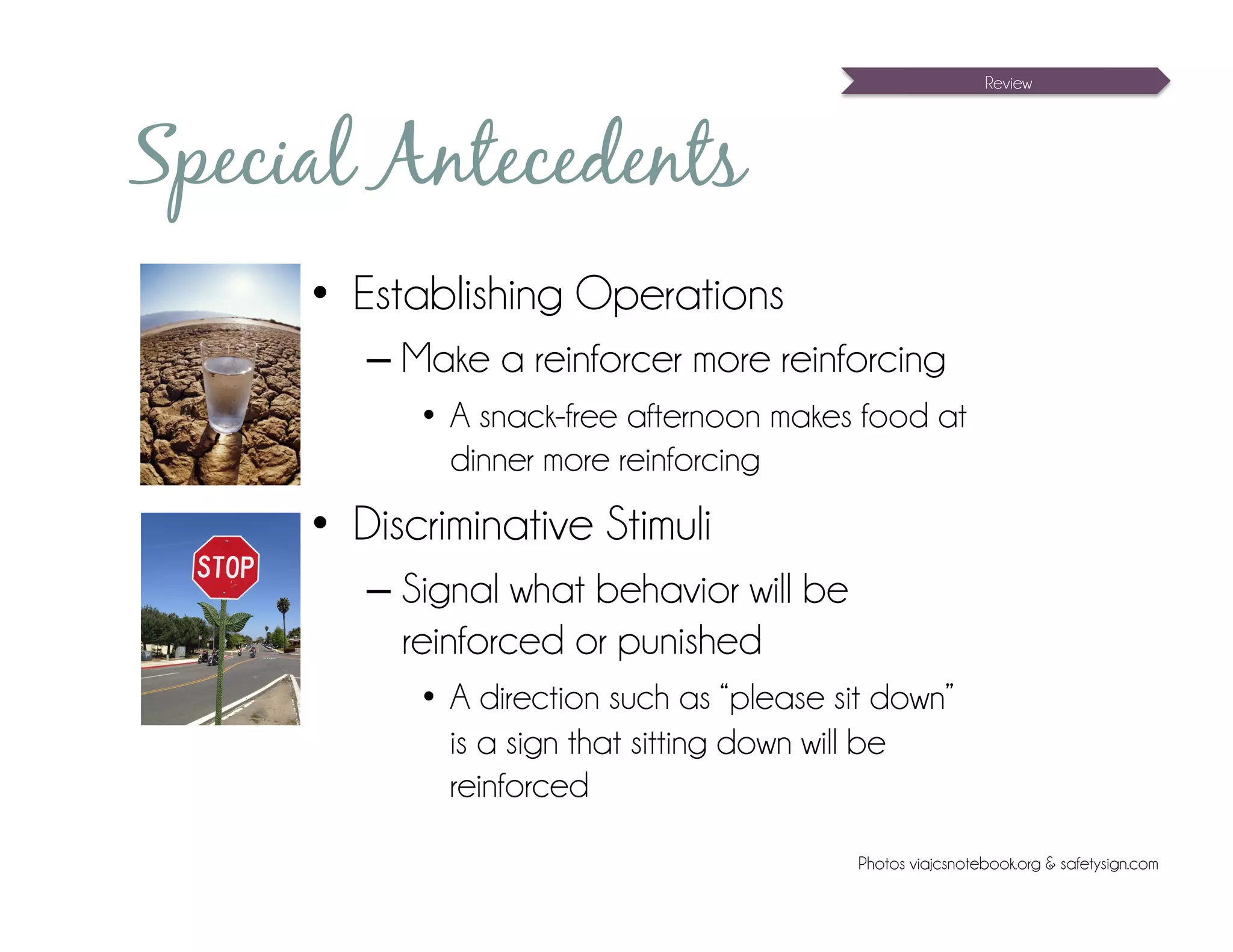
Special Antecedents
     •  Establishing Operations
        – Make a reinforcer more reinforcing
           •  A snack-free afternoon makes food at
              dinner more reinforcing
     •  Discriminative Stimuli
        – Signal what behavior will be
          reinforced or punished
           •  A direction such as “please sit down”
              is a sign that sitting down will be
              reinforced
                                           Photos viajcsnotebook.org & safetysign.com
Review


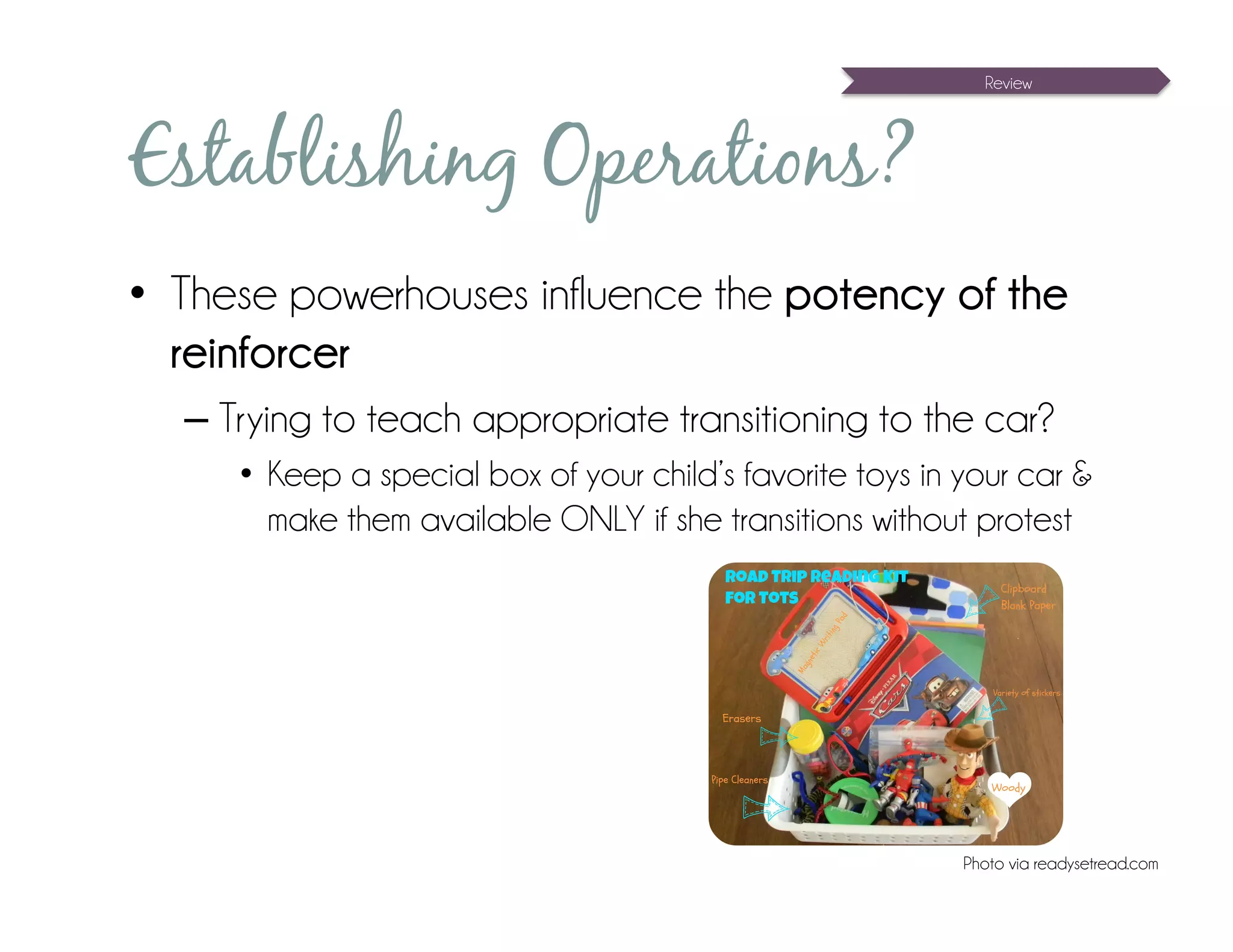
Establishing Operations?
•  These powerhouses influence the potency of the
   reinforcer
  – Trying to teach appropriate transitioning to the car?
     •  Keep a special box of your child’s favorite toys in your car &
        make them available ONLY if she transitions without protest


                                                            Photo via readysetread.com
Review


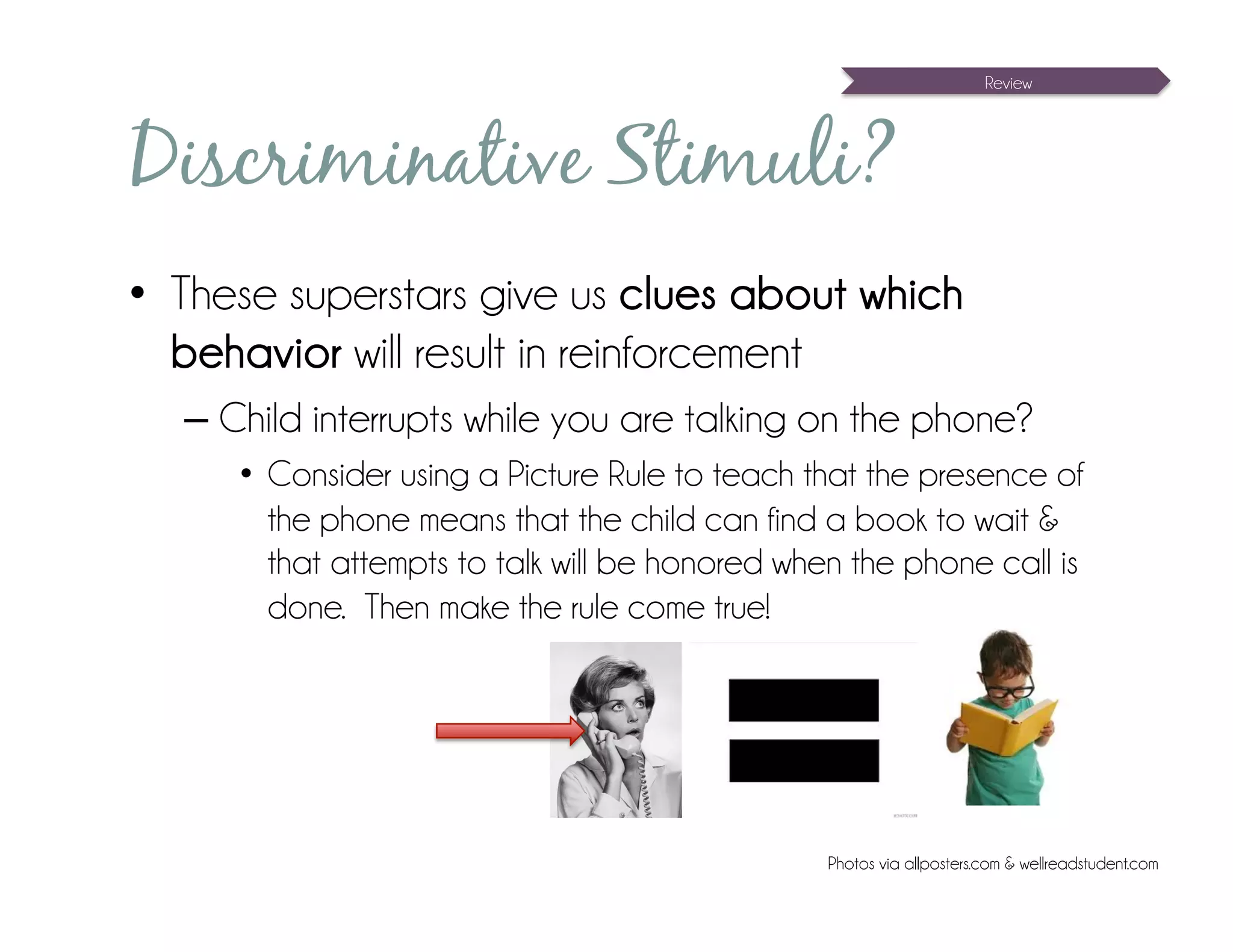
Discriminative Stimuli?
•  These superstars give us clues about which
   behavior will result in reinforcement
  – Child interrupts while you are talking on the phone?
     •  Consider using a Picture Rule to teach that the presence of
        the phone means that the child can find a book to wait &
        that attempts to talk will be honored when the phone call is
        done. Then make the rule come true!


                                                Photos via allposters.com & wellreadstudent.com
Review


Not-A-Test
•  A (n) _____________ works by changing the
   reinforcement properties of a reinforcer.
    (a) functional analysis
    (b) establishing operation
    (c) preference assessment
    (d) discriminative stimulus
Review


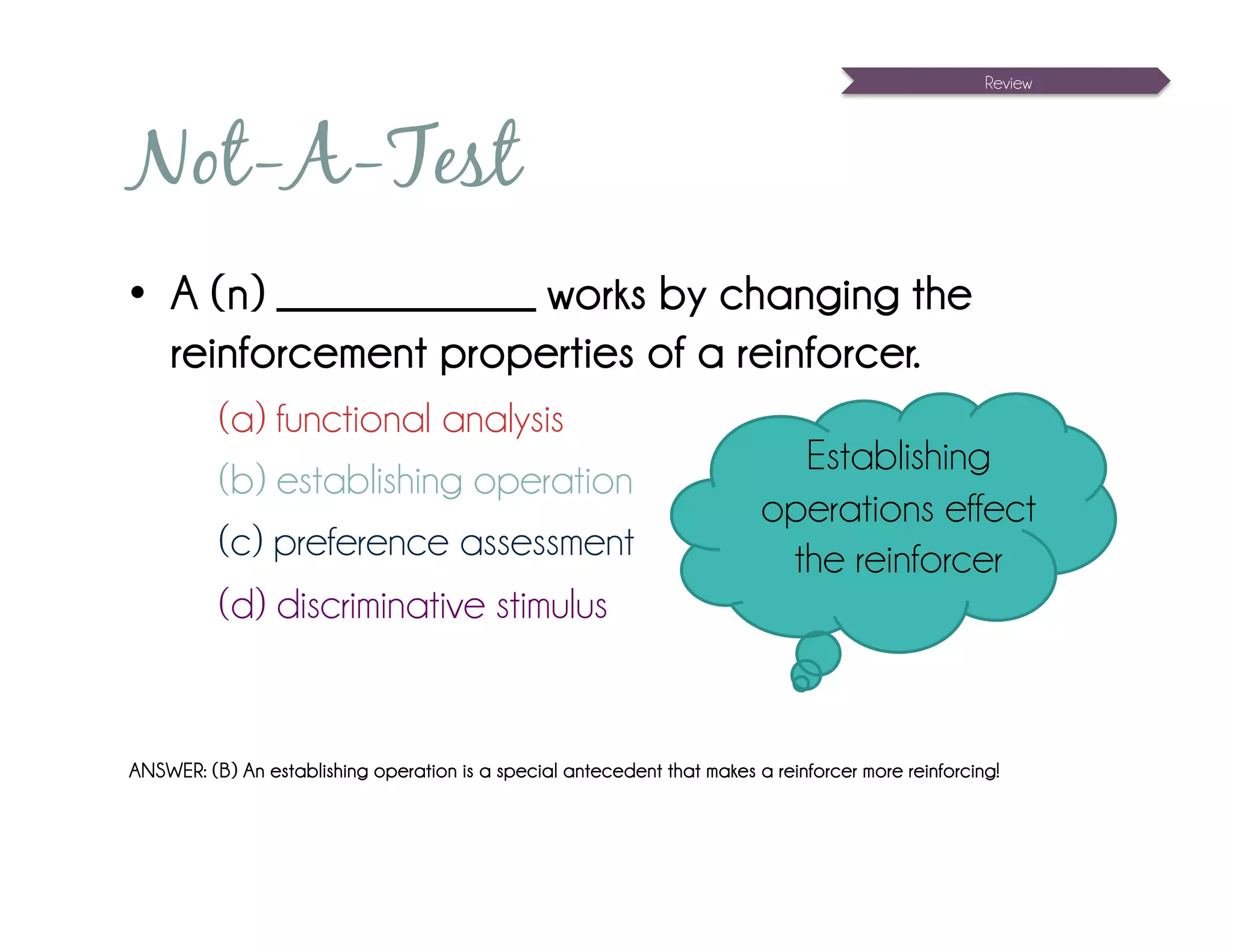
Not-A-Test
•  A (n) _____________ works by changing the
   reinforcement properties of a reinforcer.
          (a) functional analysis
                                                                            Establishing
          (b) establishing operation
                                                                          operations effect
          (c) preference assessment                                        the reinforcer
          (d) discriminative stimulus


ANSWER: (B) An establishing operation is a special antecedent that makes a reinforcer more reinforcing!
Review


Not-A-Test
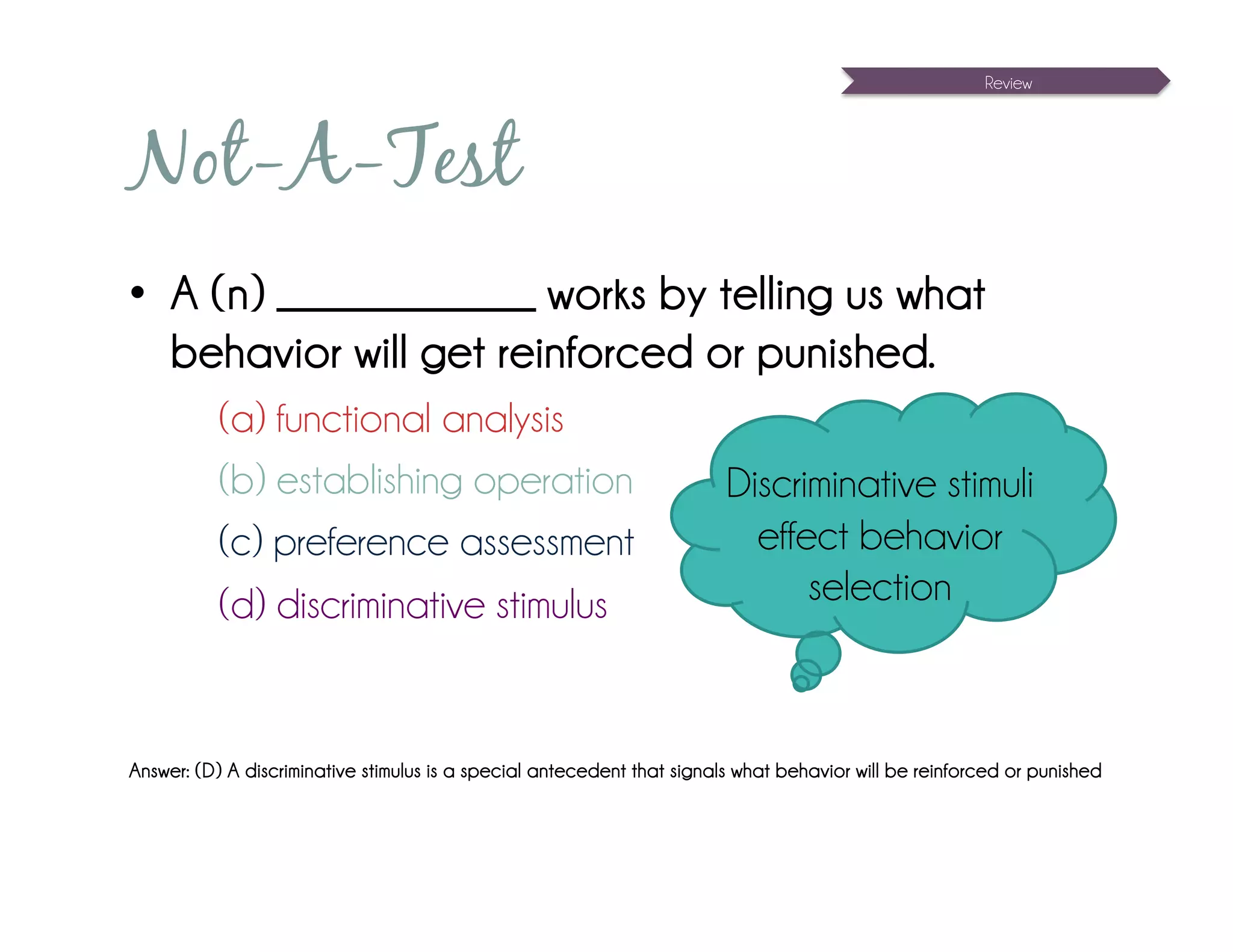
•  A (n) _____________ works by telling us what
   behavior will get reinforced or punished.
    (a) functional analysis
    (b) establishing operation
    (c) preference assessment
    (d) discriminative stimulus
Review


Not-A-Test
•  A (n) _____________ works by telling us what
   behavior will get reinforced or punished.
           (a) functional analysis
           (b) establishing operation                                    Discriminative stimuli
           (c) preference assessment                                       effect behavior
           (d) discriminative stimulus                                         selection


Answer: (D) A discriminative stimulus is a special antecedent that signals what behavior will be reinforced or punished
Week 4
     Review       Special Antecedents

   Community      A Behavioral Dilemma

    Content       Behavior is Functional

  Collaboration   Commit & Stick, Part 2
Community


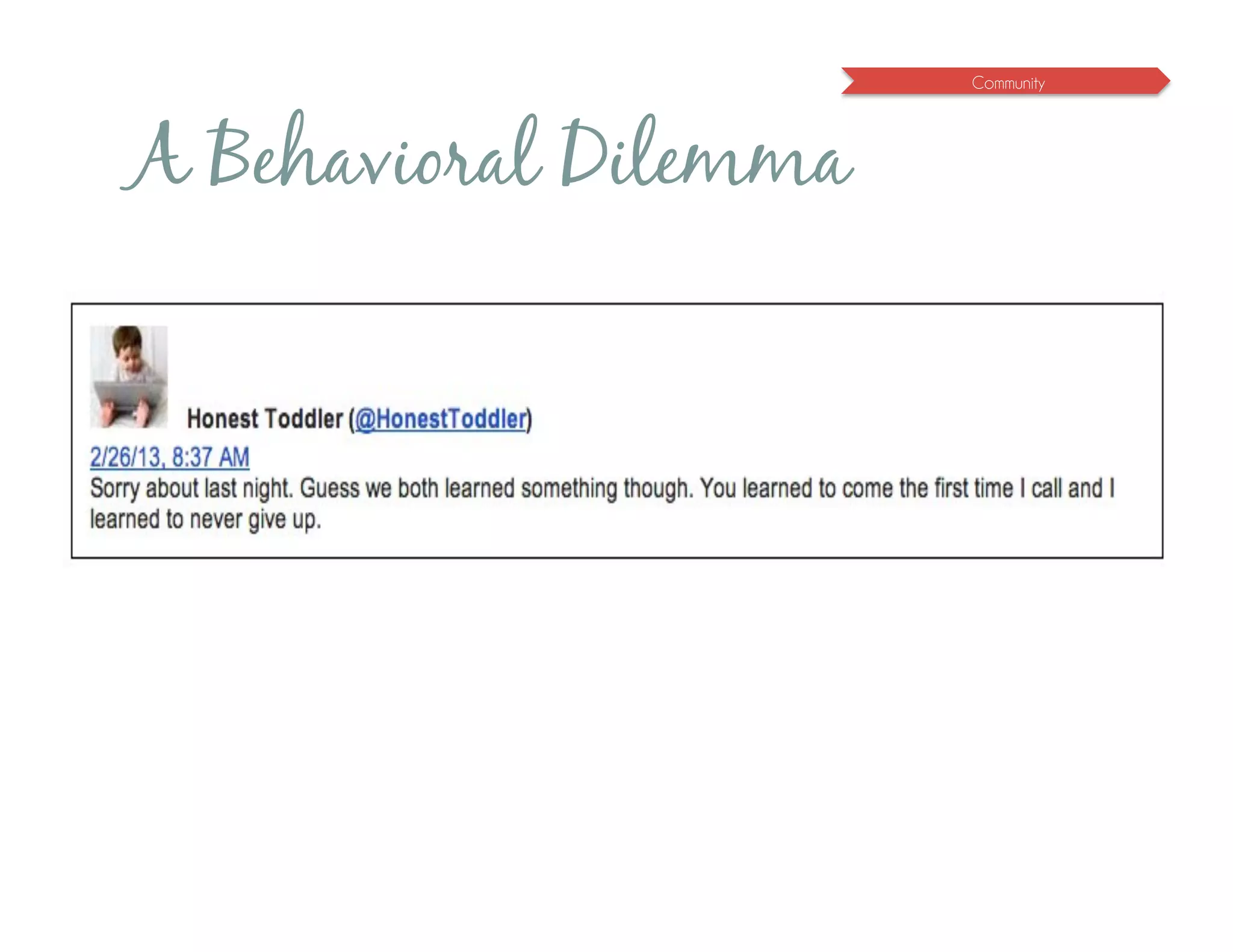
A Behavioral Dilemma
Community


Starring Your Children!
Community


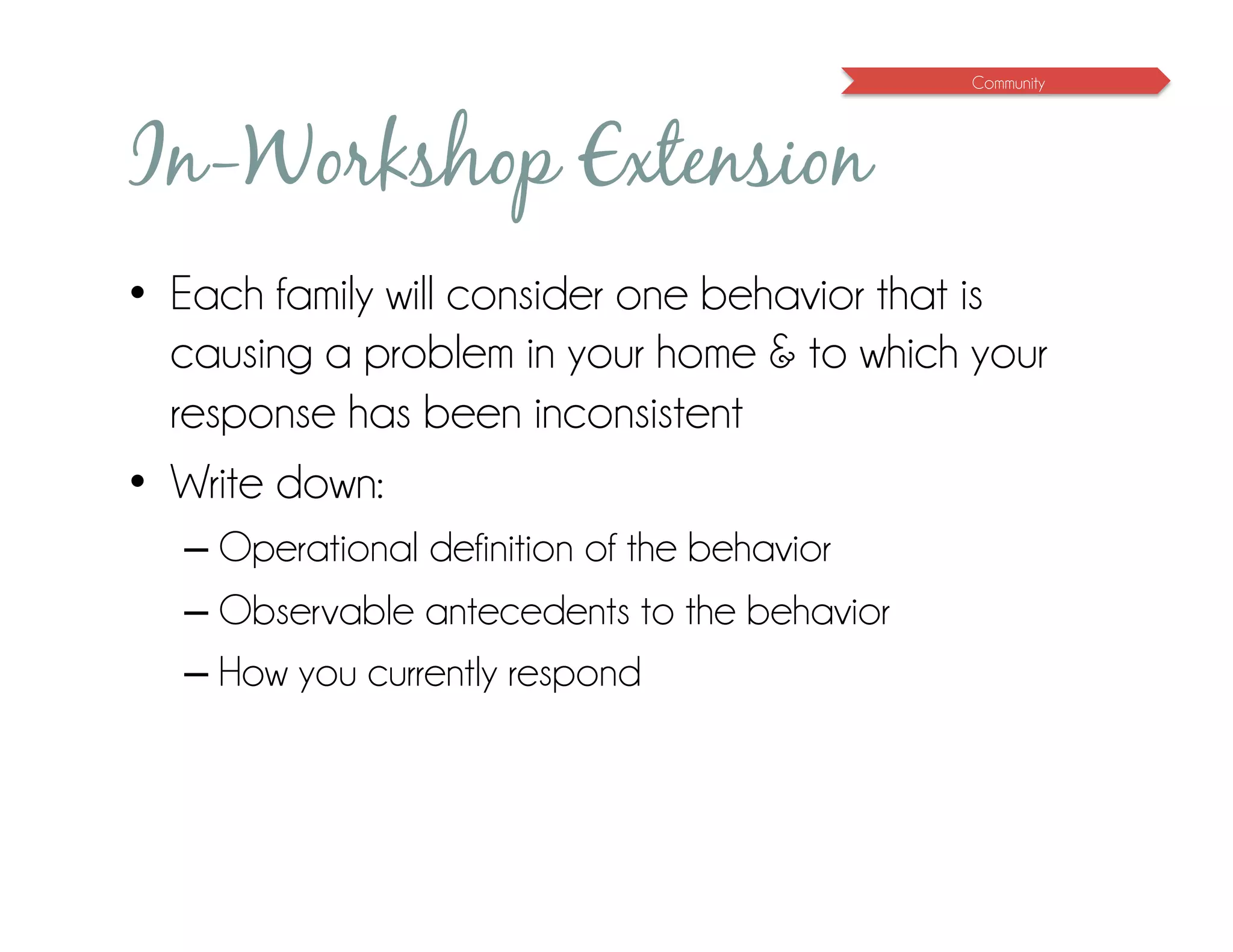
In-Workshop Extension
•  Each family will consider one behavior that is
   causing a problem in your home & to which your
   response has been inconsistent
•  Write down:
  – Operational definition of the behavior
  – Observable antecedents to the behavior
  – How you currently respond
Week 4
     Review       Special Antecedents

   Community      A Behavioral Dilemma

    Content       Behavior is Functional

  Collaboration   Commit & Stick, Part 2
Content


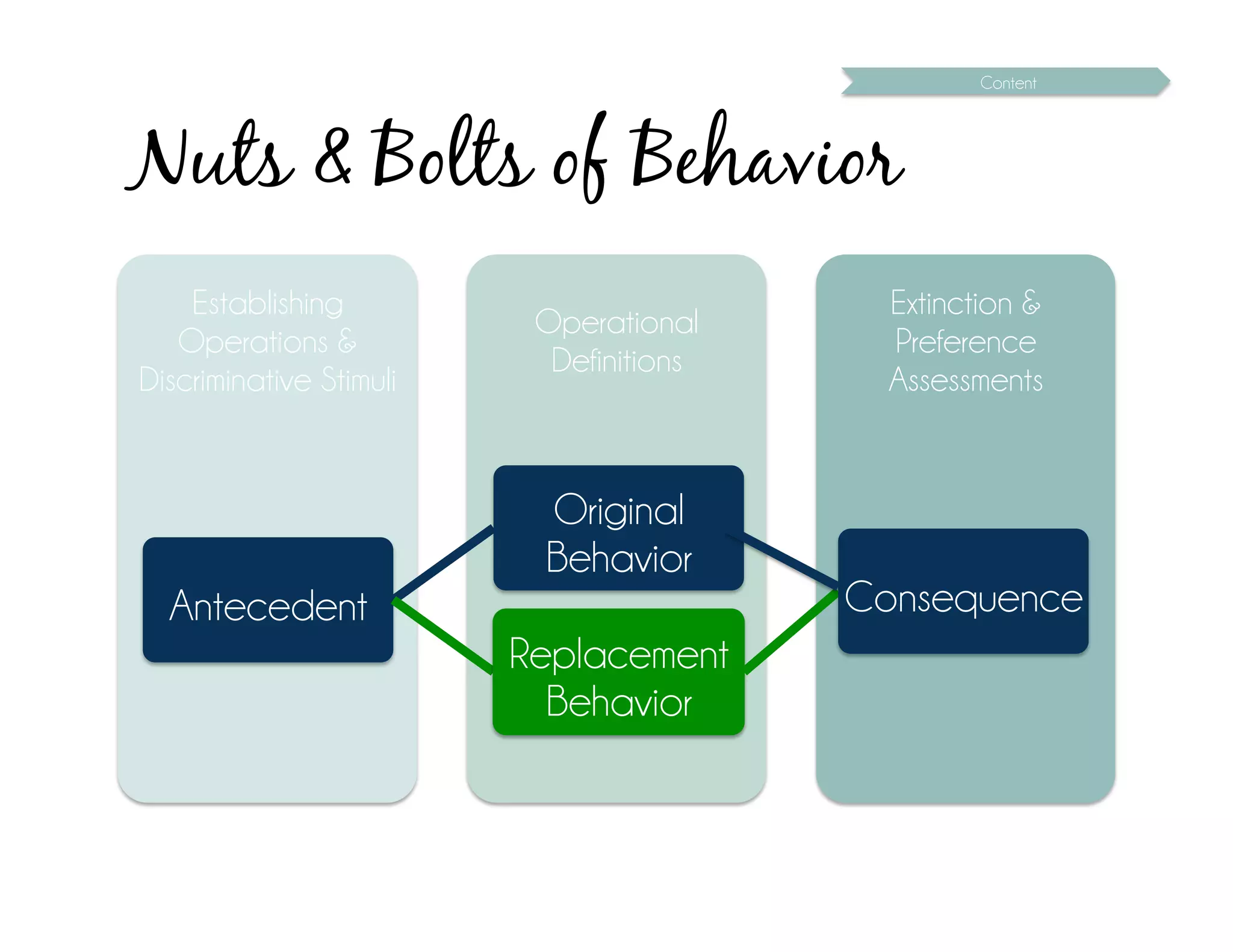
Nuts & Bolts of Behavior
    Establishing                           Extinction &
                          Operational
   Operations &                            Preference
                           Definitions
Discriminative Stimuli                     Assessments


                          Original
                          Behavior
  Antecedent                             Consequence
                         Replacement
                           Behavior
Content


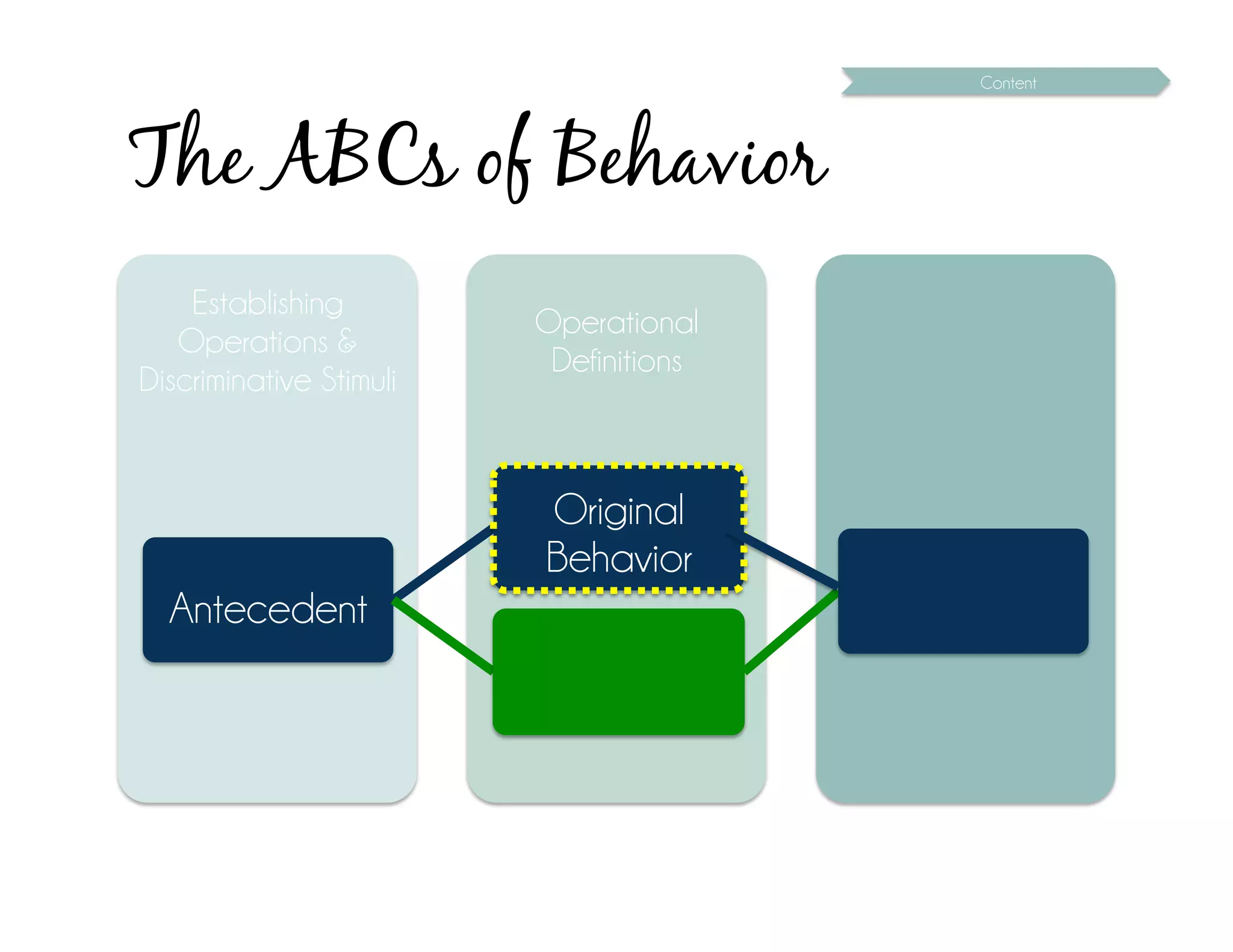
The ABCs of Behavior
    Establishing
                         Operational
   Operations &
                          Definitions
Discriminative Stimuli


                         Original
                         Behavior
  Antecedent
Content


Behavior is Functional
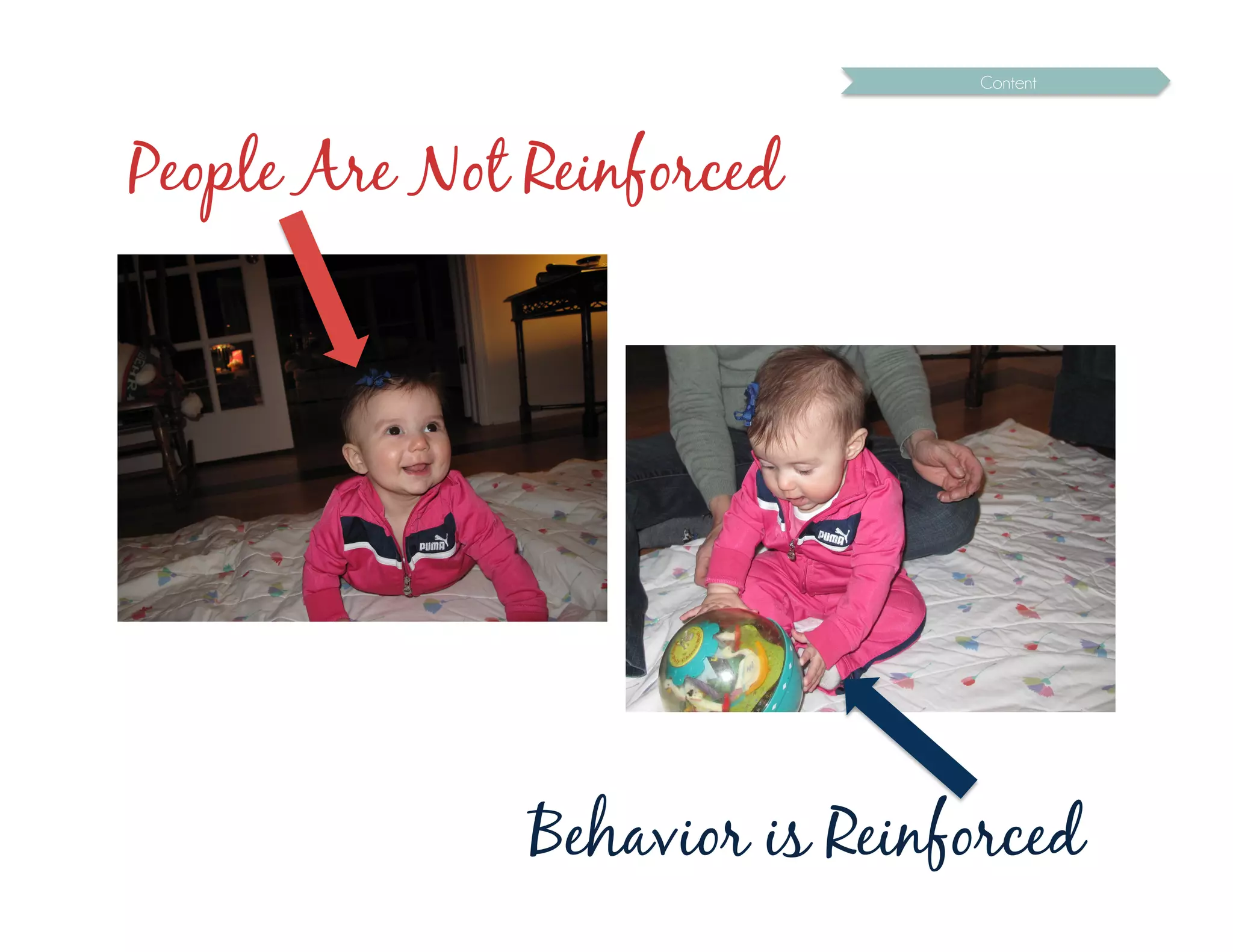
•  All behavior serves a function
•  When behavior “works” it is more likely to occur
   again the in future
•  In other words, if a behavior continues to occur it is
   because it continues to work (or has worked for a
   long time)
•  When the probability of behavior increases as a
   result of a consequence we say that behavior has
   been reinforced
Content


People Are Not Reinforced


               Behavior is Reinforced
Content


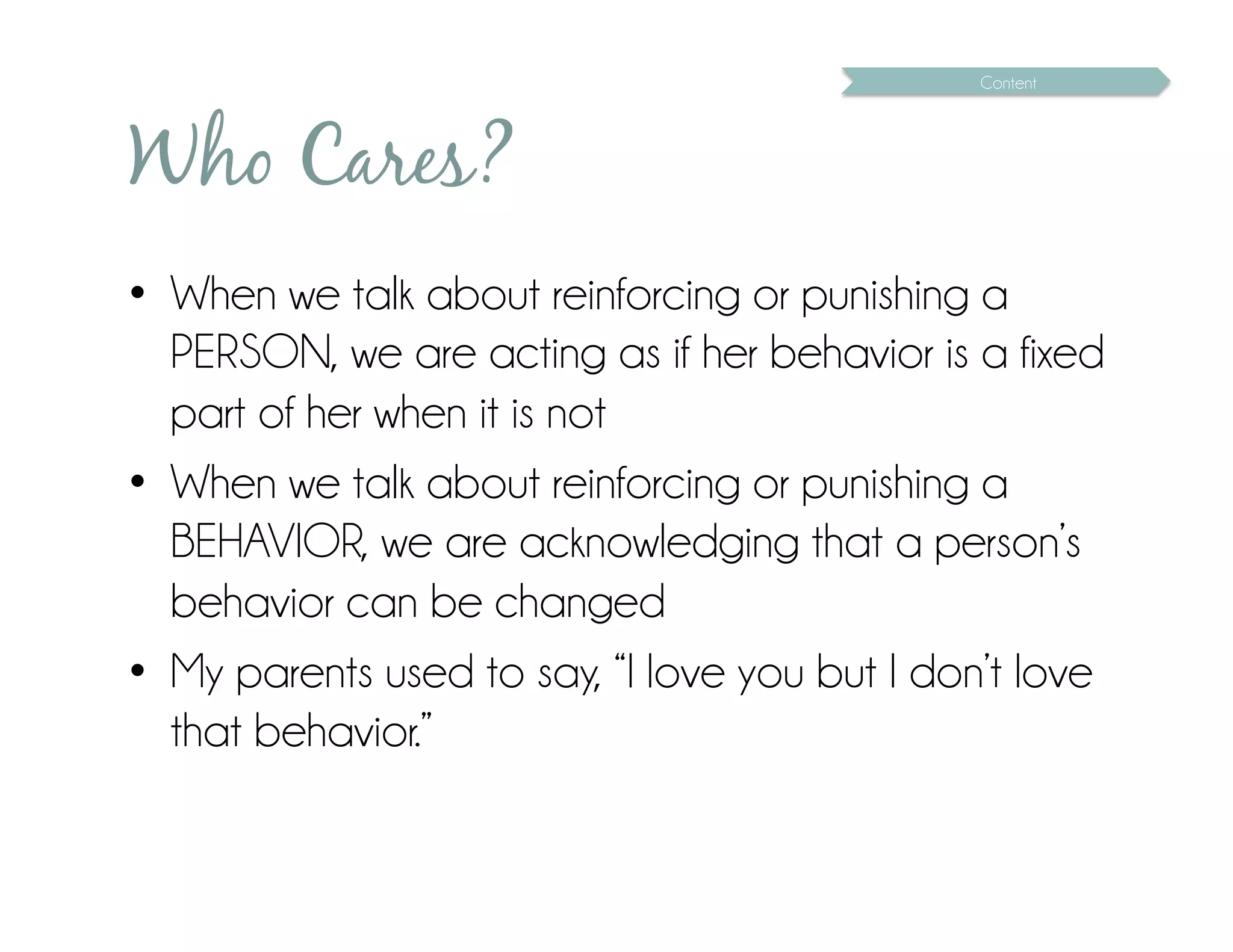
Who Cares?
•  When we talk about reinforcing or punishing a
   PERSON, we are acting as if her behavior is a fixed
   part of her when it is not
•  When we talk about reinforcing or punishing a
   BEHAVIOR, we are acknowledging that a person’s
   behavior can be changed
•  My parents used to say, “I love you but I don’t love
   that behavior.”
Content


Not-A-Test
•  All behavior serves a __________________.
   Please write in your single word answer. If you
   don’t know the real answer, creative wrong answers
   will earn partial credit 
Content


Not-A-Test
•  All behavior serves a __________________.
   Please write in your single word answer. If you
   don’t know the real answer, creative wrong answers
   will earn partial credit 


ANSWER: FUNCTION! And the key to changing a behavior is to understand its function.
Week 4
     Review       Special Antecedents

   Community      A Behavioral Dilemma

    Content       Behavior is Functional

  Collaboration   Commit & Stick, Part 2
Content
Collaboration
Collaboration


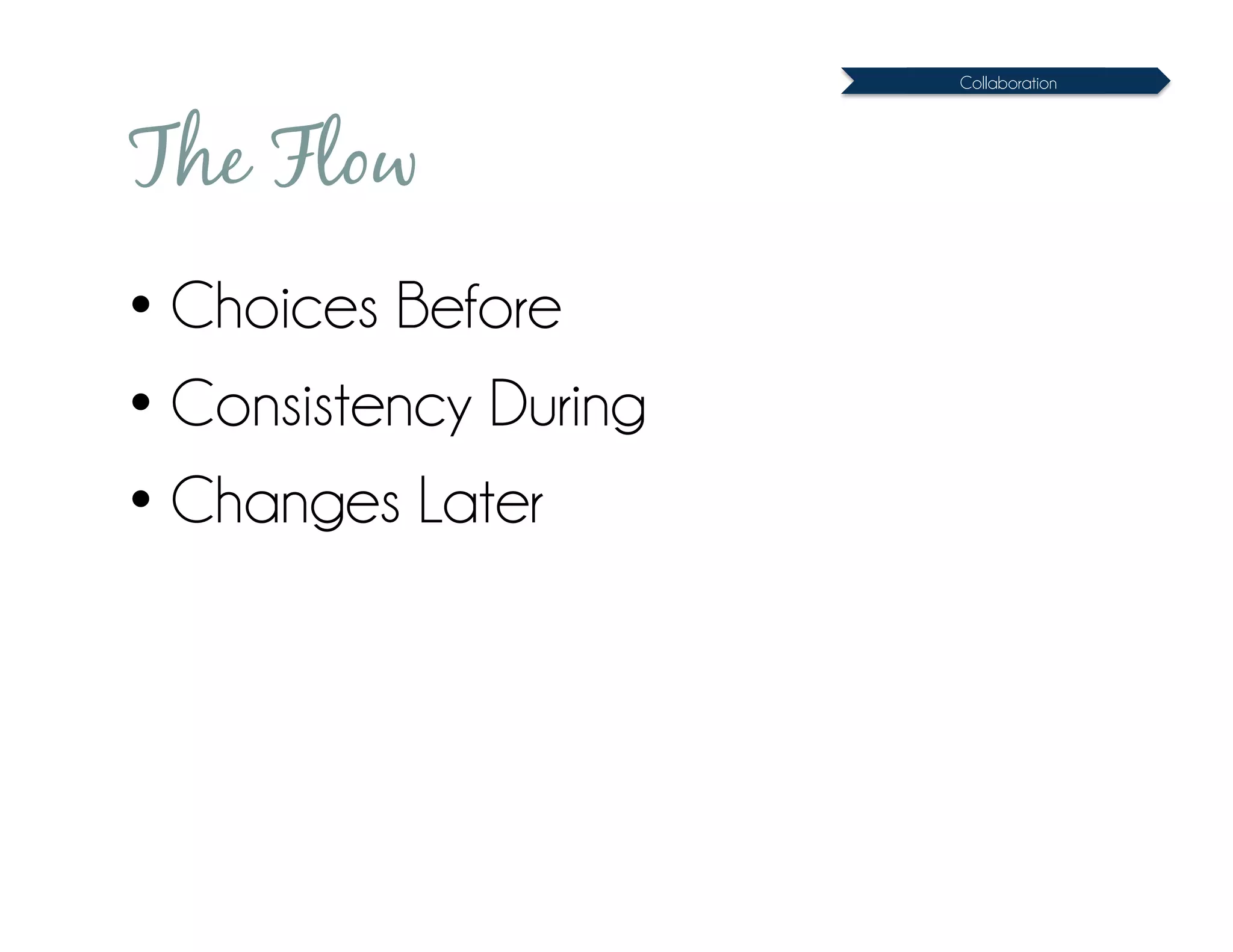
The Flow
• Choices Before
• Consistency During
• Changes Later
Collaboration


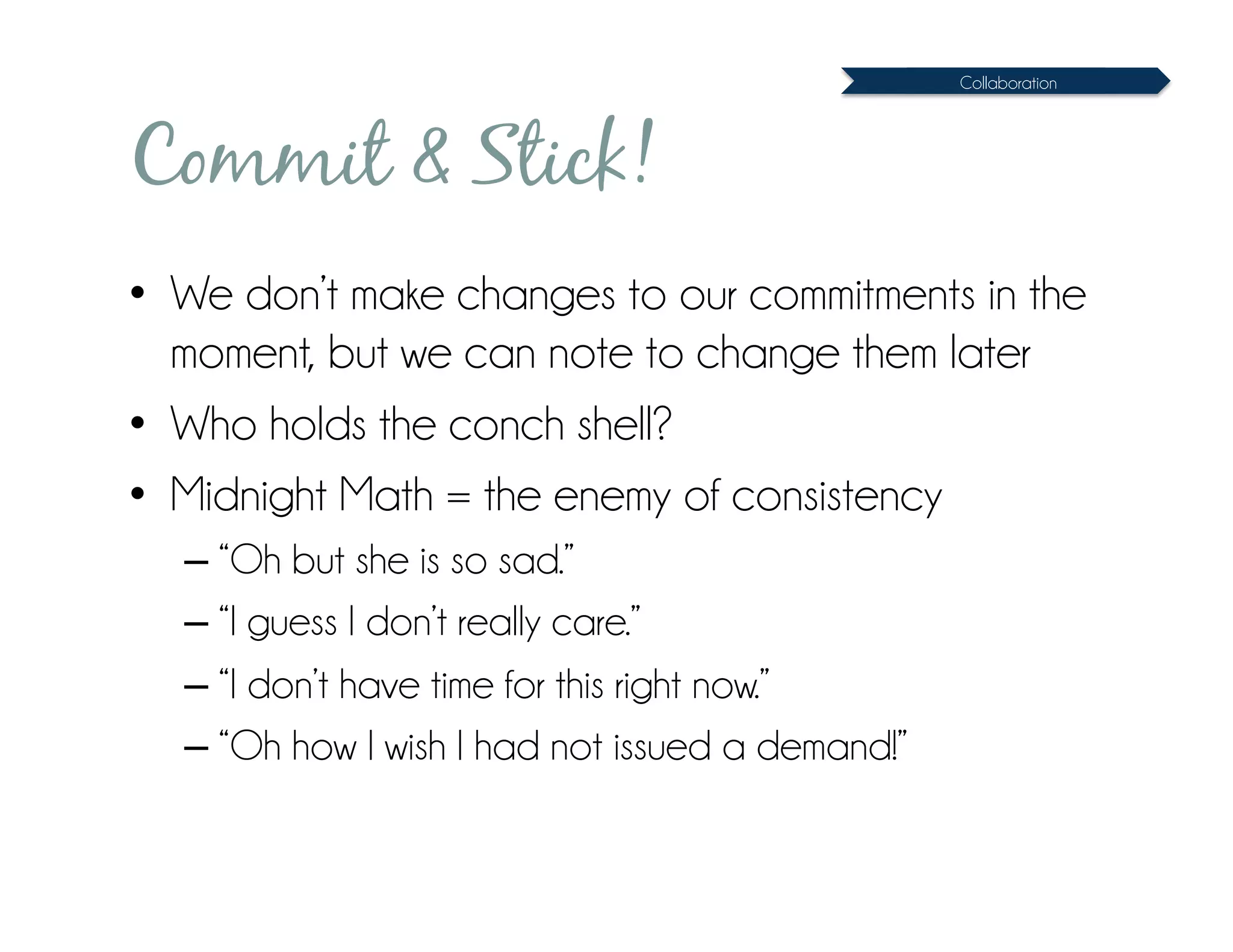
Commit & Stick!
•  We don’t make changes to our commitments in the
   moment, but we can note to change them later
•  Who holds the conch shell?
•  Midnight Math = the enemy of consistency
  – “Oh but she is so sad.”
  – “I guess I don’t really care.”
  – “I don’t have time for this right now.”
  – “Oh how I wish I had not issued a demand!”
Collaboration


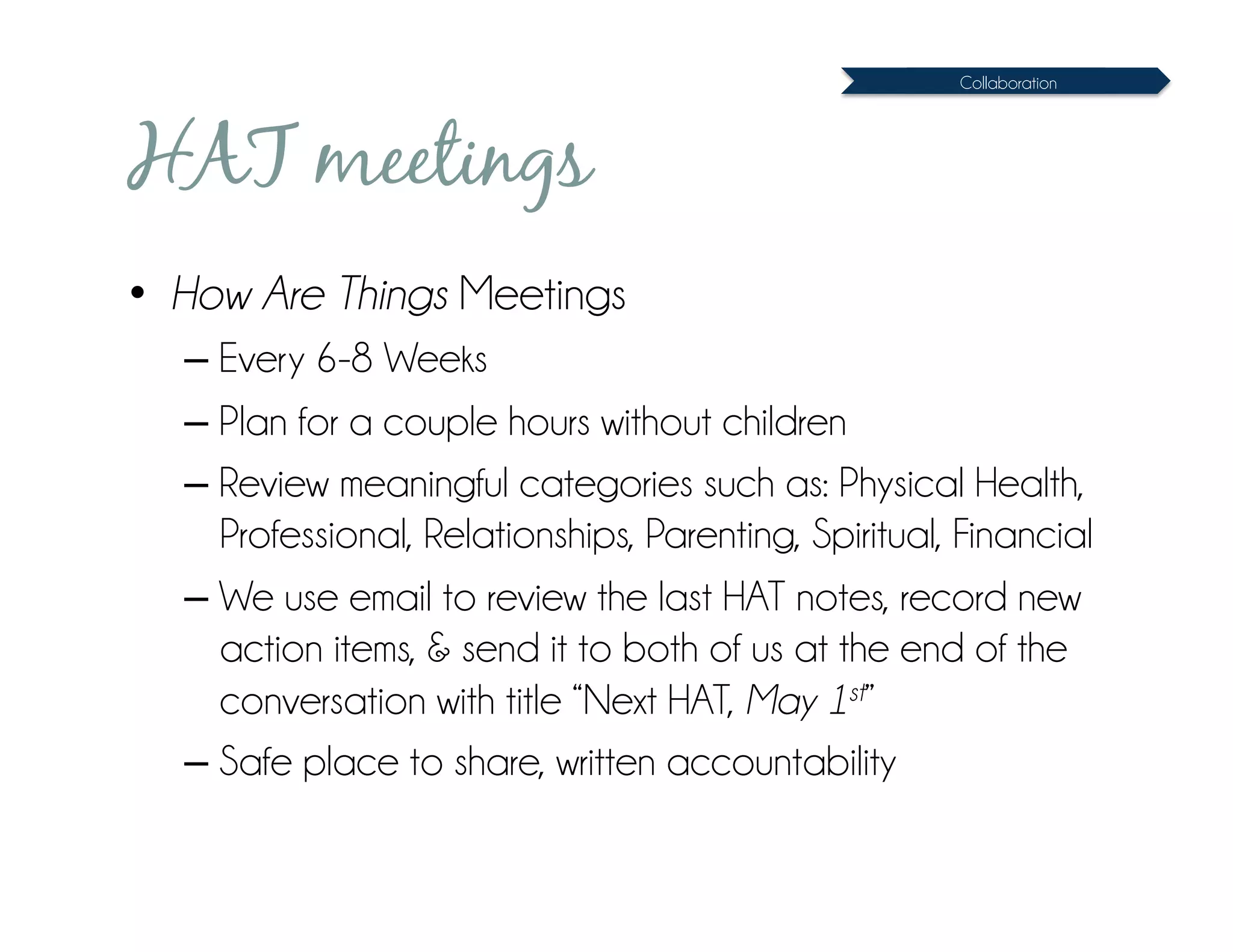
HAT meetings
•  How Are Things Meetings
  – Every 6-8 Weeks
  – Plan for a couple hours without children
  – Review meaningful categories such as: Physical Health,
    Professional, Relationships, Parenting, Spiritual, Financial
  – We use email to review the last HAT notes, record new
    action items, & send it to both of us at the end of the
    conversation with title “Next HAT, May 1st”
  – Safe place to share, written accountability
Collaboration


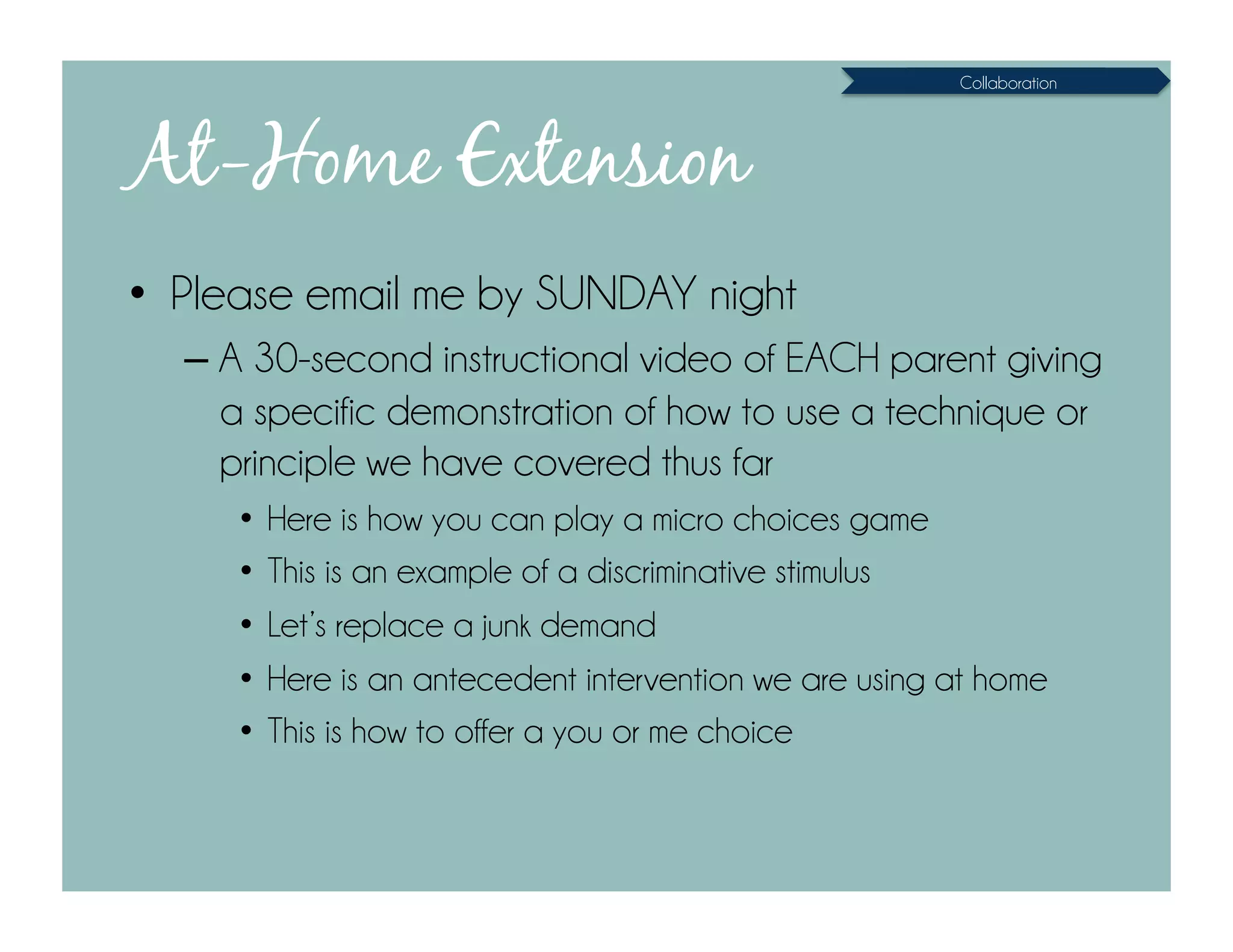
At-Home Extension
•  Please email me by SUNDAY night
  – A 30-second instructional video of EACH parent giving
    a specific demonstration of how to use a technique or
    principle we have covered thus far
     •  Here is how you can play a micro choices game
     •  This is an example of a discriminative stimulus
     •  Let’s replace a junk demand
     •  Here is an antecedent intervention we are using at home
     •  This is how to offer a you or me choice
Collaboration


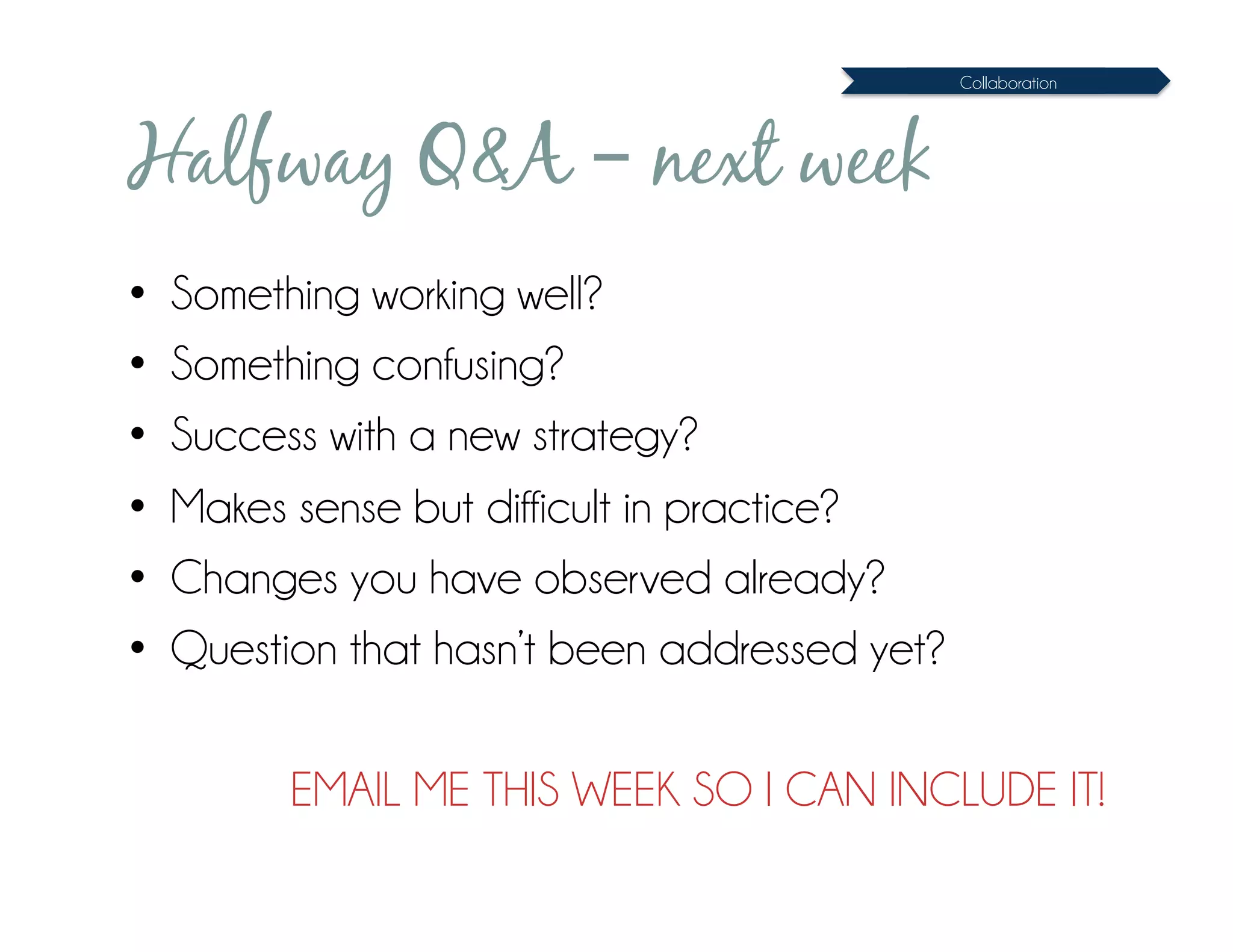
Halfway Q&A – next week
•  Something working well?
•  Something confusing?
•  Success with a new strategy?
•  Makes sense but difficult in practice?
•  Changes you have observed already?
•  Question that hasn’t been addressed yet?

        EMAIL ME THIS WEEK SO I CAN INCLUDE IT!

GSWC Workshop, Week 4

  • 1.
    Guiding Your StrongWilled Child 0 1 2 3 4 5 6 7 8 9 10
  • 2.
    Welcome Back! •  AppliedBehavior Analysis = •  Science of Learning •  Objective, Clear, Complete = •  Operational Definition •  4 Types of Choices Before = •  Open Ended Questions, Structured Choices, Micro Choices, You or Me Choices •  4 Types of Junk Demands = •  Question, Unenforceable, Unnecessary, Vague
  • 3.
    Week 4 Review Special Antecedents Community A Behavioral Dilemma Content Behavior is Functional Collaboration Commit & Stick, Part 2
  • 4.
    Review Avoiding Common Pitfalls • Choices Before – Keep them fun! Schedule during play time every day (even if you only have time for 10 minutes!) – Don’t linger if no choice, just choose & move on •  Junk Demands – “Careful” becomes “This is how we pet the cat” – Write down one to replace this week •  Antecedent Interventions – What time of day is consistently problematic? – Plan ahead & make time to take time
  • 5.
    Review Coming Soon…Good Demands • Choices are not intended to replace demands, they are meant to make life more fun & to create opportunities to share control with your child •  There is a place for good demands •  We have not yet practiced how to give a good demand but stay tuned. We will be practicing “Sure… First, Then” demands next week!
  • 6.
    Review Play: Spotthe Difference I need 4 volunteer actors. Two to act as parents and two to act as children!
  • 7.
    Review So Close Parent: Do you want to have apples or pears with dinner? Child: Bananas. •  Okay, bananas are a healthy option but •  Wish you had made it open- you need to have apples or pears next time ok? ended? Make a note for next •  OK time but commit & stick this time! •  You need to sit down, okay so you can •  A sneaky “okay?” turned it into eat them? a (question) demand •  [still walking around] •  Please sit down. It isn’t safe to eat while •  Gave (unenforced) demand you are walking around. from a distance without follow •  [still walking around] through •  Do you want to sit down in two minutes or in three minutes? •  Choice offered AFTER the •  Five minutes! demand
  • 8.
    Review Just Right •  Okay, we’ll have apples. Do you want •  Made a decision for the child cinnamon on them or no cinnamon? & moved on without dwelling •  Bananas! •  Okay, cinnamon apples it is! •  I don’t like cinnamon! •  Do you want to shake the cinnamon on or do you want me to? •  Advertised the joy of shaking •  I want to. •  Okay! You’ve got it! Are you going to •  Kept positive choices coming shake a lot or a little? •  A lot •  Ok! First, sit down. Then, cinnamon •  Gave a simple, clear demand. apples! “First, sit down. Then, cinnamon apples!”
  • 9.
    Review Special Antecedents •  Establishing Operations – Make a reinforcer more reinforcing •  A snack-free afternoon makes food at dinner more reinforcing •  Discriminative Stimuli – Signal what behavior will be reinforced or punished •  A direction such as “please sit down” is a sign that sitting down will be reinforced Photos viajcsnotebook.org & safetysign.com
  • 10.
    Review Establishing Operations? •  Thesepowerhouses influence the potency of the reinforcer – Trying to teach appropriate transitioning to the car? •  Keep a special box of your child’s favorite toys in your car & make them available ONLY if she transitions without protest Photo via readysetread.com
  • 11.
    Review Discriminative Stimuli? •  Thesesuperstars give us clues about which behavior will result in reinforcement – Child interrupts while you are talking on the phone? •  Consider using a Picture Rule to teach that the presence of the phone means that the child can find a book to wait & that attempts to talk will be honored when the phone call is done. Then make the rule come true! Photos via allposters.com & wellreadstudent.com
  • 12.
    Review Not-A-Test •  A (n)_____________ works by changing the reinforcement properties of a reinforcer. (a) functional analysis (b) establishing operation (c) preference assessment (d) discriminative stimulus
  • 13.
    Review Not-A-Test •  A (n)_____________ works by changing the reinforcement properties of a reinforcer. (a) functional analysis Establishing (b) establishing operation operations effect (c) preference assessment the reinforcer (d) discriminative stimulus ANSWER: (B) An establishing operation is a special antecedent that makes a reinforcer more reinforcing!
  • 14.
    Review Not-A-Test •  A (n)_____________ works by telling us what behavior will get reinforced or punished. (a) functional analysis (b) establishing operation (c) preference assessment (d) discriminative stimulus
  • 15.
    Review Not-A-Test •  A (n)_____________ works by telling us what behavior will get reinforced or punished. (a) functional analysis (b) establishing operation Discriminative stimuli (c) preference assessment effect behavior (d) discriminative stimulus selection Answer: (D) A discriminative stimulus is a special antecedent that signals what behavior will be reinforced or punished
  • 16.
    Week 4 Review Special Antecedents Community A Behavioral Dilemma Content Behavior is Functional Collaboration Commit & Stick, Part 2
  • 17.
  • 18.
  • 19.
    Community In-Workshop Extension •  Eachfamily will consider one behavior that is causing a problem in your home & to which your response has been inconsistent •  Write down: – Operational definition of the behavior – Observable antecedents to the behavior – How you currently respond
  • 20.
    Week 4 Review Special Antecedents Community A Behavioral Dilemma Content Behavior is Functional Collaboration Commit & Stick, Part 2
  • 21.
    Content Nuts & Boltsof Behavior Establishing Extinction & Operational Operations & Preference Definitions Discriminative Stimuli Assessments Original Behavior Antecedent Consequence Replacement Behavior
  • 22.
    Content The ABCs ofBehavior Establishing Operational Operations & Definitions Discriminative Stimuli Original Behavior Antecedent
  • 23.
    Content Behavior is Functional • All behavior serves a function •  When behavior “works” it is more likely to occur again the in future •  In other words, if a behavior continues to occur it is because it continues to work (or has worked for a long time) •  When the probability of behavior increases as a result of a consequence we say that behavior has been reinforced
  • 24.
    Content People Are NotReinforced Behavior is Reinforced
  • 25.
    Content Who Cares? •  Whenwe talk about reinforcing or punishing a PERSON, we are acting as if her behavior is a fixed part of her when it is not •  When we talk about reinforcing or punishing a BEHAVIOR, we are acknowledging that a person’s behavior can be changed •  My parents used to say, “I love you but I don’t love that behavior.”
  • 26.
    Content Not-A-Test •  All behaviorserves a __________________. Please write in your single word answer. If you don’t know the real answer, creative wrong answers will earn partial credit 
  • 27.
    Content Not-A-Test •  All behaviorserves a __________________. Please write in your single word answer. If you don’t know the real answer, creative wrong answers will earn partial credit  ANSWER: FUNCTION! And the key to changing a behavior is to understand its function.
  • 28.
    Week 4 Review Special Antecedents Community A Behavioral Dilemma Content Behavior is Functional Collaboration Commit & Stick, Part 2
  • 29.
  • 30.
  • 31.
    Collaboration Commit & Stick! • We don’t make changes to our commitments in the moment, but we can note to change them later •  Who holds the conch shell? •  Midnight Math = the enemy of consistency – “Oh but she is so sad.” – “I guess I don’t really care.” – “I don’t have time for this right now.” – “Oh how I wish I had not issued a demand!”
  • 32.
    Collaboration HAT meetings •  HowAre Things Meetings – Every 6-8 Weeks – Plan for a couple hours without children – Review meaningful categories such as: Physical Health, Professional, Relationships, Parenting, Spiritual, Financial – We use email to review the last HAT notes, record new action items, & send it to both of us at the end of the conversation with title “Next HAT, May 1st” – Safe place to share, written accountability
  • 33.
    Collaboration At-Home Extension •  Pleaseemail me by SUNDAY night – A 30-second instructional video of EACH parent giving a specific demonstration of how to use a technique or principle we have covered thus far •  Here is how you can play a micro choices game •  This is an example of a discriminative stimulus •  Let’s replace a junk demand •  Here is an antecedent intervention we are using at home •  This is how to offer a you or me choice
  • 34.
    Collaboration Halfway Q&A –next week •  Something working well? •  Something confusing? •  Success with a new strategy? •  Makes sense but difficult in practice? •  Changes you have observed already? •  Question that hasn’t been addressed yet? EMAIL ME THIS WEEK SO I CAN INCLUDE IT!