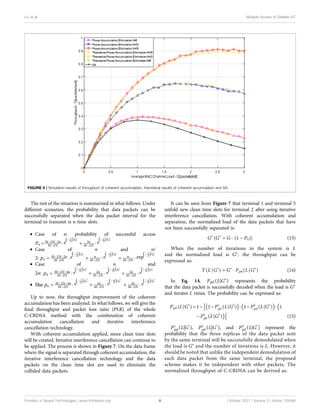
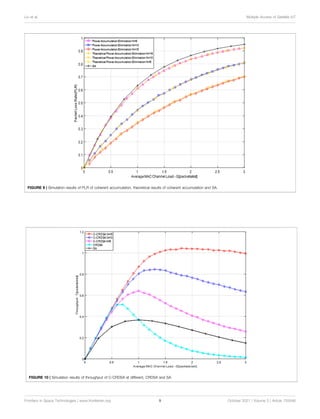
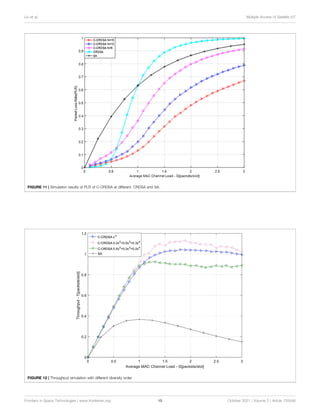
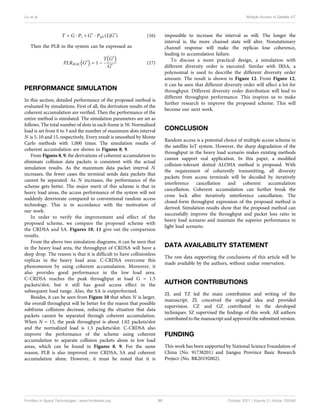
Coherent Contention Resolution
Diversity Slotted ALOHA: An Improved
Multiple Access Method for Satellite
IoT System
Ziwei Liu1
*, Tiantian Zhu1
, Chen Zhang1
, Gengxin Zhang1
and Shanshan Zhao2
1
College of Telecommunications and Information Engineering, Telecommunication and Networks National Engineering Research
Center, Nanjing University of Posts and Telecommunications, Nanjing, China, 2
College of Electronic and Optical Engineering,
Nanjing University of Posts and Telecommunications, Nanjing, China
For Beyond 5G/6G system, satellite communication systems become an effective
component of the space and terrestrial integrated network. Among typical
applications, massive Machine Type of Communication (mMTC) is a promising and
challenging application. The demands of low power consumption and light signaling
make random access methods as the potential solution. Up to now, contention
resolution-based ALOHA methods, such as contention resolution diversity slotted
ALOHA (CRDSA), improve the throughput significantly. However, its throughput will
meet the inflection point soon with the normalized load increasing since collisionless
packets are hardly existing. In fact, the diversity of transmitting packets is not utilized
totally. In this paper, an improved random access method, named coherent CRDSA
method (C-CRDSA), is proposed. It accumulates replicated packets coherently at
receiver and further improve the throughput over CRDSA. Detailed derivations and
simulations are given. Simulation results corroborate the effectiveness of the proposed
method.
Keywords: coherent accumulation, CRDSA, multiple access, internet of things, satellite communication
INTRODUCTION
Space and terrestrial integrated network can provide seamless and tridimensional information
services for the whole planet (Liu et al., 2018). It will promote the development of the communication
system and has become the core component of B5G/6G communication system (Chen et al., 2020).
Among varies of applications, Internet of Things (IoT) is a significant scenario to serve massive
machine-type communication. Terrestrial IoT terminals communicate through cellular networks
with narrow-band IoT (NB-IoT) or LoRa protocol, which is relatively complete (Leonardi et al.,
2019). However, for some special geographic areas, such as deserts, forests and oceans, the terrestrial
cellular network cannot support the IoT application for the lack of coverage. Besides, some crowds
gathering area will need extra access support. To cover these problems, satellite IoT system become a
good candidate.
Satellite communication systems are distributed in space and are not restricted by geographic
location. A properly designed satellite constellation can provide not only all-day, global seamless
coverage, but also higher reliability and resistance connection (Fraire et al., 2020). However, due to
the wide coverage, the simultaneous access number of terminal nodes in the satellite IoT system will
Edited by:
Wei Feng,
Tsinghua University, China
Reviewed by:
Kefeng Guo,
Space Engineering University, China
Lexi Xu,
China United Network
Communications Group, China
*Correspondence:
Ziwei Liu
lzw@njupt.edu.cn
Specialty section:
This article was submitted to
Aerial and Space Networks,
a section of the journal
Frontiers in Space Technologies
Received: 09 August 2021
Accepted: 20 September 2021
Published: 20 October 2021
Citation:
Liu Z, Zhu T, Zhang C, Zhang G and
Zhao S (2021) Coherent Contention
Resolution Diversity Slotted ALOHA:
An Improved Multiple Access Method
for Satellite IoT System.
Front. Space Technol. 2:755546.
doi: 10.3389/frspt.2021.755546
Frontiers in Space Technologies | www.frontiersin.org October 2021 | Volume 2 | Article 755546
1
ORIGINAL RESEARCH
published: 20 October 2021
doi: 10.3389/frspt.2021.755546
reach ten thousand to million. It becomes a great challenge on
system throughput and access efficiency.
Traditional fixed-allocation multiple access methods are
widely used, and the channel utilization rate is relatively high
(Liu et al., 2006). Unfortunately, it fits the fixed connection
demand or costs precious control signaling. For the satellite
IoT system, most terminals transmit burst packets. Moreover,
the long propagation delay and low power consumption demand
make it impossible to request resources dynamically (Qu et al.,
2019). Therefore, in this scenario, any multiple access scheme
based on fixed or dynamic resource allocation is not applicable.
On the contrary, we turn to random access technology. The
terminal can compete for communication resources without
scheduling, which is more suitable for the satellite IoT system.
In the past few decades, ALOHA-based random access
technology has been continuously improved to support the
satellite IoT multiple access demand. Slotted ALOHA (SA) is
first discussed after pure ALOHA (Gurcan et al., 1997). A frame is
divided into time slots of the same length. Each terminal can only
send data packets in a specified time slot. If multiple terminals
select the same time slot to send their data packets, collision will
occur and all of the colliding packets will be failure to access. Its
maximum normalized throughput can only reach 0.36
theoretically, which is far from the system requirement.
Diversity slotted ALOHA (DSA) improves performance by
transmitting multiple replicas of the terminal on the basis of
slotted ALOHA. When the normalized load is low, the
throughput of DSA is improved over SA since replicas can
help access in collisionless slots. For heavy load scenario, the
throughput degrades rapidly for more collision occurring from
too many replicas. In order to solve the problem of packet
collision, the contention resolution diversity slotted ALOHA
(CRDSA) was proposed, in which packet diversity
transmission and iterative interference cancellation were
effectively combined. It promotes the maximum normalized
throughput to about 0.55 (Casini et al., 2007).
Moreover, some improved methods were proposed, such as
CRDSA++, IRSA and so on (Meloni and Murroni, 2012; Lee et al.,
2012; Mengali et al., 2017; Kissling, 2011, Zhao et al., 2019, Liva,
2011). Compared with CRDSA, CRDSA++ allows terminals to
transmit more than 2 identical duplicate packets. More replicas
can provide a little more improvement on throughput. IRSA
made further improvements by optimizing the number of replicas
of data packets sent by each terminal. Except for CRDSA, an
asynchronous scheme called Asynchronous Contention
Resolution Diversity Slot Access Technology (ACRDA) and its
improved versions were proposed in the literature (De Gaudenzi
et al., 2014; Wong et al., 2017; Almonacid and Franck, 2017).
However, asynchronous access methods suffer lower throughput
when they keep the benefit of low complexity. Although the
above-mentioned random access technologies have greatly
improved performances compared with original ALOHA, they
all will suffer the “avalanche effect”. As the normalized load
increases, their access effect will drop sharply. It is still necessary
to modify throughput performance in heavy load scenario. In
order to overcome this shortage, the power difference between
data packets is used to solve the collision problem (Alvi et al.,
2018; Zheng et al., 2014). However, due to the particularity of the
satellite-ground distance and the inapplicability of small IoT
terminals for power control, the power difference between
data packets is not easy to obtain in satellite IoT systems.
In fact, packet diversity and iteratively cancellation is still an
available solution. The key is to build the cancellation condition
properly at receiver. In this paper, inspired by CRDSA++ and
ACRDA, an improved diversity slotted random access scheme is
proposed. Each terminal transmits a virtual slotted subframe in
which all the replicas are coherent and have the same interval
with each other. At receiver, the traditional iteratively
cancellation in CRDSA with collisionless replica and the
introduced coherent accumulation operation is alternatively
executed. When there is lack of collisionless replica, the sliding
coherent accumulation operation is applied to potential virtual
subframes to construct the signal-to-noise gain. Packets from the
same terminal can be accumulated and enough gain will lead to
successful cancellation and break a new breach for next round
iteratively cancellation. With the proposed scheme, the
throughput will be improved apparently, especially in the
heavy load scenario. Simulation results verify the effectiveness
of the proposed method.
The rest of this paper is organized as follows. System and
Signal Model gives the system and signal model this paper
concerned. The proposed scheme is illustrated in Using
Coherent Accumulation to Cancel Collided Data Packet. In the
Throughput Analysis With Detailed Derivations, detailed
derivations of the throughput are given. All the performance
are evaluated in the Performance Simulation and conclusion is
presented in the Conclusion.
SYSTEM AND SIGNAL MODEL
Satellite IoT Access Scenario
In this paper, the satellite IoT is considered for remote areas like
deserts and ocean areas. It is composed of satellite nodes, ground
gateways and a large number of IoT terminals. Among them, the
IoT terminal is used for the sensing and collecting information.
Satellites are used to accept and forwarding the information or
signals. The ground gateway station is used for authentication
management and processing centers. A brief diagram is shown in
Figure 1. When the satellite receives the data frame information
transmitted by the terminal, it forwards it to the ground customs
station for data analysis and processing.
In most cases, IoT terminals can be divided into two types,
namely periodically transmitting type and event-driven type.
Periodically transmitting type of terminals keep in dormancy
until the pre-set period reach. Then they will transmit the
collected data and turn into dormancy again. The event-driven
type of terminals will keep in dormancy until triggered by
operator or outer event. This type of terminals is usually more
functional than periods types. However, both of these two types of
terminals need long standby time and low power consumption.
As a result, they will save as much power as possible during its
transmitting period. No complicated signaling on access resource
allocation or power control is admitted. However, ephemeris is
Frontiers in Space Technologies | www.frontiersin.org October 2021 | Volume 2 | Article 755546
2
Liu et al. Multiple Access of Satellite IoT
stored in each terminal and their own locations can be obtained
by Global Navigation Satellite System (GNSS) systems.
Signal Transmitting Model
Instead of traditional time division multiple access (TDMA), we
turn to slotted ALOHA-based breach. Inspired by CRDSA++, in
the proposed method, each terminal transmits E packets
coherently. Here the coherence means the packets in a virtual
subframe contain the same information and modulated by the
coherent carrier. The expression of the first data packet
transmitted by terminal c is shown in Eq. 1.
Sc(t)  Pc · cos2πfct + θc(t) + φc t ∈ [tc, tc + tm] (1)
tm is the length of each time slot. Pc represents the power
transmitted by the terminal c. fc represents the signal central
frequency, φc is the initial phase of the signal and θc(t) contains
the modulation information. tc is the initial time slot selected by
terminal c. Here it is assumed that Doppler shift of all packets are
pre-compensated during transmitting using ephemeris and the
terminal location.
The E data packets transmitted by each terminal can be
regarded as an independent virtual subframe. The first data
packet transmitted by the terminal is randomly selected in the
frame with the step of one slot. The following E − 1 data packets
are transmitted with a fixed time interval. The fixed time slot
interval is different from each terminal, and it is selected within
the interval range [1, N] by every terminal. Data packets from the
same terminal contain the location information of every replica.
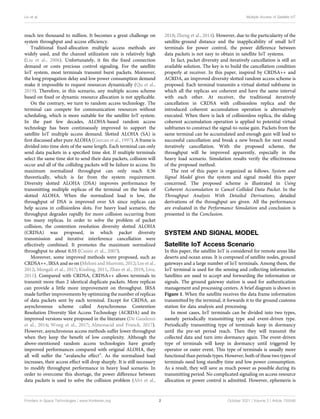
The virtual frame can be expressed by Eq. 2. The entire data
subframe is shown in Figure 2. In the figure, it shows that
terminal 1 transmits the first data packet in time slot 2 and
selects interval between data packets is one time slots. These three
data packets transmitted by terminal 1 can be regarded as a virtual
subframe.
Yvf(c)  {Sc(t), Sc(t + n · tm), · · ·, Sc(t + n · (E − 1) · tm)} (2)
Received Signal Model
Due to short time interval between each data packet in a subframe
and short-term stability of Doppler, the channel state between
each packet can be viewed as stationary. The Doppler frequency
shift between data packets which come from the same terminal is
approximately equal in the subframe. When the access subframe
reaches the receiver, all the packets will keep the coherence
FIGURE 1 | Satellite IoT system working diagram.
FIGURE 2 | Signal transmitting mechanism.
Frontiers in Space Technologies | www.frontiersin.org October 2021 | Volume 2 | Article 755546
3
Liu et al. Multiple Access of Satellite IoT
between each other. Eq. 3 expresses the signal model with
multiple signals collision in wth time slot. The initial time of
wth time slot is tw. v(t) is Gaussian white noise.
Ycollision(w)  
z
i1
hi

pi

cos2πfit + θi(t) + φi + v(t)
t ∈ [tw, tw + tm]
(3)
It must be pointed out that there is no correlation between data
packet signals from different terminals and noise is independent
with all the signals.
USING COHERENT ACCUMULATION TO
CANCEL COLLIDED DATA PACKET
With the coherence in the received subframe, coherent
accumulation can be achieved to increase the signal-to-
interference-plus-noise ratio (SINR) and build the collision
separation condition, which is widely used in radar system
(You et al., 2006). The phase between different replicas will
maintain constant so as to be processed coherently.
Considering the potential Doppler shift, Fast Fourier
transformation (FFT) is usually performed to accumulate
coherent signals (Yuan et al., 2016).
Yaccq  
E
n1
Sc(t + ntm)ej2π
kq
N0 (4)
In our design, the Doppler shift is compensated before
transmitting. The accumulation is simplified into the zero-
channel output of the FFT filter bank, i.e., a summator.
Yaccq  
E
n1
Sc(t + ntm) (5)
In the receiver, when the traditional iteratively interference
cancellation procedure is stuck, the coherent accumulation is
activated to break the “cross lock” situation in the CRDSA
receiving scheme. In order to search for all the potential
accumulation subframe, a group of sliding windows with all
possible subframe width should be applied to scan the whole
access frame. The receiver sets the length of the sliding window
to (E − 1) · N + 1 time slots. Within the sliding window, E time
slots are locked. Only all the packets from one terminal fall into
one window can be accumulated. The more packets used, the
more SINR gain it collected. The coherent packets will be
accumulated with amplitude raising to E times while
incoherent packets, such as packets from different
terminals, and noise raise E times power. The SINR gain
comes from
G  10 log10 E (6)
The sliding window moves one time a slot forward when the
data in the first window has been accumulated and canceled.
Move the window perform the above operations iteratively until
all the time slots have been accumulated at least once. The
diagram of the whole receiving scheme is shown in Figure 3.
With the separation, some locked collision packets will be
cancelled. Then iteratively interference cancellation procedure
can continue with more collisionless packets being unfolded. In
what follows, the detailed derivations about the throughput
improvement are given to illustrate the advantage of the
proposed method.
THROUGHPUT ANALYSIS WITH DETAILED
DERIVATIONS
The key to analyze the throughput is to uncover the improvement
that coherent accumulation imposes on the regular CRDSA. To
make the derivations more comprehensive, it is started with the
fixed length of the virtual subframe.
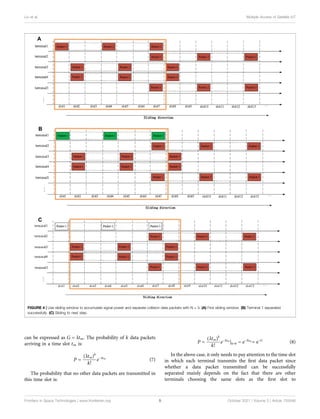
Take E  3 and 2 slot intervals as an example. Figures 4A,B
show that within the first sliding window, terminal 1 transmits
its packets in the first, fourth, and seventh time slot. The
accumulation will be applied to these three slots since it is
assumed all the virtual subframes are the same with E  3 and 2
slot intervals. In these three slots, only terminal 2 and 5
transmit one packet. As a result, the packets transmitted by
the terminal 1 can use the SINR difference created by coherent
accumulation to separate and cancel all three packets. Then the
sliding window moves forward by one time slot, which is
shown in Figure 4C. All the slots will be accumulated at
least once with window sliding.
Without loss of generality, it is assumed that the data packet
transmitted by the terminal satisfies the Poisson distribution with
the parameter λ in the time slot interval tm. The normalized load
FIGURE 3 | The diagram of the whole receiving scheme.
Frontiers in Space Technologies | www.frontiersin.org October 2021 | Volume 2 | Article 755546
4
Liu et al. Multiple Access of Satellite IoT
can be expressed as G  λtm. The probability of k data packets
arriving in a time slot tm is:
P 
(λtm)k
k!
e−λtm
(7)
The probability that no other data packets are transmitted in
this time slot is:
P 
(λtm)k
k!
e−λtm
|k0  e−λtm
 e−G
(8)
In the above case, it only needs to pay attention to the time slot
in which each terminal transmits the first data packet since
whether a data packet transmitted can be successfully
separated mainly depends on the fact that there are other
terminals choosing the same slots as the first slot to
FIGURE 4 | Use sliding window to accumulate signal power and separate collision data packets with N  3. (A) First sliding window. (B) Terminal 1 separated
successfully. (C) Sliding to next step.
Frontiers in Space Technologies | www.frontiersin.org October 2021 | Volume 2 | Article 755546
5
Liu et al. Multiple Access of Satellite IoT
transmitting packets or not. The probability that a data packet
transmitted by a terminal is successfully separated is:
Ps 
M − 4N
M − 2N
· e−3λtm
+
2N
M − 2N
· e−2λtm

M − 4N
M − 2N
· e−3G
+
2N
M − 2N
· e−2G
(9)
Transmitting the first data packet in the last 2N time slots in
the data frame, which is unsuccessful by default. We replace with
G′ and G′  M
M−2N · G.
Ps 
M − 4N
M − 2N
· e−3G’
+
2N
M − 2N
· e−2G’
(10)
Then we can obtain the extra throughput that coherent
accumulation can provide in this case is:
T1  G · Ps (11)
With the above-mentioned derivation basements, the
more general case that each terminal transmits packets
with random interval can be analyzed. All the intervals
are chosen within the interval range [1, N], where the
maximum transmission interval is N. This increases the
selectivity of the terminal to transmit data packets, and
can increase the number of terminals whose signals can
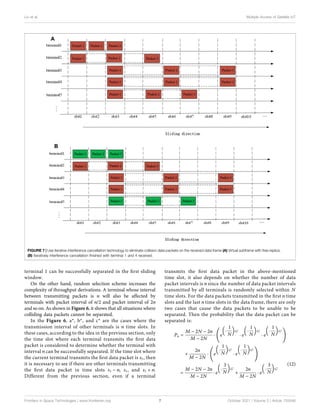
be separated. As shown in Figure 5, since each terminal
randomly selects the transmitting interval, the data packet of
FIGURE 5 | All terminals transmit data packets with different and random intervals.
FIGURE 6 | Coherent accumulation separation fails when the interval between the terminal transmitting data packets with two time slots.
Frontiers in Space Technologies | www.frontiersin.org October 2021 | Volume 2 | Article 755546
6
Liu et al. Multiple Access of Satellite IoT
terminal 1 can be successfully separated in the first sliding
window.
On the other hand, random selection scheme increases the
complexity of throughput derivations. A terminal whose interval
between transmitting packets is n will also be affected by
terminals with packet interval of n/2 and packet interval of 2n
and so on. As shown in Figure 6, it shows that all situations where
colliding data packets cannot be separated.
In the Figure 6, a*, b*, and c* are the cases where the
transmission interval of other terminals is n time slots. In
these cases, according to the idea in the previous section, only
the time slot where each terminal transmits the first data
packet is considered to determine whether the terminal with
interval n can be successfully separated. If the time slot where
the current terminal transmits the first data packet is s1, then
it is necessary to see if there are other terminals transmitting
the first data packet in time slots s1 − n, s1, and s1 + n.
Different from the previous section, even if a terminal
transmits the first data packet in the above-mentioned
time slot, it also depends on whether the number of data
packet intervals is n since the number of data packet intervals
transmitted by all terminals is randomly selected within N
time slots. For the data packets transmitted in the first n time
slots and the last n time slots in the data frame, there are only
two cases that cause the data packets to be unable to be
separated. Then the probability that the data packet can be
separated is:
Pn 
M − 2N − 2n
M − 2N
· ⎛
⎝e
−
1
N
·G’
· e
−
1
N
·G’
· e
−
1
N
·G’
⎞
⎠
+
2n
M − 2N
· ⎛
⎝e
−
1
N
·G’
· e
−
1
N
·G’
⎞
⎠

M − 2N − 2n
M − 2N
· e
−
3
N

contention resolution diversity slotted.pdf

  • 1.
    Coherent Contention Resolution DiversitySlotted ALOHA: An Improved Multiple Access Method for Satellite IoT System Ziwei Liu1 *, Tiantian Zhu1 , Chen Zhang1 , Gengxin Zhang1 and Shanshan Zhao2 1 College of Telecommunications and Information Engineering, Telecommunication and Networks National Engineering Research Center, Nanjing University of Posts and Telecommunications, Nanjing, China, 2 College of Electronic and Optical Engineering, Nanjing University of Posts and Telecommunications, Nanjing, China For Beyond 5G/6G system, satellite communication systems become an effective component of the space and terrestrial integrated network. Among typical applications, massive Machine Type of Communication (mMTC) is a promising and challenging application. The demands of low power consumption and light signaling make random access methods as the potential solution. Up to now, contention resolution-based ALOHA methods, such as contention resolution diversity slotted ALOHA (CRDSA), improve the throughput significantly. However, its throughput will meet the inflection point soon with the normalized load increasing since collisionless packets are hardly existing. In fact, the diversity of transmitting packets is not utilized totally. In this paper, an improved random access method, named coherent CRDSA method (C-CRDSA), is proposed. It accumulates replicated packets coherently at receiver and further improve the throughput over CRDSA. Detailed derivations and simulations are given. Simulation results corroborate the effectiveness of the proposed method. Keywords: coherent accumulation, CRDSA, multiple access, internet of things, satellite communication INTRODUCTION Space and terrestrial integrated network can provide seamless and tridimensional information services for the whole planet (Liu et al., 2018). It will promote the development of the communication system and has become the core component of B5G/6G communication system (Chen et al., 2020). Among varies of applications, Internet of Things (IoT) is a significant scenario to serve massive machine-type communication. Terrestrial IoT terminals communicate through cellular networks with narrow-band IoT (NB-IoT) or LoRa protocol, which is relatively complete (Leonardi et al., 2019). However, for some special geographic areas, such as deserts, forests and oceans, the terrestrial cellular network cannot support the IoT application for the lack of coverage. Besides, some crowds gathering area will need extra access support. To cover these problems, satellite IoT system become a good candidate. Satellite communication systems are distributed in space and are not restricted by geographic location. A properly designed satellite constellation can provide not only all-day, global seamless coverage, but also higher reliability and resistance connection (Fraire et al., 2020). However, due to the wide coverage, the simultaneous access number of terminal nodes in the satellite IoT system will Edited by: Wei Feng, Tsinghua University, China Reviewed by: Kefeng Guo, Space Engineering University, China Lexi Xu, China United Network Communications Group, China *Correspondence: Ziwei Liu lzw@njupt.edu.cn Specialty section: This article was submitted to Aerial and Space Networks, a section of the journal Frontiers in Space Technologies Received: 09 August 2021 Accepted: 20 September 2021 Published: 20 October 2021 Citation: Liu Z, Zhu T, Zhang C, Zhang G and Zhao S (2021) Coherent Contention Resolution Diversity Slotted ALOHA: An Improved Multiple Access Method for Satellite IoT System. Front. Space Technol. 2:755546. doi: 10.3389/frspt.2021.755546 Frontiers in Space Technologies | www.frontiersin.org October 2021 | Volume 2 | Article 755546 1 ORIGINAL RESEARCH published: 20 October 2021 doi: 10.3389/frspt.2021.755546
  • 2.
    reach ten thousandto million. It becomes a great challenge on system throughput and access efficiency. Traditional fixed-allocation multiple access methods are widely used, and the channel utilization rate is relatively high (Liu et al., 2006). Unfortunately, it fits the fixed connection demand or costs precious control signaling. For the satellite IoT system, most terminals transmit burst packets. Moreover, the long propagation delay and low power consumption demand make it impossible to request resources dynamically (Qu et al., 2019). Therefore, in this scenario, any multiple access scheme based on fixed or dynamic resource allocation is not applicable. On the contrary, we turn to random access technology. The terminal can compete for communication resources without scheduling, which is more suitable for the satellite IoT system. In the past few decades, ALOHA-based random access technology has been continuously improved to support the satellite IoT multiple access demand. Slotted ALOHA (SA) is first discussed after pure ALOHA (Gurcan et al., 1997). A frame is divided into time slots of the same length. Each terminal can only send data packets in a specified time slot. If multiple terminals select the same time slot to send their data packets, collision will occur and all of the colliding packets will be failure to access. Its maximum normalized throughput can only reach 0.36 theoretically, which is far from the system requirement. Diversity slotted ALOHA (DSA) improves performance by transmitting multiple replicas of the terminal on the basis of slotted ALOHA. When the normalized load is low, the throughput of DSA is improved over SA since replicas can help access in collisionless slots. For heavy load scenario, the throughput degrades rapidly for more collision occurring from too many replicas. In order to solve the problem of packet collision, the contention resolution diversity slotted ALOHA (CRDSA) was proposed, in which packet diversity transmission and iterative interference cancellation were effectively combined. It promotes the maximum normalized throughput to about 0.55 (Casini et al., 2007). Moreover, some improved methods were proposed, such as CRDSA++, IRSA and so on (Meloni and Murroni, 2012; Lee et al., 2012; Mengali et al., 2017; Kissling, 2011, Zhao et al., 2019, Liva, 2011). Compared with CRDSA, CRDSA++ allows terminals to transmit more than 2 identical duplicate packets. More replicas can provide a little more improvement on throughput. IRSA made further improvements by optimizing the number of replicas of data packets sent by each terminal. Except for CRDSA, an asynchronous scheme called Asynchronous Contention Resolution Diversity Slot Access Technology (ACRDA) and its improved versions were proposed in the literature (De Gaudenzi et al., 2014; Wong et al., 2017; Almonacid and Franck, 2017). However, asynchronous access methods suffer lower throughput when they keep the benefit of low complexity. Although the above-mentioned random access technologies have greatly improved performances compared with original ALOHA, they all will suffer the “avalanche effect”. As the normalized load increases, their access effect will drop sharply. It is still necessary to modify throughput performance in heavy load scenario. In order to overcome this shortage, the power difference between data packets is used to solve the collision problem (Alvi et al., 2018; Zheng et al., 2014). However, due to the particularity of the satellite-ground distance and the inapplicability of small IoT terminals for power control, the power difference between data packets is not easy to obtain in satellite IoT systems. In fact, packet diversity and iteratively cancellation is still an available solution. The key is to build the cancellation condition properly at receiver. In this paper, inspired by CRDSA++ and ACRDA, an improved diversity slotted random access scheme is proposed. Each terminal transmits a virtual slotted subframe in which all the replicas are coherent and have the same interval with each other. At receiver, the traditional iteratively cancellation in CRDSA with collisionless replica and the introduced coherent accumulation operation is alternatively executed. When there is lack of collisionless replica, the sliding coherent accumulation operation is applied to potential virtual subframes to construct the signal-to-noise gain. Packets from the same terminal can be accumulated and enough gain will lead to successful cancellation and break a new breach for next round iteratively cancellation. With the proposed scheme, the throughput will be improved apparently, especially in the heavy load scenario. Simulation results verify the effectiveness of the proposed method. The rest of this paper is organized as follows. System and Signal Model gives the system and signal model this paper concerned. The proposed scheme is illustrated in Using Coherent Accumulation to Cancel Collided Data Packet. In the Throughput Analysis With Detailed Derivations, detailed derivations of the throughput are given. All the performance are evaluated in the Performance Simulation and conclusion is presented in the Conclusion. SYSTEM AND SIGNAL MODEL Satellite IoT Access Scenario In this paper, the satellite IoT is considered for remote areas like deserts and ocean areas. It is composed of satellite nodes, ground gateways and a large number of IoT terminals. Among them, the IoT terminal is used for the sensing and collecting information. Satellites are used to accept and forwarding the information or signals. The ground gateway station is used for authentication management and processing centers. A brief diagram is shown in Figure 1. When the satellite receives the data frame information transmitted by the terminal, it forwards it to the ground customs station for data analysis and processing. In most cases, IoT terminals can be divided into two types, namely periodically transmitting type and event-driven type. Periodically transmitting type of terminals keep in dormancy until the pre-set period reach. Then they will transmit the collected data and turn into dormancy again. The event-driven type of terminals will keep in dormancy until triggered by operator or outer event. This type of terminals is usually more functional than periods types. However, both of these two types of terminals need long standby time and low power consumption. As a result, they will save as much power as possible during its transmitting period. No complicated signaling on access resource allocation or power control is admitted. However, ephemeris is Frontiers in Space Technologies | www.frontiersin.org October 2021 | Volume 2 | Article 755546 2 Liu et al. Multiple Access of Satellite IoT
  • 3.
    stored in eachterminal and their own locations can be obtained by Global Navigation Satellite System (GNSS) systems. Signal Transmitting Model Instead of traditional time division multiple access (TDMA), we turn to slotted ALOHA-based breach. Inspired by CRDSA++, in the proposed method, each terminal transmits E packets coherently. Here the coherence means the packets in a virtual subframe contain the same information and modulated by the coherent carrier. The expression of the first data packet transmitted by terminal c is shown in Eq. 1. Sc(t) Pc · cos2πfct + θc(t) + φc t ∈ [tc, tc + tm] (1) tm is the length of each time slot. Pc represents the power transmitted by the terminal c. fc represents the signal central frequency, φc is the initial phase of the signal and θc(t) contains the modulation information. tc is the initial time slot selected by terminal c. Here it is assumed that Doppler shift of all packets are pre-compensated during transmitting using ephemeris and the terminal location. The E data packets transmitted by each terminal can be regarded as an independent virtual subframe. The first data packet transmitted by the terminal is randomly selected in the frame with the step of one slot. The following E − 1 data packets are transmitted with a fixed time interval. The fixed time slot interval is different from each terminal, and it is selected within the interval range [1, N] by every terminal. Data packets from the same terminal contain the location information of every replica. The virtual frame can be expressed by Eq. 2. The entire data subframe is shown in Figure 2. In the figure, it shows that terminal 1 transmits the first data packet in time slot 2 and selects interval between data packets is one time slots. These three data packets transmitted by terminal 1 can be regarded as a virtual subframe. Yvf(c) {Sc(t), Sc(t + n · tm), · · ·, Sc(t + n · (E − 1) · tm)} (2) Received Signal Model Due to short time interval between each data packet in a subframe and short-term stability of Doppler, the channel state between each packet can be viewed as stationary. The Doppler frequency shift between data packets which come from the same terminal is approximately equal in the subframe. When the access subframe reaches the receiver, all the packets will keep the coherence FIGURE 1 | Satellite IoT system working diagram. FIGURE 2 | Signal transmitting mechanism. Frontiers in Space Technologies | www.frontiersin.org October 2021 | Volume 2 | Article 755546 3 Liu et al. Multiple Access of Satellite IoT
  • 4.
    between each other.Eq. 3 expresses the signal model with multiple signals collision in wth time slot. The initial time of wth time slot is tw. v(t) is Gaussian white noise. Ycollision(w) z i1 hi pi cos2πfit + θi(t) + φi + v(t) t ∈ [tw, tw + tm] (3) It must be pointed out that there is no correlation between data packet signals from different terminals and noise is independent with all the signals. USING COHERENT ACCUMULATION TO CANCEL COLLIDED DATA PACKET With the coherence in the received subframe, coherent accumulation can be achieved to increase the signal-to- interference-plus-noise ratio (SINR) and build the collision separation condition, which is widely used in radar system (You et al., 2006). The phase between different replicas will maintain constant so as to be processed coherently. Considering the potential Doppler shift, Fast Fourier transformation (FFT) is usually performed to accumulate coherent signals (Yuan et al., 2016). Yaccq E n1 Sc(t + ntm)ej2π kq N0 (4) In our design, the Doppler shift is compensated before transmitting. The accumulation is simplified into the zero- channel output of the FFT filter bank, i.e., a summator. Yaccq E n1 Sc(t + ntm) (5) In the receiver, when the traditional iteratively interference cancellation procedure is stuck, the coherent accumulation is activated to break the “cross lock” situation in the CRDSA receiving scheme. In order to search for all the potential accumulation subframe, a group of sliding windows with all possible subframe width should be applied to scan the whole access frame. The receiver sets the length of the sliding window to (E − 1) · N + 1 time slots. Within the sliding window, E time slots are locked. Only all the packets from one terminal fall into one window can be accumulated. The more packets used, the more SINR gain it collected. The coherent packets will be accumulated with amplitude raising to E times while incoherent packets, such as packets from different terminals, and noise raise E times power. The SINR gain comes from G 10 log10 E (6) The sliding window moves one time a slot forward when the data in the first window has been accumulated and canceled. Move the window perform the above operations iteratively until all the time slots have been accumulated at least once. The diagram of the whole receiving scheme is shown in Figure 3. With the separation, some locked collision packets will be cancelled. Then iteratively interference cancellation procedure can continue with more collisionless packets being unfolded. In what follows, the detailed derivations about the throughput improvement are given to illustrate the advantage of the proposed method. THROUGHPUT ANALYSIS WITH DETAILED DERIVATIONS The key to analyze the throughput is to uncover the improvement that coherent accumulation imposes on the regular CRDSA. To make the derivations more comprehensive, it is started with the fixed length of the virtual subframe. Take E 3 and 2 slot intervals as an example. Figures 4A,B show that within the first sliding window, terminal 1 transmits its packets in the first, fourth, and seventh time slot. The accumulation will be applied to these three slots since it is assumed all the virtual subframes are the same with E 3 and 2 slot intervals. In these three slots, only terminal 2 and 5 transmit one packet. As a result, the packets transmitted by the terminal 1 can use the SINR difference created by coherent accumulation to separate and cancel all three packets. Then the sliding window moves forward by one time slot, which is shown in Figure 4C. All the slots will be accumulated at least once with window sliding. Without loss of generality, it is assumed that the data packet transmitted by the terminal satisfies the Poisson distribution with the parameter λ in the time slot interval tm. The normalized load FIGURE 3 | The diagram of the whole receiving scheme. Frontiers in Space Technologies | www.frontiersin.org October 2021 | Volume 2 | Article 755546 4 Liu et al. Multiple Access of Satellite IoT
  • 5.
    can be expressedas G λtm. The probability of k data packets arriving in a time slot tm is: P (λtm)k k! e−λtm (7) The probability that no other data packets are transmitted in this time slot is: P (λtm)k k! e−λtm |k0 e−λtm e−G (8) In the above case, it only needs to pay attention to the time slot in which each terminal transmits the first data packet since whether a data packet transmitted can be successfully separated mainly depends on the fact that there are other terminals choosing the same slots as the first slot to FIGURE 4 | Use sliding window to accumulate signal power and separate collision data packets with N 3. (A) First sliding window. (B) Terminal 1 separated successfully. (C) Sliding to next step. Frontiers in Space Technologies | www.frontiersin.org October 2021 | Volume 2 | Article 755546 5 Liu et al. Multiple Access of Satellite IoT
  • 6.
    transmitting packets ornot. The probability that a data packet transmitted by a terminal is successfully separated is: Ps M − 4N M − 2N · e−3λtm + 2N M − 2N · e−2λtm M − 4N M − 2N · e−3G + 2N M − 2N · e−2G (9) Transmitting the first data packet in the last 2N time slots in the data frame, which is unsuccessful by default. We replace with G′ and G′ M M−2N · G. Ps M − 4N M − 2N · e−3G’ + 2N M − 2N · e−2G’ (10) Then we can obtain the extra throughput that coherent accumulation can provide in this case is: T1 G · Ps (11) With the above-mentioned derivation basements, the more general case that each terminal transmits packets with random interval can be analyzed. All the intervals are chosen within the interval range [1, N], where the maximum transmission interval is N. This increases the selectivity of the terminal to transmit data packets, and can increase the number of terminals whose signals can be separated. As shown in Figure 5, since each terminal randomly selects the transmitting interval, the data packet of FIGURE 5 | All terminals transmit data packets with different and random intervals. FIGURE 6 | Coherent accumulation separation fails when the interval between the terminal transmitting data packets with two time slots. Frontiers in Space Technologies | www.frontiersin.org October 2021 | Volume 2 | Article 755546 6 Liu et al. Multiple Access of Satellite IoT
  • 7.
    terminal 1 canbe successfully separated in the first sliding window. On the other hand, random selection scheme increases the complexity of throughput derivations. A terminal whose interval between transmitting packets is n will also be affected by terminals with packet interval of n/2 and packet interval of 2n and so on. As shown in Figure 6, it shows that all situations where colliding data packets cannot be separated. In the Figure 6, a*, b*, and c* are the cases where the transmission interval of other terminals is n time slots. In these cases, according to the idea in the previous section, only the time slot where each terminal transmits the first data packet is considered to determine whether the terminal with interval n can be successfully separated. If the time slot where the current terminal transmits the first data packet is s1, then it is necessary to see if there are other terminals transmitting the first data packet in time slots s1 − n, s1, and s1 + n. Different from the previous section, even if a terminal transmits the first data packet in the above-mentioned time slot, it also depends on whether the number of data packet intervals is n since the number of data packet intervals transmitted by all terminals is randomly selected within N time slots. For the data packets transmitted in the first n time slots and the last n time slots in the data frame, there are only two cases that cause the data packets to be unable to be separated. Then the probability that the data packet can be separated is: Pn M − 2N − 2n M − 2N · ⎛ ⎝e − 1 N
  • 8.
  • 9.
  • 10.
  • 11.
  • 12.
    ·G’ ⎞ ⎠ M − 2N− 2n M − 2N · e − 3 N