Terrestrialsatellite Communication Networks
Transceivers Design And Resource Allocation
Jiang download

https://ebookbell.com/product/terrestrialsatellite-communication-
networks-transceivers-design-and-resource-allocation-
jiang-6752830
Explore and download more ebooks at ebookbell.com
Here are some recommended products that we believe you will be
interested in. You can click the link to download.
Modeling And Simulation Environment For Satellite And Terrestrial
Communications Networks Proceedings Of The European Cost
Telecommunications Symposium 1st Edition A Nejat Ince Auth
https://ebookbell.com/product/modeling-and-simulation-environment-for-
satellite-and-terrestrial-communications-networks-proceedings-of-the-
european-cost-telecommunications-symposium-1st-edition-a-nejat-ince-
auth-4187772
Cdma Access And Switching For Terrestrial And Satellite Networks 1st
Edition Diakoumis Gerakoulis
https://ebookbell.com/product/cdma-access-and-switching-for-
terrestrial-and-satellite-networks-1st-edition-diakoumis-
gerakoulis-2008322
Satellite And Terrestrial Radio Positioning Techniques A Signal
Processing Perspective 1st Edition Davide Dardari
https://ebookbell.com/product/satellite-and-terrestrial-radio-
positioning-techniques-a-signal-processing-perspective-1st-edition-
davide-dardari-2559174
Satellite And Terrestrial Hybrid Networks 1st Edition Pascal Berthou
https://ebookbell.com/product/satellite-and-terrestrial-hybrid-
networks-1st-edition-pascal-berthou-5397616
Understanding Digital Television An Introduction To Dvb Systems With
Satellite Cable Broadband And Terrestrial Tv Distribution 1st Edition
Larsingemar Lundstrom
https://ebookbell.com/product/understanding-digital-television-an-
introduction-to-dvb-systems-with-satellite-cable-broadband-and-
terrestrial-tv-distribution-1st-edition-larsingemar-lundstrom-2007278
Terrestrial Cetartiodactyla Luca Corlatti Frank E Zachos
https://ebookbell.com/product/terrestrial-cetartiodactyla-luca-
corlatti-frank-e-zachos-46431490
Terrestrial Coastal Ecosystems In Germany And Climate Change Dietrich
Mossakowski
https://ebookbell.com/product/terrestrial-coastal-ecosystems-in-
germany-and-climate-change-dietrich-mossakowski-49192676
Terrestrial Lessons The Conquest Of The World As Globe Sumathi
Ramaswamy
https://ebookbell.com/product/terrestrial-lessons-the-conquest-of-the-
world-as-globe-sumathi-ramaswamy-51444382
Terrestrial Vegetation Of California 3rd Edition Michael Barbour
Editor Todd Keelerwolf Editor Allan A Schoenherr Editor
https://ebookbell.com/product/terrestrial-vegetation-of-
california-3rd-edition-michael-barbour-editor-todd-keelerwolf-editor-
allan-a-schoenherr-editor-51825594
Wireless Networks
Terrestrial-Satellite
Communication
Networks
Linling Kuang
Chunxiao Jiang
Yi Qian
Jianhua Lu
Transceivers Design and Resource
Allocation
Wireless Networks
Series editor
Xuemin (Sherman) Shen
University of Waterloo, Waterloo, Ontario, Canada
More information about this series at http://www.springer.com/series/14180
Linling Kuang • Chunxiao Jiang • Yi Qian
Jianhua Lu
Terrestrial-Satellite
Communication Networks
Transceivers Design and Resource Allocation
123
Linling Kuang
Tsinghua Space Center
Tsinghua University
Beijing, China
Yi Qian
Department of Electrical
and Computer Engineering
University of Nebraska-Lincoln
Lincoln, NE, USA
Chunxiao Jiang
Tsinghua Space Center
Tsinghua University
Beijing, China
Jianhua Lu
Tsinghua Space Center
Tsinghua University
Beijing, China
ISSN 2366-1186 ISSN 2366-1445 (electronic)
Wireless Networks
ISBN 978-3-319-61767-1 ISBN 978-3-319-61768-8 (eBook)
DOI 10.1007/978-3-319-61768-8
Library of Congress Control Number: 2017944138
© Springer International Publishing AG 2018
This work is subject to copyright. All rights are reserved by the Publisher, whether the whole or part of
the material is concerned, specifically the rights of translation, reprinting, reuse of illustrations, recitation,
broadcasting, reproduction on microfilms or in any other physical way, and transmission or information
storage and retrieval, electronic adaptation, computer software, or by similar or dissimilar methodology
now known or hereafter developed.
The use of general descriptive names, registered names, trademarks, service marks, etc. in this publication
does not imply, even in the absence of a specific statement, that such names are exempt from the relevant
protective laws and regulations and therefore free for general use.
The publisher, the authors and the editors are safe to assume that the advice and information in this book
are believed to be true and accurate at the date of publication. Neither the publisher nor the authors or
the editors give a warranty, express or implied, with respect to the material contained herein or for any
errors or omissions that may have been made. The publisher remains neutral with regard to jurisdictional
claims in published maps and institutional affiliations.
Printed on acid-free paper
This Springer imprint is published by Springer Nature
The registered company is Springer International Publishing AG
The registered company address is: Gewerbestrasse 11, 6330 Cham, Switzerland
Preface
Nowadays, mobile service coverage is crucial for economic development. Up to
now, there are still a large number of population without mobile service coverage,
especially in less developed areas. Moreover, future wireless networks should
also guarantee service continuity for emerging applications and heterogeneous
networks. On the other hand, the cost of providing ubiquitous coverage has to be
taken into account for mobile network operators. Current urban areas are mainly
covered by terrestrial cellular networks, while the usage of wireless network in less
developed areas, such as remote rural areas, is far less than urban areas. The cost
of pure terrestrial coverage quickly becomes unbearable with increasing network
requirements for those remote rural areas.
While the terrestrial networks can provide high-speed data service at low cost,
satellite-based access is one way to complement the terrestrial-based networks for
achieving ubiquitous, 100% geographic coverage. A satellite network is an ideal
solution to address such a dilemma. One satellite is able to cover areas of thousands
of kilometers in radius instead of several kilometers with a terrestrial base station.
The coexistence and cooperation between terrestrial and satellite networks are
of great potential in future communication networks. Therefore, investigations of
innovative technologies in terrestrial-satellite networks are in great need to reveal
their true potentials.
In a typical communication system, transmission and reception are the funda-
mental problems. We consider the technique of beamforming to achieve multiple
access transmission in the terrestrial-satellite network and the interference can-
celation reception to mitigate the inter-beam interference as well as intersystem
interference. Meanwhile, due to the limited spectrum resources, spectrum sharing
will become one critical issue in terrestrial-satellite communication networks,
and efficient spectrum sensing techniques are also worthy of being investigated.
Finally, taking the interference and limited spectrum resources into account, it is
important to design efficient resource allocation schemes to achieve optimal system
performance.
Recently, array multi-beam antennas have drawn more attention for the possible
application of digital beamforming techniques, which is an efficient transmitting
v
vi Preface
method for multiple access. By adjusting the weighting factors on antennas, it
can steer nulls to mitigate co-channel interferences and form independent beams
toward different directions, which contribute to improve the performance of mobile
communication systems. We investigated the technique of beamforming in the
integrated terrestrial and satellite communication systems we also concluded the
main challenges and prospective applications in the integrated terrestrial and
satellite systems. Based on beamforming, we proposed a multimedia multicast
integrated terrestrial-satellite network, in which base stations (BSs) and the satellite
work cooperatively to provide ubiquitous service for ground users. By serving users
that require the same contents as a group using multicasting, higher efficiency can
be achieved. As a practical application of beamforming in satellite networks, we
launched the Smart Communication Satellite (SCS) on 4 Sept. 2014, which is the
first low Earth orbit (LEO) mobile communication experimental satellite of China,
and the smart beamforming technology was experimented on this satellite. Part of
these works is introduced in Chap. 2.
In the terrestrial-satellite networks, inter-network interference may become
severe when reusing the frequency in the system. When satellite terminals and base
stations transmit signals at the same time with the same frequency, it will cause
considerable co-channel interference (CCI) which will significantly deteriorate the
system performance. Based on channel estimation and centralized processing, we
proposed several interference coordination schemes for different scenarios in the
integrated satellite and terrestrial network, which is introduced in Chap. 3.
In fifth-generation (5G) networks, millimeter-wave (mmWave) bands have drawn
great attention for the large amount of possible bandwidth. Meanwhile, satellite
communications have also shown great interest in the mmWave bands, especially
the Ka band. Under such a circumstance, due to the limitation of spectrum resources,
spectrum sharing will become one critical issue in terrestrial-satellite communica-
tion networks. We investigated the problems of spectrum coexistence between the
geostationary (GEO) satellite system and terrestrial systems and between the GEO
satellite system and the non-geostationary (NGEO) satellite system, respectively.
We first analyzed the interference caused by terrestrial systems and the NGEO
satellite system to the GEO satellite system in two transmission modes and then
introduced the concept of protection radius to protect the GEO system. Then, in the
scenario of spectrum coexistence between the GEO and the NGEO satellite systems,
we investigated the issue of blind spot where spectrum awareness techniques may
fail to identify the spectrum holes. Part of this work is introduced in Chap. 4.
The technique of cognitive radio (CR), which enables dynamic access of
spectrum, can improve the utilization rate of the spectrum. To meet the com-
munication need in terrestrial-satellite networks with limited spectrum resources,
we investigated the technique of spectrum sensing in this network. The satellite
systems having the licensed spectrum are considered as primary users, while the
terrestrial systems are regarded as secondary users. We first advanced a strategy for
SU to search available spectrums with asynchronous MAC-layer sensing. With this
method, SUs need not know the communication mechanisms in PU’s network when
dynamically accessing. Then, we discussed the asynchronous cooperative spectrum
Preface vii
sensing and derive the optimal sensing parameters under such asynchronous
scenario. Also, we proposed a density control mechanism for managing the number
of secondary transmitters around one primary receiver in order to guarantee that
primary communications are not interfered. Some important ideas are included in
Chap. 5.
In terrestrial-satellite networks, the resource allocation problem, such as spec-
trum resource, time resource, antenna resource, power resource, space resource,
orbit resource, etc., will be more complex due to the coupling between resources
and the interference. Against this issue, we proposed several resource allocation
schemes in different scenarios of terrestrial-satellite communication networks,
which can optimize the capacity performance of the entire system. In order to
protect the terrestrial users, we introduced the interference temperature limit for the
satellite to control the interference caused to BS users. Furthermore, we proposed
the concept of the cloud-based integrated terrestrial-satellite network (CTSN), in
which both the terrestrial network and the satellite network are connected to the
cloud for centralized resource management. Some interesting results are briefly
presented in Chap. 6.
Overall, this book aims at giving a comprehensive discussion on the motivation,
problem formulation, and research methodology on the transceivers’ design and
resource allocation in future terrestrial-satellite communication networks.
Beijing, China Linling Kuang
Beijing, China Chunxiao Jiang
Omaha, NE, USA Yi Qian
Beijing, China Jianhua Lu
Acknowledgments
Thanks to all the collaborators who have also contributed to this book. They are
Xiangming Zhu, Boyu Deng, and Yuanzhi Zhong. Meanwhile, we would like to
thank the continued support from the National Natural Science Foundation of China
under grants 91438206, 91638205, 91538203, 61621091, and 61371079.
ix
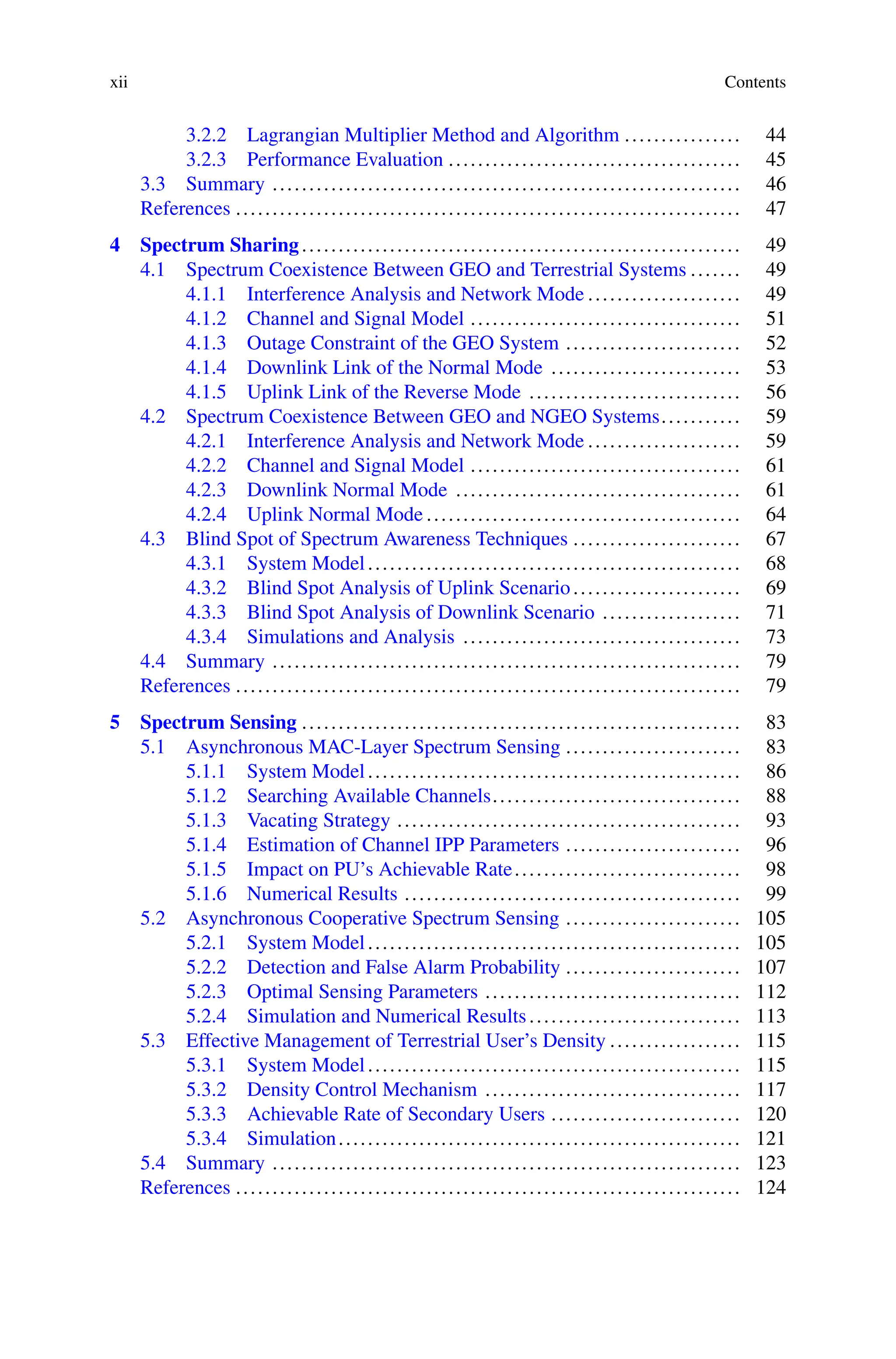
Contents
1 Introduction .................................................................. 1
1.1 Background.............................................................. 1
1.2 Integrated Terrestrial-Satellite Network Architecture ................. 2
1.3 Related Research and Development.................................... 3
1.4 Organizations of this Book ............................................. 4
1.5 Summary ................................................................ 6
2 Beamforming Transmission................................................. 7
2.1 Beamforming in Satellite Communication Systems................... 7
2.1.1 Multi-Beam Joint Processing .................................. 9
2.1.2 Multigroup Precoding .......................................... 10
2.1.3 Cooperative Beamforming in Terrestrial-Satellite
Networks ........................................................ 12
2.2 Multicast Beamforming................................................. 13
2.2.1 System Model................................................... 15
2.2.2 Problem Formulation ........................................... 16
2.2.3 Optimal Power Allocation Algorithm ......................... 18
2.2.4 Performance Evaluation ........................................ 22
2.3 Smart Communication Satellite ........................................ 26
2.3.1 System Design .................................................. 27
2.3.2 Smart Beamforming ............................................ 28
2.4 Summary ................................................................ 29
References ..................................................................... 29
3 Interference Cancelation Reception ....................................... 31
3.1 Position-Assisted Interference Coordination .......................... 32
3.1.1 System Model................................................... 32
3.1.2 Scheme of Interference Coordination.......................... 34
3.1.3 Precision Analysis .............................................. 37
3.1.4 Performance Evaluation ........................................ 40
3.2 Channel State Information Based Interference Coordination ......... 41
3.2.1 Model and Formulation......................................... 41
xi
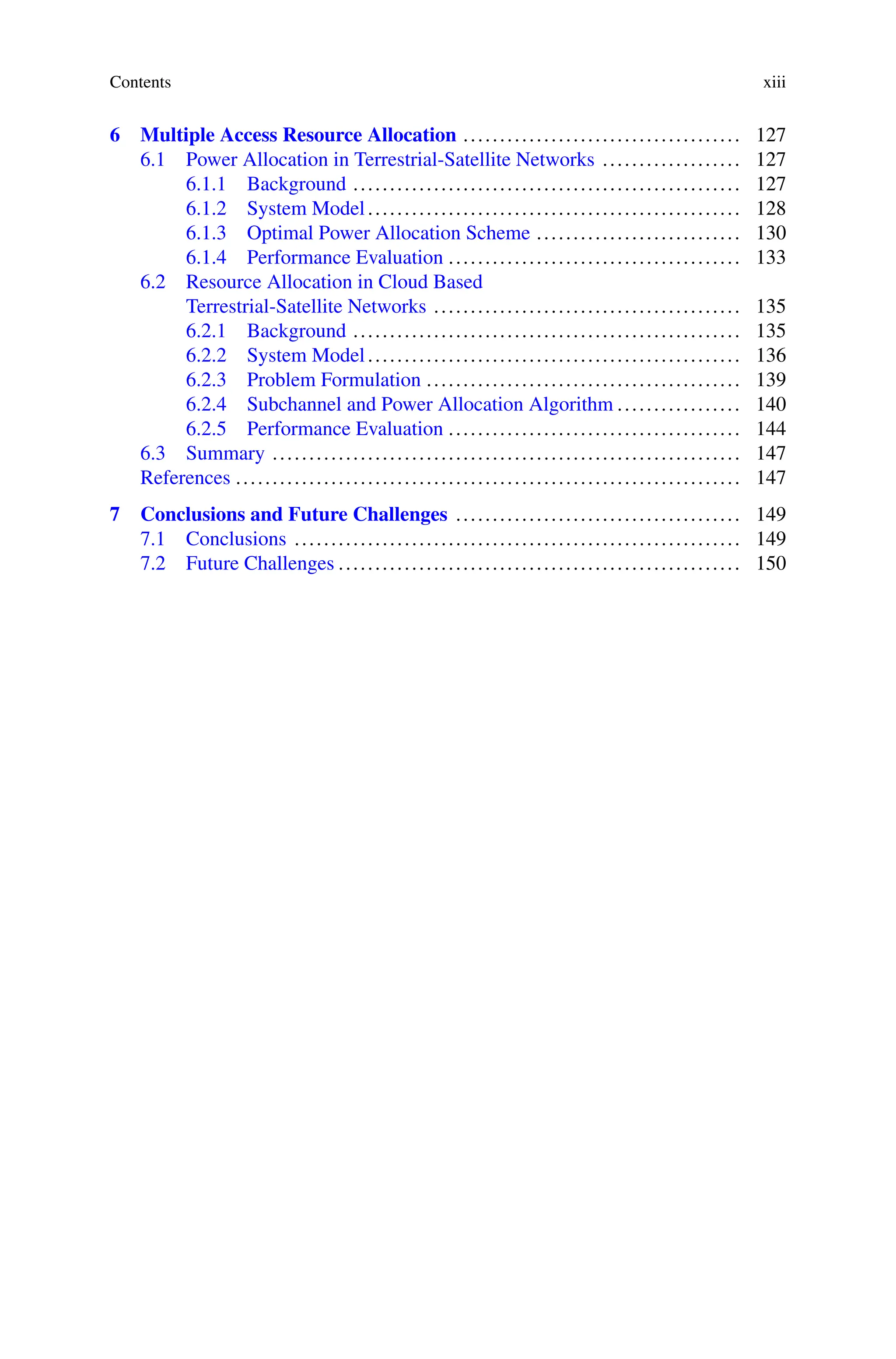
xii Contents
3.2.2 Lagrangian Multiplier Method and Algorithm ................ 44
3.2.3 Performance Evaluation ........................................ 45
3.3 Summary ................................................................ 46
References ..................................................................... 47
4 Spectrum Sharing............................................................ 49
4.1 Spectrum Coexistence Between GEO and Terrestrial Systems ....... 49
4.1.1 Interference Analysis and Network Mode ..................... 49
4.1.2 Channel and Signal Model ..................................... 51
4.1.3 Outage Constraint of the GEO System ........................ 52
4.1.4 Downlink Link of the Normal Mode .......................... 53
4.1.5 Uplink Link of the Reverse Mode ............................. 56
4.2 Spectrum Coexistence Between GEO and NGEO Systems........... 59
4.2.1 Interference Analysis and Network Mode ..................... 59
4.2.2 Channel and Signal Model ..................................... 61
4.2.3 Downlink Normal Mode ....................................... 61
4.2.4 Uplink Normal Mode ........................................... 64
4.3 Blind Spot of Spectrum Awareness Techniques ....................... 67
4.3.1 System Model................................................... 68
4.3.2 Blind Spot Analysis of Uplink Scenario....................... 69
4.3.3 Blind Spot Analysis of Downlink Scenario ................... 71
4.3.4 Simulations and Analysis ...................................... 73
4.4 Summary ................................................................ 79
References ..................................................................... 79
5 Spectrum Sensing ............................................................ 83
5.1 Asynchronous MAC-Layer Spectrum Sensing ........................ 83
5.1.1 System Model................................................... 86
5.1.2 Searching Available Channels.................................. 88
5.1.3 Vacating Strategy ............................................... 93
5.1.4 Estimation of Channel IPP Parameters ........................ 96
5.1.5 Impact on PU’s Achievable Rate............................... 98
5.1.6 Numerical Results .............................................. 99
5.2 Asynchronous Cooperative Spectrum Sensing ........................ 105
5.2.1 System Model................................................... 105
5.2.2 Detection and False Alarm Probability ........................ 107
5.2.3 Optimal Sensing Parameters ................................... 112
5.2.4 Simulation and Numerical Results............................. 113
5.3 Effective Management of Terrestrial User’s Density .................. 115
5.3.1 System Model................................................... 115
5.3.2 Density Control Mechanism ................................... 117
5.3.3 Achievable Rate of Secondary Users .......................... 120
5.3.4 Simulation....................................................... 121
5.4 Summary ................................................................ 123
References ..................................................................... 124
Contents xiii
6 Multiple Access Resource Allocation ...................................... 127
6.1 Power Allocation in Terrestrial-Satellite Networks ................... 127
6.1.1 Background ..................................................... 127
6.1.2 System Model................................................... 128
6.1.3 Optimal Power Allocation Scheme ............................ 130
6.1.4 Performance Evaluation ........................................ 133
6.2 Resource Allocation in Cloud Based
Terrestrial-Satellite Networks .......................................... 135
6.2.1 Background ..................................................... 135
6.2.2 System Model................................................... 136
6.2.3 Problem Formulation ........................................... 139
6.2.4 Subchannel and Power Allocation Algorithm ................. 140
6.2.5 Performance Evaluation ........................................ 144
6.3 Summary ................................................................ 147
References ..................................................................... 147
7 Conclusions and Future Challenges ....................................... 149
7.1 Conclusions ............................................................. 149
7.2 Future Challenges ....................................................... 150
Chapter 1
Introduction
1.1 Background
The rapid growing data traffic brings more and more pressure to the wireless
networks, which is predicted to increase by over 10,000 times in the next 20 years.
In order to improve the system capacity and satisfy the increasing demands, ultra-
dense networks (HetUDNs), massive MIMO, and new spectrum of millimeter wave
band are considered as promising methods in future terrestrial networks, especially
for the fifth generation (5G). Meanwhile, mobile service coverage is also crucial
for the development and economics. However, currently, there are still large number
of population without coverage of mobile service. By 2015, there are about 71%
rural population that are not yet covered. Furthermore, for the less developed
countries, the population that have access to mobile broadband service is only
12%. In addition to the issue of coverage, future wireless networks also need to
guarantee the service continuity for emerging services such as Machine-to-Machine
and Internet of Things. Many emerging scenarios, such as Unmanned Aerial Vehicle
(UAV) control, pipeline monitoring, or global container tracking, require the aid of
wireless networks. However, existing networks are severely hindering these services
from achieving their true potentials. Considering the deficiency in existing wireless
networks nowadays, ubiquitous on-demand coverage is the key to ensure service
continuity in future communication paradigm.
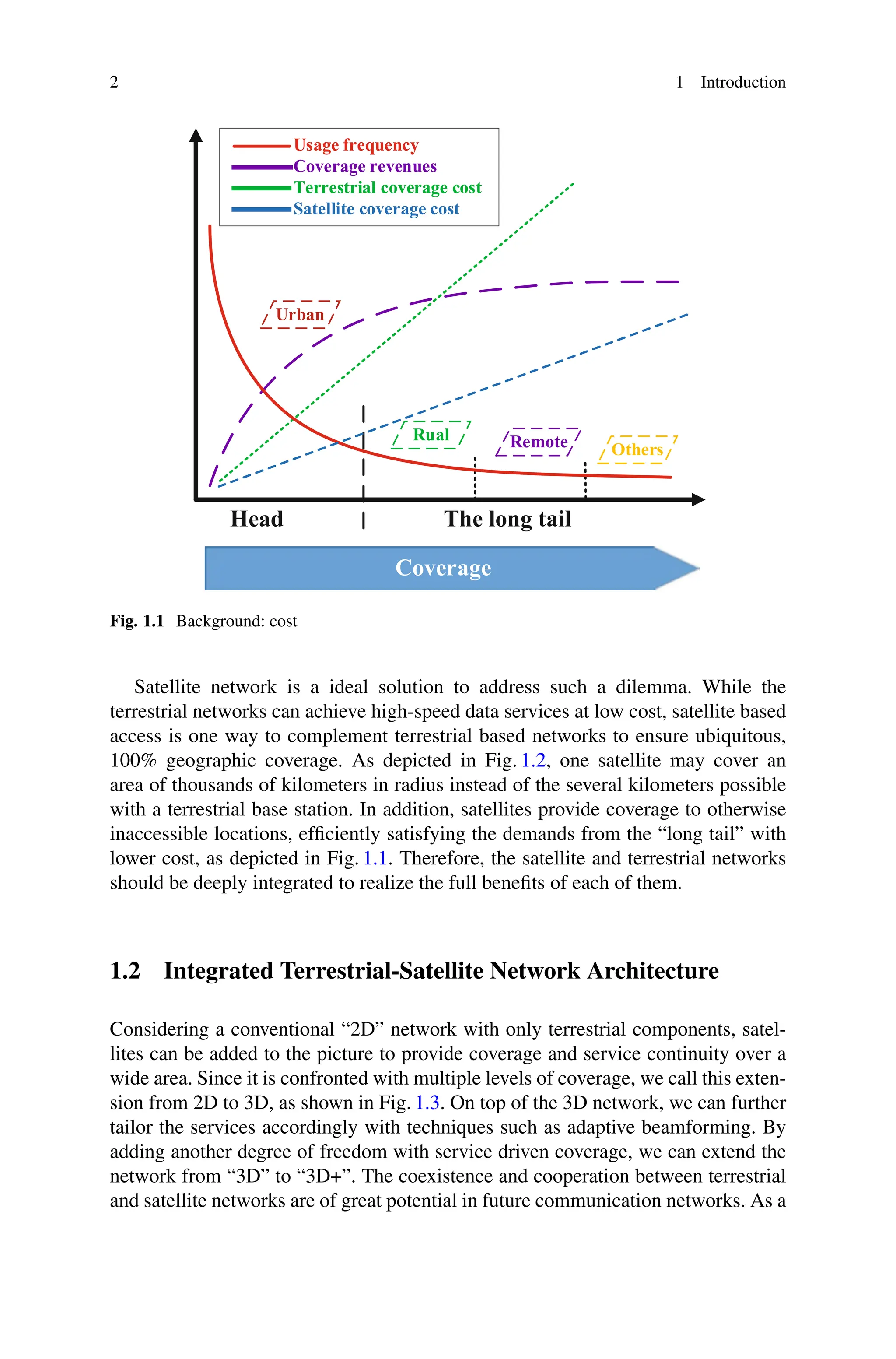
On the other hand, the cost of providing ubiquitous converge has also to be
taken into account for mobile networks operators. The concept of a “Long tail”
distribution is embodied in many innovative Internet business models. It indicates
that the revenues may be made from infrequent usage if one can effectively cater to
various individual demands. It is applicable to wireless networks operation as well,
where the usages far from urban centers can also lead to considerable revenue, as
illustrated in Fig. 1.1. However, the cost of pure terrestrial coverage quickly becomes
unbearable with the increasing network requirements for those rural, remote and
other areas.
© Springer International Publishing AG 2018
L. Kuang et al., Terrestrial-Satellite Communication Networks, Wireless Networks,
DOI 10.1007/978-3-319-61768-8_1
1
2 1 Introduction
Fig. 1.1 Background: cost
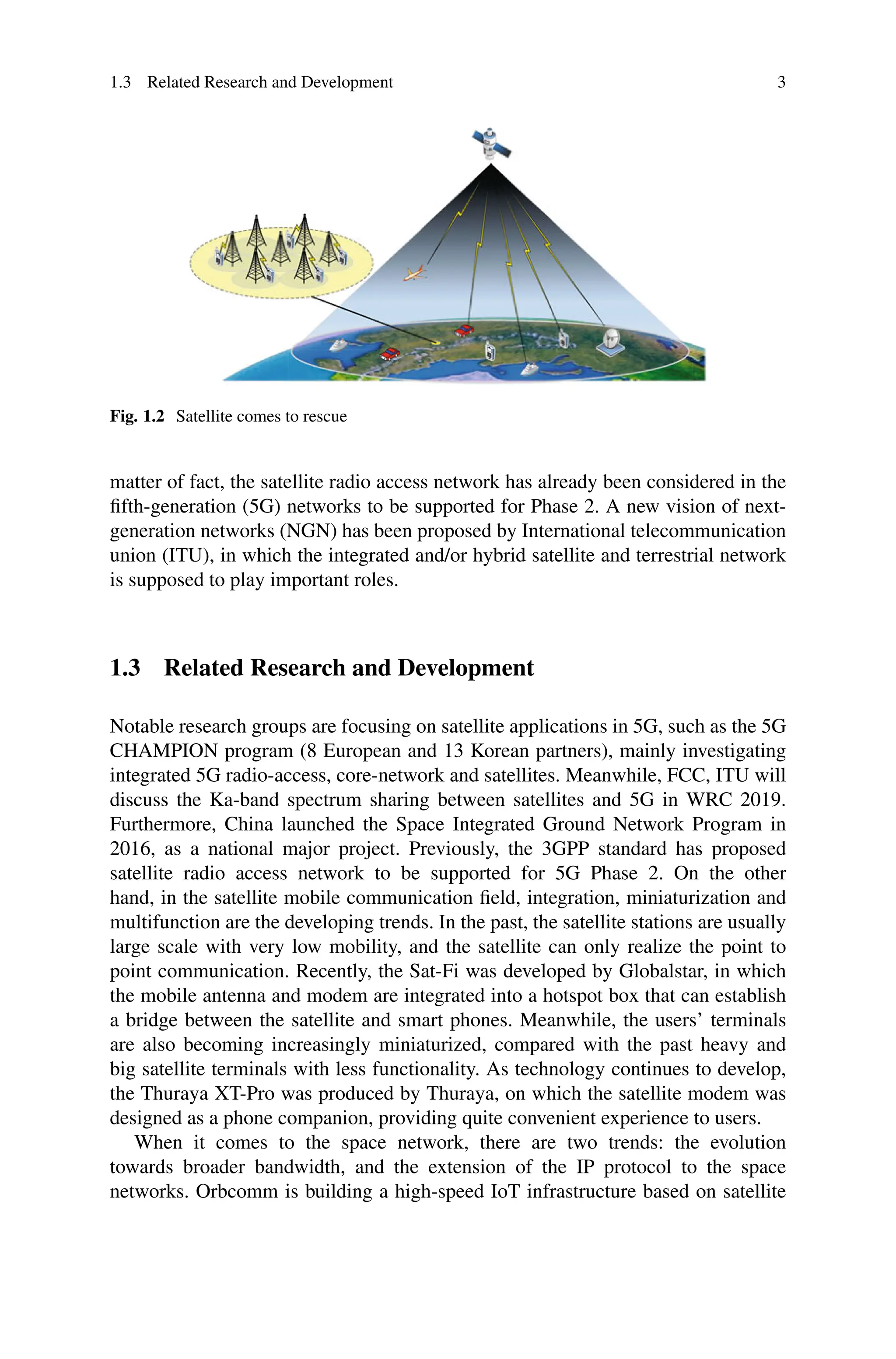
Satellite network is a ideal solution to address such a dilemma. While the
terrestrial networks can achieve high-speed data services at low cost, satellite based
access is one way to complement terrestrial based networks to ensure ubiquitous,
100% geographic coverage. As depicted in Fig. 1.2, one satellite may cover an
area of thousands of kilometers in radius instead of the several kilometers possible
with a terrestrial base station. In addition, satellites provide coverage to otherwise
inaccessible locations, efficiently satisfying the demands from the “long tail” with
lower cost, as depicted in Fig. 1.1. Therefore, the satellite and terrestrial networks
should be deeply integrated to realize the full benefits of each of them.
1.2 Integrated Terrestrial-Satellite Network Architecture
Considering a conventional “2D” network with only terrestrial components, satel-
lites can be added to the picture to provide coverage and service continuity over a
wide area. Since it is confronted with multiple levels of coverage, we call this exten-
sion from 2D to 3D, as shown in Fig. 1.3. On top of the 3D network, we can further
tailor the services accordingly with techniques such as adaptive beamforming. By
adding another degree of freedom with service driven coverage, we can extend the
network from “3D” to “3D+”. The coexistence and cooperation between terrestrial
and satellite networks are of great potential in future communication networks. As a
1.3 Related Research and Development 3
Fig. 1.2 Satellite comes to rescue
matter of fact, the satellite radio access network has already been considered in the
fifth-generation (5G) networks to be supported for Phase 2. A new vision of next-
generation networks (NGN) has been proposed by International telecommunication
union (ITU), in which the integrated and/or hybrid satellite and terrestrial network
is supposed to play important roles.
1.3 Related Research and Development
Notable research groups are focusing on satellite applications in 5G, such as the 5G
CHAMPION program (8 European and 13 Korean partners), mainly investigating
integrated 5G radio-access, core-network and satellites. Meanwhile, FCC, ITU will
discuss the Ka-band spectrum sharing between satellites and 5G in WRC 2019.
Furthermore, China launched the Space Integrated Ground Network Program in
2016, as a national major project. Previously, the 3GPP standard has proposed
satellite radio access network to be supported for 5G Phase 2. On the other
hand, in the satellite mobile communication field, integration, miniaturization and
multifunction are the developing trends. In the past, the satellite stations are usually
large scale with very low mobility, and the satellite can only realize the point to
point communication. Recently, the Sat-Fi was developed by Globalstar, in which
the mobile antenna and modem are integrated into a hotspot box that can establish
a bridge between the satellite and smart phones. Meanwhile, the users’ terminals
are also becoming increasingly miniaturized, compared with the past heavy and
big satellite terminals with less functionality. As technology continues to develop,
the Thuraya XT-Pro was produced by Thuraya, on which the satellite modem was
designed as a phone companion, providing quite convenient experience to users.
When it comes to the space network, there are two trends: the evolution
towards broader bandwidth, and the extension of the IP protocol to the space
networks. Orbcomm is building a high-speed IoT infrastructure based on satellite
4 1 Introduction
Fig. 1.3 3D+ network
constellations, including LEO (Low Earth Orbit), MEO (Medium Earth Orbit) and
GEO (Geostationary Earth Orbit) satellites. At the same time, the Iridium system is
evolving to the next generation with higher bandwidth. Moreover, the O3b project
was also proposed by Google, where the name “O3b” stands for “[The] Other
3 Billion”, referring to the population of the world where broadband Internet is
not available. By building a MEO satellite constellation, the network with the speed
of fiber can provide Internet services and mobile backhaul services to the emerging
markets. It was reported that Google just invested 1 Billion to spaceX to create a
satellite based internet.
1.4 Organizations of this Book
This book is organized as depicted in Fig. 1.4. We first introduce the technique of
beamforming in satellite communication systems, which is an efficient transmitting
method for multiple access, and discuss the main challenges as well as prospective
applications. Beamforming is one of the array processing methods of antenna
arrays. By adjusting the weighting factors on antennas, it can steer nulls to
mitigate co-channel interferences and forming independent beams toward different
directions, which contributes to improve the performance of mobile communication
systems. In mobile communication systems, transmit beamforming is a powerful
mean of interference mitigation and capacity improvement by providing isolation
among users in different directions. Based on the technique of beamforming, a
Exploring the Variety of Random
Documents with Different Content
several temples, one of Ceres; another of Vulcan. The church, called Bocca di Fuoco, was likewise a
temple. But the most entire of all is a small rotunda, which, as well as the rotunda at Rome, and some
others to be met with in Italy, demonstrates that form to be the most durable of any."
There is also a well at the foot of the old walls, where the lava, after running along the parapet, and
and then falling forwards, produced a very complete and lofty arch over the spring.
Through the care, and at the expense of prince Biscaris, many other monuments of ancient splendour
and magnificence have been recovered by digging down to the ancient town, which, on account of the
numerous torrents of lava that have flowed out of Mount Etna for the last thousand years, is now to be
sought for in dark caverns many feet below the present surface of the earth.
Mr. Swinburne states, that he descended into baths, sepulchres, an amphitheatre, and a theatre, all
very much injured by the various catastrophes that have befallen them. He found, too, that these
buildings were erected not on the solid ground and with brick or stone, but on old beds of lava, and
with square pieces of the same substance, which, in no instance, appears to have been fused by the
contact of new lavas: the sciarra or stones of old lava having constantly proved as strong a barrier
against the flowing torrent of fire as any other stone could have been, though some authors have been
of opinion, that the hot matter would melt the whole mass, and incorporate itself with it.
There was a temple at Catanea, dedicated to Ceres, in which none but women were permitted to
appear[186].
NO. XXV.—CHALCEDON.
This place, which stands opposite Byzantium, was built by a colony from Megara, some years before
Byzantium, viz. B. C. 685. Its position was so imprudently selected, that it was called the city of blind
men[187]; by which was intimated the inconsiderate plan of the founders. It was built on a sandy and
barren soil, in preference to the rich one on the opposite side of the Bosphorus, on which Byzantium
was afterwards founded.
Chalcedon, in the time of its prosperity, was considerable; not only on account of its buildings, but the
wealth of its inhabitants, who enriched themselves greatly by commerce; more especially by the
exportation of purple dye, which was found in great quantities upon its coast.
In ancient times it underwent many revolutions; being first subdued by Otanes, general of the
Persians, whose father Sisanes, one of the judges of the Persian empire, having pronounced an unjust
sentence, was flayed alive by the order of Cambyses. Not long after this the Lacedemonians made
themselves masters of it, but were obliged to give place to the Athenians, who contented themselves
with imposing upon the inhabitants an annual tribute, which they in time neglecting to pay, were again
reduced to obedience by Alcibiades. Afterwards, with the rest of the world, it passed under the
dominion of the Romans, who were succeeded by the Greek emperors, under whose administration it
became famous by a celebrated council of the church (A. D. 327), which is recorded under the name of
the council of Chalcedon.
A tribunal also was here erected by the Emperor Julian, to try and punish the evil ministers of his
predecessor, Constantius. "We are now delivered," said Julian, in a familiar letter to one of his most
intimate friends, "we are now surprisingly delivered from the voracious jaws of the hydra. I do not mean
to apply that epithet to my brother, Constantius. He is no more;—may the earth lie light on his head!
But his artful and cruel favourites studied to deceive and exasperate a prince, whose natural mildness
cannot be praised without some efforts of adulation. It is not my intention, however, that these men
should be oppressed; they are accused, and they shall enjoy the benefit of a fair and impartial trial."
The executions of some of these men, one of whom (Paulus) was burned alive, were accepted, says the
historian, as an inadequate atonement by the widows and orphans of so many hundred Romans, whom
those legal tyrants had betrayed and murdered.
Persians, Greeks, Goths, Saracens, and Turks, by turns, despoiled Chalcedon. The walls were razed by
Valens, and much of the materials was employed in the aqueduct of Constantinople that bears his
name, and which was, by a singular coincidence, repaired by Soliman II., from the remaining ruins of
this devoted city.
Here it was that the infamous Rufinus, so justly stigmatised by Claudian, built a magnificent villa,
which he called the Oak[188]. He built, also, a church; and a numerous synod of bishops met in order to
consecrate the wealth and baptise the founder. This double ceremony was performed with extraordinary
pomp.
A. D. 602, Chalcedon became remarkable for the murder of the Emperor Maurice and his five sons;
and afterwards for that of the empress, his widow, and her three daughters[189]. The ministers of death
were despatched to Chalcedon (by Phocas). They dragged the emperor into his sanctuary; and the five
sons of Maurice were successively murdered before the eyes of their agonised parent. At each stroke,
which he felt in his heart, he found strength to rehearse a pious ejaculation:—"Thou art just, O Lord!
and thy judgments are righteous."
It is now a small place, known to the Turks by the name of Cadiaci; but the Greeks still call it by its
ancient name. It is a miserable village, inhabited by a few Greeks, who maintain themselves by their
fishery, and the cultivation of their lands. Wheler found an inscription, importing that Evante, the son of
Antipater, having made a prosperous voyage towards the Abrotanians and the islands Cyaneæ, and
hence desiring to return by the Ægean Sea and Pontus, offered cakes to the statue he had erected to
Jupiter, who had sent him good weather as a token of a good voyage.
Pococke says, "There are no remains of the ancient city, all being destroyed, and the ground occupied
by gardens and vineyards." "We visited the site of Chalcedon," says Dr. Clarke, "of which city scarcely a
trace remains; landing also upon the remarkable rock, where the light-house is situate, called the tower
of Leander. The Turks call it the 'Maiden's Castle;' possibly it may have been formerly used as a retreat
for nuns, but they relate one of their romantic traditions concerning a princess, who secluded herself
upon this rock, because it had been foretold she should die by the bite of a serpent, adding, that she
ultimately here encountered the death she sought to avoid[190]."
NO. XXVI.—CHÆRONEA.
A city in Bœotia, greatly celebrated on account of a battle fought near it between Philip of Macedon
and the Athenians.
The two armies encamped near Chæronea. Philip gave the command of his left wing to his son
Alexander, who was then but sixteen. He took the right wing upon himself. In the opposite army the
Thebans formed the right wing, and the Athenians the left. At sunrise the signal was given on both
sides. The battle was bloody, and the victory a long time dubious; both sides exerting themselves with
astonishing valour. At length Philip broke the sacred band of the Thebans[191], which was the flower of
their army. The rest of the troops being raw, Alexander, encouraged by his example, entirely routed.
The conduct of the victor after this victory shows that it is much easier to overcome an enemy than to
conquer one's self. Upon his coming from a grand entertainment which he had given his officers, being
equally transported with joy and wine, he hurried to the spot where the battle had been fought, and
there, insulting the dead bodies with which the field was covered, he turned into a song the beginning
of the decree, which Demosthenes had prepared to excite the Greeks to war, and sang thus, himself
beating time; "Demosthenes the Peanian, son of Demosthenes, has said." Everybody was shocked to
see the king dishonour himself by this behaviour; but no one opened his lips. Demades, the orator,
whose soul was free, though his body was a prisoner, was the only person who ventured to make him
sensible of the indecency of this conduct, telling him—"Ah, sir, since fortune has given you the part of
Agamemnon, are you not ashamed to act the part of Thersites?" These words, spoken with so generous
a liberty, opened his eyes, and made him turn inward; and so far from being displeased with Demades,
he esteemed him the more for them, treated him with the utmost respect, and conferred upon him all
possible honours.
The bones of those slain at Chæronea were carried to Athens; and Demosthenes was charged with
composing a eulogium, for a monument erected to their memory:—
This earth entombs those victims to the state,
Who fell a glorious sacrifice to zeal.
Greece, on the point of wearing tyrant-chains,
Did, by their deaths alone, escape the yoke.
This Jupiter decreed: no effort, mortals,
Can save you from the mighty will of fate.
To gods alone belongs the attribute
Of being free from crimes with never-ending joy.
According to Procopius, Chæronea and other places in Bœotia (also of Achaia and Thessaly) were
destroyed by an earthquake in the sixth century.
The Acropolis[192] is situated on a steep rock, difficult of access; the walls and square towers are, in
some places, well preserved; and their style, which is nearly regular, renders it probable, that they were
constructed not long before the invasion of the Macedonians.
The ancient Necropolis is on the east side of the Acropolis, behind the village: the remains of several
tombs have been uncovered by the rains. The church of the Holy Virgin contains an ancient chair of
white marble, curiously ornamented. It is called by the villagers the throne of Plutarch[193].
There are two ancient circular altars with fluted intervals, in the manner of an Ionic or Corinthian
column. Altars of this kind were placed on the road side. They were unstained with fire and blood, being
set apart for exclusive oblations of honey, cakes, and fruit. These altars are common in Greece, and
generally formed of coarse black stone; those of Chæronea, however, are of white marble. They are
frequently found in Italy, and are at present used as pedestals for large vases, their height being in
general about three feet. They are never inscribed, and sometimes not fluted; and are frequently
represented on painted terra-cotta vases.
Some Ionic fragments of small proportions are scattered among the ruins. On the rock there was
anciently a statue of Jupiter; but Pausanias mentions no temple. The theatre stands at the foot of the
Acropolis, and faces the plain. It is the smallest in Greece, except one at Mesaloggion; but it is well
preserved. Indeed, nothing is better calculated to resist the devastations of time than the Grecian
theatres, when they are cut in the rock, as they generally are.
"The sole remains of this town," says Sir John Hobhouse, "are some large stones six feet in length,
and the ruins of a wall on the hill, and part of a shaft of a column, with its capital; the seats of a small
amphitheatre, cut out of the rock, on the side of the same hill; in the flat below, a fountain, partly
constructed of marble fragments, containing a few letters, not decipherable; some bits of marble pillars,
just appearing above ground, and the ruins of a building of Roman brick."
Two inscriptions have, we understand, lately been discovered at this place; one relative to Apollo, the
other to Diana. Several tombs have been also discovered and opened.
Though a respectable traveller asserts, that the battle of Chæronea, by putting an end to the
turbulent independence of the Grecian republics, introduced into that country an unusual degree of civil
tranquillity and political repose, we cannot ourselves think so; we therefore subjoin, from Dr. Leland, a
short account of the conqueror's death.
"When the Greeks and Macedonians were seated in the theatre, Philip came out of his palace,
attended by the two Alexanders, his son and son-in-law. He was clothed in a white flowing robe, waving
in soft and graceful folds, the habiliment in which the Grecian deities were usually represented. He
moved forward with a heart filled with triumph and exultation, while the admiring crowds shouted forth
their flattering applause. His guards had orders to keep at a considerable distance from his person, to
show that the king confided in the affections of his people, and had not the least apprehensions of
danger amidst all this mixed concourse of different states and nations. Unhappily, the danger was but
too near him. The injured Pausanias had not yet forgot his wrongs, but still retained those terrible
impressions, which the sense of an indignity he had received, and the artful and interested
representations of others, fixed deeply in his mind. He chose this fatal morning for the execution of his
revenge, on the prince who had denied reparation to his injured honour. His design had been for some
time premeditated, and now was the dreadful moment of effecting it. As Philip marched on in all his
pride and pomp, this young Macedonian slipped through the crowd, and, with a desperate and
malignant resolution, waited his approach in a narrow passage, just at the entrance into the theatre.
The king advanced towards him: Pausanias drew his poniard; plunged it into his heart; and the
conqueror of Greece, and terror of Asia, fell prostrate to the ground, and instantly expired[194].
NO. XXVII.—CORDUBA.
"Are we at Cordova?" says a modern writer. "The whole reign of the Omniad Caliphs passes, in mental
review, before us. Once the seat of Arabian art, gallantry, and magnificence, the southern kingdom of
Spain was rich and flourishing. Agriculture was respected; the fine arts cultivated; gardens were
formed; roads executed; palaces erected; and physics, geometry, and astronomy, advanced. The
inhabitants were active and industrious; accomplishments were held in esteem; and the whole state of
society formed a striking contrast to that of every other in Europe."
It was situated in Hispanic Bœtica, having been built by Marcellus. It was the native place of both the
Senecas, and Lucan. Indeed, it produced, in ancient times, so many celebrated characters, that it was
styled the "mother of men of genius." Its laws were written in verse; and its academy was partly
distinguished for its cultivation of the Greek language, as well as for rhetoric and philosophy. It became
celebrated, also, under the Moors.
Of its ancient grandeur, however, Cordova has preserved nothing but a vast inclosure, filled with
houses, half in ruins. Its long, narrow, and ill-paved streets are almost deserted; most of the houses are
uninhabited; and the multitude of churches and convents which it contains, are besieged by a crowd of
vagabonds, covered with rags. The ancient palace of the Moors has been converted into stables, in
which, till within these few years, one hundred Andalusian horses were usually kept. Their genealogy
was carefully preserved; and the name and age of each written over the stall in which he stood. In the
place appropriated to bathing, is part of a Cufic inscription.
Cordova was called at first Corduba, and afterwards Colonia Patricia, as appears from inscriptions on
the numerous medals which have been discovered in this city and neighbourhood.
From the Romans it passed successively under the dominion of the Goths and Arabs; and, while the
latter swayed the sceptre of Spain, Cordova became pre-eminently distinguished, as we have just
stated, as the seat of arts, sciences, and literature.
About ten miles from this place is a small town, called by the ancients Obubea[195]; and we mention
it here merely because it reminds us that Julius Cæsar came thither to stop the progress of Pompey's
sons, who had a little before entered Spain in twenty-seven days[196].
NO. XXVIII.—CORCYRA. (CORFU.)
Corcyra is an island in the Ionian Sea, on the coast of Epirus: it is now called Corfu; was first peopled
by a colony from Colchis, B. C. 1349, and afterwards by a colony from Corinth, who, with Chersicrates at
their head, came to settle there, on being banished from their native city 703 years before the Christian
era. Homer calls it Phæacia; Callimachus, Drepane.
Ancient authors give glorious descriptions of the beautiful gardens of this island belonging to
Alcinous; but, at present, no remains of them are to be found. It was famous for the shipwreck of
Ulysses.
The air is healthy, the land fertile, the fruit excellent. Oranges, citrons, honey, wax, oil, and most
delicious grapes, are very abundant.
The war between this people and that of Athens was called the Corcyrean; and operated as an
introduction to the Peloponnesian war. Corcyra was then an independent power, which could send out
fleets and armies; and its alliance was courted by many other states.
Thucydides gives a frightful account of a sedition which occurred in this city and island during the
Peloponnesian war: some were condemned to die under judicial sentences; some slew one another in
the temples; some hung themselves upon the trees within its verge; some perished through private
enmity; some for the sums they had lent, by the hands of the borrowers. Every kind of death was
exhibited. Every dreadful act, usual in a sedition, and more than usual, was then perpetrated. For
fathers slew their children; some were dragged from altars; and some were butchered at them; and a
number died of starvation in one of the temples.
Corcyra, when in the possession of the Romans, became a valuable station for their ships of war, in
their hostilities against the cities of Asia. Septimius Severus and his family appear to have been great
benefactors to it; for, about 150 years ago, there was found a number of medals, not only of Septimius,
but of his wife Julia Domna; Caracalla, his eldest son, and his wife Plankilla; also of Geta, his youngest
son.
Two hundred years ago, Corfu consisted of nothing but one old castle and a village. It is now a
considerable town. It stands projecting on a rock into the sea; and, from the fortifications guarding it, is
a place of strength. The fortresses are completely mined below; and the roads to the gates of some of
them are narrow and precipitous. By an accidental explosion of a powder-mill, one of the fortresses, in
the early part of the last century, 2000 people were killed and wounded; and by a singular catastrophe,
in 1789, 600 individuals lost their lives; ten galleys and several boats were sunk in the harbour; and
many houses in the town greatly damaged.
Wheler visited the ruins of Palœopoli, the ancient metropolis of the island. "It stood," says he, "on a
promontory to the south of the present city, separated from it by a little bay, of about a mile or two
over. The abundance of ruins and fortifications, which are to be seen there, do sufficiently prove it to
have been so." Abundance of foundations, he goes on to observe, have been dug up there; and of
arches and pillars, many of which have been employed to build the foundations of the present city.
There are also the remains of an old place of worship; the architecture of which is sustained by
Corinthian columns of white marble, with an inscription, showing that it was built by the Emperor
Jovian, after he was converted to the Christian faith and had destroyed the heathen temples.
"I Jovian, having received the faith, established the kingdom of my power; and having destroyed the
heathen temples and altars, have built to thee, O thou blessed and most high King, a holy temple, the
gift of an unworthy hand."
Mr. Dodwell visited this place some years ago, and he says that nothing is now seen above ground of
the remains of the ancient city, except some frusta of large columns, which from having flutings without
intervals, were evidently of the Doric order. They have a large square, which forms but one mass with a
column, which is a singularity, it is said, of which there is no other example.
Corcyra was celebrated, as we have before stated, for having been the island on which Ulysses is
represented in the Odyssey as having been entertained by Alcinous, king of Phæacia. It is also the place
where Cicero and Cato met after the battle of Pharsalia; and where Cato, after having intrusted Cicero
to take the command of the last legions which remained faithful to the republic, separated from him to
lose his life at Utica, while Cicero went to lose his head to the triumvirate. To this place Aristotle was
once exiled; and it is well known as having been visited by the youthful Alexander; as the place where
the tragical nuptials of Antony and Cleopatra were celebrated; and as that where Agrippina touched,
bringing from Egypt the body of the murdered Germanicus in the midst of winter[197].
NO. XXIX.—CORINTH.
Corinth!—
Whose gorgeous fabrics seem'd to strike the skies,
Whom, though by tyrant victors oft subdued,
Greece, Egypt, Rome, with awful wonder view'd.
Her name, for Pallas' heavenly art renown'd,
Spread like the foliage which her pillars crown'd;
But now in fatal desolation laid,
Oblivion o'er it draws a dismal shade.
This city was situated at the foot of a hill, on which stood the citadel. To the south it was defended by
the hill itself, which is there extremely steep. Strong and lofty ramparts protected it on three sides.
Corinth was at first subject to the kings of Argos and Mycenæ; at last Sisyphus made himself master of
it. But his descendants were dispossessed of the throne by the Heraclidæ, about ten years after the
siege of Troy. The regal power, after this, came to the descendants of Bacchis, under whom the
monarchy was changed into an aristocracy; that is, the reins of government were in the hands of the
elders, who annually chose from amongst themselves a chief magistrate, whom they called Prytanis. At
length Cypselus, having gained the people, usurped the supreme authority, which he transmitted to his
son Periander.
The most celebrated of the Corinthians was a person, who though a tyrant, was reckoned one of the
seven wise men (Periander). When he had first made himself master of the city, he wrote to
Thrasybulus, tyrant of Miletus, to know what measures he should take with his newly-acquired subjects.
The latter, without any answer, led the messenger into a field of wheat; where, in walking along, he
beat down with his cane all the ears of corn that were higher than the rest. Periander perfectly well
understood the meaning of this enigmatical answer, which was a tacit intimation to him, that, in order
to secure his own life, he should cut off the most eminent of the Corinthian citizens. Periander, however,
did not relish so cruel an advice.
He wrote circular letters to all the wise men, inviting them to pass some time with him at Corinth, as
they had done the year before at Sardis with Crœsus. Princes in those days thought themselves much
honoured when they could have such guests in their houses. Plutarch describes an entertainment which
Periander gave these illustrious guests, and observes, at the same time, that the decent simplicity of it,
adapted to the taste and humour of the persons entertained, did him much more honour than the
greatest magnificence could have done. The subject of their discourse at table was sometimes grave
and serious, at other times pleasant and gay. One of the company proposed this question;—Which is
the most perfect popular government? That, answered Solon, where an injury, done to any private
citizen, is such to the whole body: That, said Bias, where the law has no superior: That, said Thales,
where the inhabitants are neither too rich nor too poor: That, said Anacharsis, where virtue is
honoured, and vice detested: Says Pittacus, where dignities are always conferred upon the virtuous,
and never upon the wicked: Says Cleobulus, where the citizens fear blame, more than punishment:
Says Chilo, where the laws are more regarded, and have more authority, than the orators. From all
these opinions Periander concluded, that the most perfect popular government would be that which
came nearest to aristocracy, where the sovereign authority is lodged in the hands of a few men of
honour and virtue.
This city standing between two seas, an attempt was made by Periander, and afterwards by
Alexander, Demetrius, Julius Cæsar, Caligula, Nero, and Herodes Atticus, to unite them; but they all
failed in the attempt.
Strabo was in Corinth after its restoration by the Romans. He describes the site, and says, that its
circuit occupied five miles. From the summit of the Sisyphéum, he continues, is beheld to the north
Parnassus and Helicon, lofty mountains covered with snow; and below both, to the west, the Crissæan
gulf, bounded by Phocis, by Bœotia and the Megaris, and by Corinthia and Sicyonia. Beyond all these
are the Oneian mountains, stretching as far as Cithæron.
Corinth had temples dedicated to the Egyptian Isis, to Serapis, and Serapis of Canopus. Fortune, also,
had a temple, and her statue was made of Persian work; and near this temple was another, dedicated
to the mother of all the gods.
Besides the citadel, built upon the mountain, the works of art, which chiefly displayed the opulence
and taste of the people, were the grottoes, raised over the fountain of Pyrene, sacred to the Muses, and
constructed of white marble. There were, also, a theatre and stadium, built of the same materials, and
decorated in the most magnificent manner; also a temple of Neptune, containing the chariots of the
god, and of Amphitrite, drawn by horses covered over with gold, and adorned with ivory hoofs.
There were a multitude of statues, also; amongst which were those of Bacchus, and Diana of
Ephesus. These were of wood; others were of bronze; amongst which were those of Apollo Clarius; a
Venus by Hermogenes of Cythera; two Mercuries; three statues of Jupiter; and a Minerva. This last was
mounted on a pedestal, the basso-relievos of which represented the Nine Muses.
Such, indeed, were its wealth, magnificence, and excellent situation, that it was thought by the
Romans equally worthy of empire with Carthage and Capua; and this induces me to say a few words in
regard to its war with the Romans.
Metellus[198] having received advice in Macedonia of the troubles in Peloponnesus, departed thither
with Romans of distinction, who arrived in Corinth at the time the council was assembled there. They
spoke in it with abundance of moderation, exhorting the Achaians not to draw upon themselves, by
imprudent levity and weakness, the resentment of the Romans. They were treated with contempt, and
ignominiously turned out of the assembly. An innumerable crowd of workmen and artificers rose about
them, and insulted them. All the cities of Achaia were at the time in a kind of delirium; but Corinth was
far more frantic than the rest, and abandoned themselves to a kind of madness. They had been
persuaded that Rome intended to enslave them all, and absolutely to destroy the Achaian league.
The Romans, having chosen Mummius for one of the consuls, charged him with the management of
the Achaian war. When Mummius had assembled all his troops, he advanced to the city, and encamped
before it. A body of his advanced guard being negligent of duty upon their post, the besieged made a
sally, attacked them vigorously, killed many, and pursued the rest almost to the entrance of their camp.
This small advantage very much encouraged the Achaians, and thereby proved fatal to them. Diæus
offered the consul battle. The latter, to augment his rashness, kept his troops within the camp, as if fear
prevented him from accepting it. The joy and presumption of the Achaians rose in consequence to an
inexpressible height. They advanced furiously with all their troops, having placed their wives and
children upon the neighbouring eminence, to be spectators of the battle, and caused a great number of
carriages to follow them, to be laden with the booty they should take from the enemy; so fully did they
assure themselves of the victory.
Never was there a more rash or ill-founded confidence. The faction had removed from the service and
councils all such as were capable of commanding the troops, or conducting affairs; and had substituted
others in their room, without either talents or ability, in order to their being more absolutely masters of
the government, and ruling without opposition. The chiefs, without military knowledge, valour, or
experience, had no other merit than a blind and frantic rage. They had already committed an excess of
folly in hazarding a battle, which was to decide their fate, without necessity, instead of thinking of a
long and brave defence in so strong a place as Corinth, and of obtaining good conditions by a vigorous
resistance. The battle was fought near Leucopetra, and the defile of the isthmus. The consul had posted
part of his horse in ambuscade, which they quitted at a proper time for charging the Achaian cavalry in
flank; who, surprised by an unforeseen attack, gave way immediately. The infantry made a little more
resistance; but, as it was neither covered, nor sustained by the horse, it was soon broken and put to
flight. Diæus, upon this, abandoned himself to despair. He rode full speed to Megalopolis, and having
entered his house, set fire to it; killed his wife, to prevent her falling into the hands of the enemy; drank
poison; and in that manner put an end to his life, worthy of the many crimes he had committed.
After this defeat, the inhabitants lost all hope of defending themselves; so that all the Achaians who
had retired into Corinth, and most of the citizens, quitted it the following night, to save themselves how
they could. The consul having entered the city, abandoned it to be plundered by the soldiers. All the
men who were left in it were put to the sword, and the women and children sold; and after the statues,
paintings, and richest moveables were removed, in order to their being carried to Rome, the houses
were set on fire, and the whole city continued in flames for several days. From that time the Corinthian
brass became more valuable than ever, though it had been in reputation long before. It is pretended
that the gold, silver, and brass, which were melted, and ran together in this conflagration, formed a new
and precious metal. The walls were afterwards desolated, and razed to their very foundations. All this
was executed by order of the Senate, to punish the insolence of the Corinthians, who had violated the
law of nations, in their treatment of the ambassadors sent to them by Rome.
The booty taken at Corinth was sold, and considerable sums raised from it. Amongst the paintings
there was a piece drawn by the most celebrated hand in Greece, representing Bacchus, the beauty of
which was not known to the Romans, who were at that time entirely ignorant of the polite arts.
Polybius, who was then in the country, had the mortification to see the painting serve the soldiers for a
table to play at dice upon. It was afterwards sold to Attalus for £3625 sterling. Pliny mentions another
picture by the same painter, which the same Attalus purchased for 110 talents. The consul, surprised
that the price of the painting in question should rise so high, interposed his authority, and retained it
contrary to public faith, and notwithstanding the complaints of Attalus, because he imagined there was
some hidden virtue in the prize, unknown to him. He did not act in that manner for his private interest,
nor with the view of appropriating it to himself, as he sent it to Rome, to be applied in adorning the city.
When it arrived at Rome, it was set up in the temple of Ceres, whither the judges went to see it out of
curiosity, as a masterpiece of art; and it remained there till it was burned with that temple.
Mummius was a great warrior, and an excellent man; but he had neither learning, knowledge of arts,
nor taste for painting or sculpture. He ordered particular persons to take care of transporting many of
the paintings and statues of the most excellent masters to Rome. Never had loss been so irreparable, as
that of such a deposite, consisting of the masterpieces of those rare artists, who contributed almost as
much as the great captains, to the rendering of their age glorious to posterity. Mummius, however, in
recommending the care of that precious collection to those to whom he confided them, threatened
them very seriously, that if the statues, paintings, and other things with which he charged them, should
be either lost or destroyed by the way, he would oblige them to find others at their own cost[199];—a
saying deservedly ridiculed by all persons of sense, as a most egregious solecism in taste and
delicacy[200].
It is amusing to observe the difference between Mummius and Scipio;—the one the conqueror of
Corinth, the other of Carthage; both in the same year[201]. Scipio, to the courage and virtue of ancient
heroes, joined a profound knowledge of the sciences, with all the genius and ornaments of wit. His
patronage was courted by every one who made any figure in learning. Panætius, whom Tully calls the
prince of the Stoics, and Polybius the historian, were his bosom friends, the assisters of his studies at
home, and the constant companions of his expeditions abroad. To which may be added, that he passed
the more agreeable hours of his life in the conversation of Terence, and is even thought to have taken
part in the composition of his comedies.
The period in which the Isthmian games were to be celebrated being at hand, the expectation of
what was to be transacted drew thither an incredible multitude of people, and persons of the highest
rank. The conditions of peace, which were not yet entirely made public, were the topic of all
conversations, and various constructions were put upon them; but very few could be persuaded that the
Romans would evacuate all the cities they had taken. All Greece was in this uncertainty, when the
multitude being assembled in the stadium to see the games, a herald comes forward, and publishes
with a loud voice:—"The senate and people of Rome, and Titus Quintius the general, having overcome
Philip and the Macedonians, ease and deliver from all garrisons and taxes and imposts, the Corinthians,
the Locrians, the Phocians, the Eubœans, the Phthiot Achaians, the Magnesians, the Thessalians, and
the Perrhœbians; declare them free, and ordain that they shall be governed by their respective laws and
usages."
At these words all the spectators were filled with excessive joy. They gazed upon and questioned one
another with astonishment, and could not believe either eyes or ears; so like a dream was what they
saw and heard. But being at last assured of their happiness, they abandoned themselves again to the
highest transports of joy, and broke out into such loud acclamations, that the sea resounded them to a
distance; and some ravens, which happened to fly that instant over the assembly, fell down into the
stadium; so true it is, that of all the blessings of this life, none are so dear as that of liberty!
Corinth, nevertheless, remained after this in a ruined and desolate state many years. At length,
Cæsar, after he had subdued Africa, and while his fleet lay at anchor at Utica, gave order for rebuilding
Carthage; and soon after his return to Italy, he likewise caused Corinth to be rebuilt. Strabo and
Plutarch agree in ascribing the rebuilding of Carthage and Corinth to Julius Cæsar; and Plutarch remarks
this singular circumstance with regard to these cities, viz.—that as they were taken and destroyed in the
same year, they were rebuilt and repeopled at the same time.
Under the eastern emperors, Corinth was the see of an archbishop, subject to the patriarch of
Constantinople. Roger, king of Naples, obtained possession of it under the empire of Emanuel. It had,
afterwards, its own sovereign, who ceded it to the Venetians; from whom it was taken by Mahomet II.,
A. D. 1458. The Venetians retook it in 1687, and held it till the year 1715, when they lost it to the Turks,
in whose possession it remained till, a few years since, Greece was erected into an independent state.
The grand army of the Turks[202] (in 1715) under the prime vizier, to open themselves a way into the
heart of the Morea, attacked Corinth, upon which they made several attacks. The garrison being
weakened, and the governor, seeing it was impossible to hold out against a force so superior to their
own, beat a parley; but while they were treating about the articles, one of the magazines in the Turkish
camp, wherein they had 600 barrels of powder, blew up by accident, whereby between 600 and 700
men were killed; which so enraged the infidels, that they would not grant any capitulation, but stormed
the place with so much fury that they took it, and put most of the garrison, with the governor, Signior
Minotti, to the sword. The rest they made prisoners of war. This subject formed the foundation of Lord
Byron's poem of the Siege of Corinth.
The natural consequences of an extensive commerce were wealth and luxury. Fostered in this
manner, the city rose in magnificence and grandeur; and the elegant and magnificent temples, palaces,
theatres, and other buildings, adorned with statues, columns, capitals, and bases, not only rendered it
the pride of its inhabitants and the admiration of strangers, but gave rise to that order of architecture
which still bears its name.
Corinth has preserved but few monuments of its Greek or Roman citizens. The chief remains are at
the southern corner of the town, and above the bazaar; eleven columns, supporting their architraves, of
the Doric order, fluted, and wanting in height near half the common proportion to the diameter. Within
them, to the western end, is one taller, though entire, which, it is likely, contributed to sustain the roof.
They are of stone. This ruin is probably of great antiquity, and a portion of a fabric, erected mostly
before the Greek city was destroyed, but before the Doric order had attained to maturity.
Mr. Dodwell, nevertheless, observed no remains of the order of architecture which is said to have
been invented at Corinth, nor did he perceive in any part of the isthmus the acanthus plant, which
forms the principal distinctive character of the Corinthian capital.
Corinth*
, says Mr. Turner, contains, within its walls, remains of antiquity, but some small masses of
ruined walls and seven columns, with part of the frieze of a temple, of which some columns were pulled
down to make room for a Turkish house to which it joins.
As there is nothing approaching to an intelligible building of antiquity, we may exclaim with the poet—
Where is thy grandeur, Corinth! shrunk from sight,
Thy ancient treasures, and thy ramparts' height,
Thy god-like fanes and palaces! Oh where,
Thy mighty myriads and majestic fair!
Relentless war has poured around thy wall,
And hardly spared the traces of thy fall.
There are several shapeless and uninteresting masses of Roman remains composed of bricks, one of
which seems to have been a bath, resembling, in some respects, that of Dioclesian at Rome, but little
more than the lower walls and foundations are remaining. The only Grecian ruin which, at present,
remains at Corinth, is that of a Doric temple. When Du Loir travelled there (1654), there were twelve
columns of this temple standing. In the time of Chandler there were also eleven; but now there are only
seven. To what god this temple was dedicated is unknown. The columns are each composed of one
black calcareous stone, which being of a porous quality, were anciently covered with stucco of great
hardness and durability. From its massive and inelegant proportions, Mr. Dodwell is disposed to believe,
that this ruin is the most ancient remaining in Greece.
In the narrowest part of the isthmus, about three miles from Corinth, and therefore probably in the
place where the games were celebrated, are seen the spacious remains of a theatre and stadium; and
less than a mile from Corinth, in the same direction, the circuit and arena are still visible.
The Acropolis, however, is one of the finest objects in Greece, and before the introduction of artillery,
it was deemed almost impregnable, and had never been taken except by treachery or surprise. In the
time of Aratus it was defended only by four hundred soldiers, fifty dogs, and fifty keepers. It shoots up
majestically from the plain to a considerable height, and forms a conspicuous object at a great distance;
as it is clearly seen from Athens, from which it is not less than forty-four miles in a direct line. From its
summit is a glorious prospect. Strabo thus describes it:—"From the summit of the Acropolis, Parnassus
and Helicon are seen covered with snow. Towards the west is the gulf of Krissa, bordered by Phocis,
Bœotia, Megaris, Corinthia, and Sicyonia. Beyond are the Oneian mountains, extending to Bœotia and
Mount Cithæron." The entire view forms, on the whole, a panorama of the most captivating features,
and of the greatest dimensions, comprehending six of the most celebrated states of Greece;—Achaia,
Locris, Phocis, Bœotia, Attica, and Argolis[203].
The Corinthian order having been invented at Corinth, we cannot refuse ourselves the satisfaction of
quoting a passage from Dr. Brewster's treatise on Civil Architecture:—"The artists of Græcia Proper,
perceiving that in the Ionic order the severity of the Doric had been departed from, by one happy effort
invented a third, which much surpassed the Ionic in delicacy of proportion and richness of decorations.
This was named the Corinthian order. The merit of this invention is ascribed to Callimachus of Athens,
who is said to have had the idea suggested to him by observing acanthus leaves growing round a
basket, which had been placed with some favourite trinkets upon the grave of a young lady; the stalks
which rose among the leaves having been formed into slender volutes by a square tile which covered
the basket. It is possible that a circumstance of this nature may have caught the fancy of a sculptor
who was contemporary with Phidias; and who was, doubtless, in that age of competition, alive to every
thing which promised distinction in his profession. But in the warmth of our devotion for the inspiration
of Greek genius, we must not overlook the facts, that, in the pillars of several temples in Upper Egypt,
whose shafts represent bundles of reeds or lotus, bound together in several places by fillets, the capitals
are formed by several rows of delicate leaves. In the splendid ruins of Vellore in Hindostan, the capitals
are, also, composed of similar ornaments; and it is well known, that the Persians, at their great
festivals, were in the habit of decorating with flowers the tops of their pillars which formed the public
apartments. It is, therefore, not improbable, that these circumstances, after so much intercourse with
other countries, might have suggested ideas to Callimachus, which enabled him to surpass the capital of
Ionia[204]."
At Corinth, too, the art of portrait painting is said to have been first practised.
"Blest be the pencil! whose consoling power,
Soothing soft Friendship in her pensive hour,
Dispels the cloud, with melancholy fraught,
That absence throws upon her tender thought.
Blest be the pencil! whose enchantment gives
To wounded Love the food on which he lives.
Rich in this gift, though cruel ocean bear
The youth to exile from his faithful fair,
He in fond dreams hangs o'er her glowing cheek,
Still owns her present, and still hears her speak.
Oh! Love, it was thy glory to impart
Its infant being to this sweetest art!
Inspired by thee, the soft Corinthian maid,
Her graceful lover's sleeping form portray'd;
Her boding heart his near departure knew,
Yet long'd to keep his image in her view.
Pleased she beheld the steady shadow fall,
By the clear lamp upon the even wall.
The line she traced, with fond precision true,
And, drawing, doted on the form she drew:
Nor, as she glow'd with no forbidden fire,
Conceal'd the simple picture from her sire.
His kindred fancy, still to nature just,
Copied her line, and form'd the mimic bust.
Thus from thy inspiration, Love, we trace
The modell'd image, and the pencill'd face!"[205]
NO. XXX. CTESIPHON.
The Parthian monarchs delighted in the pastoral life of their Scythian ancestors; and the royal camp
was frequently pitched in the plain of Ctesiphon, on the eastern bank of the Tigris, at the distance of
only three miles from Seleucia. It was, then, no other than a village. By the influx of innumerable
attendants on luxury and despotism, who resorted to the court, this village insensibly swelled into a
large city; and there the Parthian kings, acting by Seleucia as the Greeks, who built that place, had
done by Babylon, built a town, in order to dispeople and impoverish Seleucia. Many of the materials,
however, were taken from Babylon itself; so that from the time the anathema was pronounced against
that city, "it seems," says Rollin, "as if those very persons, that ought to have protected her, were
become her enemies; as if they had all thought it their duty to reduce her to a state of solitude, by
indirect means, though without using any violence; that it might the more manifestly appear to be the
hand of God, rather than the hand of man, that brought about her destruction."
This city was for some time assailed by Julian[206], who fixed his camp near the ruins of Seleucia, and
secured himself by a ditch and rampart, against the sallies and enterprising garrison of Coche. In this
fruitful and pleasant country the Romans were supplied with water and forage; and several forts, which
might have embarrassed the motions of the army, submitted, after some resistance, to the efforts of
their valour. The fleet passed from the Euphrates in an artificial diversion of the river, which forms a
copious and navigable stream into the Tigris, at a small distance below the great city. Had they followed
this royal canal, which bore the name of Nahar-Malcha[207], the immediate situation of Coche would
have separated the fleet and army of Julian; and the vast attempt of steering against the current of the
Tigris, and forcing their way through the midst of a hostile capital, must have been attended with the
total destruction of the Roman army. As Julian had minutely studied the operations of Trajan in the
same country, he soon recollected that his warlike predecessor had dug a new and navigable canal,
which conveyed the waters into the Tigris, at some distance above the river. From the information of
the peasants, Julian ascertained the vestiges of this ancient work, which were almost obliterated by
design or accident. He, therefore, prepared a deep channel for the reception of the Euphrates: the flood
of waters rushed into this new bed; and the Roman fleet steered their triumphant course into the Tigris.
He soon after passed, with his whole army, over the river: sending up a military shout, the Romans
advanced in measured steps, to the animating notes of military music; launched their javelins, and
rushed forwards with drawn swords, to deprive the barbarians, by a closer onset, of the advantage of
their missile weapons. The action lasted twelve hours: the enemy at last gave way. They were pursued
to the gates of Ctesiphon, and the conquerors, says the historian from whom we have borrowed this
account, might have entered the dismayed city, had not their general desired them to desist from the
attempt; since, if it did not prove successful, it must prove fatal. The spoil was ample: large quantities
of gold and silver, splendid arms and trappings, and beds, and tables of massy silver. The victor
distributed, as the reward of valour, some honourable gifts civic and mural, and naval crowns: and then
considered what new measures to pursue: for, as we have already stated, his troops had not ventured
to attempt entering the city. He called a council of war; but seeing that the town was strongly defended
by the river, lofty walls[208], and impassable morasses, he came to the determination of not besieging
it; holding it a fruitless and pernicious undertaking. This occurred A. D. 363.
In this city Chosroes, king of Persia, built a palace; supposed to have been once the most magnificent
structure in the East.
In process of time Seleucia and Ctesiphon became united, and identified under the name of Al
Modain, or the two cities. This union is attributed to the judgment of Adashir Babigan (the father of the
Sassanian line). It afterwards continued a favourite capital with most of his dynasty, till the race
perished in the person of Yezdijerd; and Al Modain was rendered a heap of ruins, by the fanatic Arabs,
in the beginning of the seventh century.
At that period (A. D. 637), those walls, which had resisted the battering rams of the Romans, yielded
to the darts of the Saracens. Said, the lieutenant of Omar, passed the Tigris without opposition; the
capital was taken by assault; and the disorderly resistance of the people gave a keener edge to the
sabre of the Moslems, who shouted in religious transport, "This is the white palace of Chosroes: this is
the province of the apostle of God."
"The spoils," says Abulfeda, "surpassed the estimate of fancy, or numbers;" and Elmacin defines the
untold and almost infinite mass by the fabulous computation of three thousands of thousands of
thousands of pieces of gold[209].
One of the apartments of the palace was decorated with a carpet of silk, 60 cubits in length, and as
many in breadth; a paradise, or garden, was depicted on the ground; the flowers, fruits, and shrubs,
were imitated by the figures of the gold embroidery, and the colours of the precious stones; and the
ample square was encircled by a verdant and variegated border. The conqueror (Omar) divided the
prize among his brethren of Medina. The picture was destroyed; but such was the value of the material,
that the share of Ali was sold for 20,000 drachms. The sack was followed by the desertion and gradual
decay of the city. In little more than a century after this it was finally supplanted by Bagdad under the
Caliph Almanzor.
"The imperial legions," says Porter, "of Rome and Constantinople, with many a barbaric phalanx
besides, made successive dilapidation on the walls of Seleucia and Ctesiphon; but it was reserved for
Omar and his military fanatics to complete the final overthrow. That victorious caliph founded the city of
Kufa on the western shore of the Euphrates; whilst the defeat, which the Persians sustained from one of
his best generals in the battle of Cadesia, led to the storming of Al-Maidan, and an indiscriminate
massacre of all its Guebre inhabitants. In after times the caliph Almanzor, taking a dislike to Kufa,
removed the seat of his government to Bagdad; the materials for the erection of which he brought from
the battered walls of the Greek and Parthian city; so as Babylon was ravaged and carried away for the
building of Seleucia and Ctesiphon, in the same manner did they moulder into ruin before the rising
foundations of Bagdad." Little more remains of Seleucia but the ground on which it stood; showing, by
its unequal surface, the low moundy traces of its former inhabitants. Small as these vestiges may seem,
they are daily wasting away, and soon nothing would be left to mark the site of Seleucia, were it not for
the apparently imperishable canal of Nebuchadnezzar, the Nahar Malcha, whose capacious bosom,
noble in ruins, open to the Tigris, north of where the city stood."
What remains of the palace of Chosroes is thus described by the same hand. "Having passed the
Diala, a river which flows into the Tigris, the lofty palace of Chosroes, at Modain, upon the site of the
ancient Ctesiphon, became visible to us; looking exceedingly large through the refracting atmosphere of
the southern horizon, above the even line of which it towered as the most conspicuous object any
where to be seen around us. It looked from hence much larger than Westminster Abbey, when seen
from a similar distance; and in its general outline it resembled that building very much, excepting only
in its having no towers. The great cathedral of the Crusaders, still standing on the ancient Orthosia, on
the coast of Syria, is a perfect model of it in general appearance; as that building is seen when
approaching from the southward, although there is no one feature of resemblance between those
edifices in detail."
On the northern bank of the Diala, Mr. Buckingham saw nothing but some grass huts, inhabited by a
few families, who earned their living by transporting travellers across the river; and to the westward,
near the Tigris, a few scattered tents of Arab shepherds. On the south bank a few date-trees were
seen; but, besides these, no other signs of fertility or cultivation appeared.
When Mr. Buckingham reached the mounds of Ctesiphon, he found them to be of a moderate height,
of a light colour, and strewed over with fragments of those invariable remarks of former population,
broken pottery. The outer surface of the mounds made them appear as mere heaps of earth, long
exposed to the atmosphere; but he was assured by several well acquainted with the true features of the
place, that on digging into the mounds, a masonry of unburnt bricks was found, with layers of reed
between them, as in the ruins at Akkerhoof and the mounds of Meklooba at Babylon. The extent of the
semicircle formed by these heaps, appears to be nearly two miles. The area of the city, however, had
but few mounds throughout its whole extent, and those were small and isolated; the space was chiefly
covered with thick heath, sending forth, as in the days of Xenophon, a highly aromatic odour, which
formed a cover for partridges, hares, and gazelles, of each of which the traveller saw considerable
numbers.
After traversing a space within the walls, strewed with fragments of burnt bricks and pottery, he came
to the tomb of Selman Pauk. "This Selman Pauk[210]," says Mr. Buckingham, "was a Persian barber,
who, from the fire-worship of his ancestors, became a convert to Islam, under the persuasive eloquence
of the great prophet of Modain himself; and, after a life of fidelity to the cause he had embraced, was
buried here in his native city of Modain. The memory of this beloved companion of the great head of
their faith is held in great respect by all the Mahometans of the country; for, besides the annual feast of
the barbers of Bagdad, who in the month of April visit his tomb as that of a patron saint, there are
others who come to it on pilgrimage at all seasons of the year."
The large ruin, which forms the principal attraction of this place, is situated about seven hundred
paces to the south of this tomb. It is called by the natives Tauk Kesra (the Arch of Kesra). It is
composed of two wings and one large central hall, extending all the depth of the building. Its front is
nearly perfect; being two hundred and sixty feet in length, and upwards of one hundred feet in height.
Of this front the great arched hall occupies the centre; its entrance being of an equal height and
breadth with the hall itself. The arch is thus about ninety feet in breadth, and rising above the general
line of the front, is at least one hundred and twenty feet high, while its depth is at least equal to its
height. "The wings leading out on each side of the central arch," continues Mr. Buckingham, "to extend
to the front of the building, are now merely thick walls; but these had originally apartments behind
them, as may be seen from undoubted marks that remain, as well as two side doors leading from them
into the great central hall." The walls which form these wings in the line of the front were built on the
inclined slope, being in thickness about twenty feet at the base; but only ten at the summit. The
masonry is altogether of burnt bricks, of the size, form, and composition of those seen in the ruins of
Babylon; but none of them have any writing or impression of any kind. The cement is white lime, and
the layers are much thicker than is seen in any of the burnt brick edifices at Babylon; approaching
nearer to the style of the Greek and Roman masonry found among the ruins of Alexandria, where the
layers of lime are almost as thick as the bricks themselves. At Babylon the cement is scarcely
perceptible. The symmetry of the work bears considerable resemblance, however, both to the Birs and
the fine fragments of brick-masonry of the age of the Caliphs, still remaining at Bagdad.
The wings, though not perfectly uniform, are similar in their general construction; "but the great
extent of the whole front," says our accomplished traveller, "with the broad and lofty arch of its centre,
and the profusion of recesses and pilasters on each side, must have produced an imposing appearance,
when the edifice was perfect; more particularly if the front was once coated, as tradition states it to
have been, with white marble; a material of too much value to remain long in its place after the
desertion of the city." The arches of the building are described to be all of a Roman form, and the
architecture of the Roman style, though with less purity of taste; the pilasters having neither capital nor
pedestal, and a pyramidal termination is given to some of the long narrow niches of the front.
There is a circumstance, in regard to the position of this pile, very remarkable. The front of it, though
immediately facing the Tigris, lies due east by compass; the stream winding here so exceedingly, that
this edifice, though standing on the west of that portion of the river flowing before it, and facing the
east, is yet on the eastern side of the Tigris, in its general course. Another curiosity of the same kind is
exhibited; that in regard to the sailing of boats, the stream being so serpentine, that those which are
going up by it to Bagdad are seen steering south-south-west through one reach, and north-west
through another above it. Nor ought we to close here. Sir R. K. Porter furnishes a beautiful anecdote.
"The history of Persia, from the Royut-ul-Suffa," says he, "gives an interesting anecdote of this palace. A
Roman ambassador, who had been sent to Chosroes with rich presents, was admiring the noble
prospect from the window of the royal palace, when he remarked a rough piece of ground; and making
inquiry why it was not rendered uniform with the rest, the person to whom he spoke replied, 'It is the
property of an old woman, who, though often requested to sell it to the king, has constantly refused;
and our monarch is more willing to have his prospect spoiled, than to perfect it by an act of violence.'
'That rough spot,' cried the Roman, 'consecrated by justice, now appears to me more beautiful than all
the surrounding scene'."[211]
NO. XXXI.—DELPHOS.
Casting the eye over the site of ancient Delphos[212], one cannot
imagine what has become of the walls of the numerous buildings,
which are mentioned in the history of its former magnificence. With
the exception of a few terraces, nothing now appears. We do not
even see any swellings or risings in the ground, indicating the graves
of the temple. All, therefore, is mystery; and the Greeks may truly
say,—"Where stood the walls of our fathers? Scarce their mossy
tombs remain!" But
Though here no more Apollo haunts his grot,
And thou, the Muses' seat, art now their grave,
Some gentle spirit still pervades the spot,
Sighs in the gale, keeps silence in the cave,
And glides with glassy foot o'er yon melodious
wave.
Delphos is now sunk into a village,—a village of wretchedness,—
known by the name of Castri.
Delphos was built in the form of a kind of amphitheatre, and was
divided into three parts; one rising, as it were, above the other. It
was universally believed by the ancients to be situated in the middle
of the earth; in consequence of which it was called the "navel of the
world."
It stood under Parnassus. It was not defended by walls, but by
precipices, which environed it on all sides. It had temples dedicated
to Latona, Diana, and Minerva Providence; also one dedicated to
Apollo. This edifice was built, for the most part, of a very beautiful
stone; but the frontispiece was of Parian marble, and the vestibule
was decorated with paintings. On the walls were moral sentences. In
the interior was a statue of the god, and such a multitude of
precious things, that it is impossible to describe them. We must refer
to Plutarch, Strabo, Pausanias, and other ancient writers; and more
particularly to Barthelemy's "Travels of Anacharsis," since he has
collected all the principal circumstances in regard to it. Our business
is to state the condition to which it is reduced. Before we do this,
however, we must admit something of what has been written of this
celebrated place.
Delphos was an ancient city of Phocis, in Achaia. It stood upon the
declivity, and about the middle of the mountain Parnassus, built
upon a small extent of even ground, and surrounded by precipices,
which fortified it without the aid of art. Diodorus says, that there
was a cavity upon Parnassus, whence an exhalation arose, which
made the goats skip about, and intoxicated the brain. A shepherd
having approached it, out of a desire to know the causes of so
extraordinary an effect, was immediately seized with violent
agitations of the body, and pronounced words which indicated
prophecy. Others made the same experiment, and it was soon
rumoured throughout the neighbouring countries. The cavity was no
longer approached without reverence. The exhalation was concluded
to have something divine in it. A priestess was appointed for the
reception of its inspirations, and a tripod was placed upon a vent,
from whence she gave oracles. The city of Delphos rose insensibly
round about the cave, where a temple was erected, which at length
became very magnificent. The reputation of this oracle very much
exceeded that of all others.
The temple being burned about the fifty-eighth Olympiad, the
Amphyctions took upon themselves the care of rebuilding it. They
agreed with the architect, for three hundred talents. The cities of
Greece were to furnish that sum. The Delphians were taxed a fourth
part of it, and made gatherings in all parts, even in foreign nations,
for that purpose.
Gyges, king of Lydia, and Crœsus, one of his successors, enriched
the temple of Delphos with an incredible number of presents. Many
other princes, cities, and private persons, by their example, in a kind
of emulation of each other, had heaped up in it tripods, vessels,
tables, shields, crowns, chariots, and statues of gold and silver of all
sizes, equally infinite in number and value. The presents of gold
which Crœsus alone made to this temple amounted, according to
Herodotus, to upwards of 254 talents (about 35,500l. sterling); and
perhaps those of silver to as much. Most of those presents were in
being in the time of Herodotus. Diodorus Siculus, adding those of
other princes to them, makes the amount 10,000 talents (about
1,300,000l).
It is not less surprising than true[213], that one of the most
celebrated edifices in the world has been so entirely destroyed, that
sufficient traces are scarcely left by which the traveller can form
even a conjecture as to its position.
During the Sacred war, the people of Phocis seized from it 10,000
talents to maintain their armies against their powerful opponents.
Sylla plundered it; and Nero carried away no less than five hundred
statues of brass, partly of the gods, and partly of the most illustrious
heroes. It had been plundered no less than eleven times before.
It is not known when this celebrated oracle ceased. Lucian says
that answers were given in his time: but most of the Grecian oracles
were annihilated when Constantine relinquished the errors of
polytheism. Indeed Constantine the Great proved a more fatal
enemy to Apollo and Delphos, than either Sylla or Nero: he removed
the sacred tripods to adorn the hippodrome of his own city.
Afterwards Julian sent Oribesius to restore the temple, but he was
admonished by an oracle to represent to the emperor the deplorable
condition of the place. "Tell him, the well-built court is fallen to the
ground. Phœbus has not a cottage; nor the prophetic laurel; nor the
speaking fountain (Cassotis); but even the beautiful water is
extinct."
The temple was situated in a very romantic situation; rendered
still more striking by the innumerable echoes, which multiplied every
sound, and increased the veneration of superstitious visitants. But
even its form is unknown; though painters, for the most part, have
delineated it as circular, amongst whom may be mentioned Claude
Lorrain, and Gaspar Poussin.
The Apollo Belvidere is supposed to be a copy from the statue in
this temple.
The Castalian spring, however, still exists, and equally clear as in
ancient times. It is ornamented with ivy, and overshadowed by a
large fig-tree, the roots of which have penetrated the fissures of the
rock. At the front is a majestic plane-tree.
The remains of the town wall are a little to the east of the
Castalian spring; but no part of it is left but the interior mass, which
consists of an exceedingly hard composition of small stones and
mortar.
When Pausanias visited Delphos, there were four temples and a
gymnasium in the vicinity of the eastern gate; and several ruins and
fragments may now be seen: some fine blocks of marble, some with
inscriptions, a marble triglyph, and other Doric remains. There are
none, however, of the hippodrome; in which ten chariots are said to
have been able to start at the same moment.
The temple has vanished like a dream, leaving not a trace behind;
insomuch, that Mr. Dodwell's opinion is, that the site of this far-
famed edifice must be sought for under the humble cottages of
Castri, as the whole village probably stands within its ancient
peribolos. In some places, however, are blocks of considerable
magnitude; and some ancient foundations, supposed to be those of
the Lesche, which contained the paintings of Polygnotus; and near
the Aga's house are several remains of some fluted marble columns,
of the Doric order, and of large dimensions. Some inscriptions, too,
have been observed. One in marble is in honour of the Emperor
Hadrian: "The council of the Amphictyons, under the
superintendence of the priest Plutarch, from Delphi, commemorate
the Emperor." Another: "The council of Amphictyons and Achaians,
in honour of Polycratea, high priestess of the Achaian Council, and
daughter of Polycrates and Diogeneia." Another states that "The
father and mother of Amarius Nepos, honoured by the Senate of
Corinth with rewards, due to him as senator and overseer of the
Forum, put their son under the protection of the Pythian Apollo."
The remains of the gymnasium are principally behind the
monastery. The foundations were sustained by an immense bulwark
of hewn stone. There is also some part of a stadium. The marble
posts remain. Its length is 660 feet. "I was surprised," says Mr.
Dodwell, "to find few fragments of marble among the ruins of
Delphos. The town was small; but it was a concentration of great
opulence and splendour. What can have become of the materials
which adorned its public edifices? Several curiosities are no doubt
buried below the village: though the soil is in general so thin and so
rocky, that great masses cannot be concealed beneath the
superficies." They have, no doubt, crumbled away. The fate,
however, of Delphos has been greatly aggravated of late years; for
in consequence of some dispute between the agents of Ali Pacha
and the inhabitants of Castri, the Pacha laid the village under
contribution to pay him the sum of 15,000 piastres. This they were
unable to do; in consequence of which everything was taken from
them; and this serves to explain the ruined state of the place. "In its
present condition," says Dr. Clarke, "there is not in all Lapland a
more wretched village than Castri[214]."
NO. XXXII.—ECBATANA.
This city, which Heraclius says was as large as Athens, was
founded by one of the most illustrious princes that ever adorned the
earth—Dejoces, King of the Medes. Not that we mean to vindicate or
approve all that he did; but, "taking him for all in all," history has but
few characters that can be placed in competition with him.
It is not our intention to write the history of this celebrated prince
anew, his story being almost unanimously allowed: we have only to
copy. We shall, therefore, select the account, compiled by Rollin,
from the testimony of Herodotus; ours being an abstract.
The Medes were a people divided into tribes. They dwelt almost
entirely in villages; but Dejoces, finding with how great an
inconvenience such a mode of life was attended, erected the state
into a monarchy. The methods he took to accomplish this, exhibited
the consummate wisdom with which his mind was endowed. When
he formed the design, he laboured to make the good qualities that
had been observed in him more conspicuous than ever; and he
succeeded so well, that the inhabitants of the district in which he
lived, made him their judge. His conduct fully answered the
expectation of those who elected him. He brought the association
into a regular mode of life; and this being observed by a multitude
of other villages, they soon began to make him arbitrator for them,
as he had been for the first. "When he found himself thus
advanced," says the historian, "he judged it a proper time to set his
last engines to work for compassing his point. He, therefore, retired
from business, pretending to be over-fatigued with the multitude of
people that resorted to him from all quarters; and would not
exercise the office of judge any longer, notwithstanding all the
importunity of such as wished well to the public tranquillity. When
any person addressed themselves to him, he told them, that his own
domestic affairs would not allow him to attend to those of other
people."
The consequence of this withdrawal was, that the various
communities relapsed into a worse state than they had been before;
and the evil increased so rapidly, from day to day, that the Medes
felt themselves constrained to meet, in order to endeavour to find
some remedy for it. This was what Dejoces had foreseen. He sent
emissaries, therefore, to the assembly, with instructions in what
manner to act. When the turn came for those persons to speak, they
declared their opinion, that unless the face of the republic was
entirely changed, the whole country would be entirely uninhabitable.
"The only means," said they, "left for us is, to elect a king. Having
elected a sovereign, with authority to restrain violence, and make
laws, every one can prosecute his own affairs in peace and security."
This opinion was seconded by the consent of the whole assembly. All
that remained then was to find out a proper person. This did not
require much time. Dejoces was the man to whom all eyes were
instantly turned. He was, therefore, immediately elected king with
the consent of all present. "There is," says the author from whom
we borrow, "nothing nobler or greater, than to see a private person,
eminent for his merit and virtue, and fitted by his excellent talents
for the highest employments, and yet, through inclination and
modesty, preferring a life of obscurity and retirement; thus to see
such a man sincerely refuse the offer made to him of reigning over a
whole nation, and at last consent to undergo the toil of government
upon no other motive than that of being useful to his fellow citizens.
Such a governor was Numa at Rome, and such have been some
other governors, whom the people have constrained to accept the
supreme power. But," continues he in a strain of great wisdom, "to
put on the mask of modesty and virtue, in order to satisfy one's
ambition, as Dejoces did; to affect to appear outwardly what a man
is not inwardly; to refuse for a time, and then accept with a seeming
repugnancy what a man earnestly desires, and what he has been
labouring by secret, underhand, practices to obtain; this double
dealing has so much meanness in it, that it goes a great way to
lessen our opinion of the person, be his talents never so great or
extraordinary."
The method by which Dejoces gained his ambition to be king,
greatly disenchants us of his merits. But having attained it, he acted
in a manner few men have been found to adopt, even when they
have arrived at the throne by the most legitimate of methods. He set
himself to civilise and polish his subjects; men who, having lived
perpetually in villages, almost without laws and without polity, had
contracted rude manners and savage dispositions.
Thus animated, he selected a hill, the ascent of which was regular
on every side, and having marked out, with his own hands, the
circumference of the walls, he laid the foundation of a city, which
became the capital of the dominions of which he had been elected
sovereign. When he had done this, he constructed walls after the
following manner. Their number was seven; all disposed in such a
manner, that the outermost did not hinder the parapet of the second
from being seen; nor the second that of the third, and so of all the
rest. Within the last and smallest inclosure he erected his own
palace; and there he kept all his treasures. The first and largest
inclosure is supposed to have been of about the size of Athens,
when at its greatest height. The palace was at the foot of the
citadel, and about seven furlongs in circumference. The wood-work
was of cedar or cypress; the beams, the ceilings, the columns of the
porticoes, and the peristyles, were plated with either gold or silver;
the roofs were covered with silver tiles.
This city the founder called Ecbatana
[215]. The aspect of it was
beautiful and magnificent; and, having completed it to his
satisfaction, he employed himself in composing laws for the good of
the community. In order to do this with greater effect, and with a
view to keep up the respect which nearness of view is apt to impair
with rude and ignorant persons, he secluded himself almost entirely
from the people at large. All was done through the medium of
agents and servants. He knew all that was passing. He made a
multitude of wise laws. He became literally the true father of his
people; for so entirely did he give himself up to the contemplation of
their benefit, that though he reigned not less than fifty-three years,
he had no reason to complain of any of the neighbouring kingdoms;
and so satisfied was he of the good belonging to his own fortune,
that he never once engaged in any enterprise against them.
Dejoces was succeeded by his son Phraortes, of whom it is not
necessary to say more than that he enlarged the city his father had
built. He was succeeded by Cyaxares I., who reigned forty years. He
made himself master of all the cities of the kingdom of Assyria,
except Babylon and Chaldæa. Astyages was the next king of the
Medes, he who is called in scripture Ahasuerus.[216] He married his
daughter, Mandana, to Cambyses king of Persia; and thereby
became grandfather to the great Cyrus, one of the most remarkable
princes in all history. He was succeeded by Cyaxares II., called in
scripture Darius the Mede; who, under the generalship of Cyrus,
having taken Babylon, Cyrus, on the death of his father Cambyses,
and his uncle, whom he had made governor of Babylon, united the
empires of the Medes and Persians under one and the same
authority. Ecbatana, therefore, from that time ceased to be the chief
seat of authority[217].
Diodorus Siculus relates, that when Semiramis came to Ecbatana,
"which," says he, "is situated in a low and even plain," she built a
stately palace there, and bestowed more care upon that city than
she had done upon any other. For the city wanting water (there
being no spring near it), she plentifully supplied it with such as was
good, which she brought thither in this manner. There is a mountain
called Orontes, twelve furlongs distant from the city, exceedingly
high and steep for the space of twenty-five furlongs up to the top.
On the other side of this mount there is a large mere, or lake, which
empties itself into the river. At the foot of this mount she dug a canal
fifteen feet in breadth and forty in depth, through which she
conveyed water to the city in great abundance[218].
Welcome to our website – the perfect destination for book lovers and
knowledge seekers. We believe that every book holds a new world,
offering opportunities for learning, discovery, and personal growth.
That’s why we are dedicated to bringing you a diverse collection of
books, ranging from classic literature and specialized publications to
self-development guides and children's books.
More than just a book-buying platform, we strive to be a bridge
connecting you with timeless cultural and intellectual values. With an
elegant, user-friendly interface and a smart search system, you can
quickly find the books that best suit your interests. Additionally,
our special promotions and home delivery services help you save time
and fully enjoy the joy of reading.
Join us on a journey of knowledge exploration, passion nurturing, and
personal growth every day!
ebookbell.com

Terrestrialsatellite Communication Networks Transceivers Design And Resource Allocation Jiang

  • 1.
    Terrestrialsatellite Communication Networks TransceiversDesign And Resource Allocation Jiang download https://ebookbell.com/product/terrestrialsatellite-communication- networks-transceivers-design-and-resource-allocation- jiang-6752830 Explore and download more ebooks at ebookbell.com

  • 2.
    Here are somerecommended products that we believe you will be interested in. You can click the link to download. Modeling And Simulation Environment For Satellite And Terrestrial Communications Networks Proceedings Of The European Cost Telecommunications Symposium 1st Edition A Nejat Ince Auth https://ebookbell.com/product/modeling-and-simulation-environment-for- satellite-and-terrestrial-communications-networks-proceedings-of-the- european-cost-telecommunications-symposium-1st-edition-a-nejat-ince- auth-4187772 Cdma Access And Switching For Terrestrial And Satellite Networks 1st Edition Diakoumis Gerakoulis https://ebookbell.com/product/cdma-access-and-switching-for- terrestrial-and-satellite-networks-1st-edition-diakoumis- gerakoulis-2008322 Satellite And Terrestrial Radio Positioning Techniques A Signal Processing Perspective 1st Edition Davide Dardari https://ebookbell.com/product/satellite-and-terrestrial-radio- positioning-techniques-a-signal-processing-perspective-1st-edition- davide-dardari-2559174 Satellite And Terrestrial Hybrid Networks 1st Edition Pascal Berthou https://ebookbell.com/product/satellite-and-terrestrial-hybrid- networks-1st-edition-pascal-berthou-5397616
  • 3.
    Understanding Digital TelevisionAn Introduction To Dvb Systems With Satellite Cable Broadband And Terrestrial Tv Distribution 1st Edition Larsingemar Lundstrom https://ebookbell.com/product/understanding-digital-television-an- introduction-to-dvb-systems-with-satellite-cable-broadband-and- terrestrial-tv-distribution-1st-edition-larsingemar-lundstrom-2007278 Terrestrial Cetartiodactyla Luca Corlatti Frank E Zachos https://ebookbell.com/product/terrestrial-cetartiodactyla-luca- corlatti-frank-e-zachos-46431490 Terrestrial Coastal Ecosystems In Germany And Climate Change Dietrich Mossakowski https://ebookbell.com/product/terrestrial-coastal-ecosystems-in- germany-and-climate-change-dietrich-mossakowski-49192676 Terrestrial Lessons The Conquest Of The World As Globe Sumathi Ramaswamy https://ebookbell.com/product/terrestrial-lessons-the-conquest-of-the- world-as-globe-sumathi-ramaswamy-51444382 Terrestrial Vegetation Of California 3rd Edition Michael Barbour Editor Todd Keelerwolf Editor Allan A Schoenherr Editor https://ebookbell.com/product/terrestrial-vegetation-of- california-3rd-edition-michael-barbour-editor-todd-keelerwolf-editor- allan-a-schoenherr-editor-51825594
  • 5.
    Wireless Networks Terrestrial-Satellite Communication Networks Linling Kuang ChunxiaoJiang Yi Qian Jianhua Lu Transceivers Design and Resource Allocation
  • 6.
    Wireless Networks Series editor Xuemin(Sherman) Shen University of Waterloo, Waterloo, Ontario, Canada
  • 7.
    More information aboutthis series at http://www.springer.com/series/14180
  • 8.
    Linling Kuang •Chunxiao Jiang • Yi Qian Jianhua Lu Terrestrial-Satellite Communication Networks Transceivers Design and Resource Allocation 123
  • 9.
    Linling Kuang Tsinghua SpaceCenter Tsinghua University Beijing, China Yi Qian Department of Electrical and Computer Engineering University of Nebraska-Lincoln Lincoln, NE, USA Chunxiao Jiang Tsinghua Space Center Tsinghua University Beijing, China Jianhua Lu Tsinghua Space Center Tsinghua University Beijing, China ISSN 2366-1186 ISSN 2366-1445 (electronic) Wireless Networks ISBN 978-3-319-61767-1 ISBN 978-3-319-61768-8 (eBook) DOI 10.1007/978-3-319-61768-8 Library of Congress Control Number: 2017944138 © Springer International Publishing AG 2018 This work is subject to copyright. All rights are reserved by the Publisher, whether the whole or part of the material is concerned, specifically the rights of translation, reprinting, reuse of illustrations, recitation, broadcasting, reproduction on microfilms or in any other physical way, and transmission or information storage and retrieval, electronic adaptation, computer software, or by similar or dissimilar methodology now known or hereafter developed. The use of general descriptive names, registered names, trademarks, service marks, etc. in this publication does not imply, even in the absence of a specific statement, that such names are exempt from the relevant protective laws and regulations and therefore free for general use. The publisher, the authors and the editors are safe to assume that the advice and information in this book are believed to be true and accurate at the date of publication. Neither the publisher nor the authors or the editors give a warranty, express or implied, with respect to the material contained herein or for any errors or omissions that may have been made. The publisher remains neutral with regard to jurisdictional claims in published maps and institutional affiliations. Printed on acid-free paper This Springer imprint is published by Springer Nature The registered company is Springer International Publishing AG The registered company address is: Gewerbestrasse 11, 6330 Cham, Switzerland
  • 10.
    Preface Nowadays, mobile servicecoverage is crucial for economic development. Up to now, there are still a large number of population without mobile service coverage, especially in less developed areas. Moreover, future wireless networks should also guarantee service continuity for emerging applications and heterogeneous networks. On the other hand, the cost of providing ubiquitous coverage has to be taken into account for mobile network operators. Current urban areas are mainly covered by terrestrial cellular networks, while the usage of wireless network in less developed areas, such as remote rural areas, is far less than urban areas. The cost of pure terrestrial coverage quickly becomes unbearable with increasing network requirements for those remote rural areas. While the terrestrial networks can provide high-speed data service at low cost, satellite-based access is one way to complement the terrestrial-based networks for achieving ubiquitous, 100% geographic coverage. A satellite network is an ideal solution to address such a dilemma. One satellite is able to cover areas of thousands of kilometers in radius instead of several kilometers with a terrestrial base station. The coexistence and cooperation between terrestrial and satellite networks are of great potential in future communication networks. Therefore, investigations of innovative technologies in terrestrial-satellite networks are in great need to reveal their true potentials. In a typical communication system, transmission and reception are the funda- mental problems. We consider the technique of beamforming to achieve multiple access transmission in the terrestrial-satellite network and the interference can- celation reception to mitigate the inter-beam interference as well as intersystem interference. Meanwhile, due to the limited spectrum resources, spectrum sharing will become one critical issue in terrestrial-satellite communication networks, and efficient spectrum sensing techniques are also worthy of being investigated. Finally, taking the interference and limited spectrum resources into account, it is important to design efficient resource allocation schemes to achieve optimal system performance. Recently, array multi-beam antennas have drawn more attention for the possible application of digital beamforming techniques, which is an efficient transmitting v
  • 11.
    vi Preface method formultiple access. By adjusting the weighting factors on antennas, it can steer nulls to mitigate co-channel interferences and form independent beams toward different directions, which contribute to improve the performance of mobile communication systems. We investigated the technique of beamforming in the integrated terrestrial and satellite communication systems we also concluded the main challenges and prospective applications in the integrated terrestrial and satellite systems. Based on beamforming, we proposed a multimedia multicast integrated terrestrial-satellite network, in which base stations (BSs) and the satellite work cooperatively to provide ubiquitous service for ground users. By serving users that require the same contents as a group using multicasting, higher efficiency can be achieved. As a practical application of beamforming in satellite networks, we launched the Smart Communication Satellite (SCS) on 4 Sept. 2014, which is the first low Earth orbit (LEO) mobile communication experimental satellite of China, and the smart beamforming technology was experimented on this satellite. Part of these works is introduced in Chap. 2. In the terrestrial-satellite networks, inter-network interference may become severe when reusing the frequency in the system. When satellite terminals and base stations transmit signals at the same time with the same frequency, it will cause considerable co-channel interference (CCI) which will significantly deteriorate the system performance. Based on channel estimation and centralized processing, we proposed several interference coordination schemes for different scenarios in the integrated satellite and terrestrial network, which is introduced in Chap. 3. In fifth-generation (5G) networks, millimeter-wave (mmWave) bands have drawn great attention for the large amount of possible bandwidth. Meanwhile, satellite communications have also shown great interest in the mmWave bands, especially the Ka band. Under such a circumstance, due to the limitation of spectrum resources, spectrum sharing will become one critical issue in terrestrial-satellite communica- tion networks. We investigated the problems of spectrum coexistence between the geostationary (GEO) satellite system and terrestrial systems and between the GEO satellite system and the non-geostationary (NGEO) satellite system, respectively. We first analyzed the interference caused by terrestrial systems and the NGEO satellite system to the GEO satellite system in two transmission modes and then introduced the concept of protection radius to protect the GEO system. Then, in the scenario of spectrum coexistence between the GEO and the NGEO satellite systems, we investigated the issue of blind spot where spectrum awareness techniques may fail to identify the spectrum holes. Part of this work is introduced in Chap. 4. The technique of cognitive radio (CR), which enables dynamic access of spectrum, can improve the utilization rate of the spectrum. To meet the com- munication need in terrestrial-satellite networks with limited spectrum resources, we investigated the technique of spectrum sensing in this network. The satellite systems having the licensed spectrum are considered as primary users, while the terrestrial systems are regarded as secondary users. We first advanced a strategy for SU to search available spectrums with asynchronous MAC-layer sensing. With this method, SUs need not know the communication mechanisms in PU’s network when dynamically accessing. Then, we discussed the asynchronous cooperative spectrum
  • 12.
    Preface vii sensing andderive the optimal sensing parameters under such asynchronous scenario. Also, we proposed a density control mechanism for managing the number of secondary transmitters around one primary receiver in order to guarantee that primary communications are not interfered. Some important ideas are included in Chap. 5. In terrestrial-satellite networks, the resource allocation problem, such as spec- trum resource, time resource, antenna resource, power resource, space resource, orbit resource, etc., will be more complex due to the coupling between resources and the interference. Against this issue, we proposed several resource allocation schemes in different scenarios of terrestrial-satellite communication networks, which can optimize the capacity performance of the entire system. In order to protect the terrestrial users, we introduced the interference temperature limit for the satellite to control the interference caused to BS users. Furthermore, we proposed the concept of the cloud-based integrated terrestrial-satellite network (CTSN), in which both the terrestrial network and the satellite network are connected to the cloud for centralized resource management. Some interesting results are briefly presented in Chap. 6. Overall, this book aims at giving a comprehensive discussion on the motivation, problem formulation, and research methodology on the transceivers’ design and resource allocation in future terrestrial-satellite communication networks. Beijing, China Linling Kuang Beijing, China Chunxiao Jiang Omaha, NE, USA Yi Qian Beijing, China Jianhua Lu
  • 13.
    Acknowledgments Thanks to allthe collaborators who have also contributed to this book. They are Xiangming Zhu, Boyu Deng, and Yuanzhi Zhong. Meanwhile, we would like to thank the continued support from the National Natural Science Foundation of China under grants 91438206, 91638205, 91538203, 61621091, and 61371079. ix
  • 14.
    Contents 1 Introduction ..................................................................1 1.1 Background.............................................................. 1 1.2 Integrated Terrestrial-Satellite Network Architecture ................. 2 1.3 Related Research and Development.................................... 3 1.4 Organizations of this Book ............................................. 4 1.5 Summary ................................................................ 6 2 Beamforming Transmission................................................. 7 2.1 Beamforming in Satellite Communication Systems................... 7 2.1.1 Multi-Beam Joint Processing .................................. 9 2.1.2 Multigroup Precoding .......................................... 10 2.1.3 Cooperative Beamforming in Terrestrial-Satellite Networks ........................................................ 12 2.2 Multicast Beamforming................................................. 13 2.2.1 System Model................................................... 15 2.2.2 Problem Formulation ........................................... 16 2.2.3 Optimal Power Allocation Algorithm ......................... 18 2.2.4 Performance Evaluation ........................................ 22 2.3 Smart Communication Satellite ........................................ 26 2.3.1 System Design .................................................. 27 2.3.2 Smart Beamforming ............................................ 28 2.4 Summary ................................................................ 29 References ..................................................................... 29 3 Interference Cancelation Reception ....................................... 31 3.1 Position-Assisted Interference Coordination .......................... 32 3.1.1 System Model................................................... 32 3.1.2 Scheme of Interference Coordination.......................... 34 3.1.3 Precision Analysis .............................................. 37 3.1.4 Performance Evaluation ........................................ 40 3.2 Channel State Information Based Interference Coordination ......... 41 3.2.1 Model and Formulation......................................... 41 xi
  • 15.
    xii Contents 3.2.2 LagrangianMultiplier Method and Algorithm ................ 44 3.2.3 Performance Evaluation ........................................ 45 3.3 Summary ................................................................ 46 References ..................................................................... 47 4 Spectrum Sharing............................................................ 49 4.1 Spectrum Coexistence Between GEO and Terrestrial Systems ....... 49 4.1.1 Interference Analysis and Network Mode ..................... 49 4.1.2 Channel and Signal Model ..................................... 51 4.1.3 Outage Constraint of the GEO System ........................ 52 4.1.4 Downlink Link of the Normal Mode .......................... 53 4.1.5 Uplink Link of the Reverse Mode ............................. 56 4.2 Spectrum Coexistence Between GEO and NGEO Systems........... 59 4.2.1 Interference Analysis and Network Mode ..................... 59 4.2.2 Channel and Signal Model ..................................... 61 4.2.3 Downlink Normal Mode ....................................... 61 4.2.4 Uplink Normal Mode ........................................... 64 4.3 Blind Spot of Spectrum Awareness Techniques ....................... 67 4.3.1 System Model................................................... 68 4.3.2 Blind Spot Analysis of Uplink Scenario....................... 69 4.3.3 Blind Spot Analysis of Downlink Scenario ................... 71 4.3.4 Simulations and Analysis ...................................... 73 4.4 Summary ................................................................ 79 References ..................................................................... 79 5 Spectrum Sensing ............................................................ 83 5.1 Asynchronous MAC-Layer Spectrum Sensing ........................ 83 5.1.1 System Model................................................... 86 5.1.2 Searching Available Channels.................................. 88 5.1.3 Vacating Strategy ............................................... 93 5.1.4 Estimation of Channel IPP Parameters ........................ 96 5.1.5 Impact on PU’s Achievable Rate............................... 98 5.1.6 Numerical Results .............................................. 99 5.2 Asynchronous Cooperative Spectrum Sensing ........................ 105 5.2.1 System Model................................................... 105 5.2.2 Detection and False Alarm Probability ........................ 107 5.2.3 Optimal Sensing Parameters ................................... 112 5.2.4 Simulation and Numerical Results............................. 113 5.3 Effective Management of Terrestrial User’s Density .................. 115 5.3.1 System Model................................................... 115 5.3.2 Density Control Mechanism ................................... 117 5.3.3 Achievable Rate of Secondary Users .......................... 120 5.3.4 Simulation....................................................... 121 5.4 Summary ................................................................ 123 References ..................................................................... 124
  • 16.
    Contents xiii 6 MultipleAccess Resource Allocation ...................................... 127 6.1 Power Allocation in Terrestrial-Satellite Networks ................... 127 6.1.1 Background ..................................................... 127 6.1.2 System Model................................................... 128 6.1.3 Optimal Power Allocation Scheme ............................ 130 6.1.4 Performance Evaluation ........................................ 133 6.2 Resource Allocation in Cloud Based Terrestrial-Satellite Networks .......................................... 135 6.2.1 Background ..................................................... 135 6.2.2 System Model................................................... 136 6.2.3 Problem Formulation ........................................... 139 6.2.4 Subchannel and Power Allocation Algorithm ................. 140 6.2.5 Performance Evaluation ........................................ 144 6.3 Summary ................................................................ 147 References ..................................................................... 147 7 Conclusions and Future Challenges ....................................... 149 7.1 Conclusions ............................................................. 149 7.2 Future Challenges ....................................................... 150
  • 17.
    Chapter 1 Introduction 1.1 Background Therapid growing data traffic brings more and more pressure to the wireless networks, which is predicted to increase by over 10,000 times in the next 20 years. In order to improve the system capacity and satisfy the increasing demands, ultra- dense networks (HetUDNs), massive MIMO, and new spectrum of millimeter wave band are considered as promising methods in future terrestrial networks, especially for the fifth generation (5G). Meanwhile, mobile service coverage is also crucial for the development and economics. However, currently, there are still large number of population without coverage of mobile service. By 2015, there are about 71% rural population that are not yet covered. Furthermore, for the less developed countries, the population that have access to mobile broadband service is only 12%. In addition to the issue of coverage, future wireless networks also need to guarantee the service continuity for emerging services such as Machine-to-Machine and Internet of Things. Many emerging scenarios, such as Unmanned Aerial Vehicle (UAV) control, pipeline monitoring, or global container tracking, require the aid of wireless networks. However, existing networks are severely hindering these services from achieving their true potentials. Considering the deficiency in existing wireless networks nowadays, ubiquitous on-demand coverage is the key to ensure service continuity in future communication paradigm. On the other hand, the cost of providing ubiquitous converge has also to be taken into account for mobile networks operators. The concept of a “Long tail” distribution is embodied in many innovative Internet business models. It indicates that the revenues may be made from infrequent usage if one can effectively cater to various individual demands. It is applicable to wireless networks operation as well, where the usages far from urban centers can also lead to considerable revenue, as illustrated in Fig. 1.1. However, the cost of pure terrestrial coverage quickly becomes unbearable with the increasing network requirements for those rural, remote and other areas. © Springer International Publishing AG 2018 L. Kuang et al., Terrestrial-Satellite Communication Networks, Wireless Networks, DOI 10.1007/978-3-319-61768-8_1 1
  • 18.
    2 1 Introduction Fig.1.1 Background: cost Satellite network is a ideal solution to address such a dilemma. While the terrestrial networks can achieve high-speed data services at low cost, satellite based access is one way to complement terrestrial based networks to ensure ubiquitous, 100% geographic coverage. As depicted in Fig. 1.2, one satellite may cover an area of thousands of kilometers in radius instead of the several kilometers possible with a terrestrial base station. In addition, satellites provide coverage to otherwise inaccessible locations, efficiently satisfying the demands from the “long tail” with lower cost, as depicted in Fig. 1.1. Therefore, the satellite and terrestrial networks should be deeply integrated to realize the full benefits of each of them. 1.2 Integrated Terrestrial-Satellite Network Architecture Considering a conventional “2D” network with only terrestrial components, satel- lites can be added to the picture to provide coverage and service continuity over a wide area. Since it is confronted with multiple levels of coverage, we call this exten- sion from 2D to 3D, as shown in Fig. 1.3. On top of the 3D network, we can further tailor the services accordingly with techniques such as adaptive beamforming. By adding another degree of freedom with service driven coverage, we can extend the network from “3D” to “3D+”. The coexistence and cooperation between terrestrial and satellite networks are of great potential in future communication networks. As a
  • 19.
    1.3 Related Researchand Development 3 Fig. 1.2 Satellite comes to rescue matter of fact, the satellite radio access network has already been considered in the fifth-generation (5G) networks to be supported for Phase 2. A new vision of next- generation networks (NGN) has been proposed by International telecommunication union (ITU), in which the integrated and/or hybrid satellite and terrestrial network is supposed to play important roles. 1.3 Related Research and Development Notable research groups are focusing on satellite applications in 5G, such as the 5G CHAMPION program (8 European and 13 Korean partners), mainly investigating integrated 5G radio-access, core-network and satellites. Meanwhile, FCC, ITU will discuss the Ka-band spectrum sharing between satellites and 5G in WRC 2019. Furthermore, China launched the Space Integrated Ground Network Program in 2016, as a national major project. Previously, the 3GPP standard has proposed satellite radio access network to be supported for 5G Phase 2. On the other hand, in the satellite mobile communication field, integration, miniaturization and multifunction are the developing trends. In the past, the satellite stations are usually large scale with very low mobility, and the satellite can only realize the point to point communication. Recently, the Sat-Fi was developed by Globalstar, in which the mobile antenna and modem are integrated into a hotspot box that can establish a bridge between the satellite and smart phones. Meanwhile, the users’ terminals are also becoming increasingly miniaturized, compared with the past heavy and big satellite terminals with less functionality. As technology continues to develop, the Thuraya XT-Pro was produced by Thuraya, on which the satellite modem was designed as a phone companion, providing quite convenient experience to users. When it comes to the space network, there are two trends: the evolution towards broader bandwidth, and the extension of the IP protocol to the space networks. Orbcomm is building a high-speed IoT infrastructure based on satellite
  • 20.
    4 1 Introduction Fig.1.3 3D+ network constellations, including LEO (Low Earth Orbit), MEO (Medium Earth Orbit) and GEO (Geostationary Earth Orbit) satellites. At the same time, the Iridium system is evolving to the next generation with higher bandwidth. Moreover, the O3b project was also proposed by Google, where the name “O3b” stands for “[The] Other 3 Billion”, referring to the population of the world where broadband Internet is not available. By building a MEO satellite constellation, the network with the speed of fiber can provide Internet services and mobile backhaul services to the emerging markets. It was reported that Google just invested 1 Billion to spaceX to create a satellite based internet. 1.4 Organizations of this Book This book is organized as depicted in Fig. 1.4. We first introduce the technique of beamforming in satellite communication systems, which is an efficient transmitting method for multiple access, and discuss the main challenges as well as prospective applications. Beamforming is one of the array processing methods of antenna arrays. By adjusting the weighting factors on antennas, it can steer nulls to mitigate co-channel interferences and forming independent beams toward different directions, which contributes to improve the performance of mobile communication systems. In mobile communication systems, transmit beamforming is a powerful mean of interference mitigation and capacity improvement by providing isolation among users in different directions. Based on the technique of beamforming, a
  • 21.
    Exploring the Varietyof Random Documents with Different Content
  • 22.
    several temples, oneof Ceres; another of Vulcan. The church, called Bocca di Fuoco, was likewise a temple. But the most entire of all is a small rotunda, which, as well as the rotunda at Rome, and some others to be met with in Italy, demonstrates that form to be the most durable of any." There is also a well at the foot of the old walls, where the lava, after running along the parapet, and and then falling forwards, produced a very complete and lofty arch over the spring. Through the care, and at the expense of prince Biscaris, many other monuments of ancient splendour and magnificence have been recovered by digging down to the ancient town, which, on account of the numerous torrents of lava that have flowed out of Mount Etna for the last thousand years, is now to be sought for in dark caverns many feet below the present surface of the earth. Mr. Swinburne states, that he descended into baths, sepulchres, an amphitheatre, and a theatre, all very much injured by the various catastrophes that have befallen them. He found, too, that these buildings were erected not on the solid ground and with brick or stone, but on old beds of lava, and with square pieces of the same substance, which, in no instance, appears to have been fused by the contact of new lavas: the sciarra or stones of old lava having constantly proved as strong a barrier against the flowing torrent of fire as any other stone could have been, though some authors have been of opinion, that the hot matter would melt the whole mass, and incorporate itself with it. There was a temple at Catanea, dedicated to Ceres, in which none but women were permitted to appear[186].
  • 23.
    NO. XXV.—CHALCEDON. This place,which stands opposite Byzantium, was built by a colony from Megara, some years before Byzantium, viz. B. C. 685. Its position was so imprudently selected, that it was called the city of blind men[187]; by which was intimated the inconsiderate plan of the founders. It was built on a sandy and barren soil, in preference to the rich one on the opposite side of the Bosphorus, on which Byzantium was afterwards founded. Chalcedon, in the time of its prosperity, was considerable; not only on account of its buildings, but the wealth of its inhabitants, who enriched themselves greatly by commerce; more especially by the exportation of purple dye, which was found in great quantities upon its coast. In ancient times it underwent many revolutions; being first subdued by Otanes, general of the Persians, whose father Sisanes, one of the judges of the Persian empire, having pronounced an unjust sentence, was flayed alive by the order of Cambyses. Not long after this the Lacedemonians made themselves masters of it, but were obliged to give place to the Athenians, who contented themselves with imposing upon the inhabitants an annual tribute, which they in time neglecting to pay, were again reduced to obedience by Alcibiades. Afterwards, with the rest of the world, it passed under the dominion of the Romans, who were succeeded by the Greek emperors, under whose administration it became famous by a celebrated council of the church (A. D. 327), which is recorded under the name of the council of Chalcedon. A tribunal also was here erected by the Emperor Julian, to try and punish the evil ministers of his predecessor, Constantius. "We are now delivered," said Julian, in a familiar letter to one of his most intimate friends, "we are now surprisingly delivered from the voracious jaws of the hydra. I do not mean to apply that epithet to my brother, Constantius. He is no more;—may the earth lie light on his head! But his artful and cruel favourites studied to deceive and exasperate a prince, whose natural mildness cannot be praised without some efforts of adulation. It is not my intention, however, that these men should be oppressed; they are accused, and they shall enjoy the benefit of a fair and impartial trial." The executions of some of these men, one of whom (Paulus) was burned alive, were accepted, says the historian, as an inadequate atonement by the widows and orphans of so many hundred Romans, whom those legal tyrants had betrayed and murdered. Persians, Greeks, Goths, Saracens, and Turks, by turns, despoiled Chalcedon. The walls were razed by Valens, and much of the materials was employed in the aqueduct of Constantinople that bears his name, and which was, by a singular coincidence, repaired by Soliman II., from the remaining ruins of this devoted city. Here it was that the infamous Rufinus, so justly stigmatised by Claudian, built a magnificent villa, which he called the Oak[188]. He built, also, a church; and a numerous synod of bishops met in order to consecrate the wealth and baptise the founder. This double ceremony was performed with extraordinary pomp. A. D. 602, Chalcedon became remarkable for the murder of the Emperor Maurice and his five sons; and afterwards for that of the empress, his widow, and her three daughters[189]. The ministers of death were despatched to Chalcedon (by Phocas). They dragged the emperor into his sanctuary; and the five sons of Maurice were successively murdered before the eyes of their agonised parent. At each stroke, which he felt in his heart, he found strength to rehearse a pious ejaculation:—"Thou art just, O Lord! and thy judgments are righteous." It is now a small place, known to the Turks by the name of Cadiaci; but the Greeks still call it by its ancient name. It is a miserable village, inhabited by a few Greeks, who maintain themselves by their
  • 24.
    fishery, and thecultivation of their lands. Wheler found an inscription, importing that Evante, the son of Antipater, having made a prosperous voyage towards the Abrotanians and the islands Cyaneæ, and hence desiring to return by the Ægean Sea and Pontus, offered cakes to the statue he had erected to Jupiter, who had sent him good weather as a token of a good voyage. Pococke says, "There are no remains of the ancient city, all being destroyed, and the ground occupied by gardens and vineyards." "We visited the site of Chalcedon," says Dr. Clarke, "of which city scarcely a trace remains; landing also upon the remarkable rock, where the light-house is situate, called the tower of Leander. The Turks call it the 'Maiden's Castle;' possibly it may have been formerly used as a retreat for nuns, but they relate one of their romantic traditions concerning a princess, who secluded herself upon this rock, because it had been foretold she should die by the bite of a serpent, adding, that she ultimately here encountered the death she sought to avoid[190]."
  • 25.
    NO. XXVI.—CHÆRONEA. A cityin Bœotia, greatly celebrated on account of a battle fought near it between Philip of Macedon and the Athenians. The two armies encamped near Chæronea. Philip gave the command of his left wing to his son Alexander, who was then but sixteen. He took the right wing upon himself. In the opposite army the Thebans formed the right wing, and the Athenians the left. At sunrise the signal was given on both sides. The battle was bloody, and the victory a long time dubious; both sides exerting themselves with astonishing valour. At length Philip broke the sacred band of the Thebans[191], which was the flower of their army. The rest of the troops being raw, Alexander, encouraged by his example, entirely routed. The conduct of the victor after this victory shows that it is much easier to overcome an enemy than to conquer one's self. Upon his coming from a grand entertainment which he had given his officers, being equally transported with joy and wine, he hurried to the spot where the battle had been fought, and there, insulting the dead bodies with which the field was covered, he turned into a song the beginning of the decree, which Demosthenes had prepared to excite the Greeks to war, and sang thus, himself beating time; "Demosthenes the Peanian, son of Demosthenes, has said." Everybody was shocked to see the king dishonour himself by this behaviour; but no one opened his lips. Demades, the orator, whose soul was free, though his body was a prisoner, was the only person who ventured to make him sensible of the indecency of this conduct, telling him—"Ah, sir, since fortune has given you the part of Agamemnon, are you not ashamed to act the part of Thersites?" These words, spoken with so generous a liberty, opened his eyes, and made him turn inward; and so far from being displeased with Demades, he esteemed him the more for them, treated him with the utmost respect, and conferred upon him all possible honours. The bones of those slain at Chæronea were carried to Athens; and Demosthenes was charged with composing a eulogium, for a monument erected to their memory:— This earth entombs those victims to the state, Who fell a glorious sacrifice to zeal. Greece, on the point of wearing tyrant-chains, Did, by their deaths alone, escape the yoke. This Jupiter decreed: no effort, mortals, Can save you from the mighty will of fate. To gods alone belongs the attribute Of being free from crimes with never-ending joy. According to Procopius, Chæronea and other places in Bœotia (also of Achaia and Thessaly) were destroyed by an earthquake in the sixth century. The Acropolis[192] is situated on a steep rock, difficult of access; the walls and square towers are, in some places, well preserved; and their style, which is nearly regular, renders it probable, that they were constructed not long before the invasion of the Macedonians. The ancient Necropolis is on the east side of the Acropolis, behind the village: the remains of several tombs have been uncovered by the rains. The church of the Holy Virgin contains an ancient chair of white marble, curiously ornamented. It is called by the villagers the throne of Plutarch[193]. There are two ancient circular altars with fluted intervals, in the manner of an Ionic or Corinthian column. Altars of this kind were placed on the road side. They were unstained with fire and blood, being set apart for exclusive oblations of honey, cakes, and fruit. These altars are common in Greece, and generally formed of coarse black stone; those of Chæronea, however, are of white marble. They are frequently found in Italy, and are at present used as pedestals for large vases, their height being in
  • 26.
    general about threefeet. They are never inscribed, and sometimes not fluted; and are frequently represented on painted terra-cotta vases. Some Ionic fragments of small proportions are scattered among the ruins. On the rock there was anciently a statue of Jupiter; but Pausanias mentions no temple. The theatre stands at the foot of the Acropolis, and faces the plain. It is the smallest in Greece, except one at Mesaloggion; but it is well preserved. Indeed, nothing is better calculated to resist the devastations of time than the Grecian theatres, when they are cut in the rock, as they generally are. "The sole remains of this town," says Sir John Hobhouse, "are some large stones six feet in length, and the ruins of a wall on the hill, and part of a shaft of a column, with its capital; the seats of a small amphitheatre, cut out of the rock, on the side of the same hill; in the flat below, a fountain, partly constructed of marble fragments, containing a few letters, not decipherable; some bits of marble pillars, just appearing above ground, and the ruins of a building of Roman brick." Two inscriptions have, we understand, lately been discovered at this place; one relative to Apollo, the other to Diana. Several tombs have been also discovered and opened. Though a respectable traveller asserts, that the battle of Chæronea, by putting an end to the turbulent independence of the Grecian republics, introduced into that country an unusual degree of civil tranquillity and political repose, we cannot ourselves think so; we therefore subjoin, from Dr. Leland, a short account of the conqueror's death. "When the Greeks and Macedonians were seated in the theatre, Philip came out of his palace, attended by the two Alexanders, his son and son-in-law. He was clothed in a white flowing robe, waving in soft and graceful folds, the habiliment in which the Grecian deities were usually represented. He moved forward with a heart filled with triumph and exultation, while the admiring crowds shouted forth their flattering applause. His guards had orders to keep at a considerable distance from his person, to show that the king confided in the affections of his people, and had not the least apprehensions of danger amidst all this mixed concourse of different states and nations. Unhappily, the danger was but too near him. The injured Pausanias had not yet forgot his wrongs, but still retained those terrible impressions, which the sense of an indignity he had received, and the artful and interested representations of others, fixed deeply in his mind. He chose this fatal morning for the execution of his revenge, on the prince who had denied reparation to his injured honour. His design had been for some time premeditated, and now was the dreadful moment of effecting it. As Philip marched on in all his pride and pomp, this young Macedonian slipped through the crowd, and, with a desperate and malignant resolution, waited his approach in a narrow passage, just at the entrance into the theatre. The king advanced towards him: Pausanias drew his poniard; plunged it into his heart; and the conqueror of Greece, and terror of Asia, fell prostrate to the ground, and instantly expired[194].
  • 27.
    NO. XXVII.—CORDUBA. "Are weat Cordova?" says a modern writer. "The whole reign of the Omniad Caliphs passes, in mental review, before us. Once the seat of Arabian art, gallantry, and magnificence, the southern kingdom of Spain was rich and flourishing. Agriculture was respected; the fine arts cultivated; gardens were formed; roads executed; palaces erected; and physics, geometry, and astronomy, advanced. The inhabitants were active and industrious; accomplishments were held in esteem; and the whole state of society formed a striking contrast to that of every other in Europe." It was situated in Hispanic Bœtica, having been built by Marcellus. It was the native place of both the Senecas, and Lucan. Indeed, it produced, in ancient times, so many celebrated characters, that it was styled the "mother of men of genius." Its laws were written in verse; and its academy was partly distinguished for its cultivation of the Greek language, as well as for rhetoric and philosophy. It became celebrated, also, under the Moors. Of its ancient grandeur, however, Cordova has preserved nothing but a vast inclosure, filled with houses, half in ruins. Its long, narrow, and ill-paved streets are almost deserted; most of the houses are uninhabited; and the multitude of churches and convents which it contains, are besieged by a crowd of vagabonds, covered with rags. The ancient palace of the Moors has been converted into stables, in which, till within these few years, one hundred Andalusian horses were usually kept. Their genealogy was carefully preserved; and the name and age of each written over the stall in which he stood. In the place appropriated to bathing, is part of a Cufic inscription. Cordova was called at first Corduba, and afterwards Colonia Patricia, as appears from inscriptions on the numerous medals which have been discovered in this city and neighbourhood. From the Romans it passed successively under the dominion of the Goths and Arabs; and, while the latter swayed the sceptre of Spain, Cordova became pre-eminently distinguished, as we have just stated, as the seat of arts, sciences, and literature. About ten miles from this place is a small town, called by the ancients Obubea[195]; and we mention it here merely because it reminds us that Julius Cæsar came thither to stop the progress of Pompey's sons, who had a little before entered Spain in twenty-seven days[196].
  • 28.
    NO. XXVIII.—CORCYRA. (CORFU.) Corcyrais an island in the Ionian Sea, on the coast of Epirus: it is now called Corfu; was first peopled by a colony from Colchis, B. C. 1349, and afterwards by a colony from Corinth, who, with Chersicrates at their head, came to settle there, on being banished from their native city 703 years before the Christian era. Homer calls it Phæacia; Callimachus, Drepane. Ancient authors give glorious descriptions of the beautiful gardens of this island belonging to Alcinous; but, at present, no remains of them are to be found. It was famous for the shipwreck of Ulysses. The air is healthy, the land fertile, the fruit excellent. Oranges, citrons, honey, wax, oil, and most delicious grapes, are very abundant. The war between this people and that of Athens was called the Corcyrean; and operated as an introduction to the Peloponnesian war. Corcyra was then an independent power, which could send out fleets and armies; and its alliance was courted by many other states. Thucydides gives a frightful account of a sedition which occurred in this city and island during the Peloponnesian war: some were condemned to die under judicial sentences; some slew one another in the temples; some hung themselves upon the trees within its verge; some perished through private enmity; some for the sums they had lent, by the hands of the borrowers. Every kind of death was exhibited. Every dreadful act, usual in a sedition, and more than usual, was then perpetrated. For fathers slew their children; some were dragged from altars; and some were butchered at them; and a number died of starvation in one of the temples. Corcyra, when in the possession of the Romans, became a valuable station for their ships of war, in their hostilities against the cities of Asia. Septimius Severus and his family appear to have been great benefactors to it; for, about 150 years ago, there was found a number of medals, not only of Septimius, but of his wife Julia Domna; Caracalla, his eldest son, and his wife Plankilla; also of Geta, his youngest son. Two hundred years ago, Corfu consisted of nothing but one old castle and a village. It is now a considerable town. It stands projecting on a rock into the sea; and, from the fortifications guarding it, is a place of strength. The fortresses are completely mined below; and the roads to the gates of some of them are narrow and precipitous. By an accidental explosion of a powder-mill, one of the fortresses, in the early part of the last century, 2000 people were killed and wounded; and by a singular catastrophe, in 1789, 600 individuals lost their lives; ten galleys and several boats were sunk in the harbour; and many houses in the town greatly damaged. Wheler visited the ruins of Palœopoli, the ancient metropolis of the island. "It stood," says he, "on a promontory to the south of the present city, separated from it by a little bay, of about a mile or two over. The abundance of ruins and fortifications, which are to be seen there, do sufficiently prove it to have been so." Abundance of foundations, he goes on to observe, have been dug up there; and of arches and pillars, many of which have been employed to build the foundations of the present city. There are also the remains of an old place of worship; the architecture of which is sustained by Corinthian columns of white marble, with an inscription, showing that it was built by the Emperor Jovian, after he was converted to the Christian faith and had destroyed the heathen temples. "I Jovian, having received the faith, established the kingdom of my power; and having destroyed the heathen temples and altars, have built to thee, O thou blessed and most high King, a holy temple, the gift of an unworthy hand."
  • 29.
    Mr. Dodwell visitedthis place some years ago, and he says that nothing is now seen above ground of the remains of the ancient city, except some frusta of large columns, which from having flutings without intervals, were evidently of the Doric order. They have a large square, which forms but one mass with a column, which is a singularity, it is said, of which there is no other example. Corcyra was celebrated, as we have before stated, for having been the island on which Ulysses is represented in the Odyssey as having been entertained by Alcinous, king of Phæacia. It is also the place where Cicero and Cato met after the battle of Pharsalia; and where Cato, after having intrusted Cicero to take the command of the last legions which remained faithful to the republic, separated from him to lose his life at Utica, while Cicero went to lose his head to the triumvirate. To this place Aristotle was once exiled; and it is well known as having been visited by the youthful Alexander; as the place where the tragical nuptials of Antony and Cleopatra were celebrated; and as that where Agrippina touched, bringing from Egypt the body of the murdered Germanicus in the midst of winter[197].
  • 30.
    NO. XXIX.—CORINTH. Corinth!— Whose gorgeousfabrics seem'd to strike the skies, Whom, though by tyrant victors oft subdued, Greece, Egypt, Rome, with awful wonder view'd. Her name, for Pallas' heavenly art renown'd, Spread like the foliage which her pillars crown'd; But now in fatal desolation laid, Oblivion o'er it draws a dismal shade. This city was situated at the foot of a hill, on which stood the citadel. To the south it was defended by the hill itself, which is there extremely steep. Strong and lofty ramparts protected it on three sides. Corinth was at first subject to the kings of Argos and Mycenæ; at last Sisyphus made himself master of it. But his descendants were dispossessed of the throne by the Heraclidæ, about ten years after the siege of Troy. The regal power, after this, came to the descendants of Bacchis, under whom the monarchy was changed into an aristocracy; that is, the reins of government were in the hands of the elders, who annually chose from amongst themselves a chief magistrate, whom they called Prytanis. At length Cypselus, having gained the people, usurped the supreme authority, which he transmitted to his son Periander. The most celebrated of the Corinthians was a person, who though a tyrant, was reckoned one of the seven wise men (Periander). When he had first made himself master of the city, he wrote to Thrasybulus, tyrant of Miletus, to know what measures he should take with his newly-acquired subjects. The latter, without any answer, led the messenger into a field of wheat; where, in walking along, he beat down with his cane all the ears of corn that were higher than the rest. Periander perfectly well understood the meaning of this enigmatical answer, which was a tacit intimation to him, that, in order to secure his own life, he should cut off the most eminent of the Corinthian citizens. Periander, however, did not relish so cruel an advice. He wrote circular letters to all the wise men, inviting them to pass some time with him at Corinth, as they had done the year before at Sardis with Crœsus. Princes in those days thought themselves much honoured when they could have such guests in their houses. Plutarch describes an entertainment which Periander gave these illustrious guests, and observes, at the same time, that the decent simplicity of it, adapted to the taste and humour of the persons entertained, did him much more honour than the greatest magnificence could have done. The subject of their discourse at table was sometimes grave and serious, at other times pleasant and gay. One of the company proposed this question;—Which is the most perfect popular government? That, answered Solon, where an injury, done to any private citizen, is such to the whole body: That, said Bias, where the law has no superior: That, said Thales, where the inhabitants are neither too rich nor too poor: That, said Anacharsis, where virtue is honoured, and vice detested: Says Pittacus, where dignities are always conferred upon the virtuous, and never upon the wicked: Says Cleobulus, where the citizens fear blame, more than punishment: Says Chilo, where the laws are more regarded, and have more authority, than the orators. From all these opinions Periander concluded, that the most perfect popular government would be that which came nearest to aristocracy, where the sovereign authority is lodged in the hands of a few men of honour and virtue. This city standing between two seas, an attempt was made by Periander, and afterwards by Alexander, Demetrius, Julius Cæsar, Caligula, Nero, and Herodes Atticus, to unite them; but they all failed in the attempt. Strabo was in Corinth after its restoration by the Romans. He describes the site, and says, that its circuit occupied five miles. From the summit of the Sisyphéum, he continues, is beheld to the north
  • 31.
    Parnassus and Helicon,lofty mountains covered with snow; and below both, to the west, the Crissæan gulf, bounded by Phocis, by Bœotia and the Megaris, and by Corinthia and Sicyonia. Beyond all these are the Oneian mountains, stretching as far as Cithæron. Corinth had temples dedicated to the Egyptian Isis, to Serapis, and Serapis of Canopus. Fortune, also, had a temple, and her statue was made of Persian work; and near this temple was another, dedicated to the mother of all the gods. Besides the citadel, built upon the mountain, the works of art, which chiefly displayed the opulence and taste of the people, were the grottoes, raised over the fountain of Pyrene, sacred to the Muses, and constructed of white marble. There were, also, a theatre and stadium, built of the same materials, and decorated in the most magnificent manner; also a temple of Neptune, containing the chariots of the god, and of Amphitrite, drawn by horses covered over with gold, and adorned with ivory hoofs. There were a multitude of statues, also; amongst which were those of Bacchus, and Diana of Ephesus. These were of wood; others were of bronze; amongst which were those of Apollo Clarius; a Venus by Hermogenes of Cythera; two Mercuries; three statues of Jupiter; and a Minerva. This last was mounted on a pedestal, the basso-relievos of which represented the Nine Muses. Such, indeed, were its wealth, magnificence, and excellent situation, that it was thought by the Romans equally worthy of empire with Carthage and Capua; and this induces me to say a few words in regard to its war with the Romans. Metellus[198] having received advice in Macedonia of the troubles in Peloponnesus, departed thither with Romans of distinction, who arrived in Corinth at the time the council was assembled there. They spoke in it with abundance of moderation, exhorting the Achaians not to draw upon themselves, by imprudent levity and weakness, the resentment of the Romans. They were treated with contempt, and ignominiously turned out of the assembly. An innumerable crowd of workmen and artificers rose about them, and insulted them. All the cities of Achaia were at the time in a kind of delirium; but Corinth was far more frantic than the rest, and abandoned themselves to a kind of madness. They had been persuaded that Rome intended to enslave them all, and absolutely to destroy the Achaian league. The Romans, having chosen Mummius for one of the consuls, charged him with the management of the Achaian war. When Mummius had assembled all his troops, he advanced to the city, and encamped before it. A body of his advanced guard being negligent of duty upon their post, the besieged made a sally, attacked them vigorously, killed many, and pursued the rest almost to the entrance of their camp. This small advantage very much encouraged the Achaians, and thereby proved fatal to them. Diæus offered the consul battle. The latter, to augment his rashness, kept his troops within the camp, as if fear prevented him from accepting it. The joy and presumption of the Achaians rose in consequence to an inexpressible height. They advanced furiously with all their troops, having placed their wives and children upon the neighbouring eminence, to be spectators of the battle, and caused a great number of carriages to follow them, to be laden with the booty they should take from the enemy; so fully did they assure themselves of the victory. Never was there a more rash or ill-founded confidence. The faction had removed from the service and councils all such as were capable of commanding the troops, or conducting affairs; and had substituted others in their room, without either talents or ability, in order to their being more absolutely masters of the government, and ruling without opposition. The chiefs, without military knowledge, valour, or experience, had no other merit than a blind and frantic rage. They had already committed an excess of folly in hazarding a battle, which was to decide their fate, without necessity, instead of thinking of a long and brave defence in so strong a place as Corinth, and of obtaining good conditions by a vigorous resistance. The battle was fought near Leucopetra, and the defile of the isthmus. The consul had posted part of his horse in ambuscade, which they quitted at a proper time for charging the Achaian cavalry in flank; who, surprised by an unforeseen attack, gave way immediately. The infantry made a little more resistance; but, as it was neither covered, nor sustained by the horse, it was soon broken and put to flight. Diæus, upon this, abandoned himself to despair. He rode full speed to Megalopolis, and having
  • 32.
    entered his house,set fire to it; killed his wife, to prevent her falling into the hands of the enemy; drank poison; and in that manner put an end to his life, worthy of the many crimes he had committed. After this defeat, the inhabitants lost all hope of defending themselves; so that all the Achaians who had retired into Corinth, and most of the citizens, quitted it the following night, to save themselves how they could. The consul having entered the city, abandoned it to be plundered by the soldiers. All the men who were left in it were put to the sword, and the women and children sold; and after the statues, paintings, and richest moveables were removed, in order to their being carried to Rome, the houses were set on fire, and the whole city continued in flames for several days. From that time the Corinthian brass became more valuable than ever, though it had been in reputation long before. It is pretended that the gold, silver, and brass, which were melted, and ran together in this conflagration, formed a new and precious metal. The walls were afterwards desolated, and razed to their very foundations. All this was executed by order of the Senate, to punish the insolence of the Corinthians, who had violated the law of nations, in their treatment of the ambassadors sent to them by Rome. The booty taken at Corinth was sold, and considerable sums raised from it. Amongst the paintings there was a piece drawn by the most celebrated hand in Greece, representing Bacchus, the beauty of which was not known to the Romans, who were at that time entirely ignorant of the polite arts. Polybius, who was then in the country, had the mortification to see the painting serve the soldiers for a table to play at dice upon. It was afterwards sold to Attalus for £3625 sterling. Pliny mentions another picture by the same painter, which the same Attalus purchased for 110 talents. The consul, surprised that the price of the painting in question should rise so high, interposed his authority, and retained it contrary to public faith, and notwithstanding the complaints of Attalus, because he imagined there was some hidden virtue in the prize, unknown to him. He did not act in that manner for his private interest, nor with the view of appropriating it to himself, as he sent it to Rome, to be applied in adorning the city. When it arrived at Rome, it was set up in the temple of Ceres, whither the judges went to see it out of curiosity, as a masterpiece of art; and it remained there till it was burned with that temple. Mummius was a great warrior, and an excellent man; but he had neither learning, knowledge of arts, nor taste for painting or sculpture. He ordered particular persons to take care of transporting many of the paintings and statues of the most excellent masters to Rome. Never had loss been so irreparable, as that of such a deposite, consisting of the masterpieces of those rare artists, who contributed almost as much as the great captains, to the rendering of their age glorious to posterity. Mummius, however, in recommending the care of that precious collection to those to whom he confided them, threatened them very seriously, that if the statues, paintings, and other things with which he charged them, should be either lost or destroyed by the way, he would oblige them to find others at their own cost[199];—a saying deservedly ridiculed by all persons of sense, as a most egregious solecism in taste and delicacy[200]. It is amusing to observe the difference between Mummius and Scipio;—the one the conqueror of Corinth, the other of Carthage; both in the same year[201]. Scipio, to the courage and virtue of ancient heroes, joined a profound knowledge of the sciences, with all the genius and ornaments of wit. His patronage was courted by every one who made any figure in learning. Panætius, whom Tully calls the prince of the Stoics, and Polybius the historian, were his bosom friends, the assisters of his studies at home, and the constant companions of his expeditions abroad. To which may be added, that he passed the more agreeable hours of his life in the conversation of Terence, and is even thought to have taken part in the composition of his comedies. The period in which the Isthmian games were to be celebrated being at hand, the expectation of what was to be transacted drew thither an incredible multitude of people, and persons of the highest rank. The conditions of peace, which were not yet entirely made public, were the topic of all conversations, and various constructions were put upon them; but very few could be persuaded that the Romans would evacuate all the cities they had taken. All Greece was in this uncertainty, when the multitude being assembled in the stadium to see the games, a herald comes forward, and publishes with a loud voice:—"The senate and people of Rome, and Titus Quintius the general, having overcome
  • 33.
    Philip and theMacedonians, ease and deliver from all garrisons and taxes and imposts, the Corinthians, the Locrians, the Phocians, the Eubœans, the Phthiot Achaians, the Magnesians, the Thessalians, and the Perrhœbians; declare them free, and ordain that they shall be governed by their respective laws and usages." At these words all the spectators were filled with excessive joy. They gazed upon and questioned one another with astonishment, and could not believe either eyes or ears; so like a dream was what they saw and heard. But being at last assured of their happiness, they abandoned themselves again to the highest transports of joy, and broke out into such loud acclamations, that the sea resounded them to a distance; and some ravens, which happened to fly that instant over the assembly, fell down into the stadium; so true it is, that of all the blessings of this life, none are so dear as that of liberty! Corinth, nevertheless, remained after this in a ruined and desolate state many years. At length, Cæsar, after he had subdued Africa, and while his fleet lay at anchor at Utica, gave order for rebuilding Carthage; and soon after his return to Italy, he likewise caused Corinth to be rebuilt. Strabo and Plutarch agree in ascribing the rebuilding of Carthage and Corinth to Julius Cæsar; and Plutarch remarks this singular circumstance with regard to these cities, viz.—that as they were taken and destroyed in the same year, they were rebuilt and repeopled at the same time. Under the eastern emperors, Corinth was the see of an archbishop, subject to the patriarch of Constantinople. Roger, king of Naples, obtained possession of it under the empire of Emanuel. It had, afterwards, its own sovereign, who ceded it to the Venetians; from whom it was taken by Mahomet II., A. D. 1458. The Venetians retook it in 1687, and held it till the year 1715, when they lost it to the Turks, in whose possession it remained till, a few years since, Greece was erected into an independent state. The grand army of the Turks[202] (in 1715) under the prime vizier, to open themselves a way into the heart of the Morea, attacked Corinth, upon which they made several attacks. The garrison being weakened, and the governor, seeing it was impossible to hold out against a force so superior to their own, beat a parley; but while they were treating about the articles, one of the magazines in the Turkish camp, wherein they had 600 barrels of powder, blew up by accident, whereby between 600 and 700 men were killed; which so enraged the infidels, that they would not grant any capitulation, but stormed the place with so much fury that they took it, and put most of the garrison, with the governor, Signior Minotti, to the sword. The rest they made prisoners of war. This subject formed the foundation of Lord Byron's poem of the Siege of Corinth. The natural consequences of an extensive commerce were wealth and luxury. Fostered in this manner, the city rose in magnificence and grandeur; and the elegant and magnificent temples, palaces, theatres, and other buildings, adorned with statues, columns, capitals, and bases, not only rendered it the pride of its inhabitants and the admiration of strangers, but gave rise to that order of architecture which still bears its name. Corinth has preserved but few monuments of its Greek or Roman citizens. The chief remains are at the southern corner of the town, and above the bazaar; eleven columns, supporting their architraves, of the Doric order, fluted, and wanting in height near half the common proportion to the diameter. Within them, to the western end, is one taller, though entire, which, it is likely, contributed to sustain the roof. They are of stone. This ruin is probably of great antiquity, and a portion of a fabric, erected mostly before the Greek city was destroyed, but before the Doric order had attained to maturity. Mr. Dodwell, nevertheless, observed no remains of the order of architecture which is said to have been invented at Corinth, nor did he perceive in any part of the isthmus the acanthus plant, which forms the principal distinctive character of the Corinthian capital. Corinth* , says Mr. Turner, contains, within its walls, remains of antiquity, but some small masses of ruined walls and seven columns, with part of the frieze of a temple, of which some columns were pulled down to make room for a Turkish house to which it joins. As there is nothing approaching to an intelligible building of antiquity, we may exclaim with the poet—
  • 34.
    Where is thygrandeur, Corinth! shrunk from sight, Thy ancient treasures, and thy ramparts' height, Thy god-like fanes and palaces! Oh where, Thy mighty myriads and majestic fair! Relentless war has poured around thy wall, And hardly spared the traces of thy fall. There are several shapeless and uninteresting masses of Roman remains composed of bricks, one of which seems to have been a bath, resembling, in some respects, that of Dioclesian at Rome, but little more than the lower walls and foundations are remaining. The only Grecian ruin which, at present, remains at Corinth, is that of a Doric temple. When Du Loir travelled there (1654), there were twelve columns of this temple standing. In the time of Chandler there were also eleven; but now there are only seven. To what god this temple was dedicated is unknown. The columns are each composed of one black calcareous stone, which being of a porous quality, were anciently covered with stucco of great hardness and durability. From its massive and inelegant proportions, Mr. Dodwell is disposed to believe, that this ruin is the most ancient remaining in Greece. In the narrowest part of the isthmus, about three miles from Corinth, and therefore probably in the place where the games were celebrated, are seen the spacious remains of a theatre and stadium; and less than a mile from Corinth, in the same direction, the circuit and arena are still visible. The Acropolis, however, is one of the finest objects in Greece, and before the introduction of artillery, it was deemed almost impregnable, and had never been taken except by treachery or surprise. In the time of Aratus it was defended only by four hundred soldiers, fifty dogs, and fifty keepers. It shoots up majestically from the plain to a considerable height, and forms a conspicuous object at a great distance; as it is clearly seen from Athens, from which it is not less than forty-four miles in a direct line. From its summit is a glorious prospect. Strabo thus describes it:—"From the summit of the Acropolis, Parnassus and Helicon are seen covered with snow. Towards the west is the gulf of Krissa, bordered by Phocis, Bœotia, Megaris, Corinthia, and Sicyonia. Beyond are the Oneian mountains, extending to Bœotia and Mount Cithæron." The entire view forms, on the whole, a panorama of the most captivating features, and of the greatest dimensions, comprehending six of the most celebrated states of Greece;—Achaia, Locris, Phocis, Bœotia, Attica, and Argolis[203]. The Corinthian order having been invented at Corinth, we cannot refuse ourselves the satisfaction of quoting a passage from Dr. Brewster's treatise on Civil Architecture:—"The artists of Græcia Proper, perceiving that in the Ionic order the severity of the Doric had been departed from, by one happy effort invented a third, which much surpassed the Ionic in delicacy of proportion and richness of decorations. This was named the Corinthian order. The merit of this invention is ascribed to Callimachus of Athens, who is said to have had the idea suggested to him by observing acanthus leaves growing round a basket, which had been placed with some favourite trinkets upon the grave of a young lady; the stalks which rose among the leaves having been formed into slender volutes by a square tile which covered the basket. It is possible that a circumstance of this nature may have caught the fancy of a sculptor who was contemporary with Phidias; and who was, doubtless, in that age of competition, alive to every thing which promised distinction in his profession. But in the warmth of our devotion for the inspiration of Greek genius, we must not overlook the facts, that, in the pillars of several temples in Upper Egypt, whose shafts represent bundles of reeds or lotus, bound together in several places by fillets, the capitals are formed by several rows of delicate leaves. In the splendid ruins of Vellore in Hindostan, the capitals are, also, composed of similar ornaments; and it is well known, that the Persians, at their great festivals, were in the habit of decorating with flowers the tops of their pillars which formed the public apartments. It is, therefore, not improbable, that these circumstances, after so much intercourse with other countries, might have suggested ideas to Callimachus, which enabled him to surpass the capital of Ionia[204]." At Corinth, too, the art of portrait painting is said to have been first practised. "Blest be the pencil! whose consoling power, Soothing soft Friendship in her pensive hour,
  • 35.
    Dispels the cloud,with melancholy fraught, That absence throws upon her tender thought. Blest be the pencil! whose enchantment gives To wounded Love the food on which he lives. Rich in this gift, though cruel ocean bear The youth to exile from his faithful fair, He in fond dreams hangs o'er her glowing cheek, Still owns her present, and still hears her speak. Oh! Love, it was thy glory to impart Its infant being to this sweetest art! Inspired by thee, the soft Corinthian maid, Her graceful lover's sleeping form portray'd; Her boding heart his near departure knew, Yet long'd to keep his image in her view. Pleased she beheld the steady shadow fall, By the clear lamp upon the even wall. The line she traced, with fond precision true, And, drawing, doted on the form she drew: Nor, as she glow'd with no forbidden fire, Conceal'd the simple picture from her sire. His kindred fancy, still to nature just, Copied her line, and form'd the mimic bust. Thus from thy inspiration, Love, we trace The modell'd image, and the pencill'd face!"[205]
  • 36.
    NO. XXX. CTESIPHON. TheParthian monarchs delighted in the pastoral life of their Scythian ancestors; and the royal camp was frequently pitched in the plain of Ctesiphon, on the eastern bank of the Tigris, at the distance of only three miles from Seleucia. It was, then, no other than a village. By the influx of innumerable attendants on luxury and despotism, who resorted to the court, this village insensibly swelled into a large city; and there the Parthian kings, acting by Seleucia as the Greeks, who built that place, had done by Babylon, built a town, in order to dispeople and impoverish Seleucia. Many of the materials, however, were taken from Babylon itself; so that from the time the anathema was pronounced against that city, "it seems," says Rollin, "as if those very persons, that ought to have protected her, were become her enemies; as if they had all thought it their duty to reduce her to a state of solitude, by indirect means, though without using any violence; that it might the more manifestly appear to be the hand of God, rather than the hand of man, that brought about her destruction." This city was for some time assailed by Julian[206], who fixed his camp near the ruins of Seleucia, and secured himself by a ditch and rampart, against the sallies and enterprising garrison of Coche. In this fruitful and pleasant country the Romans were supplied with water and forage; and several forts, which might have embarrassed the motions of the army, submitted, after some resistance, to the efforts of their valour. The fleet passed from the Euphrates in an artificial diversion of the river, which forms a copious and navigable stream into the Tigris, at a small distance below the great city. Had they followed this royal canal, which bore the name of Nahar-Malcha[207], the immediate situation of Coche would have separated the fleet and army of Julian; and the vast attempt of steering against the current of the Tigris, and forcing their way through the midst of a hostile capital, must have been attended with the total destruction of the Roman army. As Julian had minutely studied the operations of Trajan in the same country, he soon recollected that his warlike predecessor had dug a new and navigable canal, which conveyed the waters into the Tigris, at some distance above the river. From the information of the peasants, Julian ascertained the vestiges of this ancient work, which were almost obliterated by design or accident. He, therefore, prepared a deep channel for the reception of the Euphrates: the flood of waters rushed into this new bed; and the Roman fleet steered their triumphant course into the Tigris. He soon after passed, with his whole army, over the river: sending up a military shout, the Romans advanced in measured steps, to the animating notes of military music; launched their javelins, and rushed forwards with drawn swords, to deprive the barbarians, by a closer onset, of the advantage of their missile weapons. The action lasted twelve hours: the enemy at last gave way. They were pursued to the gates of Ctesiphon, and the conquerors, says the historian from whom we have borrowed this account, might have entered the dismayed city, had not their general desired them to desist from the attempt; since, if it did not prove successful, it must prove fatal. The spoil was ample: large quantities of gold and silver, splendid arms and trappings, and beds, and tables of massy silver. The victor distributed, as the reward of valour, some honourable gifts civic and mural, and naval crowns: and then considered what new measures to pursue: for, as we have already stated, his troops had not ventured to attempt entering the city. He called a council of war; but seeing that the town was strongly defended by the river, lofty walls[208], and impassable morasses, he came to the determination of not besieging it; holding it a fruitless and pernicious undertaking. This occurred A. D. 363. In this city Chosroes, king of Persia, built a palace; supposed to have been once the most magnificent structure in the East. In process of time Seleucia and Ctesiphon became united, and identified under the name of Al Modain, or the two cities. This union is attributed to the judgment of Adashir Babigan (the father of the Sassanian line). It afterwards continued a favourite capital with most of his dynasty, till the race perished in the person of Yezdijerd; and Al Modain was rendered a heap of ruins, by the fanatic Arabs, in the beginning of the seventh century.
  • 37.
    At that period(A. D. 637), those walls, which had resisted the battering rams of the Romans, yielded to the darts of the Saracens. Said, the lieutenant of Omar, passed the Tigris without opposition; the capital was taken by assault; and the disorderly resistance of the people gave a keener edge to the sabre of the Moslems, who shouted in religious transport, "This is the white palace of Chosroes: this is the province of the apostle of God." "The spoils," says Abulfeda, "surpassed the estimate of fancy, or numbers;" and Elmacin defines the untold and almost infinite mass by the fabulous computation of three thousands of thousands of thousands of pieces of gold[209]. One of the apartments of the palace was decorated with a carpet of silk, 60 cubits in length, and as many in breadth; a paradise, or garden, was depicted on the ground; the flowers, fruits, and shrubs, were imitated by the figures of the gold embroidery, and the colours of the precious stones; and the ample square was encircled by a verdant and variegated border. The conqueror (Omar) divided the prize among his brethren of Medina. The picture was destroyed; but such was the value of the material, that the share of Ali was sold for 20,000 drachms. The sack was followed by the desertion and gradual decay of the city. In little more than a century after this it was finally supplanted by Bagdad under the Caliph Almanzor. "The imperial legions," says Porter, "of Rome and Constantinople, with many a barbaric phalanx besides, made successive dilapidation on the walls of Seleucia and Ctesiphon; but it was reserved for Omar and his military fanatics to complete the final overthrow. That victorious caliph founded the city of Kufa on the western shore of the Euphrates; whilst the defeat, which the Persians sustained from one of his best generals in the battle of Cadesia, led to the storming of Al-Maidan, and an indiscriminate massacre of all its Guebre inhabitants. In after times the caliph Almanzor, taking a dislike to Kufa, removed the seat of his government to Bagdad; the materials for the erection of which he brought from the battered walls of the Greek and Parthian city; so as Babylon was ravaged and carried away for the building of Seleucia and Ctesiphon, in the same manner did they moulder into ruin before the rising foundations of Bagdad." Little more remains of Seleucia but the ground on which it stood; showing, by its unequal surface, the low moundy traces of its former inhabitants. Small as these vestiges may seem, they are daily wasting away, and soon nothing would be left to mark the site of Seleucia, were it not for the apparently imperishable canal of Nebuchadnezzar, the Nahar Malcha, whose capacious bosom, noble in ruins, open to the Tigris, north of where the city stood." What remains of the palace of Chosroes is thus described by the same hand. "Having passed the Diala, a river which flows into the Tigris, the lofty palace of Chosroes, at Modain, upon the site of the ancient Ctesiphon, became visible to us; looking exceedingly large through the refracting atmosphere of the southern horizon, above the even line of which it towered as the most conspicuous object any where to be seen around us. It looked from hence much larger than Westminster Abbey, when seen from a similar distance; and in its general outline it resembled that building very much, excepting only in its having no towers. The great cathedral of the Crusaders, still standing on the ancient Orthosia, on the coast of Syria, is a perfect model of it in general appearance; as that building is seen when approaching from the southward, although there is no one feature of resemblance between those edifices in detail." On the northern bank of the Diala, Mr. Buckingham saw nothing but some grass huts, inhabited by a few families, who earned their living by transporting travellers across the river; and to the westward, near the Tigris, a few scattered tents of Arab shepherds. On the south bank a few date-trees were seen; but, besides these, no other signs of fertility or cultivation appeared. When Mr. Buckingham reached the mounds of Ctesiphon, he found them to be of a moderate height, of a light colour, and strewed over with fragments of those invariable remarks of former population, broken pottery. The outer surface of the mounds made them appear as mere heaps of earth, long exposed to the atmosphere; but he was assured by several well acquainted with the true features of the place, that on digging into the mounds, a masonry of unburnt bricks was found, with layers of reed between them, as in the ruins at Akkerhoof and the mounds of Meklooba at Babylon. The extent of the
  • 38.
    semicircle formed bythese heaps, appears to be nearly two miles. The area of the city, however, had but few mounds throughout its whole extent, and those were small and isolated; the space was chiefly covered with thick heath, sending forth, as in the days of Xenophon, a highly aromatic odour, which formed a cover for partridges, hares, and gazelles, of each of which the traveller saw considerable numbers. After traversing a space within the walls, strewed with fragments of burnt bricks and pottery, he came to the tomb of Selman Pauk. "This Selman Pauk[210]," says Mr. Buckingham, "was a Persian barber, who, from the fire-worship of his ancestors, became a convert to Islam, under the persuasive eloquence of the great prophet of Modain himself; and, after a life of fidelity to the cause he had embraced, was buried here in his native city of Modain. The memory of this beloved companion of the great head of their faith is held in great respect by all the Mahometans of the country; for, besides the annual feast of the barbers of Bagdad, who in the month of April visit his tomb as that of a patron saint, there are others who come to it on pilgrimage at all seasons of the year." The large ruin, which forms the principal attraction of this place, is situated about seven hundred paces to the south of this tomb. It is called by the natives Tauk Kesra (the Arch of Kesra). It is composed of two wings and one large central hall, extending all the depth of the building. Its front is nearly perfect; being two hundred and sixty feet in length, and upwards of one hundred feet in height. Of this front the great arched hall occupies the centre; its entrance being of an equal height and breadth with the hall itself. The arch is thus about ninety feet in breadth, and rising above the general line of the front, is at least one hundred and twenty feet high, while its depth is at least equal to its height. "The wings leading out on each side of the central arch," continues Mr. Buckingham, "to extend to the front of the building, are now merely thick walls; but these had originally apartments behind them, as may be seen from undoubted marks that remain, as well as two side doors leading from them into the great central hall." The walls which form these wings in the line of the front were built on the inclined slope, being in thickness about twenty feet at the base; but only ten at the summit. The masonry is altogether of burnt bricks, of the size, form, and composition of those seen in the ruins of Babylon; but none of them have any writing or impression of any kind. The cement is white lime, and the layers are much thicker than is seen in any of the burnt brick edifices at Babylon; approaching nearer to the style of the Greek and Roman masonry found among the ruins of Alexandria, where the layers of lime are almost as thick as the bricks themselves. At Babylon the cement is scarcely perceptible. The symmetry of the work bears considerable resemblance, however, both to the Birs and the fine fragments of brick-masonry of the age of the Caliphs, still remaining at Bagdad. The wings, though not perfectly uniform, are similar in their general construction; "but the great extent of the whole front," says our accomplished traveller, "with the broad and lofty arch of its centre, and the profusion of recesses and pilasters on each side, must have produced an imposing appearance, when the edifice was perfect; more particularly if the front was once coated, as tradition states it to have been, with white marble; a material of too much value to remain long in its place after the desertion of the city." The arches of the building are described to be all of a Roman form, and the architecture of the Roman style, though with less purity of taste; the pilasters having neither capital nor pedestal, and a pyramidal termination is given to some of the long narrow niches of the front. There is a circumstance, in regard to the position of this pile, very remarkable. The front of it, though immediately facing the Tigris, lies due east by compass; the stream winding here so exceedingly, that this edifice, though standing on the west of that portion of the river flowing before it, and facing the east, is yet on the eastern side of the Tigris, in its general course. Another curiosity of the same kind is exhibited; that in regard to the sailing of boats, the stream being so serpentine, that those which are going up by it to Bagdad are seen steering south-south-west through one reach, and north-west through another above it. Nor ought we to close here. Sir R. K. Porter furnishes a beautiful anecdote. "The history of Persia, from the Royut-ul-Suffa," says he, "gives an interesting anecdote of this palace. A Roman ambassador, who had been sent to Chosroes with rich presents, was admiring the noble prospect from the window of the royal palace, when he remarked a rough piece of ground; and making inquiry why it was not rendered uniform with the rest, the person to whom he spoke replied, 'It is the
  • 39.
    property of anold woman, who, though often requested to sell it to the king, has constantly refused; and our monarch is more willing to have his prospect spoiled, than to perfect it by an act of violence.' 'That rough spot,' cried the Roman, 'consecrated by justice, now appears to me more beautiful than all the surrounding scene'."[211]
  • 40.
    NO. XXXI.—DELPHOS. Casting theeye over the site of ancient Delphos[212], one cannot imagine what has become of the walls of the numerous buildings, which are mentioned in the history of its former magnificence. With the exception of a few terraces, nothing now appears. We do not even see any swellings or risings in the ground, indicating the graves of the temple. All, therefore, is mystery; and the Greeks may truly say,—"Where stood the walls of our fathers? Scarce their mossy tombs remain!" But Though here no more Apollo haunts his grot, And thou, the Muses' seat, art now their grave, Some gentle spirit still pervades the spot, Sighs in the gale, keeps silence in the cave, And glides with glassy foot o'er yon melodious wave. Delphos is now sunk into a village,—a village of wretchedness,— known by the name of Castri. Delphos was built in the form of a kind of amphitheatre, and was divided into three parts; one rising, as it were, above the other. It was universally believed by the ancients to be situated in the middle of the earth; in consequence of which it was called the "navel of the world." It stood under Parnassus. It was not defended by walls, but by precipices, which environed it on all sides. It had temples dedicated to Latona, Diana, and Minerva Providence; also one dedicated to Apollo. This edifice was built, for the most part, of a very beautiful stone; but the frontispiece was of Parian marble, and the vestibule was decorated with paintings. On the walls were moral sentences. In the interior was a statue of the god, and such a multitude of
  • 41.
    precious things, thatit is impossible to describe them. We must refer to Plutarch, Strabo, Pausanias, and other ancient writers; and more particularly to Barthelemy's "Travels of Anacharsis," since he has collected all the principal circumstances in regard to it. Our business is to state the condition to which it is reduced. Before we do this, however, we must admit something of what has been written of this celebrated place. Delphos was an ancient city of Phocis, in Achaia. It stood upon the declivity, and about the middle of the mountain Parnassus, built upon a small extent of even ground, and surrounded by precipices, which fortified it without the aid of art. Diodorus says, that there was a cavity upon Parnassus, whence an exhalation arose, which made the goats skip about, and intoxicated the brain. A shepherd having approached it, out of a desire to know the causes of so extraordinary an effect, was immediately seized with violent agitations of the body, and pronounced words which indicated prophecy. Others made the same experiment, and it was soon rumoured throughout the neighbouring countries. The cavity was no longer approached without reverence. The exhalation was concluded to have something divine in it. A priestess was appointed for the reception of its inspirations, and a tripod was placed upon a vent, from whence she gave oracles. The city of Delphos rose insensibly round about the cave, where a temple was erected, which at length became very magnificent. The reputation of this oracle very much exceeded that of all others. The temple being burned about the fifty-eighth Olympiad, the Amphyctions took upon themselves the care of rebuilding it. They agreed with the architect, for three hundred talents. The cities of Greece were to furnish that sum. The Delphians were taxed a fourth part of it, and made gatherings in all parts, even in foreign nations, for that purpose. Gyges, king of Lydia, and Crœsus, one of his successors, enriched the temple of Delphos with an incredible number of presents. Many other princes, cities, and private persons, by their example, in a kind
  • 42.
    of emulation ofeach other, had heaped up in it tripods, vessels, tables, shields, crowns, chariots, and statues of gold and silver of all sizes, equally infinite in number and value. The presents of gold which Crœsus alone made to this temple amounted, according to Herodotus, to upwards of 254 talents (about 35,500l. sterling); and perhaps those of silver to as much. Most of those presents were in being in the time of Herodotus. Diodorus Siculus, adding those of other princes to them, makes the amount 10,000 talents (about 1,300,000l). It is not less surprising than true[213], that one of the most celebrated edifices in the world has been so entirely destroyed, that sufficient traces are scarcely left by which the traveller can form even a conjecture as to its position. During the Sacred war, the people of Phocis seized from it 10,000 talents to maintain their armies against their powerful opponents. Sylla plundered it; and Nero carried away no less than five hundred statues of brass, partly of the gods, and partly of the most illustrious heroes. It had been plundered no less than eleven times before. It is not known when this celebrated oracle ceased. Lucian says that answers were given in his time: but most of the Grecian oracles were annihilated when Constantine relinquished the errors of polytheism. Indeed Constantine the Great proved a more fatal enemy to Apollo and Delphos, than either Sylla or Nero: he removed the sacred tripods to adorn the hippodrome of his own city. Afterwards Julian sent Oribesius to restore the temple, but he was admonished by an oracle to represent to the emperor the deplorable condition of the place. "Tell him, the well-built court is fallen to the ground. Phœbus has not a cottage; nor the prophetic laurel; nor the speaking fountain (Cassotis); but even the beautiful water is extinct." The temple was situated in a very romantic situation; rendered still more striking by the innumerable echoes, which multiplied every sound, and increased the veneration of superstitious visitants. But
  • 43.
    even its formis unknown; though painters, for the most part, have delineated it as circular, amongst whom may be mentioned Claude Lorrain, and Gaspar Poussin. The Apollo Belvidere is supposed to be a copy from the statue in this temple. The Castalian spring, however, still exists, and equally clear as in ancient times. It is ornamented with ivy, and overshadowed by a large fig-tree, the roots of which have penetrated the fissures of the rock. At the front is a majestic plane-tree. The remains of the town wall are a little to the east of the Castalian spring; but no part of it is left but the interior mass, which consists of an exceedingly hard composition of small stones and mortar. When Pausanias visited Delphos, there were four temples and a gymnasium in the vicinity of the eastern gate; and several ruins and fragments may now be seen: some fine blocks of marble, some with inscriptions, a marble triglyph, and other Doric remains. There are none, however, of the hippodrome; in which ten chariots are said to have been able to start at the same moment. The temple has vanished like a dream, leaving not a trace behind; insomuch, that Mr. Dodwell's opinion is, that the site of this far- famed edifice must be sought for under the humble cottages of Castri, as the whole village probably stands within its ancient peribolos. In some places, however, are blocks of considerable magnitude; and some ancient foundations, supposed to be those of the Lesche, which contained the paintings of Polygnotus; and near the Aga's house are several remains of some fluted marble columns, of the Doric order, and of large dimensions. Some inscriptions, too, have been observed. One in marble is in honour of the Emperor Hadrian: "The council of the Amphictyons, under the superintendence of the priest Plutarch, from Delphi, commemorate the Emperor." Another: "The council of Amphictyons and Achaians,
  • 44.
    in honour ofPolycratea, high priestess of the Achaian Council, and daughter of Polycrates and Diogeneia." Another states that "The father and mother of Amarius Nepos, honoured by the Senate of Corinth with rewards, due to him as senator and overseer of the Forum, put their son under the protection of the Pythian Apollo." The remains of the gymnasium are principally behind the monastery. The foundations were sustained by an immense bulwark of hewn stone. There is also some part of a stadium. The marble posts remain. Its length is 660 feet. "I was surprised," says Mr. Dodwell, "to find few fragments of marble among the ruins of Delphos. The town was small; but it was a concentration of great opulence and splendour. What can have become of the materials which adorned its public edifices? Several curiosities are no doubt buried below the village: though the soil is in general so thin and so rocky, that great masses cannot be concealed beneath the superficies." They have, no doubt, crumbled away. The fate, however, of Delphos has been greatly aggravated of late years; for in consequence of some dispute between the agents of Ali Pacha and the inhabitants of Castri, the Pacha laid the village under contribution to pay him the sum of 15,000 piastres. This they were unable to do; in consequence of which everything was taken from them; and this serves to explain the ruined state of the place. "In its present condition," says Dr. Clarke, "there is not in all Lapland a more wretched village than Castri[214]."
  • 45.
    NO. XXXII.—ECBATANA. This city,which Heraclius says was as large as Athens, was founded by one of the most illustrious princes that ever adorned the earth—Dejoces, King of the Medes. Not that we mean to vindicate or approve all that he did; but, "taking him for all in all," history has but few characters that can be placed in competition with him. It is not our intention to write the history of this celebrated prince anew, his story being almost unanimously allowed: we have only to copy. We shall, therefore, select the account, compiled by Rollin, from the testimony of Herodotus; ours being an abstract. The Medes were a people divided into tribes. They dwelt almost entirely in villages; but Dejoces, finding with how great an inconvenience such a mode of life was attended, erected the state into a monarchy. The methods he took to accomplish this, exhibited the consummate wisdom with which his mind was endowed. When he formed the design, he laboured to make the good qualities that had been observed in him more conspicuous than ever; and he succeeded so well, that the inhabitants of the district in which he lived, made him their judge. His conduct fully answered the expectation of those who elected him. He brought the association into a regular mode of life; and this being observed by a multitude of other villages, they soon began to make him arbitrator for them, as he had been for the first. "When he found himself thus advanced," says the historian, "he judged it a proper time to set his last engines to work for compassing his point. He, therefore, retired from business, pretending to be over-fatigued with the multitude of people that resorted to him from all quarters; and would not exercise the office of judge any longer, notwithstanding all the importunity of such as wished well to the public tranquillity. When any person addressed themselves to him, he told them, that his own
  • 46.
    domestic affairs wouldnot allow him to attend to those of other people." The consequence of this withdrawal was, that the various communities relapsed into a worse state than they had been before; and the evil increased so rapidly, from day to day, that the Medes felt themselves constrained to meet, in order to endeavour to find some remedy for it. This was what Dejoces had foreseen. He sent emissaries, therefore, to the assembly, with instructions in what manner to act. When the turn came for those persons to speak, they declared their opinion, that unless the face of the republic was entirely changed, the whole country would be entirely uninhabitable. "The only means," said they, "left for us is, to elect a king. Having elected a sovereign, with authority to restrain violence, and make laws, every one can prosecute his own affairs in peace and security." This opinion was seconded by the consent of the whole assembly. All that remained then was to find out a proper person. This did not require much time. Dejoces was the man to whom all eyes were instantly turned. He was, therefore, immediately elected king with the consent of all present. "There is," says the author from whom we borrow, "nothing nobler or greater, than to see a private person, eminent for his merit and virtue, and fitted by his excellent talents for the highest employments, and yet, through inclination and modesty, preferring a life of obscurity and retirement; thus to see such a man sincerely refuse the offer made to him of reigning over a whole nation, and at last consent to undergo the toil of government upon no other motive than that of being useful to his fellow citizens. Such a governor was Numa at Rome, and such have been some other governors, whom the people have constrained to accept the supreme power. But," continues he in a strain of great wisdom, "to put on the mask of modesty and virtue, in order to satisfy one's ambition, as Dejoces did; to affect to appear outwardly what a man is not inwardly; to refuse for a time, and then accept with a seeming repugnancy what a man earnestly desires, and what he has been labouring by secret, underhand, practices to obtain; this double dealing has so much meanness in it, that it goes a great way to
  • 47.
    lessen our opinionof the person, be his talents never so great or extraordinary." The method by which Dejoces gained his ambition to be king, greatly disenchants us of his merits. But having attained it, he acted in a manner few men have been found to adopt, even when they have arrived at the throne by the most legitimate of methods. He set himself to civilise and polish his subjects; men who, having lived perpetually in villages, almost without laws and without polity, had contracted rude manners and savage dispositions. Thus animated, he selected a hill, the ascent of which was regular on every side, and having marked out, with his own hands, the circumference of the walls, he laid the foundation of a city, which became the capital of the dominions of which he had been elected sovereign. When he had done this, he constructed walls after the following manner. Their number was seven; all disposed in such a manner, that the outermost did not hinder the parapet of the second from being seen; nor the second that of the third, and so of all the rest. Within the last and smallest inclosure he erected his own palace; and there he kept all his treasures. The first and largest inclosure is supposed to have been of about the size of Athens, when at its greatest height. The palace was at the foot of the citadel, and about seven furlongs in circumference. The wood-work was of cedar or cypress; the beams, the ceilings, the columns of the porticoes, and the peristyles, were plated with either gold or silver; the roofs were covered with silver tiles. This city the founder called Ecbatana [215]. The aspect of it was beautiful and magnificent; and, having completed it to his satisfaction, he employed himself in composing laws for the good of the community. In order to do this with greater effect, and with a view to keep up the respect which nearness of view is apt to impair with rude and ignorant persons, he secluded himself almost entirely from the people at large. All was done through the medium of agents and servants. He knew all that was passing. He made a
  • 48.
    multitude of wiselaws. He became literally the true father of his people; for so entirely did he give himself up to the contemplation of their benefit, that though he reigned not less than fifty-three years, he had no reason to complain of any of the neighbouring kingdoms; and so satisfied was he of the good belonging to his own fortune, that he never once engaged in any enterprise against them. Dejoces was succeeded by his son Phraortes, of whom it is not necessary to say more than that he enlarged the city his father had built. He was succeeded by Cyaxares I., who reigned forty years. He made himself master of all the cities of the kingdom of Assyria, except Babylon and Chaldæa. Astyages was the next king of the Medes, he who is called in scripture Ahasuerus.[216] He married his daughter, Mandana, to Cambyses king of Persia; and thereby became grandfather to the great Cyrus, one of the most remarkable princes in all history. He was succeeded by Cyaxares II., called in scripture Darius the Mede; who, under the generalship of Cyrus, having taken Babylon, Cyrus, on the death of his father Cambyses, and his uncle, whom he had made governor of Babylon, united the empires of the Medes and Persians under one and the same authority. Ecbatana, therefore, from that time ceased to be the chief seat of authority[217]. Diodorus Siculus relates, that when Semiramis came to Ecbatana, "which," says he, "is situated in a low and even plain," she built a stately palace there, and bestowed more care upon that city than she had done upon any other. For the city wanting water (there being no spring near it), she plentifully supplied it with such as was good, which she brought thither in this manner. There is a mountain called Orontes, twelve furlongs distant from the city, exceedingly high and steep for the space of twenty-five furlongs up to the top. On the other side of this mount there is a large mere, or lake, which empties itself into the river. At the foot of this mount she dug a canal fifteen feet in breadth and forty in depth, through which she conveyed water to the city in great abundance[218].
  • 49.
    Welcome to ourwebsite – the perfect destination for book lovers and knowledge seekers. We believe that every book holds a new world, offering opportunities for learning, discovery, and personal growth. That’s why we are dedicated to bringing you a diverse collection of books, ranging from classic literature and specialized publications to self-development guides and children's books. More than just a book-buying platform, we strive to be a bridge connecting you with timeless cultural and intellectual values. With an elegant, user-friendly interface and a smart search system, you can quickly find the books that best suit your interests. Additionally, our special promotions and home delivery services help you save time and fully enjoy the joy of reading. Join us on a journey of knowledge exploration, passion nurturing, and personal growth every day! ebookbell.com