
CONTENT STRATEGY
FRAMEWORK
Public version, shortened
Course Outline
• The Changing Content Landscape
• Content Planning Framework
• Creating Your Message
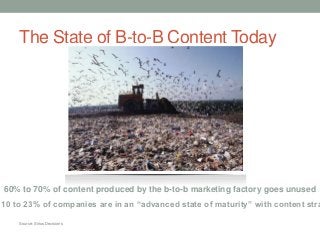
The State of B-to-B Content Today
60% to 70% of content produced by the b-to-b marketing factory goes unused
10 to 23% of companies are in an “advanced state of maturity” with content stra
Source: Sirius Decisions
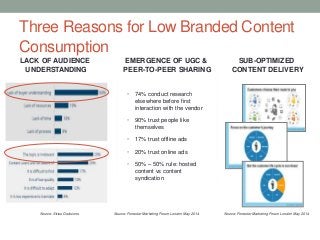
Three Reasons for Low Branded Content
Consumption
EMERGENCE OF UGC &
PEER-TO-PEER SHARING
LACK OF AUDIENCE
UNDERSTANDING
Source: Forrester Marketing Forum London May 2014Source: Sirius Decisions
• 74% conduct research
elsewhere before first
interaction with the vendor
• 90% trust people like
themselves
• 17% trust offline ads
• 20% trust online ads
• 50% – 50% rule: hosted
content vs content
syndication
Source: Forrester Marketing Forum London May 2014
SUB-OPTIMIZED
CONTENT DELIVERY
Solution…
Think like a publisher…
Course Outline
• The Changing Content Landscape
• Content Planning Framework
• Creating Your Message
• Best Practices
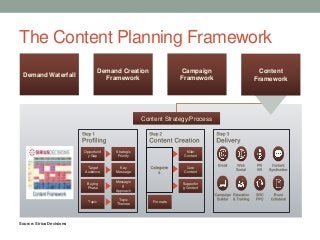
The Content Planning Framework
Content Strategy/Process
Demand Waterfall
Campaign
Framework
Content
Framework
Demand Creation
Framework
Opportunit
y Gap
Target
Audience
Buying
Phase
Topic
Strategic
Priority
Key
Message
Messagin
g
Approach
Topic
Themes
Formats
Killer
Content
Core
Content
Supportin
g Content
Source: Sirius Decisions
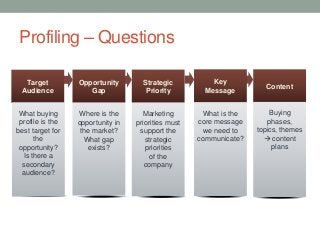
Opportunity
Gap
Strategic
Priority
Target
Audience
Key
Message
Content
Profiling – Questions
Where is the
opportunity in
the market?
What gap
exists?
Marketing
priorities must
support the
strategic
priorities
of the
company
What buying
profile is the
best target for
the
opportunity?
Is there a
secondary
audience?
What is the
core message
we need to
communicate?
Buying
phases,
topics, themes
 content
plans
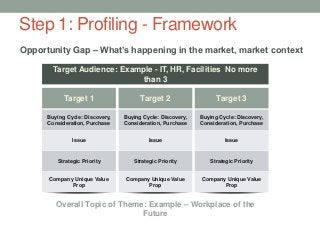
Step 1: Profiling - Framework
Opportunity Gap – What’s happening in the market, market context
Target Audience: Example - IT, HR, Facilities No more
than 3
Target 1
Buying Cycle: Discovery,
Consideration, Purchase
Issue
Overall Topic of Theme: Example – Workplace of the
Future
Target 2 Target 3
Buying Cycle: Discovery,
Consideration, Purchase
Buying Cycle: Discovery,
Consideration, Purchase
Issue Issue
Strategic Priority Strategic Priority Strategic Priority
Company Unique Value
Prop
Company Unique Value
Prop
Company Unique Value
Prop
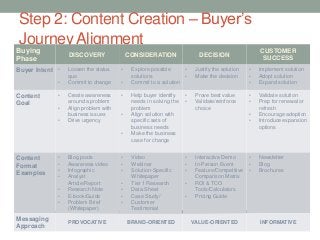
Step 2: Content Creation – Buyer’s
Journey Alignment
Buying
Phase
DISCOVERY CONSIDERATION DECISION
CUSTOMER
SUCCESS
Buyer Intent • Loosen the status
quo
• Commit to change
• Explore possible
solutions
• Commit to a solution
• Justify the solution
• Make the decision
• Implement solution
• Adopt solution
• Expand solution
Content
Goal
• Create awareness
around a problem
• Align problem with
business issues
• Drive urgency
• Help buyer identify
needs in solving the
problem
• Align solution with
specific sets of
business needs
• Make the business
case for change
• Prove best value
• Validate/reinforce
choice
• Validate solution
• Prep for renewal or
refresh
• Encourage adoption
• Introduce expansion
options
Content
Format
Examples
• Blog posts
• Awareness video
• Infographic
• Analyst
Article/Report
• Research Note
• E-book/Guide
• Problem Brief
(Whitepaper)
• Video
• Webinar
• Solution-Specific
Whitepaper
• Tier 1 Research
• Data Sheet
• Case Study/
• Customer
Testimonial
• Interactive Demo
• In-Person Event
• Feature/Competitive
Comparison Matrix
• ROI & TCO
Tools/Calculators
• Pricing Guide
• Newsletter
• Blog
• Brochures
Messaging
Approach
PROVOCATIVE BRAND-ORIENTED VALUE-ORIENTED INFORMATIVE
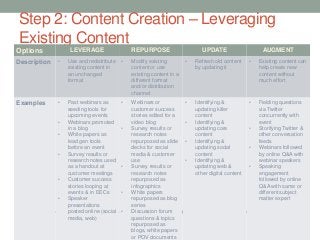
Step 2: Content Creation – Leveraging
Existing Content
Options LEVERAGE REPURPOSE UPDATE AUGMENT
Description • Use and redistribute
existing content in
an unchanged
format
• Modify existing
content or use
existing content in a
different format
and/or distribution
channel
• Refresh old content
by updating it
• Existing content can
help create new
content without
much effort
Examples • Past webinars as
seeding tools for
upcoming events
• Webinars promoted
in a blog
• White papers as
lead gen tools
before an event
• Survey results or
research notes used
as a handout at
customer meetings
• Customer success
stories looping at
events & in EECs
• Speaker
presentations
posted online (social
media, web)
• Webinars or
customer success
stories edited for a
video blog
• Survey results or
research notes
repurposed as slide
decks for social
media & customer
use
• Survey results or
research notes
repurposed as
infographics
• White papers
repurposed as blog
series
• Discussion forum
questions & topics
repurposed as
blogs, white papers
or POV documents
• Identifying &
updating killer
content
• Identifying &
updating core
content
• Identifying &
updating social
content
• Identifying &
updating web &
other digital content
• Fielding questions
via Twitter
concurrently with
event
• Storifying Twitter &
other conversation
feeds
• Webinars followed
by online Q&A with
webinar speakers
• Speaking
engagement
followed by online
Q&A with same or
different subject
matter expert
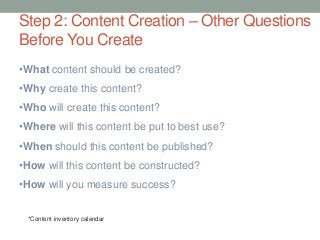
•What content should be created?
•Why create this content?
•Who will create this content?
•Where will this content be put to best use?
•When should this content be published?
•How will this content be constructed?
•How will you measure success?
*Content inventory calendar
Step 2: Content Creation – Other Questions
Before You Create
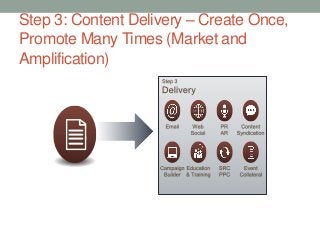
Step 3: Content Delivery – Create Once,
Promote Many Times (Market and
Amplification)
Course Outline
• The Changing Content Landscape
• Content Planning Framework
• Creating Your Message
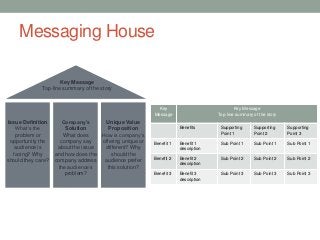
Messaging House
Key Message
Top-line summary of the story
Issue Definition
What’s the
problem or
opportunity the
audience is
facing? Why
should they care?
Company’s
Solution
What does
company say
about the issue
and how does the
company address
the audience’s
problem?
Unique Value
Proposition
How is company’s
offering unique or
different? Why
should the
audience prefer
this solution?
Key
Message
Key Message
Top-line summary of the story
Benefits Supporting
Point 1
Supporting
Point 2
Supporting
Point 3
Benefit 1 Benefit 1
description
Sub Point 1 Sub Point 1 Sub Point 1
Benefit 2 Benefit 2
description
Sub Point 2 Sub Point 2 Sub Point 2
Benefit 3 Benefit 3
description
Sub Point 3 Sub Point 3 Sub Point 3
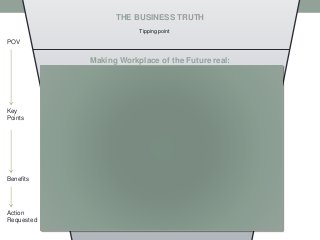
THE BUSINESS TRUTH
Tipping point
Making Workplace of the Future real:
CULTURE/PEOPLE
• Collaboration tools accessible to
all.
• Executive sponsorship and
adoption
• Engaged employees: attract
and retain the best and the
brightest
• Maximize knowledge sharing
and capture
TECHNOLOGY/EXPERIENC
E
• Quality as natural as being
there
• Technology that doesn’t get in
the way
• Easily connect externally to
customers, partners and
suppliers
• Intuitive: anyone can use
ENVIRONMENT
• Collaborate in open and shared
work spaces
• Stay connected and collaborate
on the road or from your home
office
• Connect through any mobile
device
We defy the distance between:
• Brainstorm today and archived session tomorrow (Culture/People)
• On-site colleagues and on-the-go collaborators (environment)
• Video experience as part of your company’s business DNA
(Technology/Experience)
The Workplace of the Future Delivers
• More innovation
• More engaged/motivated
employees
• Competitive advantage
• Quicker time to market
• Faster decisions
• More productive meetings
Integrated into Workflow
POV
Key
Points
Benefits
Action
Requested
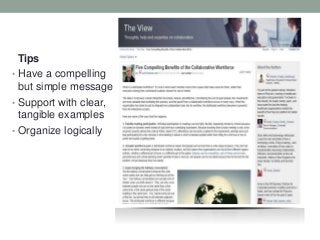
Tips
• Have a compelling
but simple message
• Support with clear,
tangible examples
• Organize logically

Content Framework

  • 1.
  • 2.
    Course Outline • TheChanging Content Landscape • Content Planning Framework • Creating Your Message
  • 3.
    The State ofB-to-B Content Today 60% to 70% of content produced by the b-to-b marketing factory goes unused 10 to 23% of companies are in an “advanced state of maturity” with content stra Source: Sirius Decisions
  • 4.
    Three Reasons forLow Branded Content Consumption EMERGENCE OF UGC & PEER-TO-PEER SHARING LACK OF AUDIENCE UNDERSTANDING Source: Forrester Marketing Forum London May 2014Source: Sirius Decisions • 74% conduct research elsewhere before first interaction with the vendor • 90% trust people like themselves • 17% trust offline ads • 20% trust online ads • 50% – 50% rule: hosted content vs content syndication Source: Forrester Marketing Forum London May 2014 SUB-OPTIMIZED CONTENT DELIVERY
  • 5.
  • 6.
    Course Outline • TheChanging Content Landscape • Content Planning Framework • Creating Your Message • Best Practices
  • 7.
    The Content PlanningFramework Content Strategy/Process Demand Waterfall Campaign Framework Content Framework Demand Creation Framework Opportunit y Gap Target Audience Buying Phase Topic Strategic Priority Key Message Messagin g Approach Topic Themes Formats Killer Content Core Content Supportin g Content Source: Sirius Decisions
  • 8.
    Opportunity Gap Strategic Priority Target Audience Key Message Content Profiling – Questions Whereis the opportunity in the market? What gap exists? Marketing priorities must support the strategic priorities of the company What buying profile is the best target for the opportunity? Is there a secondary audience? What is the core message we need to communicate? Buying phases, topics, themes  content plans
  • 9.
    Step 1: Profiling- Framework Opportunity Gap – What’s happening in the market, market context Target Audience: Example - IT, HR, Facilities No more than 3 Target 1 Buying Cycle: Discovery, Consideration, Purchase Issue Overall Topic of Theme: Example – Workplace of the Future Target 2 Target 3 Buying Cycle: Discovery, Consideration, Purchase Buying Cycle: Discovery, Consideration, Purchase Issue Issue Strategic Priority Strategic Priority Strategic Priority Company Unique Value Prop Company Unique Value Prop Company Unique Value Prop
  • 10.
    Step 2: ContentCreation – Buyer’s Journey Alignment Buying Phase DISCOVERY CONSIDERATION DECISION CUSTOMER SUCCESS Buyer Intent • Loosen the status quo • Commit to change • Explore possible solutions • Commit to a solution • Justify the solution • Make the decision • Implement solution • Adopt solution • Expand solution Content Goal • Create awareness around a problem • Align problem with business issues • Drive urgency • Help buyer identify needs in solving the problem • Align solution with specific sets of business needs • Make the business case for change • Prove best value • Validate/reinforce choice • Validate solution • Prep for renewal or refresh • Encourage adoption • Introduce expansion options Content Format Examples • Blog posts • Awareness video • Infographic • Analyst Article/Report • Research Note • E-book/Guide • Problem Brief (Whitepaper) • Video • Webinar • Solution-Specific Whitepaper • Tier 1 Research • Data Sheet • Case Study/ • Customer Testimonial • Interactive Demo • In-Person Event • Feature/Competitive Comparison Matrix • ROI & TCO Tools/Calculators • Pricing Guide • Newsletter • Blog • Brochures Messaging Approach PROVOCATIVE BRAND-ORIENTED VALUE-ORIENTED INFORMATIVE
  • 11.
    Step 2: ContentCreation – Leveraging Existing Content Options LEVERAGE REPURPOSE UPDATE AUGMENT Description • Use and redistribute existing content in an unchanged format • Modify existing content or use existing content in a different format and/or distribution channel • Refresh old content by updating it • Existing content can help create new content without much effort Examples • Past webinars as seeding tools for upcoming events • Webinars promoted in a blog • White papers as lead gen tools before an event • Survey results or research notes used as a handout at customer meetings • Customer success stories looping at events & in EECs • Speaker presentations posted online (social media, web) • Webinars or customer success stories edited for a video blog • Survey results or research notes repurposed as slide decks for social media & customer use • Survey results or research notes repurposed as infographics • White papers repurposed as blog series • Discussion forum questions & topics repurposed as blogs, white papers or POV documents • Identifying & updating killer content • Identifying & updating core content • Identifying & updating social content • Identifying & updating web & other digital content • Fielding questions via Twitter concurrently with event • Storifying Twitter & other conversation feeds • Webinars followed by online Q&A with webinar speakers • Speaking engagement followed by online Q&A with same or different subject matter expert
  • 12.
    •What content shouldbe created? •Why create this content? •Who will create this content? •Where will this content be put to best use? •When should this content be published? •How will this content be constructed? •How will you measure success? *Content inventory calendar Step 2: Content Creation – Other Questions Before You Create
  • 13.
    Step 3: ContentDelivery – Create Once, Promote Many Times (Market and Amplification)
  • 14.
    Course Outline • TheChanging Content Landscape • Content Planning Framework • Creating Your Message
  • 15.
    Messaging House Key Message Top-linesummary of the story Issue Definition What’s the problem or opportunity the audience is facing? Why should they care? Company’s Solution What does company say about the issue and how does the company address the audience’s problem? Unique Value Proposition How is company’s offering unique or different? Why should the audience prefer this solution? Key Message Key Message Top-line summary of the story Benefits Supporting Point 1 Supporting Point 2 Supporting Point 3 Benefit 1 Benefit 1 description Sub Point 1 Sub Point 1 Sub Point 1 Benefit 2 Benefit 2 description Sub Point 2 Sub Point 2 Sub Point 2 Benefit 3 Benefit 3 description Sub Point 3 Sub Point 3 Sub Point 3
  • 16.
    THE BUSINESS TRUTH Tippingpoint Making Workplace of the Future real: CULTURE/PEOPLE • Collaboration tools accessible to all. • Executive sponsorship and adoption • Engaged employees: attract and retain the best and the brightest • Maximize knowledge sharing and capture TECHNOLOGY/EXPERIENC E • Quality as natural as being there • Technology that doesn’t get in the way • Easily connect externally to customers, partners and suppliers • Intuitive: anyone can use ENVIRONMENT • Collaborate in open and shared work spaces • Stay connected and collaborate on the road or from your home office • Connect through any mobile device We defy the distance between: • Brainstorm today and archived session tomorrow (Culture/People) • On-site colleagues and on-the-go collaborators (environment) • Video experience as part of your company’s business DNA (Technology/Experience) The Workplace of the Future Delivers • More innovation • More engaged/motivated employees • Competitive advantage • Quicker time to market • Faster decisions • More productive meetings Integrated into Workflow POV Key Points Benefits Action Requested
  • 17.
    Tips • Have acompelling but simple message • Support with clear, tangible examples • Organize logically

Editor's Notes

  • #18 Leveraging existing content..