Container Shipping In Canada
Introduction
Canada occupies the bulk of the land surface of the North American continent
and it is bounded by three oceans, the Pacific, Arctic and Atlantic. Consequently,
it boasts some of the world’s most efficient ports.
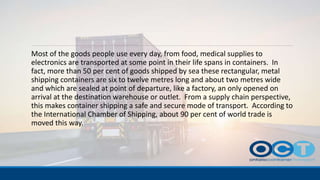
Most of the goods people use every day, from food, medical supplies to
electronics are transported at some point in their life spans in containers. In
fact, more than 50 per cent of goods shipped by sea these rectangular, metal
shipping containers are six to twelve metres long and about two metres wide
and which are sealed at point of departure, like a factory, an only opened on
arrival at the destination warehouse or outlet. From a supply chain perspective,
this makes container shipping a safe and secure mode of transport. According to
the International Chamber of Shipping, about 90 per cent of world trade is
moved this way.
Table of contents
Standardisation for efficiency
Five major ports, four for container shipping
Artificial intelligence in container shipping
Operating 24/7, 365 days a year
Standardisation for efficiency
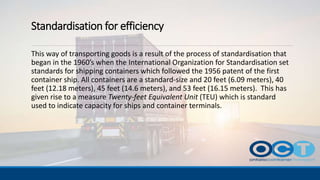
This way of transporting goods is a result of the process of standardisation that
began in the 1960’s when the International Organization for Standardisation set
standards for shipping containers which followed the 1956 patent of the first
container ship. All containers are a standard-size and 20 feet (6.09 meters), 40
feet (12.18 meters), 45 feet (14.6 meters), and 53 feet (16.15 meters). This has
given rise to a measure Twenty-feet Equivalent Unit (TEU) which is standard
used to indicate capacity for ships and container terminals.
Containers are now manufactured according to international standards. This
means that, as goods are transported from source to destination, any container
is interchangeable with another along the entire transport chain, i.e. on the
container ship, specialised rail unit and trailer for the road. The different types of
containers are designed to accommodate different classes of merchandise, for
example, fresh produce in refrigerated containers to containers that might be
open at one end, side, or the tops, or which might be flat.
Containerised tanks and half sizes are also available and are all manufactured so
that they are standardised for easy loading and offloading, whether in the hold
or on the deck of the container ship. This also means that cargo can be
efficiently loaded and unloaded especially when optimised for take-on and drop
off at the various ports of call along the container ship’s route.
Bulk transport and mechanised loading and offloading have also introduced an
added level of economy and helps to make goods more affordable than they
would otherwise have been.
Five major ports, four for container shipping
Canada has five key ports, four of which handle significant amounts of container
traffic. The largest of these is the Port of Vancouver and which is also the third
largest by tonnage in North America. This is partly a function of its strategic
position on important routes for world trade and fishing. The Port of Vancouver
has 25 terminals handling container, bulk and break cargo amounting to more
than 76 million metric tonnes of the Canada’s total international imports and
exports.
An alternative to Vancouver is Port of Prince Rupert the main business of which
is the export of food and agricultural products. These are predominately wheat
and barley for the international market, going mainly to North Africa, the
Americas and the Middle East. The Prince Rupert grain terminal is among
Canada’s most modern facilities. It has a storage capacity of 200,000 tonnes and
can ship more than seven million tonnes of grain annually.
Artificial intelligence in container shipping
Located on the shortest direct trade route between North America, the
Mediterranean and Europe, the Port of Montreal, on the Saint Lawrence River
seaway is central to the economy of Quebec and Montreal. It has recently begun
to make use of artificial intelligence to more efficiently manage the flow of
vehicles collecting and delivering containers to the port. In addition, significant
projects are planned for this port, including a fifth container terminal which will
increase its capacity to 2.1 million TEUs enabling it to handle more than 35
million metric tonnes per year.
Operating 24/7, 365 days a year
Although Halifax is a globally recognised port for cruise liners, it is an extremely
busy port for cargo and container shipping. Because of its geography, there are
minor tide variations and because it is ice-free and very deep, it is unaffected by
the seasons and able to operate all year round. Halifax has a reputation for high
levels of efficiency and professionalism associated with the movement of cargo.
The planned completion of the new container berth will double the port’s
capacity to accommodate an increase in container traffic on the east coast of
Canada.
Also on the east of Canada, is the Port of St John, and with its first-rate road and
rail links to the Canadian hinterland. This port handles containers as well as
other bulk dry and liquid cargo. It is integral to commerce in that part of the
country, connecting to 500 other world ports and moving in the region of 28
million metric tonnes each year.
Contact details
Company name: Ontario Container Transport
Address: 6201 HWY 7 West Unit 2 Woodbridge, Toronto, ON, L4H 0K7, Canada
Phone: (905) 695 1501
Email: dispatch@octi.ca
Website: http://octi.ca/

Container Shipping in Canada

  • 1.
  • 2.
    Introduction Canada occupies thebulk of the land surface of the North American continent and it is bounded by three oceans, the Pacific, Arctic and Atlantic. Consequently, it boasts some of the world’s most efficient ports.
  • 3.
    Most of thegoods people use every day, from food, medical supplies to electronics are transported at some point in their life spans in containers. In fact, more than 50 per cent of goods shipped by sea these rectangular, metal shipping containers are six to twelve metres long and about two metres wide and which are sealed at point of departure, like a factory, an only opened on arrival at the destination warehouse or outlet. From a supply chain perspective, this makes container shipping a safe and secure mode of transport. According to the International Chamber of Shipping, about 90 per cent of world trade is moved this way.
  • 4.
    Table of contents Standardisationfor efficiency Five major ports, four for container shipping Artificial intelligence in container shipping Operating 24/7, 365 days a year
  • 5.
    Standardisation for efficiency Thisway of transporting goods is a result of the process of standardisation that began in the 1960’s when the International Organization for Standardisation set standards for shipping containers which followed the 1956 patent of the first container ship. All containers are a standard-size and 20 feet (6.09 meters), 40 feet (12.18 meters), 45 feet (14.6 meters), and 53 feet (16.15 meters). This has given rise to a measure Twenty-feet Equivalent Unit (TEU) which is standard used to indicate capacity for ships and container terminals.
  • 6.
    Containers are nowmanufactured according to international standards. This means that, as goods are transported from source to destination, any container is interchangeable with another along the entire transport chain, i.e. on the container ship, specialised rail unit and trailer for the road. The different types of containers are designed to accommodate different classes of merchandise, for example, fresh produce in refrigerated containers to containers that might be open at one end, side, or the tops, or which might be flat.
  • 7.
    Containerised tanks andhalf sizes are also available and are all manufactured so that they are standardised for easy loading and offloading, whether in the hold or on the deck of the container ship. This also means that cargo can be efficiently loaded and unloaded especially when optimised for take-on and drop off at the various ports of call along the container ship’s route. Bulk transport and mechanised loading and offloading have also introduced an added level of economy and helps to make goods more affordable than they would otherwise have been.
  • 8.
    Five major ports,four for container shipping Canada has five key ports, four of which handle significant amounts of container traffic. The largest of these is the Port of Vancouver and which is also the third largest by tonnage in North America. This is partly a function of its strategic position on important routes for world trade and fishing. The Port of Vancouver has 25 terminals handling container, bulk and break cargo amounting to more than 76 million metric tonnes of the Canada’s total international imports and exports.
  • 9.
    An alternative toVancouver is Port of Prince Rupert the main business of which is the export of food and agricultural products. These are predominately wheat and barley for the international market, going mainly to North Africa, the Americas and the Middle East. The Prince Rupert grain terminal is among Canada’s most modern facilities. It has a storage capacity of 200,000 tonnes and can ship more than seven million tonnes of grain annually.
  • 10.
    Artificial intelligence incontainer shipping Located on the shortest direct trade route between North America, the Mediterranean and Europe, the Port of Montreal, on the Saint Lawrence River seaway is central to the economy of Quebec and Montreal. It has recently begun to make use of artificial intelligence to more efficiently manage the flow of vehicles collecting and delivering containers to the port. In addition, significant projects are planned for this port, including a fifth container terminal which will increase its capacity to 2.1 million TEUs enabling it to handle more than 35 million metric tonnes per year.
  • 11.
    Operating 24/7, 365days a year Although Halifax is a globally recognised port for cruise liners, it is an extremely busy port for cargo and container shipping. Because of its geography, there are minor tide variations and because it is ice-free and very deep, it is unaffected by the seasons and able to operate all year round. Halifax has a reputation for high levels of efficiency and professionalism associated with the movement of cargo. The planned completion of the new container berth will double the port’s capacity to accommodate an increase in container traffic on the east coast of Canada.
  • 12.
    Also on theeast of Canada, is the Port of St John, and with its first-rate road and rail links to the Canadian hinterland. This port handles containers as well as other bulk dry and liquid cargo. It is integral to commerce in that part of the country, connecting to 500 other world ports and moving in the region of 28 million metric tonnes each year.
  • 13.
    Contact details Company name:Ontario Container Transport Address: 6201 HWY 7 West Unit 2 Woodbridge, Toronto, ON, L4H 0K7, Canada Phone: (905) 695 1501 Email: dispatch@octi.ca Website: http://octi.ca/