How can the NHS better exploit social media to stimulate patient involvement? @markhawker #HC2011, Health Informatics Congress,  Birmingham, Tuesday 5 April 2011
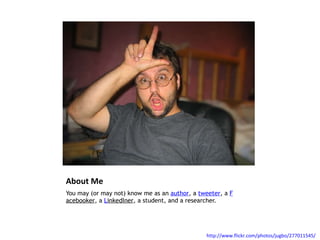
About Me You may (or may not) know me as an  author , a  tweeter , a  F acebooker , a  L inkedIner , a student, and a researcher. http://www.flickr.com/photos/jugbo/277011545/
Outline Social media (in the NHS) Public opinion 1.0 and 2.0  The information (and patient) revolution Patient involvement 1.0 and 2.0
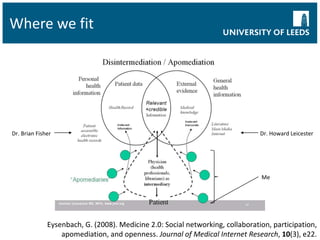
Where we fit Eysenbach, G. (2008). Medicine 2.0: Social networking, collaboration, participation, apomediation, and openness.  Journal of Medical Internet Research ,  10 (3), e22. Dr. Brian Fisher Dr. Howard Leicester Me
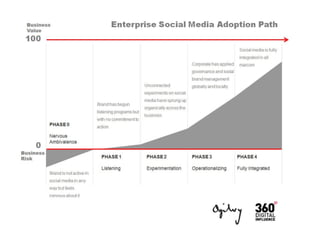
What is social media? Convert  broadcast media  from  traditional ,  one-way transmission  into a more  open  and egalitarian  conversation . (Regenberg, 2010) Internet-based services that focus on a  peer to peer  model of  information exchange  and  communication . (Anderson & Speed, 2010) Participation ,  openness ,  conversation ,  community , and  connectedness . (Mayfield, 2008) A group of Internet-based applications that build on the ideological and technological foundations of  Web 2.0 , and that allow the  creation  and  exchange  of  User Generated Content . (Kaplan & Haenlein, 2010)
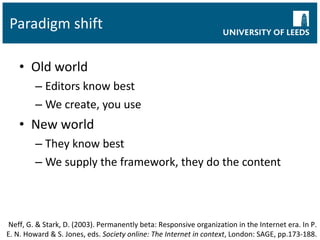
Paradigm shift Old world Editors know best We create, you use New world They know best We supply the framework, they do the content Neff, G. & Stark, D. (2003). Permanently beta: Responsive organization in the Internet era. In P. E. N. Howard & S. Jones, eds.  Society online: The Internet in context , London: SAGE, pp.173-188.
 
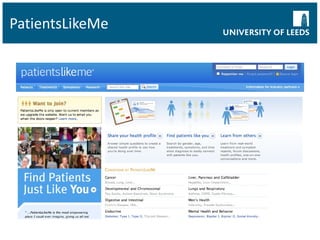
PatientsLikeMe
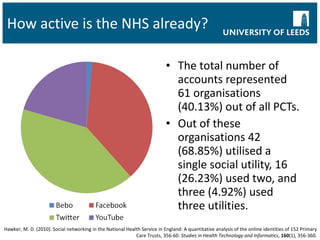
How active is the NHS already? The total number of accounts represented 61 organisations (40.13%) out of all PCTs. Out of these organisations 42 (68.85%) utilised a single social utility, 16 (26.23%) used two, and three (4.92%) used three utilities. Hawker, M. D. (2010). Social networking in the National Health Service in England: A quantitative analysis of the online identities of 152 Primary Care Trusts, 356-60.  Studies in Health Technology and Informatics ,  160 (1), 356-360.
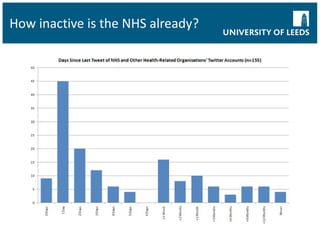
How inactive is the NHS already?
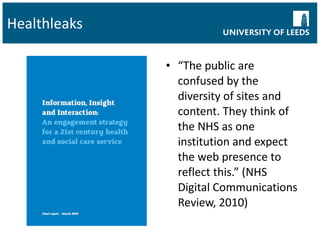
Healthleaks “ The public are confused by the diversity of sites and content. They think of the NHS as one institution and expect the web presence to reflect this.” (NHS Digital Communications Review, 2010)
There’re more here
 
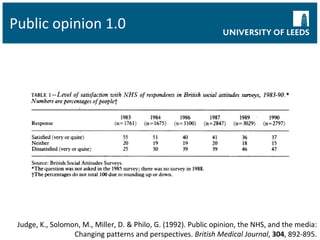
Public opinion 1.0 Judge, K., Solomon, M., Miller, D. & Philo, G. (1992). Public opinion, the NHS, and the media: Changing patterns and perspectives.  British Medical Journal ,  304 , 892-895.
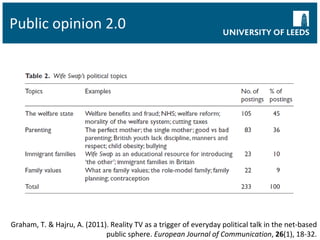
Public opinion 2.0 Graham, T. & Hajru, A. (2011). Reality TV as a trigger of everyday political talk in the net-based public sphere.  European Journal of Communication ,  26 (1), 18-32.
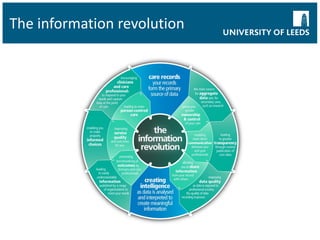
The information revolution
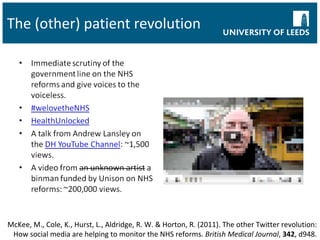
The (other) patient revolution McKee, M., Cole, K., Hurst, L., Aldridge, R. W. & Horton, R. (2011). The other Twitter revolution: How social media are helping to monitor the NHS reforms.  British Medical Journal ,  342 , d948.
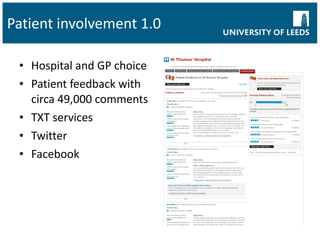
Patient involvement 1.0 Hospital and GP choice Patient feedback with circa 49,000 comments TXT services Twitter Facebook
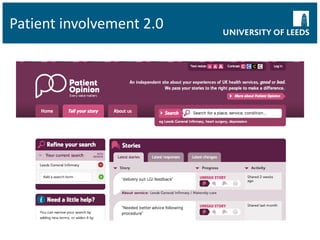
Patient involvement 2.0
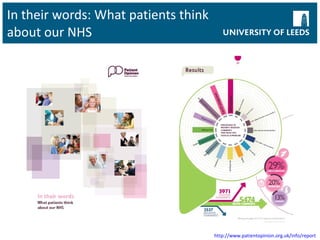
In their words: What patients think about our NHS http://www.patientopinion.org.uk/info/report
Associations between staff and [in]patient feedback Surveys across 166 NHS acute trusts in England, by 69,500 staff and 81,000 patients. Staff availability of hand-washing materials was positively-associated with patient feedback on cleanliness, and others. Negative staff experience was reflected in poorer patient experience and vice versa. Raleigh, V. S., Hussey, D., Seccombe, I. & Qi, R. (2009). Do associations between staff and inpatient feedback have the potential for improving patient experience? An analysis of surveys in NHS acute trusts in England.  BMJ Quality & Safety ,  18 , 347-354.
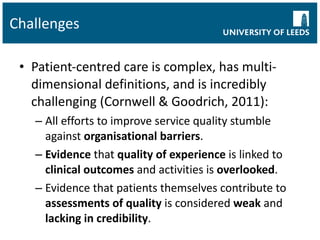
Challenges Patient-centred care is complex, has multi-dimensional definitions, and is incredibly challenging (Cornwell & Goodrich, 2011): All efforts to improve service quality stumble against  organisational barriers . Evidence  that  quality of experience  is linked to  clinical outcomes  and activities is  overlooked . Evidence that patients themselves contribute to  assessments of quality  is considered  weak  and  lacking in credibility .
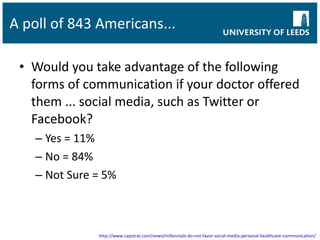
A poll of 843 Americans... Would you take advantage of the following forms of communication if your doctor offered them ... social media, such as Twitter or Facebook? Yes = 11% No = 84% Not Sure = 5% http://www.capstrat.com/news/millennials-do-not-favor-social-media-personal-healthcare-communication/
An echo chamber? “ Despite the hype surrounding the idea of the Internet [election], it was the traditional platform of broadcasting that dominated the campaign.” Wring, D. & Ward, S. (2010). The media and the 2010 campaign: The television election?  Parliamentary Affairs ,  63 (4), 802-817.
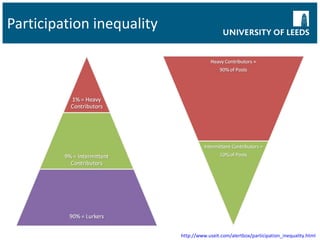
Participation inequality http://www.useit.com/alertbox/participation_inequality.html
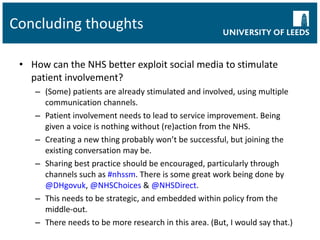
Concluding thoughts How can the NHS better exploit social media to stimulate patient involvement? (Some) patients are already stimulated and involved, using multiple communication channels. Patient involvement needs to lead to service improvement. Being given a voice is nothing without (re)action from the NHS. Creating a new thing probably won’t be successful, but joining the existing conversation may be. Sharing best practice should be encouraged, particularly through channels such as  #nhssm . There is some great work being done by  @DHgovuk ,  @NHSChoices  &  @NHSDirect . This needs to be strategic, and embedded within policy from the middle-out. There needs to be more research in this area. (But, I would say that.)
References Anderson, B. & Speed, E. (2010). Social media and health: Implications for primary health care providers.  Report to Solihull Care Trust . Colchester: University of Essex. Cornwell, J. & Goodrich, J. (2011). Challenges for improving patients’ experiences of health care.  Journal of Health Services Research & Policy ,  16 (1), 1-2. Kaplan, A. M. & Haenlein, M. (2010). Users of the world, unite! The challenges and opportunities of social media.  Business Horizons ,  53 , 59-68. Mayfield, A. (2008).  What is social media?  Available at:  http://www.icrossing.co.uk/what-we-think/  (Accessed 1 April 2011).  Regenberg, A. C. (2010). Tweeting science and ethics: Social media as a tool for constructive public engagement.  The American Journal of Bioethics ,  10 (5), 30-31.
Leeds Institute of Health Sciences  Faculty of Medicine and Health Charles Thackrah Building 101 Clarendon Road Leeds, United Kingdom LS2 9LJ http://www.ychi.leeds.ac.uk

Hc2011socialmedia

  • 1.
    How can theNHS better exploit social media to stimulate patient involvement? @markhawker #HC2011, Health Informatics Congress, Birmingham, Tuesday 5 April 2011
  • 2.
    About Me Youmay (or may not) know me as an author , a tweeter , a F acebooker , a L inkedIner , a student, and a researcher. http://www.flickr.com/photos/jugbo/277011545/
  • 3.
    Outline Social media(in the NHS) Public opinion 1.0 and 2.0 The information (and patient) revolution Patient involvement 1.0 and 2.0
  • 4.
    Where we fitEysenbach, G. (2008). Medicine 2.0: Social networking, collaboration, participation, apomediation, and openness. Journal of Medical Internet Research , 10 (3), e22. Dr. Brian Fisher Dr. Howard Leicester Me
  • 5.
    What is socialmedia? Convert broadcast media from traditional , one-way transmission into a more open and egalitarian conversation . (Regenberg, 2010) Internet-based services that focus on a peer to peer model of information exchange and communication . (Anderson & Speed, 2010) Participation , openness , conversation , community , and connectedness . (Mayfield, 2008) A group of Internet-based applications that build on the ideological and technological foundations of Web 2.0 , and that allow the creation and exchange of User Generated Content . (Kaplan & Haenlein, 2010)
  • 6.
    Paradigm shift Oldworld Editors know best We create, you use New world They know best We supply the framework, they do the content Neff, G. & Stark, D. (2003). Permanently beta: Responsive organization in the Internet era. In P. E. N. Howard & S. Jones, eds. Society online: The Internet in context , London: SAGE, pp.173-188.
  • 7.
  • 8.
  • 9.
    How active isthe NHS already? The total number of accounts represented 61 organisations (40.13%) out of all PCTs. Out of these organisations 42 (68.85%) utilised a single social utility, 16 (26.23%) used two, and three (4.92%) used three utilities. Hawker, M. D. (2010). Social networking in the National Health Service in England: A quantitative analysis of the online identities of 152 Primary Care Trusts, 356-60. Studies in Health Technology and Informatics , 160 (1), 356-360.
  • 10.
    How inactive isthe NHS already?
  • 11.
    Healthleaks “ Thepublic are confused by the diversity of sites and content. They think of the NHS as one institution and expect the web presence to reflect this.” (NHS Digital Communications Review, 2010)
  • 12.
  • 13.
  • 14.
    Public opinion 1.0Judge, K., Solomon, M., Miller, D. & Philo, G. (1992). Public opinion, the NHS, and the media: Changing patterns and perspectives. British Medical Journal , 304 , 892-895.
  • 15.
    Public opinion 2.0Graham, T. & Hajru, A. (2011). Reality TV as a trigger of everyday political talk in the net-based public sphere. European Journal of Communication , 26 (1), 18-32.
  • 16.
  • 17.
    The (other) patientrevolution McKee, M., Cole, K., Hurst, L., Aldridge, R. W. & Horton, R. (2011). The other Twitter revolution: How social media are helping to monitor the NHS reforms. British Medical Journal , 342 , d948.
  • 18.
    Patient involvement 1.0Hospital and GP choice Patient feedback with circa 49,000 comments TXT services Twitter Facebook
  • 19.
  • 20.
    In their words:What patients think about our NHS http://www.patientopinion.org.uk/info/report
  • 21.
    Associations between staffand [in]patient feedback Surveys across 166 NHS acute trusts in England, by 69,500 staff and 81,000 patients. Staff availability of hand-washing materials was positively-associated with patient feedback on cleanliness, and others. Negative staff experience was reflected in poorer patient experience and vice versa. Raleigh, V. S., Hussey, D., Seccombe, I. & Qi, R. (2009). Do associations between staff and inpatient feedback have the potential for improving patient experience? An analysis of surveys in NHS acute trusts in England. BMJ Quality & Safety , 18 , 347-354.
  • 22.
    Challenges Patient-centred careis complex, has multi-dimensional definitions, and is incredibly challenging (Cornwell & Goodrich, 2011): All efforts to improve service quality stumble against organisational barriers . Evidence that quality of experience is linked to clinical outcomes and activities is overlooked . Evidence that patients themselves contribute to assessments of quality is considered weak and lacking in credibility .
  • 23.
    A poll of843 Americans... Would you take advantage of the following forms of communication if your doctor offered them ... social media, such as Twitter or Facebook? Yes = 11% No = 84% Not Sure = 5% http://www.capstrat.com/news/millennials-do-not-favor-social-media-personal-healthcare-communication/
  • 24.
    An echo chamber?“ Despite the hype surrounding the idea of the Internet [election], it was the traditional platform of broadcasting that dominated the campaign.” Wring, D. & Ward, S. (2010). The media and the 2010 campaign: The television election? Parliamentary Affairs , 63 (4), 802-817.
  • 25.
  • 26.
    Concluding thoughts Howcan the NHS better exploit social media to stimulate patient involvement? (Some) patients are already stimulated and involved, using multiple communication channels. Patient involvement needs to lead to service improvement. Being given a voice is nothing without (re)action from the NHS. Creating a new thing probably won’t be successful, but joining the existing conversation may be. Sharing best practice should be encouraged, particularly through channels such as #nhssm . There is some great work being done by @DHgovuk , @NHSChoices & @NHSDirect . This needs to be strategic, and embedded within policy from the middle-out. There needs to be more research in this area. (But, I would say that.)
  • 27.
    References Anderson, B.& Speed, E. (2010). Social media and health: Implications for primary health care providers. Report to Solihull Care Trust . Colchester: University of Essex. Cornwell, J. & Goodrich, J. (2011). Challenges for improving patients’ experiences of health care. Journal of Health Services Research & Policy , 16 (1), 1-2. Kaplan, A. M. & Haenlein, M. (2010). Users of the world, unite! The challenges and opportunities of social media. Business Horizons , 53 , 59-68. Mayfield, A. (2008). What is social media? Available at: http://www.icrossing.co.uk/what-we-think/ (Accessed 1 April 2011). Regenberg, A. C. (2010). Tweeting science and ethics: Social media as a tool for constructive public engagement. The American Journal of Bioethics , 10 (5), 30-31.
  • 28.
    Leeds Institute ofHealth Sciences Faculty of Medicine and Health Charles Thackrah Building 101 Clarendon Road Leeds, United Kingdom LS2 9LJ http://www.ychi.leeds.ac.uk