Consumer Electrnics – Industry Analysis
Taposh Dutta Roy
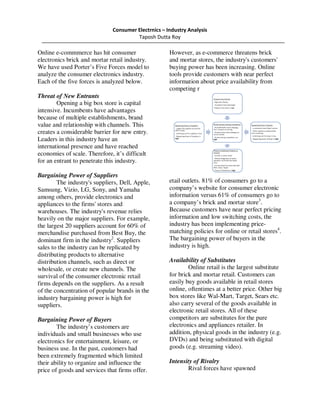
Online e-commmerce has hit consumer
electronics brick and mortar retail industry.
We have used Porter’s Five Forces model to
analyze the consumer electronics industry.
Each of the five forces is analyzed below.
Threat of New Entrants
Opening a big box store is capital
intensive. Incumbents have advantages
because of multiple establishments, brand
value and relationship with channels. This
creates a considerable barrier for new entry.
Leaders in this industry have an
international presence and have reached
economies of scale. Therefore, it’s difficult
for an entrant to penetrate this industry.
Bargaining Power of Suppliers
The industry's suppliers, Dell, Apple,
Samsung, Vizio, LG, Sony, and Yamaha
among others, provide electronics and
appliances to the firms' stores and
warehouses. The industry's revenue relies
heavily on the major suppliers. For example,
the largest 20 suppliers account for 60% of
merchandise purchased from Best Buy, the
dominant firm in the industry2
. Suppliers
sales to the industry can be replicated by
distributing products to alternative
distribution channels, such as direct or
wholesale, or create new channels. The
survival of the consumer electronic retail
firms depends on the suppliers. As a result
of the concentration of popular brands in the
industry bargaining power is high for
suppliers.
Bargaining Power of Buyers
The industry’s customers are
individuals and small businesses who use
electronics for entertainment, leisure, or
business use. In the past, customers had
been extremely fragmented which limited
their ability to organize and influence the
price of goods and services that firms offer.
However, as e-commerce threatens brick
and mortar stores, the industry's customers'
buying power has been increasing. Online
tools provide customers with near perfect
information about price availability from
competing r
etail outlets. 81% of consumers go to a
company’s website for consumer electronic
information versus 61% of consumers go to
a company’s brick and mortar store3
.
Because customers have near perfect pricing
information and low switching costs, the
industry has been implementing price-
matching policies for online or retail stores4
.
The bargaining power of buyers in the
industry is high.
Availability of Substitutes
Online retail is the largest substitute
for brick and mortar retail. Customers can
easily buy goods available in retail stores
online, oftentimes at a better price. Other big
box stores like Wal-Mart, Target, Sears etc.
also carry several of the goods available in
electronic retail stores. All of these
competitors are substitutes for the pure
electronics and appliances retailer. In
addition, physical goods in the industry (e.g.
DVDs) and being substituted with digital
goods (e.g. streaming video).
Intensity of Rivalry
Rival forces have spawned
Consumer Electrnics – Industry Analysis
Taposh Dutta Roy
2
significant action in recent quarters that have
reduced profit margins in the industry. The
pure electronics store segment has become
more concentrated in recent years as Circuit
City and CompUSA went out of business.
However, for overall electronics and
appliance sales (including online sales) there
are several large players. These larger
competitors, selling identical products, have
forced aggressive competitive activity. Price
matching programs are now commonplace
in the industry and new programs and
services, such as trade-in programs, have
been introduced.
Conclusion
e-Commerce is changing consumer
behaviors and online retailers are fiercely
competing with the big box consumer
electronic retailers. Using the 5 Forces
framework, our analysis indicates that the
industry's performance should decline,
which is consistent with the consolidation of
the industry and Best Buy's recent
performance.
References
1
The NPD Group, (September 2011). e-Commerce and Consumer Electronics: Online Shopping
and Purchasing. https://www.npd.com/lps/pdf/CE_e-Commerce_Final_Report.pdf
2
Wolf, A. (January 2013). Target Extends Online Price-Match; Best Buy May Follow.
http://www.twice.com/magazine/retailingetailing/target-extends-online-price-match-best-buy-
may-follow/104790

Consumer electronics bm_retail

  • 1.
    Consumer Electrnics –Industry Analysis Taposh Dutta Roy Online e-commmerce has hit consumer electronics brick and mortar retail industry. We have used Porter’s Five Forces model to analyze the consumer electronics industry. Each of the five forces is analyzed below. Threat of New Entrants Opening a big box store is capital intensive. Incumbents have advantages because of multiple establishments, brand value and relationship with channels. This creates a considerable barrier for new entry. Leaders in this industry have an international presence and have reached economies of scale. Therefore, it’s difficult for an entrant to penetrate this industry. Bargaining Power of Suppliers The industry's suppliers, Dell, Apple, Samsung, Vizio, LG, Sony, and Yamaha among others, provide electronics and appliances to the firms' stores and warehouses. The industry's revenue relies heavily on the major suppliers. For example, the largest 20 suppliers account for 60% of merchandise purchased from Best Buy, the dominant firm in the industry2 . Suppliers sales to the industry can be replicated by distributing products to alternative distribution channels, such as direct or wholesale, or create new channels. The survival of the consumer electronic retail firms depends on the suppliers. As a result of the concentration of popular brands in the industry bargaining power is high for suppliers. Bargaining Power of Buyers The industry’s customers are individuals and small businesses who use electronics for entertainment, leisure, or business use. In the past, customers had been extremely fragmented which limited their ability to organize and influence the price of goods and services that firms offer. However, as e-commerce threatens brick and mortar stores, the industry's customers' buying power has been increasing. Online tools provide customers with near perfect information about price availability from competing r etail outlets. 81% of consumers go to a company’s website for consumer electronic information versus 61% of consumers go to a company’s brick and mortar store3 . Because customers have near perfect pricing information and low switching costs, the industry has been implementing price- matching policies for online or retail stores4 . The bargaining power of buyers in the industry is high. Availability of Substitutes Online retail is the largest substitute for brick and mortar retail. Customers can easily buy goods available in retail stores online, oftentimes at a better price. Other big box stores like Wal-Mart, Target, Sears etc. also carry several of the goods available in electronic retail stores. All of these competitors are substitutes for the pure electronics and appliances retailer. In addition, physical goods in the industry (e.g. DVDs) and being substituted with digital goods (e.g. streaming video). Intensity of Rivalry Rival forces have spawned
  • 2.
    Consumer Electrnics –Industry Analysis Taposh Dutta Roy 2 significant action in recent quarters that have reduced profit margins in the industry. The pure electronics store segment has become more concentrated in recent years as Circuit City and CompUSA went out of business. However, for overall electronics and appliance sales (including online sales) there are several large players. These larger competitors, selling identical products, have forced aggressive competitive activity. Price matching programs are now commonplace in the industry and new programs and services, such as trade-in programs, have been introduced. Conclusion e-Commerce is changing consumer behaviors and online retailers are fiercely competing with the big box consumer electronic retailers. Using the 5 Forces framework, our analysis indicates that the industry's performance should decline, which is consistent with the consolidation of the industry and Best Buy's recent performance. References 1 The NPD Group, (September 2011). e-Commerce and Consumer Electronics: Online Shopping and Purchasing. https://www.npd.com/lps/pdf/CE_e-Commerce_Final_Report.pdf 2 Wolf, A. (January 2013). Target Extends Online Price-Match; Best Buy May Follow. http://www.twice.com/magazine/retailingetailing/target-extends-online-price-match-best-buy- may-follow/104790