Consumer Behaviour Portfolio
AMB200 Summer
with Professor Ryan Payne
Your Name
Tutorial Hours /Section
Tutorial Leader
Date
Page 1
Introduction Statement
(Outline your purchase and needed details to understand its context)
It can be said that consumer behaviour is one of the most important parts in
marketing as it allows for marketers to understand the key aspects of consumer
decision-making process and utilise them when marketing a product or service. For the
purpose of the assignment, the particular consumer behivour that I have selected as
“buying a fashion item”. The fashion items purchased can be categorised as work attire
and was considered a ‘need’ when purchasing in-store. There are three worksheet in the
portfolio which were highlighted different aspects of the consumer purchase process
assumptions: decision-making and dissatisfaction and complaint behaviour.
Page 2
TUTORIAL 1 Decision-Making
Activity 1 (Mandatory): What types of decisions do you make?
Chapter 9 Individual Decision Making
1. Choose a consumer behaviour that you have done in the last month from the following
list:
I selected: Buying a fashion item on 19th
November 2020
2. How did you come to recognize you needed or wanted to purchase this good/service?
Was your decision rational or automated? (Support with Referencing)
The reason that I would like to buy a new fashion item is my old clothes were too big for
me so it made me becoming presentable when I wore them. In addition, the dress that I would
like to buy is so adorable and I really love it. Moreover, there was a big sale at the dress shop
which I am as a loyalty customer. This is a basic outlets which usually has a big sale at the end
of the year as Black Friday holiday and this was probably the best time to get what I need.
When purchasing the fashion items, it is convenience to used a rational model of decision
making. Rational decision making basically occurs when an individual takes into account many
factors before coming to the decision. According to Uzonwanne (2016), to make decision to
purchase, consumer often uses facts, analytics, and a step-by-step decision-making process.
The things I took into account before the I made the purchase of the item were the size which
fits me, the colour which suits me, and the reasonable price of the item. Among those factors,
the price of the item matters most to me, because as an international student who does not
have an income and still depend on my parents, I do not want to trouble them in spending too
much on clothing.
3. Now Bold (and remove what you did not select) the way you did an information search,
alternative evaluation and purchase.
Limited problem solving Extended problem solving
Information search Low risk and involvement
Little search
Information processed passively
In-store decision likely
High risk and involvement
Extensive search
Information processed actively
Multiple sources consulted
prior to store visits
Alternative
evaluation
Weakly held beliefs
Only most prominent criteria
used
Alternatives perceived as
basically similar
Many criteria used
Significant differences
perceived between
alternatives
Compensatory strategy used
Page 3
Non-compensatory strategy
used
Purchase Choice often influenced by store
displays
Many outlets shopped if
needed
4. How did the company influence you at two stages of the entire Purchase decision?
The company (Zara) had influenced me at the problem recognition and the information
search. I personally needed to get some new clothes because my old ones were too big for
me, and around that period of time, some of my friends went to one of Zara outlet and
hoarded some new clothes because there was big sale in Black Friday. So, now my need for
buying new clothes has switched to become a want. I could easily get any clothing from any
other brand, but due to the big sale, I really wanted to get my clothes from that particular
brand.
At that the stage of information search, I took my time around the store going through the
fashion items which I wanted to buy. The main thing I compared among each were the price
of the item. I took some time in comparing the prices of each item, to see how much value I
would get out of it compared to buying it from the normal outet near my city. I would only
choose the item which gives me the highest value with reasonalble price.
5: What does another company do which could be applied in one phase of the decision
matrix? How does this company demonstrate theory applied in class?
What the other fashion store does in my neighbour would be that they are selling the
fashion items at a lower cost for a reasonable quality and being within the trend demanded
by the customers at that point of time. And this can be used in the decision matrix phase
where the criteria setting is done on a general basis for the product under consideration for
purchase. This is done for narrowing down the available choices and making a fine and non-
detrimental choice which you would not have to worry about later. Here the major theories
of consumer behavior that would be leading me as a consumer would be the attitude,
perception and motivation that I hold in buying the products from a somewhat high priced
brand like Zara and a normal entity in my city. With the attitude and perception on their pricing
and keeping on comparing both would be leading me throughout the decision matrix also
while ranking the choices on the basis of the criterion given.
Page 4
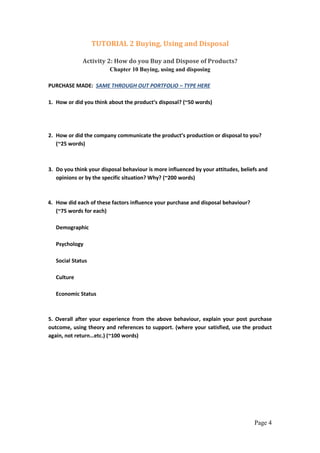
TUTORIAL 2 Buying, Using and Disposal
Activity 2: How do you Buy and Dispose of Products?
Chapter 10 Buying, using and disposing
PURCHASE MADE: SAME THROUGH OUT PORTFOLIO – TYPE HERE
1. How or did you think about the product’s disposal? (~50 words)
2. How or did the company communicate the product’s production or disposal to you?
(~25 words)
3. Do you think your disposal behaviour is more influenced by your attitudes, beliefs and
opinions or by the specific situation? Why? (~200 words)
4. How did each of these factors influence your purchase and disposal behaviour?
(~75 words for each)
Demographic
Psychology
Social Status
Culture
Economic Status
5. Overall after your experience from the above behaviour, explain your post purchase
outcome, using theory and references to support. (where your satisfied, use the product
again, not return…etc.) (~100 words)
Page 5
TUTORIAL 3 Motivation
Activity 3: What motivates you?
Chapter 6 Motivations and Values
Learning Objectives
Upon successful completion of this tutorial, students should be able to:
- explain their own consumer behavior by using two motivation theories
- link motivation theories with values theories to solve a real-world problem
PURCHASE MADE: SAME THROUGH OUT PORTFOLIO – TYPE HERE
1. Did any of these needs influence your behaviour? Complete the table below.
Yes or No McLelland’s Motives If yes, why?
Need for Achievement:
To attain personal accomplishment;
conspicuous consumption of status
products – “I’ve made it”
Need for Affiliation:
To be in the company of others;
products that are consumed with others
i.e. team sports, shopping centres
Need for Power:
To control one’s environment; products
that give a feeling of mastery i.e. Hotted-
up cars
Need for Uniqueness:
To assert one’s individual identity;
products that allow consumers to
emphasise distinctive qualities.
Page 6
2. Use your purchase and outline how it connects to the hierarchy. For each stage in
the hierarchy outline how it affected your purchase decision (~300 words) (APPLY
THEORIES AND REFERCENCES)
Self-actualisation
Ego-Needs
Belonging (Social)
Safety
Physiological
3. Which model, between the McLelland and Maslow’s hierarchy of needs models,
better describes you and your purchase? Why? (~100 words)
4. What variable or attribute was the most important factor in relating to your
selected purchase? (~200 words) (USE THEORIES AND REFERCENCE HERE)
Self-actualisation
Ego-needs
Belongingness
Safety
Physiological
Page 7
TUTORIAL 4 Attitudes
Activity 4: How attitudes are created and changed
Chapter 8 Attitude and Attitude Change (~700 words)
Learning Objectives
Upon successful completion of this tutorial, students should be able to:
- identify the components of attitude and classify their own behaviour
- employ the Theory of Planned Behaviour to demonstrate how attitudes can be changed
PURCHASE MADE: SAME THROUGH OUT PORTFOLIO – TYPE HERE
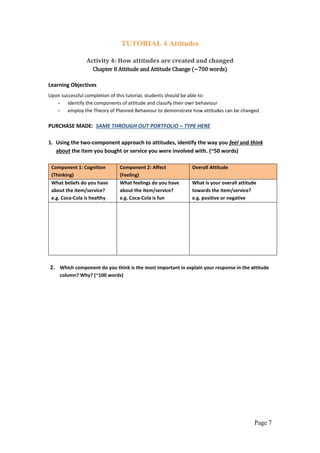
1. Using the two-component approach to attitudes, identify the way you feel and think
about the item you bought or service you were involved with. (~50 words)
Component 1: Cognition
(Thinking)
Component 2: Affect
(Feeling)
Overall Attitude
What beliefs do you have
about the item/service?
e.g. Coca-Cola is healthy
What feelings do you have
about the item/service?
e.g. Coca-Cola is fun
What is your overall attitude
towards the item/service?
e.g. positive or negative
2. Which component do you think is the most important in explain your response in the attitude
column? Why? (~100 words)
Page 8
3. Draw out your selected hierarchy of effects to show the thoughts (cognitions),
feelings (affect) and actions (behaviour) for your chosen behaviour. Explain each
behaviour and any disconnect which might occur. (~250 words)
4. Using the theory of planned behaviour please explain your consumer behaviour.
(~300 words)
 What intensions need to be created to lead to this behaviour?
 What do your family and friends think about this consumption behaviour?
 Were there any barriers to your ability to control your behaviour?
 What was your attitude towards the behaviour?
Social Norms
Attitudes
Intentions
Attitudes
Behaviour
Page 9
Tutorial 5 – Perception and learning
Activity 5 – The role of perception, learning and memory in consumer behaviour.
Chapter 3 Perception & Chapter 4 Learning and Memory
Learning Objectives
Upon successful completion of this tutorial, students should be able to:
- identify the elements of the perceptual process and classify their own behaviour
- recognise which perceptual distortions apply to them
- compare and contrast interpretations of the consumer behaviour of peers
- describe the different ways consumers learn
PURCHASE MADE: SAME THROUGH OUT PORTFOLIO – TYPE HERE
Part A – Knowledge
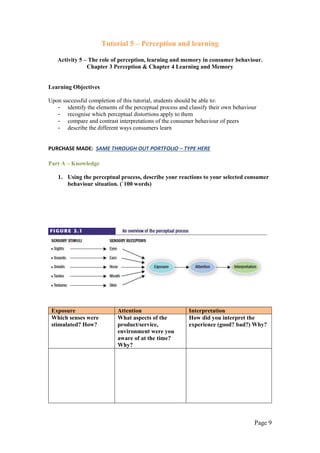
1. Using the perceptual process, describe your reactions to your selected consumer
behaviour situation. (`100 words)
Exposure Attention Interpretation
Which senses were
stimulated? How?
What aspects of the
product/service,
environment were you
aware of at the time?
Why?
How did you interpret the
experience (good? bad?) Why?
Page 10
2. Did any of these distortions in perceptual interpretation occur to you?
(~200 words)
Yes or
No
Perceptual distortions How did these occur?
 Physical Appearances - making
judgments on people’s or
objects’ appearance or other
attributes
 Stereotypes - mental shorthand,
mental “pictures of meaning”,
of product or brand – or people,
i.e. who might use the product?
 Irrelevant Cues - distractions
from main stimulus
 First Impressions - usually
lasting – based on random
attention
 Jumping to Conclusions -
tuning out because message is
not relevant to self – (could be
perceptual defence or lack of
experience)
 Halo Effect - making a
judgment based on one or two
(positive/negative) criterion
(i.e. brand name) and not
considering other criteria –
(selective perceptions)
Page 11
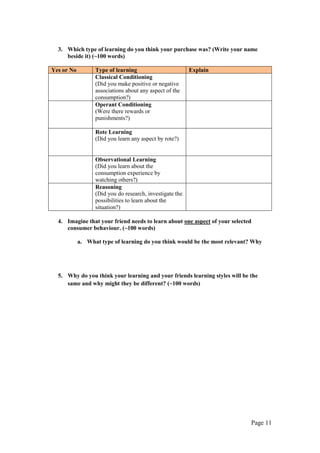
3. Which type of learning do you think your purchase was? (Write your name
beside it) (~100 words)
Yes or No Type of learning Explain
Classical Conditioning
(Did you make positive or negative
associations about any aspect of the
consumption?)
Operant Conditioning
(Were there rewards or
punishments?)
Rote Learning
(Did you learn any aspect by rote?)
Observational Learning
(Did you learn about the
consumption experience by
watching others?)
Reasoning
(Did you do research, investigate the
possibilities to learn about the
situation?)
4. Imagine that your friend needs to learn about one aspect of your selected
consumer behaviour. (~100 words)
a. What type of learning do you think would be the most relevant? Why
5. Why do you think your learning and your friends learning styles will be the
same and why might they be different? (~100 words)
Page 12
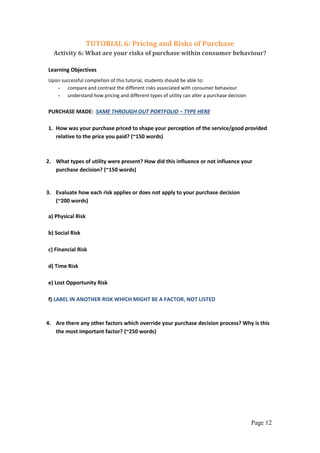
TUTORIAL 6: Pricing and Risks of Purchase
Activity 6: What are your risks of purchase within consumer behaviour?
Learning Objectives
Upon successful completion of this tutorial, students should be able to:
- compare and contrast the different risks associated with consumer behaviour
- understand how pricing and different types of utility can alter a purchase decision
PURCHASE MADE: SAME THROUGH OUT PORTFOLIO – TYPE HERE
1. How was your purchase priced to shape your perception of the service/good provided
relative to the price you paid? (~150 words)
2. What types of utility were present? How did this influence or not influence your
purchase decision? (~150 words)
3. Evaluate how each risk applies or does not apply to your purchase decision
(~200 words)
a) Physical Risk
b) Social Risk
c) Financial Risk
d) Time Risk
e) Lost Opportunity Risk
f) LABEL IN ANOTHER RISK WHICH MIGHT BE A FACTOR, NOT LISTED
4. Are there any other factors which override your purchase decision process? Why is this
the most important factor? (~250 words)
Page 13
Conclusion statement (~100 words)
What self reflection do you feel from this portfolio, what idea and
understand do you hope a reader takes away?
Page 14
References

Consumer Behavior Portfolio for Marketing

  • 1.
    Consumer Behaviour Portfolio AMB200Summer with Professor Ryan Payne Your Name Tutorial Hours /Section Tutorial Leader Date
  • 2.
    Page 1 Introduction Statement (Outlineyour purchase and needed details to understand its context) It can be said that consumer behaviour is one of the most important parts in marketing as it allows for marketers to understand the key aspects of consumer decision-making process and utilise them when marketing a product or service. For the purpose of the assignment, the particular consumer behivour that I have selected as “buying a fashion item”. The fashion items purchased can be categorised as work attire and was considered a ‘need’ when purchasing in-store. There are three worksheet in the portfolio which were highlighted different aspects of the consumer purchase process assumptions: decision-making and dissatisfaction and complaint behaviour.
  • 3.
    Page 2 TUTORIAL 1Decision-Making Activity 1 (Mandatory): What types of decisions do you make? Chapter 9 Individual Decision Making 1. Choose a consumer behaviour that you have done in the last month from the following list: I selected: Buying a fashion item on 19th November 2020 2. How did you come to recognize you needed or wanted to purchase this good/service? Was your decision rational or automated? (Support with Referencing) The reason that I would like to buy a new fashion item is my old clothes were too big for me so it made me becoming presentable when I wore them. In addition, the dress that I would like to buy is so adorable and I really love it. Moreover, there was a big sale at the dress shop which I am as a loyalty customer. This is a basic outlets which usually has a big sale at the end of the year as Black Friday holiday and this was probably the best time to get what I need. When purchasing the fashion items, it is convenience to used a rational model of decision making. Rational decision making basically occurs when an individual takes into account many factors before coming to the decision. According to Uzonwanne (2016), to make decision to purchase, consumer often uses facts, analytics, and a step-by-step decision-making process. The things I took into account before the I made the purchase of the item were the size which fits me, the colour which suits me, and the reasonable price of the item. Among those factors, the price of the item matters most to me, because as an international student who does not have an income and still depend on my parents, I do not want to trouble them in spending too much on clothing. 3. Now Bold (and remove what you did not select) the way you did an information search, alternative evaluation and purchase. Limited problem solving Extended problem solving Information search Low risk and involvement Little search Information processed passively In-store decision likely High risk and involvement Extensive search Information processed actively Multiple sources consulted prior to store visits Alternative evaluation Weakly held beliefs Only most prominent criteria used Alternatives perceived as basically similar Many criteria used Significant differences perceived between alternatives Compensatory strategy used
  • 4.
    Page 3 Non-compensatory strategy used PurchaseChoice often influenced by store displays Many outlets shopped if needed 4. How did the company influence you at two stages of the entire Purchase decision? The company (Zara) had influenced me at the problem recognition and the information search. I personally needed to get some new clothes because my old ones were too big for me, and around that period of time, some of my friends went to one of Zara outlet and hoarded some new clothes because there was big sale in Black Friday. So, now my need for buying new clothes has switched to become a want. I could easily get any clothing from any other brand, but due to the big sale, I really wanted to get my clothes from that particular brand. At that the stage of information search, I took my time around the store going through the fashion items which I wanted to buy. The main thing I compared among each were the price of the item. I took some time in comparing the prices of each item, to see how much value I would get out of it compared to buying it from the normal outet near my city. I would only choose the item which gives me the highest value with reasonalble price. 5: What does another company do which could be applied in one phase of the decision matrix? How does this company demonstrate theory applied in class? What the other fashion store does in my neighbour would be that they are selling the fashion items at a lower cost for a reasonable quality and being within the trend demanded by the customers at that point of time. And this can be used in the decision matrix phase where the criteria setting is done on a general basis for the product under consideration for purchase. This is done for narrowing down the available choices and making a fine and non- detrimental choice which you would not have to worry about later. Here the major theories of consumer behavior that would be leading me as a consumer would be the attitude, perception and motivation that I hold in buying the products from a somewhat high priced brand like Zara and a normal entity in my city. With the attitude and perception on their pricing and keeping on comparing both would be leading me throughout the decision matrix also while ranking the choices on the basis of the criterion given.
  • 5.
    Page 4 TUTORIAL 2Buying, Using and Disposal Activity 2: How do you Buy and Dispose of Products? Chapter 10 Buying, using and disposing PURCHASE MADE: SAME THROUGH OUT PORTFOLIO – TYPE HERE 1. How or did you think about the product’s disposal? (~50 words) 2. How or did the company communicate the product’s production or disposal to you? (~25 words) 3. Do you think your disposal behaviour is more influenced by your attitudes, beliefs and opinions or by the specific situation? Why? (~200 words) 4. How did each of these factors influence your purchase and disposal behaviour? (~75 words for each) Demographic Psychology Social Status Culture Economic Status 5. Overall after your experience from the above behaviour, explain your post purchase outcome, using theory and references to support. (where your satisfied, use the product again, not return…etc.) (~100 words)
  • 6.
    Page 5 TUTORIAL 3Motivation Activity 3: What motivates you? Chapter 6 Motivations and Values Learning Objectives Upon successful completion of this tutorial, students should be able to: - explain their own consumer behavior by using two motivation theories - link motivation theories with values theories to solve a real-world problem PURCHASE MADE: SAME THROUGH OUT PORTFOLIO – TYPE HERE 1. Did any of these needs influence your behaviour? Complete the table below. Yes or No McLelland’s Motives If yes, why? Need for Achievement: To attain personal accomplishment; conspicuous consumption of status products – “I’ve made it” Need for Affiliation: To be in the company of others; products that are consumed with others i.e. team sports, shopping centres Need for Power: To control one’s environment; products that give a feeling of mastery i.e. Hotted- up cars Need for Uniqueness: To assert one’s individual identity; products that allow consumers to emphasise distinctive qualities.
  • 7.
    Page 6 2. Useyour purchase and outline how it connects to the hierarchy. For each stage in the hierarchy outline how it affected your purchase decision (~300 words) (APPLY THEORIES AND REFERCENCES) Self-actualisation Ego-Needs Belonging (Social) Safety Physiological 3. Which model, between the McLelland and Maslow’s hierarchy of needs models, better describes you and your purchase? Why? (~100 words) 4. What variable or attribute was the most important factor in relating to your selected purchase? (~200 words) (USE THEORIES AND REFERCENCE HERE) Self-actualisation Ego-needs Belongingness Safety Physiological
  • 8.
    Page 7 TUTORIAL 4Attitudes Activity 4: How attitudes are created and changed Chapter 8 Attitude and Attitude Change (~700 words) Learning Objectives Upon successful completion of this tutorial, students should be able to: - identify the components of attitude and classify their own behaviour - employ the Theory of Planned Behaviour to demonstrate how attitudes can be changed PURCHASE MADE: SAME THROUGH OUT PORTFOLIO – TYPE HERE 1. Using the two-component approach to attitudes, identify the way you feel and think about the item you bought or service you were involved with. (~50 words) Component 1: Cognition (Thinking) Component 2: Affect (Feeling) Overall Attitude What beliefs do you have about the item/service? e.g. Coca-Cola is healthy What feelings do you have about the item/service? e.g. Coca-Cola is fun What is your overall attitude towards the item/service? e.g. positive or negative 2. Which component do you think is the most important in explain your response in the attitude column? Why? (~100 words)
  • 9.
    Page 8 3. Drawout your selected hierarchy of effects to show the thoughts (cognitions), feelings (affect) and actions (behaviour) for your chosen behaviour. Explain each behaviour and any disconnect which might occur. (~250 words) 4. Using the theory of planned behaviour please explain your consumer behaviour. (~300 words)  What intensions need to be created to lead to this behaviour?  What do your family and friends think about this consumption behaviour?  Were there any barriers to your ability to control your behaviour?  What was your attitude towards the behaviour? Social Norms Attitudes Intentions Attitudes Behaviour
  • 10.
    Page 9 Tutorial 5– Perception and learning Activity 5 – The role of perception, learning and memory in consumer behaviour. Chapter 3 Perception & Chapter 4 Learning and Memory Learning Objectives Upon successful completion of this tutorial, students should be able to: - identify the elements of the perceptual process and classify their own behaviour - recognise which perceptual distortions apply to them - compare and contrast interpretations of the consumer behaviour of peers - describe the different ways consumers learn PURCHASE MADE: SAME THROUGH OUT PORTFOLIO – TYPE HERE Part A – Knowledge 1. Using the perceptual process, describe your reactions to your selected consumer behaviour situation. (`100 words) Exposure Attention Interpretation Which senses were stimulated? How? What aspects of the product/service, environment were you aware of at the time? Why? How did you interpret the experience (good? bad?) Why?
  • 11.
    Page 10 2. Didany of these distortions in perceptual interpretation occur to you? (~200 words) Yes or No Perceptual distortions How did these occur?  Physical Appearances - making judgments on people’s or objects’ appearance or other attributes  Stereotypes - mental shorthand, mental “pictures of meaning”, of product or brand – or people, i.e. who might use the product?  Irrelevant Cues - distractions from main stimulus  First Impressions - usually lasting – based on random attention  Jumping to Conclusions - tuning out because message is not relevant to self – (could be perceptual defence or lack of experience)  Halo Effect - making a judgment based on one or two (positive/negative) criterion (i.e. brand name) and not considering other criteria – (selective perceptions)
  • 12.
    Page 11 3. Whichtype of learning do you think your purchase was? (Write your name beside it) (~100 words) Yes or No Type of learning Explain Classical Conditioning (Did you make positive or negative associations about any aspect of the consumption?) Operant Conditioning (Were there rewards or punishments?) Rote Learning (Did you learn any aspect by rote?) Observational Learning (Did you learn about the consumption experience by watching others?) Reasoning (Did you do research, investigate the possibilities to learn about the situation?) 4. Imagine that your friend needs to learn about one aspect of your selected consumer behaviour. (~100 words) a. What type of learning do you think would be the most relevant? Why 5. Why do you think your learning and your friends learning styles will be the same and why might they be different? (~100 words)
  • 13.
    Page 12 TUTORIAL 6:Pricing and Risks of Purchase Activity 6: What are your risks of purchase within consumer behaviour? Learning Objectives Upon successful completion of this tutorial, students should be able to: - compare and contrast the different risks associated with consumer behaviour - understand how pricing and different types of utility can alter a purchase decision PURCHASE MADE: SAME THROUGH OUT PORTFOLIO – TYPE HERE 1. How was your purchase priced to shape your perception of the service/good provided relative to the price you paid? (~150 words) 2. What types of utility were present? How did this influence or not influence your purchase decision? (~150 words) 3. Evaluate how each risk applies or does not apply to your purchase decision (~200 words) a) Physical Risk b) Social Risk c) Financial Risk d) Time Risk e) Lost Opportunity Risk f) LABEL IN ANOTHER RISK WHICH MIGHT BE A FACTOR, NOT LISTED 4. Are there any other factors which override your purchase decision process? Why is this the most important factor? (~250 words)
  • 14.
    Page 13 Conclusion statement(~100 words) What self reflection do you feel from this portfolio, what idea and understand do you hope a reader takes away?
  • 15.